DESIGN CONSIDERATIONS FOR COMPLEX
SURVIVAL MODELS
Liddy Miaoli Chen
A dissertation submitted to the faculty of the University of North Carolina at Chapel Hill in partial fulfillment of the requirements for the degree of Doctor of Philosophy in the Department of Biostatistics, Gillings School of Global Public Health.
Chapel Hill 2010
Approved by:
c
2010
ABSTRACT
LIDDY MIAOLI CHEN: DESIGN CONSIDERATIONS FOR COMPLEX SURVIVAL MODELS.
(Under the direction of Dr. Joseph G. Ibrahim and Dr. Haitao Chu.)
Various complex survival models, such as joint models of survival and longitudinal
data and multivariate frailty models, have gained popularity in recent years because
these models can maximize the utilization of information collected. It has been shown
that these methods can reduce bias and/or improve efficiency, and thus can increase
the power for statistical inference. Statistical design, such as sample size and power
calculations, is a crucial first step in clinical trials.
We derived a closed form sample size formula for estimating the effect of the
longitu-dinal process in joint modeling, and extend Schoenfeld’s (1983) sample size formula to
the joint modeling setting for estimating the overall treatment effect. The sample size
formula we developed is general, allowing for p-degree polynomial trajectories. The
ro-bustness of our model was demonstrated in simulation studies with linear and quadratic
trajectories. We discussed the impact of the within subject variability on power, and
data collection strategies, such as spacing and frequency of repeated measurements, in
order to maximize power. When the within subject variability is large, different data
collection strategies can influence the power of the study in a significant way.
We also developed a sample size determination method for the shared frailty model
to investigate the treatment effect on multivariate time to events, including recurrent
events. We first assumed a common treatment effect on multiple event times, and the
sample size determination was based on testing the common treatment effect. We then
time-to-events as nuisance, and compared the power from a multivariate frailty model
versus that from a univariate parametric and semi-parametric survival model. The
multivariate frailty model has significant advantage over the univariate survival model
when the time-to-event data is highly correlated.
Group sequential methods had been developed to control the overall type I error rate
in interim analysis of accumulating data in a clinical trial. These methods mainly apply
to testing the same hypothesis at different interim analyses. Finally, we extended the
methodology of the alpha spending function to group sequential stopping boundaries
when the hypotheses can be different between analyses. We found that these stopping
boundaries depend on the Fisher’s Information matrix, and application to a bivariate
ACKNOWLEDGMENTS
I would like to thank my advisor, Dr. Joseph Ibrahim, and my co-advisor, Dr. Haitao
Chu, for their encouragement, mentorship, and research ideas during the preparation
and completion of this dissertation. Special thanks goes to Dr. Ibrahim who kept
pushing me when I was slow and felt I had nowhere to go. During my long journey
of graduate studies at UNC Chapel Hill, I had received numerous help from different
faculty members, and I would specifically like to thank Dr. Joseph Ibrahim again
and Dr. Donglin Zeng for their help during the summer of 2007 when I prepared my
qualifying exam. I could not have come to this point without making that important
step. I would also like to thank my other committee members (Dr. William Irvin Jr.,
Dr. Donglin Zeng, and Dr. Hongtu Zhu) for their time to review my papers and their
comments.
My deepest appreciation goes to my family, especially my mother, who had given me
endless support and encouragement. Most importantly, I need to thank my daughter,
Vanessa Lin, for the sacrifice she made. There are countless times that mom could not
play with her because mom had to “work”. It is to her that I would like to dedicate
TABLE OF CONTENTS
LIST OF TABLES ix
1 Introduction and Literature Review 1
1.1 Introduction . . . 1
1.2 Joint Models in the Literature . . . 3
1.2.1 Two-Step Models . . . 3
1.2.2 The Likelihood Approach . . . 5
1.3 Multivariate Frailty Models in the Literature . . . 6
1.4 Group Sequential Methods and Alpha Spending Functions in the Literature 7 1.4.1 Group Sequential Boundaries . . . 8
1.4.2 The Alpha Spending Function . . . 9
2 Sample Size and Power Determination in Joint Modeling of Longitu-dinal and Survival Data 11 2.1 Introduction . . . 11
2.2 Preliminaries . . . 14
2.3 Sample Size Determination for Studying the Relationship between Event Time and the Longitudinal Process . . . 15
2.3.1 Known Σθ . . . 15
2.3.2 UnknownΣθ . . . 17
2.3.3 Truncated Moments ofT . . . 18
2.4 Estimating Σθˆ
i and Maximization of Power . . . 21
2.5 Sample Size Determination for the Treatment Effect . . . 28
2.6 Biased Estimates of the Treatment Effect When Ignoring the Longitudi-nal Trajectory . . . 29
2.7 The Full Joint Modeling Approach Versus the Two-Step Inferential Ap-proach . . . 30
2.8 Discussion . . . 33
2.9 Appendix A: Derivation of Sample Size Formula for Testing the Trajec-tory Effect . . . 35
2.10 Appendix B: Retrospective Power Analysis for the ECOG Trial E1193 . 39 3 Sample Size Determination in Shared Frailty Models for Multivariate Time-to-Event Data 42 3.1 Introduction . . . 42
3.2 Sample Size Determination for Testing a Common Treatment Effect . . 45
3.2.1 The Shared Frailty Model . . . 45
3.2.2 Sample Size Determination for Testing a Common Treatment Effect 46 3.2.3 Simulation Studies . . . 48
3.2.4 Recurrent Events . . . 49
3.3 Testing the Treatment Effect on One Time-to-Event While Treating the Other Event Times as Nuisance . . . 51
3.3.1 Simulation Studies . . . 51
3.3.2 Sample Size Determination for Testing β1 . . . 53
3.3.3 A Real Data Example . . . 56
3.4 Discussion . . . 58
3.5 Appendix A: Derivation of Sample Size Formula for Testing a Common Treatment Effect on Multivariate Time-to-event . . . 60
4 Flexible Stopping Boundaries When Testing Different Parameters at
4.1 Introduction . . . 64
4.2 Stopping Boundaries for Testing Different Parameters at the Interim and Final Analysis . . . 67
4.3 Application to a Bivariate Survival Model . . . 73
4.4 Application to Joint Modeling of Longitudinal and Time-to-Event Data 75
4.4.1 Motivation for Testing Different Parameters at Different Interim Analysis in Joint Models . . . 75
4.4.2 Stopping Boundaries in a Hypothetical Design . . . 77
4.5 Discussion . . . 79
LIST OF TABLES
2.1 Validation of formula (2.4) for testing the trajectory effectβ when Σθ is
known . . . 20
2.2 Power for estimating β by maximum number of data collection points (mx) and size of σ2e - linear trajectory . . . 25
2.3 Power for estimating β by maximum number of data collection points (mx) and size of σ2e - quadratic trajectory . . . 26
2.4 Validation of formula (2.12) for testing the overall treatment effectα+βγ 30 2.5 Effect of β on the estimation of direct treatment effect on survival (α)
based on different models . . . 31
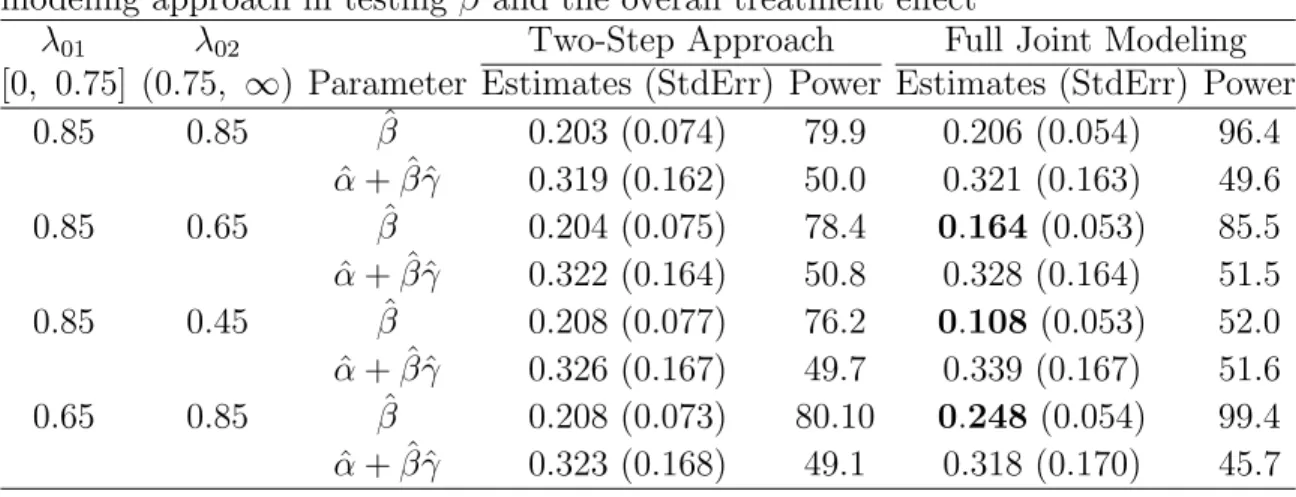
2.6 Comparison of the two-step inferential approach with the full joint mod-eling approach in testingβ and the overall treatment effect . . . 32 2.7 Parameter Estimates with Standard Errors for the E1193 Data . . . 40
3.1 Comparison of Empirical Power and Calculated Power for Testing a Common Treatment Effect with Different Model Parameters . . . 49
3.2 Estimating and Testing β1 in Multivariate Time-to-Events with K = 3 and eβ0 = 0.05 Using Different Models . . . . 53 3.3 Estimating and Testingβ1 Using Different Models by Different Baseline
Event Rates . . . 54
3.4 Estimating and Testingβ1: Empirical and Calculated Power by Different Correlation Between Event Times (K = 3, γ = 2, eβ0 = 0.05, and
eβ1 = 0.8) . . . . 56 4.1 One-sided Boundaries for Different Values of w with α = 0.025 and
K = 5 (The test parameter is assumed to be θ1 for j = 1,2, θ2 for j = 3,4,5, where j = 1, . . . ,5,t∗j =j/5.) . . . 70 4.2 One-sided Boundaries for the 5th Analysis zc(5) When α = 0.025 and
K = 5 (The test parameter is assumed to be θ1 for j = 1−4, θ2 for j = 5, where j = 1, . . . ,5,t∗j =j/5.) . . . 71 4.3 One-sided Boundaries for Different Values of w with α = 0.025, K = 2
CHAPTER 1
Introduction and Literature Review
1.1
Introduction
Various complex survival models, such as joint models of survival and longitudinal data
and multivariate frailty models, have gained popularity in recent years because these
models can maximize the utilization of information collected. Classical models such as
the Cox proportional hazard model to handle time-to-event data and the mix model
to handle repeated measurements evaluate the treatment effect on these two types of
responses separately. There are two complications in describing or making inference
on the longitudinal process in these studies: 1) Occurrence of the time-to-event may
induce an informative censoring (Wu and Carroll 1988, Hogan and Laird 1997ab), as
subjects who have early events would be censored at an earlier time point. 2) The
longitudinal data is only available intermittently for each subject, and likely subjects
to measurement errors. These concerns led to the development of joint models of the
two data types. Joint models are also developed because there is a need to take into
account the dependency of these two data types when investigating the treatment effect
on survival.
The need to study or analyze multiple correlated time-to-event data arises in many
increasingly popular for analyzing multivariate time-to-event data (Oakes 1989,
Peter-son 1998, Duchateau et al. 2003, Cook and Lawless 2007, Zeng et al. 2009) because it
provides a convenient way to introduce association and unobserved heterogeneity into
models for the multivariate survival data. A frailty, a concept introduced by Vaupel et
al. (1979), is an unobservable random effect. A natural way to model dependence of
clustered or multivariate event times is through the introduction of a cluster-specific
random effect. This random effect explains the dependence in the sense that had we
known the frailty, the events would be independent.
Design is a crucial first step in clinical trials. Well-designed studies are essential
for successful research and drug development. Although much effort has been put into
inferential and estimation methods in these complex survival models, design researches
are lacking. Sample size determination for these models have not been formally
consid-ered. There has been little guidance in the methodologic literature as to how researchers
should select the number of repeated measures for the longitudinal data. Hence
devel-oping statistical methods to address design issues in joint modeling and multivariate
frailty model are much needed.
Interim analyses are also commonly used in clinical trials due to difficulty in
enroll-ment, and/or long follow-up time until enough events have occurred. Although much
flexibility has been achieved with the alpha spending function in group sequential
de-signs, the unique feature of joint model also brings up another group sequential design
model. In Chapter 2, a sample size formula to study the association between the
time-to-event and the longitudinal data is provided, followed by detailed discussion of the
methodology when the variance-covariance matrix is known or unknown. Longitudinal
data collection strategies, such as spacing and frequency of repeated measurements, to
maximize the power are also discussed. Chapter 3 provides a sample size determination
formula to study a common treatment effect for the multivariate time-to-event data,
while taking into account the dependency of clustered event times. Group sequential
design when different parameters are involved is discussed is discussed in Chapter 4,
followed by application in multivariate survival models and joint models.
1.2
Joint Models in the Literature
1.2.1
Two-Step Models
The earliest literature on joint modeling focuses on a two-step inferential strategy which
defines sub-models for the longitudinal and event time processes (Self and Pawitan 1992,
Tsiatis and Wulfsohn 1995). In “ideal” data situation, the longitudinal process follows
a well-defined trajectory, {Xi(u), u ≥ 0)}, for all times u ≥ 0 for each subject i =
1, . . . , n. A routine framework to study the association between the time-to-event and the treatment effect, or the association between the time-to-event and the longitudinal
data, is to represent the relationship between the event time (Ti), the trajectory (Xi(u)),
and the baseline covariates (Zi) by a proportional hazard model (Cox 1975)
λi(u) = lim du→0du
−1pru≤t
i < u+du|ti ≥u, XiH(u),Zi
= λ0(u)expβXi(u) +αTZi
, (1.1)
whereXH
i (u) ={Xi(t),0≤t < u}is the history of the longitudinal process up to time
u. Inference on β and α can be made by maximizing the partial likelihood.
n
i=1
exp{βXi(Si) +αTZi}
n
k=1exp{βXk(Si) +αTZk}I(Sk≥Si)
Δi
, (1.2)
where Si = min(Ti, Ci) (Ti and Ci denote the event and censoring times, respectively) and Δi = I(Ti ≤ Ci). However, Xi(u) is unknown, and the response is collected on
value of
fX(u), β, α = exp{βX(u) +αTZ}
is given by
Eexp{βX(u) +αTZ|Y¯(u), u < S}, (1.3) where ¯Y(u) is the history of observed longitudinal data up to time u. Theoretical justification for this two-stage model is that the value of (1.3) can be approximated by
a first-order approximation:
Eexp{βX(u) +αTZ|Y¯(u), u < S}
≈ exp{βEX(u)|Y¯(u), u < S+αTZ}.
Therefore, we can replace the unknown value, Xi(Si) in (1.2) withE
Xi(Si)|Y¯i(Si)
.
Let Yi(tij) = Xi(tij) +ei(tij) denote the observed value of Xi(tij), where ei(tij) is an
intra-subject error and is normally distributed with mean 0. Tsiatis and Wulfsohn
(1995) proposed a simple linear model
Xi(u) = θ0i+θ1iu (1.4)
to represent the log CD4 trajectories. A more general polynomial model Xi(u) =θ0i+
θ1iu+θ2iu2+· · ·+θpiup had been considered in later studies (Chen et al. 2004, Ibrahim
et al. 2004). In this model, it is assumed that each subject followed his or her own
trajectory with intercept θ0i and slope θ1i. (θ0i, θ1i)T are i.i.d bivariate normal vectors
with mean (μ0, μ1)T and variance-covariance Σ
θ. Consequently, E
Xi(Si)|Y¯i(Si)
can
be represented by ˆθ0i and ˆθ1i, the Bayes estimates of θ0i and θ1i. One way to obtain
and Ware (1982).
1.2.2
The Likelihood Approach
Several drawbacks to the two-step modeling were discussed by Wulfsohn and Tsiatis
(1997), and Tsiatis and Davidian (2004). The most important drawback is that the
random effects in those at risk at each event time is probably not normally distributed,
a critical assumption for the mixed model. If the longitudinal data is predictive of
survival, patients with the steepest slope will be removed from the at risk population
at an earlier time point. Thus it is less likely that the normality assumption still holds as
time progresses. Other drawbacks include the validity of the first order approximation
and less efficient use of information.
Wulfshon and Tsiatis (1997) proposed a full data likelihood incorporating a linear
model for the longitudinal data and the Cox model for the time-to-event data as
∞
−∞ mj
j=1
f(Yij|θi, σ2e)
f(θi|μθ,Σθ)f(Si,Δi|θi, β)dθi. (1.5)
In expression (1.5), f(Yij|θi, σ2e) is a univariate normal density function with mean
θ0i+θ1itij and variance σe2, and f(θi|μθ,Σθ) is the multivariate normal density with
meanμθ and covariance matrix Σθ. The density function for the time-to-event is based
on Cox partial likelihood, where
f(Si,Δi|θi, β, α) = {λ0(Si) exp[β(θ0i+θ1iSi)]}Δi
× exp
−
Si
0
λ0(t) exp[β(θ0i+θ1it]dt
.
The parametersθ,Σθ,σe2, andβ were estimated using parametric maximum likelihood,
similar to those from the two-step model (the same data was used), with ˆβfurther from the null as compared to that from the two-step model.
Alternative forms to model the “true” longitudinal process has been considered
(Song et al. 2002b, Taylor et al. 1994, Lavalley & DeGruttola 1996, Wang & Taylor
2001, Henderson et al. 2000, and Xu & Zeger 2001)
1.3
Multivariate Frailty Models in the Literature
The shared frailty model, first introduced by Clayton (1978), assumes that individuals
in a cluster or repeated measurements of an individual share the same frailty,ω, and the survival times are assumed to be conditional independent with respect to the shared
(common) frailty. Conditional on the frailty, the hazard function of an event in an
individual, or an individual in a cluster is of the form ωλ0(t)exp(βTX), where ω is common to all events in an individual. The survival function is given as
S(t1, . . . , tK|ω) =S1(t1)ωS2(t2)ω. . . SK(tK)ω.
Independence of the survival times within an individual corresponds to a degenerate
frailty distribution with variance equals 0. One major consideration in the frailty
mod-els is the choice of the frailty distribution. Clayton (1978) and Oakes (1982) first
considered frailty models with gamma distribution for the frailty. In a gamma frailty
model, the frailty can be easily integrated out and thus the data likelihood has a closed
form. This is also the model considered in this paper. Hougaard discussed
multivari-ate failure models, where the frailty follows a positive stable distribution (Hougaard
1986a) or a power variance family (PVF) distribution (Hougaard 1986b). Whitmore
and Lee (1991) proposed a model with inverse Gaussian frailty and constant hazard.
Lognormal frailty model (McGilchrist and Aisbett 1991, Korsgaard et al. 1998) has
gained popularity recently especially in Bayesian models. The selection of the family
of frailty distributions, based on the properties of the various models was discussed by
Hougaard (1995).
Besides the shared frailty model, other frailty models have been considered to handle
more complex multivariate time-to-event data. The correlated frailty model (Pickles
et al. 1994, Yashin & Iachine 1995, Wienke et al. 2001) is not constrained to have a
common frailty. The frailty for each event time is associated by a joint distribution
instead. Price and Manatunga (2001) considered the use of cure frailty models to
analyze a leukaemia recurrence with a cured fraction. The nested frailty model that
accounts for the hierarchical clustering of the data by including two nested random
effects is considered by Rondeau et al. (2006). Most recently, joint frailty models for
modeling recurring events and death has been proposed (Rondeau et al. 2007).
1.4
Group Sequential Methods and Alpha
Spend-ing Functions in the Literature
It is fundamental to have a trial that is properly designed to answer the scientific
question, such as whether the drug improves overall survival, and every trial design
is striving to answer the question with most robustness and accuracy while involving
the least number of patients and the shortest duration of time. Theories for group
sequential clinical trials has developed largely during the past few decades so that
a trial can be stopped early if there is strong evidence of efficacy during any planned
interim analysis. A high degree of flexibility has been established with respect to timing
of the analyses and how much type I error (alpha) to spend at each analyses. Popular
methods include the Pocock group sequential boundaries (Pocock 1977), the
first introduced by Lan and DeMets (1983).
1.4.1
Group Sequential Boundaries
LetZ(k) denote the test statistic using the cumulative data up to analysisk, andZ∗(k) denote the test statistic using data accumulated between the (k−1)th analysis thekth analysis, then
Z(k) ={Z∗(1) +· · ·+Z∗(k)}/√k.
The distribution of Z(k)√k can be written as a recursive density function evalu-able by numerical integration (Armitage et al. 1969). The probability of crossing the
boundary for the very first time at each interim analysis can be calculated based on
this density function. Under H0, the sum of these probabilities should equal to the nominal overall type I error rate for the group sequential design.
Pocock (1977) first proposed that the crossing boundary be constant for all equally
spaced analyses, with zc(k) = zc for all k = 1,2. . . , K. O’Brien and Fleming (1979)
suggested thatzc(k) be changed over theK analyses such that zc(k) =zOBF
K/k. In both procedures, the number of interim analyses and the timing of the interim analyses
need to be pre-determined. The O’Brien-Fleming boundaries have been used more
frequently because it still preserves a nominal significance level at the final analysis
that is close to that of a single test procedure. An earlier work by Haybittle and
Peto (Haybittle 1971, Peto et al. 1976) in a less formal structure suggested to use
an arbitrarily large value for the crossing boundary for each interim analysis, and the
boundary for the final analysis should be determined such that the overall type I error
1.4.2
The Alpha Spending Function
The alpha spending function initially developed by Lan and DeMets (1983) over the
course of a group sequential clinical trial is a more flexible group sequential procedure
that does not require the total number nor the exact time of the interim analyses to be
specified in advance.
Specifically, let T denote the scheduled end of the trial, and t∗ denote the fraction of information that has been observed at calendar time t (t ∈ [0, T]. Also let ik, k =
1,2, . . . , K denote the information available at the kth interim analysis at calendar time tk, so t∗k =ik/I, where I is the total information. Lan and DeMets specified an alpha
spending function such that α(0) = 0 and α(1) = α. Boundary values zc(k) can be
determined successively so that
P0{|Z(1)| ≥zc(1), or|Z(2)| ≥zc(2), or . . . , or|Z(k)| ≥zc(k)}=α(t∗k) (1.6)
where {Z(1), . . . , Z(k)} are the test statistics from the interim analyses 1, . . . , k. Alpha spending functions that approximate O’Brien-Fleming or Pocock Boundaries
are as follows:
O’Brien-Fleming: α1(t∗) = 2−2Φ(Zα/2/
√
t∗) Pocock: α2(t∗) = αIn(1 + (e−1)t∗)
where Φ denotes the standard normal cumulative distribution function. The other
alpha spending function proposed in the paper is α3(t∗) = αt∗, representing uniform spending of alpha over time. α3(t∗) is intermediate between functionsα1(t∗) andα2(t∗). To solve for the boundary valueszc(k), we need to obtain the multivariate distribution
parameter at each interim analysis.
σlk = cov{Z(l), Z(k)}
=
t∗l/t∗k =
il/ik
= nl/nk, l≤k,
wherenl and nk are the number of subjects included in thelth and kth interim
analy-ses. If the information increments have independent distributional structure, which is
usually the case, derivation of zc(k) based on α(t∗) is relatively straightforward with
this covariance structure using the methods of Armitage et al. (1969).
Earlier development of the alpha spending function was based on assumption that
information accumulated between each interim analysis is independent. However, the
assumption does not apply to longitudinal studies for sequential test of slopes in which
the total information is unknown. Sequential analysis using the linear random-effects
model suggested by Laird and Ware (1982) has been considered by Lee and DeMets
(1991), and Wu and Lan (1992). The sequence of test statistics still has a
multivari-ate normal distribution but with a complex covariance. There have been debmultivari-ates on
whether the alpha spending function can still be used since the independent increment
structure doesn’t hold and the information fraction is unknown (Wei et al. 1990, Su
and Lachin 1992). It was argued by DeMets and Lan (1994) that the alpha spending
function can still be used with a more complex correlation between the successive test
statistics. The key to using the alpha spending function is being able to define the
information fraction. Although the correlation between successive test statistics will
CHAPTER 2
Sample Size and Power
Determination in Joint Modeling of
Longitudinal and Survival Data
2.1
Introduction
Censored time-to-event data, such as time to failure or time to death, is a common
primary endpoint in many clinical trials. Many studies also collect longitudinal data
with repeated measurements at a number of time points prior to the event, along with
other baseline covariates. The most original example is an HIV trial that compares
time to virologic failure or time to progression to AIDS (Tsiatis et al. 1995, Wulfsohn
& Tsiatis 1997). CD4 cell counts were considered a strong indicator of treatment effect
and are usually measured at each visit as secondary efficacy endpoints. Although CD4
cell counts are no longer considered a valid surrogate for time to progression to AIDS in
the current literature, the joint modeling strategies originally developed for these trials
led to research on joint modeling in other research areas. As discoveries of biomarkers
advance, there are more and more oncology studies that collect repeated measurements
as secondary efficacy measurements (Renard et al. 2003). Many studies also measure
quality of life (QOL) or depression measures together with survival data where joint
models can also be applied (Ibrahim et al. 2001, Billingham & Abrams 2002, Bowman
& Manatunga 2005, Zeng & Cai 2005, Chi & Ibrahim 2006, Chi & Ibrahim 2007).
Most clinical trials are designed to address the treatment effect on a time-to-event
endpoint. Recently, there has been an increasing interest in focusing on two primary
endpoints such as time-to-event and a longitudinal marker, and also to characterize the
relationship between them. For example, if treatment has an effect on the longitudinal
marker and the longitudinal marker has a strong association with the time-to-event,
the longitudinal marker can potentially be used as a surrogate endpoint or a marker
for the time-to-event, which is usually lengthy to ascertain in practice. The issue of
surrogacy of a disease marker for the survival endpoint by joint modeling was discussed
by Taylor and Wang (2002).
Characterizing the association between time-to-event and the longitudinal process
is usually complicated due to incomplete or mis-measured longitudinal data (Tsiatis et
al. 1995, Wulfsohn & Tsiatis 1997, Tsiatis & Davidian 2004). Another issue is that
occurrence of the time-to-event may induce informative censoring of the longitudinal
process (Hogan & Laird 1997b, Tsiatis & Davidian 2004). The recently developed
joint modeling approaches are frameworks which acknowledge the intrinsic relationships
between the event and the longitudinal process by incorporating a trajectory for the
longitudinal process into the hazard function of the event, or in a more general sense,
introducing shared random effects in both the longitudinal model and the survival
model (Wulfsohn & Tsiatis 1997, Henderson et al. 2000, Wang & Taylor 2001, Lin
et al. 2002, Song et al. 2002b, Zeng & Cai 2005). Bayesian approaches that address
joint modeling of longitudinal and survival data were introduced by Ibrahim et al.
(2001), Chen et al. (2004), Brown and Ibrahim (2003), Ibrahim et al. (2004), and Chi
use of joint modeling leads to correction of biases and improvement of efficiency when
estimating the association between the event time and the longitudinal process (Hsieh
et al. 2006). A thorough review on joint modeling is given by Tsiatis and Davidian
(2004). Further generalizations to multiple time-dependent covariates was introduced
by Song et al. (2002a), and a full likelihood for joint modeling of a bivariate growth
curve from two longitudinal measures and event time was introduced by Dang et al.
(2007).
Design is a crucial first step in clinical trials. Well-designed studies are essential
for successful research and drug development. Although much effort has been put into
inferential and estimation methods in joint modeling of survival and longitudinal data,
design issues have not been formally considered. Hence developing statistical methods
to address design issues in joint modeling are much needed. One of the fundamental
issues is power and sample size calculations for joint models. In this paper, we will first
provide a sample size formula for study design based on joint modeling (Section 2.3).
In Section 2.4, we provide a detailed methodology to determine the sample size and
power with an unknown variance-covariance matrix, discuss longitudinal data
collec-tion strategies, such as spacing and frequency of repeated measurements, to maximize
the power. In Sections 2.5 and 2.6, we provide a sample size formula to investigate
treatment effects in joint models, and discuss how ignoring the longitudinal process
would lead to biased estimates of the treatment effect and a potential loss of power. In
Section 2.7, we provide a brief comparison between a two-step inferential approach and
the full joint modeling approach, and show that the sample size formulas we develop
2.2
Preliminaries
For subject i, (i = 1, . . . , N), let Ti and Ci denote the event and censoring times,
respectively; Si = min(Ti, Ci) and Δi = I(Ti ≤ Ci). Let Zi be a treatment indicator,
and let Xi(u) be the longitudinal process (also referred to as the trajectory) at time
u≥0. In a more general sense, Zi can be a q-dimensional vector of baseline covariates
including treatment. To simplify the notation, Zi denotes the treatment indicator in
this paper. Values ofXi(u) are measured intermittently at timesu≤Si, j = 1, . . . , mi,
for subjecti. Let Y(tij) denote the observed value of Xi(tij) at time tij, which may be
prone to measurement error.
The joint modeling approach links two sub-models, one for the longitudinal process
Xi(u) and one for the event time Ti, by including the trajectory in the hazard function
of Ti. Thus,
λi(t) = λ0(t) exp{βXi(t) +αZi}. (2.1)
Although other models for Xi(u) have been proposed (Henderson et al. 2000; Wang
and Taylor 2001, Zeng and Cai 2005), we focus on a general polynomial model (Chen
et al. 2002, Ibrahim et al. 2004),
Xi(u) =θ0i+θ1iu+θ2iu2+· · ·+θpiup+γZi, (2.2)
where θi ={θ0i, θ1i, . . . , θpi}T is distributed as a multivariate normal distribution with
mean μθ and variance-covariance matrix Σθ. The parameter γ is a fixed treatment
effect. The observed longitudinal measures are modeled asYi(tij) =Xi(tij) +eij, where
eij ∼N(0, σe2), theθis are independent and Cov(eij, eij) = 0, forj =j. The observed
data likelihood for subject i is given by:
∞
−∞ mj
j=1
f(Yij|θi, γ, σe2)
In expression (2.3), f(Yij|θi, γ, σ2e) is a univariate normal density function with
mean θ0i + θ1itij + θ2it2ij + · · · + θpitpij + γZi and variance σ2e, and f(θi|μθ,Σθ) is
the multivariate normal density with mean μθ and covariance matrix Σθ. The
den-sity function for the time-to-event, f(Si,Δi|θi, β, γ, α), can be based on any model.
In this paper, we focus on the exponential model, where f(Si,Δi|θi, β, γ, α) =
{λ0exp[βX(Si) +αZi]}Δiexp
−Si
0 λ0exp[βX(t) +αZi]dt
.
2.3
Sample Size Determination for Studying the
Relationship between Event Time and the
Lon-gitudinal Process
The sample size formula presented in this section is based on the assumption that the
hazard function follows model (2.1) in Section 2.2 and the trajectory follows a general
polynomial model as specified in (2.2) of Section 2.2. No time-by-treatment interaction
is assumed with the longitudinal process. The primary objective is to test the effect of
the longitudinal process (H0: β = 0) by the score statistic, based on a two-step model (when Σθ is unknown) or the partial likelihood (when Σθ is known).
2.3.1
Known Σ
θWe start by assuming a known trajectory, Xi(t), so that the score statistic can be
derived directly based on the partial likelihood. We show in the Section 2.9, Appendix
A that the score statistic converges to a function of Var{Xi(t)}, and thus a function of
Σθ. WhenΣθ is known, and assuming that the trajectory follows a general polynomial
function of time as in (2.2), we derive a formula for the number of events required
D= (zβ˜+z1−α˜)
2
σ2
sβ2
, (2.4)
where
σs2 = Var(θ0k) + p
j=1
Var(θjk)E{I(T ≤¯tf)T2j}/τ + 2
p
j=0
p
l>j
Cov(θjk, θlk)E{I(T ≤¯tf)Tj+l}/τ, (2.5)
p is the degree of polynomial in the trajectory, τ = ND is the event rate, and ¯tf is
the mean follow-up time for all subjects. E{(I ≤ ¯tf)Tq} is a truncated moment of
Tq. It can be estimated by assuming a particular distribution of T, the event time,
and a mean follow-up time. Therefore, the power for estimating β depends on: (a) The expected log-hazard ratio associated with a unit change in the trajectory, or the
size of β. As β increases, the required sample size decreases; (b) Σθ ( Var(θji) and
Cov(θji, θli) ). A larger variance and positive covariances lead to smaller sample sizes,
while larger negative covariances imply less heterogeneity and require larger sample
sizes; and (c) The truncated moments of the event time,T, which depends on both the median survival and length of follow-up. Larger E{(I ≤ ¯tf)Tq} implies larger σ2
s, and
thus requires smaller sample size. Details for estimating E{(I ≤t¯f)Tq}are provided in
Section 2.3.3. Since τ, the event rate, also affects σ2
s, censored observations do in fact
contribute to the power when estimating the trajectory effect.
Specific assumptions regarding Σθ are required in order to estimate σ2s, regardless
of whetherΣθ is assumed known or unknown (see Sections 2.3.2 and 2.4). It is usually
difficult to find relevant information concerning each variance and covariance for the
θ’s, especially when the dimension ofΣθ, or the degree of polynomial in the trajectory
is high. A structured covariance matrix, such as an autoregressive or compound
also facilitates the selection of a covariance structure in the final analysis.
2.3.2
Unknown Σ
θTsiatis et al. (1995) developed a two-step inferential approach based on a first-order
approximation, E[f(X(t), β|Y¯(t), S ≥ t)] ≈ f[E(X(t)|Y , S¯ ≥ t, β)]. As noted above, X(t) is the unobserved true value of the longitudinal data at time t, and ¯Y(t) de-notes the observed history up to time t. Under this approximation, we can replace
{θ0i, θ1i, . . . , θpi}T in the Cox model with the empirical estimates{θˆ0i,θˆ1i, . . . ,θˆpi}T
de-scribed by Laird and Ware (1982). The Cox partial likelihood (Cox 1975) can then be
used for inferences in obtaining parameter estimates without using the full joint
like-lihood. Despite several drawbacks to this two-stage modeling approach (Wulfsohn &
Tsiatis 1997), it has two major advantages: (a) the likelihood is simpler and standard
statistical software for the Cox model can be used directly for inferences and
estima-tion; (b) it can correct bias caused by missing data or mis-measured time-dependent
covariates. Therefore, when Σθ is unknown, the trajectory is characterized by the
em-pirical Bayes estimates of ˆθi. Σθ in equation (2.5) can then be replaced with an overall
estimate of Σθˆ
i, whereΣθˆi is the covariance matrix of{θˆ0i, θˆ1i, . . . , θˆpi} T.
Σθˆ
i is clearly associated with the frequency and spacing of repeated measurements
on the subjects, duration of the follow-up period, and the within subject variability,
σe2 (Fitzmaurice et al. 2004). Since Σθ is never known in practice, sample size
de-termination using Σθ in equation (2.5) will likely over-estimate the power. Therefore,
we need to understand how the longitudinal data (i.e., the frequency of measurements,
the spacing of measurements etc.) affects Σθˆ
i, and design a data collection strategy to
2.3.3
Truncated Moments of
T
To obtain the truncated moments of Tq, E{(I ≤ ¯t
f)Tq}, in equation (2.5), we must
assume a distribution for T. In practice, the exact distribution for T is unknown. However, the median event time or event rate at a fixed time point for the study
population can usually be obtained from the literature. It is a common practice to
assume that T follows an exponential distribution with exponential parameterη in the study design stage. Thus, the truncated moment of Tq only depends on η and ¯t
f, and
has the following form:
E{I(T ≤¯tf)Tq}=
¯tf
0
Tqηexp(−ηT)dT = 1
ηqΓ(q+ 1,¯tf),
where Γ(q+1,t¯f) is a lower incomplete gamma function withq={1,2,3, . . . .}. ηcan
be estimated based on the median event time or event rate at a fixed time point. E.g.,
if the median event time, TM, is known for the study population, η =−log(0.5)/TM.
When the trajectory is a linear function of time,
σ2s = var(ˆθ0i) +
1
τE[I(T ≤¯tf)T
2]var(ˆθ 1i)
+2
τE[I(T ≤t¯f)T]cov(ˆθ0i, ˆ θ1i) .
Both E{I(T ≤¯tf)T2} and E{I(T ≤¯tf)T} have closed-form expressions, given by:
E{I(T ≤¯tf)T2} =
t¯f 0
T2ηexp(−ηT)dT
= 2
η2 −exp(−η¯tf)(¯t 2
f +
2¯tf
and
E{I(T ≤¯tf)T} =
¯tf
0
T ηexp(−ηT)dT
= 1
η −exp(−η¯tf)(¯tf + 1 η).
There are certain limitations of this distributional assumption forT. It does not take into account covariates that are usually considered in the exponential or Cox model for
S. A more complex distributional assumption can be used to estimate E{(I ≤¯tf)Tq}
if more information is available. However, simple distributional assumptions for T, without the inclusion of covariates or using an average effect of all covariates, is easy
to implement and it is usually adequate for sample size or power determination.
E{(I ≤ ¯tf)Tq} also depends on ¯tf, the mean follow-up time for all subjects. It
is truncated because we typically cannot observe all events in a study. Therefore,
it is heavily driven by the censoring mechanism, and can be approximated by the
mean follow-up time in censored subjects. One way to estimate ¯tf is take the average
of the minimum and maximum follow-up times if censoring is uniform between the
minimum and maximum follow-up times. It can also be estimated based on more
complex methods. If data from a similar study is available, ¯tf can be estimated with
the product-limit method by switching the censoring indicator so that censored cases
would be considered as events and events would be considered as censored.
2.3.4
Simulation Results
We first verified in simulation studies that when Σθ is known, formula (2.4) provides
an accurate estimate of the power for estimating β. Table 2.1 shows a comparison of the calculated power based on equations (2.4) and (2.5), and empirical power in a
linear trajectory with knownΣθ. In this simulation study, the event time was simulated
TABLE 2.1: Validation of formula (2.4) for testing the trajectory effect β when Σθ
is known
Power for Estimating β a β V ar(θ0i) V ar(θ1i) Cov(θ0i, θ1i) Empirical Calculated
0.15 0.5 0.9 0 41.6 39.8
0.15 0.8 1 0 52.9 52.4
0.15 0.8 1 0.5 66.1 67.0
0.2 1.2 0.7 0 87.1 86.0
0.2 0.7 1.2 0 75.9 76.4
0.2 0.7 1.2 0.2 82.7 82.7
0.2 0.7 1.2 -0.2 69.8 68.4
aCovariance matrix of (θ
0i, θ1i) is assumed known. Empirical power is based on 1000 simulations,
each with 100 subjects per arm. Minimum follow-up time is 0.75 years (9 months), and maximum follow-up time is 2 years. Event time is simulated from an exponential distribution withλ0= 0.85,
α= 0.3, andγ= 0.1. Theθ’s are simulated from a normal distribution withE(θ0i) = 0,E(θ1i) = 3., andΣθ as specified in columns 2-4.
θ1it+γZi. To ensure a minimum follow-up time of 0.75 years (9 months), censoring
was generated from a uniform [0.75, 2] distribution. (θ0i θ1i) was assumed to follow a
bivariate normal distribution. We simulated 1000 trials and each trial has 200 subjects.
Empirical power was the % of trials with a p-value from the score test≤0.05 for testing H0: β = 0. The quantities D, η, and ¯tf were obtained based on the simulated data,
η was obtained from the median survival of the simulated data, and ¯tf was the mean
follow-up time of the simulated data using the product limit method. Thus Table
2.1 shows that if the input parameters are correct, formula (2.4) returns an accurate
2.4
Estimating Σ
θˆiand Maximization of Power
Following the notation in Section 2.2, LetRi =
⎛ ⎜ ⎜ ⎜ ⎜ ⎜ ⎜ ⎜ ⎝
1 ti1 . . . ti1p
1 ti2 . . . ti2p
..
. ... . .. ...
1 timi . . . timip
⎞ ⎟ ⎟ ⎟ ⎟ ⎟ ⎟ ⎟ ⎠
be ami×(1+p)
matrix, and Zi = 1miZi, V ar(Yi) = Vi =Imiσe2+RiΣθRiT and Wi =Vi−1, then θiˆ
and Σθˆ
i can be expressed as (Laird & Ware 1982)
ˆ
θi−μθ =ΣθRiTWi(Yi−γˆZi),
and
Var(θˆi) = Σθˆi =
ΣθRiT
⎧ ⎨
⎩Wi−WiZi
N
i
ZiTWiZi
−1
ZiTWi
⎫ ⎬
⎭RiΣθ. (2.6)
Based on equation (2.6), Σθˆ
i is associated with the following: (a) The degree of the
polynomial in (2.2); (b) Σθ, that is, the between subject variability; (c) σ2e, the within
subject variability; (d)tij, time of the repeated measurements of the longitudinal data.
Largertij implies a longer follow-up period, or more data collection points towards the
end of the trial, and (e)mi, the frequency of the repeated measurements. (a)-(c) above
are likely determined by the intrinsic nature of the longitudinal data, and have little
to do with the data collection strategy during the trial design. Based on (2.6), Σθˆ
i is
associated with the inverse ofσ2
e, meaning larger σ2e will lead to smallerΣθˆi, and thus a
decrease in power for estimating β. This is confirmed in the simulation studies (Table 2.2).
Althoughσ2
measurement instrument, this is not always possible. We therefore focus on
investi-gating the impact of (d) and (e). Note that the hazard function can be written as
λi(t) = λ0(t) exp{β(θ0i+θ1it+· · ·+θpitp) +β∗Zi}, where β∗ =βγ+α. In the design
stage, instead of considering a trajectory with γ = 0 and a direct treatment effect ofα, we can consider a trajectory with γ = 0 and a direct treatment effect of α+βγ. This will simplify the calculations for Σθˆ
i. Since formula (2.6) represents Σθˆi when Zi = 0,
it should provide a good approximation when Σθˆ
i is similar between the two treatment
groups. To see the relationship between mi, tij and Σˆθi, let’s consider the alternative
trajectory with γ = 0. Equation (2.6) then simplifies to
Σθˆ
i =ΣθRi
TW
iRiΣθ, (2.7)
and
Σθˆ
i =ΣθQΣθ =
Σθ ⎛ ⎜ ⎝ mi j=1 mi k=1Wijk
mi j=1
mi
k=1tikWijk
mi j=1
mi
k=1tijWijk
mi j=1
mi
k=1tijtijWijk
⎞ ⎟
⎠Σθ. (2.8)
When the trajectory is linear. Wijk is the element in the jth row and kth column
of Wi. Now we decompose Vi as PiDgiPiT, where Pi is an mi ×mi matrix with
orthonormal columns, andDgi is a diagonal matrix with non-negative eigenvalues. Let Pijk denote the element of the jth row and kth column of Pi, and Dgij denotes the
element in the jth row and jth column of Dgi. Then the diagonal elements of Q in (2.8) can be expressed as
mi j=1 mi k=1
Wijk = mi
j=1
Dg−ij1
and
mi
j=1
mi
k=1
tijtijWijk = mi
j=1
Dg−ij1
m
i
k=1
tikPijk
2
. (2.10)
We can see that both equations (2.9) and (2.10) are sums of mi non-negative
ele-ments, and thus are non-decreasing functions of mi. Equation (2.10) is also positively
associated with tij, implying a larger variance with longer follow-up period or with
longitudinal data collected at a later stage of the trial. However, we should keep in
mind that some subjects may have failed or are censored due to early termination. If
we schedule most data collection time point towards the end of the study,mi could be
reduced significantly in many subjects. An ideal data collection strategy should take
into account drop-out and failure rates and balance tij and mi for a fixed maximum
follow-up period.
The maximum follow-up period is usually prefixed due to timeline or budget
con-straints. We can observe more events with a longer follow-up and the increase in power
is likely to be more significant due to an increased number of events. With a prefixed
follow-up period, the most important decision is perhaps to describe an optimal
num-ber of data collection points. Here, we speculate that the power would reach a plateau
as mi increases. The number of data collection points required to reach the plateau
is likely to be related to the degree of the polynomial in the trajectory function. A
lower order polynomial may require smaller mi. We investigated the power assuming
an unknownΣθ for differentmi in simulation studies. Results are summarized in Table
2.2 for a linear trajectory, and in Table 2.3 for a quadratic trajectory. We note that
longitudinal data,Yij, is missing after the event occurs or after the subject is censored.
Thereforemi varies among subjects. Let mx denote the scheduled, or maximum
num-ber of data collection points if the subject has not had an event and is not censored at
the end of the follow-up period. In the simulation studies described in Tables 2.2 and
linear trajectory simulation studies, we further assumed that the longitudinal data was
also collected when the subject exits the study due to an event or censoring, so that
each subject would have at least 2 measurements (baseline and end of study). In the
quadratic trajectory simulation studies, the longitudinal data was also collected when
the subject exited the study before their first post-baseline scheduled measurement.
Therefore, Ri in equation (2.7) was not the same for all subjects. Some had different numbers of measurements; and some had measurements at different tij’s. This results
in a different Σθˆ
i for each subject. A weighted average of Σθˆi’s can be used for the
sample size calculation. For a fixed mx, the weighted average can be calculated as mx
m=1
ξmΣθRmT(Imσ2e +RmΣθRTm)−1RmΣθ, (2.11)
where ξm is the % of non-censored subjects who have m measurements of the
lon-gitudinal data, Im is the m ×m identity matrix, and Rm is the R matrix with m
measurements, Rm =
⎛ ⎜ ⎜ ⎜ ⎜ ⎜ ⎜ ⎜ ⎝
1 t1 . . . t1p
1 t2 . . . t2p
..
. ... . .. ...
1 tm . . . tmp
⎞ ⎟ ⎟ ⎟ ⎟ ⎟ ⎟ ⎟ ⎠
. tk in the Rm matrix should represent
the mean measurement time of the kth measurement in the subjects who had m
mea-surements if not all measurments are taken at a fixed timepoint.
In the 2nd to the last column of Tables 2.2 and 2.3, we present the calculated power
based on the maximum Σθˆ
i instead of a weighted average of Σθˆi’s. The maximum
Σθˆ
i =ΣθR
T
mx(Imxσe2 +RmxΣθRTmx)−1RmxΣθ. The simulation set up in Tables 2.2
and 2.3 is the same as in Section 2.3.4. The longitudinal data Yij was simulated via a
normal distribution with mean θ0i +θ1itij +γZi (linear), or θ0i+θ1itij +θ2it2ij +γZi
(quadratic), and variance σ2e. Yij was set to be missing after an event or censoring
occurred.
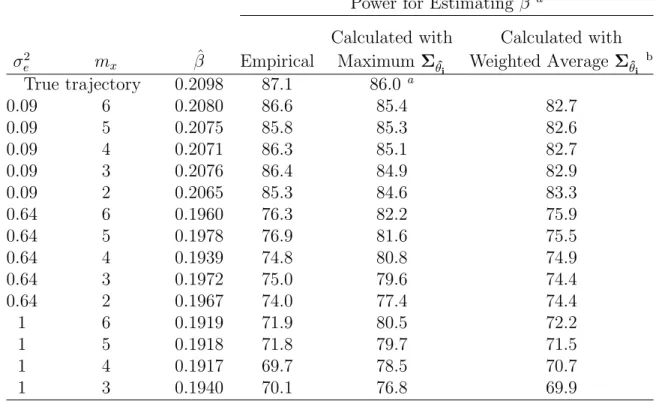
TABLE 2.2: Power for estimating β by maximum number of data collection points (mx) and size of σe2 - linear trajectory
Power for Estimating β a
Calculated with Calculated with σ2
e mx βˆ Empirical MaximumΣθˆi Weighted Average Σˆθi b
True trajectory 0.2098 87.1 86.0 a
0.09 6 0.2080 86.6 85.4 82.7
0.09 5 0.2075 85.8 85.3 82.6
0.09 4 0.2071 86.3 85.1 82.7
0.09 3 0.2076 86.4 84.9 82.9
0.09 2 0.2065 85.3 84.6 83.3
0.64 6 0.1960 76.3 82.2 75.9
0.64 5 0.1978 76.9 81.6 75.5
0.64 4 0.1939 74.8 80.8 74.9
0.64 3 0.1972 75.0 79.6 74.4
0.64 2 0.1967 74.0 77.4 74.4
1 6 0.1919 71.9 80.5 72.2
1 5 0.1918 71.8 79.7 71.5
1 4 0.1917 69.7 78.5 70.7
1 3 0.1940 70.1 76.8 69.9
aCalculated withΣ θi
aβ was estimated using the two-step inferential approach (Tsiatis et al. 1995). Empirical power was based on 1000 simulations, each with 100 subjects per arm. Minimum follow-up time is 0.75 years (9 months), and maximum follow-up time is 2 years. The event time is simulated from an exponential distribution with λ0 = 0.85, α = 0.3, γ = 0.1, β = 0.2, E(θ0i) = 0, E(θ1i) = 3.,
V ar(θ0i) = 1.2, Var(θ1i) = 0.7, and Cov(θ0i, θ1i) = 0 (the same simulated data used in Row 4 of Table 2.1).
bPower based on weighted average ofΣˆ θi.
inferential approach yields nearly unbiased estimates of the longitudinal effect. The
number of data collection points did not seem to be critical when the trajectory is
linear as long as each subject had at least two measurements of the longitudinal data.
There is a slight decrease in power when mx <5 and σ2e is large. When the trajectory
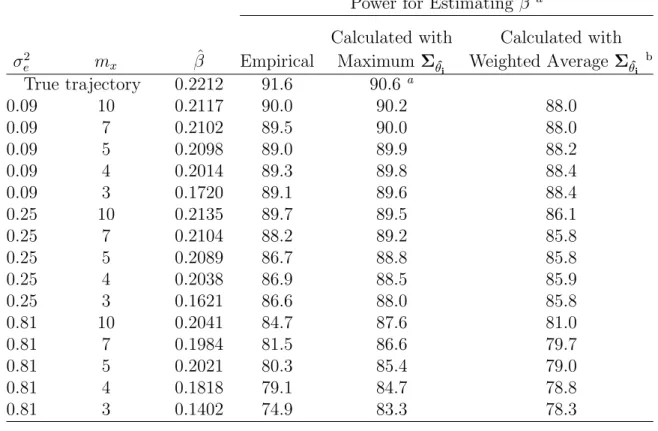
is quadratic,mx plays a more important role. The power for estimatingβ decreases as
mx decreases. Smaller numbers of measurements (mx < 4) can also lead to a biased
estimate of the longitudinal effect and result in a significant loss of power. The effect
TABLE 2.3: Power for estimating β by maximum number of data collection points (mx) and size of σe2 - quadratic trajectory
Power for Estimating β a
Calculated with Calculated with σ2
e mx βˆ Empirical MaximumΣθˆi Weighted Average Σθˆi b
True trajectory 0.2212 91.6 90.6 a
0.09 10 0.2117 90.0 90.2 88.0
0.09 7 0.2102 89.5 90.0 88.0
0.09 5 0.2098 89.0 89.9 88.2
0.09 4 0.2014 89.3 89.8 88.4
0.09 3 0.1720 89.1 89.6 88.4
0.25 10 0.2135 89.7 89.5 86.1
0.25 7 0.2104 88.2 89.2 85.8
0.25 5 0.2089 86.7 88.8 85.8
0.25 4 0.2038 86.9 88.5 85.9
0.25 3 0.1621 86.6 88.0 85.8
0.81 10 0.2041 84.7 87.6 81.0
0.81 7 0.1984 81.5 86.6 79.7
0.81 5 0.2021 80.3 85.4 79.0
0.81 4 0.1818 79.1 84.7 78.8
0.81 3 0.1402 74.9 83.3 78.3
aCalculated withΣ θi
aβ was estimated with the two-step inferential approach (Tsiatis et al. 1995). Empirical power was based on 1000 simulations, each with 100 subjects per arm. Minimum follow-up time is 0.75 years (9 months), and maximum follow-up time is 2 years. The event time is simulated from an exponential distribution with λ0 = 0.85, α = 0.3, γ = 0.1, β = 0.22, θi = (0, 2.5, 3)T, and
Σθ=diag(1.2, 0.7, 0.8).
bPower based on weighted average ofΣˆ θi.
σ2
e = 0, Σθˆi reduces to Σθ, and is unrelated to mx. The effect of mx comes from the
magnitude of reducing the contribution of the within subject variability,σ2
e. If we have
a very accurate and reliable measurement instrument, we can reduce the number of
repeated measurements and can still obtain unbiased estimates and maximum power.
The power calculation under the assumption of known Σθ or perfect data collection
(maximum Σθˆ
i) can result in a significant over-estimate of the power especially when
σ2
e is large. We next demonstrate that if we use the weighted average ofΣθˆi’s, we can
Example 1 from Table 2.2: For the scenario withσ2
e = 0.64 andmx = 2, we observed
that the mean measurement time for the subjects who had an event in the simulated
data is about 0.5 years. We used R2 =
⎛ ⎜
⎝ 1 0
1 0.5
⎞ ⎟
⎠ to calculateΣˆθ instead of setting
R2 =
⎛ ⎜
⎝ 1 0
1 2
⎞ ⎟
⎠, which assumes that the 2nd measurement was taken at 2 years. As a
result, the power based on formula (2.4) changed from 77.4% to 74.4%, which is much
closer to the empirical power of 74.0%. We used the mean measurement time in the
non-censored subjects, because the power calculation is mainly based on the number
of events. In practice, we need to make certain assumptions about tk based on the
median survival and length of the follow-up period.
Example 2 from Table 2.3: For demonstration, we chose the scenario with σ2
e =
0.81 and mx = 4. In this example, the 2nd measurement was taken at 0.45 years
(on average) in subjects who had only 2 measurements. For subjects who had more
than 2 measurements, longitudinal data was collected at scheduled time points of 0,
0.5, 1, and 1.5. Therefore, R2 =
⎛ ⎜
⎝ 1 0 0
1 0.45 0.20
⎞ ⎟
⎠, R3 =
⎛ ⎜ ⎜ ⎜ ⎜ ⎝
1 0 0
1 0.5 0.25
1 1 1
⎞ ⎟ ⎟ ⎟ ⎟ ⎠, and
R4 =
⎛ ⎜ ⎜ ⎜ ⎜ ⎜ ⎜ ⎜ ⎝
1 0 0
1 0.5 0.25
1 1 1
1 1.5 2.25
⎞ ⎟ ⎟ ⎟ ⎟ ⎟ ⎟ ⎟ ⎠
. A weighted average of the Σθˆi’s was calculated based on
formula (2.11). The resulting power is 78.8% instead of 84.7%, which is close to the
empirical power of 79.1%.
For trajectories that are quadratic or higher, it is important to schedule data