WHY CHOOSE US?:
CREATING AND APPLYING A COMPREHENSIVE RUBRIC OF EXPECTED AND RECOMMENDED WEBSITE ELEMENTS TO COMPARE AND ANALYZE THE OPERATIONAL AND MARKETING RESOURCES OFFERED ON PUBLIC AND CHARTER SCHOOL WEBSITES IN CENTRAL NORTH
CAROLINA
Will Okun
A dissertation submitted to the faculty at the University of North Carolina at Chapel Hill in partial fulfillment of the requirements for the degree of Doctor of Education in Educational
Leadership.
Chapel Hill 2019
Approved by: Kathleen Brown Brian Gibbs Martinette Horner Eric Houck
©2019 Will Okun
ABSTRACT
Will Okun: Why Choose Us?: Creating and Applying a Comprehensive Rubric of Expected and Recommended Website Elements to Compare and Analyze the Operational and Marketing Resources Offered on Public and Charter School Websites in
Central North Carolina (Under the direction of Eric Houck)
In the intensifying marketplace of American compulsory education, public school leaders are increasingly obligated to compete with charter schools and other schools of choice for the enrollment of students in their communities. Facing this new challenge, school leaders are beginning to adapt marketing strategies and practices long used by leaders of universities, colleges and private schools to better communicate how their schools’ unique academics, programs, values, and outcomes best achieve the needs and wants of current and potential stakeholders. This study examines the extent to which public school leaders, in comparison to charter school leaders, are using their school websites for these marketing purposes. Toward this goal, the researcher synthesized existing literature on education marketing and school websites to establish a
comprehensive rubric containing 69 elements that are recommended or expected to be offered on school websites for both operational and promotional purposes. The
ACKNOWLEDGMENTS
TABLE OF CONTENTS
LIST OF TABLES ... x
LIST OF FIGURES ... xii
CHAPTER 1: INTRODUCTION TO THE STUDY ... 1
Statement of Problem ... 5
Purpose of Study/Research Questions ... 9
Conceptual Framework of the Study... 11
Assumptions of the Study ... 15
Limitations of the Study ... 16
Definitions of Terms ... 20
CHAPTER 2: LITERATURE REVIEW ... 22
An Existing Dichotomy: The Use and Study of Education Marketing ... 24
Marketing as a leadership response to the new marketplace. ... 24
“A dearth of research attention.” ... 26
Leadership Dilemma: Education Marketing Research prior to 2012 ... 28
Defining education marketing. ... 28
Identifying and developing a marketing perspective. ... 29
Outlining the methodology and findings of Oplatka and Hemsely-Brown’s review. ... 30
Marketing is an “indispensable organizational activity.” ... 32
Marketing counters the values and goals of public education. ... 32
A lack of strategic marketing planning and practice. ... 34
Promotional activities. ... 35
An undeveloped field in need of large-scale, normative and empirical studies. ... 37
Necessary and Inequitable: Education Marketing Research since 2012 ... 38
Marketing as a leadership obligation without dilemma. ... 38
Principals’ perceptions of education marketing. ... 39
A research focus on education marketing and inequity. ... 43
An Already Shifted Paradigm: Marketing Higher Education ... 46
The establishment and prioritization of marketing in higher education. ... 46
The purpose, value and study of view books and websites in higher education. ... 48
Ubiquitous and Unexamined: School Prospectuses and Websites ... 50
The purpose and study of prospectuses internationally. ... 50
The limited literature on the operational purposes of school websites. ... 51
The limited literature on the marketing purposes of school websites. ... 53
Further Research ... 55
CHAPTER 3: METHODS ... 58
Purpose of Study/Research Questions ... 58
Research Design ... 61
Rationale for Study ... 79
CHAPTER 4: RESULTS ... 81
Review of Purpose and Methodology of Study ... 81
Research Question #2 ... 87
Operational. ... 88
Operational/Promotional. ... 90
Promotional... 91
Summary of research question #2. ... 92
Research Question #3 ... 95
Cumulative. ... 97
Operational. ... 100
Operational/Promotional. ... 104
Promotional... 108
Summary of research question #3. ... 112
Standard deviation of public school websites within districts. ... 115
Research Question #4 ... 117
Cumulative. ... 118
Operational. ... 123
Operational/Promotional. ... 125
Promotional... 127
Summary of research question #4. ... 129
Summary of Research ... 132
CHAPTER 5: FINDINGS AND IMPLICATIONS ... 136
Summary of Study ... 136
Discussion of Findings ... 140
Finding #1 ... 140
Finding #2 ... 142
Finding #4 ... 150
Summary of Discussion of Findings ... 152
Implications and Future Research ... 153
Implications for current and future public school leadership. ... 154
Implications for future research in education marketing. ... 163
Conclusion... 167
APPENDIX A: COMPREHENSIVE RUBRIC OF CONTENT ELEMENTS EXPECTED OR RECOMMENDED BY EXISTING RESEARCH TO BE OFFERED ON SCHOOL WEBSITES ... 170
APPENDIX B: LISTING OF EXAMINED UNIVERSITY, COLLEGE, PRIVATE SCHOOL, CHARTER SCHOOL, AND PUBLIC SCHOOL WEBSITES ... 171
APPENDIX C: GENERAL CODING INSTRUCTIONS FOR COMPREHENSIVE RUBRIC ON INDIVIDUAL SCHOOL WEBSITES (USED BY WILL OKUN AND JOSH HUNT) ... 178
LIST OF TABLES
Table 1.1 The three theoretical perspectives of Strategic Enrollment
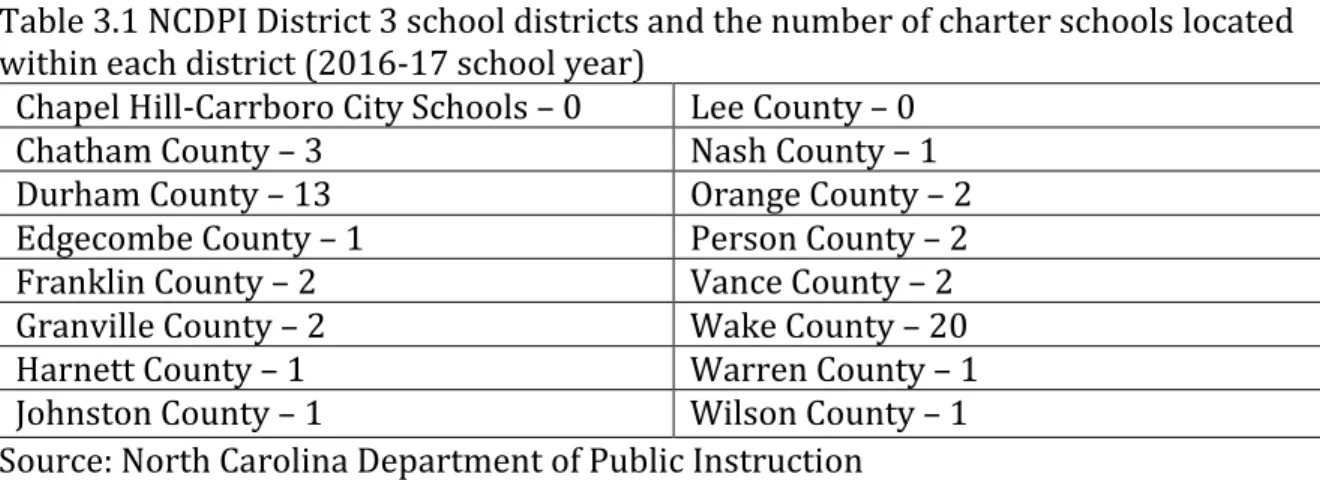
Management framework ... 13 Table 3.1 NCDPI District 3 school districts and the number of charter
schools located within each district (2016-17 school year) ... 64 Table 3.2 Percentage of eligible students in NCDPI District 3 who
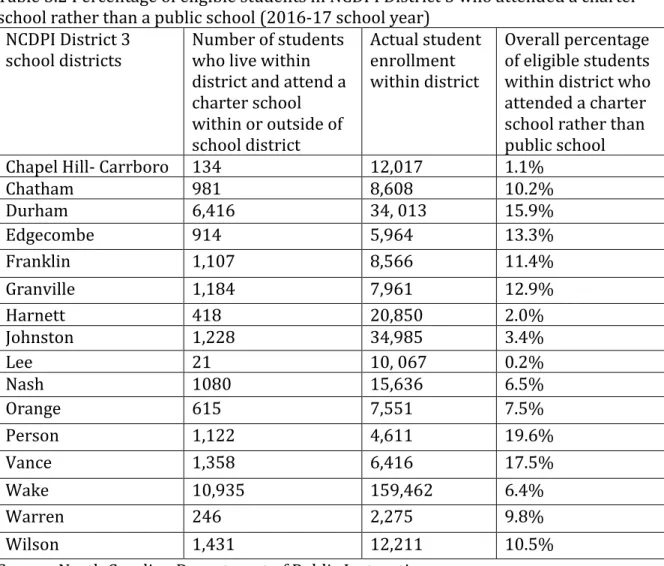
attended a charter school rather than a public school (2016-17 school
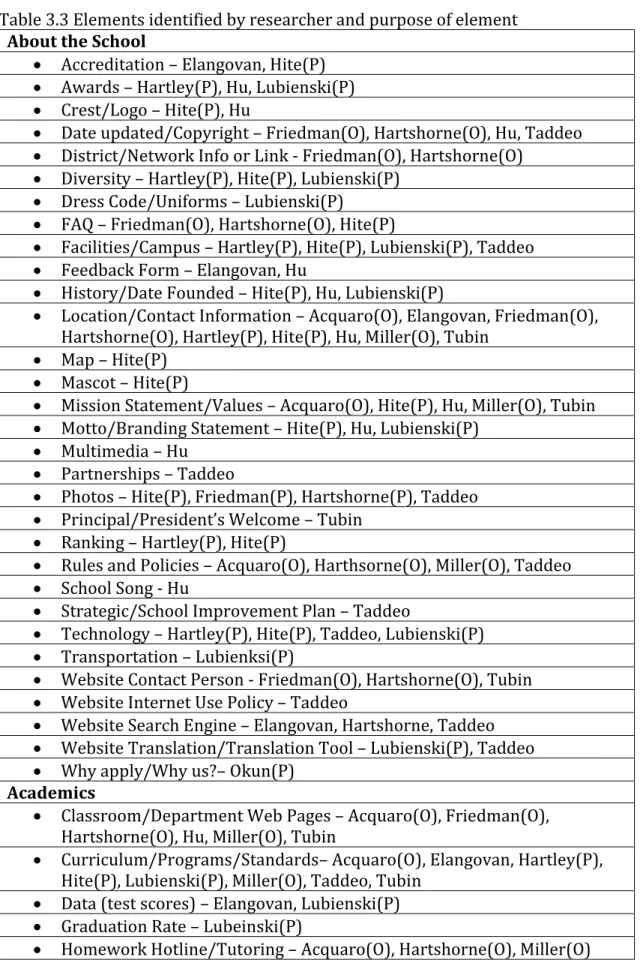
year) ... 65 Table 3.3 Elements identified by researcher and purpose of element ... 71 Table 3.4 Elements identified by purpose ... 74 Table 4.1 Cumulative totals of charter school and public school websites
that offered individual content elements identified in the comprehensive
rubric ... 84 Table 4.2 Number of charter school and public school websites that
offered elements identified as operational in purpose ... 89 Table 4.3 Numbers of charter school and public school websites that
offered elements identified as operational/promotional in purpose ... 90 Table 4.4 Numbers of charter school and public school websites that
offered elements identified as promotional in purpose ... 91 Table 4.5 Cumulative average percentages of charter and public school
websites that offered elements identified as promotional,
operational/promotional, and operational ... 93 Table 4.6 Average number of identified website elements on public and
charter school websites in districts with below average and average
charter school enrollment ... 97 Table 4.7 Average number of identified website elements on public and
charter school websites in districts with above average charter school
enrollment ... 98 Table 4.8 Average number of operational elements on public and charter
school websites in districts with below average and average charter
school enrollment ... 101 Table 4.9 Average number of operational elements on public and charter
Table 4.10 Average number of elements identified as
operational/promotional on public and charter school websites in
districts with below average and average charter school enrollment ... 105 Table 4.11 Average number of elements identified as
operational/promotional on public and charter school websites in
districts with above average charter school enrollment ... 106 Table 4.12 Average number of promotional elements on public and
charter school websites in districts with below average and average
charter school enrollment ... 109 Table 4.13 Average number of promotional elements on public and
charter school websites in districts with above average charter school
enrollment ... 110 Table 4.14 Average numbers of promotional, operational and
promotional, and operational elements offered on public and charter school websites in districts with below average, average and above
average charter school enrollment ... 112 Table 4.15 Standard deviation of public school websites within individual
districts ... 116 Table 4.16 Cumulative totals of university and college, private school,
charter school and public school websites that offered individual content
elements identified in the comprehensive rubric ... 119 Table 4.17 Numbers of university and college, private school, charter
school and public school websites that offered elements identified as
operational in purpose ... 124 Table 4.18 Numbers of university and college, private school, charter
school and public school websites that offered elements identified as
operational/promotional in purpose ... 126 Table 4.19 Numbers of university and college, private school, charter
school and public school websites that offered elements identified as
promotional in purpose ... 128 Table 4.20 Cumulative average percentages of university and college,
private school, charter school, and public school websites that offered elements identified as promotional, operational/promotional, and
LIST OF FIGURES
Figure 1.1 National student enrollment in charter schools, 2006-07 to
2016-17 ... 6 Figure 1.2 Allotted membership for charter schools in North Carolina,
2011 – 2017 ... 7 Figure 3.1 North Carolina State Board of Education North Central Region
(District 3) ... 63 Figure 4.1 Elements identified in comprehensive rubric offered on a
higher percentage of public school or charter school websites ... 87 Figure 4.2 Cumulative average percentages of charter and public school
websites that offered elements identified as promotional,
operational/promotional, and operational ... 93 Figure 4.3 Differences in average cumulative percentages of elements
offered on charter school websites as compared to public school websites ... 95 Figure 4.4 Average number of elements offered on public and charter
school websites in districts of varying charter school enrollment ... 100 Figure 4.5 Average number of operational elements offered on public and
charter school websites in districts of varying charter school enrollment ... 104 Figure 4.6 Average number of elements identified as promotional and
operational offered on public and charter school websites in districts of
varying charter school enrollment ... 108 Figure 4.7 Average number of promotional elements offered on public
and charter school websites in districts of varying charter school
enrollment ... 111 Figure 4.8 Average numbers of promotional, operational and
promotional, and operational elements offered on public and charter school websites in districts with below average, average and above
average charter school enrollment ... 113 Figure 4.9 Correlation of standard deviation of elements offered on
individual public school websites within a district and the cumulative
Figure 4.10 Cumulative average percentages of university and college, private school, charter school, and public school websites that offered elements identified as promotional, operational/promotional, and
operational ... 130 Figure 4.11 Differences in average cumulative percentages of elements
offered on university and college websites and private school websites as
CHAPTER 1: INTRODUCTION TO THE STUDY
The battle to protect education from the challenges of the market has largely been lost, and the leaders of our schools, colleges, and universities are obligated to operate in and be accountable to a marketized environment (Foskett, 2012, p. 58).
The rapid emergence and establishment of the charter school movement over the past three decades has altered the landscape of American public education for increasing numbers of communities, students, families, and educators. Originally proposed in 1988 by Ray Budde, an education professor, and Albert Shanker, the president of the American Federation of Teachers, charter schools were envisioned to be teacher-led district schools that would be granted high levels of autonomy to utilize “cutting edge” knowledge and research to experiment with pedagogy and curriculum in
“reaching the kids” that traditional schools were historically struggling to educate
(Ravitch, 2010, p. 123). Importantly, they intended charter schools to be initiated and operated in partnership with local public school districts and educators. Instead, free-market advocates and modern education reformers, including corporate, legislative, media and educational leaders, have supported the development and institution of the charter school movement as a mechanism to introduce school choice into public education, fostering direct competition among charter schools and public school districts for the enrollment and retention of students.
system that has not been held accountable for failing to meet the needs of individual students, communities, and the nation at large (Chubb & Moe, 1990; Friedman, 1955). Theoretically, in a competitive marketplace, public schools that were once guaranteed an annual enrollment of students regardless of the schools’ performance or their communities’ satisfaction would need to improve accountability, innovation, efficiency and outputs in order to compete with charter schools for student enrollment. The end result would be schools that are deemed more effective or attractive to families would be in higher demand and thrive while unsuccessful or unresponsive schools would gradually lose enrollment, potentially until their closures. This confluence of charter schools, school competition and education reform is encapsulated in a summation by James Goenner, the president and CEO of the National Charter School Institute, that “charter schools are a vehicle for infusing competition and market forces into public education, a proven method for responsive change and improvement” (Kahlenberg & Potter, 2014-2015, p. 9).
While considerable debate regarding the overall impact and effectiveness of charter schools in achieving improved student outcomes for all American students continues, charter schools are now an established feature of the American public school system, with an estimated 3.1 million students attending 6,900 charter schools in 43 states for the 2016-17 school year (National Alliance for Public Charter Schools, 2017). Within this emerging marketized environment of school choice and competition,
growing numbers of public schools find themselves in the unfamiliar position of competing with charter schools for both the enrollment of students in their
Cucchiara, 2016; DiMartino & Jessen, 2014; Foskett, 2012; Kasman & Loeb, 2013; Lubienski, Linick, & York, 2012). Leaders and faculties of both public and charter schools have become responsible for convincing stakeholders, particularly the families of prospective and current students, that their schools are the better choice for
achieving the goals of the student and community at large (Kasman & Loeb, 2013; Jabbar, 2015; Jabbar, 2016; Foskett, 2012; Wilson & Carlsen, 2016). This challenge is particularly critical to charter schools that have no assigned students and are
dependent on attracting student enrollment to survive and grow (Lubienski, Linick, & York, 2012). As with private schools and universities that have historically existed within a marketized environment of direct competition for student enrollment, many charter schools and charter school networks have embraced marketing practices to promote their movement and individual charter schools to both the general public and to individual families (Jabbar, 2016; Lubienski, Linick, & York, 2012).
By contrast, public school leaders, with no history of competing for student enrollment, have not comparatively prioritized marketing practices for the promotion of individual schools to families and other community stakeholders (Beal & Beal, 2016). Moreover, significant literature documents educators’ general reluctance to embrace the introduction of market forces into education as morally contradictory to the values of public education (Foskett, 2012; Hemsley-Brown & Oplatka, 2006; Oplatka &
Hemsley-Brown, 2012; Tubin, 2012). Despite this persistent reluctance, as the number of charter schools and charter school enrollment continue to grow annually, an
attributes of individual public school districts and their individual public schools (Beal & Beal, 2016; Cucchiara, 2016; DiMartino & Jessen, 2014; Jabbar, 2015; Jabbar, 2016; Kasman & Loeb, 2013; Loeb, Valant, & Kasman, 2011; Lubienski, Linick, & York, 2012; Tubin, 2012).
While many facets can exist in the marketing strategies of schools, one key component is the school website, the most widely available means for schools to promote themselves (Hu & Soong, 2007; Lubienski et. al, 2012; Wilson & Carlsen, 2016). School websites are designed largely for public consumption and provide each school an opportunity to define and present the unique character, look, mission, achievements or environment of that school to prospective and current stakeholders (Drew, 2013; Hartshorne, Friedman, Algozzine, Kaur, 2008; Lubienski, Linick, & York, 2012; Miller, Adsit, & Miller, 2005; Tubin & Klein, 2007; Wilson & Carlsen, 2016). Thus, the school website can be considered the “public face of the school” as it is often both the first point of contact for prospective stakeholders who are interested in learning about a school and also the primary mode of operational information for and
communication with current stakeholders already invested in the school community (Drew, 2013; Hartshorne, Friedman, Algozzine, Kaur, 2008; Hesketh & Knight, 1998; Hesketh & Selwyn, 1999; Hu & Soong, 2007; Miller, Adsit, & Miller, 2005; Taddeo & Barnes, 2016). While the promotional and operational capabilities of school websites are both highly valued and highly emphasized by leaders in the existing competitive markets of higher education and private schools, not yet well understood is the extent to which public and charter school leaders utilize school websites as marketing
competitive market of public education (Anctil, 2008; Ford, 2011; Hemsley-Brown & Oplatka, 2006; Milian, 2017; Pegoraro, 2006; Smith et al. 2016). This study addresses this gap in research by first synthesizing relevant literature on education marketing and school websites to establish a comprehensive rubric of content resources
recommended to be offered on school websites (Appendix A) and by then applying that rubric to individual public and charter school websites in one geographic area of North Carolina in order to determine the operational and promotional similarities and
differences between public and charter school websites in districts with varying levels of competition for student enrollment.
Statement of Problem
Figure 1.1 National student enrollment in charter schools, 2006-07 to 2016-17
Source: National Alliance for Public Charter Schools, 2017
In North Carolina, the setting for this study, the rate of increase in charter school enrollment has been even more dramatic. The North Carolina legislature initially authorized charter schools in 1996 with a cap of 100, a total that was reached in 2001 with a student enrollment of 14,230 students. In 2011, when new legislation lifted that original cap, enrollment in the state’s 100 charter schools had increased to 41,232 students. Five years later, for the 2016-17 school year, total charter school enrollment almost doubled to 81, 968 students in 167 charter schools (Office of Charter Schools, 2016). Additionally, in a 2016 survey of charter schools, 103 charter schools reported that a total of 37, 477 students were on the waiting lists to attend one of these schools (Office of Charter Schools, 2016).
0 500,000 1,000,000 1,500,000 2,000,000 2,500,000 3,000,000 3,500,000
Figure 1.2 Allotted membership for charter schools in North Carolina, 2011 – 2017
Source: Office of Charter Schools, 2016
This continued growth in charter school enrollment, both nationally and in North Carolina, poses severe economic ramifications for local school districts that are losing student enrollment to competing charter schools. While precise funding
formulas differ by state, typically the enrollment of each new student in a charter school results in a large portion of that child’s per-pupil budgetary allotment being transferred from the local school district to the charter school. In North Carolina, the State Board of Education estimated that the 17,757 new enrollees in charter schools for the 2015-16 school year alone would “impact” affected school districts upwards of an additional
$77 million (Office of Charter Schools, 2016). For Durham Public Schools, as one example of a school district examined in this study, the projected increase in charter school enrollment of 662 students between the 2015-16 and 2016-17 school year transferred an additional $2,453,750 dollars from the district to competing charter
0 10,000 20,000 30,000 40,000 50,000 60,000 70,000 80,000 90,000
2010-11 2011-12 2012-13 2013-14 2014-15 2015-16 2016-17
schools. This appropriation was part of a $16 million reduction in the district’s operating budget for the same fiscal cycle (Durham Public Schools, 2016).
In response to the continuing growth of charter school enrollment and the consequent reduction in per-pupil budgetary allotments for district public schools, public school leaders are increasingly assuming or being tasked with the responsibility to both develop strategies and implement practices to recruit and retain students (Beal & Beal, 2016; Jabbar, 2016; Kasman & Loeb, 2013). Some school districts and
individual schools have responded by pursuing academic, curriculum, or operating initiatives desired by prospective students and their families or as recommended by invested or potential stakeholders (Beal & Beal, 2016; Jabbar, 2016; Kasman & Loeb, 2013). However, as Lubienski, Linick, and York (2012) conclude, such systematic innovations are both expensive and difficult to develop, implement, and sustain. As a result, “almost by default, marketing holds much promise for schools charged with attracting and retaining their clientele” (p. 116). Indeed, recent research suggests public school leaders in highly competitive educational marketplaces are pursuing, or at least beginning to contemplate, the marketing practices and strategies already utilized by universities, colleges and private schools as a way to promote and differentiate individual public schools from their competition (Beal & Beal, 2016; DiMartino & Jessen, 2014; Jabbar, 2015; Jabbar, 2016; Kasman & Loeb, 2013; Kasman & Loeb, 2013; Loeb, Valant, & Kasman, 2011; Lubienski, Linick, & York, 2012; Wilson & Carlsen, 2016).
2017; Miller, Adsit, & Miller, 2005; Wilson & Carlsen, 2016). While a primary purpose of the school website is to provide current stakeholders operational information and to serve as an interactive hub for inter-organizational communication, universities,
colleges and private schools have additionally leveraged their websites as an
opportunity to present information that aims to promote their institutions to potential and current students, families and other stakeholders (Ford, 2011; Hesketh & Selwyn, 1999; Hu & Soong, 2007; Miller, Adsit, & Miller, 2005; Smith et al., 2016; Taddeo & Barnes, 2016). Earlier studies have examined the informational and operational purposes, capabilities and deficiencies of public school websites but less understood is whether and how public and charter school leaders are responding to an evolving marketplace of school choice by envisioning school websites as a widely accessible marketing platform. This study identifies and compares the types and frequencies of informational and promotional content featured on selected public and charter school websites in assessing the extent to which public and charter school leaders are or are not utilizing school websites as not just an operational hub but also as an opportunity to market their schools to current and potential stakeholders who have a new range of school enrollment options.
Purpose of Study/Research Questions
responded to this competitive pressure by pursuing academic, curricular, or operating initiatives aimed at attracting prospective and current stakeholders, the literature suggests the majority of school leaders are instead seeking a competitive advantage by pursuing traditional marketing strategies and practices already adapted and
institutionalized in the existing marketplace of private schools and higher education (Beal & Beal, 2016; Cucchiara, 2016; DiMartino & Jessen, 2014; Jabbar, 2015; Jabbar, 2016; Kasman & Loeb, 2013; Loeb, Valant, & Kasman, 2011; Lubienski, Linick, & York, 2012; Tubin, 2012). As noted, one marketing platform prioritized by colleges and universities and widely available to public and charter school leaders is the school website (Anctil, 2008; Ford, 2011; Hemsley-Brown and Oplatka, 2006; Milian, 2017; Smith et al. 2016). However, only limited normative and empirical literature exists that examines the extent to which public and charter school leaders utilize and value school websites as an available medium for marketing to current and future stakeholders. This study addresses that gap in the literature and research by investigating the following questions:
1. What content resources exist on public and charter school websites?
2. To what extent are the operational and promotional content resources offered on public school websites similar to or different than the operational and promotional content resources available on charter school websites?
resources available on public school websites in districts with average and below average percentages of charter school enrollment?
4. To what extent are the content resources offered on public and charter school websites similar to or different than the content resources available on the websites of private schools, colleges and universities, which have longer existed within a marketized environment of direct competition for student enrollment? Conceptual Framework of the Study
a field, without a “framework of analysis or conceptualization” (Foskett, 2012, p. 40)
to utilize traditional marketing practices to respond to the evolving marketization of the American public educational system.
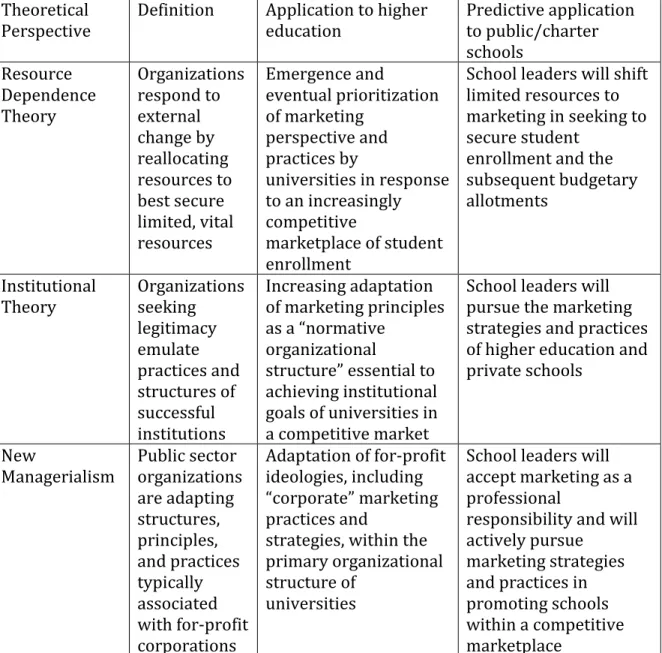
Table 1.1 The three theoretical perspectives of Strategic Enrollment Management framework
Theoretical Perspective
Definition Application to higher education Predictive application to public/charter schools Resource Dependence Theory Organizations respond to external change by reallocating resources to best secure limited, vital resources Emergence and eventual prioritization of marketing perspective and practices by
universities in response to an increasingly competitive
marketplace of student enrollment
School leaders will shift limited resources to marketing in seeking to secure student
enrollment and the subsequent budgetary allotments
Institutional
Theory Organizations seeking legitimacy emulate practices and structures of successful institutions Increasing adaptation of marketing principles as a “normative
organizational
structure” essential to achieving institutional goals of universities in a competitive market
School leaders will pursue the marketing strategies and practices of higher education and private schools
New
Managerialism Public sector organizations are adapting structures, principles, and practices typically associated with for-profit corporations
Adaptation of for-profit ideologies, including “corporate” marketing practices and
strategies, within the primary organizational structure of
universities
School leaders will accept marketing as a professional
responsibility and will actively pursue
marketing strategies and practices in promoting schools within a competitive marketplace
Resource Dependence Theory, Institutional Theory, and new managerialism are each prevalent in the literature discussing education marketing at colleges and
resources that are central to the health and vitality of the organization” (Hossler, 2014, p. 10). This theory is often cited to explain the initial emergence of marketing
perspectives and the eventual prioritization of marketing practices, including the institutionalization of SEM, by university and college leaders working to secure enrollment and budgetary goals in an increasingly competitive marketplace.
Institutional Theory posits that institutions which are in the developmental stages of operation or are aiming to increase legitimacy strive to emulate the organizational patterns and structures of institutions that are perceived to be already effective or successful. Institutional Theory helps to explain the rapid and far-reaching evolution of marketing principles, including SEM, as a “normative organizational structure”
considered essential to both the operation and mission of a college or university (Hossler, 2014, p. 10). The theory of new managerialism refers to public sector organizations adapting and utilizing “organizational structures, technologies,
management practices and values that are more commonly associated with the private, for profit business sector” (Hossler, 2014, p. 10). Considerable literature documents the relatively recent emergence, development and institutionalization of for-profit ideologies and practices within institutions of higher education, including the adaptation and prioritization of “corporate” marketing strategies and practices. Marketing and promotional activities for recruiting targeted students and achieving enrollment goals are now considered essential elements of an effective SEM framework for universities and colleges.
absent from the relevant research in the United States. However, as the American educational system continues to evolve into a competitive marketplace increasingly similar to the existing marketplace of colleges and universities, these theories can similarly inform the study and practice of education marketing at the compulsory level. The application of RDT, Institutional Theory, and new managerialism anticipates that public school leaders will increasingly respond to the new competitive marketplace of student recruitment and retention by adapting and institutionalizing traditional marketing strategies and practices already normalized and prioritized within
institutions of higher education. This study relies on this proposition in establishing the institutional websites of universities and colleges as a highly valued and widely utilized marketing platform that public and charter schools are already or will likely be seeking to emulate. In comparing the resources offered on university and college websites to the content provided on public and charter school websites, this study both explores and assesses the extent to which public and charter school leaders are utilizing school websites as a marketing platform to appeal to current and future stakeholders. Assumptions of the Study
the leaders of these public schools, charter schools, and other choice schools will need to establish and attempt to meet student enrollment goals that allow individual schools to thrive or, minimally, remain in operation. Also, within existing marketplaces and in needing or desiring to achieve student enrollment goals, it is assumed that some public schools, charter schools and other choice schools will be, at different frequencies, in direct competition with another school or schools for the enrollment of a shared pool of eligible students. Another assumption is that funding in the form of per-pupil
allotments will continue to follow the student to the school of enrollment. Without making assumptions about the purposes of school websites, this study assumes that every existing public school and charter school in 2018 operates a functioning school website that can be accessed and edited by someone employed by or affiliated with the individual school, school district or charter school network.
Limitations of the Study
The selected focus and methodology of this comparative study on the operational and marketing purposes and capabilities of public school and charter school websites necessarily has a number of important limitations to be considered in assessing the findings and implications of this study. First, the geographic scope of this study is limited to a central region of North Carolina. Although the researcher selected this region because the included school districts offered a wide range in the number of operating charter schools and charter school enrollments, the operational and
Second, this study focuses narrowly on the operating and marketing purposes and capabilities of school websites and does not consider or examine other marketing strategies or practices that may be used by public school and charter school leaders. Existing research shows that public school and charter school leaders can and do pursue or rely on other methods of school marketing, including open houses, school fairs, school visits, traditional news media, community events, advertising, and, most especially, word-of-mouth promotion by students, families, faculty, and alumni (Beal & Beal, 2016, DiMartino & Jessen, 2014, Jabbar, 2016; Jabbar, 2015, Lubienski, 2007). The presence or absence of these marketing methods in individual schools or districts has not been factored into the assessment of individual school websites or in determining the extent to which individual school leaders are or are not leveraging the marketing capabilities of school websites.
A third limitation to this study is that most school websites are easily edited and thus the resources and information offered on an individual school website can change daily. As such, the data findings for, and the subsequent evaluation of, an individual website can be slightly or fundamentally different depending on when accessed by a viewer or researcher. As an example, both the University of North Carolina at Chapel Hill and Durham Public Schools published wholly redesigned websites during the two month coding period of this study.
websites by fostering current and prospective stakeholders to initially engage with a school website, remain on the school website, and return to the school website (Acquaro & DeMarco, 2008; Friedman, Hartshorne & Algozzine, 2005, Hartshorne, Friedman, Algozzine, Kaur, 2008; Lockhart 2016). The previous studies that did assess the design and structure of public school websites determined that the majority of websites demonstrated basic principles of website design and structure (Acquaro & DeMarco, 2008; Friedman, Hartshorne & Algozzine, 2005; Hartshorne, Friedman, Algozzine, & Kaur, 2008).
Fifth, and potentially most significant to the findings and implications of this study, the methodology used in this study identifies only the existence of individual elements or resources on school websites and does not assess, evaluate, interpret, or indicate the quality or the content of the featured element or resource. For instance, for the element of photography, this study’s methodology does not differentiate between one school website that featured a large, high-quality, in-focus, colorful, candid photo of students, as recommended by the literature, and another school website that provides an outdated, fuzzy, small photo of the front of the school building (Lockhart, 2016). Instead, both school websites are coded equally on the comprehensive rubric as possessing a school photo. Additionally, the methodology of this study does not attempt to differentiate between the meaning, purpose, and targeted audience of one website’s homepage photo featuring diverse students interacting with a teacher in a
Similarly, this study’s methodology considers each of the 69 website elements
included in the comprehensive rubric to be of equal value and importance in effectively communicating with and marketing to current and prospective stakeholders of a school community. However, the literature on education marketing and school websites indicates that school leaders and stakeholders perceive specific online practices, resources and information to be most essential or effective in proactively cultivating and sharing operational and promotional information for and with a diversity of audiences. As one important example, emerging literature emphasizes that public and charter school leaders are increasingly adapting social media technologies as far-reaching, “robust platforms” capable of defining, curating, and promoting the culture,
priorities and outcomes of school communities to current and prospective stakeholders (Cox & McLeod, 2013; Griffin, 2014; Hughes, 2018; Powers & Green, 2016, p. 135). Although initially slower to embrace social media as compared with leaders of
corporations, institutions of higher education, and other types of organizations, many public and charter school leaders now consider social media use an expected
responsibility of school leadership that can positively influence current and prospective stakeholders’ perceptions of, interactions with and commitment to individual school communities (Cox & McLeod, 2013; Griffin, 2014; Hughes, 2018). Yet, despite the increasingly prominent role of social media in communicating with and marketing to school stakeholders, this study’s comprehensive rubric and methodology do not
leaders and stakeholders to be of more limited operational and marketing value and importance.
A seventh limitation of this study is that the methodology does not differentiate between the levels, types, locations and purposes of individual schools in measuring and evaluating the operational and promotional elements offered on school websites. Certainly, particular website elements included in the comprehensive rubric are more or less relevant and applicable to the operating and marketing needs and goals of
different types of schools. As just one example, due to the age of their enrolled students, the websites of elementary and middle schools are reasonably expected to provide less information on study abroad, internships, graduation, alumni, and matriculation than high school and college websites. This study does not incorporate nor account for these types of inherent differences between categories of schools and instead uses a single comprehensive rubric to measure, evaluate and compare the operational and marketing capabilities and purposes of the 264 examined school websites.
Definitions of Terms
Below are definitions to key terms that are used frequently throughout this study:
• Charter schools “share features of both public and private schools” in that they are state-authorized, publically funded, operated by both public and private organizations, not assigned a predetermined enrollment of students, offer tuition-free open enrollment and are held to the same accountability standards as public schools (Ladd et. al, 2015, p. 1).
• Promotional activities include “all actions that are focused on the school’s image,
school, and represents a more superficial strategy, not substantive change” (Jabbar, 2016, p. 6-7).
• Marketing, in the context of K-12 education, is “defined in general terms as a set of activities undertaken to facilitate and/or influence the school choice decisions of students, parents, and other stakeholders” (Beal & Beal, 2016, p. 83).
CHAPTER 2: LITERATURE REVIEW
The primary purpose of this study is to examine whether public school leaders, in comparison with charter school leaders, are responding to the new competitive marketplace of school choice by utilizing school websites as marketing platforms to promote their schools to current and prospective stakeholders. This chapter reviews the literature that informed this study, beginning with a broad overview of the limited existing research on education marketing at the compulsory school level and followed by a closer focus on studies examining the purpose and uses of institutional websites in the American educational system.
Section one summarizes the literature exploring the dichotomy between the increased acceptance and use of education marketing by school leaders in response to the competitive educational marketplace and the dearth of existing academic research examining the implications of this increasingly common leadership practice.
Section two offers a synopsis of education marketing research prior to 2012 by examining the major themes identified in Oplatka and Hemsley-Brown’s seminal and comprehensive literature review entitled “The Research on School Marketing: Current Issues and Future Directions –An Updated Version.” Their review of existing
is incompatible with the values and goals of public education (Oplatka and Hemsley-Brown, 2012, p. 6).
While almost the entirety of education marketing research prior to 2012 emanated from outside of the United States, there has been a recent emergence of academic study in the United States, culminating in the 2016 volume of Peabody Journal of Education entitled “Marketing and Public Education: Evidence, Emerging Trends, and Implications.” Section three of this literature review examines the major thematic similarities and differences between the pre-2012 international education marketing research, as synthesized in Oplatka and Hemsley-Brown’s review, and the studies published in the United States between 2012 and 2016. Most significantly, the American studies do not identify the leadership dilemma emphasized by Oplatka and Hemsley-Brown but instead focus primarily on how American school leaders can and do utilize marketing to inequitably target and exclude particular students for
enrollment.
Section four offers a brief overview of the emergence, acceptance, and institutionalization of marketing in American higher education as a framework to consider both the current status and future development of education marketing in the American school system. Section four includes a synopsis of the literature on the marketing purposes and outcomes of view books and websites in higher education that inform this study’s analysis of the marketing potential of public and charter school websites.
compulsory school level. The research identifies the school prospectus as a precursor to the school website and offers insights about how school leaders have valued and utilized marketing materials in response to competitive educational markets internationally that predate the marketization of the American school system. The limited earlier literature on school websites focused primarily on the operational purposes and effectiveness of school websites while more recent studies have critically examined the marketing purposes of school websites in inequitably targeting particular types of students and families.
Section six concludes the literature review by summarizing the existing research on education marketing and highlights the need for future research on the marketing practices of school leaders.
An Existing Dichotomy: The Use and Study of Education Marketing
Marketing as a leadership response to the new marketplace. As the
North Carolina, public school leaders must begin to learn and understand how to
navigate within this new system to compete for the enrollment of the children who now possess a choice of schools (Burnell, 2012; Lubineski, Linick, & York, 2012). As Foskett (2012) observes, “Responding to policy change and changing external environments is a key characteristic of leadership and management in all organizations, and the
ideological project of ‘marketization’ demanded direct response from those providing institutional strategic and operational leadership” (p. 41).
For public school leaders engaged in direct competition with charter and private schools (and sometimes even with other public schools) for the enrollment of children in their communities, the necessity exists that their schools be considered the best and right choices for families and their children (Beal & Beal, 2016; Bunnell, 2012; Jabbar, 2016; Wilson and Carlsen. 2016). A number of direct responses are available for school leaders seeking to enhance the desirability of their schools in comparison to rival or neighboring schools. School leaders can pursue facility, budgetary, safety, curricular, technology, faculty, and equity initiatives to improve the performance and
attractiveness of their schools (Beal & Beal, 2016; Kasman & Loeb, 2013; Loeb, Valant, & Kasman, 2011). However, such academic and operational investments are
Jessen, 2014; Jabbar, 2015; Jabbar, 2016; Holme, Carkhum & Rangel, 2013; Kasman & Loeb, 2013; Loeb, Valant, & Kasman, 2011; Lubineski, Linick, & York, 2012; Oplatka & Hemsley-Brown, 2012). One potential marketing platform available to school leaders, and the focus of this study, is the school website, which is the “most widely available
means that schools can use to promote themselves, with more schools using the web than any other form of public engagement” (Lubineski, Linick, & York, 2012, p. 121).
“A dearth of research attention.” Despite the increased acceptance and use of marketing by school leaders as a response to the increasingly competitive educational marketplace, academics and researchers “have paid remarkably little attention to this
issue, particularly in the United States” (Bunnell, 2012, p. 102). In his 2012 analysis “Marketisation and Education Marketing: The Evolution of a Discipline and a Research Field,” Foskett (2012) describes education marketing as a “new field” of academic study
that was “largely terra incognita prior to the mid-1980’s” (p. 40). In the past three decades, Foskett (2012) includes himself as part of “a small group of academics and practitioners” who have contributed “understanding and insight” to the field but notes that the academic study of education marketing still lacks a “framework of analysis or conceptualization” (p. 41). Oplatka and Hemsley-Brown (2012) similarly conclude that the study of education marketing is an emerging scholarship that remains “un
-synthesized and un-theorized”with “an extremely limited number of studies that have been conducted” (p. 4). The lack of research is surprising to Oplatka (2002), given the “considerable interest in the issues of parental choice and the subsequent emergence of
academic journal dedicated entirely to education marketing at the compulsory level in the United States, editors Beal, Stewart, and Lubienski (2016) concur that there remains a critical “imbalance between the rise of this issue” and the corresponding “dearth of research attention” (p. 2).
Two potential explanations exist for the paucity of research on education
marketing in the United States. The first is that the incentivized education marketplace and the resulting competition for student enrollment are still relatively new features of the American school system. As the marketplace of American schools becomes more established, likely so too will the academic study of education marketing. For instance, several academic journals and a plethora of corresponding research are dedicated entirely to the marketing of higher education in America, which has historically existed as a competitive marketplace (Foskett, 2012). Also, a greater body of academic study exists that examines education marketing by primary and secondary schools in other countries, especially the United Kingdom, Australia, and Israel, each of which has longer maintained a competitive educational marketplace (Beal and Beal, 2016; DiMartino & Jessen, 2014; Jennings, 2010). Even in these countries, however, the study of education marketing is still considered an “emergent” field whose scholarship is “un-synthesized and un-theorized” (Oplatka & Hemsley-Brown, 2012, p. 4; Bunnell, 2012, p. 102).
field” is inherently difficult, Foskett (2012) emphasizes that the academic arena is not a “level playing field within which new ideas or fields of engagement are always
welcomed” (p. 59) and that particular “hegemonies and heresies, contests and
competitions, allegiances and enmities … strongly influence the ways in which new
ideas are able to emerge” (p. 42). In this case, academics who “regard marketization as an inappropriate philosophy and concept for education” may consider the study of education marketing to be a legitimization and an implicit approval of the philosophy and policy of marketization (Foskett, 2012, p.58). According to Foskett (2012), the assumption within academia has been that the very few researchers who have
examined education marketing necessarily ascribe to a pro-market philosophy and are thus “morally challenged” with an institutional “concern about the motives and
respectability of those undertaking research into its development” (p. 59).
Nevertheless, despite these philosophical objections by many within the academic community, Foskett (2012) believes a recognition within academia has been growing that educational markets are now a reality in the majority of the Western world and it is thus essential to study and understand how educational leaders and schools are
responding to this changing system.
Leadership Dilemma: Education Marketing Research prior to 2012
definitions of education marketing are comparable to the ideas and concepts of marketing as practiced in the corporate and service sectors. Of the four similar
definitions of education marketing offered by the authors, the variation most specific to schools and school leadership is attributed to Davis and Ellison as “the means by which
the school actively communicates and promotes its purpose, values, and products to the pupils, parents, staff, and wider community” (Oplatka and Hemsley-Brown, 2012, p. 6). Pursuant to this definition, the authors argue that education marketing is now an “indispensable managerial function without which the school could not survive in its current competitive environment” because it is no longer sufficient for a school to be just educationally effective, but school leaders must also “convey an effective image for parents and stakeholders” (Oplatka and Hemsley-Brown, 2012, p. 6).
Identifying and developing a marketing perspective. This shift in emphasis is emblematic of the transformations in other organizations that have historically engaged and appealed to their external environments. According to Oplatka and
Hemsely-Brown (2012), organizations initially prioritized a “production” perspective that
focused on product development and improvement based on the assumption that buyers prefer options that offer the most features with the highest quality and best value. Eventually, this “production” perspective was supplanted by a “selling”
simultaneously pursues the quality, availability and affordability metrics of the “production” perspective as well as the promotional and advertising mandates of the “selling” perspective. With regard to the competitive marketplace of education emerging in many Western nations, Oplatka and Hemsley-Brown (2012) believe that schools should pursue this blended marketing perspective of both developing,
promoting, and delivering high-quality, viable educational programs that also efficiently fulfill the determined “needs and wants” of students, families and other community
stakeholders (p.6). A major purpose of the authors’ 2012 literature review on
education marketing was to examine the practical aspects of the ways in which school leaders and faculties understood and pursued marketing perspectives in their
organizations, operations, and external engagements.
Outlining the methodology and findings of Oplatka and Hemsely-Brown’s
review. To ensure the comprehensiveness of their literature review of education marketing studies prior to 2012, Oplatka and Hemsely-Brown searched for and identified studies utilizing a two-stage process. First, the authors utilized the bibliographies of the education marketing studies with which they were already
familiar to identify additional studies and papers with a similar purpose. Second, they sought to ensure comprehensive coverage of pertinent papers through a systematic search of library system databases and ERIC using the search terms “marketing and schools,” “educational marketing,” “marketing in education,” “markets and schools,”
“marketing the schools,” “marketing and education,” “marketing the educational
purposes had been to explore the nature of marketing in elementary and/or secondary schools” (Oplatka & Hemsley-Brown, 2012, p. 7). Literature that focused on general information about marketing, about ideal characteristics of education marketing or that focused on higher education was excluded from their review.
Utilizing these standards of inclusion and exclusion, the authors identified just 34 research studies published in the English language between 1980 and 2011 that assessed and documented “the marketing of schools in practice” (Oplatka & Hemsley-Brown, 2012, p. 8). The majority (18) of these studies were published in the 1990s in the United Kingdom following the 1988 passage of the Education Reform Act, which created a highly competitive marketplace for schools by legislating the open enrollment of students (Bunnell, 2012). Interestingly, the authors located and cited only three studies emanating from the United States prior to 2011 that focused on education marketing at the compulsory level. With such limited available research and deeming the field of education marketing to be still “in its incipient stage,” the authors did not benefit from nor produce a “universal paradigm or theory” to guide their literature review (Oplatka & Hemsley-Brown, 2012, p. 8). However, their synthesis of major findings from the existing studies did produce two overarching themes central to defining and understanding both the practice and academic study of education
marketing at the compulsory level prior to 2012. The first is that the issue of education marketing has created new dilemmas for school leaders in that marketing is
Hemsley-Brown, 2012, p. 10). The second is that school leaders typically pursue unsystematic promotional strategies as the primary marketing activities on behalf of their schools.
Marketing is an “indispensable organizational activity.” Although the study and practice of education marketing in primary and secondary schools is still largely perceived as nascent, Oplatka and Hemsley-Brown’s (2012) literature review
determined that principals of schools in competitive marketplaces and of schools with declining enrollments heed marketing to be “a vital element in the recruitment of prospective students without which the school may not survive” (p. 11). Conversely, principals of schools in less-competitive marketplaces or of over-subscribed schools indicated “no need for marketing in their schools” (p. 11). However, those principals who were not obligated to market acknowledged that they would likely utilize
marketing practices if their schools did have to compete for student enrollment in the future. The literature review cites numerous studies that indicate that principals and school faculties recognized this marketing obligation as a “characteristic of school management” and thus primarily the responsibility of principals, although some principals expressed an expectation that faculty also should be active in marketing the school to prospective and current stakeholders (Oplatka & Hemsley-Brown, 2012, p. 21).
Marketing counters the values and goals of public education. Although the existing research identifies a growing awareness and utilization of marketing practices among school leaders, the studies included in the Oplatka and Hemsley-Brown
among school leaders who considered marketing to be a “vital element” of school operations and who utilized marketing practices to recruit students, widespread agreement existed that the philosophy and practice of marketing were counter to the “moral values and ethical codes” of public education (Oplatka & Hemsley-Brown, 2012, p. 12). Principals and teachers in these studies expressed different variations of the belief that a school is a “place of teaching and learning processes” that cannot and should not be marketed like a typical business that seeks to sell finished products at the highest possible profit margin (Oplatka & Hemsley-Brown, 2012, p. 11). Oplatka and Hemsley-Brown (2012) emphasized that educators frequently equated marketing to “selling” and that “misleading, even deceptive messages are inevitably embedded in
market activities” (p. 12).
The leadership dilemma of education marketing. This emerging conflict between the perceived obligation to market for purposes of student enrollment in a competitive education marketplace and the longstanding resistance to marketing in the field of education by educators fostered operational and philosophical dilemmas for school principals who were typically tasked with the responsibility of school marketing. A common example of this dilemma reported in the literature concerned the leadership determination about how much energy and financial resources should be dedicated to school marketing at the expense of teaching and learning. For instance, principals in one study lamented the transferring of funds from educational activities to produce glossy prospectuses that advertised their schools while also accepting that such prospectuses were necessary for continued enrollment in a newly competitive
the research regarded principals’ decisions about whether to market their schools to targeted, more desirable students and families or whether to market to all students and families. Principals reported difficulty in balancing marketing strategies that expressly targeted “the right type of pupil” while simultaneously promoting inclusivity for all
children in the school community (Oplatka & Hemsley-Brown, 2012, p. 12). Bunnell’s (2012) review of research regarding this leadership dilemma emphasizes that school leaders had “grudgingly accepted” their new marketing roles but were neither qualified nor trained for this responsibility and that new marketing obligations presented
unwelcome sources of uncertainty, stress, and tension.
A lack of strategic marketing planning and practice. Given this ambivalence about education marketing in conjunction with the absence of sufficient training in marketing strategy and practice, it follows that a second central finding of the 2012 Oplatka and Hemsley-Brown literature review emphasized the lack of strategic
planning and implementation of marketing practices by school leaders. In the studies reviewed by Oplatka and Hemsley-Brown, only a very few schools pursued systematic plans that included a formal marketing budget, a written marketing plan with strategies and goals, initial marketing research of community needs and preferences, positioning strategies relative to other schools, and evaluation measures of marketing effectiveness. Instead, principals relied on informal and unreliable methods for creating and pursuing marketing goals. For instance, principals in the examined studies acknowledged that they did not develop formal, systematic research initiatives to determine the needs and demands of their targeted students but rather relied on ad hoc meetings and
Further, while school leaders did seek ways in which to differentiate and position their schools against competing schools, these strategies also were based on the intuition, assumptions and experience of the school leader rather than any systematic, research-based approach. Finally, the researchers could find only one study in which any school leaders had attempted a systematic evaluation about whether their implemented marketing strategies and practices were effective in achieving their schools’ marketing goals.
Promotional activities. In the absence of formalized, systematic marketing plans, the Oplatka and Hemsely-Brown (2012) literature review indicates that the most common marketing practice utilized by school leaders can be categorized as
promotional activities, which the authors define as strategies and practices that seek to “inform the market and persuade the clients to choose the service that is offered” (p.
Principals indicated that their efforts in developing beneficial media relationships and a consistent media presence allowed their schools to promote their images, celebrate their accomplishments and good works, solidify their positions and reputations within the local community, and recruit perspective students. The research included in Oplatka and Hemsley-Brown literature review offers almost no reference to any consideration of pursuing paid media advertising as part of a school’s public relations strategy.
Their review did find, however, that school leaders earmarked wide ranges of funding for producing brochures, prospectuses, and, most recently, websites to introduce and represent their schools to current and future stakeholders and to the community at-large. The studies examining various aspects of school brochures and prospectuses emphasized “the central role of brochures in school marketing, how much of schools’ expenditure on marketing was allocated to their production, and to
principals’ belief in their effectiveness for marketing the school” (Oplatka & Hemsley-Brown, 2012, p. 20). This research revealed that most brochures contained similar information and resources (address, calendars, principal’s message, curriculum, test scores, facilities, etc.) for the purpose of presenting “the competitive advantage of the school in comparison to other schools in a specific competitive arena” (Oplatka & Hemsley-Brown, 2012, p. 20). Oplatka and Hemsley-Brown’s (2012) literature review acknowledges the emergence of school websites as a type of “visual brochure” that enables “better” communication with stakeholders and that has quickly assumed a
their use was similar to the prevailing research about school brochures in that “the school images that are communicated are very similar and of particular type” (Oplatka & Hemsley-Brown, 2012, p. 20).
An undeveloped field in need of large-scale, normative and empirical studies. Writing in 2012, Oplatka and Hemsley-Brown concluded their literature review on education marketing by characterizing the “scope and extent of research currently available” as “extremely limited in its quantity, methodology, location, aims,
and topics” (p. 22). In addressing these “natural characteristics of any field of study in its initial stages of development,” the researchers explain the need for a marketing model and theory that are more specifically tailored to the contexts of education,
systematic and large-scale studies that can begin to assess the “contextual influences on school marketing,” and education marketing research that is both normative-consultive and empirical in purpose (Oplatka & Hemsley-Brown, 2012, p. 23). In assessing the academic research about education marketing published since Oplatka and Hemsley-Brown’s 2012 literature review, their primary criticisms and recommendations remain pertinent. One new development is the increased academic attention paid to the
identified but not emphasized by Oplatka and Hemsley-Brown (Beal & Beal, 2016; Cucchiara, 2013; DiMartino & Jessen, 2014; Jabbar, 2015; Jabbar, 2016; Wilson & Carlsen, 2016).
Necessary and Inequitable: Education Marketing Research since 2012
In considering the American studies, it is important to note that the research to date emanates primarily from school districts and urban areas, such as Milwaukee, New Orleans, Washington D.C. and New York City, that have legislated and fostered policies of school choice and competition that are more advanced than in most districts in the United States. While such districts presumably offer researchers the best opportunities to examine the responses of school leaders most impacted by increasing competition, the marketing perspectives and practices presented in these studies may not be representative of school leadership in many areas of the United States (Beal & Beal, 2016, Jabbar, 2016; Jabbar, 2015; Kasman & Loeb, 2013). Nevertheless, these studies about marketing practices used by school leaders in the nation’s most competitive school choice districts almost certainly will be increasingly relevant as other regions and districts progressively adapt to the market principles of school choice and competition (Jabbar, 2016; Kasman & Leob. 2013).
leadership response to perceived school competition for student enrollment was the consideration and utilization of traditional marketing strategies (Cuccharia, 2013; DiMartino & Jessen, 2014; Jabbar, 2016; Kasman & Loeb, 2013; Lubienski, Linick, & York, 2012). However, unlike the major themes synthesized by Oplatka and Hemsley-Brown in their literature review, the American studies do not indicate that school leaders viewed marketing as antithetical to the values and purposes of education and there was consequently little discussion of the marketing dilemma emphasized by school leaders in the earlier studies. Unclear from the American studies is whether school leaders in competitive marketplaces are now more accepting of the marketing ethos in education and thus of their leadership obligations to market their schools or whether these issues remain problematic for them but merely were not the focus or purpose of this recent research. Also, little examination or discussion exists in the more current research about whether school leaders are now pursuing marketing plans in a more formal, systematic manner than concluded of school leaders in the Oplatka and Hemsley-Brown review.
Principals’ perceptions of education marketing.Kasman and Loeb’s study of
principals’ perceptions of competition in Milwaukee and Jabbar’s research about how school leaders responded to competition in New Orleans are perhaps the most
illustrative of the acceptance of marketing strategies as an organizational strategy by school leaders in competitive marketplaces. In Kasman and Loeb’s 2013 survey of 143
competition (p. 58). This research found that schools perceiving “some” or “a lot” of competition “have a greater proportion of students in poverty (as measured by
eligibility for subsidized lunch) and a greater proportion of special education students than those who do not” (Kasman & Loeb, 2013, p. 59). The interviews also indicated that principals who do perceive competition most typically “associate that pressure with schools that are geographically close, serve populations of students that overlap with their own, serve demographically similar students, and have similar but somewhat higher levels of student achievement” (Kasman & Loeb, 2013, p. 69). In response to these competitive pressures, 13% of the school leaders pursued curricular,
instructional or programmatic changes while 25% utilized marketing practices in attempting to provide more or different information about their schools to potential students and their families (Kasman & Loeb, 2013, p.66). Kasman and Loeb conclude that these findings indeed reflect “the school leaders’ beliefs that increased marketing
efforts are an effective way to compete for students” (p. 69).
Similarly, in Jabbar’s 2015 interviews of 30 principals in New Orleans, where over 84% of students attended charter schools in 2012-13, all but one reported direct competition from at least one school for the enrollment and retention of students. Again, a minority of school leaders pursued academic, curricular, operational or enrollment initiatives to make their schools more competitive while “marketing
strategies were by far the most common response to competition” (Jabbar, 2015, p. 19). 25 of the 30 school leaders utilized a range of marketing strategies, including signs, flyers, home visits, open houses, and participation in school fairs to attempt to
schools already offered or planned to offer. Jabbar’s subsequent 2016 study of New Orleans schools similarly found that school leaders who perceived very high
competition were more likely to engage in marketing strategies than those who felt less competition, but that “percentages were high across the board” due to the “pressure to
recruit because of the funds associated with enrollment” (p. 14).
Kasman and Loeb’s and Jabbar’s studies, based on surveys of and interviews
with principals, also reiterate both the belief and the practice that school marketing is primarily the responsibility of school leadership. While some reference is made to the roles of faculties, families, and Charter Management Organizations (CMOs) in
contributing to schools’ marketing efforts, the principals emphasized their own professional obligations as school leaders to recruit and retain students and that marketing, consequently, is an “increasingly important aspect” of their own school leadership (Jabbar, 2015, p 28). This expectation for school leaders to market their own individual schools was also communicated from school district administrators and CMOs, found most explicitly in Cucchiara’s 2013 study of the revitalization of Center City Schools in Philadelphia where a district administrator explained to principals that “they were expected to be more than instructional leaders” but also “they had to ‘sell’ their school to professional families and provide them with exemplary service” (p. 77).