In Vitro
Assessment of Combined
Polymyxin B and Minocycline Therapy
against
Klebsiella pneumoniae
Carbapenemase (KPC)-Producing
K. pneumoniae
Dennis Huang,aBrenda Yu,aJohn K. Diep,b,cRajnikant Sharma,cMichael Dudley,d
Jussimara Monteiro,eKeith S. Kaye,fJason M. Pogue,gCely Saad Abboud,h
Gauri G. Raob,c
Department of Pharmacy Practice, School of Pharmacy and Pharmaceutical Sciences, University at Buffalo— State University of New York, Buffalo, New York, USAa; Department of Pharmaceutical Sciences, School of Pharmacy and Pharmaceutical Sciences, University at Buffalo—State University of New York, Buffalo, New York, USAb; Division of Pharmaceutics and Experimental Therapeutics, Eshelman School of Pharmacy, University of North Carolina, Chapel Hill, North Carolina, USAc; The Medicines Company, San Diego, California, USAd; Associação Fundo de Incentivo à Pesquisa (AFIP-Medicina Diagnóstica), São Paulo, Brazile; Department of Internal Medicine, Division of Infectious Diseases, University of Michigan Medical School, Ann Arbor, Michigan, USAf; Division of Infectious Diseases, Detroit Medical Center, Wayne State University, Detroit, Michigan, USAg; Instituto Dante Pazzanese de Cardiologia, São Paulo, Brazilh
ABSTRACT The multidrug resistance profiles of Klebsiella pneumoniae carbapen-emase (KPC) producers have led to increased clinical polymyxin use. Combina-tion therapy with polymyxins may improve treatment outcomes, but it is uncer-tain which combinations are most effective. Clinical successes with intravenous minocycline-based combination treatments have been reported for infections caused by carbapenemase-producing bacteria. The objective of this study was to evaluate the in vitro activity of polymyxin B and minocycline combination ther-apy against six KPC-2-producing K. pneumoniae isolates (minocycline MIC range, 2 to 32 mg/liter). Polymyxin B monotherapy (0.5, 1, 2, 4, and 16 mg/liter) sulted in a rapid reduction of up to 6 log in bactericidal activity followed by re-growth by 24 h. Minocycline monotherapy (1, 2, 4, 8, and 16 mg/liter) showed no reduction of activity of ⬎1.34 log against all isolates, although concentrations of 8 and 16 mg/liter prolonged the time to regrowth. When the therapies were used in combination, rapid bactericidal activity was followed by slower regrowth, with synergy (60 of 120 combinations at 24 h, 19 of 120 combinations at 48 h) and additivity (43 of 120 combinations at 24 h, 44 of 120 combinations at 48 h) against all isolates. The extent of killing was greatest against the more suscepti-ble polymyxin B isolates (MICs of ⱕ0.5 mg/liter) regardless of the minocycline MIC. The pharmacodynamic activity of combined polymyxin B-minocycline ther-apy against KPC-producing K. pneumoniae is dependent on polymyxin B suscep-tibility. Further in vitro and animal studies must be performed to fully evaluate the efficacy of this drug combination.
KEYWORDS polymyxin, minocycline,Klebsiella pneumoniae, KPC, MDR, antimicrobial combinations, multidrug resistance
K
lebsiella pneumoniaeis a ubiquitous colonizer of the gastrointestinal tract and a common cause of nosocomial pneumonia and of bloodstream and urinary tract infections (1, 2). Drug-resistantK. pneumoniaeinfections are often treated with carbap-enems, but the increasing dissemination of carbapenem-resistant strains has led toReceived15 January 2017Returned for modification5 March 2017Accepted15 April 2017
Accepted manuscript posted online24 April 2017
CitationHuang D, Yu B, Diep JK, Sharma R, Dudley M, Monteiro J, Kaye KS, Pogue JM, Abboud CS, Rao G. 2017.In vitroassessment of combined polymyxin B and minocycline therapy againstKlebsiella pneumoniae carbapenemase (KPC)-producingK.
pneumoniae. Antimicrob Agents Chemother
61:e00073-17.https://doi.org/10.1128/AAC .00073-17.
Copyright© 2017 American Society for Microbiology.All Rights Reserved. Address correspondence to Gauri G. Rao, [email protected].
higher mortality rates and longer hospital stays for affected individuals (2–4). SinceK. pneumoniaecarbapenemase (KPC) was first detected in 2001 in North Carolina, KPC-producing Enterobacteriaceae have become endemic in the United States, Greece, Israel, Italy, China, Brazil, Colombia, and Argentina (5–7). Monotherapy against KPC-producing bacteria has higher treatment failure rates than combination therapy (8), with the development of resistance likely to be partially responsible. Cases of colistin (polymyxin E)-resistant carbapenemase-producing Enterobacteriaceae strains arising from suboptimal exposure to colistin have been reported in some countries (9, 10). Further, the recent emergence of the first plasmid-mediated polymyxin resistance mechanism in Enterobacteriaceae is indicative of the need for combination therapy against these bacteria (9, 11–13).
Although minocycline is not commonly used for the treatment of KPC-producingK. pneumoniae infections, there are reports of clinical success with intravenous minocycline-based combinations against carbapenemase-producing K. pneumoniae
andAcinetobacter baumanniiinfections. Further research into the efficacy of minocy-cline and polymyxin combination regimens is therefore warranted (14–16). Minocyminocy-cline inhibits bacterial protein synthesis and has favorable tissue penetrability due to its lipophilicity (16). Minocycline combined with colistin is synergistic against multidrug-resistant (MDR)A. baumannii(17–19) based on the hypothesis that polymyxin disrupts outer membrane integrity to raise intracellular concentrations of minocycline in Gram-negative bacteria (20, 21). The objective of this study was to evaluate the rate and extent of killing activity of polymyxin B and minocycline alone and in combination against KPC-2-producingK. pneumoniaeisolates using staticin vitrotime-kill studies.
RESULTS
Characterization of clinical isolates revealed KPC-2 production in all isolates. No additional-lactamases were detected. ThemgrBgene was functional in all polymyxin B-sensitive isolates and was truncated in the polymyxin B-resistant BRKP57 isolate. None of the isolates contained thetet(B) resistance determinant.
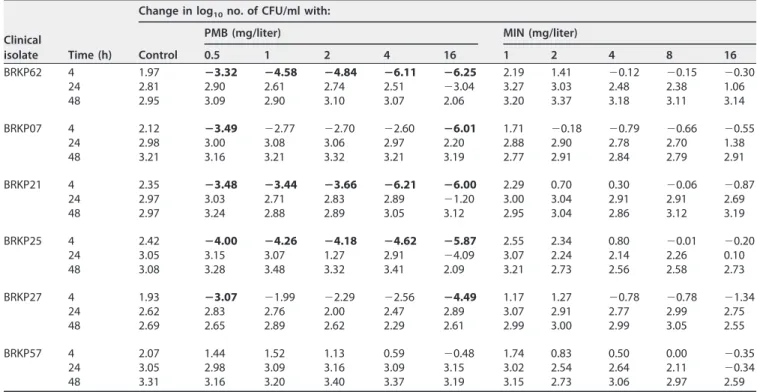
Monotherapy.Log changes in CFU per milliliter at 4, 24, and 48 h compared to the starting inoculum at 0 h for both polymyxin B monotherapy and minocycline mono-therapy are shown in Table 1. Polymyxin B monomono-therapy displayed concentration-dependent rapid bactericidal activity for all concentrations that peaked by 4 h against the polymyxin B-sensitive BRKP62, BRKP07, BRKP21, BRKP25, and BRKP27 isolates (Table 1; see also Fig. S1 in the supplemental material). However, bactericidal activity was not sustained beyond 8 h, and regrowth similar to the growth control results occurred beyond 24 h at polymyxin B concentrations ofⱕ4 mg/liter. The highest polymyxin B concentration evaluated (16 mg/liter) demonstrated a lower rate of regrowth similar to the growth control results, with a slight delay against BRKP62, BRKP21, and BRKP25 (Fig. S1a, c, and d). Against the polymyxin B-resistant BRKP57 isolate, polymyxin B at 16 mg/liter showed minimal activity, resulting in a ⬍1 log10 reduction followed by
regrowth.
Minocycline monotherapy did not result in bactericidal activity against any of the isolates at any of the minocycline concentrations (Table 1). All monotherapy concen-trations eventually resulted in growth similar to the growth control results by 48 h, although the rate of regrowth decreased with increasing minocycline concentrations (Fig. S2). The results seen with minocycline concentrations of 1, 2, and 4 mg/liter were comparable to the growth control results regardless of the minocycline susceptibility of the isolate. Minocycline at 8 mg/liter resulted in a⬍1 log10reduction at 4 h against all
isolates (Table 1), with regrowth observed by 24 h in the minocycline-susceptible (BRKP07, BRKP62, and BRKP57) isolates and by 8 h in the minocycline-resistant (BRKP27, BRKP21, and BRKP25) isolates. Minocycline at 16 mg/liter performed slightly better, resulting in a maximal reduction of 1.34 log10at 4 h followed by regrowth in all isolates
by 28 h.
polymyxin B in combination are shown in Table 2. Time-kill profiles for polymyxin B in combination with minocycline against four isolates with various levels of polymyxin B susceptibility (for BRKP62, polymyxin B MIC⫽ ⬍0.5 mg/liter; for BRKP25, polymyxin B MIC⫽0.5 mg/liter; for BRKP27, polymyxin B MIC⫽1 mg/liter; for BRKP57, polymyxin B MIC⫽64 mg/liter) are shown in Fig. 1.
Against BRKP62, an isolate susceptible to both polymyxin B and minocycline (poly-myxin B MIC, ⬍0.5 mg/liter; minocycline MIC, 4 mg/liter), polymyxin at 0.5 and 1 mg/liter in combination with all minocycline concentrations resulted in a ⬎2 log reduction by 8 h followed by regrowth similar to the growth control results at 48 h. Polymyxin B at ⱖ2 mg/liter in combination with minocycline at 1, 2, and 4 mg/liter resulted in bactericidal activity by 4 h followed by regrowth at up to 107CFU/ml at 48 h
(Fig. 1a, e, and i and Table 2). Polymyxin B at 2 and 4 mg/liter combined with minocycline at 8 and 16 mg/liter resulted in undetectable levels of isolate BRKP62 by 6 h that were sustained up to 48 h (Fig. 1m and q and Table 2).
Against the polymyxin B-sensitive and minocycline-resistant BRKP25 isolate (poly-myxin B MIC, 0.5 mg/liter; minocycline MIC, 32 mg/liter), poly(poly-myxin B concentrations of ⱖ2 mg/liter in combination with all minocycline concentrations were bactericidal by 4 h followed by regrowth beyond 24 h (Fig. 1b, f, j, n, and r). Surprisingly, the same activity was seen against BRKP07 and BRKP21, which also have a polymyxin B MIC of 0.5 mg/liter but different minocycline MICs of 2 and 16 mg/liter, respectively (Table 2; see also Fig. S3). Increasing minocycline concentrations against these isolates failed to improve the extent of killing regardless of the minocycline MIC.
Against BRKP27 (polymyxin B MIC, 1.0 mg/liter; minocycline MIC, 8 mg/liter), poly-myxin B and minocycline together at all concentrations resulted in a⬎2 log reduction by 8 h followed by regrowth by 48 h (Fig. 1c, g, k, o, and s).
The combination demonstrated minimal activity against the highly polymyxin B-resistant and minocycline-sensitive BRKP57 isolate (polymyxin B MIC, 64 mg/liter; minocycline MIC, 4 mg/liter) (Fig. 1d, h, l, p, and t). Polymyxin B at all concentrations combined with minocycline at 16 mg/liter resulted in a ⬎1 log reduction at 24 h
TABLE 1The change in log10CFU per milliliter at 4, 24, and 48 h during time-kill experiments with monotherapy with polymyxin B or
minocycline against an inoculum of⬃106CFU/ml of KPC-producingK. pneumoniaeclinical isolatesa
Clinical
isolate Time (h)
Change in log10no. of CFU/ml with:
Control
PMB (mg/liter) MIN (mg/liter)
0.5 1 2 4 16 1 2 4 8 16
BRKP62 4 1.97 ⴚ3.32 ⴚ4.58 ⴚ4.84 ⴚ6.11 ⴚ6.25 2.19 1.41 ⫺0.12 ⫺0.15 ⫺0.30 24 2.81 2.90 2.61 2.74 2.51 ⫺3.04 3.27 3.03 2.48 2.38 1.06 48 2.95 3.09 2.90 3.10 3.07 2.06 3.20 3.37 3.18 3.11 3.14 BRKP07 4 2.12 ⴚ3.49 ⫺2.77 ⫺2.70 ⫺2.60 ⴚ6.01 1.71 ⫺0.18 ⫺0.79 ⫺0.66 ⫺0.55
24 2.98 3.00 3.08 3.06 2.97 2.20 2.88 2.90 2.78 2.70 1.38 48 3.21 3.16 3.21 3.32 3.21 3.19 2.77 2.91 2.84 2.79 2.91 BRKP21 4 2.35 ⴚ3.48 ⴚ3.44 ⴚ3.66 ⴚ6.21 ⴚ6.00 2.29 0.70 0.30 ⫺0.06 ⫺0.87
24 2.97 3.03 2.71 2.83 2.89 ⫺1.20 3.00 3.04 2.91 2.91 2.69 48 2.97 3.24 2.88 2.89 3.05 3.12 2.95 3.04 2.86 3.12 3.19 BRKP25 4 2.42 ⴚ4.00 ⴚ4.26 ⴚ4.18 ⴚ4.62 ⴚ5.87 2.55 2.34 0.80 ⫺0.01 ⫺0.20
24 3.05 3.15 3.07 1.27 2.91 ⫺4.09 3.07 2.24 2.14 2.26 0.10 48 3.08 3.28 3.48 3.32 3.41 2.09 3.21 2.73 2.56 2.58 2.73 BRKP27 4 1.93 ⴚ3.07 ⫺1.99 ⫺2.29 ⫺2.56 ⴚ4.49 1.17 1.27 ⫺0.78 ⫺0.78 ⫺1.34
24 2.62 2.83 2.76 2.00 2.47 2.89 3.07 2.91 2.77 2.99 2.75 48 2.69 2.65 2.89 2.62 2.29 2.61 2.99 3.00 2.99 3.05 2.55 BRKP57 4 2.07 1.44 1.52 1.13 0.59 ⫺0.48 1.74 0.83 0.50 0.00 ⫺0.35
24 3.05 2.98 3.09 3.16 3.09 3.15 3.02 2.54 2.64 2.11 ⫺0.34 48 3.31 3.16 3.20 3.40 3.37 3.19 3.15 2.73 3.06 2.97 2.59
aBactericidal activity (ⱖ3 log
FIG 1Time-kill curves of polymyxin B (PMB) at 0.5, 1, 2, and 4 mg/liter in combination with minocycline (MIN) at 1, 2, 4, 8, and 16 mg/liter against an inoculum
of⬃106CFU/ml of the following KPC-producingK. pneumoniaeclinical isolates: (i) BRKP62 (polymyxin B MIC,⬍0.5 mg/liter; minocycline MIC, 4 mg/liter), (ii)
followed by regrowth by 48 h. Across all isolates, the pharmacodynamic activity decreased with increasing polymyxin B MIC regardless of the level of minocycline susceptibility (Fig. 1).
Combination therapy did not result in synergy before 4 h except for BRKP07, as the addition of minocycline did not increase the extent of early bactericidal activity seen with polymyxin B alone (Table 2). At 24 h, 60 of 120 (50%) combinations were considered synergistic and 43 of 120 (36%) combinations were considered additive. At 48 h, 19 of 120 (16%) combinations were synergistic and 44 of 120 (37%) were additive. A striking similarity between all isolates was that combinations with polymyxin B at 4 mg/liter were synergistic.
DISCUSSION
Here we evaluated polymyxin B and minocycline as monotherapy and in combina-tion against six clinicalK. pneumoniaeisolates with various levels of susceptibilities to each antibiotic. Polymyxin B monotherapy resulted in rapid bactericidal activity fol-lowed by regrowth by 24 h. While minocycline monotherapy at high concentrations increased the time to regrowth of all isolates, no bactericidal activity was observed. In combination with polymyxin B, the rapid bactericidal killing was followed by slower regrowth, as evidenced by synergy up to 48 h against all isolates. The extent of killing was greatest against the more susceptible polymyxin B isolates, as early bactericidal activity was seen when polymyxin B MICs were ⱕ0.5 mg/liter regardless of the minocycline MIC. Bactericidal activity was sustained at 48 h only against the most polymyxin B-susceptible isolate (MIC, ⬍0.5). Killing activity was attenuated with in-creasing polymyxin B MIC. In addition, bactericidal activity was observed at polymyxin B concentrations ofⱖ2 mg/liter, and synergy was observed against all isolates at the high concentration of 4 mg/liter. These findings further confirm that the pharmacody-namic activity of this combination is dependent on the level of polymyxin B suscepti-bility.
Previous studies have evaluated polymyxin (polymyxin B or colistin) in combination with minocycline againstA. baumanniiin bothin vitroandin vivomodels of infection with favorable results (17–19). Bowers et al. (20) determined that subinhibitory centrations of polymyxin B (0.5 mg/liter) could increase intracellular minocycline con-centrations (2 and 8 mg/liter) and enhance minocycline’s activity in static time-kill experiments against three clinical isolates and one laboratory isolate (20) with poly-myxin B MICs of ⱖ2 mg/liter and minocycline MICs ranging between 0.25 and 16 mg/liter. Zhang et al. (21) determined that the combination significantly reduced the MICs (polymyxin B, 0.25 to 4 mg/liter; minocycline, 0.25 to 8 mg/liter) against 25 resistant A. baumannii strains compared to the MIC for either polymyxin B (1 to 8 mg/liter) or minocycline (4 to 16 mg/liter) used as monotherapy (21). They also determined the synergy of the combination using the fractional inhibitory concentra-tion index (FICI). Yang et al. (22) tested the colistin and minocycline combinaconcentra-tion against four minocycline-resistant and colistin-sensitive isolates (minocycline MICs of 16 and 32 mg/liter; colistin MIC, 0.5 mg/liter) and revealed similar FICI results using a checkerboard synergy assay (22). Time-kill experiments in the same study using mino-cycline at 4 and 16 mg/liter in combination with colistin at 0.5 mg/liter showed synergy in all four isolates. Our study revealed similar findings for KPC-producingK. pneumoniae, as polymyxin B and minocycline were synergistic. However, bactericidal activity and synergy were more apparent when polymyxin B concentrations were ⱖ2 mg/liter against polymyxin-susceptible isolates.
the presence of various tet genes that code for upregulation of efflux pumps or ribosomal protection. Unlike that of the other tetracyclines, minocycline resistance is primarily attributable to the tet(B) gene, which upregulates efflux pumps (24). Our results are consistent with both hypotheses, as the pharmacodynamic activity was greatest against the more polymyxin-susceptible strains and at higher polymyxin B concentrations regardless of minocycline susceptibility. However, resistance to poly-myxin B is another growing concern. Dysfunction of themgrBgene has been found to upregulate the PhoP/PhoQ system, which reduces the negative charge of lipid A and subsequently the affinity of polymyxin B (25).
To our knowledge, this is the first report to evaluate polymyxin B and minocycline against KPC-producingK. pneumoniae. Further, we evaluated this combination against clinical isolates with a broad range of polymyxin B and minocycline susceptibilities. The combination performed better than monotherapy against all isolates by prolonging the time to regrowth to control levels from 24 h to 48 h. Bactericidal activity was observed against all polymyxin B-sensitive isolates with MICs of ⱕ0.5 mg/liter at clinically achievable concentrations. As such, this combination might be a viable treatment option against infections with such isolates. Although synergy was present, this com-bination did not demonstrate sustained bactericidal activity against these isolates past 8 h at clinically achievable concentrations. We also showed that the combination did not perform well against the highly polymyxin B-resistant BRKP57 isolate. Triple com-binations, although infrequently used in the United States, may be necessary for prolonged sustained activity to treat infections due to highly resistantK. pneumoniae
isolates. Previous studies have suggested a clinical and microbiological benefit to three-drug combinations (7, 26). Moreover, adding an additional drug such as a carbapenem or fosfomycin to the polymyxin B and minocycline combination may increase efficacy against KPC-producingK. pneumoniaeby increasing the log kill rate of polymyxin B with minocycline to theoretically slow any regrowth. Additional studies to assess such combinations are warranted.
This study had limitations. Antibiotic concentrations in time-kill experiments are inherently constant and do not fully simulate the pharmacokinetics of antibiotic drug regimens in the clinical setting. Therefore, these findings may not accurately reflect the activity of polymyxin B and minocyclinein vivoin the presence of drug metabolism and elimination and/or in the presence of an active immune system. The pharmacodynamic activity in response to humanized regimens needs to be evaluated, perhaps first employingin vivoinfection models, to further our knowledge and enable translation of these combinations to the clinic.
As KPC-producingK. pneumoniaestrains continue to spread and treatment options become more limited, it is important to determine which combinations of existing antibiotics are most effective and to prevent the emergence of further resistance. In this study, polymyxin B and minocycline showed synergistic activity at clinically relevant concentrations, although sustained activity was not achieved beyond 24 h and the mechanism has yet to be fully elucidated. Furtherin vitroand animal studies should be performed to evaluate the efficacy of this drug combination.
MATERIALS AND METHODS
Bacterial isolates, susceptibilities, and characterization.Six clinicalK. pneumoniaestrains (BRKP62
[polymyxin B MIC,⬍0.5 mg/liter; minocycline MIC, 4 mg/liter], BRKP07 [polymyxin B MIC, 0.5 mg/liter;
minocycline MIC, 2 mg/liter], BRKP21 [polymyxin B MIC, 0.5 mg/liter; minocycline MIC, 16 mg/liter], BRKP25 [polymyxin B MIC, 0.5 mg/liter; minocycline MIC, 32 mg/liter], BRKP27 [polymyxin B MIC, 1 mg/liter; minocycline MIC, 8 mg/liter], and BRKP57 [polymyxin B MIC, 64 mg/liter; minocycline MIC, 4 mg/liter]) were obtained from the Instituto Dante Pazzanese de Cardiologia, Sao Paulo, Brazil, during KPC outbreaks between June 2009 and June 2013 (27). MICs were determined in triplicate using broth microdilution according to Clinical and Laboratory Standards Institute (CLSI) guidelines (28). Genomic DNA was isolated from bacterial isolates using a DNA isolation kit (E.Z.N.A. bacterial DNA kit; Omega
Biotek, Norcross, GA). PCR analyses to evaluate the presence of seven different-lactamases belonging
to Ambler class A (GES and KPC), B (NDM, VIM, and IMP), and D (OXA-48 and OXA-40) (29) and ofmgrB
(25) andtet(B) (30) were carried out using specific primers (see Table S1 in the supplemental material)
commercially synthesized by IDT (Integrated DNA Technologies, Inc., Coralville, IA). Q5 Hi-FidelityTaq
the sequencing facility at Roswell Park Cancer Institute, Buffalo, NY. The NCBI website (www.ncbi.nlm .nih.gov) was used for nucleotide and deduced protein sequence analysis. The insertion sequence (IS)
was analyzed using the IS finder website (https://www-is.biotoul.fr/). All isolates were stored at⫺80°C
and subcultured on Mueller-Hinton agar (MHA) 1 day prior to each experiment.
Antibiotics and media.Stock solutions of polymyxin B (Sigma-Aldrich, USA; catalog no. WXBB4470V) and minocycline (Sigma-Aldrich, USA; catalog no. WXBB4793V) were prepared in water and filter
sterilized through 0.20-m-pore-size syringe filters (Corning Inc., Corning, NY) immediately prior to each
experiment. Susceptibility testing and static time-kill studies were performed using cation-adjusted (25.0
mg/liter Ca2⫹and 12.5 mg/liter Mg2⫹) Mueller-Hinton broth (CAMHB) (Becton, Dickinson and Company,
Sparks, MD).
Time-kill studies.The bacterial killing activity of polymyxin B and minocycline as monotherapies and in combination was evaluated against the six isolates by performing time-kill experiments over 48 h using methods previously described (26). Polymyxin B concentrations of 0.5, 1, 2, 4, and 16 mg/liter and minocycline concentrations of 1, 2, 4, 8, and 16 mg/liter were evaluated as monotherapy. A 4-by-5 concentration matrix of polymyxin B (0.5, 1, 2, and 4 mg/liter) in combination with minocycline (1, 2, 4, 8, and 16 mg/liter) and a growth control were also evaluated. The range of concentrations selected included clinically achievable unbound plasma concentrations and supratherapeutic concentrations to evaluate any potential benefits of intensive dosing. Minocycline dosed as a 200-mg intravenous infusion over 30 to 60 min yields maximum concentrations of 3 to 8.75 mg/liter, and the steady-state plasma concentrations following infusion of 100 mg of minocycline every 12 h range between 1 and 4 mg/liter (31–33). The average steady-state plasma concentration of polymyxin B is reported as approximately 2.79 mg/liter for doses ranging from 0.45 to 3.38 mg/kg of body weight/day (34). Levels of protein binding
for minocycline and polymyxin B are⬃76% and⬃58%, respectively.
Subcultured bacterial isolates were added to CAMHB to produce a bacterial suspension with an initial
inoculum of⬃106CFU/ml. The antibiotic(s) was added to the bacterial suspension in the
logarithmic-growth phase at 37°C. Samples were obtained at 0, 1, 2, 4, 6, 8, 24, 28, 32, and 48 h for bacterial quantification. A ProtoCOL automated colony counter (Synbiosis, Cambridge, United Kingdom) was used to quantify bacteria after 24 h of incubation at 37°C. The limit of quantification was 100 CFU/ml.
Pharmacodynamic analysis.The evaluation of the pharmacodynamic effect (E) of the individual and
combination therapies was performed according to the change in log10CFU per milliliter at an early time
point of 4 h and at later time points of 24 and 48 h compared to the change in log10CFU per milliliter
at baseline (0 h) according to the following equation:
E ⫽log10
CFU(4, 24, or 48 h)
CFU(0 h)
Bactericidal activity was defined as aⱖ3 log10CFU/ml reduction from baseline. Synergy was defined
as aⱖ2 log10CFU/ml reduction and additivity as aⱖ1 to⬍2 log10reduction in CFU/ml caused by the
combination of polymyxin B and minocycline compared to the most active single agent in the combination.
SUPPLEMENTAL MATERIAL
Supplemental material for this article may be found athttps://doi.org/10.1128/AAC .00073-17.
SUPPLEMENTAL FILE 1,PDF file, 0.6 MB.
ACKNOWLEDGMENTS
We thank Alison Vitale for all her help and support in the laboratory. This study received no funding.
We have no conflicts of interest to declare.
REFERENCES
1. Podschun R, Ullmann U. 1998. Klebsiella spp. as nosocomial pathogens: epidemiology, taxonomy, typing methods, and pathogenicity factors. Clin Microbiol Rev 11:589 – 603.
2. Tzouvelekis LS, Markogiannakis A, Psichogiou M, Tassios PT, Daikos GL. 2012. Carbapenemases in Klebsiella pneumoniae and other Enterobacteriaceae: an evolving crisis of global dimensions. Clin
Micro-biol Rev 25:682–707.https://doi.org/10.1128/CMR.05035-11.
3. Patel G, Huprikar S, Factor SH, Jenkins SG, Calfee DP. 2008. Outcomes of carbapenem-resistant Klebsiella pneumoniae infection and the impact of antimicrobial and adjunctive therapies. Infect Control Hosp Epidemiol
29:1099 –1106.https://doi.org/10.1086/592412.
4. Schwaber MJ, Klarfeld-Lidji S, Navon-Venezia S, Schwartz D, Leavitt A, Carmeli Y. 2008. Predictors of carbapenem-resistant Klebsiella pneu-moniae acquisition among hospitalized adults and effect of acquisition
on mortality. Antimicrob Agents Chemother 52:1028 –1033.https://doi
.org/10.1128/AAC.01020-07.
5. Arnold RS, Thom KA, Sharma S, Phillips M, Johnson JK, Morgan DJ. 2011. Emergence of Klebsiella pneumoniae carbapenemase
(KPC)-producing bacteria. South Med J 104:40 – 45.https://doi.org/10.1097/
SMJ.0b013e3181fd7d5a.
6. Gupta N, Limbago BM, Patel JB, Kallen AJ. 2011. Carbapenem-resistant Enterobacteriaceae: epidemiology and prevention. Clin Infect Dis 53:
60 – 67.https://doi.org/10.1093/cid/cir202.
7. Munoz-Price LS, Poirel L, Bonomo RA, Schwaber MJ, Daikos GL, Cormican M, Cornaglia G, Garau J, Gniadkowski M, Hayden MK, Kumarasamy K, Livermore DM, Maya JJ, Nordmann P, Patel JB, Pat-erson DL, Pitout J, Villegas MV, Wang H, Woodford N, Quinn JP. 2013. Clinical epidemiology of the global expansion of Klebsiella
pneu-moniae carbapenemases. Lancet Infect Dis 13:785–796.https://doi
.org/10.1016/S1473-3099(13)70190-7.
reports. Ann Clin Microbiol Antimicrob 11:32.https://doi.org/10.1186/ 1476-0711-11-32.
9. Falagas ME, Lourida P, Poulikakos P, Rafailidis PI, Tansarli GS. 2014. Antibiotic treatment of infections due to carbapenem-resistant Enterobacteriaceae: systematic evaluation of the available evidence.
Antimicrob Agents Chemother 58:654 – 663.https://doi.org/10.1128/
AAC.01222-13.
10. Matthaiou DK, Michalopoulos A, Rafailidis PI, Karageorgopoulos DE, Papaioannou V, Ntani G, Samonis G, Falagas ME. 2008. Risk factors associated with the isolation of colistin-resistant gram-negative bacteria:
a matched case-control study. Crit Care Med 36:807– 811.https://doi
.org/10.1097/CCM.0B013E3181652FAE.
11. Liu YY, Wang Y, Walsh TR, Yi LX, Zhang R, Spencer J, Doi Y, Tian G, Dong B, Huang X, Yu LF, Gu D, Ren H, Chen X, Lv L, He D, Zhou H, Liang Z, Liu JH, Shen J. 2016. Emergence of plasmid-mediated colistin resistance mechanism MCR-1 in animals and human beings in China: a microbio-logical and molecular biomicrobio-logical study. Lancet Infect Dis 16:161–168. https://doi.org/10.1016/S1473-3099(15)00424-7.
12. Paul M, Carmeli Y, Durante-Mangoni E, Mouton JW, Tacconelli E, Theuretzbacher U, Mussini C, Leibovici L. 2014. Combination therapy for carbapenem-resistant Gram-negative bacteria. J Antimicrob Chemother
69:2305–2309.https://doi.org/10.1093/jac/dku168.
13. Zavascki AP, Bulitta JB, Landersdorfer CB. 2013. Combination therapy for carbapenem-resistant Gram-negative bacteria. Expert Rev Anti Infect
Ther 11:1333–1353.https://doi.org/10.1586/14787210.2013.845523.
14. Bishburg E, Shah M, Chan T. 2014. Use of intravenous minocycline for the treatment of methicillin-resistant Staphylococcus aureus (MRSA) and resistant Gram-negative organisms: experience in a tertiary care
hospi-tal. Infect Dis Clin Pract (Baltim Md) 22:26 –31.https://doi.org/10.1097/
IPC.0b013e31828bbb82.
15. Pogue JM, Neelakanta A, Mynatt RP, Sharma S, Lephart P, Kaye KS. 2014. Carbapenem-resistance in Gram-negative bacilli and intravenous minocycline: an antimicrobial stewardship approach at the Detroit
Med-ical Center. Clin Infect Dis 59:S388 –S393. https://doi.org/10.1093/cid/
ciu594.
16. Ritchie DJ, Garavaglia-Wilson A. 2014. A review of intravenous minocy-cline for treatment of multidrug-resistant Acinetobacter infections. Clin
Infect Dis 59:S374 –S380.https://doi.org/10.1093/cid/ciu613.
17. Tan TY, Ng LSY, Tan E, Huang G. 2007. In vitro effect of minocycline and colistin combinations on imipenem-resistant Acinetobacter baumannii
clinical isolates. J Antimicrob Chemother 60:421– 423.https://doi.org/10
.1093/jac/dkm178.
18. Liang W, Liu XF, Huang J, Zhu DM, Li J, Zhang J. 2011. Activities of colistin- and minocycline-based combinations against extensive drug resistant Acinetobacter baumannii isolates from intensive care unit
pa-tients. BMC Infect Dis 11:109.https://doi.org/10.1186/1471-2334-11-1.
19. Rodríguez CH, Nastro M, Vay C, Famiglietti A. 2015. In vitro activity of minocycline alone or in combination in multidrug-resistant
Acinetobac-ter baumannii isolates. J Med Microbiol 64:1196 –1200.https://doi.org/
10.1099/jmm.0.000147.
20. Bowers DR, Cao H, Zhou J, Ledesma KR, Sun D, Lomovskaya O, Tam VH. 2015. Assessment of minocycline and polymyxin B combination against Acinetobacter baumannii. Antimicrob Agents Chemother 59:2720 –2725. https://doi.org/10.1128/AAC.04110-14.
21. Zhang Y, Chen F, Sun E, Ma R, Qu C, Ma L. 2013. In vitro antibacterial activity of combinations of fosfomycin, minocycline and polymyxin B
on pan-drug-resistant Acinetobacter baumannii. Exp Ther Med 5:1737–1739.
22. Yang Y-S, Lee Y, Tseng K-C, Huang W-C, Chuang M-F, Kuo S-C, Yang Lauderdale T-L, Chen T-L. 25 April 2016. In vivo and in vitro efficacy of minocycline-based combination therapy for minocycline-resistant
Acin-etobacter baumannii. Antimicrob Agents Chemotherhttps://doi.org/10
.1128/aac.02994-15.
23. Barth N, Ribeiro VB, Zavascki AP. 2015. In vitro activity of polymyxin B plus imipenem, meropenem, or tigecycline against KPC-2-producing Enterobacteriaceae with high MICs for these
antimicrobi-als. Antimicrob Agents Chemother 59:3596 –3597.https://doi.org/10
.1128/AAC.00365-15.
24. Chopra I, Roberts M. 2001. Tetracycline antibiotics: mode of action, applications, molecular biology, and epidemiology of bacterial
resis-tance. Microbiol Mol Biol Rev 65:232–260.https://doi.org/10.1128/MMBR
.65.2.232-260.2001.
25. Poirel L, Jayol A, Bontron S, Villegas MV, Ozdamar M, Turkoglu S, Nordmann P. 2015. The mgrB gene as a key target for acquired resis-tance to colistin in Klebsiella pneumoniae. J Antimicrob Chemother
70:75– 80.https://doi.org/10.1093/jac/dku323.
26. Diep J, Jacobs DM, Sharma R, Covelli J, Bowers DR, Russo TA, Rao GG. 21 November 2016. Polymyxin B in combination with rifampin and mero-penem against polymyxin B-resistant KPC-producing Klebsiella
pneu-moniae. Antimicrob Agents Chemother https://doi.org/10.1128/aac
.02121-16.
27. Abboud CS, Monteiro J, Stryjewski ME, Zandonadi EC, Barbosa V, Dantas D, Sousa EE, Fonseca MJ, Jacobs DM, Pignatari AC, Kiffer C, Rao GG. 2016. Post-surgical mediastinitis due to carbapenem-resistant Enterobacteriaceae: clinical, epidemiological and survival
characteristics. Int J Antimicrob Agents 47:386 –390.https://doi.org/
10.1016/j.ijantimicag.2016.02.015.
28. CLSI. 2016. Performance standards for antimicrobial susceptibility test-ing, 26th ed. CLSI supplement M100S. Clinical and Laboratory Standards Institute, Wayne, PA.
29. Monteiro J, Widen RH, Pignatari AC, Kubasek C, Silbert S. 2012. Rapid detection of carbapenemase genes by multiplex real-time PCR. J
Anti-microb Chemother 67:906 –909.https://doi.org/10.1093/jac/dkr563.
30. Aminov RI, Chee-Sanford JC, Garrigues N, Teferedegne B, Krapac IJ, White BA, Mackie RI. 2002. Development, validation, and application of PCR primers for detection of tetracycline efflux genes of Gram-negative
bacteria. Appl Environ Microbiol 68:1786 –1793.https://doi.org/10.1128/
AEM.68.4.1786-1793.2002.
31. Agwuh KN, MacGowan A. 2006. Pharmacokinetics and pharmacodynam-ics of the tetracyclines including glycylcyclines. J Antimicrob Chemother
58:256 –265.https://doi.org/10.1093/jac/dkl224.
32. Saivin S, Houin G. 1988. Clinical pharmacokinetics of doxycycline and
minocycline. Clin Pharmacokinet 15:355–366.https://doi.org/10.2165/
00003088-198815060-00001.
33. Bishburg E, Bishburg K. 2009. Minocycline–an old drug for a new century: emphasis on methicillin-resistant Staphylococcus aureus (MRSA) and Acinetobacter baumannii. Int J Antimicrob Agents 34:
395– 401.https://doi.org/10.1016/j.ijantimicag.2009.06.021.
34. Sandri AM, Landersdorfer CB, Jacob J, Boniatti MM, Dalarosa MG, Falci DR, Behle TF, Bordinhão RC, Wang J, Forrest A, Nation RL, Li J, Zavascki AP. 2013. Population pharmacokinetics of intravenous polymyxin B in critically ill patients: implications for selection of dosage regimens. Clin