AR
TIGO
AR
TICLE
1 Departamento de Tecnologia em Saúde e Biologia, Instituto Federal de Educação, Ciência e Tecnologia da Bahia. R. Emídio dos Santos, Barbalho. 40301-015 Salvador BA Brasil. muller.juliana@ yahoo.com.br 2 Programa de Pós-Graduação em Saúde, Ambiente e Trabalho, Departamento de Medicina Preventiva, Faculdade de Medicina, Universidade Federal da Bahia (UFBA). Salvador BA Brasil. 3 Departamento de Estatística, Instituto de Matemática, UFBA. Salvador BA Brasil. 4 Department of
Environmental Sciences and Engineering, University of North Carolina. Chapel Hill NC EUA.
Artisanal fisherwomen/shellfish gatherers:
analyzing the impact of upper limb functioning and disability
on health-related quality of life
Pescadoras artesanais/marisqueiras:
análise do impacto da funcionalidade e incapacidade de membros
superiores sobre a qualidade de vida relacionada com a saúde
Resumo O objetivo foi analisar a incapacidade
e a funcionalidade de membros superiores e veri-ficar sua associação com a qualidade de vida re-lacionada com a saúde de pescadoras artesanais da Bahia, Brasil. Estudo epidemiológico, de corte transversal, envolvendo uma amostra de 209 pes-cadoras artesanais. Foram utilizados questioná-rios estruturados para informações sociodemográ-ficas e comorbidades e os instrumentos Disabilities of the Arm, Shoulder and Hand (DASH) e Medi-cal Outcomes Study 36-Item Short-Form Healthy Survey (SF-36), para, respectivamente, avaliação dos membros superiores e qualidade de vida rela-cionada com a saúde. Os resultados encontrados demonstram que a presença de distúrbios muscu-loesqueléticos (DME) em membros superiores afe-ta direafe-tamente os valores do instrumento DASH e os escores do SF-36v01, bem como a correlação negativa encontrada entre o DASH e os domínios do SF-36v01. As variáveis capacidade funcional, dor e aspectos sociais afetam negativamente a fun-cionalidade de membros superiores e as atividades do cotidiano e do trabalho de pescadoras artesa-nais. A presença de doença crônica e a ausência de intervenção e reabilitação desses profissionais geram, a longo prazo, casos de incapacidade. Palavras-chave Funcionalidade e incapacidade de membros superiores, Qualidade de vida rela-cionada com a saúde, Pescadores artesanais/ma-risqueiras, DASH, SF-36
Abstract The aim is to analyze upper limb
func-tioning and disability, and its association with health-related quality of life among artisanal fisherwomen from Bahia, Brazil. Cross-section-al epidemiologicCross-section-al study was conducted with a sample of 209 fisherwomen. Structured question-naires were used for socio-demographic and co-morbidity information, as well as the instruments
Disabilities of the Arm, Shoulder and Hand (DASH) and Short-Form Healthy Survey (SF-36) respectively, to evaluate the upper limbs and health-related quality of life.The results demon-strated that the presence of musculoskeletal disor-ders in the upper limbs directly affects the values of the DASH instrument and the SF-36v01 ques-tionnaire scores, while also generating a negative correlation between the DASH and SF-36v01. The varying functioning abilities, pain and social aspects negatively affect upper limb function, and the daily activities and work of fisherwomen. The presence of chronic disease and the absence of in-tervention and rehabilitation for these profession-als, that could produces, in a long-term, cases of disability.
Key words Upper limb functioning and disabili-ty, Health-related quality of life, Artisanal fisher-women/shellfish gatherers, DASH, SF-36
Juliana dos Santos Müller 1
Ila Rocha Falcão 2
Maria Carolina Barreto Moreira Couto 2
Wendel da Silva Viana 2
Ivone Batista Alves 2
Denise Nunes Viola 3
Courtney Georgette Woods 4
Mül
le
Introduction
Human functioning and disability are a dynamic interaction between health conditions (diseases, trauma, injuries and disorders) and contextual factors (including environmental and personal factors)1. According to the World Health Organi-zation2, functioning refers to all bodily functions, activities and participation, while disability in-cludes impairments and limitations of activity, and/or restrictions in social participation3. Based on these assumptions, it should be noted that the lifestyle and labor activity of a population is di-rectly linked to maintaining functioning and hu-man disability.
The artisanal fisherwomen/shellfish gatherers that are the focus of this study, primarily sustain their families through fishing and shellfish gath-ering, and good physical condition is fundamen-tal in carrying out these activities due to the style and manner in which the work is performed. According to data from the International Labour Organization (ILO), there are 2 million artis-anal fishers in Latin America and the Caribbean, where fishing is more than a job, but a way of life4.
In Brazil, according to Ministry of Fisheries and Aquaculture (MPA), there is an estimated one million artisanal fishers, and given Brazil’s geographic characteristics, fishers are found along the entire coastline of the country5. In the northeast region, there is fishing and shellfish gathering in “Baía de Todos os Santos”, consid-ered the second largest geographical accident of its kind in Brazil, the first being São Marco bay in Maranhão6.
Todos os Santos Bay is located in the state of Bahia, and it is estimated that close to 11,850 people practice fishing as a main productive ac-tivity, representing 33.8% of the total of those dedicated to fishing in the entire State of Bahia, a sector that is also excluded from the formal labor market7. According to Pena et al. (2011):
“The work of shellfish gatherers at the beach sand and in the mangroves is of an itinerant na-ture where they maintain their upper body bent over for long periods of times8.”
Generally, fishermen works continue to work even in the face of bodily pain, ailments (in-cluding musculoskeletal disorders, MSDs) and illness8. This could be related to the physical burden of work, as well as the accumulation of housework, thus making the daily lives of these women exhausting and highly dependent on their overall state of health9.
It has become extremely necessary to evalu-ate the health status of this important group of workers, as the labor activity involved in shellfish gathering is notorious for causing muscle over-load in the neck, shoulders, back, upper limbs and lower back, aside from the rhythmic excess centered on the wrist in repetitive activities that compromise health8.
Given this premise, it is known that the in-creasing prevalence of chronic diseases com-bined with the increasing number of workers that develop long-term dysfunction processes, creates a new demand for health services, as well as a challenge in the identification and profes-sional referrals for these individuals. According to the Ministry of Health10, the high prevalence of musculoskeletal disorders is because of chang-es in the workplace and companichang-es, regardlchang-ess of the individuals and their physical and psycho-social limitations. Fishing is an occupation that involves ergonomic, physical, chemical and bio-logical risks8.
The verification of functioning has become the central factor in assessing and determining conduits, including in patients with chronic med-ical conditions11. Disability generates losses in the individual’s functioning, and to analyze the dam-age, there are generic and specific instruments that are recommended as part of the assessment to measure the psychosocial consequences, the impact of the disease on the individual’s routine and dysfunction in the affected limb12 .
The objective of this article is to analyze the disability and functioning of the upper limbs and examine its association with the health-related quality of life of artisanal fisherwomen from the municipality of Saubara in the state of Bahia.
Materials and methods
A cross-sectional epidemiological study was con-ducted with a sample of the population of arti-sanal fisherwomen/shellfish gatherers from Sau-bara in the state of Bahia.
aúd
e C
ole
tiv
a,
22(11):3635-3644,
2017
(EAP) is made up of 5,196 people14, and artisanal fishing is one of the main economic activities practiced by residents14. Artisanal fishers regis-tered with the Saubara Association of Seafood Workers correspond with (11%) of the EAP.
To calculate the sample, 50% prevalence and 5% error was used on the population total (N) of 426 artisanal fisherwomen/shellfish gatherers registered in the municipal Association of Sea-food workers, resulting in a minimum sample of 203 individuals. The estimate of the margin of error was between 3% and 10%, constituting the final sample of 209 participants, 3% more than the minimum of losses. The sampling was random, simple and without replacement, where each individual was drawn using a random num-ber chart.
Data was collected between April 10 and May 10 of 2013. The interviewers had a minimum of a high school education and their training in-volved ethical, theoretical and methodological research aspects. The following inclusion criteria was defined for the research participants: female, 18 years of age or older and at least one year of practicing the activity.
The artisanal fisherwomen/shellfish gatherers selected were invited by their association to fill out a questionnaire about health, and were also informed about the broader research objectives that involved the suspected diagnosis of muscu-loskeletal disorders. Afterwards, all of them were referred to the Occupational Health Services clinic (SESAO) at the Professor Edgard Santos University Hospital (HUPES) for specialized ex-ams. The fisherwomen/shellfish gatherers that did not participate in the study but had some kind of musculoskeletal complaint were also re-ferred to those services.
The total number of people registered with the Saubara Association of Seafood workers during the period of study (April and May of 2013) was 568 individuals, of which 426 (75%) were females and 142 (25%) were males. The great majority of female artisanal fishers/shell-fish gatherers are registered in associations. Since only those registered with associations have a right to access the social benefits the federal gov-ernment currently grants to artisanal fishers, there is an interest among this poor population to register in order to guarantee their right to those benefits. Therefore, the 426 artisanal fish-erwomen/shellfish gatherers is an approximation of the total number of workers in that sector in the municipality, and represents close to 7.4% of the women residents in Saubara, considering the
data from the last census the IBGE carried out in the municipality.
The selected shellfish gatherers for the sam-ple were given three questionnaires. The struc-tured questionnaire had the following items: identification; sociodemographic aspects; work information; current and previous occupational history; duration of time as a shellfish gatherer; daily hours of work; habits like smoking, alcohol consumption, medication use and physical activ-ity; comorbidities; housework; musculoskeletal symptoms; physical and psychosocial demands at work.
The second instrument applied was the Dis-abilities of the Arm, Shoulder and Hand (DASH), a questionnaire that specifically measures the dis-ability and symptoms of individuals with mus-culoskeletal disorders in the upper limbs. It is composed of 30 questions related to the health of the individual a week before collection, and has eighteen components: pain, weakness, stiffness, tingling, daily activities, housekeeping, shopping, recreational activities, self-care, dressing, eating, sexual activity, sleep, family care, work, socializa-tion and self-image, plus an opsocializa-tional module for athletes and musicians, and another for work-ers15.
The Brazilian version of Disabilities, Arm, Shoulder and Hand (DASH) showed good va-lidity and reliability, and its use is indicated in specialized services that monitor patients with musculoskeletal diseases. Its use has become in-teresting, as it contains the physical, social and psychological components proposed by the In-ternational Classification of Functioning, Dis-ability and Health (ICF)16.
The instrument demonstrated excellent pre-cision for measuring disability in a large group of disorders of the upper limbs, where, regardless of the condition or of its location, the evaluation of the upper limbs was conducted as a functional unit. The analysis of this instrument is shown on a numerical scale of 100-0, and the largest raw scores indicate greater impairment in disability17.
Mül
le
time of application and a year before. The final score ranges from 0 to 100, zero corresponding to a worse overall health status and 100 to the best health status. Each domain is analyzed separately so that the real problems related to general health can be identified18. According to Ware Jr.19, there have been 4,000 publications documenting the use of SF-36.
Ethical Aspects
This research was submitted and approved by the Committee on Research Ethics in Human Beings (CEP) at the Faculdade de Medicina da Bahia (Parecer 356.261), in accordance with the standards of resolution no. 466 from the Nation-al HeNation-alth Council, December 2012. After the au-thorization from CEP/UFBA, a request to use the SF-36v01 instrument was submitted to the orga-nization that created this questionnaire. Those that were invited and agreed to participate in the study signed two-way informed consent terms, ensuring the confidentiality of information, their voluntary and anonymous participation, the ab-sence of any compensation for participation in the study, and the availability of researchers to clarify anything about the project before, during and after the study period. Researchers and / or the coordinator of the project carried out instru-ment application.
Statistical Analysis
This began with descriptive analysis for each domain from both questionnaires, as well as the calculation of specific scores. For the SF-36v01 instrument, software provided by the creator or-ganization of the instrument was used, of which the calculated scores ranged from 0 to100, repre-senting the worst and best quality of life respec-tively.
To calculate scores from the DASH instru-ment, the five point Likert scale was used, in which the total score ranges from 100 (severe im-pairment) to 0 (no imim-pairment). Note that the score of this module can only be calculated if 27 answers from the 30 questions are received. Each question answered has a maximum value of 5.
The total DASH score was calculated by the sum of the score for each item, decreasing the value of 30 and dividing the result by 1.2. This transformation is made to allow comparison of scores with those of other 0-100 scales, accord-ing to the guidelines set by the creator agency. A high score (100) indicates severe dysfunction,
and a low score (0) no dysfunction20,21. The pro-cess described for the dysfunction / symptoms score is also used to calculate the four items from the optional modules. To calculate the score, the four questions of each item must be answered. The optional module score is calculated sepa-rately and obtained by the sum of the marked score for each question, reducing the value of 4 and dividing the result by 0.1620,21 . Then the central tendency (mean, median) and dispersion (standard deviation) measures were calculated for each SF-36v01 domain and the total DASH score, as well as the correlation between the do-main values of the two instruments. A negative binomial regression model was also performed, as described below.
Dependent Variable
The response variable was the DASH instru-ment score that represents the evaluation of the upper limb functioning and symptoms as a func-tional unit. This value represents the disability and functioning of the upper limbs.
Independent Variables
The independent variables include all do-mains of the SF-36v01 questionnaire, sociode-mographic information and self-reported chron-ic diseases. The MSD variable was the only one among the chronic diseases for which research was done with validated instruments, in accor-dance with previous studies from the Research Group on Health, Environment and Sustainabil-ity of Artisanal Fisheries Workers.
For the MSD variable, a record of pain or dis-comfort in each region in the last twelve months was considered, with a minimum duration of one week or a minimum monthly frequency, not caused by acute injury. Symptoms had to be re-lated to at least one of the following: degree of severity ≥ 3 on a scale of 0 to 5 (no discomfort to unbearable pain); seeking medical attention be-cause of the problem; absence from work (official or otherwise); change of work because of health restrictions22,23. To calculate MSD, the presence of MSD in at least one of 12 anatomical areas was considered.
Regression Model
aúd
e C
ole
tiv
a,
22(11):3635-3644,
2017
with support from the free statistical package R 3.1.3. A negative binomial regression model is used when the outcome under consideration is a count, and the assumption of the Poisson mod-el where the mean is equal to the variance is not respected, often because of the greater dispersion of data. In this article, the variance is greater than the mean.
The pre-selection of the independent vari-ables, for input on both initial multiple linear regression models, was based on the univariate linear regression, considering a p-value less than 0.25 in the Wald test for coefficient significance. The biological plausibility of the associations was also considered for entry into the initial models. Thus, the variables selected: physical functioning, bodily pain, social functioning, mental health, MSD in the shoulder, wrist / hand and overall MSD (all body segments).
In the third model, these variables were select-ed: functioning, bodily pain, social functioning, MSD in the shoulder, wrist / hand with p-value less than 0.17. The final model was derived from the variables with p-values less than 0.05, leaving, in the final model, physical functioning, bodily pain and social functioning, as shown in Table 1.
Results
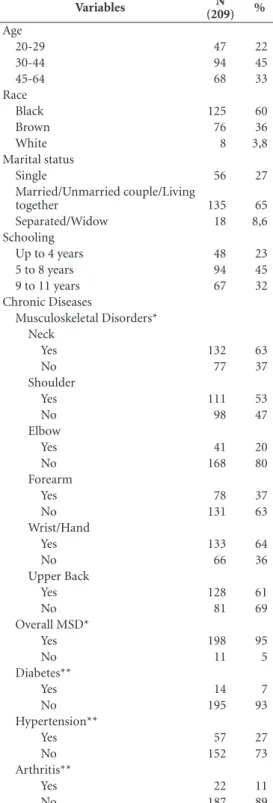
A total of 209 artisanal fisherwomen / shellfish gatherers participated in this study. The entire sample is composed of women between the ages of 30 and 44 (78%), black or brown (96.2%), with a maximum elementary school education (77%), and predominantly married (64.6%). The presence of chronic diseases showed muscu-loskeletal disorders, especially in the upper limbs (as shown in Table 1), correlating with the instru-ment used in this study.
Table 2 shows the descriptive analysis of the domain scores from the SF-36v01 and DASH instruments (general and optional). The mean DASH (dysfunction and symptoms) found for this population was 30.8 with a standard devia-tion (SD) of 21.0, and the opdevia-tional DASH was 29.0 with a standard deviation (SD) of 27.7; For the SF-36v01 instrument, the mean score ranged from 47.3 to 66.4.
A DASH instrument comparison between its general part (dysfunction and symptoms) and its optional part (leisure and business) there were no significant differences found in the medians.
Table 3 shows the mean scores of the DASH instrument in relation to the presence of
mus-Table 1. Socioeconomic distribution and chronic diseases among artisanal fisherwomen/shellfish gatherers from Saubara-Bahia, 2013.
Variables (209)N %
Age
20-29 47 22
30-44 94 45
45-64 68 33
Race
Black 125 60
Brown 76 36
White 8 3,8
Marital status
Single 56 27
Married/Unmarried couple/Living
together 135 65
Separated/Widow 18 8,6
Schooling
Up to 4 years 48 23
5 to 8 years 94 45
9 to 11 years 67 32
Chronic Diseases
Musculoskeletal Disorders* Neck
Yes 132 63
No 77 37
Shoulder
Yes 111 53
No 98 47
Elbow
Yes 41 20
No 168 80
Forearm
Yes 78 37
No 131 63
Wrist/Hand
Yes 133 64
No 66 36
Upper Back
Yes 128 61
No 81 69
Overall MSD*
Yes 198 95
No 11 5
Diabetes**
Yes 14 7
No 195 93
Hypertension**
Yes 57 27
No 152 73
Arthritis**
Yes 22 11
No 187 89
Mül
le
culoskeletal disorders in the upper limbs: neck (35.5), shoulder (37.9), elbow (43.4), forearm (38.6), wrist / hand (37.5) and upper back (35.9). It demonstrated that the presence of MSD’s in the upper limbs increases the mean values of the DASH instrument for all segments.
A correlation between DASH scores and the SF-36v01 values from domains grouped into eight categories, representing the negative cor-relation in which the increase of the DASH value (severe dysfunction) diminishes the
health-relat-ed quality of life, except in the physical and emo-tional functioning domains.
The final model of the negative binomial re-gression is shown in Table 4, where the variables physical functioning, bodily pain, social func-tioning and MSD in the wrist (selected variables) adversely affect the functioning of upper limbs. The p values are highly significant in physical functioning capacity (< 0.000), bodily pain (< 0.000), and lower statistical significance for the variable social functioning (0.011).
Discussion
This study aimed to assess upper limb function-ing and correlate it with the HRQOL of artisanal fisherwomen / shellfish gatherers from Sauba-ra-Bahia by applying the DASH and SF-36v01 in-struments. It should be noted that systematically reviewed studies in the national literature that addressed this issue were not found, particularly with this group of workers. International stud-ies discuss the interference of chronic disease on quality of life, however they carried out research using quantitative tools.
Since this is an original study, and various diseases were detected in the sample, it is of ut-most importance to analyze the failure of the functioning point of view in the artisanal fish-Table 2. Descriptive analysis of the DASH and
SF-36v01 instruments from artisanal fisherwomen / shellfish gatherers from Saubara-Bahia, 2013.
Instruments Mean SD
DASH
Optional DASH
30,8 29,0
21,0 27,7 SF-36v01
Physical Functioning 65,7 24,9 Physical Role limitations 47,3 40,8
Bodily Pain 50,4 25,4
General Health Perceptions 51,2 21,8
Vitality 54,5 22,9
Social Functioning 66,4 30,5 Emotional Role Limitations 62,4 42,9
Mental Health 64,8 23,5
Table 3. Mean and standard deviation of the DASH instrument scores according to MSD distribution in artisanal fisherwomen / shellfish gatherers from Saubara-Bahia, 2013.
Musculoskeletal Disorder Mean SD n %
Neck
Yes 35,5 23,2 132,0 63,3
No 22,6 17,0 77,0 36,7
Shoulder
Yes 37,9 22,5 111,0 53,1
No 22,7 18,3 98,0 46,9
Elbow
Yes 43,4 26,3 41,0 19,6
No 27,7 19,7 168,0 80,4
Forearm
Yes 38,6 24,8 78,0 37,3
No 26,1 18,6 131,0 62,7
Wrist/Hand
Yes 37,5 22,8 133,0 63,6
No 18,0 14,1 76,0 39,4
Upper back
Yes 35,9 22,0 128,0 61,2
aúd
e C
ole
tiv
a,
22(11):3635-3644,
2017
er professional category. Some previous studies of the same population showed the prevalence of MSD’s in all body segments26,27 with 94.7% of shellfish getherers affected. For Walsh et al.28, work-related MSD’s can generate different de-grees of disability and are considered one of the most serious problems in the occupational health field.
The correlation between the SF-36v01 and DASH findings demonstrated the presence of difficulty in carrying out daily tasks (moderate dysfunction), directly implying the HRQOL of the artisanal fisherwomen/shellfish gatherers studied. The mean score found with the DASH application (dysfunction and symptoms) was 30.8, confirming other studies29 that recognized a difficulty in physical, social, psychological and symptomatic dimensions when applying this instrument. On the other hand, there was no statistical difference in the mean values of the two DASH instrument modules. However, this comparison of the overall DASH module scores for artisanal fisherwomen / shellfish gatherers is weak because there are no normative reference studies of the Brazilian population, it is only ap-plicable in orthopedic and surgical diseases.
In a study conducted in Turkey with patients with rheumatoid arthritis, a high negative cor-relation between the DASH mean values and the physical health components from the SF-36 were found. With regard to artisanal fishers from Sau-bara-Bahia, the presence of chronic diseases as a result of work activity was proven, with the phys-ical functioning and bodily pain domains (from the SF-36v01 instrument) being statistically sig-nificant (p-value <0.000) in relation to the dys-function of the upper limbs.
Bouts in the shoulder segment generated pain and reduced joint mobility and consequent-ly, adversely affected the functioning skills, job activities, and the quality of life of those people30. In addition, disorders of this joint represent a critical socio-economic problem in the case of artisanal fishers, for health maintenance is nec-essary to perform the work that generates family subsistence.
For Moraes et al.31, upper limb disability of workers who expose this joint complex to a large amount of repetitive movement, and position the upper limbs in the shoulder abduction, is associ-ated mainly with muscle fatigue, work organiza-tion factors, cancellaorganiza-tion of the labor regulaorganiza-tion mechanism with a subsequent overload (de-crease or lack of range), and psychosocial factors that cause tension and stress.
In a study by Pena et al.8, the need for a causal link for the emergence of repetitive stress injuries (RSI) in the upper limbs among artisanal fishers From Maré Island-Bahia was emphasized. The daily labor activities develop into a dorsiflexion posture with an extended arm doing abduction and flexion movements, along with the hand holding the instrument. To find the shellfish, an average of ten upper limb movements are nec-essary per unit collected, with one hand firmly holding and bending a spoon, knife or small spade, and the other hand free to store the col-lected shellfish in a container.
Investigating the presence of musculoskeletal disorders in artisanal fishers is considered recent, and the Research Group on Health, Environment and Sustainability of Artisanal Fisheries linked to the Federal University of Bahia (UFBA) dis-cussed this reality. It is known that occupational factors only began to be examined in the 1970’s, and in light of adequate epidemiological meth-ods, work-related MSD’s have become an object of research in international scientific literature32.
This study demonstrates that the presence of MSD’s in the upper limbs increases the DASH instrument mean scores, confirming thus that chronic pathological involvement increases the upper limb disability (moderate impairment) of artisanal fisherwomen. This thus sheds light upon a serious condition because, due to the in-formality of this work activity, the guarantee of pension rights and healthcare necessary under these conditions become too complex. It is im-portant to note, however, that solely identifying a clinical condition does not predict with accuracy the care needed, job performance, social benefits or social integration. Thus, the work of artisanal fisherwomen / shellfish gatherers should be ob-served more closely, especially by public author-ities.
For Moliner et al.33, the quality of life deterio-rates to the extent that people experience chronic disability caused by MSD’s or work accidents. In the study by Roux et al.34 using the SF-36, bodily pain was the most affected area, making the in-dividuals too disabled to carry out daily activi-ties, and contributing to the reduction of their HRQOL. This finding confirms those of the pres-ent study because the physical functioning and bodily pain domains were the statistically signifi-cant variables for the disability outcome.
Mül
le
and maintenance of health conditions of this profession. It is clear that the presence of chron-ic disease and the absence of interventions that make possible the rehabilitation of these profes-sionals generate long-term, permanent disability cases that cripple the livelihoods of traditional communities.
In contrast to this cruel reality, section V of article 1 of the National Policy on Sustainable Development of Traditional Peoples and Com-munities35, determines sustainable development as promoting improvement in the quality of life within current generations of traditional peoples and communities, while ensuring the same op-portunities for future generations and respecting their ways of life and traditions. However, in-tegration of all the public policy spheres is still needed to achieve this goal.
Subsequently, this confirms the need for a specific and effective policy for artisanal fishing, as the current exclusion of this practice from the occupational healthcare system within the Uni-fied Health System (SUS) has been highlighted. For Pena and Martins36 there is a need to under-stand the significance of workload and the risk of illness, among others, taking into account the historical social context of these conditions.
Conclusion
This study was fundamental in confirming the upper limb impairment of artisanal fisherwom-en/shellfish gatherers as a functional unit, and demonstrated that the physical functioning and bodily pain domains interfere in the functioning and activities of daily life and work.
It is clear that the disability outcome of upper limbs investigated in this study have a negative impact on the HRQOL of artisanal fisherwomen. The impact worsens the health status and as a re-sult, degrades health and increases the exhaustive workload.
aúd
e C
ole
tiv
a,
22(11):3635-3644,
2017
References
1. Sampaio RF, Luz MT. Funcionalidade e incapacidade humana: explorando o escopo da classificação interna-cional da Organização Mundial da Saúde. Cad Saude Publica [periódico na Internet]. 2009 Mar. [acessado 2014 Fev 12] 25(3):475-483.Disponível em: http:// www.scielo.br/scielo.php?script=sci_arttext&pi-d=S0102-311X2009000300002&lng=en&nrm=iso 2. Organização Mundial da Saúde (OMS). CIF:
Classifi-cação Internacional de Funcionalidade, Incapacidade e Saúde. São Paulo: Edusp; 2003.
3. Fontes AP, Fernandes AA, Botelho MA. Funcionalidade e incapacidade: aspectos conceptuais, estruturais e de aplicação da Classificação Internacional de Funciona-lidade, Incapacidade e Saúde (CIF). Revista Portuguesa de Saúde Pública [periódico na Internet]. 2010 [acessa-do 2014 Jan 23]; 28(2):171-178. Disponível em: http:// www.scielo.gpeari.mctes.pt/scielo.php?script=sci_art-text&pid=S0870-90252010000200008&lng=pt&nrm= iso
4. Organização Internacional do Trabalho (OIT). Con-venção 188: referente ao trabalho na pesca. 2007. [aces-sado 2013 jan 5]. Disponível em: http://www.oitbrasil. org.br/content/referente-ao-trabalho-na-pesca 5. Brasil. Ministério da Pesca e Aquicultura (MPA).
Pes-ca artesanal. [internet]. 2012 [acessado 2014 Nov 11]. Disponível em: http://www.mpa.gov.br/#pesca/pesca -artesanal
6. Bandeira FPSF, organizador. Estudo etnoecológico so-bre a percepção das populações ribeirinhas dos riscos e impactos ambientais na Baía de Todos-os-Santos (BTS). Salvador: IMA, Secretaria do Meio Ambiente e Recur-sos Hídricos, EGBA; 2009.
7. Bandeira FPSF, Brito RRC. Comunidades pesqueiras na Baía de Todos os Santos: aspectos históricos e etnoe-cológicos. In: Caroso C, Tavares F, Pereira C, editores. Bahia de Todos os Santos: aspectos humanos. Salvador: Edufba; 2011. p. 291-326.
8. Pena GL, Freitas MCS, Cardim A. Trabalho artesanal, cadências infernais e lesões por esforços repetitivos: es-tudo de caso em uma comunidade de mariscadeiras na Ilha de Maré, Bahia. Cien Saude Colet 2011;16(8):3383-3392.
9. Müller JS, Falcão I, Couto MCB, Viana WS; Alves IB, Viola D, Woods CG, Rêgo RCF. Health-Related Quality of Life among Artisanal Fisherwomen/Shellfish Gath-erers: Lower than the General Population. Int J Environ Res Public Health 2016; 13(5):466.
10. Brasil. Ministério da Saúde (MS). Dor relacionada ao trabalho: lesões por esforços repetitivos(LER):distúrbios osteomusculares relacionados ao trabalho (Dort). Brasí-lia: Editora do Ministério da Saúde; 2012.
11. Brockow T, Cieza A, Kuhlow H, Sigl T, Franke T, Harder M, Stucki G. Identifying the concepts contained in out-come measures of clinical trials on musculokeletal disor-ders and chronic widespread pain using the Internacion-al Classification of Functioning, Disability and HeInternacion-alth as a reference. J Rehabil Med 2004; 44(Supl.):30-36. 12. Ferreira EAG. Postura e controle postural:
desenvolvi-mento e aplicação de método quantitativo de avaliação postural [tese]. São Paulo: Universidade de São Paulo; 2005.
Collaborations
JS Müller, IR Falcão and RCF Rêgo conceptual-ized the study. JS Müller, IR Falcão, RCF Rêgo, MCBM Couto, WS Viana, IB Alves and DN Viola contributed to the study design, data collection and data processing and statistical analysis. JS Müller, IR Falcão and RCF Rêgo contributed to the literature review. JS Müller, IR Falcão, RCF Rêgo and CG Woods wrote the article. All au-thors reviewed the manuscript and approved the final version.
Acknowledgments
Mül
le
13. Instituto Brasileiro de Geografia e Estatística (IBGE). Dados básicos. [internet]. 2007 [acessado 2013 Jan 10]. Disponível em: <http://www.ibge.gov.br/cidadesat/pai-nel /pai<http://www.ibge.gov.br/cidadesat/pai-nel.php?codmun=292975#>.
14. Instituto Brasileiro de Geografia e Estatística (IBGE). Estimativas de população para 1º de julho de 2011. [in-ternet]. 2011 [acessado 2013 Jan 10]. Disponível em: http://www.ibge.gov.br/home/estatistica/populacao/ estimativa2011/tab_Municipios_TCU.pdf
15. Orfale AG. Tradução e validação do Disabilities of the Arm, Shoulder and Hand (DASH) para a língua portu-guesa[tese]. São Paulo: Universidade Federal de São Paulo; 2003.
16. Drumond AS. Exploração do Disabilities Arm, Shoulder and Hand (DASH) através da Classificação Internacio-nal de FuncioInternacio-nalidade, Incapacidade e Saúde (CIF) e da análise Rasch. [dissertação]. Belo Horizonte: Universi-dade Federal de Minas Gerais; 2006.
17. Gummesson C, Ward MM, Atroshi I. The shortened disabilities of the arm, shoulder and hand question-naire (QuickDASH):validity and reliability based on responses within the full-length DASH. BMC Muscu-loskeletal Disorders 2006; 7(44):1-7.
18. Ciconelli RM. Tradução para o português e validação do questionário genérico de avaliação de qualidade de vida Medical Outcomes Study 36-Item Short-Form Health Survey (SF-36) [tese]. São Paulo: Universidade Estadu-al de São Paulo; 1997.
19. Ware Junior JE. SF-36 Health Survey Update. [inter-net].2007 [acessado 2014 Mar 15]. Disponível em: http://www.sf-36.org
20. Orfale AG, Araújo PMP, Ferraz MB, Natour J. Trans-lation into Brazilian Portuguese, cultural adaptation and evaluation of the reliability of the Disabilities of the Arm, Shoulder and Hand Questionnaire. Bra-zilian Journal Medical and Biological Research 2005; 38(2):293-302.
21. Cheng HMS, Sampaio RF, Mancini MC, Fonseca ST, Cotta RMM. Disabilities of the arm, shoulder and hand (DASH):factor analysis of the version adapted to Portuguese/Brazil. Disability and Rehabilitation 2008; 30(25):1901-1909.
22. Kuorinka I, Forcier L. Work related musculoskeletal dis-orders (WMSDs): a reference book for prevention. Lon-don: Taylor & Francis; 1995.
23. Fernandes RCP, Assunção AA, Silvany Neto AM, Car-valho FM. Musculoskeletal disorders among workers in plastic manufacturing plants. Rev. bras. epidemiol. 2010;13(1):11-20.
24. Wang P-C, Rempel DM, Harrison RJ, Chan, J, Ritz BR. Work, organisational and personal factors associated with upper body musculoskeletal disorders among sewing machine operators. Occupational and environ-mental medicine 2007; 64(12):806-813.
25. Andersen JH, Haahr JP, Frost P. Risk Factors for More Severe Regional Musculoskeletal Symptoms. Arthritis Rheum 2007; 56(4):1355-1364.
26. Falcão IR, Couto MCBM, Lima VMC, Pena PGL, Andra-de LL, Müller JS, Alves IB, Viana WS, Rêgo RCF. Preva-lence of neck and upper limb musculoskeletal disorders in artisan fisherwomen/shellfish gatherers in Saubara, Bahia, Brazil. Cien Saude Colet 2015; 20(8):2469-2480. 27. Couto MCBM. Prevalência e fatores associados à lom-balgia em pescadoras artesanais/marisqueiras de Sauba-ra - BA [dissertação]. Salvador: Universidade Federal da Bahia; 2014.
28. Walsh IAP, Corral S, Franco RN, Canetti EEF, Alem MER, Coury HJCG. Capacidade para o trabalho em indivíduos com lesões músculo-esqueléticas crônicas. Rev Saude Publica [periódico na Internet]. 2004 Fev. [acessado 2014 Jan 21]; 38(2):149-56.Disponível em: http://www.scielo.br/scielo.php?script=sci_arttext&pi-d=S0034-89102004000200001&lng=en&nrm=iso. 29. Papp MR, Souza RC, Lima SMPF, Matsumoto MH,
Chamliam TR, Santos JBG. Comparação entre DASH e SF-36 do cotovelo traumatizado reabilita-do na terapia ocupacional. Acta Ortopedica Brasilei-ra [periódico na Internet]. 2011 Jun. [acessado 2015 Jan 3]; 19(6):356-361. Disponível em: http://www. scielo.br/scielo.php?script=sci_arttext&pid=S1413 -78522011000600007&lng=en&nrm=iso.
30. Mousavi SJ, Parnianpour M, Abedi M, Askary-Ash-tiani A, Karimi A, Khorsandi A, Mehdian H. Cultural adaptation and validation of the Persian version of the Disabilities of the Arm, Shoulder and Hand (DASH) outcome measure. Clin Rehabil 2008; 22(8):749-757. 31. Moraes GFS, GonçalvesFM, Silva JD, Soares NS.
Corre-lação entre posicionamento escapular, análise postural funcional e grau de incapacidade dos membros superio-res (DASH Brasil) em médicos ultrassonografistas. Ra-diologia Brasileira. [periódico na Internet].2009 [aces-sado 2015 Fev 20]; 42 (1):[ cerca de 6 p.]. Disponível em: http://www.scielo.br/scielo.php?script=sci_arttex-t&pid=S0100-39842009000100008&lng=en&nrm=iso. 32. Bernard BP, editor. Musculoskeletal disorders and work-place factors: a critical review of epidemiologic evidence for work related musculoskeletal disorders of the neck, upper extremity, and low back. 1997. [Internet].1997 [acessado 2015 Fev 20]. Disponível em: http:// www. cdc.gov/niosh/docs/97-141/#disclaimer.
33. Moliner CE, Durand MJ, Desrosiers J, Coutu MF. Sub-jective quality of life according to work status follow-ing interdisciplinary work rehabilitation consequent to musculoskeletal disability. J Occup Rehabil 2007; 17(4):667-682.
34. Roux CH, Guillemin F, Boini S, Longuetaud F, Arnault N, Hercberg S, Briançon S. Impact of musculoskeletal disorders on quality of life: an inception cohort study. Annals of the Rheumatic Diseases 2005; 64(4):606-611. 35. Brasil. Ministério do Meio Ambiente (MMA). Institui
a política nacional de desenvolvimento sustentável dos povos e comunidades tradicionais. Decreto nº 6.040, de 07 de fevereiro de 2007. Diário Oficial da União 2007; 8 fev.
36. Pena GL, Martins VLA. Sofrimento negligenciado: doen-ças do trabalho em marisqueiras e pescadores artesanais. Salvador: EDUFBA; 2014.
Artigo apresentado em 17/05/2016 Aprovado em 25/11/2016