"Follow Us On Twitter":
The Use of Social Networking to Improve Public Health Around The Globe
By Bobby DeMuro
A Master’s Paper submitted to the faculty of the University of North Carolina at Chapel Hill
In partial fulfillment of the requirements for the degree of Master of Public Health in
the Public Health Leadership Program.
Chapel Hill 2013
________________________________ Advisor:
________________________________ Second Reader:
Abstract
Introduction What is Twitter?
Twitter is a new method of digital communication used by businesses,
government entities, and individuals as a form of communication and interaction, a way of gathering and disseminating news, a method for official communications, and also as a forum for promoting sales and marketing (Lenhart & Fox, 2009). Twitter is a popular micro-blogging website in which members post messages that are very short—140 characters or less—averaging 11 words per message (Twitter, 2012). Twitter itself is an SMS-based platform, meaning that its messages are designed to be a maximum of 140 characters, hence the need and use of simple messages, short facets of communication, and digital short-hand and abbreviations to converse and make points on the social network itself (Twitter, 2012). Though new and quickly evolving due to continuous technological advancement, the popularity and ubiquity of sites like Twitter are already spreading quickly around the world. Twitter itself continues to grow at an astonishing pace worldwide, with the site boasting more than 250 million active users globally (Twitter, 2012; for more information on terminology used regarding Twitter and its infrastructure, see Glossary at the end of this paper).
According to the Pew Internet Project (2010), 66% of adults who access the Internet use social media to communicate with friends, family, and organizations.
Although this includes other social media websites and networks (like Facebook, another very popular social network that connects people online and provides a way to
proving to be used by millions around the world in many different ways. Therefore, the potential social and cultural implications for non-governmental organizations (NGOs), and non-profit organizations (NPOs), and governmental agencies cannot be
underestimated regarding the promotion of important public health messages.
Additionally, Twitter specifically allows for a wide range of video, audio, and other interactive capabilities to share information of a multimedia variety. Although tweets are limited to 140 characters of text, attachments can be made to tweets that include links to these pictures, videos, or other forms of media that users can consume, view, and share directly from their own Twitter accounts. As such, it's relatively easy to view and consume videos, pictures, graphs and charts, and more on Twitter due to its ability to host and share information from other points on the Internet.
And as can be expected due to its popularity and open lines of communication, Twitter's interface allows for tweets to quickly travel the digital world, to be seen by millions of people in mere seconds, depending on the size of the network and influence of the sender themselves. Being a free social network with no cost to join, anybody who has access to the Internet can sign up for and have access to Twitter to seek and consume information from a variety of sources and organizations.
What Is A Tweet?
smart phone, a tablet device, or even through a more basic cell phone, and they can be used in a variety of ways and for a variety of purposes.
To use an account examined in this pilot study, it is necessary to dissect all the aspects of what makes a tweet unique, and how tweets are typically used. Global Health Corps (http://www.twitter.com/ghcorps, or '@ghcorps' in Twitter terminology) is one of the accounts examined in this pilot study. On February 21, 2013, they sent the following tweet: "#GlobalHealth needs more #statistics' http://bit.ly/12qokOv from
@ScienceMagazine #internationaldevelopment #health #analysis," (@ghcorps, 21 February 2013). Their username, '@ghcorps' is the name and link through which other users can contact and identify them, with the '@' symbol indicating that the letters and words immediately after the '@' is the username itself (hence, in their case, 'ghcorps' to reflect their organizational name, Global Health Corps).
The '#' sign used in several places throughout the tweet is called a hashtag, and is used to help Twitter users search easily for information that is catalogued and categorized by topic and theme. So, for users who want to know more about statistics, they can click on the '#statistics' hashtag in the tweet from @ghcorps, and be taken to a page that shows all the tweets about statistics in order to pursue more information about the topic on Twitter as an entire site. The same can be said for hashtags used later in the tweet, including '#internationaldevelopment,' '#globalhealth,' '#health' and '#analysis.'
format due to the brevity Twitter requires in its own 140-character bursts, but the link operates just as though a user would type a full-length link into a web browser to find information.
A tweet may best be thought of as a brief message - like a text message or a short e-mail - but with the capabilities of clicking on links and hashtags to be taken directly to web pages that provide more information and content. In that regard, Twitter is a popular communications vehicle that relies on simple, short, and straight forward bursts of information to broadcast and convey messages relating to health and other topics. Organizational Use of Twitter
In the same way that individuals have adopted Twitter to communicate ideas, organizations use Twitter to promote products, market content, and disseminate
Social media by nature is a highly interactive forum in which individuals, organizations, and governments can share opinions, interact with people around the world, and even usher in significant social change (CASRO, 2011; Paine, 2009). Furthermore, digital communication patterns have proven successful in sharing and substantiating intervention efforts within the public health sector and other population-related fields of study (Hornik, 2002). Public health organizations, like other groups and individuals, are beginning to grasp how social media can be used to communicate with publics, in an effort to easily disseminate information to mass audiences. Additionally, they must "think about social media as long-term tools that can strengthen civil society and the public sphere" (Shirky, 2011, p. 3). Just like newspaper advertisements or billboards, social media messages today are opportunities for mass communication toward the goal of citizen engagement and the improvement of civil discourse within society, especially relating to promoting health messages, as well as effectively improving health outcomes (Hawn, 2009).
Interactive Nature of Social Media
participate in discussion on a variety of civic, social, business and entertainment topics. This engagement is informative, casual, and social, and in promoting it, there is ample opportunity for a variety of public health organizations to properly and effectively engage Twitter users in such a way as to improve health literacy and public health outcomes. The Role of Twitter in Public Health Communications
Governments, non-profits, and official agencies of a wide variety are quickly working to leverage social media outlets for multiple needs, including opening up transparent lines of communication, and encouraging citizen engagement over
community and global health efforts both near and far (McNab, 2009). Open and free social media sites, like Twitter, provide these often cash-strapped governmental agencies, non-governmental organizations (NGOs) and non-profit organizations (NPOs) with exciting, usable, and cost-effective choices to open up lines of communication with publics around the world. In the United States, the Centers for Disease Control and Prevention (CDC, 2012) launched a nationwide effort via Twitter to reduce the number of teen pregnancies by mobilizing community efforts to raise awareness of the issue.
Twitter allows for these organizations to engage teenagers (and countless other stakeholders) in digital communication on a wide variety of public health issues. Because Twitter is widely available to those with Internet access, and are free to join and use, these sites are significant channels to focus on when it comes to managing community networks using the Internet. Additionally, handheld devices including smart phones, tablets, and even laptops are making it easier now than ever before to access Twitter and the Internet from a variety of places all around the world, ensuring that if a user wants, they are never without access to the information and media broadcast on Twitter at any point in their daily life. It follows, then, that the use of Twitter as a way to consume and share information is magnified the fact that it can be accessed by anyone with a smart phone, mobile computing tablet, or any other handheld digital device that can access the Internet from nearly anywhere in the world. The power to communicate with a large population in this manner to improve and promote public health is staggering.
Many government agencies, bureaucracies, NGOs and NPOs have already
succeeded in using social networking tools to improve public engagement and interaction on a variety of topics (c.f., Pettyjohn, Roberts, & Culbert, 2010). However, there are still other public health agencies and organizations for whom social networking tools are fairly new and, unfortunately, somewhat unexplored. For many agencies, the
tools to improve their means of communicating and engaging in innovative patterns of interaction (CDC, 2011).
In fact, the CDC (2011) created guidelines for public health communicators regarding social media, including Twitter. These resources work to provide a base point and a plan for early-adopting public health communicators to implement social media communication strategies by providing guidance as to how to maximize each site’s potential. The CDC's guidelines work as a blueprint for how to use Twitter as an official government-based account. These guidelines include steps on how to set up accounts, basic user function information for officials, and tips on navigating liability issues associated with providing health information to potential patients and consumers online.
While public health-focused in their mission, scope, and delivery, international governmental public health agencies, NPOs and NGOs all actively seek to leverage social media in very similar ways, in order to improve delivery of public services and promote health outcomes for people who are often far-flung throughout the world as stakeholders and interested parties. Additionally, these organizations work to adopt policies to
accommodate the shifting communication patterns that can simultaneously promote health literacy and communication (Hrdinova, et al., 2010). Sound social media policies by these agencies and organizations promote messages to enhance publics' understanding of health information, and in doing so, work to promote health literacy among those absorbing that information (Nutbeam, 2000).
And, while mitigating risk and accounting for liability in digital communication patterns is a critical aspect to any sound social media pattern and policy, there is
improve health outcomes - specifically with stakeholders who already use social media on their own (Hawn, 2009). Social media websites are community-building websites in their heart (Boyd & Ellison, 2007), which also allows for the ability to encourage civic- and community-minded individuals through proper use and interaction.
Health Communication Challenges and Opportunities Health Literacy
Health information that is disseminated over the Internet requires consumers to have a fairly significant amount of health knowledge in the first place, as well as
adequate literacy skills—or, health literacy. The definition of health literacy has evolved from focusing on a person’s ability to read and understand health information (Simonds, 1974) to incorporating the processes health education and the efforts to promote that education therein, leading to personal and community-wide benefits (Speros, 2005). Health literacy, then, is the way and success that a person has in accessing and understanding health information in order to improve his or her own health (Ratzan, 2001). Recent research on health literacy acknowledges consumers’ awareness of health issues, as well as the complex strategies consumers have for using health information to make quality of life decisions (Zarcadoolas, Pleasant, & Greer, 2005).
cultural differences can lead to different interpretation and understanding of a particular health message. This health literacy approach very broadly considers context as a frame through which people make health decisions, as well as the psychological factors that determine how health is understood. Additionally, due to the large amount and broad range of health information that is available on the Internet today, the role mass media plays in consumers’ understanding of health must be taken into account (Willis, Wang, & Rodgers, 2011).
The Internet poses barriers to consumers, including access to information in the first place, the complexity of information found and researched online leading to misunderstandings, and trouble searching and navigating basic Internet infrastructures (Summers & Summers, 2004; Zarcadoolas, et al., 2002). Some people, for example, may not have access to the Internet as a source of information, whether due to socioeconomic reasons including inability to afford Internet access, or cultural reasons relating to the lack of education about the value of the Internet as a vehicle for information and education. Still other people may experience the other end of the pendulum swing regarding information consumption on the Internet, and instead of having too little, they have too much information to consume. This information overload can make it difficult for users to filter out less important information and focus their time and energy on important and significant pieces of information that would otherwise be of value to them.
Relating to literacy itself, as many as half of U.S. adults have difficulty reading basic information, with a far higher proportion experiencing difficulty interpreting health information (Kutner, et al., 2006). A person may be literate, though, and still have
wide variety of agencies are nevertheless using the Internet, including social media, to streamline the delivery of health information and services (CDC, 2012).
Communication experts argue that message characteristics are also a significant item to understand and analyze in health communication, specifically in the way a message is constructed, as it can affect the attribution of responsibility for social problems, among other things (c.f., Cho & Gower, 2008; Damon, Fitzpatrick, &
Bronstein, 2008; Dorfman, Wallack, & Woodruff, 2005; Iyengar, 1991). To address this issue, message framing is used to make aspects of a social or community-wide problem more significant through emphasis. Message frames can help to define social problems, diagnose issues, make moral statements, and find solutions to these difficulties (Entman, 1993).
Iyengar (1991) identified two common frames used in the media—episodic and thematic frames. Episodic frames contain information regarding individuals who suffer from a particular problem (e.g., poverty), and highlight specific, individual factors that contribute (e.g., substance abuse). Thematic frames provide statistical evidence about the scope of the problem (e.g., national poverty rate) and link these issues to broader social trends (e.g., rising unemployment rate). For organizations and agencies around the world, social media is an important channel to communicate directly with the publics; as such, message framing is especially important to understand relative to the ability to mobilize constituents and stakeholders to take a desired or necessary action.
Health Behavior Change and Self-Efficacy
Health behavior change theories can be very broad, all of which share the
change (Elder, Ayala, & Harris, 1999). Conceptual models of behavior change, including reasoned action (Fishbein & Ajzen, 1975), the health belief model (Becker, 1974), or social cognitive theory (Bandura, 1986), have been applied to many disciplines, including public health. A common trend among these theories is that they all share the construct of self-efficacy, which is “the belief of one’s capabilities to organize and execute the
courses of action required to manage prospective situations” (Bandura, 1995, p. 2). Self-efficacy, then, is a person's belief in their ability to succeed in a situation. Self-efficacy influences how people think, feel, and behave (Bandura, 1994), and is an important component to behavior change in health and otherwise.
Health behaviors like using birth control, following recommended nutrition guidelines, and making it a priority to exercise more are dependent on a person’s feelings of self-efficacy (Conner & Norman, 2005). Self-efficacy is directly related to health behavior, but it also affects health behaviors indirectly through its impact on an
persuasion is the encouragement or discouragement one receives from social support systems. Finally, emotions refer to feelings such as anger or embarrassment.
Researchers have examined how-efficacy works regarding messages of health promotion. For instance, Bull and colleagues (2001) found that in order to facilitate behavioral change, consumers must be interested in (and understand) the health
information that is broadcast to them. Health information ought to be presented in ways that are new and attractive, but also informative and encouraging to foster dialogue, as well as consumption of the message (Bull, Holt, Kreuter, et al., 2001). Government agencies and other health organizations increasingly must seek to provide this type of information online and through social media, since the number of people using sites like Twitter continues to grow. Twitter has more than 250 million active users globally (Twitter, 2012).
Research Goals
Social media has changed how people, organizations, and governments
communicate online, including affecting interactions between these official agencies and their stakeholders seeking information (Park, Rodgers, & Stemmle, 2011). However, there is relatively little research examining campaigns and messages promoted by
international governmental agencies, NGOs and NPOs specifically in regard to health and health literacy. Additionally, few studies explore the potential of Twitter as a means to communicate legitimate health messages to those seeking to improve personal and public health patterns and habits.
focus a significant amount of their time and mission on public health related causes and topics. Hopefully, this focused research on health literacy and health communication patterns within messages, or tweets on the social network Twitter will provide a better idea of how Twitter is being used to shape public opinion of major health issues, as well as how these organizations are using Twitter to improve their target publics
understanding of health messages and health literacy.
Very broadly, this research - done through a content analysis of seven
governmental, non-governmental, and non-profit global health organizations' Twitter accounts - will investigate four broad questions, which can be thought of as hypotheses.
First, how much do these organizations vary in their use of Twitter as a social networking service?
Second, are these global public health agencies increasingly being made aware of the potential Twitter has in their quest to connect with the public and engage individuals and stakeholders with short, timely messages about an important variety of public health issues and medical information?
Third, are tweets largely unique to each specific public health agency and organization, relative to their own needs, mission, scope, goals, and audience, including markers for the specific regions, trends, causes, and issues that they work with and experience in their global public health work?
Fourth, do these public health agencies regard Twitter simply as yet another tool through which they can market, promote, and interact? In other words, while Twitter may be used in some ways by very innovative and forward-thinking agencies and
supplement with little focus and little implementation of more than simply a regurgitation of only the most basic news items and advocacy information.
Research Methods
Considering how important and popular Twitter has become as a vehicle for broadcasting a wide range of information, it is important to research the effect of Twitter usage in realms like public health, considering the paucity and scarcity of information currently available on this topic. Accordingly, this pilot study intends to open dialogue and begin to deepen understanding about how Twitter works as a broadcasting tool for public health organizations to share pertinent information with their publics.
This study applied textual analysis to examine text-based messages disseminated via Twitter by seven different public health-based organizations focusing on global health issues. Twitter in this case is extremely convenient for research because there are a large number of messages, many of which are publicly available. However, little current information is available summarizing how Twitter messages are used in regard to public health and the dissemination of information relative to promoting public health
campaigns among stakeholders.
The current study chose seven major public health advocacy groups,
organizations, and agencies with Twitter presences. The organizations were chosen due to the fact that they were representative of diverse global groups and missions, and thought to be a reasonable representation of the public health organizations using Twitter to broadcast information. These seven organizations were: USAID Global Health
(@USAIDGH on Twitter), the Global Health Corps (@ghcorps), the World Health Organization (@WHO), Partners in Health (@PIH), the Global Health Council
(@globalhealthorg), the World Bank (@worldbankhealth), and Global Health Progress (@globalhealth).
The tweets were examined qualitatively for content and message framing, relative to academic theories of health literacy discussed above, and the content and outward topic and framing of each tweet itself.
Sample Selection
Statistical sampling methodology was applied as follows to select the 350 tweets to be analyzed. For each of these seven organizations, a systematic random sample was used to choose 50 tweets in each; a random number generator was used to determine that every 6th tweet was to be collected, resulting in 350 tweets to examine (Levy and
sampling methodology in Table 1 presents the size of the study population, both health organizations and the total number of tweets from each organization, and the proportion of tweets represented by the sample of 50 in each stratum (organization) during the sampling period. It can be noted that there is a very large number of tweets to choose from and that this number varied across health care organizations. Overall, the sample size of 350 represented 1.69% of the 20,621 tweets across the seven organizations. Table 1: Total Tweets and Percentage Examined During Research
Organization
Name Twitter Account Total # of tweets sent to date (March 1, 2013)
% of total tweets examined in this research
USAID Global
Health @USAIDGH 4,684 1.07%
Global Health Corps
@ghcorps 1,117 4.47%
World Health Organization
@WHO 5,071 0.99%
Partners in Health @PIH 4,198 1.19%
GlobalHealth.org @globalhealthorg 2,309 2.17%
The World Bank
(Health) @worldbankhealth 731 6.84%
Global Health
Progress @globalhealth 2,511 1.99%
TOTALS 20,621 1.69%
Analysis Methods
how these tweets were used and published to promote public health information and messages.
Important theories and ideas were considered and used in textual analysis of these tweets, including message frame, presence of self-efficacy, and domains of health
literacy, all discussed above in the literature review. This qualitative analysis was meant to provide detailed description of the content disseminated by these global public health organizations and agencies in their efforts to improve health education and advocate for significant global health issues. Since social media is a new channel of communication it is important to evaluate and maximize the potential of sites like Twitter to influence health behavior change. In addition, it is important to understand the potential and ability social media sites like Twitter have to engage the public on a wide variety of public health-related topics and issues around the world.
Specific Research Questions
To address the broad hypotheses listed above about how public health
organizations use Twitter to spread information, it is important to first understand what will be gained from the work. As such, the following research questions have been developed to formulate and gain insight on concise and focused areas of Twitter:
1: What important topics and pieces of health information do global public health agencies and organizations broadcast on Twitter?
2: How and where can these organization's tweets be categorized regarding message framing?
4: To what extent do these agencies seek out interaction with their followers, engage in discussion on Twitter, answer health- or advocacy-related questions, and provide specific information to individuals on the social network?
Results
This study can be considered a pilot study since the population studied is limited to a manageable, relatively small sample. The short time frame and the seven health organizations chosen along with the sampling method led to a convenience sample, with no attempt to proportionally represent the entire population of health care tweets.
However, results from this study may lay the groundwork for future research by providing information on patterns of use of social media by global health care organizations.
The first important finding of this research is that these organizations varied widely in their use and implementation of strategies to promote public health messages and improve health outcomes using Twitter as their medium of communication. At times and on various tweets, these organizations engage in effective and timely Twitter
campaigns that are similar to other approaches such as the CDC's social media guidelines discussed above, but also reflective of broad and specific health themes relative to each topic and message frame that the organization is pursuing online.
Qualitative Results
As to be expected, there were a wide variety of topics, themes, and patterns studied and observed throughout the tweets in this pilot study. Very generally speaking, all seven accounts did one of five specific things with each and every tweet: interaction, advocacy, information sharing and health literacy, targeted health campaigns, or self-efficacy and self-improvement health messages.
Looking through the lens of interaction, these seven organizations worked to tweet and cultivate relationships with followers and stakeholders in a casual and conversational sense by answering questions, providing pictures and other fun and informative forms of media, and building virtual relationships with volunteers, staff members, stakeholders, and more. Regarding advocacy, organizations tweeted
highlighting their need for fundraising and funding, as well as through highlighting the work these organizations have done in regards to their specific missions around the world for various populations. Both information sharing and health literacy were major themes across the study, with organizations manifesting this approach through links to major public health news in mainstream media, or self-promotion of official organizational blogs that contained and shared pertinent public health information for a variety of needs and citizens.
Finally, self-efficacy and self-improvement public health messages aimed to provide specific and lasting knowledge and options that followers could use to improve their own health, and take action to improving the health and lifestyle of themselves and those around them after consuming and applying the information contained within the tweet itself.
Tweets tended broadly to focus on important messages that matter to the
stakeholders, publics, and advocates of these organizations through the Twitter platform. One notable example of this is the Global Health Corps (@ghcorps) and their use of basic hashtags (a Twitter device to improve search and interaction infrastructure) while sharing an article on statistics in global health: " #GlobalHealth needs more #statistics'
http://bit.ly/12qokOv from @ScienceMagazine #internationaldevelopment #health #analysis," (@ghcorps, 21 February 2013). This type of tweet provides a broad but effective link to important information as it relates to global health, and in this case, statistics, that stakeholders and advocates can consume when becoming better acquainted with a major facet within public health. In addition, this type of tweet can be classified as defining a gap in information needed in global public health, and carries importance because it originated from Global Health Corps, a major international non-profit public health organization that is not only active on Twitter in the first place, but also a
Many times, these Twitter accounts appear to effectively use and understand the technological capabilities of community engagement, using hashtags, links, video and photo sharing capabilities, and more of Twitter's specifications to get the most out of their tweets to the general public. In turn, this can make for captivating and engaging public health campaigns. In February, for example, the World Health Organization tweeted facts and information about the H5N1 virus in southeast Asia: " Cambodia #H5N1:
Preliminary evidence shows no human-to-human transmission. Four of the cases had close contact with sick/dead poultry," (@WHO, 1 February 2013). In this case, the WHO used Twitter as a catalog of H5N1 tweets where users in or around Cambodia (or those with interests in epidemics or other related issues) could find and catalog tweets with pertinent information about the virus in short, digestible chunks on their phones and laptop devices. Using hashtags (the words beginning with the "#" sign in tweets) further let users easily find information in rapid succession without wasting time or energy.
Other organizations, however, were far more conservative and far less likely to display and broadcast specific virus, epidemic, or public health-related information over Twitter for whatever reason. Partners in Health (@PIH), tweeted before Christmas 2012, "Embracing the holiday spirit at @PIH with Partners In #Elf
Instead of sticking to public health campaigns, this tweet exemplifies the sometimes lighter side of Twitter, based more on cultivating fun and casual relationships than on constantly affecting social change.
On the other hand, though, Partners in Health is a non-profit organization; a tweet like this may work for a different set of stakeholders - potential employees, donors, and volunteers - who may be more likely to be wooed to the organization by seeing its collegial and welcoming atmosphere with things like holiday parties. This seemingly off-topic broadcast of holiday-related organizational events may seem as though it would fail to engage Twitter users over public health, but messages like this may work to
personalize and humanize Partners in Health as a viable and caring organization, with passionate people behind it who are affecting change in the global health landscape.
One major consistency among all of the organizations studied is their willingness and reliance on Twitter to publish and promote organization-specific news and press releases, and engage in other more standard and traditional forms of health
communication and public relations. USAID Global Health (@USAIDGH) used Twitter, among other things, to promote their blog posts and news releases, including this tweet sent in January 2013: " BLOG: USAID’s Youth in Development Policy: Investing in
encourage users to visit official websites, these health organization need to be fully aware of the interactive possibilities that social networks like Twitter provide for improving health literacy among publics through direct, immediate engagement and efficient and mobile two-way conversation, rather than simply referring everyone back to a separate website to obtain more information.
Other organizations would link not to their own materials, but go out of their way to find pertinent materials from other mainstream media outlets and share them to
promote public health literacy within their following on Twitter. Global Health Progress (@globalhealth) tweeted links from major news organizations, like CNN in 2012:
"Raising a stink about global sanitation http://bit.ly/S6jNuG @cnnhealth #globalhealth," (@globalhealth, 19 November 2012). Here, they linked a mainstream media source millions of people already know, trust, and use, to a specific public health problem that they want to broadcast, providing a ready-made recipe of legitimacy for the user (seeing CNN as a legitimate news source), with a valuable and interesting way to start reading up on a global health issue, thereby improving health literacy.
A "live chat" feature and trend emerged from nearly every organization in question during this research, and while Twitter has no separate tool or infrastructure to engage in any special chat capabilities, these organizations consistently used Twitter to live-tweet conference happenings and major public health speeches to followers interested in being kept up to date, minute by minute, about certain public health news, conferences, symposiums, and events. For example, World Bank Health
to #healthcare is a new concept. We can change that. - @morningsimon #UHC," (@worldbankhealth, 19 February 2013). This tweet, which attributes a statement to the director of a global health non-profit organization made at the Universal Health Coverage event, was one in a series of tweets dedicated to keeping Twitter users up to date on the happenings of the conference itself, even if they were not in attendance. Live tweeting is one innovative and valuable way to involve stakeholders from around the world in public health conversations, allowing followers to peer into the world of conferences and
symposiums no matter where they access Twitter to do so.
Interestingly, and excitingly, there is a good deal of overlap between
organizations on Twitter. Twitter has a "retweet" function built into its infrastructure, where a user can "retweet" another user's tweet to their own set of followers, thereby expanding the range and scope of the tweet and helping see to it that more people view and consume the information. In November, for example, Global Health Progress (@globalhealth) retweeted a tweet from USAID Global Health (@USAIDGH): "RT @USAIDGH: 1 in 3 people globally does not have access to a toilet. #WTD2012 #toilets4all," (@globalhealth via @USAIDGH, 19 November 2012), thereby
This qualitative analysis of organizational Twitter accounts shows that many organizations surprisingly do quite well with their Twitter presence, though they still have important steps to take in order to (1) embrace Twitter to promote health outcomes among their citizens and publics, and (2) improve their publics’ levels of health literacy through tools like social media. Fortunately, for many of these groups and organizations as described, Twitter is a relatively new and innovative technology (as are social media tools in general), and as such, there is a learning curve for them to further embrace and take chances within new media to efforts to improve health outcomes and create innovative campaigns using this cutting edge mass communications technology.
Interestingly, while hashtags, retweets, links, blog publishing, video sharing, and image uploading were all consistent features of the examined tweets, there was very few examples of direct interaction between these organizations, and specific users. Direct replies appear to be significantly under-utilized as a method to talk one-on-one with specific users and stakeholders, and present a big shortcoming to these organizations' Twitter presence, considering the value and ease with which direct replies and
conversations can be started on the social network.
December 1, 2012 and followed and tweeted by every one of the seven organizations in question) was one specific example of episodic framing on an international scale to focus on major public health content for a specific campaign, after which organizations went back to more abstract tweeting here and there.
As expected, regarding the conversational nature and potential of Twitter, self-efficacy is largely present in tweets and postings by most all of the organizations in question, posting messages holding individuals responsible and capable of performing in a certain way to reach certain goals (Bandura, 1997). For these tweets specifically, these organizations employ self-efficacy as a way to encourage and push individuals to realize that every individual has the capability to execute courses of action required to manage prospective health problems and situations. Across organizations, self-efficacy comes from verbal persuasion and various solution methods in the tweets that the publics can follow, such as getting vaccinated, receiving a flu shot, or being more aware of a specific medical or public health condition in another part of the world.
Domains of health literacy among these organizations also fluctuate across the tweets, though there are some similarities among most of their accounts. While fundamental literacy (which refers to the skills involved in reading, writing,
communicating, and interpreting numbers), and science literacy (which refers to the level of competence with science and technology in general) are certainly present, more
recognize and use collective beliefs, customs, world-view and social identity in order to interpret and act on health information).
Quantitative Results
While the focus of this research was almost completely qualitative in nature, some basic quantitative results were obtained, to help summarize and gain a better
understanding of the patterns of Twitter use within the global public health community that are described in detail in the qualitative analysis section. Three hundred and fifty tweets were examined, providing a significant number of tweets from which to derive basic quantitative metrics, although it should be noted that in total, these organizations boast quite a bit more than 350 tweets as referenced above in Table 1 in the sampling methodology section of this paper.
Referring back to Table 1, it's important to see and understand just how many tweets these organizations have sent in their time on Twitter: over 20,6221 were sent, but the number varied substantially across the seven organizations, with World Bank Health sending a mere 731 tweets, up to a high of 5,071 tweets sent by USAID Global Health. This exemplifies the widespread differences in Twitter use, as well as how some
organizations are making much greater use of the social site than others. However, it also points out that other factors not measured in the study must be taken into consideration, such as the size of each organization.
Additionally, the fact that the number of tweets studied were less than 2% of the entire number of tweets sent also reflects the fact that it is difficult to ensure the
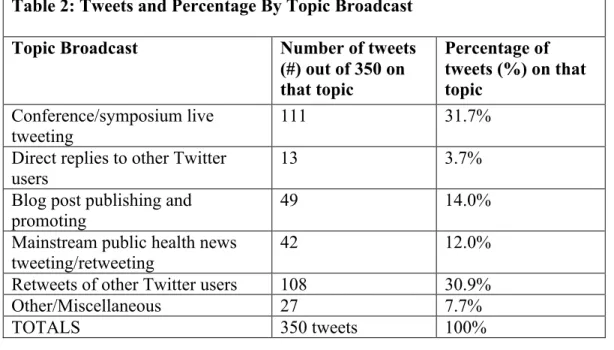
Table 2: Tweets and Percentage By Topic Broadcast
Topic Broadcast Number of tweets
(#) out of 350 on that topic
Percentage of tweets (%) on that topic
Conference/symposium live tweeting
111 31.7%
Direct replies to other Twitter users
13 3.7%
Blog post publishing and promoting
49 14.0%
Mainstream public health news
tweeting/retweeting 42 12.0%
Retweets of other Twitter users 108 30.9%
Other/Miscellaneous 27 7.7%
TOTALS 350 tweets 100%
Clearly, as noted in Table 2, which summarizes the topics of the tweets analyzed, the majority of tweets examined were devoted either to conference and symposium live tweeting (31.7% of all tweets examined), or to retweets of other Twitter users (30.9% of all tweets examined). The retweets were all public-health related, and sometimes
Table 3: Tweets and Percentage By Public Health Content Broadcast Public Health Content Number of tweets
(#) out of 350 with that content
Percentage of tweets (%) with that content Highlighting their own advocacy 79 22.5% Cultivating fun/casual
relationships
24 6.9%
Need for funds/fundraising 34 9.7%
Links to mainstream media public
health news 50 14.3%
Targeted public health campaigns 93 26.6% Self-efficacy/self-improvement
public health messages 44 12.6%
Health literacy/public health facts 26 7.4%
TOTALS 350 tweets 100%
Tweets were sent on an array of public health messages and topics, but as evidenced in Table 3, a good portion of the tweets sent were devoted, content-wise, to targeted public health campaigns, links to mainstream media public health news reports, and highlighting the advocacy work done by the specific organizations themselves in regards to their mission and outreach in nations around the world. Reflected in the fact that several of these public health organizations studied are non-profit organization is the reality that almost 10% of tweets surveyed contained information about the need for funds and fundraising, while another 22.5% of tweets surveyed highlighted advocacy work in the first place and their passion for their respective missions and results.
hunger, etc.) and provided information in a specific way to specific stakeholders, rather than being a basic tweet containing general information for widespread audiences.
Additionally, it's worth noting that the smallest area of content in Table 3 consisted of cultivating fun relationships and casual conversations, which included replies to other Twitter users, pictures of organizational holiday parties, and more informal pieces of information broadcast on Twitter by these NGOs and NPOs. While surely these organizations exist to serve a tightly-defined mission and purpose regarding their broadcasting on Twitter, it may be important to cultivate and seek out specific conversations and discussions that can improve interaction and help engage users specifically and in a one-on-one basis to promote public health causes and champion public health literacy.
Overall Themes
Generally speaking, as far as public health content discussed on Twitter, the seven accounts stuck to a wide variety of global public health issues, from vaccines in
developing nations, to malaria problems in Africa, to public health statistics and reporting, to World AIDS Day (which occurred December 1, 2012, and consumed a significant amount of tweets from every organization examined). Topics included major issues present in public health all over the world, as well as specific issues that were tightly and significantly defined by a certain group of stakeholders, or unique to a very specific geographic location or segment of the population to consume.
variety of people who may come into contact with the tweets and information produced by these organizations.
Discussion
This research sought to examine how non-profit and international public health organizations use Twitter to engage citizens and stakeholders to become more aware and engaged about major public health issues. As has been demonstrated by the findings of this pilot study, -there are many benefits that can be derived if public health organizations make greater use of social media and especially Twitter to engage with users and promote public health information. In this way they will more effectively engage their publics and turn followers and citizens into public health stakeholders in due time.
Social media sites like Twitter are a quickly evolving set of tools and technologies that are constantly growing with millions of users. Because of that, it may be difficult for organizations to keep up with innovation in this space as quickly as they would like. From following policy guidelines, to assessing risk and liability of communicating health messages within social channels, and avoiding risk-taking within social media outreach to avoid potential liability issues surrounding health literacy, organizations understandably must approach Twitter cautiously and pragmatically. That being said, though, there are too many opportunities and too many potential interactions for good on Twitter to avoid use completely or relegate a Twitter feed to a very conservative publication of messages and posts.
overlooked, as Twitter has proven itself to be a very capable platform for broadcasting a number of public health-related issues.
Policy Recommendations
The most important recommendation that can be derived form this study is that there are clear advantages for health organizations to use Twitter as a vehicle for promoting and improving public health through broadcasting of messages that promote self-efficacy and health literacy, and so more organizations should be using Twitter more frequently with that end goal in mind. Secondarily, it is critical that Twitter be used more consistently and directly to engage the publics impacted by these organizations, and in turn, positively impact their health. A third recommendation is that health care
organizations of this manner ought to be less conservative in their use of social media. Whether through specific policy change, or simply through the implementation of new interpretations and uses of Twitter based on these policy recommendations, health organizations should recognize the potential that Twitter has in engaging with a population increasingly vulnerable to chronic disease (CDC, 2012). Twitter users seek constant, quick, and efficient communication, and while guidelines, policies, and risk mitigation are critical and will always be necessary to fully develop strategies
surrounding the promotion of health literacy on Twitter, it is critical for global public health organizations to take (prudent) chances expanding use of Twitter to promote and embrace mobile and highly-connected engagement patterns of Twitter users.
discussions that can improve interaction and help engage users specifically and in a one-on-one basis to promote public health causes and champion public health literacy.
At least for now, Twitter is one of the most advanced and cost-effective forms of social media available. As such, it should be embraced by public health organizations looking to achieve their communications goals, as sites like Twitter have only increased in popularity in the last several years (Twitter, 2012). For that reason, it's important to address specific and effective policies on Twitter use by global public health
organizations in an effort to ensure that they can truly and fully use this platform in a realistic way to improve public health advocacy and literacy.
Limitations and Recommendations for Future Research
This research sought to explore the nature of tweets produced by seven global public health organizations in regard to message framing, health literacy, and
self-efficacy. Future research should build on these pilot study findings and include a content analysis in order to quantify the variables present within the tweets. Future research might also seek to gain insight from these specific organizations through interviews and surveys regarding their communication strategy, especially those groups that actively use Twitter and other social media. Also important would be to choose a broader range of organizations, among the many NGOs and NPOs engaged in global health activities and to include organizational characteristics in any analysis strategy. As this was a pilot study, it merely provides a starting point for what may come from more in-depth research on the Twitter usage patterns of public health and related organizations.
conclusions made from the content analyzed therein. It would behoove future research participants to more deeply analyze tweets and departments, either broadening their scope (in terms of the number of tweets researched), or using this study as a baseline to narrow their scope (onto specific organizations, topics and themes, or anything else that can gain further insight into a certain niche of public health communications on Twitter).
Conclusion
Global public health organizations are increasingly seeking better ways to
improve health communication for a variety of reasons, including improving government services and communication with publics, and enabling greater engagement and
involvement in community health efforts. Based on the findings of this pilot study it has been shown that Twitter is currently being used to a varying degree by the seven health organizations chosen in this study. Findings here also illustrate the varied benefits derived from this usage. Because of these demonstrated benefits it can be concluded that it would be beneficial for health care organizations to become more involved in social media and promote their use of Twitter in order to engage with their publics to help solve critical public health problems and improve various health outcomes.
While the Centers for Disease Control and other oversight organizations have produced baseline guides and recommendations with Twitter use guidelines and best practices, these global public health organizations should surpass the adoption of Twitter as a press release tool, and embrace the positive, interactive aspects of this technology. Hundreds of millions of people all around the world are already using Twitter for
or just a presence on Twitter for the sake of posting content, it behooves global health organizations and advocacy groups to enter the conversation surrounding Twitter and interact with their publics to promote civic and cultural health literacy, and frame messages that promote improved health outcomes for publics.
Glossary of Applicable Twitter Terminology # See "Hashtag"
@ The @ sign is used to call out usernames in Tweets, and get the attention of somebody for their communication purposes. When a username is preceded by the '@' sign, it is the link to their Twitter profile, and used in replies and mentions (below). Also, see 'handle.'
Activity Activity is the real time page that shows interactiosn and communications with people and organizations on Twitter. Activity can include tweets, retweets,
mentions, replies, and more. Through activity, and the 'Connect' tab on the Twitter website, you can view interactions, mentions, recent follows and Retweets. Using the Connect tab you're able to view who has favorited or retweeted your Tweets, who has recently followed you, and all of your @replies and @mentions.
Bio A short personal description of 160 characters or fewer used to define who you are on Twitter.
Blog A blog is a website that is often slightly more casual, interactive and humorous than an official website, but still functions to communicate information and pertinent content. Most often in the case of organizations, it is used to showcase
important information in an accessible way, where readers can comment, share links, and interact to obtain more information and create a community around a writer's thoughts and works.
Follow To follow someone on Twitter is to subscribe to their Tweets or updates on the site. When you follow a person, brand or business on Twitter, you can see all of their tweets when you log in to the site.
Follower A follower is another Twitter user who has followed you, and can now see all of your updates on the site.
Handle A user's "Twitter handle" is the username they have selected and the accompanying URL, like so: http://twitter.com/username. Your username is also referred to with the '@' sign and can be tweeted to directly with the '@' sign in front of the name itself.
Interactions A timeline in the Connect tab displaying all ways other users have interacted with your account, like adding you to a list, sending you a @reply, marking one of your Tweets as a Favorite, retweeting one of your Tweets.
Live tweeting Live tweeting is a process where a Twitter user tweets a play-by-play of what is occurring to or around them, for the benefit of their followers on Twitter. Most often in public health, live tweeting is used at conferences and symposiums where speakers are sharing information and Twitter users are tweeting quotes and links to promote and spread that information rapidly and immediately.
Mention Mentioning another user in your Tweet by including the @ sign followed directly by their username is called a "mention". Also refers to Tweets in which your username was included.
Reply A Tweet posted in reply to another user's message, usually posted by clicking the "reply" button next to their Tweet in your timeline. Always begins with @username.
Retweet (n.) A Tweet by another user, forwarded to you by someone you follow. Often used to spread news or share valuable findings on Twitter. When you retweet the content of another user, for example, you are spreading that message forward to all of your followers, and in turn, increasing the audience and scope of the original message very quickly.
References
Ajzen, I. (1985). From intention to action: A theory of planned behavior. In Kuhl, J. & Beckmann, J. (Eds.), Action control: From cognition to behavior (pp. 11-40). New York: Springer-Verlag.
Albarracin, D., Fishbein, M., Johnson, B. T., & Muellerleile, P. (2001). Theories of reasoned action and planned behavior as models of condom use: A meta-analysis. Psychological Bulletin, 123, 142-161.
Bagby, J. (2010). Public policy & legal issues of social networking: applying cyber law to Twitter. Paper at Pacific Southwest Academy of Legal Studies in Business, Palm Springs CA, Feb.19, 2010.
Bagozzi, R. P., Moore, D. J., & Leone, L. (2004). Self-control and the self-regulation of dieting decisions: The role of pre-factual attitudes, subjective norms, and
resistance to temptation. Basic and Applied Social Psychology, 26(2&3), 199-213. Bandura, A. (1986). Social foundations of thought and action: A social cognitive theory.
Englewood Cliffs, NJ: Prentice Hall.
Bandura, A. (1989). Human agency in social cognitive theory. American Psychologist, 44, 1175-1184.
Bandura, A. (1994). Social cognitive theory and exercise of control over HIV infection. In DiClemente, R.J. & Person, J.L. (Eds.), Preventing AIDS: Theories and methods for behavior change (pp. 25-57). New York: Plenum Press.
Bandura, A. (1995). Exercise of personal and collective efficacy in changing societies. In Bandura, A. (Ed.), Self-efficacy in changing societies (pp. 1-45). New York: Cambridge University Press.
Bandura, A. (2004). Health promotion by social cognitive means. Health Education and Behavior, 31(2), 143-164.
Becker, M. H. (1974). The health belief model and personal health behavior. Health Education Monographs, 2(4), 354-386.
Booth, M. L., Owen, N., Bauman, A., Clavisi, O., & Leslie, E. (2000). Social cognitive and perceived environment influences associated with physical activity in older Australians. Preventative Medicine, 31(1), 15-22.
Boyd, D. M. & Ellison, N. B. (2007). Social network sites: Definition, history, and scholarship. Journal of Computer-Mediated Communication, 13(1), 210-230. Brubaker, R. G. & Wickersham, D. (1990). Encouraging the practice of testicular
self-examination: A field application of the theory of reasoned action. Health Psychology, 9(2), 154-163.
Bull, F. C., Holt, C. L., Kreuter, M. W., Clark, E. M., & Scharff, D. (2001).
Understanding the effects of printed health education materials: Which features lead to which outcomes. Journal of Health Communication, 6, 265-279.
CASRO Research Foundation. (2011). Social Media Research Guidelines. CASRO Journal, August 2011.
Centers for Disease Control (2011). Center for Disease Control's Social Media Toolkit. Retrieved January 22, 2012 from
http://cdc.gov/socialmedia/Tools/guidelines/pdf/SocialMediaToolkit_BM.pdf. Centers for Disease Control and Prevention. (2012). Teen pregnancy, the importance of
Centers for Disease Control and Prevention. (2012). State and territorial health data. Retrieved March 10, 2012 from http://www.cdc.gov/nchs/fastats/map_page.htm. Cho, S. H. & Gower, K. K. (2008). Framing effect on the public’s response to crisis:
Human interest frame and crisis type influencing responsibility and blame. Public Relations Review, 32(4), 420-422.
Conner, M. & Norman, P. (Eds.). (2005). Predicting health behavior: Research and practice with social cognition models (2nd ed.). Buckingham: Open University Press.
Darmon, K., Fitzpatrick, K., & Bronstein, C. (2008). Krafting the obesity message: A case study in framing and issues management. Public Relations Review, 34(4), 373-379.
DeWalt, D. A., Berkman, N. D., Sheridan, S., Lohr, K. N., & Pignone, M. P. (2004). Literacy and health outcomes. Journal of General Internal Medicine, 19, 1228-1239.
Dillard, J. P. & Pfau, M. (Eds.). (2002). The persuasion handbook: Developments in theory and practice. Thousand Oaks, CA: Sage.
Dorfman, L., Wallack, L., & Woodruff, K. (2005). More than a message: Framing public health advocacy to change corporate practices. Health Education & Behavior, 32(3), 320-336.
Elder, J. P., Ayala, G. X., & Harris, S. (1999). Theories and intervention approaches to health-behavior change in primary care. American Journal of Preventative Medicine, 17(4), 275-284.
Entman, R. M. (1993). Framing: Toward clarification of a fractured paradigm. Journal of Communication, 43(4), 51-58.
Facebook. (2012). Fact sheet. Available online at
http://newsroom.fb.com/content/default.aspx?NewsAreaId=22.
Fairclough, N. (2003). Analyzing discourse: Textual analysis for social research. New York: Routledge, Inc.
Fishbein, M. & Ajzen, I. (1975). Belief, attitude, intention, and behavior. Reading, MA: Addison-Wesley.
Fisher, W. A., Fisher, J. D., & Rye, B. J. (1995). Understanding and promoting AIDS-preventative behavior: Insighs from the theory of reasoned action. Health Psychology, 14(3), 255-264.
Gibson, C. M. (2006) Citizens at the Center: A New Approach to Civic Engagement. The Case Foundation, 2006, 1-29.
Glanz, K., Rimer, B. K., & Lewis, F. M. (2002). Health behavior and health education, theory, research, and practice. San Francisco: Wiley & Sons.
Greenberg, D. (2001). A critical look at health literacy. Adult Basic Education, 11(2), 67-79.
Hawn, C. (2009). Take two aspirin and tweet me in the morning: How Twitter, Facebook, and other social media are reshaping health care. Health Affairs, 28(2), 361-368. Hornik, R. C. (2002). Public health communication: Evidence for behavior change.
Mahwah, NJ: Lawrence Erlbaum Associates.
Iyengar, S. (1991). Is anyone responsible? How television frames political issues. Chicago: University of Chicago Press.
Johnson, P., & Yang, S. (2009). Uses and gratifications of Twitter: An examination of user motives and satisfaction of Twitter use. Paper submitted to the
Communication Technology Division of the convention of the Association for Education in Journalism and Mass Communications, Boston, MA.
Kutner, M., Greenberg, E., Jin, Y., & Paulsen, C. (2006). The health literacy of
America’s adults: Results from the 2003 National Assessment of Adult Literacy. Washington, DC: National Center for Education Statistics, US Department of Education.
Lenhart, A. & Fox, S. (2009). Twitter and status updating. Washington, DC: Pew Internet and American Life Project. Available online from http://fortysouth.com/wp-content/uploads/2009/05/Twitter-and-status-updating.pdf.
Levy, P. S., and Lemeshow, S. (2008). Sampling of Populations: Methods and Applications (4th ed.). New York: John Wiley & Sons.
McNab, C. (2009). What social media offers health professionals and citizens. Bulletin of the World Health Organization, 87(8), available online:
http://www.who.int/bulletin/volumes/87/8/09-066712/en/index.html.
Miller, S. M., Shoda, Y., & Hurley, K. (1996). Applying cognitive social theory to health protective behavior: Breast self-examination in cancer screening. Psychological Bulletin, 119(1), 70-94.
Neilson-Bohlman, L., Panzer, A. M., & Kindig, D. A. (2004). Health literacy: A prescription to end confusion. Washington, DC: National Academies Press. Norman, P., Connor, M., & Bell, R. (1999). The theory of planned behavior and smoking
cessation. Health Psychology, 18(1), 89-94.
Nutbeam, D. (2000). Health literacy as a public health goal: A challenge for contemporary health education and communication strategies into the 21st century. Health Promotion International, 15, 259-267.
Paasche-Orlow, M. K., Gazmararian, J. A., Neilson-Bohlman, L. T., & Rudd, R. R. (2005). The prevalence of limited health literacy. Journal of General Internal Medicine, 20(2), 175-184.
Paasche-Orlow, M. K. & Wolf, M. S. (2007). The causal pathways linking health literacy to health outcomes. American Journal of Health Behavior, 31, 19-26.
Paine, K. D. (2009). Goodbye eyeballs, Hello, engagement. Communication World, 26(3), 21-24.
Park, H. J., Rodgers, S., & Stemmle, J. (2011). Health organizations’ use of Facebook for health advertising and promotion. Interactive Journal of Advertising, 13(1), article 153.
Pettyjohn, S., Roberts, M. & Culbert, A. (2010). Use of social media in the expansion of the Health Literacy Missouri brand. Available online from
http://www.ihahealthliteracy.org/index.php/en/component/content/article/90. Pew Internet and American Life Project. (2010). Social media and young adults.
Pignone, M., DeWalt, D. A., Sheridan, S., Berkman, N., & Lohr, J. N. (2005). Intervention to improve health outcomes for patients with low literacy: A systematic review. Journal of General Internal Medicine, 20(2), 185-193. Ratzan, S. C. (2001). Health literacy: Communication for the public good. Health
Promotion International, 16(2), 207-214.
Rosenstock, I. (1974). Historical origins of the health belief model. Health Education Monographs, 2(4), 328-335.
Rosenstock, I. M., Strecher, V.J., Becker, M. H. (1988). Social learning theory and the health belief model. Health Education and Behavior, 15(2), 175-183.
Ruggierio, T. (2000). Uses and gratifications theory in the 21st century. Mass Communication & Society, 3(1), 3-37.
Schifter, D. E. & Ajzen, I. (1985). Intention, perceived control, and weight loss: An application of the theory of planned behavior. Journal of Personality and Social Psychology, 49(3), 843-851.
Schwarzer, R. & Renner, B. (2000). Social-cognitive predictors of health behavior: Action self-efficacy and coping self-efficacy. Health Psychology, 19, 487-495. Sheeran, P. & Orbell, S. (2000). Using implementation intentions to increase attendance
for cervical cancer screening. Health Psychology, 19(3), 283-289.
Shirky, C. (2011). The political power of social media: technology, the public sphere and political change. Foreign Affairs, 13 (2), 2011.
Simonds, S. K. (1974). Health education as social policy. Health Education Monograph, 2, 1-25.
Smith, A. (2011). Why Americans use social media. Pew Internet & American Life Project, 1-11.
Speros, C. (2005). Health literacy: Concept analysis. Journal of Advanced Nursing, 50(6), 633-640.
Strecher, V. J., Seijts, G. H., Kok, G. J., Latham, G. P., Glasgow, R., DeVellis, B., Meertens, R. M., & Bulger, D. W. (1995). Goal-setting as a strategy for health behavior change. Health Education and Behavior, 22(2), 190-200.
Sullivan, A. (2012, February 6). “The Komen Controversy: Planned Parenthood Claims a New Kind of Victory in the Culture War.” Time Magazine. Available online from
http://swampland.time.com/2012/02/06/the-komen-controversy-planned-parenthood-claims-a-new-type-of-victory-in-the-culture-war/.
Summers, K. & Summers, M. (2004). Making the Web friendlier for lower-literacy users. Intercom, June 19-21. Available from
www.stc.org/intercom/pdfs/2004/200406_19-23.pdf.
Tedesco, L. A., Keffer, M. A., & Fleck-Kandath, C. (1991). Self-efficacy, reasoned action, and oral health behavior reports: A social cognitive approach to compliance. Journal of Behavioral Medicine, 14(4), 341-355.
Twitter. (2012). Fact sheet. Available from https://twitter.com/about.
Willis, E., Wang, Y., & Rodgers, S. (2011). Online health communities and health literacy: Applying a framework for understanding domains of health literacy. In Smedberg, A. (Ed.), E-health communities and online self-help groups:
Zarcadoolas, C., Blano, M., Boyer, J. F., & Pleasant, A. (2002). Unweaving the Web: An exploratory study of low-literate adults’ navigation skills on the World Wide Web. Journal of Health Communication, 7(4), 309-324.