Acknowledgements
I would first like to thank my primary advisor, Dr. Mitch Prinstein, for his
encouragement and support throughout this project. He has played an extremely important role in the development of my passion for research, and I cannot thank him enough for the time and energy he has invested in me throughout my undergraduate career. I would also like to thank Dr. Anna Bardone-Cone for welcoming me into her lab as a senior and helping me explore and grow my research interests. Her encouragement and kind words have been incredibly impactful, and she has significantly influenced my desire to continue conducting research for many years to come. I would also like to thank Emily Walsh for serving on my thesis committee and mentoring me throughout the graduate school application and interview processes. I am incredibly thankful to have had such amazing mentors serve on my thesis committee.
In addition to my thesis committee, I would also like to thank the project coordinators, graduate students, and each of my fellow research assistants in both the Peer Relations Lab and the Bardone-Cone Lab for supporting me and motivating me throughout this project. I have been surrounded by wonderful people who are passionate about research, and I am especially thankful for my LSI cohort: Edie, Jessica, Natasha, and Dan, who have been there every step of the way.
Body Image in Adolescent Males: Body Dissatisfaction as a Moderator of Drive for Muscularity and Depression
Cody Staples
The University of North Carolina at Chapel Hill
Abstract
Most research examining the correlates and outcomes associated with body image has focused on female populations, but there has been a recent emphasis on studying body image in males. Drive for muscularity, which examines whether or not a person desires to gain muscle mass, is an important construct to analyze during the assessment of male body image. The current study analyzed associations among drive for muscularity, body dissatisfaction, and depressive
symptoms within a sample of adolescent males. Drive for muscularity was positively correlated to body dissatisfaction and depressive symptoms at a single time point, supporting findings from previous studies. A significant interaction effect suggested that body dissatisfaction moderated the relationship between drive for muscularity and depressive symptoms over time. The current study adds to existing literature regarding male body image by suggesting that the relationship between drive for muscularity and body dissatisfaction can provide insight on future negative outcomes.
Body Image in Adolescent Males: Body Dissatisfaction as a Moderator of Drive for Muscularity and Depression
For many decades, research examining the correlates and outcomes associated with body image and body satisfaction has been conducted almost exclusively among female participants. However, beginning about 15 years ago, researchers have been increasingly studying body satisfaction and overall body image among males. Rather than examining thinness as the body ideal among females, this work with males has focused on the extent to which body shapes fit a lean, muscular shape. Most commonly, this has been captured by asking males to report their “drive for muscularity.” In prior work, drive for muscularity among adults has been associated with self-esteem and overall body satisfaction. Yet, remarkably little is known regarding drive for muscularity among adolescents, or whether drive for muscularity may be associated with depressive symptoms over time.
Drive for Muscularity
Drive for muscularity indicates whether or not an individual desires to gain muscle mass. Drive for muscularity is a significantly associated with body satisfaction, but drive for
muscularity does not include every aspect of body image (Bergeron & Tylka, 2007). Thinness may also play a role in the body satisfaction of some males, for example those who participate in sports that often involve weight restriction, but most research analyzing body image elevates muscularity over thinness for males.
how people view themselves and attempt to alter their body size. This masculine ideology can lead to harmful negative outcomes, such as taking steroids or muscle mass supplements (Martin & Govender, 2011). In addition to supplement use, adolescent boys with a higher drive for muscularity have reported lower self-esteem and more depressive symptoms at a single time point (McCreary & Sasse, 2000). Longitudinal data regarding outcomes associated with drive for muscularity are rarely reported.
Associated Outcomes
Although prior cross-sectional work has suggested associations among drive for
muscularity and several indices of social-psychological difficulties, findings among adolescents remain largely unexplored. Correlations between drive for muscularity and disordered eating symptoms have been reported, but moderators of this effect have not been further analyzed (Rodgers, Ganchou, Franko, & Chabrol, 2012). Drive for muscularity may combine with actual behavior, or outcomes related to body changes, to produce the greatest risk for maladjustment. For example, people who are highly motivated to exercise might also report having a high drive for muscularity (Vartanian & Shaprow, 2008). In addition to this, body dissatisfaction could serve as a moderator between drive for muscularity and certain negative outcomes.
This interaction between body satisfaction and drive for muscularity could potentially be manifested in the form of depressive symptoms. Drive for muscularity and depressive symptoms have been correlated in adolescent males, but this relationship has yet to be analyzed over time. Though little research has examined how drive for muscularity is longitudinally related to
and the comorbidity of depression and eating disorders suggests that body image and drive for muscularity could also be associated with depressive symptoms (Rodgers, Ganchou, Franko, & Chabrol, 2012). Because depressive symptoms have been shown to relate to body image, drive for muscularity may play a role in whether or not someone experiences depressive symptoms. Understanding how certain attitudes and behaviors could manifest themselves in the form of depressive symptoms is crucial, especially within the understudied adolescent male population.
It is hypothesized that a higher drive for muscularity will be associated with depressive symptoms at later time points, but other factors are likely to influence this relationship. Body dissatisfaction may have a moderating effect on the relationship between drive for muscularity and depressive symptoms. For example, adolescent males with a high drive for muscularity and low body dissatisfaction might not show depressive symptoms, but those with a high drive for muscularity and high body dissatisfaction may exhibit these symptoms. This is hypothesized because males who are close to their muscular ideal still may desire to gain muscle mass. While they do not report significant body dissatisfaction, they may still report a high drive for
muscularity. In contrast, the adolescent males who desire to gain muscle mass and are
significantly dissatisfied with their current body shape will show depressive symptoms because their high drive for muscularity is coupled with significant body dissatisfaction. Because of this, it is possible that drive for muscularity is only concerning for males who are also distant from their ideal body shape.
longitudinally to examine how body dissatisfaction moderates the relationship between drive for muscularity and depression over time.
Methods
Participants
Participants were 109 adolescent males enrolled in 10th grade (Mage = 16.18, SD = .46;
age range = 15.49 – 18.08) at study onset. Of the participants, 53.2% identified as Caucasian, 17.4% as Hispanic, 25.7% as African-American, and 3.7% Mixed Race or Asian. According to the school records, 67% of the students in the sampled school district qualified for free or reduced-price lunch.
Procedure
All students in the 9th grade from three lower-middle class, ethnically heterogeneous, public, rural high schools were recruited (N = 712). The current study only analyzed the data collected from participants who identified as males and completed data collection at each time point (n = 109). Attrition occurred due to students changing schools, absence during one of the time points, or refusal to participate during one of the time points.
months between time points and the exclusion of data submitted by female participants, the current study utilized a baseline sample of 109 adolescent males. All study procedures were approved by the university human subjects committee.
The first assessment occurred during the spring of 10th grade, and the follow-up
assessment was conducted a year and a half later during the fall of 12th grade, resulting in a total of two time points. To assess the relationship between drive for muscularity and depression over time, data regarding depression were analyzed from both time points, while measures of drive for muscularity and body dissatisfaction were only analyzed from the first time point.
Measures
Adolescent males completed self-report questionnaires regarding drive for muscularity and body dissatisfaction at Time 1. Adolescents reported their depressive symptoms at Times 1 and 2, and data from both time points were used to analyze the relationship between drive for muscularity and depression over time.
Drive for Muscularity. Data regarding drive for muscularity were obtained using the
Saucier, & Dorsch, 2004). The current sample yielded good internal consistency (Cronbach’s alpha 0.92).
Body Dissatisfaction. Data regarding body dissatisfaction were obtained using the Ideal
Body Subscale-Male (Cogan, Bhalla, Sefa-Dedeh, & Rothblum, 1996). This scale includes a set of 12 body silhouettes that depict thin, muscular, and obese adolescent males. By using numbers that correlated to each silhouette, participants marked their perceived actual and ideal body shape. Because most boys selected muscular silhouettes near the center of the 12-item scale, the absolute value of the discrepancy between ideal and perceived body shape was computed to serve as an index for the deviation from ideal body size. Higher discrepancy between perceived and actual body size in either direction indicated a higher body dissatisfaction.
Depression. Data regarding depressive symptoms were obtained using the Short Mood
and Feelings Questionnaire (Angold et al., 1995). Questions on this 13-item, unifactorial scale address subjects’ depressive moods and behaviors over the past 2 weeks. A sample item used in the current study was: “I felt miserable or unhappy.” Participants responded to each statement on a 3-point scale from 0 (Not true) to 2 (True). The Short Mood and Feelings Questionnaire is a valid and reliable measure to assess depressive symptoms within adolescents ( = .85). The current sample yielded good internal consistency (Cronbach’s alpha 0.94).
Data Analyses
coefficients. The key correlation analyzed was the correlation between drive for muscularity and depression.
The secondary analyses included a multiple regression model to assess the association between drive for muscularity and depression. This association was analyzed at different levels of body dissatisfaction. These analyses tested the hypothesized interaction effect between drive for muscularity, body dissatisfaction, and depression.
It was hypothesized that drive for muscularity will be associated with depression over time, and this interaction was tested using a multiple regression. It was hypothesized that body dissatisfaction would moderate the effect of drive for muscularity on depressive symptoms over time. This interaction was also analyzed using a multiple regression model. The variables were centered by subtracting the mean from each score so that the mean of all scores became 0. Centering the variables assisted in post-hoc testing to determine at what level of body
dissatisfaction (-1 SD, mean, or +1 SD) the interaction between body dissatisfaction and drive for muscularity is significant. Simple slopes were used to analyze the changes between the relationship between depression and drive for muscularity at varying levels of body
dissatisfaction.
Results
Preliminary Analyses
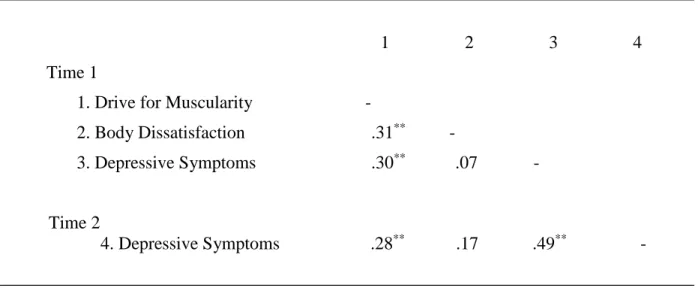
Pearson correlations were conducted to examine the bivariate associations among study variables (see Table 2). There was a significant positive correlation between drive for
muscularity and body dissatisfaction, and there was a significant positive correlation between drive for muscularity and depressive symptoms at Time 1. Depressive symptoms at Time 2 were positively correlated to drive for muscularity and depression at Time 1, but depressive symptoms at Time 2 were not significantly correlated to body dissatisfaction. Body dissatisfaction alone was not significantly correlated to depressive symptoms at either time point.
Longitudinal Prediction of Depressive Symptoms
A second set of analyses was conducted to examine drive for muscularity and body dissatisfaction as longitudinal predictors of depressive symptoms. Body dissatisfaction was analyzed as a moderator to investigate the hypothesis regarding the combined effects of drive for muscularity and body dissatisfaction in predicting depressive symptoms.
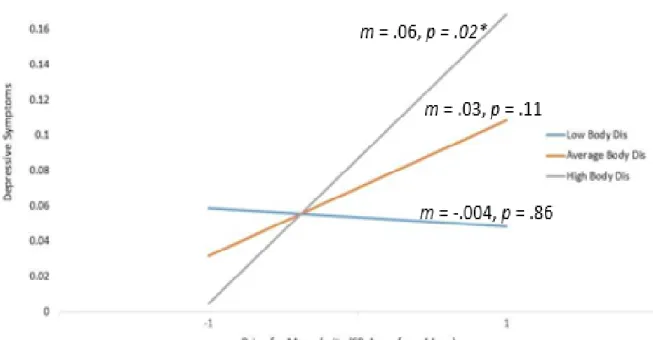
The potential effects of drive for muscularity and body dissatisfaction were examined simultaneously in one hierarchical multiple regression including the entire sample of participants (n = 109). Using Time 2 depressive symptom scores as a dependent variable, Time 1 depressive symptom scores were entered on an initial step, followed by drive for muscularity and body dissatisfaction scores on a second step. The interaction between drive for muscularity and body dissatisfaction was entered during the third and final step. All results are presented in Table 3.
conditions of high body dissatisfaction (+1 SD), b = .06; = .03, p < .05, but not under conditions of low body dissatisfaction (-1 SD), b = -.003; = .02, NS, or mean-level body dissatisfaction, b = .03; = .02, NS.
Discussion
The current study supported the hypothesis that at high levels of body dissatisfaction, high drive for muscularity is associated with greater depressive symptoms at Time 2 after controlling for depression at Time 1. Body dissatisfaction moderated the relationship between drive for muscularity and depressive symptoms, showing the importance of analyzing both drive for muscularity and body dissatisfaction when assessing one’s overall body image.
The combination of high drive for muscularity and high body dissatisfaction was
significantly associated with depressive symptoms at Time 2. High drive for muscularity paired with low or average body dissatisfaction was not significantly associated with depression at Time 2. This relationship could potentially be a result of drive for muscularity not encompassing the entirety of body image, thus resulting in it not yielding a main effect predicting depression over time. Drive for muscularity addresses how muscular a person wishes to be, but it neglects how muscular the person currently is. Males who have a high drive for muscularity and are already relatively muscular might not report depressive symptoms because their high drive for muscularity is not in contrast with their current body shape. Males who are high in drive for muscularity and are also significantly dissatisfied with their bodies might report higher
depressive symptoms because their goals are not being met. This discrepancy in self-perception could be the explanation as to why drive for muscularity alone did not predict depression, but the interaction between drive for muscularity and body dissatisfaction did predict depression.
The current study supported findings from previous studies that analyzed correlations between drive for muscularity and body dissatisfaction (Bergeron & Tylka, 2007). Drive for muscularity and body dissatisfaction both relate to overall body image, and the current study supported the notion that these constructs are significantly related. In addition to this, the current study also supported previous findings that drive for muscularity and depression are positively correlated at a single time point (McCreary & Sasse, 2000).
Analyzing concurrent correlations among drive for muscularity, body dissatisfaction, and depression was an important aspect of the study, but the current study primarily sought to add to gaps in existing literature by analyzing possible predictors of depression in adolescent males relating to body image. This study examined the relationship between drive for muscularity and depressive symptoms over the span of a year and a half, and conclusions drawn based on
analyses suggest that body dissatisfaction may have a moderating effect on the relationship between drive for muscularity and depressive symptoms. While drive for muscularity at the first time point was significantly related to depressive symptoms at the later time point, the most significant finding from the current study was the interaction effect between drive for muscularity and body dissatisfaction. Within this particular sample of adolescent males, the relationship between their drive for muscularity and later depressive symptoms depended on their body satisfaction measured by the difference between their perceived actual and ideal body shape.
Implications
mental health outcomes. Adolescence is an important transitional period in a person’s life. It is during this time when identity develops, and because of the physical changes that accompany, body image is crucial to measure and discuss during this stage of life. For males in particular, muscularity is a construct that is often compared and judged as a standard.
The ideal male body as depicted by popular culture and social media is characterized by lean muscularity. Because of this, drive for muscularity within males who are frequently
exposed to this ideal may likely increase. While this muscular ideal male body is a non-realistic standard, boys who see differences between themselves and media images could potentially experience negative emotions and turn to risky behaviors, such as steroid use, to compensate (Martin & Govender, 2011). By better understanding what may lead to these negative outcomes, interventions can be created so that one’s body image is positive and not an aspect of social comparison. Body positivity movements involving men could be difficult due to societal
messages regarding masculinity, which is why promoting positive self-image and body positivity within the male population is important.
By supporting the notion that a high drive for muscularity and high body dissatisfaction may manifest in the form of depressive symptoms, the current study shines light on one harmful effect of having a negative body image. Body image is a largely intrinsic construct, and poor self-image as a whole can also lead to a person expressing depressive symptoms. By studying the relationship between body image and depression, researchers and clinicians can better assist people who experience large discrepancies between their actual and ideal body shape and size. Depression is one outcome associated with a negative body image, but comorbid diagnoses may include eating disorders, anxiety disorders, and obsessive-compulsive disorder.
While drive for muscularity is primarily used as a measure of body satisfaction in males, it is not an exclusively male construct. Males generally have higher drives for muscularity than females, but females also could report high drives for muscularity (Slater & Tiggemann, 2014). Also, though drive for thinness is primarily used to measure body satisfaction in females, males may also report that they wished to be thinner. It is important to not generalize these constructs to one gender, as thinness and muscularity are important aspects of body image for all people. The current study only analyzed the drive for muscularity variable within a sample of males to add to the literature regarding a specific population, but future studies should also analyze potential negative outcomes associated with a high drive for thinness in males as well. Contrarily, it is important to analyze how the drives for thinness and muscularity vary within female populations.
Another limitation of the current study is that it did not analyze ethnic differences in drive for muscularity and body dissatisfaction. While age and gender are two important factors to consider when analyzing body image, cultural ideals and biases also likely influence a person’s perception of body image. Literature has begun to focus more on cross-cultural
influences of body image, such as how the intersections of race, ethnicity, and culture can impact one’s body image (Capodilupo & Kim, 2014). Cultural identity might serve as buffer against body dissatisfaction, and the ethnic group with which a person most strongly identifies might influence how they view their body or how much emphasis they place on altering it. Because of this, the current study lacks a cross-cultural dimension that could provide greater insight on the relationship between drive for muscularity, body dissatisfaction, and depression.
more immediate impacts of the relationship between drive for muscularity, body dissatisfaction, and depression might have been overlooked. For example, more frequent data collection or an ecological momentary assessment could better capture how drive for muscularity and body dissatisfaction change during a sport’s season versus an offseason.
Including other variables could have enhanced the current study and strengthened its outcomes. The current study did not include any objective, biological measures, such as Body Mass Index or a measure of body fat. When analyzing the data, it is important to note that all study variables used were collected via self-report. BMI or a skinfold test for body fat
percentage could have been used to provide a more accurate measure of the current body shape of the participants. This could have also accounted for participants believing they were either more or less muscular than they were in reality. Another measure that could have been utilized in the current study is exercise motivation. Understanding why and how often participants exercise and life weights to achieve their ideal body shape could have also influenced results. In addition to this, drive for muscularity could vary widely based on a person’s engagement in recreational or competitive sports. For example, a defensive lineman on a football team would likely report a much higher drive for muscularity than someone who loses weight in order to qualify for the 106 pound weight class on a wrestling team.
study involved participants who were generally sophomores in high school at study onset, so it was not able to fully record changes in beliefs regarding body image during early puberty. Future Directions
Future studies could analyze the directionality of the relationship between drive for muscularity, body dissatisfaction, and depressive symptoms. The current study involved body dissatisfaction being a moderator of the relationship between drive for muscularity and
depression, but it is plausible that reported drive for muscularity could moderate the relationship between body dissatisfaction and depression.
As previously mentioned, future studies should analyze the drive for thinness variable in males and the drive for muscularity variable in females. Males who have high drives for
muscularity may show different outcomes than males who have higher drives for thinness, so these variables should be compared and contrasted longitudinally. By doing so, important findings regarding gender differences in body image and body satisfaction will be discovered. Cultural norms and ideals regarding body image are shifting, so it is important to study how each construct can be represented in diverse populations.
References
Angold, A., Costello, E. J., Messer, S. C., Pickles, A., Winder, F., & Silver, D. (1995). The development of a short questionnaire for use in epidemiological studies of depression in children and adolescents. International Journal of Methods in Psychiatric Research, 5(4), 237-249.
Bergeron, D., & Tylka, T. L. (2007). Support for the uniqueness of body dissatisfaction from drive for muscularity among men. Body Image, 4(3), 288-295.
Capodilupo, C. M., & Kim, S. (2014). Gender and race matter: The importance of considering intersections in Black women’s body image. Journal of Counseling Psychology, 61(1), 37.
Cogan, J. C., Bhalla, S. K., Sefa-Dedeh, A., & Rothblum, E. D. (1996). A comparison study of United States and African students on perceptions of obesity and thinness. Journal of Cross-Cultural Psychology, 27, 98 –113.
Dakanalis, A., Timko, A., Madeddu, F., Volpato, C., Clerici, M., Riva, G., & Zanetti, A. M. (2015). Are the Male Body Dissatisfaction and Drive for Muscularity Scales reliable and valid instruments?. Journal of Health Psychology, 20(1), 48-59.
Doherty, D. T., Moran, R., Kartalova O'Doherty, Y., & Walsh, D. (2007). HRB national psychological wellbeing and distress survey: Baseline results. HRB Research Series. Edwards, C., Tod, D., & Molnar, G. (2014). A systematic review of the drive for muscularity
Martin, J., & Govender, K. (2011). “Making muscle junkies”: Investigating traditional masculine ideology, body image discrepancy, and the pursuit of muscularity in adolescent
males. International Journal of Men’s Health, 10(3).
McCreary, D. R., & Sasse, D. K. (2000). An exploration of the drive for muscularity in adolescent boys and girls. Journal of American College Health, 48(6), 297-304.
McCreary, D. R., Sasse, D. K., Saucier, D. M., & Dorsch, K. D. (2004). Measuring the drive for muscularity: Factorial validity of the drive for muscularity scale in men and
women. Psychology of Men & Masculinity, 5(1), 49.
McFarland, M. B., & Petrie, T. A. (2012). Male body satisfaction: Factorial and construct validity of the Body Parts Satisfaction Scale for men. Journal of Counseling Psychology, 59(2), 329.
Murnen, S. K., & Karazsia, B. T. (2017). A review of research on men’s body image and drive for muscularity. The Psychology of Men and Masculinities. Washington, DC: American Psychological Association.
Murray, S. B., Griffiths, S., Mitchison, D., & Mond, J. M. (2017). The transition from thinness-oriented to muscularity-thinness-oriented disordered eating in adolescent males: A clinical observation. Journal of Adolescent Health, 60(3), 353-355.
Preacher, K. J., Curran, P. J., & Bauer, D. J. (2006). Computational Tools for Probing Interactions in Multiple Linear Regression, Multilevel Modeling, and Latent Curve Analysis. Journal of Educational and Behavioral Statistics, 31, 437-448.
Rodgers, R. F., Ganchou, C., Franko, D. L., & Chabrol, H. (2012). Drive for muscularity and disordered eating among French adolescent boys: A sociocultural model. Body Image, 9(3), 318-323.
Rosen, J. C., & Gross, J. (1987). Prevalence of weight reducing and weight gaining in adolescent girls and boys. Health Psychology, 6(2), 131.
Schaefer, M. K., & Salafia, E. H. B. (2014). The connection of teasing by parents, siblings, and peers with girls' body dissatisfaction and boys' drive for muscularity: The role of social comparison as a mediator. Eating Behaviors, 15(4), 599-608.
Slater, A., & Tiggemann, M. (2014). Media matters for boys too! The role of specific magazine types and television programs in the drive for thinness and muscularity in adolescent boys. Eating Behaviors, 15(4), 679-682.
Table 1. Means (and standard deviations) for Primary Variables at Times 1 and 2 (n = 109)
___________________________________________________________________________ Time 1
Drive for Muscularity 3.24 (1.37) Body Dissatisfaction 1.60 (1.38)
Depressive Symptoms .23 (.28)
Time 2 (n = 109)
Depressive Symptoms .18 (.25)
Table 2. Bivariate Associations Among Primary Variables
______________________________________________________________________________
1 2 3 4
Time 1
1. Drive for Muscularity -
2. Body Dissatisfaction .31** -
3. Depressive Symptoms .30** .07 -
Time 2
Table 3. Longitudinal Prediction of Depressive Symptoms by Drive for Muscularity and Body Dissatisfaction (n = 109)
Time 2 Depressive Symptoms (CDI) ____________________________________________
Step Statistics Final Statistics __________________________ ______________
Predictors R2 b (se b) b (se b)
______________________________________________________________________________
Step 1 .50***
Time 1 CDI .45 (.08) .53*** .41 (.08) .48***
Step 2 .02
DMS .02 (.02) .09 .03 (.02) .12
Body Dissatisfaction .02 (.02) .09 .01 (.02) .05
Step 3 .02*
DMS x Body Dissatisfaction .02 (.01) .15*
Total R2 .54*