Article
Optimizing Bus Passenger Complaint Service
through Big Data Analysis: Systematized Analysis
for Improved Public Sector Management
Weng-Kun Liu 1,* and Chia-Chun Yen 2
1 Department of International Business, Feng Chia University, Taichung 407, Taiwan
2 Ph.D Program in Civil and Hydraulic Engineering, Feng Chia University, Taichung 407, Taiwan;
* Correspondence: [email protected]; Tel.: +886-4-2451-7250 (ext. 4276)
Abstract: With the advances in industry and commerce, passengers have become more accepting of environmental sustainability issues; thus, more people now choose to travel by bus. Government administration constitutes an important part of bus transportation services as the government gives the right-of-way to transportation companies allowing them to provide services. When these services are of poor quality, passengers may lodge complaints. The increase in consumer awareness and developments in wireless communication technologies have made it possible for passengers to easily and immediately submit complaints about transportation companies to government institutions, which has brought drastic changes to the supply-demand chain comprised of the public sector, transportation companies, and passengers. This study proposed the use of big data analysis technology including systematized case assignment and data visualization to improve management processes in the public sector and optimize customer complaint services. Taichung City, Taiwan was selected as the research area. There, the customer complaint management process in public sector was improved, effectively solving such issues as station-skipping, allowing the public sector to fully grasp the service level of transportation companies, improving the sustainability of bus operations, and supporting the sustainable development of the public sector-transportation company-passenger supply chain.
Keywords: customer complaint process improvement; customer complaint service; big data analysis
1. Introduction
With urbanization, commerce development, and the popularization of the Internet, sustainable development has become an objective for all cities in Taiwan. The extension of bus services can facilitate travel, reduce the amount of traffic jams, and lower carbon dioxide emissions caused crowds of small passenger cars. Therefore, public transport policies (e.g., bus services) are actively promoted in Taiwanese cities and counties to meet passengers’ demands.
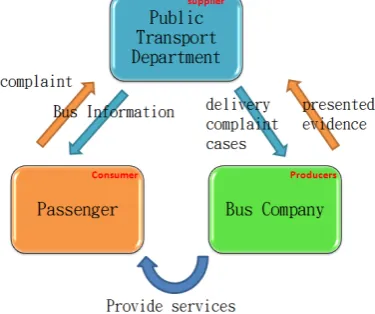
There are three major players in bus operations (Figure 1), namely, the public sector (suppliers), bus companies (manufacturers), and passengers (consumers). The public sector (suppliers) normally provides right-of-way licenses (source materials) to bus companies (manufacturers) and information about ratified right-of-way operations to passengers (consumers).
Bus companies (manufacturers) develop service content (e.g., accessible buses, step-entrance buses, energy saving and noiseless electric buses, novel bus stop signs, and convenient bus shelters) based on the right-of-way licenses (source materials) that conform with relevant regulations in order to provide services to passengers (consumers).
After receiving feedback, the public sector requires bus companies to make improvements and develops plans and strategies according to passengers’ suggestions in order to improve municipal transportation services.
Figure 1. Customer service relations for public transportation services
Bus transportation services are an important part of public services for which understanding passengers’ feedback and meeting passengers’ needs are important considerations. In other words, the government must pay more attention to passengers’ opinions. Dealing with passengers' opinions is an unavoidable part of work in the public sector. Although listening to their opinions is not a panacea and not every whim can be fulfilled, public participation is the cornerstone of the democratic system and passengers’ suggestions can promote reform in the public sector. The challenges and impacts for interactions between the public and private sectors due to these changes create new cooperative relationships between the government and the public; as a result, the concept of public governance is developed through public participation in decision-making. Under this concept, governing is no longer work exclusively done by the government but rather involves interaction between the government, companies, and non-profit (or non-governmental) organizations [1].
Understanding and analyzing each opinion and complaint can undoubtedly provide public managers insight into the possible preferences for specific issues, supplement the data regarding public opinion that was collected via traditional public participation channels (e.g., polls, forums, public hearings, seminars, and news media), and help with preparations and adjustments by perceiving potential social trends. Thus, an important role of passengers’ extensive online involvement in public matters cannot be overlooked as it reflects passengers’ participation and political behavior in the real world [2].
With regard to the supply chain relationship between public sector, bus companies, and passengers, the rise of social autonomy brought on by the popularization of the Internet has resulted in changes in the social, political, and economic environments. Many government officials do not use the advantage of the Internet’s interactivity and, instead, conceal many facts while considering public participation to be determined by individual power and that the Internet cannot be used to obtain large amounts of data in order to analyze problems, and assuming that all resources can be coordinated and supported by only the public sector; this reduces people’s trust in the public sector [3].
In the past, the public sector focused on improving performance, effectiveness, and productivity and planning effective bus routes. With the development of the Internet, more information from the external world and simpler ways to express oneself became accessible for passengers, which brought the public closer to the government. The popularization of Internet communication devices and free wireless systems (e.g., the iTaiwan system) and the increased accessibility of the Internet in Taiwan has increased passengers’ participation in public matters via the Internet as it became easier to collect related information as well as to express opinions.
more on customer needs, the importance of obtaining information regarding customer complaints has also increased. This also applies to transportation, particularly, public transportation.
Under such circumstances, online public opinion data has become available in large quantities, various formats, and at rapid speeds; these are the three Vs of digital data: volume, velocity, and variety. With regard to the public sector, the high-volume of online public opinion data brought by the spread of the Internet and networking facilities has provided democratic governments with an opportunity to gain insight into public opinions, which can help improve government responsiveness. However, due to its characteristics, big data presents a serious challenge for government departments and information systems in terms of data ingestion, analysis, management, and distribution [4].
As shown in Figure 2, as passengers become more accustomed to traveling by bus, their demands for the level of bus services increase. Passengers who are unsatisfied with bus services can express their opinion via multiple channels (e.g., the mayor’s mailbox, department mailbox, 1999 Public Service Hotline, social networks, etc.). After receiving a passenger complaint, the case is classified, assigned to an audit employee to examine the deficiencies of the company and its services, and then a fine is imposed on the bus company according to the right-of-way agreement or traffic regulations.
As the number of channels for complaints grows, complaints increase in complexity and quantity. The traditional complaint processing procedures requires improvement in terms of the efficiency in order to reduce the workload of public sector personnel. For bus companies, increased fines have led to a rise in operation costs, thus, affecting revenues and staff salaries (bus drivers) and causing dissatisfaction with bus services.
Figure 2. Vicious circle in the public sector-bus company-passenger supply chain
Issues in the relationship between the public sector, companies, and passengers arise as passengers can now easily express their complaints and suggestions to the public sector over the telephone. A large amount of complaints creates a vicious circle in the supply chain relationship.
In order to break this vicious circle, this study suggested improving the existing customer complaint process done via paperwork. An improved management process in the public sector would allow it to accurately convey passenger complaints and suggestions to bus companies and instantly and effectively determine passenger needs. Effective management of complaints would improve the public transportation service environment.
possible to reduce the number of complaints for violations such as skipping stations, driving slowly, and unauthorized detours.
Thus, improving the public sector complaint procedure can more effectively appropriate the limited resources, process customer complaints in a timely manner, and meet passenger needs. The improved complaint process in the public sector can reduce the amount of passenger complaints, increase the service level of bus transportation, raise customer satisfaction, and support the sustainable development of the public sector-transportation company-passenger supply chain.
2. Literature Review
2.1 The Importance of Bus Service Development
City development and convenient transportation are inextricably connected. A carefully planned and designed road network provides convenient, fast, and safe traveling for road users and environmental issues, such as carbon reduction and sustainable operations, cannot be ignored in the economic development of a city.
Industrial processes and methane emission in energy-involving activities such as transportation have amounted up to 60% of total emissions in Mexico; metropolitan and industrial waste accounted for 9% and agricultural, livestock, and land use changes and forestry accounted for 32%. Trucks, buses, and compact cars accounted for 30% of energy-related carbon dioxide emissions in Mexico. In Dehli, all 84,000 buses were renovated in the pursuit of the solution to this issue [5]. Thus, carbon reduction and ecological sustainable operations should be provided starting from public transportation services.
Therefore, the public transport system should be planned and designed appropriately and the use of private cars should be restricted. An important cornerstone of city development is the provision of road space and services sufficient for the vehicle population [6].
In Seoul, a reform of the public transport system was proposed that introduced Bus Rapid Transit (BRT) corridors which improved bus and subway coordination services and integrated fare and ticket booking systems and models. The reform was followed by an increase in customer satisfaction towards public transport safety, speed, and cost [7].
The popularization of public transportation services requires the government to use public power to implement reforms, create public agenda, and expand bus services [8]. Thus, everyone must combine efforts to develop bus policies that promote a sustainable environment and reduce carbon emissions.
Regardless of the country, the development of bus services is an important transportation policy for convenient transportation, energy conservation and carbon reduction, and ecological sustainability.
2.2 Big Data Analysis
Using an information and communication technology (ICT) model, the government developed a participatory website 1.0 (or Web1.0) into a participatory website 2.0 (or Web2.0). The highly interactive Web2.0 services have had an influence on the participation of the public in public matters in Taiwan and coincide with the OECD Web2.0 model description [9]. In Taichung, with the popularization of 3G and 4G phones and the Internet, bus passengers can easily send a question about bus services to public sector via their smartphone or computer during the bus ride. The compilation of such data in large amounts is called big data.
In the era of data explosion, more attention is paid to data collection, especially massive data. When selecting a partner for the supply chain, private companies use the analytic hierarchy process and fuzzy synthetic evaluation to evaluate the big data indicators of each candidate, such as technology quality, big data processing capacity, credibility, financial situation, and service quality, in order to maintain relations with upstream and downstream supply chain companies [10].
conservation, carbon reduction, and ecological sustainability, more and more people have chosen to use buses as a means for transport. The traditional public administration and management can no longer adapt to changes in the external political and economic environments. Effective public and private sectors and an active civic society willing to raise questions are necessary in order to provide better benefits to the growing number of passengers.
2.3 Customer Complaint Services
The specific significance of the Internet and ICTs for participatory governance is that they extended space via which the public can express opinions and increased the innovative capacity of public sector to meet people’s demands. However, the progress of technologies also made it more difficult to collect opinions that people express via the Internet. With the development of democracy and ICTs in Taiwan, in addition to the traditional civic participation channels, such as opinion polls, forums, public hearings, seminars, and news media, the government has started collecting public opinions and complaints via convenient data collection and feedback channels provided by ICTs, including online forums, mayor’s email, social media, and call centers.
Customer opinions and feedback can be conscious or unconscious, depending on whether the customer is aware of providing information to a third party. Companies usually directly collect customer feedback and opinions using a platform (e.g., phone, mail, online forums, etc.) or infer opinions of customers who remain silent from their behavior. Implicit customer feedback is usually determined based on customers’ consumption behavior (e.g., passengers’ riding habits, consumption habits, etc.) [11-13].
Customer needs can be identified by searching for keywords in customer complaints [14] and the issues most concerning the customers can be determined based on the word frequency. The ARC (activities, resources, and context) framework integrates customer experiences and derives more opinions of customers through their interaction, thus, facilitating the development of text mining and enabling evaluation of the impact of customers’ interactive service processes.
Private companies attach a high importance to customer feelings. In Taiwan, the government aims at providing services to the public and understanding people’s needs. Therefore, starting from January 25, 2005, Taiwan has been implementing 1999 Public Service Hotline, the first-generation call center with 31 seats providing estimated 50,000 services per month. The public hotline provides all types of services, including appeal reports, administrative consultation services, road malfunctioning complaints, social welfare consultations, communications network consultations, and travel guide introductions.
Similar services were launched in Taichung City on July 1, 2009, with the main function of answering people’s questions regarding various policies. Provision of dial-in services with one easily remembered number simplified the previous use of a 0800 number for which the receiving side had to pay for the call and integrated phone lines from different institutions. The first five minutes of a call with the current 1999 hotline services in Taichung are free. In addition, 1999 SMS services are provided for the hearing impaired. The hotline attends to various non-urgent affairs in Taichung area, such as appeals, consultations, bus inquiries, bus service feedback, etc.
After receiving passenger complaints, the public sector describes each case in an official document and assigns it to a processing unit which then returns the results in a paper document. The public sector fines bus companies according to relevant regulations or notifies them of required service improvements. As there is no unified complaint form, processing each case requires manual review and classification, which is time-consuming. Moreover, during the feedback, it is necessary to report how many human resources and how much time were required for each specific case.
Table 1. Taichung City Bus Introduction Item Content Notes
Range of bus operations
Mainly Taichung City; several bus routes reach Changhua County and Nantou County
Taichung City became a special municipality on December 25, 2010
Taichung City
population 2,747,561 (as of February 2016) Taichung City
area Approx. 2,215 sq. km No. of bus
companies in Taichung City
14 (as of March 2016)
No. of bus routes in Taichung City 208
(excluding 7 sub-routes and 18 shuttle bus routes), 4 joint bus routes
No. of bus passengers in Taichung City
Average daily ridership: 366,000
Monthly ridership: 10,980,000
(in September 2015)
Fare system in Taichung City
Electronic card No fare within 10 km
The government provided subsidies to cover 10 km fares and allow free ridership for passengers.
No. of bus-related legal cases in Taichung City
Approx. 1,500 each month
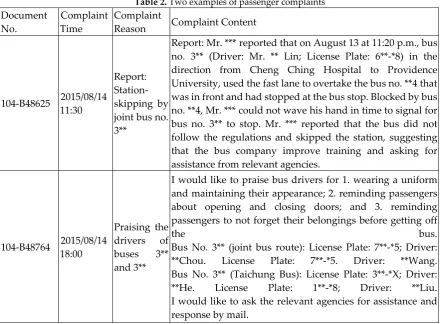
Customer complaint data examined in this study was the original data obtained by the public sector from passengers by means of systematization, automated data collection, and data filtration. The data format included the document number, time of complaint, reason for complaint, and complaint content. Two complaint examples are provided in Table 2.
Table 2. Two examples of passenger complaints Document
No.
Complaint Time
Complaint
Reason Complaint Content
104-B48625 2015/08/14 11:30
Report: Station-skipping by joint bus no. 3**
Report: Mr. *** reported that on August 13 at 11:20 p.m., bus no. 3** (Driver: Mr. ** Lin; License Plate: 6**-*8) in the direction from Cheng Ching Hospital to Providence University, used the fast lane to overtake the bus no. **4 that was in front and had stopped at the bus stop. Blocked by bus no. **4, Mr. *** could not wave his hand in time to signal for bus no. 3** to stop. Mr. *** reported that the bus did not follow the regulations and skipped the station, suggesting that the bus company improve training and asking for assistance from relevant agencies.
104-B48764 2015/08/14 18:00
Praising the drivers of buses 3** and 3**
I would like to praise bus drivers for 1. wearing a uniform and maintaining their appearance; 2. reminding passengers about opening and closing doors; and 3. reminding passengers to not forget their belongings before getting off
the bus. Bus No. 3** (joint bus route): License Plate: 7**-*5; Driver:
Using the Taiwan government's interactive Web2.0 and after many years of promotion and implementation, Taichung City bus passengers' awareness of their rights has increased, causing the number of complaint cases to grow. As a result, manual processing has become unable to provide prompt responses to all passengers and even caused many mistakes that brought about even more complaints. The service hotline is focused on improving citizens' quality of life while not giving enough consideration to the speed of processing and responding to questions [15] and, thus, reduces passengers’ trust in the efficiency of the public sector.
The government provides a hotline for passenger complaints as a convenient service. However, deficiencies in the complaint management process and low quality and speed of responding can greatly reduce passenger satisfaction with governmental services and create popular discontent.
2.4 Customer Complaint Process Improvement
Traditionally, passenger complaints are managed manually. With the technological developments, in addition to traditional data collection channels, such as opinion polls, forums, public hearings, seminars, and news media, the government of every level also started using online forums, mayor’s email, social media, and call centers. This resulted in prevalent participation of the public in public affairs via the Internet and easiness of expressing opinions. The use of ICTs by such an electronic government supported governmental operations, linked citizens and helped to provide governmental services. Recently, an emphasis has been put on civic participation and communication between the public and the public sector. However, quick emergence of multiple and massive data related to public opinions in the Internet made it difficult for traditional data analysis and management processes to promptly respond to people’s complaints [9].
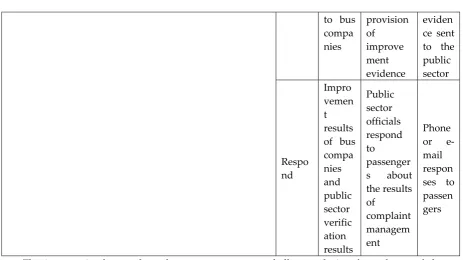
The process of passenger complaint management generally includes five phases [16]. As shown in Table 3 and described below, each phase has different outlines.
(1) Collection: If having a negative riding experience, public transportation passengers in Taichung City can report their opinions to the public sector by phone, social media, or E-mail (Input). Unified collection of passenger opinions by the public sector (Process) assigns a document number (Output) to each passenger question.
(2) Classification: After the public sector receives passenger complaint cases (Input), official documents are issued for each complaint (Output) to be sent to relevant officials in charge (Process).
(3) Assignment: After receiving a complaint document (Input), the officials in charge verify the complaint, impose a fine on the bus company according to regulations, require the company to report improvement results (Process) and issue document notifying the bus company about the decision and fine and requiring an improvement report (Output).
(4) Improvement: After receiving the notification (Input), the bus company proposes improvement measures according to the document’s content (Process) and sends documents providing improvement evidence back to the public sector (Output).
Table 3. Five phases of the management process for bus passenger complaints in Taichung City Flow Chart
to bus compa nies
provision of improve ment evidence
eviden ce sent to the public sector
Respo nd
Impro vemen t results of bus compa nies and public sector verific ation results
Public sector officials respond to passenger s about the results of
complaint managem ent
Phone or e-mail respon ses to passen gers
The increase in the number of passengers presents challenges during four phases of the complaint management process in the public sector (Table 4) and causes the emergence of such issues as overdue, inaccurate classification, inefficiency of case assignment, and inefficient use of resources. As a result, the relationship between the public sector, bus companies, and passengers gradually starts following a vicious circle, as demonstrated in Figure 2.
Table 4. Issues encountered by bus complaint management in Taichung City
Phase Encountered Issue
Collection When processing a complaint case, public sector officials may have the case go overdue due to the growing number of complaint cases and the absence of systemic control and management.
Classification A growing number of passengers makes manual classification of cases inefficient. As the number of cases increases, so does the classification error rate.
Assignment A growing number of passenger complaints makes assignment of cases through paper documents inefficient and may cause omissions.
Improvement Under the circumstances of a growing number of passenger complaints, bus companies find it difficult to determine main objectives for improvement and the efficiency of resource use decreases.
This study proposed a method for business process improvement (BPI) to solve the existing issues through improvement of customer complaint process in public sector, management of each complaint case and question, and guidance and supervision over bus companies in the improvement of service quality. Improved service quality would naturally reduce passenger complaints and help achieve the objective of BPI.
2.5 Business Process Improvement
The company process is a set of logically related business activities. Each process involves the investment of such resources as people, materials, energy, equipment, and procedures and is aimed at creating a product or service for a final recipient [17].
situations and opportunities and fast receipt of valuable information, which facilitates implementation of policies and interaction with clients [19].
BPI is "a methodology that is designed to bring about step-function improvements in administrative and support processes using approaches such as process benchmarking, process redesign and process re-engineering” [20].
Businesses differ in terms of provided services. Desired performance can be reached by designing appropriate processes and improving designs in aspects that need to be strengthened [21]. The process of BPI should integrate ideas of different management levels in internal organization and involve cross-departmental and cross-disciplinary communication and cooperation through which a good performance can be achieved due to development of different professional knowledge and technical guidance. Prior to implementing a plan, managers must have a good knowledge of current business processes in order to control the range of influence of the implemented plan and avoid or reduce negative consequences in case of failure [22].
As a result of the popularization of the Internet and networking devices, a large amount of digital data has been accumulated that cannot be managed using traditional data management methods. Integration of big data analysis into the existing procedure of complaint case management [10] can accelerate the receipt and summary of complaint cases and provide an accurate judgment of complaint content using text-mining technologies, followed by a direct assignment of information to responsible units for immediate feedback and management. Big data analysis technologies can effectively solve the issue of time-consuming delivery of information and provide faster responses to passenger complaints through integration of information systems, thus, achieving comprehensive process improvements and a higher efficiency of complaint management.
For the purpose of BPI, a proper IT system is built using goals, rules, and methods. As such, it can effectively increase the efficiency of existing processes, as well as information updates and acquirement and establishment of communication channels, thus, reducing time costs and strengthening service performance [23]. Before the system establishment, ITs, human resources, and overall quality management related to the organization must be studied. These factors are correlated and cannot be taken into consideration separately. Changes are made possible through behavior and attitude training via communication between managers and workers, which shows the importance of effective communication and knowledge transfer [24].
3. Research Methods
The growth of the amount of complaints presents great challenges for the existing process of passenger complaint management, making public sector officials be less able to focus on the true core of the question and more likely to be biased in policies. As a result, bus companies are busy with work, introducing service improvements regardless from the order of importance or urgency and non-effectively allocating the resources and solving issues. Thus, passengers do not observe any improvements in bus services and submit more complaints and the passengers' trust of the public sector decreases.
In order to break the vicious circle of passenger complaint issues, this study analyzed the existing process of bus passenger complaint management and proposed improvement methods of each phase of the process. Moreover, statistical analysis was conducted for the complaint data collected during 10 months after actual implementation of the system in the public sector. Understanding of passenger complaint process improvements can help to reduce the amount of complaints and solve passengers’ questions.
3.1 Process Improvements in the Collection Phase
In Taiwan, passengers’ opinions and complaints are valued in all levels of bus-related governmental institutions. Passengers can express their complaints about bus services at any time in any place. The unified public sector call center is available at 1999 and has specialists who record passengers’ opinions and ideas and add each complaint into the electronic document system. Passengers can also send their suggestions via e-mail to city mayor or deputy chief.
Each mail and phone record of passenger complaint is added to the electronic document system of the public sector and bus-related governmental institutions must respond and manage each suggestion and idea.
3.1.1 Encountered Issues
However, the number of passengers complaining about bus services is growing and so is the number of complaint cases that need to be managed by the public sector. Under the circumstances of the lack of systematized management and control, the public sector assigns an official to manage a complaint who is responsible for both receiving passenger complaints via 1999 calls and mail and and re-directing them to the public sector. When an official needs to manage a complaint issue on site, the service may be overdue. Overdue receipt or omission of a passenger complaint affects passenger rights and causes more discontent among the public.
3.1.2 Process Improvements
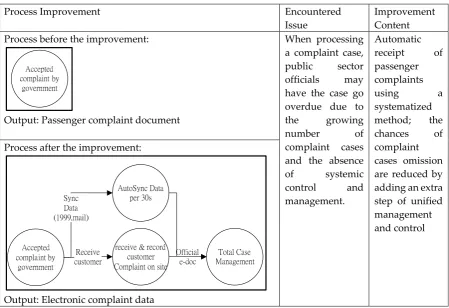
To ensure that no complaint is omitted and increase efficiency of the on-site receipt of complaints, this study proposed to distinguish between complaint sources, such as 1999 and mail, and use a systematized method for recording complaints (Table 5). First, complaint cases are received via 1999 and mail using a systematized method. Then, complaint issues are assigned among free human resources. Finally, the chances of complaint case omission are reduced by adding an extra step of unified management and control. The method involves three steps:
AutoSync Data per 30s
Automatic receipt of customer complaints: complaint cases are received via 1999 and mail using a systematized method.
receive & record customer Complaint on site
On-site management of customer complaints: on-site personnel receive customer complaints and record them in the system.
Total Case Management
Table 5. Process improvements in the phase of collection
Process Improvement Encountered
Issue
Improvement Content Process before the improvement:
Output: Passenger complaint document
When processing a complaint case, public sector officials may have the case go overdue due to the growing number of complaint cases and the absence of systemic control and management.
Automatic
receipt of passenger
complaints
using a systematized
method; the chances of complaint
cases omission are reduced by adding an extra step of unified management and control Process after the improvement:
Output: Electronic complaint data
Automatic receipt of passenger complaints with the use of a systematized method allows to allocate surplus human resources to receive complaints on site in order to ensure systematization and absence of omitted complaint cases. Assignment of an extra manager for unified management and control in the phase of collection reduces the probability of complaint case omissions and allows to avoid overdue cases that are possible in the traditional manual complaint management.
3.1.3 Process Improvement Outcomes
Effectiveness of the improvement in the collection phase should be verified. Due to the systematized automatic receipt of complaints, the objective of the collection phase is to increase the speed of receiving complaints on site in order to reduce the amount of complaint cases in this phase
and on hold. Thus, the decrease in
L
andL
q would indicate an improvement. Definitions of symbols used in the mathematical model are provided below.n: amount of customers in the system
n
λ
: average arrival rate when there are n customers in the systemλ
: average arrival rate in the system (1
λ
is the average interval between arrival times)n
μ
: average service rate when there are n customers in the systemμ
: service rate of one service provider (1
μ
is the average service time)ρ
: utilization ratioL
: number of customers complain in the systemq
L
: number of customers complain in the queue
Non-fixed times of complaints are distributed according to a Poisson process. Service times are exponentially distributed.
Bus passenger complaints are processed by the public sector on a first-come, first-served basis.
The number of customer complaints is unlimited.
Before the improvement in the collection phase, the public sector had a special service window for customer complaints, with exponentially distributed complaint receipt times (manual power). According to the queuing theory, the queuing model before the improvement was an M/M/1 model.
)
(
1
1
)
1
(
)
1
(
1
)
1
(
1
)
1
(
]
1
1
[
)
1
(
)
1
(
)
1
(
)
1
(
)
1
(
2 2 1 0 1 1 0 0 0 1 0 0 2λ
μ
μ
λ
ρ
ρ
ρ
ρ
ρ
λ
μ
λ
ρ
ρ
ρ
ρ
ρ
ρ
ρ
ρ
ρ
ρ
ρ
ρ
ρ
ρ
ρ
ρ
ρ
ρ
ρ
ρ
ρ
ρ
μ
λ
ρ
−
=
−
=
−
−
=
−
−
=
−
=
−
=
−
=
−
=
−
−
=
−
−
=
−
=
−
=
−
=
−
=
=
=
∞ = ∞ = ∞ = ∞ = ∞ = ∞ = − ∞ = ∞ = n n n n n n q n n n n n n n n n np
L
p
np
p
n
L
d
d
d
d
d
d
n
n
np
L
After introducing the improvement into the collection phase, a worker responsible for control and management of the progress of complaint management was added to the existing complaint window, resulting in the availability of two windows for customer complaints. Complaint receipt times (manual power) were exponentially distributed. According to the queuing model, the queuing model was an M/M/2 model.
2 3 2 2 2
-1
2
]
)
1
(
[
1
2
4
.
0
2
2
ρ
ρ
ρ
μ
ρ
λ
ρ
ρ
λ
μ
λ
ρ
=
−
=
−
=
=
+
=
qL
L
Mathematical model calculation results:
Before the collection improvement in the public sector complaint process in Taichung City: A. The public sector implemented one service window for collecting complaint cases
B. The public sector had an 8-hour work day with 21 work days per month. Passengers complaining about bus services to the public sector were exponentially distributed. On average, there were 1680 complaint cases per month and 10 cases could be processed per hour.
cases
L
cases
L
hr
hr
hr
q
4
.
17
24
100
5
83
.
0
12
12
1
min
5
1
10
≈
=
=
≈
=
=
=
=
=
μ
λ
ρ
μ
μ
λ
After the collection improvement in the public sector complaint process in Taichung City: A. A worker responsible for control and management of the progress of complaint
management was added to the existing complaint window, resulting in the availability of two windows for customer complaints.
B. The public sector had an 8-hour work day with 21 work days per month. Passengers complaining about bus services to the public sector were exponentially distributed. On average, there were 1680 complaint cases per month and 10 cases could be processed per hour.
C. Automatic synchronization of complaint cases: automatic receipt of passenger complaints reduced the time of manual receipt of complaints. Complaint receipt times were exponentially distributed, with the average complaint time of 3 minutes.
cases
L
cases
L
hr
hr
hr
q0.15
-1
2
]
)
1
(
[
1
1
2
4
.
0
2
2
20
20
1
min
3
1
10
2 3 2 2 2≈
=
−
=
≈
−
=
=
+
=
=
=
=
=
ρ
ρ
ρ
μ
ρ
λ
ρ
ρ
λ
μ
λ
ρ
μ
μ
λ
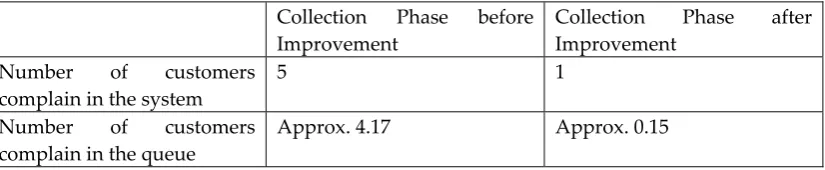
As verified by the mathematical model calculations, the improvements in the collection phase (Table 6) could reduce the idle time and the number of complaint cases queuing to be processed by public sector.
Table 6. Collection phase before and after the improvement
Collection Phase before
Improvement
Collection Phase after Improvement
Number of customers complain in the system
5 1
Number of customers complain in the queue
3.2 Process Improvements in the Classification Phase
After receiving complaint cases during the collection phase, public sector enters the classification phase, which generally involves officials classifying complaint cases based on a bus company.
3.2.1 Encountered Issues
The increase in the number of customer complaints causes inefficiency of manual classification of complaint cases and a growing error rate.
Officials differ in their performance in the management of different violation cases. The increase in the number of customer complaints results in inefficiency of traditional classification of complaint cases. Moreover, a case can be assigned to an inexperienced official, which may increase a risk of biased management and discontent among passengers. A large number of complaint cases cannot be effectively managed using the traditional manual method and assigned to an appropriate official, which is an important issue in the classification process.
3.2.2 Process Improvements
To solve the issue of big data classification and improve the existing manual procedure of complaint case classification, this study proposed using text mining technologies and keywords to classify customer complaint cases (Table 7). Sullivan (2001) defined text mining as a process of editing, organizing, and analyzing big data to provide a specific user with specific information and determine features and the relationships between features [25]. Text mining is equivalent to data mining and uses a data selection processing program to extract complex features.
Text mining technologies were used to improve the classification phase [26]. First, personal data of complaining passengers and the data of corresponding public sector officials were filtered to facilitate further tracking of a complaint case. After data filtering of each complaint case, violations described in cases were classified using text mining, which increased complaint processing speed by public sector officials and reduced the error rate in case judgments.
Thus, improvement of the existing classification phase included two steps:
1.
Classification Cases by Text mining
Text mining: Due to its large amount, customer complaint data can no longer be processed using the manual method. This study used regular expressions, text mining tools, to automatically retrieve violation state, incident time, bus station, bus route, and license plate data from complaint content and determine a management process corresponding to the violation state. Reply templates were provided to reduce mistakes in the complaint management and responses to customers by officials.
2.
Filtering data
Table 7. Process improvements in the classification phase
Process Improvement Encountered
Issue
Improvement Content Process before the improvement:
Output: Assigned official passenger complaint documents
The increase in the number of customer complaints caused inefficiency of manual
classification of complaint cases and a growing error rate.
Filtering case data allowed to reduce leakage of passengers’ personal data. Automatic retrieval of keywords from complaint content and provision of complaint management templates reduced the risk of error during case processing. Process after the improvement:
Output: Electronic complaint data included violation state, incident time, bus station, bus route, and license plate data
3.2.3 Case Match Rate Analysis
By using a systematized method for filtering data and automatic classification of cases, a risk of misrepresenting data can be avoided and case processing time can be reduced.
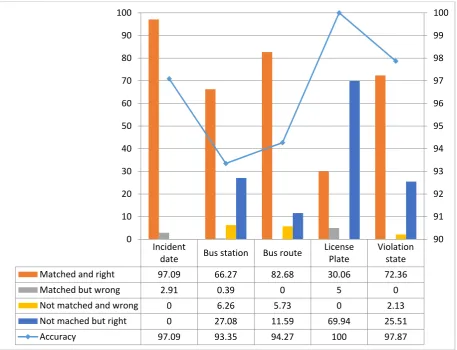
Public sector keywords were used in the classification phase. Regular expression technologies were applied to derive a violation type from complaint data, which accelerated complaint management by public sector officials and reduced the error rate in their judgments. Thus, a higher match rate in a complaint case indicated a higher efficiency of public sector in processing the case. This study examined 3054 cases collected over two months. Match results were automatically produced by a cross-match system and interpreted manually. Manual approaches are applied to clearly check the result, four indexes have been developed as presented in Figure 3. The first index is that the matching is right, which means that the complaints text feature and the RE algorithm matched successfully. In addition, the matching result turned out to be right after comparing by the manual. The second is that the matching is wrong, obviously, because the RE algorithm matched some words but it turned out to be wrong after manual examination, Similarly, the other two are that not matched and being wrong, and not matched but right respectively, whose practical significance are easy understood.
The index's matching rates have been calculated and shown in Figure 4, the matching accuracy which is defined as the sum of Index1 and Index4 was also calculated illustrated by the blue line. Seen from the figure, the license plate has achieved the highest accuracy, which is 100%, followed by the violation state matching and the time matching, which are 97.87% and 97.09%.
Figure 4. Accuracy after Applying Text Mining Technologies
3.3 Process Improvements in the Assignment Phase
After classifying all complaints, public sector assigns each complaint case in the form of a paper document with a serial number to an official.
3.3.1 Encountered Issues
Traditionally, a complaint case is assigned in the form of a numbered paper document for processing by a public sector official. When the number of complaint cases is small, public sector officials have sufficient time to process the cases. The increase in the number of complaints reduces the efficiency of case assignment through paper documents. Some cases may be omitted due to the fact that time available for case processing differs from case to case. Moreover, different officials may be skilled in processing different types of cases. Process improvements are needed in case assignment in order to make case processing more efficient and time-based.
3.3.2 Process Improvements
As shown in Table 8, sequential paper assignment of complaint cases to public sector officials is not effective. Therefore, this study proposed improvement measures for the assignment process, specifically, the use of a systematized model in complaint case assignment. The assignment phase in
Incident
date Bus station Bus route
License Plate
Violation state Matched and right 97.09 66.27 82.68 30.06 72.36
Matched but wrong 2.91 0.39 0 5 0
Not matched and wrong 0 6.26 5.73 0 2.13
Not mached but right 0 27.08 11.59 69.94 25.51
Accuracy 97.09 93.35 94.27 100 97.87
90 91 92 93 94 95 96 97 98 99 100
this case must be preceded by automatic classification of complaint content (violation state, incident time, bus station, bus route, and license plate), based on which public sector can assign complaint cases to appropriate officials, thus, ensuring effective assignment of complaint cases.
Moreover, due to overall electronization of the assignment process after the improvements, public sector officials use the electronization method of the improved classification system to assign complaint cases to bus companies. Additionally, for legal reasons, one paper document combining many complaint cases is sent to each bus company. Immediate assignment of electronized complaint data together with a paper document prevents bus companies from omitting complaint cases that must be processed.
Table 8. Case classification and assignment before and after improvements
Process Improvement Encountered
Issue
Improvement Content Process before the improvement:
Output: Assigned official passenger complaint documents
The increase in the number of customer complaints causes inefficiency of manual
classification of complaint cases and a growing error rate.
Filtering case data allowed to reduce leakage of passengers’ personal data. Automatic retrieval of keywords from complaint content and provision of complaint management templates reduced the risk of error during case processing. Process after the improvement:
Output: Immediate systematized delivery of complaint cases to bus companies; regular deliver of official paper documents
3.3.3 Process Improvement Outcomes
Different officials may have different efficiency in terms of complaint case management depending on the type of violation. In the assignment phase, all filed complaint cases should be assigned to or controlled by appropriate human resources to complete the case management within the planned period of time (E.T.). In the existing structure of complaint case management, manpower was assigned such that to reach balance in the production line. Definitions of symbols used in the mathematical model are provided below.
The model involves n workstations and 1-1 assignment issues. i: number of workers available for assignment, 1~ n
j: number of workstations that need to be assigned, 1~ n
Tij: time required for finishing work by a worker i at a workstation j. Xij: used to control whether or not the element needs to be assigned
Based on the definitions, this study developed a mathematical model with the following target and constraint formulas:
i
=1 , 2 … n∈
ijX
0 or 1
s.t . X11 + X12 + X13 +... + X1n = 1
X21 + X22 + X23 +... + X2n = 1
X31 + X32 + X33 +... + X3n = 1
. . . . . . . . . . . . . . . . . . Xn1 + Xn2 + Xn3 +... + Xnn = 1
X11 + X21 + X31 +... + Xn1 = 1
X12 + X22 + X32 +... + Xn2 = 1
X13 + X23 + X33 +... + Xn3 = 1
. . . . . . . . . . . . . . . . . . X1n + X2n + X3n +... + Xnn = 1
Xij = 0: used to control a worker i not assigned to a workstation j. Xij = 1: used to control a worker i assigned to a workstation j.
Tij × Xij: if equal to 0, indicates that a worker i is not assigned to a workstation j; if not equal to 0, indicates that a worker i is definitely assigned to a workstation j; the value represents an actual output of the workstation.
D: assuming that there are m ways to classify compliant cases and due to the influence of classification accuracy on assignment accuracy, classification with the highest accuracy is used, D=Min(D1,D2,D3...Dm)
E.T.: time that is expected to be spent on the management of a complaint case among all feasible solutions; E.T. before (B.E.T.) and after (A.E.T.) process improvements can be distinguished.
B.E.T.: prior to the process improvements, complaint cases were assigned using a linear method. There was a 50% probability that complaint cases would be assigned to a non-appropriate official. In other words, there was a 50% probability of spending maximum time on case management and a 50% probability of spending minimum time on case management.
{
}
)* 50 % ({
}
)*50 % (. . .
1
1 ij ij
n j ij
ij n
j T X Max T X
Min T
E
B = × + ×
= =
A.E.T.: After the process improvements, classified complaint cases were assigned to those officials who could manage them most efficiently. Thus, the accuracy of classification affected time that was expected to be spent on case management after the improvements. The strictest classification accuracy can be used as a control variable to calculate time expected to be spent on case management.
{
}
)* ({
}
)* (1 ) (. . .
1
1 T X D Max T X D
Min T
E
A ij ij
n j ij
ij n
j × + × −
=
= =
Mathematical model calculation results: i=3 officials
j=3 types of violation in complaint cases: C1, C2, C3
The following table presents nine case management times differing among three officials and depending on three types of complaint cases.
i=1 i=2 i=3
j=1 T11:2HR T21:1HR T31:3HR
j=2 T12:1HR T22:3HR T32:2HR
If Xij is:
i=1 i=2 i=3
j=1 X11:0 X21:0 X31:1
j=2 X12:0 X22:1 X32:0
j=3 X13:1 X23:0 X33:0
then
{
T
X
}
HR
Max
n ij ijj=1
×
=
3
If Xij is:
i=1 i=2 i=3
j=1 X11:0 X21:1 X31:0
j=2 X12:1 X22:0 X32:0
j=3 X13:0 X23:0 X33:1
then
{
T
X
}
HR
Min
n ij ijj=1
×
=
1
Before process improvements: B.E.T.=(3HR+1HR)/2 = 2HR After process improvements:
According to the match ratio of cases, D=Min(97.09%, 93.35%, 94.27%, 100%, 97.87%)=93.35%, A.E.T.=(1HR*0.9335+3HR*(1-0.9335)) = 1.133HR
Expected time of case management (E.T.) was reduced from 2 hours before the process improvements to 1.133 hours after the process improvements.
Before process
improvements
After process improvements
E.T. 2HR 1.133HR E.T.: expected time of case management
3.4 Process Improvements in the Improvement Phase
Bus companies follow recommendations to improve their services and are supposed to provide public sector with a report about the improvements within a certain period of time.
3.4.1 Encountered Issues
Traditionally, after receiving official notifications from public sector, bus companies improve their services based on the complaints. However, the increase in the number of complaint cases keeps bus companies and public sector constantly on the run trying to solve all issues raised by passengers. Due to limited resources, some issues remain ignored, which indicates inefficiency and inability to meet passengers’ needs.
3.4.2 Process Improvements
To facilitate decision-making in the public sector, this study added the application of big data
high-density point data. It can be applied to identify high-high-density areas in point data and is very useful in cluster analysis and hot spot analysis [27].
Application of a systematized method in the management of all complaint data regarding Taichung bus services allows to statistically derive hot spots of customer complaints based on the content related to incident time, incident place, and violation. These hot spots can then be presented in GIS, allowing public sector and bus companies focus on improvements in these areas under the conditions of limited resources.
Under the circumstances of a growing number of complaint cases, an electronic system may accelerate case management between public sector, bus companies, and passengers. Public sector can promptly provide bus companies with the content of complaints. Thus, bus companies can be aware of what needs to be improved as early as possible and can strengthen improvements in hot spots of passenger complaints, thus, providing passengers with better services, reducing the number of complaints, and establishing a virtuous circle in the supply chain.
After improving services in hot spots, bus companies provide public sector with electronic evidence data and an official report document upon completion of several complaint cases.
Table 9. Improvement phase before and after the improvement
Process Improvement Encountered
Issue
Improvement Content Process before the improvement:
Output: Improvement evidence provided to public sector
Under the circumstances of a growing number of passenger complaints, bus companies found it difficult to determine main objectives for
improvement and the efficiency of resource use decreases.
Analysis of complaint data using big data analysis
technologies and its presentation on a
thermodynamic diagram allows bus companies to understand which areas need
improvements and which of them call for most consideration. Process after the improvement:
Output: Improvement evidence provided to public sector
3.4.3 Process Improvement Outcomes
Figure 5. Heatmap of passenger complaints in Taichung City
3.5 Summary
This study proposed improvements for each phase of the bus passenger complaint process. The content of the improvements is provided in Table 10 and their efficiency calculated using mathematical models is presented in Table 11.
As shown in Table 10, in the collection phase, a systematized automatic approach was used to collect complaint data and unified control and management were added to the process. Mathematical model calculations showed that the process improvements could reduce the amount of pending cases in the system, as well as the waiting time of complainants.
In the classification and assignment phases, it was proposed to use text mining technologies for automatic data filtering, intelligent retrieval of complaint keywords, and compilation of complaint management samples based on the keywords. Automatically classified complaint cases were assessed for their type and assigned to officials who were more skilled in managing a certain type of complaints. This increased the efficiency of case management and reduced its time. Mathematical model calculations showed that the process improvements could reduce time required for case management.
Table 10. Complaint process phases after improvements
Improvement Content
Collection The collected data was entered into an electronic system that automatically received complaint-related information and unified control and management was integrated into the process. This reduced probability of case omissions, as well the waiting time of each complaint, thus, improving the efficiency of the collection phase.
Classification The system can automatically filter out personal data and retrieve complaint keywords by using text-mining technologies and produce samples, which requires less time for case management then manual classification and document formulation.
Assignment Automatically classified complaint cases were assessed for their type and assigned to officials who were more skilled in managing a certain type of complaints. This increased the efficiency of case management and reduced its time.
Improvement The system could quickly determine hot spots of passenger complaints, which allowed public sector and bus companies to focus on improvements in passenger complaint hot spots, increase the effectiveness of using limited resources, increase customer satisfaction and solve most problematic issues of bus services.
As shown in Table 11, after the improvements in the collection phase, the number of complaint cases in the system and in the queue was reduced from 5 to 1 and from 4.17 to 0.15, respectively. In the classification and assignment phases, the use of text-mining technologies reduced time required for case management (E.T.) from 2 to 1.133 hours.
Table 11. Processes in each phase before and after improvements
Collection
Improvement Objective Before process improvement
After process
Improvement Description Number of customers
complain in the system
5Approx. 5 1
The number of complaint cases decreased Number of customers
complain in the queue
Approx. 4.17 Approx. 0.15
Classification & Assignment
E.T. 2HR 1.133HR Less time is
required for managing a case
Improvement
Reference for decision-making
Relation between bus service improvement and experience of officials
Focus on improvements in hot spots of passenger complaints
Bus services are improved, while effectively using resources
4. Number of Complaints after the Process Improvements
To verify the effectiveness of the proposed improvement strategies for the customer complaint process, an actual statistical analysis was conducted for three types of cases that most seriously affected passengers’ objective perception and were likely to cause discontent. These three types included:
Station-skipping: A bus may not stop at the designated place, thus, preventing passengers from boarding it.
Unauthorized detours: Bus companies may not fully execute their responsibilities by changing routes without permission. As a result, passengers wait for the bus in vain, which reduces their satisfaction with bus services.
In April 2015, public sector of Taichung City officially began using a systematized approach to analyze big data related to passenger complaints and improve their processing. This study tracked the complaint data for a total 10 months, from April 2015 to February 2016, and conducted a statistical analysis of three complaint types, namely, bus idling (driving slowly), station-skipping, and unauthorized detours. Actual statistical results (Table 12 and Figure 6) showed an improvement in terms of the number of complaint cases.
Table 12. Numbers of complaint cases of three most serious types
A: Driving slowly B: Skip stations C: Unauthorized detours
2015/4 27 163 6
2015/5 38 162 5
2015/6 17 145 12
2015/7 26 151 16
2015/8 34 134 5
2015/9 23 127 12
2015/10 18 123 13
2015/11 8 111 5
2015/12 7 111 1
2016/1 2 103 3
2016/2 5 105 4
SLOPE -3.05 -6.54 -0.59
Except text mining, the intelligent assistant function is also supplied by mining the historical data. It's a statistics result based on the achieved station character to intuitive display the place where events high occurs. The different violate samples was also achieved by each month, through analyzing the characteristics of all violations, the government policy makers and enterprises was able to adjust their focus of work and optimized the allocation of human resources timely. Number of all violation samples are collected from April 2015 to February 2016, after the system was put online at Oct.2015, the optimized results could be obviously observed from the table.
Figure 6. Numbers of complaint cases of three most serious types
5. Conclusion
The use of the process improvements proposed in this study allowed public sector to effectively and promptly assign and process complaint cases. Being more aware of passenger needs, public sector can plan better policies to meet them. Fulfillment of passenger needs can increase the number of passengers and, consequently, revenues of bus companies, which, in turn, help to improve bus software (services) and hardware (vehicle). Customer satisfaction grows, reducing the number of complaints and establishing a virtuous circle. In other words, a systematized analysis of customer complaint data can improve public sector management processes by improving services through the solution of derived issues. Furthermore, bus services can be improved by strengthening improvements and actively conducting examinations in hot spots of customer complaints. This establishes a virtuous circle in supply chain relationships between public sector, bus companies, and passengers (Figure 7).
Figure 7. Virtuous circle in the supply chain relationship between public sector, bus companies, and passengers after the complaint process improvements
Using the example of Taichung City bus services, this study showed that the customer complaint process improvements reduced time required for complaint management and the number of complaint cases in public sector. Moreover, the improvements allowed to effectively use resources, improve the quality of bus services, increase customer satisfaction and increase the number of public transportation system users, thus, contributing to energy saving, carbon reduction, and sustainable environmental development of the city.
Acknowledgements: No funding was received for this research.
Author Contributions: The two authors contributed substantially to this research. Dr. Liu, W. K. conceived and designed the experiments. Yen, C. C. collected the materials and analyzed the data. Both Dr. Liu, W. K. and Yen, C. C. performed the experiments and wrote the paper.
Conflicts of Interest: The authors, Dr. Liu, W. K. and Yen, C. C., declare no conflict of interest in this study.
References
1. Cooper, T.L.; Bryer, T.A.; Meek, J.W. Citizen-Centered Collaborative Public Management. Public Administration Review 2006, 66, 76-88. doi: 10.1111/j.1540-6210.2006.00668.x
2. Aikins, S.K.; Krane, D. Are Public Officials Obstacles to Citizen-Centered E-Government? An Examination of Municipal Administrators' Motivations and Actions. State and Local Government Review 2010, 42, 87-103. doi:10.1177/0160323X10369159
3. Berry, J.M.; Thomson, K.; Portney, K. The Rebirth of Urban Democracy. Brookings Institution Press: USA, 1993.
4. Eaton, C.; Deroos, D.; Deutsch, T.; Lapis, G.; Zikopoulos, P. Understanding big data: Analytics for enterprise class hadoop and streaming data. McGraw-Hill Press: New York, USA, 2012.
5. Wright, L.; Fulton, L. (2005). Climate Change Mitigation and Transport in Developing Nations. Transport Reviews 25, 691-718.
6. Barter, P.A.; Dotson, E. Urban Transport Institutions and Governance and Integrated Land Use and Transport, Singapore. Retrieved n.d., 2013, from http://unhabitat.org/wp-content/uploads/2013/06/GRHS.2013.Case_.Study_.Singapore.pdf
8. Barter, P. A. Singapore’s Urban Transport: Sustainability by Design or Necessity? In T. Wong, C., Yuen, B., Goldblum C., Spatial Planning for a Sustainable Singapore Springer: Springer Netherlands, 2008; pp.95-112. doi: 10.1007/978-1-4020-6542-2_6.
9. Liao, C.P.; Chen, D.Y.; Hsiao, N.Y.; Liao, H.Z. Using Big Data to Achieve Good Governance: A Feasibility Study on Introducing Cyber Opinion into Government Decision-making Process. Taipei: Research, Development and Evaluation Commission, Executive Yuan, 2014.
10. Jin, Y.; Ji, S. Partner Choice of Supply Chain Based on 3d Printing and Big Data. Information Technology Journal 2013, 12, 6822-6826. doi: 10.3923/itj.2013.6822.6826
11. Coussement, K.; Poel, D.V.D. Improving Customer Complaint Management by Automatic Email Classification Using Linguistic Style Features as Predictors. Decision Support Systems 2008, 44, 870-882.
12. Zhang, K.; Narayanan, R.; Choudhary, A. Voice of the Customers: Mining Online Customer Reviews for Product Feature-based Ranking. Wosn 2010, 10, 11-11.
13. Ziegler, C.N.; Skubacz M.; Viermetz, M. Mining and Exploring Unstructured Customer Feedback Data Using Language Models and Treemap Visualizations. In Ziegler, C.N., Skubacz, M., Viermetz, M. WI-IAT '08 Proceedings of the 2008 IEEE/WIC/ACM International Conference on Web Intelligence and Intelligent Agent Technology - Volume 01 (pp.932-937). USA: IEEE Computer Society Washington. doi: 10.1109/WIIAT.2008.69
14. Zhang, L.; Liu, B.; Lim, S.H.; O' Brien-Strain, E. Extracting and Ranking Product Features in Opinion Documents. In Huang, C.R., Jurafsky, D. Cooling 2010: Poster Volume. Tsinghua University Press: China, 2010; pp. 1462-1470.
15. Tai, C.Y. The policy effect of one-stop service on internal customer: a case study of Taipei's 1999 Citizen Hotline Service (Unpublished master’s thesis). Tamkang University, Taipei, Taiwan, 2014. 16. Yan, C.C. 2014 Taichung City Bus Operation Decision Analysis and Management System
Implementation Plan: Taichung City Transportation Bureau Mid-Term Report. Taichung: Hung Ming Information Co.
17. Yang, H.P. Using Value Analysis in Business Processes. Value Management 2003, 5, 43-47. 18. Davenport, H. T.; Sbort, J. E. The New Industrial Engineering: Information Technology and
Business Process Redesign. Sloan Management Review 1990, 31, 11–26.
19. Gates, B. Business @ the Speed of Thought: Succeeding in the Digital Economy. Warner Books: USA, 1999.
20. Adesola, S.; Baines, T. Developing and evaluating a methodology for business process improvement. Business Process Management Journal, 2005, 11, 37-46.
21. Gunasekaran, A.; Nath, B. The role of information technology in business process reengineering. Int. J. Production Economics 1997, 50, 91-104. doi: 10.1016/S0925-5273(97)00035-2 22. O’Neill, P.; Sohal, A. S. Business Process Reengineering A review of recent literature.
Technovation 1999, 19, 571–581.
23. Attaran, M. Exploring the relationship between information technology and business process reengineering. Information & Management 2004, 41, 585–596. doi:10.1016/S0378-7206(03)00098-3 24. Love, P.E.D.; Gunasekaran, A. Process reengineering: A review of enablers. Int. J. Production
Economics 1997, 50, 183–197.
25. Sullivan, D. Document Warehousing and Text Mining: Techniques for Improving Business Operations, Marketing, and Sales, John Wiley & Sons, Inc: New York, USA, 2001.
26. Ordenes, F.V.; Theodoulidis, B.; Burton, J.; Gruber, T.; Zaki, M. Analyzing Customer Experience Feedback Using Text Mining: A Linguistics-Based Approach. Journal of Service 2014, 17, 278-295. doi: 10.1177/1094670514524625.
27. Wilkinson, L.; Fridnely, M. The History of the Cluster Heat Map. The American Statistician 2009, 63, 179 – 184.
© 2016 by the authors; licensee Preprints, Basel, Switzerland. This article is an open access article distributed under the terms and conditions of the Creative Commons by