THE ART OF BRANDING
Narratives of Identity and Heritage at the Crossroads of Modern Kazakhstan
By Ad Lane
An honor thesis submitted in partial fulfillment of the requirements for the degree of
BACHELORS OF ARTS IN ANTHROPOLOGY
At the
ACKNOWLEDGEMENTS
This project came together through the aid and advice of many people, without whom my work
would have not been possible. First to my advisor, Rudi Colloredo-Mansfeld, I owe my gratitude for
mentorship during the development and writing processes. Also thank you to Gina Difino, Lucius Burch,
and the other overseers of the Burch Fellowship, for providing my main funding for this research. Special
thanks to Eleonora Magomedova and Colin Thor West for their written letters of support, and to my
friends both at home and abroad for their encouragement. Also, to the various coffee shops and
restaurants I loitered at during the writing stage, thanks for your patience. Lastly, I wish to dedicate
sincere gratitude to my parents for our brief time as travel partners, but more importantly for the love of
ABSTRACT
Throughout history, colonized lands have frequently been the victims of heritage and cultural
suppression by occupying powers. In their independence, many find themselves in an uphill battle to
reclaim their past in order to guide their future. Kazakhstan, a former Soviet republic, faces one such
fight. Independent since 1991, Kazakhstan’s need for a strong identity has grown in the midst of
increasing corporate and international interests. The country is tasked with the complex challenge of
reaffirming and rebalancing cultural identity for presentation at international stages such as EXPO 2017,
using tradition as a foundation for ‘nation-branding’. One such long-respected Kazakh tradition is
craftmaking, the focus of this study.
My research sought to examine the overlaps and deviations in how the concept of ‘Kazakhness’ is
reconciled between artisan communities and nation-branding campaigns. It takes on the perspective of the
craft-maker, investigating how nation-branding aspirations are co-opted by artisans in the pursuit of their
own agendas. Using a combination of interviews, observations, and photo-documentation, I argue that
between artisans and branders, the elements comprising the Kazakhstani identity receive varying
prioritization based on the motives of each party. The resulting relationship is alternating and symbiotic -
incorporation of the other’s cultural ideology only when beneficial. Site and human accounts present a
picture of an artisan world which has experienced a recent revitalization, driven by an ability to capitalize
In March, 2016, an arts and craft festival was hosted in Astana, the capital city of Kazakhstan.
The festival, ‘Uly Dala Zharmenkesі’ (Figure 1), was promoted as a prelude competition for EXPO 2017,
a large-scale international event which took place from June to September, 2017. Over a two day period,
more than 100 artists from across the nation gathered to present products ranging from feltwork to jewelry
to clay sculptures. The winners among these earned an official seal of the EXPO, and were granted access
to more prominent markets tied to the upcoming event (“Contest Announced…” 2016; Tanyrkulova
2016). Overall, Uly Dala Zharmenkesi fit into the larger string of contributions by its primary organizer,
the United Nations Development Programme. It was considered by the UNDP to be a success both
socially and economically. Saltanat Rakhimbekova, director of fellow organizer, ‘EXPO & Women’,
described the event’s relevancy to larger Kazakhstani culture, emphasizing “the uniqueness of the
product, quality and compliance with our specific traditions. It is very important because these works will
talk about us, about the people of Kazakhstan” (Official Strategy 2050 website).
Figure 1. The Uly Dala Zharmenkesi festival (Tanyrkulova 2016)
President Nursultan Nazarbayev. Under his program, “Strategy 2050”, the Nazarbayev administration has
identified and executed a variety of security, modernization, economic, and nationalism projects. By
doing so they pursue a position within the world’s top 30 most-developed states. In this ambition officials
viewed craft culture - and tangible culture as a whole - as a means to accomplish one of the strategy’s
essential components: unification of the modern Kazakhstani identity (Official Strategy 2050 website). In
turn, participating artisans saw the competition as an avenue for promoting both their personal business
and their identity as heritage ambassadors. Uly Dala Zharmenkesi, then, represented the overlap of
ambitions between artisans - culture preservationists - and government policy makers - culture marketers.
Many works have dealt with Kazakhstan strictly as a nation-branding case study (Fullerton 2008;
Stock 2009; Yessenova 2011; Engvall and Cornell 2015; Kudaibergenova 2015; Motyl 2015; Shakirova
2015; Kaukenova 2017). Others have examined the unique position of artisans as creators and preservers
of tradition in post-Soviet states (Surganov 2009; Grewatz 2013; Kenzhebekovna and Nagima 2014). This
thesis is one which ultimately seeks to combine the two: a fusion that has precedent in Michael Ahn’s
piece, “The Art of Nation Branding” (2015), as well as the 2017 work of Mentges and Shamukhitdinova,
but is deserving of more in-depth study. To this point, my research was guided by two questions:
i) What elements of Kazakhstan’s past and heritage have been incorporated into 21st century
brand, artisan identities, and the form of modern craft?
ii) How have artisans reconciled the ambitions of 21st century Kazakh branders into their own
motives and practices, and to what extent do aspirations overlap with those of government
brand-makers?
It is in this context that my project came to be. During the summer of 2017, I spent seven weeks
ongoing branding of the state. Initial results from my work there point to the perspectives of branders and
artisans existing as cross-weaving narratives. In this paper I present a country in which each sphere
operates based first and foremost on its own sets of priorities and goals. I argue that this separation exists
due to the contrasting origins of artisans and branding campaigns, arising naturally as cultural practice
and spontaneously by external drivers, respectively. The resulting relationship between the two is largely
dissociated, coming together only when ambitions are mutually benefited by collaboration. Kazakhstani
artisanship, operating from a position of low political power, today is challenged with determining how
best to adapt its ideals to those of branders who influence the future of the state and its citizens.
These conclusions are based on a research methodology combining semi-structured interviews,
ethnographic observation, and photographic documentation. Research took place across a wide range of
permanent and seasonal locations incorporating economic, political, and artistic functions. Due to
limitations as a beginner Russian-speaker, budgetary restrictions, and the prevalence of branding
initiatives, work was concentrated in urban areas. Specifically, the cities of Astana, Almaty, Shymkent,
Taraz, Karagandy, and Sayram. In these cities I sought to observe and interact with a variety of
personalities: artists, event volunteers, store operators, and average citizens alike. Interviews provided
means of directly assessing the statuses and mindsets of agents with ties to my research topic. Behaviors
and cues, being non-verbal, were invaluable to recording the success of craft and branding elements
despite language barriers. Photographic documentation complements the traditional research
methodology, given the nature of craftwork as a visual sphere. Altogether, objects, locations, and
non-verbal interactions were photographed with consent (when appropriate). Following the argument of
C. Wright Mills in his 1959 piece, “On Intellectual Craftsmanship”, my on-the-ground approach allowed
each of these methods the freedom to be pursued in its most natural form, creating a research narrative
Given the topics at hand within this thesis, and the lenses commonly used to study former Soviet
states, it would be easy to stray too far into the realm of political science. That is not the goal of this
thesis. Large portions of Kazakhstan academia focuses on specific political policy or relationships,
including the controversial nature of the nation-state’s authoritarian administration. Though such elements
are undoubtedly important to a larger understanding of the country as a whole, and though they are
acknowledged at times throughout this paper, they are ultimately accessory to the main focus of this
work. Rather, this work hopes to contribute to an established but underdeveloped branch of
anthropological literature which speaks to a symbiosis of artisans’ and branders’ ideologies. I aspire for
this work to also add to discussion of artisanship as a form of social obligation, as compared to the
economic and self-fulfillment drivers argued and exemplified in many other cultural investigations
(Medina 2004; DeNicola and Wilkinson-Weber 2016).
My own work with Kazakhstan featured three years of preparation and planning, setting up an
awareness beyond that of a typical visitor. Still, approaching the research with an understanding of myself
as a tourist was crucial, as tourism exists as a driving determinant of both artisanship and nation-branding
success. As an international visitor (Figure 2) the perception of me was that of a potential consumer of
culture and products alike. While an consumerist expectation was not guaranteed, it undoubtedly lent
itself toward the likelihood of biases including socially-desirable responses. My specific status as an
American additionally meant (at least in the eyes of some Kazakhstanis) a degree of assumed
misinformation about the country. This is largely an effect of popular media like the 2006 film Borat
which presented a satire of American ignorance at the expense of Kazakhstan (Fullerton et al. 2008; Stock
2009; Motyl 2015). Regardless of reality or my personal attempts at entering into research well-informed,
I had to be prepared for cases where dialogue was predicated upon these assumptions, or any other biases
Figure 2. The researcher in Kazakhstan
This thesis is organized to reflect the urgency of Kazakhstan’s present day. I begin with a brief
overview of relevant anthropological literature, leading into a discussion of Kazakh identity through
history. This is followed by a discussion of post-independence nation-building and the transition to
present day’s international prerogative, where I document my experience at World Expo 2017 as a
branding venue. Conversation then shifts toward venues for artisanship specifically, using encounters to
explore production ‘authenticity’ and the preservation of traditional identity across generations. The last
main section looks specifically at how artisans’ goals have coincided with or defied branding aspirations.
Specific cases from the field and a comparison of two popular national symbols allow me to comment on
successful collaboration, as well as cases where artisan and brand goals did not align. This sets up a final
summary of observations and arguments, ending with an assessment of current standings and potential
directions for the future of interaction and the Kazakhstani brand.
LITERATURE
identity - it is imperative to acknowledge the foundational works which have informed anthropological
understanding for decades. ‘Nation’ as a concept is fairly young, a construction made possible only by the
collapse of century-long held barriers toward innovation and societal change (Anderson 1983). While
specific mechanisms behind the modern nation are still up for debate, the works of Anderson (1983),
Gellner (1983) and Hobsbawm & Ranger (1983) are frequently cited for their theories of formation.
Beginning with the claim that “nation-ness is the most universally legitimate value in the political
life of our time”, Benedict Anderson’s Imagined Communities argues that civilization’s progression to
this point is best understood as coincidence, rather than any conscious or divine coming-to-be (Anderson
1983: 12). As a result, the nation - and in fact all larger societal entities - forms as an ‘imagined
community’. Individuals coalesce intentionally using bonds of perceived yet often inconsequential
commonalities. By extension, they exist imbued with a solidarity exceeding personal connection - loyalty
and sacrifice, even for those never met. In the past these bonds formed via hierarchical religion and
language. Increasing regionalization over time eventually produced a void of identity filled by the rise of
the nation, a system suited for society’s movement away from past notions of ‘preordainment’ toward a
world of temporally-similar coincidences.
Ernest Gellner (1983) observed the decline of known rules and relationships as occurring during
the agrarian-industrial transition. Deterioration of stability and deep relationships helped produce the
modern nation. “The sense that national identity is natural is one expression of this irresistible
convergence of state, population and culture within industrial society” (Gellner 1983: XXV). By Gellner’s
classification, industrial nations require ‘citizens’ who share a common (i.e. high) culture created as
“nationalism constructs and transforms a ‘folk culture’” (Gellner 1983: XXVIII). Reprioritization toward
cognitive and economic growth sparks a drive for constant progress that razes old systems of order and
power. Generic education operates as a chief institute that promotes greater division of labor mobility and
part and this training” (Gellner: 36). Autonomy and subsistence of small groups are stripped, weakening
kinship and heightening homogenization. When all is said and done, the citizenry is reformed into a
collective united by a generalized identity, built upon the foundations of education and aspirations of
industry. A new nation emerges, guided by a new ideology: that “culture is now the necessary shared
medium, the life blood… within which alone the members of society can breath and survive and produce”
(Gellner 1983: 36).
Building on Anderson and Gellner, TheInvention of Tradition by Eric Hobsbawm and Terence
Ranger (1983) looks at the maintenance and creation of nationalism through construction of new
traditions, purposed with the unification of community. Such traditions - whether practices, beliefs, or
iconography - come to be as an “attempt to establish continuity with a suitable historic past” (Hobsbawm
and Ranger 1983: 1). Symbols are sought out as high-culture icons of permanence and repetition, from
which communities draw identity. Shared history is utilized strategically to present a past aligned with
societal ambitions. Invented traditions are thus means of enacting policy and embodying real and
imagined communities alike. They come to prominence as public sphere tools for retaining power and
legitimizing authority. In this manner, invented traditions have been identified most strongly as
instruments “highly relevant to that comparatively recent historical innovation, the ‘nation’” (Hobsbawm
and Ranger 1983: 13).
Yet even with the seminal understandings of nation and culture, Kazakhstan proves difficult to
pinpoint. For as many ways that Kazakhstan aligns with and molds to notions of the nation, it also
deviates from the proposals of featured anthropological writers (to be discussed later). Thus, an awareness
of its development is also necessary. Situated between China, Russia, and the Middle East, Kazakhstan’s
geographic centrality means its history is one of interaction. Set against the swaths of flat, windswept
steppeland, the blending of peoples, languages, and cultures which took place here is unmatched by most
THE KAZAKH NATION
From the beginning, the region of Central Asia occupied by Kazakhstan today was defined by
nomadism. While the exact origin of today’s Kazakh ancestors is unknown, roaming tribes were recorded
in the region as early as the first millenium BC. These groups are fairly undocumented, but some, such as
the Sakas, are more known about than others. Turkic groups, from which the modern Kazakhs most likely
descended, emerged sometime between 1000 and 600 BC, though the precise time remains disputed
(Akiner 1995; Sabol 2003). The Mongols, led by the infamous Genghis Khan, entered Central Asia
during the 13th century with an immediate overhaul of the region. The newly conquered land was divided
into smaller territories that by the end of the 15th century had coalesced into the larger ‘Kazakh Khanate’.
The next century, perhaps dictated by inner conflict, witnessed a fracturing of the Khanate into three tribe
hordes, but conversely marked the first significant usage of ‘Kazakh’ as an identifier among the nomadic
tribes (Akiner 1995).
Over successive centuries, regional competition increased dramatically. Raids by encroaching
Dzungar tribes against the Lesser and Middle Hordes prompted temporary alliances with Russian rivals
during the 1600s. The Greater Horde would follow suit some time after. While initially considered a
short-term arrangement for protection, Imperial Russian presence grew through the 18th century. New
forts and tradelines moved the population toward a sedentary economy, while disruptions of migratory
grazing created economic crisis among Kazakh populations. Such changes reinforced foreign dependence
and transition away from traditional lifestyles. Effects of Russian political expansion were felt heaviest in
the north and less to the south, where geographic distance, delayed incorporation, and the presence of
already-sedentary communities provided a buffer against the policies of Imperial Russia. The Russian
empire further altered the region with the introduction of state-run education, beginning with schools for
blending of Kazakh and Russian education in less nomadic areas. By the formation of the Soviet Union in
1922, Russian culture had become, unofficially, the de facto “recorder, classifier, and interpreter of the
nomad legacy” (Akiner 1995: 27).
Reconstruction and indoctrination in the 20th century promoted the newly-dominant Soviet
ideology, a “radical transformation of contemporary society” under the watch of a Moscovian government
(Akiner 1995: 34). That being said, control over the Kazakhs remained precarious and required of them
both a faith in socialism and a distinct sense of regional identity. The 1919-1920 imposition of a Kazakh
Soviet republic marked a forced boundarization of Central Asian ‘nations’ transcendent of development
and populations. Subsequent division into 5 distinct regions (now modern Central Asian states)
demonstrated an allowance of loose autonomy. Doing so communicated ‘union’ over ‘colonialism’ and
helped construct and reinforce an imagined community of ‘Sovietness’ despite existing cultural histories
developed over centuries of self-defined rule.
Massive increases in public (per Gellner, generic) education furthered this message. Literacy
improved from 7 percent in 1926 to near-100 percent by the early 1940s. While beneficial to the Kazakh
public, the ability to read also served purposes of propaganda and indoctrination literature. Soviet-led
writings framed and shaped the day’s concept of ‘Kazakhness’, conjuring a narrative which “traced the
inevitable (not to mention ‘positive’) evolution of the Kazakhs from an amorphous collection of tribes
into a fully-fledged Soviet people” (Akiner 1995: 34). USSR policy within every facet of daily life altered
Kazakh identity so extremely that “the parameters of [1995’s] modern Kazakh nationhood… [are]
essentially a Soviet creation” (Akiner 1995: 34). This narrative was a top-down construction by Soviet
leaders, with actions that traversed the political spectrum from genuine improvements to horrific and
sweeping atrocities.
Positive elements of Sovietization built a foundation of legitimate faith in the socialist system;
elites, Islam, and the nomadic lifestyle. Among the most notorious policies were forced sedentarization
and collectivization of nomadic tribes, leading to mass famine and sickness. A Stalin-approved purge of
political opposition and suppression of the citizenry further choked out potential disobedience. From 1930
to 1939, this “Great Terror” period led to the death of 1.75 million Kazakhs; 40 percent of the native
population (Akiner 1995; Kudaibergenova 2013).
Soviet Kazakhstan operated as an extension of the greater Soviet Union, demarcated by brief
flashes of autonomy and opposition, until the Union’s eventual collapse on December 25, 1991. With
newfound sovereignty, Kazakhstan and President Nazarbayev (formerly the Kazakh SSR First Secretary)
were left to fend for themselves, tasked with all the minute and massive challenges of survival. An early
economic depression notwithstanding, the country has been on a largely upward trend since the late 90s.
The country today leads all Central Asian states in development and stability (Kim 2011). Investment in
natural resources - oil being the most important of these - has drawn the eye of foreign governments and
industries, providing additional attention and capital needed to build the nation-state reputation
(Kudaibergenova 2015; Motyl 2015; Nazarbayev 2017). Above all, Kazakhstan faced with the burning
question of what kind of country it was going to be. Statehood launched a host of new questions about
how the nationalism of past and future could come to a compromise. Given this history of the Kazakh
political existence, it must be asked how discussions of Kazakh and Kazakhstani ‘nation’ can be
reconciled, and what questions arise from an investigation of the relationship between the two?
Summarized briefly, the history of the Kazakh nation is one defined by precariousness and
dynamism. Though the people themselves have remained constant, their regional context exists in flux
from very early on. Increasing systemic power of foreign actors divided the individual from his or her
roots, leaving their nation and culture susceptible and distant from self-reconciliation. It is a case study
Kazakhstan’s both aligns with and deviates from nationalism’s fundamental thinkers, and from the
commonly accepted conditions behind the formation of identity and nation.
Beginning with Anderson (1983), Kazakhstan’s Sovietization correlates to the rise of secularism
in other regions, for which nationalism was the filler of spiritual void. The nation becomes an appealing
source of identity considering Soviet suppression of Islam and animism, the two early religions of the
region (Akiner 1995; Dave 2007; Amrebaev et al. 2013; Burkhanov 2017). Anderson identifies language
regionalization as a second unifier of peoples. Kazakh’s linguistic derivation from the Turkic family
shows how regionality pushed nationalism among early tribes and Hordes. Though Russian remained the
dominant tongue, the promotion of Kazakh to a state language in the political boundaries of Soviet
Kazakhstan assisted in the building of a singular controlled nation. This continues Anderson’s idea of
language regionality reaffirming identity.
Kazakhstan’s recent independence and detachment from cultural roots makes it an appropriate
source for examining Hobsbawm and Ranger’s theories in execution. It does seem at first glance that the
Kazakhstani state fits the mold of tradition invention quite well. While The Invention of Tradition does
not outline a great number of conditions necessary for said invention to occur, the motivations for creation
align with Kazakhstan’s current status. Among the greatest difficulties its leaders face is the dilemma of
absent continuity. The removal of the Soviet legacy from 21st century Kazakhstan has left the state with
few direct paths back to its ancestry, leaving it up to creators to build new traditions that consolidate and
bridge past and present.
Hobsbawm and Ranger posited that “where the old ways are alive, traditions need to be neither
revived nor invented” (8). The recognition of authentic continuity as a voider of the need for invented
tradition makes Kazakhstan an interesting case. Kazakh culture is certainly imbued with an element of
genealogy construing continuity, but at the same time the eradication of traditional practices during the
symbology present often takes form of Khans and Batyrs (warriors), figures who have been absent from
the country for centuries. Claims to these heritages are not immediately invalid, but Hobsbawm and
Ranger would point to such statements as intentional and questionable in their authenticity.
Traditional nomadic Kazakh society evades many of the assumptions Ernest Gellner made with
set agrarianism in mind. This is indicated in part by the history of (imagined) communities defined by
heritage and patrilineage, rather than a hierarchy of literacy or theism. Indeed, nomadism brings with it a
demand for interpretation of nationalism under different light. Migratory and grazing patterns were
established examples of exchange between groups for whom contact was rare. Simultaneously, seasonal
integration and de-integration of families and entire clans challenges common assumptions of the
sedentary community. If one accepts the logic of ancient Kazakh tribes and Hordes as self-identified
‘nations’, the requirement of political boundaries must be cast aside. While the state perhaps exists as an
entity for which boundaries are necessary, the community contained within and defined by a shared
nomadic lifestyle faces no such confinement.
In his “Definitions” chapter, Gellner argues that assimilation into a larger empire or local
domination is a principle violation of nationalism. Incorporation of Kazakh tribes into Imperial and Soviet
Russia fits this definition. It may be argued that the period of colonialism resulted in the decline of Horde
status and the suppression of Kazakh identity. At the same time, the Soviet era could be conversely
argued as spurring on the development of a singular Kazakh nation - albeit controlled and part of the
larger Union - even as it in turn repressed other features of ‘Kazakhness’. Standardized education and
sedentariness undoubtedly changed the nature of what being Kazakh was, but this marks a change in
process, not necessarily the total loss of national identity.
Kazakhstan has existed since independence in varying degrees of heterogeneity. Being strongly
multi-ethnic, it fits into an avenue which authors the likes of Anderson, Gellner, and Hobsbawm and
actually belongs. While showcased as a country tolerant and welcoming of all, many decisions clearly
demarcate the state as a ‘home of Kazakhs, for Kazakhs’ (Brubaker 2011). Such actions fall into the
larger category of nation-building, and the determination of how a country’s own view their place within.
Domestic nation-building is complemented and contrasted at the same time by considerations toward how
a country is viewed by others around the world. Certainly Kazakhstan, hoping to become an increasingly
prioritized and powerful presence in the globalizing world, also seeks to promote itself internationally.
The question is: in its recent past and present day, how has Kazakhstan approached these two sides of the
coin that is identity?
NATION BRANDING AND NATION BUILDING
In the 10 years on either side of Kazakh independence, questions of identity were tied most
closely to nation-building. Leaders and public alike sought to understand their own cross-cultural
identities in a time where autonomy - and survival - of the state hinged on the formation of a unified
vision (Kudaibergenova 2013; Isaacs 2015). This has proved remarkably difficult for Kazakhstan
specifically due to its vast geographic size; the 9th largest country by area, with distinct regional histories
and demographics (Figure 3). Authors like Rogers Brubaker (2011) have written extensively on
independence as a catalyst for reformation in Kazakhstan (and post-Soviet states in general). Arguing that
the fracturing of the Soviet Union “had not produced ‘genuine’ nation-states”, he claims that Kazakhstan
was faced with the challenge of “bringing population, territory, culture and polity into the close
congruence that defines a fully realized nation-state” (Brubaker 2011: 1786). The response: a symbolic
prioritization of the state-bearing nation - being the Kazakhs - to the exclusion of other minorities (Latin
Figure 3. Kazakhstan with Astana (1), Shymkent (2), and Almaty (3)
Trends of Kazakhstan nationalization remain strong in 2017; however, international events have
prompted a shift in focus toward showcasing identity on a more global scale. Prominently, the release of
Borat pushed Kazakhstan under the world’s spotlight with newfound but negative recognition (Stock
2009; Motyl 2015). Suddenly, Kazakhstani leaders faced the crisis of managing its reputation not only
locally, but globally as well. In the ten years since, Kazakhstan has risen to become one of the more
unexpected successes of 21st-century nation-branding (Burkhanov 2017; Fullerton 2008; Motyl 2015;
Stock 2009). Knowing that image can be either self-defined or other-defined, leaders have backed a new
Kazakhstani brand promising diversity, geographical significance, peace, and a unification of people,
globalization, and the natural world (Yessenova 2011; Nazarbayev 2017). Creation of any place-branding is no easy feat, making Kazakhstan’s efforts and successes all the more impressive. “Even local, world
famous brands, such as Oxford, New York, Paris etc., have emerged not as a result of special brand
campaigns and were naturally formed throughout centuries” (Borbasova et al. 2017: 13). Kazakhstan, in
the predicament of youth amidst globalization, did not have this luxury.
Since its coinage in 1996, the concept of nation-branding has emerged as a strategy to instill
2006; Dinnie 2008; Anholt 2013). Cases like South Korea, New Zealand, Germany, and the United Arab
Emirates imply that there is no standardized endgame when it comes to nation-branding (Borbasova,
Ulakov and Ossik 2017; Smith 2015; Zeineddine 2017). Each state instead operates under an approach
tailored to its needs at a specific time. For many states the process is complicated by the difficulties of
reconciling one presentable image with the multifaceted realities actually present (Fan 2005). Even for
those states which feature a fairly homogenous history and heritage, the branding of that shared backstory
often can create an inauthentic fixation on certain aspects, elevating their prestige and diminishing other,
perhaps more domestically-valued, elements (Comaroff 2009).
Logically, brand promotion in Kazakhstan began as a direct response to Borat, aimed at
distancing and counteracting the stereotypes and ill-suited portrayals on-screen. Careful management has
evolved the situation from being a detriment into a case of timely public awareness (Fullerton et. al 2008).
State branding has capitalized on the opportunity, taking full advantage of the six elements of
place-branding developed by nation-branding’s ‘father’, Simon Anholt: “tourism, export brands, policy,
business and investments, culture, [and] people” (Anholt 1996; Anholt 2013; Borbasova et al. 2017: 12).
Political positioning under programs like ‘Strategy 2050’ pushes the state toward inclusion across a
variety of international organizations. Chairmanship on the Organization for Security and Co-operation in
Europe, as well as acceptance into the World Trade Organization and a successful bid for membership on
the UN Security Council demonstrate attempts to foster collaboration with developed countries and
western states (Engvall and Cornell 2015). At the same time, domestic policy has been shaped to foster
internationally-admired qualities. Prompted by international demand and pressure, the country disarmed
its nuclear stockpile in 1995 (then fourth-largest in the world) and has taken additional measures toward
nuclear peace, including opening an international uranium bank in 2017 (Engvall and Cornell 2015,
Recently, Kazakhstan has further begun implementing the use of mega-events, large-scale
temporary venues for international display. Beginning in 1851, the World Exposition has served as one
such platform for showcasing achievement, progress, and economic capability. Since the 1980s
especially, they have developed into a powerhouse opportunity for developing states (van Ham 2001;
Gold & Gold 2005; “The World’s Fair - A History” 2015; Shakhina 2017). China’s dual effort of hosting
the 2008 Olympics in Beijing and the 2010 World Expo in Shanghai have been well documented as a
strategic marketing move using mega-events, targeting both international and domestic visitors (Barr
2012; Chen 2012). Though not a developing state, Russia has also demonstrated its use of the Sochi
Winter Olympics as a method of positively rebranding the country for the 21st century (Ostapenko 2014;
Motyl 2015). It should be no surprise that Kazakhstan has paid close attention to the successes of its
geographic neighbors, and has sought to replicate them by hosting Expo 2017 and other large-scale events
(Nurmakov 2016; Official website of the Eurasia Int. Film Festival).
By hosting Expo 2017, Kazakhstani government and branders sought to “juxtapose and align
[Kazakhstan’s] national identity with all the things World Fairs have been associated with such as
modernity, innovation, progress and development, and success” (Shakhina 2017). Expos expose the
common citizenry to state brands in a way that high-profile political and economic moves do not. It
allows for the opportunity for nations and people to “do culture together”, and to communicate a richness
of qualities that protects any brand from one particular setback or another (Anholt 2013: 7). In light of
these possibilities and pursuits, I visited World Expo 2017 guided by two main questions: (1) to what
degree was the Expo successful in its portrayal of a positive Kazakhstani future in line with international
values; and (2) how were concepts of Kazakh culture utilized in the presentation of national image on the
World Expo stage?
As a branding case, Astana’s Expo 2017 was most intriguing for what it (subjectively) lacked.
This was, in a word, personality. Flashy and futuristic, the Expo layout was most things which a
developing state might seek to portray to international audiences. It could have, in fact, fit in anywhere. A
Kazakh flair was missing. Very little was done to synthesize the traditional with the modern. Tradition
was scarcely present at all. The Kazakhstan state pavilion was housed on the ground floor of the Expo’s
8-story central sphere. The entry walkway featured a few choice visual representations and interpretations
of regional history, while a small area documented a selection of Kazakh myths, values, and traditions
(Figure 4) (a five-minute stop in a multi-hour experience, this was the only area where traditional
Kazakhstan was on display). Despite prominently featuring in museums, monuments, and other public
institutions, symbol and color motifs were overtly lacking from Expo 2017 as a whole. Undoubtedly, this
was an intentional decision. Given that the architectural design was contracted out to a Chicago-based
firm, an argument can be made that Expo 2017 was expressly targeted toward a western aesthetic from
the onset (Corcoran 2017). Aesthetically, branding Kazakhstan as modern by American and European
standards works toward the greater goal of acceptance and recognition pursued by Nazarbayev and his
Figure 4. Central display representing a traditional Kazakh myth at Expo 2017
Expo 2017 represents Kazakhstan’s attempt to enter the upper echelon of developing states. For
that purpose, tradition arguably had no real place there. It was, after all, “designed to demonstrate that the
country is not backward and stuck in the past” (Shakhina 2017: 38). Alternatively one could argue that
Expo 2017 represented an intentional avoidance of traditional ‘Kazakhness’ not because it clashed with
modernity, but instead because it clashed with the message of ‘Kazakhstani-ness’ currently being pushed
upon the international stage. Embrace of diversity has been a frontline theme of Kazakhstan’s brand
development in the past decade (Shakhina 2017). To include only symbology of the region’s native
peoples ignores the minorities of Russian and other regional citizens that still exercise considerable power
in the country - if no longer the face of it.
Still, Expo 2017 was not totally devoid of culture. On special nights, the center stage pavilion was
bathed with imagery of both Kazakh nation and Kazakhstani state (Figure 5). Events were scheduled to
incredibly important to be shown - branding is largely cultural, after all - as long as it was practiced in
moderation. This balance was struck deliberately as part of Kazakhstani official’s desires to portray the
country as both Oriental and Occidental - a meeting of east and west - and as “some kind of crossroad of
the worlds, combining cultural values of these parts of the world within itself” (Borbasova et al. 2017: 13;
Said 1993, cited in Shakhina 2017).
Figure 5. The Kazakhstan pavilion lit during a cultural festival
In light of this desired balance, the lack of artisan crafts especially stood out as a failure of
branding at Expo 2017. Within the National Chamber of Commerce, officials have explicitly sought
“creation of positive reputation and image of ‘made in Kazakhstan’ through the quality of goods it is
exporting (Shakhina 2017: 26). This demonstrates an overt investment in the quality of national products
on the part of nation-branders. As part of appeal to tourists in addition to businesses, one would have
expected products at least partially artisan-derived. Instead, official Expo 2017 stores mostly housed items
emblematic of Kazakh culture (e.g. yurts, horses, niche patterns) but possessing little connection to local
production (Figure 6). While aesthetically Kazakh, such works lacked any deeper cultural narrative. For a
country in the midst of branding, where tourist demands and cultural portrayal are so important, this
failure to capitalize seems amiss (Anholt 2013). This appears either an overt dismissal or blind ignorance
tangible works. To understand which explanation is more likely, the present forms of artisanship around
the country must be appraised ethnographically for both structure and meaning.
Figure 6. A selection of products for sale at the Expo 2017 stores
ARTISANSHIP AND CULTURAL IDENTITIES
Artisanship is classically a means by which identity and larger concepts of belonging are
manifested in tangible products (DeNicola and Wilkinson-Weber 2016). It is a massive industry, forming
as much as ten percent of workforce in developing states (Grobar 2017). Inevitable variation within the
larger field allows for manifestation of artistry in a multitude of expressions: modern forms of creation
such as computer coding are just as valid forms of artisanship as traditional crafts like weaving and
leatherworking (DeNicola and Wilkinson-Weber 2016). In all cases, works tend to align with personal
narratives and values, even when fitting into larger societal patterns of creation and iconography; this
allows for the fulfillment of both individual and cultural expression (Hung 1999).
Expression of identity varies between sites and serves as a reflection of how artisanship processes
came to be at each. In some communities, artisanship practices were the means by which the community
production for economic means and in the process gaining a new (or rediscovering an old) identity
(Medina 2003). A large percentage of craft culture today exists within the areas of the world in which
indigenous culture (including craft traditions) either fell to the wayside or were overtly suppressed during
processes of colonization and eurocentric modernization (Medina 2003; DeNicola and Wilkinson-Weber
2016; Issimbayeva 2010). In recent years, many of these communities have experienced a resurgence in
international interest toward the ‘authentic’. This economic demand for tradition acts frequently as a
catalyst for revitalization in communities, regardless of maintained identity (Antrosio and
Colloredo-Mansfeld 2015; Grobar 2017; Medina 2003).
In the case of Kazakhstan, craftwork has been fundamental to identity since the beginning. As far
back as the 3rd century BC, tribes like the Usun and the Saka were documented as skilled craftspeople
(Akiner 1995). Despite their artistic tendencies, tribes “had no ‘fine art’: their aesthetic sensibility was
expressed through applied and functional art” (Akiner 1995: 18). Art rarely stood on its own, devoid of
utilitarian purpose. Some, like jewelry (primarily silver) and children’s dolls were formed without
function in mind, but these prove the exception. Most materials used were naturally occurring and tied to
the legacy of nomadism: felt from wool, bone, leather, wood, etc. (Akiner 1995; Pang 2001; Surganov
2009; “Traditional Life in the steppe…” 2015). Felt was the most important of these due to its
incorporation into the yurt, providing lightweight comfort, warmth, and resistance to the elements
(Kenzhebekovnaa & Nagima 2013“Traditional life in the steppe…” 2015; Interview with the owner of
Altyn Orda). Textures, patterns, and colors combined to reflect upon life on the steppe, creating a system
where “in national consciousness the applied art was inseparable from all household way”
(Kenzhebekovnaa & Nagima 2013: 111; Issimbayeva et al. 2010). Because of the attachment to the
home, products were primarily separated from the nomad economy. Financial economic power was
acquired through blacksmithing, though trade of other goods did occur (“Traditional Life in the Steppe”
As interaction with Russians increased, Kazakh craft trade began to change toward the demands
of the new social layout. The 18th, 19th, and early 20th centuries featured an altered economic structure
favoring the embrace of a universal public culture. Craft expectations changed to target “wider, more
complex” audiences (Akiner 1995: 26). A professional artisan class emerged as a consequence, creating
crafts bilaterally fit for both nomadic and Russian markets. Regional specialization in this time was
common; products of the Oriental Kazakhs of Tarbagatay and the Russified Kazakhs of the north, as
examples. (Suraganov 2009; Egizbayeva & Zhumatayev 2014). Still, artisanship remained a fundamental
aspect of traditional Kazakh life, even as it drew more and more inspiration from the surrounding world.
This would change during the Soviet era. As with many elements of daily life, visual arts were
incorporated into socialist policy to reinforce Russification. With the Soviets emerged a newfound
relationship between craftwork and political priority. Fine art, ranging from paintings to sculpture, was
injected into common culture as a more European, elegant form of creation. This was done in support of
unification through a shared Soviet culture narrative - albeit with a controlled Kazakh flair. The imagery
of new art also served a second value in that it “shaped people’s understanding of their history and
culture… [and] projected clear, unambiguous ideological messages about present achievements and future
goals”; in line with Soviet thought, of course (Akiner 1995: 39).
A third reason, and perhaps the most insidious, saw the suppression of traditional art forms as a
direct attack on the nomadic legacy of the Kazakhs (Matuszkiewicz 2010). They were, after all, one of
only a few forms of possible expression within nomadic life. Thus, “it is not surprising that traditional art
forms were soon reduced to the status of cultural tokenism” (Akiner 1995: 39). As it were, practice was
not eliminated completely. Traditional crafts of wood and felt remained selectively encouraged, but
typically such works were reserved for political gifts or to be put on display (Akiner 1995).
Put shortly, the history of craft signifies a general dynamism, yet unique intimacy, of craftwork to
finger against the pulse of the nation. Or at least, it did. The question must be asked: what relationship do
artisans hold with heritage today? To answer this the current arrangement of Kazakhstani craftwork must
be outlined, paving the way for deeper investigation into the motivations, aspirations, and strategies
employed by citizens of the artisanship world.
As is the case with craftwork around the world, the products of Kazakhstan fall into positions
across a spectrum of quality. The form of the art and that of the venue fall into categories of classification
possessing different degrees of coherence to traditional ways of life. Across the cities in which I spent
extended time, applied art products on sale were first and foremost separated by their manufacturing
origin, created either in-country or exported in from neighboring states. Regardless of branch, crafts could
then be found in a variety of settings from the generic low end to the specialized boutique.
Among Central Asian states, Kazakhstan historically has ranked very poorly in economic
potential in the craftwork industry (“Creating Futures from the Crafts of the Past” 2017). Lack of strong
internal development and access to cheaper production in neighboring countries has resulted in a mass
importation of items into Kazakhstan from the south (Interview with the Artisan Guild President). These
products are marked by lower quality and are typically viewed by many as more economically-motivated
than cultural. Yet, vendors often portray their works as hand-made locally, suggesting authenticity as a
quality either sought out by consumers and/or recognized as valuable by vendors. As one would expect,
artisans mostly view these objects as misrepresentative of their heritage with no real claims to
authenticity. This is based on both the appropriation of ‘Kazakhness’ for commercial advantage and the
general nature of mass production that goes against the by-hand methodology of traditional and modern
artisans.
At the same time, other businesses have carved out a separate imported product niche by targeting
the high-end market. In particular, chain souvenir outlet Empire, as well as rival companies Talisman and
but produced and imported in from other countries around the world. Artisan designs are drafted, planned,
and sent out for limited production in other countries (Interview with the Empire Shopkeeper). The result
- quality goods with Kazakh facades, but perhaps not much more. For some (including branders),
face-value appearance and quality may be all that is required for a good ‘Kazakh’ product. Though
objectively well-made and subjectively more authentic than imported crafts, the elimination of local
production has cut out much of the role for artisans in the craftmaking process itself. Whether exporting
this process is necessary for these types of products, or if they could be made in-state but are strategically
chosen not to be, cannot be said for certain through my research. Regardless, the importance of that
process to traditional artisans means that shops like Empire are still generally looked down upon.
Those same artisan critics (among others) are unsurprisingly major proponents for products made
within the political boundaries of Kazakhstan, the second branch of ‘Kazakh’ craftwork. The artisan
goods in this sphere, by nature of coming from a country with underdeveloped mass-production of crafts,
tend to be more singular in nature (i.e. handmade). This tends to elevate their prices. Hikes in prices
correspond with a perceived higher quality by both artisan and consumer alike, though this does not
necessarily result in an increase in purchase over cheaper options. Even without commercial priority,
products from Kazakhstan do seem to be held to a higher appreciation than those imported in, if only
slightly. This exists partially as a result of scarcity - cheaper goods are sold indiscriminately, whereas
local ones are confined to certain shops, institutes, and retail spots. Ultimately, it is these products which
are of especial interest to topics of Kazakh artisanship and identity, though their imported counterparts
reveal their fair share of knowledge on the prioritization of traditional applied arts in Kazakhstan today.
Interestingly, there seems to be little constriction on which form of crafts can appear where.
Along certain walkways and roads in public open spaces, small businesses could be found erected with
both local and imported products for consumers to peruse through. Typically, the businesses were located
recreation areas), or the Ishim River boardwalk in Astana. The crafts sold at these sites varied partially
due to the seasonal nature of these locations - the winter weather of Kazakhstan closes practically all
outside venues for much of the year, and other venues are exclusively tied to specific events and thus not
necessarily recurring. Typical ‘souvenir-ish’ products could be found at many locations, but in others the
products leaned more toward unique artisan creations. Other stands featured the work of a specific
creator, often found multitasking between creating new products and selling. While not necessarily
complex or expensive, these goods and their venues still introduce a new dynamic of direct selling
between artisan and buyer.
Mall sites lacked this personal connection, but were an interesting situation in that the products
often seemed tailored to the nature of the mall itself. Cities all across Kazakhstan have come to be home
to massive modern outlets, with the largest and most prominent housing spectacle events and locations,
and the smallest being wholly mediocre amassings of everyday businesses. Types of crafts sold within
seem to align well with the uniqueness of the mall. In larger malls craftwork can be found at concept
stores deviating from tradition in favor of stylistic pottery, modern fashion, and general items not
necessarily tied to any vernacular heritage (Figure 7). At upscale malls both small and large in size, craft
businesses gravitated toward the more high-end, with products being of much higher price and quality.
Far more often, mall craftwork was limited to the cheap products emblematic of what one might find at a
‘Big Apple’-styled New York souvenir store. These products include the same dolls of human and animal
design, felt clothing products, average silver jewelry, yurt models, etc. found at souvenir outlets. An
Figure 7. Items on sale at an Almaty concept store; some symbolic, some not
Such was not the case with many institution venues including shops and stalls inside national
sites like museums. These venues are defined most by their top-down control of the products themselves.
Stores and goods within institutions are typically approved by the higher institution itself, meaning that it
either owns the store outright or dictates what businesses rent space inside and what products those
businesses can sell. This set up questions of what the aims of institutions might be in those decisions -
were they ethnically-motivated, or economic? Shops at the National Museum in Astana, for example,
could not sell items related to Expo 2017, presumably to encourage visitation of the Expo itself. There did
not seem to be many limitations on craft quality either. Venues, from my observation, showcase the full
range of product qualities from cheap to boutique. Regardless of quality, most products remained attached
to traditional craft origins. Those that do not seem tied to events or locations, comprised of the typical
Out of all the venues where crafts were sold, by and far the most interesting to visit were the
enterprises run by artisans themselves. Being autonomous and not assisted by any institutions, these
businesses were often quite difficult to find. My pursuits to track them down, not always successful,
equated the independent artisan shop to that of the Holy Grail. Clearly, these establishments exist as
venues which are specifically sought out rather than stumbled upon. Products range vastly inside. Artisans
produce goods of different styles as a result of their specialization; thus, the available selection depends
on the size of the artisan community represented. Family-run venues can encompass products from the
traditional to the idiosyncratic, while individual-run businesses may focus on one specific line of items
exclusively. Regardless of scope, specialization and hand-crafted production (typically) result in products
of a fairly high-quality.
Differences in locations are inevitable, but no venue is less important than the others when asking
how their existence reflects the nature of modern Kazakhstani-ness. In literature, performance arts
theorists Dwight Conquergood and Deborah Kapchan promote the setting of the market, or that place in
which artisanship is so often portrayed, as one critical to the formation of modern ethnic and national
identities. Conquergood’s concept of heightened nationalism in the face of cultural erasure has been
adapted to the case of Ukranian identity by Grewatz (2013), which through its shared history as a
post-Soviet state overlaps greatly with the mechanisms of Kazakh identity reconstruction. His further
identification of cultural performance as a means “to recollect and reassert their identities” not only
applies to the application of traditional artisanship in Ukraine and Kazakhstan specifically, but to most
developing states of the world today (Conquergood 1992: 243, cited in Grewatz 2013: 102). Kapchan in
turn has assessed the market as a modern site “where social performances and ethnic identity are defined
within sociopolitical frameworks” (Grewatz 2013: 102, citing Kapchan 1996). This illustrates the unique
position of the artisanship setting as one in tune with both vernacular populace and curated political
In general, Grewatz’s 2013 investigation into national identity at the Andriyivsky Uzviz tourism
market in Kyiv, Ukraine is well-suited for comparison to my own Kazakhstan study. Her presentation of
tourist vendors as intentionally adopting full ‘Ukrainian-ness’ through native garb, language, etc. is
comparable to the Kazakh artisan phenomenon. Folk art in the case of Kyiv matches up in many ways
with Kazakh applied arts in terms of Soviet suppression, ongoing revitalization, and challenges and
compromises in the act of balancing tradition vs modernity. At the same time, the immediacy of applied
art creation to ancestral styles of life and the obvious ethnic divide between Kazakhs and Russians
(compared to Russians and Ukrainians) sets Kazakhstan apart. At face value, Grewatz’s research validates
my own by establishing that cultural production remains a crucial method of reaffirming and retaining
identity in the post-Soviet world.
Kazakhstan’s artisan venues collectively follow the conclusions of researchers like Conquergood
and Grewatz on their role as places for cultural exchange and identity expression. The breadth of forms
present suggests a wide range of expression in line with the tumultuous cultural history of the state. The
spectrum of options also indicates that no one form of artisanship has risen above others in value, thus
meaning the relationship with national image is not yet concrete. These claims are supported by
ethnographies of artisans themselves, encountered and documented during my field research component
of this project.
STORIES FROM THE ARTISAN WORLD
Astana is a city defined by its modernity. How interesting, then, that during the summer of 2017 it
juxtaposed dazzling skyscrapers with the antiquity of yurts. Divided into the Soviet-esque residential right
bank and the new-age metropolitan left, Astana represents Nazarbayev-propelled Kazakh futurism at its
heart of the capitol city. It was along the Ishim that I encountered a row of stands stretching down
Alikhan Bokeikhan Street away from the waterway.
Set to a horizon of street-food carts and sidewalk cafes, the stands featured 30-or-so business
selling wares of various natures.One business featured men in warrior garb swinging large hammers to
strike emblems into metal coins; another displayed an array of exquisitely-adorned traditional garbs. I
later found out that the stalls were set up to coincide with the Expo, and would disappear for fates
unknown at the end of the summer. Of the business owners, who rotated in and out across my multiple
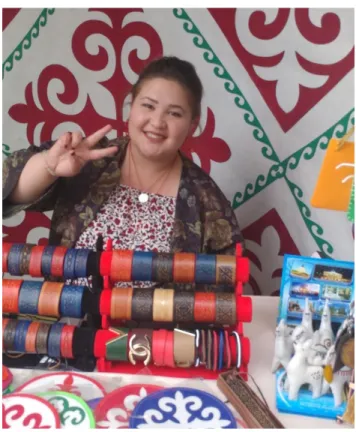
visits, one young woman became the ‘face’ of the event for me. Admittedly, her work was not the most
unique on display. She sat behind rows of leather bracelets and necklaces, just as other jewelers also
displayed products of metal, glass, and more leather. Rather, it was the fact that crafters spanned the
generations which was the most pleasing element to it all. Her age was, in fact, what made her stand out
to me. ‘Artisan Row’, as I will call it, was my first true direct exposure to craftwork in Kazakhstan. The
majority of products fell in line with what I knew to be traditional genres; those that weren’t evaded the
dreaded ‘imported’ aesthetic, at least.
Inquiring into her background, the woman explained that artisanship existed as an obligation she
felt compelled to fulfill. “I think that this is our duty, our tradition.”, she said when asked about her
motivations. “They came to us through grandparents, and we gave our heritage to our children to continue
the traditions. We should, no, even have to know [ancestors’] culture, and the history of nations.” It was a
sentiment reflected in her work, which - minus the outlier Chanel bracelet and prototypical Astana
magnets - heavily featured traditional Kazakh ornamentation (Figure 8). Whereas American culture lacks
many universally recognized patterns and motifs beyond stars and stripes, the Kazakh public has a decent
understanding of these motifs and their meanings even when (self-admittedly) ill-versed in culture
perhaps a remnant of cultural inheritance, this fact shed a light on the attitude and awareness of citizenry
to tradition.
Figure 8. The Artisan Row craftswoman and her work
It turned out that the young artisan’s views on tradition and its role in craft were shared by many I
would encounter, including an elder artisan woman working across the Ishim at a stand under Bayterek
Monument. I later found out that she was nationally-recognized, the winner of a country-wide artisan
competition who ran a full-time business in the former capital, Almaty. Her works were unique in that
they were innately tradition-tied, yet not confined to traditional products. Instead, the elder artisan worked
with silk, fashioning scarves and tapestries imbued with every color imaginable (Figure 9). Adorned on
each, icons of Kazakhstan. Her work also stood out for its use of symbols from Tamgaly, a petroglyph
the Bayterek Monument craftswoman). The Tamgaly symbols have been adopted by various events and
organizations across Kazakhstan, the Eurasia Film Festival being the most recognizable (Official website
of the Eurasia Int. Film Festival). While I ran into crafts adorned by them at times, rarely were they the
quality of her work.
Figure 9. The silk craftwork of the Bayterek Monument craftswoman
As conversation turns to the topic of quality in the face of tradition, my experience at one family
business stands out. Among the Kazakh artisan options, Altyn Orda (Kazakh for Golden Horde) ranks
among the most successful and most recognized. Settled into a backstreet of Shymkent, Kazakhstan’s
most ‘traditional’ city, the relatively ordinary building took some navigation to find. Beyond the sign
outside, it thrives on reputation alone. Felt, leather, and pottery products are the gallery’s best sellers, with
the most expensive product sold being a tapestry custom-made for a former president of Poland valued at
$15,000 dollars. The business is equal parts conference room, art gallery, shop, workspace, and home.
Visitors are treated upon entry to a gallery showcasing both traditional applied arts and purely aesthetic
modern gifts. The second and third floors, shown off eagerly, feature original painted works and a
and a sales pitch for financial investment (Figure 10). Attract enough attention, though, and you may just
meet the most interesting figure of Altyn Orda: the owner himself.
Figure 10. The proposed expansion of Altyn Orda (I did not invest)
The man who runs the Altyn Orda art gallery is a legacy figure. An old time artisan, he first began
making crafts 37 years ago under the mentorship of his great-grandfather. The owner’s work is renowned,
and in his time he has traveled to have his work honored in the United States and in India. Of the products
for sale at Altyn Orda, he specializes in painted ceramics. Together with his wife - who has been a fellow
artisan for just as long - they have spawned a family business incorporating works from four of six
children and five grandchildren. Seven members of the family are also members of Kazakhstan’s regional
artisan union (a holy and important number, he emphasized). Like most Kazakhs, Altyn Orda’s owner is
defined by his pride. When asked what it meant to be Kazakh, he answered simply, “to be happy”.
Pressed by me, he went on to recite a local phrase. “Everyone at one point must live in Shymkent and be
The owner of Altyn Orda is no stranger the Soviet era. He remembers the difficulty of being an
artisan in the waning days of the USSR: generations of knowledge-loss coupled with discouragement of
practice to create an environment where traditional craft was left volatile and receding. He saw the loss of
craftwork tradition in this period as a time when the Kazakh nation lost touch to some degree with its
heritage. They forgot who they were. In many ways, this first decade of his career during the 1980’s
shaped the owner’s perceptions of craft’s true value. Today, he views the continuation of artisanship as
more important than ever. He believes craftwork going on in 2017 is working to rebuild connections
between old and new. Modern artisanship exists first and foremost as a tool for empathy, manifestations
that educate on and honor the legacy of ancestors. As he put it: “without the past there is no future”
(Interview with the owner of Altyn Orda).
In his mind, young artisans like that at Artisan Row are doing quite well in continuing this status.
Not only have they been able to take advantage of recent revitalized interest in Kazakh craftwork, but
their motivations behind participation have stayed in line with those of older masters. Kazakh artisanship,
then, seems to be avoiding the feared drift toward purely economic drivers; youth retain a passion for
craftwork as an opportunity to maintain the legacy of their ancestors. This faith seemed well-placed to me
during a conversation with his son, the eldest and future inheritor of Altyn Orda. The son specializes in
leatherwork because of the range of products he can make, taking care to study and execute in the same
style as his ancestors before him. Through colors and ornamentation, the son finds happiness in his
workshop (Figure 11) creating something that is both new and an homage to his heritage (Interview with
the eldest son at Altyn Orda).
The son, along with the rest of the owner’s offspring and the greater artisan youth of Kazakhstan,
are the future of craft - one that in the owner’s eyes is quite obviously needed. Asked about the future of
Kazakh artisanship, the owner seemed optimistic. Since 2006, an increase in genre prioritization and
sought out as leaders. To this master, crafts are needed to live, and a way of life; sometimes little engaged,
but always around.
Figure 11. The leather workshop at Altyn Orda
Accounts of artisans and craft vendors from across Kazakhstan, diverse as they are, illustrate a
unique motivation. Whether creators or simply sellers, a faith exists in the products on display and the
importance they hold. It seems then that these individuals are inspired to action by a sense of social
obligation. Realistically, any product could be sold. Lack of heavy dependence on foreign tourism
(though improving) diminishes the need to target business with cliche or stereotype compared to more
tourist-intense countries (“Travel & Tourism Economic Impact 2015” 2015). As I learned, the items made
preserve heritage, why such regular adherence to traditional iconography (Interview with the Empire
shopkeeper)?
I argue that for Kazakh artisans, the continuation of legacy crafts fulfills what I identify as a
social obligation. Economic livelihood in part motivates the work, but opportunities in other careers are
generally more lucrative. Artisans derive from their work some element of self-satisfaction as well, but
personal fulfillment does not seem to be the sole inspiration either. Artisans in Kazakhstan, whether of
inexpensive necklaces or of tapestries for ex-presidents, are guided by a connection with the past that
lingers on, but which - without their work - could easily be extinguished. There, identity of ancestors was
never dissociated entirely from craftworkers, unlike in other regions where disconnects have challenged
claims of continuity (Medina 2003).
Of course, that not all products follow in the vein of traditional crafting processes or designs
suggests this attachment to be malleable. Unconventional works like those by the Almaty silk master or
those on display at stores like Empire represent flexibility in the relationship between crafts and their
crafters. Still, I consider these pieces to be no less genuine in the motivations behind them (Interview with
the owner of Altyn Orda). Evolution of pieces might simply be the result of their physical presence
providing a canvas for new interpretation. Unlike many other elements of traditional ‘Kazakhness’,
innately-tangible craftwork was able to keep continuity alive through the Sovietization period. For a
nation currently seeking a return to its roots, tangible and legitimate ties to heritage of the past are both
rare and in-demand. It is this legitimate connection and ability to evolve which explains re-emerging
interest in Kazakh artisanship today both from the Kazakhstani public and from those seeking to forge the
state’s modern brand.
The question of legitimate connection plays heavily in Kazakhstan. Nation-branding and building
are concepts that are built upon Hobsbawm and Rangers’ idea of invented tradition. It is prudent to