Respiratory Sinus Arrhythmia and Heart Rate Reactivity Moderate the Relationship Between Racial Discrimination and Anxiety
Rachel Uri
The University of North Carolina at Chapel Hill
A thesis presented to the faculty of the University of North Carolina at Chapel Hill in partial fulfillment of the requirements of the Bachelor of Arts degree with Honors in Psychology.
Abstract
Racial discrimination may be conceptualized as a unique, chronic stressor that impacts the lives of Black individuals with multiple associations to negative mental and physical health outcomes. High rates of racial discrimination are typically associated with increased anxiety symptomology. The present study was designed to examine if this relation may be moderated by intraindividual differences in autonomic reactivity of Black undergraduate students, as reflected by cardiac regulation. Participants completed an online questionnaire to estimate lifetime experiences of racial discrimination and current anxiety symptomology. In a subsequent
laboratory visit, electrocardiogram data were collected during a task designed to mimic a real-life encounter with racial discrimination. Heart regulation responses to this challenge were measured as change from baseline estimates of heart rate and respiratory sinus arrhythmia (heart rate reactivity and ΔRSA). Multiple regression analyses showed that both heart rate reactivity and ΔRSA moderate the relationship between reported frequency of racial discrimination and anxiety symptomology, even after controlling for the effects of age, gender, and parental education. Results also demonstrated that a high baseline heart rate can account for the same relation all by itself, as it overcomes the moderating effects of autonomic regulation. These results suggest that attention to processes of physiological regulation should be central to research aimed at
identifying Black emerging adults most physically and mentally affected by racial discrimination throughout development.
Acknowledgements
The status of racial discrimination as a distinct stressor in the lives of people of color has been well documented. Experiences of racial discrimination are generally persistent and
pervasive, chronically and negatively impacting daily functioning on interpersonal, institutional, and societal domains throughout the lifetimes of people of color (Sellers, Caldwell, Schmeelk-Cone, & Zimmerman, 2003; Hoggard, Jones, & Sellers, 2016). In addition to augmenting cumulative stress levels, acute experiences of racial discrimination may specifically impact health by generating psychological distress related to one’s race, causing individuals to seek out potentially unhealthy mechanisms to cope with this distress, and eliciting behavioral responses (e.g., hypervigilance, avoidance) that produce changes within physiological systems (Williams & Mohammed, 2009; Carter & Forsyth, 2010). Indeed, racial discrimination has been shown to be inherently harmful to both psychological and physiological health, regardless of one’s
socioeconomic status (Williams & Mohammed, 2009).While there is substantial research associating negative health outcomes with racial discrimination, few studies have examined the role of heart rate and vagal activity in this relationship. The present study seeks to examine the connection between racial discrimination and internalizing symptomology in a college
shown to moderate this relation. However, little attention has been paid to how individual differences in autonomic regulation may moderate this same relationship. The current study seeks to examine ΔRSA and heart rate reactivity as moderators of the relationship between racial discrimination and anxiety symptomology.
Racial Discrimination
Racial discrimination may be defined as “the unequal treatment of persons or groups on the basis of their race or ethnicity” (Pager & Shepherd, 2008, p.182). Discriminatory events that are solely attributed to an individual’s racial or ethnic background present a unique and pervasive source of stress to people of color (Sellers, Caldwell, Schmeelk-Cone, & Zimmerman, 2003). Racial discrimination may be conceptualized as a chronic stressor that manifests on societal, institutional, and interpersonal levels within a variety of contexts (Williams & Mohammed, 2009). Consequently, the experience of racial discrimination may be particularly salient and persistent throughout the lives of people of color.
Historically and contemporarily, Blacks1 have faced frequent experiences of racial discrimination in the workplace, the educational and justice systems, and countless other domains of daily life (Pager & Shepherd, 2008). Recurrent experiences of negative appraisal based on one’s race may have profound effects on biological, psychological and social functioning (Clark, Anderson, Clark, & Williams, 1999). Chronic activation of this stress response system is known to negatively impact health and psychological well-being. Individual differences in the recruitment of this system may explain why some individuals are more
1Note:This honors thesis uses the term “Black” to refer to individuals who self-identify as
susceptible than others to internalizing symptomology as a result of life-long experiences of discrimination (Neblett & Roberts, 2013).
As Black adolescents transition to institutions of higher education, racial identity becomes more relevant to the sense of self, causing the impact of racial discrimination to be particularly salient during this time (Harper & Quaye, 2007). This may pose specific challenges to Black students who attend primarily white institutions (PWIs), as racist attitudes, prejudices and stereotypes may contribute to an increased perception of discriminatory experiences during a time of formative identity growth (Rucker, West, & Roemer, 2010). Several studies have
examined the racially discriminative experiences of Black students at PWIs. Black college students perceived more differential treatment on campus compared with Caucasian, Hispanic, and Asian students, and reported more frequent instances of being treated differently by their peers and professors than other groups (Suarez-Balcazar, Orellana-Damacela, Portillo, Rowan, & Andrews-Guillen, 2003). Furthermore, racial prejudices often lead others to identify Black adolescents as dangerous or unintelligent, leading to negative police confrontations and
inappropriate discipline at school, being called racial slurs/epithets by peers, and being rejected from activities (Fisher, Wallace, & Fenton, 2000).
The personal distress generated from frequent experiences of racial discrimination throughout time poses a threat to both the physiological and psychological well being of Black young adults. A meta-analysis of available research have revealed a direct relationship between perceived discrimination and mental/physical health, such that perceptions of high discrimination are associated with poorer mental and physical health. Those analyses further demonstrate that this relationship is partially mediated by heightened stress responses, assessed through
2009). Other studies have shown that lifetime racial discrimination is associated with increased anxiety, somatization, and interpersonal sensitivity (Landrine & Klonoff, 1996), as well as depression and perceived stress (Brody, Lei, Chae, Yu, Kogan, & Beach, 2014). Gibbons et al., 2012 also showed that, high and sustained experiences of racial discrimination reduces resilience capacities and increases risk-taking behavior. Finally, quantitative physiological investigations have shown that high, stable levels of perceived racial discrimination are associated with increased levels of cortisol and norepinephrine, as well as high blood pressure, even when controlling for socioeconomic status and health risk behaviors (Brody et al., 2014).
Associations Between Racial Discrimination and Anxiety
Experiences of racial discrimination have been linked with internalizing symptoms, particularly anxiety (Landrine & Klonoff, 1996; Williams & Mohammad, 2009; Brody et al., 2014). Anxiety can be conceptualized as an emotional response to experiences involving challenge and pressure and may be accompanied by physiological symptoms such as sweating, trembling, muscle tension, rapid heart rate, increases in blood pressure, and dizziness (Kazdin, 2000). Chronic states of anxiety have wide-ranging effects on cognitive and behavioral
functioning as well as health outcomes. In the cognitive domain, anxiety is associated with mental confusion, impaired decision-making, fearful thoughts, and memory deficits. Actions like fidgeting, pacing, handwringing and other agitated actions are behavioral indicators of anxiety (Creamer, Foran, and Bell, 1995). Finally, sustained, high levels of anxiety are associated with increased risk for negative health outcomes such as hypertension (Vlachakis, Schiavi,
The literature detailing associations between racism and anxious behavior has
demonstrated that frequent occurrences of racial discrimination predict higher levels of anxiety symptomology. Numerous studies examining affective, cognitive, behavioral, and physiological symptoms of anxiety have identified a positive correlation between racial discrimination and anxious behavior, even when controlling for socioeconomic risk factors and levels of generalized stress (Landrine & Klonoff, 1996; Gaylord-Harden & Cunningham, 2008; Pascoe & Smart Richman, 2009; Williams & Mohammad, 2009). Racially discriminatory interactions are inherently negative and hostile, however individual differences in autonomic stress regulation may account for differential responses to the chronic stress of discrimination among young adult Black individuals (Neblett & Roberts, 2013). While the importance of race centrality in self-identity may accentuate the perception of race discrimination for some members of the Black community, this effect on health outcomes should be examined against the background of individual differences in autonomic reactivity to stress.These distinct differences in the evaluation of negativity in events involving racial discrimination indicate that a certain event may impact individuals in several ways, and affect the formation of co-morbid physiological and cognitive anxiety symptoms. While the literature has consistently demonstrated an association between the sustained experience of racism and internalizing symptoms such as anxiety, little is known regarding the moderating role the physiological stress response system may play in this relationship.
The Role of Vagal Activity in Stressful Situations
stress activation in response to racial discrimination are formed by complex interactions between constitutional, sociodemographic, psychological, and behavioral factors. Differences in these interactions not only determine the ways in which an individual is able to cope with racial adversity momentarily, but also condition how sustained racism influences health outcomes over time. Based on this model, occurrences of racial discrimination pose a challenge to an
individual’s homeostatic balance that demands recruiting physiological resources to restore stability. The present study focuses specifically on individual differences in stress activation in the face of racial discrimination, as physiological regulatory processes are herein postulated as central mechanisms that mitigate/exacerbate long-term associations between health outcomes and a cumulative life experience with racism.
As the main branch of the parasympathetic nervous system, the vagus nerve offers critical information about individual autonomic resting states and reactivity to stressful challenge. With its source in the nucleus ambiguus (brain stem medulla), the vagus nerve extends to the cardiac sinoatrial node through which it regulates heart rate (Porges, 2007). Vagal activity is also regulated by the cortico-bulbar tracts that connect the cortex to the nucleus ambiguus, and thus contribute to the regulation of vagal activity. These pathways that allows for the integration of higher-order, executive information and autonomic functions, and thus allows conscious experience to also regulate cardiac activity.
RSA suppression under external demands, functioning to maintain cardiac activity within a safe homeostatic range (Porges, 1992).
Polyvagal Theory (Porges, 1994) posits that vagal nerve input to the heart provides an index of autonomic, defensive responses to stressful environmental situations. According to this theory, the structure of the vagus has evolved in response to a “defensive world”, affording distinct capabilities that allow the individual to preserve homeostatic functioning in a challenging environment. When vagus myelination and the organization of the cortico-bulbar pathways take place over the first year of life in a supportive social context, a neural platform is established that both supports socially approved responses when challenged (Porges, 2011), and manages
energetic resources through engagement or disengagement of the vagal break, without recruiting much of the more taxing sympathetic nervous system (see “Dicksonian dissolution principle” in Porges, 2009).
The mammalian vagal complex achieves homeostatic maintenance during challenge through the “vagal brake” (Porges, 2007), a mechanism by which the vagal nerve removes its input to the heart when threat is perceived. When the vagal brake is applied, the intrinsic rate of the sinoatrial node (~100 bpm) is restored, causing the heart rate to increase slightly from resting levels. Flexibility in vagal brake regulation ensures economy of metabolic resources and
supports social engagement and cognitive functioning. During extended periods of challenge, the vagal brake may be applied, withdrawn, and reapplied in support of conflicting needs for
(Calkins et al., 2007). However, large changes in RSA have also been shown to be maladaptive, not only by “pausing” parasympathetic input via the vagal brake, but also by recruiting the sympathetic nervous system (SNS) to mobilize fight-or-flight behaviors (Kogan, Gruber, Shallcross, Ford, & Mauss, 2013). More recent literature, however, has explained these
discrepant findings by suggesting that high vagal reactivity signals heighten biological sensitivity to context (Boyce & Ellis, 2005; Holochwost, Gariepy, Propper, Mills-Koonce, & Moore, 2014). From this perspective, a high vagal reactivity may be associated with positive outcomes in low stress/high social support environment and negative outcomes in high stress/low social support environment.Therefore large ΔRSA values may signal detrimental outcomes in the context of racial discrimination.
The Role of Heart Rate Reactivity in Stressful Situations
In addition to changes in RSA, cardiac reactivity may also be conceptualized as a physiological marker of stress vulnerability and emotional regulation. Defined as the “mean increase in heart rate observed in response to a task or stressor”, heart rate reactivity reflects the autonomic arousability of an individual, and may be a pertinent factor in considering how one
responds to a stressor in the environment (Cacioppi, 1997). Early researchers in cardiac
psychophysiology have demonstrated that environmentally induced anxiety is similarly linked with a marked increase in heart rate from resting levels (Deane & Zeaman, 1958; Barclay, 1961). Furthermore, they observed a great deal of inter-individual variability in the capacity of the heart to regulate itself; some individuals responded to stress with a large surge in heart rate, while others only exhibited a small increase from baseline. Thus, the impact of the autonomic nervous system on heart rate during stress is variable from individual to individual, and has clear
Furthermore, associations between heart rate and long-term negative health outcomes, such as heart disease and hypertension, have been the focus of a wealth of medical
cardiovascular research for decades. One of the critical findings of this early medical research was well documented by Tinsley Randolph Harrison, revealing a distinct relationship between general anxiety and tachycardia, or pathologically high resting heart rate (Harrison, 1939). Harrison observed that his patients suffering from anxiety and nervousness almost always exhibited an overactive heart characterized by tachycardia of 80-120 beats per minute; he designated this state as “hyperkinetic syndrome”. Furthermore, Harrison noted that hyperkinetic syndrome did not typically lead to immediate cardiac failure, except through certain disturbances in the cardiovascular apparatus caused by pathology elsewhere in the body. Later research
examining neurogenic factors contributing to cardiac functionality have revealed that individuals that experience high levels of anxiety and associated tachycardia may be at particular risk for heart conditions such as coronary heart disease and atherosclerosis (Rosenman & Friedman, 1973). Accordingly, high resting heart rate itself may indicate biological vulnerability to developing life-threatening heart conditions as a result of perceived stress and anxiety.
Possible Implications for Heart Rate and Vagal Activity in the Experience of Racial
Discrimination
al., 2003). Social situations involving racism elicited higher heart rate reactivity in Black participants than Caucasian participants (Lepore et al., 2006). This study contributes to current research by examining the role of autonomic nervous reactivity during racially discriminatory events, as reflected through respiratory sinus arrhythmia and heart rate.
The Present Study
The current study seeks to examine the role of ΔRSA and heart rate reactivity in the relationship between racial discrimination distress and anxiety symptoms. Black undergraduate students participated in a two-part study that consisted of an online survey and an in vivo task. First, participants completed an online survey that included demographic data, as well as
information about lifetime experiences of racial discrimination and current symptoms of anxiety. For the second part of the study, participants were exposed to an in vivo experience in the
laboratory designed to stimulate psychological and physiological processes that often accompany real-life events of racial discrimination. Throughout the in vivo task, the heart rate of each
participant was measured using electrodes to determine baseline cardiac functioning as well as cardiac response to the task. Heart rate analyses were completed after laboratory visits to derive measures of vagal activity as indexed by RSA and its relative suppression during the challenge task.
Based on prior research and prevailing theories, I expect the relationship between self-reported lifetime racial discrimination and anxiety symptoms to be moderated by vagal regulation such that ΔRSA values will mitigate this relationship. Specifically, I predict that individuals with high ΔRSA will demonstrate increased levels of anxiety symptomology when exposed to frequent instances of racial discrimination throughout their lifetimes. By contrast, individuals with lower ΔRSA should exhibit less anxiety symptoms when exposed to similar levels of racial discrimination.
Additionally, I also expect heart rate reactivity to moderate the relationship between self-reported lifetime racial discrimination and anxiety symptoms. Specifically, I hypothesize that individuals with large increases in heart rate from baseline to the challenge task will exhibit high levels of anxiety when reporting frequent racial discrimination. This relation is expected to be substantially weaker for individuals whose heart rate did not change much from baseline to challenge.
Finally, I hypothesize that the moderating effect of heart rate reactivity on the
relationship between self-reported lifetime racial discrimination and anxiety symptoms will be observed only among individuals with low baseline heart rates. This moderating effect is not expected among individuals with a high resting heart rate, as the well-established relationship between tachycardia and general anxiety should override this effect.
Method
Participants
of age or older and were fluent in both written and spoken English. Participants were recruited through flyers, or announcements presented in campus organizations, class notices, and the university’s Psychology Department. A smaller subset of participants (n=120) completed both the online portion and laboratory visit components of the study, receiving either $20 or 2.5 participant pool credits for their contribution. The present study was conducted using this subset of participants exclusively, and will be the sample currently discussed. Approximately 77% of this sample was female, reflecting a slightly greater percentage of Black female students attending the university in 2015 (about 65%), and 23% of the sample was male. The ages of participants encompassed 18 to 29 years of age, although 95% of participants were 18 to 22 years old. Approximately 84% of the participant pool identified as African American, 11% identified as bi-racial or multi-racial, and 4% identified as Afro-Latino. Less than 1% of the sample identified as Native African/African immigrant.
Procedure
The present study took place in two sessions—an online component and a laboratory visit. In the online session, participants completed a Qualtrics survey including information about the study, consent, and eligibility, as well as the mental health and racial discrimination measures
previously discussed. Participants then scheduled a laboratory visit at least 72 hours after completing the online questionnaire. Upon arrival to the laboratory visit, participants were greeted by a Black research assistant and a White research assistant. The Black research assistant led the participant into a room in which the subject was informed about the nature of the study and his/her consent was obtained. Exchanges between the research assistants and the participants during the session were audiorecorded at the participant’s informed consent. After this initial phase, the Black research assistant applied ECG leads to the participant in a triangle
the participant to relax, and try not to think of anything in particular before leaving the
participant alone in the room. Upon the Black research assistant’s exit from the room, a timer set for 5 minutes began. In this period of 5 minutes, the participant’s resting baseline heart rate was recorded. After the baseline period ended, a White research assistant entered the room and conducted the challenge phase of the session in which the participant was presented with an in-vivo scenario designed to mimic an experience of racial discrimination. The stress task
incorporated elements racial discrimination vignettes (Neblett & Roberts, 2013), in order to elicit physiological and psychological reactions that may be stimulated as a result of a racist encounter. To commence the stress task, the White research assistant then reached into a box of slips of paper, telling the participant that each slip contained an everyday possible scenario. This
assistant then instructed the participant to imagine himself/herself in this real life situation and to respond verbally as if he/she were actually reacting to the scenario in real life. While the
assistant led the participant to believe a scenario would be selected at random, in reality, all slips of paper contained the same vignette, which was then read aloud to the participant:
“It is the first day of class. The instructor asks you to exchange contact information and get to know the person sitting next to you. The person sitting next to you looks like me. After exchanging contact information, the person sitting next to you says, “Oh wow, you got into (college name)! So are you actually really smart or did they just have to let a certain number of Black people in?”
The participant was then asked to respond verbally to the scenario. While the precise language of their response was not evaluated for the purposes of the present study, the heart rate of the
period, the Black research assistant rejoined the participant in the room. At this point, the participant was debriefed regarding the aims of the study, given the opportunity to provide feedback and ask questions, and offered campus health and community resources that may help him/her further explore the topics of the study and practice self-care and wellness.
Measures
Demographic Measures. Self-reported demographic information concerning participant age, sex, and degree of parental education were gathered via Qualtrics. To assess highest level of parental education, participants were asked to indicate if at least one of their parents had earned a Masters degree or higher, a Bachelors degree, an Associates degree or vocational training, a GED, or did not complete high school. These variables were later examined as potential covariates of the predictors of interest to the present study.
Racial Discrimination Measures. Information concerning experiences of racial discrimination was gathered using a slightly modified online version of the Daily Life
Experiences subscale of the Racial and Life Experience Scales (RaLES; Harrell, Merchant, & Young, 1997). For the purposes of the present study, this subscale evaluates the frequency of perceived racial discrimination distress of 18 daily experiences over the lifetime of the
participant in order to assess cumulative risk. The RaLES requires participants to indicate how frequently these events occur on a 6-point Likert Scale, which “0” signifying “never”, and “5” signifying “once a week or more”. Preceding each item, each participant was asked, “Please think about how often you have experienced each event because of your race or racial
background. How often have you experienced this in your entire life?” RaLES items included situations such as “had someone treat me badly because I was Black,” “being observed or
on each of the 18 subscale items are summed to obtain a score reflecting occurrences of racial discrimination in every day life. Psychometric properties of the Daily Life Experiences subscale of the RaLES have been well established throughout literature (Center for Disease Control, 2007) and the RaLES has been demonstrated as an effective tool for measuring racial
discrimination (Harrell, Merchant, & Young, 1997). Internal reliability for the present sample was robust, with Cronbach’s α =.92.
Physiological Measures. During the laboratory portion of the study, research assistants collected participant psychophysiological data utilizing electrocardiographic measures.
Electrodes were applied directly to the participant’s skin in a trilateral lead placement
configuration, correspondent with Einthoven’s triangle technique. Throughout the laboratory visit, electrodes recorded ongoing participant heart rate by way of electrocardiogram (ECG) technology. The ECG signal was conveyed to and recorded by a laboratory computer utilizing the AcqKnowledge program belonging to Biopac’s MP 100 data acquisition software.
Anxiety Measures. Anxiety symptomology was assessed using the Beck Anxiety
Inventory (BAI; Beck, Epstein, Brown, & Steer, 1988). The inventory utilizes a Likert-type scale to assess 21 symptoms related to anxiety in the past month. The BAI asks participants to indicate how “bothered” they have been by each symptom, with 0 representative of “not at all”, and 3 signifying “severely-it bothered me a lot”. BAI anxiety items include “unable to relax,” “terrified or afraid,” and “fear of worst happening.” Scoring of the BAI was accomplished by adding the scores of each item to compute an overall account of anxiety symptoms. The BAI has been demonstrated as a reliable measure of anxiety within non-clinical college populations (Creamer, Foran, & Bell, 1995). Furthermore, the BAI offers clinically relevant cutoffs to anxiety
score of 36 or more may be a possible basis of clinical psychopathology. Internal reliability of the present sample was robust, with Cronbach’s α =.89.
Data Analyses.
The Statistical Package for the Social Sciences 22.0 (SPSS) was used to analyze data and produce relevant statistics. Electrocardiogram data for each participant was converted into an interbeat-interval (IBI) file, then cleaned and edited using CardioEdit software. During the initial, 5-minute baseline phase of the experiment, RSA was averaged over each 30-second interval using CardioBatch software, in order to estimate individual values of baseline RSA. RSA during challenge was averaged over each 30-second interval during the full “challenge” phase when the participant was read the racial discrimination vignette and given time to respond to the scenario. The duration of this “challenge” period was variable from participant to
participant depending on the length of the response. Utilizing these values of RSA during both baseline and challenge, I calculated individual measures of ΔRSA (an estimate of RSA
suppression) for each participant by subtracting the “challenge RSA” value from the “baseline RSA” value. Heart rate measures were also computed at “baseline” and “challenge” periods for each IBI file utilizing CardioBatch. Heart rate reactivity was calculated by subtracting average heart rate during “challenge” from average heart rate during baseline.
(RSA value at time of stress) due to similar computer malfunctions which affected recording during the stress period. Therefore, only a smaller subset of participants (n=120) fully completed both parts of the study. To ensure that this subset did not differ from the larger sample, an
independent samples t-test was conducted. The analysis showed that the participants who completed both parts of the study did not significantly differ on the outcome variables, lifetime racial discrimination (t(207)=1.03, p=.297, d=.145) and anxiety symptomology (t(208)= -.398,
p=.803, d=-.055) from those who only completed the Qualtrics portion of the study. Thus it is assumed that data are Missing at Random (MAR).
Results
analyses, I mean-centered the variables of racial discrimination and anxiety symptomology, as well as the covariates of age, sex, and parental education. The moderating variables of heart rate reactivity and ΔRSA were left uncentered to reflect their true zero value.
To probe the moderating effects predicted in this study, all significant interactions were probed using an online tool created by Preacher, Curran, and Bauer (2006). This platform allows for examining the relations of interest at sample-specific cut-off points of the moderators. It also provides simple slopes and intercepts, regions of significance, and graphical plots of two-way and three-way interactions via R-output that allow testing the robustness and potential
generalizability of moderating effects.
Descriptive Statistics.
Descriptive statistics for the study variables collected using the Qualtrics questionnaire with the larger sample are presented in Table 1 (n=210). Means and standard deviations, as well as values of Cronbach’s alpha for the variables included in analyses are presented in Table 2 (n=120). Intercorrelations amongst study variables are provided in Table 3 (n=120).
ΔRSA as a Moderator of the Relationship between Discrimination and Anxiety.
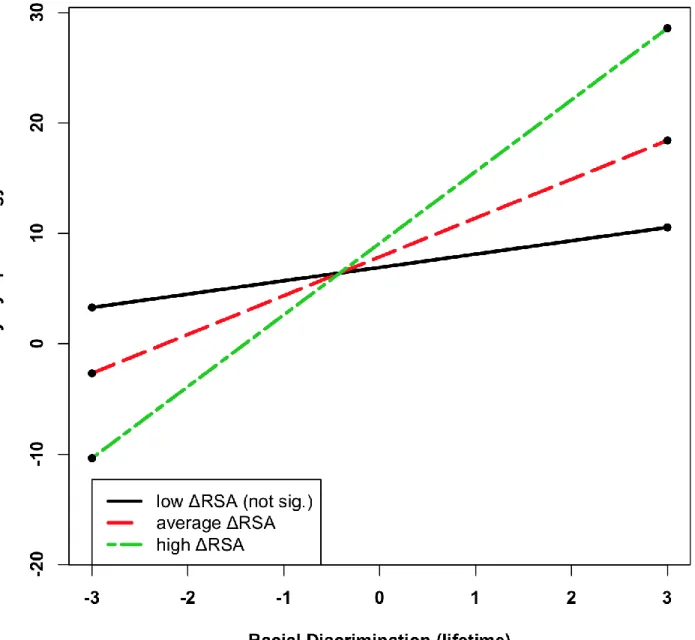
discrimination using Preacher’s Multiple Linear Regression (MLR) two-way interaction tool, I entered specific values of ΔRSA to assess the effects of racial discrimination and anxiety at conditional values of the moderator; in this instance, at the 25th, 50th, and 75th percentiles, (i.e., ΔRSA = -.1381, .3122, .8929). As ΔRSA increases, the slope related to racial discrimination and anxiety becomes more strongly positive. The simple slope is 1.1938 at the 25th percentile (p = 0.235, not significant), 4.6724 at the 50th percentile (p = 0.000), and 7.775 at the 75th percentile (p = 0.000). Submitting the R-syntax for the simple regression lines to the Rweb server creates a plot of these effects shown in Fig. 1. The confidence bands for observed sample values of ΔRSA are provided in Figure 2. Here, the region of significance on the moderator (ΔRSA) encompasses values -1.12 to -.017, indicating that any simple slope outside of this range is statistically
significant.
Heart Rate Reactivity as a Moderator of the Relationship between Discrimination and Anxiety.
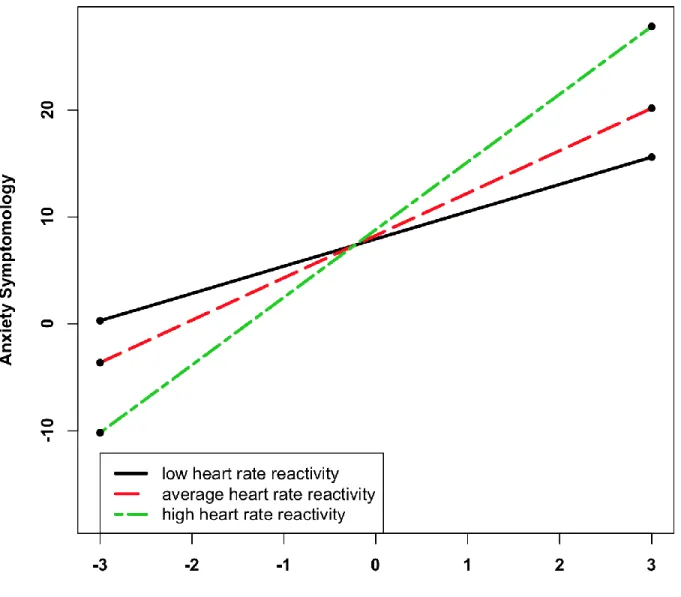
percentiles, (i.e., reactivity = -9.997, -4.967, -1.964). As shown in Figure 3, with large increases in heart rate reactivity, the slope related to racial discrimination and anxiety becomes more strongly positive. The simple slope is 6.7043 at the 25th percentile (p = 0), 4.9537 at the 50th percentile (p = 0), and 2.4392 at the 75th percentile (p = 0.016). The confidence bands for observed sample values of heart rate reactivity are presented in Figure 4. Here, the region of significance on the moderator (heart rate reactivity) encompasses values -1.27 to 23.9, indicating that any simple slope outside of this range is statistically significant.
Heart Rate Reactivity: Accounting for Baseline Heart Rate.
To determine how mean baseline heart rate may impact the moderating effects of heart rate variability, a multiple linear regression analysis was conducted that, in addition to heart rate reactivity and frequency of racial discrimination, included baseline heart rate. I assessed the three-way interaction between racial discrimination, heart rate reactivity, and baseline heart rate as predictors of anxiety symptomology. This model produced a marginally significant three-way interaction effect (p = .066). This three-predictor model accounted for 69% of the variance in participant anxiety symptomology, F(8, 112) = 31.07, p = .000, R2 = .69, and remained
effects are shown in Fig. 5. For participants with high baseline heart rate, the relation between racial discrimination and anxiety was strongly positive regardless of heart rate reactivity; its simple slope is 6.77 at the 25th percentile (p = 0.000), and 3.626 at the 75th percentile (p = .0004). These effects are shown in Fig. 6.
Discussion
Despite considerable literature linking negative health outcomes with racial discrimination, there is a paucity of research that examines the role of autonomic reactivity in this relationship. The present study evaluated the association between lifetime racial discrimination and anxiety symptoms within a population of Black college students, with consideration to the ways in which autonomic functioning may influence this relationship. In this research, autonomic functioning was measured as changes in RSA (ΔRSA) and heart rate (heart rate reactivity) from baseline levels during an in vivo task designed to elicit physiological and psychological reactions to racial discrimination.
The results of the current study supported my first hypothesis, predicting that ΔRSA would moderate the relationship between frequency of lifetime racial discrimination and anxiety symptomology. There was a significant moderating effect of ΔRSA detected for individuals at the 75th (high ΔRSA) and 50th (average ΔRSA) percentiles, such that individuals who exhibited high ΔRSA experienced elevated anxiety symptoms when exposed to frequent racial
may place individuals who display a strong autonomic reaction to challenge are at greater risk of developing internalizing symptoms.
My second hypothesis postulating that heart rate reactivity would moderate the relationship between lifetime racial discrimination and anxiety was also supported by the data. The results demonstrated a significant moderating effect of heart rate reactivity at 25th (high heart rate reactivity), 50th (average heart rate reactivity) and 75th (low heart rate reactivity) percentiles. In environments presenting infrequent encounters with racial discrimination, individuals experience few anxiety symptoms regardless of heart rate reactivity. Conversely, when faced with frequent occurrences of racial discrimination, individuals with high heart rate reactivity experienced the highest levels of anxiety. Those with average heart rate reactivity showed moderate anxiety symptomology when exposed to frequent discrimination, while individuals with low heart rate reactivity experienced minimal anxiety symptoms. These results indicate that individual differences in heart rate reactivity strongly affect the relation between experiences of
discrimination and anxiety symptomology. In this second analysis we observe, as we did in the first analysis, that anxiety is lessened at higher levels of experienced discrimination for
individuals whose heart rate varies less in response to challenge.
The final hypothesis tested in this research predicted that the moderating effect of heart rate reactivity on the relationship between lifetime racial discrimination and anxiety would only be observed amongst individuals with low baseline heart rate. While this moderating effect was only marginally significant, it is still important to discuss the possible implications of this
high baseline heart rate experienced elevated levels of anxiety when exposed to frequent discrimination regardless of heart rate reactivity, consistent with medical literature linking tachycardia with general anxiety. It appears that a high heart rate at baseline overrides any moderating effect that may be obtained through differences in heart rate reactivity. These effects suggest that individuals with a high baseline heart rate may not only predisposed to developing general anxiety, but may also be vulnerable to developing higher anxiety levels when exposed to frequent occurrences of racial discrimination during their lives. This could indicate that a
combination of high baseline heart rate and frequent lifetime racial discrimination might place these individuals at much greater risk for anxiety symptomology and associated long-term health outcomes than those who do not have high baseline heart rate, although further research on this topic is needed.
Due to the pervasive, chronic nature of discriminatory experiences, it is also critical to discuss the ability of the RaLES measure to accurately capture lifetime experiences of racial discrimination. In this study, this scale assessed the frequency of 18 daily “microexperiences” (i.e., daily hassles) related to race throughout the lifetime of the individual. Because this method only includes experiences involving microagressions that are recognizable, it may not capture the full extent of racially discriminatory experiences, as it does not ask participants about acute violent/traumatic, emotionally-charged instances of racism (Williams & Mohammed, 2009). Furthermore, due to the inherent limits of recall memory, it is possible that participants were unable to remember certain experiences that may have occurred several years ago; future studies may seek to refine the time frame in which participants are asked to remember experiencing racial discrimination. Thus, the current tool used to measure lifetime racial discrimination may not comprehensively assess experiences of racial discrimination, and may not fully capture chronic exposure to discrimination over extended periods of time.
There are several limitations to the research presented that may impact the interpretation of results. While the in vivo task designed to mimic elements of real life situations of racial
we cannot assume that the physiological responses observed during the laboratory visit were specific to stress resulting from racial discrimination; it is possible that fluctuations in heart rate and ΔRSA could be attributed to other sources of stress, such as being in an unfamiliar
laboratory with strangers or being sensitive to having one’s responses measured in the context of a psychological experiment, for example.
Another limitation to the present study regards the time frames over which autonomic responses were measured during of the stress task. Because participants were asked to respond verbally to the racial discrimination vignette, the length of the task varied from participant to participant, with the average duration being around five minutes. However, considering the transient changes normally observed in autonomic reactivity in response to stress, this time frame may in fact be too long to accurately detect changes resulting specifically from the in vivo task. While the results of the current study still seem to support hypotheses, a narrower window of time that captures the immediate response to the vignette may more precisely capture
physiological changes induced by a response to racial discrimination.
young adults may extend our knowledge of how the experience of discrimination affects mental health in the wider population of Blacks.
The present study offers several valuable contributions to the literature detailing the negative impact of racial discrimination within Black individuals. Most notably, this research
demonstrates the importance of accounting for physiological reactivity when assessing the relationship between racial discrimination and long-term health outcomes. One advantage of focusing on autonomic reactivity is that current technological advances offer easily obtainable indices of its activity. Using such measures, the present study demonstrated that in combination with frequent discriminatory experiences, individuals displaying high autonomic reactivity are placed at a heightened risk of developing anxiety symptoms.
Additionally, young adults who experience high levels of anxiety may not currently exhibit associated physical health problems, such as coronary heart disease and hypertension, but may present these issues as they age. Thus, it may be important to distinguish at-risk individuals in order to provide them with preventative intervention to lessen the effects demonstrated within the current study, as well as health conditions that may develop later as individuals age.
References
Banks, K.H., Kohn-Wood, L.P., Spencer, M. (2006). An examination of the African American experience of everyday discrimination and symptoms of psychological distress.
Community Mental Health Journal, 42, 555-570. doi: 10.1007/s10597-006-9052-9
Barclay, M. (1961). The assessment of anxiety by physiological behavioral measures.
Psychological Bulletin, 58, 234-255.
Barnes, P.W., & Lightsey, O.W. (2005). Perceived racist discrimination, coping, stress, and life satisfaction. Journal of Multicultural Counseling and Development, 33, 48-61. doi:
10.1002/j.2161-1912.2005.tb00004.x
Beck, A.T., Epstein, N., Brown, G., & Steer, R.A. (1988). An inventory for measuring clinical anxiety: Psychometric properties. Journal of Consulting and Clinical Psychology, 56, 893-897.
Boyce, T.W., & Ellis, B.J. (2005). Biological sensitivity to context: An
evolutionary-developmental theory of the origins and functions of stress reactivity. Development and Psychopathology, 17, 271-301.
Brody, G.H., Lei, M., Chae, D.H., Yu, T., Kogan, S.M., Beach, S.R.H. (2014). Perceived discrimination among African American adolescents and allostatic load: A longitudinal analysis with buffering effects. Child Development, 85, 989-1002. doi:
10.1111/cdev.12213
Cacioppi, J. (1997). Modes of Cardiac Control. Allostatic Load Notebook. Retrieved from: http://www.macses.ucsf.edu/research/allostatic/control.php#definition
Calkins, S.D., Graziano, P.A., Keane, S.P. (2007). Cardiac vagal regulation differentiates among children at risk for behavior problems. Biological Psychology, 74, 144-153
doi:10.1016/j.biopsycho.2006.09.005
Carter, R.T., & Forsyth, J. (2010). Reactions to racial discrimination: Emotional stress and help-seeking behavior. Psychological Trauma, 2, 183-191. doi:
http://dx.doi.org/10.1037/a0020102
Center for Disease Control and Prevention (2007). Race, Racism, Ethnicity, Racial
Discrimination, & Related Measures. Expanding Our Understanding of the Psychosocial Work Environment. Retrieved from:
https://www.cdc.gov/niosh/docs/2008-104/pdfs/2008-104d.pdf
Clark, R., Anderson, N.B., Clark, V.R., & Williams, D.R. (1999). Racism as a stressor for African Americans: A biopsychosocial model. American Psychologist, 54, 805-816. Creamer, M., Foran, J., & Bell, R. (1995). The Beck Anxiety Inventory in a non-clinical sample.
Davis, K.L., Davis, B.M., Greenwald, B.S., Mohs, R.C., Mathe, A.A., Johns, C.A., Horvath, T.B. (1986). Cortisol and Alzheimer’s disease I: Basal studies. American Journal of
Psychiatry, 143, 300-305.
Deane, G.E., Zeaman, D. (1958). Human heart rate during anxiety. Perceptual and Motor Skills, 8, 103-106.
Fisher, C.B., Wallace, S.A., & Fenton, R.E. (2000). Discrimination distress during adolescence.
Journal of Youth and Adolescence, 29, 679-695.
Gaylord-Harden, N.K., & Cunningham, J.A. (2008). The impact of racial discrimination and coping strategies on internalizing symptoms in African American youth. Journal of Youth and Adolescence, 38, 532-543. doi:10.1007/s10964-008-9377-5
Gibbons, F.X., Roberts, M.E., Gerrard, M., Li, Z., Beach, S.R.H., Simons, R.L., Weng, C., & Philibert, R.A. (2012). The impact of stress on the life history strategies of African American adolescents: Cognitions, genetic moderation, and the role of discrimination.
Developmental Psychology, 48, 722-739. doi: 10.1037/a0026599
Greer, T.M. (2011). Coping strategies as moderators of the relation between individual race-related stress and mental health symptoms of African American women. Psychology of Women Quarterly, 35, 215-226. doi:10.1177/0361684311399388
Harper, S.R., & Quaye, S.J. (2007). Student organizations as venues for Black identity
expression and development among African American male student leaders. Journal of College Student Development, 48, 127-144.
Harrell, S. P., Merchant, M. A., & Young, S. A. (August, 1997). Psychometric properties of the Racism and Life Experiences Scales (RaLES). Presented at the annual meeting of the American Psychological Association. Chicago, IL.
Harrell, S.P., Hall, S., Taliaferro, J. (2003). Physiological responses to racism and
discrimination: an assessment of the evidence. American Journal of Public Health, 93,
243-248.
Harrison, T.R. (1939). Failure of the Circulation. Baltimore: Williams & Wilkins Company. Hoggard, L.S., Hill, L.K., Gray, D.L., Sellers, R.M. Capturing the cardiac effects of racial
discrimination: Do the effects “keep going”? International Journal of Psychophysiology, 97, 162-170. doi:10.1016/j.ijpsycho.2015.04.015.
Huang, T.T., Mykletun, A., & Dahl, A. A. (2002). Are anxiety and depression related to gastrointestingal symptons in the general population? Scandinavian Journal of Gastroenterology, 37, 294-298. doi: dx.doi.org/10.1080/003655202317284192 Jönsson, P. (2006). Respiratory sinus arrhythmia as a function of state anxiety in healthy
individuals. International Journal of Psychophysiology, 63, 48-54.
Kawachi, I., Sparrow, D., Vokonas, P.S., & Weiss, S.T. (1994). Symptoms of anxiety and risk of coronary heart disease: The normative aging study. Circulation, 90, 2225-2229.
Kazdin, A.E. (2000). Encyclopedia of Psychology. Washington, D.C.: American Psychological Association.
Kirschbaum, C., Pirke, K.M., Hellhammer, D.H. (1993). The ‘Trier Social Stress Task’- a tool for investigated psychobiological stress in a laboratory setting. Neuropsychobiology, 28, 76-81.
Kogan, A., Gruber, J., Shallcross, A.J., Ford, B.Q., Mauss, I.B. (2013). Too much of a good thing? Cardiac vagal tone’s non-linear relationship with well-being. Emotion, 13, 599-604. doi: 10.1037/a0032725
Kunik, M.E., Roundy, K., Veazey, C., Souchek, J., Richardson, P., Wray, N.P., & Stanley, M.A. (2009). Suprisingly high prevalence of anxiety and depression in chronic breathing disorders. Chest Journal, 127, 1205-1211.
Landrine, H., & Klonoff, E.A. (1996). The schedule of racist events: A measure of racial discrimination and a study of its negative physical and mental health consequences.
Journal of Black Psychology, 22, 144-168.
Lepore, S.J., Revenson, T., Weinberger, S.L., Weston, P., Frisina, P.G., Robertson, R., Portillo, M.M., Jones, H., Cross, W. (2006). Effects of social stressors on cardiovascular reactivity in black and white women. Annals of Behavioral Medicine, 31, 120-127. doi:
10.1207/s15324796abm3102_3
Muhtadie, L., Akinola, M., Koslov, K., & Mendes, W.B. (2015). Vagal flexibility: A physiological predictor of social sensitivity. Journal of Personality and Social Psychology, 109, 106-120. doi: 10.1037/pspp0000016
Myers, L. J, Stokes, D. R., & Speight, S. L. (1989). Physiological responses to anxiety and stress: Reactions to oppression, galvanic skin potential and heart rate. Journal of Black Studies, 20, 80-96.
Pager, D., & Shepherd, H. (2008). The Sociology of Discrimination: Racial Discrimination in Employment, Housing, Credit, and Consumer Markets. Annual Review of Sociology, 34, 181-209. doi: 10.1146/annurev.soc.33.040406.131740
Pascoe, E.A., & Smart Richman, L. (2009). Perceived discrimination and health: A meta-analytic review. Psychological Bulletin, 135, 531-554. doi: 10.1037/a0016059
Perry, B.L., Harp, K.L., & Oser, C.B. (2013). Racial and gender discrimination in the stress process: Implications for African American women’s health and well-being. Sociological Perspectives, 56, 25-48. doi: 10.1525/sop.2012.56.1.25
Porges, S.W. (1992). Vagal tone: A physiologic marker of stress vulnerability. Official Journal of the American Academy of Pediatrics, 138, 498-504.
Porges, S.W. (1994). Orienting in a defensive world: Mammalian modifications of our evolutionary heritage. A Polyvagal Theory. Psychophysiology, 32, 301-318. Porges, S.W. (2007). The Polyvagal Perspective. Biological Psychology, 74, 116-143. doi:
10.1016/j.biopsycho.2006.06.009
Porges, S.W. (2009). The Polyvagal theory: New insights into adaptive reactions of the autonomic nervous system. Cleveland Clinical Journal of Medicine, 76, 86-90. doi:10.3949/ccjm.76.s2.17.
Porges, S.W., & Furman, S.A. (2011). The early development of the autonomic nervous system provides a neural platform for social behavior: A polyvagal perspective. Infant and Child Development, 20, 106-118. doi: 10.1002/icd.688
Preacher, K. J., Curran, P. J., & Bauer, D. J. (2006). Computational tools for probing interaction effects in multiple linear regression, multilevel modeling, and latent curve
analysis. Journal of Educational and Behavioral Statistics, 31, 437-448.
Roberts, C.B., Vines, A.I., Kaufman, J.S., James, S.A. (2008). Cross-sectional association between perceived discrimination and hypertension in African-American men and women: The Pitt County Study. American Journal of Epidemiology, 167, 624-632. doi: https://doi.org/10.1093/aje/kwm334
Rosenman, R.H., Friedman, M. (1973). Neurogenic Factors in Pathogenesis of Coronary Heart Disease. Medical Clinics of North America, 58, 269-279.
Rucker, L.S., West, L.M., & Roemer L. (2010). Relations among perceived racial stress,
intolerance of uncertainty, and worry in a Black sample. Behavior Therapy, 41, 245-253. doi: http://doi.org/10.1016/j.beth.2009.04.001
Sellers, R.M., Caldwell, C.H., Schmeelk-Cone, K.H., & Zimmerman, M.A. (2003). Racial identity, racial discrimination, perceived stress, and psychological distress in African American young adults. Journal of Health and Social Behavior, 44, 302-317. Sellers, R.M., & Shelton, N.J. (2003). The role of racial identity in perceived racial
discrimination. Journal of Personality and Social Psychology, 84, 1079-1092. doi: 0.1037/0022-3514.84.5.1079
Snyder, A.M., Stricker, E.M., & Zigmond, M.J. (1985). Stress-induced neurological impairments in an animal model of parkinsonism. Annals of Neurology, 18, 544-551.
Suarez-Balcazar, Y., Orellana-Damacela, L., Portillo, N., Rowan, J.M., & Andrews-Guillen, C. (2003). Experiences of differential treatment among students of color. The Journal of Higher Education, 74, 428-444.
Taylor, T.R., Williams, C.D., Makambi, K.H., Harrel, J.P., Cozier, Y., Palmer, J.R., Rosenberg, L., & Adams-Campbell, L.L. (2007). Racial discrimination and breast cancer incidence in US Black women: The Black women’s health study. American Journal of Epidemiology, 166, 46-54. doi: https://doi.org/10.1093/aje/kwm056
Tisgos, C., & Chrousos, G.P. (2002). Hypothalamic-pituitary-adrenal axis, neuroendocrine factors and stress. Journal of Psychosomatic Research, 53, 865-871.
U.S. Census Bureau (2015). Educational Attainment in the United States: 2015. Retrieved from https://www.census.gov/content/dam/Census/library/publications/2016/demo/p20-578.pdf.
Vlachakis, N.D., Schiavi, R., Mendlowitz, M., De Guia, D., & Wolf, R.L. (1974). Hypertension and anxiety. American Heart Journal, 87, 518-526.
Table 1
Basic Descriptive Statistics and Cronbach’s Alpha (n=210)
Variable M SD α
Lifetime Racial Discrimination 1.42 0.75 .92
Anxiety Symptomology 8.12 7.49 .89
Table 2
Basic Descriptive Statistics and Cronbach’s Alpha (n=120)
Variable M SD α
Lifetime Racial Discrimination 1.37 0.79 .92
Anxiety Symptomology 8.16 7.64 .89
Δ RSA 0.34 0.66
Heart Rate Reactivity -6.09 5.09
Mean Baseline Heart Rate 77.14 10.59
Table 3
Intercorrelations Amongst Study Measures (n=120)
1 2 3 4
1. Racial
Discrimination 2. Anxiety
Symptomology
.489**
3. Δ RSA .159 .120*
4. Heart Rate Reactivity
-.004 -.084 .12 5. Mean Baseline
Heart Rate
-.002 .033 .014 .194*
Table 4
Hierarchical Multiple Linear Regression Results for ΔRSA x Discrimination
Model 1 Model 2 Model 3
Variable B SE B β B SE B β B SE B β
Constant 8.01 .714 7.74 .695 7.13 .656
Age -.108 .361 -.028 -.181 .313 -.048 -.184 .290 -.049
Sex -2.55 1.68 -.142 -2.54 1.47 -.141 -2.13 1.36 -.118 Parental
Education
.463 .619 .071 .036 .541 .006 .113 .500 .017
Discrimination 4.59 .790 -.474** 2.03 1.29 .167*
ΔRSA 1.43 .954 .122 1.96 .121 .209*
Discrimination x ΔRSA
5.01 1.106 .423**
R2 .026 .281 .392
F for change in
R2
1.034 8.826** 12.035**
Table 5
Hierarchical Multiple Linear Regression Results for Heart Rate Reactivity x Discrimination
Model 1 Model 2 Model 3
Variable B SE B β B SE B β B SE B β
Constant 8.01 .714 7.41 .977 7.55 .946
Age -.108 .361 -.028 -.175 .315 -.046 -.208 .305 -.055
Sex -2.55 1.68 -.142 -2.78 1.47 -.154 -2.63 1.42 -.146 Parental
Education
.463 .619 .071 -.003 .546 .000 .069 .529 .011
Discrimination 4.79 .783 -.086** 1.71 1.29 .176
HR Reactivity -.133 .125 .494 -.105 .121 -.068
Discrimination x HR Reactivity
-.468 .158 -.392**
R2 .026 .274 .326
F for change in
R2
1.034 8.525** 9.045**
Table 6
Hierarchical Multiple Linear Regression Results for Heart Rate Reactivity x Discrimination x Baseline Heart Rate
Model1 Model 2 Model 3 Model 4
Variable B SE B β B SE B β B SE B β B SE B β
Constant 8.01 .714 7.41
.
987 7.50
.
961 7.51 .95
Age -.108 .361 -.028 -.176 .318 -.046 -.184 .310 -.049 -.221 .307 -.058
Sex -2.55 1.68 -.142 -2.79 1.55 -.155 -2.51 1.51 -.139 -2.51 1.49 -.140
Parental Education
.463 .619 .071 -.004 .548 -.001
.056 .534 .009 -.003 .529 .000
Discrimination 4.79 .787 .494** 1.77 1.31 .183 2.33 1.33 .241
HR Reactivity -.132 .128 -.086 -.111 .127 -.072 -.095 .126 -.062
Baseline HR -.002 .063 -.002 .019 .084 .026 .000 .083 .000
Discrimination x HR
Reactivity
-.472 .16 -.395** -.364 .168 -.305
Discrimination x Baseline HR
.062 .066 .076 .210 .101 .258
HR Reactivity x Baseline HR
.002 .011 .024 .001 .011 .014
Discrimination x HR
Reactivity x Baseline HR
.031 .016 .244
R2 .026 .274 .333 .354
F for change in R2
1.034 7.041** 6.035** 5.927**
Figure 2. Confidence Bands for 2-Way Interaction: Racial Discrimination x ΔRSA
-10 -5 0 5 10
-5
0
0
50
Confidence Bands
ΔRSA
S
im
p
le
S
lo
p
Figure 5.Multiple Linear Regression 3-Way Interaction: Racial Discrimination x Heart Rate Reactivity x Low Baseline Heart Rate
Figure 6.Multiple Linear Regression 3-Way Interaction: Racial Discrimination x Heart Rate Reactivity x High Baseline Heart Rate