Abstract
Children with moderate to severe traumatic brain injury (TBI) are often represented by their parents, who play a vital role in supporting their child. Minimal research captures the parents’ experiences in the acute care setting, leading to a lack of evidence-based knowledge regarding the supportive needs they wish were available. This qualitative synthesis used the PRISMA guidelines to search for and assimilate peer-reviewed research on early parenting needs in the acute care setting following moderate to severe TBI. A total of 1188 studies were screened after searching three scientific databases (PubMed; CINAHL; PsycINFO). Inclusion criteria involved: (a) children < twenty-one years of age; (b) accidental moderate to severe TBI; (c) acute inpatient setting; (d) parent(s) views on support needs; (f) published within last eight years; and, (g) written in English. Eight articles met the inclusion criteria, and the following major themes were noted: emotional family burden, the child’s protection from physical and emotional harm, the desire for parents’ conservation of energy, the demand for frequent and thorough support and communication, and parents’ varying coping abilities. Findings emphasize that a lack of
understanding of early parenting needs following moderate to severe TBI can lead to substantial communication and support barriers. These obstacles gravely interfere with the distributed knowledge and physical, cognitive, or emotional assistance provided to newly informed parents. We used this information to inform the provision of future support materials for families.
Prospective research needs be conducted to reveal unidentified parent(s) needs of newly diagnosed children with TBI.
A Qualitative Meta-Synthesis of Family Experiences and Needs Regarding Health Care of Newly Diagnosed Children with Traumatic Brain Injury in the Acute Care Setting
Introduction
One of the principal causes of death and disability throughout the world is traumatic brain injury (TBI), especially among children 21 years of age or younger (Kirk, Fallon, Fraser,
Robinson, & Vassallo, 2015). It is reported that over ten million individuals sustain a TBI each year internationally with 2.5 million cases occurring in the United States (U.S.) alone (Centers for Disease Control and Prevention, 2017). Langlois, Rutland-Brown, and Thomas (2006) additionally report that of the 2.5 million injured, 600,000 incidents occur in U.S. children. Although only a small percentage (0.06%) occurs in children 21 years of age or younger when looking at the statistical data, attention needs to be applied to the pediatric population, because the long-term effects can be profound for the individual, their family, and the communities they live in (Gagnon, Swaine, Champagne, & Lefebvre, 2008).
According to Coco, Tossavainen, Jääskeläinen, and Turunen (2011), moderate to severe TBI can be classified as an accidental or inflicted injury to the brain, and can result from external mechanical forces, such as an impact, collision, object, blow, jolt, or penetration to the head (Centers for Disease Control and Prevention, 2017). These forces affect the brain in a way that leads to loss of consciousness or coma, and recovery is dependent on many, sometimes
unpredictable, factors. According to Coco et al. (2011), copious amounts of research indicate that in addition to weakened bodily functions, moderate to severe TBI destructively impacts the physical, cognitive, emotional, and behavioral dimensions of child health and future
these pediatric patients. Parents have a wide range of needs in different phases during the recovery of the child (i.e., acute care, rehabilitation, return to home, return to school, and long-term community reintegration) (Glang et al., 2008; McCarthy et al., 2006; Roscigno, Fleig, & Knafl, 2015). Growing evidence illustrates that many areas of burden are placed on families following a child’s moderate to severe TBI. These burdens can include advocating for the child’s complete needs in their medical, school, and social categories within their communities that lead to: stress and disorganization to prior family roles and relationships and a lack of emotional, informational, physical, and financial support to supplement these new stressors (Hawley, 2003; Youngblut & Brooten, 2006). Here, informational and emotional support from healthcare professionals has been shown to reduce stress among families and enhance reciprocal
outcomes of any decision. Therefore, allowing them the opportunity to weigh in is critical (Brown, Whittingham, Sofronoff, & Boyd, 2013).
There are physical, cognitive, and emotional needs to be addressed for the parent(s) who are responsible for care decisions. Clinicians face multiple challenges in providing medical treatment for children with moderate to severe TBI with the intention of preventing further brain injury, but the team faces even more of a challenge in delivering precise information that will help parents to make such difficult decisions (Fassier & Azoulay, 2010). Additionally, there is a challenge in caring for the family of the patient as a whole unit (Moore et al., 2015). The
unknown advanced-life care desires of the injured child, parents’ moral beliefs about what it means to be a good parent, and our current inability to accurately and scientifically predict the child’s long-term functional-outcomes, so early after injury, are not always recognized as strongly guided by a system of beliefs, attitudes, and symbols that also inform parents decisions in this critical family decision-making situation (Kirk et al., 2015; Moore et al., 2015; Reuter-Rice, Doser, Eads, & Berndt, 2017).
care following TBI over two separate time periods. The first time period involved interviewing the parent(s) in the acute care setting within four days of being transferred out of an intensive care unit (ICU), and the second time period involved retrospectively interviewing the parent(s) at the time of the child’s discharge or within one week of discharge, if the patient was in a
rehabilitation or complex-care setting. The family participants in this study identified the need for information about their loved one’s injuries and their prognosis as their greatest need during time period one as compared to the other reported needs, such as the following: direct
involvement in their loved one’s care, understanding the continued progress of the loved one, managing other family and community obligations, holding on to hope for recovery, and the need for professional and community supports (Keenan & Joseph, 2010). The majority of families not only reported wanting information updates the most, but also they expressed the need for communication and information to be “consistent, understandable, honest and updated on a frequent basis” throughout this phase of care (Keenan & Joseph, 2010, p. 29).
Purpose
Given a family’s subsequent need for social support, as emphasized by Tramonti et al. (2015), this qualitative synthesis sought to analyze and contextually understand the current peer-reviewed literature thickly describing any family-member experiences and/or needs during the injured child’s acute phase of care. We sought to provide evidence for the development of supportive materials for the physical, emotional, cognitive, and social needs of the families cared for in a Pediatric Intensive Care Unit.
Methods
participants were children aged twenty-one or younger; (b) diagnosed with accidental moderate or severe TBI, and (c) admitted to an acute inpatient hospital setting, such as an ICU,
immediately after injury. Other general inclusion criteria for the studies included that they were: (a) written in English and (b) published since 2009 in a peer-reviewed journal, so that they were relevant to current acute care settings and their practices (Campbell et al., 2011).
In order to determine a comprehensive set of literature that defined and described the acute care support needs of families of children following moderate to severe traumatic brain injury, a research protocol was developed using the Preferred Reporting Items for Systematic Reviews and Meta-Analyses (PRISMA) guidelines (Moher, Liberati, Tetzlaff, Altman, & PRISMA Group, 2009).
Search Strategy
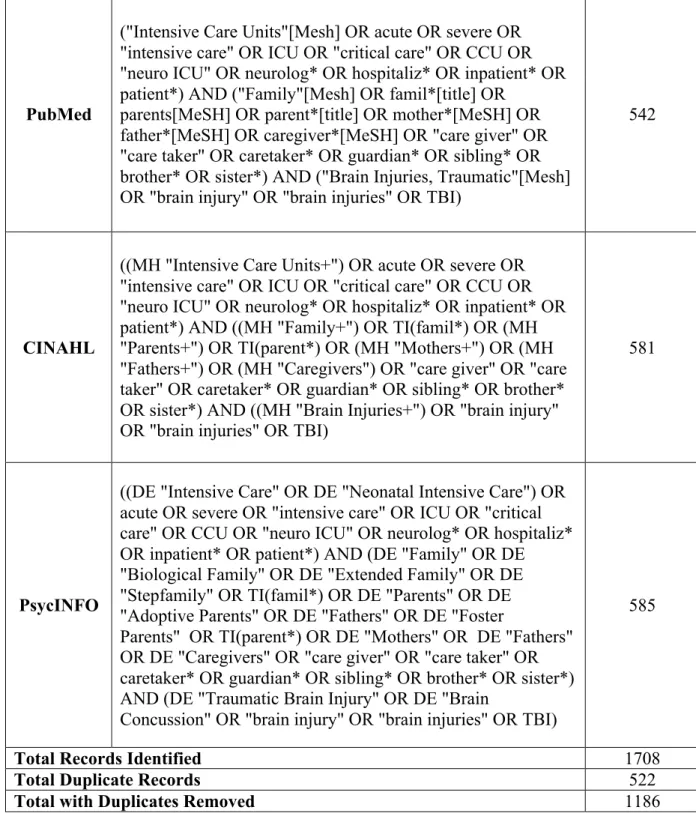
This study was guided by the PRISMA guidelines and is reflected in Figure 1 of the appendix (Moher et al., 2009). Search strategies were developed by the two authors of the study and a university medical research librarian for each database that was included (Moher et al., 2009). Kelly and St Pierre-Hansen (2008) conducted a literature search comparison across commonly used medical databases and described how various search strategies affected their respective scopes, content, and organization. Using their results and considering our limited human and physical resources, we chose to select three of the largest and most relevant databases to conduct the search: PubMed, CINAHL, and PsycINFO.
and Allied Health Literature) was determined to also be a relevant and applicable resource to capture those studies connected specifically to nursing practice. Lastly, PsycINFO was added to capture any missing articles that may not have been captured in PubMed or CINAHL. According to Kelly and St Pierre-Hansen (2008), PyscINFO, contains literature on psychology from more than 2200 periodicals, so it produces the most distinct results. Because this synthesis has the aim of capturing family and caregiver experiences, the psychological aspect was deemed important to include. Search terms used to capture the perspectives and support needs of families of children with moderate to severe TBI included “traumatic brain injury”, “mother”, “father” “caregiver”, “guardian”, “family”, “child*” for child or children, “parent*” for parent, parenting, or parental, “infant”, “teen”, “baby” or “babies”. Terms were entered in various formats and combinations in each of the databases by the research librarian (EM), as shown in Table 1A of the Appendix, to ensure an exhaustive exploration of research.
Retrieved indexed manuscripts were reviewed in various stages for recognition of duplicate retrievals in more than one of the databases and then according to our inclusion and exclusion criteria. For acceptance, articles needed to be research-based, focus on the families’ experiences, perspectives, or needs, and published between January 2009 and September 2017. At first, publication retrieval was limited to no more than five years old, but the retrieval of relevant results was scarce. Therefore, the search criteria were extended to encompass all
literature within the past eight years. The search was performed in September of 2017, making it the end date in the range of study publication dates.
screened by title and abstract, when available. Those without abstracts or those not yet excluded were then read in full to decipher their eligibility for selection. Articles that met the inclusion criteria were then imported into F1000 where their reference list was also searched, commonly known as reference harvesting or footnote chasing. This helped us to identify other possible articles from the footnotes and bibliographies of the previously identified works (Version 35; F1000 Workspace, 2018).
Multiple articles were excluded for the following reasons: (a) not research; (b) more than 50% of the injured children were older than twenty-one years of age; (c) more than 50% of participants cared for non-accidental, intentional, or acquired brain injury; (d) the study was focused on the post-acute care setting or needs, including rehabilitation or in the community; or, (e) focused only on veteran participants, who have additional unique needs beyond the TBI. Additionally, it should be noted that quantitative studies were not exclusively dismissed from inclusion, but were only excluded if their context met our exclusion criteria and/or the findings did not provide rich and thorough detail regarding the perspective of families of children with moderate to severe TBI in the acute care phase of care.
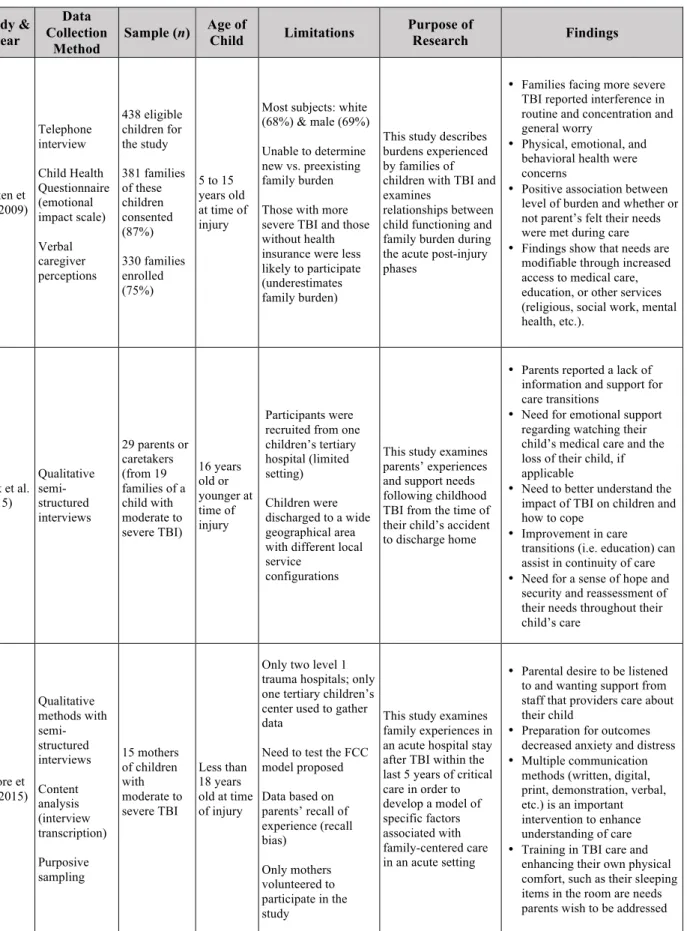
interventions that were not applied to caring for a child with moderate to severe TBI, and, lastly, one produced an outcome that was not a result of caring for a child with moderate to severe TBI. After screening and assessing each result, eight total journal articles were deemed appropriate for inclusion. Table 1B of the Appendix summarizes the purpose and relevant study data for each of the eight included works.
Quality Assessment
To ensure that each study’s findings were presented in context of any quality limitations, each study’s level of quality was assessed according to Mays and Pope (2000) criteria. When assessing qualitative data using comprehensive conceptions, one must take into account the distinctive purposes and objectives of qualitative studies. To do so, Mays and Pope recommend utilizing the following criteria categories to determine the validity and quality of qualitative research: triangulation, respondent validation, clear elucidation of methods of data collection and analysis, reflexivity, attention to negative cases or limitations, and fair dealing.
Extraction of Data
Extracting data from each of the included studies was based on the following criteria: research study authors, year published, methods of data collection, number of participants (including number of patients, number of total parent(s), and relationship to the patient), age of the child at time of diagnosis and acute care stay, limitations of the study, and the purposes of the research and findings (Lipsey, 2009). The results are concisely summarized and visually
organized in Table 1B of the appendix to better represent and compare the literature.
Data Analysis
Data analysis followed the meta-ethnography method, as this is an effective method of synthesizing and analyzing qualitative research (Noblit & Hare, 1999). All selected articles were read multiple times and organized according to themes. Findings were reciprocally translated from each individual study into those from all other qualitative studies in the synthesis using a matrix to organize the findings (Ayres, Kavanaugh, & Knafl, 2003). Rigorous application of this method was accomplished using multiple independent reviewers (i.e., student investigator, faculty peer reviewer and co-investigator, and the medical research librarian), making the research findings and the context of the study the only informing sources of our conclusions, which helped to establish trustworthiness and credibility in our findings (Valentine, 2009). The rigor of our process ensures that qualitative data can reasonably be combined and compared because the data is rightfully considered in context, as reported by Campbell et al. (2011).
of intuiting) was used to extract important contextual information. This process allowed for easy, simple, and quick referencing and categorization of data. From here, lists with the comparative information for each study was linked together for a more aesthetic and accessible document. This information was placed into tables, such as Table 1B and Table 1D in the appendix.
Results
The three database searches, which included PubMed, CINAHL, and PsycINFO,
produced a total of 1186 articles after 522 duplicates were removed. Additionally, two references found in two separate articles that met our inclusion criteria were identified using the ancestry approach, commonly known as footnote chasing, to screen for inclusion (Cooper, 2015). Both articles did not meet our inclusion criteria, validating that the database searches were likely both comprehensive and thorough enough to capture results that covered the most significant articles. According to Ackermann and Hartman (2014), these results are considered to be of high
precision/high recall, where all relevant documents are received after conducting a search. The PRISMA flow chart (Figure 1) presents the phases of the literature search and how we arrived at our final sample.
Identified Themes
While reading, evaluating, and analyzing all of the retrieved articles, it was noted that health care communication was described as a common critical need among parent(s) in the acute care phase of moderate to severe pediatric TBI. As a result, other articles were searched for using “communication” to compare similar findings. Supplemental emergent themes were
for frequent and thorough support and communication; and, (e) parents’ varying coping abilities. In addition, parents recommended suggestions for improving their comfortability and feeling fully supported while caring for their child with moderate to severe TBI in the acute care setting.
Emotional Family Burden
Within this category, findings display parental reports of emotional strife as a large part of caring for their child with moderate to severe TBI in the acute care initial stages. Two subcategories presented themselves to be common emotional subthemes among the included studies: dealing with fear and anxiety throughout their roles as caregivers and decision-makers for the child who is unable to do so for himself or herself and feeling anger, grief, and sadness toward their child’s condition.
Savage, & Philipsen, 2013). The fears and concerns among the parents of a child with moderate to severe TBI can be triggered by a multitude of factors. Roscigno and Swanson (2011) note that uncertainty about the child surviving and, if they do, what their future will entail and how the child will navigate the new world is a commonly reported cause of anxiety in parents. Regardless of the presenting symptoms among parents and how they arise, the main concern is that few parents recall having ever received any emotional support during the initial stages of acute care for their child. Because of this underlying, continuous state of overwhelming emotion in parents, information provided about their child’s condition is challenging for parents to follow and absorb (Kirk et al., 2015; Reuter-Rice et al, 2017).
Anger, grief, and sadness. As previously mentioned, uncontrolled emotions can easily affect parents’ abilities to care for their child in this context, often leading to additional negative feelings of discouragement, anger, grief, and sadness.Throughout the articles, parents reported not feeling entirely included in dialogue with providers and with additional healthcare team members related to decision-making for their injured child, which resulted in parents moving to emotional forms of coping, such as expressing anger, grief, sadness, demands, ignoring, and blocking because they felt disregarded (Roscigno et al., 2013; Roscigno, Savage, Grant, & Philipsen, 2013). As inadequate coping occurs, parents felt they had to work harder to persevere and endure the ongoing situation. As time passed, it was revealed that parents may resort to ignoring their “physical, psychological, and spiritual well-being” to utilize outside resources to overcome the overwhelming acute care barriers they encountered (Roscigno et al., 2013, p. 10).
Protecting Their Child from Harm
The relationship between moderate to severe pediatric TBI and parental burden is
the recovery of the injured child. It is also important to distinguish parents who experience much higher levels of stress because the stress not only affects the long-term health and recovery of the child, but also it can have negative effects on the parents’ well-being both acutely and later in life (Aitken et al., 2009). Reuter-Rice et al. (2017, p. 84) described burden among the family as it is positively correlated with general “stress and psychological and emotional sequelae” in addition to unmet requests from providers for social service support and care regarding follow-up. Five of the eight studies directly address parents’ desire for close attention to detail in attempting to locate and support family burden. The remaining three include statements from parents regarding their feeling extremely burdened at times, making it a commonality, but not necessarily deeming it a priority, as some parents felt they were ultimately responsible for controlling these feelings instead of burdening the providers (Kirk et al., 2015). Roscigno (2016) adds that burdens can present in many ways; however, the supposed responsibility of protecting their child from harm was reported by parents to be of utmost importance during the acute stages of care. This included harm from ignored symptoms that could lead to secondary brain injury, psychological harm from overhearing negative talk that might take away the child’s drive to survive, or harm from not providing care or withdrawing care, which could negatively affect the child’s long-term outcomes, should they survive.
The Need to Conserve Energy
involved in their child’s care, actually cared about their child as a valued person of their family and community (Moore et al., 2015; Reuter-Rice et al., 2017; Roscigno, 2016). Other sources of burden can encompass all aspects of health, including physical, emotional, social, cognitive, and financial. For example, energy expenditure is not only physical when discussing burden. Many families report struggling with work schedules and, therefore, finances, which Aitken et al. (2009) reports as being significant stressors for families of injured children, especially those with moderate to severe TBI. Aitken further elaborates that time, travel expenses, and scheduling difficulties, all of which are necessary for the child’s recovery, added to families’ stress and burden. These necessities often resulted in relational family issues and tension with role changes, which were reported to be ignored in the plan of care during the acute care hospital stay, making parents feel that care was not at all “family centered” (Roscigno and Swanson, 2011).
All levels of burden are important to consider in the presence of pediatric TBI, as care truly is for both the child and the family. It is an adjustment to a drastically new lifestyle for both parties, and it should be treated as such by healthcare professionals. The aforementioned patterns of burden demonstrated by these families is of high interest according to Aitken et al. (2009), because in many cases, the families reporting the most negative experiences were not only those with children who presented with severe physical hardship, but also they were those families and their child who suffered psychosocial dysfunction from loss of energy and emotional distress.
Support for Families
worth addressing, according to families: communication, limitations in support, and hope for recovery of their child.
Communication. It is without doubt that communication is one of the most important aspects of healthcare. When caring for a child with moderate to severe TBI and interacting with their family members, especially parents, communication becomes even more imperative. This is because that consistent flow of information on the child’s condition is used by the parents for processing the child’s current and ongoing medical state and consideration of their range of potential prognosis. This information helps the parents to decrease their uncertainty and make decisions that are in line with the child’s and family’s values for survival and recovery. Across each of the eight included studies, good and frequent communication with the parents was listed as the greatest priority from the perspective of the parent(s). Alternatively, Reuter-Rice et al. (2017) reported that caregivers reported communication, or rather, a lack thereof, as the most challenging and difficult need during the child’s hospitalization. Furthermore, Roscigno et al. (2013) adds that parents feel that providers often fail to address the need for consistent and thorough communication because they likely struggle to understand the diagnosis from a parent’s viewpoint, where making therapeutic decisions during the acute stage of recovery is difficult due to overwhelming emotions. Because overwhelming emotions can yield undesired and anxiety-producing settings, families who care for children with moderate to severe TBI desire a complete understanding of the extent of the injury. This includes understanding the possibility for
theoretical approach, which illustrated the course of a child with moderate to severe TBI in the acute care phase of the hospital, Reuter-Rice et al. (2017) determined that there are three specific phases for both moderate and severe injury. These phases include: information seeking, watchful waiting, and decision making. From this, it is noted that information seeking is listed first, as it was found to be of highest significance. As each of these stages requires thorough and
continuous communication with the healthcare team, it is no surprise that a lack of
communication would increase the anxiety of parents who are needing to make critical decisions for their child and family. Roscigno et al. (2013) provides reason to believe that communication can both create alliances, if used appropriately, and create distrust, if not implemented well or at all. Overall, the parents’ stories illustrate that any poor communication, no matter with whom, can hinder future interactions between the parents and the remainder of the healthcare team.
information, showed acceptance for their difficulties in learning such complex information under stressful circumstances, and provided practical assistance for their questions or concerns.
Hope for recovery. By definition, the stage of hoping for recovery can be described as the period of uncertainty where parents are attempting to make sense of their child’s accident, while waiting for events to unfold, in either a positive (improving) or negative (declining) direction (Kirk et al., 2015). During this phase, parents often feel alone and helpless, because the healthcare team is focused on saving the child (i.e., medical stabilization). Roscigno and
Swanson (2011) supplement this idea with the fact that parents initially focused on their injured child still being alive and having a small chance to recover and survive, hence the earliest stage of hope. Although feelings of hope come and go during this stage, as described by Kirk, such as when their child makes a significant improvement or parents see other ill or dying children on the unit, parents tend to lean more expressively toward the positive. Similarly, Roscigno and Swanson mention that parents focused on seeing the child for who they were before the injury, especially when the child was in a comatose state. As Moore et al. (2015) specifies, these parents’ small glimpses of the child’s formerly apparent personality were seen as random or meaningless to providers, but the parent(s) reported these moments as providing hopeful
evidence for the child’s progression towards healing, making them a large part of parents’ coping and security (Roscigno et al., 2013).
Parents’ Abilities to Cope
significance of spiritual faith and religion as a distinct coping strategy, while others referenced the receiving of updates on their child’s prognosis and care from providers as their method of coping (Moore et al., 2015). Regardless of the strategies used in coping, providers should avoid negative prognostic talk that is offered with absolute certainty and in an authoritative manner, because parents argued that this behavior was not helping in their coping and ability to make decisions (Roscigno et al., 2013). Instead, parents wish for providers to be honest about their impressions and explain why they think those are true, while also explaining that predicting children’s long-term prognosis, so early after injury, is fraught with imprecision because there are many factors that influence the outcomes (Roscigno et al., 2013).
It is important for providers to avoid making judgements about families’ varying coping strategies; understanding context is critical. What providers believe is effective may not help a family that is experiencing added stressors other than the fact that their child is injured. This adjustment is forced on parents rapidly and without warning, causing the parent(s) to learn to cope quickly, while undergoing many additional stressors due to the sudden change in lifestyle. According to Roscigno (2016), it is entirely normal for parents to grieve and remain hopeful simultaneously without indicating a parents’ misunderstanding of the magnitude of the situation at hand. Parents learn to cope in their own unique ways, and they should be able to talk about their experience without hesitation or judgement, so they can decompress from the trauma.
Family-Reported Suggestions for Improvement
While there are a number of suggestions provided by the parent interviewees to meet the needs of a family unit who is caring for a child with moderate to severe TBI, findings support interventions from the many categories. These interventions include the following: (a)
attention to physical, cognitive, emotional, and informational needs; (c) teaching and training parents to fully understand the care and treatment measures given to the child and the rationale and limitations of our knowledge; (d) providing resources to supplement verbal communications; and, (e) improving communication and support for the family as a whole via involving other relevant providers (chaplain, social workers, child life specialists, psychologists) and finding ways for all family members to be involved in supportive measures for the injured child (making get well cards/posters, selecting and providing the child’s favorite things at the bedside,
preparing parents to consider the unique impact on the individual family members and entire family as a unit, and involving the family in the preparation for the child to eventually return to home) (Moore et al., 2015; Reuter-Rice et al., 2017; Roscigno & Swanson, 2011)
Empowering parents to participate. Each study emphasized the desire from families to be active members in the direct care of their child during the acute stages of recovery. Parents universally described the importance of being participants in improving their own child’s health. However, Kirk et al. (2015) adds that although these parents strive to be involved, they are often uncertain on how and when to contribute, if appropriate. Moore et al. (2015) further determined the great need for educated providers, where providers are able and willing, to teach, explain, and empower and encourage parents to participate in the care of their children directly even though the technologies attached to the child may be frightening.
flexible with taking families’ needs and stressors into consideration, during the acute care stages, so that they are able to explain information and teach in a way that allows the parent(s) to
understand the rationale behind the care being provided. Roscigno (2016) explains that this may need to be done in more than one way and done several times, because the family members are overwhelmed and find processing and remembering such detailed information difficult.
Care training. While parents desire the ability to comprehend and rationalize what care is to be provided to their injured child, it is recommended that specific capacity building
techniques are including families. Moore et al. (2015) suggests that listening to families’ questions and providing conformation that each individual patient holds a unique place among the hospital care team can lead to a positive experience for the parent(s), despite the current traumatic occasion. Some parents reported that the ability to intervene and assist in caring for their child was appealing, but they did not realize providers expected their involvement (Kirk et al., 2015). Other parents explain their fear of offending providers or making them feel alienated (Moore et al., 2015; Roscigno et al., 2013). However, Kirk provides evidence that involvement in direct care of the child is a way of regaining parent identity, which leads to parents playing a more active role in their child’s recovery. In each study, parents accentuated the worth of receiving encouragement, instruction, and support in assuming and embracing the active role of being a part of the child’s team of care (Kirk et al., 2015; Reuter-Rice et al., 2017). Overall, it is widely realized that caring for a child recovering from moderate to severe TBI can be daunting in the least, so providers should be knowledgeable, generous, and empathetic to encourage parents to actively participate and prevent parents from feeling judged or incompetent to keep up.
forward, despite the outcome of their child’s injury. Additionally, electronic and print resources regarding diagnostic and prognostic information for moderate to severe TBI has proven effective in improving problem-solving and reducing emotional stress among parents and within the family as a whole (Aitken et al., 2009; Roscigno et al., 2013). It is also recommended that families are offered local and affordable resources to help reduce the impact of the child’s care on parental work schedules and to help consolidate follow-up visits in order to minimize physical distress (Kirk et al., 2015). Reuter-Rice et al. (2017) ultimately determined the three common phases that families move through: information seeking, watchful waiting, and decision-making. Understanding these phases can help respectively address parents’ changing needs efficiently and in a timely manner. Given this information, these approaches could guide the development of best care protocols and facilitate the ability of the healthcare team to help ease parental burden by providing the appropriate physical, emotional, informational, or social support needed at each phase, while also encouraging the family’s positive attempts to be involved, by not passing judgment on their abilities, needs, or noting any disagreement with their final decisions.
Communication and support. As communication was the most commonly discussed theme within each of the eight included studies, it is important to address strategies for
improvement. In addition, Aitken et al. (2009) complements the need for assistance by stating that pediatricians are more thoroughly trained in handling physical needs versus emotional or social dysfunction, which makes recognizing and managing said psychosocial issues extremely difficult. According to Aitken, these facts present the need for routine screening and
Moore et al. (2015) supplements that case management can serve as a valuable tool for not only care during the acute care period, but also for transitioning from the acute care setting back home, where families would remain supported.
Discussion
While children with moderate to severe TBI only comprise 0.06% of the 2.5 million injured in the U.S., over ten million total are still affected worldwide (Centers for Disease Control and Prevention, 2017; Langlois et al., 2006). Given this statistic in conjunction with findings of this meta-synthesis, it is identifiable that several caregivers, often the parent(s), go without effective and complete support during times of need in the hospital while caring for acute moderate to severe TBI, especially parents of children with severe TBI (Roscigno et al., 2013). To think this many families are lacking supportive care and encouragement is enough reason to research further and expand options for supporting families undergoing such stress, so they can continue to support the child in the long trajectory of recovery from moderate or severe TBI. In the acute care inpatient setting, parents especially perceive an inherent demand to create standards of care that address aforementioned needs, which have been consistently reported, in slightly different variations, among countless family members (Fassier & Azoulay, 2010).
barriers that limit the family’s involvement in care and decisions, such as family visitation policies, parent involvement in decision-making processes, and considering and addressing the unique needs of the entire family (i.e., siblings and extended family members who will be involved with helping the parent(s)) (Hawley, 2003; Roscigno, Swanson, Vavilala, & Solchany, 2011). Despite the listed focuses, there were some inconsistencies in the findings across articles. These may be attributable to the various methods of studying parents’ psychological
understandings or the diverse data collection processes in describing and/or measuring these findings. Furthermore, depending on where the parent(s) lived or how long after diagnosis of the child’s injury the parent(s) were interviewed, results may also be misrepresented. Yet we take parents’ impressions not as objective reports of events (i.e., ‘the truth’), but as important
impressions that they use for their long-term creation of meaning. By understanding the elements that influence parents’ and families’ meaning, we can better serve them in future encounters.
The included articles were selected to be specific to pediatric populations only; however, many additional studies, involving both pediatric and adult populations, complement the findings supported in the results above. For example, a study by Grant and Starza-Smith (2016), which analyzed family functions of caring for children with TBI, determined that the ability of a parent to function comfortably while feeling supported by providers is an important factor in the prognosis of a child’s recovery following TBI. In other words, families who recognize and understand the needs of their child can better advocate for and optimize the social environments for that child, compared with parents who do not appreciate the presenting difficulties.
behavioral difficulties (Coco et al., 2011; Oyesanya & Bowers, 2017). Especially in the case of TBI, where losses are often ambiguous, Boss and Couden (2002) agree that ambiguity creates powerful barriers to successful coping and grieving. Other adult studies similarly reasoned that, as a result of ambiguous loss and prognostic uncertainty, support for hope appeared as an imperative need among families. Said hope can either be used as an intervention for support and caring from providers or as a noticeable recognition among parents to let them know they are being cared for and their needs are appreciated (Schutz, Coats, Curtis, & Creutzfeldt, 2017). In the case of unmet or unappreciated needs, it is imperative to note that policies must be employed that involve support for these families. Similar to informational and emotional support and hope promotion, the highest priorities for families included information and assurance of their child’s health first, followed by proximity to the child because this is where decisions are discussed and made, comfort measures, and further support (Al-Mutair, Plummer, O’Brien, & Clerehan, 2013).
One need, which was rarely mentioned among the studies in this meta-synthesis, was that of reducing cultural barriers. Grant and Starza-Smith (2016) explain the difficulties of working with families and children whose primary language is not English, which is noted to be a significant barrier in assessing the child and working with both the family and child in the later stages of rehabilitation and recovery. Culture is not only language related, however. Culture extends past language to also include families’ belief systems and familial practices (Michelson and Rothschild, 2015). In combination with the fact that parents lack knowledge regarding their child’s trajectory, making them reliant on healthcare providers, cultural awareness is an
for the parties to communicate easily, and with comfort, between members of the healthcare team, other family members, and the child, once able.
Dealing with perplexing behaviors in the hospital is certainly significant to healthcare systems, as challenges and trials in the hospital are inevitable. Often times, patients or family members may be challenging to healthcare personnel, given their needs, questions, and concerns, but in regard to TBI, these families need to be supported more exclusively (Hanks, Rapport, & Vangel, 2007). Healthcare team members may know what to expect in terms of some of the needs of families and their child with moderate to severe TBI, but their feelings and experiences should also be understood as a summation of many thoughts and challenges (Moore et al., 2015). Healthcare providers and healthcare systems must be able to understand parents’ experiences from their points of view, as both Reuter-Rice et al. (2017) and Roscigno et al. (2013) mention. Communication measures may be vastly improved if providers learn and become comfortable with how prognostic ambiguity of severe TBI can affect those parents (Boss, 2006). Boss furthers reveals that supporting a family’s efforts of resilience and moving forward while recognizing bouts of simultaneous grief and challenge is important among healthcare providers in order to encourage early positive coping strategies. These findings demonstrate why including qualitative research was vitally important during the search, because it delivers a unique set of information to explain why and how relationships are positively built or why they breakdown when the family’s needs are not addressed appropriately.
Therefore, the survey results may not entirely reflect or detect the true psychological
implications in the same way an open interview would. However, due to the fact that parents often feel restricted from fully disclosing their feelings to avoid burdening healthcare providers from “doing their job,” interviews may limit the sensitivity to parents’ symptoms of stress and keep them from mentioning their true feelings and concerns regarding their experience, especially if conducted when the parent is too overwhelmed (prospectively while in the acute care setting). They are, indeed, in the midst of turmoil and have not yet been able to think about their experiences. Worrying about how it could affect their child’s care is also a concern
(Roscigno, 2016). Roscigno further adds that not only do parents sometimes avoid burdening others, but also they may do so because they feel threatened or shamed by providers, who make them feel excluded or judged for their emotional capacities at times.
Limitations
Although the studies included in this qualitative meta-synthesis were rated to be of moderate to high or high quality (Table 1C), there were also limitations to utilizing their data, such as the following: their study of small, homogenous sample sizes, their use of self-selected samples, the limited ethnic diversity among participants in the studies, the retrospective nature, which may have contributed to recall bias, and the fact that they often covered a limited
Implications
The findings among these studies, with the abundant insight from parents’ narratives, highlight that prospective research is needed to inform the development of early resources for families caring for a child in the acute care stages of recovery for moderate to severe TBI, especially resources that assist the parent(s) with information and decision-making regarding critical decisions for their child.
Conclusion
In reading, evaluating, and analyzing the included studies, it was noted that lack of healthcare communication regarding treatments and rationale, the trajectory of potential recovery, and explanation of the complexity of prognosis projections were the most prominent phenomena among parent(s) in the acute care phase of moderate to severe pediatric TBI. While this synthesis provides important information to cover and explain, we would suggest that any communicative interventions should be tailored to the specific needs of each parent and family. Parents know their own and their child’s situations best, and as primary sources of this
information, they should be included and involved as they want. Said involvement is critical so that healthcare providers can then support the specific needs of the family and foster all
individuals’ adjustment and adjustment of their family system as a whole.
Acknowledgements
I would like to especially thank Cecelia Roscigno, RN, MN, PhD, CNRN for her
References
Ackermann, E., & Hartman, K. (2014). The Information Specialist’s Guide to Searching and Researching on the Internet and the World Wide Web (2, revised.). Routledge.
Adams, J. A., Anderson, R. A., Docherty, S. L., Tulsky, J. A., Steinhauser, K. E., & Bailey, D. E. Jr. (2014). Nursing strategies to support family members of ICU patients at high risk of dying. Heart and Lung, 43(5), 406Y415. doi:10.1016/j.hrtlng.2014.02.001
Aitken, M. E., McCarthy, M. L., Slomine, B. S., Ding, R., Durbin, D. R., Jaffe, K. M., … CHAT Study Group. (2009). Family burden after traumatic brain injury in children. Pediatrics,
123(1), 199–206. doi:10.1542/peds.2008-0607
Al-Mutair, A. S., Plummer, V., O’Brien, A., & Clerehan, R. (2013). Family needs and
involvement in the intensive care unit: a literature review. Journal of Clinical Nursing,
22(13-14), 1805–1817. doi:10.1111/jocn.12065
American Speech-Language-Hearing Association. (2017). Pediatric Traumatic Brain Injury. (American Speech-Language-Hearing Association) Retrieved March 15, 2018, from Practice Portal–Clinical Topics: https://www.asha.org/
Ayres, L., Kavanaugh, K., & Knafl, K. A. (2003). Within-case and across-case approaches to qualitative data analysis. Qualitative Health Research, 13(6), 871–883.
doi:10.1177/1049732303013006008
Boss P. (2006). Loss, trauma, and resilience: therapeutic work with ambiguous loss. New York: W. W. Norton & Company. p 280.
Boss, P., & Couden, B. A. (2002). Ambiguous loss from chronic physical illness: clinical interventions with individuals, couples, and families. Journal of Clinical Psychology,
Bourhis, R. Y., Roth, S., & MacQueen, G. (1989). Communication in the hospital setting: A survey of medical and everyday language use amongst patients, nurses and doctors. Social Science and Medicine, 28(4), 339Y346. doi:10.1016/0277-9536(89)90035-X Brown, F. L., Whittingham, K., Sofronoff, K., & Boyd, R. N. (2013). Parenting a child with a
traumatic brain injury: experiences of parents and health professionals. Brain Injury,
27(13-14), 1570–1582. doi:10.3109/02699052.2013.841996
Campbell, R., Pound, P., Morgan, M., Daker-White, G., Britten, N., Pill, R., … Donovan, J. (2011). Evaluating meta-ethnography: systematic analysis and synthesis of qualitative research. Health Technology Assessment, 15(43), 1–164. doi:10.3310/hta15430 Centers for Disease Control and Prevention. (2017, March 30). National Center for Injury
Prevention and Control, Division of Unintentional Injury Prevention: Severe TBI. Retrieved February 20, 2018, from Centers for Disease Control and Prevention Coco, K., Tossavainen, K., Jääskeläinen, J. E., & Turunen, H. (2011). Support for traumatic
brain injury patients’ family members in neurosurgical nursing: a systematic review. The Journal of Neuroscience Nursing: Journal of the American Association of Neuroscience
Nurses, 43(6), 337–348. doi:10.1097/JNN.0b013e318234ea0b
Cooper, H. (2015). Research Synthesis and Meta-Analysis: A Step-by-Step Approach (5th ed.). Thousand Oaks, CA: SAGE Publications.
Covidence (2018). Covidence systematic review software [Software]. Melbourne, Australia: Veritas Health Innovation Ltd. Available from https://www.covidence.org/
Fassier, T., & Azoulay, E. (2010). Conflicts and communication gaps in the intensive care unit.
F1000 Workspace (2018). F1000 Workspace (Version 35) [Software]. London, UK: Faculty of 1000 Ltd. Available from https://www.f1000workspace.com/
Gagnon, I., Swaine, B., Champagne, F., & Lefebvre, H. (2008). Perspectives of adolescents and their parents regarding service needs following a mild traumatic brain injury. Brain Injury, 22(2), 161–173. doi:10.1080/02699050701867381
Glang, A., Todis, B., Thomas, C. W., Hood, D., Bedell, G., & Cockrell, J. (2008). Return to school following childhood TBI: who gets services? NeuroRehabilitation, 23(6), 477– 486. Retrieved from https://www.iospress.nl/journal/neurorehabilitation/
Grant, C., & Starza-Smith, A. (2016). Paediatric Neuropsychological Formulation of a Traumatic Brain Injury with Special Reference to Culture. In J. A. B. Macniven (Ed.),
Neuropsychological Formulation (pp. 133–155). Cham: Springer International Publishing. doi:10.1007/978-3-319-18338-1_8
Hanks, R. A., Rapport, L. J., & Vangel, S. (2007). Caregiving appraisal after traumatic brain injury: the effects of functional status, coping style, social support and family
functioning. NeuroRehabilitation, 22(1), 43–52. Retrieved from https://www.iospress.nl/journal/neurorehabilitation/
Hawley, C. A. (2003). Reported problems and their resolution following mild, moderate and severe traumatic brain injury amongst children and adolescents in the UK. Brain Injury,
17(2), 105–129. doi:10.1080/0269905021000010131
Keenan, A., & Joseph, L. (2010). The needs of family members of severe traumatic brain injured patients during critical and acute care: a qualitative study. Canadian Journal of
Kelly, L., & St Pierre-Hansen, N. (2008). So many databases, such little clarity: Searching the literature for the topic aboriginal. Canadian Family Physician, 54(11), 1572–1573.e5. Retrieved from http://www.cfp.ca/
Kirk, S., Fallon, D., Fraser, C., Robinson, G., & Vassallo, G. (2015). Supporting parents following childhood traumatic brain injury: a qualitative study to examine information and emotional support needs across key care transitions. Child: Care, Health and Development, 41(2), 303–313. doi:10.1111/cch.12173
Langlois, J. A., Rutland-Brown, W., & Thomas, K. E. (2006). Traumatic brain injury in the United States: Emergency department visits, hospitalizations, and deaths. Atlanta, GA: Centers for Disease Control and Prevention, National Center for Injury Prevention and Control.
Lipsey, M. W. (2009). Identifying Interesting Variables and Analysis Opportunities. In H. M. Cooper, L. V. Hedges, & J. C. Valentine, The Handbook of Research Synthesis and Meta-Analysis (2nd Edition ed., pp. 147-158). New York, NY: Russell Sage Foundation. Mays, N., & Pope, C. (2000). Assessing quality in qualitative research. BMJ: British Medical
Journal, 320(7226), 50–52. doi:10.1136/bmj.320.7226.50
McCabe, P., Lippert, C., Weiser, M., Hilditch, M., Hartridge, C., Villamere, J., & Erabi Group. (2007). Community reintegration following acquired brain injury. Brain Injury, 21(2), 231–257. doi:10.1080/02699050701201631
Michelson, K., & Rothschild, C. B. (2015). Family-Centered Care in the PICU: Where Do We Go From Here? Pediatric Critical Care Medicine, 16(8), 781–782.
doi:10.1097/PCC.0000000000000522
Moher, D., Liberati, A., Tetzlaff, J., Altman, D. G., & PRISMA Group. (2009). Preferred reporting items for systematic reviews and meta-analyses: the PRISMA statement. PLoS Medicine, 6(7), e1000097. doi:10.1371/journal.pmed.1000097
Moore, M., Robinson, G., Mink, R., Hudson, K., Dotolo, D., Gooding, T., … Vavilala, M. S. (2015). Developing a Family-Centered Care Model for Critical Care After Pediatric Traumatic Brain Injury. Pediatric Critical Care Medicine, 16(8), 758–765.
doi:10.1097/PCC.0000000000000494
Noblit, G., & Hare, R. (1999). Chapter 5: Meta-Ethnography: Synthesizing Qualitative Studies.
Counterpoints,44, 93-123. Retrieved from http://www.jstor.org/stable/42975557 Oyesanya, T. O., & Bowers, B. (2017). Managing visitors during the hospital stay: the
experience of family caregivers of patients with traumatic brain injury. Journal of Family Nursing, 23(2), 273–298. doi:10.1177/1074840717697673
Reuter-Rice, K., Doser, K., Eads, J. K., & Berndt, S. (2017). Pediatric traumatic brain injury: families and healthcare team interaction trajectories during acute hospitalization. Journal of Pediatric Nursing, 34, 84–89. doi:10.1016/j.pedn.2016.12.017
Roscigno, C. I. (2016). Parent perceptions of how nurse encounters can provide caring support for the family in early acute care after children’s severe traumatic brain injury. The Journal of Neuroscience Nursing: Journal of the American Association of Neuroscience
Roscigno, C. I., Fleig, D. K., & Knafl, K. A. (2015). Parent management of the school
reintegration needs of children and youth following moderate or severe traumatic brain injury. Disability and Rehabilitation, 37(6), 523–533.
doi:10.3109/09638288.2014.933896
Roscigno, C. I., Grant, G., Savage, T. A., & Philipsen, G. (2013). Parent perceptions of early prognostic encounters following children’s severe traumatic brain injury: “locked up in this cage of absolute horror”. Brain Injury, 27(13-14), 1536–1548.
doi:10.3109/02699052.2013.831122
Roscigno, C. I., Savage, T. A., Grant, G., & Philipsen, G. (2013). How healthcare provider talk with parents of children following severe traumatic brain injury is perceived in early acute care. Social Science & Medicine, 90, 32–39. doi:10.1016/j.socscimed.2013.04.017 Roscigno, C. I., & Swanson, K. M. (2011). Parents’ experiences following children’s moderate
to severe traumatic brain injury: a clash of cultures. Qualitative Health Research, 21(10), 1413–1426. doi:10.1177/1049732311410988
Roscigno, C. I., Swanson, K. M., Vavilala, M. S., & Solchany, J. (2011). Children’s longing for everydayness: life following traumatic brain injury in the USA. Brain Injury, 25(9), 882– 894. doi:10.3109/02699052.2011.581638
Schutz, R. E. C., Coats, H. L., Engelberg, R. A., Curtis, J. R., & Creutzfeldt, C. J. (2017). Is there hope? is she there? how families and clinicians experience severe acute brain injury.
Journal of Palliative Medicine, 20(2), 170–176. doi:10.1089/jpm.2016.0286
Tramonti, F., Bonfiglio, L., Di Bernardo, C., Ulivi, C., Virgillito, A., Rossi, B., & Carboncini, M. C. (2015). Family functioning in severe brain injuries: correlations with caregivers’ burden, perceived social support and quality of life. Psychology, Health & Medicine,
20(8), 933–939. doi:10.1080/13548506.2015.1009380
Valentine, J. C. (2009). Judging the Quality of Primary Research. In H. M. Cooper, L. V.
Hedges, & J. C. Valentine, The Handbook of Research Synthesis and Meta-Analysis (2nd Edition ed., pp. 129-146). New York, NY: Russell Sage Foundation.
Appendix Figure 1.
PRISMAChart
Records identified through database searching
(n = 1708)
Sc
re
en
in
g
In
cl
ud
ed
El
ig
ib
ili
ty
Id
en
tif
ic
ati
on
Records after duplicates removed (n = 1188)
Records screened
(n = 1188) Records excluded (n = 995)
Full-text articles assessed for eligibility
(n = 193)
Full-text articles excluded, with reasons:
75 Wrong setting 47 Not Research
24 Wrong Patient Population 17 Adult population 15 Wrong study design 3 Incomplete
1 Not English 1 Wrong intervention 1 Wrong outcomes
1 Wrong patient population
(n = 185) Studies included in
synthesis (meta-analysis) (n = 8)
Records identified through the ancestry approach
Table 1A: Search Terms by Database
PubMed
("Intensive Care Units"[Mesh] OR acute OR severe OR "intensive care" OR ICU OR "critical care" OR CCU OR "neuro ICU" OR neurolog* OR hospitaliz* OR inpatient* OR patient*) AND ("Family"[Mesh] OR famil*[title] OR
parents[MeSH] OR parent*[title] OR mother*[MeSH] OR father*[MeSH] OR caregiver*[MeSH] OR "care giver" OR "care taker" OR caretaker* OR guardian* OR sibling* OR brother* OR sister*) AND ("Brain Injuries, Traumatic"[Mesh] OR "brain injury" OR "brain injuries" OR TBI)
542
CINAHL
((MH "Intensive Care Units+") OR acute OR severe OR "intensive care" OR ICU OR "critical care" OR CCU OR "neuro ICU" OR neurolog* OR hospitaliz* OR inpatient* OR patient*) AND ((MH "Family+") OR TI(famil*) OR (MH "Parents+") OR TI(parent*) OR (MH "Mothers+") OR (MH "Fathers+") OR (MH "Caregivers") OR "care giver" OR "care taker" OR caretaker* OR guardian* OR sibling* OR brother* OR sister*) AND ((MH "Brain Injuries+") OR "brain injury" OR "brain injuries" OR TBI)
581
PsycINFO
((DE "Intensive Care" OR DE "Neonatal Intensive Care") OR acute OR severe OR "intensive care" OR ICU OR "critical care" OR CCU OR "neuro ICU" OR neurolog* OR hospitaliz* OR inpatient* OR patient*) AND (DE "Family" OR DE "Biological Family" OR DE "Extended Family" OR DE "Stepfamily" OR TI(famil*) OR DE "Parents" OR DE "Adoptive Parents" OR DE "Fathers" OR DE "Foster
Parents" OR TI(parent*) OR DE "Mothers" OR DE "Fathers" OR DE "Caregivers" OR "care giver" OR "care taker" OR caretaker* OR guardian* OR sibling* OR brother* OR sister*) AND (DE "Traumatic Brain Injury" OR DE "Brain
Concussion" OR "brain injury" OR "brain injuries" OR TBI)
585
Total Records Identified 1708
Total Duplicate Records 522
Table 1B: Summary of Articles Included in Meta-Synthesis
Study & Year
Data Collection
Method Sample (n)
Age of
Child Limitations Purpose of Research Findings
Aitken et al. (2009) Telephone interview Child Health Questionnaire (emotional impact scale) Verbal caregiver perceptions 438 eligible children for the study 381 families of these children consented (87%) 330 families enrolled (75%)
5 to 15 years old at time of injury
Most subjects: white (68%) & male (69%)
Unable to determine new vs. preexisting family burden
Those with more severe TBI and those without health insurance were less likely to participate (underestimates family burden)
This study describes burdens experienced by families of children with TBI and examines
relationships between child functioning and family burden during the acute post-injury phases
• Families facing more severe TBI reported interference in routine and concentration and general worry
• Physical, emotional, and behavioral health were concerns
• Positive association between level of burden and whether or not parent’s felt their needs were met during care • Findings show that needs are
modifiable through increased access to medical care, education, or other services (religious, social work, mental health, etc.).
Kirk et al. (2015)
Qualitative semi-structured interviews
29 parents or caretakers (from 19 families of a child with moderate to severe TBI) 16 years old or younger at time of injury Participants were recruited from one children’s tertiary hospital (limited setting)
Children were discharged to a wide geographical area with different local service
configurations
This study examines parents’ experiences and support needs following childhood TBI from the time of their child’s accident to discharge home
• Parents reported a lack of information and support for care transitions
• Need for emotional support regarding watching their child’s medical care and the loss of their child, if applicable
• Need to better understand the impact of TBI on children and how to cope
• Improvement in care transitions (i.e. education) can assist in continuity of care • Need for a sense of hope and
security and reassessment of their needs throughout their child’s care Moore et al. (2015) Qualitative methods with semi-structured interviews Content analysis (interview transcription) Purposive sampling 15 mothers of children with moderate to severe TBI Less than 18 years old at time of injury
Only two level 1 trauma hospitals; only one tertiary children’s center used to gather data
Need to test the FCC model proposed
Data based on parents’ recall of experience (recall bias)
Only mothers volunteered to participate in the study
This study examines family experiences in an acute hospital stay after TBI within the last 5 years of critical care in order to develop a model of specific factors associated with family-centered care in an acute setting
• Parental desire to be listened to and wanting support from staff that providers care about their child
• Preparation for outcomes decreased anxiety and distress • Multiple communication
methods (written, digital, print, demonstration, verbal, etc.) is an important intervention to enhance understanding of care • Training in TBI care and
Reuter-Rice et al. (2017) Observational study Life course trajectory (LCT) approach Extraction of information from patients’ electronic health record (EHR) 35 children with moderate to severe TBI
5 days to 15 years old at time of injury
Small sample size
Studies from one large urban medical center only (limits generalization of results)
Does not utilize a mixed-methods approach, where interviewing and surveying families could better describe interactions with the healthcare team
This study identifies common family-healthcare team interactions during the acute phase of hospitalization for children with TBI using a life course trajectory (LCT) theoretical approach
• Different needs based on severity of child’s injury • Need for information,
emotional support, participation in decision-making, and care skills training – commonly reported among all injury levels • Need for proper timing of
tailored communication and support to parents regarding their child’s care for TBI • Healthcare professionals
should approach joint decision-making using a communication framework when interacting with families
Study & Year Type of Study Data Collection Method Sample (n) Age of
Child Limitations
Purpose of
Research Findings
Roscigno and Swanson (2011) Roscigno et al. (2013) Primary Parent Study (Original) Two ~90 minute semi-structured interviews (12-15 months apart) Transcripts: hand-coded; analyzed using a longitudinal, descriptive, phenomenol-ogic approach 42 parents (from 37 families of a child with moderate to severe TBI)
6 to 18 years old at time of injury
Several recruitment methods used to obtain the sample (self-selection) Majority of families from Washington (n = 15) and Florida (n = 11)
Sample is limited in racial, ethnic, and lingual diversity
This study aimed to gain understandings of a socially varied group of parents’ experiences whose children were no more than 5 years past the date of injury
• 4 themes identified during the acute phase of moderate to severe TBI care:
1.Gratefulness of child being alive
2.Grief for the child they knew prior to injury 3.Energy– running on nerves 4.Struggle to get what the
child & family needed • Parents explained often having to
consult outside resources from a lack of trust for professionals • Parents seek 1-on-1
conversations, where medical language, education resources, procedures, and recovery are thoroughly explained by a nurse or physician who assesses their knowledge & answers questions
Secondary Analysis of Roscigno and Swanson (2011) Discourse analysis Ethnography of speaking applied to original study: Roscigno (2011) S-P-E-A-K-I-N-G Framework adaptation Sub-group: 29 parents (from 25 families of a child with moderate to severe TBI)
6 to 18 years old at time of injury No objective recall of prognostic statements provided Sample: self-participation Recollections of early acute care encounters may be biased by parents’ hindsight of the child’s later outcome (not interviewed at time of acute phase of injury)
This study aimed to analyze descriptions of prognostic encounters and their relation to parental attitudes, beliefs, notions and expectations regarding the provider’s communication of information in early TBI
• Providers often forget how parents respond to their child’s injuries
• Parents are affected physically, cognitively and emotionally, making it hard to synthesize or receive information regarding their child’s prognosis and injury • Parents’ assumed that providers
are aware of a family’s learning needs, so they expect all teams to work together to facilitate parent learning
• Honest communication, even if it is negative, is something parents desired
Study &
Year Type of Study
Data Collection
Method
Sample
(n) Age of Child Limitations Purpose of Research Findings
Roscigno et al. (2013) Roscigno (2016) Secondary Analysis of Roscigno and Swanson (2011) Discourse analysis Transcript data coded with discourse analysis in the framework of ethnography of speaking Semi-structured interviews Sub-group: 27 parents of children with severe TBI (from 23 families)
6 to 18 years old at time of injury
Study did not re-interview the parents to confirm interpretations from the final findings (secondary analysis only) Included only parents whose child survived the TBI injury
Possibility of recall bias
This study aims to understand the linguistic communication factors that parents used in all of their communication that could give understanding of their cultural expectations for early talk in these acute settings
• Parents felt left out in decision-making regarding their child’s care when physicians did not show 1-on-1 regular conversation • Providers were claimed to be
“too busy” or “unskilled” by intentionally avoiding the families
• Nurses often filled families in on the missing information, which helped parents get “back on track”
oNurses play a large role in advocating for patients and their families when caring for moderate to severe TBI in the acute care stages • Need for regular conversation
with parents about their child’s condition, treatments, and future plans of care
Secondary Analysis of Roscigno and Swanson (2011) Secondary analysis Inductive analysis (to determine applicability for further theory analyzation) Directed content analysis Hand-coded transcription Sub-group: 29 parents of children with severe TBI (from 25 families)
6 to 18 years old at time of injury
Only biological mothers (n = 19) and fathers (n = 2) or both biological parents (n = 4) were studied
93% identified as Caucasian and non-Hispanic
Small, homogenous sample (small variability)
No new themes of caring were discussed before ending parent enrollment
This study uses Swanson’s theory of caring to document and categorize parents’ descriptions in order to inform nursing care practices and family-centered care when encountering and caring for a child with TBI in the acute care setting
• Partnerships between nurses and healthcare providers help bridge the gap between families and providers
• The partnership triad plays an important role in supporting a family’s resiliency and
supportive needs, because nurses are positioned to easily advocate for patients and their families • Following Swanson’s theory of
Table 1C: Rankings of Study Quality According to Mays and Pope (2000) Criteria
Study & Year
Quality
Ranking Rationale
Aitken et al.
(2009) High
This study directly addresses family burden while caring for a child with moderate to severe TBI in the acute care phase and follows the topic accurately. It also achieves Mays and Pope (2000) criteria. Three different methods of data collection were utilized to obtain results, and several limitations were directly addressed in detail in its own section, such as limits in the participants’ perspectives and further exploration of certain health services that were addressed. Also, methods and data collection processes were explained thoroughly with time frames included, and many sources were referenced in conjunction with the study to proliferate findings and provide multiple perspectives.
Kirk et al. (2015)
Moderate to High
This study follows the trajectory of children diagnosed with moderate to severe TBI from the acute care stage until discharge home – examining families’ experiences and support needs during this time. A parent advisory group was formed to provide feedback on study findings, meeting the respondent validation piece of the Mays and Pope (2000) criteria. Data collection and methodologies for designing and collecting the data were addressed such that semi-structured interviews were completed and participant safeguarding and distress protocols were even established during this period. The data analysis process was even developed into a figure divided into three stages for graphic display. Implications were also addressed. Although there was no section for limitations, the limiting factors were discussed in the conclusion. Attention to negative cases was also included such that some parents reported frightening or ambiguous experiences while the study includes some parental regard to positivity.
Moore et al. (2015)
Moderate to High
Though an in-depth interview guide was created using a multistep process, interviewing was the only method for collecting data. However, a literature review was first conducted to identify concepts and areas of interest for the interviews. This study used data to develop a model of elements associated with family-centered care for treatment of children with moderate to severe TBI. In doing so, they explained the precise levels of content analysis, limitations in their results, the need to further test the model of family-centered care, and their relationships with the patients. Multiple sources addressing care needs for this population were consulting in the results to further validate findings and strengthen the inclusion of factors for the family-centered care model that was created.
Reuter-Rice
et al. (2017) High
Following the Mays and Pope (2000) recommendation for validity, this study approached data collection from both an observational standpoint and extraction from the patients’ electronic health record for the first eight days of hospitalization for moderate to severe pediatric TBI (triangulation). Also, proper timing of tailored communication and support and decreases in caregiver burden to improve