Victoria J. Borowski. Leisure reading materials and urban adolescents: Do school libraries collect for these readers?. A Master’s Paper for the M.S. in L.S degree. April 2009. 58 pages. Advisor: Sandra Hughes-Hassell
Literacy rates of urban adolescents are staggeringly low in comparison with that of their peers. Forty-three percent of urban 8th graders scored “Below Basic” on one national reading test as compared with only 24 percent in suburban and 25 percent in rural regions Research shows a link between the leisure reading habits of adolescents, and reading attitude and performance. Because of this link, ensuring that students living in low-income urban communities have access to materials they are interested in is key to encouraging reading, and consequently improving their reading performance. Using a list of leisure materials that have been found to be of interest to urban adolescents, 20 school library media center collections in an urban community in North Carolina were analyzed to see if these materials were within the school library collection.
Headings:
School libraries--North Carolina
Reading--Leisure reading
Reading--Preferences
Libraries and teenagers
Teenagers--Books and reading--United States
by
Victoria J. Borowski
A Master’s paper submitted to the faculty of the School of Information and Library Science of the University of North Carolina at Chapel Hill
in partial fulfillment of the requirements for the degree of Master of Science in
Library Science.
Chapel Hill, North Carolina
April 2009
Approved by
Table of Contents
Introduction ... 2
Literature Review... 4
Methodology ... 15
Results and Discussion ... 27
Manga, Comic Books, and Graphic Novels... 28
Fiction with African American Characters ... 32
Fiction with Hispanic Characters ... 35
Street Lit... 39
Nonfiction ... 42
Magazines ... 45
Internet Resources ... 48
Limitations ... 48
Conclusion ... 49
Introduction
Literacy rates of urban adolescents are staggeringly low in comparison with that
of their peers. Forty-three percent of urban 8th graders scored “Below Basic” on one national reading test as compared with only 24 percent in suburban and 25 percent in
rural regions (Department of Education, 2005). With No Child Left Behind placing
added emphasis on end-of-year test scores, this disproportion becomes even more evident
and directs attention toward the problems this disparity signifies. Additionally, children
growing up in low-income urban areas are generally not exposed to the same amount of
print sources in their households and communities as those living in higher income
communities, thus limiting their emergent literacy skills from birth (Neuman & Celano,
2001; Snow, Burns, & Griffin, 1998). This inequity immediately puts low-income urban
children at a literacy deficit, especially when compared with their higher-income,
suburban peers. Both of these disparities indicate that special attention needs to be paid
to finding ways to bridge this literacy gap.
In an attempt to make reading a primary focus, many schools have created literacy
programs aimed at remediation, putting a focus on reading comprehension, and
encouraged reading outside of school (McGrath, 2005). While literacy programs have
direct control over the habits that are taught and the material that is read within the school
setting, there is less accountability for reading outside of school. This is an issue, as links
achievement (Cunningham & Stanovich, 1991; Ivey & Broaddus, 2001; Worthy,
Moorman, & Turner, 1999; Stanovich, 1986). Additionally, many literacy programs
offer extrinsic motivation for the number of books or minutes read outside of school, but
miss the point by not encouraging intrinsic motivation for reading on one’s own. The
problem lies in finding materials that appeal to adolescents so that they want to read
without being forced (Worthy 1996).
While the reading habits and preferences of adolescents is an often studied topic,
rarely does this research focus on specific subgroups of teenage readers. Because of the
generality of the research conducted, we are primarily aware of the reading preferences of
the average adolescent student. Although there is not a significant amount of literature
on the reading preferences of urban teens, several studies have shown that urban young
adults do read for pleasure outside of school and that much of their reading materials
come from school and public libraries (Hughes-Hassell in press; Hughes-Hassell &
Rodge 2007). Unfortunately, urban school libraries tend to be underfunded as compared
to schools in higher income areas, and therefore may not have as many applicable and
current resources (Scott 2004).
In order to encourage and support leisure reading, school libraries must house
reading materials that are of interest to students. This study seeks to determine how well
urban school libraries do this. Specifically, do the middle school libraries in one large
North Carolina urban community contain materials that have been identified in the
Literature Review
Because the research directly dealing with the reading preferences of urban
adolescents is limited, this literature review is intended to give an overview of several
aspects surrounding the topic. This includes the subject of leisure reading in general, the
reading attitudes of children and adolescents, the link created between leisure reading and
academic achievement, and studies of general adolescent reading preferences and where
their reading materials come from. Using this as background knowledge, the remainder
of the literature review is focused on low-income urban adolescents and the effect their
location and socioeconomic status has on reading levels and access to print. Finally, the
review will focus on a study of urban adolescent reading habits and preferences and will
take a further look at materials geared toward this demographic.
What is leisure reading and why is it important?
The term leisure reading is in need of definition. The term has been called many
things, including recreational reading, independent reading, reading for pleasure, and free
voluntary reading, among others. While not every study that researches this concept
clearly defines the term, there are some that do.
Greaney (1980),who studied the aspects of elementary school students’ lives that
related to the amount of time they engage in leisure reading, used the term leisure reading
to mean, “reading of any kind, excluding school texts and other materials assigned at
school” (p. 344). He further defined the leisure reading as an activity that takes place
during non-school hours, and specifically did not limit leisure reading to reading books,
time engaged in reading (5.4% of time available), and that they were more likely to read
books than comics or newspapers (Greaney, 1980). While this study focused on
elementary school children, it is important because of its flexible definition of reading
and its emphasis on that fact that leisure reading encompasses more than reading books.
This definition is critical in the 21st century, as more adolescents are reading non-traditional formats, including websites, blogs, wikis, e-mails, and text messages. As
Braun (2007) points out, these formats allow adolescents to read and are not necessarily
of a lower value than traditional textual formats.
With minor variations, Greaney’s (1980) study was repeated and expanded upon
in the United States. Anderson, Wilson, and Fielding (1988) studied students’
out-of-school activities and the relationship between these activities and reading achievement.
Students completed forms telling how much time they spent doing non-reading activities
(listening to music, eating dinner, etc.), how much time they spent reading, and the title
and author of the book they read. Over the course of the study, students’ reading
achievement was tested, including a reading proficiency test, a vocabulary test, and a
reading speed test.
Of the out-of-school activities in which the students participated, reading, and
especially book reading, was found to be the greatest predictor of reading proficiency.
Surprisingly, Anderson et al. (1988) showed that no out-of-school activity interfered with
reading; the amount of television the students watched, for example, did not have a
significant effect on whether or not the students read. This study was important because
findings are supported by other research that demonstrated a positive link between
reading for pleasure and achievement (Krashen, 1993; Short, 1995).
The finding that students who read outside of school are academically good
readers is explained by what Stanovich (1986) calls the “Matthew effects”. This concept,
which can be summarized as ‘the rich get richer and the poor get poorer’ in regards to
reading achievement, asserts that if students are good readers and like to read, they will
do well in reading. If they are not good readers and do not read for pleasure, their
reading scores will suffer.
Cunningham and Stanovich (1991) researched the effect reading and print
exposure had on fourth-grade students. Students were given a series of academic tests,
including phonological coding, word recognition and verbal fluency. They were also
given a title recognition test, where the names of real books and made-up books were
together in a list, and the student marked the titles that they knew were books. Using
these tests as indicators of academic achievement and exposure to print, researchers
found that print exposure is a significant predictor of reading achievement. Cunningham
and Stanovich further interpreted these findings to mean that students that are good
readers tend to read more and are therefore more likely to do well academically. Given
the relationship between reading, reading ability, and academic achievement, it would
seem natural to encourage students to read in their leisure time.
Reading attitudes
Before looking at what students are reading, it is important to find out if they are
elementary school students to determine their attitude toward both academic and
recreational reading and how this attitude relates to reading ability, gender, and ethnicity.
The study was stratified by gender and ethnicity in line with national distributions and
included at least one school from every state. Attitude was measured using the
Elementary Reading Attitude Survey, a Likert-type scale that used pictures to denote
attitude (McKenna,et al., 1995).
McKenna et al. (1995) found that overall, students’ attitudes toward both
recreational and academic reading was most positive mid-way through the first grade and
became more negative as students progressed through school. While attitudes toward
recreational reading became increasingly negative with each year, the mean recreational
reading attitude was still higher than the academic reading attitude (the drop from first to
sixth grade was 0.54 for recreational reading and 0.8 for academic reading). There was
also a correlation between a negative attitude toward reading and reading ability, as
low-level readers tended to have the most negative attitudes towards reading.
These findings make a case for devising a way to increase motivation and interest
among all readers, but particularly for low-level readers. The findings also relate to the
idea that the less students read, the lower their reading levels tend to be. If interest is
lacking, it makes sense that attitude toward reading and reading abilities would be lower.
Reading preferences of adolescents and where they get their reading materials
Even though attitudes toward reading seem to wane as children progress in
sought to determine the reading preferences of middle school students, how these
preferences relate to specific student traits (gender, income, attitudes, and achievement),
where students obtain their reading materials, and if their reading preferences are
available within the students’ school. The schools where this research was conducted
were economically varied. Researchers used a combination of surveys and interviews to
gather information about the students, and interviewed teachers and librarians to gain
insight as to what they believed students’ interests in reading were and how library and
classroom collections reflected these preferences.
The results found that students have very clear preferences and asserted that the
existence of these preferences indicates that students are reading. There were no
significant differences between the reading preferences of low-income students and their
higher-income peers. The materials that students preferred were not always of the
highest literary merit, as most preferred to read scary books, cartoons and comics,
mysteries, and some science fiction/fantasy, while many students preferred to read “other
materials”, such as magazines (Worthy et al., 1999). The researchers make a point to
note that the study shows students are reading and is not a judgment on the ‘quality’ of
what they are reading. Worthy et al. did find, however, that the schools did not provide
extensive access to these materials. While higher-income students often purchased their
reading materials, low-income students obtained most of their reading materials from the
school library, and therefore, did not have access to the materials they preferred.
This finding also speaks to the McKenna et al. (1995) research of children’s attitudes
attitude toward reading. If students do not have access to books that interest them, this
may contribute to why they do not like reading.
Ivey and Broaddus’ study (2001) built on Worthy et al.’s research by studying
middle school students’ reading motivations within the classroom. Citing Worthy et al.’s
(1999) findings that what students like to read is difficult to find in schools, the
researchers sought to find out what students liked to read, what motivated them to read in
and out of the classroom, and if their classroom instruction and the classroom collection
reflected their reading preferences. In line with Worthy et al.’s finding, the materials
students most liked to read were magazines, adventure books, mysteries, scary stories,
and joke books. Comic books and series books were also a popular choice (Ivey &
Broaddus, 2001).
While the research lent insight to reading within the classroom context, it also
provided new findings about student’s out-of-school reading habits. In survey responses,
students stated that being able to find desirable reading materials and getting to choose
these materials was very important to them, but did not mention that materials were what
they liked about their classroom (Ivey & Broaddus, 2001). In addition, students were
able to name more individual titles and authors when asked about what they were reading
at home than they were when asked about what they were reading in school. This would
indicate that students were more engaged and interested by what they were reading at
home. Students’ at-home reading spanned a variety of genres, including non-fiction,
comics, magazine, and poetry. When asked where they get the materials the like to read,
students in both the survey and the interviews were more likely to purchase books from a
from the school library or classroom collection. This would suggest that the in-school
collections do not have titles and/or subjects that the students are interested in reading
about. Again, if the school does not provide the reading materials that students prefer,
low-income students are at a disadvantage.
Two similar studies were executed in the United Kingdom. Hopper (2005)
completed a study using structured and semi-structured self-assessment questionnaires to
find out what teenagers are reading and what their reading habits are. Her findings
corroborate the Worthy et al. study (1999) in that students tended to pick books in the
genre of horror or scary books and mystery, and were also interested in reading non-book
texts such as magazines, the internet, and tabloid and local newspapers (Hopper 2005).
The inclusion of the internet as a source of reading material in Hopper’s study is a
function of its currency. Research by Coles and Hall (2002) focused on adolescents’
(ages 10, 12, and 14) reading choices and the differences in these choices between
genders. Across the sexes, researchers found that adventure, horror/ghost, romance,
animal-related, and science fiction were the most popular reading choices (Coles & Hall
2002). It is notable to point out the similarities between most preferred topics in each of
these studies and the theme of non-book items as one of the more popular preferences.
Reading levels of students in low-income urban communities
While there is a link between independent reading and reading test scores, there is
also a clear link between attending urban schools and low reading test scores. According
likely to have higher percentages of black and Hispanic students than white students and
to have more than 75 percent of students on free or reduced-price lunch (U.S. Department
of Education, 2005). Based on these statistics, narrowing the achievement gap between
low-income minority students and their higher-income peers is of the utmost importance.
Before this can be done, researchers need to determine why there is a gap between
low-income urban students and their higher-low-income peers.
Most recently, Moje, Overby, Tysvaer, and Morris (2008) studied the relationship
between adolescent reading motivation and academic achievement, focusing specifically
on a low-income community in a Midwestern city that is mainly Latino. Data was
gathered using a combination of survey, reading tests, school record data, interviews, and
ethnographic interviews and observations. On average, students read for pleasure about
once a week, with 30 percent of the students reading weekly and 12.3 percent reading
daily (Moje et al., 2008). This study defined reading very broadly, allowing for more
reading material possibilities. Students mostly read websites, letters and notes, music
lyrics, e-mail, magazines, and novels or short stories outside of school. While the reading
frequency of online materials was high, researchers found via interviews that many of
students do not have easy access to the internet outside of school, which may affect their
online reading frequency. Researchers also found that 30 percent of the students read
novels regularly outside of school and 68 percent of these students were able to name a
favorite novel and author (Moje et al., 2008).
The study also tested Stanovich’s (1986) assertion that reading outside of school
has an effect on academic achievement. The researchers found that novel reading had an
school tended to score better on language arts tests, but that novel reading did not have an
effect on science grades or overall GPA. Reading in general seemed to have no effect on
overall test scores (Moje et al., 2008). While these findings do not corroborate past
findings, the researchers offer some possible explanations. One assertion is that reading
and vocabulary in non-language arts classes may not be an indicator of achievement in
getting good grades in a specific class, but may explain poor national test achievement
(Moje et al., 2008). If national testing measures require a greater handle on reading
fluency and content area vocabulary, it is possible that reading within and outside of
these classes may be beneficial to national test achievement. While this study may seem
to be at odds with the Stanovich (1986) and Cunningham and Stanovich (1991), it is
important to note that those studies concentrated on elementary school aged students. It
may be that because more reading is required in all content areas once students reach
adolescence, the reading students do is more complicated.
Neuman and Celano (2001) sought to find out if access to print in low-income
communities differed from higher-income communities and how this could affect early
literacy development in children. Researchers intensively studied four neighborhoods in
Philadelphia (two middle-income and two low-income) by surveying reading materials
available in stores, child-care centers, school libraries and public libraries, and assessed
the conditions of public places available for reading. They found that children’s access to
print materials differed greatly between the low-income and middle-income communities.
In the middle-income communities there were significantly more stores that sold children
and young adult reading materials than in the low-income communities. School libraries
media specialists, and public libraries too had larger collections and longer hours of
operation.
The results of this study show how access to print can differ even within the same
city, and that it differs on many levels, including the number of resources, quality of
resources, and presence of reading role models. While the number of private institutions
in each community contributed to these differences (presence of a bookstore, number of
books carried in drug stores, etc.), there was a great disparity in the quality of the public
institutions, including the school and public libraries. The combination of the Moje et al.
(2008) study and the Neuman and Celano (2001) study provides a good overview of the
unique issues facing adolescents in low-income urban areas.
Reading preferences of urban adolescents and where they get their reading materials
Although the reading preferences of urban young adults have not been extensively
researched,Hughes-Hassell (in press) has completed some research on the topic. The
purpose of her studies was to determine the leisure reading habits of urban students. To
do this, she surveyed middle school students at two low-income middle schools, one
predominately African American and the other predominately Hispanic, and students at
one urban high school. The survey included questions asking students about their reading
preferences (including what they read), habits (including if they read, when reading
occurs, where reading materials come from), and motivating factors (including why they
Hughes-Hassell (in press) found that the leisure reading habits of urban
adolescents do not vary greatly from the reading habits of adolescents in general: 72% of
the students surveyed indicated that they engage in leisure readingand females were
more likely to read independently than males. While their leisure reading habits were
consistent with other studies of adolescent habit studies, the materials the students read
were much different. Because the high school students’ reading material preferences
varied from the middle school students, their results are not included here. Middle school
students preferred reading magazines over other reading materials, followed by
comics/graphic novels and the internet. Popular magazine topics include sports, music,
fashion and beauty, and video gaming. Students most wanted to read about celebrities,
people/characters like themselves, people their age who have done cool or amazing
things, sports figures, and people/characters wrestling with tough issues. The topics they
are interested in reading about seem to explain the media they chose to read, as books
about celebrities and sports figures are generally not as current as magazines and the
internet.
Based on the findings of this study, Hughes-Hassell (in press) makes several
recommendations to librarians in order to better serve this community. Among these
suggestions is the need to provide materials that students want to read in the library
collection. Manga, graphic novels and comic books; magazines; nonfiction; and books
about people like them were highlighted in the data collected from students as being of
interest to them.
Another popular genre identified by the students in Hughes-Hassell’s (in press)
by Morris, Hughes-Hassell, Agosto, and Cottman (2006) explored why this genre is
popular with urban teens by observing the club’s discussions of specific street lit titles.
The researchers found that members of the book club were able to relate to the characters
in the book and their lifestyle, seeing both themselves and their friends and family in the
characters. While the books are sometimes criticized for their explicit sexual content and
description of drug deals, verbal and physical abuse, and violence, the members of the
book club were able to analyze the choices the characters made. While it would be rash to
make the assumption that all urban teenagers would be interested in street lit, these books
could serve as a means of encouraging reading among some teens in this demographic.
Being informed about this genre is important to studying the reading preferences of urban
adolescents and their motivations to read.
Methodology
For this study, content analysis was used to analyze the materials available to
urban students in 20 school library media centers. According to Babbie, content analysis
is “the study of recorded human communications” and can consist of any matter of items,
including magazines, books, newspapers, web pages, and songs (2007, p. 320). Content
analysis can vary greatly depending on the sample selection and the unit of analysis, and
each of these depends on the other. Units of analysis are the pieces that are being
analyzed (ex: paragraphs) and the sample selection is where the units of analysis can be
topic. For analysis to take place, data is coded to create a structural sketch of the general
concept (Babbie, 2007).
In general, there are many advantages for using content analysis as a means of
research. One advantage of using this method is that it is entirely unobtrusive. Many
public school library catalogs are available online and can be accessed by the general
public. This allowed the researcher to conduct the study without needing the assistance
of the school library media specialist. Another advantage of content analysis is that
specific titles identified from previous research can easily be searched for in the catalog,
thus allowing the researcher to not only gain an overview of titles and categories of
materials that are present in the collection, but also to see if the materials are in
circulation.
That said, content analysis also has some disadvantages. The search terms used
to explore the online catalogs may not result in an exhaustive list of titles. Also, because
the data are collected by a single researcher, some items may not be included because of
oversight. Finally, this type of research only accounts for items available through the
online catalog. It does not consider the media specialists’ reasons for purchasing or not
purchasing certain materials, the individual interests of students at each school, budgeting
concerns, or other unique issues that are school specific.
Sample selection
North Carolina, because of its proximity to the researcher, was chosen as the site
for the study. The U.S. Census Bureau defines an urban area as a territory that has a
cities in North Carolina are considered urban areas with populations ranging from 57,057
to 630,478 (U.S. Census Bureau 2009b). The three cities with the highest populations
and the subsequent school districts that serve these cities were considered for the study
sample. These included Charlotte and the Charlotte-Mecklenburg Schools (CMS),
Raleigh and the Wake County Public School System (WCPSS), and Greensboro and
Guilford County Schools (GCS).
The next step in choosing the sample was to identify the single district that would
be studied. The decision to study a single district was made for two reasons. First, this
would allow a large number of schools to be studied, therefore creating a clearer picture
of the materials available to students within that district. The key factor used for deciding
which of the three systems to study was the presence on an online cataloging system that
allows for searching by Dewey call number. CMS is the only one of the three districts
that met this criterion, and was therefore selected.
Finally, since the purpose of the study is to assess the availability of preferred
reading materials to adolescents, only middle schools (grades 6-8) were considered for
inclusion. CMS has 172 schools within their system, 31 of which are middle schools
(Charlotte-Mecklenburg Schools n.d.). In order to determine which middle schools to
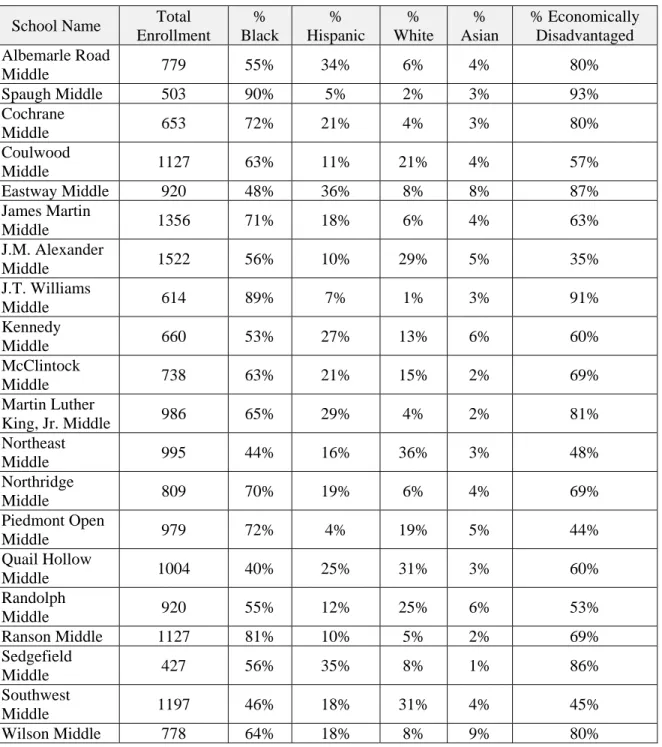
include in the study, student demographic information was examined. Student
demographic data from all of CMS’s middle schools was collected from the Great
Schools website http://www.greatschools.net and entered into a table. In order to ensure
that the schools studied have a diverse student body, schools with 40% or more white
students were eliminated from the study. Out of the 31 middle schools, 20 schools were
Table 1: Demographic information for schools included in study
School Name Total Enrollment % Black % Hispanic % White % Asian % Economically Disadvantaged Albemarle Road
Middle 779 55% 34% 6% 4% 80%
Spaugh Middle 503 90% 5% 2% 3% 93%
Cochrane
Middle 653 72% 21% 4% 3% 80%
Coulwood
Middle 1127 63% 11% 21% 4% 57%
Eastway Middle 920 48% 36% 8% 8% 87%
James Martin
Middle 1356 71% 18% 6% 4% 63%
J.M. Alexander
Middle 1522 56% 10% 29% 5% 35%
J.T. Williams
Middle 614 89% 7% 1% 3% 91%
Kennedy
Middle 660 53% 27% 13% 6% 60%
McClintock
Middle 738 63% 21% 15% 2% 69%
Martin Luther
King, Jr. Middle 986 65% 29% 4% 2% 81%
Northeast
Middle 995 44% 16% 36% 3% 48%
Northridge
Middle 809 70% 19% 6% 4% 69%
Piedmont Open
Middle 979 72% 4% 19% 5% 44%
Quail Hollow
Middle 1004 40% 25% 31% 3% 60%
Randolph
Middle 920 55% 12% 25% 6% 53%
Ranson Middle 1127 81% 10% 5% 2% 69%
Sedgefield
Middle 427 56% 35% 8% 1% 86%
Southwest
Middle 1197 46% 18% 31% 4% 45%
Procedure: Identification of titles to be searched
Two pieces of existing literature were used to identify broad categories of
materials and specific titles that appeal to urban teenagers. In her book Serving Urban
Teens (2008), Paula Brehm-Heeger includes lists of recommended materials, as well as
specific titles that may appeal to teens living in an urban area. These lists were used in
conjunction with results from the Hughes-Hassell (in press) study to build different
search categories
Fictional titles
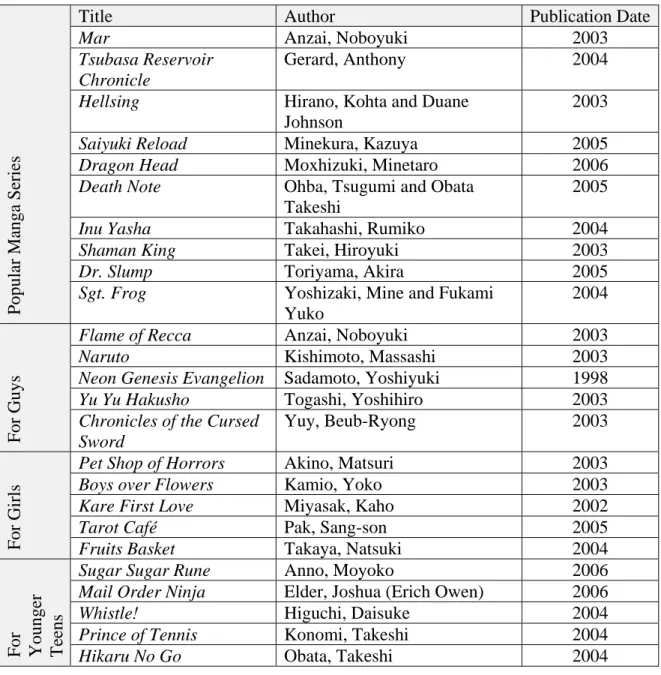
Three formats that appeal to urban teens are manga, graphic novels, and comic
books. Brehm-Heeger (2008) provides an extensive list of recommended manga titles
(see Table 2), and these were specifically searched for within each online catalog using
the “Title Keyword” search function. The presence of each title and the number of copies
Table 2: Manga series information
Popular Manga Series
Title Author Publication Date
Mar Anzai, Noboyuki 2003
Tsubasa Reservoir Chronicle
Gerard, Anthony 2004
Hellsing Hirano, Kohta and Duane Johnson
2003
Saiyuki Reload Minekura, Kazuya 2005 Dragon Head Moxhizuki, Minetaro 2006 Death Note Ohba, Tsugumi and Obata
Takeshi
2005
Inu Yasha Takahashi, Rumiko 2004
Shaman King Takei, Hiroyuki 2003
Dr. Slump Toriyama, Akira 2005
Sgt. Frog Yoshizaki, Mine and Fukami Yuko
2004
For Guys
Flame of Recca Anzai, Noboyuki 2003
Naruto Kishimoto, Massashi 2003
Neon Genesis Evangelion Sadamoto, Yoshiyuki 1998 Yu Yu Hakusho Togashi, Yoshihiro 2003 Chronicles of the Cursed
Sword
Yuy, Beub-Ryong 2003
For Girls
Pet Shop of Horrors Akino, Matsuri 2003
Boys over Flowers Kamio, Yoko 2003
Kare First Love Miyasak, Kaho 2002
Tarot Café Pak, Sang-son 2005
Fruits Basket Takaya, Natsuki 2004
For Younger Teens
Sugar Sugar Rune Anno, Moyoko 2006
Mail Order Ninja Elder, Joshua (Erich Owen) 2006
Whistle! Higuchi, Daisuke 2004
Prince of Tennis Konomi, Takeshi 2004
Hikaru No Go Obata, Takeshi 2004
Although specific titles of graphic novel and comic books were not included in
Brehm-Heeger’s book, each media center’s online catalog was canvassed for titles that fit
into this category. This was done by searching by the Dewey call number 741.5. Each
unique title was counted and copied into a Microsoft Word document. The resulting list
books under this call number. The subjects of the other books in this Dewey range
included how-to-draw, cartooning career information, comic collection information,
comic and manga character encyclopedias, author biographies, and general information
about manga, graphic novels, and comic books.
Another aspect of each collection that was examined was the fiction collection’s
ability to appeal to African American and Hispanic students as represented by young
adult novels featuring characters of color. Again, specific titles were searched for based
on Brehm-Heeger’s (2008) recommendations. Like the manga, graphic novel, and comic
book section, individual titles were searched for in the online catalog using the “Title
Keyword” search function. The presence of each title and the number of copies available
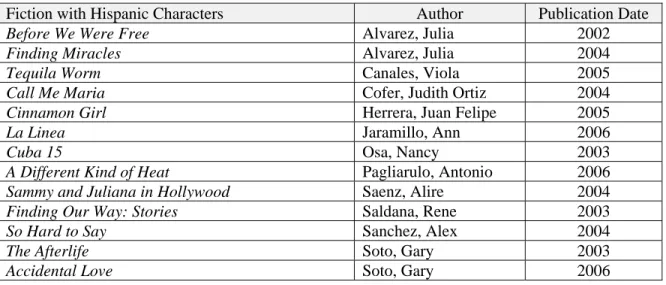
at each library was noted in an Excel document. Tables 3 and 4 include the specific
titles.
Table 3: Titles with Hispanic characters
Fiction with Hispanic Characters Author Publication Date
Before We Were Free Alvarez, Julia 2002
Finding Miracles Alvarez, Julia 2004
Tequila Worm Canales, Viola 2005
Call Me Maria Cofer, Judith Ortiz 2004
Cinnamon Girl Herrera, Juan Felipe 2005
La Linea Jaramillo, Ann 2006
Cuba 15 Osa, Nancy 2003
A Different Kind of Heat Pagliarulo, Antonio 2006
Sammy and Juliana in Hollywood Saenz, Alire 2004
Finding Our Way: Stories Saldana, Rene 2003
So Hard to Say Sanchez, Alex 2004
The Afterlife Soto, Gary 2003
Table 4: Titles with African American characters
Fiction with African American Characters Author Publication Date
Jimi and Me Adoff, Jamie 2005
The Making of Dr. Truelove Barnes, Derrick 2007
Whale Talk Crutcher, Chris 2001
Jason and Kyra Davidson, Dana 2004
Played Davidson, Dana 2005
Romiette and Julio Draper, Sharon 1999
Darkness before Dawn Draper, Sharon 2001
Begging for Change Flake, Sharon 2003
Who Am I Without Him?: Short Stories about Girls
and the Boys in their Lives Flake, Sharon 2004
Bang Flake, Sharon 2005
Keesha’s House Frost, Helen 2003
Bronx Masquerade Grimes, Nikki 2002
First Part Last Johnson, Angela 2003
Spellbound McDonald, Janet 2001
Street Love Myers, Walter Dean 2007
Harlem Hustle McDonald, Janet 2006
Hoopster Sitomer, Alan Lawrence 2005
Hip Hop High School Sitomer, Alan Lawrence 2006
Simply Divine Thomas, Jacquelin 2006
Rooftop Volponi, Paul 2006
Broken China Williams, Lori Aurelia 2005
True Believer Wolff, Virginia Euwer 2001
Emako Blue Woods, Brenda 2004
Hush Woodson, Jacqueline 2002
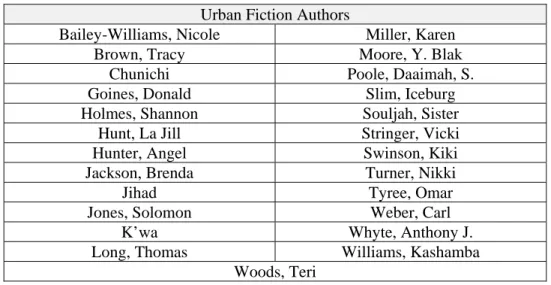
The last category of fiction searched for was street lit. Brehm-Heeger (2008)
provides a list of “Twenty-Five Urban Fiction Authors You Should Know” (p. 137).
Table 5: Street lit authors
Urban Fiction Authors
Bailey-Williams, Nicole Miller, Karen
Brown, Tracy Moore, Y. Blak
Chunichi Poole, Daaimah, S.
Goines, Donald Slim, Iceburg
Holmes, Shannon Souljah, Sister Hunt, La Jill Stringer, Vicki
Hunter, Angel Swinson, Kiki
Jackson, Brenda Turner, Nikki
Jihad Tyree, Omar
Jones, Solomon Weber, Carl
K’wa Whyte, Anthony J.
Long, Thomas Williams, Kashamba Woods, Teri
Specific street lit titles and series were obtained from Brehm-Heeger (2008). The online
catalogs were searched using the “Title Keyword” search function, and as before, the
individual titles and number of copies were recorded in an Excel spreadsheet (see Tables
Table 6: Street lit series titles
Street Lit Series Titles within Series Author Year Published
Bluford High Series
Lost and Found Anne Schraff 2002
A Matter of Trust Anne Schraff 2002
Secrets in the Shadows Anne Schraff 2002
Someone to Love Me Anne Schraff 2002
The Bully Paul Langan 2002
The Gun Paul Langan 2002
Until We Meet Again Anne Schraff 2002
Blood is Thicker Paul Langan & D.M Blackwell 2004 Brothers in Arms Paul Langan & Ben Alirez 2004
Summer of Secrets Paul Langan 2004
The Fallen Paul Langan 2007
Shattered Paul Langan 2007
Search for Safety John Langan 2007
No Way Out Peggy Kern 2009
Schooled Paul Langan 2009
Drama High Series
The Fight L. Divine 2006
Second Chance L. Divine 2006
Jayd’s Legacy L. Divine 2007
Fremenies L. Divine 2007
Lady J L. Divine 2008
Courtin’ Jayd L. Divine 2008
Hustlin’ L. Divine 2009
Platinum Teen series
Dymond in the Rough Precious & KaShamba Williams 2005 The Ab-solute Truth Juwell & Precious 2005
Runaway Precious 2006
Table 7: Street Lit Individual Titles
Street Lit Individual Titles Author Year Published
Imani in Never Say Goodbye Jackie Hardrick 2004
Ride Wit’ Me Katina King 2006
Teenage Bluez: A Collection of Urban Stories K. Cain et al. 2005
Teenage Bluez II Marketa Salley, et
al. 2006
Brother Hood Janet McDonald 2004
Indigo Summer Monica McKayhan 2007
Nonfiction materials
To collect data about each library’s nonfiction collection, specific criteria and
search terms were developed and applied. First, based on the findings of several studies
of urban teen reading preferences (Hughes-Hassell in press; Hughes-Hassell & Rodge
2007), the general categories of music, sports, fashion and actor/actresses were selected.
In order to determine the appeal of the titles in these categories to urban teens, selection
criteria were established for each category. The selection criteria and search terms used
are listed in Table 8. All searches were conducted using the “General Keyword” search
function. The search was limited to books within the biography and nonfiction sections
of the collection. Books of poetry and short stories were not included, nor were reference
materials that could not be checked out of the media center. Once material was deemed
relevant, unique titles were counted and recorded in an Excel spreadsheet under the
appropriate category. In addition, the entire list of titles was recorded in a Word
Table 8: Nonfiction Inclusion Criteria
Music
Criteria NOT Search Terms
- Publication dates from 1999-2009 - About current popular musicians - About a specific, popular genre - About how to start a band - About careers in the industry
- History of music in general - How-to-play instruments
- Historically significant musicians
- music* - rap - hip hop - rock - singers Sports
Criteria NOT Search Terms
- Publication dates from 1999-2009 - About current popular athletes - About a specific team and/or sport - About careers in the industry
- History of a sport - How-to-play sports
- Historically significant athletes - Car types
- Fundamentals of a sport (equipment, playing tips, etc.)
- sport* - wrestling - football - basketball - soccer - baseball Fashion
Criteria NOT Search Terms
- Publication dates from 1999-2009 - About current fashion icons - About careers in the industry
- History of fashion/fashion during a specific period - Crafting - fashion - clothes - clothing Actors/Actresses
Criteria NOT Search Terms
- Publication dates from 1999-2009 - About current popular actors, actresses, and others related to movies and television
- History of acting/movies/television - Historically significant
actors/actresses - Scripts
- Actors - Actresses - Movies
Magazine titles were also collected and compiled into a master list by school.
Only 10 of the 20 schools studied had magazine collection information available. In
order to determine the intended audience and subject matter of each title, the magazine’s
website was examined. Criteria were determined during website analysis. First, the
magazine’s intended audience was established: children (0-11), teens (12-20), or both; for
girls or for boys; geared toward African Americans; and geared towards Hispanics.
Magazines could fall into more than one of these categories. Next, subject-areas were
determined: sport-focused, activity-focused, celebrity-focused, music-focused,
development, other, and if the magazine is actually a comic book. Data was compiled
into an Excel spreadsheet.
Finally, internet materials were analyzed by examining the media center’s website
on the school webpage. If a media center webpage was not present on the school
webpage, this section was not assessed. The materials looked for included: links to
e-books, links to the online catalog, reading encouragement materials/event information
(for example, recommended book lists, Battle of the Books information) and, links to
other online resources. If a factor was present on the webpage, this was recorded in an
Excel spreadsheet. Additional notes were recorded as necessary to provide a more
detailed record. In addition, if the website had material that did not fit into the
predetermined category, this information was recorded in a section on the spreadsheet
marked “Other”.
Results and Discussion
In this study, a total of 20 online middle school media center catalogs from
Charlotte-Mecklenburg Schools were searched for materials that have been found to
appeal to urban adolescents. Specifically the materials included manga, comic books and
graphic novels, fiction that features African American and Hispanic characters, street lit
titles and urban fiction authors, and nonfiction materials. In addition, the libraries’
magazine collections and the media center webpages were examined. The results show
that while the library collections contain some materials that are of interest to urban
Manga, comic books, and graphic novels
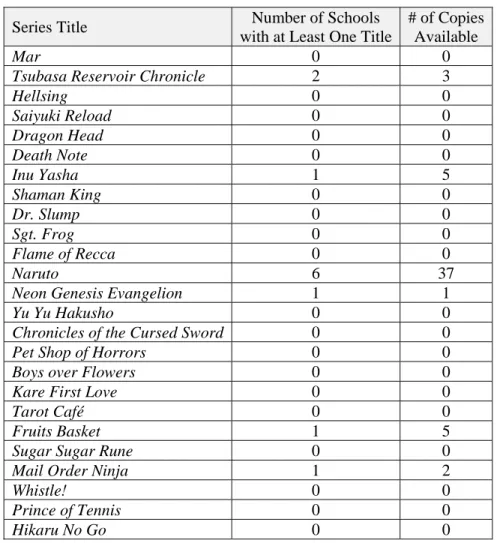
Only 7 of the 20 schools studied had any of the 25 specific manga titles
recommended by Brehm-Heeger (2008) (see Table 10). Albemarle Road had the highest
number of individual titles with four in their collection (Tsubasa Reservoir Chronicle,
Naruto, Fruits Basket, and Mail Order Ninja). Northeast and James Martin had two titles
in their collections, while Eastway, J.M. Alexander, McClintock and Ranson each had
one title. Naruto was present in six of the seven collections. Naruto follows the story of
a young boy who leaves his village to train as a ninja, and the problems he encounters
when he returns (Naruto Shippuden n.d.). However, most of the schools with Naruto in
the collection only had one or two titles of the entire series. Albemarle Road had 19 titles
Table 10: Manga series results
Series Title Number of Schools with at Least One Title
# of Copies Available
Mar 0 0
Tsubasa Reservoir Chronicle 2 3
Hellsing 0 0
Saiyuki Reload 0 0
Dragon Head 0 0
Death Note 0 0
Inu Yasha 1 5
Shaman King 0 0
Dr. Slump 0 0
Sgt. Frog 0 0
Flame of Recca 0 0
Naruto 6 37
Neon Genesis Evangelion 1 1
Yu Yu Hakusho 0 0
Chronicles of the Cursed Sword 0 0
Pet Shop of Horrors 0 0
Boys over Flowers 0 0
Kare First Love 0 0
Tarot Café 0 0
Fruits Basket 1 5
Sugar Sugar Rune 0 0
Mail Order Ninja 1 2
Whistle! 0 0
Prince of Tennis 0 0
Hikaru No Go 0 0
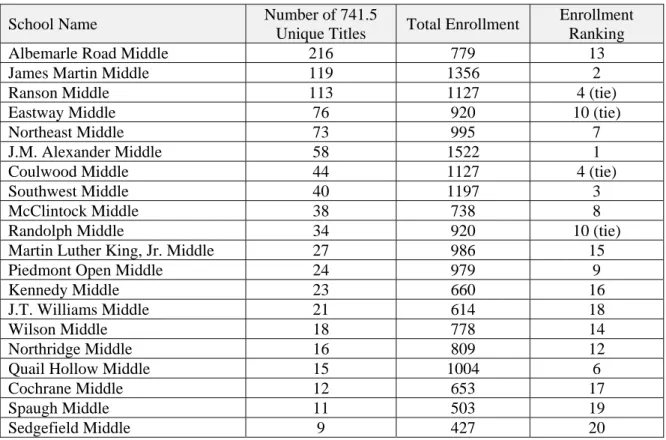
When looking at the total number of books in the 741.5 collection as a whole, the
number of books in each collection varies greatly from library to library. Table 11 shows
both the number of books in each library’s 741.5 collection and each school’s total
Table 11
School Name Number of 741.5
Unique Titles Total Enrollment
Enrollment Ranking
Albemarle Road Middle 216 779 13
James Martin Middle 119 1356 2
Ranson Middle 113 1127 4 (tie)
Eastway Middle 76 920 10 (tie)
Northeast Middle 73 995 7
J.M. Alexander Middle 58 1522 1
Coulwood Middle 44 1127 4 (tie)
Southwest Middle 40 1197 3
McClintock Middle 38 738 8
Randolph Middle 34 920 10 (tie)
Martin Luther King, Jr. Middle 27 986 15
Piedmont Open Middle 24 979 9
Kennedy Middle 23 660 16
J.T. Williams Middle 21 614 18
Wilson Middle 18 778 14
Northridge Middle 16 809 12
Quail Hollow Middle 15 1004 6
Cochrane Middle 12 653 17
Spaugh Middle 11 503 19
Sedgefield Middle 9 427 20
It is also important to look at the types of books included in this section of the
collection. As noted earlier, the 741.5 call number includes not only manga, comic books,
and graphic novels, but other genres including joke books, how-to-do books, and so on.
Figure 1: 741.5 Collection by Manga, Comic Books and Graphic Novels and “Other” Books 206 2 43 72 96 53 18 12 22 19 71 11 18 14 33 101 6 33 7 13 10 10 1 4 23 5 3 11 5 19 2 5 6 1 1 12 3 7 4 5
0 50 100 150 200 250
Albemarle Road Middle Cochrane Middle Coulwood Middle Eastway Middle James Martin Middle J.M. Alexander J.T. Williams Middle Kennedy Middle Martin Luther King, Jr. Middle McClintock Middle Northeast Middle Northridge Middle Piedmont Open Middle Quail Hollow Middle Randolph Middle Ranson Middle Sedgefield Middle Southwest Middle Spaugh Middle Wilson Middle
Number of Books
School Name
Manga, Comic Books, and Graphic Novels Total
Other 741.5 Books Total
It appears that these three genres (manga, graphic novels, and comic books) are well
represented in several of the library collections. In 12 of the 20 schools, manga, graphic
novels, and comic books represent more than 80% of the titles in the 741.5 section of the
collection. However, at Cochrane only 16.67% titles in the 741.5 section were manga,
comic books, or graphic novels. While this was the only school with a clear majority of
“other” books, there were still 8 schools total with 25% or more “other” books. In large
collections these percentages would probably not make a difference in judging the
consist of books that don’t entirely fit the genre can detract from the purpose of this
section.
Fiction with African American characters
The number of books featuring African American characters in each collection
varied. Of the 24 books recommended by Brehm-Heeger (2008), and searched for in the
catalog, each school had at least 3 of the titles; 3 of the schools had 14 of the titles. One
important aspect to consider when looking at the results is the percentage of African
American students at each school. Table 12 shows the demographics of African
American students paired with the percentage of titles searched for that are available in
the catalog, ordered by the percentage of African American students. Figure 2shows this
data in graph form. Spaugh and Ranson middle schools are 90% and 81% African
American respectively (452.7 and 912.9 students), yet only have 14 of the 24 titles
searched for (58.33%). Although the number of books found at these two schools are
among the highest of the schools canvassed, schools with much lower percentages of
African American students had the same number of books. Albemarle Road’s student
population is 55% African American (428.5 students), yet they too have 14 of the 24
books. Other schools with large numbers of African American students, such as
Sedgefield, Quail Hollow, Cochrane, Northridge, and Kennedy, had fewer than six titles.
Given the fact that African American students represent the majority of the student body
at each school, even the schools with the highest numbers have a surprisingly low
Table 12 School Name # of Unique Titles # of Copies Available
% of Titles (out of 24)
% Black Students Total Enrollment Total # Black Students
Spaugh Middle 14 33 58.33% 90% 503 452.7
J.T. Williams
Middle 10 23 41.67% 89% 614 546.5
Ranson Middle 14 34 58.33% 81% 1127 912.9
Piedmont Open
Middle 8 20 33.33% 72% 979 704.9
Cochrane Middle 4 11 16.67% 72% 653 470.2
James Martin
Middle 9 13 37.50% 71% 1356 962.8
Northridge Middle 4 14 16.67% 70% 809 566.3
Martin Luther
King, Jr. Middle 13 20 54.17% 65% 986 640.9
Wilson Middle 10 21 41.67% 64% 778 497.9
McClintock
Middle 8 32 33.33% 63% 738 464.9
Coulwood Middle 6 16 25.00% 63% 1127 710.0
J.M. Alexander
Middle 7 36 29.17% 56% 1522 852.3
Sedgefield Middle 5 15 20.83% 56% 427 239.1
Albemarle Road
Middle 14 44 58.33% 55% 779 428.5
Randolph Middle 8 19 33.33% 55% 920 506.0
Kennedy Middle 3 17 12.50% 53% 660 349.8
Eastway Middle 8 23 33.33% 48% 920 441.6
Southwest Middle 7 16 29.17% 46% 1197 550.6
Northeast Middle 8 35 33.33% 44% 995 437.8
Quail Hollow
Figure 2: Percentage of Books in the Collection and Percentage of Black Students 58.33% 41.67% 58.33% 33.33% 16.67% 37.50% 16.67% 54.17% 41.67% 33.33% 25.00%29.17% 20.83% 58.33% 33.33% 12.50% 33.33% 29.17%33.33% 20.83% 90%89% 81% 72%72%71%70% 65%64%63%63% 56%56%55%55%53% 48%46%44% 40% 0% 10% 20% 30% 40% 50% 60% 70% 80% 90% 100% Percent School Name
Percentage of Books In Collection (out of 24) Percentage of Black Students
The titles most often found in the collections included Romiette and Julio and
Darkness Before Dawn by Sharon Draper, Begging for Change and Who Am I Without
Him?: Short Stories about Girls and the Boys in their Lives by Sharon Flake, Bronx
Masquerade by Nikki Grimes, Spellbound by Angela Johnson, and Hush by Jacqueline
Woodson. All of books were written by acclaimed African American writers and
published in the last 10 years (1998-2008). Romiette and Julio and Bronx Masquerade
have been or are currently on the North Carolina School Library Media Association’s
(NCSLMA) Battle of the Books list (North Carolina School Library Media Association
Of the titles available to students, it is also important to consider the number of
copies each school has available. Every school except for James Martin had at least
twice the number of unique titles available via multiple copies. However, there was no
correlation between number of unique titles available and the total number of copies
available. At most, Albemarle Road has an additional 30 copies of the 14 books searched
for available in the media center. From all of the schools, majority of the duplicate
copies were of Romiette and Julio and Bronx Masquerade which were on the Battle of
the Books list.
Fiction with Hispanic characters
The percentage of Hispanic students in each of the schools ranged from 36% at
Eastway to 4% at Piedmont Open. Table 13 shows the demographics of the schools and
the data from the books searched. Figure 3 compare the percentage of Hispanic students
Table 13
School Name
# of Unique
Titles
# of Copies Available
% Unique Titles (out of 13)
% Hispanic Students Total Enrollment Total # Hispanic Students Eastway
Middle 5 8 38.46% 36% 920 331.2
Sedgefield
Middle 4 10 30.77% 35% 427 149.45
Albemarle
Road Middle 7 13 53.85% 34% 779 264.86
Martin Luther King, Jr. Middle
9 11 69.23% 29% 986 285.94
Kennedy
Middle 4 6 30.77% 27% 660 178.2
Quail Hollow
Middle 4 10 30.77% 25% 1004 251
Cochrane
Middle 4 13 30.77% 21% 653 137.13
McClintock
Middle 3 11 23.08% 21% 738 154.98
Northridge
Middle 5 9 38.46% 19% 809 153.71
James Martin
Middle 5 5 38.46% 18% 1356 244.08
Southwest
Middle 4 8 30.77% 18% 1197 215.46
Wilson Middle 5 11 38.46% 18% 778 140.04
Northeast
Middle 4 7 30.77% 16% 995 159.2
Randolph
Middle 6 9 46.15% 12% 920 110.4
Coulwood
Middle 4 7 30.77% 11% 1127 123.97
J.M. Alexander
Middle 7 9 53.85% 10% 1522 152.2
Ranson Middle 5 12 38.46% 10% 1127 112.7
J.T. Williams
Middle 4 12 30.77% 7% 614 42.98
Spaugh Middle 4 8 30.77% 5% 503 25.15
Piedmont Open
Figure 3: Percentage of Books in the Collection and Percentage of Hispanic Students
38.46% 30.77%
53.85% 69.23%
30.77%
30.77%30.77%
23.08%
38.46%38.46%
30.77% 38.46%
30.77% 46.15%
30.77% 53.85%
38.46%
30.77%30.77%
38.46%
36%35%34%29%27%25%21%21%19%18%18%18%16%12%11%10%10% 7% 5% 4% 0.00%
10.00% 20.00% 30.00% 40.00% 50.00% 60.00% 70.00% 80.00%
Percent
School Name
Percentage of Books in Collection (out of 13) Percentage of Hispanic Students
Martin Luther King, Jr. had the most titles searched for at nine. Both Albemarle
Road and J.M. Alexander had 7 of the 13 books searched for, and all other schools had
fewer than 6. While Albemarle Road and J.M. Alexander had the same number of titles,
they have vastly different numbers of Hispanic students. Albemarle Road has 34%
Hispanic students and J.M. Alexander has 10%. The schools with the highest and lowest
Hispanic student populations, Eastway and Piedmont Open, each had 5 of the 13 titles.
The majority of the books searched for were found in at least one of the school
catalogs; only Cinnamon Girl by Juan Felipe Herrera and A Different Kind of Heat by
collections, and The Tequila Worm by Viola Canales and Cuba 15 by Nancy Osa were
found in all 20 collections. Cuba 15 is on the 2008-2009 NCSLMA Battle of the Books
list, and has been on the list in years past (North Carolina School Library Media
Association 2009). Like the titles with African American characters, each of the books
searched for was published recently (2002-2006) and were written by Hispanic authors.
With the exception of the four titles mentioned above, only a few of the schools had the
other recommended titles. Martin Luther King, Jr. was the only school with Finding
Miracles and was one of two with Sammy and Juliana in Hollywood by Alire Saenz,
Finding Our Way: Stories by Alex Saldana, and So Hard to Say by Rene Sanchez. While
the percentage of books featuring Hispanic characters is low across all schools, the
collections that serve a lower percentage of Hispanic students have considerable
collections, relatively speaking. The schools with higher percentages of Hispanic
students should have more resources available to allow these students to see themselves
in the literature.
Again, it is important to consider the number of copies available to students.
There was no real correlation between number of unique titles found and number of
multiple copies, but ten of the schools with only 3-5 unique titles had twice the number of
duplicate copies. Only James Martin did not have any duplicate copies. From all of the
schools, majority of the duplicate copies were of Cuba 15, which is on the Battle of the
Street Lit
Of the 25 authors searched, only one school had any of the authors in their
collection. Martin Luther King, Jr. had Sister Souljah’s The Coldest Winter Ever.
The series titles searched for yielded varying results (see Table 14). None of the
schools had the Platinum Teen series in their collection, and only Albemarle Road had
the Drama High series. Of this series, Albemarle Road had four of the seven titles in the
series, with the exception of the second book Second Chance and the most recent titles
Courtin’ Jayd and Hustlin’.
Table 14: Bluford High series results
School Name # of Unique Titles % of Titles (out of 15)
Number of Copies Available
Albemarle Road Middle 13 86.67% 45
Cochrane Middle 8 53.33% 14
Coulwood Middle 13 86.67% 133
Eastway Middle 9 60.00% 43
James Martin Middle 5 33.33% 9
J.M. Alexander 0 0.00% 0
J.T. Williams Middle 12 80.00% 32
Kennedy Middle 5 33.33% 20
Martin Luther King, Jr. Middle 0 0.00% 0
McClintock Middle 14 93.33% 73
Northeast Middle 12 80.00% 56
Northridge Middle 0 0.00% 0
Piedmont Open Middle 8 53.33% 11
Quail Hollow Middle 1 6.67% 1
Randolph Middle 7 46.67% 10
Ranson Middle 13 86.67% 53
Sedgefield Middle 10 66.67% 10
Southwest Middle 11 73.33% 26
Spaugh Middle 15 100.00% 57
Wilson Middle 11 73.33% 15
books in the series. Albemarle Road, Coulwood, and Ranson each have the entire series
with the exception of the last two books, No Way Out and Schooled, both published in
2009. McClintock had all of the books with the exception of No Way Out. Only Spaugh
had the complete collection. Of the remaining schools, there was some consistency with
the books in the series that were and were not collected.
Of the individual street lit titles searched for, only eight of the 20 schools had any
of the seven titles in their collections. Albemarle Road and Spaugh had two titles each,
and J.T. Williams, Martin Luther King, Jr., Peidmont Open, Randolph, and Wilson each
had one title. Of the seven titles searched for, the schools had the same three titles in
their collections. Imani in Never Say Goodbye by Jackie Hardrick was present in two
collections, Brother Hood by Janet McDonald was present in five collections, and Tyrell
Table 15: Individual Street Lit Titles
School Name # of Unique Titles
Found
% of Titles (out of 7)
# of Copies Available
Albemarle Road Middle 2 28.57% 3
Cochrane Middle 0 0.00% 0
Coulwood Middle 0 0.00% 0
Eastway Middle 0 0.00% 0
James Martin Middle 0 0.00% 0
J.M. Alexander 0 0.00% 0
J.T. Williams Middle 1 14.29% 1
Kennedy Middle 0 0.00% 0
Martin Luther King, Jr. Middle 1 14.29% 1
McClintock Middle 0 0.00% 0
Northeast Middle 1 14.29% 1
Northridge Middle 1 14.29% 1
Piedmont Open Middle 0 0.00% 0
Quail Hollow Middle 0 0.00% 0
Randolph Middle 1 14.29% 1
Ranson Middle 0 0.00% 0
Sedgefield Middle 0 0.00% 0
Southwest Middle 0 0.00% 0
Spaugh Middle 2 28.57% 2
Wilson Middle 1 14.29% 1
Based on these findings, it seems that street literature is lacking a presence in these
collections. While many of the schools have taken the initiative to collect the Bluford
High series, some have not even collected this series. One of the benefits of this series in
particular is that the content is somewhat mature, the text is written at a 6-8th grade reading level (Townsend Press 2009). This makes the series ideal for a middle school
reluctant reader who may be struggling with less engaging, more difficult reading
materials. One reason these books may not be present in these middle school collections
is the general opinion that street lit is too violent and graphic for a young audience.
Among schools that collected any part of the Bluford High series, nine did not have The
Gun and/or Search for Safety, and six did not have The Fallen and/or Shattered. One
not necessarily more perverse than the other titles in the series, this may be one reason for
the trend of not having these titles. It is also important to note that three of these four
books are sequels to another in the series. Not having the titles that continue the story of
earlier books may not be providing readers the materials they want. Both Coulwood and
McClintock have class sets of most of the books in the series, including the four titles not
included in many of the collections. This may be a good solution to include all books in
the series in the collection, as providing the resources for whole-class discussion may
allows students to read the books in a supervised setting. At the same time, if students
want to read these books on their own time, having only a class set will not meet that
need.
While the provocative nature of street lit may be apparent a quick glance, there is
much more meaning in the books when these acts are contextualized within the plot as a
whole. For example, many of these books allow readers to make their own judgments
about the decisions characters make and teach meaningful lessons through the story
(Morris et al. 2006; Wright 2006). Given that the schools studied are located in an urban
area and most of the schools have a majority of economically disadvantaged students,
these books should appeal to these readers.
Nonfiction
The number of relevant nonfiction titles varies from school to school. In general,
there is not a correlation between the number of relevant titles and total student
enrollment. While J.M. Alexander has the highest student population, they have only the
McClintock, who have student populations of 614 and 738, respectively. Table 16 shows
the number of relevant titles for each category as well as the range, and the total student
enrollment of each school.
Table 16: Nonfiction Results
School Name Music Sports Fashion Actors Total Total Enrollment
J.M. Alexander 27 114 6 28 175 1522
James Martin Middle 50 238 13 35 336 1356
Southwest Middle 25 121 6 28 180 1197
Coulwood Middle 14 144 12 30 200 1127
Ranson Middle 62 74 4 22 162 1127
Quail Hollow Middle 31 169 3 29 232 1004
Northeast Middle 13 40 4 6 63 995
Martin Luther King, Jr. Middle 28 186 13 29 256 986
Piedmont Open Middle 34 55 4 38 131 979
Eastway Middle 49 139 11 12 211 920
Randolph Middle 18 52 4 4 78 920
Northridge Middle 32 42 4 26 104 809
Albemarle Road Middle 48 137 9 9 203 779
Wilson Middle 20 87 9 6 122 778
McClintock Middle 19 157 4 19 199 738
Kennedy Middle 26 68 3 11 108 660
Cochrane Middle 26 81 9 13 129 653
J.T. Williams Middle 25 137 11 15 188 614
Spaugh Middle 16 80 11 8 115 503
Sedgefield Middle 16 84 12 5 117 427
Range 13-62 40-238 3-13 4-38 63-336
Music titles that were found often featured modern singers and rap artists, and
often gave an overview of a specific music genre such as hip hop, reggae, or rock music.
Many schools had series on rap artists that were published in the past few years,
highlighting popular musicians. Ranson, for example, has a series on rap artists
and Ludacris. Almost all of the schools had a series on how to start a band, including
titles such as Booking a First Gig and Forming a Band.
Sports titles were the most abundant in all of the collections; every school
searched had more sports books than the other categories. There was a surprising number
of extreme sports related books in all of the collections. For 10 of the schools searched,
extreme sports made up approximately 25-50% of their relevant sports books. The
majority of the books about extreme sports belonged to a series and included topics such
as skateboarding, BMX, and snowboarding. Also included in the series were less popular
sports such as kiteboarding, barefoot waterskiing, and ice climbing. Also commonly
found in sports collections were series following the history of a specific team or league
(the American League West in the NFL, for example).
Fashion books were not abundant in any of the collections. Most of the schools
had books exploring the fashion industry as a potential career and a few had biographies
of famous designers such as Vera Wang or Russell Simmons. A few schools had a series
from Capstone Press that looks at different areas of the fashion industry. Titles from this
series include Fashion Design School: Learning the Skills to Succeed and Fashion
Modeling: Being Beautiful, Selling Clothes.
Titles featuring actors were often outdated and were often not about actors that
would be of interest to urban teens. For example, Coulwood had a biography on Elijah
Wood published in 2004. While this book fits the criteria established and may be of
interest to some teens (especially those following the Lord of the Rings movie trilogy),
multiple titles on the same artist. Northridge, for example, had multiple biographies on
Cameron Diaz, Jennifer Lopez, and Oprah Winfrey.
Magazines
Even though only 10 of the 20 schools had magazine collection information
available, there was still a wide range of the magazines offered in the middle school
media centers. On average, each school subscribed to 21 magazines. From the 10
schools with information available, there were 98 separate titles the schools subscribed
to. Of these 98 titles, 6 were for children (ex: Your Big Backyard, Click, Cobblestone),
15 were specifically for teens (ex: American Cheerleader, Current Health, Intune,
Seventeen), and 14 were for both children and teens (ex: Sports Illustrated for Kids, Right
On, Girl’s Life, Boy’s Life). Table 17 shows the magazines that four or more libraries
subscribed to. Of these 19 titles, only 3 are explicitly for teens; 5 would appeal to both