IC, 2016 – 12(4): 1040-1087 – Online ISSN: 1697-9818 – Print ISSN: 2014-3214 http://dx.doi.org/10.3926/ic.838
Deconstructing AMO framework: A systematic review
Juan A. Marin-Garcia 1, Juan Martinez Tomas 2
1ROGLE. Universitat Politècnica de València (Spain) 2Universitat Politècnica de València (Spain)
[email protected], [email protected]
Received July, 2016 Accepted August, 2016
Abstract
Purpose: The AMO framework has been widely accepted in HRM literature for explaining the linkage between human resources practices and performance. However, it remains unclear whether this model has been fully demonstrated or not. Hence, we propose a systematic review that aims at identifying those investigations that have thoroughly tested the model, as well as the approaches used by them.
Design/methodology: Systematic literature review, filtering scientific papers published in journals indexed in Scopus, Web of Science or Google Scholar, from the year 1993 to 2016, in the field of Social Sciences and Humanities with research that indirectly apply the AMO model in their analysis.
also individual beliefs, personal affinities, or personal circumstances (among others) might affect the implementation of these practices and the subsequent outcomes. For this reason, we consider that developing an HRM model that perfectly fit any situation is a very complicated, if not impossible, task.
Research limitations/implications: The results show a significant variability in both research approaches and variables taken into consideration. In addition, it seems that little research has been conducted to verify the AMO model directly. Therefore, we consider that there is a great need to study the model from a more systematic perspective. A thorough understanding of the model could lead to a better understanding of the problems that organizations face when implementing human resource practices.
Originality/value: Our study shed light on some aspects of the AMO framework within the HRM context. Specifically, we aimed to identify whether or not it is possible to confirm the model as it was originally proposed. We also find out which HR practices and measures of performance were considered across investigations, to define a standard approach.
Keywords: Systematic literature review, Human resources management, High-performance work practices, High-performance work systems, AMO framework, Ability-motivation-opportunity model, Organizational performance
Jel Codes: O15, M50
1. Introduction
social psychologists, who believe that motivation is essential to ensure performance (Maclnnis & Jaworski, 1989). Later, Vroom (1964) adopted an interactive relationship considering both ability and motivation, and explaining performance by the function P = f(A x M) (Blumberg & Pringle, 1982). As can be seen, this function considered that only personal dimensions affect performance, and was not capable of explaining the external environment effect. With the aim of solving this issue, Blumberg and Pringle (1982) developed a new model, broadening the concepts of motivation and ability, and introducing a new one: opportunity, which they considered the missing dimension. As a result, performance was a function of capacity to perform (including different variables such as age, knowledge, level of education and energy level), willingness to perform (including variables such as motivation, job satisfaction, personality, values, and expectations), and opportunity to perform (that included variables such as working conditions, tools, materials, leader behavior, procedures and time) (Blumberg & Pringle, 1982). These authors pointed out that all three elements (opportunity, capacity, and willingness) must be present for performance to occur, assuming an interactive model (P = f(O x C x W)). Also, low levels of any of the dimensions would considerably decrease levels of performance (Blumberg & Pringle, 1982).
The AMO framework was initially proposed by Bailey (1993), who suggested that ensuring the employee's discretionary effort needed three components: employees had to have the necessary skills, they needed appropriate motivation and employers had to offer them the opportunity to participate (Appelbaum et al., 2000). Based on this model, and drawing on the concept of high performance work systems (HPWS), the model was later developed by Appelbaum, Bailey, Berg and Kalleberg (Appelbaum et al., 2000), and its acronym stands for the three elements that enhance together employee performance: individual ability (A), motivation (M), and the opportunity to participate (O) (Bayo-Moriones & Galdon-Sanchez, 2010; Boselie, 2010; Claudia, 2015; Knies & Leisink, 2014; Kroon, Van De Voorde & Timmers, 2013; Munteanu, 2014). According to the model, people perform well when they have the capabilities, they have the adequate motivation, and their work environment provides opportunities to participate (Boselie, 2010; Boxall & Purcell, 2003; Choi, 2014; Marín-García, Miralles, Garcia-Sabater & Perello-Marin, 2011; Marín-García, 2013; Raidén, Dainty & Neale, 2006).
Ability-enhancing practices aim to improve those three components. Examples of these practices are employee recruitment techniques or formal training (Kroon et al., 2013; Raidén et al., 2006). Motivation deals with an employee desire to perform, which can be enhanced by extrinsic or intrinsic motivation. Examples of motivation-enhancing practices are incentives or career opportunities (Munteanu, 2014; Raidén et al., 2006). The AMO model introduces as well the opportunity dimension, on the basis of job design theories (Hackman & Oldham, 1980; Kroon et al., 2013), or empowerment literature (Gerhart, 2005; Kroon et al., 2013). Hence, opportunity takes into consideration not only individual characteristics but also the work environment. Practices contributing to the opportunity dimension are, for instance, quality circles or team working.
The model has evolved and improved over successive studies. As a matter of fact, some authors consider that AMO influence in performance is more complicated than expected, because it depends not only on the existence of a set of practices (HRM content) but also on the employee subjective perceptions of these practices (Boxall & MacKy, 2009; Ehrnrooth & Björkman, 2012; Lepak, Liao, Chung & Harden, 2006; Wright & Nishii, 2007). That is to say; we must distinguish between intended, actual and perceived HRM (Vermeeren, 2010). Moreover, some authors point out that the employee-based perspective adopted by the AMO model could be better explained from a managerial perspective (Bos-Nehles, Van Riemsdijk & Kees Looise, 2013). This view claims that well-designed HR bundles of practices do not guarantee an effective implementation, and focus on line manager's capacities to implement HR practices (A), their motivation to enable them (M), and the organizational support for undertaking the changes needed (O) (Bainbridge, 2015; Ozcelik & Uyargil, 2015). Besides, the variety of practices and measures of performance across investigations, make it difficult to state firm conclusions about which approach is decisive for performance. In fact, the selection of practices seem to be based more on intuition about their influence over performance, than on substantial empirical evidence (Wood, Burridge, Rudloff, Green & Nolte, 2015). As a result, it remains unclear which are the linking mechanisms between bundles of practices and organizational outcomes (Jiang, Lepak, Hu, Baer, Jia & Baer, 2012; Renwick, Redman & Maguire, 2013; Vermeeren, 2010). Finally, although many investigations mention the AMO model in their theoretical framework, not all of them test the model in their further analysis and, even doing it; it seems that many of them do not apply the model as it was first proposed.
that have thoroughly tested the model, as well as the approach used by them (e.g. multiplicative or summative). Furthermore, it also aims to clarify how different authors measure the effectiveness of the model, that is to say, which HR practices and measures of performance they use in their analysis. Finally, another objective of this research is to determine whether the AMO framework is useful or not in explaining the linkage between HRM and performance in different context.
We have divided the study as follows. The first section deals with the introduction. The second section outlines the conceptual framework, explaining the important concept, as well as identifying the interrelationships among them. The third section details the methodology carried out, which as the title states is a systematic literature review. The aim of this review is to ensure a structured and replicable work that will help us to both state the research questions and identify the current state-of-the-art in the field of study. In the fourth section, the results of the study are examined, with the aim of answering thoroughly to questions raised. Finally, the fifth section is devoted to state the conclusions and possible future research.
2. Conceptual framework
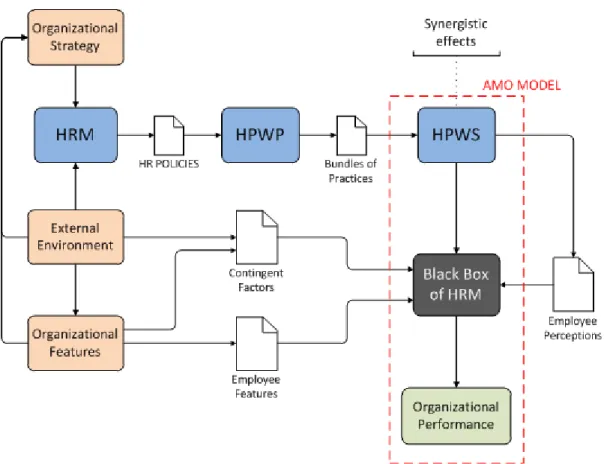
The following conceptual framework (Figure 1) aims to understand how the concepts involved in this study fit and work together. This framework takes into consideration several concepts explained below.
Human resource management (HRM) is defined as the design of employment systems that include a set of policies intended to maximize employee performance and commitment, in order to meet the organization goals (Alagaraja, 2012; Guest, 1997). Several factors shape HRM (see Figure 1), for instance, the external environment (e.g. economic conditions, competitors), the organizational strategy (e.g. low cost or focus differentiation strategy) and the organizational characteristics themselves (e.g. industry sector, organization size, management style). During the last decades, HRM research has explored the linkage between human resources practices and performance. As a result, several studies have documented a positive relationship between the use of HPWS and business performance (Appelbaum et al., 2000; Arthur, 1994; Block & Pickl, 2014; Demortier, Delobbe & El Akremi, 2014; Guthrie, Flood, Liu & MacCurtain, 2009; Huselid, 1995; Jiang, Lepak, Han, Hong, Kim & Winkler, 2012; Knies & Leisink, 2014; MacDuffie, 1995; Rabl, Jayasinghe, Gerhart & Kühlmann, 2014a).
Galdon-Sanchez, 2010; Marín-García & Conci, 2012)) apply to a broad set of human resource practices that aim to make organizations more participative and flexible, with the objective of being capable of competing in the current environment (Kalleberg, 2006). The HIW practices include three dimensions: skill requirements, jobs designed to use those skills, and an incentive structure to induce discretionary effort (Appelbaum et al., 2000). These practices are intended to increase business performance by enhancing employee ability, motivation and opportunity to contribute (Bayo-Moriones & Galdon-Sanchez, 2010; Rabl, Jayasinghe, Gerhart & Kühlmann, 2014). Moreover, implementing these practices leads to ensuring that all employees are in a position to contribute towards the goals of the organization (Ashton & Sung, 2002), cited in Robineau, Ohana&Swaton (2015).
Additionally, high-performance work systems (HPWS) (also known as "high commitment management" (Arthur, 1994; Choi, 2014) or "HR practice configurations" (Choi, 2014; Delery, 1998) are a combination of HPW practices, which are hypothesized to create synergistic effects (Bayo-Moriones & Galdon-Sanchez, 2010; Della Torre & Solari, 2013; Marín-García & Conci, 2012; Rabl et al., 2014). According to these synergies, performance obtained by using bundles of practices will be greater than the sum of individual effects achieved by applying separately each of them (An, 2009; Boxall, Purcell & Wright, 2009; Demortier et al., 2014; Drummond & Stone, 2007; Jiang, Lepak, Hu, et al., 2012; Minbaeva, 2013). As a matter of fact, introducing self-managed work teams without the support of management and proper training will reduce the results expected from teamwork (Kroon et al., 2013; MacDuffie, 1995). In the same vein, other authors point out neither ability nor motivation alone can lead to the highest performance (Sarikwal & Gupta, 2013).
Lepak, 2011). This mystery is popularly known as the "black box” of HRM (Gerhart, 2005; Harney & Jordan, 2008; Innocenti, Pilati & Peluso, 2011). In this respect, Boselie et al. (2005) conducted a literature review to analyse the linkages between HRM and performance between 1994 and 2003, and found that many studies acknowledge the existence of the “black box”, but few of them tried to look inside it (Boselie et al., 2005).
The AMO framework has been considered by many authors as a useful tool for understanding the HRM-performance linkage or, in other works, opening the so-called black box (Boselie et al., 2005; Demortier et al., 2014; Knies & Leisink, 2014). However, some authors point out that this issue should be handled in a more comprehensive way (from a contingent perspective), by integrating mediating variables. Examples of mediating variables are: employee’s individual characteristics (e.g. attitudes and behaviour (Block & Pickl, 2014; Gardner, Moynihan, Park & Wright, 2001; Kehoe & Wright, 2013)), line-managers features (e.g. leadership style or affective commitment (Demortier et al., 2014)), or organizational level dimensions such as climate or culture (Gelade & Ivery, 2003) cited in Demortier et al. (2014).
2.1. Why is important to do this review?
The aim of this study is to identify whether or not the AMO framework hasbeen fully confirmed in the way it was first proposed. We consider that it is an interesting issue because the AMO framework is widely accepted in human resource management for explaining the linkage between high involvement work practices and performance. Therefore, a thorough understanding of the model could lead to a better understanding of the problems that organizations face when implementing human resource practices.
As far as this objective is concerned, it is essential first to analyze the original model and its orientation in the field of human resources management. That is to say; we must know what the authors proposed to have it as a starting point for the investigation.
Furthermore, it is also important to identify those investigations that have been conducted with the specific objective of validating the model. Likewise, it is also important to exclude those studies citing the AMO model in their theoretical framework, but not apply it in their further analysis. As we do not expect to find many investigations that directly test the model, we decided to include also those articles that indirectly verify the model in their analysis.
Finally, the study must provide information regarding which ability, motivation, and opportunity-enhancing practices have been considered through different studies, as well as how organization performance have been measured. Identifying those factors is critical to provide an extensive overview of the current state-of-the-art.
3. Methodology
keywords related to this research. The automatic search was conducted in three databases (Scopus, Web of Science, and Google Scholar) and later on, we defined a filtering methodology for codifying and selecting those articles relevant to the study. Finally, we created a template for extracting information in a structured manner and being able to answer our research questions. The whole process is described below.
3.1. Inclusion and exclusion criteria of this review
3.1.1. Inclusion criteria
• Scientific papers in journals indexed in Scopus, Web of Science or Google Scholar.
• Articles or reviews published from the year 1993 to 2016, in the field of Social Sciences and Humanities, especially those related to the human resources management.
• Articles written in English or Spanish.
• Research conducted with the specific objective of validating the AMO framework.
• Research that indirectly apply the AMO model in their analysis; linking abilities, motivation,and opportunity enhancing practices to performance.
3.1.2. Exclusion criteria
• Articles or reviews published before 1993.
• Articles written in languages other than English or Spanish.
• Research not related to human resources management.
• Research that does not apply the AMO model in their analysis, even when they name it in the theoretical framework.
3.2. Searching Protocol
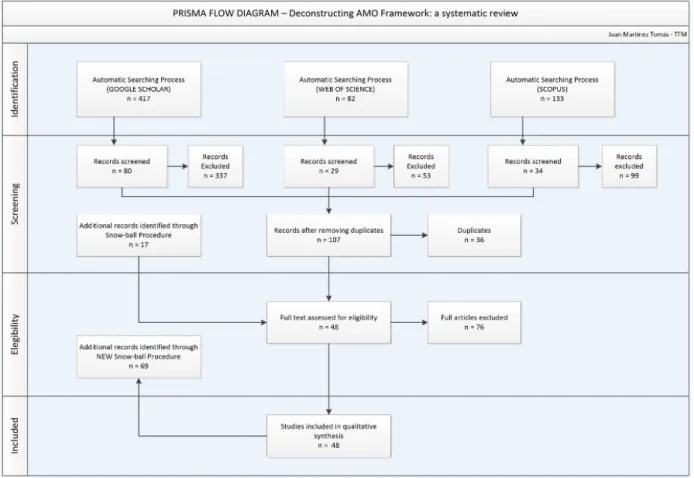
We structured the searching protocol in four different stages: Identification, screening, eligibility and Inclusion. The following PRISMA diagram (Figure 2) shows all these phases graphically:
Figure 2. Prisma flow diagram
In the Identification stage, the results have been drawn from searches conducted in Scopus, Web of Science and Google Scholar, as can be seen in the table below (Table 1). In both Scopus and Web of Science, the results were obtained by using the terms ability, opportunity, and motivation, in combination with the terms HRM and human resources.
• 1st search: articles that explicit mention Bailey’s 1993 article “Discretionary effort and the organization of work: employee participation and work reform since Hawthorne”, which is supposed to be the origin of AMO framework in the context of human resources (10 results).
• 2nd search: articles citing the article above (cited by 233), as well as containing the term AMO (21 results).
• 3rd search: results obtained by using the terms ability, motivation, and opportunity, as well as the term Bailey (125 results).
• 4th search: results obtained by using the terms AMO framework, AMO model or AMO theory in combination with the terms HRM and human resources. Also, we added the term Bailey, with the aim of reducing the results obtained (261 results).
Scopus Results
TITLE-ABS-KEY (amo AND ( theory OR framework OR model)) AND DOCTYPE (ar OR re) AND SUBJAREA (mult OR arts OR busi OR deci OR econ OR psyc OR soci) AND
PUBYEAR > 1999 31
(TITLE-ABS-KEY ((ability W/3 motivation W/3 opportunity)) OR TITLE-ABS-KEY ((amo AND (human OR hr)))) AND DOCTYPE (ar OR re) AND SUBJAREA (mult OR arts OR busi OR
deci OR econ OR psyc OR soci) AND PUBYEAR > 1988 102
Web of Science Results
TOPIC: (((ability near/3 motivation near/3 opportunity) OR (amo AND ( human OR hrm))))
Refined by:WEB OF SCIENCE CATEGORIES: ( BUSINESS OR MANAGEMENT OR
PSYCHOLOGY SOCIAL OR INDUSTRIAL RELATIONS LABOR OR OPERATIONS RESEARCH MANAGEMENT SCIENCE OR ENGINEERING MANUFACTURING OR ECONOMICS OR BUSINESS FINANCE OR ENGINEERING INDUSTRIAL)
Indexes=SCI-EXPANDED, SSCI, A&HCI, CPCI-S, CPCI-SSH, ESCI Timespan=All years
82
Google Scholar Results
("amo framework" OR "amo model" OR "amo theory") ("HRM" OR "human") (bailey)
https://scholar.google.es/scholar?q=%28%22amo+framework%22+OR+%22amo+model%22+OR+ %22amo+theory%22%29+%28%22HRM%22+OR+%22human%22%29+%28bailey %29&hl=en&as_sdt=1%2C5&as_ylo=1985&as_yhi=2016 261 (Stop 180) Ability-Motivation-Opportunity bailey https://scholar.google.es/scholar?q=Ability-Motivation-Opportunity+bailey&hl=es&as_sdt=0&as_vis=1&oi=scholart&sa=X&ved=0ahUKEwj5yPLfk_DKAhWC sxQKHT2UDBEQgQMIHjAA 125 (Stop 80)
Bailey, (1993), “Discretionary effort and the organization of work: employee participation and work reform since Hawthorne”, unpublished manuscript, Teachers College, Columbia University, New York, NY
https://scholar.google.es/scholar?q=Bailey%2C+T.+%281993%29%2C+ %E2%80%9CDiscretionary+effort+and+the+organization+of+work %3A+employee+participation+and+work+reform+since+Hawthorne%E2%80%9D %2C+unpublished+manuscript%2C+Teachers+College%2C+Columbia+University%2C+New+York %2C+NY&btnG=&hl=es&as_sdt=0%2C5&as_vis=1 10
"Discretionary effort and the organization of work: employee participation and work reform since Hawthorne". Cited by 233. Search "AMO" within citing articles.
https://scholar.google.es/scholar?
q=AMO&btnG=&hl=en&as_sdt=2005&sciodt=1%2C5&cites=4840032375480612111&scipsc=1
21
During the screening stage, with the aim of avoiding to exclude references that could meet the criteria, we decided to filter them manually by using the following methodology:
• Sort the articles by relevance.
• Review both titles and abstracts, excluding those articles that are clearly not related to the objectives explained above.
• Review both titles and abstracts, selecting those articles that could meet the inclusion criteria defined above. Store these resultsin a reference manager software (Mendeley) for further review.
• Download the full text of the documents selected in this first stage.
• Taking into consideration the filtering limitations of Google Scholar and the large number of results obtained in both the third and the fourth search strategies, we decided to stop the search in the page where no reference met our inclusion criteria.
The articles selected in this stage were stored in three different folders of Mendeley for each of the databases used. For that reason, the last action within the filtering stage was checking for duplicates and excluding them.
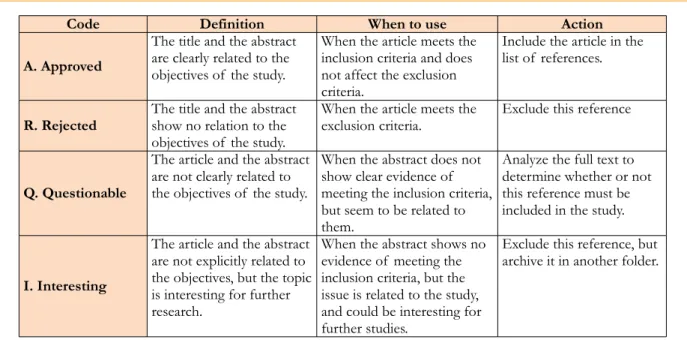
In the eligibility stage, we proceeded to the filtering process of the selected documents, using the following method:
• Sorting the references by title in alphabetic order, with the aim of minimizing potential bias caused by factors such as relevance or year of publication.
Code Definition When to use Action
A. Approved
The title and the abstract are clearly related to the objectives of the study.
When the article meets the inclusion criteria and does not affect the exclusion criteria.
Include the article in the list of references.
R. Rejected The title and the abstract show no relation to the objectives of the study.
When the article meets the
exclusion criteria. Exclude this reference
Q. Questionable
The article and the abstract are not clearly related to the objectives of the study.
When the abstract does not show clear evidence of meeting the inclusion criteria, but seem to be related to them.
Analyze the full text to determine whether or not this reference must be included in the study.
I. Interesting
The article and the abstract are not explicitly related to the objectives, but the topic is interesting for further research.
When the abstract shows no evidence of meeting the inclusion criteria, but the issue is related to the study, and could be interesting for further studies.
Exclude this reference, but archive it in another folder.
Table 2. Codification for eligibility stage
Also, we use the snowball procedure to incorporate new references once we finish the methodology commented above.
All the references codified with “Approved” and “Questionable” code were stored in a new folder of Mendeley reference manager. As a result, 48 studies were selected for the inclusion stage.
In the inclusion stage, with the aim of extracting the information of the articles selected in a structured manner, and being able to answer the research questions, we decided to create a table made up of the following items:
• Article: specifying the author, year, and title of the article (i.e. Boselie (2010). High-performance work practices in the health care sector: a Dutch case study.)
• Objectives: a short description about the aim of the study (i.e. “To present an empirical study of the effect of high-performance work practices on commitment and citizenship behavior in the health care sector”(Boselie, 2010)).
• AMO test? Used for indicating whether or not the study checks either directly or indirectly the AMO framework. That is to say; we answer YES when the study measures the AMO-performance link on the basis of a sample and using statistical methods.
◦ sum P = f (A + M + O): summative model, that is to say, the ability, motivation or opportunity-enhancing practices contribute independently to performance, even when the others practicesare not implemented.
◦ mult P = f (A x M x O): multiplicative (or interactive) model, which means that ability, motivation, and opportunity practices must be present to ensure performance.
◦ indet P = f (A, M, O): We used this code when the study did not explicitly apply either summative or multiplicative model in their statistical analysis.
◦ N/A: We used this code for studies that did not use any statistical analysis.
• Study: indicating the type of the study (i.e. cross sectional, multilevel analysis, longitudinal, literature review, theoretical model, theory building, interview, survey, questionnaire)
• Year: indicating when the study was conducted or (if this information is not available) the year of publication.
• Country: indicating the country/s where the study was conducted.
• Sample: specifying the type of sampling and sample size used in the study, either at the firm level (i.e. manufacturing or accounting firms)or the individual level (i.e. HR managers, line managers, front-line employees).
• Hypothesis (related to AMO framework): used for identifying (if any) those hypotheses related to the relationship between ability, motivation and/or opportunity practices and organization performance (i.e. “H2a. High scores on perceived HPWPs that enhance abilities (e.g. skills training, general training, coaching) are positively related to high levels of organizational citizenship behavior (OCB)” (Boselie, 2010)).
• Measures of Organization Performance: used for detecting the outcomes used in every study (i.e. productivity, financial performance, turnover intention, employee commitment, efficiency).
• Ability-enhancing practices: human resources practices utilized in the study for boosting employee abilities (A) (i.e. recruitment and selection, training, skill development).
• Opportunity-enhancing practices: human resources practices used in the study for boosting employee opportunities (O) (i.e. quality circles, self-directed work teams, employee involvement activities).
• Control variables: used for identifying the variables used to adjust the relative relationship between the dependent and independent variables, either at the organizational level (i.e. firm age, firm size) or the individual level (i.e. gender, age, educational level, tenure, position level).
• Results: we used this item for indicating whether or not the hypotheses proposed were supported.Also, we used this item for quoting the main conclusion of those studies when no hypothesis related to AMO model was found.
All the 48 studies selected for the inclusion stage were classified according to the items commented above. Therefore, it was necessary to read and analyze the full text of every one of them. The aim was filling out the table in a comprehensive manner, extracting further conclusions without the need to re-analyse those studies again.
4. Results
After a careful evaluation of the articles, we consider the review protocol to be valid, since almost every study selected is directly or indirectly related to the AMO framework. Furthermore, as the results were drawn from three different databases, we assume that the sample obtained should adequately cover the current investigations related to the topic. In fact, although Scopus and Web of Science databases only include both the title and the abstract in their automatic search, Google Scholar seeks the chosen terms in the whole article, which should avoid as much as possible the dismissal of relevant studies. Nonetheless, we expect to find out almost every article related to the topic through the snowball strategy performed during the inclusion stage.
As we predicted, not many studies of the sample have the objective of directly validating the AMO framework. In fact, only three of them include that issue as their primary goal (Demortier et al., 2014; Kim, Pathak & Werner, 2015; Obeidat, Bray & Mitchell, 2010). As a result, it seems to be a lack of research for explicitly validating the model. Nevertheless, most of the articles indirectly test the model through statistical analysis, which appears to be the common way for analyzing the AMO framework.
Keeping this in mind, we consider that the chosen studies should shed light on our initial research questions, and hence we will now move on to analyze them in detail.
4.1. What is the AMO framework? When it was first proposed?
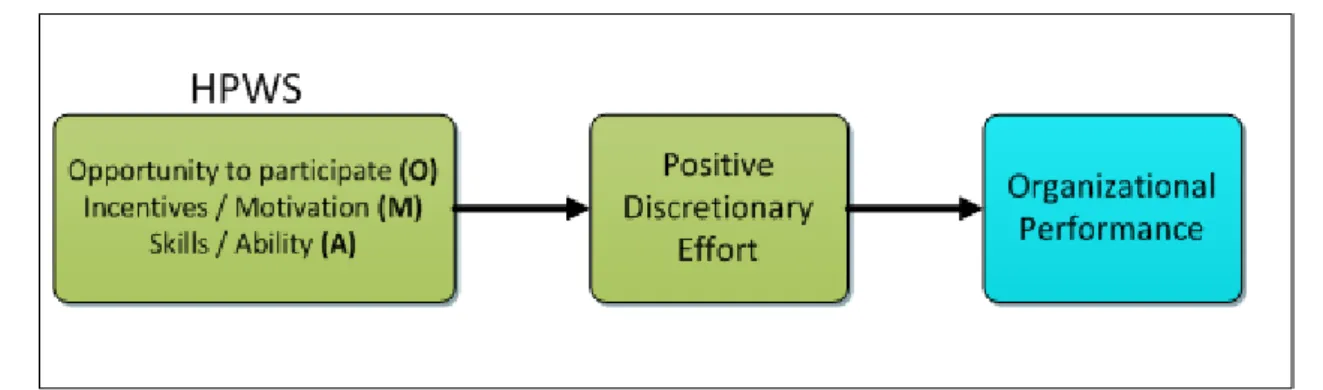
Although we have described the origins of the AMO framework in the introduction section, it is important to emphasize some aspects of the original model for a better understanding of the model and its implications for human resource management. As stated before, the AMO framework was developed by Appelbaum et al. (2000), on the basis of a model previously proposed by Bailey (1993). The aim of the model was to examine the premise that HPWS can help the organization to improve plant performance. To that end, the authors studied the effects of HPWS on plants and employees of three manufacturing industries: steel, apparel and electronic medical instruments (Appelbaum et al., 2000). With the aim of providing a comprehensive picture, they designed a multilevel research, collecting data from workers, managers, and plant performance.
Figure 3. The AMO model of performance adapted from Appelbaum et al.(2000)
It is important to detail the high-performance work system variables originally proposed by the authors in their empirical analysis. In this regard, they develop the following scales and procedures (Table 3):
Scale Variables Measures
Opportunity to participate (O)
Autonomy in decision making 1-4 scale: 1 (false) - 4 (true)
Self-directed team membership Yes / No
Offline team membership 0 = No / 1 = Yes
Communication 1-5 scale: 1 (never) - 5 (daily)
Skills (A)
Formal training Yes / No
Informal training 1-4 scale: 1 (not at all) - 4 (to a greatextend)
Seniority
---Education Low education (1-8) / High school (9-11
Incentives (M)
Employment security 1-4 scale: 1 (false) - 4 (true) Company is competitive 1-4 scale: 1 (false) - 4 (true) Company shares information 1-4 scale: 1 (false) - 4 (true)
Promotion opportunities 0 = No / 1 = Yes
Company helps with work-family conflicts 1-4 scale: 1 (not at all) - 4 (to a greatextend)
Pay Weekly earnings
Pay is fair 1-4 scale: 1 (dissatisfied) - 4 (satisfied)
Pay for performance 0 = No / 1 = Yes
Table 3. HPWS scales adapted from Appelbaum et al. (2000)
the measures of performance were related to product quality, throughput time, capital utilization and space utilization. Finally, in the medical electronic instruments industry, the measures of performance were the following: value added, operating profit, work-in-process inventory, overall productivity, and overall quality. Overall, they demonstrated that HPWS had a positive effect on organization performance in each industry.
On the other hand, the authors also considered the effects of HPWS on workers outcomes. Specifically, they studied five worker outcomes: the extent to which employees trust their managers, the intrinsical job perception, organizational commitment, job satisfaction, and work-related stress. Finally, they also investigated the effect of HPWS on earnings of employees, as well as on productivity growth.
4.2. Which other HIWP models complement or substitute the AMO framework?
Along our review protocol, we have identified several theoretical frameworks that either complete the AMO model or propose a different point of view in explaining the linkage between human resources management and performance. Identifying those theoretical frameworks provides valuable information about the assumptions (as well as the selection of specific HR practices and performance outcomes) used by different authors (Boselie et al., 2005). In fact, some authors consider that the AMO framework can be reinforced through other mechanisms for thoroughly explain the HRM-performance linkage (Demortier et al., 2014). Although we identified many theories, it is important to underline three of them, which frequently appear in many of the studies: the contingent framework, the resource-based view model, and the social exchange theory.
The contingent framework suggests that contextual factors are essential for understanding this relationship (Alagaraja, 2012). Thus, HRM must be able to respond effectively to the organization's environment features (Boselie et al., 2005; Delery, 1998; Ruzic, 2015). One example of a contextual factor is the firm's business strategy (i.e. cost leadership or focus differentiation) (Boselie et al., 2005). Contextual factors also involve culture, climate, politics and social interactions. Organization culture includes core values, beliefs and attitudes of organization's members whereas climate refers to employee's interpretations of the work environment (Raidén et al., 2006).
advantage lies in the valuable, rare, difficult to imitate and non-substitutable resources that it possesses (Boselie et al., 2005; Fu et al., 2013; Ruzic, 2015). Therefore, the RBV perspective suggests that HRM policies directly affect the employee motivation, behavior, and abilities, which in turn enhance organizational performance (Boxall and Steeneveld, 1999) cited in Katou and Budhwar (2010). In fact, some authors consider that AMO framework is an extension of RBV model (Ruzic, 2015) because it adds the opportunity dimension to the ability and motivation ones.
Social exchange theory (Blau, 1964) cited in (Boselie, 2010; Demortier et al., 2014; Kroon et al., 2013), emphases on the relationship between the organization and its employees as an exchange of mutual investment. This theory points out that subjective perceptions of the costs and benefits of maintaining this relationship could affect employee performance (Choi, 2014). Einsenberger, Huntington, Hutchison and Sowa (1986), cited in (Choi, 2014; Knies & Leisink, 2014) extended this theory by explaining that those perceptions could be affected by workplace practices and policies, which may enhance the employee feeling to compensate the organization with appropriate behaviors. The concept used for explaining those subjective perceptions (which in turn explains employee commitment to an organization), is the perceived organizational support (POS) (Knies & Leisink, 2014). High-performance work practices are expected to send positive messages to employees, increasing their willingness to perform better in their job (Boselie, 2010; Godard, 2000). These positive messages are also known as signaling effect (Bowen & Ostroff, 2004; Ehrnrooth & Björkman, 2012), which suggest that HRM systems send messages to employees who, in turn, align their efforts toward the organization goals. As a matter of fact, the perceived availability of flexibility practices will enhance employee motivation and performance. The reason is that they will observe positive signals from an organization that cares about their work-life balance (Bal & De Lange, 2015).
Besides the theories mentioned above, it is appropriate to note, if even briefly, the following theoretical frameworks identified in our study:
• Organizational ethical climates (Victor & Cullen, 1988) cited in Guerci, Radaelli, Siletti, Cirella and Rami Shani (2015) deals with the shared perceptions of what are correct behaviors, feelings, and attitudes within an organization. According to this theory, the organization climate can be egoistic (employees self-interest guide their behavior), benevolent (well-being of others guide employee's behavior) or principled (employee behavior is guided by either informal or formal norms and rules) (Guerci et al., 2015). Consequently, organization climate may affect the HRM activities to a great extent, by influencing employee commitment and satisfaction.
• The people-performance framework (Purcell et al., 2003) cited in Harney and Jordan (2008) is a comprehensive model that aims to "unlocking the black box" of HRM-performance linkages. This model consists of four keypillars. Pillar 1 is related to HRM practices, and the authors suggest that the HR policy chosen by an organization must be adapted to its organizational context (in line with contingency theory). Pillar 2 takes place inside the "black box", and includes the role of both line managers and employees on applying and perceiving respectively the HRM policies and practices. The authors integrate the AMO framework by suggesting that firm performance is a function of line managers ability, motivation and opportunity to implement those practices. Pillar 3 deals with managerial style as an important factor to consider, because employee's perceptions may vary significantly depending on the line manager approach. In fact, people is likely to commit more to individuals rather to the overall organization (Becker, 1992) cited in Harney and Jordan (2008). Finally, Pillar 4 takes into account intermediary measures of people-performance, such as commitment, motivation, and job satisfaction. These measures are necessary for understanding the HRM-performance linkage.
• Resource-poverty perspective (Welsh and White 1981) cited in Kroon et al. (2013), predicts that availability of financial resources and time is related to the organization size. That is to say; small companies have fewer resources to implement HRM practices than larger firms.
4.3. What investigations have been conducted to validate the model?
As we said before, few studies drawn from our systematic review directly test the AMO framework. Taking into account the searching strategy conducted and the results obtained, it would be surprising the existence of many more investigations testing that issue. Moreover, a quick revision (both title and abstract) of the studies extracted through the snowball procedure seem to support this view. Therefore, it appears to be a lack of research aiming to validate the model directly. However, most of the articles reviewed indirectly test the model by using statistical analysis in which they estimate the average correlation among HR practices in bundles by using a Cronbach's alpha. Those studies provide examples of HR practices as well as different measures of performance. Also, the studies that do not provide a statistical analysis, they nonetheless give an idea of how authors understood the HR practices-performance linkage.
Concerning the country in which the investigation is performed, we expected to find out studies conducted mainly in north-American and European countries, particularly in Anglo-Saxon countries such as the United States and the United Kingdom. Surprisingly, our systematic review contains studies from more than 20 countries on almost every continent. We consider that this information is remarkable because it might reduce bias caused by the country-of-origin factor (e.g. labor regulations). Many of the studies were conducted in European countries (27), distributed as follows: UK (7), The Netherlands (6), Denmark (3), Ireland (2), Romania (1), Luxemburg (1), Sweden (1), Belgium (1), Italy (1), Greece (1), Croatia (1), and Germany (1). However, other studies were conducted within the Asian context (12) (China-3, Korea-4, India-1, Taiwan-1, Hong Kong-1, Jordania-1, and Turkey-1). We also found studies performed in the United States (5), New Zealand (1), Uruguay (1) and Australia (1). Finally, some studies collect data from several countries, for instance (Japan, Brazil, China, Mexico, USA, Spain, India, UK, South Africa, Netherlands, Botswana) (Bal & De Lange, 2015), and (Italy, Germany, UK, Poland, Spain, France) (Guerci et al., 2015).
which may represent biased samples. The most common type of questionnaire along our review protocol is to prepare a set of questions related to the three dimensions of the AMO model, aiming to find out the employee or manager perceptions or assumptions concerning those practices. The HR practices are usually measured by using different scales, which assess whether these practices are present or not. As a matter of fact, the item "the organization evaluates my job performance based on objective and measurable results" can be measured with a 1-7 scale ("1 = absolutely disagree"; "7 = totally agree") (Ming, Ganli & Fulei, 2014).
However, we have also found some investigations using interviews (e.g. (Bello-Pintado, 2015; Claudia, 2015; Sterling & Boxall, 2013)). That is to say; a face-to-face methodology for obtaining reliable measures in the form of verbal responses. The advantages of interviews are the following: first, they enable the interviewer to clarify questions if needed. Also, allows the informants to clarify in greater detail the answers. Finally, it allows the interviewers to observe verbal and non-verbal behaviors. Along our review protocol, interviews are commonly used in studies with few respondents, especially for collecting information from managers. As a matter of fact, Bello-Pintado (2015), conducted a set of interviews with plant managers of Uruguayan manufacturing firms. Also, other authors used this methodology to collect data from HR managers (Ruzic, 2015), or even front-line workers (Sterling & Boxall, 2013).
causal relationships (Knies & Leisink, 2014; Shih, Chiang & Hsu, 2007; Wall & Wood, 2005). In fact, it might be important to measure the effect of high-performance work systems after a certain time span since its implementation. Nevertheless, other authors point out that this fact must not prevent companies from investing in HPWS (Shih et al., 2007). Longitudinal studies involve a survey of the same population over a period of time and are mainly conducted to detect changes in attitudes, feelings or results. That is to say; those studies might be able to determine causality. However, the use of longitudinal studies is a costly and complicated task, because it means to measure more times on equal terms. For this reason, some authors point out that fewer longitudinal studies investigated the relationship between HRM and performance (Alagaraja, 2012). In fact, we only found six articles within our review protocol conducting entirely or partially a longitudinal research (Bal & De Lange, 2015; Block & Pickl, 2014; Choi & Yoon, 2015; Demortier et al., 2014; Knies & Leisink, 2014; Shih et al., 2007).
Another concern detected in our results is the large variety of methodologies through investigations. That is to say, different data produce different results(Alagaraja, 2012), and the large variety of HR practices and measures of performance (e.g. productivity, employee commitment) used through investigations make it difficult to state firm conclusions. Moreover, scholars have used a wide variety of control variables, ranging from industry-level controls (e.g. technology, market conditions), to organization-level controls (e.g. size, firm, economic activity), and to individual level control (e.g. age, gender, the level of education). This lack of consensus is evident throughout the articles reviewed and, therefore, it is hard to identify how HR practices should be measured (e.g. index, scales) (Harney & Jordan, 2008)
4.4. What HIW practices have been used to analyze the AMO framework?
perform, the means to do their jobs, and the motivation needed (Shih et al., 2007). Practices related to those systems are selection and training programs, information sharing and worker involvement, and incentive arrangements that provide motivation (Marín-García & Conci, 2013; Shih et al., 2007). On the other hand, the contingency approach emphasizes that optimal HRM systems must be adapted to particular circumstances and be consistent within the organization (Ehrnrooth & Björkman, 2012; Ruzic, 2015). As a matter of fact, some authors point out that industries require different skills and knowledge (Schimansky, 2014). Moreover, some scholars state that choosing the right combination of practices is crucial to better performance, and similar bundles may be negatively related to positive outcomes depending on the context (Godard, 2001; Shih et al., 2007).
In any case, there are several HRM practices that commonly appear in many investigations (Perelló-Marin & Ribes-Giner, 2014). The four most frequently considered in many "bundles" are recruitment and selection, training and development, reward schemes, and performance management (Boselie et al., 2005). Some authors suggest the appropriateness of conceptualizing HRM systems into the AMO dimensions. That is to say, grouping them as ability, motivation or opportunity-enhancing practices (Claudia, 2015; Jiang, Lepak, Hu, et al., 2012). In this sense, Appelbaum et al. (2000) offered several examples of HR practices for ability (e.g. formal and informal training), motivation (e.g. job security, promotion opportunities), and opportunity to participate (e.g. autonomy, communication) (Claudia, 2015).
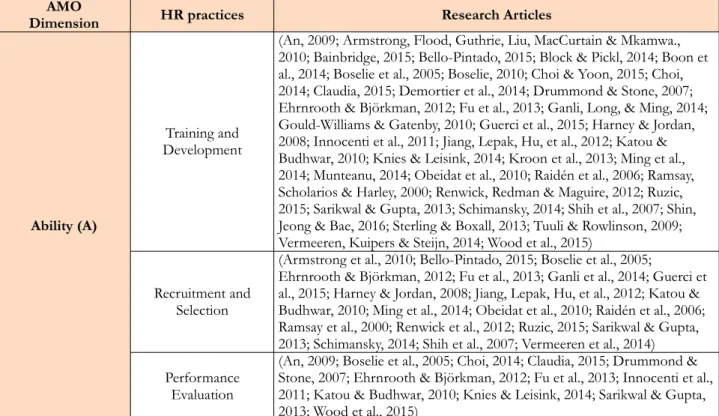
In light of this, we thought it opportune to analyze the HRM practices collected across our review protocol according to the three AMO dimensions (Table 4), as we explain below.
Ability can be defined as an acquired or natural capacity that enables an individual to perform a particular task successfully (Kim et al., 2015). Moreover, ability refers to human attributes (skills, experience, attitudes, prior related knowledge) that are relevant for the accomplishment of those tasks (Boon, Belschak, Hartog & Pijnenburg, 2014; Minbaeva, 2013). In HRM context, ability refers to the set of practices designed for ensuring that the employees have the resources needed for performing their tasks (Sarikwal & Gupta, 2013). Hence, those practices focus on increasing the knowledge, skills and abilities (KSA) at both individual and collective levels (Demortier et al., 2014; Subramony, 2009).
deals with attracting and choosing individuals who conform to the profile and the organization (Schimansky, 2014).
AMO
Dimension HR practices Research Articles
Ability (A)
Training and Development
(An, 2009; Armstrong, Flood, Guthrie, Liu, MacCurtain & Mkamwa., 2010; Bainbridge, 2015; Bello-Pintado, 2015; Block & Pickl, 2014; Boon et al., 2014; Boselie et al., 2005; Boselie, 2010; Choi & Yoon, 2015; Choi, 2014; Claudia, 2015; Demortier et al., 2014; Drummond & Stone, 2007; Ehrnrooth & Björkman, 2012; Fu et al., 2013; Ganli, Long, & Ming, 2014; Gould-Williams & Gatenby, 2010; Guerci et al., 2015; Harney & Jordan, 2008; Innocenti et al., 2011; Jiang, Lepak, Hu, et al., 2012; Katou & Budhwar, 2010; Knies & Leisink, 2014; Kroon et al., 2013; Ming et al., 2014; Munteanu, 2014; Obeidat et al., 2010; Raidén et al., 2006; Ramsay, Scholarios & Harley, 2000; Renwick, Redman & Maguire, 2012; Ruzic, 2015; Sarikwal & Gupta, 2013; Schimansky, 2014; Shih et al., 2007; Shin, Jeong & Bae, 2016; Sterling & Boxall, 2013; Tuuli & Rowlinson, 2009; Vermeeren, Kuipers & Steijn, 2014; Wood et al., 2015)
Recruitment and Selection
(Armstrong et al., 2010; Bello-Pintado, 2015; Boselie et al., 2005;
Ehrnrooth & Björkman, 2012; Fu et al., 2013; Ganli et al., 2014; Guerci et al., 2015; Harney & Jordan, 2008; Jiang, Lepak, Hu, et al., 2012; Katou & Budhwar, 2010; Ming et al., 2014; Obeidat et al., 2010; Raidén et al., 2006; Ramsay et al., 2000; Renwick et al., 2012; Ruzic, 2015; Sarikwal & Gupta, 2013; Schimansky, 2014; Shih et al., 2007; Vermeeren et al., 2014)
Performance Evaluation
(An, 2009; Boselie et al., 2005; Choi, 2014; Claudia, 2015; Drummond & Stone, 2007; Ehrnrooth & Björkman, 2012; Fu et al., 2013; Innocenti et al., 2011; Katou & Budhwar, 2010; Knies & Leisink, 2014; Sarikwal & Gupta, 2013; Wood et al., 2015)
Table 4. Ability-enhancing practices retrieved from the Review protocol
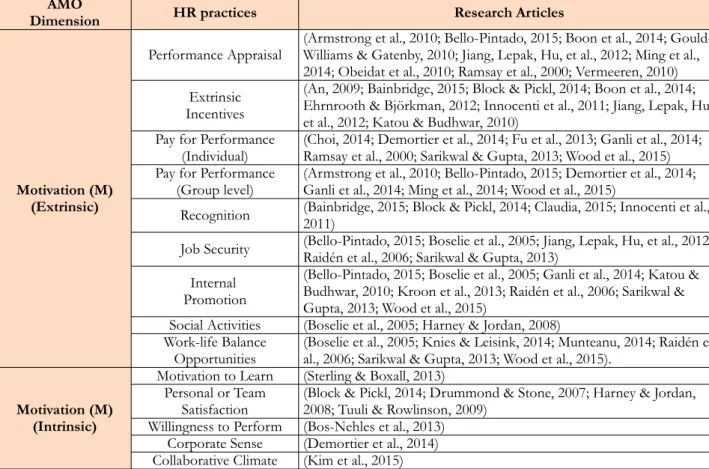
According to our review protocol, the most common motivation-enhancing practices are related to performance appraisal and extrinsic incentives (Table 5). As a matter of fact, pay for performance is used in many investigations, both at the individual or at the group level. However, we also found in many studies non-economic forms of motivation, such as recognition, job security, internal promotion (or career development), social activities, and work-life balance opportunities. In contrast, we did not find many examples practices focusing on intrinsic motivation. Some of the few examples we found are motivation to learn, personal or team satisfaction, willingness to perform, corporate sense, and collaborative climate.
AMO
Dimension HR practices Research Articles
Motivation (M) (Extrinsic)
Performance Appraisal (Armstrong et al., 2010; Bello-Pintado, 2015; Boon et al., 2014; Gould-Williams & Gatenby, 2010; Jiang, Lepak, Hu, et al., 2012; Ming et al., 2014; Obeidat et al., 2010; Ramsay et al., 2000; Vermeeren, 2010) Extrinsic
Incentives
(An, 2009; Bainbridge, 2015; Block & Pickl, 2014; Boon et al., 2014; Ehrnrooth & Björkman, 2012; Innocenti et al., 2011; Jiang, Lepak, Hu, et al., 2012; Katou & Budhwar, 2010)
Pay for Performance
(Individual) (Choi, 2014; Demortier et al., 2014; Fu et al., 2013; Ganli et al., 2014; Ramsay et al., 2000; Sarikwal & Gupta, 2013; Wood et al., 2015) Pay for Performance
(Group level) (Armstrong et al., 2010; Bello-Pintado, 2015; Demortier et al., 2014; Ganli et al., 2014; Ming et al., 2014; Wood et al., 2015) Recognition (Bainbridge, 2015; Block & Pickl, 2014; Claudia, 2015; Innocenti et al., 2011)
Job Security (Bello-Pintado, 2015; Boselie et al., 2005; Jiang, Lepak, Hu, et al., 2012;Raidén et al., 2006; Sarikwal & Gupta, 2013)
Internal Promotion
(Bello-Pintado, 2015; Boselie et al., 2005; Ganli et al., 2014; Katou & Budhwar, 2010; Kroon et al., 2013; Raidén et al., 2006; Sarikwal & Gupta, 2013; Wood et al., 2015)
Social Activities (Boselie et al., 2005; Harney & Jordan, 2008) Work-life Balance
Opportunities (Boselie et al., 2005; Knies & Leisink, 2014; Munteanu, 2014; Raidén etal., 2006; Sarikwal & Gupta, 2013; Wood et al., 2015).
Motivation (M) (Intrinsic)
Motivation to Learn (Sterling & Boxall, 2013) Personal or Team
Satisfaction (Block & Pickl, 2014; Drummond & Stone, 2007; Harney & Jordan, 2008; Tuuli & Rowlinson, 2009) Willingness to Perform (Bos-Nehles et al., 2013)
Corporate Sense (Demortier et al., 2014) Collaborative Climate (Kim et al., 2015)
Table 5. Motivation-enhancing practices retrieved from the Review protocol
decision-is linked to employee involvement in the decdecision-ision-making process (Appelbaum et al., 2000). Hence, firms must provide opportunities for dialogue across organizational hierarchies, creating systems for capturing and sharing knowledge within the organization (Minbaeva, 2013; Senge, Ross, Smith, Roberts & Kleiner, 1995). Also, the decision-making process should be decentralized and, consequently, employees will enjoy a higher level of autonomy for performing their tasks ( Marín-García & De Miguel, 2001; Sarikwal & Gupta, 2013). In HRM context, opportunity-enhancing practices are designed for delegating the decision-making authority and fostering employee voice (Demortier et al., 2014). Thus, participation is seen as an opportunity for employees to be involved (Marín-García & De Miguel, 2001; Schimansky, 2014). Likewise, based on organizational support theory (Boon et al., 2014), signals that the organization invests in supportive activities may lead to improving the employee sense of belongingness and reducing stress, absence and turnover rates (Boon et al., 2014).
According to our searching protocol, the opportunity-enhancing practices may be grouped in four principal bundles: employee-involvement practices, knowledge-sharing practices, job design practices and autonomy-enhancing practices (Table 6).
Employee-involvement practices include quality circles, self-directed work teams, problem-solving teams, team working, and those practices fostering flat hierarchies and involvement in the decision-making process.
The aim of knowledge-sharing practices is providing enough information about important issues within the organization (performance, financial, operating or strategic information). Also, those practices also aim to guarantee communication between employees and management. According to our results, many authors agree that both information sharing and communication are essential for improving the opportunity-enhancing dimension. In addition, many authors also consider as important those practices designed to foster employee voice, such as suggestions systems, complaint systems or surveys in place.
Job design practices include appropriate job description (practices, procedures and workplace design), support from HR professionals, job rotation, level of internationalization and providing favorable work conditions.
AMO
Dimension HR practices Research Articles
Opportunity (O) (employee involvement)
Quality Circles (Armstrong et al., 2010; Choi, 2014; Fu et al., 2013; Ramsay et al., 2000) Self-directed Work
Teams (An, 2009; Armstrong et al., 2010; Fu et al., 2013; Ramsay et al., 2000; Sterling & Boxall, 2013) Problem-Solving Teams (Armstrong et al., 2010; Choi, 2014; Drummond & Stone, 2007; Fu et al., 2013; Ramsay et al., 2000; Wood et al., 2015)
Team Working
(Boon et al., 2014; Boselie et al., 2005; Drummond & Stone, 2007; Gould-Williams & Gatenby, 2010; Harney & Jordan, 2008; Jiang, Lepak, Hu, et al., 2012; Kroon et al., 2013; Munteanu, 2014; Raidén et al., 2006; Sarikwal & Gupta, 2013)
Involvement in the Decision making Process
(Boselie et al., 2005; Boselie, 2010; Ehrnrooth & Björkman, 2012; Gould-Williams & Gatenby, 2010; Guerci et al., 2015; Harney & Jordan, 2008; Jiang, Lepak, Hu, et al., 2012; Katou & Budhwar, 2010; Munteanu, 2014; Raidén et al., 2006; Renwick et al., 2012; Sarikwal & Gupta, 2013)
Opportunity (O) (Knowledge - Sharing)
Information Sharing and Communication
(An, 2009; Armstrong et al., 2010; Bello-Pintado, 2015; Block & Pickl, 2014; Boselie et al., 2005; Choi, 2014; Drummond & Stone, 2007; Ehrnrooth & Björkman, 2012; Fu et al., 2013; Harney & Jordan, 2008; Jiang, Lepak, Hu, et al., 2012; Katou & Budhwar, 2010; Ming et al., 2014; Raidén et al., 2006; Shih et al., 2007; Shin et al., 2016)
Suggestions Systems, Complaint Systems or
Surveys in Place
(Boselie et al., 2005; Choi, 2014; Ganli et al., 2014; Guerci et al., 2015; Innocenti et al., 2011; Jiang, Lepak, Hu, et al., 2012; Ramsay et al., 2000; Wood et al., 2015)
Opportunity (O) (Job Design)
Job Description
(Bainbridge, 2015; Block & Pickl, 2014; Boon et al., 2014; Boselie et al., 2005; Bos-Nehles et al., 2013; Fu et al., 2013; Guerci et al., 2015; Harney & Jordan, 2008; Innocenti et al., 2011; Jiang, Lepak, Hu, et al., 2012; Katou & Budhwar, 2010; Knies & Leisink, 2014; Shin et al., 2016),
Support from HR
Professionals (Bos-Nehles et al., 2013; Choi & Yoon, 2015; Renwick et al., 2012; Schimansky, 2014) Job Rotation (Boselie, 2010; Choi, 2014; Katou & Budhwar, 2010; Shin et al., 2016)
Level of
Internationalization (Kim et al., 2015) Favorable Work
Conditions (Block & Pickl, 2014)
Opportunity (O) (Autonomy-enhancing)
Autonomy
(Bello-Pintado, 2015; Boselie et al., 2005; Boselie, 2010;
Drummond & Stone, 2007; Ehrnrooth & Björkman, 2012; Knies & Leisink, 2014; Kroon et al., 2013; Ming et al., 2014; Sarikwal & Gupta, 2013; Vermeeren, 2010)
Irregular and Regular
Flexibility (Bal & De Lange, 2015; Claudia, 2015; Drummond & Stone, 2007; Wood et al., 2015) Table 6. Opportunity-enhancing practices retrieved from the Review protocol
4.5. How have been measured the model effectiveness in AMO research?
"outcomes" reflect better the wide range of dependent variables used across investigations (Boselie et al., 2005; Guest, 1997).
Some authors point out that measures of performance should be related to financial outcomes (e.g. profits, market share, sales growth), because they are the best indicators of organizational success (Boselie et al., 2005; Ichniowski, Kochan, Levine, Olson & Strauss, 1996). However, other scholars consider that the use of more "proximal" outcome indicators (such as organizational and HR-related outcomes) is more appropriate for engaging workforce (Boselie et al., 2005; Claudia, 2015; Guest, 1997). As a result, some investigations have measured performance through organizational outcomes, such as productivity, product or service quality, or efficiency. The main problem concerning those outcomes is the difficulty in standardizing the measures of them (Boselie et al., 2005).
Also, other studies have taken into account HR-related outcomes, such as employee commitment, job satisfaction, creativity intention to quit, trust in management, and absenteeism. They argue that employees are often the most suitable people to make decisions concerning their work. Therefore, it is important to measure the effects of HPWS on these employee outcomes (Drummond & Stone, 2007). In this vein, work performance theory defines performance as individual behavior associated with the accomplishment of expected role requirements (Bos-Nehles et al., 2013).
Similarly, other investigations consider that HR-related outcomes are in fact mediating variables between HRM and operational performance (Katou & Budhwar, 2010; Lepak et al., 2006; Paauwe, 2004; Ramsay et al., 2000). It is important to underline that employee performance usually depends on the perception of the HRM content. That is to say; it is important to ensure that practices are perceived as meaningful for achieving personal and organization goals (Ehrnrooth & Björkman, 2012). In this sense, it is essential to guarantee that practices are consistent with the business strategy. In such a way, practices are more likely to engage employees toward the organization objectives. In relation to HR-related outcomes, it is interesting to note the concept "Organization Citizenship Behavior" (OCB). This term is defined as individual behavior that is discretionary, that is to say, goes beyond the basic requirements, without being explicitly recognized by the formal reward systems (Fields, 2002; Sarikwal & Gupta, 2013).
suggested that such positive effect remains unclear (Claudia, 2015). In this sense, it is important to point out that most of the investigations have focused on organizational-level analysis, while little attention has been paid to the individual employee (Boselie, 2010; Guest, 1999).
According to our review protocol, the measures of performance may be grouped in three principal bundles: Financial outcomes, operational outcomes, and HR outcomes (Table 7).
Bundle Measures Research Articles
Financial Outcomes
Market Share (Alagaraja, 2012; Fu et al., 2013; Jiang, Lepak, Han, et al., 2012; Munteanu, 2014)
Profitability (Alagaraja, 2012; Boselie et al., 2005; Fu et al., 2013; Kaufman, 2015; Kim et al., 2015; Obeidat et al., 2010; Ramsay et al., 2000; Shih et al., 2007)
Return on Assets (ROA) (Alagaraja, 2012; Choi & Yoon, 2015; Choi, 2014; Jiang, Lepak, Hu, et al., 2012; Obeidat et al., 2010; Ruzic, 2015)
Sales Growth (Alagaraja, 2012; Drummond & Stone, 2007; Fu et al., 2013; Jiang, Lepak, Hu, et al., 2012; Kaufman, 2015; Obeidat et al., 2010)
Operational Outcomes
Job Performance (Bal & De Lange, 2015; Choi & Yoon, 2015; Demortier et al., 2014; Ehrnrooth & Björkman, 2012; Gould-Williams & Gatenby, 2010; Jiang, Lepak, Hu, et al., 2012)
Productivity/ Efficiency
(Alagaraja, 2012; Armstrong et al., 2010; Bello-Pintado, 2015; Boselie et al., 2005; Jiang, Lepak, Hu, et al., 2012; Katou & Budhwar, 2010; Kim et al., 2015; Obeidat et al., 2010; Raidén et al., 2006; Ramsay et al., 2000; Vermeeren et al., 2014)
Product/ Service Quality (Alagaraja, 2012; Bello-Pintado, 2015; Boselie et al., 2005; Fu et al., 2013; Jiang, Lepak, Hu, et al., 2012; Katou & Budhwar, 2010; Ramsay et al., 2000; Sterling & Boxall, 2013)
HRM effectiveness (Bainbridge, 2015; Bos-Nehles et al., 2013; Gilbert, De Winne & Sels, 2015;Harney & Jordan, 2008; Shih et al., 2007) Customer Satisfaction (Alagaraja, 2012; Hughes, 2007; Katou & Budhwar, 2010)
HR Outcomes
Turnover Intention (Alagaraja, 2012; Armstrong et al., 2010; Boselie et al., 2005; Gould-Williams & Gatenby, 2010; Jiang, Lepak, Hu, et al., 2012; Ramsay et al., 2000; Sarikwal & Gupta, 2013)
Trust in Management (Bainbridge, 2015; Boselie et al., 2005; Harney & Jordan, 2008)
Job Satisfaction
(Boon et al., 2014; Boselie et al., 2005; Choi & Yoon, 2015; Claudia, 2015; Drummond & Stone, 2007; Fu et al., 2013; Ganli et al., 2014; Gould-Williams & Gatenby, 2010; Innocenti et al., 2011; Jiang, Lepak, Hu, et al., 2012; Ming et al., 2014; Vermeeren et al., 2014)
Organization Citizenship
Behavior (OCB) (Boselie et al., 2005; Boselie, 2010; Harney & Jordan, 2008; Jiang, Lepak, Hu, et al., 2012) Absenteeism (Boselie et al., 2005; Ramsay et al., 2000; Sarikwal & Gupta, 2013; Sterling & Boxall, 2013)
Innovative Behavior (Armstrong et al., 2010; Ehrnrooth & Björkman, 2012; Jiang, Lepak, Hu, etal., 2012; Katou & Budhwar, 2010; Schimansky, 2014; Shin et al., 2016)
Employee commitment
(Bal & De Lange, 2015; Block & Pickl, 2014; Boselie et al., 2005; Boselie, 2010; Ganli et al., 2014; Gould-Williams & Gatenby, 2010; Harney & Jordan, 2008; Innocenti et al., 2011; Jiang, Lepak, Hu, et al., 2012; Ming et al., 2014; Raidén et al., 2006; Renwick et al., 2012; Ruzic, 2015; Shin et al., 2016; Tuuli & Rowlinson, 2009)
4.6. Is the AMO framework a summative or a multiplicative model?
Scholars have considered the AMO framework from three different perspectives: multiplicative, summative and combinative. By now, they have not reached an agreement to determine which of these perspectives better explains the interaction between ability, motivation and opportunity dimensions. Indeed, it is possible that AMO dimensions combine differently depending on the level of analysis (Kim et al., 2015). Moreover, some authors maintain that the exact relationship between the three AMO dimensions remains so far unknown (Knies & Leisink, 2014). Similarly, other authors point out that either the model has never fully empirically tested or the three dimensions have been only independently empirically validated (Demortier et al., 2014).
On the one hand, some authors point out that it is a multiplicative model. That is to say, abilities, opportunities, and motivation must all be present (at least to some degree), and the lack of any of them implies that performance becomes unfeasible (Blumberg & Pringle, 1982; Bos-Nehles et al., 2013; Delery, 1998; Ozcelik & Uyargil, 2015; Siemsen, Roth & Balasubramanian, 2008; Vroom, 1964). Moreover, each of the three dimensions reinforces the other two and, therefore, low levels in one dimension will lead to poor firm performance (Kim et al., 2015). In the extreme situation of one factor being absent, then performance becomes zero (Charles, Blumberg, Pringle & Charles, 1986; Ozcelik & Uyargil, 2015). This model is usually known as interactive (or complementary) model, and may be reflected by the function: P = f(A x M x O) (Bos-Nehles et al., 2013; Kim et al., 2015).
Some scholars argue that there is a lack of research confirming the multiplicative perspective (Obeidat et al., 2010), or even consider that it has never been empirically demonstrated (Bos-Nehles et al., 2013; Siemsen, Roth, & Balasubramanian, 2008). In fact, we only found four articles within our review protocol testing the multiplicative hypothesis.
Kim et al. (2015) conducted an investigation in the Korean firm context, considering cross-cultural competences as Abilities, collaborative climate as Motivation, and firm level of internationalization as Opportunity. They tested three different AMO models and found that companies perform better, and employees are more willing to share their expertise when they grant a highly supportive climate, and also provide adequate internationalization levels to their staff to develop their professional skills. On the contrary, high global competence employees may become frustrated in environments that do not provide enough internationalization opportunities, leading to poor firm performance.
model for explaining the link between human resources practices dimensions and performance indicators. This hypothesis was validated in the study, providing empirical verification of the multiplicative model.
Also, Bello-Pintado (2015) developed a theoretical model for explaining how the interaction between bundles of HRM practices may affect performance outcomes in the Uruguayan Manufacturing industry context. As a result, they explored the three interaction model (A x M x O). In addition, due to the complexity of studying the interaction between a large number of practices, they decided to study two-way interactions as well (i.e. motivation and ability practices). Contrary to their expectations, they concluded that only the motivation-enhancing bundle had a considerable effect on performance. Moreover, their findings revealed synergistic effects of two-way interactions, but generally with the presence of motivation-enhancing practices. That is to say, performance may be reflected by the functions: P = (M x O) and P = (M x A). Concerning the three-way interaction, they concluded that performance does not improve with a third bundle of HRM practices. That is to say; they did not find a synergistic relationship among ability, motivation and opportunity-enhancing practices.
Similarly, Gould-Williams and Gatenby (2010) conducted an investigation to evaluate the effects of teamwork and organizational context on the performance outcomes of British public workers. Specifically, they tested whether or not the interaction effect of bundles of practices on organizational performance was greater than the individual effects. They used training and development activities as ability-enhancing practices (A), performance-reward activities and performance appraisals as motivation-enhancing practices (M), and team working and high-involvement climate as opportunity-enhancing practices (O). Also, they considered commitment, job satisfaction and intention to quit, among other, as organizational performance indicators. Although they used a multiplicative model, it was based on two-way interaction so we cannot, therefore, consider the study as valid for testing the multiplicative model. Moreover, the interactive effects were non-significant to demonstrate positive effects in their statistical analysis.
study show that ability and motivation-enhancing practices have a direct effect on the behavior, whereas opportunity-enhancing practices have an indirect effect through commitment (Knies & Leisink, 2014). We argue, however, that initial minimal levels of each dimension are needed for improving performance. Actually, a motivated employee is not likely to perform better if does not have the minimum abilities for developing the task.
In our review protocol, most of those studies that provide a statistical analysis for measuring the HR practices-performance linkage follow a summative model. That is to say, they usually consider separate HR practices according to each of the three dimensions, for measuring performance independently.
As a matter of fact, Boselie (2010) conducted an investigation in a Dutch hospital, with the aim of studying the effects of HPW practices on both citizenship behavior and commitment. Their hypotheses aimed to find out whether high scores on perceived HPWPs that either enhance abilities (e.g. training), motivation (e.g. pay for performance), or opportunities to participate (e.g. autonomy), were positively related to the above measures of performance. In fact, their findings showed that although abilities and opportunity-enhancing practices were related to high affective commitment, motivation-enhancing practices did not appear to make a significant contribution.
In the same vein, Ganli et al. (2014), conducted a study within the Chinese context to determine the impact of HPWS to job satisfaction, commitment and empowerment. As in the example above, they examined the effect of every dimension separately to each of the measures of performance. Their results, in this case, indicated for example that motivation and opportunity were positively associated with job satisfaction, but they did not find enough evidence concerning ability-enhancing practices.
Furthermore, Jiang, Lepak, Hu et al. (2012), developed a meta-analysis for examining the effect of the three dimensions on proximal (e.g. motivation) and distal (e.g. financial outcomes) organizational outcomes. Their conclusions showed for example that ability-enhancing practices were less positively related to employee motivation than the other two dimensions.
Likewise, other authors followed the same approach in different contexts. Either to examine the impact of these practices on organizational climate (Guerci et al., 2015), and job satisfaction (Ming et al., 2014), or for exploring the mediating effect of these practices between empowerment and performance behaviors (Tuuli & Rowlinson, 2009).