Janet Peterson. Looking for America: Keyword Searches for Diversity and Minorities in Children’s Materials in North Carolina Public Library OPACs Using Vernacular and Library of Congress Subject Heading Terms. A Master’s paper for the M.S. in L.S. degree. July, 2017. 159 pages. Advisor: Stephanie W. Haas
According to U.S. Census Bureau data, by 2015 over half of all children in the United States under the age of 5 were racial or ethnic minorities. Changing racial and ethnic demographics, in addition to changing social attitudes about other diverse groups, have led to changes in popular terminology and a call for children’s books reflecting current diversity. However, Library of Congress Subject Headings may not reflect more current terminology, and public library OPACs may return different numbers of hits for
vernacular and LCSH terms. This study examines the number of hits returned for children’s materials in ten North Carolina public library OPACs for selected vernacular and LCSH terms for racial, ethnic, and other diverse minorities. Differences in numbers of hits returned may suggest that OPAC users receive irrelevant results, or that users do not receive all relevant results for existing materials in library collections.
Headings:
Children’s literature Information retrieval Keyword searching Libraries & minorities
ONLINE LIBRARY CATALOG LOOKING FOR AMERICA: KEYWORD SEARCHES FOR DIVERSITY AND
MINORITIES IN CHILDREN’S MATERIALS IN NORTH CAROLINA PUBLIC LIBRARY OPACS USING VERNACULAR AND
LIBRARY OF CONGRESS SUBJECT HEADING TERMS
by
Janet G. Peterson
A Master’s paper submitted to the faculty of the School of Information and Library Science of the University of North Carolina at Chapel Hill
in partial fulfillment of the requirements for the degree of Master of Science in
Library Science.
Chapel Hill, North Carolina July 2017
Approved by:
Table of Contents
List of Tables ... 3
List of Figures ... 5
Introduction ... 11
Literature Review... 18
Library catalogs are difficult to use ... 18
Better trained users versus more responsive library information retrieval systems ... 19
Controlled vocabulary and end users ... 20
Minority and marginalized groups and Library of Congress subject headings ... 22
Potential solutions in the literature ... 27
Research Question ... 29
Methodology ... 30
Selection of diverse and minority groups ... 30
Selection of search terms ... 32
Comparison of search terms through Google Trends ... 35
Selection of NC Public Libraries ... 37
Performing keyword searches and recording results ... 38
Semi-structured interviews of librarians ... 42
Results ... 44
Final terms selected ... 44
Libraries selected ... 44
Results by groups of terms ... 45
Search results for Multiracial. ... 48
Search results for African American/Black. ... 59
Search results for Asian/Asian American. ... 69
Search results for American Indian/Native American. ... 82
Search results for Hispanic/Latino. ... 89
Search results for Disability. ... 106
Search results for LGBTQ. ... 113
Discussion ... 123
Interviews with Librarians ... 131
Interview summary ... 135
Conclusion ... 137
Recommendations ... 142
Bibliography ... 145
List of Tables
Table 1. Examples of term variations for African American ... 35 Table 2. Sample table of raw numbers of hits for terms across ten library OPACs ... 42 Table 3. Blank sample table of LC (N) and Variant Min/Max/Average/Median numbers of hits. ... 48 Table 4. Hits and Variant Min/Max/Average/Median for keyword search terms:
Multiracial. ... 50 Table 5. Hits and Variant Min/Max/Average/Median for keyword search terms: African American/Black. ... 61 Table 6. Hits and Variant Min/Max/Average/Median for keyword search terms:
Asian/Asian American. ... 71 Table 7. Hits for Asian/asian/Asians/asians... 74 Table 8. Hits for hyphenated, plural, and singular/adjectival variants of Asian American ... 78 Table 9. Hits and Variant Min/Max/Average/Median for keyword search terms:
American Indians. ... 85 Table 10. Hits for LCSH Indians of North America/Native Americans/American
Indians/First People/First Nations/Indians ... 90 Table 11. Numbers of hits returned for keyword search terms: Hispanic/Latino. ... 92 Table 12. Hits for Hispanic and its closely related terms and Latino and its closely
Table 14. Hits and Variant Min/Max/Average/Median for keyword search terms:
Disability. ... 108
Table 15. Hits returned for LCSH and vernacular terms for Disability. ... 111
Table 16. Hits and Variant Min/Max/Average/Median for keyword search terms: LGBTQ ... 116
Table 17. Hits for acronymic variants of the vernacular LGBT ... 119
Table 18. Hits for gay/gays/Gays ... 122
Table 19. Hits for African American and LCSH African Americans ... 126
Table 20. Hits for LCSH Asians and LCSH Asian Americans ... 128
Table 21. Hits for closely-related terms for LC People with disabilities... 128
Table 22. Hits for gay/gays/Gays: patterns. ... 130
Table 23. Hits for Hispanic/hispanic/Hispanics/hispanics ... 131
Table 24. Hits for Black/black/Blacks/blacks. ... 132
Table 25. Hits for Hispanic and closely related variants and Latino and closely related variants. ... 141
Table 26. Hits for Asians and Asian ... 142
List of Figures
Figure 1. We Need Diverse Books ... 13
Figure 2. Diversity in Children’s Books 2015 ... 14
Figure 3. A National Public Radio article about Marley Dias and 1,000 Black girl books ... 15
Figure 4. The Library of Congress now accepts proposals for change in Subject Headings from libraries and the public. ... 25
Figure 5. Library of Congress Subject Headings can be searched on the Library of Congress website. ... 34
Figure 6. Google Trends displays interest in the term “Multiracial” by subregion, and the term’s related Google queries. ... 38
Figure 7. Sample chart showing a normalized comparison of hits for terms. ... 43
Figure 8. Normalized comparison of OPAC hits for 6 terms: Multiracial. ... 51
Figure 9. Google Trends comparison: LCSH “Racially mixed people” and four other terms ... 52
Figure 10. Google Trends: Interest in “biracial” ... 53
Figure 11. Google Trends: Interest in “multiracial” ... 53
Figure 12. Google Trends: Interest in “mixed race” ... 54
Figure 13a and b. Google Trends: Interest in “racially mixed” and LCSH “Racially mixed people” ... 54
Figure 14. Google Trends comparison: “interracial,” “biracial,” “multiracial,” “mixed race,” and “racially mixed” ... 55
Figure 16. Google Trends: Interest in “racially mixed” and LCSH “Racially mixed people” ... 56 Figure 17. Library 003 OPAC: “biracial” produced 11 hits ... 57 Figure 18. Library 003 OPAC: Relevant item did not appear in keyword search results for “biracial”. ... 58 Figure 19. Library 003 OPAC: “multiracial” produced 6 hits ... 59 Figure 20. Library 003 OPAC: Relevant items did not appear in the keyword search results for “multiracial” ... 59 Figure 21. The Library of Congressed replaced Subject Heading “Afro-Americans” with “African Americans” in 2000 ... 63 Figure 22. Normalized comparison of OPAC hits for 5 terms: African American/Black ... 64 Figure 23. Google Trends comparison: LCSH “African Americans,” LCSH “Blacks,” vernacular “African American” and “African-American,” and former LCSH
“Afro-Americans” ... 65 Figure 24. The Library of Congress uses the term “Negroes” interchangeably with
“Blacks” ... 66 Figure 25. Google Trends: Related queries to “Blacks”. ... 67 Figure 26. Library 004 OPAC: top hits for “blacks” with same meaning as LCSH
Figure 29. Normalized comparison of OPAC hits for 4 terms: closely related variants of LCSH “Asians” ... 74 Figure 30. Library 004 OPAC: “Asian” produced 53 hits ... 75 Figure 31. Library 004 OPAC: LCSH “Asians” produced 1 hit. ... 76 Figure 32. Normalized comparison of OPAC hits for 6 terms: closely related variants of “Asian American” ... 78 Figure 33. LC Subject Heading “East Indians” Labels ... 79 Figure 34. LCSH “East Indians” refers to both Native American Indians and Asian Indians ... 80 Figure 35. Library 006 OPAC: LCSH “East Indians” produced 1 hit, for American Indians ... 81 Figure 36. Library 006 OPAC: LCSH “East Indian Americans” produced 2 hits, for Asian Indians ... 82 Figure 37. Library 004 OPAC: “Indian-American” produced 143 hits ... 83 Figure 38. Library 004 OPAC: “Indian-Americans” produced 61 hits. ... 84 Figure 39. Google Trends comparison: LCSH “Indians of North America” and
vernacular “Native Americans,” “American Indians,” “Indians,” and “First Nations” .... 86 Figure 40. Google Trends: Related queries to “Indians” ... 87 Figure 41. Google Trends comparison: LCSH “Indians of North America” and
Figure 44. Google Trends: Interest in “American Indians” map ... 89
Figure 45. Google Trends: Interest in “American Indians” list ... 89
Figure 46. Normalized comparison of OPAC hits for 6 terms: American Indians ... 91
Figure 47. Google Trends comparison: LCSH “Hispanics Americans,” LCSH “Latin Americans,” LCSH “Mexican Americans,” and vernacular “Hispanics” and “Latinos” . 94 Figure 48. Google Trends: Interest in “Hispanics” map ... 95
Figure 49. Google Trends: Interest in “Hispanics” list ... 95
Figure 50. Google trends: Interest in “Latinos” map. ... 96
Figure 51. Google trends: Interest in “Latinos” list ... 96
Figure 52a and b. Google Trends: Interest in LCSH “Hispanic Americans” and LCSH "Latin Americans" ... 97
Figure 53. Google Trends: Interest in LCSH “Mexican Americans” ... 97
Figure 54. Google Trends comparison: “Mexican,” “Latino,” “Hispanic,” “Hispanics,” and “Latinos” ... 98
Figure 55. Google Trends: Interest in “Mexican” ... 98
Figure 56. Google Trends comparison: “Latino,” “Hispanic,” “Hispanics,” and “Latinos” (“Mexican” removed) ... 99
Figure 57. Google Trends: Related queries to “Hispanic”. ... 100
Figure 58. Google Trends: Related queries to “Latino” ... 100
Figure 59. Google Trends: Related queries to “Hispanics”. ... 100
Figure 60. Google Trends: Related queries to “Latinos” ... 101
Figure 62. Normalized comparison of OPAC hits for 9 terms: capitalized, unhyphenated,
singular and plural variants of Hispanic/Latino. ... 105
Figure 63. Library 006 OPAC: “hispanic” produced 8 hits ... 106
Figure 64. Library 006 OPAC: “hispanics” produced 0 hits ... 107
Figure 65. Library 006 OPAC: “mexicans” produced 0 hits ... 107
Figure 66. Google Trends comparison: lowercase form of LCSH “people with disabilities” and vernacular “disability,” “disabilities,” “disabled,” and “disabled people” ... 109
Figure 67. Google Trends comparison: lowercase form of LCSH “people with disabilities” and vernacular “disabilities,” “disabled people,” “handicapped” and “crippled” ... 110
Figure 68. Normalized comparison of OPAC hits for 7 terms: Disability ... 112
Figure 69. Library 002 OPAC: “handicapped” produced 1 hit ... 113
Figure 70. Library 002 OPAC: summary of 1 hit for “handicapped” ... 113
Figure 71. Library 003 OPAC: “handicapped” produced 118 hits. ... 114
Figure 72. Google Trends comparison: 4 acronymic vernacular terms “GLBT,” “LGBT,” “LGBTQ,” and “LGBTQIA” ... 118
Figure 73. Normalized comparison of OPAC hits for 4 terms: acronymic variants of LGBT ... 119
Figure 74. Library 002 OPAC: “queer” produced 1 hit. ... 120
Introduction
In recent years, there have been large-scale demographic changes in the United States. According to a Pew Research Center report on U.S Census population data, in 2015 more than half of all children under the age of 5 in the United States were racial or ethnic minorities—a figure projected to increase until by midcentury non-Hispanic Whites are no longer the majority of the U.S. population (Cohn, 2016). In addition, the group self-reporting as “Two or More Races” was one of the fastest-growing of the first decade of this century (Humes, Jones, & Ramirez, 2011), and is projected to triple in size by 2060 (Colby & Ortman, 2015, p. 9).
Broad social changes have also occurred, resulting in changes in the way many Americans think and speak about diverse racial, ethnic, disability, sexual orientation and gender identity minority groups, among others. These sweeping social changes have resulted in an unprecedented call for books that reflect the growing diversity of the United States, particularly for children and teens, that many people who work with youth and juvenile books are aware of. Examples of recent interest in diverse and minority group representation in children’s and young adult literature include the following:
Figure 1. We Need Diverse Books has more than 34,000 followers on Twitter. • Children’s book publisher Lee & Low Books published a blog post called “Why
hasn’t the number of multicultural books increased in eighteen years?” which stated that despite the rapid demographic growth of racial and ethnic minorities in the United States, “children’s book publishing has not kept pace” (Low, 2013).
• The Cooperative Children’s Book Center of the School of Education at the University of Wisconsin-Madison, which has been gathering and publishing data on race and children’s books since 1985 (CCBC), found in mid-2013 that the overwhelming majority of human characters in children’s books published that year in the U.S. were White (Horning, 2013). Of books with human characters, almost 90% were White characters. Non-human characters such as animals and cars were represented more often than children of color.
that featured White characters versus characters of color (Huyck, 2016), and was originally published online in a post called “Picture This: Reflecting Diversity in Children’s Book Publishing” (Park, 2016). (See Figure 2 below.)
Figure 2. Diversity in Children’s Books 2015 illustrates the percentages of children’s books with characters of various races and ethnicities, as well as nonhuman characters.
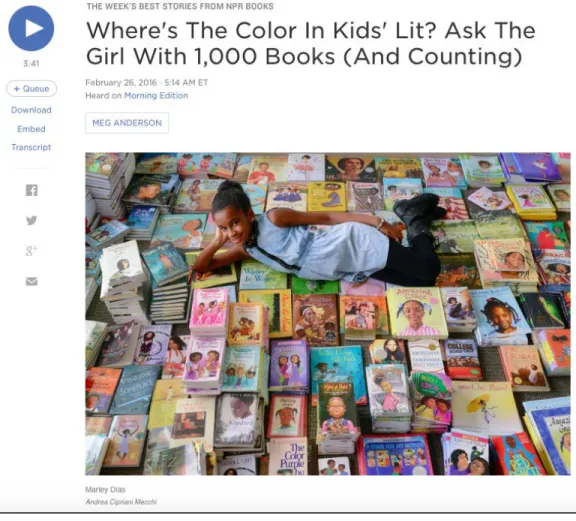
Figure 3. A National Public Radio article about Marley Dias and her quest to collect 1,000 books featuring Black girls for classroom libraries.
• A growing number of scholarly and other articles examine the issue of diverse representation in children’s literature (Broemmel, Wysmierski, & Gibson, 2014; Horning, 2015; Koss, 2015; Lambert, 2015; Moffett, 2016).
• In school and public libraries, there are users who search for diverse and minority children’s and young adult literature as a representation of the new demographics and in order to provide both “mirrors and windows” (Bishop, 1990) for youth (Cunningham, 2013; Everett, n.d.; Kane, n.d.).
1970s; yet the changes, made by the Library of Congress in response to criticism by people such as Sanford Berman, have been slower than the rate of change in popular usage—perhaps too slow for users currently seeking information from library catalogs. If users select terms for searches in online public access catalogs (OPACs) that do not match relevant Library of Congress Subject Headings, they may receive reduced or inferior search results.
Compounding the problem, because there are popular or vernacular terms used for people that have changed over time (“Asians” versus “Orientals”), or used concurrently that somewhat overlap (i.e., “Hispanic” versus “Latino”), users searching library catalogs must be aware that they need to use multiple terms in iterative searches, in order to receive comprehensive or even adequate results.
This issue has come to my attention through my experience working in public and school libraries in North Carolina. In recent years I have assisted and observed library users seeking books that represent diversity and minorities in children’s books. I have been surprised to discover that existing materials with diverse representation are sometimes difficult to find in library online public access catalog (OPAC)
searches. Library users seeking books with diverse or minority characters in library catalogs, in my observation, frequently use terminology in keyword searches that does not match Library of Congress Subject Headings. Often, OPACs do not return certain relevant results to end users, nor suggest alternate or related searches. It requires persistence, time, and a level of expertise to elicit the most fruitful responses hidden in OPACs, which remain stubbornly opaque and unresponsive to many users.
• Members of a dominant or mainstream culture may not think twice about being able to pull virtually any book off a shelf in a library or bookstore and finding the characters represent their “group,” but members of non-dominant groups do not have this experience. It has been pointed that literature ideally provides both “mirrors” of ourselves and experiences, and “windows” into the selves and experiences of others (Bishop, 1990). In childhood, when reading habits and understanding of the world are being developed, it is important to provide access to books that interest children, represent them, and help them to understand our increasingly diverse society. Further marginalizing already-marginalized diverse and minority populations by making it difficult (however unintentionally) to locate books that represent them, serves to reinforce the unfortunate stereotype that books, literacy, and education are for the dominant culture. The social and demographic changes happening now in the United States lend a sense of urgency to the situation.
• The issue speaks to the heart of the service that public libraries provide
results for existing relevant materials if they search with popular or vernacular terms rather than controlled vocabulary Library of Congress Subject Headings. In this paper I examine whether North Carolina online public library catalogs return different quantities of results for LCSH and vernacular keyword searches for children’s and young adult literature representing minority groups. A convenience sampling of ten public libraries in geographically and demographically different regions of North Carolina was selected, and their OPACs were searched with various terms for diverse and minority groups, including relevant Library of Congress subject
headings. The number of results (or “hits”) for various keyword searches of Library of Congress subject headings (LCSH) versus vernacular (non-LCSH) terms were
Literature Review
Library catalogs are difficult to use
It has long been noted that online catalog searching is difficult for many users to do effectively. As pioneer information science researcher Christine L. Borgman observed in 1986 in “Why are Online Catalogs Hard to Use?” studies “indicate that online catalog users...have difficulty performing subject searches, both in selecting terms and in executing the search, and they have problems both with increasing and decreasing the search result” (Borgman, 1986, p. 390).
Ten years later, Borgman returned to the subject with a follow-up article called “Why are Online Catalogs Still Hard to Use?” and noted that “little seems to have changed. Subsequent research studies continue to report that users have great difficulty searching online catalogs” (Borgman, 1996, Introduction section, para. 1). Noting that “searchers still bear the burden of translating their question into a precise structure that the system can interpret” she stated that most OPAC users needed help, either through the OPAC system, by a “search intermediary,” or by being given instruction on how to search (Borgman, 1996, Summary and Conclusions section, para.1). Borgman warned that despite some utility of user instruction, “good training [of end users] is not a
The Bibliographic Services Task Force of the University of California Libraries agreed, saying that “the current Library catalog is poorly designed for the tasks of finding, discovering, and selecting…resources in our libraries. It is best at locating and obtaining a known item” (Bibliographic Services Task Force, 2005). In comparison to online search engines like Google and online vendors like Amazon and iTunes, “what we fail to provide is seamlessness, simplicity, and common language searching. For the past 10 years online searching has become simpler and more effective everywhere, except in library catalogs” (Bibliographic Services Task Force, 2005).
Better trained users versus more responsive library information retrieval systems
Yet a number of librarians and others over the years have insisted that what is really needed is better information literacy training for users. For example, in “Still a Lot to Lose: The Role of Controlled Vocabulary in Keyword Searching,” authors Gross, Taylor, and Joudrey recount that “After a complaint in the Los Angeles Times in 2009 about failure of a keyword search in a library catalog,” a letter to the editor was written in response: “’If she had clicked ‘Browse Catalog,’ then selected ‘Subject Browse’ from the menu, she would have found the subject heading [for the topic sought]…’” (Gross, Taylor, & Joudrey, 2014). This point of view places the burden of knowing how to navigate a particular library catalog interface (that may seem arcane in its workings) onto the user, rather than allowing the user to receive a satisfactory result with a direct and simple keyword search.
In the meanwhile, users have become accustomed to searching online with
Search Disconnect” that “for at least the past twenty-five years, authors have noted the increasing failure of library subject arrangements to meet the needs of real users.
Librarians see that students are frustrated with libraries and have difficulty using them to access topical information. Students prefer commercial search tools to our catalogs, subject guides and library web pages” (Mellinger & Nichols, 2007, pp.134-135).
Mellinger and Nichols went on to say that “Internet search engines shape users’ understanding, preferences and behavior” (Mellinger & Nichols, 2007, p.135), quoting Holly Yu and Margo Young’s “The Impact of Web Search Engines on Subject Searching in OPAC”: “the popularity of the Web appears to have influenced users’ mental models and thus their expectations and behavior when using a Web-based OPAC interface” (Yu & Young, 2004, p.168). Because undergraduate library users are accustomed to using Internet search engines, when they search library catalogs, “they expect to find a Google-like interface” (Mellinger & Nichols, 2007, p. 135).
Controlled vocabulary and end users
case for many minority groups), the searches performed by users may receive results from OPACs that do not match all relevant library holdings.
In a task force recommendation to the Library of Congress in 2003, Marcia Bates addressed the issue of terms users search in OPACs: “An extensive body of research has documented that the range of vocabulary used by information system users is extremely wide and varied, the most popular terms seldom being used in more than 20 or 30 percent of all searches, with the total number of different terms used among a group of people found to be almost always high. Traditional cross-references seldom equal the number of search terms nor match their informality or range” (Bates, 2003, p. 2).
Earlier research done by Bates in the days of card catalogs prior to OPACs showed that the same problem existed even then: “Early academic library studies found that between two-thirds and three-quarters of all subject catalog searches were one-place searches, that is, the searcher only looked under one term and then quit--yet the data also show that searchers find what they want on the first try only about half the time” (Bates, 1977, p. 162).
This result exemplifies a finding for which there is much anecdotal evidence: When people look up a term and do not find anything under it that suits them, they assume the library does not have anything on the subject. Almost never do they assume that they need to try another term. Librarians use search terms and techniques as tools. We have learned from experience that one must often try a variety of approaches to succeed. So if one “tool” does not work, we try another. The average user, however, identifies their search term with their whole subject query. It does not occur to them that it might be called other things by the catalog. They look up their topic, do not find it, therefore the library must not have
Twenty-five years later, Bates observed that “It is a truism in the field of
psychology that people can recognize information far easier than they can recall it. The typical library catalog functions as a black box for the searcher. That is, the searcher has to produce a search phrase with no direct help from the system. The phrase is entered, then the delphic system responds with a match or a failure, seldom with any guidance on what to search for instead” (Bates, 2003, p.16). Furthermore, “It can be surprisingly difficult to come up with an alternative term if one’s first try fails. Once we have
produced a name for something we have in mind, a kind of cognitive interference sets in; it is hard to re-name the thing…there is considerable anecdotal evidence of the need to be exposed to multiple search terms” (Bates, 2003, p.16).
Minority and marginalized groups and Library of Congress subject headings
Library users seeking materials representing minority or marginalized groups face an additional hurdle in the form of Library of Congress Subject Headings for those groups. Library of Congress Subject Headings have long been criticized for bias and outdated and offensive terminology. In 1971 Sanford Berman famously led a charge against implicit biases in Library of Congress Subject Headings in his influential “Prejudices and
antipathies: A tract on the LC Subject Heads concerning people” (Berman, 2nd ed. 1993). In “Subject Accessto Diversity Materials: The Library of Congress Subject Heading Shortfall,” Karen Nuckolls observed that “For years, Library of Congress
change ethnic and racial, as well as sexual and medical headings” (Nuckolls, 1994, p. 241).
Yet many changes have been made by the Library of Congress to its subject headings in response to criticism: Steven A. Knowlton stated in 2005 that, in the three decades since Berman’s original critique, “bias in subject headings, while a continuing source of concern, has been addressed in a serious manner by the compilers of LCSH” (Knowlton, 2005, p. 128). For example, in 2016 the Library of Congress replaced the subject heading “Illegal aliens” with “Noncitizens” and “Unauthorized Immigration”:
In response to constituent requests, the Policy and Standards Division of the Library of Congress, which maintains Library of Congress Subject Headings, has investigated the possibility of cancelling or revising the heading Illegal aliens. PSD also explored the possibility of revising the broader term Aliens. It concluded that the meaning of Aliens is often misunderstood and should be revised to Noncitizens, and that the phrase illegal aliens has become pejorative. The heading Illegal aliens will therefore be cancelled and replaced by two headings, Noncitizens and Unauthorized immigration, which may be assigned together to describe resources about people who illegally reside in a country (Library of Congress, 2016, “Library of Congress to Cancel…”).
Figure 4. The Library of Congress now accepts proposals for change in Subject Headings from libraries and the public.
offend many with outdated and racist, sexist, ableist or otherwise biased terminology: Benedictine University Library’s Racial and Ethnic Groups Research Guide warns that users “will see some terms in this list that are now considered offensive or
outdated…since the Library of Congress Subject Headings are slow to change and do not always reflect current attitudes or usage” (Hopkins, 2017). Controlled vocabulary
referring to minority groups that is not in popular use may frustrate many library catalog users by making it difficult to find relevant materials hidden by obscure or outdated Subject Headings.
In “Standardization, Objectivity, and User Focus: A Meta-Analysis of Subject Access Critiques,” Hope Olson and Rose Schlegl noted existing critiques that “biases of gender, sexuality, race, age, ability, ethnicity, language and religion [may limit]
representation of diversity [as well as] effective library service for diverse populations” (Olson & Schlegl, 2001a, p. 62). In an analysis of existing research, Olson and Schlegl found that “standards tend to represent the mainstream well and [marginalized groups] poorly in spite of their sincere intentions toward objectivity of representation and user friendliness” (Olson & Schlegl, 2001a, p.62).
Amelia Koford in “How Disability Studies Scholars Interact with Subject
Koford cited Olson’s “The Power to Name: Representation in Library Catalogs” on the challenges facing those seeking minority or marginalized identity representation in libraries: “Library users seeking material on topics outside of a traditional mainstream will meet with frustration in finding nothing, or they will find something but miss important relevant materials. Effective searching for marginalized topics will require greater ingenuity and serendipity than searching for mainstream topics” (Olson, 2001b, p. 639).
Too often, “ingenuity and serendipity” (Olson, 2001b, p. 639) fail to locate relevant materials in libraries for users seeking works representing those on the margins of the dominant culture of America. Knowlton pointed out that “By utilizing the language and perspective of a particular group...LCSH can make materials hard to find for other users” (Knowlton, 2009, p. 125). Koford concurred: “Narratives from activist librarian de la tierra (intentionally not capitalized) illustrate the potential negative effects of the embedding of dominant ideologies in subject access standards. She writes that ‘Latina lesbians and all queers have the well-documented tradition of going to the library as part of critical soul-searching that precedes the ‘coming out’ process—and leaving disappointed’” (Koford, 2014, p.392).
Racial terms, too, are particularly fraught with meaning in the United States. In an online publication of ANSS, The Anthropology and Sociology Section of the
with the reality that people think in terms of race and races….the idea of race and the presence of racial prejudice persist in human culture and like many fictions, we cannot afford to ignore the power of these beliefs in human affairs, nor how to classify them for easy retrieval” (ANSS, 2011).
Emily Drabinski in “Queering the Catalog” suggested that all descriptive terms are, by nature, biased (that is, dependent on point of view) and temporary (changing over time) (Drabinski, 2013). Terminology will continue to change; and multiple terms exist concurrently. What term one person prefers to use is not the same as another person might use. While Drabinski and others share the extremely important and worthy goal of teaching users to question the very concepts of classification and authority, in the short term it may do little to help users find what they are seeking in library catalogs.
Potential solutions in the literature
Karen Drabenstott noted that “In naming new subjects, LC catalogers face a more difficult task than their predecessors because of the diversity of today's catalog users” (Drabenstott, 1999). She also noted, however, that
[a]lthough today's user population is much more diverse than the user population was in Cutter's day, today's catalogers have tools to aid in the naming of subjects that their predecessors could not have imagined. For example, catalogers can examine an online catalog's transaction log to identify user queries that fail to retrieve records; they can then determine whether these queries should be represented in the controlled vocabulary as established headings or See references. Or catalogers can analyze catalog users' answers to online
questionnaires in which users are asked questions about their interests, overall objectives, search requests, and the usefulness of search results. Before online systems, researchers and library practitioners did not have an accurate and systematic method of determining the subjects that users had difficulty finding in library catalogs. (Drabenstott, 1999).
enable users to get easily from their chosen search term(s) to the richest and most relevant contents of the catalog or database they are searching” (Bates, 2003, p.2): the development of “cluster vocabularies” that include “searcher vocabularies” of “any reasonable word or phrase (including popular misspellings)” (Bates, 2003, pp. 30-31). Clustered (related) terms in the vocabularies would be presented as linked results in OPAC search results, for improved service to users (Bates, 2003, pp. 29-37). She acknowledged that the vocabularies would require “continual updating” but not many “dramatic changes” (Bates, 2003, p. 37).
Research Question
The goal of this study is to discover whether the OPACs of ten representative North Carolina public libraries return different numbers of results for Library of Congress Subject Heading (LCSH) keyword search terms versus popular or “vernacular” (i.e., non-LCSH) keyword search terms when children’s materials representing diverse minority groups are sought. Difference in the numerical quantities of hits returned for search terms may show that users are not finding relevant existing materials in library collections that they are seeking through the catalogs. There will also be incidental examination of whether results are relevant to the intention of the search query, as judged by titles and descriptions of the items returned on search results pages.
Methodology
This paper compares the number of hits received from ten online public library catalogs of libraries in demographically diverse areas of North Carolina for keyword searches of “vernacular” (non-LCSH) terms for diverse or minority groups vs.
controlled-vocabulary LCSH in children’s materials. The study notes the quantity of results returned for the keywords including LCSH within each library OPAC. Any differences in the number of hits received in library OPACs between the selected terms may show that users could be receiving reduced results for relevant materials, depending on which search terms they select. The heads of the children’s departments in the libraries studied were interviewed to determine whether they had observed users looking for children’s materials with diverse and minority group representation; whether they were aware of any differences in the number of search results for LCSH vs. vernacular terms for
minority groups; and if they were aware of differences, whether and how they attempt to mitigate the results.
Selection of diverse and minority groups
The diverse and minority groups selected to search for representation in children’s materials in NC public library catalogs include people who are:
• African American/Black
• American Indian
• Asian
• Hispanic/Latino
• LGBTQIA
• Disabled
These diverse and minority groups do not represent all minority groups in the United States. Rather, they represent some groups of people who are either growing in number in the United States relative to the racial or ethnic majority, or groups toward whom there has been a substantial shift in public attitudes (perhaps reflecting advocacy efforts), and hence in many cases a corresponding shift in commonly used terminology. (For
example, the terms “colored” and “Negro” to denote people have given way over time in common usage to “Black” or “African American” over the last half-century in the United States.)
The selected groups of diverse and minority people in America include people of minority (non-White) races and/or Hispanic or Latino ethnicities as well as people of more than one race; non-heterosexual orientations and transgender identities (represented by the acronym LGBTQIA, or Lesbian, Gay, Bisexual, Transgender, Queer or
Questioning, Intersex, and Asexual); and people with disabilities.
this study, neither the categories of Alaska Native or Native Hawaiian and Other Pacific Islander was chosen to search for as a group in this paper.
U.S. Census data also includes a category of Two or More Races (in contrast to One Race), a rapidly growing demographic in the United States which is projected to triple in size by 2060 (Colby & Ortman, 2015, p. 9). This is the group referred to as multiracial in this study.
LGBTQ representation was selected because since the 1980s, children’s materials have included a number that represent adult characters with non-heterosexual orientations (usually of parents, but including grandparents). In addition, while the number of
children’s materials dealing with the issue of transgender identity is small, it is growing, reflecting recent awareness and some change in societal attitudes. The terms “bisexual,” “queer,” “intersex” and “asexual” were included in the searches because they are the component terms of the current LGBTQIA umbrella, although the search results may show that children’s materials have not broached these issues.
Selection of search terms
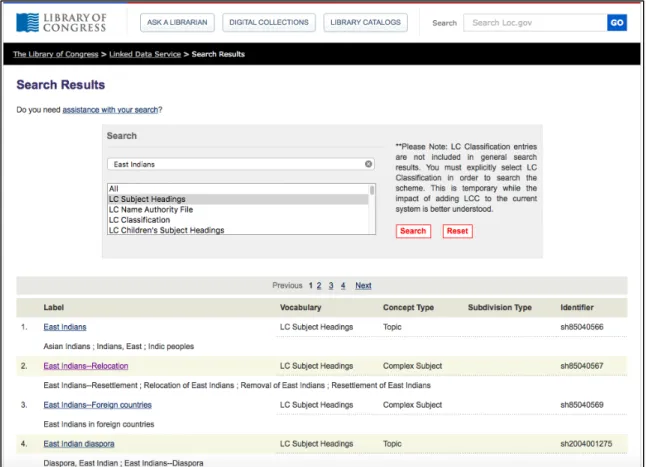
Similarly, LCSH terms selected for the groups are not all possible LC terms, but rather a representative sampling; and were derived by noting LCSH terms displayed in item records after finding items through vernacular term searches, as well as by searching the Library of Congress Subject Headings web page (Library of Congress) (see Figure 5 below).
Figure 5. Library of Congress Subject Headings can be searched on the Library of Congress website.
Table 1. Examples of term variations for African American. Types of Term Variations (Ex. African Americans)
Upper Case Singular African American Black
Lower Case Singular african american black
Upper Case Plural African Americans (LCSH) Blacks (LCSH)
Lower Case Plural african americans blacks
Hyphenated Upper Case Singular African-American Hyphenated Lower Case Singular african-american Hyphenated Upper Case Plural African-Americans Hyphenated Lower Case Plural african-americans Enclosed in Quotation Marks
"african american" or "african
americans"
Phrase black people
LCSH African Americans
Former LCSH Afro-Americans
Each table of terms in the Results section will display the term variations searched and the number of hits received for each within each library OPAC.
While exact consistency of term variations was not employed for each term in this study, the variations displayed reflect some part of the variety of terms and strategies employed by users in OPAC searches. Even seemingly slight variations of terms may be found to return different numbers of results in OPAC searches, illustrating that users are not necessarily receiving all the relevant results for their searches; especially if users search vernacular rather than LCSH terms.
It is acknowledged that searches for terms that produce little to no results may skew the average and median number of results in a category. However, it was not possible to predict which terms would receive few results or no results. Furthermore, even if terms that produce little to no results across libraries were excluded from comparisons, there might still be wide variability in the number of results received for term variants including LCSH.
Comparison of search terms through Google Trends
The number of hits vernacular and LCSH terms received in OPAC searches were in some cases compared with the relative actual usage of the terms by users searching the Google search engine in the United States. Google is most popular internet search engine in the United States, with 63.4% of market share in April 2017, much higher than its
The comparisons were made through Google Trends, an online data visualization tool that displays the relative popularity (i.e., frequency of use) of terms searched in the Google search engine over selected periods of time and in various geographic areas (Google Trends). Users can enter search terms and see trends in their popularity in Google searches, from 2004 until the present (or a smaller selected window of time); in the entire United States (or other countries, or worldwide), and by state or region. Users can compare the popularity of multiple search terms in an automatically generated chart. As only up to five terms can be compared at a time in Google Trends, a subgroup of terms must be selected out of every group of search terms. In the Search Results section of each group of terms, I will discuss why I selected certain terms to compare.
Related search queries are also shown in Google Trends, which can help to illuminate whether the intended meanings of the search terms by Google searchers were the same meanings I intended in the OPAC searches. While there is no guarantee that library users choose the search terms that are reported as more popular by Google Trends data, the data is suggestive of the search terms a user might actually use in a public library catalog.
For this paper, for each Google Trends comparison of search terms performed, I selected web searches in a time frame of 2004 until the present in the United States--the longest period of time available in the data tool.
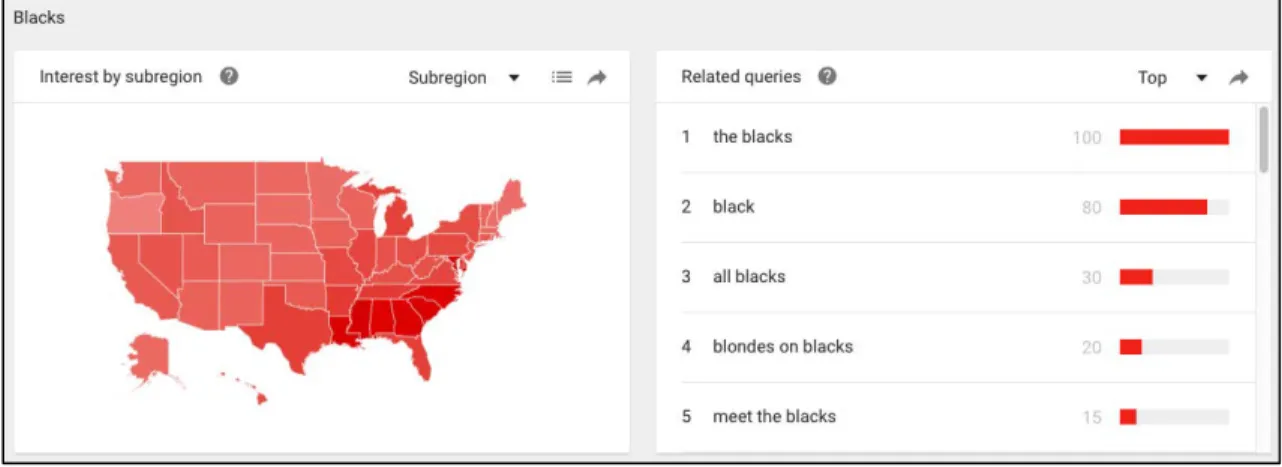
Figure 6. Google Trends displays interest in the term “Multiracial” by “subregion” (state), and the term’s related Google queries.
Google Trends can break down the popularity of search term queries by state, metropolitan region, and city as well as by country. Examining the popularity of North Carolina Google search term usage by region or city is another potential way to compare popular Internet search terms in a given area to the results of searches in the OPACs of their respective public libraries.
Selection of NC Public Libraries
For the purpose of this paper, public libraries in different regions of North Carolina were selected from U.S. Census data, based on demographic variations of population size, racial and ethnic composition, and relative poverty. Relative community poverty levels were not selected for, but nonetheless were highly variable (as discovered through U.S. Census data). Communities were selected for populations that were comparatively very large, very small, and in between; and for varying proportions of White, African
members, for example, may include more books in Spanish or about Hispanic heritage than a community with very few Hispanic and Latino members. Libraries may also add local catalog headings that reflect community interest and term usage.
The number of public library catalogs examined was restricted to 10, as a preliminary examination showed that library catalog interfaces vary widely in the steps required to perform the intended searches; and limitations of time performing the various search steps necessitated limiting the number of OPACs examined.
Performing keyword searches and recording results
After selecting groups of diverse and minority people and the LCSH and vernacular terms to represent, I searched the terms in the selected North Carolina public library catalogs. The selected terms were keyword-searched rather than subject-searched, as end users overwhelmingly choose to perform keyword searches. As declared unequivocally in the Online Computer Library Center (OCLC) report “Online Catalogs: What Users and Librarians Want,” “Keyword searching is king” (Calhoun, Cantrell, Cellentani, Gallagher & Hawk, 2009, p. 5). With 20+ years of widespread public use of the Internet, it has become common for users to perform internet searches using keywords. As noted in the literature review, this behavior has shaped the way end users search library catalogs. For this reason, I chose to keyword-search the ten library OPACs.
All catalog searches were performed online, without being physically present in the libraries.
to narrow results just to children’s materials for multiple searches, as some libraries revert to default settings for each search or after a period of time; therefore search results for some libraries may include YA materials. This may be a limitation of the study, but not a necessarily a critical flaw, as each group of terms were searched in a consistent way within each library. Thus each library’s results are internally consistent, enabling within-library comparison.
Results of library catalog keyword searches were the number of “hits” each term received, and were recorded in tables for each set of terms across the selected libraries. This study is limited to examining quantities of hits for search terms in OPACs. The number of hits for terms does not indicate any potential overlapping of results: different search terms may return some of the same items. In addition, differences found in numbers of hits for terms cannot determine how relevant the search results were to the intended search. Marked differences in numbers of hits may indicate another problem related to terminology, which is outside the scope of this study: that users may receive large numbers of results that are irrelevant to the intent of their searches, which can impede finding of relevant materials.
Because this study reports numbers of hits for search terms from library catalogs, it must be emphasized that library collections grow and shrink over time, and can change daily as items are added and removed. Therefore, the results reported in the tables represent a snapshot in time. The relative popularity of the search terms in Google Trends as reported in this study is another snapshot in time. As with the OPAC search results, the terms people use as seen in Google search data may not by the same tomorrow as they were today.
Examining the results
After performing the searches and recording the results, some vernacular terms or
variations may stand out as having a particularly high or low proportion of “hits” (search results) relative to LCSH in some or all of the libraries; or conversely, the results may show that the proportion of hits for vernacular terms relative to LCSH are much the same across selected libraries. In addition, vernacular terms may be shown to be relatively popular in Google searches compared to their relevant LCSH terms; or it may be that LCSH terms are as or more popular in Google searches as the selected vernacular terms. These results will be discussed in the Discussion section of this paper.
library catalog users searching for children’s materials that represent diverse and minority groups.
For the purposes of comparing relative proportions of hits for terms across
libraries, some terms from the tables of raw numbers (Table 2 below) will be compared in normalized charts (Figure 7 below).
Table 2. A sample table containing raw numbers of hits for terms across ten library OPACs shows that in all libraries the vernacular term “Native Americans” received fewer hits than the LCSH term “Indians of North America.”
Terms searched: Library 001 Library 002 Library 003 Library 004 Library 005 Library 006 Library 007 Library 008 Library 009 Library 010 (LCSH) Indians of North
America 264 427 474 376 238 148 31 195 391 368
Native
Americans 69 129 202 82 72 13 14 72 181 256
American
Indians 91 554 646 436 92 82 7 83 255 406
First
People 126 48 145 171 138 30 39 177 707 292
First
Nations 55 12 29 14 51 5 19 59 260 130
Figure 7. A sample chart showing a normalized comparison of hits for six terms for American Indians across ten library OPACs. Each stacked column represents 100% of the designated library’s hits for the selected search terms.
Cross-library comparison of the relative proportions of hits received for
vernacular and LCSH terms may reveal an additional problem for users: a difference in the way different OPACs handle terms.
Semi-structured interviews of librarians
Results
Final terms selected
A full listing of terms for each diverse and minority group is given in the tables of results for each group.
Libraries selected
The ten libraries selected for this study are a convenience sampling of North Carolina public libraries that represent a broad range of population size and racial/ethnic
demographics. Ranges for each demographic variable are given below, rather than data for each library, to avoid the possibility that one or more library, and thus, one or more librarian, could be identified.
Populations served by the libraries ranged from less than 1,000 to more than 400,000, with the majority serving populations between 15,000 and 250,000.
One library’s community had more than 60% of individuals living below the Federal poverty level, while four had between 10-20%, and the remaining five library communities were in the range between 21-40% of individuals below the poverty level.
In one community more than 90% of its population self-identified as White, while in another fewer than 30% did, and in the remainder between 40-75% self-identified as White.
remaining six communities, between 15-45% of their populations self-identified as Black or African American.
In one library’s community more than 10% of its population self-identified as American Indian or Alaskan Native. In the other nine libraries’ communities, less than 1% of their populations self-identified as American Indian or Alaskan Native.
In two libraries’ communities between 10-15% of their populations self-identified as Asian, while in one library’s community 0% of its population self-identified as Asian. In the remaining seven libraries between 0.5-10% of their populations self-identified as Asian.
In one library’s community 15% of its population self-identified as “some other race.” In six communities the figure was between 1-4.9% of their population, and in the three remaining communities between 5-10% of their populations self-identified as some other race.
In all ten libraries’ communities between 97-100% of their populations self-identified as one race. In all ten libraries’ communities between 0-3% of their populations self-identified as two or more races.
In one library’s community more than 20% of its population self-identified as Hispanic or Latino, while in six communities between 1-9% did. In the remaining three communities, between 10-15% of their populations self-identified as Hispanic or Latino.
Results by groups of terms
library. Each table contains 2 sections: summary data over all the term variants, and data for each specific term variant.
The top portion of each table displays the Library of Congress subject heading (LCSH) terms searched for each group and the number (N) of hits received for them in each library’s OPAC (Table 3 below). The top portion of each table also includes aggregate data to summarize the overall results for the group:
• the lowest number of hits for any term in the group of terms, including LCSH: Variant Min (N)
• the highest number of hits for any term in the group of terms, including LCSH: Variant Max (N)
• the average number of hits for the group of terms, including LCSH: Variant Average (N)
Table 3. A blank sample table of LC (N) and Variant Min/Max/Average/Median numbers of hits in NC Public Library OPACs.
NC Public Library OPAC Keyword Search Results for Children's Materials: MIN/MAX
LC (N) and Variant Min/Max/ Average/ Median (N) Library 001 Library 002 Library 003 Library 004 Library 005 Library 006 Library 007 Library 008 Library 009 Library 010 LC term (N) Variant Min (N) Variant Max (N) Variant Average (N) Variant Median (N)
Variant Min (N) and Variant Max (N) show the range of variation in the number of hits received for the terms searched. Variant Average (N) shows the average number of hits for the group of terms searched within each library, while Variant Median (N) shows that the numeric results clustered either closer to the minimum, maximum, or midpoint for the range of hits for the group of terms for each library.
illustrate whether public library OPACs are yielding similar or dissimilar numbers of hits for vernacular vs. LCSH terms for diverse and minority groups in children’s materials.
The lower portion of each table shows a full listing of each term searched and the number of hits or results received for each term by library OPAC. Terms which are Library of Congress Subject Headings are denoted by (LCSH).
Search results for Multiracial. Table 4 on the following page shows the number of results for each term representing people of more than one race searched in the library catalogs of Library 001 to 010, including the relevant Library of Congress Subject Heading (LCSH); as well as the minimum, maximum, average, and median number of results for the group of terms including LCSH.
Table 4. Numbers of hits returned for keyword search terms for Multiracial in NC public library catalogs.
NC Public Library OPAC Keyword Search Results for Children's Materials: multiracial MIN/MAX
LC (N) and Variant Min/Max/ Average/ Median (N) Library 001 Library 002 Library 003 Library 004 Library 005 Library 006 Library 007 Library 008 Library 009 Library 010 LC Racially mixed
people (N) 14 111 92 91 11 9 0 14 69 68
Variant Min
(N) 0 4 3 3 0 0 0 1 1 2
Variant Max
(N) 14 115 98 95 13 9 1 15 70 72
Variant
Average (N) 6 42 36 37 6 4 0 7 28 30
Variant
Median (N) 3.5 8 8 13.5 4 2.5 0 5.5 10 13
Terms searched: Library 001 Library 002 Library 003 Library 004 Library 005 Library 006 Library 007 Library 008 Library 009 Library 010
multiracial 0 3 6 3 0 0 0 1 1 2
biracial 2 8 11 12 1 1 0 0 7 9
interracial 5 10 14 15 5 4 0 3 10 13
mixed race 2 4 7 8 3 0 1 8 10 13
racially
mixed 13 120 100 95 13 9 0 15 70 72
(LCSH) Racially
mixed people 14 116 93 91 11 9 0 14 69 68
Figure 8. The relative proportion of hits for the various terms varied by library. The number of hits are normalized for comparison, with the measurement of 1 in the Y axis expressing the total number of hits in each library.
In the library OPACs, by far the most productive terms were the LCSH “Racially mixed people” and its closely related vernacular term “racially mixed.” The average number of hits for the whole group of terms including “Racially mixed people” and “racially mixed” was in each library half or less than half of the maximum number of hits; and the median number of hits were lower than the average.
This is in marked contrast to a Google Trends search for the same terms
Figure 9. The LCSH term “Racially mixed people” and the closely related “racially mixed” were the least popular of the five terms compared in Google Trends.
According to Google Trends, the most popular search term of the five is
“biracial,” followed by “mixed race,” then “multiracial.” The terms “racially mixed” and “Racially mixed people” tied for the lowest number of search inquiries, with 0 of the normalized queries (with the value 100 representing the highest peak of interest for “biracial” out of all the terms occurring in June of 2013).
Figure 10. Interest in “biracial” by subregion and related queries.
Similarly, both the terms “multiracial” and “mixed race” can be seen to be popular Google search terms in North Carolina, with related queries nationwide (such as “multiracial people,” “biracial,” “mixed race hair,” “mixed race people,” and “mixed race babies”) showing clearly relevant intended meaning, Figure 11 and Figure 12 below:
Figure 12. Interest in “mixed race” by subregion and related queries.
However, the terms “racially mixed” and LCSH “Racially mixed people,” which were by far the highest-yielding terms in the library OPACs, were comparatively so little searched on Google that Google Trends displayed the message “Hmm, your search doesn’t have enough data to show here. Please make sure everything is spelled correctly, or try a more general term” (Figures Figure 13a and b below).
Figure 13a and b. Interest in “racially mixed” and “Racially mixed people” did not return enough data to show in Google Trends.
pushed the normalized results of all the remaining 4 terms down drastically (see Figure 14 below):
Figure 14. The search term “interracial” was so popular on Google in the United States that it almost completely suppressed the normalized search data for the terms “biracial,” “multiracial,” “mixed race,” and “racially mixed.”
A closer look at the popularity of the term “interracial” and its related queries “interracial dating,” “interracial marriage,” “interracial couple,” “interracial couples,” and “interracial relationships” is below, and together with the term’s relative popularity nationwide, shows that the growth of the population of people of more than one race seen in recent U.S. Census data is unsurprising (Figure 15 below):
When all other terms besides “racially mixed” and “racially mixed people” are removed from the normalized comparison, Google Trends still does not show any search queries for the two terms (Figure 16 below):
Figure 16. Even without comparison to other terms, “racially mixed” and “Racially mixed people” still show too little search data to show in Google Trends.
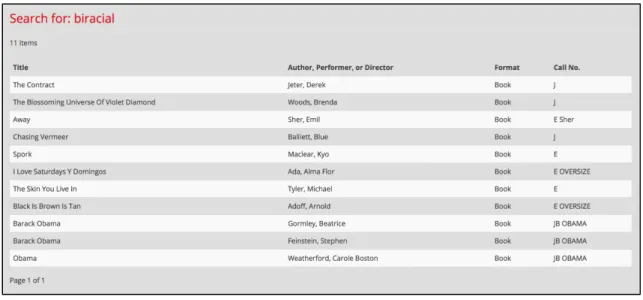
Figure 17. A list of 11 results in Library 003’s catalog for the vernacular term
Figure 18. The item summary for “Marisol McDonald Doesn’t Match” (Brown, 2011) describes the main character as biracial, yet the book did not appear in the keyword search results for “biracial” in Library 003’s catalog.
Figure 19. The second and third Marisol McDonald books do not appear in search results for the vernacular term “multiracial” in Library 003, although the catalog’s summary for those books describes the character as multiracial.
Figure 20. Library 003’s catalog describes the titular character as multiracial, yet the book does not appear in search results for the term in the OPAC.
Search results for African American/Black. Table 5 on the following page shows the number of results for each term for African American and/or Black
representation in juvenile materials searched in the library catalogs by library, including the relevant Library of Congress Subject Headings (LCSH); as well as the minimum, maximum, average, and median number of results for the group of terms including LCSH.
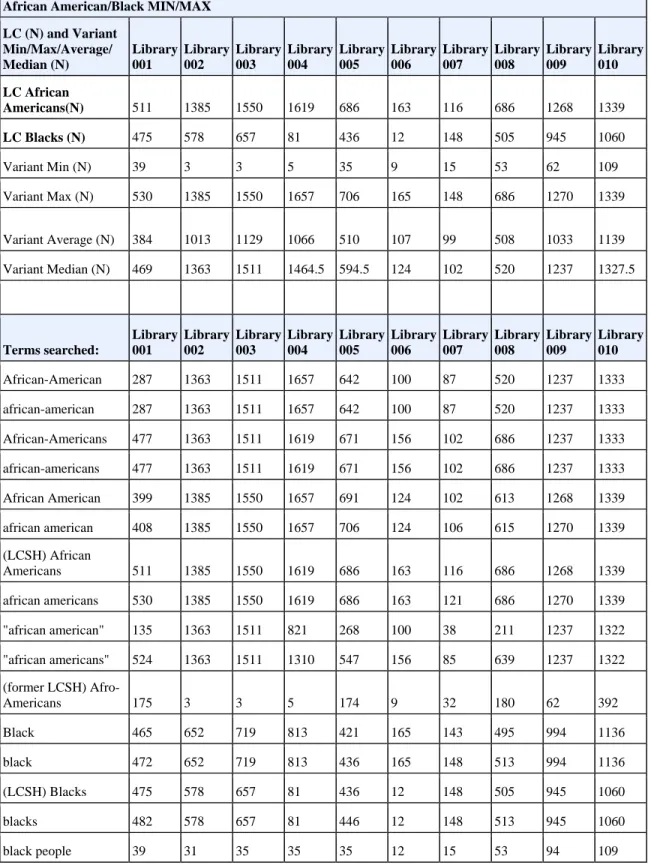
Table 5. Numbers of hits returned for keyword search terms for African American/Black in NC public library catalogs.
NC Public Library OPAC Keyword Search Results for Children's Materials: African American/Black MIN/MAX
LC (N) and Variant Min/Max/Average/ Median (N) Library 001 Library 002 Library 003 Library 004 Library 005 Library 006 Library 007 Library 008 Library 009 Library 010 LC African
Americans(N) 511 1385 1550 1619 686 163 116 686 1268 1339
LC Blacks (N) 475 578 657 81 436 12 148 505 945 1060
Variant Min (N) 39 3 3 5 35 9 15 53 62 109
Variant Max (N) 530 1385 1550 1657 706 165 148 686 1270 1339
Variant Average (N) 384 1013 1129 1066 510 107 99 508 1033 1139
Variant Median (N) 469 1363 1511 1464.5 594.5 124 102 520 1237 1327.5
Terms searched: Library 001 Library 002 Library 003 Library 004 Library 005 Library 006 Library 007 Library 008 Library 009 Library 010
African-American 287 1363 1511 1657 642 100 87 520 1237 1333
african-american 287 1363 1511 1657 642 100 87 520 1237 1333
African-Americans 477 1363 1511 1619 671 156 102 686 1237 1333
african-americans 477 1363 1511 1619 671 156 102 686 1237 1333
African American 399 1385 1550 1657 691 124 102 613 1268 1339
african american 408 1385 1550 1657 706 124 106 615 1270 1339
(LCSH) African
Americans 511 1385 1550 1619 686 163 116 686 1268 1339
african americans 530 1385 1550 1619 686 163 121 686 1270 1339
"african american" 135 1363 1511 821 268 100 38 211 1237 1322
"african americans" 524 1363 1511 1310 547 156 85 639 1237 1322
(former LCSH)
Afro-Americans 175 3 3 5 174 9 32 180 62 392
Black 465 652 719 813 421 165 143 495 994 1136
black 472 652 719 813 436 165 148 513 994 1136
(LCSH) Blacks 475 578 657 81 436 12 148 505 945 1060
blacks 482 578 657 81 446 12 148 513 945 1060
There is a wide amount of variation between the results returned for the lowest-yielding term, which in the case of 5 of the libraries was the former LCSH term “Afro-Americans,” and the highest-yielding terms, which in all the libraries but Library 007, was the LCSH “African Americans” or the variants “African American,” “african americans” or “african american.”
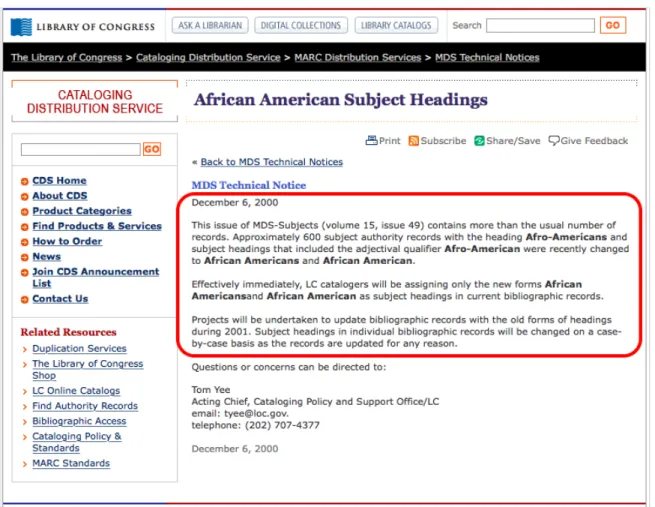
Figure 21. The Library of Congressed replaced its Subject Heading “Afro-Americans” with “African Americans” in 2000. Yet in five of the libraries studied, the older term returned a much higher relative proportion of hits than in the other five libraries.
Figure 22. Five sample terms searched across ten libraries show different proportions of hits. The chart is normalized and 1 in the Y axis represents the total of each library’s catalog hits.
The five terms selected to compare in Figure 22 above and in Google Trends were the LCSH terms “African Americans” and “Blacks”; two singular or adjectival and capitalized variants, “African American” and “African-American,” which were very similar to the first LCSH term and to each other; and the former LCSH term “Afro-American.” The hyphenated variant “African-American” was also selected to gain a sense of how frequently a hyphenated term might be used in Google searches. All vernacular terms were selected to match the capitalization of the LCSH terms.
There are clear differences in relative popularity of the five terms: “African American” has been the most popular search term of the five since January 1, 2004 (as far back as search data is displayed), with “Blacks,” “African Americans,” the
“Afro-Americans” was relatively so little-used in Google searches that it did not show any search data. (See Figure 23 below.)
Figure 23. A Google Trends comparison for the LCSH term “African Americans,” and the terms “Blacks,” “African American,” “African-American,” and former LCSH “Afro-Americans.”
Another point of interest is that Google Trends shows a clear difference in the popularity of the hyphenated search term “African-American” and the unhyphenated “African American,” while of the library catalogs, only Library 001 showed a large difference in numbers of results for the two terms (with 399 for “African American” versus 287 for “African-American”). Library 001 was the most sensitive of the ten libraries to small changes in search terms, with wide variation in results for
near-synonyms of singular vs. plural, hyphenation vs. non-hyphenation, and terms enclosed in quotation marks vs. not enclosed.
Figure 24. The Library of Congress uses the term “Negroes” interchangeably with “Blacks.”
The top three related queries to the term “Blacks” on Google are “the blacks,” “black,” and “all blacks” (Figure 25 below). When those phrases are searched on
Figure 25. The top related queries for “Blacks” shown on Google Trends.
The lower-case variant “blacks” returned the identical number of results as “Blacks” in each catalog search but Library 001’s. However, a look at the search results for the term “blacks” shows a variety of results in terms of meaning or relevancy: some library catalogs seem to return results with the same meaning as the LCSH term
Figure 27. Library 009 returned results for the term “blacks” that were mostly unrelated to the LCSH meaning of Black people: only one of the top 22 results displayed were relevant to the LCSH.
The irrelevance of many of the hits to the intended meaning of a racial group returned by some of the catalogs for “Blacks,” “blacks,” “Black,” and “black” is likely due to the ambiguity of the terms: as shown in the results of Google searches, the terms can mean a racial group, a color, and a proper name.
Figure 28. The top related queries for “African Americans” in Google searches are related to the LCSH meaning of the same term.
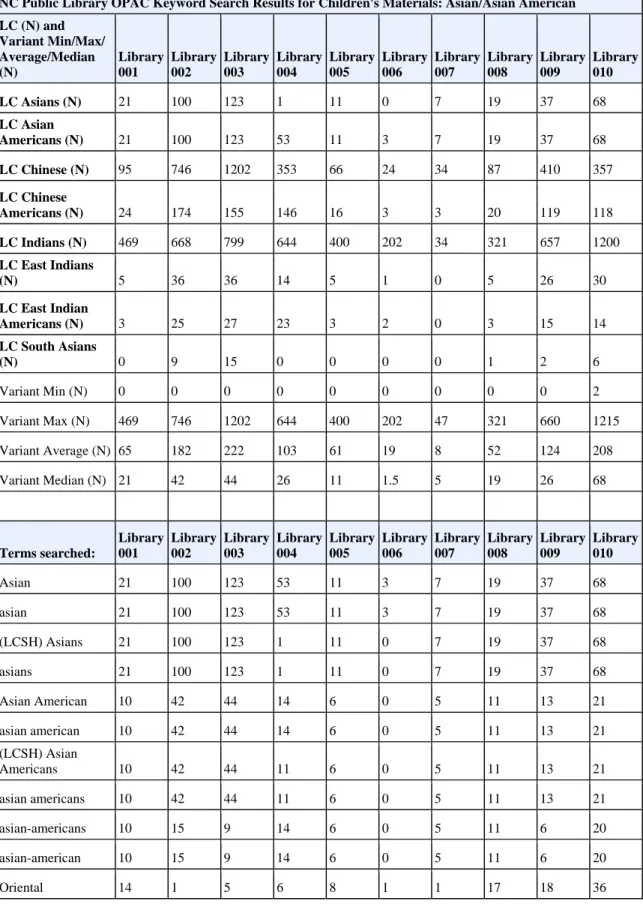
Search results for Asian/Asian American. Table 6 on the following pages shows the number of results for each term for Asian or Asian American representation searched in the library catalogs by library, including the relevant Library of Congress Subject Headings (LCSH); as well as the minimum, maximum, average, and median number of results for the group of terms including LCSH.