Anona C. Earls. Designing a Metadata Scheme for the Documentation of Data Rescue
Activities. A Master’s Paper for the M.S. in L.S degree. July,2013. 50 pages.Advisor:
Jane Greenberg
Rescuing fragile scientific data is crucial to ensuring that this data can continue to be part of the scientific process. The complementary documentation of data rescue efforts is also essential for ongoing scientific study and future data rescue. This paper reports on a study that examined how best to document and describe data rescue activities. A mixed
methods approach included a case study of 20 data rescue initiatives and a content analysis of seven descriptive metadata schemes. The results identified 13 metadata elements that were common across schemes and well suited to describing rescue projects. The findings were used to develop a core metadata scheme for the description of data rescue activities. The study was undertaken as part of the Data-at-Risk Initiative (DARI). Results of the study will help inform future DARI efforts and contribute to the knowledge base on data rescue and project-descriptive metadata.
Headings:
Metadata
Data rescue
Data at risk
Endangered data
by Anona C. Earls
A Master’s paper submitted to the faculty of the School of Information and Library Science of the University of North Carolina at Chapel Hill
in partial fulfillment of the requirements for the degree of Master of Science in
Library Science.
Chapel Hill, North Carolina
July 2013
Approved by
_______________________________________
Table of Contents
Introduction ... 2
Purpose ... 3
Literature Review ... 4
Rescue Efforts ... 5
Meteorological and Climate Data ... 6
Marine/Oceanic Data... 9
Astronomical Data ... 10
Biodiversity Data ... 11
Geological Data ... 11
Metadata for Project Documentation ... 12
The Dublin Core & Project Description ... 12
Social Science Data Description ... 14
Software Project Description ... 14
Research Questions ... 15
Research Design ... 15
Methods ... 16
Analysis ... 16
Challenges ... 17
Results ... 18
Data Rescue Activities ... 18
What is it? ... 19
Who is involved? ... 20
When & where? ... 21
Metadata Schemes ... 23
Scheme Relevance: Elements and Purpose ... 24
Element Relevance: Occurrence Across Schemes ... 28
Proposed Scheme ... 29
Final Element Set ... 31
Benefits ... 33
Limitations ... 34
Conclusion ... 34
Acknowledgements ... 36
Notes ... 37
References ... 38
Introduction
Scientific data throughout the world are at risk of being lost forever due to factors such as
degradation and improper storage conditions, format obsolescence, and a lack of
accompanying metadata. In fact, the majority of research data are not properly preserved
or archived. (Thompson, 2011) Yet, historical data very often retain scientific value, and
current scientific research draws upon data collected from previous studies for this very
reason. (Anderson et al., 2011) As Carver (2012, p. 2) points out, “knowledge of a
subject’s past conditions helps researchers create new models, forecasts, and theories,”
and historical data can thus be critical to present day scientific advancement. It is
understandable, then, that at-risk data poses a serious concern for the scientific
community.
In 2010, the Committee on Data for Science and Technology (CODATA)1, an
interdisciplinary Scientific Committee under the International Council for Science
(ICSU), appointed the Data at Risk Task Group (DARTG)2 to work in the general area of
data rescue. (Nordling, 2010). A major goal of DARTG has been to create an inventory
of scientific data that is at risk of being lost to posterity. (CODATA/DARTG)The
prototype Data-at-Risk Inventory3 was built using the web publishing platform Omeka
and was officially launched via a partnership between DARTG, the University of North
Carolina at Chapel Hill’s (UNC) Metadata Research Center4
Center, DARTG and the Metadata Research Center together formed a student working
group called the Data-at-Risk Initiative (DARI)6 to further spearhead this effort. Another part of this work was to collect information on data rescue. This secondary task led
DARTG and DARI to recognize a need to document the efforts being put forth to rescue
endangered datasets in a structured way, and the inventory is now beginning to expand its
focus to describe these efforts. However, there currently exists no standard way to
document or describe rescue efforts or projects per se. This paper addresses the need for a
standard descriptive scheme and explores the core descriptive elements needed to
describe data rescue activities. Three guiding questions focused on metadata and data
rescue needs, as stated in the Research Questions section of the paper, are investigated to
this end.
Purpose
The purpose of this study is to design a core metadata scheme to be used in the
description and digital documentation of scientific data rescue activities. While there
have been efforts to design metadata schemes for the purpose of describing rescued
scientific data, approaches to describing the activities undertaken to rescue the data
remain largely unexplored. At present, there exist very few (if any) metadata schemes
designed to describe and document the characteristics of a project as an entity. The new
scheme will consist of elements that reflect the major defining characteristics of data
rescue activities in general. These rescue activities may include both specific projects and
scheme will be directly applied to the description of several data rescue projects, which
will be documented online through DARI’s rescue mission repository.
Literature Review
Faced with the problem of at-risk data, scientists and information professionals have
begun to undertake efforts to rescue these data in danger of being lost forever. Initial
efforts must as a matter of course involve data archaeology, or “the process of seeking
out, restoring, evaluating, correcting, and interpreting historical data sets.” (Levitus,
2002) Once the data have been located and properly cared for in their original form, the
data rescue can begin. In WCDMP Report No. 49, the World Meteorological
Organization (WMO) defines data rescue as “the ongoing process of preserving all data
at risk of being lost due to deterioration of the medium and digitizing current and past
data into computer compatible form for easy access.” (as cited in Diwakar, Kulkarni, &
Talwai, 2008, p. 139) The WMO (WCDMP Report No. 49) adds further specifications
for continued preservation: 1) data should be stored as image files onto media that can be
regularly renewed (cartridges, CDs, DVDs, etc.); 2) data already in computer-compatible
media should be constantly migrated to storage facilities that conform to changing
technologies; and, 3) data should be key-entered in a form that can be used for analyses.”
(as cited in Page, et al., 2004) Documentation through metadata “is integral to this work
and essential for measuring and assessing high priority data preservation cases.”
Today, these rescue practices are being carried out by a broad array of organizations and
individuals from a number disciplines.Groups such as CODATA and DARTG have
spearheaded rescue efforts at the broadest level, working to illustrate the problem of
at-risk data through a multi-national Inventory of at-at-risk data from across scientific
disciplines. The World Meteorological Organization (WMO) and the National Oceanic
and Atmospheric Administration (NOAA) provide a driving force behind many current
rescue projects and initiatives within the realms of atmospheric, climate, and
environmental data. The USGS is another major organization behind data rescue efforts
within the geological sciences. Smaller-scale efforts are also being carried out around the
globe, in locations as diverse as China, Belgium, Cuba, and France. Even crowdsourcing
projects for data rescue are now underway via the Web. Such projects include Old
Weather7, a ‘citizen science’ project aiming to research historical weather variability; Data Rescue at Home8, a historical weather data digitization project involving volunteers
and weather enthusiasts; and the Canadian Historical Data Typing Project9, a volunteer
effort to type up historical weather data from early Canadian observers.
Rescue Efforts
Many present day data rescue activities fall under one of several broad categories
correlating to scientific disciplines – in particular, disciplines in which research often
depends on historical data and information indicating changes over time. This section
provides an overview of various data rescue efforts in the areas of Meteorology &
Climatology, Oceanography, and Astronomy, as well as additional efforts relating to
Meteorological and Climate Data
Numerous ongoing rescue endeavors exist in the areas of meteorology and climatology.
The World Meteorological Organization (WMO) Data Rescue projects and initiatives
(DARE) is an overarching program that collaborates on a number of other initiatives,
including the Expert Team Data Rescue (ET-DARE), the Atmospheric Circulation
Reconstructions over the Earth (ACRE) Initiative, the NOAA Climate Database
Modernization Programme (CDMP), the International Environmental Data Rescue
Organization (IEDRO), and the MEditeranean climate DAta REscue initiative
(MEDARE). Each of these efforts is focused on the preservation and digitization of
climate data into computer compatible form, defining data rescue as “the ongoing process
of preserving all data at risk of being lost due to deterioration of the medium and
digitizing current and past data into computer compatible form for easy access.” (World
Meteorological Organization)
The Pacific-Australia Climate Science and Adaptation Planning Program (PACCSAP),
which is a part of the International Climate Change Adaptation Initiative (ICCAI) and
operates under the government of Australia’s Bureau of Meteorology, conducts data
rescue and digitization of climate records as they relate to climate change. Small islands
are facing serious challenges with respect to climate change, and those in the Pacific
region are no exception. There is very limited specific scientific information available to
the countries comprised of these islands, and better scientific knowledge is urgently
needed to adapt and plan for their future. PACCSAP is actively working with 15 partner
examination of past climate trends and variation and by providing regional and national
climate projections. (PACCSAP) Among the project’s goals are security of national
climate records for current and future climate study and applications, more efficient data
management, higher quality data, more efficient data rescue and data entry, better data
availability and improved data analysis, [and] increased availability of historical data
through data entry and data rescue efforts. (Martin et al., 2012)
Another rescue effort within the realm of climatology focuses on the ISCCP B1 data
record, which refers to geostationary imagery that has been collected from satellites
around the world as a part of the International Satellite Cloud Climatology Project
(ISCCP) since 1983. The data are archived at the National Climatic Data Center (NCDC),
which is a part of the NOAA. The NCDC began data rescue efforts in 2003, though by
this time the data were largely unusable, with issues such as unknown formats/lack of
format documentation, a lack of software for reading the data files, and nonexistent read
and write routines. (Knapp, 2008) The rescue efforts have resulted in the successful use
of some ISCCP BI data in additional scientific work studying tropical cyclones, and may
also be used to study topics such as rain fall and cloud cover in the future. (Knapp, 2008)
In their description of solar radiation data rescue at Camag ey, Cuba, Antu a et al.
(2006) note that a considerable amount of some countries’ climate data remains in the
form of paper records, despite an abundance of global-scale digitized information.
Because these records are at risk of being lost forever, efforts such as those at Camag ey
Camag ey project is focused on rescuing the solar radiation measurements dataset
collected there over a period of more than 30 years. Due to a lack of funding for
computer equipment, the project has developed a low-cost data rescue plan based on
older, out-of-service PCs. Work to rescue the data involves entering the original
observations, as well as developing the software to process the observations, controlling
uality, and improving the original manual processing in order to engage the complete
research cycle. (Antu a et al., 2006) The project is illustrative of a meteorological data
rescue project functioning successfully in a less developed country, without support or
leadership from an international organization, using scare resources and only basic
technology, and relying on local e pertise. (Antu a et al., 2006)
Additional efforts to rescue and preserve climate data are being carried out in India. Over
the past 80-90 years, the Indian Meteorological Department has taken and recorded
observations of on barometric pressure, temperature, and humidity, and transcribed them
onto preset paper forms called autographic charts. These charts are now held by the
Indian Metropolitan department but are at risk of being lost due to the medium’s rapid
deterioration. Because analyzing and compiling data from the charts is very time
consuming and prone to human error, the rescue project has worked to develop methods
of automatic extraction and storage of the endangered atmospheric data through use of
image processing tools, with a focus on speed, accuracy and space. The Autographic
Chart Data Extraction (ACDE) software has been developed for this purpose. (Diwakar,
Marine/Oceanic Data
A number of rescue activities are focused on historical data relating to the world’s
oceans. The Global Oceanographic Data Archeology and Rescue (GODAR) Project is
one major endeavor in this area, initiated in 1993 under the UNESCO Intergovernmental
Oceanographic Commission (IOC). Before the widespread use of computers,
oceanographic data were recorded in the form of manuscripts, data reports, and card
index files. As electronic data storage became more prevalent, oceanographic
observations were increasingly recorded on magnetic media such as tapes and disks.
However, these media have been subject to degradation over time, resulting in the loss of
unique data in some instances. (Levitus, 2002) The GODAR project is working to locate
and digitize or otherwise copy to modern electronic media historical oceanographic data
sets (pre-1992) that are at risk of loss due to media decay, and “to incorporate them into a
global, comprehensive, integrated, scientifically quality-controlled database with all data
in one uniform format.” (Levitus, 2012, p. 46)
The EUR-OCEANS (EURopean research on OCean Ecosystems under Anthropogenic
and Natural forcingS) network has also supported several data rescue projects. One such
initiative has focused on Southern Ocean data rescue, addressing a range of data from
research cruises that sailed between 1925 and 1985. The project has successfully
retrieved valuable data on the biological components of the Southern Ocean ecosystem.
Another effort within the marine sciences is the Coastal and Estuarine Data/Document
Archeology and Rescue (CEDAR) initiative, backed by NOAA. CEDAR aims to “collect
unpublished data and documents on the marine ecosystem; convert and restore
information into electronic and printed form, and distribute it electronically to the
scientific community, academia and the public.” (Pikula, 2001) As the project’s name
indicates, this effort is specifically focused on coastal and estuarine related documents
and data.
Efforts have also been put forth towards rescuing historical marine data in Belgium. With
the financial support of the Belgian Science Policy, the Belgian Marine Data Centre
launched a 2–year project aimed at identifying Belgian historical marine data recorded on
media at risk and rescuing as many of these data as possible. The project specifically
focused on data collected during two multi-disciplinary scientific programs. As with
many data rescue projects, these efforts will be particularly helpful in cases where
evolution over time is under scientific consideration. (Borremans, 2010)
Astronomical Data
Several important rescue projects are focused on the preservation of astronomical plates
and the valuable data recorded on them. One project addressing astronomical plate
collection and preservation in China began in 2008. Plates from five observatories were
physically relocated to a controlled environment, and efforts are now underway to
digitize the plates and represent them via an online catalogue. (CODATA/DARTG)
Belgium as well. Wide-field photographic plate images taken throughout the course of
the 20th century, which are in danger due to aging emulsions, are being digitized in an effort to both preserve the data and make the information contained in the images widely
accessible. Additionally, the Observatory initiated the UDAPAC project, which entailed
acting as host to the endangered plates themselves. (CODATA/DARTG) The Dominion
Astrophysical Observatory, a part of the Herzberg Institute of Astrophysics in Canada, is
also making progress in astronomical plate preservation. These efforts have included the
scanning of archival materials, and updates to data acquisition hardware and software.
(CODATA/DARTG)
Biodiversity Data
Many important rescue efforts have been pursued within additional scientific domains.
The reBiND project is a complementary effort to direct data rescue. he focus of the
project is on developing an efficient and well-documented workflow for rescuing legacy
biodiversity data. ( ntsch et al., 2012) he workflow consists of “phases for data
transformation into contemporary standards, data validation, storage in a native ML
database, and data publishing in international biodiversity networks.” ( ntsch et al.,
2012, p. 752)
Geological Data
The U.S. Geological Survey (USGS) has sponsored a data rescue program focused
and make accessible legacy USGS scientific records at risk of being lost or in need of
greater accessibility.
(CODATA/DARTG) Various projects have been executed under the USGS data rescue
program, addressing historical images of Alaskan volcanoes; diagnostic records for
wildlife disease; expansion of the USGS Landsat archive; historical files from federal
government mineral exploration-assistance programs, 1950-1974; water resources
records available only in USGS archives; and historical files from USGS North American
bird phenology program (BPP), 1880–1970. (U. S. Geological Survey, 2012)
Metadata for Project Documentation
Four guiding principles for the creation of a new metadata scheme are that it be 1)
simple; 2) broadly applicable across a range of projects, approaches, or missions; 3)
sufficiently describe the project, approach, or mission; and 4) extensible (implementation
takes future growth into consideration). (Anderson et al., 2011) Additionally, it is
important that the terms and phrases used to create content in metadata records should
reflect appropriate and accepted vocabularies within the corresponding community or
institution. (DataONE) This section provides an overview of the seven metadata schemes
analyzed for this study, in light of best practice guidelines and the schemes’ applicability
to the description of projects.
The Dublin Core & Project Description
The Dublin Core Metadata Initiative (DCMI) Metadata Element Set, Version 1.1 (Simple
important primary source for basic, broadly applicable metadata elements. This point is
corroborated by Mourkoussis et al., who point out that the Dublin Core “is of importance
for resource discovery across domains and hence of great relevance to any system
proposing information retrieval over the Internet. It is also pertinent to issues of
interoperability and information e change.” (2003, p.2) The Digital Library Federation
encourages the use of Simple Dublin Core as well, along with other supplemental
metadata formats as necessary. In addition to the core element set, the DCMI Metadata
Terms provide additional options for descriptive characteristics.Along similar lines, the
Goddard Core is a metadata element set developed to support evaluation and resource
discovery of project-oriented information across the project libraries of NASA’s oddard
Space Flight Center (GSFC). (Hodge, Templeton, & Allen, 2005) It is based on qualified
Dublin Core, with e tensions. Beyond the SFC, the scheme’s applicability for general
use with project-oriented information “has been discussed with other NASA Centers,
other U.S. Government science agencies, industry and non-governmental organizations
internationally.” (Hodge et al., 2005, p.22)
The Archaeology Data Service (ADS) and Digital Antiquity have collaborated on a series
of Guides to Good Practice, including information on providing project metadata.
Specifically, the Guide defines project-level metadata as that which is recorded at a broad
level for an entire project/archive and incorporates descriptive and resource discover
metadata. The basic Dublin Core metadata elements form the foundation of the ADS
project-level metadata. (ADS/Digital Antiquity)The RSLP Collection Description
Programme (RSLP) and is also based on Dublin Core where possible. (Johnston, 2002)
Because this scheme is another used to describe collections, or "an aggregation of
physical and/or electronic items," only some of the elements will apply to a project as a
whole.
Social Science Data Description
The Data Preservation Alliance for the Social Sciences (Data-PASS) is a voluntary
partnership of organizations aiming to archive, catalog and preserve social science
research data that is at risk of being lost. As a part of these efforts, Data-PASS has
drafted a document outlining the project’s metadata re uirements. (Data-PASS Project)
The Data-PASS scheme focuses on studies and their corresponding data.The ISLE
Metadata Initiative (IMDI) has outlined a metadata scheme designed to describe
“multi-modal multimedia and written language corpora.” (IMDI Part 1) It was designed for the
linguistic community, who often needed a more extensive and specialized set of elements
than a scheme such as Dublin Core could currently provide. (IMDI Part 1) However, like
the Data-PASS scheme, only a few of the IMDI metadata elements are mandatory. Again,
this is a specialized scheme for a particular community’s use, and it is important to note
that it is also designed to describe “corpora” rather than a singular item.
Software Project Description
An examination of Apache Maven, a software project management and comprehension
tool, provides guidance on project related metadata. The software itself is based on the
Maven: an XML representation of a Maven project. (Apache Maven Project) The Apache
Maven guidelines on project metadata outlines the recommended eight metadata elements
that should be provided for a project. DOAP (Description of a Project) uses an RDF
Schema and XML vocabulary to convey semantic information about open source
software projects. Although its focus is specific to software projects, the scheme is useful
in that it focuses on the projects as entities. he tool “sbt,” used to build within Scala and
Java, also outlines some of the basic metadata elements to be used for a project. (sbt
Documentation) Like Maven, some of its elements are specific to software but are
pertinent in that they relate to the description of a whole project.
Research Questions
1) What are the major descriptive characteristics of known data rescue activities?
2) What existing metadata standards can be applied to describing a project as a whole?
3) What metadata elements are essential for describing data rescue projects in particular?
Research Design
The study was designed as a survey of the current landscape and state of the area of data
rescue activity description. A mixed methods approach included a case study to examine
20 data rescue projects and programs, a review of best practices in the application of
descriptive metadata, and a content analysis of seven metadata schemes relating to
preservation and data description. The initial aim in this approach was to determine what
was still needed. The ultimate goal, after accomplishing these objectives, was to produce
a core metadata scheme based on a synthesis of the findings.
Methods
Data were collected through a review of the relevant literature in the areas of data rescue
and descriptive metadata. The review included literature detailing 20 examples of data
rescue activities, best practices in the application of descriptive metadata, and seven
metadata schemes relating to preservation and data description. Keyword searches used
to gather the literature were done through UNC’s Articles+ (Summon), oogle, and
oogle Scholar. Search terms included: “endangered scientific data rescue,” “scientific
‘endangered data’ rescue,” “scientific ‘data at risk’ rescue,” “description ‘project
information,’” “documentation ‘project information,’” “archiving ‘project information,’”
“project description,” “project description schema,” “project description vocabulary,”
“project description schema,” “metadata for project documentation,” and “project
documentation.”
Analysis
A number of schemes were initially considered for this project’s analysis, with seven
being deemed most applicable to the study’s purpose.The metadata elements comprising
each scheme were compiled in a spreadsheet along with their descriptions for analysis.
Major descriptive characteristics of each data rescue project or program were compiled in
a separate spreadsheet for analysis and comparison. The data were then analyzed to
elements within and across the two spreadsheets were collected, compiled, and
consolidated to form a set of elements. These elements make up the new proposed core
metadata scheme for data rescue activity description. A beta-test implementing the new
scheme through the DARI online inventory will provide continued analysis of the
efficacy of these results.
Challenges
One initial challenge in the selection of appropriate sources was to distinguish between
metadata that would describe a rescue project as a whole versus metadata that would
describe the data being rescued. For example, it was difficult to draw the line as to where
a description of the scientific subject area of the data should fall, and whether it should be
reflected in the description of the project or was instead related to the data itself. In this
case, the solution was to include ambiguous descriptive information under the Notes
element, since it provides important supplemental information but does not explicitly
define the project itself.
Locating metadata for the description of an activity or project as a whole in itself also
proved to be a challenging task, as this does not appear to be a major focus among
metadata schemes. Even metadata relating to “project documentation” tended to address
the documentation of a project’s steps and progress, rather than an after the fact
description. However, some schemes do touch on projects to some degree, and others
such as Dublin Core are general enough to have lent a number of useful elements to the
Distinguishing between projects and programs for data rescue also presented a minor
challenge, primarily because it added a previously unanticipated layer of complexity to
the study of these activities. In the end, it did not greatly affect what was required for
description of the activity.
Results
Data Rescue Activities
Current data rescue activities tended to fall into one of a few broad scientific categories,
notably climatology, oceanography, and astronomy. This result is consistent with the
typical context in which historical data preservation is most urgent and valued, as these
disciplines in particular often rely on historical data in order to track changes over time.
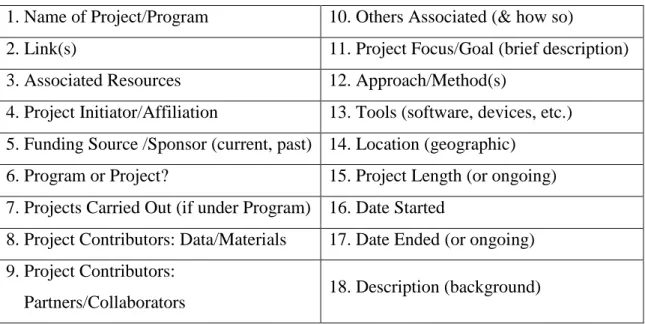
There were many overlapping descriptive characteristics for the rescue activities
analyzed. These had the potential to be grouped into several broader categories, equating
to a more minimal set of elements, or divided into more granular categories, forming a
more extensive and nuanced element set. This section discusses the major characteristics
found to be relevant to the description of data rescue activities according to the nature of
the activity, who has carried it out, and when (and where) it has taken place. The section
concludes by commenting on the current state of self-documentation on the part of these
rescue activities overall.
What is it?
The project or program name was the first descriptive element identified for all activities
(MEDARE), have established titles, while others, such as the Astronomical Plate
Collection and Preservation in China project, are referred to informally according to their
particular undertaking. Nevertheless, the Name or Title descriptor was an essential
descriptive element for identification purposes. Many of the data rescue endeavors
examined also have some form of documentation online, so Link was another important
aspect to the identification of projects overall. A few of the projects examined had other
associated resources – for e ample, the US S Data Rescue Program’s Toolkit for
Managing Electronic Records – which also have the potential to be noted as supplemental
description.
A basic description of a rescue activity is also pertinent to its documentation in nearly all
cases. Many projects were introduced in their literature according to the driving goal or
focus of the endeavor; for e ample, to “preserve and digitize climate data into computer
compatible form.” (WMO DARE) hus, Project Focus or Goal served in most cases as
an accurate and workable summary description of the rescue activity as a whole. An
additional aspect of most projects is their approach to the data rescue and methods for
accomplishing the rescue and preservation efforts, such as the controlled storage
conditions, online metadata cataloging, and plate digitization implemented by the
Astronomical Plate project in China. Some rescue efforts also detailed specific software,
machinery, or other tools used in preservation and rescue efforts, as in the case of the
Camag ey, Cuba project’s low-cost methods of data transfer via older computer
operating systems. Approach/Method(s) on the whole was an important descriptive aspect
important component of many of the activities examined, given the complex history and
makeup of some endeavors. For many, such as the GODAR project, the Background
Description element also provided an opportunity for the data being rescued to be noted
and discussed.
Throughout the analysis, it became useful to classify the rescue activities according to
type of endeavor. While some of the endeavors were projects focused on a particular set
of data or materials for rescue, others were broader programs established to undertake
data rescue within a scientific discipline and oftentimes had various projects being carried
out under the overarching initiative. The Project/Program distinction had little effect on
the necessities of activity description overall, as both tended to have essentially the same
major characteristics, but it was highly useful in terms of understanding the activity being
examined and how it related to other endeavors – for example, the Southern Ocean Data
Rescue project exists under the umbrella of the EUR-OCEANS Data Rescue program.
Identification of an activity’s relationship to any others, whether broader or narrower in
focus, provided additional layers of description when applicable.
Who is involved?
There are generally many different individuals and organizational bodies involved with a
data rescue endeavor. Several distinct roles emerged from this study’s e amination of
rescue activities; however, there was a tendency for roles to blend, vary by project, or
remain unclear based on the information available Common questions included: ‘Was the
the project?’ By necessity each project or program did have an Initiator: one or more
individuals or an organization behind putting the project into action. In most cases there
was also the need for a Sponsor or source of funding (and in some cases the source
changed over time for a given project, as in the case of IEDRO). Frequently, the initiating
body and the funding body were one and the same, especially in the case of a large
program such as WMO DARE. In addition to those undertaking the project, there were
many instances of secondary involvement, such as those contributing data or materials, or
other project partners or collaborating bodies not connected with undertaking the work
directly.
When & where?
Dates are another useful and often essential characteristic of data rescue activity
description. All current and former efforts necessarily have a date of initiation, at least
roughly, which can be used to place them in a temporal context. A majority of the
projects examined were ongoing and had no end date or time limit established; however,
the date of completion is an equally important temporal marker and was noted when
applicable. Geographic location was a distinguishing characteristic for some rescue
activities, such as the solar radiation data rescue project in Camag ey, Cuba. However, it
was not an applicable descriptor for many others, such as WMO DARE or the GODAR
project, which are global efforts and are focused on the type of data rather than a specific
1. Name of Project/Program 10. Others Associated (& how so)
2. Link(s) 11. Project Focus/Goal (brief description)
3. Associated Resources 12. Approach/Method(s)
4. Project Initiator/Affiliation 13. Tools (software, devices, etc.)
5. Funding Source /Sponsor (current, past) 14. Location (geographic)
6. Program or Project? 15. Project Length (or ongoing)
7. Projects Carried Out (if under Program) 16. Date Started
8. Project Contributors: Data/Materials 17. Date Ended (or ongoing)
9. Project Contributors:
Partners/Collaborators 18. Description (background)
Table 1. Descriptive categories initially determined via analysis of defining aspects of data rescue activities.
At present, data rescue activities primarily are being documented and described through
scholarly articles and/or an online presence. While some rescue activities are well
documented, there are others for which information is scarce. The level of documentation
and description tended to correlate with the scale of the activity and the reach of the
entity backing it. The GODAR project, for example, which is affiliated with NOAA, is
widely publicized and well documented, whereas much less has been written regarding
projects such as the Royal Observatory of Belgium’s astronomical plate rescue, which
operates unto itself. The end-goal data repositories of some efforts may also be
considered a part of their “documentation” – for example, the Astronomical Plate project
in China’s plan to create an online catalog of digitized plates.
Although many data rescue activities are well documented on an individual level, there
or database, of rescue activities. The need for such a directory was acutely apparent
throughout this study as challenges initially arose in discovering and correctly defining
many of the activities surveyed. This type of compilation would also likely serve as a
useful resource for the scientific community as a whole. Such an overview would allow
for a greater opportunity to view the whole picture of data rescue efforts and provide
important insight into the nature of these efforts via a synthesis of their descriptions. This
added perspective could contribute to increased awareness and use of rescued data, as
well as further progress with respect to data rescue initiatives in the future.
Metadata Schemes
There are very few, if any, metadata schemes designed to describe a project, activity, or
endeavor as a whole. Within the science realm, schemes have more commonly been
designed to describe the data that resulted from a study or project, rather than the project
itself. Outside of the sciences, schemes similarly tend to describe materials or information
as opposed to a project or activity. This section first discusses each of the schemes
analyzed and their elements in light of their relevance to data rescue project description,
and follows up by discussing the elements relevant to data rescue project description that
were found to recur across schemes and guidelines.
Scheme Relevance: Elements and Purpose
Seven metadata schemes were selected for final analysis and synthesis into a proposed set
of elements for the description of data rescue projects. Included in the analysis were: the
schema, the Dublin Core Element Set v. 1.1 & the DCMI Terms, the Goddard Core, the
IMDI scheme, and the RSLP Collection Description Schema. Several best practices and
guidelines for descriptive metadata were also considered, and the essential descriptive
categories outlined were compared with the element sets from the schemes analyzed.
The Dublin Core Element Set, Version 1.1 was the most broadly applicable scheme and
seven of its 15 elements were determined to be relevant to data rescue activity
description. These were Title, Creator, Subject, Description, Publisher, Contributor, and
Date. When the extended DCMI Terms were considered alongside these, the Dublin Core
offered 10 applicable element categories. These included spatial to represent Geographic
Location; source, isPartOf, or isVersionOf to represent Associated Resources; and
identifier or bibliographicCitation to represent a citation or URL.
The Data-PASS metadata requirements outlined 9 elements relevant to data rescue
activity description. The Data-PASS scheme focuses on studies and their corresponding
data, which differs slightly from project description and is broader insofar as it includes
data description. However, a majority of the elements (Title, Author, Description,
Identifier, Publication Date, Subject, Data Sources, Time Period, Collection Date, and
Geographic Coverage) have the potential to apply to the description of projects as well.
There could also be potential to draw upon this scheme in the future, if rescue activities
The Goddard Core scheme is made up of a significant number of elements that may
easily be applied to rescue project documentation as well, including Title, Creator,
Creator.Organization, Subject.MissionsProjects, Subject.Competency,
Subject.Instrument, Subject.BusinessPurpose, Subject.Industries, Subject.Uncontrolled,
Description, Date.Created, Identifier.URL, Source, and Coverage.Spatial. Combined into
more general categories, these elements address eight applicable element types for rescue
activity description, including Title/Name, Description, Creator/Author, Dates,
Geographic Location, Associated Resources, Subject Keywords, and Unique ID. Because
this scheme was created for information pertaining to the Goddard Space Flight Center, it
has some granular elements that differ from the specifics of data rescue endeavors. Yet,
it’s underlying design goal to support evaluation and resource discovery of
project-oriented information has resulted in many aspects that are applicable to this study.
The Archaeology Data Service Guidelines have seven elements relevant to data rescue
activities. Because the Archaeology Data Service scheme was designed to apply to
archaeological data, some elements are not applicable to scientific data or to projects as a
whole. However, a number of the elements (Project Title, Description, Subject, Creators,
Contributors, Source, Dates) are applicable to projects across disciplines, including data
rescue efforts.
Six elements from the RSLP Collection Description Schema were found to be relevant to
rescue activities. The schema was designed to describe collections, and thus differs in
both collections and projects could be considered to be types of “bodies” of information.
In particular, several of the scheme’s eneral Attributes (Title, Identifier, Description,
Note, Location, Concept) are applicable in a project description context.
The IMDI scheme offered five applicable elements. This scheme, which was designed to
describe multimedia and bodies of written language within linguistics, differs
significantly in focus from that of data rescue activity description. Yet, much like the
RSLP scheme, similarities can be found in terms of the description of a “body.” Many of
the elements (including Name, Title, Date, Creator (Name, Contact, Description), Project
(Name, ID, Description)) are similar in a general sense to what is needed for the
description of a data rescue project.
Lastly, the four elements from the DOAP scheme were applicable to rescue activity
description. Despite its specified focus on software projects, examination of the scheme
and comparison to the description requirements of other projects proved fruitful to some
degree. DOAP Properties in particular have some potentially useful elements for rescue
description, including name, homepage, created, short description, description, and
helper.
Apache Maven, a software project management and comprehension tool, offers
guidelines on project related metadata, including eight standard elements that should be
provided. Although some of these elements are specific to software projects, some
generalizable and add to the knowledge of what is necessary for useful project
description. he tool “sbt,” which is used to build within Scala and Java, outlines some of
the basic metadata elements to be used for a project.Similar to Maven, some of the
elements in this framework are software specific, but many (Name, Organization,
Homepage, StartYear, Description) provide general guidance in standard project
description.
The Massachusetts Institute of Technology (MIT) Guide on Data Management and
Publishing also provides a list of general aspects that should be documented for a project
or project data. These include Title, Creator, Dates, Location, Data Processing, and
Sources. Similarly, the Digital Library Federation (DLF) Best Practices for Shareable
Metadata outlines a list of Recommendations for Classes of Data Elements, including
Titles, Names, Dates, Subjects/Topics, and Geographic Places.
The Goddard Core, Dublin Core, Data-PASS requirements, and ADS guidelines offered
the four most applicable schemes for the description of data rescue activities. These were
the most developed towards describing a project or program, as evidenced by their
variety of relevant elements. Notably, two of the schemes are based on Dublin Core
where possible, and even Data-PASS uses Dublin Core as a starting point of comparison.
As a major standard in the field of metadata, Dublin Core is certainly useful in many
ways for data rescue description. At the same time, it is important to note that Dublin
some cases therefore, description with Dublin Core alone lacks some of the finer nuances
that are desirable in detailed description of data rescue.
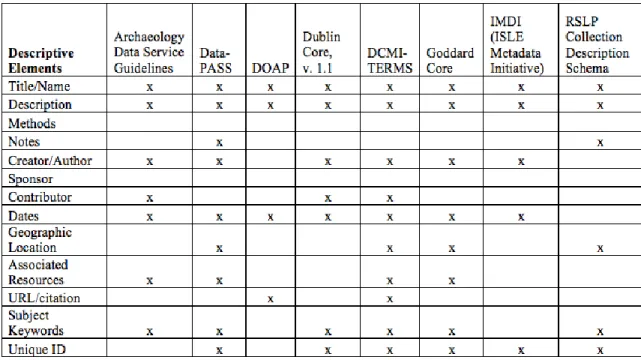
Element Relevance: Occurrence Across Schemes
The analysis of metadata schemes resulted in a suggested 11 elements suitable for the
description of data rescue activities. The Title/Name element and the Description element
were both found in every scheme examined, indicating that these are essential elements to
include in the proposed scheme as well. The Dates element was also found to be integral
across the schemes, being identified in all but one. The Creators element, the
Subject/Topics/Keywords element, and the Unique Identifier element were all found in
five of the seven schemes, indicating that these elements would be highly useful to the
proposed scheme. Similarly, the Geographic Coverage/Spatial element was found in four
of the seven schemes, as was the Source or Associated Resources element, indicating a
strong potential usage. The Notes element, the Contributors element, and the
URL/Citation element were all found in two of the seven schemes. These were therefore
Table 2. Occurrence of potential elements for data rescue activity description across schemes and guidelines.
Proposed Scheme
The final proposed scheme was developed via a synthesis of the results from analysis of
rescue activities and metadata schemes (Table 3). The major descriptive categories found
to be relevant to rescue activities were compared with the elements derived from analysis
of descriptive metadata schemes. In some cases, the element or category from one list had
been broken down into several elements in the other list in order to provide more detail.
For example, the Contributors element derived from the metadata scheme analysis
corresponded to four different sub-categories derived from the rescue activity analysis
(Table 3). Such situations were considered carefully in terms of clarity and distinction
provided by each element and level of granularity desired for the final scheme. In many
the Contributors category, two final elements resulted (Table 3). This approach was
guided in part by the Dublin Core “Dumb-Down” principle10
, which indicates that, when
using a ualified element, “the ualifier may be dropped and the remaining value of the
element should still be a term that is useful for discovery.” (DCMI) hus, two elements
such as Date Started and End Date became simply Dates in the final scheme (Table 3).
Each element or category was similarly examined, and the two lists were merged to form
the final proposed element set for data rescue activities.
Metadata Elements Analysis Rescue Activity Analysis Final Proposal
Title/Name Project Name Title
Description
Project Focus/Goal [brief description] Description Approach/Method(s) to Rescue (incl.
software, devices, etc.) Methods
Notes Other Description [project
background/history] Notes
Creators Project Initiator/Primary Affiliation Creator
Contributors
Funding Source/Sponsor (current & past?) Sponsor Project Contributors: Partners/Collaborators
Contributor Project Contributors: Data/Materials
Others Associated? (and how so)
Dates Date Started Dates
End Date (or ongoing)
Geographic Coverage/Spatial Location (if applicable) Location Source Associated Projects (if applicable)? Associated
URL link/url URL
Subject/Topic/Keywords Subject.Keywords
Project ID (optional) Project ID (optional)
Final Element Set
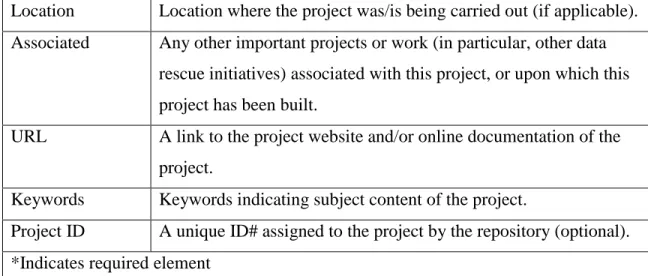
The proposed core metadata scheme for the description of data rescue activities consists
of 13 metadata elements: Title, Description, Methods, Notes, Creator, Sponsor,
Contributor, Dates, Location, Associated, URL, Keywords, and Project ID. Many of the
element descriptions are based on those from the Archaeology Data Service scheme,
which were found to be both detailed and oriented towards the description of whole
projects (Table 4).
Metadata Element Name
Element Description
Title* The title (and any alternatives) for the project.
Description A brief summary of the main focus, goals, aims, and/or objectives
of the project.
Methods A brief summary of the approach, methods, techniques, and/or
processes (including tools, software, etc.) being used for the data
rescue.
Notes Other details pertinent to the project, such as background
information or project history.
Creator* Individual(s) or organization(s) who initiated and have overseen
the data rescue effort. May include contact information.
Sponsor Individual(s) or organization(s) who have contributed financially
or otherwise endorsed the project.
Contributor Other individual(s) or organization(s) who have contributed to the
project; for example, project partners/collaborators (physical or
intellectual efforts), contributors of data/materials, etc.
Dates* Dates indicating when the rescue effort was initiated and when it
was completed (if applicable). May also include important
Location Location where the project was/is being carried out (if applicable).
Associated Any other important projects or work (in particular, other data
rescue initiatives) associated with this project, or upon which this
project has been built.
URL A link to the project website and/or online documentation of the
project.
Keywords Keywords indicating subject content of the project.
Project ID A unique ID# assigned to the project by the repository (optional).
*Indicates required element
Table 4. Final proposed metadata scheme for the description of data rescue activities.
The Title and Description elements were deemed essential to the scheme, as these are the
primary means of identification for each rescue activity. Similarly, the Dates and Creator
elements designate unique and highly useful information for identifying a rescue activity.
Although it is possible to describe a data rescue activity without any additional elements,
the Sponsor and Contributor elements also designate unique and important information.
The Methods element, although not essential to the basic description of an activity,
provides additional details regarding the activity’s e ecution, which could be especially
useful as a future data rescue reference point. The Geographic Location element did not
apply in all instances but was an important characteristic of some rescue efforts.
Although the Notes element was found in just two of the seven schemes examined, it was
found to be useful for all of the rescue activity descriptions. Rescue efforts are often
multi-dimensional and have background information such as the type of data being
rescued or how the project was developed. Similarly, the URL element was useful for
Resources element is also a useful way to provide additional details on activity as it
relates to the broader picture of data rescue. The Unique ID element is mainly helpful to
the repository or inventory that maintains the descriptions, since it is an arbitrary
identification, but it was judged to be potentially useful for the purpose of cataloging
rescue activities. The Keywords element is also essential for cataloging an activity and is
a useful way to provide an at-a-glance summary.
While each of these elements distinguishes unique and useful information, the majority
will be considered optional for initial implementation through the DARI inventory(Title,
Creator, and Dates will be required). This distinction is made in order to prioritize the
most essential descriptive elements and maintain simplicity, with the particular goal of
encouraging contributions to the Inventory through ease of submission. The proposed
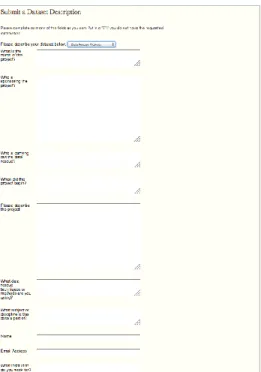
scheme is currently being implemented through a data entry form on the DARI website
(Appendix A).
Benefits
This study contributes to the body of knowledge relating to project documentation and
archiving and adds to the realm of existing metadata schemes. Specifically, the results of
the study have the potential to aid in the documentation and description of vital data
rescue efforts worldwide. The proposed metadata scheme will be directly applied to the
description of data rescue activities being documented in the DARI online repository,
making this effort more robust. The scheme may also be applied and built upon by other
significance of data rescue work, the results of this study will help to support further
work in this area.
Limitations
This study was conducted within a limited time frame. Although the study attempted to
analyze the most applicable descriptive metadata schemes, many other schemes exist that
were not a part of the study and could provide further insights. Similarly, although the
study made an effort to examine as many data rescue activities as possible, there are still
more to be examined. These too could provide further insights that have not yet been
incorporated into the creation of the proposed scheme. Additionally, the work to design a
new metadata scheme entailed a certain amount of subjectivity. As a result, there is the
possibility of bias on the part of the researcher. It is likely that personal preference and
circumstance could dictate variations to the scheme. Future study could benefit from a
survey of researchers in the areas addressed.
Conclusion
Documentation of efforts to preserve at-risk data is essential for ongoing scientific study
and future data preservation efforts. This study has investigated how best to document
and describe data rescue efforts through analysis of 20 data rescue activities and seven
descriptive metadata schemes, and a review of descriptive metadata best practices.
Similar and recurring descriptive elements across schemes and rescue activities were
elements were used to develop a core metadata scheme for the description of data rescue
activities.
This study was undertaken as part of the Data-at-Risk Initiative (DARI), which will
implement the proposed core scheme through an online data entry template designed to
gather information on rescue activities for the online Data-at-Risk Inventory. The study
will help to inform future DARI efforts.and contributes to the bodies of knowledge
relating to data rescue and project-descriptive metadata. The resulting metadata scheme
may also be applied to the documentation and description of data rescue activities
worldwide.
Future work in this area could potentially benefit from a study of additional project- and
data- oriented metadata schemes in the areas of description and preservation, as well as a
review of additional data rescue activities. This study may also be built upon by
implementing focus groups and surveys to test the workability of the proposed schema.
Additional future consideration should be given to the relationship between data rescue
activities and rescued data in the context of documentation; that is, how these two
important facets might be best connected within a repository to represent the larger
Acknowledgements
The author would like to thank Jane Greenberg, University of North Carolina at Chapel
Hill; William L. Anderson, University of Texas at Austin; and all contributing members
Notes
1
http://www.codata.org/
2
http://ils.unc.edu/~janeg/dartg/
3
http://ibiblio.org/data-at-risk/
4
http://ils.unc.edu/mrc/
5
http://www.ibiblio.org/
6
http://ils.unc.edu/mrc/dari-2/
7
http://www.oldweather.org/
8
http://www.data-rescue-at-home.org/
9
https://sites.google.com/site/historicalclimatedata/canadian-historical-data-typing-project
10
References
Anderson, W., Faundeen, J., Greenberg, J., & Taylor, F. (2011). Metadata for data rescue
and data at risk: Ensuring long-term preservation and adding value to scientific and
technical data. PV2011, 17 November 2011, Toulouse, France. Proceedings paper
retrieved 2013-04-26 from
http://ils.unc.edu/~janeg/dartg/final-PV2011-060-DARTG.pdf. Conference presentation retrieved April 26, 2012 from
http://www.slideshare.net/2ghouls/metadata-for-data-rescue-and-data-at-risk.
Antuña, J. C., Fonte, A., Estevan, R., Barja, B., Acea, R., & Antuña Jr., J. C. (2008).
Solar radiation data rescue at Camagüey, Cuba. Bulletin of the American Meteorological
Society, 89, 1507–1511.
Apache Maven Project. Frequently asked questions about project metadata. Retrieved
June 23, 2013 from http://maven.apache.org/project-faq.html
Archaeology Data Service / Digital Antiquity. Guides to good practice: Project metadata.
Retrieved June 23, 2013 from
http://guides.archaeologydataservice.ac.uk/g2gp/CreateData_1-2
Atmospheric Circulation Reconstructions over the Earth (ACRE). Retrieved April 26,
2013 from http://www.met-acre.org/
Borremans, C., Scory, S., De Cauwer, K., & Devolder, M. (2010). Rescuing historical
marine data and making them accessible: the case of data collected during the first years
Systems, IMDIS 2010Id = 36 - 2. Data Circulation and Services in ocean science –
Poster.
Brunet, M., & Jones, P. (2011). Data rescue initiatives: bringing historical climate data
into the 21st century. Climate Research, 47, 29–40.
Caldwell, Patrick. (2003). NOAA support for global sea level data rescue: International
sea level data rescue. Earth System Monitor, 14(1), 1-6.
Carver, N., Collins, K., Greenberg, J., Sinclair, J., Thompson, C., Veitch, M., Anderson,
W. (2011). Identifying endangered data: A case study supporting inventory design and
implementation. ASIST 2011, October 9-13, 2011, New Orleans, LA, USA.
Committee on Data for Science and Technology (CODATA) Data at Risk Task Group
(DARTG). Data-at-Risk Inventory. Retrieved from http://www.ibiblio.org/data-at-risk/
Commonwealth of Australia, Bureau of Meteorology. Pacific-Australia Climate Science
and Adaptation Planning Program (PACCSAP). Retrieved June 28, 2013 from
http://www.bom.gov.au/climate/pacific/
Data-at-Risk Inventory. (n.d.). Retrieved April 26, 2012 from
http://www.ibiblio.org/data-at-risk/
DataONE Metadata Best Practices. Retrieved April 26, 2013 from
http://www.dataone.org/best-practices/metadata
Description of a Project (DOAP) vocabulary. Retrieved June 23, 2013 from
Digital Preservation Alliance for the Social Sciences (PASS) Project. (2007).
Data-PASS Metadata Requirements (version 1.2, approved 12/15/2007). Retrieved April 26,
2013 from http://www.data-pass.org/sites/default/files/metadata.pdf
Digital Library Federation Best Practices for Shareable Metadata. Retrieved April 26,
2013 from
http://webservices.itcs.umich.edu/mediawiki/oaibp/index.php/ShareableMetadataPublic
Diwakar, A. S., Kulkarni, A. A., & Talwai, P. (2008). Rescue and preservation of climate
data by extraction and digitization from autographic weather charts using image
processing tools. 8th WSEAS International Conference on SIGNAL, SPEECH and
IMAGE PROCESSING (SSIP '08) Santander, Cantabria, Spain, September 23-25, 2008.
(p.139-143.)
Downs, R. R. (2009). Managing Risks to Scientific Data. Prepared for Presentation to the
NYU/IBM Workshop on Managing Data Risk: Acquisition, Processing, Retention and
Governance, New York University New York, NY April 24, 2009. Retrieved April 26,
2012 from http://w4.stern.nyu.edu/emplibrary/Downs-ManagingRisksSciData.pdf
Dublin Core Metadata Element Set, Version 1.1. Retrieved July 5, 2013 from
http://dublincore.org/documents/dces/
Dublin Core Metadata Initiative Metadata Terms. Retrieved April 26, 2013 from
http://dublincore.org/documents/dcmi-terms
Dupigny-Giroux, L-A., Ross, T. F., Elms, J. D., Truesdell, R., & Doty, S. R. (2007).
NOAA’s climate database modernization program: Rescuing, archiving, and digitizing
EUR-OCEANS Knowledge Transfer Unit, British Antarctic Survey. (2008). Southern
Ocean data rescue: Extending time-series into the past.
Griffin, R. E. (2005). Rescuing and recovering lost or endangered data. CODATA Data
Science Journal, 4, 21- 26. doi:10.2481/dsj.4.21.
Güntsch, A., Fichtmüller, D., Kirchhoff, A., & Berendsohn, W. G. (2012). Efficient
rescue of threatened biodiversity data using reBiND workflows. Plant Biosystems – An
International Journal Dealingwith all Aspects of Plant Biology: Official Journal of the
Societa Botanica Italiana, 146(4), 752-755.
Hodge, G., Templeton, C., & Allen, R. (2005). A Metadata Element Set for Project
Documentation. Science & Technology Libraries, 25:4, 5-23.
IMDI (ISLE Metadata Initiative). (2003). Part 1 Metadata elements for session
descriptions, version 3.0.4. Retrieved June 23, 2013 from
http://www.mpi.nl/IMDI/documents/Proposals/IMDI_MetaData_3.0.4.pdf
International Council for Science: Committee on Data for Science and Technology.
(2011). CODATA Data At Risk Task Group (DARTG). Data Rescue Efforts. Retrieved
April 26, 2012 from http://ils.unc.edu/~janeg/dartg/datarescue.html
International Environmental Data Rescue Organization. Retrieved on June 28, 2013 from
http://www.iedro.org/
Johnston, P. (2002). A standard for collection-level description: the RSLP Collection
Description Model and Schema; Collection-Level Description & NOF-digitise projects.
NOF-digitise programme seminar, London, 22 February 2002. Retrieved June 23, 2013
Knapp, K. R. (2008). Scientific data stewardship of International Satellite Cloud
Climatology Project B1 global geostationary observations. Journal of Applied Remote
Sensing, Vol. 2, 023548.
Levites, S. (2002). The GODAR and WOD Projects: Past, present, and future.
GODAR-WESTPAC Workshop Tokyo, Japan 5 March, 2002. p.1-8.
Levitus, S. (2012). The UNESCO-IOC-IODE “Global Oceanographic Data Archeology
and Rescue” ( ODAR) Project and “World Ocean Database” Projects. Data Science
Journal, Vol. 11, p. 46-71.
Martin, D., Hutchinson, R., & Howard, A. (2012). Pacific climate change science:
PACCSAP – data rescue and digitising. Retrieved June 28, 2013 from
http://www.colloque.ird.fr/icshmo-2012/documents/presentations-all/S15-martin-105.pdf
Massachusetts Institute of Technology Libraries. Data management and publishing:
Documentation and Metadata. Retrieved July 4, 3013 from
http://libraries.mit.edu/guides/subjects/data-management/metadata.html
MEditerranean climate DAta REscue (MEDARE). Retrieved June 28, 2013 from
http://www.omm.urv.cat/MEDARE/index.html
Mourkoussis, N., White, M., Patel, M., Chmielewski, J., & Walczak, K. (? ? ?) AMS –
Metadata for Cultural Exhibitions using Virtual Reality.
Murillo, A. P., Carver, N., Greenberg, J., Robertson, D. W., Thompson, C. A., &
Anderson, W. (2012). Data At Risk Initiative: Scientists’ perceptions of endangered data
and data reuse. CODATA Abstract for 2012 conference CODATA 2012, Taipei, Taiwan.
Murillo, A. P., Thompson, C. A., Carver, N., Robertson, W. D., Greenberg, J., &
endangered scientific data. ASIST 2012, October 28-31, 2012, Baltimore, MD. Retrieved
April 26, 2012 from
http://ils.unc.edu/~janeg/dartg/AM12ProceedingsFormat_DARI_final_v5.pdf
Nordling, L. (2010). Researchers launch hunt for endangered data: Global effort will
catalogue information languishing in drawers and basements. Nature, 468, 17.
doi:10.1038/468017a.
Page, C. M., et al. (2004). Data Rescue in the Southeast Asia and South Pacific Region:
Challenges and Opportunities. Bulletin of the American Meteorological Society, 85,
1483–1489.
Pikula, L., Cantillo, A., & Hale, K. (2001). CEDAR: Data and document rescue coastal
and estuarine data/document archeology and rescue. (p.146-147.)
RSLP Collection Description Schema. Retrieved April 26, 2013 from
http://www.ukoln.ac.uk/metadata/rslp/schema/
sbt Documentation. Project metadata. Retrieved April 26, 2013 from
http://www.scala-sbt.org/release/docs/Howto/metadata.html
Schmidt, C. (2007). DOAP A Matic. Retrieved June 23, 2013 from
http://crschmidt.net/semweb/doapamatic/
Tan, L. S., Burton, S., Crouthamel, R., van Engelen, A., Hutchinson, R., Nicodemus, L.,
Peterson, T. C., & Rahimzadeh, F. (2004). Guidelines on Climate Data Rescue. World
Meteorological Organization.
Thompson, C. A., Carver, N., Collins, K., Sinclair, J., & Veitch, M. (2011). Supporting
2011. Retrieved June 21, 2013 from http://ils.unc.edu/~janeg/dartg/
DARi_ASIST_SIG_Poster100611_FNL.pdf
U. S. Geological Survey. (2012). Preserving science for the ages – USGS data rescue.
Fact Sheet 2012–3078.
U.S. eological Service: “Create a Rescue Re uest”, Retrieved on April 26, 2012 from
http://eros.usgs.gov/government/archive_rescue/archive_request.php
World Climate Data and Monitoring Programme (WCDMP). Project Plan for Data
Rescue of Climate and Hydrological Data. Retrieved April 26, 2013 from
http://www.wmo.int/pages/prog/wcp/wcdmp/wcdmp_series/documents/WCDMP49_Ann
ex2.pdf
World Meteorological Organization. Data Rescue projects and initiatives (DARE).
Retrieved June 28, 2013 from http://www.wmo.int/pages/prog/wcp/wcdmp/CDM_2.php
World Meteorological Organization. Expert Team Data Rescue (ET-DARE). Retrieved
Appendix A
Figure 1. Screenshot of the prototype entry form for contributors of data rescue project information on the DARI website.
Appendix B
Appendix C