The Effect of Healthcare Transition Services on State Level Recidivism
By: Evan Harrell
Honors Thesis Department of Public Policy
University of North Carolina at Chapel Hill
March 22, 2019
Approved
Dr. Carmen Gutierrez
_____________________________
Dr. Jeremy Moulton
Table of Contents
Abstract 3
Acknowledgements 4
Chapter 1: Significance 5
Chapter 2: Background 9
Chapter 3: Data 17
Chapter 4: Methods 20
Chapter 5: Results 22
Chapter 6: Analysis and Policy Implications 28
Bibliography 38
Abstract
Every state currently offers some amount of healthcare transition services to individuals
leaving prison, but there is little research on whether, and how, these services are effective at
reducing recidivism. This paper focuses on the extent to which healthcare transition services are
effective, and identifies which services are effective, controlling for state spending. Using data
provided by the Pew Charitable Trusts, I examine how the number of services offered, as well as
the amount spent on prison healthcare within a state affects the recidivism rate at the state level.
The primary model is a multivariate ordinary least squares model with state-level recidivism as
the dependent variable. Then, I use a separate multivariate model to examine ten transition
services that are in less than 80% of states. Next, I estimate the effect of each individual service
in a third model. Finally, I use a fixed-effects model to estimate how changes in both total and
per-inmate healthcare spending affect recidivism. The results of these models suggest that
providing more services lowers recidivism. However, not all transition services are equally
effective. Community supervision and transition services that provide for people suffering from
substance abuse, namely referrals or appointments, were shown to be among the most effective
services. On the other end, mental health appointments were the least effective. Increased access
to community supervision is the recommended policy, with individuals getting at least one
meeting prior to or just following release. Further research is needed to determine why
appointments for individuals suffering from mental illness are so ineffective as well as study how
Acknowledgements
First and foremost I would like to acknowledge Dr. Jeremy Moulton for his tireless
efforts and generous support throughout this entire process. He was my first choice to be my
advisor and this work would not have been completed without him. I would also like to
acknowledge Dr. Carmen Gutierrez for her support and professional knowledge on the matter.
Her advice made my thesis much stronger and more relevant than I could have on my own.
Together these two have made this arduous process bearable and have taught me so much about
conducting my own research.
I would also like to thank my mom and dad for their support during this year and for
providing me with the ability to have a chance to do my own projects. I also want to thank my
brother, Daniel Harrell for competition between our honors theses. In addition I want to
acknowledge my girlfriend Marissa Brinkman for listening to me talk more about care continuity
programs then she probably ever cared to as well as being one of four people to actually read the
entire thing. Her love and support have been invaluable.
Finally I want to acknowledge Dr. Krome-Lukens and the rest of the public policy honors
thesis writers. Dr. Krome-Lukens helped keep me on track and stay up to date with all relevant
deadlines as well as prepared for the defense. She also kept me continuously writing even when I
began to stall out. I also appreciate the support and feedback all of my classmates provided me
with, both for my paper and for my defense. In particular I want to single out Beth Clifford for
Chapter 1: Significance
Despite making up only 4.4% of the global population, the United States holds 20% of
the world’s prisoners (NRCC, 2015; Walmsley, 2013). Roughly one in every one hundred adults
is currently in prison, but this risk of being incarcerated is not evenly distributed across the
population (Warren, 2008). The prison population has a greater likelihood of suffering from
medical issues than does the general population. Up to fifty percent of all inmates meet the
Diagnostic and Statistical Manual of Mental Disorders IV criteria for either drug dependence or
drug abuse which means that many of these former inmates will need assistance to help them
with withdrawal and rehabilitation (Rich, et. al, 2011). In addition, many former inmates will
need prescriptions for other mental or physical ailments, appointments for chronic issues, or
referrals for specialists. There is also the intersection of race alongside healthcare. Black men
who are incarcerated have lower mortality levels than unincarcerated black men, something that
is not the case for white men (Patterson, 2010). This means that black men actually get better
care once they are in prison then they might otherwise have access to. All told this shows a trend
of health issues among the U.S. prison population.
Unfortunately, for many individuals, state prisons are floundering and failing to always
provide care. The 2005 national recidivism rate for states was 68% for the typical three year
duration (Durose, et. al, 2014). This means that for every inmate released in 2005 from state
prisons, 68% were reincarcerated within the next 3 year period. In addition there are numerous
issues of healthcare bias before incarceration. According to the Bureau of Justice Statistics, even
though roughly 50% of all state prisoners had a mental disorder, only 33.8% received any
treatment after admission, with only 22.3% having access to anything besides acute care in the
primarily due to increases in the cost of treatment, making it even more unattainable (Dieleman,
et. al, 2017). Obtaining healthcare is becoming increasingly difficult for prisoners, which can be
deadly for theindividuals with individuals with substance use disorders, particularly those with
opioid addition (Binswanger, 2007).
With so many obstacles to good healthcare options, a study of the systems prisons use to
facilitate former prisoners accessing healthcare is important. As people are released, prisons use
a series of programs, called transition services, that provide assistance to former inmates by
helping them mitigate obstacles with returning to society. States offer a variety of different
transition services, ranging from finding jobs to providing access to healthcare. The PEW
Charitable Trusts found that there are 15 different transition services that can be provided by
states that are used to provide a level of care for former inmates as they look for long term
solutions. These healthcare services can range from providing bridge medication, scheduling
appointments or referrals with specialists, and even helping to register for Medicaid (Pew 2017).
All healthcare transition services aim to provide access to affordable healthcare, so that people
can get the care they need when they no longer have access to the prison infirmary. The intent of
these services is twofold: first to help people rebuild their lives upon leaving and second, to
reduce the number of individuals returning to prison. The intention is that by providing access to
care, people will not be forced to commit acts of desperation for care or fall into worse health.
Providing transitional care helps to obtain some form of healthcare, allowing people more time
to focus on finding shelter and employment, which are two fundamental factors in reducing
recidivism.
Evaluation of transition services is important for a number of reasons, not least of which
women, with 1,342 out of 100,000 men being incarcerated compared to 126 out of 100,000 for
women (Wagner, 2012). Black men are the most likely group to be incarcerated, with 17% of all
black men having previously been incarcerated compared to only 2.6% of white men. As such,
young black men face the largest risk of being incarcerated in the United States. The risk of
incarceration is also unequally distributed with respect to educational attainment. Forty percent
of the prison population does not have a high school diploma, compared to only 18% of the
general population (Zoukis, 2015). The prison population is primarily made up of vulnerable
populations, which makes studies into the reduction of recidivism all the more important. As the
lack of healthcare during the reentry process often causes people to continue cycling in and out
of prison, increasing our understanding of whether and how healthcare transition services
effectively reduce recidivism is an important social issue with significant policy relevance
Besides helping vulnerable segments of the population, transition services come at an
important time for former prisoners as they are often faced with many overwhelming tasks
during reentry. In addition to finding healthcare they must also look for housing and
employment, which are often the most pressing concerns. This is dangerous as one out of every
seventy inmates are likely to be hospitalized within a week and one in twelve hospitalized within
ninety days, much higher than the hospitalization rate for the general population (Wang, 2013).
The reentry process is also associated with significant risk of death as newly released prisoners
have a 127% greater chance of dying in the first two weeks after release relative to the overall
risk of death in the general population (Binswagner, 2007). Further care after release might help
counter some of these substantial health risks individuals face during the reentry period.
Transition services are also important because they can set up more permanent care
solution to any chronic issues. Transition services, on the other hand, seek to provide former
inmates with the means to set up successful and long lasting lives. While in-prison care may do
great work, it is not intended to provide a pathway to permanent treatment in the same way
transition services do. We know that as a whole rehabilitation programs and transition services
are an effective means of reducing recidivism (Mackenzie, 2006). These results show that
transition services could potentially have a longer ranging impact, particularly for chronic issues.
There also is the question of whether the services offered are cost-effective. Provision of
these services is expensive, and while certainly helpful if working properly, there is currently
little research on which transition services work most effectively. In fiscal year 2011, the total
spending on healthcare in prisons for 491 states was $8,069,053,935 (Pew 2017). This number is
a massive amount, even as spending levels have dropped due to downsizing of prisons (Turner,
et. al, 2015). Thus, it is important to look at the effect spending has on recidivism, instead of
examining transition services in a vacuum. The Washington State Institute of Public Policy did a
general evaluation in 2006 for Washington State prisons, finding which services were affordable
and effective. While the services studied were not transition services there is still some precedent
for states making policy decisions on how cost effective programs are. The evaluation ended by
noting that implementation of policies that work could save almost $2 billion (Aos, et. Al, 2006).
Evaluation of current state healthcare transition systems could also lead to such beneficial
findings, benefiting both taxpayers and incarcerated citizens. While reducing the recidivism rate
is a worthwhile goal there must always be tradeoffs between policies and price. By examining
the effectiveness of healthcare spending reducing recidivism, I shed light on fiscal reforms that
prisons can make while still being effective and creating a multipronged approach to evaluating
new and existing transition policies at the state level.
In spite of these reasons, the effectiveness of healthcare transition services, as a group
and especially individually, have undergone little evaluation to determine any significant impact
they have on the recidivism rate. Now is a good time to examine whether, and how, transition
services are actually effective, so states can make informed decision on which services to offer
and which ones should be eliminated. While providing healthcare transition services seems like a
good idea, especially in conjunction with the multitude of other such services, they should be
evaluated for feasibility before they continue to be expanded upon by states.
This paper hypothesizes that the provision of more transition services offered to former
inmates can play an important part in helping to reduce recidivism. I hypothesize that more
transition services leads to more former inmates receiving care and reducing the recidivism rate.
States that provide more services enable prisoners to develop their own connections in the
healthcare system, which leads to continuous care and a lower chance of recidivism. In addition,
I also hypothesize that the most effective services will be the services that provide people with
the opportunity to find healthcare options before release, namely coordination with community
supervisors and communication with providers. Finally, I hypothesize that per-inmate healthcare
spending will have a negative correlation with state-level recidivism.
Chapter 2: Background
Prisons have increasingly become large providers of healthcare as prisoners often suffer
from many chronic conditions. The effectiveness of this expanded healthcare, both from
services are most effective. Prior research into healthcare for former prisoners explains how
transition services operate and how they affect prisoners who are setting up a new life.
Rise of the Hospital Prison
According to the BJS, in 2004 44% of state inmates suffered from a medical condition
more serious than a common cold and in 2009 it was found that 56% of all state prisoners
suffered from a mental illness (James and Glaze, 2006). Mental illness in particular has been
found to be a significant predictor of incarceration. Individuals who have a serious mental illness
are incarcerated at a much higher rate than those without them (Abram and Teplin, 1991;
Munetz, et. al, 2001). In addition, the police encounter individuals with mental illnesses at a
greater rate than people without. These confrontations often lead to criminal charges as police
fail to attribute their illness as a contributing factor and are unable to do more for people besides
placing them in an already overburdened system (Greenberg, 2008; Teplin and Pruett, 1992).
Substance abuse disorders are also very common among the incarcerated population; sharing
similar problems as people with mental illnesses in regards to arrest due to policing bias and lack
of care. In state prisons, 58% of the population meet the criteria for drug abuse or dependence
(Bronson, et. al, 2017). Many inmates who meet the criteria for mental illness also suffer from
substance abuse problems, compounding any issues (DiVento, 2011).
In spite of the fact that many prisoners suffer from chronic mental and physical illnesses,
there still exists a large healthcare gap for prisoners, particularly after exiting prison. The gap in
healthcare is due in part to the lack of health insurance coverage among individuals returning
home from prison. The majority of prisoners have trouble accessing Medicaid after returning to
society, often because Medicaid enrollment will lapse during one’s time behind bars and
health insurance, the burden of taking care of the formerly incarcerated often falls to the task of
acute care, such as the emergency room (Frank, et. al, 2014). This situation is not ideal, as use of
acute care is expensive and dangerous for many individuals, who often only use these services
upon forced hospitalization (Wang, et. al, 2013). Access to non-acute forms of care would help
in this area, which is the purpose of transition services. As such, the study of healthcare
effectiveness in reducing recidivism is crucial to explaining the effectiveness of transition
services.
Access to healthcare has been shown to reduce the need for use of acute systems and this
is often seen through the development of community care systems (Shavit, et. al, 2017).
Community care systems refer to local programs that provide means for former prisoners to
access treatment, but are not run by the state. One example of this is the University of North
Carolina’s Formerly Incarcerated Transition program (UNC FIT), which matches newly released
prisoners with other former prisoners who help them navigate the healthcare system. Still,
problems remain with gaining access to these community systems due to low health literacy
among the incarcerated population and difficulty in informing prisoners about these systems
(Hadden, et. al, 2018). Because they are not state run, these programs can have trouble entering
the prisons to lay groundwork and often must rely on people coming to them upon release.
Transition services have tried to bridge this gap by getting individuals to interact with the outside
healthcare system. Transition services also provide care for at least the first month after release
in the hopes of giving people time to get settled and find all available options. The effectiveness
of healthcare transition services however has not been fully studied and questions remain as to
which transition services manage to extend care.
Expanding transition services are effective if the increased healthcare coverage provided
is able to help reduce recidivism. Current literature helps provide a way to examine if post-prison
treatment has any benefit in reducing recidivism, by showing that increased access to care helps
people manage their health issues. Recent studies show how continuous care can help benefit
former prisoners, and make specific mention how Medicaid would be beneficial to former
inmates (Wakeman, et. al, 2009). The provision of Medicaid often lapses but transition services
may be able to fill in for this lack of coverage until long-term treatment can be found.
Unfortunately, this care is often impeded by lack of understanding as well as a perceived stigma
in seeking out help with mental illness (Pietrzak, et. al, 2009). This perceived stigma in seeking
out help is a significant problem among people with mental health illnesses and indeed does not
seem likely to be solved by transition services (Corrigan, 2000; Wahl, 1999). It may be possible
to circumvent this stigma if care is continuously provided from correctional facilities to the
outside. When treatment lapses however is often when there are issues with getting individuals to
reenroll into care regiments. One example of this seamless transition of care between prison and
out of prison care is the community care programs studied by Dr. Wang, which match former
prisoners with other former prisoners so they have help making choices regarding healthcare
without judgement (Ashkin, 2018). In addition, we know that the time just after release is very
dangerous, making stigma potentially deadly if people go without needed care (Wang, et. al,
2013). The access to care as provided by prisons would be a convenient way of bridging the care
gap for people while also navigating the stigma issue. Transition services enable access to
continuous care, providing a way around the stigma many prisoners feel after so many
previously failed systems by enrolling them automatically to prevent attrition.
Evidence for the effectiveness of transition services can be found in the work of Dr.
Lattimore, who studied how prison reentry programs affect the lives of former prisoners, but the
results of her study were mixed. On one hand, Lattimore found that reentry programs improved
housing and employment, with lower levels of substance abuse among former inmates.
(Lattimore and Visher, 2014). However, there was no statistically significant reduction to
recidivism. These results provide a defense for transition services as a whole but do not explain
which type of service is most effective. The reentry programs Lattimore studies offer a wide
variety of different transition services, which can include services beyond healthcare. Although
this paper seeks to examine just healthcare services, Dr. Lattimore’s results lay the groundwork
for studying transition services and how they affect prisoners and former inmates.
The effectiveness of healthcare transition services depends on the ability of such services
to expand healthcare access to former prisoners. For this paper Josiah Rich’s study of prisoners
with HIV and Emily Wang’s study of individuals with chronic disease provide the most clear cut
evidence for the effectiveness of transition services. Dr. Rich’s study examined Project Bridge,
which was a federally-funded system in Rhode Island providing in-depth case management and
mental health referrals to prisoners with HIV. Project Bridge was successful in providing care,
particularly long-term care, and contributed to a drop in recidivism with just under half being
reincarcerated (Rich, 2001). Dr. Wang’s study of primary care for prisoners found that early
access to care led to increased engagement with the healthcare system as well as reduction in
emergency room visits. This underlines the advantage that a state imposed transition system
would have over community efforts, as the time frame encourages getting as many individuals as
possible into the program so that they may begin to receive care. A state-run system would be
allowed in prisons to recruit and rely on finding people after release. Project Bridge, for instance,
enrolled only 97 patients within three years of study, even with federal support. State-mandated
transition services available to all inmates upon release from prison would be able to reach many
more individuals, from people with chronic physical illnesses to substance abuse and beyond.
A drawback of current prison healthcare is the current lack of continuity, with the norm
that most prisoners drop out of prison without access to the healthcare system. Even with the
provision of short-term transition services, such as bridge medication, many inmates simply use
up the services provided to them when they leave (Wang, et. al, 2013). Much of this drop in care
is due to a disconnect between community services and the services offered inside the prison
itself, with former inmates leaving prison and not getting to community services promptly, or
sometimes getting to them only after being hospitalized. Continuous access to care has been
found to reduce recidivism and with many states dropping prisoners from Medicaid while
incarcerated it is hard for coverage to remain continuous. Pushing for a state program to provide
increased transition services will possibly be able to help shrink the gap in lieu of universal
coverage. Increased transition healthcare services could be long enough for the formerly
incarcerated to make it into community programs. With increased enrollment in community
programs, the dangerous period right after release may begin to shrink or disappear entirely.
Goals of Research
By examining the total number of services provided by states and investigating the
relationship that each service has with recidivism, my research fills an existing gap in the
research surrounding healthcare transition services. Transition services have been studied in the
past, with mental health referrals and access to primary care being the two main services studied
transition services by examining services provided by the community. This study will continue
this, by examining total service provided. The amount of services provided upon leaving prison
varies from state to state, from a high of fifteen to a low of two. This study will focus only on
government reforms as a pathway to community programs. Community-driven transition
services have often been the focus of past research due to their narrow scope, making them prime
groups to analyze. Since then, the fact that they have a proven track record in reducing
recidivism has led to a slight bias in how studies are conducted. Talking with Dr. Evan Ashkin
he was surprised I would want to study transition services and said he thought the results could
be interesting but thought that it would not change how community services are viewed within
the profession. I chose to focus on states as a unit of analysis because they provide a strong base
from which healthcare impacts many people while also displaying variation in services offered.
States also help show changes in healthcare and the impact on many people. If benefits can be
shown to come from the state it could have far-reaching impacts on how all transition services at
any level will be offered to inmates. With a better understanding of how transition services affect
recidivism and how government can provide access to transition services, this paper could help
provide policymakers with recommendations on how to enact effective policies, related to the
criminal justice system and the healthcare system.
Besides the effectiveness of using transition services to reduce recidivism, this study also
investigates the cost of healthcare as incurred by the state. Much of the existing literature
examines and discusses the increasing cost of healthcare and prisons. This paper focuses on how
variation in healthcare spending may affect the recidivism rate within a state. Existing work
looked primarily at helping to reduce recidivism while only briefly mentioning the cost of the
extent to which transition services are cost effective for prisons, but this work has generally
focused on outcomes in a single state. One such example was done by the Washington State
Institute for Public Policy. They conducted research to evaluate evidence based options used in
Washington state prisons to measure their cost effectiveness (Aos, et. Al, 2006). My study does
not deal directly with transition services but provides a precedent for current research on prison
spending. It also measures benefits to taxpayer, which is often overlooked when examining
recidivism only. This study acknowledges the practicality of policymaking and seeks to
determine the extent to which spending changes how effective transition services are in addition
to which transition services help reduce recidivism. Knowledge of which services are effective
allows state to make informed decisions in cutting services that provide little benefit. While the
exact cost of each service is not in my data, I will be able to make general statements about
which services could be cut due to little effectiveness. Reducing the cost of prisons is beneficial
to everyone, especially when looking to implement state run programs that will need to use
taxpayer money to be able to function.
The transition services examined in this paper fall into a different category of providing
care compared to some of the most popular transition services. The most common services are
focused on immediate care, like bridge medication of appointments for physical ailments. The
transition services in this paper should engage people with healthcare providers at some level and
foster active participation in taking charge of healthcare. This engagement will hopefully keep
people in the system as they move onto community services and will open the door to increased
connection between prisons and community services. Earlier bridging of prison to community
groups has been shown to be helpful and by providing services that require former prisoners to
et. al, 2013). Trouble does arise with this, especially with the state deciding which community
organizations to endorse, but the premise still is a promising one. There is little literature for
healthcare transition services this paper hopes to contribute to a trend of reevaluating prison
programs.
Chapter 3: Data
In order to examine the effects that transition services have on a state’s recidivism rate, I
gathered data from several sources. All data was unidentifiable and was used with either
permission from the sources or was publicly available. The Pew Charitable Trusts State
Healthcare Costs and Quality report provided data on spending and transition services for every
state. This report contains a survey of all fifty states through contact with their Department of
Justice and contains the amount spent on healthcare as well as all services provided.
I included 44 states in the sample; the remaining six were either not used due to
differences in how recidivism or spending data is reported. The recidivism rate definition used in
this paper was based upon a three year follow up of re-incarceration, which is the standard
definition of recidivism in most states. This recidivism rate is found by taking the total number
of prisoners incarcerated in a three year period following release and dividing it by how many
were released in the given year. This does not include the number arrested and jailed but only
those who were actually returned to prison for incarceration. Five states, Georgia, Illinois,
Hawaii, Oregon, and Texas, were not included in the sample due to differences in reportable
data2. Georgia and Illinois calculate a recidivism rate using conviction as opposed to
2There was some fear that dropping large states like Texas and Illinois might influence the data. To account for this
incarceration, Hawaii’s rate is calculated with re-arrest numbers, Oregon’s follows a six month
time frame, and Texas’ includes individuals convicted of misdemeanors and sentenced to jail
along with prisons. For these reasons the states did not fit within the traditional definition of
recidivism and as such were dropped from the sample. New Hampshire is not included because
they do not report any spending numbers for their prison healthcare. The data summary statistics
for the other 44 states are reported in Figures 1.1, 1.2, and 1.3, which show the recidivism rates
over the years, the total healthcare spending, and the per-inmate healthcare spending,
respectively.
Data Sources
Pew Charitable Trust
The bulk of all data collected came from the Pew Charitable Trust and their 50 state
report on all current healthcare policies and spending levels. Healthcare policies are split by Pew
into a few distinct areas, with this research focusing on all polices that are classified as care
continuity polices by Pew, otherwise known as transition services. The Pew data measures which
policies are in place and how much each state spent over the past six years, along with
population, provision method, and Medicaid opportunities made available to the former inmates
upon release. The variables included from Pew are each state’s care continuity services as well as
their healthcare spending levels for the past nine years, both at the per-inmate and at the state
level.
Council of State Governments
The Council of State Governments maintains the Justice Center branch which produces a
per state varies as all of their data was gathered by individual contact with each state. Recidivism
is reported in a few ways in the report, but this paper only covers recidivism as it was defined by
re-incarceration during a three year period. The recidivism data found here was then merged with
data from the Bureau of Justice Assistance to create a complete my full list of past recidivism
rates.
Bureau of Justice Assistance
The Bureau of Justice Assistance provides a yearly map of all states with various data
about the state, including recidivism. This source reports an overview of each state although only
for the most recent year, which for recidivism is 2014, and was used as a source to help
supplement data gathered from the Justice Center.
Bureau of Justice Statistics
The Bureau of Justice Statistics does not report state level trends in incarceration but does
provide national numbers. Data from this source provided current national trends in incarceration
as well as national efforts to combat recidivism for comparison. They also provided assistance in
locating other sources.
Variables
Table 3.0 provides the summary statistics for the individual variables. The mean of each
policy variable describes the number of states that offer the type of service described. For
example, approximately 82% of states in my sample offered written prescriptions for inmates as
a transition service. In my models the only services that were included have a mean of 0.8 or
lower. In other words, services offered by more than 80% of states were excluded from my
that were in 80% or more of all states. The mean for the variable Total Services Provided is approximately 10 services offered. These ten services are likely to include the 5 most popular
services. This means that on average there are 4-5 variables studied appearing in a state’s
transition services portfolio. A histogram detailing how many variables a provided by how many
states is included in Figure 2.0.
Chapter 4: Methods
Results were obtained from an ordinary least squares multivariate log-linear model which
enables the measurement of how recidivism rates change in states based on the number of
transition services they provide as a part of their transition package. There are a few weaknesses
in my models that come from data I did not have access to. Importantly, I do not have
information on all other programs offered by states nor do I have data on when specific services
were started. Because I cannot control for other programs offered by the states there is room for
improvement in my models in the future. For now, the impact of total transition services on the
change in the recidivism rate per state can be written as equation (1).
(𝑅) = 𝑎 + 𝐵1(𝑇𝑜𝑡𝑎𝑙𝑃𝑟𝑜𝑣𝑖𝑑𝑒𝑑) + 𝐵2𝑥 + 𝜖 (1)
In this equation B1, represents how much the provision of the total amount of transition
services offered affects the recidivism rate, represented by R as the output variable. The B2
coefficient represents the control variables for my model: per inmate spending, total healthcare
spending, prison population and the consumer price index of each state. The data encompasses
44 states excluding D.C. from 2005 to 2015.
The next model was a large multivariate model containing the ten transition policy
individually. These models do two things, control for bias from services in more than 80% of
states and also help determine which policy is having the greatest individual effect. The first
issue, concerning services offered in more than 80% of states could bias the first model by being
the only effective services, with any difference in total being due to variance in states having all
five of these services. The second benefit found in these models is the fact that they show exactly
what each service is doing. This makes recommending one specific service much easier than can
be done from the first model which just estimates if transition services as a whole provide any
benefit. This model can be written as:
𝑅 = 𝑎 + 𝐵1(𝐶𝑜𝑜𝑟𝑑𝑖𝑛𝑎𝑡𝑖𝑜𝑛) + 𝐵2(𝑆𝑢𝑏𝑠𝑡𝑎𝑛𝑐𝑒𝑅𝑒𝑓) + 𝐵3(𝑅𝑒𝑐𝑜𝑟𝑑𝐶𝑜𝑝𝑦) +
𝐵4(𝑅𝑒𝑐𝑜𝑟𝑑𝐶𝑜𝑝𝑦2) + 𝐵5(𝑀𝑒𝑛𝑡𝑎𝑙𝐴𝑝𝑝𝑜𝑖𝑛𝑡) + 𝐵6(𝑃𝑒𝑒𝑟𝑅𝑒𝑓) + 𝐵7(𝑀𝑒𝑑𝑖𝑐𝑎𝑙𝐴𝑝𝑝𝑜𝑖𝑛𝑡) +
𝐵8(𝑆𝑢𝑏𝑠𝑡𝑎𝑐𝑛𝑒𝐴𝑝𝑝𝑜𝑖𝑛𝑡) + 𝐵9(𝑃𝑜𝑣𝑖𝑑𝑒𝑟𝑐𝑜𝑚) + 𝐵10(𝑂𝑣𝑒𝑟𝑑𝑜𝑠𝑒𝐸𝑑𝑢) + 𝐵11(𝐶𝑜𝑛𝑡𝑟𝑜𝑙𝑠) + 𝜖 (2)
One of the main concerns when looking at differences among states is that total state
spending may be affecting how effective prison systems are. While spending is controlled for in
Equation 1 there was still a fear of variation within a state affecting how effective a state is at
reducing the recidivism rate. For this reason, a fixed effects model was also run to test how
variation in spending over time within a state might have affected recidivism levels. The primary
purpose of this model is to check that spending was not the primary variable affecting state-level
recidivism rates. Variation in spending levels may change the types of policies offered,
highlighting the importance of making sure that individual transition services are not just being
swept up in the amount of funding states are allocating to prison systems healthcare services. The
fixed-effect models can be found in Equation 3.
I used a fixed-effects model for my panel data to negate any variation across the states.
Due to differences in partisan ideology of the states, as well as other varying state identities,
there is a good chance that the policies implemented to conduct prison healthcare are going to be
influenced by statewide effects. A fixed-effects model should help to control for these issues
whereas a random effects model would have been unable to do this. The fixed effects model
examines how variation within a state shapes recidivism, making it possible to tell if recidivism
was being reduced whenever a state decided to spend more. It should be noted that fixed effects
was used only for examining spending data however, as there was no variation over time among
care continuity services offered in the available data sources.
Chapter 5: Results
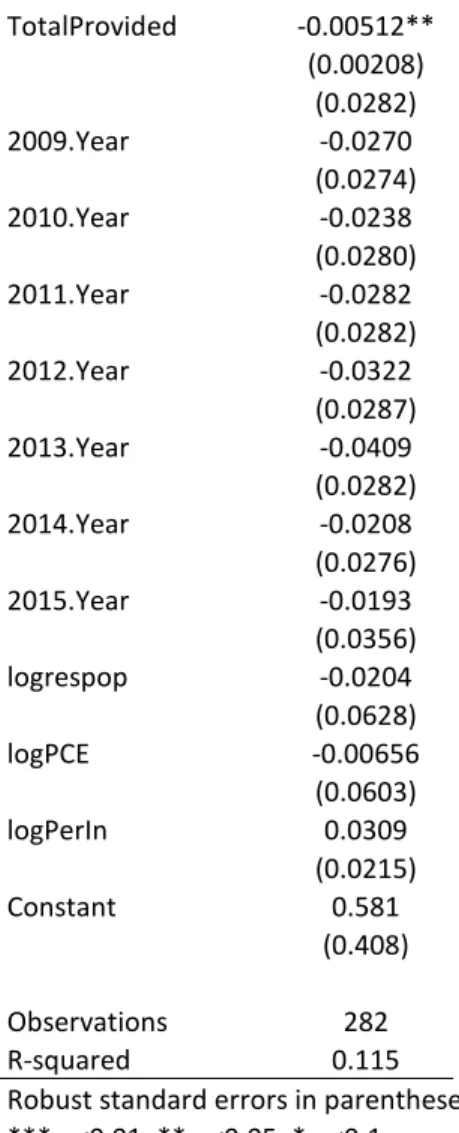
The total amount of care continuity services offered was effective at lowering recidivism.
Table 4.1 shows the effect of having more care continuity procedures on recidivism. As the total
amount of services offered by a state Correctional Department increase, the overall state level
recidivism decreases, an important association between these two factors. This correlation is
statistically significant at the 95% confidence level. Each additional care continuity services
offered lowers state wide recidivism by 0.05 percent.
This result matches the expected theory that having a greater number of care continuity
services will help a state lower their recidivism rate. This result may be biased by one of the
more common transition policies, such as bridge medication which is offered by every state
except one. In theory these five services could do all the work, and any variation in total
provided could be coming from having more or less of these select few services. Because almost
impossible to say for sure. We next move onto the investigating how each individual policy
affects state level recidivism.
Individual Services Effects on Recidivism
Understanding the full impact of transition services requires a more in-depth look at each
individual service. If the total number provided tells us that care continuity services together are
effective, this does not do much for states which are only able to offer a handful of them.
Understanding where to get the best value is critical for states and it is important to know which
care continuity services actually work. There were a total of ten policies that had enough
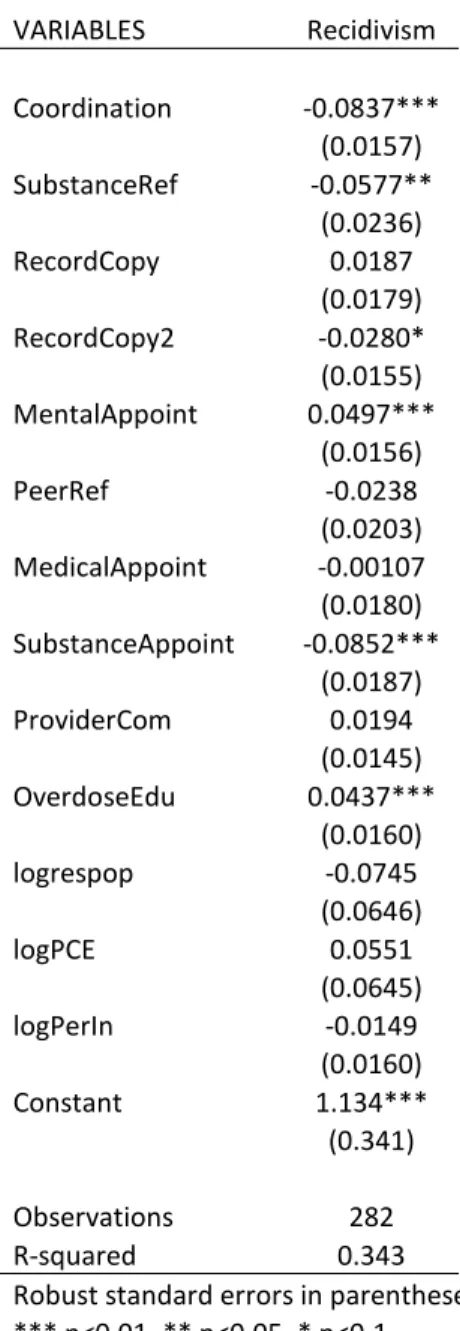
variation to study. In Table 4.3, which contains a regression of all care continuity procedures
studied, it appears that some are more effective than others. The table shows results for equation
2 containing all studied transition services, with most of the controls at the bottom.3 The remaining columns contain results for each policy individually.
Results from the full model show that six of the ten services were statistically significant:
Coordination with community supervision, referrals to substance abuse disorder treatment,
providing record copies to the outside care providers, confirmed mental health appointments,
confirmed substance abuse care appointments, and overdose education. The most significant are
coordination and substance abuse appointments which are both significant at a 99% confidence
level. In addition they also have a large effect on recidivism, reducing it by 8.37% and 5.2%
respectively. At a 95% confidence level we can see that referrals to peer substance abuse centers
are also effective, reducing the recidivism rate by 5.77%. Finally providing record copies to
outside providers reduces the state recidivism rate by 2.8% at a 90% confidence level. The
3The control variable for the year has been removed for clarity sake and because it had no statistically significant
results match my hypothesis that increased engagement reduces the recidivism rate. Merely
providing a patients records alone will not have as big an impact as coordination which will
actually set up pathways for the individual to meet and engage with outside care providers. This
result also shows just how prevalent substance abuse is and how important it might be to receive
treatment.
Out of the six results, four of them remain statistically significant at the individual level
as well, with provision of record copies failing the test of significance as well as overdose
education. At the same time however, referrals to peer recovery programs for substance abuse
disorder rises to become statistically significant. For the time being mental health referrals will
be set aside until later, as the results for this service indicate that it actually raises the recidivism
rate. For the other individual results they are roughly separated into two, with the Coordination
service alone and the other three services put together due to the fact that they are all related with
treating substance abuse.
The first and perhaps most effective policy is coordination with community supervision
before release. This coordination lowered the recidivism rate by 8.37% in the second model and
was seen to have an individual effect in the third model as well, reducing recidivism by 6.72%.
This result is certainly not surprising considering the evidence found in the work of Dr. Emily
Wang. Her research on community care centers has found perhaps the most effective method of
reducing recidivism for a country by pairing formerly incarcerated individuals with outside
programs to help them manage the healthcare transition. Although coordinating with a
community supervisor, commonly known as a parole officer, is not the same as setting an
individual up with outside care options, there remains the same principle of engaging another
system. This result corresponds roughly to my original hypothesis although not in the typical
way past research has identified.
The other three policies that are effective at reducing recidivism in the individual
regression actually have a lot in common; they all work to help people who suffer from
substance abuse disorders. These were substance abuse referrals, substance abuse confirmed
appointments, and referrals to peer recovery groups. Substance abuse appointments are still
significant at a 99% confidence level and substance abuse referrals rises to meet it at this level
too. Substance abuse referrals also rise in effectiveness, from 5.77% to 7.16% although
substance abuse appointments actually falls a small amount from 8.52% to 7.38%. Referrals to
peer recovery programs is significant at a 95% confidence level and reduces the recidivism rate
by 3.32%. Of the three, referrals to peer recovery groups is the least effective. This conclusion
can be drawn from the fact that having the service alone provides some benefit but when added
with others the benefit vanishes, likely because substance abuse referrals may play a similar role.
This is a place where a state could make smart cuts to programs, as peer recovery groups appear
to not be as effective as the other options aimed at drug abuse. These results did not actually fit
my original hypothesis. Substance abuse is a big issue in prisons but they have so many
resources for individuals suffering from them that transition services were not expected to have a
large change in recidivism. This result shows that this is not the case. Given that substance abuse
services are consistently effective means there is much to be gained from further investment into
substance abuse programs. Whether this expansion should come from transition services alone is
difficult to say, but states should certainly make sure they are providing all support possible.
The next care continuity systems worth examining are all of the ones which are positively
correlated with recidivism, consisting of record copies for inmates, confirmed mental health
appointments, provider communication, and overdose education. Of these four, mental health
appointments and overdoes education are statistically significant when run in the multivariate
regression. Both are significant at a 99% confidence level with mental health appointments
raising recidivism by 4.97% and overdose education correlated with an increase of 4.37%. This
result was very surprising, especially due to the high statistical significance with both of them.
Overdose education can partly be explained by the existence of a few other services aimed at
reducing substance abuse but mental health referrals is a complete surprise. Both of these results
are at odds with my hypothesis, as I suspected that all services would either be effective or have
a null effect.
In spite of the fact that when together these services seem like they increase recidivism
this is not exactly the case. When these four are run alone they all reverse their correlation to a
negative except for confirmed mental health appointments, which also remains statistically
significant at a 95% confidence level raising recidivism by 3.11%. This means that these services
may have some effect, just not a very large one and at the very least they are not counter
effective. It is interesting to note that in the bivariate regressions the medical appointment
variable also becomes positively correlated with recidivism although not at any significant level.
The most peculiar of all of these services, and indeed one of the most stand out results of
the entire work, is the effect that confirmed mental health appointments have on recidivism. This
is counter to my hypothesis because it appears to show that offering this service will have a
negative effect on the people incarcerated inside state run prisons. No matter the controls placed
correlation with recidivism, and may actually be counter effective at a statistically significant
level. While this result is shocking and a little unsettling there is no stand out apparent answer.
Certain parole requirements could influence this result but it appears this is likely not the case. A
survey of such requirements does not appear to confirm this suspicion and this service is
supposed to be different from any community supervision requirement. Further research on this
is of high priority to discern if such programs should be ceased or if there are other variables
affecting why this services raises the recidivism rate.
Control Results
One worry in trying to isolate the effect of care continuity variables alone would be the
effect of prison spending, the price of living in a state, and any temporal events, notably the 2008
recession. These results are at the bottom of Tables 4.1 and 4.3, although they were controlled
for in every model run. Per-inmate spending, a higher state population, and a lower state PCE
were not significant in either reducing or raising the state recidivism rate. Perhaps surprisingly,
per inmate spending and the state population were both correlated with having a higher
recidivism rate, but again not at any significant level. These results held across almost all
regressions along with the trend that each individual year was likely to show recidivism as
slightly higher than 2007. The increase after 2007 was never significant but may perhaps have
something to do with the start of the financial crisis, although there is not enough data here to
make any solid claims. Further research into the effect of the Great Recession and how it may
have effected recidivism is an important question moving forward. We move onto the effect of
any funding in the fixed effects model.
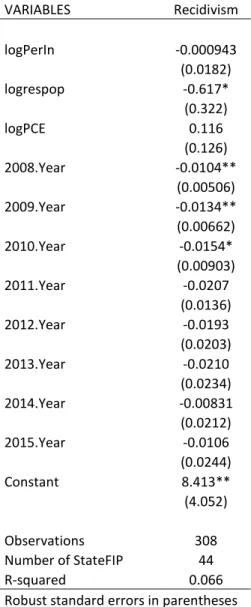
The fixed effects model showed no statistically significant results for per-inmate
healthcare spending, with Table 4.4 detailing all results found. Interestingly, PCE, which is a
measure of how expensive it would be to live in a particular state, was positively correlated with
recidivism but not at any significant level. This result is comforting to many states that are
expensive to live in, as well as to any prisoners themselves. Important to note with these results
is that this is for healthcare spending only and also only accounts for variation within a state.
Spending more overall may have an effect but my models would not be able to establish this.
Chapter 6: Analysis and Policy Implications
The effectiveness of care continuity programs looks to be quite well established in my
models. Before examining the systems, there was some concern about whether or not any one
transition service would be effective. Dr. Evan Ashkin, who runs the UNC Formerly Incarcerated
Transition program, expressed doubts as to whether any one policy would be actually able to
have any significant impact on recidivism in total. This belief has been based upon the
effectiveness of prisoner community programs, which provide a very effective form of care.
Therefore the effectiveness of care continuity programs may actually be more beneficial when
used as a gateway into community provision of treatment. For that reason, the effectiveness of
individual services is best explained in terms of how they work to set up a transition system with
the ultimate goal of stabilized long term care, either in terms of community provision or
otherwise. First will be an examination of the total effectiveness of systems before moving into a
more detailed examination of individual services offered, and an examination of ineffective
services. Finally, I will examine the effect spending has on the recidivism rate.
The total amount of services provided was shown to help lower the recidivism rate. A
likely reason for the effectiveness of multiple services is that having more services means a state
provides more total care to make sure that the prisoners have a seamless transition. More services
will cover more areas in which a former prisoner may otherwise lack care. With multiple
transition services offered to each person upon release it seems evident they will undergo a
smoother transition. Multiple services may also be correlated with other features of a state prison
system not accounted for in this design, but it raises questions for examining other differences
among state systems. Beyond this it is hard to say exactly which services have the greatest
impact, due to the known effectiveness of the five common transition services. Because these
services are known to be helpful, it makes it difficult to know if more services is helping or if
help is coming from variation in states among the five known services.
Individual Analysis
The best individual services are providing individuals meetings with community
supervisors, which gives former prisoners a plan for what they need to do upon release, and
providing assistance with substance abuse. Community supervisor meetings are very similar to
the ideas promoted by Doctor Wang, which lends credibility to the results of this study. In
addition, the most effective treatments are the ones which begin active engagement in the health
care system. For this reason some of the effects which are based on personal knowledge or
resources, such as record copies, are not as effective as resources which engage the individual
within the broader health care system. Below the analysis has been split between coordinating
with a community supervisor and services which help people dealing with substance abuse.
Coordinating with a community supervisor, often known as a parole officer, was perhaps
the single most effective tool for reducing recidivism. These results suggest that a parole officer
can work to help provide some services that a case manager may provide. In the same way the
community service centers offer non-professional support for people who are just released,
having a parole officer may enable people to find areas where they may receive treatment. While
a parole officer is not the same as case management, they will provide the opportunity to set up a
plan for people to follow after release. According to the North Carolina Department of Public
Safety webpage the purpose of their community supervisors are to “…reach an equal balance of
control and treatment for offenders that will positively affect their behavior and lifestyle
patterns” (Community Corrections). This purpose is similar to the purpose of most state’s
systems so it is little surprise that having a community supervisor will help people find access to
health care.
One potential issue with this result is the question of who gets parole. If an individual is
released early for good behavior and is put on parole there could be a selection bias in effect. If
the people who are getting parole are not representative of the general prison population then this
result is going to be skewed and may make community supervision not as effective as it may
seem. More research on who may get put under community supervision is necessary to say for
certain how effective community supervision is.
Substance Abuse Prevalence
Although the Coordination policy did the most by itself to reduce recidivism, the
programs centered on substance abuse were not far behind. Substance abuse is much more
common in prisons than among the general population. According to the Bureau of Justice
dependence and people who are victims of substance abuse are more likely to commit crimes
than those who do not (NIH Fact Sheets). The National Institute of Drug Abuse states that one of
the best ways to break from this cycle of incarceration is through treatment. The prevailing
opinion, in other countries as well as the United Nations Commission on Narcotic Drugs, is that
substance abuse should best be treated as a public health issue rather than punished with criminal
sanctions (Volkow, et. al, 2017). However, due to the war on drugs in the U.S. there is still an
emphasis on criminalization and the incarceration of drug users. As such, the U.S. criminalizes
many people with low-level drug charges and fails to solve one of the contributing factors that
lead to more serious crimes.
This all leads into the transition services described above. Having transition services that
actually assist in setting up treatment for people to cope with their substance abuse is very likely
to help reduce the amount of crime in a community. There may be some confusion as to why
overdose education does not fit into the model of reducing crime due to helping people with
substance abuse but there are some pretty clear cut differences. Overdoes education is less about
preventing drug use than it is about promoting a safer lifestyle. Although it may reduce deaths, it
is not designed to reduce drug consumption, which is actually correlated with criminal activity.
For this reason overdose education does not have the same effect that making appointments or
referring people to professionals will have in reducing the recidivism rate.
The result found with substance abuse services does raise the question on how effective
current substance abuse policies are in reducing recidivism. Should there be more done? The fact
that referrals and appointments are comparable means that these resources are effective and
individuals readily uses them. The results found in the transition services show that providing
could greatly benefit from refocusing efforts on substance abuse although transition services may
not need to be the way that is done.
Mental Health Appointments
The most shocking result from the models was how mental health appointments
consistently and significantly were correlated with a higher recidivism rate. It is unlikely that this
system in any way was making people more likely to return to jail but further research on the
topic is of the utmost importance. One theory behind why mental health appointments do not
help to lower the recidivism rate is twofold. Individuals in prison have low levels of trust for the
system due to prolonged abuse and neglect (Ashkin 2018). Once people are released it may be
that they are less likely to attend their appointment, which would make these services null. If this
is the case then there needs to be a way to either hold people accountable or a way to increase
trust in the system. Mental illness already suffers from a high amount of stigma which makes
people less likely to acknowledge it. Compounded with low levels of trust it would not be too
shocking that people are not going to their appointments, which makes these services worthless.
Another issue here is the matter of visibility in policing. While not a main focus of this
paper, there is evidence that people with a mental illness are more likely to encounter the police
than get medical help (Jailing People with Mental Illness 2018). This theory requires much more
research to fully flesh it out but the fact that mental illness is often incarcerated rather than
treated may be another reason for the low levels of effectiveness.
Spending Implications
The fact that healthcare spending has no significant effect on recidivism is an important
their prison healthcare spending. At the same time however, it does not mean total spending has
no effect. It is also important to remember that healthcare spending tracks state population
reasonably well. For this reason, the fact that healthcare spending has no effect is not altogether
surprising, as it does not make much sense for states to have differing recidivism rates based on
population alone. The per-inmate spending result having no effect was more surprising, but this
still places the emphasis on the services offered, rather than on variations on spending.
The result in the fixed-effects model does make policy proposals a bit more politically
feasible, since it will not necessarily require more spending, a sticking point for a lot of
legislation. Because my model examines how variations in spending within a state affect
recidivism we can see that states have no incentive to increase healthcare spending, which means
they can try to cut bad policies to focus on expanding good ones at little new cost. This does run
the risk of politicians taking funds from other effective areas but this seems unlikely given that
my paper can help direct the best places to make cuts. A bigger issue would be cutting total
funding for prison healthcare. Care should be taken here, as dropping the healthcare funds may
drop in-prison healthcare options, which could have a disastrous effect on specific segments of
the population, in particular black men who often do not have the same access to care on the
outside (Patterson, 2010). While spending more on healthcare may have no effect, spending less
could potentially be an issue. Because there is no effect found regarding healthcare spending
does not mean there is cause for cutting total prison spending.
Policy Implications
The total amount of care continuity services provided did have a statistically significant
negative effect on recidivism at the state level. This finding is perhaps the strongest in terms of
weaker ones individually. Importantly these results occur when controlling for spending as well.
This is significant, as increasing the amount of services will mean that a prison system would
need to spend more on setting up the new programs. The idea that spending and the effectiveness
of services are not as closely aligned as once thought means that places will not need to spend
much more in order to reduce recidivism, all they need to do is just cover more bases. Along
with the provision of more total care continuity services is the fact that many services were not
tested due to how many states currently offer them. It would be fair to assume for now that they
are not the only services making a difference because of the individual results. Looking at the
how adding more services changed the recidivism rate, there is certainly evidence that an
increase in services will be beneficial in reducing recidivism.
The total number of services provided is an effective treatment tool when it comes to
recidivism but it suffers from a few key drawbacks. The first is that it seems politically
infeasible. This is due to the fact that the only real way to provide more services is to provide
corrections departments with more funding. This can makes this policy much more expensive
compared to the others, because these results do not pinpoint a specific program. One way to try
and offset costs is by privatizing the system while making the services a requirement of holding
the contract (Capital Report). While it may be cheaper there is also some worry as to what might
happen when everything is run privately as opposed to by the state.
Substance abuse is also proven effective but it would not affect all prisoners equally.
While new substance abuse programs are needed it may not be best to provide them after a
prison sentence has already been served. These issues should be treated promptly and
immediately. This paper is not a detailed analysis of substance abuse and the causes or cures of
services should not be the primary vehicle for giving people care (Bond, et. al, 2012). Instead
transition services should build upon progress made in prison and provide for a seamless
transition from inside care to outside care. While providing them as part of a transition package
is a good goal, it is not the primary policy that should be enacted.
The best place to start is with the coordination service. Coordination with a community
supervisor prior to release is more effective at reducing recidivism than any other service. The
logic behind this is that by providing someone to hold an individual accountable they are more
likely to establish long term care for themselves because they are almost forced to do so. By
providing coordination with a community supervisor there is already a pathway through which
former prisoners may begin receiving assistance in finding care. Besides being an effective tool
for reducing recidivism this policy also lends itself to straightforward bipartisan policy options.
I suggest providing everyone with one meeting with a parole officer where they can go
over a plan for the individual, including where and how they will receive medical care. This
meeting can help provide goals and as well as information on outside systems that are available
to the individual. This way people are not let out without a clear plan as to what steps they
should take to set themselves up for success. One meeting would not cause such a burden on the
parole system, although it would be helpful to provide more parole officers. In fact I am not
entirely certain that the meeting must be with a parole officer specifically, as long as a meeting
takes place where assistance is provided with understanding the healthcare options available to
the individual. This system would also work well with other programs that are already proven to
be beneficial. Programs like UNC FIT could be a suggested place for former prisoners to start
and a meeting with a community supervisor could be a place for an incarcerated individual to
substance abuse transition services. Because of the adaptability of such a system this is the
primary policy proposed to help reduce recidivism.
Further Research
The primary area where further research should take place is in studying why mental
health appointments may be ineffective at reducing recidivism. This result was far and away the
biggest shock and it sends up red flags about the quality of mental health treatment inside prisons
as well as how the transition is being made. The first place research should start with is how the
confirmed appointments are being enforced, as any attrition in the system may be what is causing
the result. The lack of literature on mental health services in particular is also concerning and a
study on what programs are being offered in prison along with their effectiveness would be a
next step in the process.
A few other areas that could use more study would be healthcare spending versus total
prison spending to see why healthcare spending does not has any effect on recidivism. This
might also shed light on effective allocation of resources inside prisons. Another area that could
use study are the transition services not examined in this piece. The study of transition services
that more than 80% of prisons offer would require clear start dates so difference in difference
models could be used. The lack of such dates prevented such models in my research but it would
be important to learn if this core group of transition services are still as effective now that more
are being added.
Conclusion
Healthcare transition services appear to reduce a state’s recidivism rate. In particular
disorders are a close second. As for spending there is little evidence that healthcare spending is
as effective as originally anticipated. These results provide mixed support for the original
hypothesis. While increased programs and services that provide engagement with healthcare are
effective and support the original hypothesis, the lack of support for spending does not.
Substance abuse still plays a large part, which provides support for the theory that current
substance abuse systems are not doing enough. Mental health appointments provided results that
were not at all expected and provide the first place where future research should pick up. I did
lack access to some data, such as other programs offered and how each service is administered
which may be influencing the results here. Regardless the strong correlation of mental health
appointments with a higher recidivism rate is a worrying trend that must be examined in future
research. As transition services remain a large part of every state’s reentry program there should
be a greater focus on incorporating parole to make sure the individuals have some connection to
Bibliography
Abram, K. M., & Teplin, L. A. (1991). Co-occurring disorders among mentally ill jail detainees:
Implications for public policy. American Psychologist,46(10), 1036-1045. doi:10.1037/0003-066x.46.10.1036
Aos, S., Miller, M., & Drake, E. (2006). Evidence-Based Public Policy Options to Reduce Future
Prison Construction, Criminal Justice Costs, and Crime Rates(Oct. 2006). Federal
Sentencing Reporter,19(4), 275-290. doi:10.1525/fsr.2007.19.4.275
Binswagner, I. (2007). Release from Prison — A High Risk of Death for Former Inmates. New
England Journal of Medicine,356(5), 536-536. doi:10.1056/nejmx070008
Bond, G. R., Drake, R. E., Mueser, K. T., & Latimer, E. (2001). Assertive Community Treatment
for People with Severe Mental Illness. Disease Management and Health Outcomes,9(3), 141-159. doi:https://doi.org/10.2165/00115677-200109030-00003
Bronson, J., Stroop, J., Zimmer, S., & Berzofsky, M. (2017, June). Drug Use, Dependence, and
Abuse Among State Prisoners and Jail Inmates, 2007-2009 (United States, Bureau of
Justice Statistics, Office of Justice Programs). Retrieved from
https://www.bjs.gov/content/pub/pdf/dudaspji0709.pdf
Bureau of Justice Assistance (2014) BJA Fact Sheet (United States, Bureau of Justice
Assistance, Office of Justice Programs). Retrieved from
https://www.bja.gov/Publications.aspx
Capital Report [Radio episode]. (n.d.). In Prison privatization: Good news or bad deal for
Florida?Tallahassee, Florida: WFSU. Retrieved from
https://news.wfsu.org/post/prison-privatization-good-news-or-bad-deal-florida
Community Corrections. (n.d.). Retrieved from
https://www.ncdps.gov/adult-corrections/community-corrections
Corrigan, P. W. (2006). Mental Health Stigma as Social Attribution: Implications for Research