ACKNOWLEDGEMENTS
1 TABLE OF CONTENTS
1 Introduction ... 2
2 Food Access Background ... 5
2.1 The Problem of Food Deserts... 5
2.2 Healthy Food Finance Policies ... 8
2.3 The Role of Community Development Financial Institutions ... 12
3 Food Access and HFFI Data Analysis ... 13
3.1 Methodology ... 13
3.2 Results and Analysis ... 15
4 Case Study: New Food Retail in Greensboro, North Carolina ... 20
4.1 Methodology ... 21
4.2 Neighborhood Demographics ... 22
4.3 Neighborhood Organization in Northeast Greensboro... 23
4.4 Local Non-Profit Champion ... 26
4.5 The Role of CDFIs ... 28
4.6 Stakeholder Experience with HFFI ... 31
4.7 Take-Aways ... 34
5 Conclusion ... 36
2 1 INTRODUCTION
There are vigorous debates in the planning and public health fields about inequities in food
access and the best way to remedy the ills associated with a poor diet. It is common now in policy
circles and amongst political actors to discuss “food deserts,” physical areas where people live
without proximate access to full-service grocery stores. These food deserts are most commonly
found in low-income communities, where residents must shop at higher cost convenience stores
and corner stores. Shopping at these types of stores, which typically do not stock fresh produce, is
associated with unhealthy diets and increased incidence of obesity. As the Obama Administration
made combatting obesity a priority, food deserts were seen as important targets of intervention.
However, while policy makers have become increasingly interested in tackling the problem of
food deserts, many open questions stand out concerning the best way to improve food access and
eliminate food deserts. For example, in what ways does the built environment influence health
outcomes? What are the most effective ways to incentivize and induce healthier eating choices?
How does the physical presence of food retail outlets impact food purchasing behaviors within a
community? What types of public policies are needed to improve food access in low-income
communities? Within this context, to date the bulk of government efforts to improve food access
have concentrated on increasing the number of grocery stores in underserved areas.1
In this paper I examine federal efforts to bring new food retail outlets to low income
communities from a specific perspective: that of finance. All of these new grocery stores will
necessarily require financing, and it is widely acknowledged that food retail projects in
3 income areas have a hard time attracting private investment. How, then, can growing support for
increased food access be financed in a sustainable manner? What role should federal level policy
play in supporting this process? What is the role of non-profits and other non-governmental
institutions in engaging with existing policy to improve food access in their communities? My
paper seeks to contribute to this conversation, with a specific focus on evaluating the Healthy Food
Financing Initiative (HFFI), a policy tool created under the Obama Administration in 2010. HFFI
is designed to improve food access by setting aside funds targeted to opening new food retail
outlets. HFFI’s policy design is modeled after a similarly structured state-level healthy food
financing initiative, with the goal of providing financing and supporting the development of
public-private partnerships in order to open new food retail outlets in neighborhoods classified as
food deserts. HFFI’s explicit focus is opening new grocery stores and increasing the availability
of healthy foods at food retail outlets in these underserved areas.2
To examine the policy’s implementation and effectiveness, I take a two-step approach: I first
use quantitative data analysis to examine the association between capture of HFFI funding and
food access indicators; I then present a case study on a food retail project in a low-income
community that faced barriers in accessing HFFI funds, but was nonetheless successful in opening.
The quantitative analysis begins with a review of geographic variation in food access at the
national level, using newly released data from the United States Department of Agriculture
(USDA) Food Access Research Atlas (FARA). Data on HFFI fund disbursement is incorporated
with FARA data. By overlaying HFFI fund disbursement data with food access indicators, I seek to
4 establish whether a statistically significant correlation exists between improvement in food access
and capture of HFFI funds.
To complement this national context on food access, I next present a case study investigating
one community’s experience of financing and opening a new grocery store in a food desert
neighborhood. This particular case is presented with a specific focus on the various institutions
involved, the process of securing necessary financing, and the role of community development
financial institutions (CDFIs) in working with city and community actors to bring the food retail
project to fruition. The case highlights the challenges faced in opening a grocery store, while also
providing insights into how this community overcame these barriers to achieve success.
Ultimately, this paper aims to provide communities interested in improving their food retail
landscape with an overview of—and insights into—the federal financing available to them.
Planners interested in leveraging food business opportunities as part of a local economic
development strategy will also benefit from the paper’s analysis of the HFFI program, as well as
the granular experience of one community working with various institutional actors to open a new
grocery store. Understanding how this particular, predominantly low-income community was able
to navigate complex financing processes and was or was not able to access federal funding support
provides important take-aways for other communities hoping to open a grocery store. At the same
time, analyzing the disbursement of HFFI awards and seeking to establish a correlation between
food access improvement and capture of federal funds provides important insight regarding the
policy’s effectiveness to date. HFFI awards have now been available to support food access
projects for six years, yet the bulk of evaluation research so far has focused on the physical number
5 environment. My research seeks to contribute to this existing gap. Overall, the two-step approach
I employ is intended to provide both a broad overview of existing food access, and specifics on
one community’s experience in improving their food access environment, in order to present a
comprehensive analysis of federal financing for opening grocery stores in food desert
neighborhoods.
The rest of this paper is organized as follows. Section 2 is a literature review and background
on food deserts, healthy food financing policies, and the role of CDFIs in supporting new food
retail outlets. Section 3 presents my quantitative data analysis exploring existing associations
between food access indicators and capture of HFFI funding. My findings suggest that HFFI funds
to date have not been targeted to the areas most in need. Section 4 presents my case study of the
Renaissance Community Cooperative (RCC) grocery store in Greensboro, North Carolina. My
research into the RCC reveals how involved actors were unable to access HFFI funds, yet were
able to successfully open the store. I find the RCC’s success is largely attributable to a
well-organized community, a supportive non-profit champion, and flexible financing provided by
CDFIs. Section 5 provides concluding remarks, including ways to improve HFFI’s effectiveness
and a discussion of the policy tool’s political future.
2 FOOD ACCESS BACKGROUND
2.1 The Problem of Food Deserts
The term ‘food desert’ first entered the conversation around public health just over twenty
years ago, as academics began to discuss health disparities and obesity as a consequence of
environmental inequities, and not solely as a result of individual choice. While definitions of food
6 substantial number or share of residents has low access to a supermarket or large grocery store.”
The USDA uses a different threshold for establishing “low access” in urban versus rural areas.
Typically, someone living a distance greater than one mile in urban areas or greater than ten miles
in rural areas is considered to be living in a food desert. Supermarkets and large grocery stores
comprise food retail outlets that regularly stock a varied selection of healthy foods including fresh
produce, whole grains and other unprocessed items. Convenience stores and corner stores, which
offer less product variety, generally lack refrigeration, and do the bulk of their sales in processed
foods including candy and soda, are not considered when measuring people’s proximity to a
grocery store. In 2016, the USDA identified approximately 10 percent of all Census tracts in the
U.S. as food deserts, containing 13.5 million people who live with low access to healthy food.3
The majority of those living in food deserts are low-income individuals in communities with high
incidence of diet-related illnesses. Research documenting the links between poverty, race and
obesity shows that being non-white increases the incidence of both obesity and poverty, which are
in turn the most closely linked predictors of food insecurity (Dharmasena et al. 2016). Findings
from this growing body of research have motivated policy interventions like HFFI, which attempt
to combat obesity and food insecurity by improving the physical food retail outlet environment.
At the national level, Former First Lady Michelle Obama launched her “Let’s Move”
campaign in February 2010, with policy prescriptions aimed at curbing childhood obesity. Her
platform included a call to make fresh produce more readily available in low-income areas and to
open more supermarkets in underserved neighborhoods. Mrs. Obama stated her campaign’s
ambitious goal to “eliminate food deserts completely in seven years,” (Office of the First Lady
7 2010). In conjunction with the launch of Mrs. Obama’s campaign, in February 2010 the White
House announced the creation of the Healthy Food Financing Initiative (HFFI), a $400 million
fund to support more healthy food retail outlets in low-income neighborhoods. The motivation for
HFFI and its provision of federal funds to open grocery stores in food deserts stems from a belief
that people’s diets can be improved if they have easy access to healthy foods, such as fresh produce
and minimally processed foods. Within this framework, opening new food retail outlets thus has
the potential to change and positively impact peoples’ eating habits by surmounting the access
barrier. By opening a grocery store in a neighborhood that previously only had convenience stores,
the expectation is that people will choose to shop at the grocery store and will have access to
healthier foods that were previously inaccessible.
Over the past decade much of the research into food deserts and food access has focused
on this positive relationship between grocery store proximity and better health outcomes, such as
improved diet quality and obesity reduction. Studies have established a statistically significant
improvement in diet in former food desert neighborhoods that then see the opening of a full-service
grocery store (Dubowitz 2015; White House Task Force on Childhood Obesity 2010). These
findings underlay the motivation for HFFI and other policy interventions aimed at improving
spatial proximity to food retail.
However, other studies in recent years have also shown that merely increasing food access,
such as opening a full-service grocery store in a former food desert, has little to no impact on food
purchasing behavior and diet quality (Ver Ploeg and Rahkovsky 2016; Cummins 2014). There is
also a growing recognition that people’s food choices take place within a complex food
8 neighborhood composition interact with government policies that shape food production,
marketing and taxes. Within this complex environment, physical proximity to a store is just one
factor that decides people’s diet. In fact, income level is a better predictor of food purchasing habits
than store proximity (Dharmasena et al. 2016). Opening a new store, without taking into account
issues of affordability, familiarity and marketing, is thus not enough to change eating habits. More
robust interventions that complement a new retail outlet with education campaigns promoting
healthy food choices and an emphasis on affordability have the potential to impact eating
behaviors. Regardless of impact on improving diet quality, some argue that opening a grocery store
in a low-income neighborhood is a positive development, as grocery stores serve as a symbol of
middle-class life. Viewed this way, a new grocery store in a food desert can bring community
benefits beyond healthier eating habits, including new jobs and heightened community pride
(Donald 2013).
While it has been difficult for studies to establish a causal link between increased access to
healthy foods and improved diet quality, policies have nonetheless focused on bringing full-service
grocery stores into communities classified as food deserts, on the assumption that proximate and
affordable access to fresh produce is the first step to a good diet and improving health outcomes.
This belief informed the design and creation of HFFI, which was the first federal-level policy
aimed at providing the financing necessary to create more grocery stores.
2.2 Healthy Food Finance Policies
Amidst calls for eliminating food deserts and policy interventions designed to encourage
new food retail outlets, the need for dedicated financing sources became clear. Researchers and
9 from opening stores in food deserts, highlighting the need for public support to surmount these
barriers. According to the current conventional wisdom, grocery stores, like other retailers, are
hesitant to open in low-income areas because of perceptions that low-income people are not a
reliable consumer base and their spending will not be enough to sustain a store. Grocery stores in
particular operate on very thin margins—the average supermarket has a one to two percent profit
margin4—so in order to protect their bottom line, retailers are hesitant to open in locations
perceived as unprofitable (Chung and Myers 1999). There are concerns about the high costs for
insurance and security in high crime neighborhoods, the need to provide extra job training in
neighborhoods of high unemployment, and the irregular cash flow that comes from having a high
proportion of your shoppers reliant on monthly food stamp benefits. For these reasons, national
retailers view opening stores in food deserts as high risk investments that are difficult to finance.
On top of this, the grocery industry is increasingly consolidated, providing the big national retailers
with near monopoly power and leaving consumers without viable alternatives (Treuhaft and
Karpyn 2010). Prior to the 1990s, 17 percent of consumers shopped for groceries at one of the top
four national grocery retailers. After two decades of consolidation and mergers, by 2014, the top
four national grocers captured 60 percent of consumers.5 These national chains have rigid formats
and they are reluctant to adapt in order to meet individual community needs. Since these national
chains control the bulk of the grocery market and benefit from low-overhead costs and well-formed
national distribution networks, it can be very expensive for independent retailers to open and
attempt to compete. It is in this existing retail climate that healthy food financing policies have
4 The Associated Press. “Supermarket chains avoid low-income neighborhoods, even though they promised not to.” December 8, 2015.
5 Douglas, Leah. “FTC allows grocery chains to further consolidate power.” Food and Power Newsletter, August 4, 2016,
10 emerged, as a way to surmount these barriers by leveraging public investment to entice new retail
outlets to locate in underserved areas.
The Pennsylvania Fresh Food Financing Initiative (PFFFI) was the first statewide policy
designed to respond to this need. PFFFI came about as a result of research and advocacy campaigns
led by the Food Trust, a Philadelphia-based non-profit. The Food Trust published research
demonstrating the high incidence of diet-related health problems in low-income communities in
Philadelphia. They also documented the lack of full service supermarkets in these neighborhoods.
Based on this research, the Food Trust launched an advocacy campaign designed to incentivize
more supermarkets to open in these low-income areas. This effort was aided by supportive
champions at both the city and state government levels and ultimately led to the establishment of
PFFFI in 2004. PFFFI was the first statewide program in the country to provide financing
specifically for bringing new food retail projects into underserved areas (Giang 2008). Initially
seeded with $30 million from the state, the financing program in Pennsylvania ran from 2004 to
2010 and leveraged an additional $145 million from other public and private sources through a
partnership with the Reinvestment Fund, a CDFI. Overall, the program financed 88 new food retail
projects located across the state, with an expected gain of 5,023 jobs and 1.67 million square feet
of new commercial space (Reinvestment Fund 2016).
The success of the PFFFI in leveraging public funds to attract private investment and
finance food retail outlets in underserved areas attracted national attention. PFFFI’s programmatic
design inspired the development of the federal Healthy Food Financing Initiative, which the White
House announced in 2010. HFFI was designed to provide one-time flexible loan and grant
11 exists as a collaborative partnership between the USDA, the Department of Treasury and the
Department of Health and Human Services. The goal is to bring the expertise of these three federal
agencies together in order to tackle the problem of food deserts: USDA’s Rural Development
program uses HFFI funds to provide financial and technical assistance to retailers to implement
promotion strategies and infrastructure improvements; Treasury’s CDFI Fund uses HFFI funds to
support CDFIs in their ability to finance healthy food retail outlets; and HHS’s Community
Economic Development program uses its HFFI funds to provide grants to community development
corporations financing food retail and economic development programs.
Beginning with the 2011 budget, each of the three federal partners made funding available
for projects targeting healthy food access. Over the past six years of its existence, HFFI has
distributed over $169 million in grants to food access projects across the country. HFFI is designed
like PFFFI as a public-private partnership intended to utilize public financing to attract further
private investment, and has leveraged over $1 billion in private grants and institutional investments
so far (Policy Link 2016). Since HFFI is a policy, and not a law, these HFFI set-asides have been
voluntary decisions made by each agency’s head.
As a policy focused specifically on the finance aspect of food access, HFFI’s design is
intended to minimize the deployment of government funds needed to spark private investment in
developing these new food retail projects. This reliance on public-private partnerships to address
food access comes largely through the involvement of CDFIs. CDFIs play an important role in
helping new stores open by providing loans and grants to bridge the gap in financing offered by
12 2.3 The Role of Community Development Financial Institutions
One of the key channels through which HFFI funding flows is the Treasury’s CDFI Fund.
Established in 1996 as a way to provide federal support to CDFIs, the Fund provides loans and
grants to certified CDFIs. Under HFFI, the Fund reserves a certain portion of money specifically
for food retail finance projects. In fiscal year 2016, the Fund granted a total of $22 million in HFFI
awards to nine organizations. In order to be eligible to access funding from the Treasury’s CDFI
Fund, organizations must be certified as CDFIs. Eligibility requirements include having a primary
mission of serving low-income individuals and communities, offering financial products like loans
that are more flexible than what is offered by traditional lenders, and providing education and
technical assistance in line with their mission. While it can be difficult in certain cases for a CDFI
to measure its social impact, since quantifying things like sense of community and neighborhood
resiliency is not easily done, in the case of healthy food finance, there is clear measurable output—
the CDFI provides financing, and then a store opens, increasing a community’s access to healthy
foods (Rausch 2012).
Evaluations of the success of PFFFI have focused on the crucial role played by CDFIs in
translating a retail intervention policy into reality. Under PFFFI, CDFIs provided financial
expertise and an ability to attract private investment to deals, filling a specific need unmet by
community organizers and non-profit partners who may be actively involved in efforts to improve
food access but who lack these financial skills. CDFIs help communities properly assess the
potential success and profitability of a retail store project. In addition to providing technical
assistance and assessing a project’s market feasibility, a CDFI plays the crucial role in leveraging
public money to attract private investment (Fife 2012), which is the linchpin to develop the
13 With this understanding of how HFFI was designed and its goal of eliminating food deserts,
I next present the findings from my analysis of HFFI award capture and food access indicators.
3 FOOD ACCESS AND HFFI DATA ANALYSIS
3.1 Methodology
In this section I analyze national data from the USDA Food Access Research Atlas
(FARA), as well as data on annual HFFI fund disbursement from the USDA and the Department
of Health and Human Services to provide an overview of geographic variation in food access at
the Census tract level. The goal of the data analysis is to examine any existing associations between
capture of HFFI award money and improvement in food access. FARA data provides a variety of
indicators around food access at the Census tract level, and food access estimates are available for
both 2010 and 2015. FARA’s measure of food access is based on distance to a full-service
supermarket, supercenter or large grocery store (convenience stores are excluded). A tract is
considered low access if a significant number (at least 500 people) or share (33 percent or greater)
of the tract’s population lives more than 1 mile in urban areas, or more than 10 miles in rural areas,
from the nearest supermarket, supercenter or large grocery store. While FARA does include access
measures that use different thresholds (e.g. ½ mile in urban areas, 20 miles in rural areas), this
analysis only looks at low-access at the 1 and 10 mile distance, since these distance thresholds are
commonly used in other food access research.
I obtained HFFI data on fund disbursement from the three federal agencies that administer
the HFFI program. I downloaded data from the Department of Health and Human Services’
Community Economic Development (CED) program website, which lists CED-HFFI grant awards
14 of all USDA project awards from FY 2009-2014; and the Department of Treasury’s CDFI Fund
website, which has a searchable database for its funding programs for FY 1996-2016. I limited my
data analysis to awards disbursed from FY 2011-2015, in order to match the years that HFFI was
active as a policy (due to data availability limitations, USDA awards only span FY 2011-2014).
HHS data listed a city location for each project funded. I plotted the X, Y coordinates for these
cities in ArcMap. There was a total of 64 CED-HFFI awards from FY 2011-2015. Once plotted, I
created a five mile buffer around each city, given that data limitations did not provide an exact
location of where the HFFI funded project took place. I assume that a five mile buffer captures the
general area where an HFFI funded project took place. I coded Census tracts within this buffer as
having captured HFFI funding. This methodology resulted in a total of 4,066 Census tracts. A
similar process was repeated with USDA award data. The Know Your Farmer Database contains
award information from multiple USDA projects, so I limited my analysis to only projects tagged
as “Healthy Food Access,” which I took as a proxy for HFFI activity. A specific address was
provided for each project. I plotted X,Y coordinates for these awards in ArcMap. For FY
2011-2014, there were 359 projects tagged as “Healthy Food Access.” Once plotted, I created a one mile
buffer around each project. I used a smaller buffer given that an exact project location was
provided. I coded Census tracts within this buffer as having captured HFFI funding. This
methodology resulted in a total of 2,236 Census tracts. There were 596 Census tracts that received
funding from both USDA and HHS awards. This resulted in a combined total of 5,706 Census
tracts coded as having captured HFFI award money, out of a total of 72,776 Census tracts.
I made the decision to exclude CDFI Fund award data from this analysis due to data
availability limitations. Many CDFIs have national footprints, and the award database only
15 example, Self-Help, a CDFI located in Durham, North Carolina received a $3 million HFFI award
in 2013, but not all of this money was spent in Durham, or even in North Carolina. Self-Help used
this 2013 award money to fund food access projects in Indiana and California. Given the
geographic uncertainty inherent in the available data, I decided to exclude all CDFI-HFFI awards.
Due to this, and other assumptions I made, the following data analysis is not a complete picture. It
is, however, a partial examination of possible associations between available HFFI award
disbursement data and a Census tract’s food access status. Future research with more robust data
will be needed to add further detail to this picture.
3.2 Results and Analysis
I ran a two-sample t-test with unequal variances on a sample of 72,776 Census tracts to
determine if there was a difference in the number of low access people (the combined population
living at either more than 1 mile in urban areas or 10 miles in rural areas) living in tracts based on
whether that tract captured HFFI award money or not. The results show that there is a statistically
significant difference between the two groups (Ho: difference=0, Ha, difference ≠ 0, p=0.000).
This indicates that the difference between the number of low food access people living in tracts
that did not receive HFFI money and the number of low food access people living in tracts that did
receive HFFI money is not equal to zero, and is in fact greater than 0 (Ha: difference > 0, p=0.000).
We would expect to see the opposite—if HFFI funds are reaching the tracts most in need, we
would expect to see a higher number of low-access people living in tracts that captured HFFI
funding when compared to tracts that did not capture HFFI funding. However, the mean number
of low-access people in 2015 living in a tract that captured HFFI funding was 410, while the mean
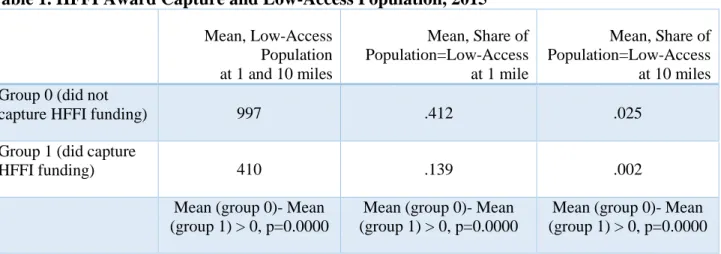
16 This pattern holds true, and is statistically significant when we compare the share of low-access
people in 2015 living in tracts that captured HFFI funding or did not, for both urban and rural
populations. Table 1 presents the results from these three t-tests, comparing low-access
populations in tracts that captured HFFI funding with those that did not. This suggests that on
average, there were fewer low-access people living in tracts that captured HFFI funding than those
tracts that did not. Overall, this indicates that HFFI funds are not reaching the populations most in
need.
Table 1. HFFI Award Capture and Low-Access Population, 2015 Mean, Low-Access
Population at 1 and 10 miles
Mean, Share of Population=Low-Access at 1 mile
Mean, Share of Population=Low-Access at 10 miles Group 0 (did not
capture HFFI funding) 997 .412 .025
Group 1 (did capture
HFFI funding) 410 .139 .002
Mean (group 0)- Mean (group 1) > 0, p=0.0000
Mean (group 0)- Mean (group 1) > 0, p=0.0000
Mean (group 0)- Mean (group 1) > 0, p=0.0000
I also ran a Pearson Chi-Squared test on the sample of 72,776 Census tracts, to further look
at the relationship between a tract’s low food access status and its treatment with HFFI award
capture. If HFFI award capture has no association or impact on low-access status, then the null
hypothesis expects the proportion of tracts to be equal across all categories, that is no significant
difference between treated tracts and untreated tracts that are low-access and those that are not
low-access. Results from the Chi-Squared test comparing 2015 low-access classification and HFFI
17 and there is a statistically significant relationship between award capture and whether a tract was
low-access in 2015.
Table 2. Proportions of 2015 low-access tracts and HFFI award capture
2015 Low-Access at 1 and 10 miles
Award Capture
0 1 Total
0 40,646 26,424 67,070
1 4,603 1,103 5,706 Total 45,249 27,527 72,776
Pearson chi2 (1) = 900.4306, P=0.0000
In interpreting this distribution, we can infer that 37.82% of all Census tracts (27,527 tracts
out of a total 72,776 tracts) were low food access in 2015 at the 1 and 10 mile threshold. 19.33%
of treated tracts were low food access, compared to 39.40% of untreated tracts. This suggests that
there is an association between capture of HFFI award money and low-food access status. A further
refinement of this association is presented in Table 3, which takes into account a tract’s change in
food access status from 2010 to 2015. Change in food access is captured by the variable
“AccessImprove”, which I created and coded as follows:
AccessImprove 2010 2015
-1 not low access low access
0 low access low access
1 low access not low access
2 not low access not low access
Results from the Pearson Chi-Squared test comparing a tract’s change in food access status
and its capture of HFFI award funds are presented in Table 3. With a p value of 0, we reject the
null hypothesis and conclude that there is a significant association between change in food access
18 Table 3. Change in food access status and HFFI award capture
Access Improve
Award Capture -1 0 1 2 Total
0 2,052 24,372 2,977 37,669 67,070
1 131 972 220 4,383 5,706
Total 2,183 25,344 3,197 42,052 72,776
Pearson chi2 (3) = 965.0442, P=0.000
In considering HFFI’s ability as a policy tool to mediate the problem of food deserts, tracts
whose food access status improved are of particular interest. These are the tracts
(AccessImprove=1) that were low access in 2010 but were no longer low access in 2015. If the
proportion of treated tracts (places that captured HFFI award funds) that saw improved food access
status is greater than in untreated tracts, this finding would provide support for the policy’s
effectiveness. However, my analysis did not find this to be true. There was a total of 3,917 tracts
whose food access status improved, which represents 4.39% of all Census tracts. When we look at
how many treated tracts saw their food access improve from 2010 to 2015, we see this percentage
is lower: 3.86% of treated tracts had improved food access, while 4.44% of tracts that did not
receive HFFI award money saw an improvement in food access. This finding demonstrates that
tracts saw improvement in their food access via developments outside of HFFI. It is not possible
to know what happened in these places that were low access in 2010 and were no longer in 2015—
perhaps market conditions improved and new retailers came in voluntarily, perhaps philanthropic
sources provided seed capital to construct new stores, perhaps there were trends of people within
an area moving closer to existing stores. But this finding does establish that capture of HFFI
19 also interesting to note that 76.81% of all tracts that captured HFFI award money were neither low
access in 2010 nor 2015. This finding suggests that HFFI fund disbursement is not reaching the
areas most in need. A more targeted approach to fund allocation could help HFFI in its ability to
specifically fund food retail projects in actual areas of low food access.
As noted, this analysis presents an incomplete picture. Data limitations prevented all HFFI
fund activity from being included. The analysis looks solely at the association between award
capture and only one indicator of food access, measured as physical proximity to a full service
food retail outlet. Potential confounding factors such as vehicle access, household income and race
are excluded from this analysis. Despite these limitations, the analysis produces results of interest
that point to a need for further, more robust analysis of HFFI as a policy tool and its effectiveness
in improving food access. Results indicate that HFFI effectiveness could be improved through
better targeting of fund disbursement to low-access tracts. Federal staff who make decisions
regarding HFFI fund disbursement could also benefit from studying communities that were able
to improve their food access, despite not receiving any HFFI funds.
The next section of this paper presents a case study of one such community’s process in
opening a new food retail outlet, the Renaissance Community Cooperative in Greensboro, North
Carolina. Detailing their experience in financing the new grocery store illuminates some of HFFI’s
shortcomings and suggests areas of improvement in order to achieve better outcomes. As the case
demonstrates, HFFI as a policy is not enough to guarantee improved food access in low-income
communities. As the following section details, the institutional actors involved in the Renaissance
project were unable to secure financing through HFFI, and yet despite these barriers, they were
20 4 CASE STUDY: NEW FOOD RETAIL IN GREENSBORO, NORTH CAROLINA
The October 2016 opening of the Renaissance Community Cooperative (RCC) in Greensboro,
North Carolina provides a case study on how a low-income community organized to successfully
open a grocery store in their neighborhood. Collaboration amongst multiple stakeholders proved
key to the project’s success. It is important to note that the RCC project was not financed with any
HFFI funds, and in fact, stakeholders had difficulties in attempting to access these funds.
Before the RCC opened its doors, this northeastern neighborhood of Greensboro had not had
a full-service grocery store since 1998. As this case study will show, there were a variety of factors
that enabled the RCC to overcome challenges associated with opening a grocery store, including
the existence of well-organized, active citizen groups; the support and assistance of a local
non-profit; and the financing expertise of several CDFIs. The story of the RCC highlights the necessity
of a CDFI in helping a community navigate the complex process of opening a new food retail
outlet and developing a project that is financially feasible. It also illuminates some of the
challenges faced by CDFIs in accessing HFFI award money.
The next sections present the methodology I employed, followed by a brief demographic
overview of the neighborhood, provided to contextualize the case. Next I present my findings,
organized around the three primary factors that enabled RCC’s success: pre-existing, active
neighborhood groups; a local non-profit champion; and the involvement of several CDFIs. I next
detail the RCC’s experience with trying to access HFFI funds. The case study concludes with
takeaways for interested parties, including planners and community activists hoping to bring new
food retail outlets into their neighborhoods, as well as recommendations for improving HFFI as a
21 4.1 Methodology
The RCC was chosen as the focus of this case study both for its proximity—I live within
easy driving distance of the store—and for its timeliness—the store opened during the course of
this research, allowing me to observe parts of the process leading up to RCC’s first day and to
attend the store’s grand-opening celebration. I initially came across the RCC project through
existing connections with food access networks in North Carolina. I assumed that RCC had
accessed HFFI funding, an assumption that proved to be untrue.
I used a mix of key-informant and stakeholder interviews as well as snowball sampling to
conduct primary interviews with actors involved with the RCC project. I first heard about the
RCC project from an employee at Self-Help, a CDFI in Durham, North Carolina, that was part of
the RCC project. I attended a pre-store opening meeting in September 2016, and later attended the
store’s grand opening ceremony in November 2016, and identified relevant people to contact at
these events. Other contacts were identified through the snowball sampling method. I conducted
semi-structured interviews, in person and on the phone to gather information on the store’s opening
and financing. The goal in these interviews was to gather information from a variety of
perspectives, including CDFI employees, city officials and neighborhood activists regarding how
the RCC project successfully opened its doors. I developed a questionnaire and conducted
interviews with the following stakeholders:
• Steve Saltzman, Loan Officer, Healthy Food Systems Initiative, Self-Help Credit Union, • Dr. Goldie Wells, Co-Chair, Greensboro Citizens for Economic and Environmental Justice • Marikay Abuzuaiter, At-Large Member, Greensboro City Council
• Gabriella Mora, Senior Associate, The Food Trust • Jim Barham, Agricultural Economist, USDA
• Olivia Rebanal, Director of Loan Programs, Capital Impact Partners
22 I also reviewed news articles that covered the RCC’s opening, blog posts from involved
non-profit actors, and other primary source documents to supplement the information gathered through
these interviews.
4.2 Neighborhood Demographics
The RCC grocery store is located in northeastern Greensboro, in Census tract
37081012705. This tract was low food access in both 2010 and 2015, as determined by the FARA
methodology described in the previous section. The tract is home to a predominantly
African-American, low-income population. Table 5 gives a comparative overview of the tract’s
demographics as well as those of the surrounding area, while Figure 1 provides a look at the store’s
location within Greensboro. We can see that the RCC is located in a neighborhood that is over
90% African-American with an unemployment rate more than double that of the City of
Greensboro. This area also falls behind on measures of education and income when compared to
the City of Greensboro.
Table 5. Demographics for RCC location and surrounding geographies Census Tract
37081012705
City of
Greensboro Guilford County North Carolina Percent
African-American 90.6% 42.1% 33.4% 21.5%
Percent of Population 25 Years and over with a college degree
11.2% 23.5% 22.4% 18.4%
Unemployment Rate 19.6% 8.5% 8.8% 9.4%
Median Household
Income $27,384 $41,628 $45,651 $46,868
23 Figure 1. Location of the RCC within Greensboro
4.3 Neighborhood Organization in Northeast Greensboro
The RCC is housed within the Bessemer Shopping Center, at 2517 Phillips Avenue, in
Greensboro, North Carolina. This is the same shopping center that previously housed the
Winn-Dixie grocery store. When the Winn-Winn-Dixie closed its doors in 1998, the neighborhood lost its sole
full-service supermarket in the area, and became a food desert. In response, residents formed the
Concerned Citizens of Northeast Greensboro (CCNG), a community interest group that provided
an outlet for community members to gather and discuss strategies for trying to attract a national
food retailer to open a new store in the abandoned shopping center. Over the years, several national
retailers expressed interest in moving into the neighborhood, and the City of Greensboro had
24 expressions of interest yielded nothing. Despite these repeated setbacks and false starts, this
grassroots coalition persisted over the years, with its sights set on bringing a grocery store back to
the Bessemer Shopping Center.
Organizing to get a grocery store was not the only cause uniting people in this
neighborhood. Citizens had been active for many years in opposing repeated efforts by the City of
Greensboro to reopen the White Street Landfill, located in the neighborhood. Grassroots coalitions
of African-American residents had been voicing concern about the landfill since the mid-1990s.
After repeated discussions and City Council consideration of plans to expand the landfill, the City
Council decided to finally close the landfill in 2006. The White Street Landfill stopped accepting
household garbage in 2007, largely due to this continued pressure from citizen activists in the
neighborhood. Household waste was instead shipped to a site in nearby Montgomery County.
However, the possibility of expanding the White Street Landfill was reignited in 2009, when City
Council elections resulted in a new, conservative majority. These new members promised to cut
taxes and reduce municipal spending, and saw re-opening and expanding the White Street Landfill
as one such way to cut costs. As this new council moved forward with plans to re-open the landfill,
neighborhood residents organized under the direction and leadership of Dr. Goldie Wells, a former
City Council member. Building on their tradition of forming grassroots advocacy groups, they
formalized into a group they called Citizens for Economic and Environmental Justice (CEEJ).
Many members of CCNG joined CEEJ. CEEJ held regular meetings where neighbors could voice
their concerns, formed coalitions with other local groups, and organized protests, all with the goal
of preventing the landfill’s re-opening and expansion. This ability to collectivize and take action
towards a common goal proved to be one of the community’s key assets, one that ultimately played
25 With CEEJ focused on keeping the White Street Landfill closed, these citizen activists also
set their sights on political change. Many of them viewed the current City Council as antagonists.
CEEJ members formed a group focused on voter registration and “unseating the pro-landfill City
Council members” (Madsen 2012, 132). By the time of City Council elections in November 2011,
CEEJ and neighborhood organizers were successful in their goals: the members supportive of
reopening the landfill largely lost their seats, and the new Council assured residents that reopening
the White Street Landfill would no longer be considered as a viable option for handling the city’s
waste. New Council members also expressed their support for the neighborhood’s movement to
get a grocery store and voiced their commitment to making this a reality. After the November 2011
elections, Dr. Wells recalled several Council members promising to help with CEEJ’s efforts to
get a new grocery store. Newly elected Councilwoman Marykay Abuzuaiter felt that in face of the
community’s commitment to the grocery store, and in light of their recent success in organizing
residents to affect political change, the City had a duty to help. “We felt we couldn’t let the
community down on this. We can’t let this community go without a grocery store any longer.”
This sequence of events highlights the power of the community’s self-organization in driving the
eventual RCC project. CEEJ’s voter registration efforts lead to higher turnout throughout
northeastern Greensboro neighborhoods. As a result, several City Council members viewed as
unsympathetic to these residents’ needs lost their seats, and the newly elected members explicitly
promised to assist in securing a new grocery store.
Demonstrating their capacity to collectivize and organize was key to establishing the
community’s legitimacy in the eyes of the City Council. The City of Greensboro owned the
Bessemer Center at the time, so having support from the City Council and their commitment to
26 the City eventually sold the shopping center to Self-Help, a Durham based CDFI whose role in the
project is further detailed below. The City also committed a $250,000 grant to the project,
contingent on the RCC’s ability to raise a matching amount. The tenacity of CCNG and CEEJ in
pressuring political representation to meet their needs can thus be seen as a success. The
community’s ability to self-organize and coalesce around a common cause built a solid foundation
from which the RCC project could be launched.
4.4 Local Non-Profit Champion
In addition to the strength of the neighborhood’s grassroots coalitions, evinced by the
existence of both CCNG and CEEJ, the development and execution of the RCC relied heavily on
support from the Fund for Democratic Communities (F4DC), a local non-profit dedicated to
economic justice and community empowerment. In late 2010, Ed Whitfield and Marnie
Thompson, the co-founders of F4DC, were focusing their work on cooperative economies. As
Thompson described, they “were looking for opportunities to use cooperative enterprises to solve
real world problems, and we wanted to teach and learn about coop development in the context of
actually doing it.” They were aware of CCNG and residents’ attempts to attract a grocery store, so
they began to have discussions with Dr. Wells about the possibility of bringing a cooperative
grocery store into the neighborhood. F4DC staff began speaking about the cooperative grocery
model at both CEEJ and CCNG meetings in late 2011 and early 2012.
Initially, residents were unsure about pursuing a cooperative, and F4DC’s suggestion of a
grocery coop was not met with enthusiasm. Dr. Wells and others thought that Save-A-Lot, a
national chain, was going to come into the former Winn-Dixie space. Save-A-Lot was one of
27 the Bessemer Center, before eventually backing out. When the Save-A-Lot deal fell through in
early 2012, community members were still hesitant about pursuing a cooperative model. Much of
this resistance stemmed from misconceptions about what a cooperative grocery store looks like.
There was the perception that coops meant high prices, exclusively organic produce, and the types
of products people in the neighborhood were not interested in. There were also worries that despite
strong community organizing skills and past success in keeping the landfill closed, neighborhood
residents did not have the capacity to run and manage a coop. To overcome these hurdles, F4DC
invested staff time and resources to work with community groups and provide education on how
cooperative businesses work. They regularly attended community meetings and performed
outreach over the course of 2011 and 2012. This involved assuring people that their coop did not
have to look like existing coops and that it could instead be designed to meet their needs. As
member-owners, they would be able to design a food retail outlet that met their goals: a full-service
grocery store stocked with fresh, affordable produce that pays its workers a living wage. As part
of this education effort, F4DC organized a trip in August 2012 for community members to visit a
newly opened food cooperative in Burlington, North Carolina. 30 community members attended,
and seeing the Burlington cooperative store served to inspire several of the Greensboro residents
to get more serious about having a cooperative grocery store in their own neighborhood.
F4DC also had to reiterate its commitment to the project, and assure residents that the
organization was willing to assist in helping people develop the capacities necessary to start and
manage a cooperative. As a mission-based intermediary deeply dedicated to the community, F4DC
was uniquely positioned to shepherd community members through this multi-year process.
28 been less willing to invest as many resources to one project and remain in an active leadership role
over the course of several years.
By November 2012, after continued education and outreach efforts, a group of 15-20
community members decided that a cooperative grocery store was their best option. They
formalized their organizational efforts by forming the Renaissance Coop Committee. The
Renaissance Community Coop opened its doors in October 2016. Over the course of this multi-
year process, F4DC played an integral role in shepherding the project to success. If not for F4Dc’s
vision and willingness to educate and provide resources, the community would likely not have
pursued a cooperative model. Without F4DC’s patient involvement in every step of the process,
particularly their provision of financing assistance, it is likely the RCC would not have been a
success.
4.5 The Role of CDFIs
F4DC led the RCC financing process, after bringing the cooperative model to the
neighborhood and supporting residents as they pursued market and feasibility studies to assess the
store’s potential. This involved working with CDFIs and other supportive lenders to secure
necessary financing. F4DC staff approached Self-Help, a nationally known CDFI based in
Durham, North Carolina, in the spring of 2013, after the RCC board had completed its feasibility
study. Self-Help is involved with a grocery cooperative in Durham, received HFFI award money
through the CDFI Fund in 2013, and has a social justice oriented mission to support economic
opportunity. F4DC staff also had pre-existing relationships with Self-Help, facilitating
communication. For these reasons, supporting the RCC project was a natural fit for Self-Help’s
29 viable development project to the Greensboro City Council. Steve Saltzman, who leads
Self-Help’s Healthy Food Initiative, spoke on behalf of the RCC project at a Greensboro City Council
meeting. He prepared a basic terms sheet and said Self-Help was on board to act as a lender to the
RCC project. This provided the project with important credibility before the Council, and indicated
that the RCC could successfully secure financing. Around this time, the Council was in talks to
sign an agreement with a developer to purchase and redevelop the Bessemer Center, where the
abandoned Winn-Dixie stood. However, this deal fell through in the summer of 2013. At this time,
after being approached by both F4DC and members of the Council, Self-Help agreed to purchase
the shopping center. F4DC and community members felt that since Self-Help had already voiced
its support for bringing a grocery store to the Bessemer Center, having Self-Help as the center’s
owner and developer would ensure the RCC could progress forward.
In purchasing the shopping center, Self-Help shifted its role from potential lender to
shopping center developer and landlord. This is the same role they play in the Durham Coop, as
owner of the shopping center and landlord. In the RCC case, while Self-Help did not end up
fulfilling its traditional role as lender, they did provide a sizeable amount of equity to the project
through a generous tenant improvement allowance. Additionally, as owner of the entire shopping
center, Self-Help is in the ongoing process of attracting other retail tenants that meet community
needs and compliment the RCC, such as a medical clinic, a pharmacy and a restaurant. In these
ways, Self-Help’s involvement in and support of the RCC can be seen as instrumental to the
project’s success and longevity.
With Self-Help no longer able to act as a lender to the project, F4DC shifted to take on
30 included working with the RCC board to raise equity through the sale of ownership shares in the
coop, grassroots fundraising, particularly in local churches, and pursuing grants from supportive
foundations. F4DC also reached out to CDFIs who would be interested in lending to the project.
F4DC had a pre-existing relationship with Shared Capital Cooperative, a national CDFI based in
Minneapolis, Minnesota. Shared Capital is focused on lending to cooperative businesses as a way
to build economic democracy, a mission that aligns well with F4DC’s, as well as that of the RCC.
In August 2015, Shared Capital made an early loan commitment to the project as RCC’s senior
lender due to the project’s fit with their mission—a cooperative business located in an area of
demonstrated economic need. This early commitment was made so that F4DC and the RCC could
use Shared Capital’s financing commitment as leverage in seeking grants and additional sources
of finance. Shared Capital provided two loans to the project, both with patient terms and
below-market interest rates. Shared Capital was willing to subsidize its interest rate and stretch their
normal repayment terms for the RCC project due to its mission fit. This flexibility and willingness
to support the project’s success exemplifies the role of CDFIs in healthy food finance. Unlike
traditional bank lenders, where the sole focus is on minimizing risk, CDFIs are looking for projects
in line with their mission that they really want to see succeed. They realize that their best hope of
getting repaid is by helping the project be successful.
This mentality and approach is evident in Shared Capital’s ongoing relationship with F4DC
and the RCC project. The RCC store is F4DC’s first experience raising millions in capital, so
having a close relationship with the lenders involved, who are willing to provide education and
support, has been instrumental to the RCC’s success. F4DC led financing discussions with Shared
Capital, negotiating and re-negotiating the deal and terms to meet community needs. As part of
31 and the project’s other major lender, the Southern Reparations Loan Fund (SRLF). These calls are
held to check in on store operations and monitor how progress is going. F4DC staff, who continue
to manage RCC’s financing process, report feeling very supported by Shared Capital and SRLF.
Both Self-Help and Shared Capital, two mission-driven CDFIs, were instrumental in
bringing the RCC project to life, from site acquisition through ongoing store operations. By
purchasing the building and re-developing the former Winn-Dixie with the RCC in mind, as well
as contributing project equity, Self-Help worked to ensure the project could move forward. By
contributing patient capital with flexible terms, Shared Capital ensured the project had the debt
financing necessary to fund its opening. These two CDFIs became involved in a way and made
contributions that traditional sources of finance (commercial banks) would have been unwilling
and/or unable to make. This again highlights the necessity of mission-driven institutions like
CDFIs in helping to finance food retail outlets in low-income communities.
4.6 Stakeholder Experience with HFFI
At the start of this case study, I assumed that Self-Help had received HFFI funding that
allowed them to finance the RCC project. I also assumed that Self-Help had acted as RCC’s senior
lender. These were incorrect assumptions, and as my conversations progressed, I learned in fact
that Self-Help, the RCC and Shared Capital had all individually attempted, unsuccessfully, to
access HFFI funds. Self-Help and Shared Capital had applied for HFFI funds from the Department
of Treasury’s CDFI Fund, while the RCC, with F4DC playing an important role in preparing the
grant application, attempted to access HFFI funds through HHS’s Community Economic
32 that exist within HFFI’s policy design, and suggest areas of improvement to strengthen HFFI’s
efficacy.
The experience of Self-Help and Shared Capital in accessing HFFI funds illuminates two
roadblocks in the policy’s design that limit its effectiveness. The first is only recognizing when a
CDFI makes a loan as qualifying HFFI activity. The second is requiring that CDFIs receive a
general financial assistance award in order to be eligible for a HFFI award. In evaluating
applications for HFFI funds, Treasury’s CDFI Fund considers a CDFI’s past experience in healthy
food finance projects as an important factor in selecting applicants. Current parameters for defining
past “qualifying food access activity” only recognize when a CDFI provides a direct loan to a food
access project. If a CDFI is involved in a project in a role other than lending, this non-lending
activity is not considered by the Fund. As receiving HFFI awards from the Fund is a competitive
process, CDFIs with proven track records of successfully lending to new food retail outlets are
more likely receive awards. For Self-Help, their involvement with the Durham Cooperative and
the RCC are thus not counted as qualifying food access activity, because Self-Help did not provide
loans in these two instances. As Saltzman explained, “our most impactful healthy food access
projects largely have happened without getting credit form the CDFI Fund.” To overcome this
roadblock, HFFI’s definition of qualifying food access activity could be expanded, incentivizing
CDFIs to both lend to, and when necessary, to act as developers for food retail projects. According
to Saltzman, “If HFFI awards incentivized and recognized when CDFIs took on roles as
developers, that could serve as a catalyst” for improving food access.
Another roadblock in a CDFI’s ability to access HFFI funds involves the requirement to
33 assistance awards are the bulk of the Fund’s financing to CDFIs. CDFIs that receive general
financial assistance awards must match their award, dollar-for-dollar, with funds from non-federal
sources. Shared Capital has applied for HFFI funds four times, and has not been successful due to
this rule. Brenda Pfahnl, Director of Programs and Senior Loan Officer at Shared Capital, reports
that their HFFI applications have received high scores. In fact, last year Shared Capital received a
perfect score on their HFFI application, but they did not receive a general financial assistance
award. Due to existing rules, they were therefore deemed ineligible for the HFFI award, despite
their high score. Pfahnl finds it ironic that Shared Capital, a CDFI founded by retail cooperative
grocers that has been successfully lending to grocery stores for nearly 40 years, has been unable
to access CDFI funds specifically targeted to supporting food retail. The twinning of general
assistance awards and HFFI eligibility thus represents another roadblock in the policy’s design. If
this requirement was modified or relaxed, and HFFI eligibility was not tied to receiving a general
financial assistance award, then CDFIs like Shared Capital that want to support cooperative food
businesses could have a clearer path to accessing HFFI money to support their work.
The RCC applied twice for a HFFI award from the Department of Health and Human
Services, and their application was rejected both times. Thompson reports that the application
process was complex and time-consuming. Based on her experience, she ultimately would not
recommend that other aspiring food retail outlets in low-income communities bother with the
arduous process. HHS awards HFFI funds through its Community Economic Development (CED)
grant program, and requires that applicants be certified community development corporations
(CDC). CDCs are a class of non-profit organizations with a focus on supporting economic
development within a specified geography. Since the RCC is a cooperative enterprise and neither
34 application eligibility requirement. This felt like an arbitrary requirement to F4DC and the RCC,
as the YMCA was not fully vested in the project. Additionally, to fulfill its mission of creating
employment opportunities for underserved individuals, CED sets hiring parameters and job
creation requirements that applicants for HFFI awards must meet. Projects that receive CED-HFFI
awards must commit to filling a minimum of 75 percent of these newly created jobs with
low-income individuals. While the RCC was committed to hiring from the community, the RCC board
and F4DC were concerned about filling management and departmental positions with
inexperienced people. They felt that the store’s ability to succeed depended on having experienced
management and department heads in place, while cashiers, stockers and other entry level jobs
could be filled by less experienced people from the neighborhood. Thompson felt that HHS’s job
requirements therefore did not match with RCC’s goals.
4.7 Take-Aways
The presence of the Renaissance Community Cooperative is an important milestone for the
northeastern Greensboro community. A low-income, marginalized community was able to
self-organize and utilize institutional resources in their vicinity to overcome barriers in opening a
grocery store. With support from F4DC, they pursued a cooperative model, not only bringing in a
food retail outlet, but one that they themselves owned. Through the sale of owner-shares to
members of the community, the cooperative model also enabled the community to self-raise a
portion of the project’s equity. To further raise the finance needed to complete their vision, the
RCC relied on capital from CDFIs supportive of their mission. As this case has demonstrated,
RCC’s success can be understood as a product of an active, engaged community; the active
35 This case has also highlighted some of the barriers encountered by institutions trying to access
HFFI funds. The RCC is exactly the type of project the policy is designed to support—a
full-service grocery store in a low-income neighborhood classified as a food desert, and yet the
institutions involved in opening the store were unsuccessful in accessing HFFI funding. This can
in part be explained by the competitive nature of HFFI awards—applicants are competing for
access to a limited pool of resources—and suggests a need for the federal agencies involved to
expand the resources they allocate to HFFI. At the same time, the difficulties faced by Self-Help,
Shared Capital and the RCC in accessing HFFI funds suggests areas for improvement, particularly
around streamlining the application process employed by both the Treasury’s CDFI Fund and
HHS’s CED program.
While the focus of this paper is on the financing process, in studying what enabled the RCC’s
success, the need for community support emerged as a principal theme and perhaps the most
important condition for success. Stakeholders reiterated to me the importance of an organized
community in driving the project. Thompson said F4DC receives multiple inquiries a week from
people interested in replicating RCC’s model. She says she always asks, “Do you have community
support? Is the community organized? Because the project is not going to work if an outsider
comes in and says ‘we think this neighborhood could use a grocery store.’” Dr. Wells expressed a
similar sentiment, and offers similar advice to communities interested in bringing new food retail
to their neighborhood. She encourages residents of low-income areas to “be aware that their
community contains untapped resources and assets.” With the right leadership in place, and
someone to act as a champion during the long process, success can be achieved. In leading CEEJ,
Dr. Wells saw her role as reminding people that they could achieve their goal and encouraging
36 strengths and our ability to make change.” As RCC’s experience demonstrates, it can take many
years for a project to move from idea to completion, with the financing process requiring patience
and resourcefulness. If residents themselves are not willing to put in the time to follow through on
this project timeline, success will be hard to achieve.
5 CONCLUSION
The Obama Administration, particularly through Former First Lady Michelle Obama’s Let’s
Move campaign, made targeting obesity a national priority. As public health research documented
the links between food deserts and suboptimal health outcomes, policy efforts to open more
grocery stores emerged at both the state and federal level. The Healthy Food Financing Initiative,
announced in 2010 and first funded in 2011, is one such policy tool created at the federal level as
part of this effort to eliminate food deserts. Under HFFI, three federal agencies agreed to set aside
funding specifically targeted for supporting new food retail outlets. However, these are voluntary
set-asides, subject to the agencies’ discretion. With a new administration in place, and newly
appointed agency heads, the continuity of HFFI funding is uncertain. There is little to suggest that
federal policy aimed at increasing food access will be a priority of Trump’s administration. This
creates a large amount of strategic uncertainty around the future of HFFI and what actions, if any,
the new President will take to address food deserts. In an attempt to make HFFI a more permanent
policy tool, the USDA hired an official national HFFI fund manager in January 2017, in the last
days of the Obama Administration. In doing so, the HFFI Fund can be seeded with federal
appropriations set aside in the Farm Bill, rather than discretionary funding from agency heads. The
Reinvestment Fund, a CDFI based in Philadelphia that has been a leader in healthy food finance,
37 believe Treasury and HHS will likely not continue to fund HFFI, so having the USDA designate
an official fund manager guarantees continuity for HFFI. The 2014 Farm Bill authorizes up to
$125 million for the HFFI Fund, and now that a fund manager has been selected, the USDA can
transfer funds directly to the Reinvestment Fund. Current versions of both the House and Senate
fiscal year 2017 budgets contain a $1 million appropriation for the HFFI Fund, and the hope
amongst USDA and other healthy food finance advocates is that this initial $1 million will increase
in future years. Advocacy efforts targeting the 2018 Farm Bill and increased appropriations for the
HFFI Fund are underway.
At the same time, recent studies have shown that the construction of a supermarket is often
not enough to impact diet quality and change purchasing behaviors. In this context, a better
understanding of HFFI’s impact to date is useful in helping to determine its future. In this paper, I
attempted to evaluate the policy’s effectiveness through a quantitative data analysis and a granular
case study. In both instances, it becomes clear that HFFI alone is not enough to improve food
access. With the majority of HFFI award money disbursed to date captured by Census tracts not
classified as low food access, there is clearly a need to rethink how applications for funds are
evaluated. Targeted disbursement of funds is needed to ensure that neighborhoods the most in need
of new food retail receive financial support for new grocery stores. Utilizing FARA’s newly
released estimates of food access indicators at a Census tract level can help decision-makers better
target HFFI awards. The RCC case further demonstrates areas of improvement for increasing
HFFI’s efficacy. The CDFI Fund could expand its eligibility requirements, allowing CDFIs like
Shared Capital to receive HFFI funds even if they have not received a general assistance award.
The CDFI Fund can also start to recognize CDFIs when they act as developers in healthy food