Tanya L. Whippie. A Study of the use of MARC Language Codes in OCLC Catalog Records. A Master’s Paper for the M.S. in L.S degree. April, 2010. 45 pages.Advisor: Susan Rathbun-Grubb
This study investigates the use of MARC language codes and whether they are being used in the method that best indicates that language of the materials being described. It also examines what aspects cause the language codes to be used incorrectly.
Headings:
Foreign language materials--Cataloging
MARC System
by
Tanya L. Whippie
A Master’s paper submitted to the faculty of the School of Information and Library Science of the University of North Carolina at Chapel Hill
in partial fulfillment of the requirements for the degree of Master of Science in
Library Science.
Chapel Hill, North Carolina
April 2010
Approved by
_______________________________________
Introduction
There are thousands of languages in the world, which create many problems
when trying to catalog materials in all these diverse languages. The current method of
labeling these materials is to use a Machine Readable Cataloging (MARC) language code
in the record to specify the language or languages of the materials. However, there are
many more languages in the world than there are codes and it is sometimes difficult to
determine the language of an item. My hypothesis is that some of the more confusing
language codes are being used incorrectly for various reasons.
This paper will look into records that use confusing language codes to determine
if they are being used correctly. It will also explore when and why materials are given
incorrect language codes. This can help catalogers determine how to prevent miscoding
of material in future and thus make it easier for patrons to find materials in their target
language.
This study will investigate how the MARC language codes are being used in
practice and whether actual use is in compliance with the established rules. It looks
particularly at codes, which are most likely to be misunderstood or confused: specifically
the codes that are used for special situations: miscellaneous (mis), multiple (mul), no
linguistic content (zxx), and undetermined (und) and also the codes for Bosnian (bos),
Croatian (hrv), and Serbian (srp), which until the dissolution of SFR Yugoslavia were
where catalogers may be confused about which codes to use. The latter three codes were
originally two codes. Serbian and Croatian were given their new codes in July of 2008.
The study investigates records that use those codes. It specifically examines if
those codes are being used correctly, and also establishes if there is a correlation between
when the records were created, when they were updated, the level of the record, and
LiteratureReview
MAchine Readable Cataloging or MARC standards dictate the format in which
bibliographic information is coded, so as to facilitate computers exchanging, using, and
interpreting the data. The MARC language codes are three letter alphabetic codes that
were established for MARC records. These codes were created to form a standard
method of referring to languages in a catalog record. This way, languages with alternate
names are all coded in the same manner, and languages with the same name are
distinguishable ("MARC Code List for Languages").
This paper mainly deals with MARC 21, which is the standard primarily used in
the United States, Canada, and Great Britain. In this standard, the MARC language
codes are primarily used in two places within the record. In what is known as the fixed
fields, there is a place where it is mandatory to insert a three letter code for the language.
This fixed field, Lang, in conjunction with the 041 field describes the language of the
item. The language codes are mandatory in the fixed field, but the 041 field is optional.
The MARC language codes can also be used in the following non-mandatory fields:
040‡b Cataloging Source / Language of cataloging
242‡y Translation of Title by Cataloging Agency / Language code of translated title
775‡e Other Edition Entry / Language code
("MARC Code List for Languages").
Besides those fields, most information about the language of the described material
On the online public access catalog (OPAC) of the University of North Carolina at
Chapel Hill, the language of the item is not displayed, unless a user clicks on the MARC
tab or the full record tab, although the 041 field does not display in the full record tab. In
the full record tab, the Lang field is not displayed as the MARC language code, but rather
as the full name of the language, for which the language code stands. On WorldCat, the
Lang field, as the full name of the language, and the 546 notes are displayed, but not the
041 fields.
In this study, all the MARC records analyzed come from the Online Computer
Library Center (OCLC) database of records. OCLC’s database is used and contributed to
by approximately 27,000 members from 86 countries. More than 470 languages are
represented on records within it and the system supports 12 language scripts
(“Community”).
Before the MARC standards were introduced, most catalog records did not
specify the language of items and if they did they listed the name of the language. In the
Anglo-American Cataloging Rules published in 1967, it says that “the title should be followed by the name of the language of the text,” but only if that language “differs from
the language of the conventional form of the title or if the title does not indicate the
language” (The American Library Association, et al. 248). The United Nations had a
similar method of designating the language of their documents. Their rules state: “to
distinguish material in the different official languages the name of the language is added
under the call number” (Caballero-Marsal, Nielsen, and Winton 69).
In MARC I format, the rules for dealing with the language of materials presented
language. The language of the materials was indicated in fixed fields in positions 28-36.
These positions covered three fields: the language indicator, language 1, and language 2.
The 28th position, the language indicator, contained one of five letters, indicating how
many languages were used in the item and how. These letters were:
S = The work contains only one language. The language is given in the language 1 field and the language 2 field is blank.
T = The work is a translation. Language 1 contains the language of publication, the language 2 field contains the language in which the work was originally written or Multilingual in the case of anthologies.
M = The work contains more than one language. The principal language is given in the languages field. If only two languages are used, the second language is given in the language 2 field. If more than 2 languages are used, multilingual is given in the second language.
D = The work is a dictionary of more than one language. If only 2 languages are used, these are given in the language fields. If more than 2 languages are used, the principal language appears in the language 1 field and multilingual is given as the second language.
G = The work is a grammar or reader of the type used in language courses. The native language of the student is in the language 1 field. The language being studied is given the language 2 field (Avram, Knapp, and Rather 156).
The language 1 (position 29-32) and language 2 (position 33-36) fields would be filled
by language codes that were “either three or four alphabetic characters. If three
characters, the language code is left justified with the fourth character position in the
field a blank” (155).
In the first edition of the MARC II standards, the rules for dealing with the
language of materials changed again. According to the rules, “if the work is in a single
language and is not a translation, this field will contain a three character code for the
language,” but “if the work is multilingual or a translation, the language will be recorded
in variable field 003 and the fixed field will contain blanks” (63). At the time of the
However, two years later, when MARC Manuals used by the Library of Congress
was published, there were 261 language codes listed in their own appendix. The method
of recording the language also changed and at that time:
The language of the work will always be recorded in these [fixed (35-37)] character positions by use of a 3-character alphabetic code. If the work is multilingual or a translation, the first language code will be recorded in these positions and the additional language codes, including the first language, will be recorded in variable field 041 (Library of Congress, Information Systems Office 38).
Appendix G in that publication listed all the language codes and when to use them. The
list only included written languages and when one language had more than one writing
system, both writing systems were listed. Their example of this situation was that
“Serbian and Croatian are the same spoken language but the former is written in the
Cyrillic alphabet and the latter in the Roman alphabet” (271). It also goes on to explain
that minor languages will use the language code for their language group rather than
having individual codes and where possible the codes are the first three letters of the
language name. It also gives the codes for when multiple languages are used, for
miscellaneous languages that are not listed, and for when a language code is not
applicable. It did not, however, give codes for undetermined languages (271-286).
By 1987, a separate document was being published with a list of the MARC
language codes. In this publication, “the list contains 373 discrete codes, of which 85 are
used as group codes” (USMARC iii). The methods of usage did not change drastically. However, a code for undetermined (und) languages and codes for many individual
languages were added. Also, the not applicable language option was replaced with a
no sung, spoken, or written textual content” (v). In the 1993 publication of the list, the
blank language code was replaced by not applicable (n/a) (OCLC 3:1). In the most
recent publication of the list, neither not applicable nor blank are used, instead no
linguistic content (zxx) is to be used (MARC 7).
Besides the MARC language codes, there is another family of language codes
that are frequently used in bibliographic documentation and metadata. These codes, the
ISO 639 standard, have three parts and there are three more parts in development. ISO
639-1, the original list, only contains the major languages of the world and only has 2
letter codes. In 1998, ISO 639-2 was published as a more comprehensive list. It was
based upon the MARC language codes and the two lists are still kept compatible. The
only major differences between the two lists are the names of the languages and the
codes qaa-qtz, which ISO 639-2 has reserved for local use. The most recent list, ISO
639-3, has a three letter code for every single known language both living and extinct.
The list contains all the codes from ISO 639-2 for individual languages (Library of
Congress).
All of the current literature on cataloging foreign language materials covers other
aspects of cataloging. There have been several articles written on romanization of
languages in different languages and whether that is an appropriate way to allow access
to the materials (e.g. Agenbroad). Other articles deal with specific languages and how to
improve access to materials in those languages (e.g. Adamich and Shin). There have also
been articles written about the value of vendor records, especially those in languages
other than English (e.g. Mueller). These articles do not tend to even mention using the
This study concentrates on seven of those language codes: Bosnian (bos),
Croatian (hrv), Serbian (srp), undetermined (und), no linguistic content (zxx),
miscellaneous (mis), and multiple (mul). All seven of these codes have unique histories
and reasons as to why they particularly are more likely to be used incorrectly than other
language codes.
Within the last twenty-five years, the language known as Serbo-Croatian has, for
mainly political reasons, split into three or four different languages. There had always
been local variations and dialectal differences within Serbo-Croatian, but it was only
until Yugoslavia began to break apart that they started to become known as separate
languages. Since the split, the languages have emphasized their differences, primarily
with vocabulary. These new languages are Bosnian, Croatian, Montenegrin, and Serbian.
Out of these languages Montenegrin is the leas recognized and does not have its own
MARC code; thus it will not be addressed in this paper.
In the most recent edition of the Ethnologue1
There is one variety that is more developed and that tends to be used for wider communication by speakers of various closely-related languages; as a result, there is a perceived common linguistic identity across these languages. For instance, there are several distinct spoken Arabic languages, but Standard Arabic is
generally used in business and media across all of these communities, and is also , Serbo-Croatian was identified as a
macrolanguage. In the ISO 639 lists of languages, there are several languages that are
designated as macrolanguages. This term refers to very closely related languages that
have individual codes, but that in certain situations are considered to be the same
language. The ISO 639 offers the following examples as reasons why a macrolanguage
designation might be necessary:
1
an important aspect of a shared ethno-religious unity. As a result, a perceived common linguistic identity exists.
There is a common written form used for multiple closely-related languages. For instance, multiple Chinese languages share a common written form.
There is a transitional socio-linguistic situation in which sub-communities of a single language community are diverging, creating a need for some purposes to recognize distinct languages while, for other purposes, a single common identity is still valid. For instance, in some contexts it is necessary to make a distinction between Bosnian, Croatian and Serbian languages, yet there are other contexts in which these distinctions are not discernible in language resources that are in use. (Scope of Denotation for Language Identifiers)
The Ethnologue further clarifies what macro languages are, by making a distinction between them and “other groupings of languages (e.g., all the languages spoken in South
American or all of the languages that use the Latin script or all the Bantu languages) in
that the individual languages that comprise a macrolanguage must be closely related, and
there must be some domain in which they are commonly viewed as comprising a single
language” (Lewis).
The language code for Serbo-Croatian has also changed scope over the past
twenty-five years. There have been two codes for Serbo-Croatian since the first list of
language codes. One was for Serbo-Croatian in a Roman script (scr) and the other for
Serbo-Croatian in a Cyrillic script (scc). However, in 2000 a third code was added for
Bosnian and the language code scr was changed to simply Croatian and the code scc to
Serbian. In 2008, the codes hrv (Croatian) and srp (Serbian) were created to replace scr
and scc, although it was not until late 2009 that the existing records were switched to the
Methodology
The records that are of interest for the purpose of this study are those that employ
easily confusable language codes, specifically miscellaneous (mis), multiple (mul), no
linguistic content (zxx), undetermined (und), Bosnian (bos), Croatian (hrv), and Serbian
(srp). For the purpose of this study the records will be limited to monographs that are
held by the University of North Carolina at Chapel Hill.
In order to select the records that would be part of the data set, a WorldCat search
by language phrase with the results limited to those with availability at University of
North Carolina at Chapel Hill, Academic Affairs and with the type, book was performed
using the names of the language codes. After determining how many books in the
catalog fit those criteria, the random number generator at www.random.org was
employed to generate a set of 42 records for each language code to analyze. When there
were less than 42 records for a language code, all of the records were chosen. In total
there were 248 cataloging records that were selected for analysis. At that time the OCLC
accession numbers were recorded and subsequently the records were searched for in
OCLC Connexion and printed out. Between the time of selecting the records and
printing out the records, several of the records had been edited so that they no longer had
the desired language code. Those records were then removed from the study. The actual
items were also found in the UNC libraries, in order to verify the record with book in
hand. Several items could not be obtained and thus those records were removed from the
The following data were recorded and analyzed to determine if the items were
coded correctly when cataloged, and to ascertain whether there were noticeable patterns
depending on the language: language fixed field, the 041 field, the country fixed field,
the date replaced, the encoding level, the date entered, the publisher’s information in the
260, and any other notes or subject headings that might give information about the
language of the material. The next step was to look at each item individually and decide
whether the current record accurately reflected the piece. Many of the pieces were in
relatively straightforward languages to identify such as English, Spanish, French,
German, Russian, Latin, etc. A lot of the more obscure languages were published with a
more commonly known language and the language name was printed on the piece, such
as grammars and dictionaries. The major exception was the books that were cataloged as
being in Bosnian, Croatian, and Serbian, but how those were dealt with will be discussed
later in detail.
Where there was uncertainty about the language, the title and a random sentence
from the book was entered into the Google translate tool, with the detect language option
selected. When the language was named, but the language was unfamiliar and it was not
listed on the MARC Code List for Languages, then the Ethnologue was used to look up the language to find alternative names for the languages and to determine its language
family. The MARC Code List for Languages was then consulted to determine which
language code the language fell under.
The items in Bosnian, Serbian, and Croatian posed a particular challenge, because
the languages are so similar. In order to distinguish between these three languages
Office’s suggestions (“Identification of Serbian, Croatian, and Bosnian”). The primary
method used to determine which language the piece was written in was researching the
author’s ethnicity. The place of publication, the script used, Google translator, and the
subject matter of the item were also taken into consideration. Finally, two lexical
differences between the languages were scanned for in the texts: the months of the year
and the word šta. In Croatian, there is a strong preference for words with a Slavic root. Thus their words for the months are: siječanj, velijača, ožujak, travanj, svibanj, libanj,
srpanj, kolovoz, rujan, listopad, studeni, and prosinac. Serbian and Bosnian use names
for the months with the international Latin based root: januar, februar, mart, april, maj,
jun(S)/juni(B), avgust(S)/august(B), septembar, oktobar, novembar, decembar
(Alexander 397).
It was then determined whether the item was correctly cataloged in terms of the
language and also if the record was technically accurate, but used an older set of rules or
could be improved in some manner in order to be more precise. The accuracy was
compared with the different data that was collected from the records to determine which
percentage of records were correct based upon language, encoding level, the year that it
Results
The study found that 29% of all records that were investigated were coded
incorrectly and that 41% of the records were correct, but could still have been improved
to make the record more accurately reflect the language of the item.
Figure 1:Accuracy of all records
While more of the books that were written in Bosnian/Croatian/Serbian were
coded inaccurately (35%), it is more significant that 60% of the records conveyed the
language in a manner that did not need any improvement.
Figure 2: Accuracy of all records of books in Bosnian/Croatian/Serbian
29% 41%
30% 71%
incorrect
improvement possible
completely correct
35%
5%
60% 65%
incorrect
improvement possible
Records for books in Bosnian had about the same percentage of accuracy as the records
for those in Bosnian/Croatian/Serbian.
Figure 3: Accuracy of records of books in Bosnian
In contrast, 90% of all the records for books in Serbian were entirely correct and 10% of
the records were incorrect; there were none that could be improved.
Figure 4: Accuracy of records of books in Serbian
This completely contrasted with the records for books in Croatian, of which 71% were
inaccurate and only 23% were entirely correct. 26%
11%
63% 74%
incorrect
improvement possible
completely correct
10%
90%
incorrect
Figure 5: Accuracy of records of books in Croatian
In the other language codes, all of the records for books in undetermined
languages could be improved, but were not technically incorrect. As seen in figure 6, of
the records for books with a language code of zxx, 87% of the records were incorrect and
13% of the records were incorrect. There were no records that were correct, but could
use some improvement.
Figure 6: Accuracy of zxx records
Slightly less than half (44%) of all the records for books in miscellaneous languages
were incorrect and only a tenth of them were completely correct. 71%
6% 23% 29%
incorrect
improvement possible completely correct
87% 13%
incorrect
Figure 7: Accuracy of records of books in miscellaneous languages
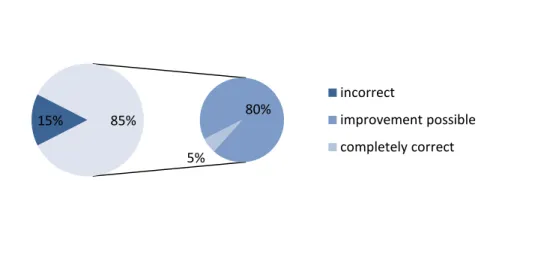
In contrast, only 15% of all the records in multiple languages were incorrect, with an
astonishing 80% of the records that could be improved.
Figure 8: Accuracy of records of books in multiple language
The study also observed how the encoding level of the record related to the
accuracy of the record. Encoding levels indicate the degree of completeness of the
MARC record. Among the records investigated in this study, only eight, out the possible
fourteen, encoding levels were recorded: blank ( ), 1, 4, 7, I, K, L, and M. A blank level
record is considered to be full-level and the most complete MARC record. A physical
44% 46%
10% 56%
incorrect
improvement possible completely correct
15% 80%
5% 85%
incorrect
inspection of the item by the cataloger is necessary to create the information contained in
a record of this level. This code can only be used specific agencies and libraries that
have authorization. An encoding level of 1 is applied to records where the item is not
examined, but they are still full-level. The information on the record is obtained from an
existing description of the item, such as a printed catalog card. Primarily this code is
used in the retrospective conversion of records. A record with an encoding level of 4 is
considered to be core-level or “less-than-full, but greater-than-minimal-level cataloging
and that meets core record standards for completeness” ("Bibliographic Formats and
Standards"). It can be entered by any OCLC participant. An encoding level of 7 is
applied to minimal-level records that meet the specifications of the National Level Bibliographic Record. A record with an encoding level of I is considered to be a full-level record that was created by an OCLC participant. An encoding full-level of K is applied
to less-than-full records created by OCLC participants. A record with an encoding level
of L is considered to be a full-level record that is added from a batch record from an
institution other than LC, NLM, BL, NLC, or NLA. An encoding level of M is applied
to less-than-full records that were batch loaded from institutions other than the ones
listed above.
Out of all the blank level records, which should be the most complete, only
two-thirds of the records accurately denote the language of the item. The only encoding level
that has a higher ratio of accuracy in this study is 4, which refer to core-level records.
Most of the encoding level codes have too few examples to draw conclusions; however,
exception is M level records, which are batch loaded less-than-full records; 86% of those
records denote the language of the material incorrectly.
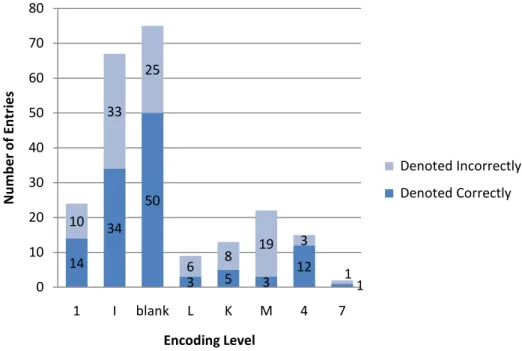
Figure 9: Accuracy of all records according to the encoding level
Among all the records that indicated that the item was in Bosnian, Croatian, or Serbian,
approximately two-thirds of records with encoding levels of I, blank, L, K, and M
denoted the language correctly. Over 83% of all the records with an encoding level of 4
indicate the language of the items accurately. 14
34 50
3 5 3 12 1
10 33
25
6 8
19 3
1 0
10 20 30 40 50 60 70 80
1 I blank L K M 4 7
N
umb
er o
f E
nt
rie
s
Encoding Level
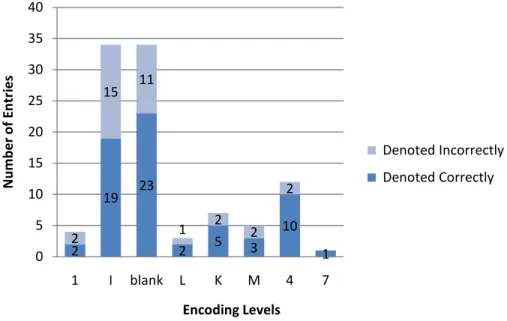
Figure 10: Accuracy of records of books in Bosnian/Croatian/Serbian according to the encoding levels
Of the blank level records that indicated the item to be in Bosnian, 92% correctly denote
the language of the material. All the other levels of records have less than 5 records in
the sample and all of them except for M level records, which are 33% accurate, are 50%
or more accurate. 2
19 23
2 5 3
10 1 2
15 11
1 2 2
2
0 5 10 15 20 25 30 35 40
1 I blank L K M 4 7
N
umb
er o
f E
nt
rie
s
Encoding Levels
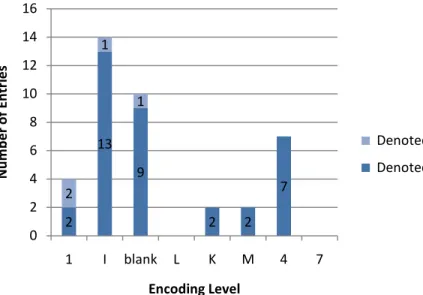
Figure 11: Accuracy of records of books in Bosnian according to the encoding level
There was a very high percentage of accuracy of records for books in Serbian and thus it
is not too surprising that all the level 4, K, and M records were accurate. There was also
only one level I and one blank level record that were incorrect. Out of the four level 1
records, two correctly denoted the language and two denoted it incorrectly.
Figure 12: Accuracy of records of books in Serbian according to the encoding level
1 11
2 2 1 3
1 1 1 2 2 0 2 4 6 8 10 12 14
1 I blank L K M 4 7
N umb er o f E nt rie s Encoding Level Denoted Incorrectly Denoted Correctly 2 13 9 2 2 7 2 1 1 0 2 4 6 8 10 12 14 16
1 I blank L K M 4 7
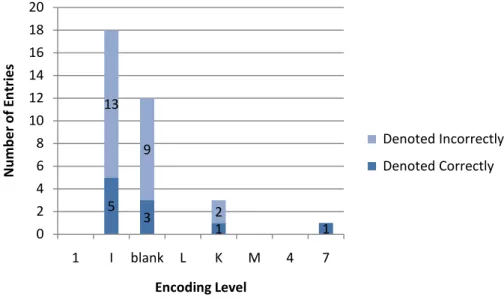
The records of Croatian books had a very high inaccuracy rate and that trend spanned
records of all levels. Out of the 18 I level records, only five were correct. Similarly only
three out of the 12 blank level records were accurate. There were fewer records of the
other levels and the one 7 level record was correct and one-third of the level K records
were accurate.
Figure 13: Accuracy of records of books in Croatian according to the encoding level
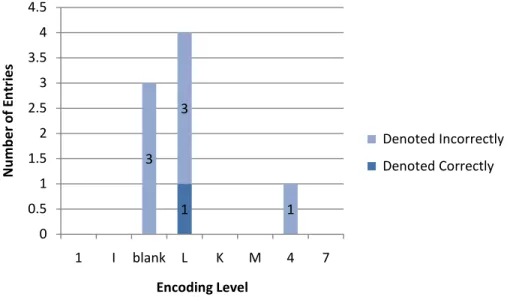
Only one of the records with a language code of zxx (no linguistic content) was coded
correctly. Thus all the records with a blank and 4 encoding level were inaccurate. The
one correct record was one of four L level records. 5
3
1 1
13
9
2 0
2 4 6 8 10 12 14 16 18 20
1 I blank L K M 4 7
N
umb
er o
f E
nt
rie
s
Encoding Level
Figure 14: Accuracy of zxx records according to encoding language
Among the records for books in miscellaneous languages, all the 1, 7, K, and M level
records denoted the language of the item incorrectly, whereas all the level 4 records were
accurate. Six of the 23 blank level records and six of the nine I level records were
incorrect.
Figure 15: Accuracy of records of books in miscellaneous languages according to encoding level
1 3 3 1 0 0.5 1 1.5 2 2.5 3 3.5 4 4.5
1 I blank L K M 4 7
N umb er o f E nt rie s Encoding Level Denoted Incorrectly Denoted Correctly 3 17 2 1 6 6
2 1 1
0 5 10 15 20 25
1 I blank L K M 4 7
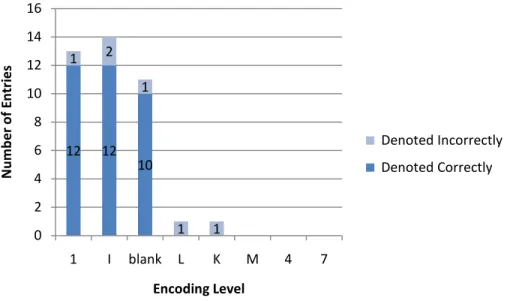
Among the records of books in multiple languages, the blank, 1, and I level records are
all more than 85% accurate. In this group there is only one K and one L level record and
they both denoted the language of the item incorrectly.
Figure 16: Accuracy of records of books in multiple languages according to encoding level
Besides looking at the accuracy of the records based upon the encoding level, this
study also observed what year the records were created and what years they were updated
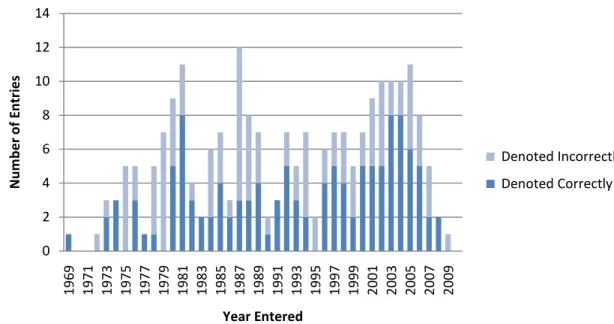
to see if there were any trends. The earliest record was created in 1969 and the most
recent one in 2009. The most inaccurate records (nine) were created in 1987, closely
followed by 1979, when all seven records that were created were incorrect. 1981, 2003,
and 2004 all tied for the year when the most accurate records were created, as in each of
those years eight correct records were made. 12 12
10
1 2
1
1 1
0 2 4 6 8 10 12 14 16
1 I blank L K M 4 7
N
umb
er o
f E
nt
rie
s
Encoding Level
Figure 17: Accuracy of all records according to the year entered
The creation dates for records of books in Bosnian, Croatian, and Serbian only
span from 1979 until 2008. The most inaccurate records (five) were created in 1987
closely followed by 1979 and 2001, when there were four incorrect records each of those
years. Almost 75% of the inaccurate language coding situations occurred in records that
were created before 2000, when the Library of Congress decreed in their rule
interpretation that Serbo-Croatian should no longer be used, but rather Bosnian, Croatian,
Serbian (Cyrillic), or Serbian (roman). 0
2 4 6 8 10 12 14
1969 1971 1973 1975 1977 1979 1981 1983 1985 1987 1989 1991 1993 1995 1997 1999 2001 2003 2005 2007 2009
N
umb
er o
f E
nt
rie
s
Year Entered
Figure 18: Accuracy of records of books in Bosnian/Croatian/Serbian according to the year entered
All the records for items in Bosnian were between 1997 and 2008. The separate code for
Bosnian was not created until 2000, so the records created before then, were obviously
updated later to have that language code. Within those years, the most incorrect items
that were created in one year (four) were created in 2001.
Figure 19: Accuracy of records of books in Bosnian according to the year entered
0 1 2 3 4 5 6 7 8 9 10
1979 1981 1983 1985 1987 1989 1991 1993 1995 1997 1999 2001 2003 2005 2007 2009
N umb er o f E nt rie s Year Entered Denoted Incorrectly Denoted Correctly 0 1 2 3 4 5 6
1997 1998 1999 2000 2001 2002 2003 2004 2005 2006 2007 2008
The records for items in Serbian were created between 1979 and 2006. These records in
general had a very low inaccuracy rate. However, all of the incorrect records were
created before 2000, when the Serbo-Croatian (Cyrillic) was in practice replaced by
Serbian (Cyrillic), or Serbian (roman).
Figure 20: Accuracy of records of books in Serbian according to the year entered
All the records with the language code for Croatian were entered between 1979 and
2003. Of all the inaccurate records, five, the most in one year, were created in 1987. All
but two of the records were created before 2000, when Serbo-Croatian stopped being
recognized as a language by Library of Congress. 0
1 2 3 4 5
N
umb
er o
f E
nt
rie
s
Year Entered
Figure 21: Accuracy of records of books in Croatian according to year entered
The records for languages with the no linguistic content (zxx) language code were
created between 1973 and 2007. Only one of the items was created after 2006, when the
code was created and it is incorrectly used in that record.
Figure 22: Accuracy of zxx records according to the year entered
0 1 2 3 4 5 6 7 8
1979198119831985198719891991199319951997199920012003
N
umb
er o
f E
nt
rie
s
Year Entered
Denoted Incorrectly Denoted Correctly
0 1
1973 1975 1977 1979 1981 1983 1985 1987 1989 1991 1993 1995 1997 1999 2001 2003 2005 2007
N
umb
er o
f E
nt
rie
s
Year entered
The samples of records with the language code mis (miscellaneous languages) were all
entered between 1973 an 2008. The years 1975, 1976, 1978, and 1998 were all tied for
the most inaccurate records created in a year with two each. The most correct records in
a year occurred in 1980 and 1992 with three accurate records each of those years. Since
languages that are coded under miscellaneous languages are being given their own
language codes throughout time there is no one point in time to look at to pinpoint if the
records were originally cataloged correctly, but later became incorrect when the code
changes its scope.
Figure 23: Accuracy of records of books in miscellaneous languages according to year entered
In this sample of records with the language code mul (multiple languages), all of the
records were created between 1969 and 2007. Half of the inaccurate records were
created in the last five years of that span of time. 1981 was the year that the most records
with that code were created. 0
0.5 1 1.5 2 2.5 3 3.5 4 4.5
1973 1975 1977 1979 1981 1983 1985 1987 1989 1991 1993 1995 1997 1999 2001 2003 2005 2007
N
umb
er o
f E
nt
rie
s
Year Entered
Figure 24: Accuracy of records of books in multiple languages according to the year entered
The study also tracked what date the records were replaced, which means that the
record was edited in any manner. All the records that were examined for this study had
been replaced in the last ten years with the majority of them being replaced in 2009. The
records replaced in 2010 had the highest percentage of accuracy. There were very few
records that had not been replaced since 2006 and most of them were incorrect. 0
1 2 3 4 5 6 7 8 9
1969 1971 1973 1975 1977 1979 1981 1983 1985 1987 1989 1991 1993 1995 1997 1999 2001 2003 2005 2007
N
umb
er o
f E
nt
rie
s
Year Entered
Figure 25: Accuracy of all records according to the year replaced
The majority of inaccuracy in records for items in the Bosnian, Croatian, and Serbian
occurred in records replaced in 2009. This is not due to the work of catalogers updating
records in 2009, but rather because all the Croatian and Serbian records were mass edited
in 2009. Thus the majority of Croatian and Serbian records have that year as their
replacement date. All those replaced in 2004, 2005, and 2010 were correct and most of
those replaced in 2007 and 2008 were also accurate. 0
20 40 60 80 100 120 140
N
umb
er o
f E
nt
rie
s
Year Replaced
Figure 26: Accuracy of records of books in Bosnian/Croatian/Serbian according to the year replaced
All the records for items in Bosnian were replaced between 2004 and 2010. All the
inaccurate records were edited in 2007, 2008, or 2009.
Figure 27: Accuracy of records of books in Bosnian according to the year replaced
0 10 20 30 40 50 60 70 80 90
2004 2005 2006 2007 2008 2009 2010
N umb er o f E nt rie s Year Replaced Denoted Incorrectly Denoted Correctly 0 2 4 6 8 10 12
2004 2005 2006 2007 2008 2009 2010
The records with the language code of srp (Serbian) were all replaced within the last two
years. The code for Serbian (srp) started to be used in July 2008, but the majority of the
records were not updated to start using this code, rather than scc (Serbo-Croatian in
Cyrillic), until 2009 when OCLC ran a mass edit. That is why the majority of the records
were replaced in 2009, including all the inaccurate records.
Figure 28: Accuracy of records of books in Serbian according to the year replaced
All the records of items in Croatian were replaced in 2009, when OCLC did a mass edit
and replaced all records with the code scr (Serbo-Croatian roman) to hrv (Croatian).
Since all the records have the same replacement year, it is impossible to gain further
insight from the replacement date. 0
5 10 15 20 25 30 35 40
2008 2009 2010
N
umb
er o
f E
nt
rie
s
Year Replaced
Figure 29: Accuracy of records of books in Croatian according to the year replaced
All of the records that use the language code of zxx (no linguistic content) were replaced
either in 2008 or 2009. Since the code was changed in 2006 and all the records except
one were incorrect in their use of zxx, this indicates a failure to check the language code
when editing the records.
Figure 30: Accuracy of zxx records according to year replaced
0 5 10 15 20 25 30 35 40 2009 N umb er o f E nt rie s
Year Entry Replaced
The records with the language code of mis (miscellaneous languages) were all replaced
between 2003 and 2010, with more than half of the replacements occurring in 2009.
Figure 31: Accuracy of records of books in miscellaneous languages according to year replaced
Within this study, all the records for items in multiple languages were replaced between
2002 and 2010. The majority of the records were replaced in either 2008 or 2009. All
the records that were replaced before 2006 denoted the language of the item incorrectly.
The records that were edited in 2007 and 2010 were accurate. There were a few
incorrect records replaced in 2008 and 2009, but the vast majority of them were correct. 0
5 10 15 20 25
2003 2004 2005 2006 2007 2008 2009 2010
N
umb
er o
f E
nt
rie
s
Year Replaced
Figure 32: Accuracy of records of books in multiple languages according to year replaced
0 2 4 6 8 10 12 14 16 18
2002 2003 2004 2005 2006 2007 2008 2009 2010
N
umb
er o
f E
nt
rie
s
Year Replaced
Discussion
70% of all the records analyzed were incorrect or could have been improved and
among those the records with the multiple languages and undetermined code had the
largest percentages of improvement possibilities. That is because those two codes are
inherently unspecific. Although they were infrequently used incorrectly, in fact it might
be impossible to use und (undetermined language) incorrectly,--in almost every situation
there was a more specific and helpful method of conveying the language of the items.
Croatian, zxx (no linguistic content), and miscellaneous languages had the
highest percentage of incorrect languages. They are also languages whose codes have
changed scope since they were originally created. For example, the majority of the items
that are miscataloged as Croatian are really in Serbian with a roman script. Thus these
records were correctly cataloged when they were created, but when the code changed its
scope from Serbo-Croatian in a roman script to Croatian, the record was no longer
considered correct. The same happened with most of the materials using the zxx
language code incorrectly. All but one of those items were cataloged before 2006 when
the zxx code was created, replacing the N/A designation. The code signifying “not
applicable” covered a wider range of situations than the current code signifying no
linguistic content. Since the code for miscellaneous languages is somewhat of a catch-all
for any language without a code, its scope changes almost every time that a new
The majority of the errors in the use of cataloging codes were not from cataloger
error, but rather from records not being changed properly when codes were changed.
However, all of the records that were investigated were replaced within the last ten years
and most of them because the code that it used changed its scope, with the exception of
those using the codes for Bosnian/Croatian/Serbian. Catalogers need to be especially
aware when editing records with language codes that have been changed. In this study
the cataloging agency was not investigated, but it could be interesting in the future to
broaden the scope of the study to see if the cataloging agency had an impact upon the
accuracy of the use of the language codes.
I would suggest that instead of changing all of the items with the codes of
Serbo-Croatian in Cyrillic (scc) and Serbo-Serbo-Croatian in Roman (scr) to Serbian (srp) and
Croatian (hrv) that three new language codes should have been created: the two for
Serbian and Croatian and a third one for Bosnian/Croatian/Serbian (bcs). The code for
BCS, could be treated as either a historical language and simply refer to anything written
before 1990 or it could be used as a macrolanguage code. It seems ridiculous to claim
that Serbo-Croatian never existed and make it impossible to catalog an item under that
language, which is essentially what the current method does. Creating one code that
would refer to items written in two different scripts might cause some problems, but
there are specifications in place about how to properly catalog the script in which an item
is.
In fact, the MARC language code recently compressed the last language that had
two separate codes according to the script used on the item--Moldovan. Moldovan is
historically written in a Cyrillic script and Romanian in a Latin script. Moldovan had its
own language code of mol until 2009, when it was changed to rum, the code for
Romanian. The code for BCS could similarly contain items written in both Cyrillic and
Latin scripts.
The encoding levels do not appear to have much of an effect on whether the
language of the item is denoted correctly. It is significant, however, that only K, L, and
M level records indicated the language incorrectly in more than 50% of the examples.
This implies that the batch loaded records and less-than-full records are more likely to be
inaccurate. Also, level 4 records had a very high percentage of accuracy, but because
there were only 15 records with this designation it is difficult to tell if this trend could be
applied on a larger scale. If this trend did apply over a wider sample, it could be used as
support for using core-level records over full-level records to increase productivity while
Conclusion
This type of study is significant, because it informs catalogers and OCLC to what
causes errors in MARC language codes and how to prevent and fix errors in the future.
In this situation, the majority of the errors were caused by changes in the scope of the
language codes. This particular study implies that language codes are being changed
without fully considering all the records that the changes will affect. It also indicates that
catalogers are not reviewing the language codes when they update records.
The study is limited, however, by the scope of the research and future studies
could expand the sample sizes, the language codes investigated, and the amount of
auxiliary data collected, such as cataloging agency. In particular, it would be interesting
to investigate language codes that have not changed and are more common to verify that
it is the changes in the codes that are causing these errors. Future studies might also
investigate how and if these codes are used in searching.
This research shows that when a MARC language code is changed or a new one
is added that there are often records that need to be corrected. In the future, when such
changes are enacted, there should be a more concerted effort to change the code in all the
effected records. Catalogers should also be alert when editing a record to check the
language of the item, especially ones that have the coding of mis or und, which may not
appear to be wrong, but could be improved. It is important to note that the findings of
this study do not reflect catalog records in general, as the records selected for this study
research in this area should establish whether the codes in general are being used
Works Consulted
Adamich, T. "The Purpose of the Cataloging for Matters of Equitable Access:
Spanish-Language Cataloging and “Everyday” Approaches for Non-Native English
Speakers." Knowledge Quest 37.5 (2009): 42-47. Library Literature & Information Science. Web. 17 Apr. 2010.
Agenbroad, James E. "'Romanization Is Not Enough." Cataloging & Classification Quarterly 42.2 (2006): 21-34. InformaWorld. Web. 17 Apr. 2010.
<http://dx.doi.org/10.1300/J104v42n02_03>.
Alexander, Ronelle. Bosnian, Croatian, Serbian, a Grammar: with Sociolinguistic Commentary. Madison, WI: University of Wisconsin, 2006. Print.
The American Library Association, The Library of Congress, The Library Association,
and The Canadian Library Association, comps. Anglo-American Cataloging Rules (North American Text). Chicago: American Library Association, 1967. Print.
Avram, Henriette D., John F. Knapp, and Lucia J. Rather. The MARC II Format: A Communications Format for Bibliographic Data. Washington, D.C.: Library of Congress, 1968. Print.
Caballero-Marsal, Fernando, Jorgen K. Nielsen, and Harry N.M. Winton. "United
Nations Documents in the United Nations Library: Organization and Servicing."
Cataloging Policy and Support Office. "Identification of Serbian, Croatian, and Bosnian
(Preliminary Draft)." Cataloger's Desktop. Library of Congress. Web. 25 Mar. 2010. <http://www.loc.gov/catdir/cpso/serb.pdf>.
Lewis, M. Paul (ed.), 2009. Ethnologue: Languages of the World, Sixteenth edition. Dallas, Tex.: SIL International. Web. 25 Mar. 2010.
Library of Congress. "ISO 639-2 Registration Authority." Library of Congress. Web. 07 Sept. 2009. <http://www.loc.gov/standards/iso639-2/>.
Library of Congress, Information Systems Office. MARC Manuals used by the Library of Congress. 2nd ed. Chicago: American Library Association, 1970. Print.
Library of Congress. "LC Rule Interpretation —
Congress. Web. 6 Apr. 2010.
MARC code list for languages. Washington, D.C: Cataloging Distribution Service, Library of Congress, 2007. Print.
Mueller, Christine, and Elizabeth Steinhagen. "Multilingual Records in
WorldCat." Cataloging & Classification Quarterly 36.1 (2003): 25-40. InformaWorld. Web. 17 Apr. 2010.
Network Development and MARC Standards Office. "MARC Code List for
Languages."LOC.gov. Library of Congress. Web. 27 Mar. 2010. <http://www.loc.gov/marc/languages/>.
OCLC. "Bibliographic Formats and Standards." OCLC.org. Online Computer Library Center. Web. 27 Mar. 2010. <http://www.oclc.org/bibformats/en/>.
OCLC. "Community." OCLC.org. Online Computer Library Center. Web. 27 Mar. 2010. <http://www.oclc.org/about/community/default.htm>.
OCLC. OCLC-MARC Code Lists. 2nd ed. Dublin, Ohio: OCLC Online Computer Library Center, 1993. Print.
"Scope of Denotation for Language Identifiers." SIL International: Partners in Language Development. Web. 20 Mar. 2010. <http://www.sil.org/iso639-3/scope.asp#M>. Shin, Hee-sook. "Quality of Korean Cataloging Records in Shared
Databases." Cataloging & Classification Quarterly 36.1 (2003): 55-90. InformaWorld. Web. 17 Apr. 2010.