Karna Younger. The Politics of College Reading Programs in South Carolina: A case study of the College of Charleston and the University of South Carolina Upstate, 2013-2014. A Master’s paper for the M.S. in L.S. degree. April 10, 2015. 124 pages. Advisor: Mary Grace Flaherty
This study analyzes the political response to and the resulting state budget cuts of the college reading programs at the College of Charleston and the University of South Carolina Upstate in the 2013-2014 academic year. Three participants in the events were interviewed: the directors of both reading programs and one state senator involved with the political debate. Coupled with an analysis of media reports, these interviews provided insight into why and how state politicians elected to cut the budgets for program and how these budget cuts affected the programs. Studying the South Carolina cases provides an example of how reading program directors can cope with political backlash, and how reading programs can simultaneously build and disrupt community.
Headings:
Bechdel, Alison. Fun Home: A Family Tragicomic.
Madden, Ed. Chellow-Hodge, Candace. Out Loud: The Best of Rainbow Radio. University of South Carolina Upstate. Reading Program.
College of Charleston. Reading Program. Academic freedom – South Carolina. Books and reading – South Carolina.
THE POLITICS OF COLLEGE READING PROGRAMS IN SOUTH CAROLINA: A CASE STUDY OF THE COLLEGE OF CHARLESTON AND THE UNIVERSITY OF
SOUTH CAROLINA UPSTATE, 2013-2014
by
Karna L. Younger
A Master’s paper submitted to the faculty of the School of Information and Library Science of the University of North Carolina at Chapel Hill
in partial fulfillment of the requirements for the degree of Master of Science in
Library Science.
Chapel Hill, North Carolina
April 2015
Approved by
Table of Contents
Introduction ... 2
Methodology ... 35
About the CofC and Upstate reading programs ... 40
From campus to capitol ... 63
Reading program supporters respond ... 75
Lasting impact of compromise on reading programs ... 94
Discussion ... 99
Conclusion ... 108
Notes ... 110
Introduction
Colleges offer summer reading programs for a variety of reasons. Chief among
them is to welcome first-year students to campus by offering them an introduction to
academic discussions in a non-threatening environment and to build a sense of
community (Laufgraben, 2006, pp. vii-ix). To do so, summer reading program officials
often invite faculty and staff to lead discussion groups or incorporate the text into their
coursework, and to attend or participate in any other planned events, such as a guest
lecture by the author or a performance based on the selected work. On college campuses
where students rarely share common curricular experiences, common readings programs
stand to be one component that classmates can share. It can also be an opportunity for
educators to introduce newly minted college students to certain community or civic
values, and to prompt students to question and develop their own personal value systems.
Moreover, recent studies have shown having these shared experiences are key to helping
students form intellectual and personal relationships with faculty, staff, and fellow
students (Elkins, Forrester, & Noël-Elkins, 2011; Ferguson, 2006; Laufgraben, 2006, pp.
vii-ix). Discussing a good read and then attending a co-curricular activity, such as a
lecture or taking a hike, has been shown to reduce students’ stress levels and feelings of
loneliness (Elkins, Forrester, & Noël-Elkins, 2011). In short, it helps students feel at
college campuses across the country, educators and administrators have come to see
college reading programs as a positive good.
Background
In the summer of 2013, the College of Charleston (CofC) and the University of
South Carolina-Upstate (Upstate) assigned incoming first-year students their common
readings. CofC selected Alison Bechdel’s critically acclaimed and best-selling graphic
novel, Fun Home: A Family Tragicomic (2006) for its The College Reads! program, and
Upstate put forth Out Loud: The Best of Rainbow Radio (2010), a collection of essays
from a local radio station edited by Ed Maden and Candace Chellew-Hodge, for its
Preface program. Both works focus on homosexuality, and both were to become political
lightning rods in the state.
It is rare for reading program directors to select a book that deals with
homosexuality, as Thorne, Turscak, and Wood (2014) have found while surveying
approximately 300 college and university reading programs over the course of three
years. The year that Upstate selected Out Loud and CofC, Fun Home, five other
universities assigned a common read with the theme of homosexuality (p. 56-57).
However, CofC and Upstate were the only schools attracted any negative media attention
that year or, seemingly, other years. For instance, the University of Buffalo at SUNY
selected a work on the murder of Matthew Shephard, a gay college student in Wyoming,
and Brandeis University even picked Fun Home for its 2011 New Student Forum. Neither
of these scarce selections caused much of a stir in the community, though (p. 184-185).
The matter of what type of community values the two South Carolina summer
reading programs endorsed unleashed a firestorm of debate from the college campuses to
the halls of the state legislature. At the end of the debate, the state legislature had cut the
budgets for the reading programs, leaving a state divided over the issues of academic
freedom, the role of the state in education, and the politics of reading.
During the ensuing public debate over the two reading programs, the structuring
of the programs as well as the selected titles came under fire. CofC’s program, “The
College Reads!” holds the same mission statement today as it did when it assigned Fun
Home. The program is designed to build community among students, faculty, and staff,
using “a single book to promote the idea that liberally educated people read broadly and
discuss with one another ideas arising from the books they share” (College Reads, 2013,
2014). A “large” committee of faculty, staff, administration, and students fielded 50
suggested titles taken from the college community. The criteria for selecting a book
included having a monograph of “manageable length, with a living author, with relevant
themes and intellectually topics” to generate meaningful dialogue for the campus
community (Fun Home Selection, undated).
In January of 2013, the program announced the selection of Fun Home, and
“encouraged” all faculty and incoming students to read the text in preparation for the
author’s campus visit and public lecture the following October. The college provided all
participants with a copy of the text and encouraged continuing students to pick up their
own copies. The autobiographical graphic novel related Bechdel’s college experience of
coming out as a lesbian while learning of her father’s own repressed homosexuality
students to think about their own identities and the college’s institutional values, college
officials believed the book’s emotionally charged themes would “open conversations
about identity, diversity, sexuality, and finding one’s place in the world,” and reflected
the college’s Diversity Strategic Plan and the opening of a Gender Resource Center on
campus (Whetzel, Jan. 25, 2013). To help students discuss the book, College Reads! also
provided students with a one-page reading guide, which contained summaries of the book
and its literary references and several questions asking students how they identified with
the work and the construction of identity (Fun Home Reading Companion, undated). The
college hosted several other events to help students explore the themes of the book
throughout the year. In addition to Bechdel’s visit, the library created a display of
supplemental resources, and, the following spring, the Department of Theatre and Dance
hosted the Off-Broadway musical version of the Pultizer-Prize nominated work (Fun
Home, 2014; Fun Home Selection; Look for Fun Home Related Reading Book Display in
the Library!, September 5, 2013). Appreciating CofC’s support of Fun Home, Bechdel
returned the favor by paying for the flights of many of the performers, who were
reportedly met with a standing ovation at the end of the show (Fish, B. May 13, 2014).
Meanwhile, Upstate was promoting its own selection, Out Loud. The volume is a
collection of essays written by members of and allies of South Carolina’s LGBTQ
community who appeared on Rainbow Radio, the state’s first LGBTQ radio show. The
short essays relate the experiences of LGBTQ persons in South Carolina, including their
struggles for acceptance and the processes of friends and family to accept members of the
LGBTQ community. Madden, an associate professor of English at the University of
Church of Christ in Columbia, SC, produced the radio show and edited the book to
explicitly challenge the state’s heteronormativity and homophobia, especially after the
legislature passed an amendment that denied legal recognition to unmarried couples and
their children. Madden and Chellew-Hodge wanted to give “voice to a community that is
all too often ignored, demonized, and demoralized” by “their politicians, their preachers,
and sometimes their own families” (pp. xi, 152, 155).
Agreeing with Madden and Chellew-Hodge’s stance, Upstate believed the text
was “especially appropriate” for its Preface reading program According to the program’s
website, the Department of Languages, Literature & Composition administers the
first-year reading program through its required English 101 and 102 and most elective
University 101 courses. The program’s goals included: helping first-year students
connect with each other and the university, to practice the needed skills for a successful
collegial experience, and to “discuss how a deeper understanding of shared reading can
inform the way we make personal decisions and influence public policy today.” By
asking students to read, write about, and discuss Out Loud, the department believed
students would be challenged to think deeply about the constitutional rights involved with
the Supreme Court’s decision on homosexual marriage, Peter Caster, director of
Upstate’s Preface program, said in an interview. To further integrate the reading program
into the campus culture, the department hosted eleven events throughout the fall semester
that were free and open to the public. Many of these events seemed to focus on the issue
of homosexuality and faith, and ranged from Madden’s keynote address to religious and
LGBTQ leaders as guest speakers and panels on “Faith, Humanity and Inclusion,”
Preface Program Events, 2013-2014; Thorne, Turscak, Wood, 2014, pp. 183-184). With
their scheduled discussion groups or incorporated classwork and host of related
programming events, the reading programs at CofC and Upstate functioned much like the
typical college reading program even though their choice of topic were atypical. Local
and even national interest groups and politicians, however, did not agree with the
colleges’ reading selections.
South Carolina and gay rights
Some may have seen this coming. South Carolina has a reputation for being one
of the more conservative states in the union, and its state’s political stance on gay rights
has loomed large in national politics for some time, particularly focusing on the definition
of marriage. In 1996, the US Congress granted states the right to restrict marriage as
“only a legal union between one man and one woman” in the Defense of Marriage Act
(DOMA) (Defense of Marriage Act, January 3, 1996). The state’s House of
Representatives adopted DOMA in 1996 by an 82-0 voice vote (Monk, September 1,
2013). Then, to buttress DOMA, voters amended the state’s constitutional definition of
marriage. In 2006, the majority of South Carolinians (830,081 of the 1,064,545 or
roughly 78 percent of voters) elected to constitutionally define marriage between one
man and one woman (Monk, September 1, 2013).
The thread of gay rights in the state was tied into the larger debate of gay civil
rights. The Republican Party fiercely opposed extending such rights to LGBTQ
community members. In the state’s GOP 2012 Platform, Republicans denounced
homosexuality as “a lifestyle detrimental to the health and well-being of individuals” and
being gay was “an alternate lifestyle” because being gay was a choice. The party believed
“one’s gender is fixed at birth” and that no one should receive any federal, state, county,
or municipal legal or special rights to protect “his or her perceived gender identity.” The
party stated same sex marriage and adoptions were “detrimental to the peace and
tranquility” of the state, and promoted marriage and family as a union between a man and
a woman and their natural-born or adopted children. Gay civil and legal rights,
effectively, were not an option for SC Republicans because being LGBTQ was choice not
to be pandered to. If LGBTQ citizens wanted equal rights, then, the party reasoned, they
could cease to alter “their anatomy or appearance,” and live as cisgendered heterosexuals
(The Platform of the South Carolina Republican Party, 2012, p. 13-14).
This denial of civil rights, moreover, extended to the classroom. The same 2012
party platform opposed “efforts in education to redefine the meaning of family” through
curriculums, and called upon “the State Department of Education and local school
districts to uphold the traditional family as the model of behavior for children” (p. 14).
Former US Sen. Jim DeMint, for one, vocally supported his party’s platform during his
tenure in the US Senate from 2005-2013. After using a slur about lesbians in an email,
DeMint announced openly gay teachers (and unwed sexually active female teachers)
should not be employed by the state’s public schools at a 2004 debate and reiterated his
beliefs at a 2010 church rally (DeMint apologizes for saying unwed, single mothers
shouldn’t teach in public schools, October 6, 2014; Montopoli, B., October 5, 2010). If
Republican politicians and the majority voters could agree on anything, it was that they
did not want to extend the right to marry to the LGBTQ community, and, as we will see,
As the years marched on, though, the LGBTQ community in and out of South
Carolina began to launch its counter offense. While students were reading Fun Home and
Out Loud and attending co-curricular activities discussing gay rights, there was some
indication that times and attitudes were changing in the Palmetto state. The most
prominent example of this shift came when a lesbian couple from Lexington County filed
suit in a US District Court to challenge the amendment and the state’s Defense of
Marriage Law in (SC State Election Commission, 2005-2006, pp. 80-83; Thorne, et al.,
2014, p. 183). As local journalist John Monk remarked, their suit not only questioned the
validity of the state’s laws but also “confront[ed] a long-standing and deep-rooted social,
religious and political culture of a majority of South Carolinians who oppose gay rights.”
With the backing of the American Civil Liberties Union (ACLU), the couple, who had
been legally wed in Washington, DC, desired legal recognition of their marriage so that
they could have the same legal protections afforded spouses and for their children, who
they stated were “stigmatized” as “second-class citizens” in their community (September
1, 2013).
Their sentiment echoed Madden and Chellew-Hodge’s motivation for hosting
Rainbow Radio and publishing Out Loud. Fueled by the state’s gay marriage ban,
Madden and a small group of LGBTQ activists started broadcasting Rainbow Radio,
upon which Out Loud is based, to give “voice to a community that is all too often
ignored, demonized, and demoralized by the messages they hear from their politicians,
their preachers, sometimes even their own families” beginning October 9, 2005 (Madden
& Chellew-Hodge, 2010, xi). Members of the LGBTQ community who appeared on air
equality for themselves and their families. Some South Carolinians seemed to inching in
that direction. A 2006 poll mirrored the results of the constitutional amendment.
However, at the time of the reading programs, a new poll reported that a majority of S.C.
adults were still against legalizing same-sex marriage and granting same-sex couples the
same rights afforded their heterosexual counterparts (Self, November 3, 2013). But only
52 percent of 887 polled adults reported this belief in 2013, which was significantly
smaller than the 78 percent of voters who instituted the same-sex marriage ban.
Moreover, 39 percent reported that they supported legalizing same-sex marriage and
equal rights. LGBTQ advocates heralded the 2013 poll results as a positive sign that
people were inching toward accepting same-sex couples as equals (Self, November 3,
2013). But Republican State Rep. Greg Delleney from Chester was skeptical of the poll
results, voicing concern over the phrasing of the question (Self, November 3, 2013). One
thing that is certain, though, is that LGBTQ advocates clearly continued to campaign for
equality while conservative politicians were not afraid to voice the opinion that equal
rights was not a viable option yet in South Carolina because they did not believe the
majority would support equality and same-sex marriage.
South Carolina’s recent history of challenging books
Fun Home’s past
Fun Home brought with it a controversial past as well. Fun Home was previously
challenged in 2006 at a public library in Marshall, Missouri, and in 2008 when a
University of Utah student refused to read the assigned text for his English class
(Williams, 2014; Sims, Oct. 3, 2006). However, this one student’s objection did not cause
was the first time any college, university, or high school had fielded objections for
assigning her text (Knich, D., July 25, 2013). Supporting Bechdel’s positive impression
of her book’s reception, Massachusetts’ Brandeis University also selected Fun Home for
its New Student Forum in 2011, but without the controversy encountered elsewhere
(Thorne, et al., 2014, pp. 184-185). Of course, it should be noted, that Massachusetts
legalized gay marriage in 2003, making it a rather progressive state regarding LGBTQ
rights (see Massachusetts Trial Court Law Libraries, August 25, 2014). Being a local
publication, Out Loud has not been as widely circulated, read, and publicized as Fun
Home. As a result, there have not been any reported challenges to the book other than that
discussed here.
Politics of South Carolina curricula
But South Carolina was not Massachusetts. Rather, it was a state with a recent
fondness for challenging the politics of university curriculum. In two incidents we will
see a familiar pattern of a student voicing concern about university curriculum to a
political action group, which then alerts the national media and or politicians to the
matter. For instance, in 2002, Lynn Weber, then the director of the women’s studies
program at the University of South Carolina at Columbia, came under fire for her
courses’ discussion guidelines. A student objected to Weber’s requirement that students
agree to “acknowledge that racism, classism, sexism, heterosexism, and other
institutionalized forms of oppression exist” and that members of these groups, including
those in the class, “always do the best they can.” The student complained to the
Foundation for Individual Rights in Education, a national political activist group that
From there, the matter snowballed into a national media event. The media
coverage alerted a chorus of angry email writers, who flooded Weber’s inbox with
complaints that her discussion requirements endorsed a political ideology and
unconstitutionally required students to adhere to it in order to take Weber’s class. Weber
disagreed, arguing that the rules were in place to create a safe place for conversation, but
that did stop the university administration from pressuring her to amend her syllabus.
(Bartlett, September, 27, 2002). Likewise, as recently as 2014, conservative news outlets
The Daily Caller and Fox News decried a textbook assigned in some introductory to
social work courses at the University of South Carolina. The text, Karen Kirst-Ashman’s
Introduction to Social Work and Social Welfare, reportedly referred to Ronald Reagan as
“an avowed sexist who refused to appoint women to government positions because he
though they belonged in the kitchen and bedroom,” and that conservatives were against
charity because they believe people as “evil” and “lazy.” A student, who disagreed with
the author’s political statements in the textbook, contacted Campus Reform, “a watchdog
to the nation’s higher education system” that “exposes bias and abuse” on campuses, and
the rest was national media news (Soave, February 17, 2014a; Soave, February 17,
2014b; Mission, undated; Bonham, February 16, 2014). As with the case understudy, the
common theme in both of these cases was that both sides of the debate believed their
constitutional rights to freedom of speech were being violated. The objecting
conservatives believed the curriculum stifled their rights, and the defensive liberal
educators thought the protest campaigns against their courses belied their rights.
Fun Home and Out Loud underfire
Conservatives launch protest
With Fun Home’s controversial past and the state’s tempestuous present
foreshadowing events, it can be no surprise that Fun Home and Out Loud became
lightning rods for people on both sides of the debate over gay rights and academic
freedom (Williams, 2014; Sims, Oct. 3, 2006). Politicians and activists particularly
focused on how Fun Home depicted two women having sex alongside paraphernalia
“from a recent one-woman protest against some visiting Christians” (Bechdel, 2006, pp.
214-215). Correspondingly, among the first to cry foul was a local conservative group,
the Palmetto Family Council, which aligns itself with the national groups Focus on the
Family and the Family Research Council. Oran Smith, the council’s president, objected
to the book’s graphic content in the local media, calling it “close to pornography,” but
explicitly stated he did not believe the book should be banned. However, when a
concerned parent of an incoming, out-of-state first-year student contacted the council, he
determined the material was not “appropriate for college freshmen,” and emailed 10,000
of his organization’s followers to alert them to the situation, and they quickly provided
Orin Smith with enough negative feedback to inspire the organization to take action
(Knich, July 25, 2013). The council posted Oran Smith’s email to its website, and
launched a massive protest against Fun Home. The missive compared CofC’s assignment
to 10 other South Carolina college reading programs (Upstate was not included in the
list), and decried CofC for assigning a text that “would be NC-17” if it were a film. The
group maintained it did not object to the book’s LGBTQ theme but its graphic depiction
touch with reality, August 9, 2013). Objectors also voiced concern with the co-curricular
programming, questioning why CofC’s programming did not involve any speakers
opposed to same-sex marriage (Thorne, et al., 2014, pp. 182-183). In a state where the
majority of voters had banned same-sex marriage, such detractors represented themselves
as the vocal majority whose views deserved to be represented on the state’s college
campuses.
Educators and activists rally defense
On the other side of the debate, there were actions at the grassroots and legal
levels with people decrying an attack on gay rights. Early on, Upstate faculty reaffirmed
its support for the Preface program and its selections, the faculty’s academic freedom “to
require course readings that promote critical thinking, and the USC system’s commitment
to equality regardless of sexual orientation” (Thorne, et al., 2014, p. 184; University of
South Carolina Upstate Faculty Senate Agenda, Oct. 11, 2013). Their statement made it
clear that the campus believed the attacks on the book selection were also an attack on
homosexuality. With faculty circling their proverbial wagons, other supporters launched
very public campaigns. Aside from numerous newspaper editorials, students at Upstate
formed the organization Stand Proudly Everyone is Allowed Knowledge (SPEAK) in
protest, and other grassroots groups took to the internet to state their opinions (Lyons,
July 9, 2014). For example, Southerners On New Ground, a gay activist group, launched
a Tumblr site, “Homo Sweet Homo,” to post pictures of people, including students,
faculty, and alumni of the colleges, protesting the state legislature’s actions as attacks on
academic freedom and LGBTQ people. The group faulted the legislature for “creating
funded academic institutions (Southerners on New Ground, 2014). Additionally, the
South Carolina chapter of the American Civil Liberties Union (ACLU) and the Comic
Book Defense League launched a defense of the book in the media (Gomez, July 29,
2013; Williams, 2014). Despite its lack of graphic content, Upstate’s Out Loud was
caught up in the frenzy surrounding Fun Home by the time state politicos received
complaints about the reading assignments.
State politicians slash reading programs’ funding
Complaints sprung from households to the state house when Rep. Garry R. Smith
received an email complaint from parents of an incoming CofC 17-year-old female
student. After CofC’s board of trustees told him there were no alternatives for students
who objected to the assigned reading, the Republican from Greenville County proposed
the House Ways and Means committee cut funding for the programs for practicing
“academic totalitarianism” (Newsome, March 9, 2014). While most Republicans railed
against the reading selections and most Democrats opposed the cuts, the debate was not a
cleanly divided by party line. Both sides of the political aisle respectively called for their
counterparts to “get over” sexuality and homosexuality. In the end, though, the two
parties could not be reconciled on this issue despite bi-partisan efforts: Rep. B.R. Skelton,
a Republican and former professor, publically denounced legislatures for overstepping
their bounds, and offered a proposal to restore funding to both programs in the Ways and
Means Committee. His fellows did not embrace his overture (Newsome, March 9, 2014;
Borden, May 14, 2014, p. 4B).
Despite Skelton’s pleadings, the South Carolina legislature had effectively cut the
the expenditure of $52,000 from CofC’s approximately $20 million total state budget and
$17,000 from the state’s total $9.1 million contribution. Legislatures ordered the colleges
to spend the amount of their summer reading programs on the “instruction in the
provisions and principles of the United States Constitution, the Declaration of
Independence, and the Federalist Papers, including the study of and devotion to American
institutions and ideals,” with the recommendation that the colleges satisfy the mandate by
“providing or assigning reading materials related to the subject matter.” Legislatures
further reshaped the reading programs’ practices. They stipulated that if a student with “a
sincerely held religious, moral, or cultural belief” objected any non-elective readings or
mandatory lecture, seminar, or similar presentation required apart from an instructional
class at a public university or college, then the institution must provide the student with
an alternative reading choice and excuse him or her from attending the program without
“any negative consequences or disparate treatment” of the student by any employee of
institution (South Carolina Legislature, 2014).
Local and national communities react to budget cuts
The larger community’s reactions remained mixed after the state legislature
passed the budget amendment. South Carolina Gov. Nikki Haley elected not to veto the
budget or insert her office into the debate, but still frowned upon legislative action. “To
go in there and micromanage books that are being read,” she clarified at a summer press
conference, “I kind of think is out of our purview” (Lyons, July 9, 2014). Meanwhile, the
Comic Book Legal Defense Fund joined with the National Coalition Against Censorship
and the American Civil Liberties Union of South Carolina in condemning the budgetary
curriculum and excluding disfavored ideas,” which amounted to a “destructive assault on
academic freedom” and was “constitutionally suspect (Williams, 2014).
While the local community continued to reel, spokespersons for the colleges
publicly voiced their disappointed and reluctant acceptance of the news. For one,
Christopher Korey, CofC associate professor of biology and director of the First Year
Experience, has publicly stood by his program’s decision to select Fun Home, admitting
that the book could be “controversial for a few readers,” but that it raised “important
questions for all college students” (Borden, 2014, Feb. 20). Despite their book love,
college officials understood the correlation of the cuts to their summer reading
assignments. The college deciphered “that the cut was directly related” because the cut
was “precisely the amount” the college spent on the reading program, a CofC associate
provost clarified (Lyons, July 9, 2014). Additionally, a public relations specialist for
Upstate called the decision “shortsighted” and that the school was exploring how to use
the $17,000 appropriation (Borden, 2014, Feb. 20). This case study will explore the
dynamics of why and how these two books created such division in the larger community
surrounding the CofC and Upstate and how the college reading programs were affected
by the effective budget cuts and state-imposed regulations. By doing so, we will gain
deeper understanding of the role of censorship in college reading programs and how
library and information professionals and their communities can respond to criticism and
such state-imposed regulations.
Literature review
Historians and librarians have taken a special interest in evaluating the important
the impact of college common reading programs. Moreover, the literature on college
reading programs largely focuses on the positive effects of these programs, neglecting the
rare instances when these programs have the antithetical effect of dividing, rather than
uniting, a community.
A short history of reading programs
Reading in the United States
Historians have largely focused on the positive effects that reading can have on a
community and culture, and librarians and researchers have followed suit. For instance,
Anderson (1983, 2006) found that reading newspapers and novels allowed middle-class
eighteenth-century Americans to imagine their “political community” (p. 6). Through the
power of language, Anderson’s subjects expressed their nationalistic ideals in print, and
being able to consume or produce these readings became a determiner for membership in
the new republic. Building on Anderson’s “imagined communities,” Warner (1986)
expounded that white citizens deployed a republican language to articulate, imagine, and
enforce the republican civic virtue and the power of the Constitution. This act of
collective reading creates a reading culture, which is how a public culture interprets and
contests meanings, reflecting the power relations between identities, races, genders, and
classes (Nayar, 2006, p. 9). In this sense, then, reading allowed a people to define and
police their community’s standards and cultural membership. Simply by reading a
common literature, people were able to negotiate their place in the community and
participate in the political and cultural debates that shaped it. In the early republic, those
who did not read such common materials, such as illiterate minorities and women, were
these folks could not become self-educated about contemporary political events, nor
could they fully participate in the greater political community. Despite this exclusion of
others, both Anderson and Warner presented reading as a primarily positive method for
the common folk to establish and maintain a cohesive community in an era when the
American nation was growing at a rapid pace and did not have the benefit of telephones,
television, and other media to facilitate personal and face-to-face conversations. Rather,
the shared reading experience because the commonality among participants in such
“imagined communities” (Anderson,1983, 2006).
Book clubs in the United States
This positive effect of reading on building communities is one that readers and
librarians have utilized to develop book clubs and other common reading programs. Their
power as cultural arbitrators is an important element in the community-building process.
Book clubs became a fixture in the American landscape in the mid-1800s when
middle-class Americans, particularly women, turned to books as a means for self-education
(Hall, 2003, p. 646). While informal clubs continued to exist, book clubs matured into
institutionalized and commodified programs. In her evaluation of one such program, the
Book-of-the-Month Club, Radway theorized there was a “peculiar cultural power”
associated with acquiring, owning, reading, and discussing books in the United States
(1997, p. 8). Tracing the history of the club back to its mid-century founding and
performing an ethnographic study of its editors, Radway argued that the club’s editors
helped shape middle-class culture by dictating the reading of its subscribers. Similar to
Anderson and Warner, she found the club’s selections “normalized and naturalized a
found that reading could empower readers “to use those books in ways not entirely
congruent” with the middlebrow ideological framework behind the selection of the books
(p. 357). In these ways, the selectors were sometimes able to normative values, but
readers also had the free will to challenge views on gender, sexuality, and gender
relations, perpetuated by the selection committee. On the one hand, an arbitrator of taste
holds a great deal of power to establish the communal normative values. How to use the
power of reading to resolve modern problems, such as sexuality, gender relations, and
feminism, were paramount in the minds of selecting editors of the Book-of-the-Month
Club (p. 176-186). Anderson and Warner largely overlooked this power dynamic,
focusing on the consumption of literature instead. Moreover, both authors failed to
recognize what would occur if a reader did not agree with the common literature.
Acknowledging these elements allows us to better understand how the shared experience
of reading can simultaneously perpetuate and disrupt a community, as was the case in
South Carolina in 2013. Additionally, it forces us to recognize that the power to do so lies
largely in the hand of those writing, creating, disseminating, and promoting the shared
literature.
When examining some of the literature concerning reading programs that targeted
a broader population range, particularly adults, we begin to gain a better understanding of
the power of and actions behind administering a common reading program. In such
literature, the focus is often bifurcated between celebrating prominent leaders of popular
reading movements and deciphering the mechanics of actually running a reading
program. In the former case, scholars and journalists try to decipher why and how these
communities. They can be understood as rather polarizing figures -- as Oprah Winfrey is
for her book club -- or much beloved -- as librarian Nancy Pearl is for her popular
common reading program. In the latter instance, scholars and practitioners compile and
analyze the experiences and outcomes of reading programs in order to determine the best
practices for administering common reading programs.
Oprah’s Book Club
In the first case, we will briefly examine the programs initiated by Winfrey and
Pearl.1 Winfrey’s “Oprah’s Book Club” aired on the Oprah Winfrey Show from 1996 through 2011, with a temporary suspension in 2002, and was cancelled when she retired
from her talk show. It is distinctive from other reading programs because it was televised,
but shares the common trait of hosting a discussion of the book and uniting a community
of readers -- Winfrey’s viewers -- over a common read. Winfrey’s program, in fact, was
so successful, that literary scholar R.M. Hall (2003) claimed there was an “Oprahfication
of literacy.” This “Oprahfication” included Winfrey’s ability to skyrocket book sales
simply by recommending a text to her readers, and her ability to encourage her viewers to
become readers. This was largely done through the formatting of her club, which
involved fairly standard programming. Winfrey would announce a selection on her show,
and give her viewers about two months to read it. Next, she would host a televised
discussion group. If Winfrey selected a text of a living author, she would interview the
author or invite him or her to the discussion group.
This, Hall asserted, was when Winfrey worked her charm. Though her book club
discussions never garnered the highest ratings, Winfrey told USA TODAY that the slightly
“necessary” (Minzesheimer, 2011, May 22). For Winfrey, the club was not a financial
gain, but a type of personal mission to promote reading, and to “connect the author and
the book to the audience.” She made both so relatable that critics faulted her
“touchy-feely” discussion groups for being more about the readers than the reading
(Minzesheimer, 2011, May 22). But for Hall, Winfrey’s sentimental approach to
discussion groups substantiated her power and authority as a book selector. By inviting
viewers into her home or even a replicated set of her home, Winfrey created an “illusion
of intimacy.” She drew back the curtain of the show to share her personal life, confessing
intimate details of her rags-to-riches life during discussions, which made her
working-class audience members emotionally connect with her even though they had never met.
Treating her as a girlfriend while idolizing her for her ability to overcome life’s obstacles,
Winfrey’s audience took up her reading suggestions because they viewed her as a
“trusted friend” and influential celebrity (p. 651). Winfrey’s reading program, in Hall’s
opinion, is not so much about the education of the nineteenth century, but
self-improvement or self-help, which holistically espouses an individual’s intellectual,
emotional, and character development as a public good (pp. 655-656). Winfrey is a
successful “literacy sponsor because she offers a promise of uplift to her viewers” (p.
661). Reading in Winfrey’s hands, then, is a key to a better life and, ultimately,
community. As the one selecting and promoting the texts, Winfrey is the authority figure
who enables such improvement.
One City One Book
Likewise, Seattle public librarian Nancy Pearl popularized common reading
“build on the interest in book discussion groups, encourage people to read and talk about
books that they might not discover themselves, and bring authors to the library to meet
and talk to their readers,” Pearl and her fellow librarians at the Seattle Public Library, like
school librarians and educators, wanted to sow the seeds of loving to read among a more
diverse demographic (Lust for Reading, 2005, p. 36). Pearl aimed to get everyone in
Seattle, especially lower-wage workers, reading and talking about the same book. While
Pearl has gain celebrity status as a tastemaker through her OCOB campaign and Book
Lust readers’ advisory books, television show, and regular appearances on National
Public Radio (NPR), she is consistently portrayed as wanting to exercise her power to
promote a more free and democratic society. Practitioners, scholars, and readers trust her
judgment because the Library Journal’s 2011 librarian of the year wants to empower
everyone through reading. Touting the public library as “the last democratic institution
around,” Pearl pushes her fellow librarians to provide “free and open access to
information, as well as reading discussion to help everyone become “better, more humane
people and develop into a better society” (Hughes & Dowling, 2003, p. 359). For
promoting such democratic values, Pearl’s fame has risen to a cult-like following. She is
now immortalized as an action figure, and, retired from her post as executive director of
Washington Center for the Book at Seattle Public Library, divides her time between
teaching at the University of Washington’s iSchool and traversing the globe as a
consultant and coach for librarians wishing to start their own OCOB programs (Berry,
2011).
In short, both Pearl and Winfrey have developed a type of cult of celebrity by
but means to become a better person and improve society for everyone, regardless of
race, ethnicity, class, or gender. As leaders of these programs, folks trust Winfrey and
Pearl as authority figures -- Pearl for her years of experience as a librarian and Winfrey as
American’s best girlfriend. While deciphering the celebrating attributed to Pearl and
Winfrey is beyond the scope of this work, it is important to note the implicit and palpable
power both women hold as selectors. Popular, professional, and academic presses
celebrate their ability to compel large groups of people to read and discuss the same text.
While Winfrey’s and Pearl’s programs have not escaped controversy, the majority of
literature on the reading programs focuses on the relatively positive effects and aspects of
the women’s leadership ability.2 Radway’s foreboding attitude of the potentially negative aspects of the power to select community reading materials, namely the ability to define
community’s norms, is one that is not fully fleshed out in the above literature, and one
that we will seek to further understand in this work. The power of defining a
community’s norms through book selection becomes more troublesome as the borders of
that community grow and the population of the readers becomes more diverse, as the
literature of the administration of reading programs can indicate.
Summer Reading Programs
Before there was the Book-of-the-Month Club or any other popular, nationalized
reading programs, though, there were more humble, local summer reading programs
administered by public librarians and educators. Without the cult of celebrity, studies
focusing on such programs allow us to better understand the practical mechanics of
administrating a common reading program. Focusing on the work of children’s librarians,
secondary literature, finding that the programs persisted throughout a variety of format
changes and target audience to promote their common cause: to encourage a love of
leisure reading. The movement originally started in public libraries, but became a shared
project between public libraries and schools starting in the 1950s. Librarians and
educators would hold a number of programming events to encourage reading or simply
supply a list of suggested readings to young students. Similarly to Pearl’s beliefs, public
librarians and educators hoped this love of reading would develop into habitual reading,
which ultimately would help students, particularly low-income students, retain the
knowledge they had gained through the summer months (Gorman, 2008). To entice
students join summer reading programs, librarians and educators turned to businesses for
a proverbial carrot. Through the 1980s, corporate businesses began offering prizes to
encourage readers, such as Pizza Hut’s Book It Club, which rewarded students with free
pizza once they met a certain quota (Bertin, 2004; Gorman, 2008). Despite the addition of
corporate sponsorships, these reading programs remained largely a cultural or educational
commodity rather than an economic one, unlike the Book-of-the-Month Club. It is
additionally important to note that educators and public librarians, like
Book-of-the-Month Club editors, acted as arbitrators of culture, carefully selecting the suggest lists of
summer reading. However, under the benign auspices of fostering a love of reading and
promoting self-education, summer reading program administrators largely escaped
negative attention in the public eye or at least in the eye of these researchers, who
focused more on the professional or practical aspects of reading programs.
Enthused by the work of Winfrey and Pearl, self-reporting practitioners carry a
people of all ages. Each OCOB is held as a type of ode to Pearl’s work. For instance,
overviewing her own public library OCOB program and inviting essayed responses from
three other programs in Massachusetts and Pennsylvania, Hill (2012) illustrated how
public libraries selected their works and developed programming events based on a
book’s themes. First, to helping their reading programs grow, some public libraries will
plant seed books, distributing free copies of the selected text to staff volunteers or their
most faithful readers. These free texts are intended to be passed along to new readers so
that as many people will have free access to the text as possible. Unlike on a college
campus where the reader demographic is primarily that of 17-23-year-old college
students, public libraries must organize programing events that appeal to the full age
range of readers. In addition to hosting discussion groups, these events ranged from
hosting potluck dinners, planting community gardens, viewing films and documentaries,
and inviting scholars and authors to lecture on the subject (p. 17-21). One library even
held an online discussion group to appeal to tech savvy readers and moved book
discussion groups to local bars to appeal to 22-40 year olds (p. 21). To reach out to
teenagers, public libraries will often partner with local high schools. High school teachers
assign the selected common text as required reading for their classes, and librarians
geared certain programming, such as film screenings, toward high school students, who
received extra credit for attending such events (p. 19-21). Hosting these additional
outreach events is what distinguishes common reading programs from typical book clubs
such as the Book-of-the-Month Club and Oprah’s Book Club. They are also the key ways
in which librarians and programmers attempt to attract as many readers as possible
College reading programs
With the cult of celebrity making common reading programs so popular across the
nation, it should be no surprise that colleges and universities soon adopted the practice to
bring greater unity to their campuses. Bartlett (2003, February 28) found that the
University of Massachusetts at Amherst (Amherst) was one of several colleges to be
inspired by Oprah’s Book Club to form their own. At Amherst, students enrolled in the
honors college enroll in a semester-long course in which they read a common text, such
as Dave Eggers’s A Heartbreaking Work of Staggering Genius. Without a resident
celebrity book club leader, though, a group of 20 students were charged with selecting the
text over the course of two semesters, working with the dean of the honors college to
select one book from a list of 40. Being a committee of individuals, strife sometimes did
develop among selectors – possibly a draw back from not having a single leader making
unilateral decisions. Additionally unlike Oprah’s Book Club or OCOB programs, all
students were required to complete a project by the end of the semester in which the read
their peer-selected common read. Bartlett’s short piece served as a brief introduction to
the diverse selection processes and programs colleges and universities were developing
across the country in the years after Pearl’s and Winfrey’s program skyrocketed.
Reading on a multicultural campus
College educators have turned to reading programs to help their students adapt to
the increasingly multicultural campus environment because of the impact reading has on
young adults. Rothbauer’s (2006) evaluation of the effects of reading on young adults
values such voluntary reading as “an ally in the construction of both personal and social
reading fiction, graphic novels, and even magazines allows young adults to mediate their
place in society, empathetically understand the lives of others, and, as a result, develop
their own social identities. Through their local interaction with each other in reading
groups, textual interaction with the book, and virtual imagining of the world, surveyed
students were better able to make sense of and build connections in their community,
Rothbauer found (p. 101-131).
To better ground this theory, we can turn to Champion’s (1993) earlier study of
the power of multicultural readings among high school students for whom English was a
second language. The author evaluated how student-focused reading groups provided an
environment for students to explore similarities and commonalities between their own
and different cultures. She found that reading narratives of the archetype of the hero and
the journey allowed students “to symbolically experience the pain” the students reported
they “had experienced in reality” when trying to navigate between their own subculture
and the dominant English-speaking culture. This was especially vital because the students
did not have the language skills to express in English the emotions they were feeling (p.
479). The author observed that group discussions of poetry allowed students to explore
their own emotions and feelings, to develop “a philosophy that enabled them to see
themselves from another perspective,” and to better solve their own problems when
navigating an alien culture (p. 481).
Striving to “be more than a book club,” a common reading program’s ability to
both challenge and uphold community norms is a dualism that college reading programs
utilize (Laufgraben, 2006, p. 96-97). Since as early as 1965, colleges have turned to
reading programs can be understood as “educationally purposeful programs that engage
students in a variety of in- and out-of-class academic and social experiences” (p. vii, ix).
But this simple definition can be expanded to encompass the variety of programs colleges
host, which include holding small reading groups, inviting guest lecturers to campus, and
encouraging faculty to incorporate the assigned text into their teaching. Through these
activities, reading program administrators hope to develop intellectual competence,
establish and maintain interpersonal relationships, explore identity development, develop
multicultural awareness, and develop civic responsibility (p. ix). In other words, a reading
program can be an important tool to introduce incoming students to the college campus
environment and prepare them for an increasingly multicultural society.
College reading programs literature
Laufgraben’s (2006) book is one of the most highly cited works on college
reading programs, but it is primarily a guide for practitioners, advising on the
practicalities of establishing and running a reading program. The remaining literature
could mostly be considered practical assessment works, attempting to gain a better sense
of the chaotic landscape of college reading programs. To begin, while there are numerous
websites that attempt to track all of the assigned texts in college reading programs, the
National Association of Scholars (NAS) offers the most comprehensive annual listing of
reading programs. In its most recent edition, Thorne, Turscak, and Wood (2014) break
down the assigned texts by topic and highlight exceptional or newsworthy programs,
including the 2013 South Carolina programs. However, the NAS’s reports also take a
didactic tone as the editors offer selection and programming recommendations based on
goals of reading program administrators. Those involved with reading programs offer
their own angle. For instance, Twiton (January 2007), an undergraduate inspired by her
college’s reading program, surveyed and selectively interviewed reading program
administrators, staff, faculty, and librarians to gain a general understanding of program
characteristics, goals, and benefits and challenges, offering us an understanding of
national patterns across programs. On the other end of the spectrum, Ferguson, Brown,
and Piper (2014) surveyed undergraduate students at their Canadian university to
determine the effectiveness of their program. While this project will also seek to
understand how reading programs are administered, it will differ from the above studies
because it is focused on a particular and peculiar instance in which administrators were
forced to defend their programs against political opposition and censorship.
Censorship
The literature on censorship largely ignores college reading programs. According
to Casso (2008), censorship may be understood as a leaders’ forbidding speeches writing,
and images that threaten their authority; a manipulation of information that people are
allowed to receive; and secrecy or a government’s attempt to prevent the publication of
secret information (p. ix). Of course, pressure groups other than political leaders may
censure information, including the religious groups, special interest groups, and media
outlets that became involved in the South Carolina cases. Americans have rarely known a
moment in history in which censorship did not rear its head, from the Alien and Sedition
Acts of 1798 through fervent book banning beginning in the 1980s with “the resurgence
of Christian fundamentalism” (p. 42). Politically and religiously conservative challengers
concerning sex education and secular humanism, while more liberal challengers eyed
politically incorrect works (p. 42-48).
As Semonche (2007) has pointed out, Americans have long restricted sex in text
in order to uphold community moral values and uphold political and religious orthodoxy.
These “moral guardians” push to police sex because they “assume that individuals cannot
be trusted to make the right choices” (p. 3). Perhaps the most well known measure to
regulate the distribution of such materials is the Comstock Act, which prevented the
mailing of obscene materials and often targeted the romance novels of the late eighteenth
century (p. 15). Until the late 1960s, the Comstock Act served as the legal means for
censors to challenge books until the Supreme Court began to take a more lenient stance
on salacious fiction (p. 9-52). At this point, the American Library Association and other
interest groups launched a public battle against censors, defending readers’ rights to
access materials that censors may deem inappropriate. Throughout these battles, the
question remained how much state regulation was appropriate, and at what point did
regulation become censorship. This is exactly the question that plagued the ideological
battles in South Carolina, and one which administrators of the college reading programs
had to face in order to continue with their programming.
Practitioners of OCOB programmers openly grapple with the issue of censorship
in the literature. Practitioners make it clear that it is difficult to determine if a community
will respond positively to a selection. In Hill’s short survey, the Scranton, PA public
library reported it feared controversy when it assigned Tim O’Brien’s The Things They
Carried for its One City One Book program. As the book concerns the Vietnam War, the
politics behind the war, and considered self-censorship for the sake of communal
harmony. Despite their fears, the librarians reported an overwhelmingly positive response
to its selection. Moved by reading the book, Vietnam veterans shared their wartime
experiences and one thousand community members turned up to hear the author speak (p.
21). While this example is not used to deny that OCOB programs have not provoked
communal disputes, such an experience points to the fact that a selection committee may
never quite know if a read will provoke a moral or political outcry. This lack of
predictability can also contribute to a selection committee’s impulse to practice
self-censorship.
The notion of censorship in libraries is not always understood as a direct objection
to a text. Rather, censorship may be a by-product of budget cuts, an important factor in
our current study. Take the Bridgewater, Massachusetts, OCOB program for example.
Started by a local high school librarian, the Bridgewater OCOB program is a sponsorship
of the high school, public library, and a local college. Like Winfrey and Pearl, the
programmers hoped that their OCOB would help create a more positive environment in
their small city, following the motto “A community that opens the same book together
closes it in greater harmony” (O’Connell, 2012, p. 20). Practitioners reported educators,
students, and residents responded positively to the program, incorporating the book into
class curriculums, forming their own discussion groups, participating in essay contests,
and attending plays on the books’ themes (O’Connell, 2012 & Hayes-Bohanan, 2011).
However, when taxpayers failed to support funding for the public library, librarians were
forced to drastically reduce their hours and cut back their support of the OCOB program.
that it effectively put the OCOB at risk. As the public library was a primary sponsor,
community members would not be able to read the text, hold discussion groups, or
participate in other activities because the public library did not have the means to
purchase books or sponsor programming. As Hayes-Bohanan explained, the funding cuts
caused a great deal of strife in the community, but the selection committee soldiered on.
Waffling over how their selection would affect their community, the committee
ultimately considered their mission, “which was simply to promote reading” (p. 58). As
a result, they disregarded “how the theme may or may not bring the rest of the
community together,” selected Ray Bradbury’s Fahrenheit 451, confronting the issue of
censorship head-on through their themed programming. While attendance was lower at
some of their events than the committee would have liked, they learned not to cave into
censorship, and to better adapt their selections and programming to better appeal to
students and educators to increase participation (Hayes-Bohanan, 2012, pp. 58-60).
Censorship and college reading programs
The literature abounds with examples of censorship, but the site of contention is
often the public library or its reading program, not a college reading program. Cherry
(2008) represents one of the few studies of the censorship of a college reading program.
Paralleling the situation in South Carolina, Cherry examined the fight that broke out in
North Carolina over The University of North Carolina at Chapel Hill’s 2002 selection of
Michael Sell’s Approaching the Quran: The Early Revelations. Not even a year after the
9/11 attacks, conservatives in North Carolina objected to the text because they feared it
promoted Islam at a time when there was an increasingly anti-Islamic sentiment in the
to politicians, who also amended the state budget “that forbade the expenditure of state
funds for UNC-CH’s Summer Reading Program – unless all other religions were added
to the assignment in an ‘equal or incremental way’” (p. 77). Additionally, three students
filed an injunction against the university, stating that summer reading text and alternative
assignment infringed upon their First Amendment rights to religious freedom by
promoting the Islamic religion. Their case was still pending six years later when Cherry
pinned his work. Though Cherry never fully completed his study of how this budget cut
affected the reading program, it fills an important gap in the literature concerning college
reading programs and censorship. This case study of the South Carolina case, then, will
join Cherry in corduroying a new path. Here, we will evaluate why state legislatures
moved to punitively regulate the school’s reading programs, and how the legislatures’
actions affected the reading programs. Doing so will help us better understand the power
struggle between community leaders and reading program directors to control the
selection of readings and, implicitly, the right to define South Carolina’s community
values. By studying two controversial college reading programs at the College of
Charleston and the University of South Carolina-Upstate in 2013, this study will seek to
understand why and how a college common reading program can cause communal strife,
and what administrators of such programs can do to regroup and rebuild after bearing the
Methodology
Operational Definitions
A common reading program is centered on a community’s reading of the same
book. The community may be as large as a city or state or, as is the case in this work, a
college campus. As Laufgraben (2006) explains, “common reading programs are
educationally purposeful programs that engage students in a variety of in- and
out-of-class academic and social experiences.” Programmers may ask or require only the
first-year class or the entire student body to participate, or first-first-year students may be
compelled to participate while the rest of the students may simply be encouraged to do
so. The program has established learning goals or outcomes, which may challenge
students to develop intellectual competence, to establish and maintain interpersonal
relationships, to explore identity development, to develop multicultural awareness, and to
develop civic responsibility. To instill these lessons and to incorporate sustainable
initiative into campus culture, programmers host a variety of activities beyond asking or
requiring students to read the assigned text, such as discussion groups, guest speakers,
and plays or other public performances. Finally, programmers must assess their program
for improvement (2006, pp. vii-ix, 96-97). Though the manner in which the programs at
CofC and Upstate meet these requirements lies outside the scope of this work, it is
important to note that the programs do meet these standards.
Process
Conducting a case study was the best method to evaluate the 2013 reading
programs at CofC and Upstate and the surrounding controversy. As Yin (2009) theorized,
conducting a case study is most appropriate when one is evaluating contemporary events
and is still able to interview participants in order to trace an operational link over time,
rather than frequencies or incidence (pp. 9-17). This case study seeks to decipher why the
reading programs caused such controversy in South Carolina, why state legislatures
elected to amend the college’s budgets, and how these past actions have affected the
reading programs. To do so, I researched the general history of reading programs and
those at CofC and Upstate. This involved culling local and national media accounts,
consulting legislative records, viewing videos of debates from the floors of the state
government, and analyzing the reading program websites for material related to the
2013-2014 academic year and state funding debate, though I also examined some 2015
materials on the college reading program website to assess the longer term impact of the
controversy. From these information sources, I pieced together a general timeline of
events and garnered a fair understanding of key stakeholders: members of the general
public, faculty, staff, and students at the schools, state politicians, and even the authors of
the questioned works.
I also interviewed key people involved with the controversy to better understand
what occurred behind the media curtain, and to develop an oral history of the events. I
selected the interview subjects based on their publicized involvement with the
controversy. Because the focus of this project is the administration of reading programs, I
Year Experience that oversees The College Reads! program, and Peter Caster, director of
Upstate’s Preface program. In order to capture the political events from the capital, I
intended to interview a balanced number of Republican and Democrats involved with the
budget amendment. I selectively invited politicians to participate in the study. I did so by
selecting names of politicians who spoke out about the event in national and local media.
As it turned out, the vocal politicians were members of the state senate who served on the
education committee. I focused on contacting these individuals because of their direct
involvement with amendment, political experience in education, and demonstrated
willingness to speak about their experience with the reading programs and budget
amendment in the local and national media. My subjects’ insider, expert knowledge
granted me a better understanding of the events in 2013-2014. Because of the public
nature of events, subjects are not anonymized.
I sought the professional opinions of these subjects. I solicited and scheduled the
interviews via email (see Appendix C). Caster, director of Upstate’s Preface program,
and Korey, director of CofC’s The College Reads!, responded to my solicitations for an
interview, meeting my goal of speaking with both directors. I sought to interview up to
four politicians, but wanted to maintain an equal numbers of Democrats and Republicans
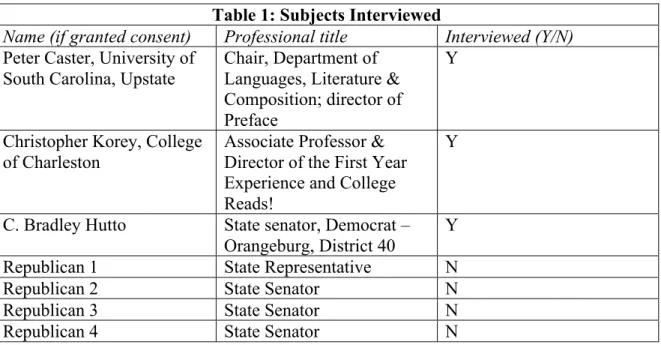
to fairly represent both sides of the political debate. As it turned out, I only received one
response, Sen. C. Bradley Hutto a Democrat from Orangeburg, from the five politicians I
asked to participate. Initially, I emailed Sen. Hutto and a key Republican who opposed
the summer reading selections and spearheaded the budget amendment. Sen. Hutto
responded to my first email, but the Republican did not respond to two follow up emails