ABSTRACT
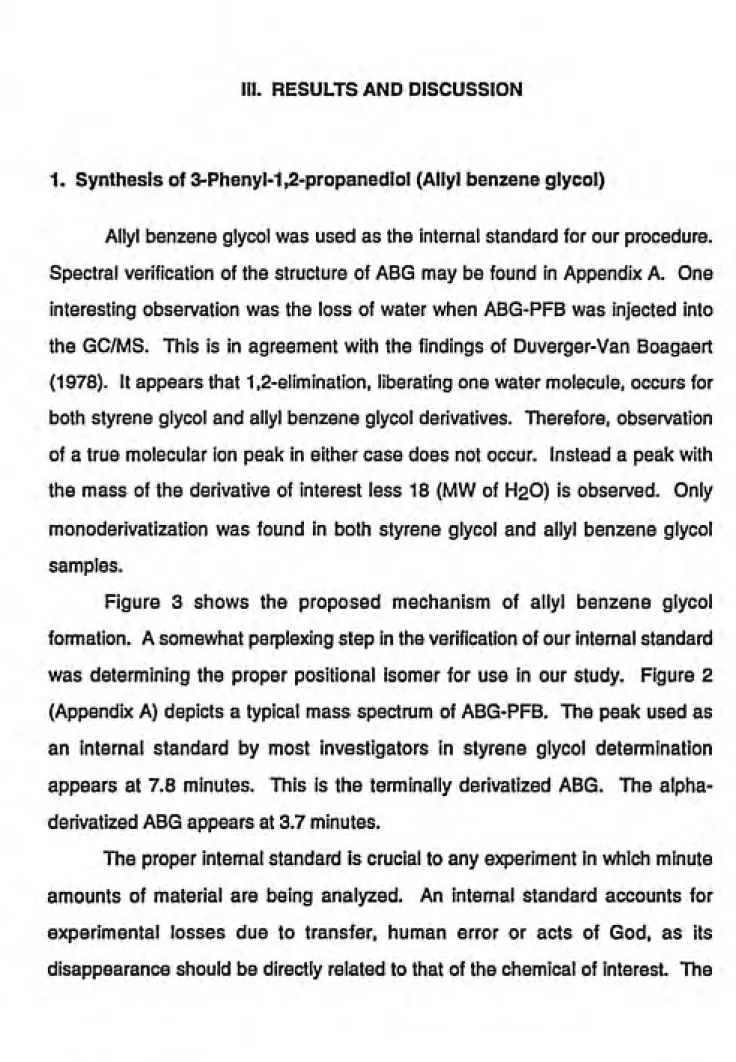
CATHERINE CHERYL BODUROW. A Modified Method for Determination of
Free Styrene Glycol in Human Blood. (Under the Direction of STEPHEN M.
RAPPAPORT, Ph.D.)Partitioning of free styrene glycol in plasma and packed red blood cells
was investigated in this study. Allyl benzene glycol was synthesized and used as
an internal standard in the procedure. It was determined there was no significant
difference in the styrene glycol concentrations in the plasma and red blood cells
layers (B=0.08, SE=1.01) of dosed blood samples. This result suggested that
free styrene glycol distributes uniformly throughout whole blood. The plasma
layer was chosen for analysis in this study and free styrene glycol concentrations
were determined in 85 plasma samples using the developed methodology of this
study. Samples and exposure data were obtained from three reinforced plastic
industry companies in the state of Washington. The exposure data investigated
were: eight-hour air styrene concentrations, whole blood styrene concentrations
and urinary metabolite (sum of mandelic and phenylglyoxylic acids)
concentrations. Companies #1,2 and 3 afforded the following number of plasma
samples, respectively: 31,17 and 17. Fourteen and six replicate measurements
and sets of exposure data were obtained for Companies # 1 and 2, respectively,
approximately one year after initial monitoring. Statistical analysis regressing
exposure data and plasma styrene glycol concentrations against exposure data
for single and replicate observations are presented in this work. Our findings
vary depending upon the company sampled. Company # 3 produced statistically
Ill
ACKNOWLEDGEMENTS
This work is dedicated to Mathukutty whose love and devotion have
unselfishly encouraged my graduate studies. I thank the Lord each day for
bringing him into my life.
I would like to acknowledge my advisor, Steve Rappaport, and my
readers. Dr. Lori Todd and Dr. Louise Ball, for their assistance in the preparation of this report. I am also indebted to Dr. Hans Kromhout for his statistical expertise and to Mary Ellen Tucker, MLS. for her assistance in locating technical
information.
Many thanks are due to my family and friends who have provided much support the past two years . In particular, I am eternally grateful to my parents whose endless encouragement and faith in my abilities have given me strength.
This project was conducted as part of a graduate training program and
was supported in part by a Centers For Disease Control Grant, grant number
TABLE OF CONTENTS
I. INTRODUCTION...1
1. Biological Monitoring...1
2. Styrene Exposure in the Reinforced Plastic Industry...5
3. The Metabolism of Styrene...6
4. Purpose of Study...8
II. METHODS AND MATERIALS...9
1. Plasma Samples and Exposure Data...9
2. Experimental...10
2.1. Materials and Instrumentation... 10
2.2. Synthesis of 3-Phenyl-1,2-propanediol (Allyl benzene glycol)...10
2.3. Styrene Glycol Partitioning in Human Plasma and Red Blood Cells...11
2.4. Analysis of Styrene Glycol in Workers' Plasma Samples...12
3. Statistical Analysis...13
3.1. Regression Analysis for Partitioning Experiment...13
3.2. Regression Analysis for Workers' Plasma Samples...13
III. RESULTS AND DISCUSSION...14
1. Synthesis of 3-Phenyl-1,2-propanediol (Allyl benzene glycol)...14
2. Styrene Glycol Partitioning in Human Plasma and Red Blood
Cells...162.1. Experimental Analysis...16
2.2. Statistical Analysis...17
3. Analaysis of Workers' Plasma Samples...25
3.1. Experimental Analysis...25
3.2. Statistical Analysis of Exposure Data...26
3.3. Statistical Analysis of Workers' Plasma Samples...43
3.4. Statistical Analysis of Replicate Exposure Data and Workers' Plasma Samples...56
4. General Discussion...67
IV. CONCLUSIONS...68
VII. BIBLIOGRAPHY...70
LIST OF FIGURES
FIGURE
1. Sites of uptake, target tissue, and media for monitoring of xenobiotic
compounds...2
2. Proposed Metabolic Pathways of Styrene...7
3. Proposed Mechanism for Allyl Benzene Glycol Formation...15
4. Whole Blood Styrene Glycol Concentration VS Serum Styrene Glycol
Concentration...18
5. Air Styrene Concentration VS Blood Styrene Concentration
(Company* 1)...34
6. Air Styrene Concentration VS Urinary Metabolite Concentration
(Company* 1)...35
7. Blood Styrene Concentration VS Urinary Metabolite Concentration
(Company* 1)...36
8. Air Styrene Concentration VS Blood Styrene Concentration
(Company #2)...37
9. Air Styrene Concentration VS Urinary Metabolite Concentration
(Company #2)...38
10. Blood Styrene Concentration VS Urinary Metabolite Concentration
(Company #2)...39
11. Air Styrene Concentration VS Blood Styrene Concentration
(Company #3)...40
12. Air Styrene Concentration VS Urinary Metabolite Concentration
(Company #3)...41
13. Blood Styrene Concentration VS Urinary Metabolite Concentration
VII
14. Air Styrene Concentration VS Average Plasma Styrene Glycol
Concentration (Company* 1)...47
15. Blood Styrene Concentration VS Average Plasma Styrene Glycol Concentration (Company* 1)...48
16. Urinary Metabolite Concentration VS Average Plasma Styrene Glycol Concentration (Company* 1)...49
17. Air Styrene Concentration VS Average Plasma Styrene Glycol Concentration (Company #2)...50
18. Blood Styrene Concentration VS Average Plasma Styrene Glycol
Concentration (Company #2)...5119. Urinary Metabolite Concentration VS Average Plasma Styrene Glycol Concentration (Company #2)...52
20. Air Styrene Concentration VS Average Plasma Styrene Glycol Concentration (Company #3)...53
21. Blood Styrene Concentration VS Average Plasma Styrene Glycol
Concentration (Company # 3)...5422. Urinary Metabolite Concentration VS Average Plasma Styrene Glycol Concentration (Company # 3)...55
A-1. NMR of 3-phenyl-1,2-propanediol (allyl benzene glycol)...75
A-2. Mass Spectrum of allyl benzene glycol derivative (ABG-PFB)...76
A-3. Gas Chromatogram of Typical Plasma Sample...77
UST OF TABLES
TABLE
1. Plasma and Red Blood Cells Partitioning Experiment Data...19
2. Model Definitions for Partitioning Experiment...22
3. Summary Statistics for Partitioning Experiment...22
4. Plasma, Red Blood Cells and Whole Blood Concentrations...23
5. Workers' Styrene Glycol Concentrations and Exposure Data...28
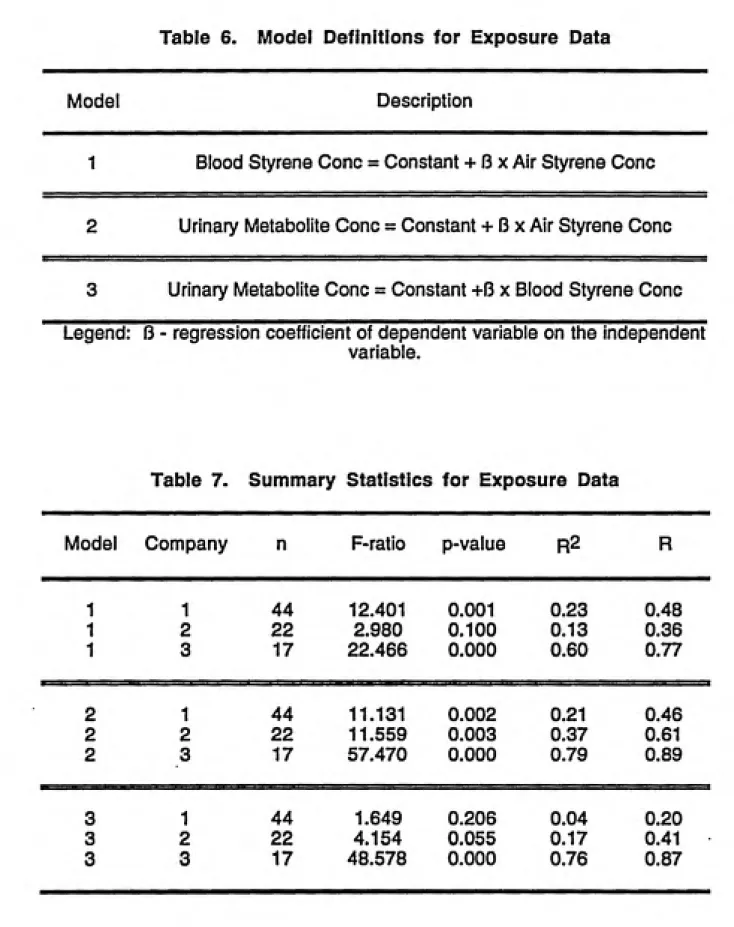
6. Model Definitions for Exposure Data...32
7. Summary Statistics for Exposure Data...32
8. Model Definitions for Workers' Plasma Samples...44
9. Summary Statistics for Workers' Plasma Samples...44
10. Replicate Worker's Styrene Glycol Concentrations and Exposure Data...57
11. Model Definitions for Exposure Data...58
12. Summary Statistics for Replicates' Exposure Data...58
13. Model Definitions for Workers' Plasma Samples...60
tx LIST OF ABBREVIATIONS
ABG
ABG-PFB
ANOVA
cone
BCD
GC
marker
MS
PFB
SG
SG-PFB
allyl benzene glycol
pentafluorobenzoyl ester of allyl benzene glycol
Analysis of Variance
concentration
electron capture detector
gas chromatograph
biological marker mass spectrometer
pentafluorobenzoyl chloride
styrene glycol
I. INTRODUCTION
1. Biological Monitoring
Occupational hygienists have traditionally monitored air concentrations to
evaluate human exposure to chemicals in the workplace. The growing necessity,
however, to quantify a worker's actual body burden has enabled hygienists to
make use of the emerging biological monitoring field (Fiserova-Bergerova, 1990).
A basic definition of biological monitoring is the measurement of an internal
exposure through the analysis of a biological specimen (Zielhuis, 1978). Wogan
(1989) defines biological monitoring as measurements made on cells, tissues, or
body fluids of exposed people with the intent to determine an internal or
biologically effective dose on an individual basis. Several media suitable for
biological monitoring are represented in Figure 1. The most common media are
exhaled air, blood and urine (Hulka, 1990 and Bernard, 1986).
There are several advantages to the use of biological monitoring as a
supplement to environmental monitoring. Biological monitoring can more
adequately determine susceptible groups of individuals than environmental
monitoring. Factors such as age, sex, body fat, intake of drugs and alcohol, and
socioeconomic status will affect an individual's uptake and metabolism of a
chemical (Guidotti, 1988). Secondly, it may be easier to estimate external
exposure by utilizing the individual as the sampling instrument. For example, if
ABSORPTION
Exfoli¬ ation
Skin
(Sweat)
INHALATION
Exhala¬ tion
Respiratory
Tract
Developing
Organs
~Pf^
\ ( Blood j ^
(^^
"7K
Kidney
( Urine j
INGESTION
\/
Gl-Tract
/salivaj
Liver
(Feces)
.KEY.
O
Target Tissues
Mediator
Biological
Monitoring
Figure 1. Sites of uptalce, target tissue, and media for monitoring of
practices and respiratory minute volume are not considered by environmental
monitoring. These factors contribute to a worker's body burden. It should also
be recognized that people are exposed to many chemicals simultaneously
through different pathways. Biological monitoring allows investigation of total
body burden which may aid in health risk assessment (Committee on Biological
Markers of the National Research Council, 1987). Finally, and perhaps most
importantly, biological monitoring offers the opportunity to consider individual
variability among those exposed (Hattis, 1987).
Although several advantages in favor of biological monitoring exist, the
method also possesses its disadvantages. People are the sampling instrument
in biological monitoring. This may be inconvenient for some individuals and
cause others unneeded anxiety. Although this field is rapidly developing, it is a
fact that many biological monitoring procedures for chemicals and/or their
metabolites do not yet exist. It is also important to consider that investigators are
not yet capable of producing reliable data on an individual monitoring basis.
Finally, biological monitoring may not be the appropriate method of evaluation
when external exposures vary greatly with time and the chemical of interest
exerts an acute effect on the individual (Zielhuis, 1978).Griffith (1989) defines a biological marker as "any measurable
biochemical, physiological, cytological, morphological, or other biological
parameter obtainable from human tissues, fluids, or expired gases, that is
associated (directly or indirectly) with exposure to an environmental pollutant."
~ ." ͣ"•"--«V*f—^=. '
before a marker is chosen (Schulte, 1987). This will determine the validity of the
use of a marker at low exposure levels. Adducts of endogenous
macromolecules, such as DNA or proteins, may also indicate if damage and/or
repair have occurred due to chemical exposure (Perera, 1987). Another form of
markers of exposure or effect are cellular changes (Hulka, 1990). Cellular
changes may in fact be a link to carcinogenesis found in individuals exposed to
certain chemicals (Garner, 1985). Finally, the amount of time before a marker
appears and the persistance of the marker are important considerations. The
half-lives of chemicals may vary dramatically in different "compartments" of the
body. Many decisions in biological monitoring are indeed based upon biological
half-lives of chemicals and markers (Droz, 1989 and Monster, 1991). Regardless
of the choice of marker, Schulte (1987, 1989 and 1991) emphasizes the
importance of validation studies, including determinations of sensitivity,
specificity, and predictive value, before a marker is used in an epidemiologic
study.
Biological monitoring is not a new concept. Hints of biological monitoring
date back to the early 20th century when methods were developed more actively
in Europe than in the United States (Lowry, 1986). The past two decades have
yielded many advances worldwide. Of course, the appropriate use of biological
monitoring is as a complement to environmental monitoring and rigorous
epidemiologic designs (Brown, 1989). The field will continue to grow and may
act as the bridge between laboratory and epidemiologic assessment studies in
2. Styrene Exposure in the Reinforced Plastic industry
Chemical and Engineering News (1992) recently reported that styrene
monomer production has reached an all-time annual high of 9 billion lbs in the
United States . It also reported that combined quantities of polystyrene,
styrene-acrylonitrile and styrene-acrylonitrile-butadiene-styrene thermoplastic resins amounted to
approximately 7.3 billion lbs in 1991 production.
Although the reinforced plastic industry consumes less than ten percent of
the world's styrene production, the industry experiences the greatest exposures
to styrene. The primary raw material used in the reinforced plastic industry is
unsaturated polyester resin dissolved in styrene. The fabrication process adds
organic peroxides to the resins to initiate polymerization between the unsaturated
polyester resin and styrene. This produces the hard polymer which is essential
for many durable items, such as boats and automobiles (Tossavainen, 1978).
In the reinforced plastic industry, styrene primarily enters the body through
the respiratory system (MaIek, 1986). Dermal exposure may be avoided by strict
use of protective clothing and gloves. Brooks (1980) showed that skin protection
reduced the risk of dermatitis from styrene. In addition, Brooks also found that
"percutaneous absorption of styrene was not significant and indeed did not
significantly contribute to the body burden of styrene of workers engaged in hand
lay-up operations." Berode (1985) and Wieczorek (1985) reported similar results
in studies of percutaneous absorption of styrene. It is for this reason that styrene
exposure is normally assessed by measuring air concentrations.
Mortality studies performed by Okun (1985) and Wong (1990) of
styrene-exposed workers in the reinforced plastics industry did not yield a significant
3. The Metabolism of Styrene
The uptake of styrene vapor from the lungs has been investigated and Is
reported to be 63% of the inspired quantity (Engstrom, 1978). Ramsey (1978)
found approximately 97% of the absorbed styrene was cleared from the body by metabolism, and Teramoto (1979) showed styrene's biological half-life in the
human body to be 40 minutes in the rapid phase and 180 minutes in the slow
phase.
The metabolism of styrene has been extensively studied and is
summarized in Figure 2 (Lof, 1983). The first step of the proposed metabolic
pathway is the formation of styrene-7,8-oxide (phenyloxirane) from catalysis by microsomal cytochrome P-450 (Watabe, 1978). The epoxidation of styrene may
also be catalyzed by blood erythrocytes and lymphocytes (Norppa, 1983).
Styrene-7,8-oxide may then spontaneously hydrate to styrene glycol (1-phenyl-1,2-ethanediol) or be converted by microsomal epoxide hydratase (Dansette,
1978). Next, styrene glycol may either be conjugated with B-glucuronic acid
(Pantarotto, 1978) or oxidized to mandelic acid which can be further oxidized to
phenylglyoxylic acid (Bardodej, 1966). Mandelic acid may also oxidize to benzoic
acid which has been shown to conjugate with glycine (Leibman, 1975).
Another metabolic pathway primarily found in animals acts as a minor
pathway In humans. Styrene-7,8-oxide conjugates with glutathione in the
presence of glutathione S-transferase (Boyland, 1965). These conjugates will
generally degrade to mercapturic acids (James, 1967).
A minor amount of ring hydroxylation may occur at the 1,2- or 3,4-position of styrene and small quantities of phenyl ethanols and phenylacetaldehyde are also produced (Pantarotto, 1978). Several other metabolites have been identified
OH
I
CH-CH3 CH=CH2
CH=CH2 CH=CH2
1-PHENYLETHANOL
CH2-CH2-OH
STYRENE
CH-CH2
OH
STYKENE-3,4-OXIDE 4-VINYLPHENOL
OH I
CH-CH2-SR
2-PHENYLETHANOL
CH2-CHO
PHENYLACETALDEHYDE
STYRENE-7,8-OXIDE
OH OH
I I CH-CH2
S-(2-PHENYL-2-HYDROXYETHYL)
GLUTATHIONE
SR
I
CH-CH2OH
CH2-COOH
PHENYLACETIC ACID
CH2CONHCH2COOH
STYRENE GLYCOL
OH
S-(l-PHENYL-2-HYDROXYETHYL)
GLUTATHIONE CONJUGATION WITH GLUCURONIC ACID
CH-COOH COOH
MANDELIC ACID BENZOIC ACID PHENACETURIC ACID
O
I
C-COOH
0
I
C-NHCH2COOH
PHENYLGLYOXYLIC ACID HIPPURIC ACID
8
2-phenylethanol, p-hydroxymandelic acid, p-hydroxybenzoic acid, and
p-hydroxyhippuric acid (Pantarotto, 1978).
Although approximately 85% of absorbed styrene is eliminated as
mandelic acid and 10% as phenylglyoxyiic acid in the urine (Guillemin, 1979), a small quantity of unchanged styrene may also be excreted in the urine (Dolara, 1984). In addition, Engstrom (1978) reported that the remainder of absorbed
styrene, approximately 2%, was exhaled unchanged.
4. Purpose of Study
It is clear that several media-exhaled air, blood and urine--may be used in
the biological monitoring of styrene-exposed workers. Lof has developed several methods for the assessment of styrene exposure in workers (1983, 1986). Of
particular interest is a method for determination of free styrene glycol in whole
blood which has been used in correlations with air styrene concentrations (Lof, 1986). It was our intention to streamline this procedure so that styrene glycol could be determined in human plasma or packed red blood cells rather than in whole blood.
The specific goals of this study were: a) to synthesize an appropriate internal standard for the procedure; b) to develop methodology for the determination of free styrene glycol in human plasma and packed red blood cells; c) to test the new method in a styrene-exposed population; and d) to compare plasma styrene glycol concentrations with styrene in air and blood and with
II. METHODS AND MATERIALS
1. Plasma Samples and Exposure Data
Plasma samples and exposure data were obtained from a group at the
University of Washington which conducted a study of styrene exposure in the
reinforced plastic industry. Blood samples and exposure data were collected at
three companies in the state of Washington over a two year period. Immediately
after collection, the blood samples were separated into plasma and red blood
cells layers and stored at -80 ^C prior to analysis. Exposure to styrene was
determined by personal monitoring over the eight-hour work shift. Styrene was
also measured in whole blood, and mandelic and phenylglyoxylic acid were
measured in the urine.
The number of workers monitored at Companies #1, #2 and #3,
respectively, were: 31,17 and 17. Replicate measurements and blood samples
were obtained from selected workers approximately one year after initial
monitoring at Companies #1 and #2. Company #1 yielded fourteen replicates
10
2. Experimental
2.1. Materials and Instrumentation
Reagents and chemicals. All chemicals were of reagent grade and used without further purification. Formic acid, hydrogen peroxide, allyl benzene, sodium hydroxide, hexanes, pentafluorobenzoyi chloride, methanol and styrene glycol were obtained from Aldrich Chemical Company, Inc. Ethyl acetate
was obtained from EM Science. Pyridine was obtained from Pierce.
Apparatus and conditions. Gas chromatography: A Varian model 3740 Gas
Chromatograph equipped with 63Ni electron-capture detector was
employed. A J & W Scientific DBS fused silica column (internal diameter =
0.25 mm, thickness = 0.25 nm, length = 30 meters) was used. The operating conditions were: column temperature, 240 OC; injector
temperature, 250 ^C; detector temperature, 320 ^C; carrier gas, He at a
flow rate of 1 mUmin; backflush, 0.5 minutes; length of run, 10 minutes.
Mass spectrometry: A Hewlett-Packard model 5890 Series II Gas
Chromatograph / 5971A Mass Selective Detector was employed under the
above operating conditions.
Nuclear Magnetic Resonance: Proton NMR spectra were obtained in deuterated
methanol on a Varian XL 400 MHz NMR fitted with Varian's 6.1 E Database.
2.2. Synthesis of 3-Phenyi-1,2-propanediol (Allyl benzene glycol)
Method adapted from Duverger-VanBogaert (1978)
Formic acid (96%) (30 mL, 0.80 mole) was placed in a 250 mL three-neck
round bottom flask equipped with a mechanical stirrer, thermometer and dropping
funnel. Hydrogen peroxide (30%) (7 mL, 0.2 mole) was then added dropwise at
room temperature. Dropwise addition of allyl benzene (98%) (6.7 mL, 51 mmole)
occurred thereafter. The reaction flask was next placed in an ice bath and the
exceed 35 ^C . The reaction was left stirring overnight at room temperature.
Excess reagent was removed by evaporation and addition of 7.5 mL saturated
sodium hydroxide hydrolysed the formyl esters of allyl benzene glycol. The
mixture was then extracted with 5 X 20 mL ethyl acetate. The combined organic
layers were dried over anhydrous sodium sulfate and were concentrated in vacuo
to approximately 15 mL. After cooling at 0 ^C, the clear oil (5.2g) was recovered
by filtration and distilled under vacuum. "Ih-NMR and Mass Spectrum
confirmation are found in Appendix A as Figure 1 and 2, respectively.
2.3. Styrene Glycol Partitioning in Human Plasma and Red Blood Cells
Derivatization method adapated from Duverger-Van Bogaert (1978)
Thirty mL of whole blood from a volunteer in our laboratory were drawn
into three ten mL heparinized vacutainers. The following procedure began within
one hour of the blood drawing. Twenty whole blood samples (ImL) were placed
in 4 mL capped glass vials. Ten piL of 1-Phenyl-1,2-ethanediol (styrene glycol)
solution in physiological saline (0.9% NaCI, by weight) were injected into each
whole blood sample, in duplicate, yielding the following levels: 100, 200, 300,
400, 500. 600, 700, 800, 900, 1000 ng styrene glycol/mL blood. The samples were gently inverted several times and then placed in a warm bath at 37 oc for 2
hours. The samples were next centrifuged at 2500 rpm for 8 minutes to separate
the plasma and red blood cells layers. Injection of 10 ^L of a solution of 100
ng/jiL 3-Phenyl-1,2-propanediol (allyl benzene glycol) in saline (0.9% NaCI, by
weight) afforded 1000 ng allyl benzene glycol as an internal standard in each
sample. The samples were extracted 3 times with ImL of ethyl acetate. If
emulsions occurred during the extractions, the samples were frozen in an
acetone/dry ice bath, warmed to room temperature and centrifuged at 1500 rpm
12
combined organic layers were dried over anhydrous sodium sulfate and
concentrated under nitrogen to a few drops. One mL of hexane was added to
each sample. Then 2 |xL pyridine and pentafluorobenzoyi chloride (1 p.L,
7 M-mole) were added to convert the glycols to the corresponding
pentafluorobenzoyi esters. The samples were mixed and placed in a heating
block at 50 ^c for 20 minutes. The samples were then dried under nitrogen flow.
In order to trap excess pentafluorobenzoyi chloride, 0.5 mL of an 85% solution of
methanol in water was added. Then the methanol/water layer was extracted with
one mL of hexane. Hexane standards containing 0, 30, 100, 300 and 1000 ng
styrene glycol/mL hexane and 1000 ng allyl benzene glycol/mL hexane in each
sample were derivatized as above. GC/MS confirmed the presence of the PFB
derivatives of styrene glycol and allyl benzene glycol. Two |j.I aliquots were then
injected into the GC/ECD (in triplicate). Three gas chromatograms were obtained
for each sample. A typical chromatogram is shown as Figure 3 in Appendix A.
The ratio of SG peak area and ABG peak area were compared to a standard
curve in order to determine the concentration of SG present in 1 mL hexane.
2.4. Analysis of Styrene Glycol In Workers' Plasma Samples
Each plasma sample (0.5mL) was gradually warmed to room temperature
and placed in a 4 mL capped glass vial. Injection of 10 ^L of a 100 ng/^iL
3-phenyl-1,2-propanediol (allyl benzene glycol) solution in physiological saline
(0.9% NaCI, by weight) afforded 1000 ng allyl benzene glycol as an internal
standard in each sample. The samples were gently inverted several times and
then placed in a warm bath at 37 OQ for 2 hours. The samples were extracted
with 3 times ImL of ethyl acetate and further processed as described in Section 2.3. GC/MS confirmed the presence of styrene glycol and allyl benzene glycol
(in duplicate). Ten samples were analyzed per experiment. A typical gas
chromatogram is shown as Figure 4 (Appendix A). The ratio of SG peak area
and ABG peak area were compared to a standard curve in order to determine the
concentration of SG present in 1 mL hexane.
3. Statistical Analysis
3.1. Regression Analysis for Partitioning Experiment
Statistical analysis of the partitioning experiment was conducted with SAS
software (SAS Institute, Gary, NC). Data were organized as shown in Table 1.
The variables considered in the regressions were: type (red blood cells or
plasma), initial styrene glycol concentration (100-1000 ng/mL), repeat (replicates
were run) and injection (1,2 or 3). These variables were regressed against the
final styrene concentration in different combinations as models.
3.2. Regression Analysis for Workers' Plasma Samples
The exposure data received from the University of Washington were
regressed against one another and also against the workers' plasma styrene
glycol concentrations via Lotus 123 software. Simple F-tests were also
III. RESULTS AND DISCUSSION
1. Synthesis of 3-Phenyl-1,2-propanediol (Allyl benzene glycol)
Allyl benzene glycol was used as the internal standard for our procedure.
Spectral verification of the structure of ABG may be found in Appendix A. One interesting observation was the loss of water when ABG-PFB was injected into the GO/MS. This is in agreement with the findings of Duverger-Van Boagaert
(1978). It appears that 1,2-elimination, liberating one water molecule, occurs for both styrene glycol and allyl benzene glycol derivatives. Therefore, observation
of a true molecular ion peak in either case does not occur. Instead a peak with
the mass of the derivative of interest less 18 (MW of H2O) is observed. Only
monoderivatization was found in both styrene glycol and allyl benzene glycol
samples.
Figure 3 shows the proposed mechanism of allyl benzene glycol
formation. A somewhat perplexing step in the verification of our internal standard
was determining the proper positional isomer for use In our study. Figure 2
(Appendix A) depicts a typical mass spectrum of ABG-PFB. The peak used as
an internal standard by most investigators in styrene glycol determination
appears at 7.8 minutes. This is the terminally derivatized ABG. The
alpha-derivatized ABG appears at 3.7 minutes.
The proper intemal standard is crucial to any experiment in which minute
amounts of material are being analyzed. An internal standard accounts for experimental losses due to transfer, human error or acts of God, as its
HO.
V=o + H2O2 H
FORMIC ACID
HYDROGEN
PEROXIDE
0
. 1
H-COOH PEROXYFORMIC ACID
r^
^
^r^<k^
0 HAT.T.YT, BF:N7.KNE /
0 1 0
= --H
^-^
+ OH
-o.'S
;c=o
H
"OH
O—C—H
X^
"-^^
ALLYL BENZENE GLYCOL
16
extraction and derivatization efficiencies of an internal standard will determine if it
is an appropriate comparison to the chemical being quantified. In addition, the gas chromatographic retention time of the internal standard in relation to the chemical sought is important. Normally, the ratio of the gas chromatographic peak areas of the chemical of interest to the internal standard are used to
determine concentrations of the chemical of interest. This was the method used in our study.
Allyl benzene glycol has proven to be the most appropriate internal standard to date for the analysis of styrene glycol concentrations. Three other possible internal standards were evaluated (DL-2-phenyl-1,2-propanediol,
4-methyl styrene glycol and 3-(4-hydroxyphenyl)-1-propanol); however, none of these compounds extracted and/or derivatized as well as allyl benzene glycol.
2. Styrene Glycol Partitioning in Human Plasma and Red Blood Cells
2.1. Experimental Analysis
It was our initial hypothesis that the concentrations of free styrene glycol in
the plasma and red blood cells layers of whole blood would be equal. Regardless, this experiment was crucial in proving that analysis of either plasma or red blood cells layers may be used to predict the amount of styrene glycol in
the other layer or whole blood.
The experiment consisted of twenty human whole blood samples which
we could recognize differences in duplicates, levels and between the plasma and
red blood cells layers.
It was observed during the separation of red blood cells and plasma that minimal breakage of red blood cells occurred. This is an important consideration
in subsequent statistical analysis, as red blood cell breakage will bias one's
results. The extractions were performed with great ease due to development of an unpublished freeze/centrifuge procedure in our laboratory (Jin, 1990). Typically, some samples of plasma and red blood cells emulse when extracted with ethyl acetate. This procedure yields optimal separation of the organic and
aqueous layers.
2.2. Statistical Analysis
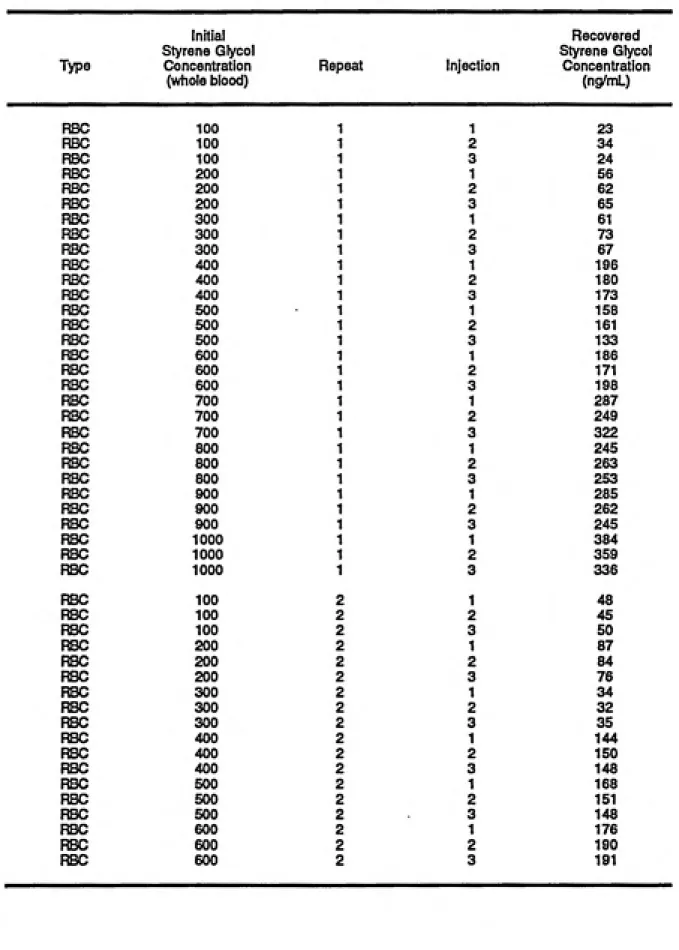
Relevant data for the statistical analysis of the partitioning experiment may be found in Table 1. The variables investigated in the regression analyses were:
type (red blood cells or plasma), initial styrene glycol concentration (100-1000
ng/mL), replicate of type (1 or 2) and injection (1,2 or 3). Table 3 summarizes the
results of the regression analyses of variables against the final styrene glycol
concentrations obtained. Table 2 describes the various models presented in Table3. A two-way nested ANOVA model indicates a total of 5.7% error related to experimental procedure (2.0% due to the duplicate observations and 3.7% due
to the injections).
As shown in Table 3, the differences in the regresson coefficients for Models 1-3 and 4-6 are not significant. In fact, the regression coefficients of
Models 7 and 8 demonstrate that there is, essentially, no difference in the
regression coefficients for each injection. By grouping all of the data points together, we see that the difference in the regression coefficients for plasma and
18
lines is not significant (B = 0.08, SE = 1.01). This is a powerful and logical result,
as it suggests that styrene glycol distributes uniformly throughout whole blood.
Thus, the concentration of styrene glycol may be predicted in one layer (red
blood cells or plasma) by determination of the other.
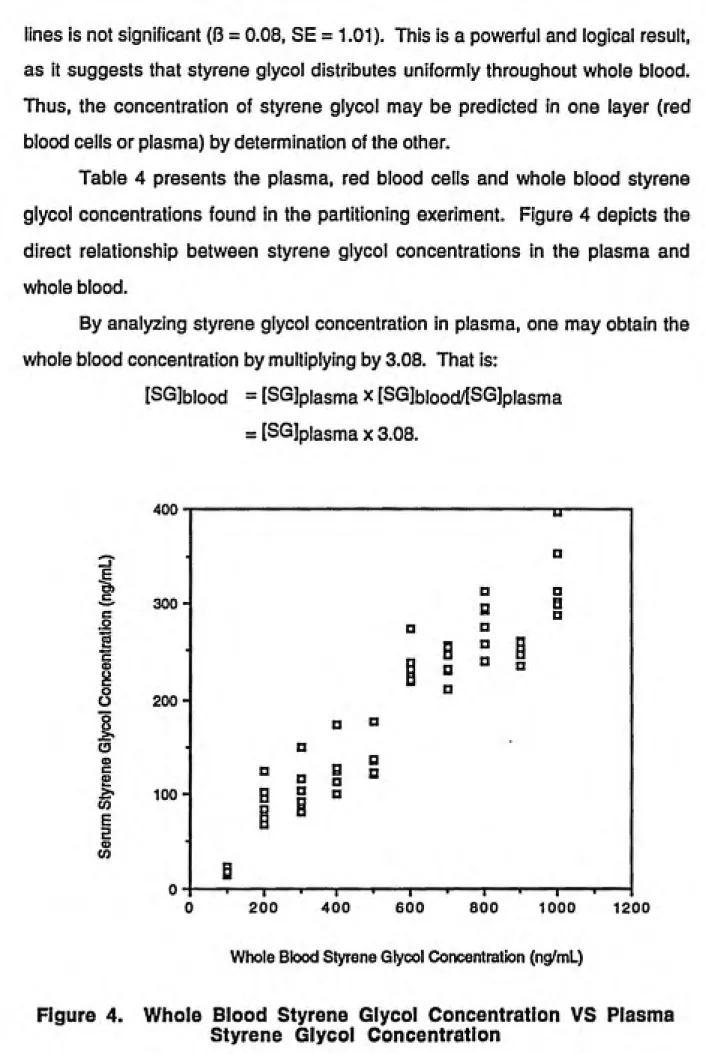
Table 4 presents the plasma, red blood cells and whole blood styrene
glycol concentrations found in the partitioning exeriment. Figure 4 depicts the
direct relationship between styrene glycol concentrations in the plasma and
whole blood.
By analyzing styrene glycol concentration in plasma, one may obtain the
whole blood concentration by multiplying by 3.08. That is:
[SG]biood = [SG]piasma x [SG]biood/[SG]piasma
= [SG]piasma X 3.08.
400
t
"S- 300
c
o
'H
a>
o
o 1 o
o c
£
CO
E
E
9
200-
100-1000 1200
Whole Blood Styrene Glycol Concentration (ng/mL)
Figure 4. Whole Blood Styrene Glycol Concentration VS Plasma
19
Table 1. Plasma and Red Blood Cells Partitioning Experiment Data
Table 1. (continued) 20 Initial Styrene Glycol Type Concentration (whole blood) Rep(
RBC 700 2
RBC 700 2
RBC 700 2
RBC 800 2
RBC 800 2
RBC 800 2
RBC 900 2
RBC 900 2
RBC 900 2
RBC 1000 2
RBC 1000 2
RBC 1000 2
PLASMA 100 PLASMA 100 PLASMA 100 PLASMA 200 PLASMA 200 PLASMA 200 PLASMA 300 PLASMA 300 PLASMA 300 PLASMA 400 PLASMA 400 PLASMA 400 PLASMA 500 PLASMA 500 PLASMA 500 PUSMA 600 PLASMA 600 PLASMA 600 PLASMA 700 PLASMA 700 PLASMA 700 PLASMA 800 PLASMA 800 PLASMA 800 PLASMA 900 PLASMA 900 PLASMA 900 PLASMA 1000 PLASMA 1000 PLASMA 1000
PLASMA 100 2
PLASMA 100 2
PLASMA 100 2
PLASMA 200 2
PLASMA 200 2
PLASMA 200 2
PLASMA 300 2
PLASMA 300 2
PLASMA 300 2
22
Table 2. Model Definitions for Partitioning Experiment
Model Description
1 Plasma SG Cone = B x Whole Blood SG Cone (injeetion=1, no intercept) 2 Plasma SG Cone = B x Whole Blood SG Cone (injection=2, no intercept) 3 Plasma SG Cone = B x Whole Blood SG Cone (injection=3, no intercept) 4 RBC SG Cone = B x Whole Blood SG Cone (injection=1, no intercept) 5 RBC SG Cone = B x Whole Blood SG Cone (injection=2, no intercept) 6 RBC SG Cone = B x Whole Blood SG Cone (injection=3, no intercept)
7 Plasma SG Cone = B x Whole Blood SG Cone (injection=1,2,3, no inter) 8 RBC SG Cone = B x Whole Blood SG Cone (injeetion=1,2,3, no intercept)
9 All Cone = B X Whole Blood SG Cone (injection=1,2,3, no intercept)
Legend: B - regression coefficient of styrene glycol concentration (ng/mL)
[dependent variable] on whole blood concentration (ng/mL).
Table 3. Summary Statistics for Partitioning Experiment
Model Type n Injection B SE R2
1 Plasma 20 1 0.331 0.0128 0.97
2 Plasma 20 2 0.332 0.0121 0.98
3 Plasma 20 3 0.311 0.0093 0.98
4 RBC 20 1 0.337 0.0134 0.97
5 RBC 20 2 0.322 0.0114 0.98
6 RBC 20 3 0.317 0.0148 0.96
7 Plasma 60 all 0.325 0.0066 0.98
8 RBC 60 all 0.326 0.0076 0.97
9 Both 120 all 0.325 0.0050 0.97
Legend: B-regression coefficient of styrene glycol concentration (ng/mL)
23
Table 4. Plasma, Red Blood Cells and Whole Blood Concentrations
Repeat Injection
RBC Plasma Whole Blood
Styrene Glycol Styrene Glycol Styrene Glycol
Concentration Concentration Concentration
(ng/nnL) (ng/mL) (ng/mL)
23 18 100
34 20 100
24 15 100
56 102 200
62 68 200
65 84 200
61 89 300
73 103 300
67 81 300
196 99 400
180 124 400
173 100 400
158 122 500
161 120 500
133 135 500
186 224 600
171 273 600
198 219 600
287 245 700
249 230 700
322 256 700
245 274 800
263 292 800
253 240 800
285 260 900
262 252 900
245 261 900
384 298 1000
359 353 1000
336 302 1000
48 22 100
45 17 100
50 22 100
87 94 200
84 124 200
76 74 200
34 149 300
32 91 300
35 116 300
144 127 400
150 113 400
148 174 400
168 136 500
151 177 500
148 122 500
176 238 600
190 232 600
191 220 600
24
Table 4. (continued)
Repeat Injection
2 1 2 2 2 3 2 1 2 2 2 3 2 1 2 2 2 3 2 1 2 2 2 3
RBC Plasma Whole Blood
Styrene Glycol Styrene Glycol Styrene Glycol
Concentration Concentration Concentration
(ng/mL) (ng/mL) (ng/mL)
225 211 700
235 254 700
219 232 700
205 314 800
198 296 800
191 257 800
285 245 900
258 258 900
225 235 900
401 397 1000
374 287 1000
3. Analaysis of Workers' Plasma Samples
3.1. Experimental Analysis
Two important findings may be concluded from the partitioning experiment. Firstly, there is essentially no difference in the partitioning of dosed human whole blood samples into plasma and red blood cells layers. Secondly,
there is minimal variability in injections at one concentration level. These
considerations afforded a more streamlined analysis of the workers' samples. There were two reasons that plasma was chosen as the layer of human whole blood for analysis in this study. The first reason was that the plasma layer yielded slightly lower standard errors than the red blood cells layer in the regression analysis of the partitioning experiment. The second reason was that emulsions occur less frequently during extractions in plasma than red blood cells because the plasma layer of whole blood contains less protein than the red blood
cells layer.
The analysis of the workers' plasma samples occurred more than one year after collection of the blood. For the purposes of this study, we have assumed the degradation of styrene glycol over time will not affect our analysis. If this were not the case, it would be crucial to investigate how styrene glycol degrades
overtime.
Ten plasma samples were analyzed per experiment and new hexane standards of styrene glycol and allyl benzene glycol were prepared for each experiment. As the samples had been frozen for a long time, it was critical to
warm the samples slowly from -80 ^C. They were warmed in the following manner: -20 ^c freezer, 0 ^C freezer, 4 ^C refrigerator, room temperature and
26
3.2. Statistical Analysis of Exposure Data
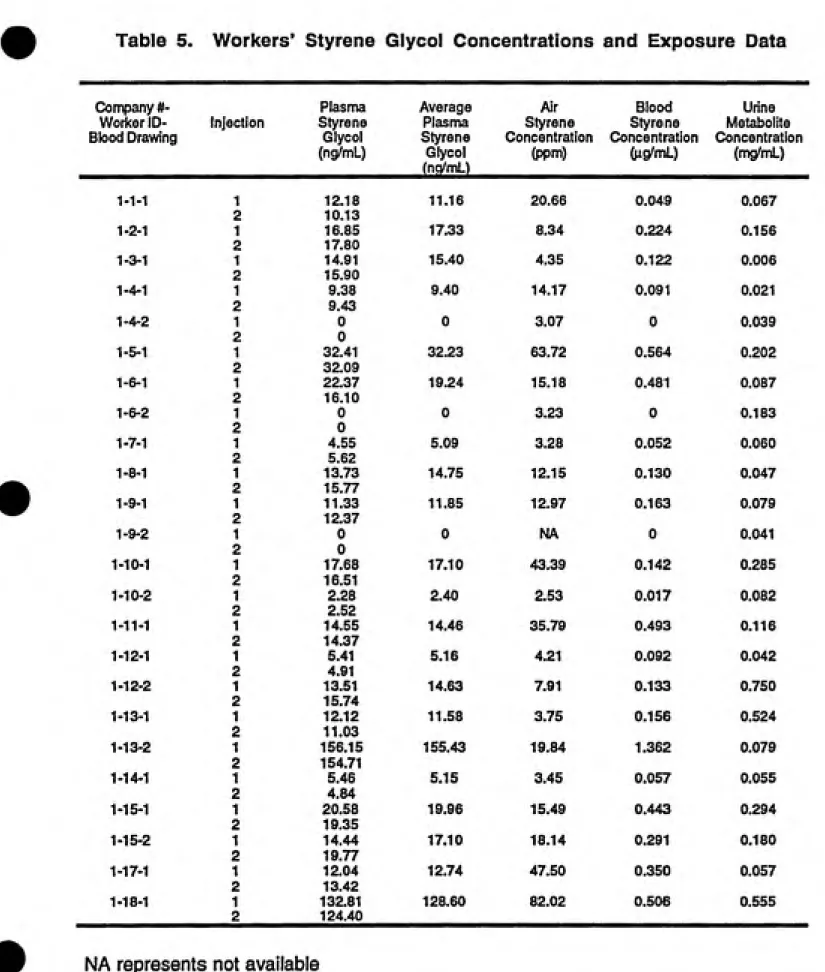
The exposure data received from the University of Washington are found
in Table 5. The data were evaluated by Company # and all pertinent regression
information may be found below the appropriate scatter diagram for each of the
described one-way Analysis of Variance (ANOVA) models (at the end of this section). Although the regression information in Table 7 of this section is summarized by model, the following results will be discussed by Company #.
Table 6 describes the regression models presented in Table 7. It is important to
note that the urinary metabolite concentration is the sum of mandelic acid and phenylglyoxylic acid concentrations. All replicate measurements for Companies
#1 and 2 are treated separately in the analyses to ensure the independence of
observations.
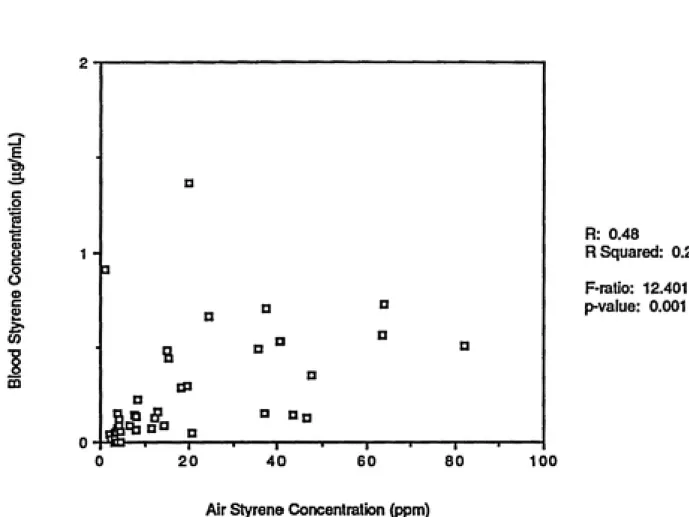
Company #1 exposure data (obtained from the University of Washington) are graphically represented in Figures 5-7. These are Models 1, 2 and 3,
respectively, in Table 6. Figure 5 plots air styrene concentration against blood
styrene concentration and yields a correlation coefficient of 0.48 (F-ratio =
12.401, p-value = 0.001, r2 = 0.23). Figure 6 depicts air styrene concentration
against urinary metabolite concentration. The correlation coefficient of 0.46
(F-ratio = 11.131, p-value = 0.002, r2 = 0.21) is similar to that in Model 1.
Finally, Figure 7 graphs blood styrene concentration against urinary metabolite concentration. These variables correlate poorly, yielding a R-value of 0.20
(F-ratio = 1.649, p-value = 0.206, r2 = 0.04). In summary, air styrene
concentration for Company #1 correlates acceptably with blood and urinary
metabolite concentrations. Each p-value is significant. Blood and urinary
Figures 8-10 graphically represent exposure data collected at Company #2. These are Models 1, 2 and 3, respectively, in Table 8. Figure 4 depicts the correlation of air styrene concentration and blood styrene concentration (R =
0.36, F-ratio = 2.980, p-value = 0.100, r2 = 0.13). A correlation coefficient of
0.61 (F-ratio = 11.559, p-value = 0.003, r2 = 0.37) is obtained when air styrene
and urinary metabolite concentrations are regressed (Figure 9). Regression of
blood styrene and urinary metabolite concentrations (Figure 10) yields a
correlation coefficient of 0.41 (F-ratio = 4.154, p-value = 0.055, r2 = 0.17).
Summarizing, Company #2 afforded p-values which are not significant when air styrene concentration is regressed against blood styrene concentration and when blood styrene and urinary metabolite concentrations are regressed. Regression of air styrene and urinary metabolite concentrations yielded a significant p-value.
Company #3 exposure data are graphically presented in Figures 11-13. These are Models 1, 2 and 3, respectively, in Table 6. Figure 11 shows air styrene concentration plotted against blood styrene concentration. These variables correlate well, yielding a R-value of 0.77 (F-ratio = 22.466, p-value =
0.000, r2 = 0.60). A correlation coefficient of 0.89 (F-ratio = 57.470, p-value =
0.000, r2 = 0.79) is found when air styrene and urinary metabolite concentrations are regressed (Figure 12). Figure 13 depicts the relationship
between blood styrene and urinary metabolite concentrations. The variables have a strong correlation coefficient of 0.87 (F-ratio = 48.578, p-value = 0.000,
r2 = 0.76). In summary. Company #3's exposure data correlates well with each
other.
28
Table 5. Workers' Styrene Glycol Concentrations and Exposure Data
Company #- Plasnia Average Air Blood Urine
Worker ID- Injection Styrene Plasnia Styrene styrene Metabolite
Blood Drawing Glycol Styrene Concentration Concentration Concentration
(ng/mL) Glycol
(nq/mL)
(ppm) (ag/rrL) (mg/mL)
1-1-1 1
2
12.18 10.13
11.16 20.66 0.049 0.067
1-2-1 1
2
16.85
17.80
17.33 8.34 0.224 0.156
1-3-1 1
2
14.91 15.90
15.40 4.35 0.122 0.006
1-4-1 1
2
9.38 9.43
9.40 14.17 0.091 0.021
1-4-2 1
2
0 0
0 3.07 0 0.039
1-5-1 1
2
32.41 32.09
32.23 63.72 0.564 0.202
1-6-1 1
2
22.37 16.10
19.24 15.18 0.481 0.087
1-6-2 1
2
0
0
0 3.23 0 0.183
1-7-1 1
2
4.55
5.62
5.09 3.28 0.052 0.060
1-8-1 1
2
13.73
15.77
14.75 12.15 0.130 0.047
1-9-1 1
2
11.33 12.37
11.85 12.97 0.163 0.079
1-9-2 1
2
0 0
0 NA 0 0.041
1-10-1 1
2
17.68 16.51
17.10 43.39 0.142 0.285
1-10-2 1
2
2.28 2.52
2.40 2.53 0.017 0.082
1-11-1 1
2
14.55 14.37
14.46 35.79 0.493 0.116
1-12-1 1
2
5.41 4.91
5.16 4.21 0.092 0.042
1-12-2 1
2
13.51 15.74
14.63 7.91 0.133 0.750
1-13-1 1
2
12.12 11.03
11.58 3.75 0.156 0.524
1-13-2 1
2
156.15 154.71
155.43 19.84 1.362 0.079
1-14-1 1
2
5.46 4.84
5.15 3.45 0.057 0.055
1-15-1 1
2
20.58 19.35
19.96 15.49 0.443 0.294
1-15-2 1
2
14.44
19.77
17.10 18.14 0.291 0.180
1-17-1 1
2
12.04
13.42
12.74 47.50 0.350 0.057
1-18-1 1
2
132.81
124.40
128.60 82.02 0.506 0.555
Table 5. (continued)
Company #- Plasnna Average Air Blood Urine
Worker ID- Injection Styrene Plasnna Styrene Styrene Metabolite
Blood Drawing Glycol Styrene Concentration Concentration Concentration
(ng/mL) Glycol
(no/ml)
(ppm) (jig/mL) (mg/mL)
1-18-2 1
2
1.60 1.19
1.40 3.26 0.030 0.241
1-19-1 1
2
5.31
4.46
4.88 8.10 0.064 0.039
1-19-2 1
2
0 0
0 4.67 0 0.020
1-20-1 1
2
3.78
3.34
3.56 3.72 0.072 0.008
1-20-2 1
2
8.76 8.64
8.70 46.53 0.130 0.350
1-21-1 1
2
7.33 7.45
7.39 4.32 0.088 0.024
1-21-2 1
2
23.87
17.45
20.66 37.06 0.155 1.272
1-22-1 1
2
61.48 69.93
65.71 63.97 0.719 0.975
1-23-1 1
2
6.83 10.89
8.86 1.97 0.043 0.024
1-23-2 1
2
0.69 0.62
0.66 3.89 0 0.166
1-24-1 1
2
46.09 51.20
48.64 37.51 0.699 0.110
1-24-2 1
2
P2.79
29.56
26.17 24.60 0.660 0.125
1-25-1 1
2
132.04
145.44
138.74 1.12 0.904 0.318
1-26-1 1
2
7.31 9.80
8.56 4.51 0.058 0.044
1-26-2 1
2
3.92 4.61
4.26 3.56 0 0.051
1-27-1 1
2
30.27 22.23
26.25 19.56 0.299 0.192
1-28-1 1
2
7.78 15.21
11.50 6.65 0.091 0.159
2-32-1 1
2
105.61 110.40
108.01 51.87 0.135 1.749
2-33-1 1
2
121.19
134.15
127.67 70.83 0.015 2.287
2-34-1 1
2
193.66 196.52
195.09 64.21 0.124 0.324
2-34-2 1
2
16.20 22.97
19.58 85.15 0.017 0.192
2-35-1 1
2
107.18 120.14
113.66 51.38 0.325 0.886
2-36-1 1
2
144.52
134.72
139.62 12.48 0.120 0.299
2-37-1 1
2
7.70 8.48
8.09 18.77 0.132 0.084
Table 5. (continued) 30 Connpany #-Worker ID-Blood Drawing Injection Plasnna Styrene Glycol (ng/mL) Average Plasnia Styrene Glycol (ng/mL) Air Styrene Concentration (ppm) Blood Styrene Concentration (ng/mL) Urine Metabolite Concentration (mg/mL) 2-37-2 1 2 74.32 76.91
75.62 10.61 NA 0.133
2-38-1 1
2
26.19 27.16
26.68 9.85 0.176 0.326
2-38-2 1
2
485.41 478.59
482.00 6.98 0.150 0.109
2-39-1 1
2
31.32 38.97
35.15 19.29 0.410 0.580
2-40-1 1
2
4.38 5.41
4.90 0.55 0.001 0.005
2-41-1 1
2
5.55
6.11
5.83 2.57 0.016 0.066
2-42-1 1
2
31.98 23.54
27.76 0.96 0.020 0.002
2-43-1 1
2
12.17
9.22
10.70 1.86 0.031 0.004
2-44-1 1
2
3.37 3.89
3.63 0.49 0.009 0.005
2-44-2 1
2
27.75
26.73
27.24 1.12 0.001 0.005
2-47-1 1
2
14.32
13.26
13.79 13.90 0.047 0.319
2-48-1 1
2
14.76 14.39
14.58 56.83 0.125 0.212
2-48-2 1
2
437.35
440.88
439.11 61.31 0.052 0.251
2-49-1 1
2
37.24
37.09
37.17 43.53 0.054 0.419
2-49-2 1
2
150.86 163.64
157.25 76.38 0.747 1.456
3-52-1 1
2
6.43
13.40
9.91 3.33 0.027 0.399
3-53-1 1
2
30.09 26.88
28.48 22.46 0.153 0.572
3-54-1 1
2
4.91
4.43
4.67 4.21 0.054 0.083
3-55-1 1
2
100,70 106.20
103.45 42.95 0.504 1.779
3-56-1 1
2
0 0
0 1.36 0 0.046
3-57-1 1
2
5.81 7.27
6.54 1.78 0.020 0.059
3-58-1 1
2
17.22
20.62
18.92 160.90 0.351 2.645
3-59-1 1
2
171.21
163.28
167.25 134.90 0.582 2.001
3-60-1 1
2
0 0
0 4.40 0.003 0.021
31
Table 5. (continued)
Company #-Worker ID-Blood Drawing Injection Plasma Styrene Glycol (ng/mL) Average Plasma Styrene Glycol (ng/mL) Air Styrene Concentration (ppm) Blood Styrene Concentration (ng/mL) Urine Metabolite Concentration (mg^mL) 3-61-1 1 2 2.00 1.54
1.77 2.95 0.008 0.029
3-62-1 1
2
16.43 14.94
15.68 53.24 0.022 0.359
3-63-1 1
2
72.28 76.10
74.19 37.55 0.196 0.105
3-64-1 1
2
12.03 13.48
12.75 2.31 0.010 0.008
3-65-1 1
2
15.16 14.44
14.80 4.87 0.056 0.414
3-66-1 1
2
21.10 19.15
20.12 25.63 0.165 0.939
3-67-1 1
2
37.82
43.56
40.69 29.22 0.123 0.524
3-68-1 1
2
0 0
0 1.06 0.021 0.009
1-99-2 1
2
3.22
2.59
2.90 3.24 0 0.116
1-100-2 1
2
26.41 29.70
28.06 11.60 0.076 0.235
1-101-2 1
2
20.69
21.43
21.06 7.76 0.148 0.436
1-102-2 1
2
74.86
88.26
81.56 40.47 0.530 0.472
2-121-2 1
2
0 0
0 0.78 0.001 0.007
32
Table 6. Model Definitions for Exposure Data
Model Description
Blood Styrene Cone = Constant + B x Air Styrene Cone
Urinary Metabolite Cone = Constant + B x Air Styrene Cone
3 Urinary Metabolite Cone = Constant +B x Blood Styrene Cone
Legend: B - regression coefficient of dependent variable on the independent
variable.
Table 7. Summary Statistics for Exposure Data
Model Company n F-ratio p-value R2 R
1 1 44 12.401 0.001 0.23 0.48
1 2 22 2.980 0.100 0.13 0.36
1 3 17 22.466 0.000 0.60 0.77
2 1 44 11.131 0.002 0.21 0.46
2 2 22 11.559 0.003 0.37 0.61
2 3 17 57.470 0.000 0.79 0.89
3 1 44 1.649 0.206 0.04 0.20
3 2 22 4.154 0.055 0.17 0.41
regression models. Company #1 correlates acceptably when air styrene
concentration is regressed against blood styrene and urinary metabolite
concentrations; however, blood styrene and urinary metabolite concentrations do
not correlate well. Company #2's exposure data produce p-values which are not
significant in two instances. However, a significant p-value is obtained when air
34
E
ͣ
&> 3>
c
.2
•E
U c
o
o
c
£
0}
CQ
R: 0.48
R Squared: 0.23
F-ratio: 12.401
p-value: 0.001
100
Air Styrene Concentration (ppm)
Figure 5. Air Styrene Concentration VS Blood Styrene Concentration
1
E,
c
.2
S "E
o
O
o (0 4)
R: 0.46
R Squared: 0.21
F-ratio: 11.131
p-vaiue: 0.002
100
Air Styrene Concentration (ppm)
Figure 6. Air Styrene Concentration VS Urinary l\/letabolite Concentration
36
t
E,
c
o
•E
(D U c
o
o
»
(0
ͣ
s
•c
R: 0.20
R Squared: 0.04
F-ratio: 1.649
p-value: 0.206
Blood Styrene Concentration (^g/mL)
E
s
ͣ
s
o
o c
o
O
o c o
t
CO
0.6-*-.
R: 0.36
R Squared: 0.13
F-ratio: 2.980
p-value: 0.100
100
Air Styrene Concentratbn (ppm)
Figure 8. Air Styrene Concentration VS Blood Styrene Concentration
38
t
E
S
5
5
(0
R: 0.61
R Squared: 0.37
F-ratio: 11.559
p-value: 0.003
100
Air Styrene Concentration (ppm)
Figure 9. Air Styrene Concentration VS Urinary iUletabolite Concentration
#
E
E,
c
.S
"E
o
o
CO
"S
R: 0.41
R Squared: 0.17
F-ratio: 4.154
p-value: 0.055
0.8
Blood Styrene Concentration (ng/rrL)
Figure 10. Blood Styrene Concentration VS Urinary lUletabolite
40
i
c
o
1
o
I
o c
S
CQ
R: 0.77
R Squared: 0.60
F-ratio: 22.466
p-value: 0.000
100 200
Air Styrene Concentration (ppm)
41
E
ͣ
&)
E,
c
.2
•E
O c
o
o
CO
•5
R: 0.89
R Squared: 0.79
F-ratio: 57.470
p-value: 0.000
200
Air Styrene Concentration (ppm)
42
C
o
I
"S
a> o
o
(0
•c
3
— " u
0 yp ͣ---1
R: 0.87
R Squared: 0.76
F-ratb: 48.578
p-value: 0.000
0.6
Blood Styrene Concentration Oig/mL)
Figure 13. Blood Styrene Concentration VS Urinary Metabolite
43
3.3. Statistical Analysis of Workers'Plasma Samples
Experimentally determined plasma styrene glycol concentrations from
workers in the reinforced plastic industry may be found in Table 5. The data
were evaluated by Company # and all pertinent regression information may be
found below the appropriate scatter diagram for each of the described one-way
ANOVA models (at the end of this section). Although regression information in
Table 9 is summarized by model, the following results will be discussed by
Company #. Table 8 describes the regression models presented in Table 9. All
replicate measurements for Companies #1 and 2 are treated separately in the analysis to ensure the independence of observations. The plasma styrene glycol
concentrations are represented as the average concentration of the two
injections.
Company #1 data are depicted in Figures 14-16. These are Models 1, 2
and 3, respectively, in Table 8. Figure 14 plots air styrene concentration against
average plasma styrene glycol concentration. The correlation coefficient is 0.48
(F-ratio = 9.815, p-value = 0.003, r2 = 0.23). Blood styrene concentration is
correlated with average plasma styrene glycol concentration in Figure 15. Here a
relatively good correlation coefficient of 0.60 (F-ratio = 101.790, p-value = 0.000,
r2 = 0.60) is observed. Figure 16 depicts the correlation of urinary metabolite
concentration and average plasma styrene glycol concentration. The correlation
is weak, yielding a R-value of 0.28 (F-ratio = 3.691, p-value = 0.062, r2 = 0.08).
Summarizing, Company #1 air and blood styrene concentrations appear to regress relatively well against the average plasma styrene glycol concentration.
However, urinary metabolite concentration does not regress as well against
44
Table 8. Model Definitions for Workers' Plasma Samples
IVIodei Description
Plasma SG Cone = Constant + B x Air Styrene Cone
Plasma SG Cone = Constant + B x Blood Styrene Cone
3 Plasma SG Cone = Constant + B x Urinary Metabolite Cone
Legend: B - regression coefficient of dependent variable on the independent
variable.
Table 9. Summary Statistics for Workers' Plasma Samples
Model Company n F-ratio p-value R2 R
1 1 44 9.815 0.003 0.23 0.48
1 2 22 1.740 0.202 0.08 0.28
1 3 17 7.878 0.013 0.34 0.58
2 1 44 101.790 0.000 0.60 0.77
2 2 22 0.654 0.428 0.03 0.17
2 3 17 56.913 0.000 0.79 0.89
3 1 44 3.691 0.062 0.08 0.28
3 2 22 0.476 0.498 0.02 0.14
45
Company # 2 data are presented in Figures 17, 18 and 19. These figures
are Models 1,2 and 3, respectively, in Table 8. Figure 17 shows air styrene
concentration plotted against average plasma styrene glycol concentration. A weak correlation coefficient of 0.28 is obtained (F-ratio = 1.740, p-value = 0.202,
r2 = 0.08). Figure 18 presents the correlation of blood styrene concentration
with average plasma styrene glycol concentration. A R-value of 0.17 (F-ratio =
0.654, p-value = 0.428, r2 = 0.03) demonstrates a very weak correlation. The
regression of urinary metabolite concentration and average plasma styrene glycol
concentration is shown in Figure 19. Another weak correlation coefficent, R =
0.14 (F-ratio = 0.476, p-value = 0.498, r2 = 0.02), is observed. In summary.
Company #2's exposure data do not correlate well with average plasma styrene
glycol concentration.
Figures 20-22 represent Models 1, 2 and 3, respectively, in Table 8.
These models investigate Plant #3's relationship to average plasma styrene
glycol concentration. Figure 20 depicts the regression of air styrene
concentration against average plasma styrene glycol concentration. A marginal
correlation coefficient of 0.58 (F-ratio = 7.878, p-value = 0.013, r2 = 0.34) was
found. Blood styrene concentration and average plasma styrene glycol
concentration are plotted in Figure 21. An exceptional R-value of 0.89 Is
obtained (F-ratio = 56.913, p-value = 0.000, r2 = 0.79). Figure 22 plots urinary
metabolite concentration against average plasma styrene glycol concentration,
yielding a marginal coefficient of 0.60 (F-ratio = 8.351, p-value = 0.011, r2 =
0.36). Company #3's exposure data regresses relatively well with the average
plasma styrene glycol concentraiton. Each p-value is significant.
Company #3 provides the best overall correlations for air styrene, blood
46
styrene concentrations correlate well with average plasma styrene glycol
concentration, yielding significant p-values. However, the correlation of urinary
metabolite concentration with average plasma styrene glycol concentration for
Company #1 yields only a marginally significant p-value. Company #2 does not
correlate well with average plasma styrene glycol concentration, affording non¬
47
E
ͣ
&)
s
CO
c
o
$0
o
O
I
a
o
c
S
O) s
cyj\j
-a
a 1
100-a
a
ͣ a
0-n o0-n
---J
D
R: 0.48
R Squared: 0.23
F-ratio: 9.815
p-value: 0.003
20 40 60 80 100
Air Styrene Concentration (ppm)
Figure 14. Air Styrene Concentration VS Average Plasma Styrene Glycol
48
200
t
CO
c
.2
I
c
» o
O
I
o>
&
e
100-R: 0.77
R Squared: 0.60
F-ratio: 101.790
p-value: 0.000
Blood Styrene Concentration Oxg/mL)
Figure 15. Blood Styrene Concentration VS Average Plasma Styrene Glycol
200
E
E S
c
o
ͣ
•?s
B 8
I
o
9
C £
e
S
100-R: 0.28
R Squared: 0.08
F-ratio: 3.691
p-value: 0.062
Urinary Metabolite Concentration (mg/mL)
Figure 16. Urinary IMetabolite Concentration VS Average Plasma Styrene Glycoi
.jm
50
1
E
S
§
ͣ
s
1
a
o
c £
o
S
500
400
300
200
100
B
3 D
0-^ .""i
20
—T"
40
—r—
60
—r—
80
R: 0.28
R Squared: 0.08
F-ratto: 1.740
p-value: 0.202
100
Air Styrene Concentration (ppm)
Figure 17. Air Styrene Concentration VS Average Plasma Styrene Glycol
t
¥
o
(0
1
"S
i
o
O
8
(3
a> c
2
a> o>
S
e
3UU
-ͤ
ͣ
a
400-
300-200- a
100-a
ͤ
a a
D
1
0^
k
,iA-ͤ
—1---' ͣ -I--->---1
R: 0.17
R Squared: 0.03
F-ratio: 0.654
p-value: 0.428
0.0 0.2 0.4 0.6 0.8
Blood Styrene Concentration (^g/mL)
Figure 18. Blood Styrene Concentration VS Average Plasma Styrene Glycol
'-"^T?^^^^^^^^^-52
E
S
CO
c
o
$0
0)
5
1
9
C
o
t
o>
S
o
ouu
-D
•
D
400-
300-200- D
100-D
D
D
D
D
o\
1 n° °
Us ,
R: 0.14
R Squared: 0.02
F-ratio: 0.476
p-value: 0.498
Urinary Metabolite Concentrat'ion (mg/mL)
Figure 19. Urinary Metabolite Concentration VS Average Plasma Styrene Glycol
53
200
c
0)
CO
,c
c
.S
o
o
O
1
a
o c
£
o
S
o
100-R: 0.58
R Squared: 0.34
F-ratio: 7.878
p-value: 0.013
200
Air Styrene Concentration (ppm)
Figure 20. Air Styrene Concentration VS Average Plasma Styrene Glycol
54
200
E
»
CO
,c
c
o
"S
H
o
o
8
a
o i
s>
G
I
100
0-<Po-?-0.0
R: 0.89
R Squared: 0.79
F-ratio: 56.913
p-value: 0.000
—T---1---1---1---1---1---1---1---1---1---0.1 0.2 0.3 0.4 0.5 0.6
Blood Styrene Concentration (^g/mL)
Figure 21. Blood Styrene Concentration VS Average Plasma Styrene Glycol
55
E
o
ͣE
o
O
o o
» c
£
o>
2
(0
uu
-D
00-D
D
ͣ
D
D
1
OH
I ^
D
---1---—,---,---D 1
R: 0.60
R Squared: 0.36
F-ratio: 8.351
p-value: 0.011
Urinary Metabolite Concentratbn (mg/mL)
Figure 22. Urinary Metaboiite Concentration VS Average Plasma Styrene Giycol
56
3.4. Statistical Analysis of Replicate Exposure Data and Workers' Plasma
Samples
Approximately one year after initial collection, replicate measurements for
air and blood styrene and urinary metabolite concentrations were collected for
Companies # 1 and # 2. Blood samples were also obtained at this time. Thirteen
sets of data came from Company #1 and five sets from Company #2. There
were no replicates measured for Company #3. For the purposes of our analysis,
the data from Companies #1 and 2 have been combined and the replicate
measurements have been averaged. The data are found in Table 10. All
pertinent regression information may be found below the appropriate scatter
diagram for each of the described one-way ANOVA models (at end of this
section).
Exposure data for replicate observations in Companies #1 and 2 are
graphically represented in Figures 23-25. These figures correspond to Models 1,
2 and 3, respectively, in Table 11. Figure 23 plots average air styrene
concentration against average blood styrene concentration. A weak correlation
coefficient of 0.14 (F-ratio = 0.347, p-value = 0.564, r2 = 0.21) is obtained.
Figure 24 depicts average air styrene concentration against average urinary
metabolite concentration. These variables correlate relatively well, yielding a
R-value of 0.50 (F-ratio = 5.271, p-value = 0.036, r2 = 0.25). The regression of
average blood styrene concentration against urinary metabolite concentration is
represented in Figure 25. A weak correlation coefficient of 0.30 (F-ratio = 1.511,
p-value = 0.237, r2 = 0.09) is obtained. In summary, when the averaged
exposure concentrations are regressed against one another, the only model
which yields a significant p-value is average air styrene concentration against
Table 10. Replicate Workers' Styrene Glycol Concentrations
and Exposure Data
57
Company
#-Worker
ID-Average
Plasma
Styrene Glycol (ng/mL)
Average
Air
Styrene
Concentration
(ppm)
Average
Blood
Styrene
Concentration
(tig/mL)
Average
Urine
Metabolite Concentration
(mg/mL)
1-4 4.70 8.62 0.046 0.030
1-6 9.62 9.20 0.241
0.135
1-10 9.75 22.96 0.079 0.184
1-12 9.89 6.06 0.113 0.396
1-13 83.50 11.80 0.759 0.302
1-15 18.53 16.82 0.367 0.237
1-18 65.00 42.64 0.268
0.398
1-19 2.44 6.38 0.032 0.029
1-20 6.13 25.12 0.101 0.179
1-21 14.02 20.69 0.122 0.648
1-23 4.76 2.93 0.021 0.095
1-24 37.41 31.06 0.679
0.117
1-26 6.41 4.04 0.029 0.048
2-34 107.34 74.68 0.070 0.258
2-38 254.34 8.42 0.163
0.217
2-44 15.43 0.80 0.005
0.005
2-48 226.84 59.07 0.089
0.232
58
Table 11. Model Definitions for Exposure Data
Model Description
Blood Styrene Cone = Constant + (3 x Air Styrene Cone
Urinary Metabolite Cone = Constant + B x Air Styrene Cone
3 Urinary Metabolite Cone = Constant +3 x Blood Styrene Cone
Legend: B - regression coefficient of dependent variable on the independent
variable.Table 12. Summary Statistics for Replicates' Exposure Data
Model Company n F-ratio p-value R2 R
1 2 3
1+2 1+2 1+2
18 18 18
0.347
5.271 1.511
0.564
0.036
0.237
0.02
0.25 0.09
59