The effects of misclassification errors on multiple deferred
state attribute sampling plan
Robab Afshari
1, Bahram Sadeghpour Gildeh
2*1
Department of Statistics, Ferdowsi University of Mashhad
2
Department of Statistics, Ferdowsi University of Mashhad, P.O. Box 91775-1159, Mashhad, Iran [email protected], [email protected]
Abstract
Multiple deferred state (MDS) sampling plan by attribute in which current lot and future lots information is utilised on sentencing submitted lot, is constructed under the assumption of perfect inspection. But sometimes the inspection may not be free of inspection errors. In this paper, we develop MDS-plan by attribute to the state where misclassification errors exist during the inspection. In the following, we consider effects of the inspection errors on operating characteristic curve, expected disposition time and average sample number (ASN) for decision in MDS- plan. In order to discuss influence of the inspection errors on these mentioned measures, we have more focus on a specific feature of MDS(0,1,2)-plan. Also, some applicable examples are given to make more understanding. The results show that accuracy and performance of MDS(0,1,2)-plan can be affected by the inspection errors. Also we show that the inspection errors not only cause the considerable difference between true and observed curves of the expected disposition time in MDS(0,1,2)-plan but also have a negative influence on the ASN curve of the mentioned plan.
keywords
:
Multiple deferred state sampling plan, inspection errors, operating characteristic curve, average sample number1- Introduction
Acceptance sampling schemes are often utilise to make a decision for quality control regarding the process. Most sampling plans use only the current lot information on sentencing the submitted lot. Unfortunately, these kinds of plans can not be applied in costly or destructive testing. Beacuse they often need large sample size to provide adequate consumer and producer risks. In order to overcome the mentioned disadvantage, conditional sampling methods developed in which past or future lots information is used to make a decision criteria.
Conditional sampling plans have been discussed by many researchers. Chain sampling was the first modern of them developed by Dodge (1955), Dodge and Stephens (1966). Mogg and Wortham (1970) studied about dependent state sampling inspection in which they used the information obtained from the past lots. Later, the plan called multiple deferred state (MDS) sampling plan was presented by Wortham and Baker (1976) in which they used the information of the several future successive lots. More details about these sampling schemes can be found in Soundararajan and Vijayaraghavan (1990), Subramain and Haridoss (2012), Balamurali and Jun (2007), Wu et al. (2015). Jun et al. (2014) presented a multiple
*Corresponding author
ISSN: 1735-8272, Copyright c 2018 JISE. All rights reserved
Journal of Industrial and Systems Engineering
Vol. 11, No. 1, pp. 31-46
Spring (April) 2018
dependent state sampling plan in which they use the process capability index to design their proposed plan. Wu et al. (2016) have extended multiple dependent state variable sampling plan based on the normal distribution with two-sided specification limits. Also, a multiple dependent state sampling plan based on the coefficient of variation of the quality characteristic has been designed by Yan et al. (2016). Moreover, the past history of samples has recently been applied by some scholars to design an acceptance sampling plan. The theory and method of bayesian MDS sampling plan was presented by Latha and Subbiah (2015) based on Gamma prior distribution. Their proposed sampling plan improved the quality of any product and service. Senthilkumar et al. (2015) proposed a bayesian repetitive deferred sampling plan in which they used the consecutive lots information under repetitive group sampling inspection. Also, Balamurali et al. (2016) have recently discussed MDS sampling plan by use of the bayesian technique.Afshari et al. (2018) proposed MDS attribute sampling plan in a fuzzy environment where the proportion of nonconforming items is uncertain.Also, fuzzy MDS sampling plan was studied by Afshari and Sadeghpour Gildeh (2017) for measurement data.
During an inspection exercise, it is usually assumed that inspectors are perfect. However, sometimes inspection errors may exist during the inspection. In general, two types of errors might be occurred by the inspectors. First, a good item is classified as a defective item which can be termed as type 1 error. Secondly, an item that is nonconforming may be categorised as a good item which can be termed as type 2 error. Collins et al. (1973) addressed effects of the inspection errors in single sampling plans. Also, the influence of the inspection errors on average outgoing quality was studied by Case et al. (1975). Osanaiye and Alebiosu (1988) researched about effects of industrial inspection errors on some plans that utilise the surrounding lot information. A new acceptance sampling plan utilising bayesian approach in the presence of the misclassification errors was developed by Fallahnezhad and Yousefi Babadi (2015). Also, Duffuaa and El-Gaaly (2015) proposed a multi-objectives targeting model with measurement errors. They discussed the influence of the inspection errors on the optimal parameters of the process. Further studies can be found in Dorris and Foote (1978), Beaing and Case (1981), Suich (1990), Chen and Chou (2003), Chen et al. (2008), Markowski and Markowski (2002).
In this study, we extend MDS-plan by attribute to the state where the inspection is not perfect. In order to discuss the effects of the inspection errors on operating characteristic (OC) curve of MDS-plan, expected disposition time and average sample number (ASN) for decision in mentioned plan, a specific feature of MDS(0,1,2)-plan is highlighted.
The rest of the paper is set as follows. In next section, MDS-plan is developed to the situation where the inspection errors exist during the inspection. In section 3, MDS-plan of type MDS(0,1,2) is bolded and probability of lot acceptance with and without the inspection errors is calculated. For more details, a practical example is given in this section. Section 4 deals with OC curve of the developed plan. In the following, we discuss the influence of the inspection errors on OC curve of MDS(0,1,2)-plan in this section. In section 5, the expected disposition time of MDS(0,1,2)-plan in the presence of the inspection errors is studied. In section 6, the ASN of MDS(0,1,2)-plan is discussed as the misclassification errors exist during the inspection. In order to make more realization, an applicable example is presented in this section. We analyze the effects of the inspection errors on the expected disposition time and the ASN of MDS(0,1,2)-plan in section 7. Finally, some concluding remarks are given in the last section. In this study, R-software is applied to the different situations in order to solve the problems.
2-Multiple deferred state attribute sampling plan in the presence of inspection
errors
In this section, firstly MDS sampling plan by attribute is recalled when the inspection procedures are free from errors. In the following, this plan is developed to the state where the misclassification errors exist. In order to apply and operate MDS-plan, the following assumptions are needed:
1. The successive lots need to be produced by a continuing process.
2-1- MDS-plan by attribute without inspection errors
Assume that the inspection is perfect. The procedure of MDS-plan by attribute is as follows:
Step1. From each submitted lot k, select a sample of size
n
and observe the number of defective items,d.
Step2. If d c1 then accept the lot, and if d >c2 then reject the lot. If c1<dc2 then accept the current
lot on condition all the future m lots in succession are accepted (c1 and c2 are acceptance
sampling numbers under MDS plan).
Hence, MDS-plan by attribute designated as MDS(c1,c2), is specified by four parameters namely n,m,c1
and
c
2. If size of the lot is very large then the random variable D (number of defective items) has abinomial distribution with parameters n and p where p is the true proportion of defective items in the
lot. According to Wortham and Baker (1976), probability of k’th lot acceptance (
k a
P: ) is given by ), ( ) < ( ) ( = )
( 1 1 2 :
: p P D c P c D c P p
Pak amk
), ( ) ( ) (
= 2 :
1 1 = 1 0 = p P p P p
P d amk
c c d d c d
(1)
where p is the true proportion of defective items in the submitted lot and Pd is probability of exactly d
defectives occur in a sample of size n for a given percent defective.
2-2-MDS-plan by attribute with inspection errors
One of the usual assumption to design an acceptance sampling plan is that the inspector is perfect neglecting the possibility of his committing errors. But there may be the inspection errors in reality when the product is inspected by an inspector. In general, two types of the inspection errors may be occurred. Such errors include classifying a good item as nonconforming which can be called as type 1 error or categorising a defective item as good which can be termed as type 2 error.
Now, suppose that we want to make a decision about the lot by using MDS-plan when the inspection errors exist during the inspection. Consider the following symbols:
1
A: Event that an item is really defective.
2
A : Event that an item is really nondefective.
B: Event that an item is categorised as a nonconforming item after the inspection.
2
|A
B : Event a good item is classified as a defective item.
1
|A
Bc : Event that a defective item is classified as a good item (Bc is complementary event of B).
Let p and pe be the real and the apparent proportion of nonconforming items in the lot, respectively.
Then we have p=P(A1) and pe=P(B).
Consider e1= P(B| A2) is the probability that a good item is classified as defective and e2 =P(B |A1)
c is the probability that a defective item is categorised as nondefective. Then, according to the total probability law, we have:
), | ( ) ( ) | ( ) (
=P A1 P B A1 P A2 P B A2
pe
, ) (1
= p e2 qe1
(2)
where pq=1.
By using (1), probability of k’th lot acceptance in the presence of the inspection errors
), ( ) < ( ) ( = )
( 1 1 2 (: )( )
) )( : ( e m e k a e e k
a p P D c P c D c P p
P
( )= 1 ( )
0 = e e d c d p
P ( )( ) ( : )()( ), 2 1 1 = e m e k a e e d c c d p P p P
(3)
where Pd(e) is the probability of exactly d nonconforming items occur in a sample of size n when the
proportion of defective items is pe and
. ) (1 = ) ( )
( e n d
d e e
e
d p p
d n p
P
(4)
3-MDS (0,1,2)-plan with and without the inspection errors
A single sampling plan (SSP) by attribute, having zero acceptance number with a small sample size, is often utilised in costly or destructive testing. However such a plan has two disadvantages:
1. The submitted lot is rejected as soon as seeing only a nonconforming item in the sample taken from it. 2. OC curve of the mentioned plan includes high convexity so that the probability of lot acceptance starts to drop rapidly for the smaller values of the defective proportion.
Wortham and Baker (1976), Soundararajan and Vijayaraghavan (1990) showed that MDS(c1,c2)-plan with
acceptance numbers c1=0,c2 =1 and m=2 designated by MDS(0,1,2), is an appropriate choice to
overcome these shortcomings. Hence, we concentrate on MDS-plan when c1=0,c2 =1 and m=2 in the
presence of the misclassification errors. So according to (3), probability of k’th lot acceptance with the
inspection errors can be written as follows: ), ( ) ( ) ( = ) ( 2 ) )( : ( ) 1( ) 0( ) )( :
(ak e pe P e pe P e pe Pak e pe
P
(5)
where, , ) (1 = ) ( , ) (1 = ) ( 1 ) 1( )
0( e e e e n
n e e
e p p P p np p
P and, . ) (1 2 ) (1 4 1 1 = ) ( 1 1 2 ) )( : ( n e e n e e e e k a p np p np p P
(6)
In the absence of the inspection errors, probability of k’th lot acceptance
k a
P: is written in a similar
manner by replacing p and Pa:k instead of pe and P(a:k)(e) in (5) and (6). Here in after, to make
shortness the symbols P(a:k)(e), Pd(e),
P
a:k andP
d will be put on instead of P(a:k)(e)(pe), Pd(e)(pe), )(
: p
Pak and Pd(p), respectively.
Example 3.1. Suppose that in a production process, the real proportion of defective items is p=0.02.
Also, consider that inspection is done in the presence of the misclassification errors given as e1=0.01 and
0.15 =
2
e . According to a written agreement between the producer and the buyer, the lot k will be
accepted if all the items in a sample of size 10 taken from lot k, are good or both of the next lots are
obtained as pe=0.0268. By using (5) and (6), probability of k’th lot acceptance with and without the
inspection errors are equal to P(a:k)(e) =0.7664 and Pa:k =0.8302. This means in the absence of the inspection errors it is expected that for every 100 lots in such a process 83 lots will be accepted. While this value decreases to 76 lots in every 100 submitted lots when the inspection is not perfect. Since in the
presence of the misclassification errors, p increases from 0.02 to 0.0268.
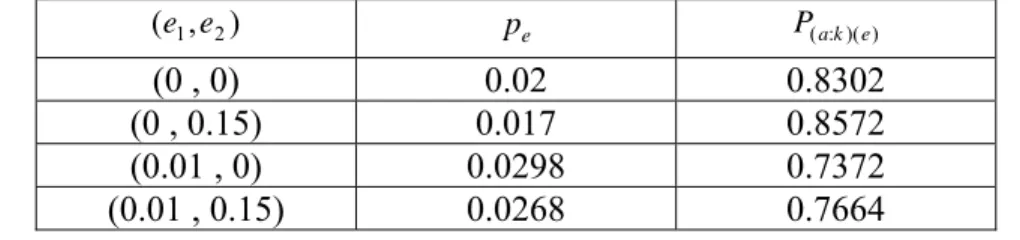
Some values of apparent proportion parameter and the observed probability of lot acceptance are reported in Table 1 for different values of e1 and e2. According to Table 1 it can be easily seen that when pe is
greater than p=0.02 , P(a:k)(e) is smaller than Pa:k =0.8302 and vice versa. For example if (0,0.15)
= ) ,
(e1 e2 then the fake proportion of defective items (pe) is equal to 0.017, and probability of lot
acceptance increases from 0.8302 to 0.8572. Because p reduced from 0.02 to 0.017.
Table 1.Apparent proportion parameter and observed probability of lot acceptance for different values of inspection errors when n=10 and p=0.02 in MDS(0,1,2)-plan.
) ,
(e1 e2 pe P(a:k)(e)
(0 , 0)
0.02
0.8302
(0 , 0.15)
0.017
0.8572
(0.01 , 0)
0.0298
0.7372
(0.01 , 0.15)
0.0268
0.7664
4-OC curve of MDS(0,1,2)-plan with an without inspection errors
OC curve of each plan is one of the important tools to describe the performance of plan against good and poor quality. In addition, it can be applied to compare the efficiency of different plans. OC curve plots probability of lot acceptance against the actual proportion of defective items (see Montgomery, 1991). So it seems that OC curve as a function of incoming fraction defective is affected by the inspection errors. Since in the presence of inspection errors, the value of apparent proportion parameter is far from its real value.
Let p be the true fraction of defective items in the lot and pe be the apparent fraction of defective items
when the inspection errors exist and they are equal to(e1,e2). According to (2) and by fixing p, if the
inspection errors change then it might be occurred two cases: (a) pe p or (b) pe > p.
The first occurs on condition that
2 1 1 e e e p
. If
2 1 1 < e e e p
then the second will occur. Now consider
the point at which the true proportion parameter is equal to the apparent fraction defective (p= pe).
According to (2) implies that p= p(1e2)(1p)e1. By solving this equation for p we have 2 1 1 = e e e p
. If the real proportion of defective items is perfect (p=0), it can be observed that the apparent
quality is perfect if and only if e1 is equal to zero.
Now, let e1 and e2 be greater than zero. Then the observed probability of lot acceptance is bigger than
that e1=e2 =0 for values of pwhich are greater than
2 1 1 e e e
. For values of < e1 1e2
e p
the observed
probability of lot acceptance is less than that without the inspection errors. That is, . < if < and if 2 1 1 : ) )( : ( 2 1 1 : ) )( : ( e e e p P P e e e p P
Pak e ak ak e ak
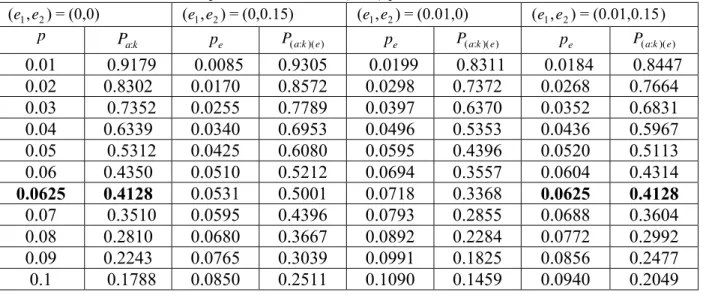
Example 4.1. Consider MDS(0,1,2)-plan such that its sample size is 10. By using (2), (5) and (6) some values of pe, P(a:k)(e) and Pa:k are reported in Table 2 for some possible values of p when four
error-pairs (e1,e2)=(0,0),(0,0.15),(0.01,0),(0.01,0.15) are used. According to Table 2 it can be easily seen that the values of P(a:k)(e)are greater than Pa:k for all possible values of p when (e1,e2) is equal to
(0,0.15) . Because in this case, the observed fraction defectives are smaller than the actual proportion defectives. This result comes out to be the opposite when (e1,e2) is equal to (0.01,0) That is, the observed . probabilities of lot acceptance reduce for all possible values of p. Also, Table 2 shows that when (e1,e2)
equals (0.01,0.15 , the values of ) P(a:k)(e) are less than the values of Pa:k when < =0.0625 2
1 1
e e
e p
. On
the other hand, the values of P(a:k)(e) are greater than the values of Pa:k when p starts to be greater than
0.0625. It can be seen that they are equal when p equals 0.0625.
Table 2.Some values of true and apparent fraction defective and probability of lot acceptance with and without the inspection errors in MDS(0,1,2)-plan when n=10.
(0,0) = ) ,
(e1 e2 (e1,e2)=(0,0.15) (e1,e2)=(0.01,0) (e1,e2)=(0.01,0.15)
p
k a
P: pe P(a:k)(e) pe P(a:k)(e) pe P(a:k)(e)
0.01
0.9179
0.0085
0.9305
0.0199
0.8311
0.0184
0.8447
0.02
0.8302
0.0170
0.8572
0.0298
0.7372
0.0268
0.7664
0.03
0.7352
0.0255
0.7789
0.0397
0.6370
0.0352
0.6831
0.04
0.6339
0.0340
0.6953
0.0496
0.5353
0.0436
0.5967
0.05
0.5312
0.0425
0.6080
0.0595
0.4396
0.0520
0.5113
0.06
0.4350
0.0510
0.5212
0.0694
0.3557
0.0604
0.4314
0.0625
0.4128
0.0531
0.5001
0.0718
0.3368
0.0625
0.4128
0.07
0.3510
0.0595
0.4396
0.0793
0.2855
0.0688
0.3604
0.08
0.2810
0.0680
0.3667
0.0892
0.2284
0.0772
0.2992
0.09
0.2243
0.0765
0.3039
0.0991
0.1825
0.0856
0.2477
0.1
0.1788
0.0850
0.2511
0.1090
0.1459
0.0940
0.2049
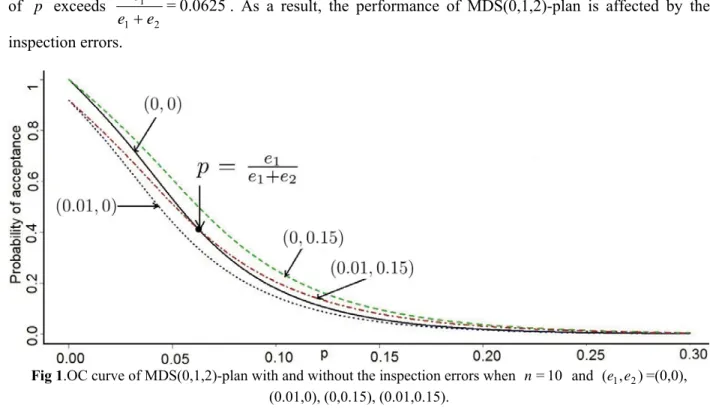
In order to witness more and to illustrate the effect of inspection errors on the performance of the mentioned plan, OC curve of MDS(0,1,2)-plan is plotted for the reported values in table 2 (figure 1). Figure 1 demonstrates that the observed probability of lot acceptance decreases for all possible values ofp when the type 1 error be only occurred. Also, it can be easily seen that the fake probability of lot
acceptance increases for all possible values of p when the inspector only makes the type 2 error during
the inspection. Because the type 1 error occurs when a nondefective item is classified as defective by mistake, and if a nonconforming item is incorrectly categorised as good, the type 2 error will occur. In addition, Figure 1 shows that if e1>0 and e2 >0 then the value of P(a:k)(e) is not always greater than the
value of Pa:k. As it can be seen from Figure 1, the value of P(a:k)(e) is less than the value of Pa:k when p
changes from 0 to =0.0625
2 1
1 e e
e
of p exceeds =0.0625 2
1 1
e e
e
. As a result, the performance of MDS(0,1,2)-plan is affected by the
inspection errors.
Fig 1.OC curve of MDS(0,1,2)-plan with and without the inspection errors when n=10 and (e1,e2)=(0,0),
(0.01,0), (0,0.15), (0.01,0.15).
In the following, we want to discuss how the values of the inspection errors have an influence on the OC curve of MDS(0,1,2)-plan when e1 equals zero and e2 increases or when e2 equals zero and e1
increases.
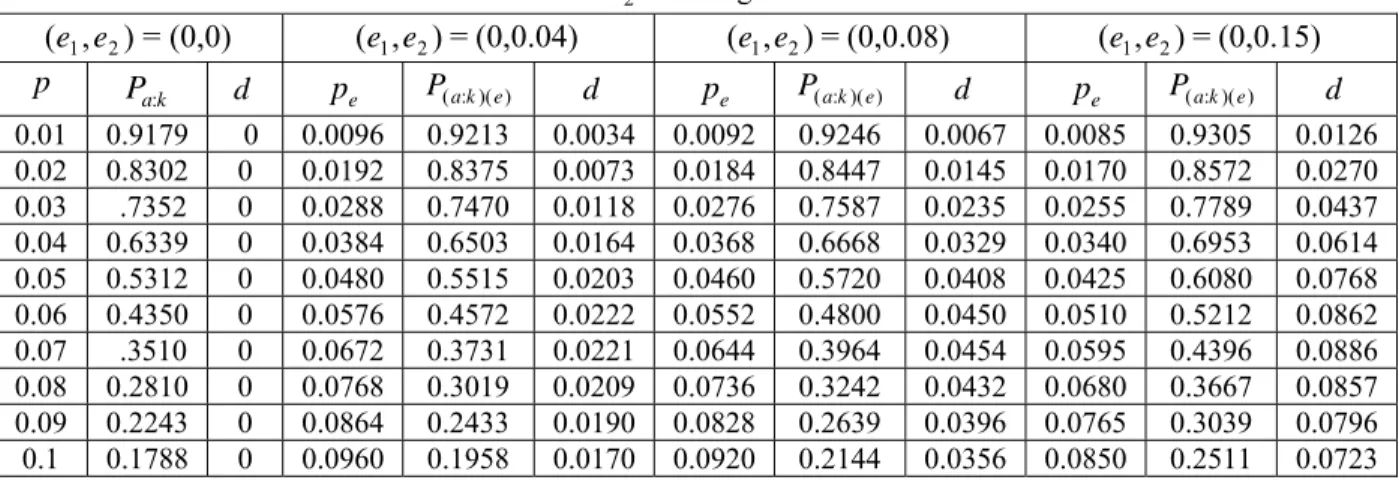
Table 3 shows some values of pe,P(a:k)(e) and Pa:k for different possible values of p when e1 is
fixed in 0 and e2 takes the values 0, 0.04, 0.08 and 0.15. Also, the distance between P(a:k)(e) and Pa:k
d =|P(a:k)(e)Pa:k|
is reported in Table 3. According to Table 3 it can be concluded that when e1 =0 and0 >
2
e , amount of P(a:k)(e) is greater than the actual probability of lot acceptance for all possible values of
p. Also it can be easily seen that the distance between these two values is considerable when the value of
type 2 error increases. For example, according to Table 3 if p equals 0.02 then Pa:k =0.8302. In this case,
when e1 =0 and e2 changes from 0 to 0.15, the distance between the true and observed probability of lot
Table 3.The values of true and apparent fraction defective, probability of lot acceptance with and without the inspection errors with distance between them
d=|P(a:k)(e)Pa:k|
in MDS(0,1,2)-plan when n=10,e1 =0 and2
e is changed.
(0,0) = ) ,
(e1 e2 (e1,e2)=(0,0.04) (e1,e2)=(0,0.08) (e1,e2)=(0,0.15)
p
k a
P: d pe P(a:k)(e) d pe P(a:k)(e) d pe P(a:k)(e) d 0.01 0.9179 0 0.0096 0.9213 0.0034 0.0092 0.9246 0.0067 0.0085 0.9305 0.0126 0.02 0.8302 0 0.0192 0.8375 0.0073 0.0184 0.8447 0.0145 0.0170 0.8572 0.0270 0.03 .7352 0 0.0288 0.7470 0.0118 0.0276 0.7587 0.0235 0.0255 0.7789 0.0437 0.04 0.6339 0 0.0384 0.6503 0.0164 0.0368 0.6668 0.0329 0.0340 0.6953 0.0614 0.05 0.5312 0 0.0480 0.5515 0.0203 0.0460 0.5720 0.0408 0.0425 0.6080 0.0768 0.06 0.4350 0 0.0576 0.4572 0.0222 0.0552 0.4800 0.0450 0.0510 0.5212 0.0862 0.07 .3510 0 0.0672 0.3731 0.0221 0.0644 0.3964 0.0454 0.0595 0.4396 0.0886 0.08 0.2810 0 0.0768 0.3019 0.0209 0.0736 0.3242 0.0432 0.0680 0.3667 0.0857 0.09 0.2243 0 0.0864 0.2433 0.0190 0.0828 0.2639 0.0396 0.0765 0.3039 0.0796 0.1 0.1788 0 0.0960 0.1958 0.0170 0.0920 0.2144 0.0356 0.0850 0.2511 0.0723
These results are illustrated in figure 2.
Fig 2.OC curve of MDS(0,1,2)-plan when n=10,e1=0 and e2 is changed.
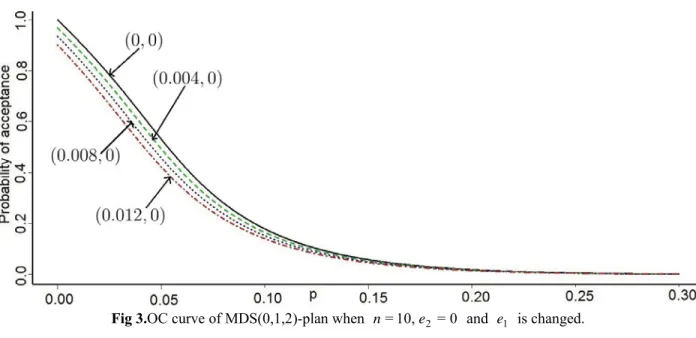
Similarly, some values of pe,P(a:k)(e),Pa:k and d are reported in Table 4 for different possible values
of p when e2 is fixed in 0 and e1 takes the values 0, 0.004, 0.008 and 0.012. Table 4 demonstrates that
amount of the observed probability of lot acceptance is less than the real probability of lot acceptance for all possible values of p when e2 =0 and e1 >0. Also it can be found that when e1 increases, there are
considerable differences between the values of the true and observed probability of lot acceptance. For
example, according to Table 4 if p=0.02 then Pa:k =0.8302. Also, we can see that when e2 equals 0
and e1 increases from 0 to 0.012 the distance between the actual and fake probability of lot acceptance
changes from 0 to 0.1124. This result comes from the fact that by increasing e1, the apparent fraction
Table 4.The values of true and apparent fraction defective, probability of lot acceptance with and without the inspection errors with distance between them
d=|P(a:k)(e)Pa:k |
in MDS(0,1,2)-plan when n=10,e2=0 and1
e is changed.
(0,0) = ) ,
(e1 e2 (e1,e2)=(0.004,0) (e1,e2)=(0.008,0) (e1,e2)=(0.012,0)
p
k a
P: d pe P(a:k)(e) d pe P(a:k)(e) d pe P(a:k)(e) d 0.01 0.9179 0 0.0139 0.8839 0.0340 0.0179 0.8490 0.0689 0.0218 0.8129 0.1050 0.02 0.8302 0 0.0239 0.7939 0.0363 0.0278 0.7564 0.0738 .0317 0.7178 0.1124 0.03 0.7352 0 0.0338 0.6965 0.0387 0.0377 0.6569 0.0783 0.0416 0.6169 0.1183 0.04 0.6339 0 0.0438 0.5942 0.0397 .0476 0.5548 0.0791 0.0515 0.5160 0.1179 0.05 .5312 0 0.0538 0.4935 0.0377 0.0576 0.4572 0.0740 0.0614 0.4225 0.1087 0.06 0.4350 0 0.0637 0.4018 0.0332 0.0675 0.3705 0.0645 0.0712 0.3413 0.0937 0.07 0.3510 0 0.0737 0.3233 0.0277 0.0774 0.2976 0.0534 0.0811 0.2738 0.0772 0.08 0.2810 0 0.0836 0.2587 0.0223 0.0873 0.2381 0.0429 .0910 0.2191 0.0619 0.09 0.2243 0 0.0936 0.2066 0.0177 0.0972 0.1902 0.0341 0.1009 0.1752 0.0491 0.1 0.1788 0 0.1036 0.1648 0.0140 0.1072 0.1520 0.0268 0.1108 0.1401 0.0387 In order to make these results easier to understand, Figure 3 includes all the information of Table 4. According to Figure 3 it can be described that OC curve of MDS(0,1,2)-plan in the presence of the inspection errors (e2 =0 and e1>0) is always under true OC curve of the mentioned plan for all possible
values of p. Also these OC curves are far from together when e1 increases. Because by increasing e1, a
good item is most likely categorised as defective.
Fig 3.OC curve of MDS(0,1,2)-plan when n=10,e2 =0 and e1 is changed.
5-Expected disposition time of MDS (0,1,2)-plan in the presence of inspection errors
Wortham and Baker (1976) showed that the primary limitation of MDS-plans is waiting line which may form until disposition of future lots are known. Now, consider the following symbols:A: Event of unconditional acceptance of a lot,
R: Event of unconditional rejection of a lot,
D: Event of deferring disposition,
W : Variable denoting the number of lots that a deferred lot has to wait before disposition,
d
P : Probability of exactly d defectives occur in a sample of size n,
A
P : Probability that a lot is unconditionally accepted,
R
P : Probability that a lot is unconditionally rejected,
D
P : Probability that a lot disposition is deferred,
U
P : Probability that a lot is unconditionally accepted or rejected i.e. waiting time equals zero.
) =
(W i
P : Probability that the waiting time before disposition for a lot is exactly i lots.
Note: The symbols of PA(e),PR(e),PD(e),PU(e) and Pe(W =i) are the previous concepts except they are
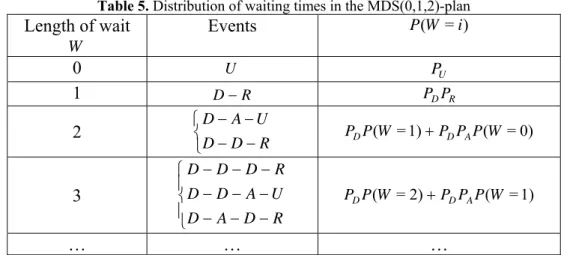
utilised in the presence of the inspection errors. Distribution of waiting times in MDS(0,1,2)-plan can be given as table 5 (Wortham and Baker, 1976):
Table 5. Distribution of waiting times in the MDS(0,1,2)-plan
Length of wait
W
Events
P(W =i)0
U PU1
DR PDPR2
R D D U A D 0) = ( 1) =(W P P PW
P
PD D A
3
R D A D U A D D R D D D 1) = ( 2) =(W P P PW
P
PD D A
…
…
…
Hence, the general term for the waiting time distribution in MDS(0,1,2)-plan is given as: 2. 2), = ( 1) = ( = ) =
(W i P PW i P P PW i i
P D D A
(7)
It should be noted that we require only the values of PA and PR as inputs to evaluate P(W=i)(i0).
Because both PU and PD can be written as functions of PA and PR. Also we have
, ) (1
= n
A p
P
(8)
. ) (1 ) (1 1
= n n1
R p np p
P
(9)
Now assume that the inspection is not perfect. According to (7), a general expression for the waiting time
distribution of MDS(0,1,2)-plan in the presence of the misclassification errors, designated by Pe(W =i),
can be written as:
2. 2), = ( 1) = ( = ) =
(W i P ( )P W i P ( )P ( )P W i i
Pe De e De Ae e
(10)
It should be mentioned that the evaluation of these observed probabilities on the computer needs only PA(e)
and PR(e) as inputs, since both PU(e) and PD(e) can be expressed as functions of PA(e) and PR(e). We can
calculate the values of PA(e) and PR(e) with replacing pe instead of p in (8) and (9).
6-ASN for Decision of MDS(0,1,2)-plan in the Presence of Inspection Errors
In MDS-plan, the ASN is somewhat related to the expected disposition time. The ASN of this plan displays the average number of samples taken from several successive lots before making a decision to
accept or reject the current lot. Also the size of samples are taken per lot is fixed in n (see Wortham and
Baker, 1976).
Now, consider that the inspection errors exist during the inspection. Let N be a random variable that
shows the number of items that are inspected. By using (10) the observed ASN of MDS(0,1,2)-plan,
designated as ASNe, can be obtained as follows. We have:
N n 2n 3n 4n
...
) =
(N i
Pe Pe(W=0) Pe(W=1) Pe(W =2) Pe(W=3)
...
Therefore,
), = ( =
=
i N P i
ASN e
n i
e
1), = ( =
1 =
jP W jn e
j
, ) = ( =
0 =
n k W P k
n e
k
, ) (
=nEe W n
(11)
where Ee(W) is the expected disposition time in the presence of the inspection errors. In the absence of
the misclassification errors, the actual ASN can be calculated with replacing P(W =k) and E(W)
instead of Pe(W =k) and Ee(W) in (11), respectively.
Example 6.1. Consider assumptions of Example 3.1. We had n=10 and p=0.02. According to (10)
and (11), the values of Ee(W) and ASNe are reported in table 6 for different values of the inspection
errors.
Table 6.The values of the expected disposition time and ASN for MDS(0,1,2)-plan in the presence of the inspection errors whenn=10.
) ,
(e1 e2 Ee(W) ASNe
(0 , 0)
0.4347
14.34
(0 , 0.15)
0.3669
13.66
(0.01 , 0)
0.6520
16.52
(0.01 , 0.15)
0.5868
15.86
Tables 1 and 6 demonstrate that when pe is greater than p, the expected disposition time increases.
Since the observed probability of lot acceptance reduces. Consequently, the value of the observed average
sample number for decision increases. For example, according to Tables 1 and 6 if p=0.02 and
(0,0) = ) ,
(e1 e2 then P(a:k)(e) =0.8302, Ee(W)=0.4347 and ASNe=14.34,
While pe=0.0298,P(a:k)(e) =0.7372,Ee(W)=0.6520 and ASNe=16.52 if the inspection erros equal (0.01,0) . This means that when p increases from 0.02 to 0.0298, the value of Ee(W) changes from
0.4347 to 0.6520. As a result, the value of ASNe will be affected by Ee(W). As it can be seen, the value
7-The effects of inspection errors on the expected disposition times and the ASN of
MDS (0,1,2)-plan
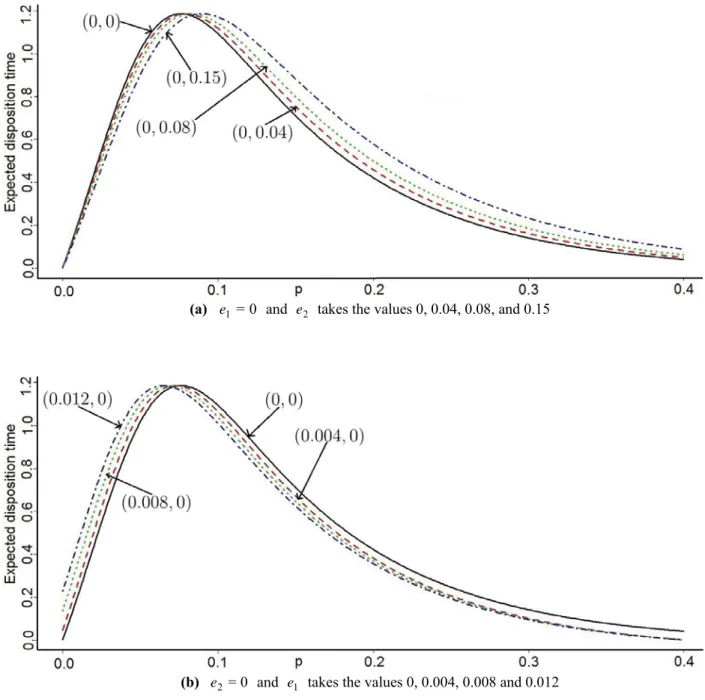
An interesting comparison can be made between the true and apparent expected disposition times of MDS(0,1,2)-plan (figure 4). Also a similar comparison can be made between the actual and observed ASN for decision of the mentioned plan (figure 5). In both figures 4 and 5 the sample size taken per lot is equal to 10.
Figure 4(a) depicts curves for the expected disposition times of MDS (0,1,2)-plan in the presence of the misclassification errors when e1 is fixed in 0 and e2 takes the values 0, 0.04, 0.08 and 0.15. Figure 4(a)
shows that when e1=0 and e2 >0, amount of the apparent expected disposition time is less than the true
expected disposition time for small values of p. But for large values of p, the curve of the unreal expected
disposition time is above the curve of the real expected disposition time.
Next important result can be concluded from Figure 4(a) is that when e2 increases (while e1=0) it can
seriously affect the expected disposition time for all possible values of p. This result is due to the fact that
by increasing e2 the apparent fraction defective reduces. Consequently, the value of the observed
probability of lot acceptance as a function of the fraction defective increases. Hence the expected disposition
time decreases for small values of p and it increases for large values of p. Similar results can be seen in
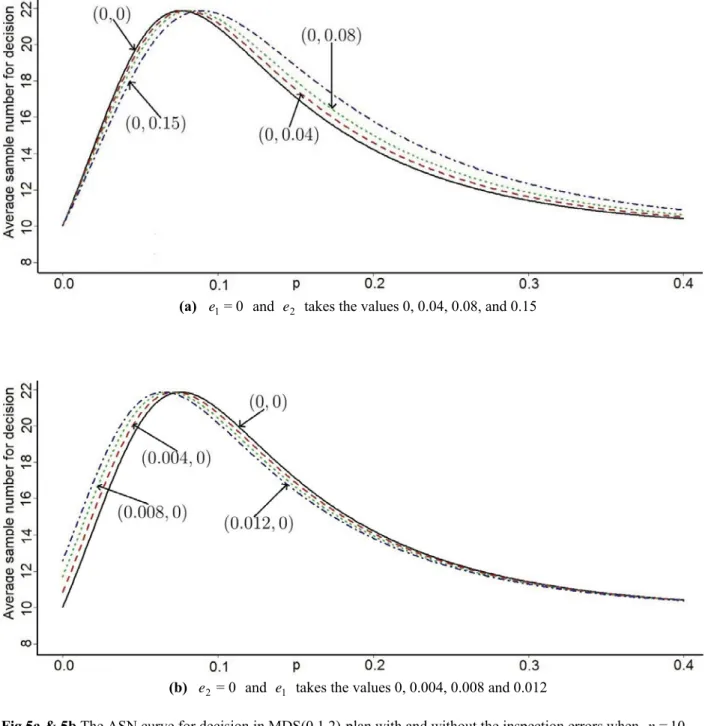
figure 5(a) which illustrates the effects of the type 2 error (whereas e1 =0) on the curve of the ASN in
MDS (0,1,2)-plan. Because according to (11), curve of the observed ASN is exactly similar to the curve of the apparent expected disposition time except the scale for the ordinate axis is obtained by the transformation ASNe =nEe(W)n.
Figure 4(b) provides such a comparison between the curves of the true and apparent expected disposition
time of MDS (0,1,2)-plan. But here e2 is fixed in 0 and e1 takes the values 0, 0.004, 0.008 and 0.012.
According to figure 4(b), one could conclude that the value of the fake expected disposition time is greater than the actual expected disposition time for small values of p when e2 =0 and e1 >0. Also it can be
seen that by increasing e1 (whereas e2 =0), they are far from together for all possible values of p. Since
increasing e1 means that a good item is most likely classified as defective. So the apparent fraction
defective increases. As a result, amount of the observed probability of lot acceptance as a function of the
fraction defective decreases. Therefore, the expected disposition time increases for small values of p. It
can be concluded the similar results from Figure 5(b) which shows the influences of the type 1 error (while 0
=
2
(a) e1 =0 and e2 takes the values 0, 0.04, 0.08, and 0.15
(b) e2=0 and e1 takes the values 0, 0.004, 0.008 and 0.012
Fig 4a & 4b. The curve of the expected disposition time in MDS(0,1,2)-plan with and without the inspection errors when n=10
(a) e1=0 and e2 takes the values 0, 0.04, 0.08, and 0.15
(b) e2=0 and e1 takes the values 0, 0.004, 0.008 and 0.012
Fig 5a & 5b.The ASN curve for decision in MDS(0,1,2)-plan with and without the inspection errors when n=10
8- Conclusion
In the present article, at first we extended MDS-plan by attribute to the state where inspection errors exist during the inspection. Later, we concentrated on a specific feature of MDS (0,1,2)-plan. Then influence of the inspection errors on OC curve, expected disposition time and ASN for decision in MDS (0,1,2)-plan was studied. It was shown that in the presence of inspection errors (type 1 and type 2 errors), the value of unreal probability of lot acceptance is greater than true probability of lot acceptance when type 2 error is only occurred. This result comes out to be the opposite if type 2 error is equal to zero and type 1 error increases. As a result, OC curve of the plan which shows the changes of the probability of lot acceptance against different values of the fraction defective, is affected by misclassification errors. The results showed that there is a considerable difference between true and fake curves of expected disposition time in MDS (0,1,2)-plan. We also obtained the similar results about the effects of misclassification errors
on ASN curve in the mentioned plan.
References:
Afshari, R., SadeghpourGildeh, B. &Sarmad, M. (2018). Multiple deferred state sampling plan with fuzzy
parameter.International Journal of Fuzzy Systems, 20(2), 549-557.
Afshari, R. & Sadeghpour Gildeh, B. (2017). Fuzzy multiple deferred state variable sampling plan,Journal
of Intelligent and Fuzzy Systems,
Accepted ,DOI: 10.3233/JIFS-17907.
Balamurali, S., Jeyadurga, P. & Usha, M. (2016). Designing of bayesian multiple deferred state sampling
plan based on Gamma Poisson distribution. American Journal of Mathematical and Management Sciences,
35(1), 77-90.
Balamurali, S. & Jun, C. H. (2007). Multiple dependent state sampling plans for lot acceptance based on
measurement data. European Journal of Operational Research, 180(3), 1221-1230.
Beaing, I. & Case, K. E. (1981). A wide variety of AOQ and ATI performance measures with and without
inspection error. Journal of Quality Technology, 13(1), 1-9.
Case, K. E., Benett, G. K. & Schmidt, J. W. (1975). The effect on inspection error on average outgoing
quality.Journal of Quality Technology, 7(1), 28-33.
Chen, C. H. & Chou, C. Y. (2003). Economic specification limits under the inspection error.Journal of the
Chinese Institute of Industrial Engineers, 20(1), 9-13.
Chen, T. T., Huang, C. P. & Lien, S. Y. (2008). Dodge-Roming rectifying single sampling plans based on inspection error. In: Proceedings of International Conference on Business and Information Management, Linkou, Taipei County, Taiwan.
Collins, R. D., Case, K. E. & Bennett, G. K. (1973). The effect of inspection errors in single sampling
inspection plans.International Journal of Production Research, 11(3), 289-298.
Dodge, H. F. (1955). Chain sampling inspection plan.Industerial quality control, 11(4), 10-13.
Dodge, H. F. & Stephens, K. S. (1966). Some new chain sampling inspection plans.Industerial quality control, 23(2), 61-67.
Dorris, A. L. & Foote, B. L. (1978). Inspection errors and statistical quality control.AIIE Transactions,
10(2), 184-192.
Duffuaa S. O. & El-Gaaly A. (2015). Impact of inspection errors on the formulation of a multi-objective
optimization process targeting model under inspection sampling plan.Computers and Industrial
Engineering, 80, 254-260.
Fallahnezhad M. S. & Yousefi Babadi A. (2015). A new acceptance sampling plan using bayesian approach
in the presence of inspection errors.Transactions of the Institute of Measurement and Control, 37(9),
1060-1073.
sampling plans based on process capability index.Journal of Testing and Evaluation, 43(1), 171-178.
Latha M. &Subbiah K. (2015). Selection of bayesian multiple deferred state (BMDS-1) sampling plan based
on quality regions.International Journal of Recent Scientific Research, 6(5), 3864-3867.
Markowski, E. P.& Markowski, C. A. (2002). Improved attribute acceptance sampling plans in the presence
of misclassification error.European Journal of Operational Research, 139(3), 501-510.
Mogg, J. M. & Wortham, A. W. (1970). Dependent stage sampling inspection.International Journal of
Production Research, 8(4), 385-395.
Montgomery, D. C. (1991). Introduction to statistical quality control. New York: Wiley.
Osanaiye, P. A. & Alebiosu, S. A. (1988). Effects of industrial inspection errors on some plans that utilise
the surrounding lot information.Journal of Applied Statistics, 15(3), 295-304.
Senthilkumar D., Ramya S. R. & Raffie B. E. (2015). Construction and selection of repetitive deferred
variables sampling (RDVS) plan indexed by quality levels.Journal of Academia and Industrial Research,
3(10), 497.
Soundararajan, V. & Vijayaraghavan, R. (1990). Construction and selection of multiple dependent
(deferred) state sampling plan.Journal of Applied Statistics, 17(3), 397-409.
Subramain, K. & Haridoss, V. (2012). Development of multiple deferred state sampling plan based on minimum risks using the weighted poisson distribution for given acceptance quality level and limiting
quality level.International Journal of Quality Engineering and Technology, 3(2), 168-180.
Suich, R. (1990). The effects of inspection errors on acceptance sampling for nonconformities.Journal of
Quality Technology, 22(4), 314-318.
Wortham, A. W.& Baker, R. C. (1976). Multiple deferred state sampling inspection.International Journal
of Production Research, 14(6), 719-731.
Wu C. W., Lee A. & Chen Y. (2016). A novel lot sentencing method by variables inspection considering
multiple dependent state.Quality and Reliability Engineering International, 32(3), 985-994.
Wu, C. W., Liu, S. W. & Lee, A. (2015). Design and construction of a variable multiple dependent state
sampling plan based on process yield.European Journal Industrial engineering, 9(6), 819-838.
Yan A., Liu S. & Dong X. (2016). Designing a multiple dependent state sampling plan based on the coefficient of variation.SpringerPlus, 5(1), 1447.