i
Abstract
Introduction: The policies governing Medicare reimbursement for inpatient admissions affect admission status for older adults. These rules strongly influence the willingness of hospital providers to accept patients from the emergency department. We contend that emergency physicians have limited knowledge of these rules, and that knowledge is tied to how EM medical directors would manage patients in hypothetical cases designed to be inappropriate for admission under current Medicare guidelines.
Methods: We administered an online survey to emergency department medical directors presenting two hypothetical cases designed to miss one or both of the Medicare severity of illness and intensity of service criteria. The cases also raised issues of 30-day readmissions penalties and condition at presentation vs. admission. We asked Respondents questions about the applicability of Medicare rules to the cases, how they would manage the patients, and what case management resources they use or could use in managing these patients.
Results: Sixty-two medical directors of the 1,460 reached via the Medical Directors listserv completed the survey. Overall, knowledge of Medicare admissions guidelines was limited, with the average respondent answering 56.3% (S.D. 13.1) of questions correctly. We found no correlation between two kinds of Medicare knowledge, that of of the intensity of service/severity of illness rules, and knowledge of the rules governing 30-day readmissions. Physicians with greater knowledge were less likely to recommend inpatient admissions that Medicare guidelines would consider inappropriate. They were also more likely to recommend skilled nursing placement over inpatient admission in a hypothetical case that would qualify for skilled nursing, but not inpatient care(p=0.02).
iii
Acknowledgements
First and foremost, I would like to thank my advisor, Dr. Sue Tolleson-Rinehart, for the patience, dedication, and enthusiasm that were a constant during this process. Any time I began to doubt my abilities or insights, she reassured me and helped me see the way through. I could not have completed this project without her guidance. She remained a steadfast source of encouragement and wisdom.
I would also like to thank Dr. Timothy Platts-Mills, whose concern for providing the best possible care to injured older adults led me to consider the policy environment governing how older Americans receive their care. This project started in an effort to understand why a hospitalist would object to admitting an incredibly vulnerable nonagenarian with a new and disabling injury. This simple inquiry led us to consider the role of Medicare’s Prospective Payment system and the way it drives care in the emergency department, despite what we perceived to be physicians’ limited awareness of its effects.
Thanks to Dr. Jay Pomerantz, for guiding Dr. Platts-Mills and me through our early stages of discovery. Your patience and eagerness to help us navigate a complex and often difficult to access web of guidelines and regulations was critical to forming the theoretical background for this paper. I also appreciate your willingness to help me design the cases for this survey.
Thanks to Dr. Abhi Mehrotra for distributing the survey. Recruiting participants can be an onerous task, and your help made it possible. I am also extremely grateful to my survey participants. It’s quite intimidating to study emergency department medical directors as a medical student hoping to match in emergency medicine. I’m thankful for the willingness of medical directors to take my survey, and especially grateful for the thoughtful commentary and insights they took time to provide.
Table of Contents
1)
Abstract………..i
2)
Acknowledgements………..………ii
3)
List of Tables………iv
4)
Introduction………1
5)
Background and Theoretical Perspective……….2
6)
Methods………5
7)
Results………8
8)
Discussion………13
9)
Conclusion………..18
10)
References………..………..20
11)
Appendix 1: Systematic Review………..22
12)
Appendix 2: Regions for Analysis………28
13)
Appendix 3: Generation of Scores……….29
List of Tables
Table 1: Demographic information for survey respondents………..….…9
Table 2: Summary of Scores……….……..10
Table 3:
Association between demographic factors and practice decisions……..12 Table 4: Association between total and IOSSOI scores and practice decisions…..13 Table 5: Results of multiple linear regression against score for intensity ofIntroduction
Older adults represent an ever-growing proportion of emergency department patients.1 For many of these patients who visit the emergency department because of injury, the emergency department is a critical juncture in their care and rehabilitation. While some patients will require hospitalization based on the severity of their injuries, and others can safely be sent home after their evaluation in the emergency department, as many as thousands of patients each year will fall into a gray area of Medicare policy. Not sick enough for the hospital, but unable to care for themselves at home, these patients remain in the emergency department until a safe disposition can be arranged.
Arranging a safe disposition takes time, and resources to provide for patients outside the hospital often are limited or difficult to access. The safe disposition that can be arranged often is not the ideal one. In 2009, 1.1 million patients were admitted to observation status nationwide, up dramatically from 828 thousand in 2006. The average length of observation stay is increasing, as well2. Many of the
patients also could receive their care in rehabilitation facilities, or even at home. Home hospital
programs provide high quality care to individuals in their own homes, but these programs are limited to a few cities and as yet lack the capacity to handle large numbers of patients.34
2 navigate Medicare policies for inpatient and out of hospital care, and their beliefs as to how best
improve their coordination of patients who don’t meet criteria for inpatient admissions.
Background and Theoretical Perspective
In 2008, older adults made over 19 million visits to emergency department in the United States. Of these, five million were injury related.5 Although some injuries are severe and require immediate
hospitalization, while others are minor and result in no functional limitation, a significant subset results in a functional limitation that is in effect a new disability. This disability may be temporary, but for many older adults even a temporary disability can disrupt their ability to provide needed self-care.
The classic paradigm is that the emergency department stands at the crossroads between admission and discharge home. Patients present to the emergency department with an acute injury or illness, receive treatment, and are either admitted to the hospital for any requisite further care or discharged home if their condition can be treated satisfactorily in the ED. Since the advent of Medicare’s Prospective Payment System (PPS) in 1983, hospitals face strong pressure to ensure their patients meet Medicare’s guidelines governing severity of illness and intensity of service. Hospitals who admit patients of lessening severity face a variety of financial disincentives, many of which are passed to the patient in the form of a larger copay6.
3 at all. In such a case, the remaining options are for the patient to languish in the emergency department or be admitted to a hospital bed under an outpatient “observation” status.78
Patients admitted under observation status remain outpatients in the eyes of Medicare, and the hospital is reimbursed at a much lower rate than for an inpatient admission9. Additionally, the patient is assessed a much higher co-pay for his or her hospital stay under observation status.102Stabilization and discharge are expected within 24 to 48 hours of observation status, although some observation stays last even longer. Although observation status provides strong financial disincentives to hospitals and patients, the difficulty of arranging alternative dispositions to home or skilled nursing facilities from the emergency department often leaves observation status as the only viable recourse for patients
presenting to the emergency department with new functional limitations from injury. This is generally called a “social admission.” Social admission has no standardized meaning and only scattered
examination in the medical literature (see Appendix 1 for literature review), but for the purposes of this paper, it is defined as an admission to a hospital bed when the patient does not meet Medicare
guidelines for inpatient admission, and a primary driver for the admission is the lack of access to outpatient services that could have prevented admission.
In addition to the financial disincentives for admitting patients to observation status, the immobility that characterizes admission to a hospital bed makes hospitalization a poor place for rehabilitating a functionally limiting injury11. Older patients admitted to a hospital bed when increased social supports could have averted hospitalization are unnecessarily exposed to risk of nosocomial infections, delirium, muscle loss, and other iatrogenic complications.12 Furthermore, the task of
4 Many of these patients admitted under observation status actually would meet criteria for short-term admission to skilled nursing or rehab facilities directly from the emergency department, or would even meet guidelines for home care assistance. However, because of the gragmented nature of the American health care system, it is rarely possible for such care to be arranged from the emergency department. Skilled rehab and home care services generally can only be arranged during regular working hours, leaving few options for patients presenting to the emergency department during weekends, early evenings, or nights. Even if placement can be arranged directly from the emergency department, the billing structure of emergency care pays a flat rate based on the patient’s medical complexity. The emergency department receives no additional reimbursement for a patient with complex case management needs, incentivizing the ED to make the swiftest possible disposition, which is often the hospital.
This combination of variables funnels injured older adults into observation status, although the transition Is often not smooth. Emergency department physicians unfamiliar with inpatient payment policies may recommend patients most appropriate for observation status or discharge to an alternative setting for inpatient admission, leading to delays and conflict with hospitalist providers, for whom observation admissions are associated with strong financial or administrative disincentives.
Despite the importance of this topic for practice in the emergency department, a systematic literature review conducted for this paper revealed very sparse evidence on the topic in relevant emergency medicine journals, and it is unclear the extent to which emergency department physicians are familiar with these policies or how knowledge of them affects practice in the emergency
5 the case management resources emergency department medical directors possess, find useful, and believe would assist them in managing patients whose disposition is complicated by the intricacies of Medicare payment policy.
Methods
To assess the knowledge of emergency department medical physicians about Medicare payment policies for inpatient admissions, we administered a survey to emergency department medical directors, recruited through the voluntary email listserv of medical directors who attended the American College of Emergency Physicians (ACEP) Emergency Department Directors Academy. Emergency department medical directors were selected as a study population for several reasons. Most importantly, they are more likely than their peers to work with Medicare policy in the course of their duties. We selected this population of EM physicians who are most likely to be familiar with Medicare policy to ensure that a result showing lack of familiarity with Medicare inpatient policies was more likely to be accurate, and because this sampling strategy most easily resulted in a distribution of potential respondents across all regions of the country.
We designed the survey was designed using Qualtrics software available to us through the Odum Institute at the University of North Carolina at Chapel Hill. After receiving IRB approval from the UNC IRB, we sent a link to the survey to the listserv, with one follow-up email message approximately 3 weeks after we sent the original recruitment message. After providing informed consent at the
6 guidelines for severity of illness and intensity of service, and how respondents would most likely
manage the patient’s disposition in their current practice. They then were asked general knowledge questions about Medicare inpatient admissions guidelines and guidelines governing 30 day readmission rates. The survey then asked about the case management resources they possessed and those they thought would be of use to them. The survey concluded with minor demographic information. Free text responses were saved but not coded for the present analysis.
The clinical scenarios
The first case presents a 93 year old woman, previously living at home with her son, who was seen in the ED after falling. She is diagnosed with a broken neck, but surgery is not recommended. Her vital signs and laboratory values all are normal. Based on this and other information in the case, she meets Medicare guidelines for severity of illness, but not intensity of service.13
The second case presents a 65 year old man presenting with an exacerbation of congestive heart failure three weeks after discharge for a similar exacerbation. Of note, he meets Medicare admissions guidelines at the time of EMS contact, as well as upon arrival to the ED. However, he does not meet admissions guidelines after stabilization in the emergency department.13
7 categorical variables in demographic information, frequencies and percentages were examined for representativeness and to identify viable subgroups for further analysis.
We identified five subgroups with which to conduct further analysis: Years in practice (grouped ≤10 years, 11-19 years, and ≥20 years), region (four regions nationally, see appendix 2 for complete listing), trauma center level (“High” if Level 1 or Level 2 trauma center, “Low” if Level 3 trauma center or not a trauma center), access to any form of case management resources in the Emergency Department (yes or no), and whether or not the emergency department trains residents. We used the subgroup analysis to check for possible contextual or demographic correlates of knowledge.
We quantified overall knowledge by assigning a score to each respondent based on the
percentage of attempted questions that were answered correctly. “Attempted questions” were used as the denominator for each case in order to include the information provided by the respondents who initiated but did not complete the survey and respondents who did not provide responses to every section. Questions that were part of sections for which no response was entered were not scored. Response choices whose correctness could not be conclusively verified by researchers due to limited guideline access were not included in the scoring.
Respondents’ aggregate score was also subdivided into two separate scores, one for knowledge of how Medicare utilizes intensity of service and severity of illness (IOSSOI Score), and another for respondents’ performance on 30-day readmission questions. All three scores were analyzed in the bivariate analysis section. Only the intensity of service/severity of illness section was analyzed in multivariate analysis. See appendix 3 for a full description of how the scores were generated.
8 categories, we did further testing with paired t-testing between categories \. We used Chi squared testing to determine if any of the subgroups identified significantly discriminated among medical director responses on individual questions about patient management. We also correlated scores on intensity of service/severity of illness and 30-day readmissions, to determine whether knowledge in one area is predictive of knowledge in another. Finally, we regressed the knowledge scores on the
independent demographic, experience, and practice context variables to identify predictors of performance on knowledge of Medicare governance of these kinds of cases.
Results
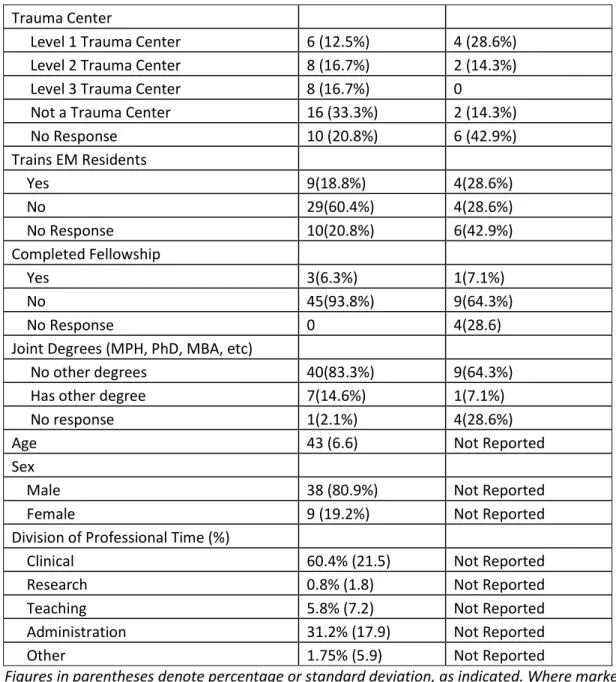
Sixty-two (62) individuals responded to the online survey. Of these, 48 finished the complete survey, all of whom reported active positions as emergency medicine medical directors. Respondents to the survey represented all regions of the country and a variety of levels of care as determined by level of trauma center. Among those completing the survey, 9 (18.8%) trained EM residents in their department. Very few respondents reported completion of fellowship, board certifications other than emergency medicine, or joint degrees, so these were not used for further analysis. Table 1: Demographic information for survey respondents
Completed Survey
Partially Completed Survey
Number 48 14
Years in Practice 13.4 (4.3) 12.2 (5.8)
Board Certified in EM 45 (93.8%) 11*
Current EM Medical Director 48 (100%) 11*
Region
South 12 (25%) 2(14.3%)
Northeast 10 (20.8%) 2(14.3%)
Midwest 17 (35.4%) 4(28.6%)
West 9 (18.75%) 1(7.1%)
International 0 1(7.1%)
9 Trauma Center
Level 1 Trauma Center 6 (12.5%) 4 (28.6%)
Level 2 Trauma Center 8 (16.7%) 2 (14.3%)
Level 3 Trauma Center 8 (16.7%) 0
Not a Trauma Center 16 (33.3%) 2 (14.3%)
No Response 10 (20.8%) 6 (42.9%)
Trains EM Residents
Yes 9(18.8%) 4(28.6%)
No 29(60.4%) 4(28.6%)
No Response 10(20.8%) 6(42.9%)
Completed Fellowship
Yes 3(6.3%) 1(7.1%)
No 45(93.8%) 9(64.3%)
No Response 0 4(28.6)
Joint Degrees (MPH, PhD, MBA, etc)
No other degrees 40(83.3%) 9(64.3%)
Has other degree 7(14.6%) 1(7.1%)
No response 1(2.1%) 4(28.6%)
Age 43 (6.6) Not Reported
Sex
Male 38 (80.9%) Not Reported
Female 9 (19.2%) Not Reported
Division of Professional Time (%)
Clinical 60.4% (21.5) Not Reported
Research 0.8% (1.8) Not Reported
Teaching 5.8% (7.2) Not Reported
Administration 31.2% (17.9) Not Reported
Other 1.75% (5.9) Not Reported
Figures in parentheses denote percentage or standard deviation, as indicated. Where marked by an asterisk, denominator was not available for the calculation of percentage.
Table 2: Summary of Scores
Observations
Mean
(stdev) Min Max
Overall Score 53 56.3 26.3 90.0
IOSSOI Score 53 54.9 14.3 90.0
Readmission
10 Of 53 respondents for whom a score could be calculated, the mean for total score, IOSSOI score, and readmission score were 56.3 (sd 13.1), 54.9 (sd 18.1), and 61.6 (sd 18.2), respectively. Overall scores ranged from a minimum of 26.3 to a maximum of 90.0. IOSSOI scores ranged from 14.3 to 90.0. Scores for readmission ranged from 40.0 to 80.0. Bivariate analysis did not reveal any statistically significant associations between total score and trauma level (t=0.774, p=0.443), training EM residents (t-1.828, p=0.075), region (F=1.13, p=0.344), years of experience (F=0.94, p=0.399), or availability of case management resources (F=0.94, p=0.3367). Nor was the IOSSOI Score significantly associated with demographic or practice context variables. The two knowledge scores arerelatively independent of one another; although they are not significantly correlated, the correlation is slightly inverse (r=-0.1488, p=0.3076), suggesting that more knowledge in one area may mean less knowledge in another. One possible interpretation of this weak inverse relationship may be that knowledge of guidelines about severity and intensity on initial presentation may make people somewhat more likely to think they know what governs 30-day readmissions, when they do not .
11 Table 3: Association between demographic factors and practice decisions, chi-squared results
Most appropriate disposition How would you manage?
Case 1 Case 2 Case 1 Case 2
Region 11.56 (p=0.07) 11.66 (p=0.233) 7.18 (p=0.619) 13.29 (p=0.348) Years of
Experience 2.71 (p=0.608) 5.82(p=0.444) 5.99 (p=0.424) 7.97 (p=0.436) Trauma Level 1.27 (p=0.530) 4.61 (p=0.202) 5.50 (p=0.139) 4.25 (p=0.373) Trains EM
Residents 1.66 (p=0.437) 6.52 (p=0.089) 1.66 (p=0.646) 3.45 (p=0.486) Available Case
Management 0.88 (p=0.643) 3.55 (p=0.313) 2.08(p=0.557) 8.47 (p=0.076)
The F-statistic for overall associations between medical directors’ views on most appropriate disposition and their most likely management of the patient are shown in Table 3. We investigated significant associations further with paired t-tests between subgroups. For case 1, medical directors with lower IOSSOI scores were significantly more likely to view inpatient admission as the most appropriate disposition, rather than observation (p=0.0463) or skilled nursing care (p=0.0173);
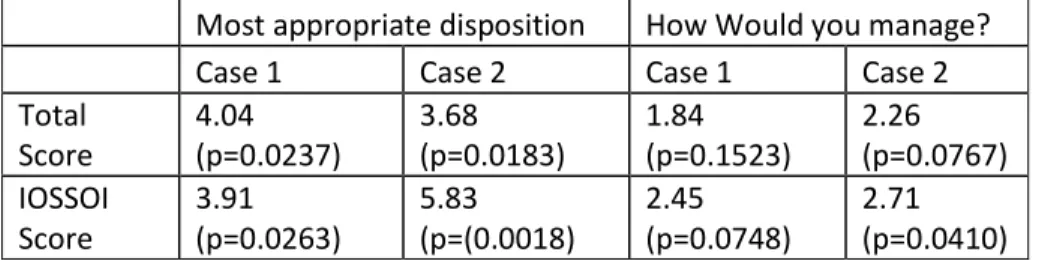
12 Table 4: Association between total and IOSSOI scores and practice decisions, F-statistic
Most appropriate disposition How Would you manage?
Case 1 Case 2 Case 1 Case 2
Total Score 4.04 (p=0.0237) 3.68 (p=0.0183) 1.84 (p=0.1523) 2.26 (p=0.0767) IOSSOI Score 3.91 (p=0.0263) 5.83 (p=(0.0018) 2.45 (p=0.0748) 2.71 (p=0.0410)
None of the demographic, experience, or practice context variables are significant in a
multivariate regression, as Table 4 makes clear. The lack of significance seems to suggest that nothing in the general background of an ED medical director particularly prepares him or her for awareness of Medicare policy. .
Table 5: Results of multiple linear regression against score for intensity of service and severity of illness questions
Beta Coefficient
Standard
Error t p
EM Residency 12.87 8.59 1.5 0.145
Availability of Case
Management 7.67 8.53 0.9 0.376
20+ years in practice 6 11.22 0.53 0.597
11-19 years in practice 0 (omitted for collinearity)
10 or fewer years in practice 1.91 8.4 0.23 0.822
Midwest -14.82 9.08 -1.63 0.114
Northeast -7.01 9.66 -0.73 0.474
South -7.32 9.83 -0.74 0.462
West (omitted for collinearity)
Level I or II Trauma Center -4.86 7.6 -0.64 0.527
Discussion
13 seem to matter: they are associated with physicians’ own preference for lower levels of care that are both in line with Medicare payment policies and likely beneficial to patient care.
Interestingly, the only apparent correlation between knowledge of the intensity of service and severity of guidelines of the Prospective Payment System with knowledge of 30-day readmissions policies was weak and insignificant, but inverse. Our findings raise questions about why this particular knowledge disparity exists, and suggests that differing education strategies may be necessary to raise EM physicians’ awareness of the policies. That we were unable to find any demographic factor predictive of policy knowledge also is of interest, because it suggests the need for a more powerful investigation into the effect of inpatient payment policies on ED practice before implementing new policies or educational strategies to reduce recommendations for inpatient admission for which a lower level of care is considered more appropriate.
Our survey response rate was 4.4%, which limits our ability to generalize results to the broader population of emergency medicine physicians. However, the sample of Emergency Medicine medical directors who responded to the survey was broadly representative of the general population of EM practitioners in several regards. Geographically, physicians from all major regions of the country were included among the respondents. All levels of trauma centers and non-trauma centers were included, as well as programs with and without EM residency training programs. Respondents also spanned a large number of years in practice. Although the sample size was small in total numbers the analysis was done on broad enough subgroups that the results can be used to target future research into the effects of Medicare inpatient payment policies on emergency department practice.
14 examination of the data revealed an apparent lack of correlation between performance on questions about the prospective payment system and those about 30-day readmissions. We thus created sub-scores for each of these categories to analyze further. There was no significant correlation between knowledge of 30-day readmissions policies and those related to the PPS, and what correlation we did find was negative. This raises a series of issues. First of all, why is it that knowledge of one Medicare policy does not translate to knowledge of another or, to ask it another way, does knowledge of one policy area create a false sense of confidence about knowledge in another, or the erroneous assumption that, in this case, knowledge is transferrable? Unraveling these puzzles may be necessary to the
development of the most effective educational strategies. Second, our cases were designed mostly to test knowledge of the intensity of service and severity of illness criteria, although the second case did touch on 30-day readmissions. Does knowledge specifically of 30-day readmission guidelines affect ED practice in a manner similar to that of the PPS? Our study was not designed to investigate this
association, but it may be of interest to future investigations.
Physicians who demonstrated greater knowledge of the intensity of service and severity of illness guidelines used by Medicare were more likely than were their peers to recommend appropriate lower levels of care over inpatient admission in case 1, whether observation or discharge to skilled nursing care. This differing practice pattern may reflect different attitudes about appropriate
15 In case 2, physicians who performed better on the knowledge questions were more likely to appropriately recommend observation. Physicians who scored lower were more likely to recommend inpatient observation, which is inappropriate per Medicare’s InterQual guidelines, but they were also more likely to recommend discharge home. For the purposes of this paper, we considered either observation admission or discharge home for the patient to be appropriate. As such, physicians who scored well were more likely to recommend one appropriate disposition, but physicians with lower scores were split between an appropriate disposition (discharge) and an inappropriate disposition (inpatient admission). That responses by those with lower scores fell into two very different levels of care may indicate multiple things. It likely reflects a lack of awareness about observation admissions and their role in the hospital. It may also represent two different subgroups with differing views on how patients are best managed between which our study lacked the power to differentiate.
Our multivariate analysis revealed that, at least in our sample, demographic and practice variables do not predict knowledge of Medicare policy. The only association that approached statistical significance was with being the medical director of an ED that trains emergency medicine residents (β=12.87 p=0.145). It is possible that a more powerful study could identify this as a significant association, but the lack of other plausible predictors of knowledge identified by the survey suggests that ED physicians’ need for knowledge is universal, and that strategies to make that knowledge easier to get could benefit physicians in any ED setting.
16 did not have direct access to the proprietary formulae. If our findings are correct, and knowledge of the guidelines predicts practices consistent with Medicare policy, then this limited access may be
problematic in efforts to improve practice through education. If more powerful research confirms our findings, further discussion about the balance of proprietary rights with public good in the case of a multi-billion dollar public program like Medicare is warranted.
This paper should be considered a starting point for further work on the relationship between Medicare payment policies and injured older adults’ disposition from the emergency department. While we have provided unique data showing that emergency medicine medical directors have limited
knowledge of Medicare payment policies for inpatient admissions, and that knowledge apparently correlates with practices consistent with guidelines, there is much more to understand about the topic before concrete recommendations can be made to improve practice. Important targets for future research include further clarifying the role of case management in managing emergency department patients at risk for unnecessary hospitalization, as in the case of the patient in the first scenario, for whom discharge to SNF or home with assistance would be appropriate. It is unreasonable to expect all EM physicians to become well-versed in inpatient payment policies, but clearly some level of knowledge changes practice to be more consistent with guidelines.
17 diversity in availability and utilization of case management resources, as well as the alternative
dispositions available in any given region, a study targeted directly to understanding the role of case management is warranted.
Furthermore, with the current development of Accountable Care Organizations intended to coordinate and streamline patient care, emergency physicians are in a position to advocate for improved resources with which to arrange timely placement in outpatient settings. Observation admission is a waypoint for older adults every year, but many of these are preventable. These social admissions place older adults at increased risk for bad outcomes4, 12. Greater integration with outpatient skilled nursing and home health services could reduce these risks and save the patients from expensive observation copays. However, in order to become effective policy advocates in the developing world of Accountable Care Organizations, emergency physicians must first understand the policy environment surrounding emergency department practice.
Conclusion
Our pilot data show that emergency medicine medical directors who demonstrated greater knowledge of Medicare’s guidelines for intensity of service and severity of illness were more likely than their peers to correctly identify dispositions consistent with Medicare guidelines for the case of a 92 year old female with a broken neck, showing a lower tendency to make a social admission. The patterns associated with the case of a 65 year old man with a CHF exacerbation were more complex, but
19 REFERENCES
1. Gruneir A, Silver MJ, Rochon PA. Emergency department use by older adults: A literature review on trends, appropriateness, and consequences of unmet health care needs. Med Care Res Rev.
2011;68(2):131-155. doi: 10.1177/1077558710379422.
2. Jaffe S. Growing number of patients finda A hospital stay does not mean they're admitted. Kaiser Health News. September 12 2010. Available from:
http://www.kaiserhealthnews.org/Stories/2010/September/07/hospital-observation-care.aspx.
Accessed 5/21/12.
3. Leff B, Burton L, Mader SL, et al. Hospital at home: Feasibility and outcomes of a program to provide hospital-level care at home for acutely ill older patients. Ann Intern Med. 2005;143(11):798-808.
4. Leff B, Burton L, Mader SL, et al. Comparison of functional outcomes associated with hospital at home care and traditional acute hospital care. J Am Geriatr Soc. 2009;57(2):273-278. doi: 10.1111/j.1532-5415.2008.02103.x.
5. Centers for Disease Control and Prevention. National ambulatory medical care survey: 2008 emergency department summary. CDC gov. 2008:330-343.
6. Mayes R. The origins, development, and passage of medicare's revolutionary prospective payment system. J Hist Med Allied Sci. 2007;62(1):21-55. doi: 10.1093/jhmas/jrj038.
20 8. American College of Emergency Physicians. Utilization review FAQ.
http://www.acep.org/content.aspx?id=36598. Accessed 5/31/2012, .
9. American College of Emergency Physicians. Observation care payments to hospitals FAQ. http://www.acep.org/content.aspx?id=30486. Accessed July 2, 2012.
10. Jaffe S. Patients held for observation can face steep drug bills. USA Today. 2012. Available from:
http://www.usatoday.com/money/industries/health/drugs/story/2012-04-30/drugs-can-be-expensive-in-observation-care/54646378/1. Accessed 7/2/12.
11. Brown CJ, Redden DT, Flood KL, Allman RM. The underrecognized epidemic of low mobility during hospitalization of older adults. J Am Geriatr Soc. 2009;57(9):1660-1665. doi:
10.1111/j.1532-5415.2009.02393.x.
12. Creditor MC. Hazards of hospitalization of the elderly. Ann Intern Med. 1993;118(3):219-223.
13. Pomerantz J. Meeting and emails with jay pomerantz, utilization review officer at UNC hospitals. meeting purpose to design cases. meeting date 3/8/2012. email dates 3/11/2012, 3/28/2012. .
21
Appendix 1: Systematic Review
Objectives, concepts, and terminology
Because we are interested in whether the question of how emergency medicine physicians understand Medicare payment policies, and whether they are aware of how these policies affect the “social admission” of patients who cannot safely be sent home but do not require the level of services provided during an inpatient admission, the primary concern with searching the literature was whether the emergency medicine literature contained articles published addressing either Medicare inpatient payment policies or social admissions resulting from the lack of a safe venue to which to discharge an injured older adult. Because we were more interested in understanding whether the literature was publishing on this topic than the nature of the research or commentary, our search was open to any sort of journal publication, including relevant clinical trials as well as published commentaries. We elected to limit search results to results after 2000 for two reasons. First, we are most interested in whether this issue is currently or recently in the EM literature. Second, the nature of Medicare payment policy is constantly evolving, so articles older than 2000 are unlikely to be relevant to a current understanding of payment policy.
22 complications. For this paper, however, we are interested in a different type of safe discharge – one in which a new functional limitation from injury places the patient at risk for not being able to provide needed self-care or receive necessary living assistance to meet their basic needs.
While an abundance of literature relates to Medicare payment policy in one way or another, we were primarily interested in articles that would be likely to be seen by emergency medicine physicians or those who are making policy for the emergency department. Literature on Medicare payment policy is useful only if it informs the question for this search: “Does the available medical literature indicate awareness by the emergency medicine community of Medicare inpatient payment policies and their implications for the disposition of injured older adults?” No sentinel article could be identified, so we searched broadly using a variety of terms.
Additionally, we chose to review whether or now the issue was being addressed by the policy community by directly searching two prominent health policy journals, Health Affairs and The Journal of Health Policy, Politics, and Law for articles relevant to Medicare payment policy, social admissions, and safe discharge as they relate to the emergency department. Even if emergency medicine physicians are not themselves addressing the question, it would be useful to know if the policy community is publishing on it, since it represents an alternative stakeholder capable of guiding changes in the delivery of health care.
Search strategy
Search: PubMed, the Emergency Medicine Journals, and Health Policy literature
23 department. “Medicare” was included as a search term to reflect our interest in Medicare policies, specifically. To capture the variety of terms that could refer to the payment policies of interest, we searched to include terms Payment, Guideline, and Policy.
On PubMed, we used “Emergency Department” AND Medicare AND (Payment OR Guideline OR Policy) since 2000, returning 66 articles. Of these, 41 were rejected on the basis of title. Of the 25 whose abstracts were reviewed, four were selected for full review (PMID 18785944, 18786746, 19008757, 18851718).
“Emergency Department” AND “Social Admission” since 2000 returned one article that was accepted upon review of title, but was rejected on abstract review for being a study conducted outside the US.
“Emergency Department” AND “Safe Discharge” returned 20 articles. Upon review of title, 18 were rejected, with all 18 focusing on predicting medical complications rather than addressing social support. Upon review of abstracts, the two remaining articles also were rejected as not addressing relevant issues.
Our focus on emergency medicine physicians’ awareness of the policies makes it informative to also search the emergency medicine literature specifically using broader search terms to guarantee that we are obtaining an accurate picture of whether the EM literature is addressing how Medicare payment policies for inpatient status affect practice in the emergency department. We decided to search
individually the American emergency medicine journals with an impact factor greater than two, Annals of Emergency Medicine (4.142) and Academic Emergency Medicine (2.197) using a similar combination
24 In addition to strictly medical literature, we were interested to know if the policy
literature addressed this question. We elected to search two major policy journals, Health Affairs and The Journal of Health Policy, Politics, and Law, using similar searches to identify relevant articles for
review. Searching Health Affairs with “Safe Discharge” OR “Social Admission” revealed two articles whose abstracts were reviewed. One, a patient narrative, was selected for full review (draw the line – haidet and Osorio). The same search of The Jounral of Health Policy, Politics, and Law returned no articles.
Results: reviewing the relevant literature
25
Study/Paper The profitability of Medicare Admissions Based on Source of Admission Megan McHugh, Marsha Regenstein, Bruce Siegel
Academic Emergency Medicine. Volume 15, Issue 10. 2008 Topic/Question Do ED admissions have different margins than other admissions? Type of Journal Emergency Medicine-specific journal
Paper type Study comparing dollar margins (patient revenue minus cost) across 321 hospitals between admissions from the ED versus elective admissions Results Admissions from the ED are less profitable than elective admissions. The
authors propose hospitals may face a pressure to reduce admissions from the emergency department if they can fill their beds with elective admissions Quality Rating Fair. Well-designed study with large sample size, but result inconsistent with
study below.
Relevance Rating Fair. While this study addresses one aspect by which Medicare payment policies for inpatient admission may affect practice in the Emergency Department, indicating some awareness by emergency physicians, it does not raise awareness of inpatient admissions policy by ED physicians, and it does not address how payment policies guide admissions for specific patients.
Study/Paper Emergency Department admissions are more profitable than non-emergency department admissions
Henneman PL, Lemanski M, Smithline HA, Tomaszewski A, Mayforth JA Annals of Emergency Medicine. Volume 53, Issue 2. 2009.
Topic/Question Do ED admissions have different profitability than other admissions Type of Journal Emergency Medicine-specific journal.
Paper Type Retrospective study comparing revenue minus cost for patients admitted through the ED vs those not admitted through the ED. Not restricted to Medicare paitents.
Quality Rating Fair. Well-designed study with large sample size, but inconsistent results with above.
Relevance Rating Poor. Does not restrict to Medicare population, does not consider how Medicare policy affects patient disposition, but does consider ED in a systems context.
Study/Paper Reducing unnecessary admissions related to 1-day stays: A collaborative effort Helderman M, Kraemer YL, Dyer J, Davis HS, Firestone M
Professional Case Management. Volume 13, issue 6
Topic/Question Does a new case management program reduce 1-day length of stay admissions for Medicare patients.
Type of Journal A case management journal.
26 Quality Rating Poor, as there is no control. Would have been stronger as a controlled cohort
study or an RCT.
Relevance Rating Poor. Poor quality does not help us understand if interventions can improve practice patterns. Because this is a case management journal, this is unlikely to reach emergency medicine physicians, although it may affect practice for EM physicians with case management resources.
Study/Paper Form Follows Finance: Emergency Department Admissions and Hospital Operating Margins
Schneider SM, Asplin BR
Academic Emergency Medicine. Volume 15, Issue 10. 2008
Topic/Question This paper discusses the financial pressures faced by hospitals that can lead to “boarding” patients in the emergency room, even as patients continue to be admitted for elective surgical and other procedures. It briefly discusses the Prospective Payment System used by Medicare.
Type of Journal Emergency Medicine Journal
Paper Type Commentary
Quality Rating N/A – Commentary, not study
Relevance Rating Fair. Although it does not address the question of how Medicare policy affects the disposition of individual patients, this commentary addresses the financial pressures of the hospital affect ED practice. It is published in a prominent emergency medicine journal and addresses the ED in a health systems context. It also makes mention of the Prospective Payment system, although it is not discussed in depth.
Study/Paper You Gotta Draw The Line Somewhere: Bending the rules to do right for a turfed patient
Topic/Question How far should providers go in bending admissions guidelines in order to care for a patient?
Type of Journal Policy
Paper Type Commentary/Narrative Quality Rating N/A - Commentary
Relevance Rating Fair to poor – This directly addresses the question of social admissions, although the patient it uses for its case is not a Medicare patient, and is in the VA system. It also is not likely to be read by emergency medicine physicians, and the call to action is not one that would likely affect care in the emergency department.
27
Appendix 2: Regions utilized in analysis.
28
28
Appendix 3: Generation of Scores
Scores were generated based on the percentage of questions answered correctly in sections that were attempted by the respondent. Because there were no forced entry questions on the survey, it is difficult to say with exact certainty whether a respondent intended to answer any particular question. On multiple-answer questions wherein the “correct” answer was sometimes a non-response, it is impossible to differentiate between a non-response as an affirmation of knowledge and a non-response from uncertainty or disinterest. As such, no attempt was made to discern between them. A section was considered “attempted” if any question on the display page was answered. There were no cases wherein a pause in responses was followed by a resumption of survey participation.
The bulk of the fact-based questions on the survey related to the Prospective Payment System and dealt with severity of illness and intensity of service. One multiple-response question, coded as five different questions (one for each possible response) comprised the questions related to 30-day
readmission.
A correct answer could not be determined for all questions included on the survey. In case 2, investigators did not have access to information regarding what, if any, skilled nursing or home care needs Medicare would cover for this patient. These were multiple response answers coded as individual questions by the survey software, so they were excluded from calculation.
29
29
Case 1
What about Medicare reimbursement for this patient’s care? Please choose all that apply in this scenario:
Medicare will reimburse the hospital for an inpatient stay for this patient (1)
Medicare will reimburse the hospital for an observation stay for this patient (2)
Medicare will pay for this patient to receive care in a skilled nursing facility (3)
Medicare will pay for this patient to receive living assistance in her home (4)
Medicare guidelines have changed frequently in the last 10 years. Which of the statements below is true for this patient, in this scenario?
This patient meets Medicare guidelines for intensity of service for inpatient admission (1)
This patient does not meet Medicare guidelines for intensity of service for inpatient admission (2)
And which of these statements is true for this patient, in this scenario?
This patient meets Medicare guidelines for severity of illness for inpatient admission (1)
This patient does not meet Medicare guidelines for severity of illness for inpatient admission (2)
Case 2
What about Medicare reimbursement for this patient’s care? Please choose all that apply in this scenario:
Medicare will reimburse the hospital for an inpatient stay for this patient (1)
Medicare will reimburse the hospital for an observation stay for this patient (2)
Medicare will pay for this patient to receive care in a skilled nursing facility (3)
Medicare will pay for this patient to receive living assistance in her home (4)
Medicare guidelines have changed frequently in the last 10 years. Which of the statements below is true for this patient, in this scenario?
This patient meets Medicare guidelines for intensity of service for inpatient admission (1)
30
30 And which of these statements is true for this patient, in this scenario?
This patient meets Medicare guidelines for severity of illness for inpatient admission (1)
This patient does not meet Medicare guidelines for severity of illness for inpatient admission (2)
General Knowledge Questions
The cases asked you to consider Medicare policies regarding the intensity of service and severity of illness needed to justify a hospital admission. Which of the following is true regarding severity of illness and intensity of service criteria?
Patients must meet either severity of illness or intensity of service criteria to qualify for inpatient status (1)
Patients must meet both severity of illness or intensity of service criteria to qualify for inpatient status. (2)
Which of the following is most accurate for patients who are readmitted to the hospital within 30 days of discharge?
Medicare does not reimburse the hospital for patients who are readmitted to the hospital within 30 days of discharge. (1)
Medicare reimburses the hospital for patients who are readmitted to the hospital within 30 days of discharge, but it does so at a reduced rate (2)
Medicare reimburses the hospital for patients who are readmitted to the hospital within 30 days of discharge, and it does so at the regular rate (3)
Hospitals with 30-day readmission rates higher than Medicare deems acceptable receive a penalty in the base rate of reimbursement for all patients. (4)
Hospitals with 30-day readmission rates higher than Medicare deems acceptable do not receive a penalty in the base rate of reimbursement for all patients. (5)
When reviewing the appropriateness of hospital admissions decisions, which of the following is true? (Check all that apply)
Medicare guidelines consider patient condition at time of admission (1)
Medicare guidelines consider patient condition at time of presentation to the emergency department (2)
31
31
APPENDIX 4: Survey
ED Physician Knowledge of Medicare Admissions Policies
Q13 Hello, I am Scott Owens. I am an EMT and a 4th-year medical student who is completing a Master of Public Health degree. Because I hope to become an Emergency Medicine physician, I am doing my master's paper research on whether and how Medicare admissions policies affect the ways EM physicians do their jobs. I am very grateful for your help. My advisors are Dr. Sue Tolleson-Rinehart, in Pediatrics and the MD-MPH program and Dr. Timothy Platts-Mills from UNC Emergency Medicine. I am also receiving assistance from Dr. Abhi Mehrotra from UNC Emergency Medicine. The survey should take approximately 10 minutes to complete If you have any questions or concerns, please contact me at [email protected] or my faculty advisor at [email protected] you have any questions or concerns regarding your rights as a research subject you may contact, anonymously if you wish, the Institutional Review Board at (919) 966-3113 or via email at [email protected] with study number _____________. Thank you! If you are willing to start the survey, please select that option below.
I agree to start the survey. (1)
No, thank you, I decline to participate (2)
32
32 Q15 How long have you been practicing emergency medicine, including your time spent in residency? Please round to the nearest year, and choose from the list below.
1 (1)
2 (2)
3 (3)
4 (4)
5 (5)
6 (6)
7 (7)
8 (8)
9 (9)
10 (10)
11 (11)
12 (12)
13 (13)
14 (14)
15 (15)
16 (16)
17 (17)
18 (18)
19 (19)
20 or more years (20)
Q19 In what field(s) are your board certified? Please choose all that apply.
Emergency Medicine (1)
Family Medicine (2)
Internal Medicine (3)
General Surgery (4)
Other (Please describe) (5) ____________________
Q18 Are you currently practicing as a medical director for an Emergency Department?
Yes (1)
No (2)
33
33 Q83 Is your emergency department a trauma center?
Level 1 (1)
Level 2 (2)
Level 3 (3)
Not a trauma center (4)
Q17 Does your emergency department train EM residents?
Yes (1)
No (2)
Answer If Does your emergency department train EM residents? No Is Selected
Q84 Does your ED provide training to non-emergency medicine residents (e.g. family medicine residents)?
Yes (1)
34
34 Answer If Are you currently practicing Emergency Medicine? No Is Selected
35
35 Q6 Have you completed any fellowships? If so, what are they?
Yes (1) ____________________
No (2)
Q7 Do you hold any degrees other than MD or DO, such as an MPH, PhD, MMM, or other professional degrees? If so, what are they?
No (1)
MPH (2)
PhD (3)
JD (6)
MBA or other management master's (4)
36
36 Q20 In what state do you currently practice? Please choose from the dropdown box.
Alabama (1)
Alaska (2)
Arizona (3)
Arkansas (4)
California (5)
Colorado (6)
Connecticut (7)
Delaware (8)
Florida (9)
Georgia (10)
Hawaii (11)
Idaho (12)
Illinois (13)
Indiana (14)
Iowa (15)
Kansas (16)
Kentucky (17)
Louisiana (18)
Maine (19)
Maryland (20)
Massachusetts (21)
Michigan (22)
Minnesota (23)
Mississippi (24)
Missouri (25)
Montana (26)
Nebraska (27)
Nevada (28)
New Hampshire (29)
New Jersey (30)
New Mexico (31)
New York (32)
North Carolina (33)
North Dakota (34)
Ohio (35)
Oklahoma (36)
Oregon (37)
Pennsylvania (38)
Rhode Island (39)
37
37
South Dakota (41)
Tennessee (42)
Texas (43)
Utah (44)
Vermont (45)
Virginia (46)
Washington (47)
West Virginia (48)
Wisconsin (49)
Wyoming (50)
Other US (Washington DC or US Territories) (51)
International (52)
Q23 In the next few questions, I'd like to get your views about managing transitions of care for Medicare patients. When you click to the next screen, you'll see the first of two hypothetical cases. After each of these scenarios, you'll see some statements and questions related to the patient's disposition. Please choose the responses that make the most sense to you.Please read the cases carefully, as the details are important for answering the questions associated with each case.
Q1 A 93-year-old woman with minimal medical history who lived at home with her son was seen in an emergency department after falling at home. She reported neck pain and was diagnosed with fractures of bilateral lamina of C1 and a type 3 odontoid fracture. The patient was seen by neurosurgery, who recommended a collar and no surgery. She could not sit up without experiencing severe pain. Her vital signs and labs are normal. Based on physician, patient, and family concerns about pain control and the increased need for assistance with transfers, a hospitalist was called for admission. Please read the entire case, because the details of the case are important for answering the questions.
Q24 People use their experience and clinical judgement to come to different conclusions. In the list below, although all these dispositions may be appropriate, please choose the option that seems MOST APPROPRIATE to you for this patient in this scenario. For this patient, in this scenario, it is most
appropriate to...
Admit this patient to an inpatient bed (1)
Admit this patient to an observation bed (2)
Discharge the patient to skilled nursing/rehab care (3)
38
38 Q26 What about Medicare reimbursement for this patient's care? Please choose all that apply in this scenario:
Medicare will reimburse the hospital for an inpatient stay for this patient (1)
Medicare will reimburse the hospital for an observation stay for this patient (2)
Medicare will pay for this patient to receive care in a skilled nursing facility (3)
Medicare will pay for this patient to receive living assistance in her home (4)
Q31 Medicare guidelines have changed frequently in the last 10 years. Which of the statements below is true for this patient, in this scenario?
This patient meets Medicare guidelines for intensity of service for inpatient admission (1)
This patient does not meet Medicare guidelines for intensity of service for inpatient admission (2)
Q32 And which of these statements is true for this patient, in this scenario?
This patient meets Medicare guidelines for severity of illness for inpatient admission (1)
This patient does not meet Medicare guidelines for severity of illness for inpatient admission (2)
Q25 In your current practice environment, how would you most likely manage the patient's disposition?
Admit the patient to an inpatient bed (1)
Admit the patient to an observation bed (2)
Discharge the patient to skilled nursing care (3)
Discharge the patient to home with appropriate assistance (4)
Other (Please Explain) (5) ____________________
Q28 If you would like to make any comments about how you would manage the disposition of this patient or Medicare reimbursement policies related to the case, please include them here.
Q2 A 65 year old man with a history of hypertension, diabetes mellitus type 2, and diastolic/systolic heart failure (EF 35%) presented to the emergency department complaining of three days increasing shortness of breath and 5 pound weight gain since running out of his Lasix. He arrives by EMS, stating "It feels like my heart failure." He takes a low dose ACE inhibitor and furosemide, but stopped the
39
39 appropriate treatment in the ED, his blood pressure is 100/62, heart rate is 86, respiratory rate is 20, O2 sat 94% on 2L by nasal cannula.Please read the entire case, because the details of the case are
important for answering the questions.
Q67 People use their experience and clinical judgement to come to different conclusions. In the list below, although all these dispositions may be appropriate, please choose the option that seems MOST APPROPRIATE to you for this patient in this scenario. For this patient, in this scenario, it is most
appropriate to...
Admit this patient to an inpatient bed (1)
Admit this patient to an observation bed (2)
Discharge the patient to skilled nursing/rehab care (3)
Discharge this patient home with recommendations for appropriate assistance. (4)
Q68 What about Medicare reimbursement for this patient's care? Please choose all that apply in this scenario:
Medicare will reimburse the hospital for an inpatient stay for this patient (1)
Medicare will reimburse the hospital for an observation stay for this patient (2)
Medicare will pay for this patient to receive care in a skilled nursing facility (3)
Medicare will pay for this patient to receive living assistance in his home (4)
Q70 Medicare guidelines have changed frequently in the last 10 years. Which of the statements below is true for this patient, in this scenario?
This patient meets Medicare guidelines for intensity of service for inpatient admission (1)
This patient does not meet Medicare guidelines for intensity of service for inpatient admission (2)
Q71 And which of these statements is true for this patient, in this scenario?
This patient meets Medicare guidelines for severity of illness for inpatient admission (1)
40
40 Q44 In your current practice environment, how would you most likely manage the patient's disposition?
Admit the patient to an inpatient bed (1)
Admit the patient to an observation bed (2)
Discharge the patient to skilled nursing care (3)
Discharge the patient to home with appropriate assitance (4)
Other (Please Explain) (5) ____________________
Q38 If you would like to make any comments about how you would manage the disposition of this patient or Medicare reimbursement policies related to the case, please include them here.
Q79 I have three general questions about Medicare policies related to the cases presented earlier.
Q43 The cases asked you to consider Medicare policies regarding the intensity of service and severity of illness needed to justify a hospital admission. Which of the following is true regarding severity of illness and intensity of service criteria?
Patients must meet either severity of illness or intensity of service criteria to qualify for inpatient status (1)
Patients must meet both severity of illness or intensity of service criteria to qualify for inpatient status. (2)
Q76 Which of the following is most accurate for patients who are readmitted to the hospital within 30 days of discharge?
Medicare does not reimburse the hospital for patients who are readmitted to the hospital within 30 days of discharge. (1)
Medicare reimburses the hospital for patients who are readmitted to the hospital within 30 days of discharge, but it does so at a reduced rate (2)
Medicare reimburses the hospital for patients who are readmitted to the hospital within 30 days of discharge, and it does so at the regular rate (3)
Hospitals with 30-day readmission rates higher than Medicare deems acceptable receive a penalty in the base rate of reimbursement for all patients. (4)
41
41 Q85 When reviewing the appropriateness of hospital admissions decisions, which of the following is true? (Check all that apply)
Medicare guidelines consider patient condition at time of admission (1)
Medicare guidelines consider patient condition at time of presentation to the emergency department (2)
Medicare guidelines consider patient condition at time of contact with emergency medical services (3)
Q39 In the next questions, I'd like to know more about the resources you have to help you arrange patient dispositions in your Emergency Department. Here, I'll be asking about the resources you regularly utilize. I also want to know about the resources you feel would help you most in managing care transitions for patients patients whose ideal disposition is complicated or uncertain.
Q29 Which of the following do you have available for managing transitions of care? (Check all that apply)
Nursing Case Manager (1)
Social Worker (2)
Other case manager (6)
ED-based observation unit (3)
Streamlined placement to skilled nursing facility and/or rehab care (4)
Other (Please explain) (5) ____________________
Q40 Please think about how valuable these services are to you in your current practice as you arrange these complicated dispositions. On a scale of 1 to 10, where "1" means "not at all valuable" and "10" means "I couldn't do without it", would you please use the slider bars to choose a value from 1 to 10? If you don't have or use a service, just leave that slider bar at zero.
______ Nursing Case Manager (1) ______ Social Worker (2)
______ Other Case Manager (6) ______ ED-based observation unit (3)
42
42 Q82 Please think about whether these services would be of value to you, regardless of whether you have access to them currently. On a scale of 1 to 10, where "1" means "not at all valuable" and "10" means "I couldn't do without it", would you please use the slider bars to choose a value from 1 to 10? If you don't think a service would be useful at all, just leave that slider bar at zero.
______ Nursing Case Manager (1) ______ Social Worker (2)
______ Other Case Manager (6) ______ ED-based observation unit (3)
______ Streamlined placement to skilled nursing facility and/or rehab care (4) ______ Other (Please explain) (5)
Q80 As an ED Medical Director, you probably have to manage more financial information than you'd like. Thinking about Medicare reimbursement, please use the slider bars to indicate how comfortable you are with your knowledge of the details of Medicare reimbursement policy, where 0 means "I'm not at all comfortable with my knowledge level" and 100 means "I'm completely comfortable with my knowledge level."
______ Medicare reimbursement for ED care (1)
______ Medicare reimbursement for inpatient admissions (2) ______ Medicare reimbursement for post-discharge care (3)
Q81 Is there anything you'd like to see to make it easier for you to manage what you need to know about these three reimbursement areas?
Q8 It would help me to know how you divide your professional time. Please look at the list below and allocate the time you spend on your various roles and responsibilities. Please assign a weight to each such that the total adds up to 100%.
43
43 Q9 How old are you?
21 (1)
22 (2)
23 (3)
24 (4)
25 (5)
26 (6)
27 (7)
28 (8)
29 (9)
30 (10)
31 (11)
32 (12)
33 (13)
34 (14)
35 (15)
36 (16)
37 (17)
38 (18)
39 (19)
40 (20)
41 (21)
42 (22)
43 (23)
44 (24)
45 (25)
46 (26)
47 (27)
48 (28)
49 (29)
50 (30)
51 (31)
52 (32)
53 (33)
54 (34)
55 (35)
56 (36)
57 (37)
58 (38)
59 (39)
44
44
61 (41)
62 (42)
63 (43)
64 (44)
65 (45)
66 (46)
67 (47)
68 (48)
69 (49)
70 (50)
71 (51)
72 (52)
73 (53)
74 (54)
75 or older (55)
Q5 Are you male or female?
Male (1)
Female (2)
Q21 Is there anything I've forgotten that you'd like to tell me about this subject? (Optional)
Q22 Thank you very much for your time in completing this survey. If you would like a copy of the results or have any questions about the survey, please send an email message to Scott Owens