15
Mathematical Model for the Calculation of Feed Allowances
in Poultry Function of the Daily Weight Gain Quality
Radu Burlacu, Cosmin Nitu, Livia David
1
University of Agricultural Sciences and Veterinary Medicine – Bucharest,011464, Bulevardul Marasti no 59, Romania
Abstract
Traditionally, the energy and protein allowances are designed to produce as high as possible performance (we shall refer subsequently to the daily weight gain). Only few systems of assessing the energy and nutrient requirement offer the possibility to monitor carcass quality expressed mainly by the lipid to protein ratio.
Keywords: computer simulation, energy requirement, mathematical modeling, metabolic processes, poultry, protein requirement
1. Introduction
The method of mathematical modeling of the metabolic processes offers the possibility to assess feed allowances in their evolution, related both to the growth rate and to carcass quality. This paper presents an approach of this issue.
Because for a given weight gain the quality of this gain is included in an interval
(min Lr Pr
Lr Pr
Lr Pr max
, where Lr = daily retained lipids and Pr = daily retained protein), it results that feed allowance will be expressed as intervals of the form [normmin, normmax]. We obtain thus an infinity of possible values for the feed allowance.
The choice of one possible value or of another one depends on the rearing technology, on the purpose of growing expressed in economic terms and/or in terms of a human-friendly food. In the present paper, besides the modality of calculating the intervals for energy and protein allowance we shall also present formulas which, in our opinion, characterize a physiological evolution of the
* Corresponding author: Radu Burlacu, [email protected]
weight gain and of the lipid/protein ratio of the carcass.
2. Materials and methods
Calculation of the energy and protein requirement using mathematical modeling.
The following parameters should be taken into consideration when calculating the energy and protein requirements:
- body weight (W, g);
- intended final body weight (W, g);
- ratio between the lean gain (protein+water) and the retained protein ();
- ratio between the daily retained fat and
protein (
Lr
Pr
= );- ratio between the daily gain of ash and
protein (
Ashr
Pr
= );- biological value of the diet (BV); - environmental temperature (Ta);
- digestible energy per kg DM of diet (MJ/kg DM).
16 g) as a Gompetz time variable (t, days) (Burlacu et al.,1995):
- for males:
(1) Wn=37.96
e
0,16232 0,03288 1-e
-0,03288 t
- for females:
(2) Wn=37.96
e
0,15501 0,03223 1-e-0,03223 t
The (gross) body weight is calculated in both situations with the formula:
(3) W= Wn
0,973
From (1) and (2) the expression of the standard daily net weight gain (Wn, g/day) is obtained by derivation.
- for males: (4)
Wn=
dWn
dt
0,16232 Wn e
-0,03288 t
- for females:
(5) Wn=
dWn
dt
0,15501 Wn e
-0,03223 t
Body weight can, of course, be measured directly too, and used as such in the model. Weight gain is also not the unique determinant. For each body weight there is an interval [Wmin, Wmax] for the
daily weight gain. Formulas (4) and (5) propose the maximal values for it.
The ratio between the lean gain (protein+water) and the retained protein () was calculated function of the net body weight (Wn):
- for males:
(6) =7.51245xWn-0.07287
- for females: (7) =7.65598xWn-0.0784
Unlike the parameters discussed previously, the value of is uniquely determined for a given weight.
The ratio between the daily retained fat and
protein (
Lr
Pr
)This parameter has the highest variability for a given body weight and for a determined daily gain. This ratio is otherwise the key parameter in determining the daily weight gain by the feed allowance. Experimental determinations have shown that [0.2; 1.2]. The physiological value of , which we define as being the lowest value
specific to each age, was calculated according to the body protein (Pt) and age expressed in days (t):
- for males:
(8) =34,6 + 11,78xt xe 23,6x0,1765xPtxe
1,06 (0,00198xt - 0,0017xt )
- 0,03425xt 2
1
- for females:
(9) =33,97 + 14,14xt xe 23,6x0,17xPtxe
0,94 (0,00536xt - 0,0001xt )
- 0,03425xt 2
1
The ratio between the daily gain of ash and protein
(
Ashr
Pr
=) was calculated according to the evolution of the total body weight (Pt) with the formulas:- for males: (10) =0.14518xPt0.02523
- for females: (11) =0.13646 xPt0.03438
as in the case of , the value of is considered to be uniquely determined for a determined total body weight.
Calculation of the requirement of digestible crude protein and digestible amino acids
We begin this calculation with the determination of the total body protein (Pt, g) (also required by formulas (8) and (9)).
(12) Pt=
W
100
15,7651 + 0,00302 W
In the hypothesis of a growth not restricted by the environmental factors, we propose for the calculation of the maximal body protein (at a given age) the following, Gompertz-type formula, function of time (t):
- for males:
(13) Ptm=5.99375xe
0,176460,03425 e
-0,03425xt
1
- for females
(14) Ptm=5.99375xe
0,170060,03449 e
-0,03449xt
1
Based on formulas (13) and (14), by derivation, we obtain the formula for the maximal amount of daily retained protein:
- for males:
(15) Prm=
dPt
dt
m=0,170xPtmxe-0,034525xt
17 (16) Prm=
dPt
dt
m=0,170xPtmxe-0,034495xt
For all the other cases, the determination of the calculated value for the retained protein (Prc,g) is done according to the following judgment:
Wn = lean gain + Lr + Ashr, but lean gain =xPrc, Lr=xPrc, Ashr=xPrc
Thus, Wn=xPrc+xPrc+xPrc=Prcx(++)
(Wn=0,973xW) It results:
(17) Prc=
Wn
+ +
0,973 W
+ +
Finally, the rate of daily retained protein (Pr, g) is determined as follows:
(18) Pr = min(Prc, Prm)
Once the value of Pr is determined, we can calculate the available protein (AP, g)
(19) AP = Pm+ Pr
0,837
where (Pm, g) is the protein requirement for maintenance calculated according to Pt as follows:
- for males: (20) Pm = 0.038xPt0.744
- for females: (21) Pm = 0.036xPt0.761
Based on the available protein we calculate the allowance of digestible crude protein and digestible amino acids:
(22) DCP=
AP
BV
where BV[0,45; 0,85] is the biological value of the dietary protein
(23) Digestible lysine = 0.066xAP (24) Digestible Met.+Cys. = 0.056 x AP (25) Digestible tryptophan = 0.012 x AP
For the other amino acids the calculation is similar, taking into account that the AP is multiplied with the proportion of amino acid existing in poultry meat.
Calculation of the requirement of metabolisable energy (ME, KJ)
To calculate the requirement of metabolisable energy we used the formula:
(26) ME=MEm + EPr + ELr + Q’ + Q’’ where
MEm is the requirement of metabolisable energy
for maintenance calculated as follows: - for males:
(27) MEm= 546
Wn
1000
0 700,
- for females:
(28) MEm=518
Wn
1000
0 646,
EPr is the requirement of metabolisable energy for the synthesis and retention of protein. For both sexes the following formula was used:
(29) EPr=50xPr
ELr is the requirement of metabolisable energy for the synthesis and retention of lipids. For both sexes the following formula was used:
(30) ELr=56xLr , unde Lr=xPr
The requirement of energy for thermal regulation was noted with Q’ and it was given by the formula:
(31) Q’=
(Tci - Ta)(31,7215 - 2,042x10 xW + 6,7x10 xW - 6,561x10 xW x xW , dacă Tci > Ta
0 în rest
-2 -6 2 -10 3
0,75 )
We noted Ta the environmental temperature and Tci the lower critical temperature determined by the formula:
(32) Tci=37.5784-2.014x10⁻²xW+8.242x10⁻⁶
-1.231x10⁻⁹xW3
Q’’ is the energy requirement spent for the daily physical activity
(33) Q’’=MEm 140,34 0,4034x
100 1
where x is the feeding level (% of ad libitum).
Following is the calculation of the maximal amount of ingested dry matter.
- for males:
(34) g DMmax/zi=(5.686+1.904xt1.234xe -0.01159xt)x 1
- for females
(35) g DMmax/zi=(5.686+2.273xt1.149xe -0.01073xt)x 1
18 Currently, the amount of the ingested dry matter is calculated according to the formula:
(36) DM= ME(allowance) ME / kg DM
The values thus calculated must be lower or equal to DMmax given in (33) and (34) which are uniquely determined, expressing variations of both the diet (the content of ME/kg DM, the biological value of the diet BV) and of the quality of gain (Lr/Pr ratio) involving the existence of allowances
expressed by intervals and not by values uniquely determined as it is done traditionally.
3. Results and discussion
Table 1 shows the energy and protein requirement calculated according to the model proposed in broilers, for feeds and diets with variable content of metabolisable energy and with a biological value, between 13.5 and 16 MJ/kg DM, respectively 0.55 and 0.75 and with a retained fat/retained protein ratio () between 0.2 and 1.0.
Table 1.Energy and protein requirements in broilers per animal and day
Body weight, (g) DM intake, (g) ME, (KJ) DCP, (g) Lysine, (g) Met.+Cys., (g)
100 14.5-22.2 232-300 4.7-3.1 0.24-0.22 0.15-0.13
200 23.3-37.4 373-504 7.5-5.3 0.38-0.37 0.23-0.22
500 42.0-67.4 673-908 13.2-10.9 0.67-0.66 0.41-0.40 1000 66.6-100.3 1066-1354 22.0-14.3 1.12-099 0.68-0.60 1500 83.9-125.8 1342-1698 28.0-18.2 1.43-1.26 0.87-0.77 2000 92.3-135.8 1476-1834 29.0-19.0 1.48-1.32 0.90-0.81
Based on the allowances in DM (35) and DCP (21) we can determine without any difficulty the total amount of the diet and the amount of dietary crude protein.
(37) TCI=
DM in the diet
0.001x
, where = g DM/kg diet(38) CP=
DCP
dCP
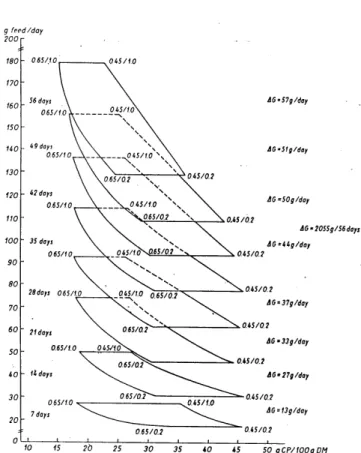
, where dCP = digestibility of the dietary crude proteinFigure 1 shows the amount of compound feed dry matter that can be given in order to attain a body weight gain from the first to the eighth week depending on the CP percentage in the diet (dCP was considered to be 0.8) taking into account the maximal rate of protein retention and the limits of the ratio between fat and protein retention (). We notice that the daily body weight can be obtained for ex. in the 28th day only be giving a compound feed in amounts ranging within wider limits, from 62 to 93g but with protein concentration between 45 to 18g/100 g DM, a
ratio between 0.2 to 1.0 and a biological value
between 0.45 to 0.65. Figure 1. Calculation of poultry performance using the model
19 As a conclusion, the model allows us to calculate the energy and protein requirement starting from easily determined input variables (weight gain, age in days). At a given age (body weight) and at a determined gain there is a variable requirement of feed.
References
1. Burlacu Gh., Burlacu R., Columbeanu I. and Alexandru G., Bull. ASAS, 1988, 17, 245-261.
2. Burlacu Gh., Burlacu R., Columbeanu I. and Alexandru G., Arch. Anim. Nutr. Berlin, 1990, 40, 5/6, 409-422.
3. Burlacu Gh., Pârvu Monica, Cavache A., Burlacu R. and Olteanu Margareta Arch. Anim. Nutr. Berlin, 1995, 46
4. Burlacu R. and Mirică Şt. Some optional control problems for metabolic processes of ruminant animals. in press.
5. France J. and J.H.M. Thornley, Mathematical Models in Agriculture, Ed. Butterworths, London, 1986.
- Kyriazakis J. and Emmans G.C., British J. Nutr., 1992, 68, 615.