Krzewski Szymon, Baranowski Mateusz, Zubrzycki Robert, Stachurski Maciej, Borowicz Janusz. Correlation between temporomandibular joint dysfunction and Eichner classification. Journal of Education, Health and Sport. 2020;10(4):155-162. eISSN 2391-8306. DOIhttp://dx.doi.org/10.12775/JEHS.2020.10.04.017
https://apcz.umk.pl/czasopisma/index.php/JEHS/article/view/JEHS.2020.10.04.017 https://zenodo.org/record/3760173
The journal has had 5 points in Ministry of Science and Higher Education parametric evaluation. § 8. 2) and § 12. 1. 2) 22.02.2019. © The Authors 2020;
This article is published with open access at Licensee Open Journal Systems of Nicolaus Copernicus University in Torun, Poland
Open Access. This article is distributed under the terms of the Creative Commons Attribution Noncommercial License which permits any noncommercial use, distribution, and reproduction in any medium, provided the original author (s) and source are credited. This is an open access article licensed under the terms of the Creative Commons Attribution Non commercial license Share alike.
(http://creativecommons.org/licenses/by-nc-sa/4.0/) which permits unrestricted, non commercial use, distribution and reproduction in any medium, provided the work is properly cited. The authors declare that there is no conflict of interests regarding the publication of this paper.
Received: 20.03.2020. Revised: 25.03.2020. Accepted: 22.04.2020.
Correlation between temporomandibular
joint dysfunction and Eichner classification
Szymon Krzewski, Mateusz Baranowski, Robert Zubrzycki, Maciej Stachurski, Janusz Borowicz
Szymon Krzewski1 - https://orcid.org/0000-0003-2339-6741 [email protected] Mateusz Baranowski2* - https://orcid.org/0000-0001-7266-738X
Robert Zubrzycki3 - https://orcid.org/0000-0001-6932-6381 [email protected]
Maciej Stachurski4 - https://orcid.org/0000-0001-6872-0694 [email protected]
Janusz Borowicz5 - https://orcid.org/0000-0002-6567-2604 [email protected]
*Corresponding Author:
Mateusz Baranowski - PhD student, dentist [email protected] Chair and Department of Periodontology Medical University of Lublin, Poland
Abstract characters:2920 Abstract word count: 456 Word count: 1704
Number of Tables: 1 Number of Figures: 2
Key words: temporomandibular joint, dysfunction, Eichner classification, prosthetics, dentures.
Abstract Introduction:
The Dental Prosthetics Department's most common patients are elderly who have lost their teeth. Dental deficiencies not only impair the functions of the stomatognathic system but can also be the cause of temporomandibular disorders (TMD). Deficiencies in the lateral sections lead to a decrease in the occlusion height in patients, which negatively affects the aesthetics of the face by shortening the lower floor and overloading the remaining teeth, eventually leading to their pathological wear. Loss of occlusion height changes the spatial arrangement of the lower jaw to the upper jaw, which can lead to changes in the temporomandibular joint. The loss of a tooth or group of teeth is an indication for proper prosthetic treatment. The dentist should be able to take into account, evaluate and, if necessary, cure TMD, but this is not a common skill among dentists. Such treatment requires an appropriate comprehensive approach. There are currently no standards for such treatment. We presented one of the methods as part of our study.
Purpose of work:
The aim of the study was to check the correlation between the occurrence of temporomandibular disorders and missing teeth and used prosthetic restorations.
Material and methods:
Medical history records of 58 patients under the care of the Department of Dental Prosthetics at Medical University of Lublin were analyzed. Factors such as age and gender, occlusion height, distribution of missing teeth according to the Eichner classification and symptoms of temporomandibular joint disorders, i.e. crackling, pain, limited and excessive abduction of the
jaw were checked.
Results:
The study group consisted of 38 women and 20 men. The average age of all patients was 69.6 years; - average for men - 70.45 years, women 68.16 years. The oldest patient was an 88-year-old man, and the youngest was a 43-year-88-year-old woman. 31% of patients were toothless. 25.9% of patients had pain within the stomatognathic system, of which 86.7% were women and 13.3% men. Relaxation splint was made in 24.1% of patients.
Summary:
The study showed that the ailments associated with the stomatognathic system are correlated with a reduction in occlusion height. Larger dental deficits are more common in older people. Pain symptoms are the most common cause of making relaxation splints. Women more often than men complain of pain. The correct treatment scheme for patients with missing teeth and long-term loss of support zones is staggered treatment - two-stage. The first stage of treatment is to restore the correct occlusion height by using the occlusal splint. Then, after the adaptation period, there is a transition to the second stage of treatment - the use of proper prosthetic restoration maintaining the correct height of occlusion.
Article
Temporomandibular joint temporomandibular joint (TMJ) is one of the most complex joints in the human body (1). Its complexity results, among other things, from the combination of the right and left joint with one jawbone, two joint levels and the presence of a removable disc. In addition, TMJ is a physiological one part with the teeth, muscles and nerves of the cranium forming a stomatognathic system. The complicated arrangement of these structures means that temporomandibular disorders may appear. Symptoms on the part of TMJ indicating Temporomandibular disorder (TMD) may be general pain, limited mouth opening, clatter, headache and blockage of the articular disc. (2–6) The etiology of TMD is multifactorial and it’s very controversial issue in clinical dentistry.(7–9) Some authors classify TMD in a broader perspective, including in addition to typical symptoms such as osteoarthritis and muscle pain.(10,11) Problems with TMJ affect an average of 10 to 15% of adults, occurring more often among women especially in the 20-40 age group.(4)
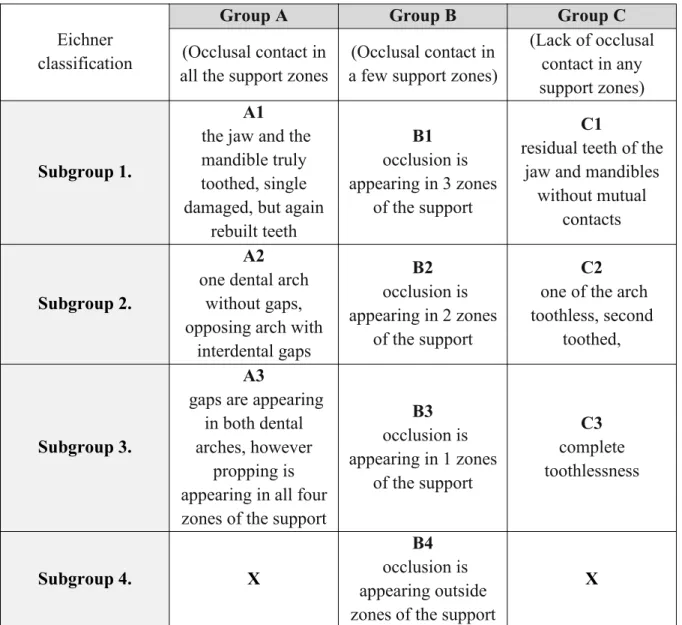
In order to assess the extent of missing teeth and loss of occlusal support zones, the Eichner classification was used. We can distinguish there 3 groups marked with letters “A”, “B” and “C”,
Eichner classification
Group A Group B Group C
(Occlusal contact in
all the support zones a few support zones)(Occlusal contact in
(Lack of occlusal contact in any support zones)
Subgroup 1.
A1
the jaw and the mandible truly toothed, single damaged, but again
rebuilt teeth
B1
occlusion is appearing in 3 zones
of the support
C1
residual teeth of the jaw and mandibles
without mutual contacts
Subgroup 2.
A2
one dental arch without gaps, opposing arch with
interdental gaps
B2
occlusion is appearing in 2 zones
of the support
C2
one of the arch toothless, second
toothed,
Subgroup 3.
A3
gaps are appearing in both dental arches, however
propping is appearing in all four zones of the support
B3
occlusion is appearing in 1 zones
of the support
C3
complete toothlessness
Subgroup 4. X
B4
occlusion is appearing outside zones of the support
X
Tab. nr.1 – classification of Eichner, Protetyka Stomatologicznaprof. E. Spiechowicz PZWL Warszawa 2013, wyd.6.
In the tests, the missing teeth were distributed as follows:
Ryc.1 Distribution of individual types of missing teeth according to the Eichner classification The highest number of completely edentulous patients - C3 - was recorded, which constituted as much as 31% of all examined patients. The second most numerous groups were patients with A3 deficiencies, who constituted 27.6% of the respondents. In the literature, research on TMD in people using prosthetic restorations is not a frequently discussed topic.(10)
Pain associated with TMD cannot be characterized unambiguously. May produce similar symptoms as neurogenic, psychogenic, visceral, skin, tooth or periodontal pain. (9) The Department of Dental Prosthetics research showed that 25.9% of patients had pain within the stomatognathic system, of which 86.7% affected women and 13.3% men. Various epidemiological studies have shown that at least 33% of the general population may experience TMJ pain symptoms. (14) Thomas List in the review of research on pain confirms the more frequent occurrence of this ailment in women. (4). There is no clear evidence in the literature that all TMD sufferers should be treated with prosthetic restorations. Performed prosthetic treatment often leads to pain relief and normalization of TMJ function(13). In the study, none of the people using prosthetic restorations reported symptoms from TMJ. Pain only accompanied people who did not use any prostheses. All people with pain were qualified for the treatment.
Among TMD patients, blockage of the disc in TMJ is not a rare symptom. (13,15) Displacement of the disc is observed in 30% of healthy adults and 10% of teenagers.(4) Clicking of the disc often accompanies TMD, and the sound itself changes over time. (13) Both in the Department of Dental Prosthetics, as well as in the research of other authors, this problem was more common in women (10,15,16)
Cracks in the temporomandibular joint were found in 5.2% of patients, of which: - 66.7% had A3 deficiencies according to Eichner
- 33% had type B1 deficiencies Eichner
Ryc.2 Dental splint and crackles correlation
mandibular abduction, and one of them reported an episode of blockage of the disc in the temporomandibular joint.
In the conducted study, among patients with prosthetic treatment recommendations, in 30% of people, it was first decided to perform non-invasive treatment - relaxation splint, 85.7% of them reported pain before treatment. The use of treatment including relaxation splint, on Department of Dental Prosthetics, has significantly led to a reduction in pain over time. Is this treatment the most appropriate? Especially, including the fact, relaxation splints are not used to fulfill missing teeth? It seems not. In the extensive study leaded by the British National Institute for Health Research there was compared the effectiveness of the use of relaxation splints, compared to the effectiveness of non-invasive muscle relaxation exercises combined with patient education and elements of psychotherapy. In this study, relaxation splints were the optimal solution only in 29% of cases.
Conclusion:
Relaxation splints are often overused, although they can be helpful, especially when the alternative is expensive occlusion remodeling. However, they do not show any advantage over relaxation methods using physiotherapy and psychology. In the case of patients completely toothed or with slight dental deficiencies, treatment should be started non-invasively (education, relaxation, physiotherapy), then, optionally use splints, and then as a last resort movable or, finally, permanent prosthetic restorations. This is the right approach that will improve chewing function and aesthetics, and may help to reduce TMD by minimizing potential disadvantage (17)
Bibliography:
1. Zhou ZH, Chen XZ, Chen XW, Wang YX, Zhang SY, Sun SF, i in. Improved anchoring nails: design and analysis of resistance ability: Tensile test and finite element analysis (FEA) of improved anchoring nails used in temporomandibular joint (TMJ) disc anchor. BMC Oral Health. grudzień 2018;18(1):150.
2. Ferreira MC, Porto de Toledo I, Dutra KL, Stefani FM, Porporatti AL, Flores-Mir C, i in. Association between chewing dysfunctions and temporomandibular disorders: A systematic review. J Oral Rehabil. październik 2018;45(10):819–35.
3. Al-Moraissi EA, Wolford LM, Perez D, Laskin DM, Ellis E. Does Orthognathic Surgery Cause or Cure Temporomandibular Disorders? A Systematic Review and Meta-Analysis. J Oral Maxillofac Surg. wrzesień 2017;75(9):1835–47.
4. List T, Jensen RH. Temporomandibular disorders: Old ideas and new concepts. Cephalalgia. czerwiec 2017;37(7):692–704.
5. Clark GT, Tsukiyama Y, Baba K, Watanabe T. Sixty-eight years of experimental occlusal interference studies: What have we learned? J Prosthet Dent. grudzień 1999;82(6):704–13.
6. Todic J, Martinovic B, Pavlovic J, Tabakovic S, Staletovic M. Assessment of the impact of temporomandibular disorders on maximum bite force. Biomed Pap. 23 wrzesień 2019;163(3):274–8. 7. Sousa ST de, Mello VVC de, Magalhães BG, Morais MPL de A, Vasconcelos MMVB, Junior A de FC, i in. The role of occlusal factors on the occurrence of temporomandibular disorders. CRANIO®. lipiec 2015;33(3):211–6.
8. Boever JAD, Carlsson GE, Klineberg IJ. Need for occlusal therapy and prosthodontic treatment in the management of temporomandibular disorders. Part I. Occlusal interferences and occlusal adjustment. J Oral Rehabil. 2000;27(5):367–79.
9. Alzarea BK. Temporomandibular Disorders (TMD) in Edentulous Patients: A Review and Proposed Classification (Dr. Bader’s Classification). J Clin Diagn Res JCDR. kwiecień 2015;9(4):ZE06–9.
10. Sipilä K, Näpänkangas R, Könönen M, Alanen P, Suominen AL. The role of dental loss and denture status on clinical signs of temporomandibular disorders. J Oral Rehabil. styczeń 2013;40(1):15–23.
11. Edwin A, Singh AM, Joseph AM. 2. TMD diagnosis and management – “a nightmare” or “is it really so”. :1.
12. Manfredini D, Poggio CE. Prosthodontic planning in patients with temporomandibular disorders and/or bruxism: A systematic review. J Prosthet Dent. maj 2017;117(5):606–13.
13. De Boever JA, Carlsson GE, Klineberg IJ. Need for occlusal therapy and prosthodontic treatment in the management of temporomandibular disorders. J Oral Rehabil. sierpień 2000;27(8):647–59.
14. Carrara SV, Conti PCR, Barbosa JS. Statement of the 1st Consensus on Temporomandibular Disorders and Orofacial Pain. :7.
15. Bueno CH, Pereira DD, Pattussi MP, Grossi PK, Grossi ML. Gender differences in temporomandibular disorders in adult populational studies: A systematic review and meta-analysis. J Oral Rehabil. wrzesień 2018;45(9):720–9.