VOLUME 18 ISSUE 2 (2020), Page 1 – 11
ASSESSMENT OF THE HISTORIC INTERIOR OF CARCOSA HERITAGE BUILDING, KUALA LUMPUR FOR BUILDING
CONSERVATION
Siti Norlizaiha Harun 1, Norashikin Abdul Karim 2,
Afzanizam Muhammad 3 & Shaari Mohd Sood 4
123Faculty of Architecture, Planning & Surveying
UNIVERSITI TEKNOLOGI MARA
4Cluster of Heritage & Civilization
ISLAMIC UNIVERSITY OF MALAYSIA
Abstract
An assessment of historic buildings, its history and conditions are essential in the study of buildings conservation. Other than architecture history and building defects, the interior scheme of building, the decorations, the building's form and space interior layout are also some significant aspects that need to be analysed in building conservation study. In current practice, the change of use of any heritage building will need approval from the National Heritage Department (NHD). The report of history and building condition is the one of the main documents needed to be submitted for the approval process. The main objective of this research is to analyse the buildings based on the original materials, form, function, decoration, and layout. The methods used for this research include in-depth building investigation, analysis, and interpretation; backed up by measured drawing and historical assessment. The analysis involved the mapping of original and existing spaces and then analysed the unique characters of the interior using a series of photos categorised based on time or dates of the photos. From this analysis, the authenticity of the space can be identified and recommendations on better usage of spaces of these historic buildings can be proposed to the National Heritage Department.
INTRODUCTION
In Malaysia, the conservation procedure of historic buildings follows the guidelines provided by the National Heritage Department Malaysia (NHDM). The Historic Building Conservation Guideline (National Heritage Department Malaysia [NHDM], 2017) has outlined the process and suitable methods to investigate historic buildings which are divided into three sections, namely architectural research, documentation on measured drawings, and dilapidation survey with laboratory analysis. Before starting any exploration of a historic site, the purpose of investigation needs to be determined. McDonalds (1994) in National Park Services (NPS) Preservation Brief stated that both the purpose and scope of investigation need to be determined before formulating a particular approach. For example, investigation strictly for research purposes could produce information for an architectural survey or a historic designation application at the local, state or national level. The United Nations Educational, Scientific and Cultural Organization (UNESCO) has established guidance and standard to evaluate the authenticity and integrity of a heritage building (Nara Document on Authenticity, 1994). The authenticity and historic integrity in the context of the heritage building is linked to the uniqueness of the building characteristics and the value of the historic places (Brida, Disegna & Scuderi, 2012). In other scenarios, most buildings were built with a specific reason and purpose, and the history of the buildings started when the building started to be constructed. Because of that, the object of conservation, especially a historic building, must be thoroughly researched, and it must be regarded as an object created in space and history (Weaver, 1997). Moreover, the condition, integrity and authenticity of the story line or the history of the building need to be validated (Pearson & Marshall, 2011). In this research, since Carcosa has been vacated for a while, building investigations were conducted to determine the magnitude of the damages and renovation works that have been made. The results of the study were intended to be used to present suitable proposals for future use of similar historic buildings to the relevant authorities.
HISTORICAL BACKGROUND OF CARCOSA
study, and seven bedrooms, each room located along a long veranda. The outbuildings included stables and several tennis courts. The estimated cost of the palatial building, built in the eclectic fusion of Neo-Gothic and Tudor Revival styles, was about 25,000 pounds (Seng, 2018). Carcosa began life as home to the Resident-General in 1898. After Swettenham, Carcosa was occupied by British high officials and as a temporary residence for the Governor of the Straits Settlements, who resided in Singapore. Throughout the Second World War, the Japanese army used the building as the head station for their officials. By 1946, Carcosa served its original function as British high-officer official residence. On January 21, 1948, the building was used as the venue to sign the document of the Federation of Malaya between the Malay Rulers and the British Empire. On September 12, 1956, the Chief Minister of Malaya, who later became Prime Minister of Malaysia, Tunku Abdul Rahman, handed Carcosa to the British government as a gift and the building has been used as the British High Commissioner building. On 5th August 1957, the building was used again as the venue to sign the document of the Independence Malaysia. In early 1987, the Malaysia government decided to convert the building into a hotel. The colonial architecture and interior designs complemented the colonial-themed hotel service perfectly. In its inaugural year as a hotel, Carcosa Seri Negara served as the temporary official residence for Queen Elizabeth II and Prince Philip during the 1989 Kuala Lumpur Commonwealth Heads of Government Meeting. The Carcosa building has been gazetted as a National Heritage Building, under the National Heritage Act 2005 (Act 645) on July 6, 2011. The building is not only historically significant but also possesses impressive colonial architectural values.
ARCHITECTURE STYLE
One of the unique architectures brought by the British to Malaya is the Tudor architecture. The Tudor era emerged in England around the 15th and 16th centuries
Figure 1: Carcosa in year 1900 (left) and the building in 2018 (right), still remain the original form and design, however the decorative timber at front gable has been painted
and covered the Tudor features.
Source: Cheah (2008); Harun (2018)
HISTORIC BUILDING CONSERVATION
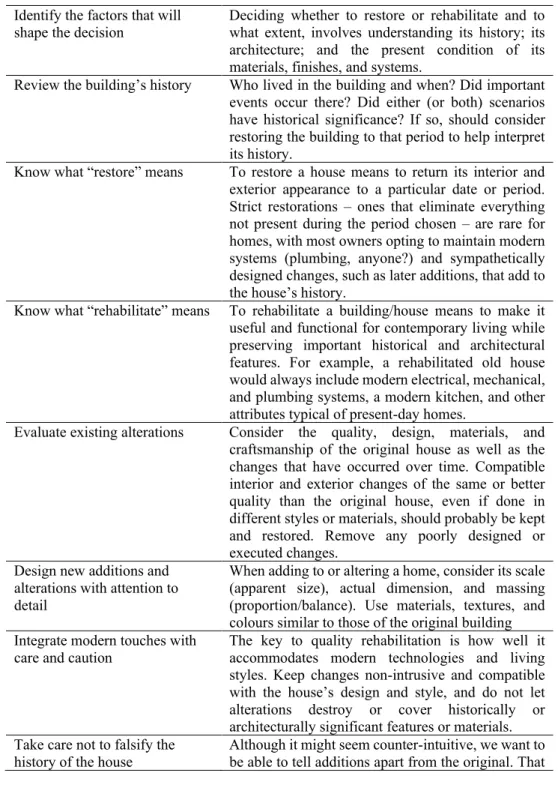
Table 1: The Guidance for Restoration of Historic Interior Identify the factors that will
shape the decision
Deciding whether to restore or rehabilitate and to what extent, involves understanding its history; its architecture; and the present condition of its materials, finishes, and systems.
Review the building’s history Who lived in the building and when? Did important events occur there? Did either (or both) scenarios have historical significance? If so, should consider restoring the building to that period to help interpret its history.
Know what “restore” means To restore a house means to return its interior and exterior appearance to a particular date or period. Strict restorations – ones that eliminate everything not present during the period chosen – are rare for homes, with most owners opting to maintain modern systems (plumbing, anyone?) and sympathetically designed changes, such as later additions, that add to the house’s history.
Know what “rehabilitate” means To rehabilitate a building/house means to make it useful and functional for contemporary living while preserving important historical and architectural features. For example, a rehabilitated old house would always include modern electrical, mechanical, and plumbing systems, a modern kitchen, and other attributes typical of present-day homes.
Evaluate existing alterations Consider the quality, design, materials, and craftsmanship of the original house as well as the changes that have occurred over time. Compatible interior and exterior changes of the same or better quality than the original house, even if done in different styles or materials, should probably be kept and restored. Remove any poorly designed or executed changes.
Design new additions and alterations with attention to detail
When adding to or altering a home, consider its scale (apparent size), actual dimension, and massing (proportion/balance). Use materials, textures, and colours similar to those of the original building Integrate modern touches with
care and caution The key to quality rehabilitation is how well it accommodates modern technologies and living styles. Keep changes non-intrusive and compatible with the house’s design and style, and do not let alterations destroy or cover historically or architecturally significant features or materials. Take care not to falsify the
way, the house’s history is visible and transparent. Also be careful not to design additions that make the house appear to date from an earlier or later period, or alter the house’s details to the extent that suggest a different architectural period.
Restoring historic interior is also interpreted as restoring the historic character of interior building property, including detailing of interior materials, mouldings and stairways, room configuration and spatial relationships, as well as structural and mechanical systems (Morton & Hume, 1983; Morton & Hume, 1997). Moreover, restoring historic interior schemes for the purposes of preserving interior features which are considered as architectural elements, are essential to the characteristic of the designated landmark (Alliance Greater Philadelphia, 2007). Therefore, to achieve this objective, the authenticity and historic integrity criteria should be followed especially in terms of its location; setting; design; material; workmanship; feeling; and association (Jokilehto, 2006; Alho et al., 2010). In terms of the authenticity and historic integrity of Carcosa building, it is confirmed that the building has undergone several renovations works due to its functional change. However, the association and location of the renovations in the interior's space can still be identified.
HISTORIC INTERIOR INVESTIGATION OF CARCOSA BUILDING
Thus, secondary spaces are usually the most appropriate places to be altered, which may be necessary for a historic building, such as those that are required to meet specific codes or to install mechanical equipment. Based on this guidance, the changes in the interior layout of the Carcosa mansion can be acceptable since the changes still preserve the exterior appearance of the mansion.
CHANGES OF SPACE AND INTERIOR LAYOUT
The Carcosa mansion started its function as a hotel in 1989 and ended operation in 2016. Marketed as a luxurious heritage boutique hotel, much of the mansion’s colonial architecture and interior were preserved, carefully adapted and complemented with colonial themed-hotel service. The original space and layout were designed as a mansion and British residence office. The 2-storey mansion has more than eight bedrooms, including the master bedroom and guest rooms, a spacious living room surrounded by a corridor terrace or veranda at the ground and first floor, and eleven bathrooms.
Figure 3: Corridor terrace (A) has been closed for part of expansion of hotel suite room. New toilets and refreshment room (B) has been added behind the main staircase.
Source: Harun (2018)
Figure 4: Corridor and terrace at first floor (A and B) closed for new rooms and toilets. The main hall (C) been renovated as hotel suite room.
Source: Harun (2018)
INTERIOR FEATURES AND FINISHES
Figure 5: Carcosa during British Resident. The historical photos captured this historic moment of the mansion; (a) The spacious rooms were lavishly furnished, (b) The grand
staircase, and (c) Carcosa’s spacious porch.
Source: Seng (2018)
Figure 6: The existing timber staircase. All components, including the railing, balustrade, and decorative elements had been painted in cream thick paint.
Sources: Author (2018)
FINDING AND CONCLUSION
used by the future generation. In conclusion, this research can be a basic guidance in preserving historic interior for heritage building, especially when applying planning permission for conservation and adaptive re -use.
ACKNOWLEDGEMENTS
The authors wish to express a gratitude to the National Heritage Department for giving permission to access Carcosa Seri Negara as a case study for this research.
REFERENCES
Alliance Greater Philadelphia. (2007). Protecting Historic Interiors: A Survey of
Preservation Practices and Their Implications for Philadelphia. Retrieved from
http://www.preservationalliance.com/publications/InteriorsFINAL.pdf
Alho, C., Morais, A., Mendes, J., & Galvao, A. (2010). Authenticity Criteria in Conservation of Historic Buildings. Cib 2010 World Conference, Building a Better
World, 188–198.
Bahauddin, A., Mohamed, B., Mat Som, A. P., Irwana, S, & Othman, A. G. (2010). The
British Colonial architectural heritage of Fraser's Hill and Cameron Highlands,
Malaysia. 3rdAsia-Euro Tourism, Hospitality and Gastronomy Conference - Transformation and Modernisation in Tourism, Hospitality and Gastronomy. Subang Jaya, Kuala Lumpur
Barber, A. (2007). Malaysian moments: A pictorial retrospective (p. 60). Kuala Lumpur: AB & A Publisher.
Brida, J. G., Disegna, M., & Scuderi, R. (2012). The visitors’ perception of authenticity at the museums: Archaeology versus modern art. Current Issues in Tourism. 10.1080/13683500.2012.742042.
Cheah, J. S. (2008). Malaya: 500 early postcards. Singapore: Editions Didier Millet Pte Ltd.
Grimmer, A. E. (2017). The Secretary of the Interior’s Standards for the treatment of historic properties with guideline for preserving, rehabilitating, restoring and reconstructing historic building. Washington, DC: U.S. Department of the Interior, National Parks Services, USA.
Harun, S. N. (2011a). Heritage building conservation in Malaysia. Retrieved from http://kota-city.blogspot.com/2011/04/heritage-building-conservation-in.html Harun, S. N. (2011b).Heritage building conservation practice in Malaysia: Experience
and challenges. Procedia Engineering, 20, 41–53. https://doi.org/10.1016/j.proeng.2011.11.137
Jokilehto, J. (2007). An international perspective to conservation education. Built
Environment, 33(3), 275–286.
Jokilehto, J. (2011). ICCROM_The Conservation of Cultural Heritage_ A History of the Organization’s first 50 years 1959-2009.
McDonald, T. C. (1994). Understanding old buildings (The process of architectural
investigation) – Preservation brief 35. Heritage Preservation Services, National
Park Service. Retrieved from http:///www2.cr.nps.gov/tps/briefs/brief35.htm Morton, B., & Hume, G. (1983). Standards for Rehabilitation and Guidelines for
Morton, B., Hume, G., Weeks, K. D., & Jandl, H. W. (1997). The Secretary of the Interior’s Standards for Rehabilitation & Illustrated Guidelines for Rehabilitating Historic Buildings. U.S. Department of the Interior National Park Service. Washington, D.C.
Nara Document on Authenticity. (1994). Nara Conference on Authenticity in Relation to
the World Heritage Convention. Nara, Japan.
National Heritage Department Malaysia (2017). Historic Building Conservation Guideline.
Pearson, M., & Marshall, D. (2011). Study of condition and integrity of historic places – Report prepared for the Australian Government Department of Sustainability, Environment, Water, Population and Communities on behalf of the State of the Environment 2011 Committee. Canberra: DSEWPaC.
Rocchi, J. (2016). 10 tips: Restoring vs. rehabilitation your historic house. Retrieved from https://savingplaces.org/stories/10-on-tuesday-restore-vs-rehabilitate-which-is-right-for-your-historic-house#.XG4ps-GeXD0
Seng, A. T. L. (2018). Rising from the ashes – the Carcosa story. New Straits Times. Retrieved from https://www.nst.com.my/lifestyle/sunday-vibes/2018/11/435673/rising-ashes-%E2%80%93-carcosa-story
Tudor revival architecture. In Wikipedia (2019). Retrieved February 20, 2019 from https://en.wikipedia.org/wiki/Tudor_Revival_architecture
Warren, W., & Gocher, J. (2007). Asia’s legendary hotels: The romance of travel (p. 164). Singapore: Periplus Editions
Weaver, M. E. (1997). Conserving buildings: A manual of techniques and material. New York: Chichester Wiley.