VOLUME 16 ISSUE 3 (2018) Page 274 – 284
THE DEFENSIBLE SPACE CONCEPT IN NEIGHBOURHOOD PARK CASE STUDY: TAMAN TASIK PUCHONG PERDANA, SELANGOR,
MALAYSIA
Marlyana Azyyati Marzukhi1, Mohd Aizzat Afiq2, Oliver Ling Hoon Leh3, & Yusfida Ayu Abdullah4
1,2,3,4Faculty of Architecture, Planning and Surveying
UNIVERSITI TEKNOLOGI MARA, MALAYSIA
Abstract
Open space can contribute to the overall wellbeing of life by providing social and recreational focal points. However, open space may also be associated with undesirable qualities of a place such as crime activities that affect negatively its quality and the surrounding. Thus, to create a safe and comfort open space area, the defensible space concept is seen as an important approach to deter crime from occurring and to sustain the safety environment. Therefore, this research objective is to investigate whether the elements of the defensible space concept; territoriality, surveillance, and image, may be used in the planning of neighbourhood park. A study was carried out at Taman Tasik Puchong Perdana, Selangor by using a questionnaire survey to collect information from the visitors. The findings show that the defensible space concept with all the three elements was not implemented, which further may lead to the crime activities in the neighborhood park.
INTRODUCTION
Open space is an important element that needs to be provided at residential, commercial and industrial area development. It can contribute to the ecological balance of physical development and function as suitable place for social interaction and communication. As such, the provision of open space needs proper planning either from physical or social aspects. According to Zainudin and Abdul Malek (2010), safe environment is a condition which is free from all of the physical, social and mental threats. In order to prevent crime, it is important to design a space that is more easily observed through the placement of physical elements to maximize visibility. The environment is one of the factors influencing crime and the level of fear of crime in society (Sakip, Johari, & Salleh, 2012).
During the last few decades, crime incidences in open space and public spaces have been rapidly increasing (Iqbal, 2015). The absence of proper approach used to ensure the planning of open space and neighbourhood park can prevent crime resulted in the opportunity for crime to take place in neighbourhood park (Anastasia & John, 2007; Liebermann & Kruger, 2004). Hence, the purpose of this research is to examine the implementation of the defensible space concept in neighbourhood park.
LITERATURE REVIEW
The defensible space concept was introduced by Oscar Newman in 1972. This concept is one of the approaches to the prevention of crime. According to Newman (1972), defensible space is defined as “....model for residential environments which inhabits crime by creating the physical expression of a social fabric which defends itself....an environment in which latent territoriality and sense of community in the inhabitants can be translated into responsibility for ensuring a safe, productive and well-maintained living space”.
The physical design usually provides the potential for community care and social control to prevent crime. Newman's concept of space defence was explained on buildings, roads and the environment in residential area. Although the concept was not specifically targeted at neighbourhood park, its elements provide the key point of a space defence that potentially makes it less vulnerable to crime. In fact, this concept can be adapted into the design scheme of open space and neighbourhood park, and made as one of the key elements in planning residential areas and its layout.
improve the condition of the environment to promote safety, comfort, satisfaction and productivity of community across a variety of contexts.
This approach aims to prevent criminal activities through the creation of social value which could keep the community from the threat of criminal activity in the neighbourhood park. It is important to plan and develop a conducive recreational area, which can create a sense of belonging to the community. Further, it will lead the local people to appreciate, value and ensure their neighbourhood park is safe and well managed to give comfort and guarantees the safety of the users. In this sense, the planning of the residential area (and neighbourhood park) is more liveable and can be managed by the residents within their locality (Mohit & Hannan, 2012).
The concept of defensible space does not solely emphasise on physical planning approach in preventing crime, but also including certain technical methods and mechanisms particularly when designing the space’s layout. It also involves the social aspects, where it needs the participation and awareness among the community in eradicating crime.
Elements of Defensible Space Concept
According to Newman (1972), the three elements that create the defensible space are the territoriality, surveillance, and image.
Territoriality
Territorial include a group of individuals and other territorial units. This group will form its surveillance to monitor their home environment. Each unit who is in the territory has territorial characteristics. A set that includes several territorial known as a territorial complex. To determine the territorial shape of a region, individuals who reside in these areas must be observed. This is a situation that formal (professional) and informal (social). This space refers to ownership clearly and evidently depends on other factors such as appearance and size, shape and size, the number of units, the breadth, the types of boundaries and a clear distinction and detail.
which is a space defence as a transition zone between public space, semi-public, semi-private and private. The relationship with the territorial concept living space must be able to differentiate between these spaces to enhance the sense of security and can help to reduce the occurrence of crime.
Surveillance
Surveillance is an element that is closely related to elements of the territory in which breadth of a territorial community area will affect the environmental aspects of surveillance in those communities. It emphasizes the area that is design to allow the people within the area to observe the activities in the area. The element of surveillance makes the people engage in unnoticed activities. Some of the elements that can create surveillance in the area are lighting and benches. Lighting is important to ensure the area can be seen and not dark so that people can supervise the area and avoid unnoticed activities. If an area is poorly maintained and unsupervised, it will create ‘sign of crime’ (Melde & Esbensen, 2009).
Image
The image refers to the location of the area that does not appear vulnerable to crime and not isolated from the surrounding view. The image of the area can attract people to visit the area. Thus, it can elude from the existence of the defenceless area which may lead to the crime activities. Every planning of neighbourhood park should emphasize and implement the safety elements to ensure the safeness of the public. The “Defensible Space” concept is important in the implementation of safety elements in the recreation area. The evaluation of safety level in the recreation area will be carried out in this study. This concept is crucial in ensuring the security elements be applied in every planning of recreation area to provide comfort and safety to the users. The implementation of security elements are also vital to reduce the crime activities.
RESEARCH METHODOLOGY
Study Area
This study is focused on the implementation of the Defensible Space Concept in neighbourhood park, which is the Taman Tasik Puchong Perdana, Puchong, Selangor. The total area of Taman Tasik Puchong Perdana is 7.70 acres, which includes 4.51 acres of lake area. Based on the planning standards published by the Federal Department of Town and Country Planning Peninsular Malaysia (2013), the park can be classified as a neighbourhood park.
to Lebuhraya Damansara Puchong (LDP). Located next to the park is a primary school (Sekolah Kebangsaan Puchong Indah) and a mosque (Masjid As-Salam), and a food court under the management of MPSJ (Figure 1).
Figure 1: Taman Tasik Puchong Perdana and its surrounding development
Questionnaire Survey and Sampling of Respondents
Table 1: Background of respondents
Variables Percentage (%)
Gender Male Female
58.00 42.00 Ethnicity
Malay Indian Chinese Others
85.70 5.90 8.40 0.00 Age
< 20 years old 20-29 years old 30-39 years old 40-49 years old > 59 years old
47.10 27.70 8.40 5.90 10.90
Method of Analysis
The data were analysed using frequency, chi-square and correlation tests as provided in the IBM SPSS software. The purpose of the analysis is to identify the safety level, sense of security among the respondents and the implementation of defensible space concept in Taman Tasik Puchong Perdana.
RESULTS AND FINDINGS
Territoriality
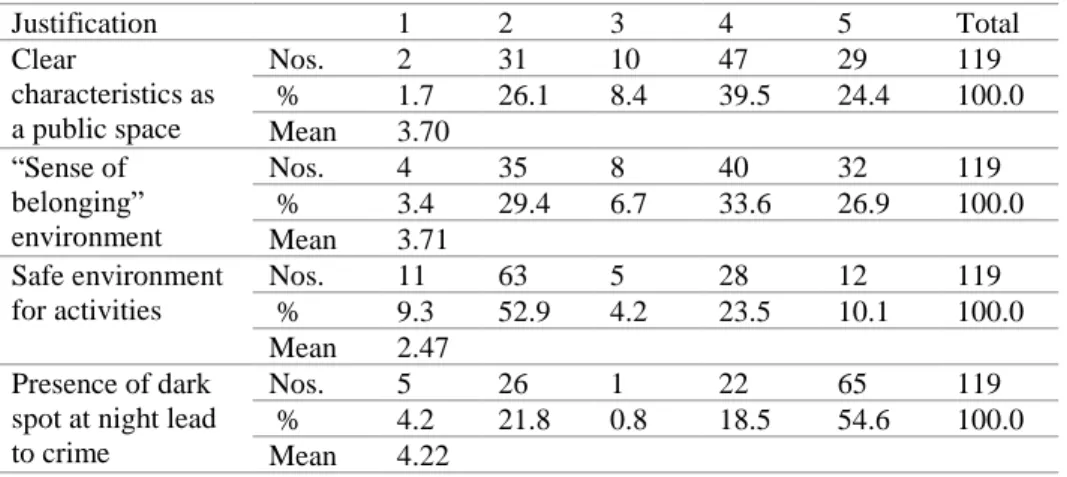
Based on the results shown in Table 2, 76 respondents agreed with the opinion on the characteristic of the whole of the study area as a public space with the percentage of 63.9% and the mean score of 3.70 – agreed. Accordingly, the study area is a neighbourhood park that is used by the community to do recreational activities. This showed the function of the study area as a public space for the community. Moreover, 60.5% of respondents agreed that the neighbourhood park has created a sense of belonging environment (mean score 3.71). This is because most of the visitors felt that they have rights to do any recreation activities in the park. It also allows the visitors to have interaction among themselves without any interruption. Interaction among the neighbours is important to strengthen the relationship among the community.
spots particularly due to lack of lighting at the study area at night will lead to crime.
Table 2: The respondents’ opinion on territoriality element
Justification 1 2 3 4 5 Total
Clear
characteristics as a public space
Nos. 2 31 10 47 29 119
% 1.7 26.1 8.4 39.5 24.4 100.0
Mean 3.70
“Sense of belonging” environment
Nos. 4 35 8 40 32 119
% 3.4 29.4 6.7 33.6 26.9 100.0
Mean 3.71
Safe environment for activities
Nos. 11 63 5 28 12 119
% 9.3 52.9 4.2 23.5 10.1 100.0
Mean 2.47
Presence of dark spot at night lead to crime
Nos. 5 26 1 22 65 119
% 4.2 21.8 0.8 18.5 54.6 100.0
Mean 4.22
The neighbourhood park is a secondary territorial type which the area is less important than the primary but still have a moderating influence on the residents. The territoriality is important to show the boundary between the recreation area and non-recreation area. However, there is no provision of fence, bollard and landscape around the neighbourhood park (Photo 1 and 2). The provision of fence, bollard and landscape is important to ensure the one-way in and out in order to increase the safety level of visitors in the recreation area.
Photo 1: No barrier around the study area
Photo 2: No barrier between the park and motorized lane
Surveillance
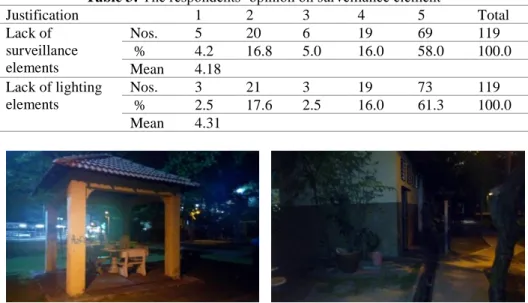
Surveillance is also the key element of defensible space concept which can help in reducing crime. Based on the questionnaire survey, 74% of the respondents, with mean score of 4.18 (Table 3), agreed that surveillance elements such as security patrol and CCTV are lacking in the study area. At the same time, 77.3% of respondents, with mean score 4.31, agreed that certain part of the neighbourhood park also lack lighting at night (Photos 3 and 4) and has caused visitors to feel unsafe and insecure.
Table 3: The respondents’ opinion on surveillance element
Justification 1 2 3 4 5 Total
Lack of surveillance elements
Nos. 5 20 6 19 69 119
% 4.2 16.8 5.0 16.0 58.0 100.0
Mean 4.18
Lack of lighting elements
Nos. 3 21 3 19 73 119
% 2.5 17.6 2.5 16.0 61.3 100.0
Mean 4.31
Photo 3: Lack of lighting at gazebo Photo 4: Location of public toilet in secluded area with poor lighting
Image
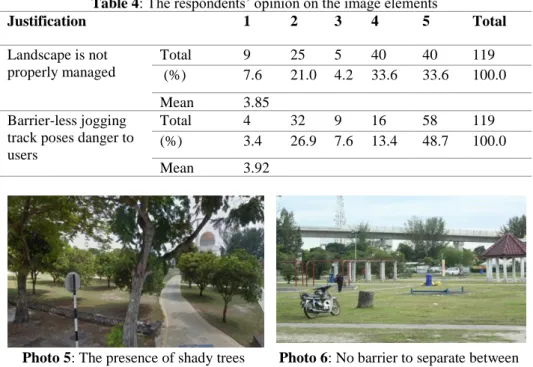
Image plays an important part in attracting people to visit neighbourhood park. Fundamentally, if the study area can attract people due to its attractive landscape, it also can create a natural element of supervision and help in reducing crime. The result from the questionnaire surveys showed that 67.2% of the respondents, with mean score 3.85 (Table 4), felt that the landscape in the study area is not properly managed and not in good condition. Furthermore, the presence of many large shady trees has obstructed the view towards the public area (Photo 5).
Table 4: The respondents’ opinion on the image elements
Justification 1 2 3 4 5 Total
Landscape is not properly managed
Total 9 25 5 40 40 119
(%) 7.6 21.0 4.2 33.6 33.6 100.0
Mean 3.85
Barrier-less jogging track poses danger to users
Total 4 32 9 16 58 119
(%) 3.4 26.9 7.6 13.4 48.7 100.0
Mean 3.92
Photo 5: The presence of shady trees obstruct view and surveillance.
Photo 6: No barrier to separate between recreation area and motorized lane
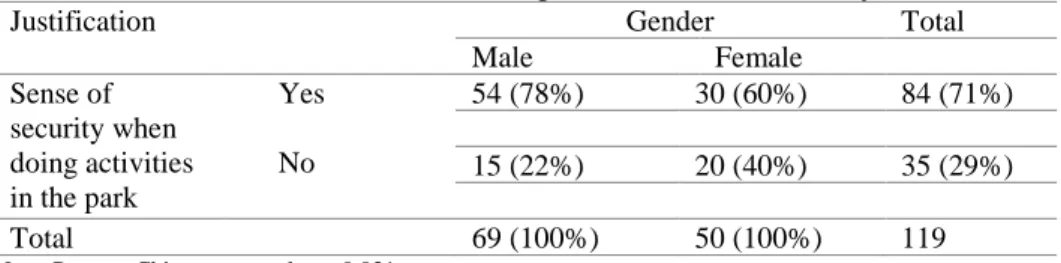
For relationship analysis, correlation tests had been carried out. The analyses showed a significant relationship between gender and sense of security among respondents. The level of security as measured showed that male (78%) felt secured when doing activities in the park as compared to female (Table 5). Thus, a higher percentage of female respondents felt unsecured (40%) as compared to male respondents (22%). Also, Chi-square test showed a statistically significant association between gender and sense of security with p value of 0.031 (p < 0.05). It shows that sense of security is dependent on gender. Thus, factor of gender was affecting the level of sense of security. It is suggested that the security aspects in the study area should be improved especially for the female users.
Table 5: Correlation between gender and sense of security
Justification Gender Total
Male Female
Sense of security when doing activities in the park
Yes No
54 (78%) 30 (60%) 84 (71%)
15 (22%) 20 (40%) 35 (29%)
Total 69 (100%) 50 (100%) 119
Note: Pearson Chi-square p value = 0.031
CONCLUSION
As a conclusion, the overall findings demonstrate the lack of defensible space concept implementation in the neighbourhood park. It is also found that most of the visitors felt the neighbourhood park is not safe for them to engage in recreational activities. This could be attributed to several weaknesses of the park such as lacking a strong element of territoriality due to no physical barriers between the recreation area and non-recreation area to control the entry to and the exit from the neighbourhood park. Furthermore, there is also lack of surveillance elements such as security patrol and CCTV, as well as community programmes and awareness among the community. The programmes and activities are essential to attract people to come to the park, thus, become one of the surveillance agents. The image of the study area also failed to encourage and attract people to engage in the recreation activities. Thus, the implementation of the defensible space concept at the park is highly recommended, not only to prevent crime, but also to strengthen the social interaction of the area.
ACKNOWLEDGEMENT
The authors would like to thank Universiti Teknologi MARA (UiTM) for the support and partly funding the study through LESTARI research grant (600-IRMI/ MYRA5/ 3/LESTARI (K) (237/2017)), as well as all the government departments, organisations and individuals who have contributed to this study.
REFERENCES
Anastasia, L. S., & John, E. E. (2007). Crime prevention and active living.American Journal of Health Promotion, 21, 380-389.
Iqbal, A. (2015). Assessment of crime and safety issues in parks (Licentiate dissertation). Stockholm. Retrieved from http://urn.kb.se/resolve?urn=urn:nbn:se:kth:diva-175662.
Liebermann, S., & Kruger, T. (2004). Crime prevention through environmental design (CPTED). 9th International Conference on Crime Prevention Environmental Design. Brisbane, Australia.
Mair, J. S., & Mair, M. (2003). Violence prevention and control through environmental modifications. Annual Review of Public Health, 24, 209-255.
Melde, C., & Esbensen, F.A. (2009). The victim-offender overlap and fear of in-school victimization: A longitudinal examination of risk assessment models. Crime & Delinquency, 55, 499-525.
Mohit, M. A. & Hannan, M. H. E. (2012). A study of crime potentials in Taman Melati terrace housing in Kuala Lumpur: Issues and challenges. Social and Behavioral Sciences, 42, 271-283.
Newman, O. (1972). Defensible space – Crime prevention through urban design. New
York: Collier Books.
Sakip, S. R. M., Johari, N., & Salleh, M. N. M. (2012). The relationship between crime prevention through environmental design and fear of crime.Procedia-Social and Behavioral Sciences, 68, 628-636.