VOLUME 15 ISSUE 4 (2017), Page 35 – 44
PERCEIVED FAIRNESS IN ISLAMIC HOME FINANCING:
COMPARISON BETWEEN AL-BAY’ BITHAMAN AJIL AND
MUSHARAKAH MUTANAQISAH PARTNERSHIP CONTRACTS
Mohamed Noordeen Mohamed Imtiyazˡ, Salina Kassim², & Nor Zalina Harun³
1,2
Institute of Islamic Banking and Finance
ISLAMIC INTERNATIONAL ISLAMIC UNIVERSITY MALAYSIA 3
Institute of the Malay World and Civilization UNIVERSITI KEBANGSAAN MALAYSIA
Abstract
While many see housing sector as a commodity, there are still many people in Malaysia who fail to own homes and many are forced to rent or stay away from urban areas. This paper aims to provide information and disclosure of available loan opportunities for house purchases in Malaysia. Apart from the importance among buyers, it is also seen as important from the perspective of property valuers and professionals involved in housing industry. This study compares the perceive fairness between three types of home financing that are available in Malaysia, namely conventional home loan, al-bay’ bithaman ajil, and musharakah mutanaqisah partnership (MMP) contracts among the customers in Malaysia. The study conducts a survey among 100 respondents to examine the relationship between customer intentions to use Islamic home financing based of MMP. The study concludes that the MMP has several advantages and cheaper over the BBA for the customer. Apart from being unanimity Shari’ah-compliant, it can be made to keep away from interest completely by means of practicing rental or house price index at the same time as reducing the cost of homes and the duration of financing. This paper concludes by suggesting recommendations for the appropriate actions to address the issues and challenges facing the MMP home finance products and deregulate BBA in Malaysia.
Keywords: Islamic Home Financing, Bay’ Bithaman Ajil, Musharakah Mutanaqisah Partnership
Date Received: 11th May 2017
Partnership Contracts
INTRODUCTION
The availability of home to people is imperative as failure to have access to home or shelter would also inevitably deny people to other basic rights such as safety, health and education. In view of this importance, Islamic banks have provided various schemes for home ownership particularly to the Muslims who seek for halal alternative or Shari’ahcompliant mortgage. Among the most popular home financing products in Islamic banking are the al-Bay’ Bithaman Ajil (BBA) and Musyarakah Mutanaqisah Partnership (MMP). BBA home financing facility has been widely used in providing home financing to customers especially in Malaysia, Indonesia and Brunei, while the variants of MMP are widely practiced in other parts of the world such as Australia and the US. Islamic finance system is being faced with a number of paradoxes and it is consistently being criticized for the overuse of contracts which has been declared to be Islamically permissible. The BBA structure is highly controversial because of the different interpretations by Malaysian and Middle East scholars on the issue of bay’ al‘inah.
This study investigates the practice of Islamic banks in Malaysia in home financing. It makes comparison with the interest-based conventional home financing which is prohibited in Islam. The over reliance on debt based financing which is considered parallel to its conventional counterpart and the advantages of equity based financing over debt based financing advocated by previous Islamic economic scholars has further encouraged the Central Bank of Malaysia to encourage the Islamic banks to introduce equity based financing, particularly MMP as a mode of Islamic home financing. MMP home financing derived from musharakah contract is superior over any debt based financing as the element of profit and loss sharing as well as demising ownership is considered to be closer to justice and the spirit of Shari’ah. Therefore, it is deemed to be a better alternative to BBA home financing.
On the back of these issues, this study aims to achieve the following objectives: (i) to compare between BBA home financing and MMP home financing and (ii) to examine factors affecting people's intention to use Islamic home financing based on MMP.
LITERATURE REVIEW
The al-Bay Bithaman Ajil (BBA) Contract
is a mode of Islamic financing used for property, vehicle, as well as financing of other consumer goods (The Council of Islamic Ideology Pakistan, 1977).
BBA house financing is basically a trading transaction. In order for a trading transaction to be valid from an Islamic perspective, the contract must contain offer and acceptance (sighah), the contracting parties (‘aqidain) and the subject matter (ma’qud ‘alayh). Home financing with the conventional system is based on interest which is completely forbidden in Islam. However, the current BBA home financing does not change much from the conventional loans. Instead of charging the customer interest, financiers charge a profit derived through a buy-and-sell contract which is allowed in Islam, but regretfully, the profit rate is dependent on the market interest rate due to arbitrage activities. Therefore, it is similar to the conventional mode in term of computational formulas whereby the profit rate tracks the market interest rate.
BBA is commonly used in Malaysia, Brunei, previously in Indonesia and some other countries. However, the contract has been subjected to debates among scholars. While some agree to its permissibility in Islam, others disagree because they see BBA agreement is similar to the conventional loans.
Musharakah Mutanaqisah Concept
The MMP concept was introduced to overcome the main criticisms of BBA. The MMP model is based on the highly successful Islamic cooperative housing corporation in Toronto, Canada, established in 1981 out of necessity to avoid the Muslim community from engaging in riba. It is based on an equity model different from the traditional debt-based mortgage. MMP focus on joint purchase of property between customers and banks. There are three portions to the contract. First, the customer enters into a partnership under the concept of Shirkat-al-Milk (joint ownership) agreement with the bank. Second, the bank leases its share in the house ownership to the customer under the contract of ijarah. Thirdly, the customer redeems the financier’s portion through the purchase of share until the house is fully owned by the customer. The bank takes ownership and assumes responsibility of the property until the financing amount is fully settled and the customer takes possession of the property. The MMP concept is Shari’ah compliant as it promotes the true spirit of Islamic banking by promoting the welfare of the people and takes care of the well-being of society (Ahmad, 2000, Siddiqui, 2001, Rosly & Bakar, 2003).
Partnership Contracts
attitudes, intentions, and behaviour. It is a widely studied model from social psychology, which is concerned with the determinants of consciously intended behaviors (Fishbein & Ajzen, 1975; Ajzen & Fishbein, 1980). Therefore, this is when the customer pays a percentage of the asset cost for example 10% as down payment to become part of the asset ownership while the bank offers for the balance which is 90% of the cost of house. Then, the customer gradually buys the bank’s percentage of share at an agreed portion periodically until the asset is eventually fully owned by the client.
The amounts of rental during the period of the contract will be jointly shared between the bank and client according to the portion shareholding at the times of signing the contract, which keeps altering as the client purchases the share of the financier. As a result, after each rental payment the share portion of the customer would increase due to the periodic redemption until eventually fully owned by the client. According to one report, MMP was implemented for the first time in Egypt by the Islamic banking division of a commercial bank in partnership with a tourism company (Contemporary Financial Transactions of Islamic Banks). Today, MMP has been applied in several countries worldwide. In Pakistan, for example, MMP is used in home financing schemes offered by Meezan Bank of Pakistan (Usmani, 2002).
Comparison between the BBA and the MMP Contracts
Under the MMP, the value of the home are determined by the market value and always reflects the market price, on the other hand, the selling price of the home under BBA does not reflect the market value because the payment on deferment which is quite substantial.The bank, under MMP would not be tied with a fixed profit rate via the financing period because the rental rate can be reread periodically to reflect current market situations, while under the BBA the return is based on a fixed selling price. In addition, under BBA the managing of liquidity risks is not possible because BBA has fixed rate profit for the whole period of financing, whereas under MMP the bank can manage the liquidity risks because rental payment can be adjusted after the end of each period of the contract.
METHODOLOGY
Conceptual Framework
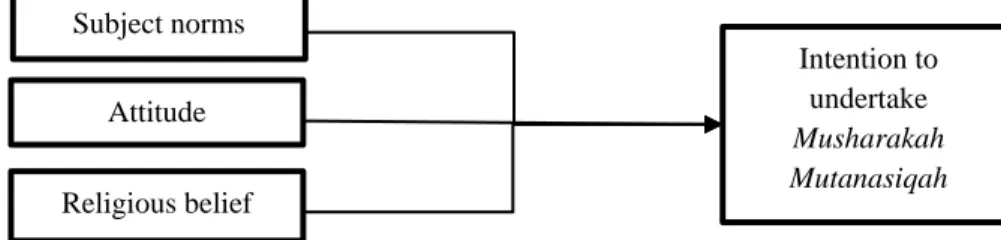
In order to build a conceptual framework, various factors have been taken into consideration as potential variables. However, only three variables were identified as possible main factors that affect intention to undertaking Islamic home financing based on MMP, which are subject norms, attitude and religious belief (Figure 1).
Figure 1 Research Model
Hypothesis
H1 : Subject norm has significant positive relationship towards to intention to
undertake MMP.
H2 : Attitude has significant positive relationship towards to intention to
undertake MMP.
H3 : Religious belief has significant positive relationship towards to undertake
MMP.
Data Collection and analysis
Questionnaire survey was conducted in the area around the International Islamic University Malaysia Gombak campus. A total of 100 questionnaires were distributed randomly. The target respondents were those who were able to communicate in English. The questionnaires were issued to the respondents by face to face method.
Demographic questions were computed using a five-point Likert scale was used with 1 (strongly disagree), 2 (disagree), 3 (neutral), 4 (agree), 5 (strongly agree). Data was analysed using SPSS version 20. Frequency, correlation and multiple regression analysis were conducted to deal with relationships among variables.
Subject norms
Religious belief Attitude
Intention to undertake
Partnership Contracts
RESULTS AND ANALYSIS
Frequency Analysis of Respondents Profile
Table 1 shows the profile of the respondents involved in the survey, namely race, gender, age and occupation. In terms of race, the majority of the respondents were Malays 43%, others 43%, Chinese 9%, and Indian 5%. Of the total respondents, males were 56% and females were 44%. In terms of age, the majority (42%) of the respondents were between the age 21 to 25. This is followed by those between 26 to 30 (30%) and below 20 (13%). Only 3% of the respondents were above 40 years old. In terms of occupation, the majority of respondents were (84%) university students. Their responses in this survey was therefore helpful in order to gauge future house buyers’ intention in undertaking MMP home financing.
Table 1 Profile of Respondents
Frequency Percent (%)
Race
Malay 43 43
Chinese 9 9
India 5 5
Others 43 43
Total 100 100
Gender
Male 56 56
Female 44 44
Total 100 100
Age
Below 20 13 13
21-25 42 42
26-30 30 30
31-35 8 8
36-40 4 4
Above 40 3 3
Total 100 100
Occupation
Executive 8 8
Office worker 5 5
University student 84 84
Business person 1 1
Others 2 2
Reliability analysis
Reliability analysis was done to confirm the internal consistency of all measured items in the questionnaire. In other words, it is to see whether the items that make up a scale are all measuring the same underlying construct. Table 2 below shows the results of the reliability test. For all variables, the Cronbach’s alpha is above 0.7, indicating high reliability.
Table 2 Reliability Test Results
Variable Number of items Cronbach’s alpha
Subject Norms 4 0.857
Attitude 5 0.901
Religious belief 5 0.886
Intention 4 0.959
Descriptive analysis
The descriptive analysis of the independent and dependent variables was conducted to get mean values and standard deviations. In this study, for each variable Likert type measure was used to enable respondents to answer the questions stated in the questionnaire survey form.
Table 3 Descriptive Statistics
Variable Mean Standard Deviation
Subject norms 3.3400 .79972
Attitude 3.8320 .72235
Religious belief 3.8160 .80135
Intention 4.3940 .59862
Bivariate analysis
Bivariate analysis is the analysis between two variables. Correlation analysis is able to describe the strength and direction of the liner relationship between two variables. The relationship may be positive correlation (as one variable increase, other variable also increase) or negative correlation (as one variable increase, the other variable decrease). Correlation coefficient can only take values from -1 to +1.
Table 4 Correlation between variables
Intention Subject norms Attitude Religious belief
Pearson Correlat ion
Intention 1.000 .571*** .653*** .336*** Subject norms .571*** 1.000 .520*** .079
Partnership Contracts
The results of correlation analysis in Table 4 reveal that the relationships between independent variables and dependent variable were between the accepted range of 0.3 to 0.8.
Multivariate Analysis
The multivariate analysis is done using standard multiple regression to explore the relationship between one dependent’s variable and a number of independents’ variables or predictors, it is able to show how well a set of variables are able to predict a particular outcome and which variable in a set of variable is the best predictor of an outcome. In this study, multiple regressions are used to test on the three independent variables (subject norms, attitude, and religious belief) in relation with dependent variable “Intention to undertake MMP”. It is expected that the multiple regressions will provide information about the model as a whole and the relative contribution of each variables that make up the model.
Table 5 Multivariate Regression Results
Model Squares Sum of df Square Mean F Sig. Regression
Residual Total
34.859 28.716 63.574
3 96 99
11.620
.299 38.845 .000
b
R R-square
Adjusted R-square Durbin-Watson
.740 .548 .534 1.812
Notes: a Dependent Variable: Intention; b. Predictors: (Constant), Religious belief, Subject norms, Attitude
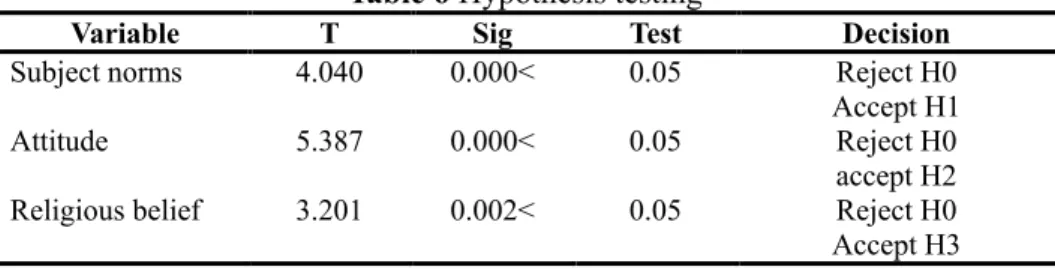
According to Table 5, the ANOVA data analysis F=38.845, Sig=0.000b, the significant is below 0.05, therefore the research model is accepted.From model summary R square =0.548, that means 54.8% variation “intention to undertake Islamic home financing based on MMP can be explained by “subject norms, attitude, and religious belief. 45.2% cannot be explained by these variables. The Durbin-Watson value was between the general range of 1.5-2.5, at 1.812.
Table 6 Hypothesis testing
Variable T Sig Test Decision
Subject norms 4.040 0.000< 0.05 Reject H0 Accept H1
Attitude 5.387 0.000< 0.05 Reject H0
Table 6 above shows the results of the hypothesis testing. All variables are accepted, hence, these three variables have significant relationship towards to consumers’ intention to undertake Islamic home financing based on MMP. Among coefficient presented there were two variables that have significant relationship towards “intention to undertake MMP”.
CONCLUSION
This study represents an effort to examine the relationship between customer intentions to use Islamic home financing based of MMP. More precisely, the objective of this research was to examine whether Subject norms, Attitudes and Religious belief of customer’s have impact on choosing MMP despite availability of other Islamic financing products and non-Islamic home loan products. According the findings, it was observed that there were significant relationships when respondents choosing MMP were influenced through subject norms and their attitudes. Furthermore religious belief also influenced their intention, albeit with weaker relationship. These outcomes are consistent with previous studies. Most recent one was by Amin, Abdul-Rahman and Abdul Razak (2014), which suggests that attitude, subjective norm and perceived behavioural control are significantly influencing the intention to become partner in MMP. Findings by Abdul-Razak and Taib (2011) also support the results of this study.
It is the opinion of the researchers that the ongoing practice of the BBA in Malaysia is contrary to the Shari’ah principles, and thus, it should be Islamized and restructured until it is fully able to protect the rights of the partners, especially purchasers in all situations such as loss making occasions when the housing projects or units are abandoned, to avoid any possibility of uncertainty (gharar al-fahish). Otherwise, other modes of Islamic house financing should be chosen in place of the current BBA.
As a way to achieve human justice and religious purpose, many Islamic instruments are offered to the customers as a way to avoid activities which is prohibited by the Shari’ah. According to Shari’ah, one of the principles that are allowed for Islamic transactions is that the price must be fixed. In contract to BBA, the bank sells the house to the customer at a mark-up price. All the jurists including the Malikis, Hanafis, and Hanbalis are in the opinion that this kind of act (contract) is forbidden, except Al Shafies. The scholars agreed that the absence of khiyr-al’Ayb in BBA financing has a risk of involving riba in the profit gain from this contract. Furthermore, the BBA practices consists of a few elements of gharar which is prohibited in Islam (Al Baqarah: 188) and Islamic law is clear on contracts involving non-existing subject matter (in this case house under construction).
Partnership Contracts
Islamic financing should avoid interest rates totally, and let the values and payments solely be determined by the real economy. It also must be free of uncertainty in contract to prevent fraud/injustice.
MMP is not free from issues and limitations. Therefore, valuable inputs from various parties, academics and religious scholars are very important in improving MMP based contract to make it more Shari’ah compliant and accessible to all income groups, but yet not forgoing its commercial objectives.
The conclusions from this study suggest that the understanding and perception of the community on the types of housing finance plays an important role in making decisions before they decide and buy a home. Housing ownership and housing development have a very close association and these two aspects play an important role as a catalyst for the economy of a city. These imply that managing finance and house purchase can be included as one of the aspects in urban management and housing development.
REFERENCES
Abdul Razak, D., & Taib, F. M. (2011). Consumers' perception on Islamic home financing: empirical evidences on al-Bay Bithaman Ajil (BBA) and diminishing partnership (DP) modes of financing in Malaysia. Journal of Islamic Marketing, 2(2), 165-176.
Ahmad, K. (2000), Islamic finance and banking: The challenge and prospects. Review of Islamic Economics, 9, 57‐82.
Amin, H., Abdul-Rahman, A. R., & Abdul Razak, D. (2014). Theory of Islamic consumer behaviour: an empirical study of consumer behaviour of Islamic mortgage in Malaysia. Journal of Islamic Marketing, 5(2), 273-301.
Ajzen, I., & Fishbein, M. (1980). Understanding attitudes and predicting social behaviour. Englewood Cliffs, NJ: Prentice-Hall.
Fishbein, M., & Ajzen, I. (1975). Belief, attitude, intention and behavior: an introduction to theory and research. Reading, MA: Addison-Wesley.
International Fiqh Academy of the Organization of Islamic Conference (2004). 15th Session, Resolutions of Musharakah Mutanaqisah and its Shariah Principles. Ramayah, T., & Norazah, M. S. (2005). Intention to shop online amongst MBA students:
comparing theory of reasoned action (TRA) and the technology acceptance model (TAM). In Proceedings of International Conference on E-Commerce 2005. Retrieved from http://repo.uum.edu.my/14345/1/ICoEC-1c1.pdf
Rosly, S. A., & Bakar, M. A. A. (2003). Performance of Islamic and mainstream banks in Malaysia. International Journal of Social Economics, 30(12), 1249‐65 Siddiqui, S. H. (2001). Islamic banking: True modes of financing. New Horizon, May‐
June: 109.
The Council of Islamic Ideology Pakistan (1977). Elimination of interest from the economy. Islamabad: Government of Pakistan.