https://doi.org/10.17170/kobra-202002281030 ISSN: 2363-6033 (online); 1612-9830 (print) – website: www.jarts.info
Adoption and utilisation of Zai pits for improved farm productivity in
drier upper Eastern Kenya
Serah Wairimu Kimaru-Muchai
a,∗, Felix K. Ngetich
b, Mary Baaru
c,
Monicah Wanjiku Mucheru-Muna
daDepartment of Social and Development Studies, Mt. Kenya University, Kenya
bDepartment of Land and Water Management, University of Embu, Kenya
cDepartment of Environmental Studies in Community Development, Kenyatta University, Kenya
dDepartment of Environmental Science, Kenyatta University, Kenya
Abstract
Inadequate and poorly distributed rainfall and declining soil fertility have led to low crop productivity in most small-holder farms in sub-Saharan Africa. As a result, there has been a renewed quest for sustainable and resource-use efficient agricultural production practices. Zai pit technology is a practice that has the potential to alleviate water stress and enhance soil fertility. We assessed the factors that influence farmers’ adoption and utilisation of Zai pits in Tharaka-Nithi County in upper Eastern Kenya. We interviewed 291 farm household heads. Descriptive statistical analysis and a logistic regression model were applied to evaluate socio-economic factors that affect the adoption of Zai pits by farmers. Binary logistic regression estimation revealed that the number of non-formal training, beneficiaries of nongovernmental organisations, wealth status and membership of a social group play an essential role in the adoption of Zai pits. Based on the findings, we recommend that farm characteristics and socio-economic characteristics of farmers should be considered in the promotion of Zai pits as a water harvesting technology. The results of the study will be useful to extension service providers in planning, designing and evaluating effective and efficient agricultural policies, programs and projects at local, regional and national scales in the dissemination of Zai pit technology among smallholder farmers in the semi-arid tropics.
Keywords: Erratic rainfall, non-government extension agents, socio-economic, water harvesting
1
Introduction
Low rainfall, soil moisture stress and low nutrient avail-ability have been major constraints that impinge crop pro-ductivity in arid and semiarid environments of the world (Yazar & Ali, 2016). Moreover, frequent occurrences of droughts and dry spells experienced in rainfed agriculture in Africa (Ayanlade et al., 2018) threaten food security (Grafton et al., 2015). In 2008–2010 drought in the Horn of Africa affected more than 13 million people, including 3.75 million Kenyans (Muller, 2014). According to the In-tergovernmental Panel on Climate Change [IPCC] (2014) and Muller (2014), African rain-fed agriculture will severely be affected by the ongoing climate change and variability
∗Corresponding author – [email protected]
(Mukherjeeet al., 2018). In developing countries, rainfed grain yields average 1.5 t ha−1(Rosegrantet al., 2002) com-pared with 5-6 t ha−1 (Rockström & Falkenmark, 2000) in regions with reliable rainfall and sufficient nutrient availab-ility (Clarkeet al., 2017). The yield gap between the actual yields being harvested from farmers’ fields and what could be potentially realised attests the need to develop new ap-proaches of agricultural production in sub-Saharan Africa (Wani et al., 2009). A 8-22 % yield loss is estimated for the main grain crops such as millet, sorghum and maize by 2050 unless sustainable techniques are adapted to mitig-ate the effects of rainfall anomalies and soil fertility decline (Schlenker & Lobell, 2010). These observations suggest that to overcome the biophysical constraints and intensify yield production in rainfed farming systems in tropical developing countries, soil water conservation in combination with
nutri-Published online: 6 March 2020 – Received: 7 March 2019 – Accepted: 12 December 2019
ent management should be recommended (McLellanet al., 2015; Zougmoréet al., 2014). Integrating water harvesting technologies with soil fertility management techniques can create synergies that can further increase water use efficiency and hence, higher yields (Jägermeyret al., 2016). Use of cli-mate adaptation strategies that combine water and soil man-agement (Parteyet al., 2018) such as Zai pit increase rainfall use efficiency and bridge intraseasonal dry spells increasing agricultural productivity (Dileet al., 2013; Wildemeerschet al., 2015).
A ‘Zai’ is a hole dug into the soil but of different sizes depending on farmer innovation. Zai pits are technologies initially practised in Burkina Faso, although some litera-ture points it to Dogon in Mali (Danjuma & Mohammed, 2015; Parteyet al. 2018). Zai pit also called Tassa in Niger (Parteyet al., 2018), is an intervention that improves precipi-tation capture, reduces runoffand evaporation, and increases agricultural productivity (Wouterse, 2017). Since crusted soils characterise most cultivated lands by hardpan forma-tion, compacforma-tion, inadequate aeraforma-tion, reduced permeability and limited plant root development (Zougmoréet al., 2014), Zai pit can enhance more water infiltration and increase run-offcollection (Amedeet al., 2011; Kaboré & Reij, 2004). Zai pit system has been promoted by non-governmental or-ganisations (NGOs) and other international oror-ganisations in many developing countries like Niger, Zambia, Ethiopia South Africa among others (Fatondjiet al., 2009; Gumboet al., 2012; Haggblade & Tembo, 2003; Thierfelder & Wall, 2009).
In Kenya, most farmers know Zai as the ‘five by nine’ pit or Tumbukiza whose metric dimensions are 60 cm wide by 60 cm long by 60 cm deep (Kathuli & Itabari, 2015 ; Biazin
et al., 2012). These pits are slightly bigger than the conven-tional Zai, which are considered to be 20-20 cm in diameter and 10-15 cm deep (Bandre & Batta, 2002). The ‘five by nine’ refers to the five or nine maize seeds (for dry areas or wet areas respectively) planted at the pit diagonals (Mati, 2005). This type of pit can be re-used for up to 3 years (Mati, 2005). A farmer can dig between 4,000 to 6,000 Zai per hectare depending on the spacing. Mostly, pits are spaced 0.6-0.8 m and dug in alternate rows to increase the capture of eroded soil and reduce runoffwater (Sidibe, 2005). In each Zai, the farmer adds a mixture of crop residue, farm-yard manure and topsoil and then places either the seed to be planted or an entire plant, depending on the type of propaga-tion material. Zai pit technology has been used in producpropaga-tion of staple food crops such as sorghum, millet, maize. pigeon peas and lablab (black beans) among other drought resistant crops in the semi-arid areas.
Factors influencing the adoption of Zai pits could be regional or household-specific due to variations in socio-cultural, economic and biophysical conditions (Amsalu & de Graaff, 2007). In northern Burkina Faso, farmers using Zai pits had large herds of livestock, bigger families and more transport facilities, which are consistent with their need for workforce and organic manure (Slingerland & Stork, 2000). Wildemeersch et al. (2015) identified that lack of enough knowledge on erosion and other vital resources such as ma-nure, agricultural equipment and transport facilities limit the adoption of Zai in Tillaberi, Niger. In northern Burkina Faso, Sidibe (2005) found that variables such as education and per-ceptions of soil degradation were determinants for the adop-tion of Zai technique. A study by Ndahet al. (2014) showed that positive institutional factors such as a well-structured extension system contributed to the high adoption of Zai pits in Malawi and Zambia (Nyanga, 2012). Besides, the integra-tion of farmer to farmer extension approach has been of sig-nificance in the adoption of Zai pit technology (Haggblade & Tembo, 2003). These studies focus on demographic charac-teristics of farmers and resource availability to explain adop-tion problems in different regions. However, research related to factors influencing farmers’ adoption of Zai pits in Kenya is scanty.
Therefore it is not sufficient to infer these results for sub-humid and drier regions of Kenya. Moreover, Zai pits have their unique characteristics and requirements different from other rainwater harvesting technologies; hence, it is essential to establish factors that influence its adoption. The results of this study will provide entry points for planning or adjusting some of the current and future promotion efforts of Zai pits as a technology intended to reduce the total loss of produc-tion experienced in semi-arid areas. Improving the efficiency of rainwater use is, therefore, pertinent, especially in Kenya, where rainfed agriculture dominates.
2
Materials and methods
2.1 Study area
Fig. 1:Map of the study area Tharaka-Nithi County.
short (Jaetzoldet al., 2006). Rainfed agriculture is not eco-nomical without the use of runoff-catching techniques. Des-pite bimodal distribution, it is mostly inadequate to meet re-quirements for crops and fodder. The predominant soils in the study area are ferrasols that are highly weathered and leached (Jaetzoldet al., 2006). The primary source of liveli-hood for the Tharaka people revolves around marginal farm-ing and livestock rearfarm-ing (Nderiet al., 2014) which are much affected by long spells of drought, which at times lead to total crop failure and massive loss of livestock.
Due to dependence on unreliable and unpredictable means of livelihood, poverty is widespread standing at about 65 % (Jaetzold et al., 2006; Kristjanson et al., 2010). Con-sequently, the overall development of the district has been negatively affected, as most of the emigrants are active la-bour force. The distribution of relief food and school-feeding programmes are some of the indicators of the extent of poverty.
2.2 Collection of data
Tharaka-Nithi county is sub-divided into Tharaka North, Maara, Meru South (currently known as Chuka) and Tharaka South sub-counties. Tharaka South sub-county was purpos-ively selected from a list of the four sub-counties in Tharaka-Nithi county as NGOs and the Ministry of Agriculture have here promoted water and soil conservation technologies. The list of the households from the chiefs of the locations made the sampling frame. Exponential discriminative snowball
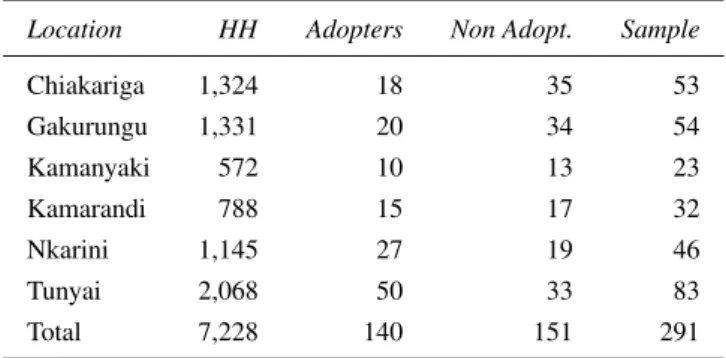
sampling approach was used to identify farmers who had adopted Zai technology in six locations of Tharaka South sub-county. The approach was used to ensure uniform spa-tial distribution of the subjects over the entire sub-county. The measure of adoption was the actual presence or use of the technology in farmers’ fields. For the non adopters, ran-dom sampling technique was applied at 8 % confidence in-terval and 95 % confidence level (Cochran, 1963), resulting in a sample size of 151. The distibution of households per location and sample sizes are shown in Table 1.
Table 1: Distribution of household and sample size in the study
area by administrative units.
Location HH Adopters Non Adopt. Sample
Chiakariga 1,324 18 35 53
Gakurungu 1,331 20 34 54
Kamanyaki 572 10 13 23
Kamarandi 788 15 17 32
Nkarini 1,145 27 19 46
Tunyai 2,068 50 33 83
Total 7,228 140 151 291
HH: Households; Non Adopt.: Non Adopters
To facilitate the process, seven enumerators who had at-tained tertiary education level were recruited and trained prior to pre-testing. Pre-testing of the questionnaires was done to ascertain the validity of questions before the ac-tual survey, to evaluate the performance of the enumerat-ors, and to ensure uniformity. Necessary adjustments were made accordingly to improve the questionnaires after the pre-testing exercise. A structured interview schedule was administered to all selected household heads to gather in-formation on household demographic characteristics, water harvesting techniques and soil fertility-related issues. Before data entry, all the completed interview forms were examined thoroughly to determine farmers who had adopted the Zai pit system (adopters) and those who had not (non-adopters).
2.3 Data analysis
Data were analysed using statistical package for social sciences (SPSS version 20) using descriptive and inferen-tial statistics. The description was made using frequency, mean, and percentage. To determine factors influencing Zai pits adoption, binary logistic regression was used in Zai pit adoption model. According to the diffusion of innovation theoretical perspective, a farmer’s response towards innov-ation is binary, either adopts or rejects. Hence the model for Zai adoption was as shown in equation 1.
Where
P is the probability of adopting Zai pits
(1-P) is the probability that a farmer does not adopt Zai pit a=y-intercept
β=regression coefficients
ε=error term
x1−x11=independent variables (. . . )
Independent variables were the socio-economic characteris-tics as follows:
x1 Non-formal trainings (continuous)
x2 Household size (continuous)
x3 No groups (continuous)
x4 Land Slopy (0=no, 1=yes)
x5 Formal title deed (0=no, 1=yes)
x6 Soil fertility status (1=high, 2=moderate, 3=poor)
x7 HH wealth status (1=rich, 2=average, 3=poor)
x8 Received relief (0=no, 1=yes)
x9 Sell farm produce (0=no, 1=yes)
x10 Improved planting material (0=no, 1=yes)
x11 Total farm size (continuous)
3
Results
3.1 Social demographic characteristics of adopters and non-adopters of Zai pit technology
The respondents interviewed composed of 77 % male farmers and 23 % female farmers (Table 2). About 52 % of the respondents were non-adopters, while 48 % were ad-opters. The observation made in this study is that amongst the adopters, the percentage of female farmers is lower than amongst the non-adopters. A higher percentage of middle-aged farmers (41–60 years) had adopted Zai pits compared to older farmers (61–80 years) and young farmers (21–40 years) (Table 2). In addition, middle aged farmers were more among the adopters as compared to the non-adopters. Most of the farmers (64 %) had at least primary education. Among those with no formal education, majority were non-adopters. Majority of farmers (85 %) depended on farming activities for survival and generation of income. Amongst the em-ployed respondents, only 33 % were adopters.
3.2 Integration of Zai pits and soil fertility amendments
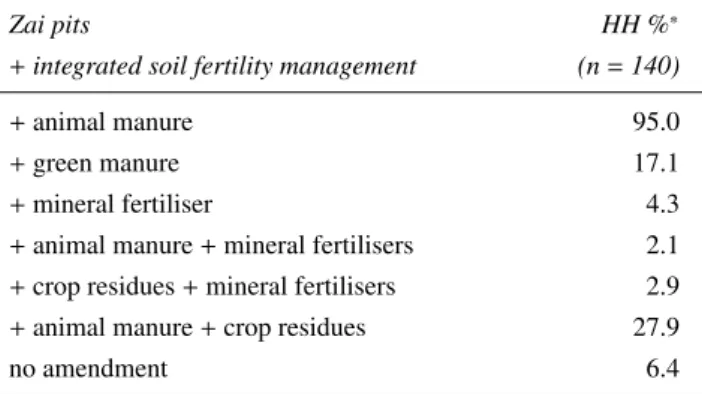
Ninety-five percent of the farmers who had adopted Zai pits used animal manure as a soil fertility amendment (Table 3). Only 2.1 % of the farmers combined animal ma-nure plus mineral fertiliser as input. At least 17.1 % of the farmers utilised Zai pits in combination with green ma-nure while only 4.3 % applied mineral fertiliser only in the
Table 2:Social demographic characteristics of adopters and
non-adopters of Zai pit technology in Tharaka-Nithi County
Non-adopters % Adopters % Total %
(n=140) (n=151) (n=291)
Gender
Male 72 81 77
Female 28 19 23
Age (years)
21–40 48 34 41
41–60 35 52 43
61–80 17 14 16
Level of education
No formal education 22 13 18
Primary education 61 67 64 Secondary education 9 11 10
Tertiary education 8 9 8
Main occupation of the household head
Farming 83 88 85
Business 5 6 6
Employed 12 6 9
Zai pits. Further, 6.4 % reported having not used any in-put at all on Zai pits (Table 3). A combination of animal manure and crop residue had also been applied by 27.9 % (Table 3). Farmers in the study area also reported using dif-ferent sources of manure and applied different amounts of manure ranging from 0.05 kg to 3 kg per Zai pit.
Table 3:Combination of Zai pits and soil fertility improvements in
Tharaka-Nithi County
Zai pits HH %*
+integrated soil fertility management (n=140)
+animal manure 95.0
+green manure 17.1
+mineral fertiliser 4.3
+animal manure+mineral fertilisers 2.1
+crop residues+mineral fertilisers 2.9
+animal manure+crop residues 27.9
no amendment 6.4
*Households that applied this combination
3.3 Benefits and challenges of Zai pits
score the Zai challenges between 1 and 5 where 1=least challenging and 5=most challenging. Farmers perceived Zai pits to have various benefits with high economic returns getting the highest rating. Control of soil erosion and im-proved soil fertility were also regarded as being significant with a mean score of 4.0 and 3.9, respectively (Table 4). Fewer weeds, as well as low input application, were not considered as significant benefits in the adoption of Zai pits. The biggest challenge perceived by the farmers was that Zai pits are both labour intensive and highly demanding, particu-larly during construction. The fact that a farmer cannot use animal traction was equally considered as a significant chal-lenge. However, the absence of immediate benefits was not perceived as a significant challenge by most of the farmers.
Table 4: Benefits and challenges of Zai pits in Tharaka-Nithi
County (1–5 scale; n=140)
Mean scores Std. Deviation
Benefits of Zai pits
High economic return 4.7 0.77
Improve soil fertility 3.9 0.87
Less weeds 2.2 0.97
Precise application of inputs 2.4 1.01 Control soil erosion 4.0 1.02
Increased water retention 3.7 1.06
Ease application pesticide 2.8 1.13
Challenges of Zai pits
Labour intensive 4.1 1.25
Difficult to maintain 3.9 1.14 Requires skills 3.2 1.02
Occupy large portion land 3.1 1.33 No immediate benefits 2.1 1.05
Not possible to use animal traction 3.7 1.46
Waterlogging 2.8 1.42
3.4 Predictors of Zai system adoption by farmers
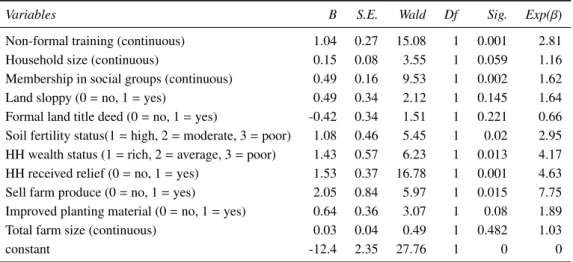
A logistic regression analysis was conducted to predict ad-option of Zai system for 291 households using non-formal training, household size, membership in social groups, land inclination, formal land title, soil fertility status, house-hold wealth status, received relief, selling farm produce, improved planting material, and total farm size as predict-ors (Table 5). A test of the full model against a constant model was statistically significant, indicating that the pre-dictors, as a set, reliably distinguished between adopters and non-adopters of Zai system (chi-square 90.107, p<0.001, df=13). Overall prediction success was 75.3 % (74.4 % for
non-adopters and 76.2 % for adopters) (Table 5). The Wald criterion demonstrated that non-formal training, number of groups, soil fertility status, household wealth status, received relief and sell of farm produce made a significant contribu-tion to prediccontribu-tion (Table 5).
Household size, land inclination, soil fertility status, use of improved planting material and total farm size had no significant influence on the adoption rate of Zai system (Table 5). Non-formal training significantly and positively influenced the adoption of the Zai system. The exp (β) value associated with non-formal training attended by the hold head was 2.81. The number of social groups a house-hold head belonged to had a positive effect on the adoption of Zai system. The exp (β) shows that for a 1-unit increase in the number of groups, the probability of adoption would increase by a factor of 1.62. The results also indicated that there was a statistically significant relationship between soil fertility condition of the land and the adoption of Zai pits at p=0.05. Wealth status of the household head had a posi-tive effect on the adoption of Zai system. Farmers ranked as poor were more likely to adopt the Zai system as compared to those who were wealthy. The exp (β) value associated with wealth status was 4.17. Hence, with one unit increase of wealth status, the odds for adoption would decrease by 4.16. Received relief significantly (p=0.01) and positively influenced the adoption of Zai system by farmers. The exp (β) showed that the odds of a farmer receiving relief food were 4.63 times likely to adopted compared to those who were not. Household heads who sell farm produce had a sig-nificant (p=0.05) and positive impact on the adoption of Zai system. The exp (β) value associated with the sale of farm produce as a factor that influence adoption of Zai system was 7.75 at p=0.05.
4
Discussion
Table 5:Predictors of Zai system adoption by farmers
Variables B S.E. Wald Df Sig. Exp(β)
Non-formal training (continuous) 1.04 0.27 15.08 1 0.001 2.81 Household size (continuous) 0.15 0.08 3.55 1 0.059 1.16 Membership in social groups (continuous) 0.49 0.16 9.53 1 0.002 1.62 Land sloppy (0=no, 1=yes) 0.49 0.34 2.12 1 0.145 1.64 Formal land title deed (0=no, 1=yes) -0.42 0.34 1.51 1 0.221 0.66 Soil fertility status(1=high, 2=moderate, 3=poor) 1.08 0.46 5.45 1 0.02 2.95 HH wealth status (1=rich, 2=average, 3=poor) 1.43 0.57 6.23 1 0.013 4.17 HH received relief (0=no, 1=yes) 1.53 0.37 16.78 1 0.001 4.63 Sell farm produce (0=no, 1=yes) 2.05 0.84 5.97 1 0.015 7.75 Improved planting material (0=no, 1=yes) 0.64 0.36 3.07 1 0.08 1.89 Total farm size (continuous) 0.03 0.04 0.49 1 0.482 1.03
constant -12.4 2.35 27.76 1 0 0
B – intercept; Wald - Wald chi-square to test the null hypothesis that the constant equals 0; Df- degrees of freedom; Sig- significant; Exp(B) – exponentiation of the B coefficient, which is an odds ratio.
farmers are less likely to adopt technologies that are labour intensive.
Most of the middle-aged farmers had adopted Zai pits compared to older farmers and young farmers. This was attributed to the labour-intensive nature of the Zai pit tech-nique (Nyamadzawoet al., 2013). It may also be pointed out that middle-aged farmers may have good understanding and experience of their environment and the benefits of particu-lar techniques compared to young farmers. According to a study by Theriaultet al. (2017) and Mangoet al. (2017), age of the farmer is a significant factor that can affect the use of soil conservation technologies. This is attributed to the fact that younger farmers may be less interested in food security matters while the middle-aged farmers could be more aware of the benefits of water harvesting technologies through ex-perience. Besides, older farmers may be more conservative, less flexible and more uncertain about the benefits of Zai pits.
According to Mangoet al. (2017), education levels of the farmers may have influenced the chances of implementing and adopting the water harvesting techniques. This study showed that most of the respondents with no formal educa-tion were non adopters. This is because educaeduca-tion exposes one to information and therefore creates awareness and en-hances the adoption of water harvesting systems. Chianu & Tsujii (2005) and Theriaultet al. (2017) also reported that farmers’ educational achievement could increase the prob-ability of water harvesting technology adoption.
The study suggests a low use of soil fertility amendments except for animal manure in combination with Zai pits. This could be due to the availability of animal manure locally. According to Liniger et al. (2011), combining different soil fertility amendments with soil and water conservation
is more suitable. Manure placed in the pits improves plant growth, and better use is made of the harvested water (An-schützet al., 2003). In Burkina Faso, a combination of ma-nure application with Zai pits resulted in more than two-fold grain yield compared to that without manure (Fatondjiet al., 2006). Water and soil conservation techniques cannot suc-ceed without nutrient application as poor nutrient status is, besides limited water availability, one of the paramount crop growth limiting factors (Wildemeerschet al., 2013). For op-timal yields, 3 t of manure ha−1 or 300 g per Zai pit should be applied (Fatondjiet al., 2006). Low application of inor-ganic fertilisers is also in line with studies by Morriset al. (2007) and Potteret al. (2010) who reported that majority of smallholder farmers use no (0 kg ha−1) or low (8 kg ha−1) rates of mineral fertiliser in Africa, compared with a mean 100 kg ha−1application rate in Asia.
Implementation of Zai pits has been observed to be labour intensive by several studies (Etongo et al., 2018, Schuler
weeds are disadvantaged (Kaboré & Reij, 2004). However, it is not possible to use animal traction on the digging of Zai pit, and hence, this makes it a challenge for large-scale farmers (Fatondjiet al., 2009).
The results of logistic regression analysis suggests that the more non-formal training a farmer attends on farming techniques, the more likely they are to adopt the Zai sys-tem. Lukuyuet al. (2012) observed that non-formal train-ing is a cost-effective way of disseminating information even after phasing out agricultural related projects. These results are consistent with Rogers (2003) innovation diffusion the-ory, which postulated that information access is central to the process of innovation adoption. In most adoptions, extension services provided through formal and informal institutions are a vital factor in making farmers aware of and enabling them to promote new agricultural technologies (Thapa & Rattanasuteerakul, 2011; Paudel & Thapa, 2004). Farmers who were members of different social groups were more in-clined to adopt Zai system than those who were not. Farmer groups predispose farmers to increased learning opportunit-ies for improved water harvesting technologopportunit-ies and exchange of information among themselves on the advantages of Zai ignites them to apply the technology on their farms. Studies have also shown a positive relationship between the adoption of conservation practices and membership in farmer organ-isations (Nyanga, 2012). The increased likelihood to adopt Zai pits when farmers belonged to a group, could suggest that the groups were sources of information on water and soil conservation. (Muchaiet al., 2014).
Farmers who perceived their farmland to be low in fer-tility were more likely to adopt the Zai system than those who perceived their soil fertility as high. This is consistent with research findings by Tadesse & Belay (2004) who re-ported that farmers who feel that their farmlands are prone to soil erosion are more likely to adopt physical soil conser-vation measures than those who do not perceive the problem of soil erosion. Another observation made in this study was that poor farmers were more likely to adopt Zai pit as a wa-ter harvesting technology. It implies that ‘wealthier’ farmers may not invest more in Zai pits, probably because they are manually dug while they may have a greater ability to hire tractors or other mechanised power to prepare their lands.
Possession of formal title deed had an insignificant nega-tive impact on the adoption of Zai system. However, it is usually expected that farmers who have title deeds are more likely to adopt Zai pits as compared to those who do not. Zai pits are inherently a long-term investment requiring the security of tenure over land for an extended period. Many smallholder farmers who apply these technologies on leased land can lose the benefit of their investments as the
own-ers can withdraw the land for their use. Tenure insecurity explains farmers’ unwillingness to invest effort in measures to improve soil conservation and enhance fertility (Lovo, 2016).
According to the logistic model land size, family size, the sloppiness of land and use of improved planting material were not significant variables in the adoption of Zai pits. The findings differ with those of Huenchuleoet al. (2012) who established farm size to be among the significant predictors in the adoption of soil and water conservation measures in Chile. These results also contradict the findings of Tadesse & Belay (2004) and Amsalu & de Graaff(2007) who identified the significant positive influence of land size on farmers’ de-cision to adopt soil conservation measures. In the highlands of Eritrea, a study by Araya & Asafu-Adjaye (2001) indi-cated that family size was a significant variable affecting soil conservation efforts. The findings were in agreement with the study of Mangoet al. (2017), who found that family size had a positive significance in the adoption of soil conserva-tion measures. This is because larger households will be able to provide the required labour force for the implementation of soil-conserving structures as constructing soil-conserving structures is labour intensive. Anleyet al. (2007) indicate that farmers were inclined to invest in conservation practices where their farm plots are located on higher slopes. Similar results on the effect of plot slope were reported by Amsalu & De Graaff(2007) in Ethiopia. This is attributed to the fact that most conservation practices are mainly used to control soil erosion in hilly areas, and the benefits are also expected to be higher in these areas.
5
Conclusion
need for agricultural policymakers to develop and implement appropriate agricultural guidelines for extension service pro-viders and smallholder farmers on the effectiveness and effi -ciency of the Zai pits. This will enable smallholder farmers to make informed decisions on adoption of the technology as a coping mechanism to climate change, enhancement of food security and alleviation of poverty in the semi-arid tropics in sub-Saharan Africa.
Acknowledgements
We would like to thank The National Commission for Sci-ence, Technology and Innovation (NACOSTI/RCD/ST&I 5th Call) for financing this work. We also extend our grat-itude to the Ministry of Agriculture Tharaka sub-county for their support. Special appreciation to Phillip Muthiani, who provided most of the logistical support throughout the re-search survey exercise.
Conflict of interest
The authors declared no conflicts of interest with respect to the research, authorship, and publication of this article.
References
Amede, T., Menza, M. & Awlachew, S.B. (2011). Zai im-proves nutrient and water productivity in the Ethiopian highlands.Experimental Agriculture, 47 (S1), 7–20. Amsalu, A. & de Graaff, J. (2007). Determinants of adoption
and continued use of stone terraces for soil and water con-servation in an Ethiopian highland watershed. Ecological Economics, 61 (2–3), 294–302.
Anley, Y., Bogale, A. & Haile-Gabriel, A. (2007). Adop-tion decision and use intensity of soil and water conserva-tion measures by smallholder subsistence farmers in Dedo district, Western Ethiopia.Land Degradation& Develop-ment, 18 (3), 289–302.
Araya, B. & Asafu-Adjaye, J. (2001). Adoption of farm-level soil conservation practices in Eritrea.Indian Journal of Agricultural Economics, 56 (2), 239.
Asfaw, D. & Neka, M. (2017). Factors affecting adoption of soil and water conservation practices: the case of Wereillu Woreda (District), South Wollo Zone, Amhara Region, Ethiopia. International Soil and Water Conservation Re-search, 5 (4), 273–279.
Ayanlade, A., Radeny, M., Morton, J. F. & Muchaba, T. (2018). Rainfall variability and drought characteristics in two agro-climatic zones: An assessment of climate change challenges in Africa. Science of the Total Environment, 630, 728–737.
Biazin, B., Sterk, G., Temesgen, M., Abdulkedir, A. & Stroosnijder, L. (2012). Rainwater harvesting and man-agement in rainfed agricultural systems in sub-Saharan Africa–a review. Physics and Chemistry of the Earth, Parts A/B/C, 47, 139–151.
Chianu, J. N. & Tsujii, H. (2005). Determinants of farmers’ decision to adopt or not adopt inorganic fertilizer in the savannas of northern Nigeria. Nutrient Cycling in Agroe-cosystems, 70 (3), 293–301.
Clarke, N., Bizimana, J. C., Dile, Y., Worqlul, A., Osorio, J., Herbst, B. & Jones, C. A. (2017). Evaluation of new farm-ing technologies in Ethiopia usfarm-ing the Integrated Decision Support System (IDSS).Agricultural Water Management, 180, 267–279.
Danjuma, M. N. & Mohammed, S. (2015). Zai pits system: a catalyst for restoration in the dry lands.Journal of Agri-culture and Veterinary Science, 8 (2), 1–4.
Dile, Y. T., Karlberg, L., Temesgen, M. & Rockström, J. (2013). The role of water harvesting to achieve sustainable agricultural intensification and resilience against water re-lated shocks in sub-Saharan Africa. Agriculture, Ecosys-tems&Environment, 181, 69–79.
Etongo, D., Epule, T. E., Djenontin, I. N. S. & Kanninen, M. (2018). Land management in rural Burkina Faso: The role of socio-cultural and institutional factors.Natural Re-sources Forum, 42 (3), 201–213.
Fatondji, D., Martius, C., Bielders, C. L., Vlek, P. L., Ba-tiono, A. & Gerard, B. (2006). Effect of planting technique and amendment type on pearl millet yield, nutrient uptake, and water use on degraded land in Niger.Nutrient Cycling in Agroecosystems, 76 (2–3), 203–217.
Fatondji, D., Martius, C., Zougmore, R., Vlek, P. L., Bield-ers, C. L. & Koala, S. (2009). Decomposition of organic amendment and nutrient release under the zai technique in the Sahel. Nutrient Cycling in Agroecosystems, 85 (3), 225.
Grafton, R. Q., Williams, J. & Jiang, Q. (2015). Food and water gaps to 2050: Preliminary results from the global food and water system (GFWS) platform. Food Security, 7 (2), 209–220.
Haggblade, S. & Tembo, G. (2003). Conservation farming in Zambia. EPTD discussion paper no. 108. International Food Policy Research Institute (IFPRI), Washington, D.C., USA.
Jaetzold, R., Schmidt, H., Hornet, Z. B. & Shisanya, C. A. (2006). Farm Management Handbook of Kenya. Nat-ural Conditions and Farm Information (Eastern Province). Nairobi, Kenya.
Jägermeyr, J., Gerten, D., Schaphoff, S., Heinke, J., Lucht, W. & Rockström, J. (2016). Integrated crop water man-agement might sustainably halve the global food gap. En-vironmental Research Letters, 11 (2), 025002.
Kaboré, D. & Reij, C. (2004). The emergence and spread-ing of an improved traditional soil and water conserva-tion practice in Burkina Faso. EPTD Discussion Paper
(114). International Food Policy Research Institute (IF-PRI), Washington, D.C., USA.
Kamau, M., Smale, M. & Mutua, M. (2014). Farmer de-mand for soil fertility management practices in Kenya’s grain basket.Food Security, 6 (6), 793–806.
Kathuli, P. & Itabari, J. K. (2015). In situsoil moisture con-servation: Utilization and management of rainwater for crop production. In:Adapting African Agriculture to Cli-mate Change. Springer, Cham, Switzerland, pp. 127–142. Kristjanson, P., Mango, N., Krishna, A., Radeny, M. & Johnson, N. (2010). Understanding poverty dynamics in Kenya. Journal of International Development, 22 (7), 978–996.
Lenhardt, A., Glennie, J., Intscher, N., Ali, A. & Morin, G. (2014). A Greener Burkina: Sustainable farming techniques, land reclamation and improved livelihoods. Development Progress Case Study Re-port. Overseas Development Institute. Available at: https://www.odi.org/publications/ 8797-greener-burkina- sustainable-farming-techniques-land-reclamation-improved-livelihoods. Last accessed: 26th June 2018.
Liniger, H. P., Studer, R. M., Hauert, C. & Gurtner, M. (2011). Sustainable Land Management in Practice: Guidelines and Best Practices for Sub-Saharan Africa. FAO, Rome, Italy.
Lovo, S. (2016). Tenure insecurity and investment in soil conservation. Evidence from Malawi. World Develop-ment, 78, 219–229.
Lukuyu, B., Place, F., Franzel, S. & Kiptot, E. (2012). Disseminating improved practices: Are volunteer farmer trainers effective?. The Journal of Agricultural Education and Extension, 18 (5), 525–540.
Mango, N., Makate, C., Tamene, L., Mponela, P. & Ndengu, G. (2017). Awareness and adoption of land, soil and water conservation practices in the Chinyanja Triangle, South-ern Africa.International Soil and Water Conservation Re-search, 5 (2), 122–129.
Mati, B. M. (2005). Overview of water and soil nutri-ent managemnutri-ent under smallholder rain-fed agriculture in East Africa. Working Paper 105. International Water Man-agement Institute (IWMI), Colombo, Sri Lanka.
McLellan, E., Robertson, D., Schilling, K., Tomer, M., Kostel, J., Smith, D. & King, K. (2015). Reducing nitro-gen export from the Corn Belt to the Gulf of Mexico: Agri-cultural strategies for remediating hypoxia.Journal of the American Water Resources Association, 51 (1), 263–289. Morris, M., Kelly, V. A., Kopicki, R. J. & Byerlee, D. (2007).
Fertilizer use in African agriculture: Lessons learned and good practice guidelines. World Bank Publications No 6650. The World Bank, Washington, D.C., USA.
Muchai, S. W. K., Muna, M. W. M., Mugwe, J. N., Mugendi, D. N. & Mairura, F. S. (2014). Client focused extension approach for disseminating soil fertility management in Central Kenya. International Journal of Agricultural Ex-tension, 2 (2), 129–136.
Mudhara, M., Hildebrand, P. E. & Gladwin, C. H. (2002). Gender-sensitive LP models in soil fertility research for smallholder farmers: Reaching de Jure female headed households in Zimbabwe. African Studies Quarterly, 6 (1&2), 295–309.
Mukherjee, N., Zabala, A., Huge, J., Nyumba, T. O., Adem Esmail, B. & Sutherland, W. J. (2018). Comparison of techniques for eliciting views and judgements in decision-making.Methods in Ecology and Evolution, 9 (1), 54–63. Muller, J. C. Y. (2014). Adapting to climate change and ad-dressing drought–learning from the Red Cross Red Cres-cent experiences in the Horn of Africa. Weather and Cli-mate Extremes, 3, 31–36.
Ndah, H. T., Schuler, J., Uthes, S., Zander, P., Traore, K., Gama, M. S. & Corbeels, M. (2014). Adoption potential of conservation agriculture practices in sub-Saharan Africa: Results from five case studies. Environmental Manage-ment, 53 (3), 620–635.
Nderi, M. O., Musalia, L. M. & Ombaka, O. (2014). Live-stock farmers perceptions on the relevance of natural licks in Igambang’ombe Division, Tharaka-Nithi County, Kenya.International Journal of Agricultural Sciences and Veterinary Medicine, 7, 52–59.
Nyamadzawo, G., Wuta, M., Nyamangara, J. & Gumbo, D. (2013). Opportunities for optimization of in-field wa-ter harvesting to cope with changing climate in semi-arid smallholder farming areas of Zimbabwe. SpringerPlus, 2 (1), 100.
Nyanga, P. H. (2012). Factors influencing adoption and area under conservation agriculture: A mixed methods ap-proach. Sustainable Agriculture Research, 1 (526-2016-37812).
Partey, S. T., Zougmoré, R. B., Ouédraogo, M. & Camp-bell, B. M. (2018). Developing climate-smart agriculture to face climate variability in West Africa: Challenges and lessons learnt. Journal of Cleaner Production, 187, 285– 295.
Paudel, G. S. & Thapa, G. B. (2004). Impact of social, institutional and ecological factors on land management practices in mountain watersheds of Nepal. Applied Geo-graphy, 24 (1), 35–55.
Potter, P., Ramankutty, N., Bennett, E. M. & Donner, S. D. (2010). Characterizing the spatial patterns of global fer-tilizer application and manure production. Earth Interac-tions, 14 (2), 1–22.
Rockström, J. & Falkenmark, M. (2000). Semiarid crop pro-duction from a hydrological perspective: Gap between po-tential and actual yields. Critical Reviews in Plant Sci-ences, 19 (4), 319–346.
Rogers, E. M. (2003). Elements of diffusion. Diffusion of Innovations, 5 (1.38).
Rosegrant, M. W., Cai, X. & Cline, S. A. (2002). World wa-ter and food to 2025: Dealing with Scarcity. Inwa-ternational Food Policy Research Institute (IFPRI), Washington, D.C., USA.
Schlenker, W. & Lobell, D. B. (2010). Robust negative im-pacts of climate change on African agriculture. Environ-mental Research Letters, 5 (1), 014010.
Schuler, J., Voss, A. K., Ndah, H. T., Traore, K. & de Graaff, J. (2016). A socioeconomic analysis of the zaï farming practice in northern Burkina Faso. Agroecology and Sus-tainable Food Systems, 40 (9), 988–1007.
Slingerland, M. A. & Stork, V. E. (2000). Determinants of the practice of Zai and mulching in North Burkina Faso.
Journal of Sustainable Agriculture, 16 (2), 53–76. Tadesse, M. & Belay, K. (2004). Factors influencing
adop-tion of soil conservaadop-tion measures in southern Ethiopia: The case of Gununo area. Journal of Agriculture and Rural Development in the Tropics and Subtropics, 105 (1), 49–62.
Thapa, G. B., & Rattanasuteerakul, K. (2011). Adoption and extent of organic vegetable farming in Mahasarakham province, Thailand.Applied Geography, 31 (1), 201–209. Theriault, V., Smale, M. & Haider, H. (2017). How does gender affect sustainable intensification of cereal produc-tion in the West African Sahel? Evidence from Burkina Faso.World Development, 92, 177–191.
Wani, S. P., Sreedevi, T. K., Rockström, J. & Ramakrishna, Y. S. (2009). Rainfed agriculture - past trends and future prospects. In: S.P. Wani, J. Rockström and T. Oweis (Eds.)
Rainfed Agriculture: Unlocking the Potential. CABI. Comprehensive assessment of water management in agri-culture series: 7. Wallingford, UK, pp. 1-35.
Wildemeersch, J. C., Timmerman, E., Mazijn, B., Sabiou, M., Ibro, G., Garba, M. & Cornelis, W. (2015). Assessing the constraints to adopt water and soil conservation tech-niques in Tillaberi, Niger. Land Degradation& Develop-ment, 26 (5), 491–501.
Wodon, Q. & Blackden, C. M. (Eds.). (2006). Gender, time use, and poverty in sub-Saharan Africa. The World Bank, Washington, D.C., USA.
Wouterse, F. (2017). Empowerment, climate change adap-tation, and agricultural production: evidence from Niger.
Climatic Change, 145 (3–4), 367–382.
Yazar, A., & Ali, A. (2016). Water Harvesting in Dry Envir-onments. In: Farooq M., Siddique K. (eds)Innovations in Dryland Agriculture. Springer, Cham, Switzerland. Zougmoré, R., Jalloh, A. & Tioro, A. (2014). Climate-smart