ARTICLE
SAJCH DECEMBER 2010 VOL. 4 NO. 4
95
Amisha Kanji, MA (Audiology)
Department of Speech Therapy and Audiology, University of the Witwatersrand, Johannesburg
Katijah Khoza-Shangase, PhD (Audiology),
Department of Speech Therapy and Audiology, University of the Witwatersrand
Daynia Ballot, MB BCh, PhD (Med)
Department of Paediatrics and Child Health, University of the Witwatersrand
Corresponding author: A Kanji ([email protected])
Hearing screening follow-up return
rate in a very low birth weight project:
A retrospective record review
S
A
J
ou
ea
lth
S
A
J
ou
rna
l of Child H
ea
lth
S
A
J
ou
rna
l of Child H
ea
lth
Objectives. To determine the follow-up return rate for a hearing screening programme implemented as part of a very low birth weight
project (VLBWP).
Design. This was a retrospective, passive archival design. Data were collected from the VLBWP records and participant files from the
Department of Audiology, Charlotte Maxeke Johannesburg Academic Hospital.
Setting. Charlotte Maxeke Johannesburg Academic Hospital, South Africa, a public sector hospital.
Subjects. Eighty-six participants were included for retrospective analysis, consisting of 35 males and 51 females with a birth weight range
of 680 - 1 500 g.
Outcome measures. Return rate for all neonates referred for follow-up oto-acoustic emissions screening.
Results. Of the 86 neonates who were referred for a follow-up screening, only 31.4% (27) returned for a repeat outpatient hearing
screening appointment.
Conclusions. The follow-up return rate is significantly poor and may influence implementation of early hearing detection and intervention
(EHDI). Efforts to improve the return rate should be intensified. These may involve parental education and counselling, as well as involvement of nursing staff and medical professionals in implementation of EHDI programmes. It may be possible to improve follow-up by aligning follow-follow-up screening with the day of neonatal follow-follow-up clinics in provincial hospitals where such services are available, including it in such clinics, or ensuring follow-up screening at immunisation clinics closer to where patients live.
Early intervention refers to the identification and management of children from birth to 3 years of age who display, or are at
risk of, communication delay.1 Anything that interferes with
the child’s ability to interact with the environment in a normal manner can be a potential factor contributing to a developmental
delay.1 Hearing loss can be one such factor, as it may result in a
communication delay. Speech-language difficulties are the most reported direct consequence of permanent congenital and
early-onset hearing loss (PCEHL).2,3
In developed countries there is increasing evidence that effective implementation of early hearing detection and intervention (EHDI) programmes leads to linguistic, speech and cognitive
development comparable to that of normally hearing peers.4,5
South Africa is making every effort to ensure that these documented positive effects of EHDI reach all newborns and
infants with disabling hearing loss as early as possible.6 In order
to achieve these goals the Health Professions Council of South Africa (HPCSA) recommends the following EHDI principles:
All infants should have access to hearing screening using a physiological measure at discharge from the neonatal intensive care unit (NICU) and at well-baby nurseries or through immunisation visits at primary health care clinics.
All infants who do not pass the initial and follow-up screenings should be appropriately referred for audiological and medical evaluations to confirm the presence of hearing loss by 3 months of age, and no later than 4 months in a clinic-based context.
Early intervention services should be provided to all infants with confirmed permanent hearing loss by 6 months of age, and no later than 8 months in a clinic-based context. Prompt access to assistive devices should be ensured and appropriate interdisciplinary, family-centred intervention programmes should be provided. These should be based on informed choice and take cultural beliefs and traditions into consideration.
All infants who pass the initial hearing screening but present with risk indicators for late-onset or progressive hearing loss, speech-language delay, or other auditory disorders should be
monitored by informed caregivers.6
Universal newborn hearing screening (UNHS) has been identified as the recommended protocol for EHDI, particularly
in developed countries.7 In developing countries such as
South Africa, where UNHS is not considered feasible, targeted
screening has been proposed as an interim step towards UNHS.8,9
96
SAJCH DECEMBER 2010 VOL. 4 NO. 4
screening protocols require caregivers to make an informed decision about enrolling their children for initial hearing screening and subsequent follow-up screening or diagnostic
assessment until a diagnosis is established and confirmed.10
Current evidence indicates that initial participation in UNHS programmes in developed and developing countries exceeds
95%.7 However, loss to follow-up in terms of attendance for
subsequent screening or diagnostic assessment remains a major challenge in many countries, particularly in the initial stages
of implementation of newborn hearing screening services.7
A study performed across different heath districts in the USA revealed a follow-up return rate for secondary outpatient screening of 56.8% and 100% at Atlanta and Waycross hospitals, respectively. The difference was considered to be due to the fact that Waycross Hospital had routinely educated
mothers about UNHS during pregnancy.11 These findings
are in contrast to those reported from developing countries, where evidence indicates much lower return rates. Studies performed in Lagos, Nigeria, and in Malaysia revealed return
rates of 16% and 56.97%, respectively.12,13 Results from these
studies suggest that low return rates are a challenging factor in developing countries, where a higher percentage of loss to
follow-up is reported compared with developed countries.7
Loss to follow-up decreases the effectiveness of newborn screening programmes as it prevents early diagnosis and subsequent intervention. It also leads to inaccurate estimation
of the incidence or prevalence of PCEHL,14 as neonates or
infants who obtain ‘refer’ results from newborn hearing screening require follow-up to determine whether the result
was a false positive or hearing loss truly exists.11
The aim of the current study was to determine the newborn hearing screening follow-up return rate in a group of very low birth weight (VLBW) neonates in a developing country context.
Methods
Study design
The study employed a passive, archival research design.
Data collection
Data were obtained from archived screening results performed as part of a VLBW project (VLBWP) at Charlotte Maxeke Johannesburg Academic Hospital, a tertiary academic hospital in Johannesburg, South Africa. The VLBWP was conducted from July 2006 to February 2007, included neonates with birth weight of 1 500 g or less, and was aimed at determining the functional and developmental outcomes of these infants at a corrected age of 12 - 15 months. Hearing screening in the VLBWP consisted of in-hospital screening before discharge using the BioLogic AudX oto-acoustic emissions (OAE) screener. All neonates were referred for outpatient follow-up screening to confirm and ensure reliability of initial screening results.
With regard to the current retrospective study, initial participant information was obtained from the VLBWP records. These records were obtained before discharge from the speech-language, hearing and feeding assessment record sheets completed during NICU admission. Follow-up records of participants requiring follow-up OAE screening were obtained from participants’ files drawn from the Department of Audiology at Charlotte Maxeke Johannesburg Academic Hospital.
Participants
Hearing screening records of 112 participants were reviewed, but only 86 were included for retrospective analysis. This was primarily due to absence of and/or incomplete results for 23 of the participants. A further 3 participants had to be excluded
following cross-checking of information with original admission records; 2 of them weighed more than 1 500 g, and 1 was only initially assessed at 6 months’ chronological age. The final study sample therefore comprised 35 males and 51 females with a gestational age range of 26 - 40 weeks (mean 31 weeks). The birth weight range was 680 - 1 500 g (mean 1 199 g).
Data analysis
Descriptive statistics were used to analyse the differences between return rates for initial and follow-up OAE screening.
Results
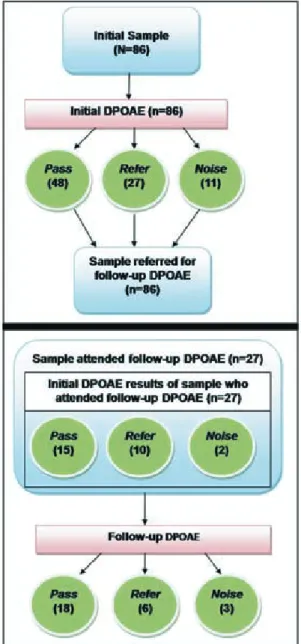
Initially 86 neonates were screened using distortion product OAE. For the current analysis, a ‘pass’ result was indicated by either a unilateral or bilateral ‘pass’. ‘Pass’ results were obtained for 48 of the neonates at the initial screening session. Twenty-seven neonates had ‘refer’ findings, while high noise artifacts precluded testing for 11. All 86 neonates were referred for follow-up screening as outpatients to confirm the presence or absence of hearing loss and to ensure reliability of findings. However, of the total baseline sample, only 27 returned for a follow-up outpatient screening, giving a 31.4% return rate.
Of the 27 neonates who attended follow-up screening, 15 had passed the initial screening and 10 had ‘refer’ results (37.0%). Noise artifacts were too high during testing of the remaining 2 neonates. Follow-up OAE screening as outpatients revealed bilateral ‘pass’ results for 11 of the neonates, unilateral ‘pass’ results for 7, and ‘refer’ results for 6. Noise artifacts were too high for 3 of the neonates. Two neonates who had initially presented with bilateral ‘pass’ results obtained bilateral ‘refer’ results on follow-up screening. Of the 6 neonates who initially presented with bilateral ‘refer’ results, 3 obtained bilateral ‘pass’ results and 3 a unilateral ‘pass’ result on follow-up screening. Two neonates who initially presented with a unilateral ‘refer’ result obtained bilateral ‘pass’ results at follow-up screening (Fig. 1). Hence, of the 27 neonates who attended the outpatient follow-up screening, 11 were shown to have bilateral normal hearing and 7 to have unilateral normal hearing.
The 27 VLBW neonates who attended the follow-up screening presented with one or more risk factors for hearing loss. All but 1 were preterm and had neonatal jaundice, 5 were in the NICU for more than 48 hours, and 4 were on mechanical ventilation. With regard to HIV, 4 neonates were HIV positive, 18 were HIV negative, results were unknown for 5, and one caregiver refused to provide consent for testing.
All but 8 mothers lived in close proximity to the hospital. Of the 8 mothers who lived outside the hospital catchment area, 4 failed to attend the outpatient follow-up screening. Most mothers lived within 10 km from the hospital. Fifty-two per cent of mothers who lived within 11 - 20 km of the hospital attended follow-up screening, whereas only 25% of those who lived within 1 - 10 km attended. However, of the 27 who attended the follow-up screening, those living within 1 - 10 km from the hospital had a higher attendance rate than those living 11 - 20 km from the hospital (Table I).
SAJCH DECEMBER 2010 VOL. 4 NO. 4
97
Discussion
Follow-up return rates after discharge from hospital are principal indicators of the efficiency and effectiveness of
hearing screening programmes as well as of parent compliance.7
The poor follow-up in the current study undermines ability to
identify hearing loss,15 as well as to establish and document
prevalence rates of hearing loss at any given point in time. This is of particular concern in our population, where there is already an established risk for developmental delay.
Findings from the current study support concern about the effective implementation of EHDI in developing countries. Our findings correlate with reports from a pilot study performed at immunisation clinics in South Africa, where
one of the main barriers of the hearing screening programme was found to be poor follow-up, with only 40% of initial screening referrals returning for follow-up screening, and the figure decreasing even further to 11% for return for
diagnostic assessment.16 This barrier has been identified as
the most significant challenge to identification of hearing loss
in developed countries.17 To overcome it, it has been proposed
that aligning follow-up screenings with routine immunisation visits may improve return rates in developing countries, and that more comprehensive coverage could be attained if this
approach is adopted.16
Poor follow-up return rates may also be attributed to other factors. A survey of mothers of newborn infants revealed that poor follow-up was related to the lack of awareness within the community with regard to screening for hearing loss, the impact of hearing loss on the child’s development, and
the importance of strategies to reduce these consequences.18
Another study reported that parents perceived there to be
no identifiable problem contributing to poor follow-up.19
These factors have clinical significance, as they highlight the importance of the role of the audiologist in counselling and
education of parents19 on the function and importance of
regular hearing assessment as well as the impact of hearing loss on development. Such counselling could even be done during the antenatal period.
Pre-screening education for community health workers and parents was incorporated in a recent community-based infant hearing screening programme in Lagos, Nigeria. Results indicated that of a total of 287 infants referred for follow-up screening, less than half (137) returned for the second-stage
screening.10 The authors suggested that reasons for a high
proportion of loss to follow-up subsequent to initial screening included minimal prompting by screening staff, that caregivers were not traceable, and that hearing loss was perceived as not
to be life-threatening.10 Similarly, our study showed that the
follow-up return rate was likely to have been influenced by distance the family lived from the hospital rather than factors such as maternal age or affordability of services.
In an earlier study, when education was provided to Missouri parents (in the form of brochures) nurses and doctors reported an improvement in the follow-up return rate over a 3-year period despite not achieving the 70% benchmark for individual
screening programmes in Missouri during that period.20 This
study included assistance from the state department of health in the form of letters reminding parents to have follow-up testing performed.
While maternal or caregiver factors are commonly thought to be associated with poor follow-up return rates, some authors reported that infants with characteristics such as low birth weight or admission to a special care baby unit are more
likely not to be brought for follow-up screening.14 Infant ill
health and mortality may also contribute to poor follow-up return rates, and this could have been a significant factor in the VLBW infants in our study, particularly those weighing under 1 000 g and BBA. A study at our hospital between July 2006 and June 2007 revealed that being BBA was among the predictors of survival rates in VLBW neonates, and that the survival rate of neonates below 1 000 g was lower than that
for those weighing between 1 001 and 1 501 g.21 The follow-up
return rate needs to be looked at within its context (i.e. the population being screened, and the type of newborn hearing screening). The current study involved targeted screening in a vulnerable population, whereas similar studies in developed countries may primarily have been based on UNHS.
TABLE I. ATTENDANCE AT FOLLOW-UP SCREEN-ING BASED ON DISTANCE PATIENTS
LIVED FROM THE HOSPITAL
Distance from Attended Failed to attend
hospital (km) Total follow-up follow-up
1 - 10 60 15 45
11 - 20 23 12 11
21 - 35 2 0 2
36 - 50 1 0 1
The facts that all 27 infants in the current study who attended the follow-up session had one or more risk factors for hearing loss, and that 19% still presented with ‘refer’ findings at follow-up, highlight the importance of ensuring that solid strategies are put in place to ensure improved return rates for these infants.
Follow-up is the most difficult part of an EHDI programme, and it is vital that obstacles to follow-up be identified and
ways to eliminate barriers be found.22 Audiologists and other
health care professionals, such as neonatologists and nursing staff involved in the care of the neonate, can assist in improving follow-up return rates by ensuring good communication with caregivers. Nursing staff are not routinely involved in hearing screening in provincial hospitals in South Africa, but their role involves constant involvement and information exchange with caregivers. It is therefore important for audiologists to ensure that they are regularly
provided with information regarding hearing screening and that their involvement with regard to hearing screening is encouraged.
Communication with caregivers can include education and counselling regarding the risk factors for hearing loss, the reasons for early identification, the importance of follow-up visits, and the implications of undetected hearing loss.
Apart from pre-screening
education, improving protocols to reduce unnecessary referrals for follow-up screening may also be beneficial. In determining the number of neonates presenting with ‘refer’ results, findings from the current study indicate a high initial OAE referral rate of 59%. This initial rate is significantly higher than the specified benchmark of a 4% follow-up referral rate recommended by the HPCSA
(2007).6 If the screening protocol
of a unilateral pass is applied in the current study, the referral rate decreases from 59% to 36%. This is, however, still significantly higher than the specified benchmark.
Some screening protocols are believed to be associated with high referral rates, particularly when screening is limited to the use of OAE only, even
within multiple screenings.7
This may have been the reason for high referral rates found in the current study, as initial
screening and follow-up
screening were limited to the use of OAEs only.
Conclusion
The poor follow-up return rate in the current study resulted in insufficient information
to determine the true hearing function of the participants, and the prevalence of hearing loss in the VLBW population. Follow-up screening should be performed during neonatal follow-up clinics in provincial hospitals where such services are available. This may assist in changing perceptions of the importance of hearing screening, as caregivers may begin to view it as being as important as medical follow-up. Referral rates decrease or are minimal when the use of OAE and automated auditory brainstem response (AABR) are combined in a screening protocol. However, the high cost of AABR may
pose a limitation in developing countries.7
Conflict of interest. The authors have no conflicting interests.
References
1. Rossetti LM. Communication Intervention: Birth to Three. 2nd ed. San Diego, CA: Singular Thomson Learning, 2001: 1-45.
Seretide
®
the No.1 prescribed
combination in asthma control
1
Now accessible to
more asthma sufferers
The Original
60N
OW AVAILABL
E
FOXAIR
NEW TMThe more accessible
equivalent
60
The original molecule
By the originator company
In the original Accuhaler®
S4 SERETIDE® 50/100 ACCUHALER® – 33/21.5.4/0413, SERETIDE® 50/250 ACCUHALER® – 33/21.5.4/0414, SERETIDE® 50/500 ACCUHALER® – 33/21.5.4/0415. Composition: ACCUHALER® – Each blister contains a mixture of salmeterol xinafoate equivalent to 50µg of salmeterol and microfi ne fl uticasone propionate (100µg, 250µg or 500µg). Contains lactose as excipient. Applicant: GlaxoSmithKline South Africa (Pty) Ltd; (Co. Reg. No. 1948/030135/07), Private Bag X173, Bryanston, 2021. Tel +27 11 745 6000. Fax +27 11 745 700. SE/0810/859. S4 FOXAIR 50/100 ACCUHALER® – 42/21.5.4/0581, FOXAIR 50/250 ACCUHALER® – 42/21.5.4/0582, FOXAIR 50/500 ACCUHALER® – 42/21.5.4/0583. Composition: ACCUHALER® – Each blister contains a mixture of salmeterol xinafoate equivalent to 50µg of salmeterol and microfi ne fl uticasone propionate (100µg, 250µg or 500µg). Contains lactose as excipient. Applicant: Group Laboratories South Africa (Pty) Limited, T/A GlaxoSmithKline South Africa (Pty) Limited, (Co. Reg. No. 1952/001213/97), P.O. Box 44, Howard Place, 7450. Tel +27 11 507 6100. SE/0810/859
For full prescribing information, please refer to the package inserts approved by the Medicines Control Council.
Reference: 1. IMS Data, June 2010. Marketed by Aspen Pharmacare. Building 12, Healthcare Park, Woodlands Drive, Woodmead, 2191. www.aspenpharma.com Medical Information Hotline: 0800 118 088. A11936 08/10
2. Chiong C, Ostrea E, Reyes A, Llanes EG, Uy ME. Correlation of hearing screening with developmental outcomes in infants over a two-year period. Acta Otolaryngol 2007;127:384-388.
3. Horn DL, Pisoni DB, Miyamoto RT. Divergence of fine and gross motor skills in prelingually deaf children: Implications for cochlear implantation. Laryngoscope 2006;116:1500-1506.
4. Moeller MP. Early intervention and language development in children who are deaf and hard of hearing. Pediatrics 2000;106:1-9.
5. Yoshinaga-Itano C. Levels of evidence: universal newborn hearing screening (UNHS) and early hearing detection and intervention systems (EHDI). J Commun Disord 2004;37:451-465.
6. Health Professions Council of South Africa. Early Hearing Detection and Intervention Programmes in South Africa, Position Statement Year 2007. http://www.hpsca.co.za/hpcsa/default.aspx?id=137 (accessed 7 February 2010).
7. Olusanya BO, Swanepoel D, Chapchap MJ, et al. Progress towards early detection services for infants with hearing loss in developing countries.
BMC Health Serv Res 2007;7:14-28.
8. Joint Committee on Infant Hearing. Year 2000 Position Statement: Principles and Guidelines for Early Hearing Detection and Intervention Programs. Am J Audiol 2000;9:9-29.
9. Olusanya BO, Luxon LM, Wirz SL. Screening for early childhood hearing loss in Nigeria. J Med Screen 2005;12:15-118.
10. Olusanya BO, Akinyemi OO. Community-based infant hearing screening in a developing country: parental uptake of follow-up services. BMC Public Health 2009;9:66.
11. Todd NW. Universal newborn hearing screening follow-up in two Georgia populations: Newborn, mother and system correlates. Int Journal Pediatr Otorhinolaryngol 2006;70:807-815.
12. Olusanya BO, Wirz SL, Luxon LM. Hospital-based universal newborn hearing screening for early detection of permanent congenital hearing loss in Lagos, Nigeria. Int J Pediatr Otorhinolaryngol 2008;72:991-1001. 13. Mukari SZ, Tan KY, Abdullah A. A pilot project on hospital-based
universal newborn hearing screening: Lessons learned. Int J Pediatr Otorhinolaryngol 2006;70:843-851. 14. Olusanya BO. Follow-up default in
a hospital-based universal newborn hearing screening programme in a low-income country. Child Care Health Dev 2009;35:190-198. 15. Swanepoel DCD, Hugo R, Louw
B. Infant hearing screening at immunization clinics in South Africa. Int J Pediatr Otorhinolaryngol 2006;70:1241-1249.
16. Swanepoel DCD, Louw B, Hugo R. A novel service delivery model for infant hearing screening in developing countries. Int J Audiol 2009;46:321-327.
17. White KR. The current status of EHDI programs in the United States. Ment Retard Dev Disabil Res Rev 2003;9:79-88.
18. Hatzopoulos S, Qirjazi B, Martini A. Neonatal hearing screening in Albania: Results from an ongoing universal screening program. Int J Audiol 2007;46:176-182.
19. John M, Balraj A, Kurien M. Neonatal screening for hearing loss: pilot study from a tertiary care centre. Indian J Otolaryngol Head Neck Surg 2009;61:23-26.
20. Lieu JE, Karzon RK, Mange CC. Hearing Screening in the Neonatal Intensive Care Unit: Follow-up of referrals. Am J Audiol 2006;15:66-74.
21. Ballot DE, Chirwa, TF, Cooper PA. Determinants of survival in very low birth weight neonates in a public sector hospital in Johannesburg. BMC Pediatr 2010;10:30.
22. Spivak LG. Neonatal hearing screening, follow-up, and diagnosis. In: Roeser RJ, Valente M, Hosford-Dunn H, eds. Audiology: Diagnosis. 2nd ed. New York: Thieme Medical Publishers, 2007: 497-513.
Seretide
®
the No.1 prescribed
combination in asthma control
1
Now accessible to
more asthma sufferers
The Original
60N
OW
AVAILABL
E
FOXAIR
NEW TMThe more accessible
equivalent
60
The original molecule
By the originator company
In the original Accuhaler®
S4 SERETIDE® 50/100 ACCUHALER® – 33/21.5.4/0413, SERETIDE® 50/250 ACCUHALER® – 33/21.5.4/0414, SERETIDE® 50/500 ACCUHALER® – 33/21.5.4/0415. Composition: ACCUHALER® – Each blister contains a mixture of salmeterol xinafoate equivalent to 50µg of salmeterol and microfi ne fl uticasone propionate (100µg, 250µg or 500µg). Contains lactose as excipient. Applicant: GlaxoSmithKline South Africa (Pty) Ltd; (Co. Reg. No. 1948/030135/07), Private Bag X173, Bryanston, 2021. Tel +27 11 745 6000. Fax +27 11 745 700. SE/0810/859. S4 FOXAIR 50/100 ACCUHALER® – 42/21.5.4/0581, FOXAIR 50/250 ACCUHALER® – 42/21.5.4/0582, FOXAIR 50/500 ACCUHALER® – 42/21.5.4/0583. Composition: ACCUHALER® – Each blister contains a mixture of salmeterol xinafoate equivalent to 50µg of salmeterol and microfi ne fl uticasone propionate (100µg, 250µg or 500µg). Contains lactose as excipient. Applicant: Group Laboratories South Africa (Pty) Limited, T/A GlaxoSmithKline South Africa (Pty) Limited, (Co. Reg. No. 1952/001213/97), P.O. Box 44, Howard Place, 7450. Tel +27 11 507 6100. SE/0810/859
For full prescribing information, please refer to the package inserts approved by the Medicines Control Council.
Reference: 1. IMS Data, June 2010. Marketed by Aspen Pharmacare. Building 12, Healthcare Park, Woodlands Drive, Woodmead, 2191. www.aspenpharma.com Medical Information Hotline: 0800 118 088. A11936 08/10