N-Queens-based Algorithm for
Moving Object Detection in
Distributed Wireless Sensor Networks
Biljana Stojkoska, Danco Davcev and Vladimir Trajkovik
Faculty of Electrical Engineering and Information Technologies, Ss. Cyril and Methodius University, Skopje, Republic of Macedonia
The main constraint of wireless sensor networks(WSN)
in enabling wireless image communication is the high energy requirement, which may exceed even the future capabilities of battery technologies. In this paper we have shown that this bottleneck can be overcome by developing local in-network image processing algorithm that offers optimal energy consumption. Our algorithm is very suitable for intruder detection applications. Each node is responsible for processing the image captured by the video sensor, which consists of NxN blocks. If an intruder is detected in the monitoring region, the node will transmit the image for further processing. Otherwise, the node takes no action. Results provided from our experiments show that our algorithm is better than the traditional moving object detection techniques by a factor of(N/2)in terms of energy savings.
Keywords: wireless sensor networks, multimedia, image processing, motion detection
1. Introduction
In recent years, there has been a huge advance-ment in wireless sensor computing technology
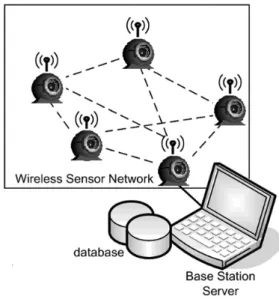
[3]. This has led to the production of wire-less sensors not only capable of observing and reporting physical phenomena, but also of ac-complishing other operations, like data process-ing and communication. The sensors are or-ganized in a network and they communicate by exchanging information using radio mod-ules. They are actually responsible for the first stages of the processing hierarchy. After taking samples from the environment they sense(light level, air temperature, humidity etc.) they can process data or exchange it. All useful packets are sent to the sink node. This node is usually wirily connected with a server which stores the
data. Server (base station) might be the final destination of the data or might act as a hub from where the data is sent to users over the wired network(Figure 1).
Figure 1.Architecture of the system.
The data is not directly sent to the sink as sensors nodes have short range of radio communication while being deployed in a vast region. There are a lot of multi-hops routing protocols that of-fer optimal communication cost. Each sensor sends data to its closest neighbor responsible for retransmitting the packets[9].
security and video surveillance. The ability of WSNs to provide support for video streaming is restricted due to the bandwidth and power limitations of the nodes. Video streams, unlike data streams, are larger in size and require vari-ous guarantees for bandwidth, delay and jitter from the network [13]. A WSN is labored to provide enough end-to-end bandwidth for such communications. In addition, sensor nodes run-ning on small batteries are power-starved, as battery technology has not been keeping pace with microelectronic technology. By using the up-to-date WSN routing protocols, this opera-tion will result in unaccepted occupaopera-tion of the bandwidth for a long period of time, which will reduce the efficiency of the system.
In such a scenario, maintaining the lifetime of the nodes and enabling the video streams to travel over the network are two diametrically opposite requirements.
In this paper we describe fast in-network image processing algorithm for surveillance applica-tion, which is especially suitable for intruder detection applications.
The rest of the paper is organized as follows. In the next section, the relevant work related to the present mote platforms for camera sen-sor network is discussed. Section three of this paper describes the traditional techniques for motion detection and explains the framework we propose for WSN image processing. The forth section explains our N-Queens-based al-gorithm for local in-network image processing. The fifth section gives the results provided from our experiments and demonstrates the effective-ness of the proposed algorithm in minimizing
energy consumption for wireless sensor com-munication. Finally, we conclude this paper in section six.
2. Related Work
Unless WSN are touted as a popular solution in surveillance systems, little work has been done in integrating image sensors into wireless node. Mica2 platform provides an easy way to add the capability of capturing images just by plug-ging a module onto the mote. The camera and the mote are interfaced using an intermediate board providing an interface to combine them
[5]. MICA motes can be purchased from Cross-bow technology, Inc. They are equipped with a radio module, 8-bit 4-7 MHz processor, mem-ory, two AA batteries and a suite of sensors[6]. Cyclops[10]is a smart vision sensor board that can be attached as an external sensor to a mote, such as the one from the Mica family (Figure 2 left). Cyclops consists of a micro-controller
(MCU), a complex programmable logic device
(CPLD), an external SRAM, an external Flash and an imager that offers a limited resolution of the images(128x128).
Weeble node architecture is another video plat-form[11]that represents an integration of low cost, wide angle camera with Mica2 motes( Fig-ure 2 right). This node is capable of taking im-ages at a maximum resolution of 640x480 and additionally can self-correct for arbitrary orien-tation.
SensEye[12] is a camera sensor network for video surveillance based on three tier architec-ture. Tier 1 consists of Cyclops nodes that wake up periodically, obtain an image of the environ-ment and process the image to detect presence of new objects using a simple frame differenc-ing mechanism. An image of the background is stored in the memory and is used for framing differences for each captured image. The frame difference is passed through a simple threshold-based noise filter to get a cleaned foreground image. The number of foreground pixels to-gether with a thresholding mechanism is used to detect new objects in the environment. Higher tiers consist of more advanced motes with high-resolution cameras.
3. Framework for WSN Image Processing
Motion detection is the first building block in a typical surveillance application. The next stages (object tracking and higher level pro-cessing) heavily depend on the accuracy and robustness of the first step of moving object de-tection[1].
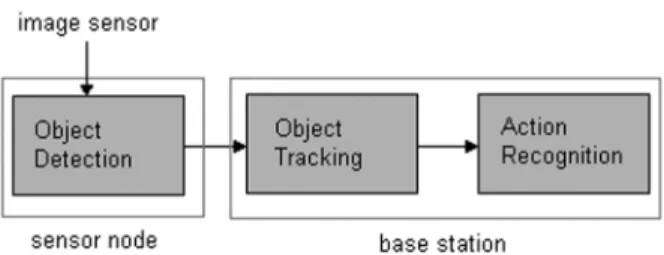
Figure 3.Generic framework for image processing algorithms.
In the traditional systems for video surveillance
(Figure 3), the video sequence is captured by the image sensor and compressed using JPEG compression. The module for motion detection receives a wide-angle camera image as an input and computes the difference between consecu-tive images. When this difference is above the threshold, it announces the presence of a mov-ing object. Motion detection is still considered as a difficult problem, due to dynamic changes in the nature, like sudden illuminations, weather changes, waving trees, water etc.
Most of the algorithms that have been pro-posed within the last years and have solved the problem of extracting moving targets from
a video stream, basically can be divided into three main groups: temporal differencing, back-ground subtraction and optical flow[1]. The op-tical flow approach is a very complex and time consuming technique that is inappropriate for such real-time applications and is not subject of our interest[1].
Temporal differencing is highly adaptive to dy-namic environments, since it uses the pixel-wise difference between two or three consec-utive frames in video imagery. This method does not perform well in extracting all relevant feature pixels, especially when the foreground object stops moving, moves slowly or its tex-ture is uniform. This algorithm is also known as temporal thresholding.
The most commonly used algorithms for motion detection are based on background subtraction. This method is very sensitive to dynamic envi-ronment, but provides complete feature data. The detection is achieved by subtracting the background from the current frame in all re-gions where they match. The background im-age is created in an initialized phase by averag-ing images over time. In order to adapt to the current environmental conditions, the reference background is updated with new images over time.
When modeling the background, there are usu-ally two common problems we are faced with:
• the presence of foreground objects during the process of modeling the background;
Such high-rate, real-time imaging applications pose significant design challenge, as they re-quire strict end-to-end delay, bandwidth, and jitter guarantees:
• In the most multi-hops routing protocols, each node sends the packets to its parent. The nodes that are highest in the routing tree
(and closest to the sink), will have the most data to transmit and will quickly exhaust their available energy. In this situation, the useful information could not reach the sink any more.
• Since multi-hop communication tends to gen-erate more interference, delay, and both hig-her packet loss and error during transmis-sion, this operation will result in unaccepted occupation of the bandwidth for a long pe-riod of time. Interference and high packet loss rate affect the bandwidth and delay val-ues of the route. This cannot satisfy the strict quality of service requirements, such as sus-taining transmission of high quality data at a high bit-rate.
To overcome the bottlenecks of wireless im-age communication, we propose two-level ar-chitecture for video surveillance systems. The nodes represent the first level since they are re-sponsible for image capturing and initial frame processing. Image sensor nodes must process the images in-node to extract relevant features before transmission. Nodes locally apply the algorithms for motion detection, and if the pro-vided results are decided to be useful, the pic-ture is compressed and sent to the sink. Various compression standards have been analyzed for WSN efficient power management, but JPEG is considered as the most appropriate technique
[4][8].
The second level is represented by the server
(base station) which is responsible for further analysis (object tracking and action recogni-tion)as shown on Figure 4.
Figure 4.Image processing framework in large scale wireless sensor networks.
This architecture suits well for large scale net-works used for applications such as military tracking or intruder detection. The nodes are scattered randomly in a hostile and unattended environment. After deployment, they would form a topology map and would start to monitor the area for any movement or unusual activity. If a particular node detects a moving object, it could compress the current frame (or only the critical block of the frame)and send it over the network to the base station.
4. In-network Motion Detection
WSN framework for image processing discussed in previous section reflects only on reducing network traffic, therefore minimizing commu-nicational cost and increasing lifetime of the network. Another issue that arises in wireless image sensor networks is the complex image processing algorithms, which are both mem-ory and computational intensive. Data encod-ing/decoding involves significant processing, much more than the processing required for other sensed data. Further, aggregation at the intermediate nodes requires complicated algo-rithms and higher processing power.
These requirements make image processing a challenging problem, as sensor nodes are re-source constraint devices. Memory limitations, local computational energy cost and processor speed have to be considered in order to guar-antee real-time response. To rise above these shortcomings, we propose a new fast algorithm for motion detection.
We were inspired by the famous problem of N-Queens distribution on a chess field. The queens are put on an N×N chessboard such that no two queens attack each other. This N-queens based paradigm was previously proposed for block matching techniques, as in[12]where N-Queen pixel decimation is used for fast motion estimation. We apply a similar idea as a tech-nique for motion detection.
4.1. N-queens-based Algorithm for Motion Detection
• none of said N blocks occupies a position in the same row as any other one of said N blocks;
• none of said N blocks occupies a position in same column as any other one of said N blocks; and,
• none of said N blocks occupies a position in the same diagonal as any other one of said N blocks.
It is very possible that most of the moving object trajectories can cross at least one queen. It is because we expect that trajectories in the nature are usually continual. It is not very common to have zig-zag trajectories.
By applying modified background subtraction technique, we propose to reduce the image anal-ysis. Instead of comparing all N2 blocks from
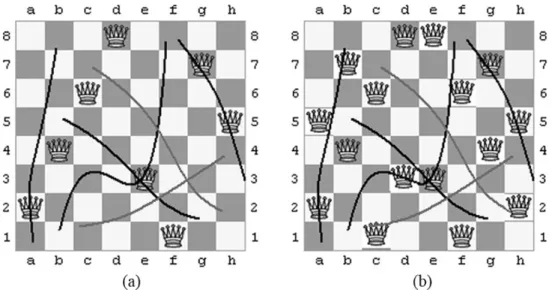
background and current image, we can compare only N blocks that belong to the queens, hoping that moving object will cross at least one queen. We made a small experiment. At the begin-ning 64 queens were placed on 32 x 32 grid cells. Generating random trajectories, for each we check if it passes though at least one queen. We had positive results in 75% of 100 sam-ples. As can be seen from the picture (Figure 5 (a)), the trajectories with grey color are not captured. To decrease this possibility, queens can be applied on more positions. One way is by reflecting the initial N queens across central vertical line (Figure 5 (b)). This distribution we call double N queens distribution. Other combinations are also possible. For double N queens distribution the experiment was positive in 95%.
Motivated by this analysis, we propose the fol-lowing algorithm:
Step 1. capture first image;
Step 2. store first image in background frame buffer;
Step 3. forever:
• capture new image
• store new image in the input frame buffer
• divide the input frame into N columns and N rows;
• choose N referent blocks that correspond to the positions of N-Queens problem distribu-tion;
• compare each of the N blocks from the input frame with the same block from the back-ground frame;
• if the difference of at least one block is above the threshold, send the frame to the sink and go to step 3;
• if the difference is below the threshold, up-date the background frame and go to step 3.
The main challenge here is modeling the back-ground. For simplicity we pronounce the first frame as a background, although it can be cre-ated by averaging images over time. To respond to the environmental changes, if the block dif-ference is below the threshold, we move the background frame slightly in the direction of the current frame. In other words, we update
pixels values toward new values. It has to be mentioned that choosing the threshold is not only application-specific, but also depends on the specification of the environment.
The pseudo code of the algorithm is shown be-low:
read background image;
while(true){ i:=1;
read new image;
while( i<=2*N){
q position =next(q position); s = n f[q position]-bg f [q position];
if(abs(s)>threshold){ send alarm; break;
}
else{ if(s>0)
bg f [q position]++;
else
bg f [q position]- -;
}
i++;
} }
The function read background image reads the
background image and stores it in one dimen-sional array bg f. The functionread new image
reads the new image and stores it in one dimen-sional array n f. The function send alarmsends
the new image to the sink. The function next
returns the position of the next queen which has to be processed.
5. Evaluation
First we tested our N-Queens based algorithm with double N-Queens distribution on video
streams taken from web cameras (320 × 240
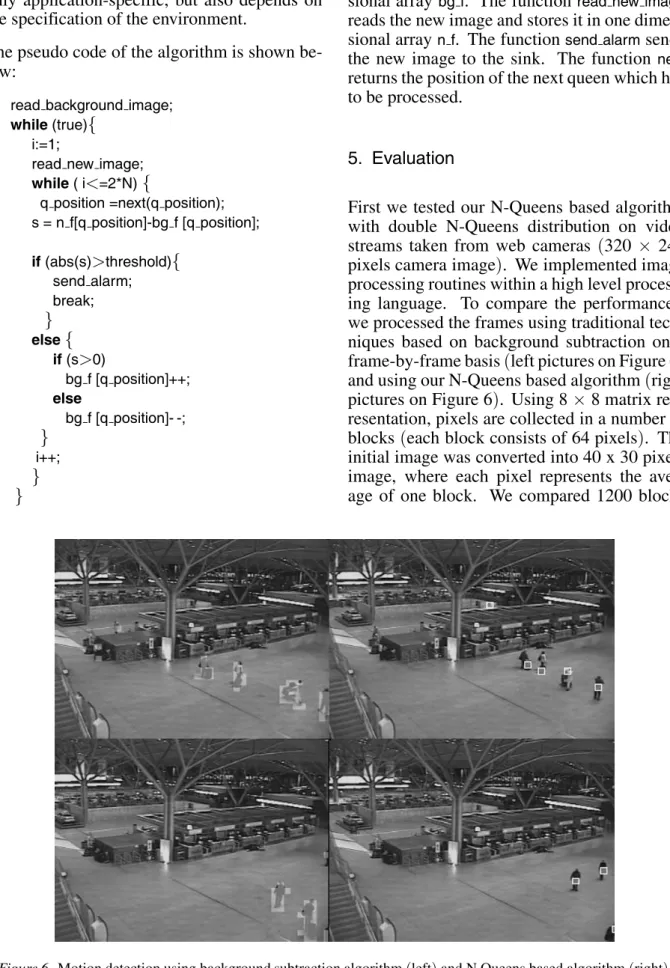
pixels camera image). We implemented image processing routines within a high level process-ing language. To compare the performances, we processed the frames using traditional tech-niques based on background subtraction on a frame-by-frame basis(left pictures on Figure 6) and using our N-Queens based algorithm(right pictures on Figure 6). Using 8×8 matrix rep-resentation, pixels are collected in a number of blocks(each block consists of 64 pixels). The initial image was converted into 40 x 30 pixels image, where each pixel represents the aver-age of one block. We compared 1200 blocks
for background subtraction and 64 blocks for N-Queens based algorithm. These 64 blocks satisfy the double N-Queens distribution. To analyze the performance achievement for Mica2 platform, simulation software was imple-mented in NesC, a structured, component-based language, very similar to the programming lan-guage C, and the testbed was simulated using Avrora[5]simulator.
We measured the energy consumption for pro-cessing one image sample. The power needed to capture the image is not included in our ex-periments. The results are shown in the table below:
Energy Usage(mJ)
Algorithm 128x128 176x255
Background Subtraction 23.19 63.78
N-Queens-based 2.9 5.79
As can be seen from the results, our N-Queens based algorithm is better than the traditional background subtraction technique by a factor of
(N/2)in terms of energy savings. As N-Queens based algorithm for moving object detection is a heuristic method, we suggest an adaptive ap-proach which is combination of our algorithm and the traditional background subtraction. For example, if we capture images at every 5 sec-onds, then four images can be processed with our algorithm, and the fifth image can be pro-cessed with traditional background subtraction method. The number of images processed with our algorithm is application specific. If we are interested in detecting intruders, we can com-pute which is the common speed of the people passing cross. If the time needed for the people to cross the whole region is 20 seconds, we can use our algorithm for 19 image samples, and the traditional method for one image sample. Such an adaptive approach should increase the robustness of the particular application.
6. Conclusion
In this paper, we presented a new WSN im-age processing framework. In our approach, each node in the network is responsible for the first stage of the processing. If an intruder is
detected, the image is transmitted to the sink. In order to minimize the energy consumption, we propose an in-network image processing al-gorithm based on the famous N-queens distri-bution of the blocks. The results we have pre-sented show that our algorithm consumes(N/2) -times less energy for local image processing than traditional techniques.
If combined with traditional techniques, this ap-proach can perform significant improvement of the network performances.
References
[1] C. IANASI, V. GUI, C. I. TOMA, D. PESCARU, A Fast Algorithm for Background Tracking in Video Surveillance, Using Nonparametric Kernel Density Estimation, FACTA UNIVERSITATIS (Nis), Se-ries: Electronics and Energetics, 18(1):127-144, April 2005
[2] C.N. WANG, S. W. YANG, C. M. LIU, T. CHIANG, A hierarchical decimation lattice based on N-Queen with a application for motion estimation, Signal Processing Letters, IEEE, 10(8): 228-231, Aug. 2003,
[3] F. L. LEWIS, Wireless Sensor Networks, chapter 4
in D. J. Cook and S. K. Das, editors, Smart Environ-ments: Technologies, Protocols, and Applications, John Wiley, New York, 2004;
[4] H. WU ANDA. ABOUZEID, “Energy Efficient
Dis-tributed JPEG2000 Image Compression in Multi-hop Wireless Networks, inProceedings of the 4th workshop on Applications and Services in Wireless Networks (ASWN), Boston, 2004.
[5] http://www.compilers.cs.ucla.edu/avrora [1/3/2008]
[6] http://www.xbow.com [1/3/2008]
[7] I. AKYILDIZ, T. MELODIA, K. R. CHOWDHURY, A
survey of wireless multimedia sensor networks, Computer Networks, 51:921-960, 2007.
[8] JOHN LACH, DAVID EVANS, JON MCCUNE, JASON
BRANDON, “Power-Efficient Adaptable Wireless
Sensor Network, .Military and Aerospace Pro-grammable Logic Devices International Confer-ence, 2003.
[9] K. AKKAYA, M. YOUNIS, A survey of routing
proto-cols in wireless sensor networks,Elsevier Ad Hoc Network Journal, 3(3):325–349, May 2005.
[10] M. RAHIMI, R. BAER, J. WARRIOR, D. ESTRIN, M.
[11] P. SAMBHOOS, A. HASAN, R. HAN, T. LOOKABAUGH,
J. MULLIGAN, Weeblevideo: Wide angle field-of-view video sensor networks. In Workshop on Dis-tributed Smart Cameras (DSC06), 2006, held in conjunction with ACM SenSys 2006.
[12] PURUSHOTTAM KULKARNI, DEEPAK GANESAN,
PRASHANTSHENOYQIFENGLU, SensEye: A
Multi-tier Camera Sensor Network, in Proceedings of the 13th ACM International Conference on Multimedia
(ACM Multimedia ’05), pp. 229–238, Singapore, November 2005.
[13] S. MISRA, M. REISSLEIN, G. XUE, A Survey of
Mul-timedia Streaming in Wireless Sensor Networks,
IEEE Communications Surveys and Tutorials, 2008.
Received:June, 2008 Accepted:September, 2008
Contact addresses: Biljana Stojkoska Faculty of Electrical Engineering and Information Technologies Karposh 2, PO Box 574, Skopje Republic of Macedonia e:mail:[email protected]
Danco Davcev Faculty of Electrical Engineering and Information Technologies Karposh 2, PO Box 574, Skopje Republic of Macedonia e:mail:[email protected]
Vladimir Trajkovik Faculty of Electrical Engineering and Information Technologies Karposh 2, PO Box 574, Skopje Republic of Macedonia
BILJANAL. STOJKOSKAobtained B.Sc. degree from the Faculty of Elec-trical Engineering at the University “Ss. Cyril & Methodius”, Skopje, Macedonia in 2006. In 2008 she received her M.Sc. degree in Computer Science from the same university.
She is currently working as teaching and research assistant at the Com-puter Science and Informatics Department at the Faculty of Electrical Engineering and Information Technology.
Her research interests include wireless sensor systems, intelligent in-formation systems, ICT based collaboration systems, distributed and multi-agent systems.
DANCOP. DAVCEVobtained the degree of Engineer in Electronics and Computer Science from the Faculty of Electrical Engineering at the University of Belgrade(YU)in 1972. He received his "Doctor – In-genieur" degree in Computer Science from the University of ORSAY (Paris, France)in 1975 and Ph.D. degree in Informatics from the Uni-versity of Belgrade(YU)in 1981.
He is currently a professor and head of Computer Science and Infor-matics Department. He is also head of EU Open and Distance Learning Center at the University "Ss. Cyril & Methodius", Skopje( Macedo-nia). He has more than 250 research papers presented on International Conferences or published in International Journals in Computer Science and Informatics.
His research interests include multimedia databases and systems, spatio-temporal data and 3D objects, intelligent information systems, distance learning systems, distributed and multi-agent systems, wireless sensor systems and system biology. He is a member of ACM and a Senior Member of IEEE.
VLADIMIRTRAJKOVIKhas obtained his degrees at the Faculty of Elec-trical engineering and Information Technologies, University “Ss. Cyril and Methodius” in Skopje, Macedonia. From February 1995 to De-cember 1997 he worked for Macedonian Telecommunications. His current position is at the Faculty of Electrical Engineering and In-formation technologies at the University “Ss. Cyril and Methodius”. During the past 5 years he published more than 60 research papers presented on International Conferences or published in International Journals in Computer Science and Informatics. In the same period, he coordinated and participated in more then 10 bilateral and multilateral EU projects.
![Figure 2. Cyclops [10] (left) weeble architecture [11] (right).](https://thumb-us.123doks.com/thumbv2/123dok_us/8042935.2129699/2.892.113.789.848.1097/figure-cyclops-left-weeble-architecture-right.webp)