Thomas C. Hales?
University of Pittsburgh [email protected]
Fig. 1.Alan Turing (image source [Ima13])
“And when it comes to mathematics, you must realize that this is the human mind at the extreme limit of its capacity.” (H. Robbins)
“. . . so reduce the use of the brain and calculate!” (E. W. Dijkstra)
“The fact that a brain can do it seems to suggest that the difficulties [of trying with a machine] may not really be so bad as they now seem.” (A. Turing)
?Research supported in part by NSF grant 0804189 and the Benter Foundation.
1
Computer Calculation
1.1 a panorama of the status quo
Where stands the mathematical endeavor?
In 2012, many mathematical utilities are reaching consolidation. It is an age of large aggregates and large repositories of mathematics: the arXiv, Math Reviews, and euDML, which promises to aggregate the many European archives such as Zentralblatt Math and Numdam. Sage aggregates dozens of mathematically oriented computer pro-grams under a single Python-scripted front-end.
Book sales in the U.S. have been dropping for the past several years. Instead, online sources such as Wikipedia and Math Overflow are rapidly becoming students’ preferred math references. The Polymath blog organizes massive mathematical collaborations. Other blogs organize previously isolated researchers into new fields of research. The slow, methodical deliberations of referees in the old school are giving way; now in a single stroke, Tao blogs, gets feedback, and publishes.
Machine Learning is in its ascendancy.LogAnswerandWolfram Alphaanswer our elementary questions about the quantitative world; Watson our Jeopardy questions. Google Pageranks our searches by calculating the largest eigenvalue of the largest ma-trix the world has ever known.Deep Blueplays our chess games. The million-dollar-prize-winningPragmatic Chaos algorithm enhances ourNetflix searches. The major proof assistants now contain tens of thousands of formal proofs that are being mined for hints about how to prove the next generation of theorems.
Mathematical models and algorithms rule the quantitative world. Without applied mathematics, we would be bereft of Shor’s factorization algorithm for quantum com-puters, Yang-Mills theories of strong interactions in physics, invisibility cloaks, Radon transforms for medical imaging, models of epidemiology, risk analysis in insurance, stochastic pricing models of financial derivatives, RSA encryption of sensitive data, Navier-Stokes modeling of fluids, and models of climate change. Without it, entire fields of engineering from Control Engineering to Operations Research would close their doors. The early icon of mathematical computing, Von Neumann, divided his final years between meteorology and hydrogen bomb calculations. Today, applications fuel the economy: in 2011 rankings, the first five of the “10 best jobs” are math or computer related: software engineer, mathematician, actuary, statistician, and computer systems analyst [CC111].
1.2 Birch and Swinnerton-Dyer conjecture
I believe that the Birch and Swinnerton-Dyer conjecture is the deepest conjecture ever to be formulated with the help of a computer [BSD65]. The Clay Institute has offered a one-million dollar prize to anyone who settles it.
LetEbe an elliptic curve defined by an equationy2 =x3+ax+bover the field of rational numbers. Motivated by related quantities in Siegel’s work on quadratic forms, Birch and Swinnerton-Dyer set out to estimate the quantity
Y
Np/p, (1)
where Np is the number of rational points on E modulo p, and the product extends
over primes p ≤ P [Bir02]. Performing experiments on the EDSAC II computer at the Computer laboratory at Cambridge University during the years 1958–1962, they observed that asPincreases, the products (1) grow asymptotically inPas
c(E) logrP,
for some constant c, where r is the Mordell-Weil rank of E; that is, the maximum number of independent points of infinite order in the group E(Q) of rational points.
Following the suggestions of Cassels and Davenport, they reformulated this numerical asymptotic law in terms of the zeta functionL(E,s) of the elliptic curve. Thanks to the work of Wiles and subsequent extensions of that work, it is known that L(E,s) is an entire function of the complex variables. The Birch and Swinnerton-Dyer conjecture asserts that the rankrof an elliptic curve overQis equal to the order of the zero of L(E,s) ats=1.
A major (computer-free) recent theorem establishes that the Birch and Swinnerton-Dyer conjecture holds for a positive proportion of all elliptic curves over Q[BS10]. This result, although truly spectacular, is mildly misleading in the sense that the elliptic curves of high rank rarely occur but pose the greatest difficulties.
1.3 Sato-Tate
The Sato-Tate conjecture is another major conjecture about elliptic curves that was discovered by computer. IfEis an elliptic curve with rational coefficients
y2=x3+ax+b,
then the number of solutions modulo a prime numberp(including the point at infinity) has the form
1+p−2√pcosθp.
for some real number 0 ≤ θp ≤ π. In 1962, Sato, Nagashima, and Namba made cal-culations ofθp on a Hitachi HIPAC 103 computer to understand how these numbers
are distributed as pvaries for a fixed elliptic curveE[Sch]. By the spring of 1963, the evidence suggested sin2θas a good fit of the data (Figure 2). That is, ifP(n) is the set of the firstnprimes, andf : [0, π]→Ris any smooth test function, then for largen,
1 n
X
p∈P(n)
f(θp) tends to
2
π
Z π
0
Fig. 2.Data leading to the Sato-Tate conjecture (image source [SN])
The Sato-Tate conjecture (1963) predicts that this same distribution is obtained, no matter the elliptic curve, provided the curve does not have complex multiplication. Tate, who arrived at the conjecture independently, did so without computer calculations.
Serre interpreted Sato-Tate as a generalization of Dirichlet’s theorem on primes in arithmetic progression, and gave a proof strategy of generalizing the analytic proper-ties ofL-functions used in the proof of Dirichlet’s theorem [Ser68]. Indeed, a complete proof of Sato-Tate conjecture has now been found and is based on extremely deep an-alytic properties ofL-functions [Car07]. The proof of the Sato-Tate conjecture and its generalizations has been one of the most significant recent advances in number theory.
1.4 transient uses of computers
It has become common for problems in mathematics to be first verified by computer and later confirmed without them. Some examples are the construction of sporadic groups, counterexamples to a conjecture of Euler, the proof of the Catalan conjecture, and the discovery of a formula for the binary digits ofπ.
(1972) predicted the existence of a sporadic group of order
28·37·56·7·11·31·37·67.
In 1973, Sims proved the existence of this group in a long unpublished manuscript that relied on many specialized computer programs. By 1999 , the calculations had become standardized in group theory packages, such as GAP and Magma [HS99]. Eventually, computer-free existence and uniqueness proofs were found [MC02], [AS92].
Another problem in finite group theory with a computational slant is the inverse Galois problem: is every subgroup of the symmetric groupSn the Galois group of a
polynomial of degreenwith rational coefficients? In the 1980s Malle and Matzat used computers to realize many groups as Galois groups [MM99], but with an infinite list of finite groups to choose from, non-computational ideas have been more fruitful, such as Hilbert irreducibility, rigidity, and automorphic representations [KLS08].
Euler conjectured (1769) that a fourth power cannot be the sum of three positive fourth powers, that a fifth power cannot be the sum of four positive fifth powers, and so forth. In 1966, a computer search [LP66] on a CDC 6600 mainframe uncovered a counterexample
275+845+1105+1335=1445,
which can be checked by hand (I dare you). The two-sentence announcement of this counterexample qualifies as one of the shortest mathematical publications of all times. Twenty years later, a more subtle computer search gave another counterexample [Elk88]:
26824404+153656394+187967604=206156734.
The Catalan conjecture (1844) asserts that the only solution to the equation
xm−yn=1,
in positive integersx,y,m,nwith exponentsm,ngreater than 1 is the obvious
32−23=1.
That is, 8 and 9 are the only consecutive positive perfect powers. By the late 1970s, Baker’s methods in diophantine analysis had reduced the problem to an astronomically large and hopelessly infeasible finite computer search. Mih˘ailescu’s proof (2002) of the Catalan conjecture made light use of computers (a one-minute calculation), and later the computer calculations were entirely eliminated [Mih04], [Met03].
Bailey, Borwein, and Plouffe found an algorithm for calculating thenth binary digit ofπdirectly: it jumps straight to thenth digit without first calculating any of the earlier digits. They understood that to design such an algorithm, they would need an infinite series forπin which powers of 2 controlled the denominators. They did not know of any such formula, and made a computer search (using the PSLQ lattice reduction algorithm) for any series of the desired form. Their search unearthed a numerical identity
π=
∞
X
n=0
4 8n+1−
2 8n+4−
1 8n+5 −
1 8n+6
!
1 16
!n
,
1.5 Rogers-Ramanujan identities
The famous Rogers-Ramanujan identities
1+
∞
X
k=1
qk2+ak
(1−q)(1−q2)· · ·(1−qk) = ∞
Y
j=0
1
(1−q5j+a+1)(1−q5j−a+4), a=0,1.
can now be proved by an almost entirely mechanical procedure from Jacobi’s triple product identity and the q-WZ algorithm of Wilf and Zeilberger that checks identi-ties ofq-hypergeometric finite sums [Pau94]. Knuth’s foreword to a book on the WZ method opens, “Science is what we understand well enough to explain to a computer. Art is everything else we do.” Through the WZ method, many summation identities have become a science [PWZ96].
1.6 packing tetrahedra
Aristotle erroneously believed that regular tetrahedra tile space: “It is agreed that there are only three plane figures which can fill a space, the triangle, the square, and the hexagon, and only two solids, the pyramid and the cube” [AriBC]. However, centuries later, when the dihedral angle of the regular tetrahedron was calculated:
arccos(1/3)≈1.23<1.25664≈2π/5,
it was realized that a small gap is left when five regular tetrahedra are grouped around a common edge (Figure 3). In 1900, in his famous list of problems, Hilbert asked “How can one arrange most densely in space an infinite number of equal solids of given form, e.g., spheres with given radii or regular tetrahedra . . . ?”
Fig. 3.Regular tetrahedra fail to tile space (image source [Doy11]).
was found using Monte Carlo experiments. In the numerical simulations, a finite num-ber of tetrahedra are randomly placed in a box of variable shape. The tetrahedra are jiggled as the box slowly shrinks until no further improvement is possible. Now that a precise conjecture has been formulated, the hardest part still remains: to give a proof.
Fig. 4.The best packing of tetrahedra is believed to be the Chen-Engel-Glotzer arrangement with density 4000/4671≈0.856 (image source [CEG10]).
1.7 the Kepler conjecture
Hilbert’s 18th problem asks to find dense packings of both spheres and regular tetra-hedra. The problem of determining the best sphere packing in three dimensions is the Kepler conjecture. Kepler was led to the idea of density as an organizing principle in nature by observing the tightly packed seeds in a pomegranate. Reflecting on the hexag-onal symmetry of snowflakes and honeycombs, by capping each honeycomb cell with a lid of the same shape as the base of the cell, he constructed a closed twelve-sided cell that tiles space. Kepler observed that the familiar pyramidal cannonball arrangement is obtained when a sphere is placed in each capped honeycomb cell (Figure 5). This he believed to be the densest packing.
L. Fejes T´oth proposed a strategy to prove Kepler’s conjecture in the 1950s, and later he suggested that computers might be used. The proof, finally obtained by Ferguson and me in 1998, is one of the most difficult nonlinear optimization problems ever rigorously solved by computer [Hal05b]. The computers calculations originally took about 2000 hours to run on Sparc workstations. Recent simplifications in the proof have reduced the runtime to about 20 hours and have reduced the amount of customized code by a factor of more than 10.
1.8 the four-color theorem
Fig. 5.An optimal sphere packing is obtained by placing one sphere in each three-dimensional honeycomb cell (image source [RhD11]).
most four colors in such a way that contiguous countries receive different colors. The proof of this theorem required about 1200 hours on an IBM 370-168 in 1976. So much has been written about Appel and Haken’s computer solution to this problem that it is pointless to repeat it here [AHK77]. Let it suffice to cite a popular account [Wil02], a sociological perspective [Mac01], the second generation proof [RSST97], and the cul-minating formal verification [Gon08].
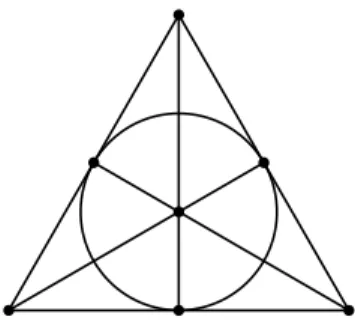
1.9 projective planes
A finite projective plane of ordern > 1 is defined to be a set ofn2+n+1 lines and n2+n+1 points with the following properties:
1. Every line containsn+1 points; 2. Every point is onn+1 lines;
3. Every two distinct lines have exactly one point of intersection; 4. Every two distinct points lie on exactly one line.
The definition is an abstraction of properties that evidently hold forP2(Fq), the
pro-jective plane over a finite fieldFq, withq =n, for any prime powerq. In particular, a
finite projective plane exists whenevernis a positive power of a prime number (Fig-ure 6).
The conjecture is that every finite projective plane of ordern>1 is a prime power. The smallest integersn>1 that arenotprime powers are
6, 10, 12, 14, 15, . . .
The brute force approach to this conjecture is to eliminate each of these possibilities in turn. The casen = 6 was settled in 1938. Building on a number of theoretical ad-vances [MST73], Lam eliminated the casen =10 in 1989, in one of the most difficult computer proofs in history [LTS89]. This calculation was executed over a period of years on multiple machines and eventually totaled about 2000 hours of Cray-1A time.
Unlike the computer proof of the four-color theorem, the projective plane proof has never received independent verification. Because of the possibilities of programming errors and soft errors (see Section 3.5), Lam is unwilling to call his result a proof. He writes, “From personal experience, it is extremely easy to make programming mistakes. We have taken many precautions, . . . Yet, I want to emphasize that this is only an ex-perimental result and it desperately needs an independent verification, or better still, a theoretical explanation” [Lam91].
Recent speculation atMath Overflow holds that the next case, n = 12, remains solidly out of computational reach [Hor10].
1.10 hyperbolic manifolds
Computers have helped to resolve a number of open conjectures about hyperbolic man-ifolds (defined as complete Riemannian manman-ifolds with constant negative sectional cur-vature−1), including the proof that the space of hyperbolic metrics on a closed hyper-bolic 3-manifold is contractible [GMT03], [Gab10].
1.11 chaos theory and strange attractors
The theory of chaos has been one of the great success stories of twentieth century math-ematics and science. Turing1 expressed the notion of chaos with these words, “quite
small errors in the initial conditions can have an overwhelming effect at a later time. The displacement of a single electron by a billionth of a centimetre at one moment might make the difference between a man being killed by an avalanche a year later, or escaping” [Tur50]. Later, the metaphor became a butterfly that stirs up a tornado in Texas by flapping its wings in Brazil.
Thirteen years later, Lorenz encountered chaos as he ran weather simulations on a Royal McBee LGP-30 computer [Lor63]. When he reran an earlier numerical solution with what he thought to be identical initial data, he obtained wildly different results.
1For early history, see [Wol02, p. 971]. Turing vainly hoped that digital computers might be
He eventually traced the divergent results to a slight discrepancy in initial conditions caused by rounding in the printout. The Lorenz oscillator is the simplified form of Lorenz’s original ordinary differential equations.
A setAisattractingif it has a neighborhoodUsuch that
A=\
t≥0
ft(U),
where ft(x) is the solution of the dynamical system (in present case the Lorenz
oscil-lator) at timetwith initial condition x. That is,U flows towards the attracting setA. Simulations have discovered attracting sets with strange properties such as non-integral Hausdorffdimension and the tendency for a small slab of volume to quickly spread throughout the attractor.
Fig. 7.The Lorenz oscillator gives one of the most famous images of mathematics, astrange
attractorin dynamical systems (image source [Aga13]).
Lorenz conjectured in 1963 that his oscillator has a strange attractor (Figure 7). In 1982, the Lax report cited soliton theory and strange attractors as two prime examples of the “discovery of new phenomena through numerical experimentation,” and calls such discovery perhaps the most “significant application of scientific computing” [Lax82]. Smale, in his list of 18 “Mathematical Problems for the Next Century” made the four-teenth problem to present a rigorous proof that the dynamics of the Lorenz oscillator is a strange attractor [Sma98] with various additional properties that make it a “geometric Lorenz attractor.”
Smale’s list in general envisions a coming century in which computer science, es-pecially computational complexity, plays a much larger role than during the past cen-tury. He finishes the list with the open-ended philosophical problem that echoes Turing: “What are the limits of intelligence, both artificial and human?”
1.12 4/3
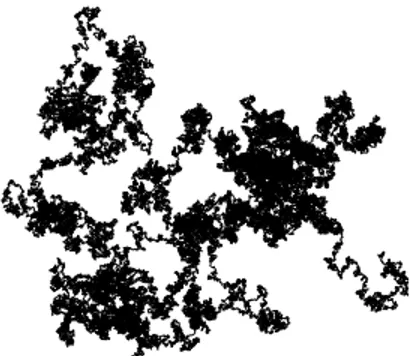
Mandelbrot’s conjectures in fractal geometry have resulted in two Fields Medals. Here he describes the discovery of the 4/3-conjecture made in [Man82]. “The notion that these conjectures might have been reached by pure thought – with no picture – is sim-ply inconceivable.. . . I had my programmer draw a very big sample [Brownian] motion and proceeded to play with it.” He goes on to describe computer experiments that led him to enclose the Brownian motion into black clusters that looked to him like islands with jagged coastlines (Figure 8). “[I]nstantly, my long previous experience with the coastlines of actual islands on Earth came handy and made me suspect that the bound-ary of Brownian motion has a fractal dimension equal to 4/3” [Man04].
This conjecture, which Mandelbrot’s trained eye spotted in an instant, took 18 years to prove [LSW01].
402 GREGORY F. LAWLER, ODED SCHRAMM, AND WENDELIN WERNER
Figure 1.Simulation of a planar Brownian path
it had been established that the dimension of the frontier, cut points, and pio-neer points are 2−ξ(2,0),2−ξ(1,1),and 2−ξ(1,0), respectively. Duplantier and Kwon [4] were the first to conjecture the valuesξ(1,1) = 5/4, ξ(1,0) = 1/4 using ideas from conformal field theory. Duplantier has also developed another non-rigorous approach to these results based on “quantum gravity” (see e.g. [3]). For a more complete list of references and background, see e.g. [9].
2. Intersection exponents
LetB1, B2, . . . , Bj+kbe independent planar Brownian motions with
uni-formly distributed starting points on the unit circle. LetTl
Rdenote the first
time at whichBlreaches the circle of radiusR, and letωj
R=Bj[0, TRj]. The
intersection exponentξ(j, k) is defined by the relation
P!(ω1
R∪ · · · ∪ωjR)∩(ωRj+1∪ · · · ∪ωjR+k) =∅ "
≈R−ξ(j,k), R
→ ∞, wheref≈gmeans lim(logf /logg) = 1. Using subadditivity, it is not hard to see that there are constantsξ(j, k) satisfying this relation. Let
ZR=ZR(ωR1, . . . , ωRj) :=P[ (ω1R∪ · · · ∪ωjR)∩ω
j+1
R =∅ |ω1R, . . . , ωjR].
Then
E[Zk
R]≈R−ξ(j,k), R→ ∞.
(2.1)
In the latter formulation, there is no need to restrict to integerk; this defines
ξ(j, λ) for allλ >0. The existence of these exponents is also very easy to
Fig. 8.A simulation of planar Brownian motion. Mandelbrot used “visual inspection supported
by computer experiments” to formulate deep conjectures in fractal geometry (image generated from source code at [LSW01]).
1.13 sphere eversion visualization
Smale (1958) proved that it is possible to turn a sphere inside out without introducing any creases.2 For a long time, this paradoxical result defied the intuition of experts.
R. Bott, who had been Smale’s graduate advisor, refused to believe it at first. Levy writes that trying to visualize Smale’s mathematical argument “is akin to describing
2I am fond of this example, because The Scientific American article [Phi66] about this theorem
what happens to the ingredients of a souffl´e in minute detail, down to the molecular chemistry, and expecting someone who has never seen a souffl´e to follow this ‘recipe’ in preparing the dish” [Lev95].
Fig. 9.Computer-generated stages of a sphere eversion (image source [Op111]).
It is better to see and taste a souffl´e first. The computer videos of this theorem are spectacular. Watch them on YouTube! As we watch the sphere turn inside out, our intuition grows. The computer calculations behind the animations of the first video (the Optiverse) start with a sphere, half inverted and half right-side out [SFL]. From halfway position, the path of steepest descent of an energy functional is used to calculate the unfolding in both directions to the round spheres, with one fully inverted (Figure 9). The second video is based on Thurston’s “corrugations” [LMM94]. As the name suggests, this sphere eversion has undulating ruffles that dance like a jellyfish, but avoids sharp creases. Through computers, understanding.
1.14 minimal surface visualization
Weber and Wolf [WW11] report that the use of computer visualization has become “commonplace” in minimal surface research, “a conversation between visual aspects of the minimal surfaces and advancing theory, each supporting the other.” This started when computer illustrations of the Costa surface (a particular minimal surface, Fig-ure 10) in the 1980s revealed dihedral symmetries of the surface that were not seen directly from its defining equations. The observation of symmetry turned out to be the key to the proof that the Costa surface is an embedding. The symmetries further led to a conjecture and then proof of the existence of other minimal surfaces of higher genus with similar dihedral symmetries. As Hoffman wrote about his discoveries, “The im-ages produced along the way were the objects that we used to make discoveries. They are an integral part of the process of doing mathematics, not just a way to convey a discovery made without their use” [Hof87].
Fig. 10.The Costa surface launched an era of computer exploration in minimal surface theory
(image source [San12]).
1.15 double bubble conjecture
Closely related to minimal surfaces are surfaces of constant mean curvature. The mean curvature of a minimal surface is zero; surfaces whose mean curvature is constant are a slight generalization. They arise as surfaces that are minimal subject to the constraint that they enclose a region of fixed volume. Soap bubble films are surfaces of constant mean curvature.
shared disk is determined by the condition that angles should be 120◦ where the three surfaces meet. This is thedouble bubble conjecture.
The first case of double bubble conjecture to be established was that of two equal volumes [HHS95]. The proof was a combination of conventional analysis and computer proof. Conventional analysis (geometric measure theory) established the existence of a minimizer and reduced the possibilities to a small number of figures of revolution, and computers were to analyze each of the cases, showing in each case by interval analysis either that the case was not a local minimizer or that its area was strictly larger than the double bubble. Later theorems proved the double bubble conjecture in the general unequal volume case without the use of computers [HMRR00].
Fig. 11.The optimality of a double bubble was first established by computer, using interval anal-ysis (image source [Tsi13]).
The natural extension of the double bubble conjecture from two bubbles to an in-finite bubbly foam is the Kelvin problem. The problem asks for the surface area mini-mizing partition of Euclidean space into cells of equal volume. Kelvin’s conjecture – a tiling by slight perturbations of truncated octahedra – remained the best known partition until a counterexample was constructed by two physicists, Phelan and Weaire in 1993 (Figure 12). The counterexample exists not as a physical model, nor as an exact mathe-matical formula, but only as an image generated from a triangular mesh in theSurface Evolvercomputer program. By default, the counterexample has become the new con-jectural answer to the Kelvin problem, which I fully expect to be proved someday by computer.
1.16 kissing numbers
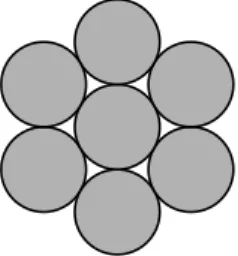
In the plane, at most six pennies can be arranged in a hexagon so that they all touch one more penny placed at the center of the hexagon (Figure 13). Odlyzko and Sloane, solved the corresponding problem in dimension 8: at most 240 nonoverlapping congruent balls can be arranged so that they all touch one more at the center.
Up to rotation, a unique arrangement of 240 exists. To the cognoscenti, the proof of this fact is expressed as one-line certificate:
(t−1
2)t
2
(t+1 2)
2
Fig. 12.The Phelan-Weaire foam, giving the best known partition of Euclidean space into cells of equal volume, was constructed with Surface Evolver software. This foam inspired the bubble design of the Water Cube building in the 2008 Beijing Olympics (image source [PW111]).
Fig. 13.In two dimensions, the kissing number is 6. In eight dimensions, the answer is 240. The proof certificate was found by linear programming.
(For an explanation of the certificates, see [PZ04].) The certificate was produced by a linear programming computer search, but once the certificate is in hand, the proof is computer-free.
1.17 digression onE8
It is no coincidence that the calculation of Odlyzko and Sloane works in dimension 8. Wonderful things happen in eight dimensional space and again in 24 dimensions.
Having mentioned the 240 balls in eight dimensions, I cannot resist mentioning some further computer proofs. The centers of the 240 balls are vectors whose integral linear combinations generate a lattice inR8, known as theE8lattice (Figure 14).
There is a packing of congruent balls in eight dimensions that is obtained by center-ing one ball at each vector in theE8lattice, making the balls as large as possible without
overlap. Everyone believes that this packing in eight dimensions is the densest possible, but this fact currently defies proof. If the center of the balls are the points of a lattice, then the packing is called alattice packing. Cohn and Kumar have a beautiful computer assisted proof that the E8 packing is the densest of all lattice packings inR8(and the
corresponding result in dimension 24 for the Leech lattice). The proof is based on the Poisson summation formula. Pfender and Ziegler’s account of this computer-assisted proof won the Chauvenet Prize of the MAA for writing [PZ04].
Fig. 14.TheE8lattice is generated by eight vectors inR8whose mutual angles are 120◦or 90◦
depending on whether the corresponding dots are joined by a segment are not.
The 240 vectors that generate theE8lattice are therootsof a 240+8 dimensional Lie
group (also calledE8); that is, a differentiable manifold that has the analytic structure of
a group. All simple Lie groups were classified in the nineteenth century.3They fall into
infinite families named alphabetically, An,Bn,Cn,Dn, with 5 more exceptional cases
that do not fall into infinite familiesE6,E7E8,F4,G2. The exceptional Lie group4of
highest dimension isE8.
The long-termAtlas Projectaims to use computers to determine all unitary repre-sentations of real reductive Lie groups [Atl]. The 19-member team focused onE8first,
because everyone respects the formidableE8. By 2007, a computer had completed the
character table of E8. Since there are infinitely many irreducible characters and each
character is an analytic function on (a dense open subset of) the group, it is not clear without much further explanation what it might even mean for a computer to output the full character table as a 60 gigabyte file [Ada11]. What is significant about this work is that it brings the computer to bear on some abstract parts of mathematics that have been traditionally largely beyond the reach of concrete computational description,
3I describe the families over
C. Each complex Lie group has a finite number of further real
forms.
4For decades,E8 has stood for the ultimate in speculative physics, whether in heterotic string
including infinite dimensional representations of Lie groups, intersection cohomology and perverse sheaves. Vogan’s account of this computational project was awarded the 2011 Conant Prize of the AMS [Vog07].
While on the topic of computation and representation theory, I cannot resist a di-gression into the P versus NP problem, the most fundamental unsolved problem in mathematics. In my opinion, attempts to settlePversusNPfrom the axioms of ZFC are ultimately as ill-fated as Hilbert’s program in the foundations of math (which nonethe-less spurred valuable partial results such as the decision procedures of Presburger and Tarski), but if I were to place faith anywhere, it would be in Mulmuley’s program in geometric complexity theory. The program invokes geometric invariant theory and rep-resentation theoretic invariants to tease apart complexity classes: if the irreducible con-stituents of modules canonically associated with two complexity classes are different, then the two complexity classes are distinct. In this approach, the determinant and per-manent of a matrix are chosen as the paradigms of what is easy and hard to compute, opening up complexity theory to a rich algebro-geometric structure [Mul11], [For09].
1.18 future computer proofs
Certain problems are natural candidates for computer proof: the Kelvin problem by the enumeration of the combinatorial topology of possible counterexamples; the search for a counterexample to the two-dimensional Jacobian conjecture through the minimal model program [Bor09]; resolution of singularities in positive characteristic through an automated search for numerical quantities that decrease under suitable blowup; ex-istence of a projective plane of order 12 by constraint satisfaction programming; the optimality proof of the best known packing of tetrahedra in three dimensions [CEG10]; Steiner’s isoperimetric conjecture (1841) for the icosahedron [Ste41]; and the Reinhardt conjecture through nonlinear optimization [Hal11]. But proceed with caution! Check-ing on our zeal for brute computation, computer-generated patterns can sometimes fail miserably. For example, the sequence:
&
2 21/n−1
'
−
$
2n log 2
%
, n=1,2,3, . . .
starts out as the zero sequence, but remarkably first gives a nonzero value when n reaches 777,451,915,729,368 and then again whenn = 140,894,092,055,857,794. See [Sta07].
TEX Active-DVI, AUCTEX, TEXmacs, Kile, WhizzyTEX computer algebra Axiom, CoCoA4, GAP, Macaulay2, Maxima,
PARI/GP, Risa/Asir, Sage, Singular, Yacas numerical calc Octave, Scilab, FreeFem++, Yorick
visualization 3D-XplorMath-J, Dynagraph, GANG, Geomview, gnuplot, JavaView, K3DSurf
geometry C.a.R, Dr.Geo, GeoGebra, GEONExT, KidsCindy, KSEG programming CLISP, Eclipse, FASM, Gauche, GCC, Haskell, Lisp
Prolog, Guile, Lazarus, NASM, Objective Caml, Perl, Python, Ruby, Squeak
Fig. 15.Some free mathematical programs on the Knoppix/Math DVD [Ham08].
2
Computer Proof
Proof assistants represent the best effort of logicians, computer scientists, and mathe-maticians to obtain complete mathematical rigor by computer. This section gives a brief introduction to proof assistants and describes various recent projects that use them.
The first section described various computer calculations in math, and this section turns to computer reasoning. I have never been able to get used to it being the math-ematicians who use computers for calculation and the computers scientists who use computers for proofs!
2.1 design of proof assistants
A formal proof is a proof that has been checked at the level of the primitive rules of inference all the way back to the fundamental axioms of mathematics. The number of primitive inferences is generally so large that it is quite hopeless to construct a formal proof by hand of anything but theorems of the most trivial nature. McCarthy and de Bruijn suggested that we program computers to generate formal proofs from high-level descriptions of the proof. This suggestion has led to the development of proof assistants. Aproof assistantis an interactive computer program that enables a user to generate a formal proof from its high-level description. Some examples of theorems that have been formally verified by proof assistants appear in Figure 16. The computer code that implements a proof assistant lists the fundamental axioms of mathematics and gives procedures that implement each of the rules of logical inference. Within this general framework, there are enormous variations from one proof assistant to the next. The feature table in Figure 16 is reproduced from [Wie06]. The columns list different proof assistants, HOL, Mizar, etc.
LCF (for Logic of Computable Functions) that had been designed by Dana Scott a few years earlier. A long series of innovations (such as goal-directed proofs and tactics, the ML language, enforcing proof integrity through the type system, conversions and theorem continuations, rewriting with discrimination nets, and higher-order features) have led from LCF to HOL.
Year Theorem Proof System Formalizer Traditional Proof
1986 First Incompleteness Boyer-Moore Shankar G¨odel
1990 Quadratic Reciprocity Boyer-Moore Russinoff Eisenstein 1996 Fundamental - of Calculus HOL Light Harrison Henstock
2000 Fundamental - of Algebra Mizar Milewski Brynski
2000 Fundamental - of Algebra Coq Geuvers et al. Kneser
2004 Four Color Coq Gonthier Robertson et al.
2004 Prime Number Isabelle Avigad et al. Selberg-Erd¨os
2005 Jordan Curve HOL Light Hales Thomassen
2005 Brouwer Fixed Point HOL Light Harrison Kuhn
2006 Flyspeck I Isabelle Bauer-Nipkow Hales
2007 Cauchy Residue HOL Light Harrison classical
2008 Prime Number HOL Light Harrison analytic proof
2012 Odd Order Theorem Coq Gonthier Feit-Thompson
Fig. 16.Examples of Formal Proofs, adapted from [Hal08].
Without going into full detail, I will make a few comments about what some of the features mean. Different systems can be commended in different ways: HOL Light for its small trustworthy kernel, Coq for its powerful type system, Mizar for its extensive libraries, and Isabelle/HOL for its support and usability.
small proof kernel. If a proof assistant is used to check the correctness of proofs, who checks the correctness of the proof assistant itself? De Bruijn proposed that the proofs of a proof assistant should be capable of being checked by a short piece of computer code – something short enough to be checked by hand. For example, the kernel of the proof assistant HOL Light is just 430 lines of very readable computer code. The architecture of the system is such that if these 430 lines are bug free then it is incapable5 of generating a theorem that hasn’t been properly proved.
automating calculations. Mathematical argument involves both calculation and proof. The foundations of logic often specify in detail what constitutes a mathematical proof (a
proof assistant HOL Mizar PVS Coq Otter
/
Ivy
Isabelle
/
Isar
Alf
a
/
Agda
A
CL2
PhoX IMPS Metamath Theorema Le
go
Nuprl Ωme
g
a
B
method
Minilog
small proof kernel (‘proof objects’)+ - - + + + + - + - + - + - + - + calculations can be proved automatically+ - + + + + - + + + - + + + + + + extensible/programmable by the user + - + + - + - - - + + - + powerful automation + - + - + + - + - + - + - - + + -readable proof input files - + - - - + - + - - - + -constructive logic supported - - - + - + + - - - + - + + - - +
logical framework - - - + - - - - + -typed + + + + - + + - + + - - + + + - + decidable types + + - + - + + - + + - - + - + - + dependent types - + + + - - + - - - + + -based on higher order logic + - + + - + + - + + - + + + + -based on ZFC set theory - + - - - + - - - - + - - - - + -large mathematical standard library + + + + - + - - - + - - - +
-Fig. 17.Features of proof assistants [Wie06]. The table is published by permission from Springer Science Business Media B.V.
sequence of logical inferences from the axioms), but downgrade calculation to second-class status, requiring every single calculation to undergo a cumbersome translation into logic. Some proof assistants allowreflection(sometimes implausibly attributed to Poincar´e), which admits as proof the output from a verified algorithm (bypassing the expansive translation into logic of each separate execution of the algorithm) [Poi52, p. 4], [Bar07].
A Mathematical Gem – Proving the Excluded Middle
The logic of HOL Light is intuitionistic until the axiom of choice is introduced and classical afterwards. By a result of Diononescu [Bee85], choice and extensionality imply the law of excluded middle:
φ∨ ¬φ.
The proof is such a gem that I have chosen to include it as the only complete proof in this survey article. Consider the two sets of booleans
P1={x|(x=false)∨((x=true)∧φ)} and
P2={x|(x=true)∨((x=false)∧φ))}.
The sets are evidently nonempty, because false∈P1and true∈P2. By choice, we
may pickx1∈P1andx2∈P2; and by the definition ofP1andP2:
(x1=false)∨(x1=true), (x2=false)∨(x2=true).
We may break the proof of the excluded middle into four cases, depending on the two possible truth values of each ofx1andx2.
Cases(x1,x2)=(true,true),(x1,x2)=(true,false): By the definition ofP1, ifx1 =
true, thenφ, soφ∨ ¬φ.
Case(x1,x2)=(false,false): Similarly, by the definition ofP2, ifx2=false, thenφ,
so alsoφ∨ ¬φ.
Case(x1,x2)=(false,true): Ifφ, thenP1=P2, and the choicesx1andx2reduce to
a single choicex1 = x2, which contradicts (x1,x2)=(false,true). Henceφimplies
logical framework. Many different systems of logic arise in computer science. In some proof assistants the logic is fixed. Other proof assistants are more flexible, allowing different logics to be plugged in and played with. The more flexible systems implement a meta-language, a logical framework, that gives support for the implementation of multiple logics. Within a logical framework, the logic and axioms of a proof assistant can themselves be formalized, and machine translations6 can be constructed between
different foundations of mathematics [IR11].
type theory. Approaching the subject of formal proofs as a mathematician whose prac-tice was shaped by Zermelo-Fraenkel set theory, I first treated types as nothing more than convenient identifying labels (such real number, natural number, list of integers, or boolean) attached to terms, like the PLU stickers on fruit that get peeled away before consumption. Types are familiar from programming languages as a way of identifying what data structure is what. In the simple type system of HOL Light, to each term is affixed a unique type, which is either a primitive type (such as the boolean typebool), a type variable (A,B,C, . . .), or inductively constructed from other types with the arrow constructor (A→ B,A→(bool→C), etc.). There is also a way to create subtypes of existing types. If the types are interpreted naively as sets, thenx:Aasserts that the term xis a member ofA, and f : A → Basserts that f is a member ofA → B, the set of functions fromAtoB.
In untyped set theory, it is possible to ask ridiculous questions such as whether the real numberπ = 3.14. . ., when viewed as a raw set, is a finite group. In fact, in a random exploration of set theory, like a monkey composing sonnets at the keyboard, ridiculous questions completely overwhelm all serious content. Types organize data on the computer in meaningful ways to cut down on the static noise in the system. The question aboutπand groups is not well-typed and cannot be asked. Russell’s paradox also disappears:X <X is not well-typed. For historical reasons, this is not surprising:
Russell and Whitehead first introduced types to overcome the paradoxes of set theory, and from there, through Church, they passed into computer science.
Only gradually have I come to appreciate the significance of a comprehensivetheory of types. The type system used by a proof assistant determines to a large degree how much of a proof the user must contribute and how much the computer automates behind the scenes. The type system isdecidableif there is a decision procedure to determine the type of each term.
A type system isdependent if a type can depend on another term. For example, Euclidean spaceRn, depends on its dimensionn. For this reason, Euclidean space is
most naturally implemented in a proof assistant as a dependent type. In a proof assistant such as HOL Light that does not have dependent types, extra work is required to develop a Euclidean space library.
6My long term Flyspeck project seeks to give a formal proof of the Kepler conjecture [Hal05a].
2.2 propositions as types
I mentioned the naive interpretation of each typeAas a set and a termx:Aas a member of the set. A quite different interpretation of types has had considerable influence in the design of proof assistants. In this “terms-as-proofs” view, a type A represents a proposition and a term x:A represents a proof of the proposition A. A term with an arrow type, f :A→ B, can be used to to construct a prooff(x) ofBfrom a proofxof A. In this interpretation, the arrow is logical implication.
A further interpretation of types comes from programming languages. In this “terms-as-computer-programs” view, a term is a program and the type is its specification. For example, f : A → Bis a program f that takes input of typeAand returns a value of typeB.
By combining the “terms as proofs” with the “terms as computer programs” in-terpretations, we get the famousCurry-Howard correspondencethat identifies proofs with computer programs and identifies each proposition with the type of a computer program. For example, the most fundamental rule of logic,
A, A→B
B , (modus ponens)
(fromAandA-implies-BfollowsB) is identified with the function application in a com-puter program; fromx:Aand f :A →Bwe get f(x):B. To follow the correspondence is to extract an executable computer program from a mathematical proof. The Curry-Howard correspondence has been extremely fruitful, with a multitude of variations, running through a gamut of proof systems in logic and identifying each with a suitable programming domain.
2.3 proof tactics
In some proof assistants, the predominant proof style is a backward style proof. The user starts with agoal, which is a statement to be proved. In interactive steps, the user reduces the goal to successively simpler goals until there is nothing left to prove.
Each command that reduces a goal to simpler goals is called atactic. For example, in the proof assistant HOL Light, there are about 100 different commands that are tactics or higher-order operators on tactics (called tacticals). Figure 18 shows the most commonly used proof commands in HOL Light. The most common tactic isrewriting, which takes a theorem of the forma=band substitutesbfor an occurrence ofain the goal.
name purpose usage
THEN combine two tactics into one 37.2%
REWRITE usea=bto replaceawithbin goal 14.5%
MP TAC introduce a previously proved theorem 4.0%
SIMP TAC rewriting with conditionals 3.1%
MATCH MP TAC reduce a goalbtoa, given a theorema=⇒b 3.0%
STRIP TAC (bookkeeping) unpackage a bundled goal 2.9%
MESON TAC apply first-order reasoning to solve the goal 2.6%
REPEAT repeat a tactic as many times as possible 2.5%
DISCH TAC (bookkeeping) move hypothesis to the assumption list 2.3% EXISTS TAC instantiate an existential goal∃x. . . 2.3%
GEN TAC instantiate a universal goal∀x. . . 1.4%
Fig. 18.A few of the most common proof commands in the HOL Light proof assistant
2.4 first-order automated reasoning
Proof by Resolution
Resolution is the granddaddy of automated reasoning in first-order logic. The reso-lution rule takes two disjunctions
P∨A and ¬P0∨B
and concludes
A0∨B0,
whereA0 andB0 are the specializations of AandB, respectively, under the most
general unifierofPandP0. (Examples of this in practice appear below.)
This box presents a rather trivial example of proof by resolution, to deduce the easy theorem asserting that every infinite set has a member. The example will use the following notation. Let∅be a constant representing the empty set and constantc representing a given infinite set. We use three unary predicates e, f, i that have interpretations
e(X) “Xis empty”, f(X) “Xis finite”, i(X) “Xis infinite.”
The binary predicate (∈) denotes set membership. We provei(c)⇒ (∃z.z∈ c) “an infinite set has a member” by resolution.
To argue by contradiction, we introduce the hypothesisi(c) and the negated conclu-sion¬(Z ∈c) as axioms. Here are the axioms that we allow in the deduction. The axioms have been preprocessed, stripped of quantifiers, and written as a disjunction of literals. Upper case letters are variables.
Axiom Informal Description
1.i(c) Assumption of desired theorem.
2.¬(Z∈c) Negation of conclusion of desired theorem. 3.e(X)∨(u(X)∈X) A nonempty set has a member.
4.e(∅) The empty set is empty.
5. f(∅) The empty set is finite.
6.¬i(Y)∨ ¬f(Y) A set is not both finite and infinite. 7.¬e(U)∨ ¬e(V)∨ ¬i(U)∨i(V) Weak indistinguishability of empty sets.
Here are the resolution inferences from this list of axioms. The final step obtains the desired contradiction.
Inference Resolvant
8. (resolving 2,3, unifyingXwithcandu(X) withZ) e(c)
9. (resolving 7,8, unifyingUwithc) ¬e(V)∨ ¬i(c)∨i(V)
10. (resolving 1,9) ¬e(V)∨i(V)
11. (resolving 4,10, unifyingVwith∅) i(∅) 12. (resolving 6,11, unifyingYwith∅) ¬f(∅)
13. (resolving 12,5) ⊥
Writing about first-order automated reasoning, Huet and Paulin-Mohring [BC04] describe the situation in the early 1970s as a “catastrophic state of the art.” “The stan-dard mode of use was to enter a conjecture and wait for the computer’s memory to ex-haust its capacity. Answers were obtained only in exceptionally trivial cases.” They go on to describe numerous developments (Knuth-Bendix, LISP, rewriting technologies, LCF, ML, Martin-L¨of type theory, NuPrl, Curry-Howard correspondence, dependent types, etc.) that led up to the Coq proof assistant. These developments led away from first-order theorem proving with its “thousands of unreadable logical consequences” to a highly structured approach to theorem proving in Coq.
First-order theorem proving has developed significantly over the years into sophis-ticated software products. They are no longer limited to “exceptionally limited cases.” Many different software products compete in an annual competition (CASC), to see which can solve difficult first-order problems the fastest. The LTB (large theory batch) division of the competition includes problems with thousands of axioms [PSST08]. Sig-nificantly, this is the same order of magnitude as the total number of theorems in a proof assistant. What this means is that a first-order theorem provers have reached the stage of development that they might be able to give fully automated proofs of new theorems in a proof assistant, working from the full library of previously proved theorems.
sledgehammer. The Sledgehammer tactic is Paulson’s implementation of this idea of full automation in the Isabelle/HOL proof assistant [Pau10]. As the name ‘Sledgeham-mer’ suggests, the tactic is all-purpose and powerful, but demolishes all higher math-ematical structure, treating every goal as a massive unstructured problem in first-order logic. IfLis the set of all theorems in the Isabelle/HOL library, andgis a goal, it would be possible to hand offthe problemL =⇒ gto a first-order theorem prover. However, success rates are dramatically improved, when the theorems inLare first assessed by heuristic rules for their likely relevance for the goalg, in a process calledrelevance filtering. This filtering is used to reduceLto an axiom setL0of a few hundred theorems
that are deemed most likely to proveg.
The problemL0=⇒gis stripped of type information, converted to a first-order, and fed to first-order theorem provers. Experiments indicate that it is more effective to feed a problem in parallel into multiple first-order provers for a five-second burst than to hand the problem to the best prover (Vampire) for a prolonged attack [Pau10], [BN10]. When luck runs in your favor, one of the first-order theorem provers finds a proof.
The reconstruction of a formal proof from a first-order proof can encounter hurdles. For one thing, when type information is stripped from the problem (which is done to improve performance), soundness is lost. “In unpublished work by Urban, MaLARea [a machine learning program for relevance ranking] easily proved the full Sledgeham-mer test suite by identifying an inconsistency in the translated lemma library; once MaLARea had found the inconsistency in one proof, it easily found it in all the oth-ers” [Pau10], [Urb07]. Good results have been obtained in calling the first-order prover repeatedly to find a smaller set of axiomsL00 ⊂ L0that imply the goalg. A
manage-ably sized setL00is then passed to the metis tactic7in Isabelle/HOL, which constructs
a formal proofL00=⇒gfrom scratch.
B¨ohme and Nipkow took 1240 proof goals that appear in several diverse theories of the Isabelle/HOL system and ran sledgehammer on all of them [BN10]. The results are astounding. The success rate (of obtaining fully reconstructed formal proofs) when three different first-order provers run for two-minutes each was 48%. The proofs of these same goals by hand might represent years of human labor, now fully automated through a single new tool.
Sledgehammer has led to a new style of theorem proving, in which the user is pri-marily responsible for stating the goals. In the final proof script, there is no explicit men-tion of sledgehammer. Metis proves the goals, with sledgehammer operating silently in the background to feed metis with whatever theorems it needs. For example, a typical proof script might contain lines such as [Pau10]
hence“x⊆spaceM”
by(metis sets into space lambda system sets)
The first line is the goal that the user types. The second line has been automatically inserted into the proof script by the system, with the relevant theoremssets, into
etc. selected by Sledgehammer.
2.5 computation in proof assistants.
One annoyance of formal proof systems is the difficulty in locating the relevant theo-rems. At last count, HOL Light had about 14,000 theorems and nearly a thousand pro-cedures for proof construction. Larger developments, such as Mizar, have about twice as many theorems. Good search tools have somewhat relieved the burden of locating theorems in the libraries. However, as the formal proof systems continue to grow, it becomes ever more important to find ways to use theorems without mentioning them by name.
As an example of a feature which commendably reduces the burden of memoriz-ing long lists of theorem names, I mention the REAL RING command in HOL Light, which is capable of proving any system of equalities and inequalities that holds over an arbitrary integral domain. For example, I can give a one-line formal proof of an isogeny (x1,y1)7→(x2,y2) of elliptic curves: if we have a point on the first elliptic curve:
y21=1+ax21+bx41,
x2y1=x1,
y2y21=(1−bx 4 1),
y1,0
then (x2,y2) lies on a second elliptic curve
y22=1+a0x22+b0x42,
The algorithm works in the following manner. A universally quantified system of equalities and inequalities holds over all integral domains if and only if it holds over all fields. By putting the formula in conjunctive normal form, it is enough to prove a finite number of polynomial identities of the form:
(p1=0)∨ · · · ∨(pn=0)∨(q1,0)∨ · · · ∨(qk,0). (2)
An element in a field is zero, if and only if it is not a unit. Thus we may rewrite each polynomial equality pi = 0 as an equivalent inequality 1−pizi , 0. Thus, without
loss of generality, we may assume thatn=0; so that all disjuncts are inequalities. The formula (2) is logically equivalent to
(q1=0)∧ · · · ∧(qk=0)=⇒false.
In other words, it is enough to prove that the zero set of the idealI = (q1, . . . ,qn) is
empty. For this, we may use Gr¨obner bases8to prove that 1∈I, to certify that the zero
set is empty.
Gr¨obner basis algorithms give an example of acertificate-producing procedure. A formal proof is obtained in two stages. In the first stage an unverified algorithm pro-duces a certificate. In the second stage the proof assistant analyzes the certificate to confirm the results. Certificate-producing procedures open the door to external tools, which tremendously augment the power of the proof assistant. The meson is procedure implemented this way, as a search followed by verification. Other certificate-producing procedures in use in proof assistants are linear programming, SAT, and SMT.
Another praiseworthy project is Kaliszyk and Wiedijk’s implementation of a com-puter algebra system on top of the proof assistant HOL Light. It combines the ease of use of computer algebra with the rigor of formal proof [KW07]. Even with its nota-tional idiosyncrasies (&and#as a markers of real numbers,Cxas a marker of complex numbers,iifor √−1, and--for unary negation), it is the kind of product that I can imagine finding widespread adoption by mathematicians. Some of the features of the system are shown in Figure 19.
2.6 formalization of finite group theory
The Feit-Thompson theorem, or odd-order theorem, is one of the most significant theo-rems of the twentieth century. (For his work, Thompson was awarded the three highest honors in the mathematical world: the Fields Medal, the Abel Prize, and the Wolf Prize.) The Feit-Thompson theorem states that every finite simple group has even order, except for cyclic groups of prime order. The proof, which runs about 250 pages, is extremely technical. The Feit-Thompson theorem launched the endeavor to classify all finite sim-ple groups, a monumental undertaking that consumed an entire generation of group theorists.
Gonthier’s team has formalized the proof of the Feit-Thompson theorem [Gon12]. To me as a mathematician, nothing else that has been done by the formal proof com-munity compares in splendor to the formalization of this theorem. Finally, we are doing
8Kaliszyk’s benchmarks suggest that the Gr¨obner basis algorithm in the proof assistant Isabelle
In1 := (3 + 4 DIV 2) EXP 3 * 5 MOD 3 Out1 := 250
In2 := vector [&2; &2] - vector [&1; &0] + vec 1 Out2 := vector [&2; &3]
In3 := diff (diff (\x. &3 * sin (&2 * x) + &7 + exp (exp x)))
Out3 := \x. exp x pow 2 * exp (exp x) + exp x * exp (exp x) + -- &12 * sin (&2 * x) In4 := N (exp (&1)) 10
Out4 := #2.7182818284 + ... (exp (&1)) 10 F In5 := 3 divides 6 /\ EVEN 12
Out5 := T
In6 := Re ((Cx (&3) + Cx (&2) * ii) / (Cx (-- &2) + Cx (&7) * ii)) Out6 := &8 / &53
Fig. 19.Interaction with a formally verified computer algebra system [KW07].
real mathematics! The project formalized two books, [BG94] and [Pet00], as well as a significant body of background material.
The structures of abstract algebra – groups, rings, modules, algebras, algebraically closed fields and so forth – have all been laid out formally in the Coq proof assistant. Analogous algebraic hierarchies appear in systems such as OpenAxiom, MathScheme, Mizar, and Isabelle; and while some of these hierarchies are elaborate, none have delved so deeply as the development for Feit-Thompson. It gets multiple abstract structures to work coherently together in a formal setting. “The problem is not so much in capturing the semantics of each individual construct but rather in having all the concepts working together well” [GMR07].
Structure finGroupType Type := FinGroupType {
element :> finType; 1 : element;
−1 : element → element;
* : element → element → element; unitP : ∀x, 1∗x=x;
invP : ∀x, x−1∗x=1;
mulP : ∀x1 x2 x3, x1∗(x2∗x3)=(x1∗x2)∗x3
}.
Fig. 20.The structure of a finite group [GMR07].
Other aspects of Gonthier’s recent work can be found at [Gon11], [GGMR09], [BGBP08]. Along different lines, a particularly elegant organization of abstract alge-bra and category theory is obtained with type classes [SvdW11].
2.7 homotopy type theory
The simple type theory of HOL Light is adequate for real analysis, where relatively few types are needed – one can go quite far with natural numbers, real numbers, booleans, functions between these types, and a few functionals. However, the dependent type theory of Coq is better equipped than HOL Light for the hierarchy of structures from groups to rings of abstract algebra. But even Coq’s type theory is showing signs of strain in dealing with abstract algebra. For instance, an unpleasant limitation of Coq’s theory of types is that it lacks the theorem of extensionality for functions: if two functions take the same value for every argument, itdoes notfollow that the two functions are equal.9 The gymnastics to solve the problem of function extensionality in the context of the Feit-Thompson theorem are found in [GMR07].
A lack of function extensionality is an indication that equality in type theory may be misconceived. Recently,homotopy type theoryhas exploded onto the scene, which turns to homotopy theory and higher categories as models of type theory [HTT11]. It is quite natural to interpret a dependent type (viewed as a family of types parametrized by a second type) topologically as a fibration (viewed as a family of fibers parametrized by a base space) [AW09]. Voevodsky took the homotopical notions of equality and equivalence and translated them back into type theory, obtaining theunivalence axiom of type theory, which posits what types are equivalent [Voe11], [PW12], [KLV12b], [KLV12a]. One consequence of the univalence axiom is the theorem of extensionality for functions. Another promising sign for computer theorem-proving applications is that the univalence axiom appears to preserve the computable aspects of type theory (unlike for instance, the axiom of choice which makes non-computable choices) [LH]. We may hope that some day there may be a back infusion of type-theoretic proofs into homotopy theory.
2.8 language of mathematics
Ganesalingam’s thesis is the most significant linguistic study of the language of math-ematics to date [Gan09], [Gan10]. Ganesalingam was awarded the 2011 Beth Prize for the best dissertation in Logic, Language, or Information. Although this research is still at an early stage, it suggests that the mechanical translation of mathematical prose into formal computer syntax that faithfully represents the semantics is a realistic hope for the not-to-distant future.
The linguistic problems surrounding the language of mathematics differ in various ways from those of say standard English. A mathematical text introduces new defini-tions and notadefini-tions as it progresses, whereas in English, the meaning of words is gen-erally fixed from the outset. Mathematical writing freely mixes English with symbolic expressions. At the same time, mathematics is self-contained in a way that English can
never be; to understand English is to understand the world. By contrast, the meaning in a carefully written mathematical text is determined by Zermelo-Fraenkel set theory (or your favorite foundational system).
Ganesalingam’s analysis of notational syntax is general enough to treat quite gen-eral mixfix operations gengen-eralizing infix (e.g. +), postfix (e.g. factorial !), and prefix (cos). He analyzes subscripted infix operators (such as a semidirect productHoαN), multi-symboled operators (such as the three-symboled [ : ] operator for the de-gree [K : k] of a field-extension), prefixed words (R-module), text within formulas
{(a,b) | ais a factor ofb}, unusual script placementLG, chained relationsa < b < c,
ellipses 1+2+· · ·+n, contracted formsx,y∈N, and exposed formulas (such as “for allx>0, . . . ” to mean “for allx, ifx>0, then . . . ”).
The thesis treats what is called the formal mode of the language of mathematics – the language divested of all the informal side-remarks. The syntax is treated as a context-free grammar, and the semantics are analyzed with a variant ofdiscourse rep-resentation theory, which in my limited understanding is something very similar to first-order logic; but different in one significant aspect: it provides a theory of pronoun references; or put more precisely, a theory of what may be the “legitimate antecedent for anaphor.”
A major issue in Ganesalingam’s thesis is the resolution of ambiguity. For example, in the statement
P is prime (3)
the term ‘prime’ may mean prime number, prime ideal, or prime manifold. His solution is to attach type information to terms (in the sense of types as discussed above). The reading of (3) depends on the type ofP, variously a number, a subset of a ring, or a manifold. In this analysis, resolution of ambiguity becomes a task of a type inference engine.
Because of the need for type information, Ganesalingam raises questions about the suitability of Zermelo-Fraenkel set theory as the ultimate semantics of mathematics. A number of formal-proof researchers have been arguing in favor of typed foundational systems for many years. It is encouraging that there is remarkable convergence between Ganesalingam’s linguistic analysis, innovations in the Mizar proof assistant, and the de-velopment of abstract algebra in Coq. For example, in various camps we find ellipses (aka big operators), mixfix operators, type inference, missing argument inference mech-anisms, and so forth. Also see [Hoe11] and [Pas07]. Mathematical abuses of notation have turned out to be rationally construed after all!
2.9 looking forward
about Bruck loops10[PS08]. Eventually, we will have to content ourselves with fables that approximate the content of a computer proof in terms that humans can comprehend. Turing’s great theoretical achievements were to delineate what a computer can do in the concept of a universal Turing machine, to establish limits to what a computer can do in his solution to theEntscheidungsproblem, and yet to advocate nonetheless that computers might imitate all intelligent activity. It remains a challenging research program: to show that one limited branch of mathematics, computation, might stand for all mathematical activity.
In the century since Turing’s birth, the computer has become so ubiquitous and the idea of computer as brain so commonplace that it bears repeating that we must still think very long and hard about how to construct a computer that can imitate a living, thinking mathematician.
Proof assistant technology is still under development in labs; far more is needed before it finds widespread adoption. Ask any proof assistant researcher, and you will get a sizable list of features to implement: more automation, better libraries, and better user interfaces! Wiedijk discusses ten design questions for the next generation of proof assistants, including the type system, which axiomatic foundations of mathematics to use, and the language of proof scripts [Wie10b].
Everyone actively involved in proof formalization experiences the incessant barrage of problems that have been solved multiple times before and that other users will have to solve multiple times again, because the solutions are not systematic. To counter this, the DRY “Don’t Repeat Yourself” principle of programming, formulated in [HT00], has been carried to a refreshing extreme by Carette in his proof assistant design. For example, in his designs, a morphism is defined only once, eliminating the need for separate definitions of a morphism of modules, of algebras, of varieties, and so forth. Carette’s other design maxims include “math has a lot of structure; use it” and “abstract mathematical structures produce the best code” [CES11]. Indeed, mathematicians turn to abstraction to bring out relevant structure. This applies to computer code and math-ematical reasoning alike. American Math Society guidelines for mathmath-ematical writing apply directly to the computer: “omit any computation which is routine. . . . Merely indi-cate the starting point, describe the procedure, and state the outcome” [DCF+62] (except that computations should be automated rather than entirely omitted).
We need to separate the concerns of construction, maintenance, and presentation of proofs. The construction of formal proofs from a mathematical text is an extremely arduous process, and yet I often hear proposals that would increase the labor needed to formalize a proof, backed by secondary goals such as ease of maintenance, elegance of presentation, fidelity to printed texts, and pedagogy.11 Better to avail ourselves of au-tomation that was not available in the day of paper proofs, and to create new
mathemat-10The theorem states that Bruck loops with abelian inner mapping group are centrally nilpotent
of class two.
11To explain the concept ofseparation of concerns, Dijkstra tells the story of an old initiative to
ical styles suited to the medium, with proofs that variously look like a computer-aided design session, a functional program, or a list of hypotheses as messages in gmail. The most pressing concern is to reduce the skilled labor it takes a user to construct a formal proof from a pristine mathematical text.
The other concerns of proof transformation should be spun offas separate research activities: refactored proofs, proof scripts optimized for execution time, translations into other proof assistants, natural language translations, natural language abstracts, probabilistically checkable proofs, searchable metadata extracts, and proof mining.
For a long time, proof formalization technology was unable to advance beyond the mathematics of the 19th century, picking classical gems such as the Jordan curve the-orem, the prime number thethe-orem, or Dirichlet’s theorem on primes in arithmetic pro-gressions. With the Feit-Thompson theorem, formalization has risen to a new level, by taking on the work of a Fields medalist.
At this level, there is an abundant supply of mathematical theorems to choose from. A Dutch research agenda lists the formalization of Fermat’s Last Theorem as the first in a list of “Ten Challenging Research Problems for Computer Science” [Ber05]. Hes-selink predicts that this one formalization project alone will take about “fifty years, with a very wide margin.” Small pieces of the proof of Fermat, such as class field theory, the Langlands-Tunnell theorem, or the arithmetic theory of elliptic curves would be a fitting starting point. The aim is to develop technologies until formal verification of theorems becomes routine at the level of Atiyah-Singer index theorem, Perelman’s proof of the Poincar´e conjecture, the Green-Tao theorem on primes in arithmetic progression, or Ngˆo’s proof of the fundamental lemma.
Starting from the early days of Newell, Shaw, and Simon’s experiments, researchers have dreamed of a general-purpose mechanical problem solver. Generations later, af-ter untold trials, it remains an unwavering dream. I will end this section with one of the many proposals for a general problem solving algorithm. Kurzweil breaks general problem solving into three phases:
1. State your problem in precise terms.
2. Map out the contours of the solution space by traversing it recursively, within the limits of available computational resources.
3. Unleash an evolutionary algorithm to configure a neural net to tackle the remaining leaves of the tree.
3
Issues of Trust
We all have first-hand experience of the bugs and glitches of software. We exchange sto-ries when computers run amok. Science recently reported the story of a textbook “The Making of a Fly” that was on sale at Amazon for more than 23 million dollars [Sci11]. The skyrocketing price was triggered by an automated bidding war between two sellers, who let their algorithms run unsupervised. The textbook’s author, Berkeley professor Peter Lawrence, said he hoped that the price would reach “a billion.” An overpriced textbook on the fly is harmless, except for students who have it as a required text.
But what about the Flash Crash on Wall Street that brought a 600 point plunge in the Dow Jones in just 5 minutes at 2:41 pm on May 6, 2010? According to the New York Times [NYT10], the flash crash started when a mutual fund used a computer algorithm “to sell $4.1 billion in futures contracts.” The algorithm was designed to sell “without regard to price or time.. . . [A]s the computers of the high-frequency traders traded [fu-tures] contracts back and forth, a ‘hot potato’ effect was created.” When computerized traders backed away from the unstable markets, share prices of major companies fluc-tuated even more wildly. “Over 20,000 trades across more than 300 securities were ex-ecuted at prices more than 60% away from their values just moments before” [SEC10]. Throughout the crash, computers followed algorithms to a T, to the havoc of the global economy.
3.1 mathematical error
Why use computers to verify mathematics? The simple answer is that carefully imple-mented proof checkers make fewer errors than mathematicians (except J.-P. Serre).
Incorrect proofs of correct statements are so abundant that they are impossible to catalogue. Ralph Boas, former executive editor of Math Reviews, once remarked that proofs are wrong “half the time” [Aus08]. Kempe’s claimed proof of the four-color theorem stood for more than a decade before Heawood refuted it [Mac01, p. 115]. “More than a thousand false proofs [of Fermat’s Last Theorem] were published between 1908 and 1912 alone” [Cor10]. Many published theorems are like the hanging chad ballots of the 2000 U.S. presidential election, with scrawls too ambivalent for a clear yea or nay. One mathematician even proposed to me that a new journal is needed that unlike the others only publishes reliable results. Euclid gave us a method, but even he erred in the proof of the very first proposition of the Elements when he assumed without proof that two circles, each passing through the other’s center, must intersect. The concept that is needed to repair the gap in Euclid’s reasoning is an intermediate value theorem. This defect was not remedied until Hilbert’s ‘Foundations of Geometry.’
![Fig. 1. Alan Turing (image source [Ima13])](https://thumb-us.123doks.com/thumbv2/123dok_us/8184934.2169814/1.918.330.596.405.762/fig-alan-turing-image-source-ima.webp)
![Fig. 2. Data leading to the Sato-Tate conjecture (image source [SN])](https://thumb-us.123doks.com/thumbv2/123dok_us/8184934.2169814/4.918.317.619.166.565/fig-data-leading-sato-tate-conjecture-image-source.webp)
![Fig. 4. The best packing of tetrahedra is believed to be the Chen-Engel-Glotzer arrangement with density 4000/4671 ≈ 0.856 (image source [CEG10]).](https://thumb-us.123doks.com/thumbv2/123dok_us/8184934.2169814/7.918.395.530.277.473/packing-tetrahedra-believed-engel-glotzer-arrangement-density-source.webp)
![Fig. 7. The Lorenz oscillator gives one of the most famous images of mathematics, a strange attractor in dynamical systems (image source [Aga13]).](https://thumb-us.123doks.com/thumbv2/123dok_us/8184934.2169814/10.918.349.573.435.643/lorenz-oscillator-famous-mathematics-strange-attractor-dynamical-systems.webp)
![Fig. 9. Computer-generated stages of a sphere eversion (image source [Op111]).](https://thumb-us.123doks.com/thumbv2/123dok_us/8184934.2169814/12.918.272.652.267.646/fig-computer-generated-stages-sphere-eversion-image-source.webp)
![Fig. 10. The Costa surface launched an era of computer exploration in minimal surface theory (image source [San12]).](https://thumb-us.123doks.com/thumbv2/123dok_us/8184934.2169814/13.918.374.549.479.637/costa-surface-launched-computer-exploration-minimal-surface-theory.webp)
![Fig. 11. The optimality of a double bubble was first established by computer, using interval anal- anal-ysis (image source [Tsi13]).](https://thumb-us.123doks.com/thumbv2/123dok_us/8184934.2169814/14.918.382.542.403.513/optimality-double-bubble-established-computer-using-interval-source.webp)