UVA-SCPS Office of Mathematics Outreach with support from VADOE Mathematics and Science 1
Partnership Grant Program NCLB Title II Part B Revised 8/14/12 Mathematics Senior Level Capstone Course
Title of Unit: Golf Math Unit Designers:
Chris DuBois
Stafford County Schools
Kim Riddle
Spotsylvania County Schools
Pamela Bailey, Editor Spotsylvania County Schools
Context:
Summary of the issue, challenge,
investigation, or problem.
How does the design of the golf hole affect your ability to get a hole in one?
Number of Class Hours:
5.75 hours Unit
Design: _x_Task Based
Other Subject Areas/Disciplines Addressed:
Physics, Writing
Driving Question: How does changing the parameters of a quadratic function affect the equation of the function?
Mathematics Content Addressed:
Use pictorial representations to solve problems,
Transfer between multiple representations,
Investigate and describe the relationships among solutions of an equation and zeros of a function,
Recognize the general shape of a function,
Convert between graphic and symbolic forms of functions,
Use knowledge of transformations to write an equation given the graph of a function, and
Investigate and analyze functions.
MPE Addressed:
Problem solving, decision making, and integration
UVA-SCPS Office of Mathematics Outreach with support from VADOE Mathematics and Science 2
Partnership Grant Program NCLB Title II Part B Revised 8/14/12 Assumption of Prior
Knowledge:
Ability to graph linear and quadratic functions and find the curve of best fit; ability to transfer between multiple representations; ability to find the zeros and vertex of a quadratic function; ability to evaluate a function for given replacement value(s); ability to transform functions.
College and Career Readiness/21st Century Skills to be taught (T) during this unit or expectation (E) for student use during this unit and assessed (A):
Collaboration - students will work in pairs (or a group of 3 if needed)
E & A Research -
Communication (Oral and/or Written) – written summary of findings
E & A Technology – use a graphing calculator to evaluate and analyze data
E & A
Critical Thinking/Decision Making – organizes, analyzes, and synthesizes information to develop well-reasoned conclusions and solutions
E & A Other: (Describe)
Major Products and/or Performances:
Student presents a poster outlining the solution to the Golf Math task and shows an overview of the holes on the 7th and 8th tees to include the trajectory of the golf ball, labeling distance traveled and height of the golf ball at critical moments.
Presentation Audience: None for this unit
x Class
School
Expert Community Other:
Launch: Event or experience used to engage the students interest and inquiry:
Show students video of “angry birds” game from YouTube.
http://www.youtube.com/watch?v=s9TxM3Jpo8o
UVA-SCPS Office of Mathematics Outreach with support from VADOE Mathematics and Science 3
Partnership Grant Program NCLB Title II Part B Revised 8/14/12
Evaluation: Formative Assessments
(During the Unit)
Interview Practice Presentations
Mathematicians Journal x Notes
Preliminary
Plans/Outlines/Prototypes
x Checklists
Rough Drafts Concept maps
Field Tests x Other:
Summative Assessment (End of Project)
Written Products, with a rubric x Peer Evaluation, with a rubric
x
Oral Presentation with a rubric Self Evaluation, with
a rubric
x
Other Product(s) or
Performance(s), with a rubric
Other: fishbowl questioning
x
Resources Needed: On-site people,
facilities:
Teacher
Equipment/Technology: Graphing calculator, computer with internet access
Materials: Poster board, markers/crayons
Community Resources:
Reflection Methods: Individual, Group, and/or Whole Class
Mathematicians Journal x Small/Focus Groups
Whole Class Discussions x Fishbowl Discussions x
Survey Other:
Material Adapted From: http://www.exeter.edu/academics/72_6539.aspx and
http://www.sites4teachers.com/links/redirect.php?url=http://www.rubrics4teachers.com/pdf/PerformanceTaskRubric.pdf
UVA-SCPS Office of Mathematics Outreach with support from VADOE Mathematics and Science 4
Partnership Grant Program NCLB Title II Part B Revised 8/14/12 Unit Title: Golf Math
Driving Question: How does changing the parameters of a quadratic function affect the equation of the function?
Task/Project/Problem: How does the design of the golf hole affect your ability to get a hole in one?
ENGAGE
How will student’s interest be peaked so they will become engaged in the unit of study?
0.25 hour
Description of the activity.
Show students video of “angry birds” game from YouTube.
http://www.youtube.com/watch?v=s9TxM3Jpo8o
Teachers questions and anticipated reactions and results
What can you do to change the trajectory and distance that the angry bird flies?
Students should provide answers such as “pull back further” which increase tension or change angle of the launch. Ask for any other ideas but teacher should not give answers.
Materials and/or Resources Needed
Computer with internet access
Mathematician Journal Prompts: Identify the variables that affect the trajectory and distance that the birds fly.
EXPLORE
Teacher provides
guidance for the explorations to prepare students with the
knowledge and skills to engage in the task.
Students will self-assess prior knowledge and skills assumed for the unit.
1 Hour
Title of Activity: Ball Fall
Goals of activity: Evaluate functions for given replacement values, identify initial conditions and determine zeros of functions.
Description of the activity. (see Handout #1)
After rolling off the end of a ramp, a ball follows a curved
trajectory to the floor. To test a theory that says the trajectory can be described by an equation y = h – ax2, Sasha takes some
measurements. The end of the ramp is 128 cm above the floor, and the ball lands 80 cm downrange. In order to catch the ball in mid-flight with a cup that is 78 cm above the floor, where should Sasha place the cup?
Directions for Instructor
Students solve the problem with a partner. As a class students discuss the different methods used to solve Sasha’s question.
Teachers questions and anticipated reactions and results
What type of function is represented by the falling ball?
What does each of the variables in the given equation represent?
Mathematician Journal
Prompts: How will you find the height of the ball at any point along the trajectory? Virginia’s Senior Level Capstone Course
UVA-SCPS Office of Mathematics Outreach with support from VADOE Mathematics and Science 5
Partnership Grant Program NCLB Title II Part B Revised 8/14/12
How did you find the missing values of the constants in the equation? (Are you finding the variables or the
coefficients/constants of the equation?) How did you arrive at your final answer?
Materials and/or Resources Needed
Graphing calculator
Student self-assessment of skills required forunit - See Golf Math Handout #5
Recommendations for online tutorial and/or practice YouTube videos under graphing linear equations
Graph linear equation using slope and y-intercept
http://www.youtube.com/watch?v=x-g4c9UDZQQ Graph linear equation using y=mx+b
http://www.youtube.com/watch?v=miG-JhttnZo The intercept method
http://www.youtube.com/watch?v=5avYfw7DRo8 Graphing linear equations with tables
http://www.youtube.com/watch?v=m_mRQT7pUUw Writing linear equations
http://www.youtube.com/watch?v=u9YZxBh1AxQ Graphing linear equations by plotting points
http://www.youtube.com/watch?v=VKqledd8wUA Videos on quadratics
Quadratics: deriving an equation from data points
http://www.youtube.com/watch?v=dMHyOPIDb9o Writing quadratic equations
http://jwilson.coe.uga.edu/emt668/emat6680.f99/jones/in structional%20unit/writingquads.html
http://www.khanacademy.org Quadratic Equations by Graphing
http://static1.tenmarks.com/static/albums/Quadratic- Functions-and-Equations/Characteristics-of-Quadratic-Functions-practice.html
http://www.algebra-class.com/vertex-formula.html
EXPLAIN Skills or knowledge needed
UVA-SCPS Office of Mathematics Outreach with support from VADOE Mathematics and Science 6
Partnership Grant Program NCLB Title II Part B Revised 8/14/12
Teacher introduces the main task of the unit and
prepares students to in small group independent work...
0.5 Hour
multiple representations, find zeros and vertices of quadratic functions, evaluate functions, transform functions.
Materials/Equipment/Resources Needed
Graphing calculator, graph paper, poster board, markers/crayons, rulers.
Directions for Instructor
Divide students into groups of 2 or 3.
Go over expectations for collaborative groups as listed on peer and student assessments.
Give students copy of rubric and discuss expectations for task and final product of poster.
Students submit a written plan of action by the end of class with a description of how the group plans to approach the problem, jobs of team members, and a list of resources needed.
ELABORATE
The student groups are working independently with teacher consultations.
3 Hours
Students work with their partner on the “Golf Math” task (See below and Golf Math Handout #2). While students work the teacher interviews and monitors progress, asking probing questions as needed.
Problem:
Using a driver on the 7th tee, you hit an excellent shot, right down the middle of the level fairway. The ball follows the parabolic path described by the quadratic function h = 0.5f−0.002f 2. This relates the height h of the ball above the ground to the ball’s progress f
down the fairway. Distances are measured in yards.
(a) Use the distributive property to write this function in factored form. Notice that h = 0 when f = 0. What is the significance of this data?
(b) If you got a hole in one, how far is the hole from the tee?
(c) At what distance down the fairwaydoes the ball reach the highest point of its arc? What is the maximum height attained by the ball?
(d) Using the information from the previous questions, rewrite the equation of the function in vertex form.
(e) Now on the 8th tee which is on a plateau 10 yards above the level fairway, using the same driver creating the same trajectory, you hit another fine shot. Again, you get a hole in one.
UVA-SCPS Office of Mathematics Outreach with support from VADOE Mathematics and Science 7
Partnership Grant Program NCLB Title II Part B Revised 8/14/12
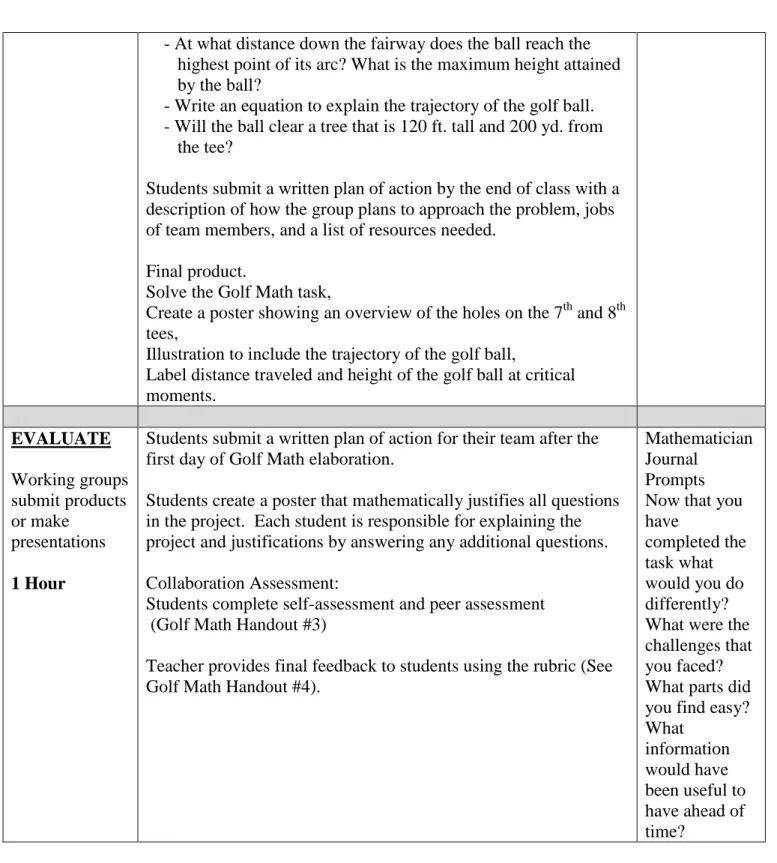
- At what distancedown the fairway does the ball reach the highest point of its arc? What is the maximum height attained by the ball?
- Write an equation to explain the trajectory of the golf ball. - Will the ball clear a tree that is 120 ft. tall and 200 yd. from the tee?
Students submit a written plan of action by the end of class with a description of how the group plans to approach the problem, jobs of team members, and a list of resources needed.
Final product.
Solve the Golf Math task,
Create a poster showing an overview of the holes on the 7th and 8th tees,
Illustration to include the trajectory of the golf ball,
Label distance traveled and height of the golf ball at critical moments.
EVALUATE
Working groups submit products or make
presentations
1 Hour
Students submit a written plan of action for their team after the first day of Golf Math elaboration.
Students create a poster that mathematically justifies all questions in the project. Each student is responsible for explaining the project and justifications by answering any additional questions.
Collaboration Assessment:
Students complete self-assessment and peer assessment (Golf Math Handout #3)
Teacher provides final feedback to students using the rubric (See Golf Math Handout #4).
Mathematician Journal
Prompts Now that you have
completed the task what would you do differently? What were the challenges that you faced? What parts did you find easy? What
UVA-SCPS Office of Mathematics Outreach with support from VADOE Mathematics and Science 8
Partnership Grant Program NCLB Title II Part B Revised 8/14/12 Map the Unit
What do students need to know and be able to do to complete the task/project/problem
successfully? How and when will they assess their own necessary knowledge and skills? How will they remediate their own gaps or weaknesses in knowledge and skills? Look at each major task for the unit and analyze the tasks necessary to produce a high-quality product.
Task: How does the design of the golf hole affect your ability to get a hole in one?
KNOWLEDGE AND SKILLS NEEDED Assumed
already learned
Students will self-assess
Will be taught during the unit 1. Evaluate functions for given replacement
values
x x
2. Graph functions x
3. Factor polynomials x x
4. Write quadratic functions in standard and vertex forms.
x x
5. Transformations of functions x x
6.
7.
What project tools will student’s use?
Know/need to know lists
Daily goal sheet
Mathematician’s Journals
Briefs/Memos
Task lists
Planning Calendar
UVA-SCPS Office of Mathematics Outreach with support from VADOE Mathematics and Science 9
Partnership Grant Program NCLB Title II Part B Revised 8/14/12 HO #1
Golf Math Exploration
UVA-SCPS Office of Mathematics Outreach with support from VADOE Mathematics and Science 10
Partnership Grant Program NCLB Title II Part B Revised 8/14/12 HO #2
Golf Math Task
Using a driver on the 7th tee, you hit an excellent shot, right down the middle of the level fairway. The ball follows the parabolic path described by the quadratic function h = 0.5f−0.002f 2. This relates the height h of the ball above the ground to the ball’s progress f down the fairway. Distances are measured in yards.
(a) Use the distributive property to write this function in factored form. Notice that h = 0 when
f = 0. What is the significance of this data?
(b) If you got a hole in one, how far is the hole from the tee?
(c) At what distance down the fairwaydoes the ball reach the highest point of its arc? What is the maximum height attained by the ball?
(d) Using the information from the previous questions, rewrite the equation of the function in vertex form.
(e) Now on the 8th tee which is on a plateau 10 yards above the level fairway, using the same driver creating the same trajectory, you hit another fine shot. Again, you get a hole in one. - How far is the hole from the tee?
- At what distancedown the fairway does the ball reach the highest point of its arc? What is the maximum height attained by the ball?
- Write an equation to explain the trajectory of the golf ball.
UVA-SCPS Office of Mathematics Outreach with support from VADOE Mathematics and Science 11
Partnership Grant Program NCLB Title II Part B Revised 8/14/12 HO #3
Peer Evaluation
Name____________________________ Partner Name_____________________
The following is a list of statements to be answered by you about your partner. Think carefully about assigning values for each of the following statements.
Directions: Put an ‘X’ in the box that applies.
My partner… Strongly
Agree Agree Neutral Disagree
Strongly Disagree
Contributed positively to discussions
Did an equal portion of the workload
Helped to keep me focused on the task
Was respectful of my ideas and opinions
Is someone I would work with again
Self Evaluation
The following is a list of statements to be answered by you about yourself. Think carefully about assigning values for each of the following statements.
Directions: Put an ‘X’ in the box that applies.
I ,________________ , (insert name here)… Strongly
Agree Agree Neutral Disagree
Strongly Disagree
Contributed positively to discussions
Did an equal portion of the workload
UVA-SCPS Office of Mathematics Outreach with support from VADOE Mathematics and Science 12
Partnership Grant Program NCLB Title II Part B Revised 8/14/12
HO #4 Golf Math Grading Rubric
Understanding Planning and Execution Communication Persistence
4
Shows complete understanding of
the required mathematical knowledge.
The solution completely addresses
all mathematical components presented in the task.
Uses only the important elements of the task.
Uses an appropriate and complete strategy for solving the
problem.
Uses only relevant information.
Uses clear and effective diagrams, tables, charts, and
graphs.
There is a clear, effective explanation
of the solution. All steps are included so the reader does not have to infer how the task was completed.
Mathematical representation is actively
used as a means of communicating ideas.
There is a precise and appropriate
mathematical terminology and notation.
Works hard on the task
and does not need much help.
Student may extend his
thinking beyond the problem and make new connections or create new problems.
3
Shows nearly complete
understanding of the required mathematical knowledge.
The solution addresses almost all of
the mathematical components presented in the task. There may be minor errors.
Uses most of the important elements of the task.
Uses an appropriate but incomplete strategy for solving the
problem.
Uses most of the relevant data
Appropriate but incomplete use of diagrams, tables, charts,
and graphs.
There is a clear explanation.
There is appropriate use of accurate
mathematical representation.
There is effective use of mathematical
terminology and notation.
Works hard on the task
and only gets help after having tried many strategies given throughout.
Completes task, working
dutifully at the harder parts also.
2
Shows some understanding of the
required mathematical knowledge.
The solution addresses some of the
mathematical components presented in the task.
Uses some of the important elements of the task.
Uses an inappropriate strategy or application of strategy is
unclear.
Uses some relevant data
Limited use or misuse of diagrams, tables, charts, and
graphs.
There is an incomplete explanation; it
may not be clearly represented.
There is some use of appropriate
mathematical representation.
There is some use of mathematical
notation appropriate to the task.
Can do simple parts of the
problem with little help.
Starts working on the
harder parts, but unless there is help, gives up.
1
Shows limited or no understanding
of the problem, perhaps only re-copying the given data.
The solution addresses none of the
mathematical components required to solve the task.
Uses none of the important elements of the task.
Works haphazardly with no particular strategy for solving
the problem.
Uses irrelevant data
Does not show use of diagrams, tables, charts, and graphs.
There is no explanation of the solution.
The explanation cannot be understood or is unrelated to the task.
There is no use or inappropriate use of
mathematical representations.
There is no use, or mostly
inappropriate use, of mathematical terminology and notation.
Needs help even for very
simple tasks.
Gives up quickly, often
UVA-SCPS Office of Mathematics Outreach with support from VADOE Mathematics and Science 13 Partnership Grant Program NCLB Title II Part B
-10
-8
-6
-4
-2
2
4
-10
-8
-6
-4
-2
2
4
6
8
10
HO #5
Golf Math Self Assessment of Prerequisite Skills
1. Evaluate each linear function for the given domain. Graph each of the linear functions in the coordinate plane below.
4 3 4 1
x
x f
5
y x
x -7 -6 -5 -4 -3 -2 -1 0 1 2 3 4 5
f(x)
x -7 -6 -5 -4 -3 -2 -1 0 1 2 3 4 5
UVA-SCPS Office of Mathematics Outreach with support from VADOE Mathematics and Science 14 Partnership Grant Program NCLB Title II Part B
2. Multiply the linear functions. Show your work. Write the new equation on the line below.
3. Evaluate the new function for the given domain. Record the data in the table below.
4. Graph the new function in the coordinate plane in question #1.
5. What are the coordinates of the vertex of the parabola? __________________________
6. Write the equation of the function in vertex form. _____________________________
7. Move the parabola seven units to the left and five units down. Using a different color, graph the new parabola in the coordinate plane above.
8. What are the coordinates of the new vertex? __________________________________
9. What is the equation of the new parabola? __________________________________
Use the graph below to answer the following questions:
x -7 -6 -5 -4 -3 -2 -1 0 1 2 3 4 5
UVA-SCPS Office of Mathematics Outreach with support from VADOE Mathematics and Science 15 Partnership Grant Program NCLB Title II Part B
10.Reflect the graph across the vertical dotted line.
11.Fill in the table with both the coordinates of the original ordered pairs and the transformed ordered pairs created by the reflection. List ordered pairs from smallest value of x to largest value of x.
12.What is the equation of the axis of symmetry? ___________________________
13.A) Are there any turning points? YES or NO
B) What are the coordinates of the turning point(s), if any? _____________________
Is this turning point a maximum or a minimum? _________________________
14.Determine the zeros of the function? ____________________________________
15.Use the transformation application on the graphing calculator to find the coefficient of the leading term. Then write the equation of the function in vertex form.
16.Write the equation of the function in standard form.
______________________________
17.Determine the y-intercept of the function?
______________________________
x
UVA-SCPS Office of Mathematics Outreach with support from VADOE Mathematics and Science 16 Partnership Grant Program NCLB Title II Part B HO #6
Comments/Answers for Handouts
HO #1
Given two points and a parent function.
Using the point (80, 0) and the height of 128 cm.
Rewrite the equation using the height at distance = 0 and the newly found a value. 2
128 0.02
y x
To answer the question of where should the cup be placed if the ball is to be caught 78 cm above the floor use substitution for the variable y representing the height to find the horizontal distance
x.
The cup should be placed 50 cm. from the starting point horizontally on the floor and 78 cm. high.
HO #2
a) h 0.002f
f 250
The significance of the point (0,0) for (f,h) is where the ball starts which is on the ground.b)
The ball will go from the hole for a hole in one 250 yd. down the fairway.
2
2
0 128 80
0 128 6400
6400 128
0.02
y h ax
a
a
a
a
2
2
2
2
128 0.02
78 128 0.02
50 0.02
2500
50
y x
x
x
x
x
0.002 0 250 0
0 250
f f
f f
UVA-SCPS Office of Mathematics Outreach with support from VADOE Mathematics and Science 17 Partnership Grant Program NCLB Title II Part B
c) Highest point is reached halfway down the fairway.
250 0 125 .
2 yd
h(125)31.25 yards
At 125 yd. the ball will reach a maximum height of 31.25 yd.
d) h f( ) 0.002
f 125
231.25e) Raising the 8th tee 10 yards above the level fairway results in a distance of 268.61 yd. to the hole. Graphical approach by transforming the existing graph 10 units up.
The ball will still reach its maximum height 125 yd down the fairway with the height increasing 10 units to 41.25 yd.
The new transformed equation is
The ball will not clear a tree that is 120 ft (or 40 yd.) tall and 200 yd. from tee.
The ball will be 30 yd. above the ground and the tree is 40 yd. tall.
HO #5
1.
x -7 -6 -5 -4 -3 -2 -1 0 1 2 3 4 5
1 3
( )
4 4
f x x -2.5
-2.25 -2
-1.75 -1.5
-1.25 -1 -.75 -.5 -.25 0 .25 .5
x -7 -6 -5 -4 -3 -2 -1 0 1 2 3 4 5
( ) 5
y x x -2 -1 0 1 2 3 4 5 6 7 8 9 10
2
2
( ) 0.002 0.5 10
( ) 0.002 125 41.25
h f f f or
h f f
2
(200) 0.002 200 0.5 200 10
(200) 30 h
h yd
UVA-SCPS Office of Mathematics Outreach with support from VADOE Mathematics and Science 18 Partnership Grant Program NCLB Title II Part B
2. Product of the two functions:
2
2 2
1 3
5
4 4
1 5 3 15
4 4 4 4
1 1 15 1
2 15
4 2 4 4
y x x
y x x x
y x x or y x x
3.
x -7 -6 -5 -4 -3 -2 -1 0 1 2 3 4 5
2
1
( ) ( ) 2 15
4
f x y x x x 5 2.25 0
-1.75 -3
-3.75 -4 -3.75 -3
-1.75 0 2.25 5
Ask students to compare and contrast the graphs and tables for f(x), y(x), and f(x)*y(x). For each of the x values their correlated y values are multiplied for the product. Where there is a zero, x-intercept, on a linear function there is also a zero on the quadratic function.
4. See number 1
5. Vertex of the parabola is (-1, -4).
y(x)
f(x) f(x)*y(x
)
UVA-SCPS Office of Mathematics Outreach with support from VADOE Mathematics and Science 19 Partnership Grant Program NCLB Title II Part B
6. ( ) ( ) 1
1
2 44
f x y x x Discuss the vertex form in relationship to the graph and
table.
7. See number 1
8. New vertex of transformed function g(x) is (-8, -9).
9. The equation of the transformed function is ( ) 1
8
2 9 4g x x .
10.See graph number 9 11.
x -3 -2 -1 0 1 2 3 4 5
( )
f x -12 -5 0 3 4 3 0 -5 -12
12.Axis of symmetry is x = 1.
13.a) Yes there is a turning point. b) turning point is at (1,4) and it is a maximum.
14. Zeros are x = -1, 3.
15. Transformed function in vertex form is relate to maximum point.
16. Standard form of the function is
17. y-intercept of the function is y(0) = 3 or (0,3).
2( ) 1 4
y x x
2
2
( ) 2 1 4
( ) 2 3
y x x x
y x x x