COMPARING BRAZILIAN AND EUROPEAN
RESULTS
November 2013
RISKS AND SAFETY ON THE
INTERNET
Alexandre Barbosa, Brian O’Neill, Cristina Ponte,
José Alberto Simões and Tatiana Jereissati
Please cite as: Barbosa, A., O’Neill, B., Ponte, C., Simões, J.A., and Jereissati, T. (2013). Risks and safety on the internet: Comparing Brazilian and European children. LSE, London: EU Kids Online.
Previous reports and publications from EU Kids Online include:
Holloway, D., Green, L., and Livingstone, S. (2013). Zero to eight. Young children and their internet use. http://eprints.lse.ac.uk/52630
Helsper, E.J., Kalmus, V., Hasebrink, U., Sagvari, B., and de Haan, J. (2013). Country classification: Opportunities, risks, harm and parental mediation. http://eprints.lse.ac.uk/52023
Livingstone, S., Kirwil, L., Ponte, C., and Staksrud, E., with the EU Kids Online Network (2013). In their own words: What bothers children online? LSE, London: EU Kids Online. http://eprints.lse.ac.uk/48357 D’Haenens, L., Vandonink, S., and Donoso, V. (2013). How to cope and build resilience. LSE, London:
EU Kids Online. http://eprints.lse.ac.uk/48115
Livingstone, S., Ólafsson, K., O’Neill, B., and Donoso, V. (2012). Towards a better internet for children: Findings and recommendations from EU Kids Online to inform the CEO coalition. LSE, London: EU Kids Online. http://eprints.lse.ac.uk/44213
Haddon, L., Livingstone, S., and the EU Kids Online Network (2012). EU Kids Online: National perspectives. LSE, London: EU Kids Online. http://eprints.lse.ac.uk/46878
Smahel, D., Helsper, E., Green, L., Kalmus, V., Blinka, L., and Ólafsson, K. (2012). Excessive internet use among European children. LSE, London: EU Kids Online. http://eprints.lse.ac.uk/47344
Dürager, A. and Livingstone, S. (2012). How can parents support children’s internet safety? http://eprints.lse.ac.uk/id/eprint/42872
Livingstone, S., Haddon, L., Görzig, A., and Ólafsson, K. (2011). EU Kids Online final report. http://eprints.lse.ac.uk/39351
Livingstone, S., Haddon, L., Görzig, A., and Ólafsson, K. (2011). Disadvantaged children and online risk. http://eprints.lse.ac.uk/39385
Livingstone, S., Ólafsson, K., and Staksrud, E. (2011). Social networking, age and privacy. http://eprints.lse.ac.uk/35849
Sonck, N., Livingstone, S., Kuiper, E., and de Haan, J. (2011). Digital literacy and safety skills. http://eprints.lse.ac.uk/33733
Hasebrink, U., Görzig, A., Haddon, L., Kalmus, V., and Livingstone, S. (2011). Patterns of risk and safety online. http://eprints.lse.ac.uk/39356
Görzig, A. (2011). Who bullies and who is bullied online? A study of 9-16 year old internet users in 25 European countries. http://eprints.lse.ac.uk/39601
O’Neill, B., Livingstone, S., and McLaughlin, S. (2011). Final recommendations for policy, methodology and research. http://eprints.lse.ac.uk/39410
Livingstone, S. and Ólafsson, K. (2011). Risky communication online. http://eprints.lse.ac.uk/33732
Livingstone, S., Haddon, L., Görzig, A., and Ólafsson, K. (2011) Risks and safety on the internet: The perspective of European children: Full findings. http://eprints.lse.ac.uk/33731
The EU Kids Online network has been funded by the EC Safer Internet Programme in three successive phases of work from 2006-14 to enhance knowledge of children’s and parents’ experiences and practices regarding risky and safer use of the internet and new online technologies.
As a major part of its activities, EU Kids Online conducted a face-to-face, in home survey during 2010 of 25,000 9- to 16-year-old internet users and their parents in 25 countries, using a stratified random sample and self-completion methods for sensitive questions. Now including researchers and stakeholders from 33 countries in Europe and beyond, the network continues to analyse and update the evidence base to inform policy.
For all reports, findings and technical survey information, as well as full details of national partners, please visit www.eukidsonline.net
CONTENTS
Summary 4
Introduction 5
THE BRAZILIAN CONTEXT ON CHILDREN’S RIGHTS, PUBLIC POLICY
AND DIGITAL SAFETY ... 5
A FAST AND UNEQUAL INTERNET PENETRATION ... 6
Brazilian children’s (aged 9-16) and parents’ online practices in 2012 8 LOCATION OF ACCESS TO THE INTERNET ... 8
DEVICES THROUGH WHICH CHILDREN ACCESS THE INTERNET ... 9
AVERAGE AGE WHEN CHILD FIRST USED THE INTERNET AND FREQUENCY OF USE ... 10
ONLINE ACTIVITIES AND FREQUENCY ... 10
SOCIAL NETWORKING ... 11
INTERNET EXPERIENCE OF PARENTS/LEGAL GUARDIANS ... 14
In their own words: Brazilian and European children reporting online risks 16 PORNOGRAPHIC AND VIOLENT CONTENT ... 19
CONDUCT-RELATED RISKS ... 20
CONTACT- RELATED CONTENTS ... 20
Conclusions 22 COMMONALITIES AND DIFFERENCES BETWEEN EUROPE AND BRAZIL ... 22
IMPROVING DIGITAL INCLUSION: RECOMMENDATIONS FOR POLICY ... 22
A note on methodology 24
Annex 1: EU Kids Online 25
SUMMARY
A child’s home and school are the most frequently reported locations of internet use in Brazil: 60% of Brazilian children aged 9 to 16 who used the internet claimed to access it from home, and 42% from school, whereas in Europe this proportion is 87% for home access and 63% for schools.
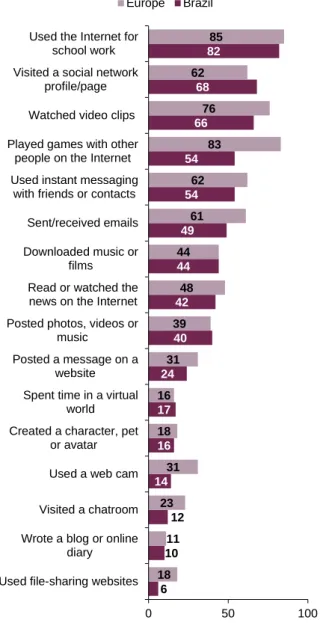
However, when it comes to accessing the network from publicly sponsored internet access centres such as Local Area Network (LAN) Houses or cybercafés, the value in Brazil is considerably higher when compared to Europe, 35% against 12% respectively. Access from public libraries is far more popular in Europe (12%) than in Brazil (4%). School activities were identified as a gateway to internet use, both in Brazil and Europe. Using the internet for school work was the most reported activity by both Brazilian and European children (82% and 85%. respectively). In Brazil, this is followed by ‘visiting a social networking profile’ (68%); in Europe playing internet games came second (83%). This result reveals the popularity of social networking among Brazilian children, being the second most mentioned activity in Brazil. The frequency of internet activities carried out by Brazilian and European children follows similar patterns of use.
Regarding internet experience of parents/legal guardians, it is worth mentioning that of all children aged 9 to 16 interviewed in Brazil, 53% lived in families where none of the parents/legal guardians was an internet user, while 47% of them had at least one parent or
legal guardian who used the internet. This contrasts with the results in Europe, where such proportions are higher.
Regardless of their socio-economic status (SES), slightly more than two thirds of Brazilian children consider they know more about the internet than their parents (from 68% among high SES to 78% among low SES). In Europe these values range from 28% (high SES) to 46% (low SES).
In terms of online risks, content-related risks rank as the highest concern among children, reported by about half of children in Europe and Brazil (58% and 49%, respectively). However, conduct-related risks present a
bigger difference (19% against 30%,
respectively). Contact-related risks are reported less frequently in both samples (13% and 12%, respectively).
Regarding experiences that bother children online, the two most reported experiences were found to be similar in both Brazil and Europe: pornography and aggressive/violent content. The next highest internet concern reported by European children referred to scary content (8%), while Brazilian children are concerned with peers’ conduct in disseminating messages that damage their reputation (10%).
It can be said that young internet users in Brazil and in Europe share similar patterns of use and activities. These similarities suggest a transnational digital culture and socialisation that includes both old and new concerns.
INTRODUCTION
The Center for Studies on Information and Communication Technologies (Cetic.br) of the Brazilian Network Information Center (NIC.br) – the executive arm of the Brazilian Internet Steering Committee (CGI.br) – has been commissioned to carry out an annual survey of Brazilian youth (aged 9-16) online. Drawing on the methodology of EU Kids Online, the survey aims to assess the risks, opportunities and issues of online safety that arise in relation to child and adolescent use of the internet. The Brazilian Kids Online Survey will be carried out on an annual basis, and intends to build a longitudinal series providing evidence to policymakers.
This report presents selected findings from the first wave of data collection carried out in 2012 in Brazil. Given the common methodological framework, the findings offer an opportunity to compare internet use and concerns as expressed by children and young people in two contrasting parts of the world yet experiencing many common aspects of
the global internet.1
The Brazilian context on
children’s rights, public policy
and digital safety
Children’s rights have long been a topic of major political and civic concern in Brazil. Against a background of large-scale poverty, years of authoritarian rule and human rights abuses, the country’s constitution in 1988 proclaimed that the rights of children and adolescents were to be treated as an ‘absolute priority’ by families, society and the
state (Article 227). In 1990, Brazil ratified the United Nations Convention on the Rights of the Child (UNCRC) and subsequently passed a domestic Bill of Rights of Children and
Adolescents (Estatuto da Criança e do
Adolescente, ECA) that is aligned with the UNCRC. A concern for child safety has been a feature of communications policy. An update to the Brazilian media rating system in 2006 developed a common classification system for media content across cinema and video games and in 2007 for media content on television. Brazil’s National Broadband Plan or PNBL is an infrastructure project that is aimed at increasing broadband access in Brazil by 2014. As a key instrument for social inclusion, providing increased internet access for children and for the general population is of upmost importance.
The size of the country and a population in excess of 200 million poses enormous challenges for awareness-raising of online safety. High illiteracy rates, the lack of educational resources or their uneven distribution across such a vast country means that online safety education remains a huge task.
The Brazilian government has been increasingly involved in tackling the problem of child pornography on the internet, particularly since 2008, working with non-governmental organisations (NGOs) and the industry to better equip law enforcement and internet service providers (ISPs) to deal with
illegal online content.2 Despite such important
online opportunities and strengthening media and information literacy for a better use of the internet in Brazil.
NGOs such as Safernet, in conjunction with the Regional Secretariats of Education and the Special Secretariat for Human Rights, and industry leaders such as the Brazilian
telecommunications company GVT, run
training of trainers’ workshops to guide coordinators in schools focusing on education for greater online opportunities and a safer use of the internet.
A fast and unequal internet
penetration
Over the last two decades, Brazil has experienced rapid economic growth and social development, such that the country is now the sixth largest economy in the world. This has led to many social benefits, evident in overall positive socio-economic and demographic indicators. However, enormous disparities in information and communications technologies (ICT) access and use remain between different geographical regions and SES.
According to the ICT Households 2012 Survey, approximately 49% of the Brazilian population aged 10 or older were characterised as internet users, that is, had accessed the internet in the three months preceding the survey. In urban areas, the proportion of internet users reached 54% of the population aged 10 or older, while in rural areas about one fifth (18%) were internet users. The proportion of households with internet access in the South and Southeast regions (47% and 48%, respectively) was
more than double that for the North and Northeast regions (21% and 27%).
In addition to geographic distribution, other factors, such as family income and SES largely influence access to the internet. Only 7% of the households where family income is below one minimum wage claimed to have internet access at home against 91% of the families whose total incomes were over five times the minimum wage. Similarly, internet access for the lowest socio-economic households was 6%, while it was 97% for the
highest.3
Most internet users (74%) accessed the internet from their homes. The workplace and other people’s homes ranked next (30% and 26%, respectively), while 19% accessed in public cybercafés. Cybercafés are a particularly relevant location of internet access for low-income (SES DE) and rural populations.
Public policies to increase internet access, such as the PNBL, implementing public telecentres and large-scale deployment of computer labs in public schools under the National Program for IT in Education (Proinfo) and National Broadband in Schools Plan, have contributed to reducing the digital
divide,4 but have not been effective in
increasing media and information literacy skills in order to make the most use of the internet.
With increasing internet access, the debate on digital inclusion of children gains special attention. According to the Brazilian Institute of Geography and Statistics, with 27.7% of its population below the age of 16, Brazil can still be considered a predominantly young country.
Increasingly, these young Brazilians use the internet intensively in their daily lives, progressively incorporating new access technologies such as notebooks, mobile phones and tablets.
With such significant levels of internet use among the younger population, it has now become essential to understand the challenges brought about by this reality, including a cross-national perspective. This is why the Brazilian Kids Online Survey fully adopted the EU Kids Online theoretical and methodological framework, including key constructs, definitions and the questionnaires used in the European survey in 2010 (see ‘Note on the methodology’ used in Brazil at the end of this report).
BRAZILIAN CHILDREN’S (AGED 9-16) AND PARENTS’
ONLINE PRACTICES IN 2012
5Location of access to the internet
Where children use the internet has an important bearing on patterns of use such as mobility, freedom, privacy, control, safety and exposure. As in Europe, a child’s home and school are the most frequently reportedlocations of use in Brazil.6
As Figure 1 shows, most Brazilian children (60%) aged 9 to 16 who used the internet in 2012 claimed to access it from home, mostly in shared family spaces, such as the living room, rather than in their own bedroom. Among internet users, accessing the internet from their own bedroom presents the highest difference between European and Brazilian children: almost half of children in Europe and about a quarter in Brazil, two years later. In contrast with the European average, use at school, reported by 42% of Brazilian children, was not far ahead of use in other locations such as relatives’ homes (38%), LAN Houses or cybercafés (35%) and friends’ homes (34%). Internet use via mobile phones was mentioned by 18% of the respondents, and is twice the European value. Interestingly, public places offering free wireless access, such as libraries and telecentres, were not widely used. These trends illustrate distinctive patterns of access as well as the challenges faced by Brazilian schools and other public spaces in promoting children’s online access.
Figure 1: Location of children’s access to the internet in Brazil and in Europe
Base: All children aged 9-16 who are internet users.
Children from higher socio-economic classes accessed the internet more often through mobile devices than children from less privileged socio-economic classes, as shown in Figure 2. While 38% of children in in the highest socio-economic class (SES AB) accessed the internet from their bedrooms, only 10% of the children in SES DE did so. Also, access via mobile phone among
1 4 18 26 34 35 38 40 42 60 0 12 9 49 53 12 42 62 63 87 0 50 100 In a telecentre In a public library or other public place When 'out and about' via mobile
phone Child's own bedroom At a friend's house LAN House or cybercafé At a relative's home Living room at home At school At home Europe Brazil
children in SES AB (20%) is almost double that of children in SES DE (11%). For the latter, cybercafés were the most favoured location for internet access, as reported by 57% of the children.
Figure 2: Location of Brazilian children’s access to the internet by socio-economic status
Base: All children aged 9-16 who are internet users.
Devices through which children
access the internet
In 2012, 38% of Brazilian internet users aged 9 to 16 accessed the internet through shared desktop computers: 20% did so through their own desktop computers, 21% via mobile phones, 10% through laptops and 9% through shared laptops. Regional differences reveal unequal internet availability throughout the country, as shown in Figure 3. It is noteworthy
that in the North and Centre-West regions, the proportion of children who accessed the internet via mobile phones was higher than the proportion of children who accessed the internet from home through shared desktop computers.
Figure 3: Devices through which Brazilian children access the internet by region
Base: All children aged 9-16 who are internet users.
Age is a variable that also affects the use of mobile phones to access the internet, that is, the older the child, the higher the proportion of internet access via mobile phones.
38 15 20 25 39 18 10 57 11 0 20 40 60 80 100 A t hom e, in t he bedr o om LA N hous e When ' o ut and a bout ' v ia m obi le phone
Class DE Class C Class AB
43 26 35 21 39 13 0 20 40 60 80 100 S o ut heas t and So u th C ent re-Wes t and No rth N or theas t
Mobile phone to browse the Internet
Average age when child first
used the internet and frequency
of use
The average age when Brazilian children first use the internet was 9.6 years old, close to
the European value in 2010 (9 years).7 Still,
there are notable differences by socio-economic class. Brazilian children from higher socio-economic backgrounds started using the internet earlier, while 47% of children in the lowest socio-economic group used the internet for the first time at age 11 or higher. For SES AB this was only 18%.
With regard to the frequency of internet use, there were no differences by gender: 47% of both Brazilian boys and girls use the internet every day or almost every day. However, significant differences are apparent by age and SES: the older the children, the more frequent their use. While 66% of the children in SES AB use the internet every day or almost every day, this proportion is only 17% in SES DE. These patterns on gender, age and SES are relatively similar to the European
ones.8
Overall, 12% of the Brazilian children claimed to spend more than three hours on the internet on weekdays; this proportion rises steeply to 24% of the children on weekends. Although there is no difference in time spent between boys and girls, those from upper socio-economic classes and older children tend to spend more hours on the internet.
Online activities and frequency
Figure 4 shows certain degree of similarities on internet activities. School work was the most reported activity by both Brazilian andEuropean children (82% and 85%, respectively) and watching video clips occupies the third position (66% and 76%). In Brazil, the second position goes to ‘visiting a social networking profile’ (68%); in Europe playing internet games (83%) came second, next to the references to homework.
Figure 4: Children’s online activities in Brazil and in Europe
Base: All children aged 9-16 who are internet users. 6 10 12 14 16 17 24 40 42 44 49 54 54 66 68 82 18 11 23 31 18 16 31 39 48 44 61 62 83 76 62 85 0 50 100
Used file-sharing websites Wrote a blog or online
diary Visited a chatroom
Used a web cam Created a character, pet
or avatar Spent time in a virtual
world Posted a message on a
website Posted photos, videos or
music
Read or watched the news on the Internet Downloaded music or
films Sent/received emails Used instant messaging with friends or contacts Played games with other people on the Internet
Watched video clips Visited a social network
profile/page Used the Internet for
school work
The proportion of Brazilian children who had visited social networking sites was nearly 20% higher than those who reported having sent or received emails, while in Europe these were found to be similar (62% and 61%, respectively).
Most of the less reported activities present relatively similar values. The highest differences go to the use of a webcam, file-sharing websites and visits to chatrooms, which are far less frequent in Brazil.
As in Europe, there are a few noteworthy differences in activity patterns among Brazilian children from different age groups. Activities such as sending and receiving
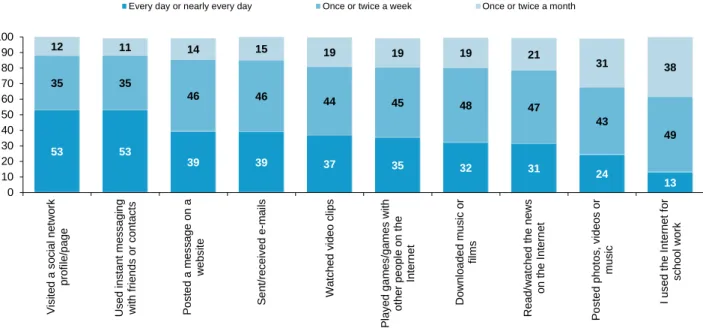
emails, instant messaging and using social networking sites are more frequent among older children. Young children are more likely to play games with others on the internet. As shown in Figure 5, in Brazil the most frequent activities are those related to social networking: 53% of respondents mentioned ‘visiting a social networking profile’ and ‘using instant messaging’ every day or almost every day. Interestingly, the most mentioned activity carried out on the internet by children aged 9 to 16 is also the least frequent: 13% used the internet for school work every day.
Figure 5: Frequency of internet activity among Brazilian children
Base: All children aged 9-16 who are internet users who carried out each activity.
Social networking
As expressed in Figures 4 and 5, social networking is an integral part of young Brazilians’ internet use. In this survey, 70% of children aged 9 to 16 who are internet users
claimed to have their own profiles in social networking sites.
Figure 6 reveals that among internet users for accessing a social networking site, gender is not relevant, age matters in both contexts,
53 53 39 39 37 35 32 31 24 13 35 35 46 46 44 45 48 47 43 49 12 11 14 15 19 19 19 21 31 38 0 10 20 30 40 50 60 70 80 90 100 V is it ed a s oc ial net w or k pr of ile/ page U s e d i ns tant m es s a gi n g w it h f ri ends or c ont ac ts P o s te d a m es s age on a w ebs it e S e nt /r ec ei v ed e-m ai ls Wat c hed v ideo c lips P lay ed ga m es /gam es w it h ot her peopl e on t he Int er n et D ow nl oade d m us ic or fil m s R ead/ w at c hed the new s on t he I nt er n et P o s te d phot os , v ideos or m u s ic I us ed t he I nt er net f or s c hool w or k
and the socio-economic class of the child matters in Brazil.
The European average shows almost no difference by class in the use of SNS; by contrast, in Brazil, 79% of the children in SES AB claimed to have a profile on a social networking site, while 49% of children in SES DE did so. Age is another relevant factor. Taking into account the time gap between the two surveys, two trends are visible. On the one hand, the percentage of younger children accessing social networking sites is higher in Brazil – 42% of the Brazilian children aged 9 to 10 reported having their own profile, rising to 71% for those aged 11 and 12; in Europe these values were 26% and 49% respectively. On the other hand, a similar value was found among the oldest group: 82% of European and 83% in the 15-16 year age range reported social networking.
In Brazil, the most widely used social networking sites – Facebook (61%) and Orkut (39%) – are strongly related to age and SES; younger children and those from lower socio-economic classes primarily use Orkut more, while older children and upper socio-economic classes prefer Facebook. There are no gender differences in the social networks preferred by children; 27% of the children who used social networking sites claimed to have more than one profile in their preferred network. Half of the children with their own profiles had more than 100 contacts, and 21% had over 300 contacts.
Figure 6: Children who have their own profile on a social networking site in Brazil and in Europe
Base: All children aged 9-16 who are internet users.
It is worth noting that similar values are reported by Brazilian and European children on the management of their profiles, as shown in Figure 7. With regard to privacy settings, in both contexts, about 43% of those who had their own profiles claimed to have a private profile that only friends could see. However, a quarter of children with their own social networking profile reported having their information public, that is, set up so that anyone could see it.
70 79 71 49 83 80 71 42 69 71 59 61 59 57 82 73 49 26 58 60 0 20 40 60 80 100 Total Class AB Class C Class DE 15-16 years 13-14 years 11-12 years 9-10 years Male Female Europe Brazil
Figure 7: Privacy setting of children’s social network profiles in Brazil and in Europe
Base: All children aged 9-16 who are internet users and have their own social networking profile.
As Figure 8 shows, among Brazilian children who had their own profiles in social networking sites, 86% claimed having a photo in their profile that clearly showed their face, while 76% of European children report the same. A relatively similar percentage in both contexts said they explicitly stated their last name.
Two significant differences concerning identification are related to age and naming the school. While most of the Brazilian children (57%) had provided an age that was not their correct age, only 16% of European children reported the same. While 43% of European children had information about their school in their profile, 28% of Brazilian children did the same. These values are certainly not independent from national contexts, in Brazil as well as in Europe. While
the most used social networking sites by Brazilian children (Facebook and Orkut) share age restrictions, the European data collected in 2010 revealed the weight of social networking sites for students, such as Nasza-Klasa (Poland), Hyves (The Netherlands) or
SchülerVZ (Germany).9
Figure 8: Information available on
children’s social network profiles in Brazil and in Europe
Base: All children aged 9-16 who are internet users and have their own social networking profile.
2 25 31 42 3 26 28 43 0 50 100 Don't know Public, so that everyone can see Partially private, so that friends of friends or own networks can
see Private, so that only
friends can see
Europe Brazil 0 2 12 13 27 28 57 69 86 1 5 7 11 61 43 16 64 76 0 50 100 Don’t know None of the above Your phone number Your address Your real age Your school An age that is not your real age
Your surname Photo clearly showing your face
Internet experience of
parents/legal guardians
Of all Brazilian children aged 9 to 16 interviewed, 53% lived in families where none of the parents/legal guardians was an internet user, while 47% of them had at least one parent or legal guardian who used the internet. In the higher social class (SES AB), 73% claimed to be internet users; in SES C this proportion is 44% and only 12% in SES DE.
As shown in Figure 9, among Brazilian parents/legal guardians who are internet users, the vast majority (85%) accessed the internet from home; 20% accessed the internet at work or university. Both values are below the European average. Furthermore, 10% reported their access from a LAN House or cybercafé and 1% from telecentres, two spaces not reported by European parents. It is noteworthy that the proportion of Brazilian parents/guardians who were internet users and accessed the internet via mobile phones was much lower than the proportion of their children, 6% and 18%, respectively.
Among Brazilian parents/guardians the
frequency of internet use is also related to SES. Overall, among parents/guardians who use the internet, 44% claimed to use it every day or nearly every day. This proportion is 59% among parents/legal guardians from SES AB, 35% in SES C and only 8% in SES DE.
It is remarkable that regardless of their SES, slightly more than two thirds of Brazilian children consider they know more about the internet than their parents (from 68% among SES AB to 78% in DE). In Europe these
values range from 28% (high SES) to 46% (low SES).
Figure 9: Locations of internet access by parents/legal guardians in Brazil and in Europe
Base: Parents of children aged 9-16 who are internet users. Note: European parents were not asked about access at LAN Houses and in telecentres.
In Brazil, only 6% of parents report that their child has experienced something that bothered them in the last 12 months, close to the European average of 9%. However, there are differences between Brazilian and European parents on their level of internet concerns. About one third of European parents are concerned with the possibility of the child being treated in a hurtful or nasty way by other children (35%), being contacted by strangers on the internet (33%) and seeing inappropriate material online (32%). Among
1 6 10 20 85 0 7 0 36 97 0 50 100 In a telecentre Mobile phone LAN House At work or university At home Europe Brazil
Brazilian parents, these values are higher. Concern about the possibility of the child being contacted by strangers on the internet is reported by more than half (53%), seeing inappropriate content online by 47%, and being treated in a hurtful or nasty way by other children worries 42% of parents.
IN THEIR OWN WORDS: BRAZILIAN AND EUROPEAN
CHILDREN REPORTING ONLINE RISKS
An open-ended question, ‘What things on the internet would bother people about your age?’, was asked of both Brazilian and European children prior to questions on
specific online risks.10
Online risks are classified according to the EU Kids Online typology:
content risks are those where the child is positioned as the recipient of, usually, mass-produced images or texts;
contact risks place the child as participant in adult-initiated activities, possibly unwillingly or unwittingly; and
conduct risks place the child as an actor in a peer-to-peer context.
Brazilian and European children’s response rates to the open-ended question varied considerably, and this should be kept in mind when interpreting the findings. The rate of Brazilian children (72%) was close to the highest European rate, reached by Danish children (73%). High response levels by Brazilian children also contrast with the
predominant view of parents that nothing has bothered the child on the internet.
Figure 10 shows that content-related risks rank as the highest concern among children, reported by about half of children in Europe and Brazil (58% and 49%, respectively). Conduct-related risks present a broader difference (19% against 30%, respectively) and contact-related risks are reported less frequently in both samples (13% and 12%, respectively).
‘Other risks’ includes children’s answers that couldn’t be clearly placed in any of the above categories. Although they have less importance (10% and 9%, respectively in Europe and Brazil), they reveal children’s unforeseen concerns or ways of expressing their perceptions. For instance, some Brazilian children use generic words such as ‘racism’ or ‘prejudice’, which may refer to content, contact or conduct.
Figure 10: Type of risk first mentioned by children in Brazil and Europe (%)
Base: 9,636 European children and 1,110 Brazilian children who identified one or more risks.
The distribution of all reported risks (see Figure 11) provides evidence of the diversity of concerns expressed both by Brazilian and European children. Children responded in almost every category; in both surveys, the three most frequent categories of risk represent less than half (42-43%) of all references.
The two most reported experiences that bother children were found to be similar in
both Brazil and Europe: pornography is reported by one in five, while 14% of responses referred to aggressive/violent content. The next highest internet concern reported by European children referred to scary content (8%), while Brazilian children are concerned with peers’ conduct, disseminating messages that damage their reputation (10%). 49% 30% 12% 9% 58% 19% 13% 10% 80% 60% 40% 20% 20% 40% 60% 80% Content-related risks Conduct-related risks Contact-related risks Other risks Europe Brazil
Figure 11: All risks mentioned by Brazilian and European children by type of risk: content-related, contact-content-related, conduct-related and other risks (% of risks mentioned)
20% 14% 5% 8% 1% 2% 0% 0% 0% 1% 21% 15% 8% 3% 2% 2% 2% 2% 1% 1% 0% 0% 30% 20% 10% 10% 20% 30%
Pornographic or sexual content Violent/aggressive content Unwanted content Scary content Gory content Content about drugs Commercial content Content about self-harm or suicide or anorexia/bulimia Violent pornography Racist content Hateful content Content harmful to self-esteem
Content-related risks
Europe Brazil 4% 2% 1% 3% 1% 1% 1% 0% 6% 3% 2% 1% 1% 1% 0% 0% 8% 3% 2% 7%The possibility of inappropriate contact in general The possiblity of inappropriate sexual contact in general People pretending to be someone else Actual or attempted inappropriate contact - general Actual or attempted inappropriate contact - sexual Face-to-face meetings following online contact Other people accessing your data/being tracked/cookies Ideological or religious or fundamentalist persuasion
Contact-related risks
Base: 15,444 online risks reported by European children and 1,582 online risks reported by Brazilian children.
Pornographic and violent content
There is no gender difference in thereferences to pornography and to sexual
images, but age and particularly social position matter. In Brazil, concerns about pornography rise during adolescence, and is the main concern for one out of four 15- to 16-year-olds, second only to conduct risks. References to pornography as something that bothers them are higher among children from classes DE, reaching 28%, more than twice the values expressed by classes AB (12%). In Europe, the highest levels of concern were reported by pre-adolescents (aged 11-12) and remain the highest concern for teenagers; however, they come mainly from high SES households (33%), more than three times the value of low SES households (9%).
Concern about violent/aggressive content is
reported equally by both boys and girls in
Brazil, and similarly shared by children from all classes. In Europe, it is reported slightly more by boys than by girls and by children from high and medium SES, almost twice the value (20%-21% against 11%). In both samples the concern is higher among young than older respondents.
As in Europe, Brazilian children’s references to violent and to pornographic content frequently appear together. Some descriptions use generic terms (violent sites, porn sites), others distinguish between professional media
content (horror, war movies, games) and
uploaded content (videos). Some answers
incorporate awareness of content classification as well as their own rights of being informed. 4% 3% 7% 10% 2% 1% 1% 5% 5% 4% 2% 2% 1% 1% 1% 11% 6% 1% 4% 9%
Other means of aggressive conduct Bullying (usually repeated aggression) Unwelcome conduct in general Hacking/misuse of personal information/specific privacy… People saying bad things/damage to reputation Sharing images or photos Sexual harassment or unwelcome 'sexting' Sharing personal information
Conduct-related risks
“Pornography, the site didn’t inform me of an inadequate content for minors. They should have guided me.” (Boy, 14, DE).
Conduct-related risks
Conduct concerns are reported by 30% of Brazilian children and adolescents, substantially above the 19% references among European respondents. In Brazil concerns related to conduct rise with age: from 23% of 9- to 10-year-olds to 34% of 15- to 16-year-olds, this being the leading concern. Responses are reported slightly more frequently by Brazilian girls (32% against 29% for boys), while they are equal among European boys and girls.
Conduct-related concerns are highest among Brazilian children from social classes AB (37%) and C (29%). The European pattern is similar but presents lower values, respectively 24% and 20% among high and medium SES households.
This higher level of concern relating to online conduct may be explained by the predominance of social networking use among younger Brazilian internet users. As Figure 11 shows, in addition to negative comments that affect their reputation, Brazilian children also report more concerns about hacking, misuse of personal information, violation of privacy and shared images and photos than European children. These concerns tend to include detailed self-references as the diversity of voices express:
“People bugging me through the internet, speaking bad things about me.” (Boy, 11, AB)
“Using one’s image to do wrong things, like offending someone, pretending to be me.”
(Girl, 11, C)
“The fact of entering in our social network [Orkut] and use our data as if they were you.”
(Girl, 14, DE)
“It would bother me if something that I didn’t authorise would be exposed about me. Indecent messages about me would bother
me.” (Boy, 15, DE)
“Disclosure of personal information, people denigrating your image.” (Boy, 16, C)
“Using Facebook without user’s permission, to slander about someone or disturbing something that is not true, even that way people judge you.” (Girl, 16, AB)
“Videos without fun, something that you have done and everyone else gets to know. People that try to hurt you posting unwanted things for others to know. The fact that you have to be perfect and take good care of your things so that it doesn’t leak”. (Girl, 16, DE)
Contact-related contents
In both Brazil and Europe, concerns about being contacted by strangers rise among adolescents and are higher among girls. While in Brazil they are less frequent among classes DE, in Europe ‘stranger danger’ is lower among children from higher SES households.
“If someone I don’t know spoke with me.”
(Boy, 9, DE)
“People you don’t know talking with you as if they know you intimately.” (Girl, 13, C)
“Weird people that talk with children about wrong subjects that might hurt children and affect their conscience.” (Girl, 14, C)
“A paedophile, there are people who says it is one thing and it is another, you have to be very careful.” (Girl, 14, AB)
CONCLUSIONS
Commonalities and differences
between Europe and Brazil
Based on this comparative report, it can be said that young internet users in Brazil and in Europe share similar patterns of use and activities. These similarities suggest a transnational digital culture and socialisation that includes both old and new concerns. On the one hand, children living in different parts of the world report being bothered by sexual and violent content, and recipients of unwanted mass-distributed content when searching for entertainment. On the other hand, Brazilian and European children similarly articulate the dominance of digital culture and peer-to-peer communication. This digital socialisation seems to be increasingly influenced by peer pressure, by issues of privacy and self-control versus publicity and popularity. Finally, in both Europe and Brazil, age and SES seem to matter more than gender differences for internet access, a result that may differ from other cultures around the world.
The high percentage of Brazilian children and parents who do not have any kind of access to the internet or who access the internet in difficult conditions cannot be ignored. As this report shows, regional differences matter as well as social class. However, it should be recalled that among the 25 European countries that participated in the EU Kids
Online Survey, differences related to
children’s and parents’ access were also visible. For instance, the estimated children
online in 2010 ranged from 55% in Italy to 98% in Finland, Sweden and the UK.
The time gap that separates the two data collection periods for each survey may be a factor for some of the higher findings in Brazil, for example, for social networking or mobile access. However, other differences evidenced in this comparative analysis may be more resistant to time, thus suggesting they are rooted in cultural patterns. This is the case, for instance, in relation to content that bothers children, for example, sexual content, where higher concern was expressed by children from high SES homes in Europe and from low SES homes in Brazil.
Improving digital inclusion:
recommendations for policy
Findings from the first wave of data collection of the Kids Online Brazil Survey allows a comparison between social classes and level of education and region, contributing valuable data to the debate on online safety, privacy and mediation. In a country marked by social and economic inequalities and with a large youth population, policies on digital inclusion and on ICT adoption in schools promise a more inclusive society but also face challenges where digital access and opportunities are concerned. In this context, the Kids Online Brazil Survey provides evidence for policymaking and allows international comparability of its results.
While experiencing rapid expansion, data on internet penetration highlights significant gaps
between geographic regions, rural and urban spaces. Regional policies in those places that present lower conditions for internet access should consider how to reduce digital exclusion at the basic level.
Many children in low-income households access the internet in public locations, such as cybercafés, possibly without any guidance. High levels of mobile and private access for higher-income children also raise questions about parental mediation, much as in a European context.
Moreover, the relatively low use of ICT in school in Brazil as a place for accessing the internet is also a challenge. Schools and other educational places such as youth centres could be a place for developing digital literacy skills, awareness of digital rights and responsibilities, and for stimulating creative and socially engaged activities.
More research is needed as to why Brazilian children and adolescents do not use public places such as public libraries or telecentres. Policies regarding promotion and better utilisation of public access facilities need to be prioritised.
With increasing privatisation of their internet access, Brazilian children have far more autonomy and freedom, which may increase the possibility for risk exposure and potential harm. Besides necessary mediation by parents and professionals working with children (teachers, educators, librarians, and so on), peer mediation should also be considered and supported. In this context the NGO sector can play an important role. Children and adolescents are likely to be more open to sharing experiences and talk
about safety practices with young people close to their own age. Attention by Brazilian academics is needed, namely, considering the
challenges concerning age, SES and
geographic differences. A deeper analysis of the data, theoretically sustained and reflecting knowledge of the Brazilian cultural context
(revealed, for instance, in distinctive
perspectives on sexual content) is also a requisite for better informed policies.
On the mass media side, there are also important roles, such as avoiding either the narrative of children as ‘digital natives’ (thus broadening the generational gap) or the narrative of the ‘devil internet’, full of dangers. Balanced news stories, introducing the challenges that Brazilian children, in their diversity, are facing in digital access and use are needed. Mainstream media, from TV to magazines, play an important role in this regard. The introduction of the topic of digital inclusion across generations, from children to the elderly, could also feature in television
fiction, such as telenovelas that are especially
influential in Brazil.
The Brazilian internet industry should prioritise development of online content for children. Content creators should take into account children’s interests, experiences and concerns. Thus participatory design of digital content including children could also be considered. Public policies supporting initiatives in internet regulation and content creation bearing in mind children’s rights may contribute to fulfilling the ambitious aims of a national digital strategy in Brazil.
A NOTE ON METHODOLOGY
This section provides a general overview, focusing on the sample design, questionnaire design, cognitive interviews, pre-test and face-to-face interviews that were carried out at respondents’ homes by means of structured questionnaires.
The target population of the survey is comprised of Brazilian children aged 9 to 16 who are internet users, and the unit of reference for the Kids Online Brazil Survey was the population of internet users aged 9 to 16 and the parent/legal guardian who was the best informed about their routines and internet use. The sample for the ICT Kids Online Brazil Survey was initially composed of up to 2,500 children and their respective parent/legal guardian, with different data collection instruments for each group (structured questionnaires for children and parents/legal guardian and self-completion questionnaires for children aged 11-16). Answers were only valid if both the child and the parent/legal guardian had been interviewed in a selected household. By the end of the data collection, 1,580 interviews were conducted with children and also their parents or legal guardians.
The survey frame and sources used to collect information on the target population for the sample design were the 2010 Census, which is the base for random selection of municipalities and census sectors, and the CNEFE (National Registry of Addresses for Statistical Purposes), which was used as the reference frame for household selection.
In order to test the understanding of the questions and key concepts, eight cognitive interviews were carried out in a mirrored room to test critical questions and their underlying concepts. The objective of the interviews was to understand the cognitive path taken by respondents, as well as their comprehension of the concepts under study.
Both the questionnaire for children (self-completion and face-to-face) and the questionnaire for parents/legal guardians were tested.
Additionally, 20 pre-test interviews were carried out in different geographic regions with
respondents of different ages to test the flow of the questionnaire, to assess times and to adjust question and answer categories.
More information is available at:
www.cetic.br/publicacoes/2012/tic-kids-online-2012.pdf
ANNEX 1: EU KIDS ONLINE
Overview
In its first phase (2006-09), as a thematic network of 21 countries, EU Kids Online identified and critically evaluated the findings of nearly 400 research studies, drawing substantive, methodological and policy-relevant conclusions. In its second phase (2009-11), as a knowledge enhancement project across 25 countries, the network surveyed children and parents to produce original, rigorous data on their internet use, risk experiences and safety mediation. In its third phase (2011-14), the EU Kids Online Network is examining findings and critical analyses of internet and mobile technology uses and associated risks among children across Europe, drawing on these to sustain an active dialogue with stakeholders about priority areas of concern for child online safety.
Thus, the network has widened its work by including all member states and extending its engagement – both proactively and responsively – with policy stakeholders and internet safety initiatives. It has also deepened its work through targeted hypothesis testing of the pan-European dataset, focused on strengthening insights into the risk environment and strategies of safety mediation, by pilot testing innovative research methodologies for the nature, meaning and consequences of children’s online risk experiences, and conducting longitudinal comparisons of findings where available over time. Last, it is updating its work on the online database of available findings, and by producing timely updates on the latest knowledge about new and emerging issues (for example, social networking, mobile platforms, privacy, personal data protection, safety and awareness-raising practices in schools, digital
literacy and citizenship, geo-location services, and so forth).
Work packages
WP1: Project management and evaluation WP2: European evidence base
WP3: Hypotheses and comparisons
WP4: Exploring children’s understanding of risk WP5: Dissemination of project results
WP6: Policy implications
International Advisory Panel
María José Cantarino, Telefonica, Spain Michael Dreier, Clinic for Behavioural Addictions, Mainz, Germany
David Finkelhor, Crimes against Children Research Center, University of New Hampshire, USA
Lelia Green, ARC Centre of Excellence for Creative Industries and Innovation, Australia Natasha Jackson, Family Online Safety Institute
(FOSI) and GSMA, UK
Amanda Lenhart, Pew Internet & American Life Project, USA
Janice Richardson, European Schoolnet, and Insafe, Brussels, Belgium
Kuno Sørensen, Save the Children, Denmark Janis Wolak, Crimes against Children Research
ANNEX 2: THE NETWORK
Country National contact information Team members
AT
Austria
Ingrid Paus-Hasebrink [email protected] Department of Audiovisual Communication, University of Salzburg, Rudolfskai 42, A-5020 Salzburg, Austria
Ingrid Paus-Hasebrink Andrea Dürager Philip Sinner Fabian Prochazka BE Belgium
Leen D’Haenens [email protected]
Centrum voor Mediacultuur en Communicatietechnologie (OE), OE Centr. Mediacult.& Comm.technologie, Parkstraat 45 – bus 3603, 3000 Leuven, Belgium Leen d’Haenens Verónica Donoso Sofie Vandoninck Joke Bauwens Katia Segers BG Bulgaria
Luiza Shahbazyan [email protected]
Applied Research and Communications Fund, 1113, Sofia, 5, Alexander Zhendov St. Luiza Shahbazyan Jivka Marinova Diana Boteva HR Croatia
Dunja Potočnik [email protected] Institute for Social Research, Zagreb
Ivana Ćosić Pregrad Marija Lugarić Dejan Vinković Dragana Matešković
CY
Cyprus
Yiannis Laouris [email protected]
Cyprus Neuroscience & Technology Institute, Science Unit of the Future Worlds Center, 5 Promitheos, 1065 Lefkosia, Cyprus
Yiannis Laouris Elena Aristodemou Aliki Economidou Tao Papaioannou CZ Czech Republic
David Šmahel [email protected]
Faculty of Social Studies, Masaryk University, Joštova 10, 602 00 Brno, Czech Republic
David Šmahel Štepán Konečný Lukáš Blinka Anna Ševčíkov Petra Vondráčková Alena Černá Hana Macháèková Věra Kontríková Lenka Dědková DK Denmark
Gitte Stald [email protected]
IT University of Copenhagen, Ruud Langgaards Vej 7, 2300 Copenhagen, Denmark
Gitte Stald Heidi Jørgensen
EE
Estonia
Veronika Kalmus [email protected]
Institute of Journalism and Communication, University of Tartu, 18 Ülikooli St., 50090 Tartu, Estonia
Veronika Kalmus Pille Pruulmann-Vengerfeldt Maria Murumaa-Mengel Andra Siibak Kersti Karu Lennart Komp Inga Kald Marianne Võime Kairi Talves FI Finland
Reijo Kupiainen [email protected]
Department of Journalism and Mass Communication, University of Tampere, 33014 Finland Reijo Kupiainen Kaarina Nikunen Annikka Suoninen Sirkku Kotilainen FR France
Catherine Blaya [email protected] IREDU – Université de Bourgogne,
Catherine Blaya Elodie Kredens Seraphin Alava Said Jmel
DE
Germany
Uwe Hasebrink [email protected]
Hans Bredow Institute for Media Research, Warburgstr. 8-10, D – 20354 Hamburg, Germany
Uwe Hasebrink Claudia Lampert
EL
Greece
Liza Tsaliki [email protected]
Department of Mass Media and Communications, National and Kapodistrian University of Athens, 5 Stadiou Street, Athens 105 62, Greece Liza Tsaliki Despina Chronaki Maria Philippi Sonia Kontogiani HU Hungary
Bence Ságvári [email protected]
Information Society and Network Research Center – ITHAKA, Perc u. 8, Budapest, 1036 Hungary
Bence Ságvári Anna Galácz
IS
Iceland
Kjartan Ólafsson
University of Akureyri, Borgum v/Nordurslod, IS-600 Akureyri, Iceland Kjartan Ólafsson Thorbjorn Broddason Gudberg K. Jonsson IE Ireland
Brian O’Neill [email protected]
College of Arts and Tourism, Dublin Institute of Technology, Rathmines Road, Dublin 6, Ireland
Brian O’Neill Thuy Dinh Simon Grehan Nóirín Hayes Sharon McLaughlin IT Italy
Giovanna Mascheroni [email protected] OssCom, Università Cattolica del S. Cuore, Largo Gemelli, 1, 20123 Milano, Italy
Piermarco Aroldi Giovanna Mascheroni Maria Francesca Murru Barbara Scifo
LV
Latvia
Inta Brikše [email protected]
Department of Communication Studies, University of Latvia
Inta Brikše Skaidrite Lasmane Marita Zitmane Ilze Šulmane Olga Proskurova-Timofejeva Ingus Bērziņš Aleksis Jarockis Guna Spurava
Līva Brice, Ilze Bērziņa
LT
Lithuania
Alfredas Laurinavičius [email protected]
Department of Psychology, Mykolas Romeris University, Ateities st. 20, LT-08303 Vilnius, Lithuania Alfredas Laurinavičius Renata Mackoniene Laura Ustinavičiūtė LU Luxembourg
Georges Steffgen [email protected] Université du Luxembourg Georges Steffgen André Melzer Andreia Costa MT Malta
Mary Anne Lauri [email protected] University of Malta
Mary Anne Lauri Joseph Borg Lorleen Farrugia Bernard Agius
NL
Netherlands
Nathalie Sonck [email protected]
SCP, Parnassusplein 5, 2511 VX, Den Haag, Netherlands
Nathalie Sonck Jos de Haan Marjolijn Antheunis Susanne Baumgartner Simone van der Hof Els Kuiper Natascha Notten Marc Verboord Peter Nikken NO Norway
Elisabeth Staksrud [email protected]
Dept. of Media and Communication, University of Oslo, Boks 1093 Blindern, 0317 Oslo, Norway
Elisabeth Staksrud Jørgen Kirksæther Birgit Hertzberg Kaare Ingunn Hagen
Thomas Wold
PL
Poland
Lucyna Kirwil [email protected]
Department of Psychology, Warsaw School of Social Sciences and Humanities, ul. Chodakowska 19/31, 03-815 Warsaw, Poland
Lucyna Kirwil Aldona Zdrodowska
PT
Portugal
Cristina Ponte [email protected]
Departamento de Ciências da Comunicação, Faculdade de Ciências Sociais e Humanas, Universidade Nova de Lisboa (UNL), Av. de Berna, 26-C, 1069-061 Lisboa, Portugal
Cristina Ponte José Alberto Simões Daniel Cardoso Ana Jorge Rosa Martins
RO
Romania
Monica Barbovschi [email protected]
Babes-Bolyai University, Faculty of Sociology and Social Work, 21 Decembrie 1989 st. no.128-130, Cluj-Napoca, Romania
Monica Barbovschi Eva Laszlo Bianca Fizesan Gyöngyvér Tőkés George Roman Valentina Marinescu Anca Velicu RU Russia
Galina Soldatova [email protected]
Moscow State University, Foundation for Internet Development
Galina Soldatova Ekaterina Zotova Elena Rasskazova Polina Roggendorf Maria Lebesheva SK Slovakia
Jarmila Tomková [email protected]
VUDPaP, Institute for Child Psychology and Pathopsychology
Jarmila Tomková Ľudmila Václavová Magda Petrjánošová Dana Petranova Norbert Vrabec Magdalena Petrjanosova SI Slovenia
Bojana Lobe [email protected]
Centre for Methodology and Informatics, Faculty of Social Sciences, University of Ljubljana, Kardeljeva pl. 5, Ljubljana, Slovenia
Bojana Lobe Sandra Muha
ES
Spain
Maialen Garmendia [email protected]
Depto. de Sociología, Universidad del País Vasco, Apartado 644, 48.080 Bilbao, Spain
Carmelo Garitaonandia Maialen Garmendia Gemma Martínez Miguel Angel Casado Estefanía Jiménez
SE
Sweden
Cecilia von Feilitzen [email protected]
The International Clearinghouse on Children, Youth and Media, Nordicom, Goteborg University, Box 713, 405 30 Goteborg, Sweden
Cecilia von Feilitzen Elza Dunkels Olle Findahl Ulrika Sjöberg Karl Dahlstrand CH Switzerland
Sara Signer [email protected]
IPMZ – Institute of Mass Communication and Media Research, Andreasstrasse 15, CH-8050, Zürich Sara Signer Martin Hermida Heinz Bonfadelli TR Turkey
Kursat Cagiltay [email protected]
Department of Computer Education and Instructional Technology, Faculty of Education, Middle East Technical University, 06531, Ankara, Turkey Kursat Cagiltay Engin Kursun Turkan Karakus Secil Tisoglu UK United Kingdom Coordinator
Leslie Haddon [email protected]
Department of Media and Communications, London School of Economics and Political Science, Houghton Street, London WC2A 2AE, UK Sonia Livingstone Leslie Haddon Benjamin de la Pava-Velez Ellen Helsper John Carr
Endnotes
1
Detailed information and comments on the Brazilian results are presented in the report ICT Kids Online Brazil 2012, available at www.cetic.br/publicacoes/2012/tic-kids-online-2012.pdf (English and Portuguese versions).
2
Jensen, M. (2011). Broadband in Brazil: A multipronged public sector approach to digital inclusion. Washington, DC: infoDev/The World Bank. Available at www.broadband-toolkit.org
3
Socio-economic status (SES) for the purpose of this survey is based on the ABEP (Brazilian Association of Research Institutes) criterion. The Brazilian Criteria for Economic Classification (CCEB) is an instrument for economic segmentation, based on a survey of household characteristics (availability and number of certain comfort-related household items and level of education of the head of the household) to classify the
population. The criterion attributes scores to each characteristic and adds them all up. The score range on the criterion is then matched to one of five economic classification strata, namely, class A, B, C, D and E. In the Kids Online Brazil Survey, SES was grouped into classes AB, C and DE.
4
ICT Kids Online 2012, available at www.cetic.br/publicacoes
5
Further comparative information is available in Ponte, C. and Simões, J.A. (2013). Comparing results on internet access and use: Brazil, Portugal and Europe. In ICT Kids Online Brazil 2012.Survey on internet use by children in Brazil (pp. 161-70). Available at www.cetic.br/publicacoes/2012/tic-kids-online-2012.pdf (English and Portuguese versions).
6
See Livingstone, S., Haddon, L., et al. (2011). Risks and safety on the internet. The perspective of European children. Full findings and policy implications from the EU Kids Online survey of 9-16 year olds and their parents in 25 countries. London, LSE (p. 22). Available at www.eukidsonline.net
7
Idem, p. 24.
8
Idem, p. 25.
9
See Livingstone, S., Ólafsson, K., and Staksrud, E. (2011). Social networking, age and privacy. Short Report, London: LSE.
10
For the European report, which includes the Code Book and a large number of quotations from children, see Livingstone, S., Kirwill, L., Ponte, C., and Staksrud, E. (2013). In their own words: What bothers children online. Available at