E
XPLORING THE DIFFUSION
OF E
-
LEARNING
:
GENERAL AND ENABLING GUIDELINES FOR
IMPLEMENTATION OF COMPUTER-AIDED
TEACHING IN DEVELOPING COUNTRIES
VT 2012:KANI13
Bachelor’s thesis in Informatics Olof Blom Daniel Salomonsson
Title: Exploring the diffusion of e-learning: general and enabling guidelines for implementation of computer-aided teaching in developing countries.
Year: 2012
Author/s: Olof Blom and Daniel Salomonsson
Supervisor: Dr. Anders Hjalmarsson, PhD
Abstract
The purpose of the study was to create guidelines regarding effective diffusion of e-learning to and within developing countries. Another aim of the study was to identify challenges and problems related to the diffusion of e-learning, as well as identifying what characterizes a successful ICT diffusion project. To achieve the purpose of the study a case study was performed in Thailand, where two different schools, i.e. two cases that had been targeted by ICT diffusion projects were studied. In combination to studying the schools, the donor side of the project were also included in the study. The study was conducted with a qualitative research approach, and was divided into one inductive and exploratory phase, which generated a theory, and one deductive phase where the theory was both theoretically and empirically validated. To gather the empirical material, eight semi-structured interviews were conducted of which six included staffs from the two schools, and two included donors that were involved in one of the studied ICT diffusion projects. Yet another semi-structured interview was performed with a person involved in an ICT diffusion project, which helped to perform the empirical validation of the generated theory. With the help of the collected empirical material as well as through existing theories it was possible to identify numerous of challenges regarding diffusion of e-learning to and within developing countries. The challenges were primarily connected to language, culture, governmental, lack of computer knowledge and infrastructural. To tackle the challenges a number of characteristics regarding effective ICT diffusion projects in developing countries were identified. These characteristics included the importance of doing a proper investigation about the recipients, follow ups, provided right amount of computers, provided software that had been adapted and provided education about how computers should be used. Based on the challenges and characteristics guidelines for effective diffusion of e-learning to and within developing countries were designed. The knowledge about challenges and characteristics led to the identification of two important findings. The first was that the diffusion of e-learning to developing countries is highly dependant on the diffusion of ICT to the schools, as an evident problem that existed was that the schools lacked the proper technical infrastructure to be able to support computer-aided teaching. The other finding was that in order for the diffusion process to be effective, it is vital to provide information and education about the technology in advance of the implementation. These two findings lead to that the 19 created guidelines were divided into two categories; basic guidelines for diffusion of ICT and enabling guidelines for diffusion of e-learning.
Keywords: e-learning, computer-aided teaching, diffusion, guidelines, ICT, developing countries, rural areas
Acknowledgements
Fist of all we would like to thank the Swedish International Development Agency (Sida) for providing us with scholarships and thereby giving us the opportunity to conduct this study in Thailand. We would also like to thank our contact person in Thailand, Mr. Jerker Helander for arranging with contacts and accommodation.
Secondly we would like to thank our supervisor Dr. Anders Hjalmarsson. Without your help and encouraging words throughout the entire research process this thesis would not have been what it is today.
We would also like to express our gratitude towards all respondents and informants that participated in the empirical data collection of this study. Without you it would not had been possible to conduct this study.
Last but not least we would like to send a special thanks to Mr. Håkan Alm and our interpreter Ms. Opel, who also became a dear friend, for providing us with help and support throughout the entire research process. Without you two it would have been impossible to conduct this study.
Borås 2012‐05‐30
___________________________ __________________________
Table of contents
1 Introduction... - 1 -
1.1 Introduction to the area ... - 1 -
1.2 Research overview ... - 1 - 1.3 Problem discussion ... - 4 - 1.4 Purpose ... - 5 - 1.5 Research questions ... - 6 - 1.6 Target audience ... - 6 - 1.7 Outline ... - 6 - 2 Research design ... - 8 - 2.1 Research perspective ... - 8 - 2.2 Research strategy ... - 9 - 2.3 Research process ... - 10 - 2.4 Research methods ... - 13 - 2.4.1 Data collection ... - 13 - 2.4.2 Data analysis ... - 17 - 2.4.3 Evaluation ... - 18 - 3 Theoretical framework ... - 21 -
3.1 The subject areas’ role in the study ... - 21 -
3.2 IT and developing countries ... - 22 -
3.2.1 ICT for development... - 22 -
3.2.2 ICT adoption barriers ... - 23 -
3.2.3 Information system risk management in developing countries ... - 24 -
3.2.4 IT as support for e-learning in developing countries ... - 25 -
3.3 Diffusion of IT ... - 26 -
3.3.1 Historical perspective ... - 26 -
3.3.2 Central components of the diffusion process ... - 28 -
3.3.3 Challenges regarding the diffusion of IT ... - 31 -
3.3.4 Technology Acceptance Model ... - 32 -
3.4 IT-supported learning ... - 35 -
3.4.1 Historical perspective ... - 35 -
3.4.2 How can IT support learning? ... - 38 -
3.5 Learning theories and rural areas ... - 38 -
3.5.1 Participatory rural appraisal theory ... - 38 -
3.5.2 How can IT support learning in rural areas? ... - 39 -
3.5.3 What challenges regarding IT supported learning exists in rural areas? ... - 40 -
3.6 Concluding remarks regarding the theoretical framework ... - 42 -
4 Empirical study ... - 43 -
4.1 Donors ... - 43 -
4.1.1 Interview one - Project initiator ... - 43 -
4.1.2 Interview two - Project participant ... - 47 -
4.2 School A ... - 50 -
4.2.1 Interview one - Director ... - 50 -
4.2.2 Interview two - Computer teacher ... - 54 -
4.2.3 Interview three - Regular teacher ... - 58 -
4.3 School B ... - 61 -
4.3.1 Interview one - Director ... - 61 -
4.3.2 Interview two - Computer teacher ... - 64 -
5 Summary of case results ... - 69 - 5.1 Donors ... - 69 - 5.2 School A ... - 73 - 5.3 School B ... - 78 - 6 Analysis ... - 83 - 6.1 Comparative analysis ... - 83 - 6.2 Preliminary guidelines ... - 87 - 6.3 Theoretical validation ... - 89 - 6.4 Empirical validation ... - 95 - 7 Discussion ... - 101 -
8 Conclusions, evaluation and further research ... - 106 -
8.1 Conclusions ... - 106 -
8.1.1 What challenges and problems related to the diffusion of e-learning exists in developing countries? ... - 106 -
8.1.2 What are the characteristics regarding effective diffusion of ICT to schools in developing countries? ... - 108 -
8.1.3 How should e-learning projects be designed when implemented in developing countries? ... - 109 -
8.2 Evaluation ... - 111 -
8.2.1 Evaluation criteria ... - 111 -
8.2.2 Method evaluation ... - 113 -
8.3 Suggestions for further research ... - 115 -
References ... - 116 -
Appendix A – Interview guide Donors ... - 119 -
Appendix B – Interview guide School A ... - 120 -
List of Tables
Table 2.1: Potential data collection methods for our study ... - 15 -
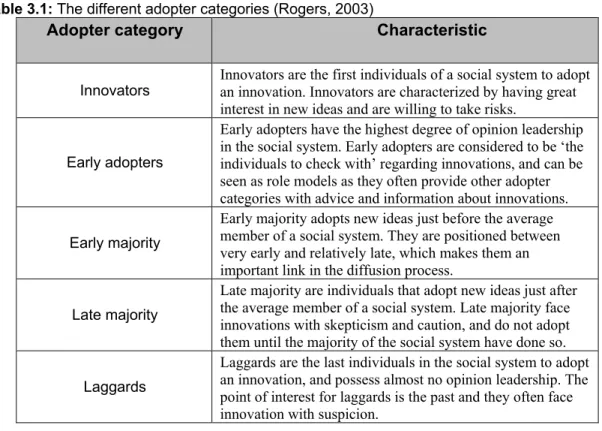
Table 3.1: The different adopter categories (Rogers, 2003) ... - 30 -
Table 3.2: Determinants of perceived usefulness (Adapted from Venkatesh & Bala, 2008) ... - 33 -
Table 3.3: Determinants of perceived ease of use (Adapted from Venkatesh & Bala, 2008) .. - 35 -
Table 6.1: Preliminary guidelines for effective diffusion of ICT and e-learning ... - 87 -
Table 6.2: Theoretically validated guidelines G1-G3 (Basic guidelines) ... - 89 -
Table 6.3: Theoretically validated guidelines G4-G6 (Basic guidelines) ... - 90 -
Table 6.4: Theoretically validated guidelines G7-G9 (Basic guidelines) ... - 91 -
Table 6.5: Theoretically validated guidelines G10-G13 (Basic guidelines) ... - 92 -
Table 6.6: Theoretically validated guidelines G14-G16 (Enabling guidelines) ... - 93 -
Table 6.7: Theoretically validated guidelines G17-G19 (Enabling guidelines) ... - 94 -
Table 6.8: Empirically validated guidelines G1-G3 (Basic guidelines) ... - 95 -
Table 6.9: Empirically validated guidelines G4-G6 (Basic guidelines) ... - 96 -
Table 6.10: Empirically validated guidelines G7-G9 (Basic guidelines) ... - 97 -
Table 6.11: Empirically validated guidelines G10-G13 (Basic guidelines) ... - 98 -
Table 6.12: Empirically validated guidelines G14-G16 (Enabling guidelines) ... - 99 -
Table 6.13: Empirically validated guidelines G17-G19 (Enabling guidelines) ... - 100 -
Table 8.1: The final guidelines for effective diffusion of ICT and e-learning to and within developing countries. ... - 109 -
List of Figures
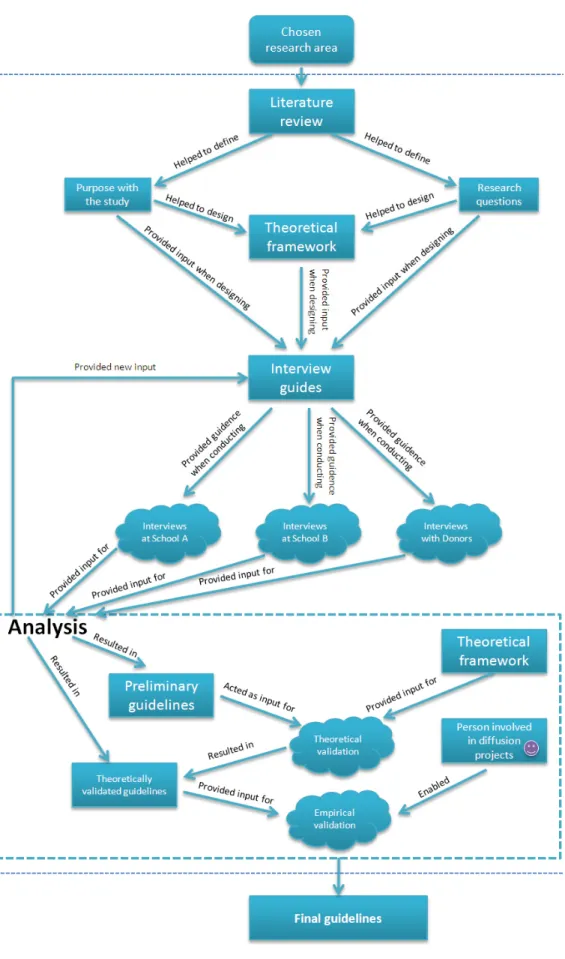
Figure 2.1: The research strategy of the study, divided into one inductive and exploratory phase and one deductive phase. ... - 10 -Figure 2.2: An illustration over the research process ... - 12 -
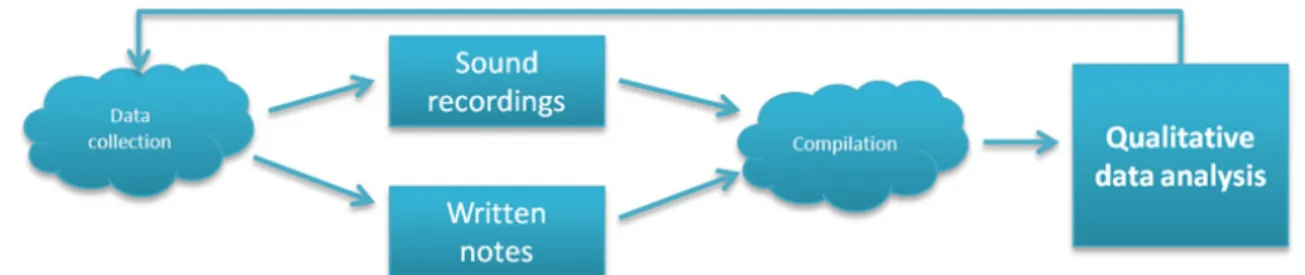
Figure 2.3: The qualitative data analysis process used in the study (Adapted from Christenssen et. al., 2010:298) ... - 17 -
Figure 3.1: An illustration over how the subject areas in the theoretical framework are related to the research questions. ... - 21 -
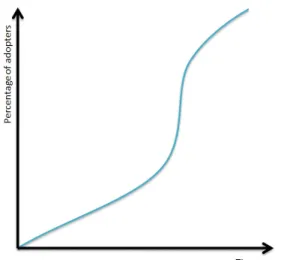
Figure 3.2: The s-shaped curve – illustrating how the adoption rate differs over time (Adapted from Rogers, 2003:113) ... - 26 -
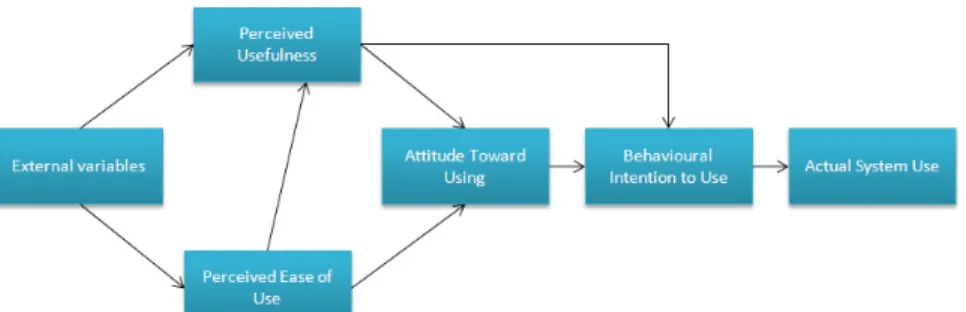
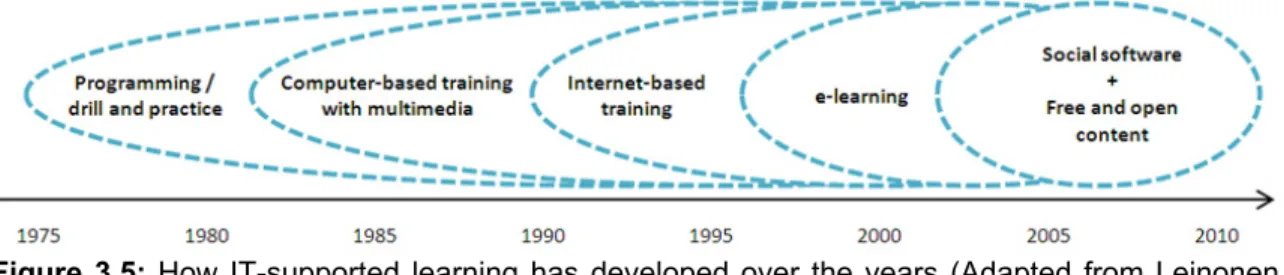
Figure 3.3: TAM – illustrating how the determinants that affect individuals’ behavioural intentions to use a system are interrelated (Adapted from Davis, Bagozzi & Warshaw, 1989:985) - 33 - Figure 3.4: TAM 3 – an extended version of TAM that introduces additional determinants of perceived ease of use and perceived usefulness (adapted from Venkatesh & Bala, 2008:280).- 34 - Figure 3.5: How IT-supported learning has developed over the years (Adapted from Leinonen, 2005) ... - 35 -
1 Introduction
1.1 Introduction to the area
The rapid development in information and communication technologies (ICTs) has led to a technical disparity (Fong, 2009). This technical disparity, that can occur both within a single country as well as between developed and developing countries, is often referred to as the digital divide. Fong (2009) argues that the digital divides that exists today cannot only be confined to computer or Internet use; but that it also refers to infrastructural problems, like the accessibility to fixed phone lines and mobile phones. This is worrying as some of the most common reasons to the generally low educational level in developing countries are infrastructural problems combined with a shortage of teachers (Andersson & Grönlund, 2009; Simba, 2010).
So how should these infrastructural and teacher related problems be solved? Can e-learning, in this study defined, in accordance with Lujara (2006), as an alternative way of teaching and learning which includes delivered instructions via e.g. Internet, interactive TV or CD-ROM, be the answer? Maybe it can. At least Andersson and Grönlund (2009) claim that e-learning has the potential to solve a lot of the existing problems in developing countries, not least the shortage of teachers. Simba (2010) also sees great potential in e-learning and mentions that one advantage with e-learning is that the education can take place independent of time and place which can help to overcome some of the existing infrastructural problems.
Lately e-learning has begun to spread to developing countries in an increasing pace. Today there are many ongoing projects aimed at increasing the general educational level in developing countries. One of these project is ‘one tablet per child’, an educational policy project in Thailand that aims to provide all first year students the same opportunity to keep up with technological development (Willson, 2012). The fact that a journal called ‘Electronic Journal of Information Systems in Developing Countries’ exists and that there are an annual conference called ‘eLearning Africa’1, that focuses on enabling development of e-learning in Africa, are two indicators that there is a genuine interest for e-learning in developing countries. Any attempts to bridge the digital divide and make the diffusion of e-learning more efficient are therefore most likely to be received with open hands by the population.
1.2 Research overview
Even though e-learning has the potential to raise the average educational level in developing countries, there are challenges that can hinder the diffusion of e-learning in developing countries. Andersson and Grönlund (2009) describe that the concept of e-learning has begun to spread to developing countries and that it is believed to have the potential to overcome some of the main educational problems in those countries. This statement is supported by Omidinia, Masrom and Selamat (2011) and they agree that e-learning have the potential to solve a lot of the existing educational problems. Bhuasiri,
Xaymoungkhoun, Rho and Ciganek (2011) describe that both external sources, e.g. social and environment, and internal sources, e.g. individual characteristics, are crucial when implementing e-learning systems.
One main issue that Omidinia, Masrom and Selamat (2011) bring up is the shortage of teachers in developing countries. Even so, Andersson and Grönlund (2009) describe that other challenges also exists that can hinder the implementation of e-learning projects. There are also many developing countries that lack vital e-learning components such as computers, electricity and the appropriate skill set (Omidinia, Masrom & Selamat, 2011). The availability of hardware and Internet connections are also mentioned as important factors when implementing e-learning in developing countries (Williams & Eyo, 2011). In contradiction to Williams and Eyo (2011), Lating (2009) describes that an Internet connection is not as vital and instead proposes the use of CD-ROM based courses to help overcome the existing infrastructural problems. However Pade-khene and Sewry mentions that large amounts of ICT-project in developing countries are linked to failure and wastage of resources. Based on the above mentioned, Williams and Eyo (2011) emphasizes the importance of an existing IT-infrastructure. Omidinia, Masrom and Selamat (2011) also describe that students’ attitudes towards e-learning can be an issue, as the tradition in developing countries is to teach in a more traditional way. It is vital for those concerned with the implementation of e-learning in developing countries to understand all existing challenges.
Andersson and Grönlund (2009) have created a conceptual framework for e-learning challenges in which they have listed 30 challenges divided into four main categories: Course challenges, challenges related to the characteristics of the individual, technological challenges and contextual challenges. The researchers emphasize that there are some main challenges related to courses; the curriculum needs to be specifically designed with e-learning in mind, as there are differences between traditional learning and e-learning. Other challenges mentioned are that participating students misses social engagement and a feeling of not being involved, which leads to a higher rate of dropouts. The researchers describe that a large challenge in developing countries is that both teachers and students lack the appropriate computer and technological skills, which leads to a low technological confidence. This statement is supported by Williams and Eyo (2011) when they describe the lacklustre technological knowledge of the teachers in developing countries. Lee, Lee and Yoon (2009) also describe that it is vital to educate teachers if the outcome of e-learning projects should be a success. There are also a number of technological issues, which is something that Omidinia, Masrom and Selamat (2011) also agrees with. The fact that it is vital to educate teachers is an issue as Andersson and Grönlund (2009) mention that the required training of teachers and staffs is often overlooked in developing countries.
Another factor that has to be taken into consideration when working with e-learning is the cultural differences between countries. This becomes evident as Pagram and Pagram (2006) argue that education is a process of cultural indoctrination and that culture therefore must be seen as a part of education. Based on this the researchers describe that children from different countries attitudes and behaviour differs from one and other but that motivation and beliefs always plays an important role in learning.
There have been numerous attempts to create guidelines for how to make e-learning efficient and useful as an educational instrument. Khan, Rahman and Ahmed (2011) for example introduces a framework for adopting quality e-learning systems in primary educational institutes. The aim with this framework is to enable the development of primary level education systems through the advantages of e-learning systems. Holsapple and Lee-Post (2006) also tries to clarify the success of e-learning in their study. In the study Holsapple and Lee-Post introduces an e-learning success model which point out that when the success of e-learning is to be measured, the six dimensions system quality, information quality, service quality, use, user satisfaction and net benefits have to be taken into consideration. The authors also argue that students online readiness, which is measured to the degree of academic preparedness, technical competence, lifestyle aptitude, and learning preference toward e-learning, is another critical factor that affect the e-learning success.
Omidinia, Masrom and Selamat (2011) describe that government institutions in developing countries often lack qualified personnel, financial support, lack of planning and justification to mention a few, which often leads to project failures. Another challenge mentioned is that most of the technologies and designs used in developing countries are developed and deployed in a developed country context which leads to limitations when used in developing countries. Masoumi (2010) describes that a lot of the institutions in developing countries lack a strategic or technological plan, which makes the system/organization rely on a specific person instead of a plan. This leads to decisions made by that person to sometimes be biased and based on the basis of that person’s likes and dislikes.
Lating (2009) describes two alternative approaches to e-learning, one being blended, and the other being hybrid. The main idea of blended e-learning is that there should be a balance between classroom learning and online learning. The researcher describes that an approach like this allows for a more smooth transition from the more traditional education, commonly used in developing countries. Hybrid e-learning according to the researcher means that the main e-learning courses should be delivered by CD-ROM instead of online. Hybrid e-learning is aimed at students with no access to computers at home or nearby, but instead rely on the availability of computers at their schools. Hybrid e-learning is specifically designed for use by rural, disadvantaged students in Uganda. Lating (2009) describes that by using CD-ROMs as the main platform for delivering e-learning courses to students, an increase in the amount of students that passes their exams was noticed. The researcher suggests that poor secondary schools in rural areas, by embracing the concept of hybrid e-learning, can save resources connected to construction and maintenance of Internet connectivity and Local Area Networks (LANs). As such, in contradiction to Lee, Lee and Yoon (2009) statement about a generally high initial cost when implementing e-learning, schools in the rural areas can save money by introducing the concept of hybrid e-learning and therefore get a lower initial cost. Roffe (2002) describes that the implementation of e-learning programs are associated with a high initial cost, and that a great interest for studies that evaluate whether different e-learning solutions are effective exists.
Most of the studies made within the area use a mixed-research approach, i.e. a combination of both quantitative and qualitative approaches (e.g. Bhuasiri et. al., 2009; Sun, Tsai, Finger & Chen, 2008). Theories mentioned in previous studies within the area are for example the situated learning theory and the participatory rural appraisal theory (Lating, 2009). Many researchers have also used the technology acceptance model (TAM) when studying the effects on individuals’ behavioural intention to use e-learning systems (e.g. Liu, Liao & Pratt, 2009; Sheng, Jue & Weiwei 2008).
1.3 Problem discussion
As Fong (2009) describes, the rapid development in ICT has led to a digital divide between and within countries. If nothing is done, there is a chance that this gap will continue to increase and that developing countries will fall even further behind.
As mentioned in section 1.1, the educational levels in developing countries are generally low. One reason for this is that traditional education, which is bound to time and place, is an ineffective way to conduct education in these countries. As Omidinia, Masrom and Selamat (2011) mentions there is a lack of teachers in most developing countries. The poor economy of developing countries makes it impossible to employ the amount of teachers needed to fulfil the needs of every student. As such an alternative to the traditional education is needed.
One possible solution to this problem is to use e-learning as an educational form as it adds a more flexible way of teaching. With e-learning courses and lectures are not bound to a specific time and place, which can be seen as a solution to the existing infrastructural problems in developing countries (Andersson & Grönlund, 2009; Simba, 2010). Another dimension to e-learning is that fewer teachers are needed, and as such more students could get a proper education, which in turn can result in a higher educational level.
As Andersson and Grönlund (2009) mentions there are a lot of challenges connected to the implementation of e-learning in developing countries. A great problem when implementing e-learning in developing countries is that they generally have a poor infrastructure, as well as low access to the needed technology for e-learning (Omidinia, Masrom & Selamat, 2011). The focus on the challenges a developed country faces differs from the challenges a developed country are faced with when implementing e-learning projects. The solutions and project techniques developed in developed countries are as such lacklustre when used in a developing country context. Omidinia, Masrom and Selamat (2011) describe that the fail rate in many developing countries regarding e-learning projects is high due to this particular reason.
Pagram and Pagram (2006) describe that cultural differences between countries plays a part in the educational process. As such this has to be taken into consideration when implementing an learning project. But how does this affect the introduction of e-learning projects in developing countries? Pagram and Pagram argue that children from different countries attitudes and behaviour differs from one and other, but that motivation and beliefs always plays an important role in learning.
When studying previously conducted research within the area of e-learning and developing countries, it becomes evident that the results from a large part of the studies
only are representative for some specific countries. With this in mind one could wonder why only research regarding specific countries has been performed and only little research have been conducted with a more general approach in mind.
It becomes evident that many problems exist in developing countries that could have a negative impact on the diffusion of e-learning to and within developing countries. It therefore becomes interesting to further investigate the challenges and problems related to diffusion projects in developing countries as these challenges and problems can hinder the diffusion of e-learning to these parts of the world. Many problems have been identified in previously performed research, however little research exist that point towards characteristics regarding effective diffusion of e-learning and how diffusion projects should be designed to make the diffusion process as effective as possible. As these problems can be a great hindrance regarding the diffusion of e-learning to and within developing countries, one could argue that it of interest to investigate what characterizes successful diffusion projects in developing countries.
As mentioned earlier by Omidinia, Masrom and Selamat (2011) developing countries often have low access to the required technology that is needed to support e-learning. With this in mind it becomes evident that the existence of a working technical infrastructure is required if the diffusion of e-learning should be successful in developing countries. It therefore becomes important to investigate difficulties, problems and success factors for effective diffusion of ICT to and within developing countries as the diffusion of ICT can be seen as required if the technical infrastructure is to be improved.
As a lot of the research within the area of e-learning has focused on indentifying difficulties and challenges, as well as being connected to a specific country, one could wonder how these difficulties and challenges can be overcome, not only in specific countries but instead on a more general level that can be applied to more than one developing country.
1.4 Purpose
The purpose of the study is to create an understanding regarding challenges and problems related to the diffusion of e-learning in developing countries. Based on this understanding, guidelines for effective diffusion of e-learning to and within developing countries will be designed. The aim with these guidelines is to improve the developing countries’ chances to catch up with more developed countries. To design guidelines for effective diffusion of e-learning to and within developing countries are important as their current educational system is far behind those in developed countries, and as such it is an important aspect to try to develop the educational systems in developing countries.
Even if the aim of the study is to create general guidelines that can be applicable in ‘all’ developing countries, the study will be conducted, and therefore also limited to, one country – Thailand. This makes the study limited to knowledge and understanding about the situation in the rural areas of Thailand. The study is as such limited to identifying difficulties and challenges connected to diffusion projects, characteristics regarding effective diffusion and to create an understanding regarding the situations at two different schools in the rural areas of Thailand.
1.5 Research questions
Based on the problem discussion the following research questions have been created. Of the research questions, the first one is the main research question, and the following two are sub questions with the aim of helping to answer the main question.
• RQ 1: How should e-learning projects be designed when implemented in developing countries?
o RQ 1.1: What challenges and problems related to the diffusion of e-learning exists in developing countries?
o RQ 1.2: What are the characteristics regarding effective diffusion of ICT to schools in developing countries?
1.6 Target audience
The result of this study is of interest to both practitioners and the academic world. The main target audience for the thesis is people working with diffusion projects in developing countries as well as governments in these countries. This as the aim of the study is to create general guidelines that are useable in all developing countries, especially since there are many challenges and difficulties associated with diffusion projects in developing countries.
The result can also be of interest to the academic world, i.e. researchers, as the topic of e-learning is an area of interest to many researchers. However within the research field of e-learning little research has been done focusing on the same aspects as this study, i.e. effective diffusion of e-learning to and within developing countries. This fact indicates that the result of our study can be of interest for researchers within the field of e-learning, as it hopefully can help to contribute to and complement the existing research.
1.7 Outline
Chapter 1 – Introduction
This chapter begins by introducing the reader to the background of the selected research area. This is followed by a research overview, which aims to present previously performed research to the reader, and to motivate the relevance of the selected research area. The research area is then discussed, and based on that the purpose and research questions are presented. The target audience is also presented in this chapter.
The main purpose of the chapter is to introduce the reader to the selected research area as well as motivating why the study is important to conduct.
Chapter 2 – Research design
In this chapter the study’s research design is presented. The chapter begins by specifying the research perspective of the study, followed by a description over the chosen research strategy. The used data collection methods and sampling methods are presented as well as the analysis method of the study. The chapter ends with a presentation over the chosen evaluation criteria, used to secure the quality of the study.
Chapter 3 – Theoretical framework
This chapter presents the reader to the chosen theories of the study. The theories address different areas e.g. general theories about ICT and developing countries, technology diffusion theories as well as theories specific to rural areas in developing countries. The aim of this chapter is to create an overview of the research area, and to present the reader to the theories used to validate the findings of the study.
Chapter 4 – Empirical study
In this chapter a summary of the collected empirical material is presented. Information about the specific recipients will also be presented in conjunction with the presented empirical material. The most relevant topics identified during the data collection process are presented to the reader.
The aim of the chapter is to present the reader to the empirical findings of the study.
Chapter 5 – Summary of case results
In this chapter the result from a comparative analysis per case with each respondent is summarized, analyzed and presented. The summary of the results are presented for each case as well as for the two interviewed donors.
The purpose of the chapter is to present the reader with a summarized version of the empirical results, which enables a smoother transition to the comparative analysis between all cases.
Chapter 6 – Analysis
In this chapter a comparative analysis between the two cases are presented, followed by a presentation of a set of preliminary guidelines. The next part of the chapter addresses the validation processes of the study; a theoretical and an empirical validation of the preliminary guidelines.
The aim of the chapter is to analyze the collected material to find patterns between the cases, and based on that, combined with the validations, come up with a set of guidelines.
Chapter 7 – Discussion
This chapter focuses on discussing the contribution of the findings and result of the study in relation to existing theories, i.e. to clarify the knowledge contribution of the study. In addition to discussing the knowledge contribution to existing theories the value for practitioners within the chosen research area is discussed.
The purpose of this chapter is to place our finding in a larger context; the knowledge contribution to the target audience.
Chapter 8 – Conclusions, evaluation and further research
The aim of this chapter is to present the findings and result of the study; the answer to our research questions. How the chosen evaluation criteria of the study have been used to ensure the quality of the study will also be presented, as well as presenting limitations of the study in relation to the chosen criteria. A short discussion about how the chosen research method has been used in the study is also presented. The chapter ends with suggestions for further research, which are based on the identified limitations of the study.
2 Research design
In this chapter the study’s research design, which is based on the purpose with the study and the research question defined in the last chapter, is presented. The chapter begins with a specification of our research perspective followed by a description over the chosen research strategy. The research process, data collection methods, sampling methods as well as the analysis method of the study are then presented to provide the reader with a better understanding of how the study was conducted. The chapter ends with a presentation over the chosen evaluation criteria, used to secure the quality of the study.
2.1 Research perspective
The two main ontological research perspectives are objectivism and constructionism (Bryman & Bell, 2011). Bryman and Bell (2011) describe that constuctionism, as opposed to objectivism, sees phenomenon such as organization and culture as something that is created and can be influenced by its actors; it is the social actors that create the social phenomenon.
We as researchers believe that social phenomenon can have an external reality, but that the individuals that inhabit it can, and does influence it. To achieve the purpose of the study we were interested in creating an understanding of the perception and acceptance of a project, seen through the eyes of the targeted individuals. As such one could say that we have been primarily constructivistic in our way of thinking. Our view on the collected data is that it represents a description of what a specific individual has said, and as such we understand that the collected data cannot be objective.
The two main epistemological research perspectives are positivism and interpretivism (Bryman & Bell, 2011). Bryman and Bell (2011) describe that researchers with an interpretivistic approach aim to gain access to people's 'common-sense thinking' and hence to interpret their actions and social world from their point of view; to get a subjective meaning of social actions. Interpretative studies try to indentify, explore and explain how factors in a particular social setting are related and interdependent to each other, and look at how people perceive their world and understand the meaning of it from their point of view (Oates, 2006). Another perspective described by Bryman and Bell (2011) is hermeneutic, which is commonly used within interpretivism. Hermeneutic is concerned with the interpretation of human action through the perspective of the social actor.
We were interested in getting knowledge about how individuals have perceived the usefulness of a project and accepted it, and we believed that the individuals could have different perceptions regarding the project. With that in mind we did not believe that everyone had the same thoughts about the project. As much of the data we collected was descriptions of experiences, it was important for us to be able to interpret and understand the data from the respondents’ point of view. This enabled us to transform the stories to useful data for our research. With this in mind, one can say that we were both interpretivistic and hermeneutic in our research perspective.
As the research perspective of the study had a hermeneutic and interpretivistic focus, i.e. we were interested in creating an understanding based on different persons’ point of views, a qualitative research approach was best suited, and therefore used. This as a qualitative research approach could provide us with rich and detailed data, in the form of stories from persons’ point of views, with depth rather than breadth. The use of a qualitative research approach was further strengthened by the fact that Oates (2006) and Yin (2003) describe that this is a typical approach for case studies. Bryman and Bell (2011) also argue that our research perspectives often are used by qualitative researchers, something that made it natural for us to take on a qualitative research approach.
2.2 Research strategy
As described in section 2.1 we used a qualitative research approach. To get the data we were interested in we conducted a case study where we used two different cases as the source of information for our study. The reason to why we chose to use multiple cases within our study was to get even richer and more detailed data, in addition to that it also made it possible for us to do a comparison between the two cases and get more accurate data (Oates, 2006). The fact that we chose two cases also helped us to alleviate the problem of generalization that is connected to case studies in some way; albeit smaller, the problem about generalization still existed (Oates, 2006; Yin, 2003).
As little had been written about our specific area of research, we decided to divide our study into two phases. The first phase of the study was exploratory, and the aim with that phase was to get an understanding of the problems related to diffusion of e-learning in developing countries (for an illustration of the research strategy, see figure 2.1). Another reason to why we chose an exploratory approach in the first phase was that little had been written about our specific subject of interest, and as such an exploratory approach was suited (Oates, 2006; Bryman & Bell, 2011). This was also coloured by an inductive approach, as we set out to collect as much rich and detailed data as possible. Based on what we collected we created guidelines regarding diffusion of e-learning to and within developing countries, as such we used our data to create a theory, which according to Bryman and Bell (2011), is described as an inductive approach.
In the second phase our focus changed from being exploratory as we now had gathered information about our subject, and based on that created a set of preliminary guidelines. In this phase our approach also changed from being purely inductive to being deductive, as the aim now was to test our created theory. The preliminary guidelines acted as hypotheses that we tested against existing theories and through an empirical test. Bryman and Bell (2011) describe that with a deductive approach theory is used as a base when the researchers draw conclusions, i.e. our own created theory. This was exactly what the aim of the last phase was, to see if we could get confirmation about our created theory from existing theories about what we had created inductively. In this last phase we also performed an interview with a person that represents the donor side. The aim of this interview was to present our findings and get his opinion on them, based on his experiences with diffusion projects. After that the next step of the study was to create the final guidelines in accordance with what we had gathered during our last interview combined with theory about the area, and to perform a discussion about our result and its contributions to existing theories.
Figure 2.1: The research strategy of the study, divided into one inductive and exploratory phase and one deductive phase.
2.3 Research process
The first part of our research process was to start discussing about what we wanted to research, which lead to us starting to discuss different relevant areas that we found interesting. After getting an idea about what we wanted to base our research on, we started to gather information about it to create a better understanding about the area and to be able to get an idea about what we really wanted to study. To begin with we examined the relevance of the chosen research area by studying various articles and identifying trends. By doing so we identified that there was a genuine interest of the chosen area. This led to us starting to gather information about previous research to get a clearer picture of what had been done and not been done within the area. The collection of data regarding previous research was done by using Summon (a search engine for articles, books, theses etc, available at the University of Borås’ website) and Google Scholar. The keyword used were: ‘e-learning’, ‘eLearning’, ‘e learning’, ‘IBT’, ‘Internet-based training’, ‘CBT’, ‘computer-‘Internet-based training’, ‘digital divide’, ‘bridging the digital divide’ and ‘ICT’. All these keywords were used as separate keywords as well as in combination with the keywords ‘developing countries’, ‘challenges’ and ‘possibilities’. This literature review about previous research led to a greater knowledge about what had been done within the research area, but also about what the area lacked. This made it possible for us to get a clearer picture about the scope of the study and it made it possible for us to define the purpose and research questions of the study (for an illustration of the research process, see figure 2.2).
The next step of the research process was to create a theoretical framework to further increase our knowledge about the area, as well as giving guidance when we created our interview guides and the connected interview questions. The theoretical framework also acted as a base for the theoretical validation which stressed the importance of gathering
information about relevant theories and to include theories that could help us validate the findings. To gather the theories for our theoretical framework we used the knowledge that we had gained from performing the literature review. Based on that gained knowledge we chose theories that had been included in some of the previous research as well as adding new theories as our area of interest did lack some in previously performed research. The theories were collected by using various search engines and databases on the Internet, mainly through the use of Summon and Google Scholar. To gather the required knowledge about the theories, we also used books as a compliment to the electronic data sources.
After the theoretical framework for our study had been created, we created interview guides and questions based on the knowledge gained from the included theories together with the purpose and research questions of our study. The interview guides was created with the situation of each case in mind, and as such the interview guides for our different cases and persons differed from one another; persons with the same position got the same questions, but the questions differed between positions. This was an important aspect for us as it made it possible to get a deeper understanding of how the different people in the cases had perceived the usefulness of the diffusion projects that they had been involved in. This is something that we believe would have been more difficult if the same generic questions would have been used as a base for all interviews.
The next step was to start interviewing different persons from our two cases. These interviews were performed with a range of different persons, that included staff with different positions at the schools, as well as persons that was on the other end of the diffusion projects, i.e. the donors. During these interviews the analysis process started to take shape, as we unintentionally started to analyse what was being said during the interviews, as well as intentionally as we after the interviews started to go through the collected material. When all our interviews had been performed, we started to transcribe and analyze our material further, to be able to compile our material into a workable size to be used in our empirical summary.
After all material had been collected and summarized into a workable size, we started to further analyze the material, with the aim of finding categories and connections between the collected data. This analysis ended up in us creating a preliminary set of guidelines. The next step after the preliminary guidelines had been created was to perform a theoretical validation of the guidelines. To do this we used the theories included in our theoretical framework, to find confirmation or contradictions against the created guidelines. After the theoretical validation had been performed, we conducted yet another interview with a person that had been involved in diffusion projects. This interview used our created guidelines as a base, and a discussion about each question was performed. This was the empirical validation of our findings.
After the validations of the created guidelines had been performed, we started to analyze our findings once again, and this analysis phase ended up with us answering all of our research questions. This was when we created the final set of guidelines, based on the confirmations and contradictions that the two validation test had provided us with.
2.4 Research methods
In this section the methods used for collecting and analysing the data used in the study are described.
2.4.1 Data collection
In this section the sampling and data collection techniques used during the study are described. The section also includes a description over the method used for analysing the data.
2.4.1.1 Sampling Empirical Sampling
As our study was qualitative where we wanted to get descriptive, rich and detailed data, it was vital that the data we got was of high quality. This was one reason as to why we did not want to use random sampling, as we wanted some control over the sampling process. For this reason we conducted a non-probability sampling approach where we picked the people most suited for the study, and that was available to us.
At first we got in contact with a person related to a diffusion project, which is one of the selected cases of the study. This person was a driving force behind the project, and had a lot of knowledge about it. Through this person we came in contact with another person involved in the project that also had a lot of knowledge about the project, but at another level, as he was in charge of the logistics. Through this person we managed to establish contact with a local Rotary club that had been involved in the project and it was through this Rotary club we came in contact with the management of two schools, one of which the project had been performed at. Through the contact at the Rotary club and the directors at the schools teachers that fit the purpose of the study was contacted and selected. The first part of our sampling is a typical example of snowball sampling. This as we started with an initial contact with a small group, who were relevant to the research topic and through them we established contact with other relevant contacts (Bryman & Bell, 2011). The other part of the sampling, after we had been introduced to schools, let us chose respondents from those schools that were most suited for the purpose of our study. This was a purposive sampling, as we ourselves decided the respondents, with the aim of getting deeper knowledge of higher quality about the phenomenon (Christensen, Engdahl, Grääs & Haglund, 2010). This led to us choosing eight different persons, which became the base of the empirical part of the study.
For our last interview, the empirical validation, we let our created theory guide us when choosing an interviewee. We also sought a person with great knowledge about the field, which lead to us choosing a person that we found suitable for the purpose of the validation. As such one could say that we used a purposive sampling combined with a theory driven sampling when deciding on whom to perform the empirical validation on. As our research approach is mainly qualitative, the above-mentioned sampling methods are well suited, as both are commonly used within qualitative research (Bryman & Bell, 2011; Christensen et. al., 2010).
Sampling of country
One reason for choosing Thailand as the basis for the empirical part of the study was that we managed to come in contact with a person involved in an ICT-diffusion project in Thailand. The project had been running for several years, which suited the purpose of the study well as it enabled us to get information about both short- and long-term effects of the project. The fact that the project had been running for several years also made it possible for us to study initial challenges and problems as well as problems that arose over time. Another important reason for choosing Thailand as the basis for the study was that Thailand no longer can be seen as a typical developing country. Even though Thailand still have poor living conditions, especially the rural areas, and therefore is seen as a developing country, some of the larger cities, i.e. urban areas, have better living conditions, which means that there is a large gap within the country. As a part of the purpose of the study was to study the diffusion of e-learning within developing countries, Thailand was suited to have as a basis for the study, due to the above mentioned gap that exists within the country. With all above in mind, one could claim that we used a purposive sampling, with some influences from a convenience sampling, when choosing in which country to conduct the study.
Theoretical sampling
When choosing the theories that are included in the theoretical framework of the study we used a type of purposive sampling. This as we decided to chose theories connected to the area we studied, and related to the purpose and research questions of our study. This was an important aspect for us as the theories were used as a base when we created questions in our interview guides, and as such it was important that the theories covered all the areas that we needed information about during our empirical study.
The theories we used in the theoretical validation of our findings was based on the content of the guidelines as it was important that we had theories that were closely connected to the results of the study. By doing so it was possible to use the theories as validation tools, to either confirm or dismiss our created guidelines.
2.4.1.2 Data collection techniques Theoretical data collection
The data required for the theoretical part of the study was gathered by using various search engines and databases on the Internet (more details about the search engines and keywords used can be found in section 2.3). By using the Internet when collecting the theoretical data, it was possible to get access to research from a broader perspective, as it enabled us to find research from many different parts of the world. In accordance with Bryman and Bell (2011), who argue that the collected material is only as good as the keywords employed in the search process, we used a variety of keywords (see section 2.3) in our search process. This was done to ensure the quality of the material found as well as minimizing the chances of missing any relevant material. The theoretical data collection also included the use of books, e.g. ‘Diffusion of Innovations’ by Rogers.
Empirical data collection
As we had decided to perform a case study, the following alternatives to collect the needed empirical data were identified: questionnaire, participant observation, structured interview, qualitative interview and focus group. In accordance with Bryman and Bell (2011) we identified a number of advantages and disadvantages associated with each alternative (see table 2.1).
Table 2.1: Potential data collection methods for our study Data collection
method
Type of data Advantages Disadvantages
Questionnaire Quantitative • Low cost
• No ‘interview effect’
• Questions have a specific
order
• No variation regarding how
questions are asked
• Inflexible
• No way of explaining a
question
• No possibility to probe
• Generally low response
rate
• Language barriers
• ‘False respondent’
Participant
observation Qualitative • Close relation to the studied object
• Possible to find hidden data
• Easier to get data about
behavior
• Possible to find data that is
taken for granted
• Generates ‘real’ data
• Ethical considerations
• Cannot observe the past
• Reactive effects • ‘Observer effect’ • Intrusive • Time consuming • Narrow coverage Structured
interview Quantitative • Possible to explain unclear questions
• Possible to ask for
elaboration regarding answers
• Variation in answer is
’always true’
• Questions have a specific
order
• No variation regarding how
questions are asked
• No way of probing
• ‘Interview effect’
• Socially accepted
answers can occur
• Risk of interpretation
errors
Qualitative
interviews Qualitative • Possible to ask follow-up questions
• Possible to ask new
questions
• Possible to get information
about things from the past
• Possible to generate a deep
understanding of a specific area
• ‘Interview effect’
• Difficult to get knowledge
about behavior
• Hard to catch information
taken for granted
• Difficult to get a groups
opinion
Focus group Qualitative • Permits discussion
• Many different views on the
same subject
• Difficult to analyze data
• Difficult to organize
• Group effects
• Sensitive subjects can be
difficult to discuss in a group setting
As the main approach of the study was a qualitative one, we decided that the quantitative methods questionnaire and structured interview were inappropriate; as they could not provide us with the rich and detailed data we were interested in. We were interested in gaining a deeper knowledge about a specific event i.e. stories, from different persons’ perspective, rather than a broad and general point of view. This led to us deciding that qualitative data would be preferred.
From the remaining alternatives, after some discussion about whether or not it was ethical to use, we identified that participant observation was out of the question. If we had used participant observations it would have included observation of children, and we came to the conclusion that the risk of it leading to ethical problems was too large. When observing you need the consent of the observed people, and this is not an easy task when it comes to children, as it can be a hassle to explain what we as researchers are doing, and getting them to understand what they are agreeing to. Of the two remaining alternatives, we decided that focus groups would be hard to conduct as the study was performed in Thailand, which lead to us having to use an interpreter for all our data collection work. It would have been close to impossible for us to act as a moderator for the focus group due to the language barrier. For a focus group to be able to work for us, we would have been forced to use an interpreter as the moderator. We felt that this was a too great a risk, as it would lead to us having to trust the interpreter to do ‘our’ work and losing control over the data collection process.
The alternative that was left, qualitative interviews, seemed to fit our study very well, as we wanted to collect data regarding different persons’ experiences and view on the outcome of a project and create a deeper knowledge about it. This was in line with Bryman and Bell (2011), who describe that by using qualitative interviews one will get the studied persons point of view, as well as rich detailed answers. Yin (2003) also adds that one of the most important sources of information when conducting a case study is the interview. As such we felt that qualitative interviews would be able to supply us with the right type of data.
Out of the different types of qualitative interviews, we decided that unstructured and semi-structured interviews were the two most relevant as they allowed us to capture both what was verbally said as well as the accompanied reactions and body language. Both unstructured and semi-structured interviews result in data in the form of words and stories, but there are certain aspects that differ between the two (Bryman & Bell, 2011). If the researcher has a rather clear focus before conducting the interviews, Bryman and Bell argue that the semi-structured interview is the preferred one. The semi-structured interview, as opposed to the unstructured interview, uses an interview guide that can help to guide the interview and thereby address more specific issues. In addition to these advantages, we also felt that the semi-structured interview had advantages that were important as the study was conducted in the rural areas of Thailand where the English knowledge is limited. It allowed us to change the way questions were asked in the event of any uncertainties regarding the questions, use follow-up questions and the possibility to ask new questions whenever we felt the need for it. This added a layer of flexibility to the interviews, as it allowed us to gather unplanned information that came up during the
interviews that we would otherwise have missed. In addition to providing us with flexibility it also gave us some ’solid ground’ to base the interviews on in the form of an interview guide. This guide also made sure that we got all the data that we needed in order for us to be able to finish the study.
All above-mentioned factors were clear indications that the semi-structured interview fitted our study and its purpose well. We therefore chose to use the semi-structured interview as the main data collection method.
2.4.2 Data analysis
All the conducted interviews were recorded using a Dictaphone combined with written notes taken during the interview (for an illustration of the analysis process, see figure 2.3). After the interviews the recorded data was transcribed word-by-word and combined with the written notes. During the data collection a preliminary analysis was performed, both intentionally and unintentionally. During the interviews we unintentionally started to reflect over the given answers in relation to our theoretical framework, which led to our knowledge regarding the area to get better and better with each interview. After each interview we also intentionally started to analyze the collected material. This was done partly to increase our own understanding regarding the area, as well as minimizing the risk of becoming overburdened by unprocessed data. The latter is a risk that Christenssen et. al. (2010) puts emphasis on, as it may lead to a poorly executed and shallow analysis, due to that the researchers can have a hard time to grasp the collected data.
Figure 2.3: The qualitative data analysis process used in the study (Adapted from Christenssen et. al., 2010:298)
The primary data analysis method used in this study was an alteration and combination of the qualitative data analysis methods described by Oates (2006) and Christenssen et. al. (2010). When starting with the analysis process we began with analyzing our different cases separately. This was done to make the analysis process more manageable due to the sheer amount of data we had collected.
When analyzing our data, we started by reading through what we had collected at that point to create a general impression about our collected data. We then, in accordance to what Oates (2006) recommends, started to identify different segments in it. These identified segments were then divided into three themes suggested by Oates (2006). These themes were: ‘data that have no relation to the purpose of the study’, ‘general data that can describe the context of the research to its readers’ and ‘data relevant to the research questions’. By dividing the segments of data into different themes at an early stage, it was possible to focus on the segments of data most relevant to the purpose and research questions of the study. It also made it possible to reduce the amount of data to a
more manageable level and allowed us to shift focus to the data most relevant for our study.
We then started to categorize the data into categories, mainly identified from the collected data. However, the theoretical framework in some way also influenced these categories, as it provided us with an initial guidance regarding on how to categorize our data. With that in mind one could argue that our main approach to categorizing data was inductive combined with some influences from a deductive approach (Oates, 2006).
After the data had been categorized we started to look for patterns between the categories. To do this we printed out the data and started to cut and paste and begun to divide the printed data into categories, as we felt that this would give us a better overview of the data. By doing so we managed to indentify different patterns between the categories, and as such create knowledge about how the different data was related to and affected each other. After this step, we set out to discuss about all the categories and the relations between them, and by doing so we managed to identify the key aspects of each case.
After the initial analysis of each case, we performed a comparative analysis to identify patterns and relations between the different cases, i.e. triangulation by comparing data collected from different sources (Oates, 2006). Based on these patterns we created a set of preliminary guidelines. To further strengthen the created guidelines we analyzed the guidelines by validating them against theory as well as against an empirical person involved in diffusion projects in Thailand, i.e. theoretical triangulation of the collected material to further strengthen the quality of our findings (Yin, 2003). The analysis process described above was performed continuously throughout the entire project, and as such it was an iterative process.
2.4.3 Evaluation
In this section the chosen evaluation criteria, used to secure the quality of the study, are presented. In connection with each criterion follows a short description regarding when the criterion primarily were used during the research process.
To establish and assess the quality of the research, Bryman and Bell (2011) argue that it is important that the researchers follow some sets of guidelines, i.e. evaluation criteria. To decide how the researcher can establish high quality in his or her research, the authors describe that it is important that criteria for how this should be achieved are established. Bryman and Bell (2011) describe that validity and reliability are two common evaluation criteria that are used. However these are mainly used within quantitative research as they often refer to measurement. With this in mind, Oates (2006) argues that they are not suitable for the evaluation of qualitative research. For this reason Bryman and Bell (2011) and Oates (2006) describe that qualitative researchers often use alterations of validity and reliability to evaluate and ensure high quality in their research. In our research we have decided to use a mix of the proposed alternatives to validity and reliability. The following criteria were used to evaluate our research and as such create as high quality as possible: credibility, transferability, internal reliability, confirmability and generalizability.
Credibility
The evaluation criterion of credibility is parallel to internal validity, which can be described as whether or not there is a good match between the researchers’ findings and the theoretical ideas they develop (Bryman & Bell, 2011; Oates, 2006). To increase the credibility criterion Bryman and Bell (2011) argue that it is important to carry out the research in accordance with the canons of good practices. In addition to this they argue that it is important to submit the research findings to the participants to ensure that the researchers have correctly understood the social world that they have studied, i.e. respondent validation. Another aspect described by Oates (2006) is that the evaluation criterion of credibility can be strengthened by the use of triangulation, where multiple sources of data, methods or theories are used.
As we are of the belief that more than one social world exists we found it important to include the evaluation criterion credibility. By doing so we ensured that our findings and our result were as representative as possible to the studied case. As Bryman and Bell (2011) describe it is the credibility of the findings that the researchers arrives at that is going to decide how well it is accepted by others.
The evaluation criterion credibility was used primarily during the inductive phase of the study, but it was also used in the latter phases, as it was important that our validation tests provided us with accurate information.
Transferability
The evaluation criterion of transferability is parallel to external validity. Bryman and Bell (2011) describe that external validity refers to the degree of which the findings can be generalized across social settings and that it can be a problem within qualitative research, or as Oates (2006) describes it: can the findings from one case be transferred to another? Within qualitative research the aim often is to create depth rather than breath within the findings, as such Bryman and Bell (2011) and Oates (2006) describe that one should try to create a thick description. With a thick description the aim is to create rich accounts of the details of a culture. By providing a thick description, Bryman and Bell (2011) and Oates (2006), describe that it is possible to transfer the findings to another milieu.
We chose to include the evaluation criterion of transferability as we were creating guidelines on how to diffuse ICT and e-learning in developing countries based on the study of two cases. With this in mind it was important that our findings and result could be transferred to other settings than the studied one, as the aim of our guidelines was to be general and not specific to our studied cases.
The evaluation criterion transferability is something that we have had in mind and worked towards throughout the entire research process, as it has been an important aspect for us that the study can be transferred to other settings.
Internal reliability
Bryman and Bell (2011) describe internal reliability as whether or not, when there is more than one researcher, the members of the research team agree about what they see and hear. We chose to include this evaluation criterion, as we were two researchers that conducted this study. If we were to disregard the risk of not having the same view on our finding, it could get a negative impact on the overall quality of our results and findings. As such we felt that it was a relevant evaluation criterion to use.
The evaluation criterion internal reliability was something that we worked with primarily with during the first phases of the project, to make sure that we shared the same view on what we wanted to accomplish. However it has been something that we have had in mind throughout the entire study, as it has been an important aspect that we have had the same view on what we are trying to study.
Confirmability
The criterion confirmability is by Bryman and Bell (2011) described as whether or not the researchers have acted in good faith, and as mentioned by Oates (2006), if the researchers have told enough about the study to judge if the findings flow from data and experiences in the setting they have been collected in. Bryman and Bell (2011) describe that it should be apparent that no personal values or theoretical inclinations have influenced how the research was conducted and the findings derived from it.
The evaluation criterion confirmability was chosen as we feel that it was vital that the guidelines and the collected material were as free of personal values as possible. If not it could have had negative effects on the quality of the results of our study, which could lead to unusable guidelines.
The evaluation criterion confirmability is a criterion that we have been working with throughout the entire project, as it has been an important aspect for us that the findings and result are as close to reality as possible, and as unaffected as possible by our personal values and our included theories.
Generalizability
Generalizability defines how well the results of the study can be applied to other settings (Bryman & Bell, 2011). Bryman and Bell (2011) describe that it can be difficult to achieve high generalizability in a qualitative study, as the collected data is often generated from a smaller amount of people with the aim of creating depth rather than breath in the findings.
The reason to why we chose to include generalizability was that the aim of the study was to create guidelines that are usable not only within our specific case but in all developing countries, and as such we felt that the evaluation criterion generalizability was important to include.
The evaluation criterion generalizability was used primarily during the last phases of the project, as that was when the focus changed from being aimed at our selected cases to us interpreting the findings to create a result from a more general perspective that can be applied to other countries than Thailand.
3 Theoretical framework
In this chapter our theoretical framework is presented. The theories included are concerned both with IT in general, IT in developing countries as well as with the diffusion and acceptance of IT. The framework will also act the base for a theoretical validation that will be performed on our finding, later in the study.
3.1 The subject areas’ role in the study
The theoretical framework is divided into four subject areas: IT and developing countries, Diffusion of IT, IT-supported learning and learning theories and rural areas. The reason for including these subject areas is to present the reader to the research area as well as giving us a solid ground to base the study on, especially since the theories, i.e. the subject areas, acted as a base when creating the interview guides. The subject areas were also included to act as a base when performing the theoretical validation, and as such subject areas, and relevant theories within those areas, connected to the diffusion of e-learning as well as IT and its effects and relation to developing countries were included.
As the study has been conducted with an inductive research approach, the theories included in the theoretical framework have played a minor role when answering the research questions. The theories have instead acted as important input when creating the interview guides as they made sure that no important aspects were left out. Figure 3.1 illustrates how the theories, i.e. the subject areas, are linked to the research questions and how they secured that no important aspects were left out when creating the interview guides.
Figure 3.1: An illustration over how the subject areas in the theoretical framework are related to the research questions.