Journal of Information Technology Management
A Publication of the Association of Management
IT PROJECT
DEPARTMENT OF POLITI
Project portfolio management (PPM) is currently gaining widespread attention among practitioners and as a research topic, but the process through which organizations improve their PPM practices is not well understood, and our knowledge about what makes PPM improvement succeed or fail is not well developed. This article presents lessons learned from IT organizations trying to improve their PPM practice. Based on this research practitioners are advised to respect the limitatio for fundamentally changing the way that the involved managers make portfolio decisions, invest in understanding the organizational decision-making capabilities and preferences, focus on decision
professionalization during improvement efforts.
Key words: information technology, project
INTRODUCTION
Project portfolio management (PPM) is gaining widespread attention among practitioners and researchers e.g. [70]. Based on Kester et al. [43] PPM is in this article perceived as a “span of interrelated decision
processes that aim to refine and implement the firm’s strategic goals by allocating the available resources. The decisions that have to be made in the portfolio management system occur at various levels in the firm involving different departments, and thus manifold decision-makers pursuing various divergent goals
Especially within the last ten years a large number of PPM textbooks have been published advising practitioners on how to design and implement PPM in IT organizations. Research within IT organizations indicates that PPM performance has a positive effect on organizational performance, but also that improving PPM
Journal of Information Technology Management
ISSN #1042-1319
A Publication of the Association of Management
IMPROVING
ROJECT PORTFOLIO MANAGEMENT
LESSONS LEARNED
KELD PEDERSEN
DEPARTMENT OF POLITICAL SCIENCE, AALBORG UNIVERSITY
[email protected]ABSTRACT
Project portfolio management (PPM) is currently gaining widespread attention among practitioners and as a research topic, but the process through which organizations improve their PPM practices is not well understood, and our knowledge improvement succeed or fail is not well developed. This article presents lessons learned from IT organizations trying to improve their PPM practice. Based on this research practitioners are advised to respect the limitatio
way that the involved managers make portfolio decisions, invest in understanding the making capabilities and preferences, focus on decision-risks, and balance formalization and professionalization during improvement efforts.
roject portfolio management, improvement.
Project portfolio management (PPM) is gaining widespread attention among practitioners and researchers PPM is in this article
span of interrelated decision-making processes that aim to refine and implement the firm’s strategic goals by allocating the available resources. The decisions that have to be made in the portfolio management system occur at various levels in the firm lving different departments, and thus manifold
makers pursuing various divergent goals”. Especially within the last ten years a large
been published advising how to design and implement PPM in IT Research within IT organizations indicates that PPM performance has a positive effect on organizational performance, but also that improving PPM
practice is difficult for most organizations limited empirical research regarding PPM imp
indicates that organizations do not fully realize the expected benefits and have problems implementing the best practices prescribed by the PPM literature (e.g. [60]). The purpose of this research is to:
• Increase our understanding of some o major challenges faced during PPM improvement in IT organizations and extract lessons learned that might help practitioners in overcoming these challenges and exploiting the full potential of PPM.
The research is based on qualitative data from Danish public and private sector IT organizations research reviews existing advice about PPM improvement, especially in the context of IT development projects, and extends this advice by building upon theory about organizational decision-making and exploi
Journal of Information Technology Management
ANAGEMENT:
UNIVERSITY
Project portfolio management (PPM) is currently gaining widespread attention among practitioners and as a research topic, but the process through which organizations improve their PPM practices is not well understood, and our knowledge improvement succeed or fail is not well developed. This article presents lessons learned from IT organizations trying to improve their PPM practice. Based on this research practitioners are advised to respect the limitations way that the involved managers make portfolio decisions, invest in understanding the risks, and balance formalization and
practice is difficult for most organizations [36]: The limited empirical research regarding PPM improvement indicates that organizations do not fully realize the expected benefits and have problems implementing the best practices prescribed by the PPM literature (e.g. [36];
). The purpose of this research is to:
ncrease our understanding of some of the major challenges faced during PPM improvement in IT organizations and extract lessons learned that might help practitioners in overcoming these challenges and exploiting the full potential of PPM. The research is based on qualitative data from public and private sector IT organizations. The research reviews existing advice about PPM improvement, especially in the context of IT development projects, and extends this advice by building upon theory making and exploiting
experience from project portfolio managers improving PPM practice in their organizations.
Besides providing new knowledge about an area – PPM improvement - that we have little knowledge about, the research contributes by being based on a qualitative study of how managers and teams make and improve portfolio decisions in practice, and by illustrating how theory about organizational decision-making can benefit PPM research. The PPM literature is, as recently described by Voss [70], mostly about “processes, tasks, tools and instruments for PPM”, there are only few qualitative studies of PPM practice (e.g. the studies by Bentzen et al [5] that investigated what managers focus on during project portfolio gate meetings and Kester et al [43] who identified various PPM decision-making styles), and decision-making theory is hardly used within PPM research even though decision-making is central to PPM. It has been suggested, most recently in the editorial from the special issues on PPM in International Journal of Project Management (July, 2012) that PPM research may benefit from exploiting theories from other fields. Given that PPM is a decision-making process (e.g. [45]; [71]; [69]) it makes sense to use theory about decision-making to enhance the field of PPM.
The article is structured in the following way. The next section provides an overview of current improvement advice and identifies key improvement levers as described in existing literature. After that, the research process is described, followed by the four challenges and related lessons learned from the participating organizations. In the discussion the lessons learned are related to existing literature. Last, the conclusion summarizes the results, describes the limitations and points to future research opportunities.
KEY LEVERS FOR IMPROVING
PPM PRACTICE: A LITERATURE
REVIEW
The PPM improvement process itself has, so far, not been treated as an independent research topic (see for example the literature reviews by Killen et al [45] and Frey and Buwmann [31]) and it has only been possible to identify few empirical research contributions explicitly dealing with the improvement process: The work of De Reyck et al [20] and Jeffery and Leliveld [36]. Besides reviewing scientific contributions explicitly dealing with
the improvement process, two other streams of literature have been reviewed: IT PPM books targeting practitioners and the scientific literature describing best practices within PPM in general. What do we know then? The literature emphasizes both factors of general significance independent of the kind of changes that organizations implement (e.g. top management commitment) and factors specifically relevant for PPM improvement (e.g. the design and implementation of specific PPM components). The review of the literature has identified the following key levers for improvement:
• Reliance on phased maturity models: PPM is best improved through an overall phased process that takes organizations from one maturity level to the next leading to increasingly higher benefits of PPM [36], [20].
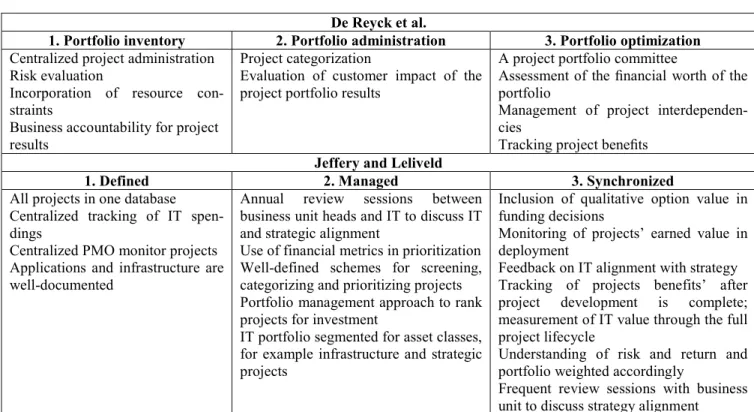
Summarizing the phased maturity models by De Reyck et al [20] and Jeffery and Leliveld [36] there are some differences, but the basic idea is the same: That organizations are at different maturity levels and that specific PPM components are best introduced in a specific order, e.g. that a basic project portfolio oversight should be introduced at the lowest maturity level, while systematic tracking of project benefits are implemented at the highest maturity level.
While De Reyck et al [20] reported that organizations benefit even at the lowest maturity level Jeffery and Leliveld [36] reported that only organizations on the highest maturity level experienced significant improvements on return-on-asset performance.
• An iterative improvement process: Within each phase organizations are advised to use an iterative improvement process (e.g. [46]; [27]; [56]; [36])
According to the literature using an iterative improvement process has several advantages. First, momentum, management attention and support can be maintained by demonstrating early results, second PPM is best improved by introducing new ways of managing the project portfolio in a small part of the organization before widespread implementation, and third because an iterative approach allows for learning and exploiting lessons learned [36]. As PPM is adopted in larger parts of the organization, the early adopters should ideally become advocates for PPM and demonstrate evidence of success [56].
Table 1: Maturity models
De Reyck et al.
1. Portfolio inventory 2. Portfolio administration 3. Portfolio optimization
Centralized project administration Risk evaluation
Incorporation of resource con-straints
Business accountability for project results
Project categorization
Evaluation of customer impact of the project portfolio results
A project portfolio committee
Assessment of the financial worth of the portfolio
Management of project interdependen-cies
Tracking project benefits
Jeffery and Leliveld
1. Defined 2. Managed 3. Synchronized
All projects in one database Centralized tracking of IT spen-dings
Centralized PMO monitor projects Applications and infrastructure are well-documented
Annual review sessions between business unit heads and IT to discuss IT and strategic alignment
Use of financial metrics in prioritization Well-defined schemes for screening, categorizing and prioritizing projects Portfolio management approach to rank projects for investment
IT portfolio segmented for asset classes, for example infrastructure and strategic projects
Inclusion of qualitative option value in funding decisions
Monitoring of projects’ earned value in deployment
Feedback on IT alignment with strategy Tracking of projects benefits’ after project development is complete; measurement of IT value through the full project lifecycle
Understanding of risk and return and portfolio weighted accordingly
Frequent review sessions with business unit to discuss strategy alignment
Generally, the first iterations should emphasize getting the governance structures right because this is the most challenging part that will evoke most resistance, because the governance structures must be used to get approval of other PPM components, and because processes are easier to design when the governance structures are in place [39]. Based on the literature review the key activities in the iterative improvement process are: Practice evaluation, governance design, process design, quality assurance and business integration.
During Practice evaluation the current project portfolio is documented as one of the first activities (e.g. [46]). Besides identifying PPM problems, the activity should also identify the motivation for change, the capacity for change, the limitations that must be respected, where in the organization PPM may provide most value [52], and the existing PPM resources, experiences and competencies in the organization that might be exploited as part of the improvement efforts [56]. Governance design includes designing the organizational structure used to make PPM decisions as well as designing?? the corresponding portfolio structure ([27]; [39]). When designing the PPM processes and enablers these should be tailored to the specific organization. Fitzpatrick [27] recommends to start with some rather general processes adding details as more
experience is gained about how to perform PPM. During
Quality assurance PPM components are evaluated before they are released for use. There should be established some kind of support for the process users before widespread use, and by regularly conducting audits it is possible to evaluate whether the implementation is successful [46]. It should be monitored whether PPM decisions are executed properly [46] and the PPM components should be systematically improved based on the data collected through the various quality assurance activities [27]. When designing and implementing new processes the key issue is to focus on business integration, that is, not to invent something entirely new but to integrate PPM (also PPM software) into existing decision-making processes and systems. PPM should align IT project decisions with organizational and business development efforts in general and PPM should integrate business units and the IT department’s planning and decision-making processes across the enterprise [39]. Accountability for PPM should be transferred to the business [36] and employees should be trained in the PPM process as well as in the financial methods used ([20]; [36]).
• Change management: A PPM improvement initiative is an organizational
change project, and not just a technical project introducing a new software tool [39]. Improvement must start at the top with senior management buy-in and keep focus on building and sustaining senior management support [46] and accountability for the results [27]. Moore [56] recommends motivating improvement through incentives and not by forcing people to use new processes. Due to the organizational change aspect stakeholder management is an essential part of both problem identification and change management [52]. The PPM problems addressed by the improvement initiative as well as the proposed solutions should be communicated as part of a planned communication effort targeting the involved stakeholders and future process users in order to manage expectations and ease the change process [27].
Improvements should focus on solving relevant problems as experienced by the stakeholders. One way of establishing a problem based perspective is to develop a business case for the various iterations as suggested by Fitzpatrick [27]. The business case should describe the problems addressed by the iteration, who and how they are supposed to benefit, and how decision-making behavior will have to change [39].
Proper project management of the improvement initiative and creating and maintaining momentum are considered critical by most of the literature (e.g. [46]; [52]). On one side a fast paced improvement process should be established because it is very difficult to maintain management focus if visible results are not produced within a short timeframe, but on the other side the organizations capability for absorbing the changes should be respected [56].
The literature emphasizes the need for attracting good people to PPM work through various incentives [36] and that existing capabilities and resources should be exploited [56]. The project group responsible for leading improvement initiatives should represent all major stakeholders and have the authority to make PPM design decisions. The solutions established by the team should be approved by all major stakeholders before their implementation [27]. The literature also recommends that measureable success criteria should be linked to the improvement initiatives making it clear what level of improvement are expected, and that the impact of the
improvement efforts should be measured after the implementation [52].
Within this framework created by a phased and iterative improvement process with a high emphasis on organizational change management a range of improvement levers are suggested in the literature:
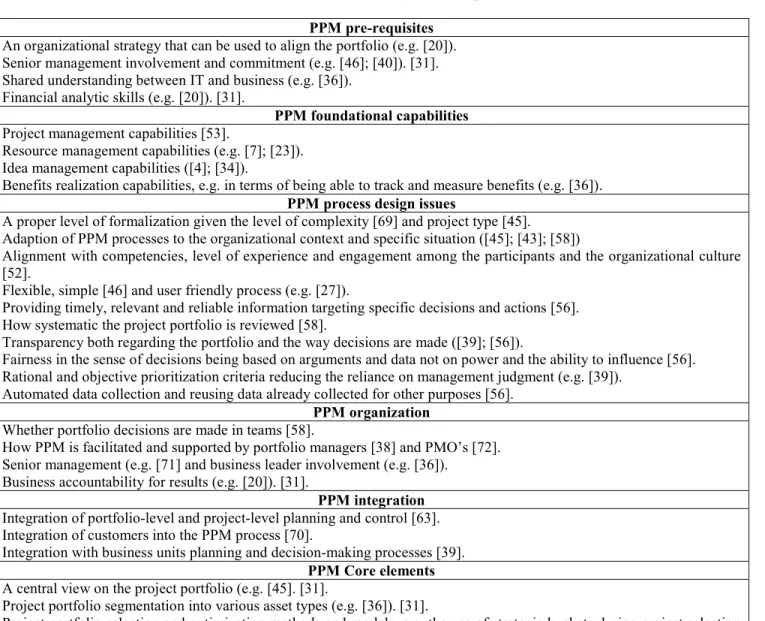
• Formalization: Increased formaliz-ation in terms of more governance, rules, process, stage-gate models, tools, centralization etc. that governs and supports PPM decision-making is by far the most dominating improvement lever in the PPM literature. The maturity models illustrated in Table 2 both equals increased maturity with increased formalization in terms of more process, procedures and tools. The basic, taken for granted, idea promoted by much of the PPM literature (also within IT): that PPM performance is improved by increased formalization is according to Killen et al [45] supported by some empirical studies, but challenged by other studies. It seems like the appropriate level of formalization at least depends on the type of project (e.g. Loch, 2000), the level of complexity [69] and organizational characteristics. Kester et al [43] identified three PPM decision-making genres across different organizations: formalist, intuitive, and integrative. The formalist-reactive genre is characterized by reliance on relatively rigid approaches, quantitative criteria, financial methods and procedural rationality in decision making and it is within this genre that formalization is most dominating. Table 2 summarizes frequently mentioned critical issues related to formalization of PPM practice and the needed pre-requisites and foundational capabilities for doing so.
The content in Table 2 has been cross checked against the success factors identified by Frey and Buxmann [31] in their literature review specifically within IT PPM. All the factors identified by that review have been included and references have been inserted to indicate a match. Far from all factors have been investigated empirically (e.g. many publications do not provide empirical evidence about the use of the methods they suggest [45]).
• Business orientation: One of the cornerstones of PPM is establishing a strategic and business oriented perspective on IT project investments.
Table 2: Critical issues during PPM improvement
PPM pre-requisites
An organizational strategy that can be used to align the portfolio (e.g. [20]). Senior management involvement and commitment (e.g. [46]; [40]). [31]. Shared understanding between IT and business (e.g. [36]).
Financial analytic skills (e.g. [20]). [31].
PPM foundational capabilities
Project management capabilities [53].
Resource management capabilities (e.g. [7]; [23]). Idea management capabilities ([4]; [34]).
Benefits realization capabilities, e.g. in terms of being able to track and measure benefits (e.g. [36]).
PPM process design issues
A proper level of formalization given the level of complexity [69] and project type [45]. Adaption of PPM processes to the organizational context and specific situation ([45]; [43]; [58])
Alignment with competencies, level of experience and engagement among the participants and the organizational culture [52].
Flexible, simple [46] and user friendly process (e.g. [27]).
Providing timely, relevant and reliable information targeting specific decisions and actions [56]. How systematic the project portfolio is reviewed [58].
Transparency both regarding the portfolio and the way decisions are made ([39]; [56]).
Fairness in the sense of decisions being based on arguments and data not on power and the ability to influence [56]. Rational and objective prioritization criteria reducing the reliance on management judgment (e.g. [39]).
Automated data collection and reusing data already collected for other purposes [56].
PPM organization
Whether portfolio decisions are made in teams [58].
How PPM is facilitated and supported by portfolio managers [38] and PMO’s [72]. Senior management (e.g. [71] and business leader involvement (e.g. [36]).
Business accountability for results (e.g. [20]). [31].
PPM integration
Integration of portfolio-level and project-level planning and control [63]. Integration of customers into the PPM process [70].
Integration with business units planning and decision-making processes [39].
PPM Core elements
A central view on the project portfolio (e.g. [45]. [31].
Project portfolio segmentation into various asset types (e.g. [36]). [31].
Project portfolio selection and optimization methods and models, e.g. the use of strategic buckets during project selection (e.g. [17], [13]).
Alignment of the project portfolio with organizational strategy (e.g. [45]). [31].
Balancing the project portfolio along various dimensions, e.g. risk and short term vs. long term development efforts (e.g. [54]).
Management of uncertainty (e.g. [62]) and risk (e.g. [50]. [31].
Management of project dependencies and synergies (e.g. [63]) and constraints (e.g. budget constraints) [20]. [31].
Decision support and expert systems that support, e.g. prioritization (e.g. [32]; [37]) and a common reporting platform for all projects [58].
The use of stage-gate models (e.g. [16]; [59]).
The maturity models (see table 1) emphasize establishing an increasingly closer collaboration between IT and the business as maturity increases; i.e. the business should be accountable for PPM decisions (e.g. [20]; [36]), PPM should result in a more strategically aligned project portfolio (e.g. [17]; [45]), financial methods and metrics should be used to make sure that project investments are beneficial from a business perspective and the benefits should be tracked [36], and PPM should be integrated with business planning and decision making [39]. Generally PPM can be perceived as a way to achieve a higher degree of strategic alignment between the business and IT.
• Rational decision-making: A rational and transparent decision-making process supported by high quality and timely data. PPM, as described in most sources, heavily relies on a strictly rational perspective on organizational decision-making (e.g. [60]). PPM decisions should be based on rational and objective prioritization criteria reducing the reliance on management judgment (e.g. [39]). Several financial optimization algorithms and tools have been suggested, e.g. decision support and expert systems that support project prioritization and selection ([32]; [37]).
• Portfolio level risk and uncertainty management: The ability to make decisions under uncertainty and manage portfolio risk balances and risk vs. reward issues.
Besides ensuring that investments in new projects are aligned with business needs and strategies one of the major concerns is to achieve a risk balance in the project portfolio (e.g. [50]). Dealing with portfolio level risk is mentioned as a vital part of PPM in most PPM books targeting practitioners (e.g. [8]; [46]).
• Project- and resource-manage-ment: Sound project management practices, management of project resources and dependencies to secure smooth and efficient project execution, exploitation of project synergies, integration of project level and portfolio level planning, etc.
PPM depends on organizations being capable of managing the projects included in the portfolio (e.g. [53]) as well as the project resources required (e.g. [7]; [23]) and the dependencies among the projects in the portfolio
(e.g. [63]). Besides securing smooth project execution another important issue is to avoid organizations initiating more projects than they can actually accomplish [23].
Given that the purpose of PPM is to improve organizational decision-making about projects and project portfolios it is striking that none of the reviewed sources attempt to understand the actual decision-making process or exploit the large and mature body of knowledge about organizational decision-making. Furthermore, it is striking that there is no focus at all on the individual and team decision-making capabilities, what makes individuals and teams make better decisions or the situational characteristics that might improve or harm decision-making processes.
RESEARCH METHOD
The research is based on a case study [73] involving public sector IT organizations working with PPM improvement initiatives during a three year period from 2008 to 2010 supplemented by interviews with experienced IT project portfolio managers from four private sector companies.
Three of the four public sector organizations experienced limited progress during the period studied, while one of them (municipality 1) succeeded in implementing some major improvements. “Success” is in this regard perceived as the ability to identify and implement IT PPM improvements (e.g. a new governance structure) that is perceived as valuable by the involved organizational actors. No attempts have been made to relate these improvements to increased organizational performance.
The interviews with the experienced portfolio managers from the private sector companies were conducted in order to get a more balanced view across both private and public sector organizations, and to learn from more successful organizations from a PPM perspective. Three of the four private sector companies had been through successful improvement efforts resulting in well-functioning and accepted PPM practices in the organizations, while the last of the organizations (private sector company No. 2) was struggling and experiencing some resistance against the improvement initiatives.
Table 3: Participating organizations
Organization Characteristics
Municipality 1 1,000 employees. The case study included interviews with the IT manager in charge of the project portfolio and his staff (two other persons) working with PPM related tasks.
Municipality 2 5,000 employees. The case study included interviews with the IT manager in charge of the project portfolio and a senior project manager working with PPM related tasks.
Municipality 3 6,000 employees. The case study included interviews with the IT manager in charge of the project portfolio and a senior project manager working with PPM related tasks.
Municipality 4 5,400 employees. The case study included interviews with the IT manager in charge of the project portfolio and two senior project managers working with PPM related tasks.
Private company 1 Software development, revenue approx. EUR 11 million. The interviewed portfolio manager had approximately 15 years of experience with IT-development and IT project management and five years of PPM experience.
Private company 2 Retails, revenue approx. EUR 6 billion, the interviewed portfolio manager had approximately five years of IT management experience and two years of PPM experience.
Private company 3 Manufacturing, jewelry, revenue approx. EUR 5 billion. The interviewed portfolio manager had approximately 20 years of experience with IT and IT management, and seven years of PPM experience.
Private company 4 Manufacturing, food industry, revenue approx. EUR 10 billion. The interviewed portfolio manager had approximately 15 years of experience with IT project management, IT management and consulting, and approximately 10 years of PPM experience.
All the interviews were conducted as semi structured interviews. Furthermore, a series of seven workshops involving practitioners from the organizations participating in the case study were conducted. The purpose of these workshops was to discuss the various challenges as well as theories and models that might be useful during improvement efforts. The workshops also facilitated experience exchange among the participating organizations. All interviews (approximately 24 hours in total) and workshops (approximately 30 hours in total) were recorded on tape. The material has been coded and analyzed in an iterative process.
In the first iteration focus was on understanding PPM practice in detail in terms of how the actors performed the various PPM related tasks compared to the advice given by literature, and on identifying PPM decision-making strategies, practices and challenges across the organizations. The interviews conducted as part of this iteration were structured according to the critical issues as described in table 2.
In the second iteration focus was on increasing the understanding by interpreting the data using theory about decision-making and how the strategies, practices and challenges might be understood using these theories.
In the third iteration focus were on contrasting the key levers for IT PPM improvement as presented in section 2 with the empirical data from the studied organizations and theory about decision-making and
extract some lessons learned regarding how the studied practitioners actually dealt with the challenges and improved their own practice. The lessons learned were based on empirical data as well as theory about organizational decision-making.
Data collection and data analysis have been conducted partially in parallel, and later interviews have been informed by data analysis conducted on the first interviews as well as the decision-making theory used to analyze previously collected data. In the same spirit the interviews with the private sector portfolio managers were not part of the original study l, but were triggered by the need to get access to more mature PPM users.
Many of the understandings and insights gained during this iterative process have been feed back into practice and discussed at the workshops. The research can this way be characterized as an explorative learning process where the early findings have been used to shape and direct the research process.
PPM IMPROVEMENT: LESSONS
LEARNED
In this section four lessons learned that might inspire PPM improvement efforts are introduced. The lessons are:
• Respect the limitations for con-trolling and changing PPM deci-sion-making
• Open the black box and understand how PPM decisions are made
• Prioritize PPM improvement initia-tives by focusing on decision-risks
• Balance formalization and profes-sionalization during PPM improve-ment Each lesson will be further described in the remaining parts of this section.
Respect the Limitations for Controlling and
Changing PPM decision-making
Challenge No. 1 was to develop new PPM decision-making processes that were implementable in the case organizations. While the PPM literature exclusively focus on organizational level changes, the individual level changes turned out to be more challenging: human decision-making processes are very complicated, the individual makers might have different decision-making styles that they are not even aware of, these processes change dependent on situational characteristics and improving the individual decision-making capabilities is a long term learning process.
Two types of changes
We can start by differentiating between two types of changes in PPM improvement – the organizational level changes and the changes in individual decision-making behavior that might lead to better decisions. Organizational level changes advocated by the PPM literature are primarily related to formalization, e.g. introducing new governance structures, processes, standards and tools, while the individual level changes are related to decision-making behavior and capabilities of the decision-makers, e.g. how they process information and exploit their experience when making decisions. Changes and improvement of individual decision-making behavior is not addressed by the PPM literature reviewed as part of this research, even though decisions are made by individuals.
Organizational level changes
Dealing with the organizational level changes was in itself very difficult for all the studied organizations. In the public sector organizations the level of transparency introduced with PPM was not appreciated by some managers primarily because visible failures could create political problems:
“The politicians currently in charge expect us not to create opportunities for the opposition to
turn (IT-project) failures into political attacks.” Public sector IT-manager, municipality 4.
In one of the private sector companies business managers were unwilling to accept a shared responsibility for project and portfolio risks; it was the responsibility of the IT department if anything went wrong, and changing decision-making authority was not welcome:
”You have to understand the interests and political issues, you have to understand that some managers have no interest in a situation where the portfolio is more controlled, that’s the basic problem that I am challenged by.. the further down in the organization we get, the less interest the managers have in portfolio management. They want to do their own prioritization.. the more control we have in the top, the less power and freedom to prioritize they have at the bottom. Only top management is truly supportive.” Portfolio manager, private sector company 2.
It was also a big challenge to establish a sufficient level of shared understanding between IT and the business managers needed for collaborative decision-making in the four public sector organizations, or even to create a shared understanding of the benefits of introducing a more formal PPM approach:
“It’s a bit experimental…We don’t want to create a formal, heavy control structure (around IT PPM)… we will never succeed in doing so, there will be no understanding of the benefits of doing so (among the functional managers) upfront…we have to introduce more management in small steps… we sort of have to prove that the way it is currently done doesn’t work, we have to wait for a shared understanding of the need for more control (regarding the portfolio)”. Public sector IT manager, municipality 1.
There are many different competing and partly conflicting theories explaining how decision-making takes place in organizations – e.g. that decision-making is deeply political [61], coincidental and opportunity driven in terms of solutions chasing problems [15], incremental [47], partly subconscious and based on intuition and partly deliberate and based on rational analysis [44], or driven by emotional factors and conflicts [51]. None of these theories indicate that organizational decision-making is easily controlled or changed, even though some dysfunctional aspects of decision-making processes might be eliminated [51]. Examples of decision-making
processes with these characteristics could be found in all the case organizations, and implementing processes as described in the PPM literature (e.g. [46]) would be a substantial and high risk change effort.
Generally the improvement of PPM in the studied organizations did not follow an overall structured process and plan as described in section 2, but was more opportunity driven and experimental. Even with a thorough and systematic change management effort as described in the PPM literature, changing the way organizations make decisions is very challenging.
Changing individual decision-making
behavior
Even though the organizational changes were difficult, it was far more difficult to achieve an actual change in individual decision-making behavior. The studied portfolio managers all, except one (private sector company 2), perceived the rational PPM decision-making model, based on objective criteria and scoring algorithms prescribed in most of the PPM literature, as being too simplistic for improving decision-making behavior. First, the insight, experience and capabilities needed to make high risk strategic decisions could not be reduced to following a procedure (table 4 illustrates some major capabilities emphasized by the interviewed portfolio managers), second these procedures and algorithms did not properly reflect the high level of uncertainty that characterizes most projects in the initial phases, third the rational model did not match the organizational cultures and decision-making behaviors.
Decision-makers can be trained in using various rational analytic techniques and in developing and using their intuition [35], but radically changing the way that people make decisions by applying increased formalization and enforced rationality is hard. It is not just about overcoming e.g. political issues but also about how the human brain works. The next sections will go deeper into this discussion but basically individual decision-makers rely on two different decision-making styles: Rational-analytic deliberate thinking and the partly subconscious use of intuition. We know that managers have different personal preferences for the two decision-making styles ([1]; [11]) and that their preferences might change over the years as they get more experienced within a specific domain. Burke and Miller [10] found that older and more experienced employees tend to use and trust intuition more than younger and inexperienced employees who rely more on rational analytic thinking. Agor [1] found that the use of intuition varied with management position (top managers were generally using intuition more than middle and lower managers), profession (e.g. the use of intuition being higher among managers in
general administration than in financial management), by sex (females generally using intuition more than men) and ethnic background (e.g. people with an Asian background generally relying more on intuition than Anglo Americans). Based on his research Agor [1] categorized managers into left-brainers (preferences for rational-analytic decision-making), right-brainers (preferences for intuitive decision-making) and integrative (integrating the two decision-making approaches) and suggested how organizations by exploiting the various skills at the right time in decision-making processes could increase decision quality and organizational productivity. In a similar study Busenitz & Barney [11] found that entrepreneurs in start-up companies had a much stronger preference for intuitive decision-making than managers in more mature organizations, and that this was quite sensible since they didn’t have the time or the resources to invest in large scale analytic efforts but had to exploit opportunities while they were still around. We also know that various situational characteristics push decision-makers towards certain decision-making styles. Time pressure (e.g. [22]), lack of clear policies and procedures (formalizations) [10], people related issues being involved in the decision [10], consistency with organizational culture and values being important [10], the need to check quantitative analysis [10], lack of information (e.g. due to environmental uncertainty or unexpected decisions), (e.g. [10]; [44]), and information overload [10] are all factors that push decision-makers towards relying on experi-enced-based intuition when making decisions.
Research into the effectiveness of intuitive decision making has not provided clear answers regarding the benefit of relying on intuition. Since intuiting is deeply personal and related to personal experience, it is obvious that managers only can be intuitive about something that they really know something about (Mintzberg in [12]), and that our intuitive judgments are limited by the relevance of our experience and our ability to use it. Some research findings indicate that the use of intuition in decision making leads to lower quality decisions than the use of rational models (e.g., [19]; [65]). Other findings suggest that for certain people, under the right conditions, intuition may be as good as and at times better than other decision-making approaches ([6]; [44]). Understanding these findings is not made easier because intuition has been perceived differently (e.g. [9]). Research indicates that in unstable environments, leading to a high degree of uncertainty, organizational performance is enhanced by intuitive decision-making, while more rational analytic-approaches are favorable in more stable environments [44]. Simon [67] suggested that good managers probably rely on a combination of
experience-based intuition and rational-analytic decision-making styles and that both the nature of the problem and how fast a decision is needed influence how the two approaches are mixed. Eisenhardt [26] described how effective managers make fast decisions based on combinations of experience-based intuition and more rational decision-making, and how they rely on “deep personal knowledge of the enterprise that allows them to access and interpret information rapidly when major decisions arise”. Fredrickson [30] found that the effectiveness of decision-making depends on a combined deliberate rational and intuitive effort, and that successful managers base decisions upon intuition but justify and rationalize their intuitive decisions using e.g. spread sheets and diagrams.
The implications and lessons learned are that practitioners should be very conscious not only about the organizational level changes they can achieve realistically, but also about the limits for changing or controlling individual decision-making behavior even through a thorough and well planned change management effort as described by the PPM literature: Managers have some deeply embedded decision-making preferences, the way they make decisions might change slowly over years as they get more experienced, situational characteristics might push decision-makers towards relying on rational-analytic or intuition-based decision-making but it is not easily controlled or changed. Furthermore just adopting the rational decision-making ideal advocated especially by the PPM books (e.g. [46]) might in itself create resistance not just because it challenges organizational politics and power balances, but also because it doesn’t match the decision-making preferences, behaviors and situational characteristics.
The way managers combine deliberate rational and intuitive thinking is complicated and may differ from person to person (e.g. depending on the level of relevant experience) and the specific situation (e.g. level of time pressure) and this makes it difficult to design PPM processes and tools that support them. The least experienced private sector portfolio manager (private company 2) wanted to change how senior managers made decisions. He wanted them to reduce their reliance on experienced based intuition and use a more rational-analytic and objective method instead, but experienced little success. The more experienced portfolio managers were adapting the support, the communication, the information and collaboration to the individual stakeholders and their decision-making preferences.
Open the black box: Understand how PPM
decisions are made
While the first challenge tells us that we should be modest about the possibilities for changing actual decision-making behavior, challenge no 2 tells us that in order to succeed with anything we need to understand what is going on during PPM decision-making and how decisions are made. This is in line with the PPM literature suggesting that the improvements must be based on a thorough understanding of the current practice (e.g. [52]). However, the PPM literature provides little insight into how this understanding is established, how decision-makers make decisions, or why they make good or bad decisions. One way of establishing this understanding is to exploit our knowledge about individual and team-level decision-making and use this knowledge to analyze the PPM practices of the specific organization.
Understanding individual decision-makers
The capabilities and actions of individual decision-makers have great impact on both decision quality and the degree of consensus of PPM decisions. The human brain has two different systems that support thinking, reasoning and decision-making called system 1 and system 2 (e.g. [33]). In order to increase our understanding e.g. about how managers make strategic decisions, a substantial research effort has been conducted regarding the functioning and interplay between these systems.
System 1 is considered the oldest one from an evolutionary perspective. System 1 processes are very fast, parallel, and automatic, permitting humans to make fast decisions without conscious reasoning. Intuiting is a system 1 process giving humans e.g. the ability to make fast decisions without conscious thinking but still drawing on past experience. System 2 processes are slower, serial and require a conscious effort, permitting abstract reasoning and hypothetical thinking (e.g. [33]). Rational-analytic thinking is a system 2 process giving humans the ability to e.g. apply logic to analyze complex problems and make decisions. Both systems are used in a complex interplay shaped by the specific situation when individuals make decisions, also PPM decisions. The intuitive processes belonging to system 1 can be divided into several categories. Miller & Ireland [55] distinguish between “intuition as automated-expertise” and “intuition as holistic-hunches” and relate these concepts to the organizational learning concepts exploitation and exploration. Pursuing and balancing exploration (e.g. by relying on holistic-hunches) and exploitation (e.g. by relying on automated-expertise) are classic organizational challenges which are very present in project portfolio
management with regard to project selection (what’s the right balance between short-term projects that e.g. focus on optimizing the current way of working and long-term strategic and innovative projects that create new opportunities?) and the way portfolio management is performed and improved (when should we follow standard procedures or explore new innovative ways of dealing with portfolio issues?).
Intuition as automated-expertise corresponds to the recognition of a familiar situation and the partially or totally subconscious application of previous learning related to that situation. This form of intuition develops over time as relevant experience is accumulated in a particular domain, e.g. project or portfolio management where a number of situations become familiar over time [55]. In the case organizations the experienced portfolio managers could make up their minds regarding e.g. a business case very fast, because they knew what to focus on based on many years of experience. In one of the participating organizations the resources were so limited that investing many resources in e.g. thoroughly analyzing an on-going project to figure out whether the project was in trouble or not was a large decision, in another company the need to meet deadlines (due to hard competition) also limited the possibilities to conduct thorough rational analysis as part of deciding which projects to start. Instead they accepted that some projects had to be cancelled further down the road.
Inexperienced professionals within a particular domain typically try to use explicit rational analysis to identify and process key factors related to the particular domain and the decisions they make, but as they get more experienced their performance becomes more fluent and explicit rational analysis becomes more rudimentary. Based on accumulated experience-based expertise some steps in the explicit analysis are dropped while others are completed in a rapid and subconscious way [55]).
The key to automated expertise lies in a sophisticated pattern matching: a person’s ability to quickly identify a familiar situation and automatic exploitation of stored knowledge related to the situation. Simon [67] described these intuitive judgments as “analyses frozen into habit and into the capacity for rapid response through recognition”.
The typical scenario in the case organizations were that when considering multiple alternatives, the portfolio managers would not apply a thorough, rational analysis on all the alternatives (that would be practically impossible given the time and resource limitations), but use their experience-based intuition to focus on what they perceived to be the most valuable alternatives. When evaluating these alternatives they would quickly, also
using experience-based intuition, zoom in on the essentials, the factors that were considered especially relevant. This behavior is in line with the observations by Clarke & Mackaness [14]. They found that senior managers seem to use intuition to go beyond the rational data and information, using experience to focus on the essence of a situation, and evaluate their thoughts against the outcome and experience from previous similar decisions.
The status-report evaluation practice of one portfolio-manager (private sector company no 3) was studied in order to understand how he processed information and how he balanced experience-based intuition and rational analysis. The portfolio-manager regularly received status reports for all projects collected in one big power point presentation, which he went through in a first pass rather fast using few seconds on each. The overall criteria used to determine which projects to take a closer look at were whether the project managers perception of the status corresponded with the information the portfolio manager got from his personal and informal network (e.g. vendors delivering resources to the project, old colleagues, customers and other stakeholders). Experience had taught him that the really big catastrophes happened when project managers were unable to see, or wouldn’t admit, that their project was in trouble. In such projects the portfolio manager himself, or others appointed by the portfolio manager, would conduct a thorough analysis of the project. He would not necessarily intervene in a troubled project if the project manager’s perception of the status matched his own perception and the project manager seemed qualified to deal with the situation.
Intuition as a holistic-hunch is almost opposite. Intuition as holistic-hunches allows us to break away from established routines and do something innovative that e.g. creates new business opportunities. During this kind of intuiting knowledge stored in memory is subconsciously combined in complex ways to produce intuitive judgments that feel right and lead to new approaches and radical changes in strategies. The term “gut feeling” is often used to describe the phenomenon [55]. The subconscious process involved in holistic hunch is not well understood [55], but it is related to creativity. Andersen [3], for instance, argued that creative alternatives are more likely to be the result of intuitive judgments because intuition allows people to “think outside the box” and make the association of new combinations of means and ends. Only very few instances of this kind of intuiting were identified in the case organizations.
There are no previous studies of how PPM decision-makers make decisions but the research by Woiceshyn [75] about how CEOs combine intuition and rational analysis provides some insight into the differences between effective and less effective CEOs when making investment decisions. One of the major differences being the ability to quickly identify and focus on the most essential aspects of alternative investment proposals and the identification and use of experience-based and relevant principles. Not surprisingly the best decision-makers simply think and reason differently, they have access to relevant high quality experience, and make better decisions given the same information.
The lessons of this is that PPM improvement might benefit from taking a closer look both at the theories about how managers make decisions, as well as the actual individual decision-making practices among key decision-makers in the specific organizations and try to understand how they make different kinds of decisions. The PPM literature generally promotes and supports rational-analytic decision-making. Reading the literature it is easy to overlook the fact that rational-analytic thinking is not the only way to make decisions because this decision-making style seems so obviously right. Individual decision-making behaviors and capabilities are generally not discussed. By supplementing the focus on processes, techniques, criteria and tools that support rational-analytic decision-making with exploiting decision-making expertise extracted by interviewing skilled decision-makers in the organizations better results might be achieved. By extracting the essence in terms of the primary information, experience, principles and strategies that skilled decision-makers use in specific situations it becomes easier to provide relevant support, help them to increase their capabilities, and to learn from them. Furthermore it seems obvious that stimulating managers’ ability to make intuition-based decisions must be a vital part of PPM improvement, given that this kind of decision-making in reality plays a large role in actual decision-making.
Understanding decision-making in teams
The quality of management decisions, like PPM decisions, depends not only on the cognitive capabilities of individuals but also on the interaction between the participants in the decision-making team (e.g. [24]). Generally, cognitive diversity among team members increases both decision quality and innovation (e.g. [2]). However, diversity only helps if it is actually exploited by the team. That’s why the process through which the team interacts matters for both decision quality and consensus (e.g. [2]). During this interaction the participants should be able to “identify, extract, and synthesize their
perspectives to produce a decision” [2]. Consensus in the team increases the likelihood of decisions being successfully implemented afterwards (e.g. [2]). Consensus is based on the commitment and understanding that might be achieved during the decision-making process. If the cognitive conflicts turn affective, participants in the decision-making process develop negative attitudes towards each other and this makes them less likely to fully participate in the process, which has negative impact on both decision quality and consensus (e.g. [2]).
In the case organizations dealing with cognitive diversity and conflicts was generally difficult. In all the organizations it was normal practice that decision-makers on all levels consulted people in their network in order to explore different perspectives, prepare or validate decisions. Some of these activities were institutionalized in some of the organizations, e.g. in terms of conducting workshops where people with different expertise and background (e.g. business people, domain experts and IT architects) would discuss and qualify project proposals, some of these activities where informal and ad hoc. In one organization the portfolio manager (private sector company No. 1) would deliberately consult people he knew would disagree, because he wanted to optimize his proposals by incorporating their criticism, in other organizations people expected to disagree were excluded from the process because it was perceived as being too difficult or taking too much time to include them (private sector company no 3). Seeking early consensus and avoiding open disagreement were common practice in all the organizations, but especially in the public sector organizations. One of the skills emphasized by the experienced portfolio managers was their ability to design decision-proposals that were almost unconditionally accepted by the stakeholders as a result of the portfolio managers’ experience, their knowledge about all the interests of the stakeholders, their knowledge about how to communicate with the stakeholders and their social capital. While these skills increased consensus and speeded up the process, they could also reduce decision quality. The worst examples of cutting of constructive disagreements happened when senior management commitment and involvement in specific projects almost were too strong: In some cases a senior manager would insist on initiating a specific project, shortcut all processes and neglect the organizational expertise within the area, and due to the manager’s position and power relevant objections were disregarded.
In most of the organizations differences in perspectives among decision-makers were not only an asset leading to better decisions, but also a challenge because the various stakeholders in some aspects had little
understanding for the legitimate concerns of other stakeholders: E.g. top management not understanding project risks or the problems related to project execution, project managers not understanding what was important for top management, and misunderstanding and mis-communicating problems between IT managers and business managers. In the public sector organizations IT managers typically complained about business managers’ lack of understanding of the business potential of IT.
The lessons here are that in order to improve practitioners need to study how the team dynamics in the portfolio management boards function in general, especially regarding the two issues that were important in the portfolio decision-making in the case organizations: The ability to exploit differences in perspectives and background, e.g. between business people and IT specialists, to increase decision quality, and the ability to create consensus about the final decisions. Making high quality project portfolio decisions requires the inclusion of many different perspectives and no single category of stakeholders can do this alone.
Prioritize IT PPM improvement initiatives by
focusing on decision-risks
Challenge No. 3was how to prioritize and focus PPM improvement initiatives. Just by looking at table 2 the possibilities for initiating PPM improvements are overwhelming. The PPM literature recommends that improvement efforts should focus on solving PPM related problems as experienced by key stakeholders (e.g. [52]). As previously described two factors are especially relevant to focus on when improving decision-making: The quality of the decisions as well as the level of
consensus among the managers that make and implement the decisions (e.g. [2]; [21]). These two factors could also be the primary concern during PPM improvement efforts: How can we make better decisions and how can we make sure that they are actually implemented afterwards? The factors that impact decision quality or consensus may be grouped into four major categories:
• Factors related to individual decision-makers
• Factors related to decision-making team interaction
• Factors related to the decision itself
• Factors related to the context in which decision-making takes place
Factors that are related to individual decision-makers are factors like domain relevant experience (e.g. Mintzberg in [12], personal biases (e.g. [9]),
decision-making skills (e.g. [75]), decision-decision-making preferences (e.g. [1]) and attitudes towards risk (e.g. [68]).
Examples of factors that are related to the interaction between the individual decision-makers in the decision-making team are cognitive diversity (e.g. [2]), the team interaction process (e.g. [2]), conflict (e.g. [2]), groupthink [24], decision-makers’ perception of other team-members competence and loyalty [21] and team cohesion [24].
Factors that are related to the specific decision made by the team are for example the degree of uncertainty and equivocality (e.g. [18]) and escalation of commitment (e.g. [42]).
Finally some factors are related to the context in which the decision-making team operates e.g. politics and power games [25], the general need for decision-speed (e.g. [29]), organizational level information processing capabilities (e.g. [18]) or toxic and highly dysfunctional decision-making processes [51].
In the remaining part of this section these factors are called decision-risks because they are risks linked to the decision-making process that impact the likelihood of bad decisions being made regarding the project portfolio, e.g. not closing down a failing project, or starting a project with limited possibilities for success. Within portfolio and project management there are long traditions for risk-management (e.g. [50]; [28]), but decision-risks are different because they are partly unrelated to the specific project and more related to the way portfolio-level decisions are made about these projects. To make the distinction clear an example from one of the organizations is provided:
“We are working with a high degree of risk in our decision-making processes – I’ve recently had to retire two systems before they even got into production. The initial analysis was simply inadequate and further down the road we learned that it was wrong… there is a tendency to push risk responsibility down to the project managers. Management doesn’t want to hear about risks and expect project managers to deal with them, but the majority of risks should actually be dealt with by management because they are out of scope compared to what the project managers are able to control… there is a tendency to make project managers take the blame, e.g. for missing an unrealistic deadline decided by management.” Portfolio manager, private sector company No 3.
In the same organization project proposals could, due to a strong sense of urgency, turn in to “no-brainers”,
that is projects that were so obviously right that they just had to be started. Making a business case or doing some initial analysis seemed a waste of time. Both the tendency to push down risk responsibility, the unwillingness among managers to discuss or take responsibility for risks as part of their decision-making, and turning a strong sense of urgency into “no-brainers” are decision-risks.
When the portfolio managers interviewed were asked to describe bad portfolio decisions leading to e.g. project failures, the examples they emphasized were typically characterized by a combination of high project- and high decision-risks. In one organization the managing director were put under high pressure to make a sale in a new market (a high project-risk) and as a consequence bypassed all existing processes and knowledgeable people (high decision-risk). In the same organization a tough contract with an external customer (a project risk) in combination with project managers withholding information about the actual progress placed the portfolio management board under hard time pressure when making decisions (a decision risk).
For these organizations it made sense to systematically identify the frequently occurring decision-risks and attempt to reduce them as part of PPM improvement, and to be especially concerned about the projects that were characterized by a combination of high project- and decision-risk.
The concept of decision-risk might help practitioners focus improvement efforts on the issues that are most harmful and potentially lead to bad decisions in terms of low quality and inadequate consensus. It is easy to get lost in all the suggestions for new processes, methods and tools, but the concept of decision risk is a simple way to stay focused on the issues that threaten the core of IT PPM: making good decisions. Furthermore the large body of knowledge regarding organizational decision-making can be exploited to pinpoint some of the most common decision-risks and how to deal with them. Taking on this perspective means that the focus changes from designing and implementing PPM components as suggested by most of the PPM books (e.g. [39]) to a perspective where reducing the root causes to bad project portfolio decisions is central. Doing so might involve introducing a new PPM component, e.g. a tool, but it could also involve e.g. increasing the understanding of IT management issues among business managers to make them more qualified to make PPM decisions, or to improve dysfunctional team dynamics among key decision-makers.
Balance organizational formalization and
professionalization
Challenge No. 4 is how to design relevant improvements given the problems identified as described in section 4.3. As previously described the PPM literature almost exclusively provide suggestions for improvement based on increased formalization and more rationality. The essence of this lesson is that organizations engaged in IT PPM improvement might benefit from adopting a mixed strategy based on both formalization and professionalization.
Formalization is perceived as providing more structure, rules, procedures and standards within a given area, e.g. providing an explicit and well defined governance structure for IT PPM decision-making, while professionalization is perceived as improving individual and team decision-making capabilities.
Formalization without professionalization might just result in organizations being able to make bad decisions in a more structured way, while professionalization without formalization might lead to inefficient decision-making, turbulence and a high degree of dependencies on individual management capabilities.
Formalization provides the governance structures, processes and tools that create a structured environment facilitating and supporting decision-making, e.g. that organizations have a management board with clearly defined authority and responsibility to make portfolio-level decisions that receives timely and relevant portfolio information.
Professionalization, on the other side, focuses on the improvement of individual and team level decision-making capabilities primarily by learning from experience but also through other learning mechanisms: For example by learning how to make qualified judgments when facing difficult IT project portfolio decisions under uncertainty and exploiting the decision-making environment created through relevant formalizations.
The following examples from the case organizations illustrate the point. These organizations can roughly be divided into four categories: 1) organizations having neither governance structure (formalization) nor strong making capabilities among key decision-makers (professionalization) 2) organizations having the governance structure in place but not the decision-making capabilities 3) organizations having the decision-making capabilities, but not the governance structure and 4) organizations having both in place. The portfolio managers in category 3 and 4 organizations, not surprisingly, expressed most satisfaction with the organizations’ PPM performance. Portfolio managers in