THE PAIN OF IBM LOTUS DOMINO
EMAIL BROADCASTING –
OPTIMIZING DELIVERY
PERFORMANCE
© Splitrock Software LLC 2006 www.re-soft.com 203-972-8462 Page: 2 of 7
As a general purpose e-mail system, IBM Lotus Notes/Domino (Domino) provides powerful e-mail authoring, transport, and delivery services, combined with unparalleled encryption and security features. However, when utilizing Domino for e-mail broadcasting purposes (within this paper, an e-mail broadcast represents any message with 20 or more recipients), there are numerous factors that can degrade overall mail system
performance, and add to the workload of system administrators. The Performance Challenges of Domino Broadcasting
Numerous factors can contribute to
degraded mail system performance when delivering e-mail broadcasts.
Businesses utilizing Domino Messaging services face numerous
performance challenges when the e-mail system is used to send e-mail broadcasts.
Routing Overhead: During the delivery process, the mail system must make routing decisions for each address within the message. This process is repeated at each mail router (hop) in the delivery path. The additional processing necessary for documents with small address lists is negligible; however as the address list grows in size, the amount of additional processing can reach levels that seriously degrade the performance of all mail system resources along the delivery path.
Network Utilization Issues: With any e-mail transmission, bandwidth utilization increases as the document size increases. Broadcasts can significantly increase bandwidth utilization as address lists grow large. Excessive bandwidth utilization can negatively impact the availability of network resources for all network users.
Contention with other e-mail: E-mail systems typically do not have capabilities to distinguish between non-broadcast and broadcast e-mail, therefore all e-mail traffic is generally considered equal for delivery purposes. This means that all messages use the same routing resources, following the very same delivery paths. When broadcast e-mail is being delivered, any non-broadcast e-mail traffic in transit can be delayed by the increased resource requirements of the broadcast, or simply by the need to wait until the delivery of the broadcast is complete.
Lack of Robust Delivery Scheduling Features: Domino provides limited delivery scheduling capabilities, consisting of a low, normal, and high priority scheme which delivers low priority mail during off-peak hours, and all others as soon as possible. For non-broadcast e-mail, the lack of robust scheduling features is usually not an issue. However, due to impact broadcasts can have on the mail system, it is highly desirable, and in many cases absolutely necessary, to have flexible features to schedule broadcast delivery for specific days and/or times more appropriate for the content and size of recipient list.
Lack of Delivery Metering: Domino does not possess a mechanism for metering or controlling the rate of mail delivery. All e-mail is delivered essentially at once when transmission is initiated. Without a mechanism to control the rate at which mail is delivered, the simultaneous delivery of messages to a large number of recipients can significantly degrade e-mail system performance.
© Splitrock Software LLC 2006 www.re-soft.com 203-972-8462 Page: 3 of 7
Typical Solutions for Notes/Domino Broadcasting
A variety of broadcasting applications have attempted to solve broadcast delivery issues.
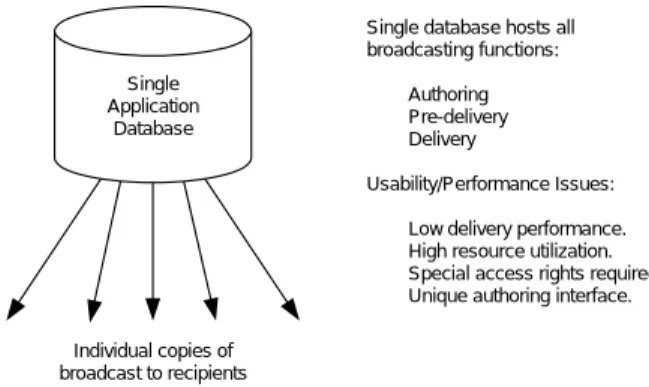
A variety of applications have been historically available which attempt to provide a Domino broadcasting solution. Most of these applications generally approach the problem by providing a special database which is used to author and deliver broadcasts from a central location (see figure 1 below). This approach, while arguably functional, suffers from some fundamental usability/performance issues:
• Database access is generally limited, therefore broadcast authoring
is restricted to selected individuals, and is not open.
• Broadcast authoring is performed with an interface unique to the
application.
• High network and mail routing resource utilization due to delivery
from a single, central point.
• High contention with non-broadcast e-mail.
• Low delivery performance due to single delivery agent processing
large address lists.
Figure 1: Typical broadcasting solution.
Individual copies of broadcast to recipients
Single Application
Database
Single database hosts all broadcasting functions:
y Authoring y Pre-delivery y Delivery
Usability/Performance Issues:
y Low delivery performance. y High resource utilization. y Special access rights required. y Unique authoring interface.
A High Performance Solution: Castcadia
Castcadia Broadcast Manager provides a high performance solution for IBM Domino.
Castcadia Broadcast Manager for IBM Lotus Notes/Domino is a commercially available application for high performance/high volume broadcast delivery.
How Castcadia Works
Castcadia was designed specifically for efficient, high-performance delivery of e-mail broadcasts.
Castcadia is not a broadcast authoring application, but rather a type of specialized router/engine designed specifically for efficient and high-performance management and delivery of broadcast e-mail traffic. E-mail broadcasts are authored from an e-mail client (Notes, POP3, etc) and routed to Castcadia for processing. This method also does not require special authoring databases or tools, or special access rights in order to compose and send broadcasts, therefore keeping the authoring function open and flexible, but completely controllable.
Castcadia’s Architecture
Castcadia’s
architecture provides flexible delivery
Castcadia has a flexible architecture, based on the configuration and utilization of two primary types of application databases that perform the
© Splitrock Software LLC 2006 www.re-soft.com 203-972-8462 Page: 4 of 7
configuration options. processing and delivery of e-mail broadcasts:
• Broadcast Management Database- This database ‘captures’ broadcasts sent from mail clients, and performs all of the pre-delivery processing. Basic pre-delivery processing includes determining recipient addresses from group addresses, delivery path analysis, removal of redundant recipients, and the creation of broadcast ‘pallets’ (single copies of the message with an encapsulated address list) for delivery. Many other functions are also performed during pre-delivery, but are outside the scope of the document.
• Distribution Database- The sole function of this database is to accept broadcast pallets from the broadcast management database and perform the final delivery of broadcasts to all addressed users.
Separate databases for pre-delivery and delivery functions provide several important advantages over a single database:
• Broadcast pre-delivery processes can run independently from delivery
processes.
• Additional instances of the distribution database can be implemented to
provide multiple, independent delivery points.
• The distribution database(s) can be separated geographically from the
location of the broadcast management database.
Basic Broadcast Delivery Processing
The most basic configuration possible for Castcadia is comprised of one
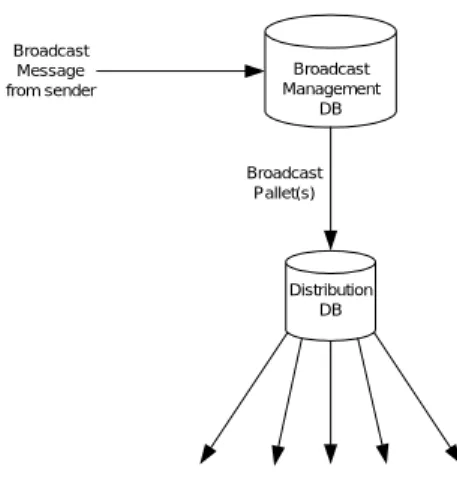
broadcast management database, and one distribution database. Figure 2 illustrates this configuration.
Figure 2: Basic configuration: single instance of
distribution database.
Broadcast Management
DB Broadcast
Message from sender
Broadcast Pallet(s)
Individual copies of broadcast to recipients
Distribution DB
© Splitrock Software LLC 2006 www.re-soft.com 203-972-8462 Page: 5 of 7
Multiple Distribution Database Configuration
Multiple delivery point configuration allows high performance, concurrent delivery mechanism.
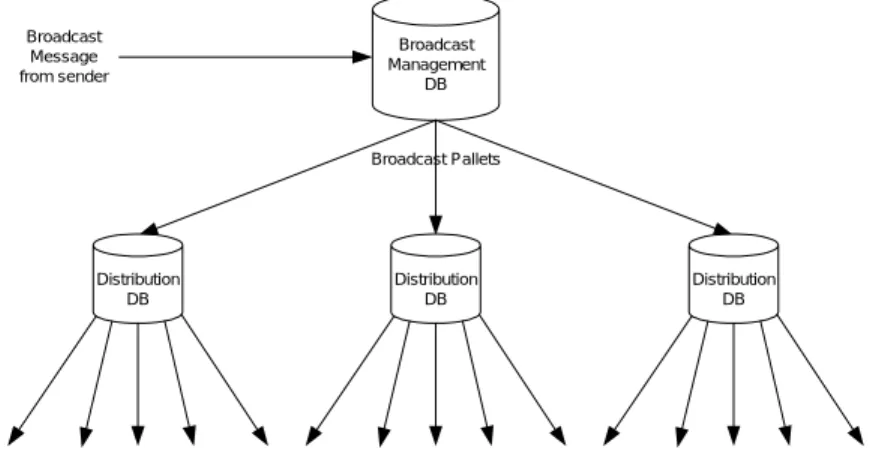
Multiple Castcadia distribution databases can be implemented for increased flexibility and performance (see figure 3 below). With such a configuration in place, delivery tasks are spread across the separate databases, where agents can run concurrently. Any number of distribution databases can be deployed. Each distribution database receives only a single copy of the broadcast (pallet), with a recipient address list specifically built for it by the broadcast management database. Each distribution database receiving the broadcast then cycles through its own address list, delivering a copy of the message to each recipient.
Figure 3: Multiple instances of
distribution database configured for independent, concurrent delivery.
Broadcast Management
DB Broadcast
Message from sender
Broadcast Pallets
Individual copies of broadcast to addressed recipients Distribution
DB
Distribution DB
Distribution DB
High Performance Considerations
Thoughtful implementation of multiple distribution databases is a key to increased delivery performance.
A thoughtfully designed implementation of multiple distribution databases is a primary key to increasing broadcast delivery performance.
As distribution databases can be physically located on any Domino server that can run agents, careful consideration of database location is essential. Since only one copy of the broadcast message is sent to a distribution database, locating distribution databases at the other ends of WAN connections, or routing paths, from the broadcast management database yields the best overall performance results. Also, as a general rule of thumb, the closer the distribution databases are to targeted mail files and/or domains, the better. Ideally, where possible, distribution databases are best located on the mail servers themselves, where the final deliveries are made on the server, without using network resources, resulting in the utmost efficiency and delivery performance.
The Benefits of Multiple Distribution Databases
Proper utilization of distribution databases can significantly reduce issues related to broadcasts.
When properly implemented and utilized as described above, multiple distribution databases can significantly minimize the negative effects of e-mail broadcasts:
Reduced router processing overhead: Castcadia’s pre-delivery agents process all addresses to determine the appropriate delivery path before delivery is initiated. This processing is done apart from mail routing
© Splitrock Software LLC 2006 www.re-soft.com 203-972-8462 Page: 6 of 7
resources.
Minimal contention with other e-mail traffic: By reducing the number of messages to be routed when transmitting broadcasts, Castcadia minimizes the delaying effect of broadcasts on other e-mail.
Decreased bandwidth requirements: Since each distribution database receives only one copy of the message, the amount of bandwidth required for transmission between the broadcast management database and the distribution database is essentially only that necessary to send a single message.
Real-world Delivery Scenario
A real-world scenario demonstrates how Castcadia can be implemented for high performance
broadcast delivery.
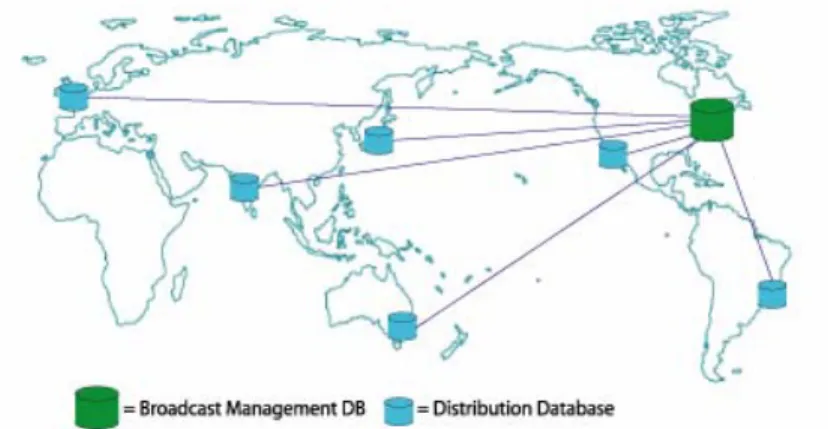
As a possible real-world scenario, an organization configures multiple distribution databases installed on mail servers located at their global offices (see Figure 4 below). A broadcast is authored and sent to an 'All Employees' group. Instead of being immediately delivered to the targeted recipients, this e-mail message is routed to the broadcast management database, where it is processed and one copy of the message (pallet) is delivered to each distribution database utilized. Once received at the distribution database, an individual copy of the broadcast is delivered to each recipient in the embedded address list.
In this scenario, since only a single copy of the message is sent to each distribution database across the network, regardless of total number of recipient addresses, the network bandwidth utilization for each link is only what is required for that single copy of the message.
Additionally, since the delivery of the broadcast is split across multiple independent distribution databases, located on local mail servers, deliveries at these databases can occur in parallel, and without utilizing network resources, resulting in much higher performance than delivering from a single central source.
Figure 4: Multiple distribution databases utilized to localize & parallelize delivery of an ‘All Employees’ broadcast.
© Splitrock Software LLC 2006 www.re-soft.com 203-972-8462 Page: 7 of 7
Castcadia provides flexible and powerful delivery scheduling capabilities.
Flexible and Powerful Delivery Scheduling:
Castcadia provides the following features to schedule broadcasts for the best delivery date/time:
• Delivery can be scheduled for a specific date and time, or specific days
of the week.
• Time zones are recognized. Castcadia provides the following time zone
scheduling modes:
o Single specified time zone. Deliveries can be scheduled for
date/time delivery relative to a specified time zone.
o Multiple time zones. Deliveries can be scheduled for independent
deliveries at specified date/time relative to each time zone addressed in a broadcast.
• Customizable 'distribution periods' provide the capability to define
special broadcast delivery windows such as "Business Day", "Off Peak", or "Heavy Load" for scheduling purposes.
• Broadcasts can be scheduled to repeat. Intervals can be specified to
repeat daily, weekly, every 2 weeks, every 3 weeks, every 4 weeks, or according to a custom defined date list.
Delivery Metering:
Castcadia provides delivery metering capabilities to control the rate of broadcast delivery.
Castcadia provides delivery throttles to meter broadcast delivery. When utilized, delivery throttles control the rate of delivery of individual messages from distribution databases according to defined parameters (x number of messages per y minutes), instead of performing an immediate delivery to all addresses. By limiting the rate of delivery in this manner, contention with other e-mail is significantly reduced.
Conclusion
For organizations utilizing IBM Lotus Notes/Domino messaging services, Castcadia helps overcome the inherent challenges of managing and delivering e-mail broadcasts. By reducing network and mail system utilization issues, and providing improved methods to schedule, and meter deliveries, outside and away from mail routing functions, Castcadia can significantly improve e-mail delivery. To find out more about Castcadia, visit
http://www.re-soft.com or call 203 972 8462.
Castcadia is a trademark of Splitrock Software, LLC. All other product or service names are the property of their respective owners.