Deployment of a Wireless Hybrid and Mobile Network for
VoIP Services Based on Open Source Software
Danilo F. S. Santos, Jos´e L. do Nascimento, Olympio C. S. Filho and Angelo Perkusich∗ 1Embedded Systems and Pervasive Computing Laboratory
Electrical Engineering and Informatics Center Federal University of Campina Grande - UFCG C.P. 10105, 58.109-970 – Campina Grande – PB – Brazil
{danilo,jluisn,olympio,perkusic}@dee.ufcg.edu.br
Abstract. This article describes the M-VoIP (Mobile Voice over the Internet
Protocol) project, which provides a hybrid wireless and mobile network in-frastructure for the deploy a VoIP solution. The solution is entirely based on open source software and the Linux operating system. The characteristics of the architecture of the system, its main components, as well as the development process used is presented.
1. Introduction
The advances and wide availability of wireless/mobile communications technologies it is crucial to provide Internet access to mobile devices, such as notebooks, tablet and internet tablet devices, PDAs, etc. Also, the advent of VoIP (Voice over Internet Protocol) services and their fast growth is playing a major role in the successful deployment of IP-based convergence of mobile/wireless networks.Besides, VoIP technology promotes the possibility to reduce costs associated with the traditional telephony systems through the integration of data and voice networks [Fong 2002].
Thus, a system that integrates VoIP services with support to mobility and multiple wireless networking technologies emerges as a natural trend in this scenario. Much effort have been done to achieve a solution for such problem [Lennox 2001]. The M-VoIP (Mobile VoIP) is an effor to provide a complete working solution based on open source software.
The M-VoIP project goals are to provide voice communication as well as tradi-tional telephony services to mobile users based on open source software and the Linux operating system. The system should be able to seamlessly configure mobile devices and provide seamless integration between different wireless technologies. Also, it is neces-sary to provide support for mobility between different networks and user access to the PSTN (Public Switched Telephone Network).
An open source solution was chosen because it allows the addition of new features to the system, and also makes possible the deployment of a lower cost solution.
∗The authors would like to thank Nokia do Brasil and Instituto Nokia de Tecnologia for the support to
The article is organized as follows: in Section 2 the architecture of the system and its components are presented. In Section 3 the steps to implement the proposed solution, detailing the system modules, are presented. The last section presents the conclusions and discussions about the work.
2. M-VoIP Architecture
As stated in the introduction, the M-VoIP solution aims to provide a network architecture coverage with different technologies. More specifically Bluetooth and Wi-Fi, to support VoIP applications based on open source software. Gateways Bluetooth - Wi-Fi are used on the wireless network architecture, creating a mobile hybrid network that makes available access to the users, through different network technologies within different wireless cells. An infrastructure with a Mobile IP [Perkins 1996, Perkins 1998] system together with the gateways, was defined, installed, configured, and deployed. Such infrastructure keeps the users when a handoff between different wireless networks cells occurs.
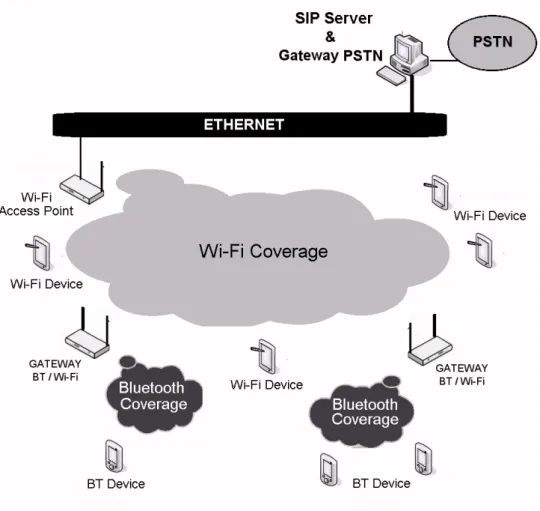
The network insfrastructure is connected to a VoIP PBX (Private Branch eX-change) that controls the softphones clients, and connects the IP telephony system to the PSTN (Public Switched Telephony Network) through a telephony card, as illustrated in the Figure 1.
As can be observed in Figure 1, the M-VoIP system can be divided in two sub-systems, the hybrid mobile network architecture, and the VoIP system, both operating transparently of the underlying network technology. These sub-systems were used in the development process, and are described in what follows.
2.1. Hybrid Network Architecture
The architecture can be divided in two different groups of components. First, the gateways between the two mobile technologies, Bluetooth and Wi-Fi. Second, the Mobile IP system which supports the mobility between different networks.
The Bluetooth - Wi-Fi gateways were implemented in order to make available Bluetooth coverage for devices without Wi-Fi interfaces, These gateways were called Base Modules. Therefore, as the Base Module only depends on the Wi-Fi coverage, they are easy to install and maintain. The gateways were implemented based on a machine running the Linux operational system (OS). Bluetooth access points are then established based on PANs (Personal Area Networks), which are access networks with a smaller cov-erage than Wi-Fi. The Linux OS was used because it provides different open source tools to deploy and manage networks. Therefore, a private network was implemented using the Linux OS as a router to others networks. Thus, allowing the dynamic configuration of mobile devices using the DHCP (Dynamic Host Configuration Protocol) protocol.
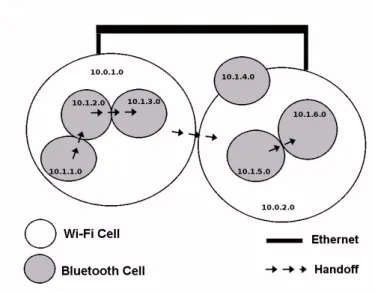
Figure 2. Handoff between Cells
As illustrated in the Figure 2, the network architecture was deployed using wire-less coverage cells. Each cell has its own IP address range, therefore they are distinct and independent networks. Based on this, a Mobile IP system to maintain the connec-tions when the user moves between distinct networks, doing a handoff, was implanted. Usually this is a major issue, because normally the IP address changes, and therefore the connection is lost [Tanenbaum 2003]. However, with the Mobile IP, the user can change the connection point (network) transparently, therefore there is no need to change the IP address of the mobile device. The Mobile IP solution added two new network entities, called foreign and home agents [Perkins 1996, Perkins 1997], in the Base Modules. These
agents are responsible to maintain the network connection, making routing and tunnelling of packets to mobile users devices, as described in [Perkins 1996].
2.2. VoIP System
The VoIP system consists of an open source server to control calls and a sofphone running on a mobile device or even a desktop. Before defining the best open source solution, a survey of the technologies adopted was carried out. This survey allowed us to define the best feasible solution. The studies included IP telephony, VoIP (Voice over IP) and some communications protocols. It was studied and analyzed two options to the deployment of Voice over IP communications: the H.323 standard [Brandl 2004] and the SIP (Session Initiation Protocol) [Rosenberg et al. 2002].
The H.323 standard is the most used and it supports media transmission (video, voice and data). Its first version came up in 1996, established by ITU-T and its main focus was the LAN (Local Area Network) environments. The H.323 specification is a set of recommendations which defines the components, protocols and necessary procedures to establish media communication on IP-based networks. The H.323 standard includes issues related to signaling control and voice and video communications protocols.
The Session Initiation Protocol (SIP) is an IETF (The Internet Engineering Task
Force) standard to stablish multimedia sessions over the Internet. It was proposed (RFC
2443) in February 1999 and was originally written by Henning Schulzrinne. SIP is an ap-plication level protocol to manage calls. It is used with other IETF protocols such as SDP (Session Description Protocol), SAP (Service Advertising Protocol) and MGCP (Media
Gateway Control Protocol), in order to provide different services. SIP has a client-server
architecture [Ubiquity Software 2003], like HTTP (Hyper Text Transfer Protocol). SIP is independent of the lower protocols because there is no considerations about them. It supports mobility through proxy servers and redirection mechanisms. Media communi-cation should be made through RTP (Real-time Protocol) and RTCP. SIP is an end-to-end signaling protocol, so the logic is stored on terminal and not on the network, thus enabling a scalable network.
Based on the requirements defined for the M-VoIP project, the Session Initiation Protocol was chosen because of its simplicity, ease of implementation, and due to the fact that there are a number of open source solutions already implemented.
After de above mentioned choices, the chosen server for the system should be enabled with SIP VoIP communication. The server had also to be able to communicate with the PSTN (Public Switched Telephone Network). The best available solution was the Asterisk [Asterisk PBX 2005].
3. System Implementation
From the implementation point of view the system was divided into three modules: com-munication (gateway Bluetooth-Wi-Fi), mobility (Mobile IP) and Voice over IP (VoIP server). Each one of them was tested separately, before being integrated in order to build the final system.
3.1. Communication
As explained in the previous sections, the communication module provides a hybrid wire-less network infrastructure based on Bluetooth - Wi-Fi gateways. These gateways provide
device interconnection in the network. They are also responsible by the configuration and attribution of IP address to the devices in the network. The communication process is transparent to the user, this is due to the fact that only a wireless connection is needed, either Wi-Fi or Bluetooth.
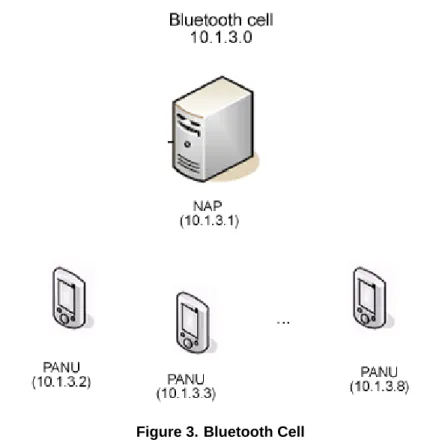
Up to seven devices can be connected at the same time for each Bluetooth cell. In this case, the cell is called a Bluetooth piconet [Kammer et al. 2002], and the coverage of a cell is about 10 m for a Class 2 Bluetooth device, and 100m for Class 1 Bluetooth device. The profile implemented by the Bluetooth peers is called PAN, and it is supported by the open source Bluetooth Bluez [Bluez 2005] implementation. In a PAN network the Bluetooth master device is called NAP (Network Access Point) and the seven slaves in the piconet are called PANUs (PAN Users). This approach is illustred in Figure 3.
Figure 3. Bluetooth Cell
The Bluetooth cells are confined inside a Wi-Fi cell. The Wi-Fi cells can support a larger number of users and its coverage is about 100m. The connection between them is made through Ethernet cables. This connection is established using Wi-Fi bridges, with only one of them with access to the external network.
The gateways were implemented based on the Linux OS due the large amount of network management tools and by its open source availability, as well as its interoperabil-ity between different operating systems.
3.2. Mobility
In a general way, RTP (Real Time Protocol) protocol based applications are used in our scenario. These applications have a continuous data flow, thus requiring constant execu-tion. The issue of Mobile IP when dealing with real time protocols, emerges when the mobile node is moving among different networks. Usually, the IP address is changed and
the connection is lost. However, with the Mobile IP, a node can switch between networks transparently without the need to change its IP address. However, the node physically changes its connection point, and the Mobile IP system has to make a search for an avail-able address and register it as soon as possible, so that the tunnelling of packets could be executed without losses. Then, the adopted Mobile IP system need to do handoffs efficiently, by satisfying timing restrictions, in order to maintain real-time data flow.
In the context of the M-VoIP project four implementations of Mobile IP were investigated:
• The MosquitoNet Research Group Implementation, from the Stanford University [MosquitoNet 2005]
• The Monarch Research Project Mobile IP, from the Carnegie Mellon University [Maltz and Johnson 2005]
• Dynamics - HUT Mobile IP, from the Helsinki University of Technology [Forsberg et al. 2005]
• Transparent Mobile IP - TMIP, from the research group SOWN [TMIP 2004] The chosen solution for Mobile IP was TMIP (Transparent Mobile IP) version 0.14 alpha, which is an open source Mobile IP system. Its architecture avoids all the configuration needed in the mobile device, which is essential in our scenario. This char-acteristic solves the configurations issues of new devices in the network.
Despite the fact that the implementation does not completely follow the IETF Mobile IP specification [Perkins 1996], it fits our requisites because besides providing operational systems heterogeneities for the mobile devices, the system was also designed to operate in a wireless network topologies.
3.3. Voice over IP
The Voice over IP system is composed by a VoIP server (Asterisk) that supplies users with telephony services. The Asterisk [Mark Spencer 2003] is a convergent telecommu-nication platform. It was designed to allow the use of VoIP, offering support for hardware connections with the PSTN. It offers various services from lower layers, including man-agement of time division multiplexing (TDM) and packet-based telephony, to upper layers including typical PBX applications such as Interactive Voice Response (IVR). Asterisk supports SIP, H.323 and translations between then. It can be also seen as a functionality server offering conference, call redirecting, and mail box, among other functionalities. Asterisk is an open source platform compatible with the Linux OS.
From the client side, many different implementations of softphones were tested on desktop computers as well as on mobile devices.
The first tested sofphone was KPhone, developed for the Linux OS [KPhone 2005]. This softphone presented unstable behaviour The second one was Lin-phone [LinLin-phone 2005] also developed for the Linux OS. This softLin-phone presented many problems too. The last software tested was X-Lite [XLITE 2004]. It worked well and it was the best suitable and general solution because it runs on different versions of the Linux OS as well as the Windows OS, and in both cases there free implementations. Details of the survey were omitted due to the lack of space in this paper.
The SJPhone [SJPhone 2005] was tested on a HP iPAC hx4700 PDA. The SJPhone is a freeware software developed by SJ Labs. As this softphone presented satisfactory performance no further tests were made.
The Asterisk system was installed with a telephony board model TDM400P [Digium 2005] providing access to the PSTN. Thus, a mobile user can make calls from its softphone installed on a handheld, to any telephone in the PSTN. Initially tests to verify registering and communication operations using just SIP clients using desktop softphones were made. The next step was to test outgoing calls using the telephony board access-ing the PSTN. In all calls, the voice quality perceived by different users, was considered comparable to that obtained with pure PSTN calls.
4. Conclusions
The M-VoIP solution was deployment using a Mobile IP system on a hybrid wireless network with Bluetooth and Wi-Fi gateways. Also, VoIP services are made available in this infrastructure. These services are offered by the Asterisk platform, which works as the gateway between the VoIP network and the PSTN.
Thus, the development of this solution with open source tools and the Linux OS, made possible the development of a hybrid network infrastructure with low cost, and high degree of interoperability with systems based on proprietary operating systems. The sys-tem cost was reduced basically to the hardware devices used to build the testbed syssys-tem.
The field tests realized, shows that our solution has some problems with vertical handoffs. Thus a specific daemon in the mobile device it is necessary to deal with the change between different technologies, the vertical handoff.
One of the benefits of the developing process, was the establishment of a multi-media and wireless network culture, mainly on VoIP technologies. The deployment of the M-VoIP solution made possible the development of VoIP applications based on the open source philosophy. In particular based on the Linux OS and the GPL (GNU General Public License) license, such as the application presented in [Gomes 2005]. Also, in the industrial wireless network automation context a mobile field operations aid application was developed [Wireless Project 2006].
References
Asterisk PBX (2005). Asterisk: The Open Source PBX. http://www.asterisk. org/.
Bluez (2005). Bluez - Official Linux Bluetooth Protocol Stack.http://www.bluez. org.
Brandl, M. (2004). IP Telephone CookBook. TERENA.
Digium (2005). Digium: Telephony for Business. http://www.digium.com/. Fong, P. J. (2002). Voice over IP. Syngress.
Forsberg, D., Malinen, J. T., and Malinen, J. K. (2005). Dynamics - HUT Mobile IP
technical document. Helsinky University of Technology. http://dynamics.
Gomes, Y. C. (2005). Uma Aplicac¸˜ao de VoIP. Electrical Engineering Department, Fed-eral University of Campina Grande. Graduation Report inhttp://www.percomp. org.
Kammer, D., McNutt, G., Senese, B., and Bray, J. (2002). Bluetooth: Application
Devel-opers Guide. Syngress.
Kelly, T. (2004). Global technology trends. ITU Presentation to Guang Dong Telecom. KPhone (2005). KPhone: A SIP-based VoIP phone. http://sourceforge.net/
projects/kphone.
Lennox, J. (2001). Internetworking internet telephony and telecommunications networks.
ACM SIGCOMM Computer Communication Review.
Linphone (2005). Linphone Project: Telephony on Linux. http://www.linphone. org/.
Maltz, D. A. and Johnson, D. B. (2005). The CMU Monarch Project IETF Mobile IPv4
Implementation User´s Guide. http://www.monarch.cs.rice.edu/. Mark Spencer (2003). The asterisk handbook. Documentation Team.
MosquitoNet (2005). MosquitoNet Mobile IPv4 - User´s Manual. Mobile Comput-ing Group of Stanford University, 2.0 beta edition. http://mosquitonet.
stanford.edu/mip/.
Perkins, C. E. (1996). IP mobility support. RFC 2002, Internet Engineering Task Force. Perkins, C. E. (1997). Mobile IP. IEEE Communication Magazine.
Perkins, C. E. (1998). Mobile networking through mobile IP. IEEE Internet Computing. Rosenberg, J., Schulzrinne, H., Schooler, E., Handley, M., Camarillo, G., Johnston, A.,
Peterson, J., and Sparks, R. (2002). SIP: Session Initiation Protocol. RFC 3261, Internet Engineering Task Force .
SJPhone (2005). SJPhone. http://www.sjlabs.com/.
Tanenbaum, A. S. (2003). Computer Networks. Prentice-Hall, 4th edition.
TMIP (2004). Transparent Mobile IP. http://www.slyware.com/projects_ tmip.shtml.
Ubiquity Software (2003). Undertanding sip. Ubiquity Software Cooporation - White
Paper.
Wireless Project (2006). Wireless - Mobile Automation. http://
wirelessproject.org.