Grid-based Distributed Data Mining Systems, Algorithms and Services
∗Domenico Talia
†Abstract
Distribution of data and computation allows for solving larger problems and execute applications that are dis-tributed in nature. The Grid is a distributed comput-ing infrastructure that enables coordinated resource sharcomput-ing within dynamic organizations consisting of individuals, in-stitutions, and resources. The Grid extends the distributed and parallel computing paradigms allowing resource negoti-ation and dynamical allocnegoti-ation, heterogeneity, open proto-cols and services. Grid environments can be used both for compute intensive tasks and data intensive applications as they offer resources, services, and data access mechanisms. Data mining algorithms and knowledge discovery processes are both compute and data intensive, therefore the Grid can offers a computing and data management infrastructure for supporting decentralized and parallel data analysis. This paper discusses how Grid computing can be used to support distributed data mining. Grid-based data mining uses Grids as decentralized high-performance platforms where to exe-cute data mining tasks and knowledge discovery algorithms and applications. Here we outline some research activities in Grid-based data mining, some challenges in this area and sketch some promising future directions for developing Grid-based distributed data mining.
1 Introduction.
Distributed data mining in distributed environments like virtual organization networks, the Internet, corpo-rate intranets, sensor networks, and other decentralized infrastructures questions the suitability of centralized KDD architectures for large-scale knowledge in a net-worked environment. Distributed data mining works by analyzing data in a distributed fashion and pays careful attention to the trade-off between centralized collection and distributed analysis of data [7]. When the data sets are large scaling up the speed of the data mining task is crucial. Parallel knowledge discovery techniques address this problem by using high performance multi-computer machines. The increasing availability of such machines calls for extensive development of data analy-sis algorithms that can scale up as we attempt to analyze ∗Research described in this paper is partially supported by
CoreGRID, GRID.IT, and GeoPKDD.it.
†DEIS, University of Calabria, Italy.
data sets measured in terabytes and petabytes on paral-lel machines with hundreds or thousands of processors. This technology is particularly suitable for applications that typically deal with very large amount of data (e.g., transaction data, scientific simulation and telecom data) that cannot be analyzed on traditional machines in ac-ceptable times. Grid technology integrates both dis-tributed computing and parallel computing, thus it rep-resent a critical infrastructure for high-performance dis-tributed knowledge discovery.
Grid computing represents the natural evolution of distributed computing and parallel processing technolo-gies. The Grid is a distributed computing infrastruc-ture that enables coordinated resource sharing within dynamic organizations consisting of individuals, insti-tutions, and resources. The main aim of grid com-puting is to give organizations and application develop-ers the ability to create distributed computing environ-ments that can utilize computing resources on demand. Grid computing can leverage the computing power of a large numbers of server computers, desktop PCs, clus-ters and other kind of hardware. Therefore, it can help increase efficiencies and reduce the cost of computing networks by decreasing data processing time and op-timizing resources and distributing workloads, thereby allowing users to achieve much faster results on large operations and at lower costs.
Data mining algorithms and knowledge discovery processes are both compute and data intensive, there-fore the Grid offers a computing and data management infrastructure for supporting decentralized and paral-lel data analysis. The opportunity of utilizing grid-based data mining systems, algorithms and applica-tions is interesting to users wanting to analyze data dis-tributed across geographically dispersed heterogeneous hosts. Grid-based data mining would allow corporate companies to distribute compute-intensive data analy-sis among a large number of remote resources. At the same time, it can lead to new algorithms and techniques that would allow organizations to mine data where it are stored. This is in contrast to the practice of having to select data and transfer it into a centralized site for mining. As we know centralized analysis is difficult to perform because data is becoming increasingly larger, geographically dispersed, and because of security and
privacy considerations.
A few research framework currently exists for de-ploying distributed data mining applications in grids [3]. Some of them are general environments supporting ex-ecution of data data mining tasks on machines that be-long to a Grid, others are single mining tasks for spe-cific applications that have been ”gridfied”, and some others are implementations of single data mining algo-rithms. As the Grid is becoming a well accepted com-puting infrastructure in science and industry, it is neces-sary to provide general data mining services, algorithms, and applications that help analysts, scientists, organi-zations, and professionals to leverage Grid capacity in supporting high-performance distributed computing for solving their data mining problem in a distributed way. This paper discusses some approaches for explot-ing Grid computexplot-ing to support distributed data minexplot-ing by using Grids as decentralized high-performance plat-forms where to execute data mining tasks and knowl-edge discovery algorithms and applications.
2 Distributed Data Mining and Grids
Today many organizations, companies, and scientific centers produce and manage large amounts of complex data and information. Climate data, astronomic data and company transaction data are just some examples of massive amounts of digital data repositories that today must be stored and analyzed to find useful knowledge in them. This data and information patrimony can be effectively exploited if it is used as a source to produce knowledge necessary to support decision making. This process is both computationally intensive and collabo-rative and distributed in nature. Unfortunately, high-level products to support the knowledge discovery and management in distributed environments are lacking.
This is particularly true in Grid-based knowledge discovery [1], although some research and development projects and activities in this area are going to be acti-vated mainly in Europe and USA, such as the Knowl-edge Grid, the Discovery Net, and the AdAM project. In particular, the Knowledge Grid [2] that we shortly discuss in the next section, provides a middleware for knowledge discovery services for a wide range of high performance distributed applications. Examples of large and distributed data sets available today include gene and protein databases, network access and intru-sion data, drug features and effects data repositories, astronomy data files, and data about web usage, con-tent, and structure. Knowledge discovery procedures in all these application areas typically require the cre-ation and management of complex, dynamic, multi-step workflows. At each step, data from various sources can be moved, filtered, and integrated and fed into a data
mining tool. Based on the output results, the analyst chooses which other data sets and mining components can be integrated in the workflow or how to iterate the process to get a knowledge model. Workflows are mapped on a Grid assigning its nodes to the Grid hosts and using interconnections for communication among the workflow components (nodes).
In the latest years, through the Open Grid Services Architecture (OGSA), the Grid community defined Grid services as an extension of Web services for providing a standard model for using the Grid resources and com-posing distributed applications as composed of several Grid services. OGSA provides an extensible set of ser-vices that virtual organizations can aggregate in vari-ous ways defines a uniform exposed-service semantics,
the so-calledGrid service, based on concepts and
tech-nologies from both the Grid computing and Web ser-vices communities. Recently the Web Service Resource Framework (WSRF) was defines as a standard specifica-tion of Grid services for providing interoperability with standard Web services so building a bridge between the Grid and the Web.
The development of data mining software for Grids will offer tools and environments to support the process of analysis, inference, and discovery over distributed data available in many scientific and business areas. The creation of Knowledge Grids on top of data and com-putational Grids is the enabling condition for develop-ing high-performance data mindevelop-ing tasks and knowledge discovery processes and meeting the challenges posed by the increasing demand for power and abstractness coming from complex data mining scenarios in science and engineering. The same can occur in industry and commerce, where analysts need to be able to mine the large volumes of information that can be distributed over different sites to support corporate decision mak-ing. The design of distributed data mining in Grids can benefit from the layered Grid architecture, with lower levels providing middleware support for higher level application-specific services.
In the implementation of data mining systems, al-gorithms and applications over computational Grids a main issue is the integration of two main demands: synthesizing useful and usable knowledge from data and performing sophisticated large-scale computations
leveraging the Grid infrastructure. Such integration
must pass through a clear representation of the knowl-edge base used to translate moderately abstract domain-specific queries into computations and data analysis op-erations able to answer such queries by operating on the underlying systems. The systems discussed here provide different approaches for supporting knowledge discovery on Grids. Research projects such as the
Ter-aGrid project and the GridDataMining project aim at developing data mining services on Grids, whereas sys-tems like the Knowledge Grid, Discovery Net, and Grid-Miner developed KDD systems for designing complete distributed knowledge discovery processes on grids.
On the basis of this previous experiences it is nec-essary to design and implement Grid-based distributed data mining services that leveraging the OGSA and WSRF standards will provide a distributed data min-ing open service midddleware by which users can de-sign higher level distributed data mining services that cover the main steps of the KDD process and offer typ-ical distributed data mining patterns such as collective learning, ensemble learning, meta-learning, and other concurrent models for composing data mining applica-tions.
3 Grid Services for Distributed Data Mining.
TheService Oriented Architecture (SOA) is essentially
a programming model for building flexible, modular, and interoperable software applications. SOA enables the assembly of applications through parts regardless of their implementation details, deployment location, and initial objective of their development. Another principle of service oriented architectures is, in fact the reuse of software within different applications and processes.
The Grid community adopted the Open Grid
Ser-vices Architecture (OGSA) as an implementation of the
SOA model within the Grid context. OGSA provides a well-defined set of basic interfaces for the develop-ment of interoperable Grid systems and applications [6]. OGSA adopts Web Services as basic technology. Web Services are an important paradigm focusing on
sim-ple, Internet-based standards, such as theSimple Object
Access Protocol (SOAP) and theWeb Services
Descrip-tion Language (WSDL), to address heterogeneous
dis-tributed computing. Web services defines techniques for describing software components to be accessed, methods for accessing these components, and discovery mecha-nisms that enable the identification of relevant service providers.
In OGSA every resource (e.g., computer, storage,
program) is represented as a Grid Service: a Web
Service that conforms to a set of conventions and supports standard interfaces. This service-oriented view addresses the need for standard interface definition mechanisms, local and remote transparency, adaptation to local OS services, and uniform service semantics.
OGSA defines standard mechanisms for creating, naming, and discovering transient Grid Service in-stances; provides location transparency and multiple protocol bindings for service instances; and supports integration with underlying native platform facilities.
OGSA also defines mechanisms required for creating and composing sophisticated distributed systems, in-cluding lifetime management, change management, and
notification. The WS-Resource Framework (WSRF)
was recently proposed as a refactoring and evolution of Grid Services aimed at exploiting new Web Services standards, and at evolving OGSI based on early imple-mentation and application experiences [5].
WSRF provides the means to express state as state-ful resources and codifies the relationship between Web
Services and stateful resources in terms of the implied
resource pattern, which is a set of conventions on Web
Services technologies, in particular XML, WSDL, and
WS-Addressing. A stateful resource that participates in
the implied resource pattern is termed aWS-Resource.
The framework describes the WS-Resource definition and association with the description of a Web Service interface, and describes how to make the properties of a WS-Resource accessible through a Web Service inter-face.
Through WSRF is possible to define basic services for supporting distributed data mining tasks in Grids. Those services can address all the aspects that must be considered in data mining and in knowledge discov-ery processes from data selection and transport to data analysis, knowledge models representation and visual-ization. To do this it is necessary to define services corresponding to
• single steps that compose a KDD process such as
preprocessing, filtering, and visualization;
• single data mining tasks such as classification,
clustering, and rule discovery;
• distributed data mining patterns such as collective
learning, parallel classification and meta-learning models;
• data mining applications including all or some of
the previous tasks expressed through a multi-step scientific workflows.
This collection of data mining services can
consti-tute an Open Service Framework for Grid-based Data
Mining. This framework might allow developers to
de-sign distributed KDD processes as a composition of sin-gle services that are available over a Grid. At the same time, those services should exploit other basic Grid ser-vices for data transfer and management such as Re-liable File Transfer (RFT), Replica Location Service (RLS), Data Access and Integration (OGSA-DAI) and Distributed Query procesing (OGSA-DQP). Moreover, distributed data mining algorithms can optimize the ex-change of data needed to develop global knowledge mod-els based on concurrent mining of remote data sets. This
approach also preserves privacy and prevent disclosure of data beyond the original sources. Finally, Grid ba-sic mechanisms for handling security, monitoring, and scheduling distributed tasks can be used to provide ef-ficient implementation of high-performance distributed data analysis.
In the following we describes two systems that have been developed according this service-based approach to develop distributed data mining in grids.
3.1 The Knowledge Grid framework. The Knowledge Grid framework is a system implemented to support the development of distributed KDD processes in a Grid [2]. It uses basic Grid mechanisms to build specific knowledge discovery services. These services can be developed in different ways using the available Grid environments. This approach benefits from “stan-dard” Grid services that are more and more utilized and offers an open distributed knowledge discovery architecture that can be configured on top of Grid middleware in a simple way.
The Knowledge Grid provides users with high-level abstractions and a set of services by which is possible to integrate Grid resources to support all the phases of the knowledge discovery process, as well as basic, related tasks like data management, data mining, and knowl-edge representation. Therefore, it allows end-users to concentrate on the knowledge discovery process they must develop, without worrying about the Grid infras-tructure and its low-level details. The framework sup-ports distributed data mining on the Grid by providing mechanisms and higher level services for searching re-sources, representing, creating, and managing knowl-edge discovery processes, and for composing existing data services and data mining services as structured, compound services, so as to allow users to plan, store, document, verify, share and (re-)execute their applica-tions, as well as manage their output results.
We are developing the Knowledge Grid in terms
of the OGSA model. In this implementation, each
Knowledge Grid service (K-Grid service) is exposed as
a Web Service that exports one or more operations
(OPs), by using the WSRF conventions and
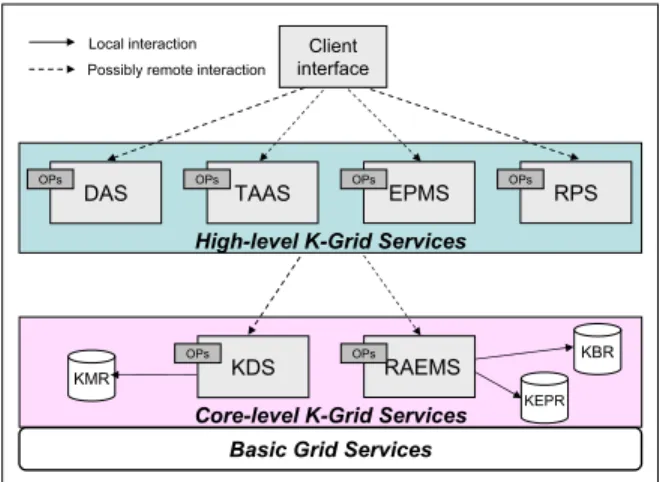
mecha-nisms. The operations exported by high-level K-Grid services (data access services (DAS), tools and algo-rithms access services (TAAS), execution plan manage-ment services (EPMS), and result presentation services (RPS)) are designed to be invoked by user-level applica-tions, whereas operations provided by core K-Grid ser-vices (knowledge directory serser-vices (KDS) and resource access and execution services (RAEMS)) are thought to be invoked by high-level and core K-Grid services (see figure 1).
High-level K-Grid Services DAS OPs TAAS OPs EPMS OPs RPS OPs Client interface Local interaction Possibly remote interaction
Core-level K-Grid Services KDS OPs RAEMS OPs KBR KEPR KMR
Basic Grid Services
Figure 1: Interactions between a client and the Knowl-edge Grid environment.
In the WSRF-based implementation of the Knowl-edge Grid each service is exposed as a Web Service that exports one or more operations (OPs), by using the WSRF conventions and mechanisms. The opera-tions exported by High-level K-Grid services are de-signed to be invoked by user-level applications only, whereas the operations provided by Core K-Grid ser-vices are thought to be invoked by High-level as well as Core K-Grid services.
Users can access the Knowledge Grid functionalities by using a client interface located on their machine. The client interface can be an integrated visual environment that allows for performing basic tasks (e.g., searching of data and software, data transfers, simple job execu-tions), as well as for composing distributed data mining applications described by arbitrarily complex execution plans. The client interface performs its tasks by invok-ing the appropriate operations provided by the different High-level K-Grid services. Those services may be in general executed on a different Grid node; therefore the interactions between the client interface and High-level K-Grid services are possibly remote.
3.2 Weka4WS. Weka4WS is a framework that ex-tends the widely used open source Weka toolkit [9] for supporting distributed data mining on WSRF-enabled Grids. Weka4WS adopts the WSRF technology for run-ning remote data mirun-ning algorithms and managing dis-tributed computations. The Weka4WS user interface supports the execution of both local and remote data mining tasks. On every computing node, a WSRF-compliant Web Service is used to expose all the data mining algorithms provided by the Weka library.
The Weka4WS software prototype has been devel-oped by using the Java WSRF library provided by
Globus Toolkit (GT4). All involved Grid nodes in Weka4WS applications use the GT4 services for stan-dard Grid functionality, such as security, data manage-ment, and so on. We distinguish those nodes in two categories on the basis of the available Weka4WS
com-ponents: user nodes that are the local machines
provid-ing the Weka4WS client software; andcomputing nodes
that provide the Weka4WS Web Services allowing for the execution of remote data mining tasks. Data can be located on computing nodes, user nodes, or third-party nodes (e.g., shared data repositories). If the dataset to be mined is not available on a computing node, it can be uploaded by means of the GT4 data management services.
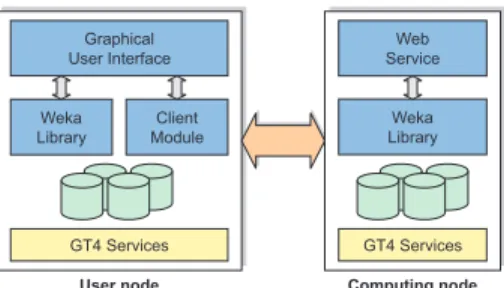
Figure 2 shows the software components of user nodes and computing nodes in the Weka4WS
frame-work. User nodes include three components: Graphical
User Interface (GUI),Client Module (CM), andWeka
Library (WL). The GUI is an extended Weka Explorer
environment that supports the execution of both local and remote data mining tasks. Local tasks are executed by directly invoking the local WL, whereas remote tasks are executed through the CM, which operates as an in-termediary between the GUI and Web Services on re-mote computing nodes.
Graphical User Interface Weka Library User node Client Module GT4 Services Web Service Weka Library GT4 Services Computing node
Figure 2: Software components of user nodes and
computing nodes.
Through the GUI a user can either: i) start the
execution locally by using the Local pane; ii) start
the execution remotely by using the Remote pane.
Each task in the GUI is managed by an independent thread. Therefore, a user can start multiple distributed data mining tasks in parallel on different Web Services, this way taking full advantage of the distributed Grid environment. Whenever the output of a data mining task has been received from a remote computing node,
it is visualized in the standard Output pane. A recent
paper [8] presents the architecture, details of user interface, and performance analysis of Weka4WS in executing a distributed data mining task in different network scenarios.
The experimental results demonstrate the low
over-head of the WSRF Web service invocation mechanisms with respect to the execution time of data mining al-gorithms on large data sets and the efficiency of the WSRF framework as a means for executing data mining tasks on remote resources. By exploiting such mecha-nisms, Weka4WS provides an effective way to perform compute-intensive distributed data analysis on large-scale Grid environments. Weka4WS can be downloaded from http://grid.deis.unical.it/weka4ws.
4 Some Concluding Remarks.
Many experts in IT, science, finance and commerce are recognizing the importance of scalable data mining solutions in their business. From the Bill Gates’ keynote
speech at Supercomputing 05: ... And so now we need
to take the techniques that have been developed for things like business intelligence and data mining that goes on around that and think how we can apply those in these realms as well, how we can take every step of the process and have it be very visual and only require as much
software understanding as is absolutely necessary. we
can conclude that the importance of high-performance data mining is going to be considered a real added value. In this scenario, the Grid can offer an effective in-frastructure for deploying data mining and knowledge discovery applications. It can represent in a near fu-ture an effective infrastrucfu-ture for managing very large data sources and providing high-level mechanisms for extracting valuable knowledge from them. To solve this class of tasks, advanced tools and services for knowl-edge discovery are vital. Here we discussed systems and services for implementing Grid-enabled knowledge dis-covery services by using dispersed resources connected through a Grid. These services allow professionals and scientists to create and manage complex knowledge dis-covery applications composed as workflows that inte-grate data sets and mining tools provided as distributed services on a Grid. They also allow users to store, share, and execute these knowledge discovery workflows as well as publish them as new components and services. As an example of this approach, we described how the Knowl-edge Grid and the Weka4WS systems provide a higher level of abstraction of the Grid resources for distributed knowledge discovery activities, thus allowing the end-users to concentrate on the knowledge discovery process without worrying about Grid infrastructure details.
In the next years the Grid will be used as a plat-form for implementing and deploying geographically dis-tributed knowledge discovery and knowledge manage-ment services and applications. Some ongoing efforts in this direction have been recently started. Example of systems such as the Discovery Net, the AdAM sys-tem, and the Knowledge Grid discussed here show the
feasibility of the approach and can represent the first generation of knowledge-based pervasive Grids. The future use of the Grid is mainly related to its abil-ity embody many of those properties and to manage world-wide complex distributed applications. Among those, knowledge-based applications are a major goal. To reach this goal, the Grid needs to evolve towards an open decentralized infrastructure based on interop-erable high-level services that make use of knowledge both in providing resources and in giving results to end users [4]. Software technologies for the implementation and deployment of knowledge Grids as we discussed in this paper will provide important elements to build up knowledge-based applications on a local Grids or on a World Wide Grid. These models, techniques, and tools can provide the basic components for developing Grid-based complex systems such as distributed knowledge management systems providing pervasive access, adap-tivity, and high performance for virtual organizations in science, engineering and industry that need to produce knowledge-based applications.
5 Acknowledgements
I would like to thanks Antonio Congiusta and Paolo Trunfio for their work on some systems cited in this paper.
References
[1] F. Berman.From TeraGrid to Knowledge Grid, Com-munications of the ACM, 44(11), pp. 27–28, 2001. [2] M. Cannataro, D. Talia, The Knowledge Grid,
Com-munications of the ACM, 46(1), (2003), pp. 89–93. [3] M. Cannataro, A. Congiusta, C. Mastroianni, A.
Pugliese, D. Talia, P. Trunfio,Grid-Based Data Mining and Knowledge Discovery, In: Intelligent Technologies for Information Analysis, N. Zhong and J. Liu (eds.), Springer-Verlag, chapt. 2 (2004), pp. 19–45.
[4] M. Cannataro, D. Talia, Semantics and Knowledge Grids: Building the Next-Generation Grid, IEEE In-telligent Systems, 19(1), (2004), pp. 56–63.
[5] K. Czajkowski et al., The WS-Resource
Framework Version 1.0.
http://www- 106.ibm.com/developerworks/library/ws-resource/ws-wsrf.pdf.
[6] I. Foster, C. Kesselman, J. Nick, and S. Tuecke,The Physiology of the Grid, In: F. Berman, G. Fox, and A. Hey (eds.), Grid Computing: Making the Global Infrastructure a Reality, Wiley, pp. 217–249, (2003). [7] H. Kargupta and C. Kamath and P. Chan,Distributed
and Parallel Data Mining: Emergence, Growth, and Future Directions, In: Advances in Distributed and Parallel Knowledge Discovery, AAAI/MIT Press, pp. 409–416, (2000).
[8] D. Talia, P. Trunfio, O. Verta. Weka4WS: a WSRF-enabled Weka Toolkit for Distributed Data Mining on Grids. Proc. PKDD 2005), Porto, Portugal, October 2005, LNAI vol. 3721, pp. 309–320, Springer-Verlag, 2005.
[9] H. Witten and E. Frank.Data Mining: Practical ma-chine learning tools with Java implementations. Mor-gan Kaufmann, 2000.