GFI Product Guide
The information and content in this document is provided for informational purposes only and is provided "as is" with no warranty of any kind, either express or implied, including but not limited to the implied warranties of merchantability, fitness for a particular purpose, and non-infringement. GFI Software is not liable for any damages, including any consequential damages, of any kind that may result from the use of this document. The information is obtained from publicly available sources. Though reasonable effort has been made to ensure the accuracy of the data provided, GFI makes no claim, promise or guarantee about the completeness, accuracy, recency or adequacy of information and is not responsible for misprints, out-of-date information, or errors. GFI makes no warranty, express or implied, and assumes no legal liability or responsibility for the accuracy or completeness of any information contained in this document.
If you believe there are any factual errors in this document, please contact us and we will review your concerns as soon as practical.
All product and company names herein may be trademarks of their respective owners. Microsoft and Windows are either registered trademarks or trademarks of Microsoft Corporation in the United States and other countries.
1 About GFI Archiver™ 9
1.1 Introduction to GFI Archiver 9
1.2 How does GFI Archiver work? 9
1.3 GFI Archiver licensing 11
1.4 Legal compliance 11
1.4.1 Terms and conventions used in this guide 11
2 Installing GFI Archiver 12
2.1 Before you install 12
2.2 System requirements 13
2.2.1 Software requirements 14
2.2.2 Hardware requirements 15
2.2.3 Connections established from the GFI Archiver Server 16
2.2.4 Excluding folders from antivirus scanning 17
2.2.5 Database settings 17
2.2.6 ASP.NET® settings 17
2.2.7 How to install/enable .Net 3.5 SP1 on Windows Server 2008 R2 19
2.3 Where should I install GFI Archiver? 19
2.4 Setting up a journaling mailbox 20
2.4.1 Creating a Journal Mailbox in Microsoft® Exchange Server 2003 20 2.4.2 Preparing the Journal Mailbox in Microsoft® Exchange Server 2007/2010/2013 27 2.4.3 Creating a Journal Mailbox in Microsoft® Exchange Server 2007 28 2.4.4 Creating a Journal Mailbox in Microsoft® Exchange Server 2010 34
2.4.5 Set up standard journaling 35
2.4.6 Set up premium journaling 38
2.4.7 Creating a Journal Mailbox in Microsoft® Exchange 2013 39
2.5 Choosing and preparing a database 40
2.5.1 Choosing your database type 40
2.5.2 Using GFI Archiver Database 42
2.5.3 Using SQL Server® Express 42
2.5.4 Using Microsoft® SQL Server 44
2.6 Installing GFI Archiver 45
2.7 Removing email from Microsoft® Exchange 46
2.7.1 Remove emails from Exchange Server using Archive Assistant 46 2.7.2 Removing email from Microsoft® Exchange Server 2003 47
2.7.3 Removing email Microsoft® Exchange Server 2007 50
2.7.4 Removing email from Microsoft® Exchange Server 2010 52 2.7.5 Removing email from Microsoft® Exchange Server 2013 53
2.7.6 Uninstall information 55
3 GFI Archiver Post-install Wizard 56
3.1 License configuration 56
3.2 Configuring New Archive Store Settings via Post Install Wizard 56 3.2.1 Configuring Archive Store - GFI Archiver Database 57
3.3.2 Creating a journal mailbox via the Post Install Wizard 65
3.4 Finalizing the Post Install setup 68
3.5 Test your setup 69
3.6 Using the Port Change Tool 71
4 Upgrading from previous versions 73
4.1 Why upgrade to GFI Archiver 2015? 73
4.2 Upgrading to GFI Archiver from versions earlier than GFI MailArchiver 2012 73
4.2.1 What benefits do the new Archive Stores offer? 74
4.3 Before you upgrade 75
4.4 Upgrading GFI Archiver 76
4.5 Upgrading Client Tools 77
4.6 Post upgrade actions 78
4.6.1 Check licensing 78
5 Using GFI Archiver 79
5.1 Logging in to GFI Archiver 79
5.2 Using the Home tab 80
5.2.1 Status overview 81
5.2.2 Servers 81
5.2.3 Archive Stores 82
5.2.4 Email Flow 82
5.2.5 Event Viewer 83
5.3 Browsing Archived items 83
5.4 Working with archived items 84
5.5 Searching archived items 87
5.5.1 Using Simple Search 87
5.5.2 Using Advanced Search 90
5.5.3 Email search using smart phones 92
5.6 Accessing multiple mailboxes 93
5.7 GFI MailInsights® 94
5.7.1 GFI MailInsights® Requirements 95
5.7.2 Generating MailInsights reports 95
5.7.3 Scheduling MailInsights reports 96
5.7.4 Communication Flow 97
5.7.5 WebMail Usage 98
5.7.6 Email Responsiveness 99
5.7.7 Storage Use 100
5.7.8 Inactive Accounts 101
5.7.9 Inappropriate Words 102
5.7.10 Internal Spammers 104
5.7.11 Outside Office Hours 105
5.7.12 Data Leakage Detection 107
5.7.13 Job Search 108
5.7.14 Phrase Search 110
5.7.17 Email Performance Indicators report 114
5.7.18 Large Emails report 116
5.8 Changing user preferences 118
6 Achieving results 119
6.1 Achieving results with GFI Archiver - How to archive your company's email 119 6.2 Achieving results with GFI Archiver - Importing and exporting emails 120 6.3 Achieving results with GFI Archiver - Analyze your archived emails 121
7 Configuring GFI Archiver 124
7.1 Settings overview 124
7.2 Configuring Archiving Method 126
7.3 Managing the Mail Servers to Archive 128
7.3.1 Viewing configured mail servers 128
7.3.2 Adding a new journaling mailbox 129
7.3.3 Editing an existing journaling mailbox 131
7.3.4 Deactivating and activating an existing journaling mailbox 131
7.3.5 Removing an existing journaling mailbox 132
7.4 Configuring Archiving Rules 132
7.4.1 Adding Archiving Rules 133
7.4.2 Editing Archiving Rules 135
7.4.3 Removing Archiving Rules 136
7.5 Configuring Archive Restrictions 136
7.5.1 Enabling Mailbox Archive Restrictions 137
7.5.2 Disabling Mailbox Archive Restrictions 140
7.6 Managing the Archiving Scope 141
7.7 Configuring Mailbox Folder Structure Retrieval 141
7.7.1 Enabling Mailbox Folder Structure Retrieval 142
7.7.2 Disabling Mailbox Folder Structure Retrieval 144
7.7.3 Excluding folders from Folder Structure Retrieval 144
7.7.4 Removing Excluded Folders Policies 147
7.8 Importing Emails and Calendar Items via the GFI Archiver Archive Assistant 148
7.8.1 Configuring Default Import Settings 149
7.8.2 Configuring import settings for detected users 153
7.9 Configuring default File Archive Assistant settings 154
7.9.1 Enabling File Collaboration using the File Archive Assistant 155
7.9.2 Create a public user in Active Directory 155
7.10 Resolving a file conflict 157
7.11 Managing Archive Stores 158
7.11.1 Viewing Configured Archive Stores 158
7.11.2 Configuring New Archive Store Settings 160
7.11.3 Choosing and Preparing a Database for Use With GFI Archiver 162
7.11.4 Attaching an Archive Store 163
7.11.5 Editing Existing Archive Store Details 164
7.11.9 Scheduling Archive Stores 169
7.11.10 Backup Archive Stores 170
7.11.11 Online Backup 170
7.11.12 Offline Backup 170
7.11.13 Moving emails from one database to another 175
7.11.14 Configure the GFI Archiver Import Service 176
7.11.15 Remove source Archive Stores from GFI Archiver 176 7.11.16 Move binary files to the GFI Archiver Import Service 177 7.11.17 Moving emails to the GFI Archiver archive stores 177 7.11.18 Restoring the mailbox folder structure of moved emails 178
7.11.19 Upgrading the Database Schema 179
7.11.20 Attaching a GFI MailArchiver 3 Database 180
7.12 Configuring Roles and Permissions 181
7.12.1 Viewing configured roles and permissions 182
7.12.2 Adding a new role 183
7.12.3 Assigning Roles 185
7.12.4 Configuring a Full Access role 186
7.12.5 Deleting Roles 187
7.12.6 Default Role 187
7.13 Access Control 189
7.13.1 Adding users to the Group Manager archive access 189
7.13.2 Define user Access Control 189
7.13.3 Configuring Shared Mailboxes 190
7.14 Configuring IMAP Server 190
7.14.1 Working With Certificates 192
7.15 Retention Policies 193
7.15.1 How Are Retention Policies Applied? 193
7.15.2 Viewing Retention Policies 194
7.15.3 Adding a new Retention Policy 194
7.15.4 Changing the order of Retention Policies 197
7.15.5 Adding a SPAM Retention Policy 197
7.15.6 Configuring Legal Hold 199
7.15.7 Using Retroactive Retention 199
7.16 Configuring File History Retention Policies 200
7.16.1 Add a new File History Retention Policy 200
7.16.2 Edit File History Retention Policies 201
7.16.3 Viewing File History Retention Policies 202
7.16.4 Changing the order of File History Retention Policies 202
7.16.5 Removing File History Retention Policies 202
7.17 Classification Rules 203
7.17.1 Adding a New Classification Rule 203
7.17.2 Editing a Classification Rule 205
7.17.3 Removing a Classification Rule 205
7.18 Configuring Auditing 205
7.18.1 Configuring Database Activity Auditing 206
7.19 Configuring Email Deletion 209
7.20 Viewing and editing license keys 211
7.21 Configuring General Settings 211
7.22 Changing General Settings 212
7.23 Changing version check settings 213
7.24 Configure the Fax Archiving search tab 214
7.25 Configuring Archiving status notification 214
7.26 Configuring GFI Directory Service 215
8 Configuring Client Access 216
8.1 Installing GFI Archiver Outlook Connector 216
8.1.1 How GFI Archiver Outlook® Connector works 217
8.1.2 Downloading GFI Archiver Outlook Connector 217
8.1.3 Changing the Outlook® Connector tab availability 218
8.1.4 Outlook® Connector system requirements 218
8.1.5 Software 218
8.1.6 Hardware 219
8.1.7 Installing Outlook Connector - Manual install 219
8.1.8 Installing Outlook Connector via GPO 220
8.1.9 Installing Outlook® Connector via GPO in Windows® Server 2003 220 8.1.10 Installing Outlook® Connector via GPO in Windows Server 2008 223
8.2 Configuring the Archive Assistant 225
8.2.1 How does Archive Assistant work? 226
8.2.2 System requirements - Outlook Connector Archive Assistant File Archive Assistant227
8.2.3 Enabling and disabling Manual Archiving 227
8.2.4 Changing the Archive Assistant tab availability 228
8.2.5 Installing Archive Assistant manually 229
8.2.6 Installing the Archive Assistant via GPO in Windows® Server 2008 229
8.2.7 Configuring Archive Assistant 231
8.3 Deploying the File Archive Assistant 233
8.3.1 System requirements - Outlook Connector Archive Assistant File Archive Assistant234 8.3.2 Changing the File Archive Assistant tab availability 234
8.4 Configuring default File Archive Assistant settings 235
8.4.1 Configuring Roles and Permissions for file archiving 235
8.4.2 Downloading the File Archive Assistant 236
8.4.3 Downloading the File Archive Assistant MSI package 237 8.4.4 Installing the File Archive Assistant via GPO - Windows Server 2008 237
8.4.5 Configuring the File Archive Assistant 239
8.5 Deploying the GFI Archiver App for Windows 8/RT 240
8.5.1 System requirements 240
8.5.2 Configuring the GFI Archiver Touch App 240
8.6 Configuring GFI Archiver IMAP Client Access 242
8.6.1 Configuring IMAP in Apple Mail 3.0 243
8.6.2 Configuring IMAP in iOS5 244
8.6.6 Configuring IMAP in Microsoft Outlook 2013 247
8.6.7 Configuring IMAP in Outlook® 2011 for Mac 248
8.6.8 Configuring IMAP in Windows® Live Mail 249
8.6.9 Configuring IMAP on Android 250
8.6.10 Configuring IMAP in Mozilla Thunderbird 10 251
9 Using the Import Export Tool 252
9.1 Import Emails From Microsoft® Exchange Mailboxes 252
9.1.1 Step 1: Importing emails from a remote computer 253
9.1.2 Microsoft® Exchange mailbox access permissions – Grant Permissions 254
9.1.3 Step 2: Run the GFI Archiver Import Export Tool 257
9.1.4 Microsoft® Exchange mailbox access permissions – Revoke Permissions 261
9.2 Import emails from PST files locally 263
9.2.1 Step 1: Importing items from a remote computer 264
9.2.2 Step 2: Run the GFI Archiver Import Export Tool to Import from PST Files 264
9.3 Export emails from GFI Archiver Archive Stores 267
9.3.1 Exporting Emails 267
10 Restoring Mailboxes 274
11 Using the GFI Archiver DB Split Tool 276
12 Using the Export SQL Raw Data tool 278
12.1 Export raw data from GFI Archiver 278
12.2 Import back exported data into GFI Archiver 279
13 Troubleshooting and support 280
13.1 Introduction 280
13.2 GFI SkyNet 280
13.3 Web Forum 280
13.4 Request technical support 280
13.5 Documentation 280
13.6 Installation problems 281
13.7 General Issues 283
13.8 Import Export Problems 288
13.9 Outlook® Connector Issues 291
14 Glossary 294
1 About GFI Archiver™
1.1 Introduction to GFI Archiver
GFI Archiver is an email archiving solution that can archive all internal and external email into a central Archive Store. You can then easily manage the email Archive Stores from the web-based configuration of GFI Archiver. You can also allow users to browse and search old emails via the web-based interface. GFI Archiver also provides Microsoft Outlook®integration.
1.2 How does GFI Archiver work?
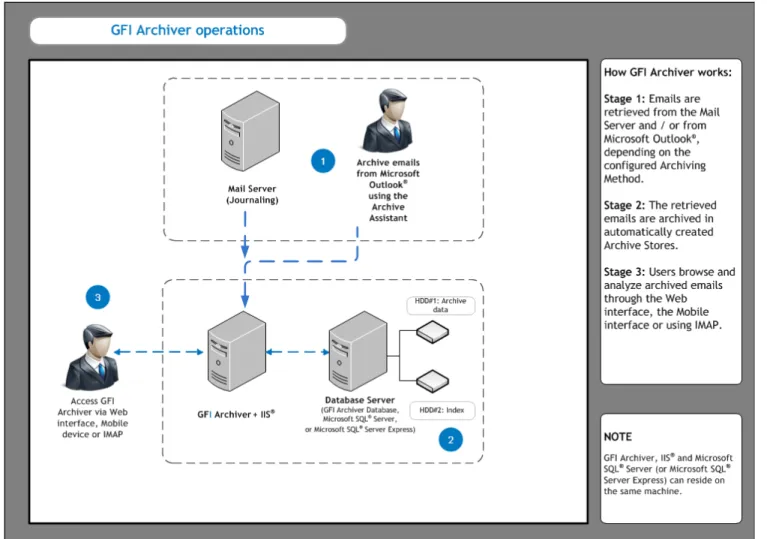
GFI Archiver operations can be classified in three stages as described below:
Figure 1: Typical GFI Archiver installation diagram.
Stage 1: Retrieve items to archive
GFI Archiver retrieves emails, calendar items or files depending on the configured Archiving Method as described in the table below:
OPTION DESCRIPTION
Manual Archiving This method enables users to manually archive messages, calendar items or files from their Microsoft Outlook®client into GFI Archiver. Users need to deploy Archive Assistant to archive items manually. For more information refer toConfiguring the Archive Assistant(page 225).
Auto-Archiving (Journaling) GFI Archiver uses Microsoft®Exchange Server journaling to retrieve items to archive in a single mailbox. A Journaling mailbox (configured in Microsoft Exchange) is required for the Auto-Archiving (Journaling) method and is configured through the post-install wizard. This enables you to start archiving items from a Microsoft®Exchange Server. For more information refer toSetting up a journaling mailbox(page 65). If Auto-Archiving (Journaling) method is enabled, select one of the following options:
All Emails- select to archive all emails that pass through your con-figured mail servers. For more information refer toManaging the Mail Servers to Archive(page 128).
Rule-Based Archiving- archive emails based on criteria specified in the configured Archiving Rules. For more information refer to
Configuring Archiving Rules(page 132).
In addition to these methods of archiving, GFI Archiver provides also the following options:
OPTION DESCRIPTION
File Archive Assistant The File Archive Assistant enables users to archive files such as doc-uments or images. This can be done manually from any location on their machine, or automatically, by placing the files they need to archive in a folder synchronized with GFI Archiver. For more inform-ation refer toDeploying the File Archive Assistant(page 233). Import Export Tool Emails and calendar items can also be imported into GFI Archiver
through the Import Export Tool. For more information refer toUsing the Import Export Tool(page 252).
Stage 2: Archive retrieved items
GFI Archiver stores collect items in Archive Stores created automatically based on the configured New Archive Store Settings. Items are archived according to their received date. If an Archive Store does not exist for the period that matches the date of the item, a new Archive Store is automatically created. For more information refer toConfiguring New Archive Store Settings(page 160).
NOTE
When Rule-based method of archiving is selected, GFI Archiver only archives items that match criteria specified in the configured Archiving Rules. For more information refer toConfiguring Archiving Rules
(page 132).
Stage 3: Browse and analyze archived items
Users can browse, search and analyze archived items using the GFI Archiver web interface or from within Microsoft Outlook®using the Outlook Connector. For more information refer toBrowsing Archived items(page 83).
Additionally, use GFI MailInsights to analyze information related to email usage and trends. Use this feature to generate management and HR reports that provide insight on email and resource use or misuse. For more information refer toGFI MailInsights®(page 94).
1.3 GFI Archiver licensing
GFI Archiver requires a license for every mailbox. Each GFI Archiver license is made up of the following:
An Archiving license
A File Archive Assistant (FAA) license
Each license can be used by the same user to archive items from the mail server and/or to archive files from a client machine using the File Archive Assistant.
For example, when purchasing a license for 75 users, you can enable archiving for 75 different mailboxes and for each of these users you can also install the File Archive Assistant on their machines.
A user with multiple computers, all of which have File Archive Assistant installed, is still counted as 1 File Archive Assistant license. To free up File Archive Assistant licenses simply uninstall File Archive Assistant from client machines on your network.
You may need to exclude certain mailboxes from archiving while including specific ones. This can be achieved by configuring Mailbox Archive Restrictions and determines the number of licensed
mailboxes counted by the product.
For more information refer toConfiguring Archive Restrictions(page 136).
For general information on GFI Archiver licensing, refer to:http://go.gfi.com/?pageid=MAR_Licensing
1.4 Legal compliance
Ensure that by enabling the Rule-based method of archiving or the Email deletion feature you are not breaching your company policy or any laws and regulations related to email storage in your
jurisdiction. For more information refer toConfiguring Archiving Rules andEmail Deletionchapters.
1.4.1 Terms and conventions used in this guide
Term Description
Note Additional information and references essential for the operation of GFI Archiver.
Important Important notifications and cautions regarding potential issues that are commonly encountered. > Step by step navigational instructions to access a specific function.
Bold text Items to select such as nodes, menu options or command buttons.
Italics text Parameters and values that you must replace with the applicable value, such as custom paths and file names.
2 Installing GFI Archiver
The following sections provide you with information about how to successfully deploy a fully functional instance of GFI Archiver:
SECTION DESCRIPTION
Installation notes Follow a detailed checklist to ensure that your envir-onment meets the necessary requirements.
System requirements Browse information related to software and hardware requirements and other important settings such as Port Settings, ASP.NET Settings and Database Settings. Environment considerations Find information related to the environment where you
are going to install GFI Archiver.
Preparing a journaling mailbox Create a journaling mailbox on Microsoft Exchange from where GFI Archiver retrieves items to archive.
Choosing and preparing a database Configure the database infrastructure to ensure the best performance for data archival and retrieval processes. Installation procedure Follow the steps to install GFI Archiver.
Removing emails from Microsoft Exchange Server
Once GFI Archiver is configured and items are being archived correctly, create a mailbox management policy to free up space on the Microsoft Exchange server by deleting email that has been archived. Post-installation tasks After GFI Archiver is successfully installed, follow the
post install wizard that assists in setting up GFI Archiver .
2.1 Before you install
The following checklist ensures that you have all the necessary requirements in place before going through the installation process:
1. Ensure that you are logged on as Administrator or using an account with administrative priv-ileges.
2. Install .NET Framework 4.0 or 4.5.
3. Set up IIS (SMTP/World Wide Web Services). For more information refer toASP.NET® settings (page 17).
4. Enable .NET Framework 3.5. For more information refer toHow to install/enable .Net 3.5 SP1 on Windows Server 2008 R2(page 19).
5. Install Microsoft Exchange Server MAPI Client and Collaboration Data Objects. 6. Ensure screen resolution is 1024 x 768 or higher.
7. Ensure ports used by GFI Archiver are free. For more information refer toConnections estab-lished from the GFI Archiver Server(page 16).
8. Check that the machine on which you are installing GFI Archiver meets the system and hard-ware requirements specified inSystem Requirements.
9. Check the Microsoft®Exchange Server role. GFI Archiver cannot be installed on the Microsoft® Exchange Server 2007/2010 Edge Role, since such a server is typically deployed on a DMZ using
ADAM (Active Directory®Application Mode)/AD LDS (Lightweight Directory Services) instead of Active Directory.
10. Ensure to enable IMAP if installing on the Microsoft®Exchange Server 2007/2010 Client Access Role.
11. (Optional) Install Microsoft SQL Server®or Microsoft SQL Server®Express. For more information refer toChoosing your database type(page 40).
12. Save any pending work and close all open applications on the machine.
13. Run the GFI Archiver installer to install GFI Archiver and missing pre-requisites. For more information refer toInstalling GFI Archiver(page 45).
14. Follow the post-install wizard to configure GFI Archiver and its operating environment. For more information refer toGFI Archiver Post-install Wizard(page 56).
NOTE
Ensure that theDisplay nameandE-mailfields in Active Directory®are filled with valid data.
2.2 System requirements
Use the following links to find information related to software and hardware requirements and other important settings to ensure a successful deployment of GFI Archiver.
Software requirements Supported operating systems Supported mail servers Supported databases Other required components
Hardware requirements Processor Memory
Physical storage
Important Settings Antivirus software Firewall Port settings Database settings ASP.NET®settings
Enabling .Net 3.5 on Windows Server 2008 R2
NOTE
The recommended software and hardware specifications depend on the number of users, settings enabled, email flow and message sizes.
2.2.1 Software requirements
Supported operating systems
GFI Archiver can be installed on all the operating systems listed below:
OS VERSION SUPPORTED OPERATING SYSTEM
32 BIT Windows®SBS 2003
Windows®2003 Standard & Enterprise with SP2 Windows®2008 Standard & Enterprise
64 BIT Windows®SBS 2008 Standard & SBS 2011 Windows®2003 Standard & Enterprise with SP2
Windows®2008 Standard, Enterprise, Datacentre & Hyper-V®Environments Windows®Server 2008 R2 Enterprise & Hyper-V®Environments
Windows®Server 2012 Standard, Enterprise & Hyper-V environments Windows®Server 2012 R2 Standard, Enterprise & Hyper-V environments
Supported Mail Servers
Supported Mail Servers
Microsoft®Exchange Server 2003 or later
IMAP compatible mail servers (with journaling-like feature)
Microsoft®Office 365. For more information refer tohttp://go.gfi.com/?pageid=MAR_Office365. Kerio Connect
Google Apps for Business™
Supported Databases
GFI Archiver supports the database back-ends listed below:
SUPPORTED DATABASE DESCRIPTION
SQL Server®2005 or later
(including SQL Server®Express editions)
Microsoft SQL Server or Microsoft SQL Server Express are recommended for all organizations. Microsoft SQL Server (or Microsoft SQL Server Express) is not included with the GFI Archiver installation and needs to be installed as a separate process. For more information refer to: Using Microsoft SQL ServerandUsing Microsoft SQL Express. Firebird-for evaluation purposes only An open source database used for evaluation purposes
bundled with GFI Archiver. Recommended for evaluation purposes only for organizations with less than 50 email users and with an average mail flow of up to 2500 per day.
Other required components
OTHER COMPONENTS
Microsoft .NET®Framework 4.0 or 4.5. Download .NET Framework 4.5 from:
http://www.microsoft.com/visualstudio/eng/downloads#d-net-45 NOTE
Microsoft .NET®Framework 4.5 is not supported on Microsoft Server 2003. Access to Microsoft®Active Directory
ASP.NET®4.0 or 4.5
Internet Information Services (IIS®) 6.0 or later - SMTP & World Wide Web services Internet Explorer®8 or later, Mozilla Firefox, Google Chrome, Safari®
Microsoft®Data Access Components (MDAC) 2.6 or higher
Microsoft®Exchange Server MAPI Client and Collaboration Data Objects 1.2.1 - Required (unless Outlook® 2003 32-bit or later is installed or unless GFI Archiver is installed with Microsoft®Exchange Server 2003). Clickhereto download.
Domain functional level: 2003 onwards
NOTE
Minimum supported screen resolution is 1024 x 768.
IMPORTANT
After installing Microsoft .NET®Framework 4.0 or 4.5 restart the machine.
2.2.2 Hardware requirements
Processor
REQUIREMENT DESCRIPTION
Minimum Intel Pentium or compatible - 2GHz 32 bit processor.
Recommended x64 architecture-based server with Intel 64 architecture or AMD64 platform.
Memory
REQUIREMENT DESCRIPTION
Minimum 1GB RAM (dedicated to GFI Archiver)
Physical storage
REQUIREMENT DESCRIPTION
Minimum 400MB physical disk space (NTFS) for GFI Archiver installation. More space is required for the database (Firebird or Microsoft®SQL server). Storage space depends on mail volume to archive.
Recommended Server with 4 physical drives, with the ability to increase storage space on demand when required. Refer toDatabase Settingssection for more information on how to configure your database.
NOTE
It is highly recommended that you store databases and Index files on separate, appropriately sized hard disks. SAS hard disks are highly recommended.
2.2.3 Connections established from the GFI Archiver Server
PORT DESCRIPTION PROTOCOL
25 Used by GFI Archiver when an email needs to be restored to a user’s mailbox or a notification is sent to the GFI Archiver administrator.
SMTP 80 Used by the GFI Archiver user interface and web services. Required for
cli-ents to access the GFI Archiver server.
HTTP 80 Enable this port when GFI Archiver is not installed with Microsoft Exchange
Server. This port is required by GFI Archiver to access Microsoft Exchange and retrieve emails from the journal mailbox using EWS.
HTTP
135 Enable this port when GFI Archiver is installed on the same machine as Microsoft®Exchange Server and configured to use ExOLEDB to retrieve emails.
MAPI/RPC
143 Enable this port to retrieve emails when GFI Archiver is not installed on the same server as Microsoft®Exchange Server when using IMAP.
IMAP 1443 Enable this port when GFI Archiver is configured to archive emails to a SQL
Server®Database.
Microsoft SQL Server® 3268 Used for connections done from the GFI Archiver Server to the Domain
Con-troller which stores the Microsoft®Global Catalog.
Microsoft Global Catalog 8017, 8018, 8019, 8020, 8022
Used for communication between GFI Archiver components and services. Ensure these ports are available and free.
44143 Default port assigned to GFI Archiver IMAP Service. IMAP Service enables users to access archived email via IMAP from 3rd party email clients such as Thunderbird, Microsoft Outlook®, Apple Mail, Android, iOS and others.
IMAP
NOTE
Use the Port Changing Tool to easily change port numbers. For more information refer toUsing the Port Change Tool(page 71).
2.2.4 Excluding folders from antivirus scanning
Antivirus software may cause GFI Archiver to malfunction. This occurs when such software denies access to certain files required by GFI Archiver.
It is recommended to exclude the following folders and subfolders from antivirus software (on-access and on demand) running on the GFI Archiver server:
GFI Archiver FOLDERS
<GFI Archiver Installation folder> and subfolders. <..\Program Files\Common Files\GFI>
Also, exclude the index and the Archive Store locations from antivirus scans. The default Index and Archive Store locations are:
GFI Archiver DEFAULT INDEX AND ARCHIVE STORE LOCATIONS
<GFI Archiver Installation folder>\Indexes\default <GFI Archiver Installation folder>\Databases\default\>
NOTE
You can change the Index and Archive Store locations after installing GFI Archiver. For information, refer to theConfigure New Archive Store SettingsandConfigure search indexessections in this manual.
2.2.5 Database settings
GFI Archiver requires SQL Server®(if used as the archival database) to be installed in case insensitive mode. This is the default installation setting of SQL Server®. The SQL Server®collation modes apply to all SQL Server®objects including login names. In such cases if a user changes a property in the name and does not make EXACT character case matches, GFI Archiver will fail since it would not find the resources required.
Once installed, it is not possible to change the SQL Server®collation mode easily. It requires a rebuild of the master database using advanced Microsoft®SQL tools or methods. The best solution is to install another instance of SQL Server®(set to operate in insensitive collation mode).
IMPORTANT
Ensure SQL Server®is installed in case insensitive mode if SQL Server®is used as the archival database.
2.2.6 ASP.NET
®
settings
Register and enable ASP.NET®with IIS®for GFI Archiver to work.
Register ASP.NET
®With IIS
®If the Microsoft®.NET framework is installed after IIS is installed this is automatically registered. Else, register ASP.NET®with IIS®by following these steps:
NOTE
Replace <v4.0.xxxxx> with the folder name of Microsoft®.NET Framework version number. For example: C:\Windows\Microsoft.NET\Framework\v4.0.30319\
Screenshot 1: Registering ASP.NET with IIS
2. Key inaspnet_regiis.exe -iand press Enter.
Enable ASP.NET
®From IIS
®NOTE
Ensure that ASP.NET®is allowed by Internet Information Services (IIS®) Manager.
IIS 6
1. Navigate toControl Panel > Administrative Tools > Internet Information Services (IIS) Manager. 2. Expand the local computer node and selectWeb Service Extensions.
3. In the right pane, right clickASP.NET v4.0.xxxxxand select Allow.
IIS 7
1. Navigateto Control Panel > Administrative Tools > Internet Information Services (IIS) Manager. 2. Select the local computer node and from the Features View pane launchISAPI and CGI
Restrictions.
2.2.7 How to install/enable .Net 3.5 SP1 on Windows Server
2008 R2
The .NET Framework 3.5 SP1 is a prerequisite for SQL Server 2008. In Windows Server 2008 R2, the .NET Framework is a feature that can be enabled as follows:
1. ClickStart > Administrative Toolsand selectServer Manager.
2. In the Server Manager interface, clickFeaturesto display all the installed Features in the right hand pane.
3. If .NET Framework 3.5.1 feature is not listed, clickAdd Features. 4. Locate .NET Framework 3.5.1 Features and select checkbox. 5. ClickNext.
6. Confirm installation selections, then clickInstall.
NOTE
SQL Server 2008 Setup for standalone instance will install the .NET Framework 3.5 SP1 if it is not already installed.
2.3 Where should I install GFI Archiver?
Install GFI Archiver on any machine that meets the system requirements and is part of an Active Directory®domain. Before proceeding with the installation, first consider the details listed below:
CONSIDERATION DESCRIPTION
Email volume on your servers
Installing GFI Archiver on a mail server where a high volume of emails is received and processed will invariably put more load on server resources. This can cause these servers to become unresponsive and not process mail in a timely fashion.
Hardware and software spe-cifications of your servers
The hardware and software specifications listed in the System requirements section above should be considered to be over and above the requirements of other software installed on the same server. Servers which are nearing their capacity in terms of resources should not be used to install GFI Archiver.
Need to archive email from mul-tiple sources concurrently
Installing GFI Archiver on a server which is not granted access to multiple sources creates a problem in the centralization efforts of email data archival.
If all of the above details are considered not to be of significant issues then you can consider installing GFI Archiver on the mail server.
For example:
If you need to archive items from one Microsoft®Exchange Server, and the server is handling the email flow on your network and still has spare processing capacity, then you can consider installing GFI Archiver directly on the Microsoft®Exchange Server machine. If you want to archive items from multiple Microsoft®Exchange Servers using IMAP, it is recom-mended that you install GFI Archiver on a separate server.
GFI Archiver can be installed in the following virtual environments: VMware®
Microsoft Hyper-V®Server
Microsoft Virtual Server®(installed on a 32 bit guest operating system)
IMPORTANT
Ensure that access to the server where GFI Archiver data is stored is restricted to authorized persons only.
2.4 Setting up a journaling mailbox
If you have selected theAuto-Archiving (Journaling)method of archiving, you need to create a journaling mailbox. Journaling is a feature that enables the recording of email in an organization. Through Microsoft®Exchange Server journaling, you can channel the items to archive into a single mailbox. Emails and calendar items are then retrieved by GFI Archiver for archiving.
To create the journaling mailbox on Microsoft®Exchange Server, perform one of the following actions:
Automatically create a journaling mailbox via the post install wizard Manually set up a journal mailbox for Microsoft®Exchange Server 2003 Manually set up a journal mailbox for Microsoft® Exchange Server 2007 Manually set up a journal mailbox for Microsoft® Exchange Server 2010 Manually set up a journal mailbox for Microsoft® Exchange Server 2013
IMPORTANT
If journaling is not set up correctly,Auto-archiving (journaling)method of archiving will NOT work.
Archiving mail-enabled public folders
Public folders are not journaled and archived out-of-the-box since Microsoft Exchange server does not journal emails which are addressed to public folders by default. For instructions on how to archive emails addressed to mail-enabled public folders refer to the following article:
http://go.gfi.com/?pageid=mar_archivingpublicfolders.
2.4.1 Creating a Journal Mailbox in Microsoft
®
Exchange
Server 2003
Configuring a Microsoft®Exchange Server journaling mailbox for use within GFI Archiver requires you to create a new journal mailbox and to configure Microsoft Exchange to archive items to the journal mailbox. Then you are also to configure whether to journal just the BCC information or all the header information.
Screenshot 2: Add new user in Microsoft®Exchange Server 2003
Screenshot 3: New Object - User dialog
3. Key in a relevant ‘User logon name’ (For example journal), fill in other new user details, and click Next.
4. Key in a password, unselectUser must change password at next logonoption and enableUser cannot change passwordandPassword never expiresoptions. ClickNextto continue setup.
NOTE
Ensure that the password keyed in meets the password complexity requirements setup for your Active Directory®users.
5. ClickNextand review the new user details. ClickFinishto create new user.
Step 2: Configure Email Archival to Journaling Mailbox
Screenshot 4: Mailbox store node properties
2. ExpandServers > <Your Server name> > Storage group, right click Mailbox Store node and select Properties.
Screenshot 5: Enabling journaling on a Microsoft®Exchange Server mailbox store
3. From theGeneraltab, selectArchive all messages sent or received by mailboxes on this store check box and clickBrowsebutton.
4. Select the journaling mailbox name you created in step one, for example ‘journal’, and clickOK. 5. Close theMailbox Store Propertiesdialog and theExchange System ManagerManagement console.
Step 3: Enable BCC Information Journaling
IMPORTANT
It is highly recommended that you DO NOT enable this option but enableenvelope journalinginstead. Envelope journaling journals all the header information, not just the BCC data. For more information on envelope journaling refer toStep 4: Enable Envelope Journaling
On Microsoft®Exchange Server 2003 systems, BCC information is not by default included in the journaled message. To enable BCC information journaling:
1. From command prompt, typeregedit.exe
2. Add the following registry key:
HKEY_LOCAL_
HKEY_LOCAL_
MACHINE\System\CurrentControlSet\Services\MSExchangeTransport\Parameters\
Key name: JournalBCC Data type: Dword Data value: 1
4. Close Registry editor and from command prompt typeservices.msc. RestartSimple Mail
Transport Protocoland theInformation Storeservices.
Step 4: Enable Envelope Journaling
Envelope Journaling enables the archival of email header information and can be switched on using: Microsoft®Exchange Server Email Journaling Advanced Configuration (exejcfg.exe), or
ADSI Editor Management console. Using the exejcfg.exe tool
1. Download the exejcfg.exe tool from:
http://www.microsoft.com/downloads/details.aspx?familyid=E7F73F10-7933-40F3-B07E-EBF38DF3400D&displaylang=en
2. From the command prompt, navigate to the folder in which you copied the exejcfg.exe tool. 3. Typeexejcfg -eand pressEnter.
NOTE
exejcfg -ddisables Envelope Journaling for that organization.
Step 5: Using the ADSI Editor
1. Locate theadsiedit.msctool from the Windows®2000 Server resource kit or the Windows® 2003 Server support tools.
2. From command prompt, navigate to the folder whereadsiedit.mscis stored, type
Screenshot 6: ADSI Edit
3. ExpandADSI Edit > Configuration > <CN=Configuration> > <CN=Services> > <CN=Microsoft Exchange>node.
Screenshot 7: Heuristics attribute
5. Selectheuristicsattribute from theAttributeslist and clickEdit.
Screenshot 8: Editing the heuristics attribute value
6. Key in ‘512’ and clickOK.
7. ClickOKto save and close theADSIEditconsole.
NOTE
A value of 512 enables Envelope Journaling, and a value of 0 disables Envelope Journaling.
2.4.2 Preparing the Journal Mailbox in Microsoft
®
Exchange
OPTION DESCRIPTION
Standard journaling:
This feature enables the configuration of a Mailbox store that enables the recording of email in an organization. GFI Archiver can use Microsoft®Exchange Server journaling to centralize all the emails to archive in a single mailbox for archival. This type of journaling is also called per-mailbox database journaling.
Premium journaling:
Only available with the Microsoft®Exchange Server Enterprise client access license. It enables an administrator to setup custom journaling rules such as Archive only incoming emails, Archive only outgoing emails or Archive emails for a particular group. This journaling is also called per-recipient journaling. GFI Archiver utilizes this type of journaling by detecting and displaying these rules in the Data Sources Configuration Wizard.
Choosing a Journaling Method
Choose standard journaling to archive all emails (inbound and outbound) for all users in your organization.
Choose premium journaling of you want more control over the emails to archive (e.g. only for spe-cific users or for inbound or outbound only).
NOTE
Premium journaling requires a Microsoft®Exchange Enterprise client access license.
Enabling Journaling for Microsoft
®Exchange Server 2007, 2010 or 2013
For Microsoft®Exchange Server 2007 pre-service pack 2 installations, journal mailbox creation should be created using the instructions listed in:
Creating a Journaling Mailbox in Microsoft Exchange Server 2007
Installations running Microsoft®Exchange Server 2007 SP2 or Microsoft®Exchange Server 2010 can: Use the GFI Archiver Post-Installation wizard to automatically create the required journal mail-box, or
Manually create a Journaling Mailbox in Microsoft Exchange Server 2007 Manually create a Journal Mailbox in Microsoft Exchange Server 2010 Manually create a Journaling Mailbox in Microsoft Exchange 2013
2.4.3 Creating a Journal Mailbox in Microsoft
®
Exchange
Server 2007
Setting up standard journaling
Step 1: Create a new journaling mailbox
1. SelectStart > All Programs > Microsoft Exchange Server 2007 > Microsoft Exchange Management Console.
4. SelectUser Mailboxoption and clickNext. 5. SelectNew useroption and clickNext.
Screenshot 9: New user mailbox details
6. Key in theUser informationdetails and clickNext.
7. In theMailbox Settingswindow, select aMailbox databaseand clickNext. 8. Review theNew Mailboxsummary for the new journaling mailbox and clickNew.
Step 2: Configure standard journaling
1. SelectStart > All Programs > Microsoft Exchange Server 2007 > Microsoft Exchange Management Console.
Screenshot 10: Configuring a Mailbox Database
2. Expand MicrosoftExchange > Server Configuration > Mailbox nodeand clickPropertiesfrom the Actionspane.
Screenshot 11: Mailbox Database properties
3. SelectJournal Recipientoption, clickBrowse, and select mailbox previously configured from the Active Directory®.
4. ClickOKto finalize setup.
Setting up premium journaling
Step 1: Create a new journaling mailbox
1. SelectStart > All Programs > Microsoft Exchange Server 2007 > Microsoft Exchange Management Console.
2. ExpandRecipient Configurationnode and click onMailboxnode. 3. SelectNew Mailbox…from theActionspane.
4. SelectUser Mailboxoption and clickNext. 5. SelectNew useroption and clickNext.
Screenshot 12: New user mailbox details
6. Key in the ‘User information’ details for the new user to which the new journaling mailbox will be assigned and clickNext.
7. Ensure that the mailbox settings are correct and clickNext.
8. Review the new mailbox summary for the new mailbox to create and clickNew.
Step 2: Configure Premium journaling
1. SelectStart > All Programs > Microsoft Exchange Server 2007 > Microsoft Exchange Management Console.
Screenshot 13: Configuring Journaling rules
2. ExpandOrganization Configuration > Hub Transportnode and selectJournalingtab. 3. From theActionstab and click onNew Journaling Rule.
Screenshot 14: Creating a new Journaling rule
4. Key in a name for the new rule and clickBrowse. Select theJournal e-mail address, preferably a mailbox within the existing Microsoft®Exchange organization, from Active Directory®.
5.<Optional>Configure:
Scope- Select whether to journal all email (Global), internal or external email.
Journal e-mail for recipient- Select specific recipient(s) for which this journaling rule applies. 6. Ensure that theEnable Ruleoption is enabled and clickNew.
NOTE
In Microsoft®Exchange Server 2007, envelope journaling is automatically enabled by default.
2.4.4 Creating a Journal Mailbox in Microsoft
®
Exchange
Server 2010
Microsoft®Exchange Server 2010 supports two types of journaling:
Standard journaling: Configure a Mailbox store that enables the recording of email in an organ-ization. GFI Archiver can use Microsoft®Exchange Server journaling to centralize all the emails in a single mailbox for archival. This type of journaling is also called per-mailbox database
journ-Premium journaling: Only available with Microsoft®Exchange Enterprise client access license. It enables an administrator to setup custom journaling rules such as:
Archive only incoming emails Archive only outgoing emails
Archive emails for a particular group.
GFI Archiver utilizes this type of journaling by detecting and displaying these rules in the Data Sources Configuration Wizard.
Which journaling method shall I use?
Choosestandard journalingto archive all emails (inbound and outbound) for all users in your organization.
Choosepremium journalingif you want more control over the emails to archive (For example, only for specific users or for inbound or outbound only).
NOTE
Premium journaling requires a Microsoft®Exchange Enterprise client access license.
2.4.5 Set up standard journaling
Step 1: Create a new journaling mailbox
1. Launch Microsoft Exchange Management Console.
2. ExpandRecipient Configurationnode and click onMailboxnode. 3. SelectNew Mailbox…from theActionspane.
4. SelectUser Mailboxoption and clickNext. 5. SelectNew useroption and clickNext.
Screenshot 15: New user mailbox details
6. Key in the ‘User information’ details for the new user to which the new journaling mailbox will be assigned and clickNext.
7. Enter an ‘Alias’ for the journaling mailbox and clickNext.
8. Click Next and review the new mailbox summary for the new mailbox to create and clickNew.
Step 2: Configure standard journaling
Screenshot 16: Configuring a Mailbox Database
2. ExpandMicrosoft Exchange > Organization Configuration > Mailbox node. Right-click the Mailbox database and selectProperties.
Screenshot 17: Mailbox Database properties
3. From the mailbox database properties dialog, select theMaintenancetab and select theJournal Recipientcheckbox. ClickBrowse, and select the journaling mailbox previously configured.
4. ClickOKto finalize setup.
2.4.6 Set up premium journaling
Set up premium journaling
1. LaunchMicrosoft Exchange Management Console.
2. ExpandOrganization Configuration > Hub Transportnode and selectJournalingtab. 3. From theActionstab, clickNew Journal Rule.
Screenshot 18: Creating a new Journaling rule
4. Key in a name for the new rule
5. ClickBrowseto select the journaling mailbox where to send journal reports. 6.<Optional>Configure:
Scope - Select whether to journal all email (Global), internal or external email. Journal messages for recipient - Select specific recipient(s) for this journaling rule. 7. Ensure that the Enable Rule option is enabled and click New.
NOTE
In Microsoft®Exchange Server 2010, envelope journaling is automatically enabled by default.
2. Clickrecipientsnode.
3. Undermailboxes, selectNewfrom the toolbar.
4. SelectNew userand enter the required mailbox details. 5. Clicksave.
Step 2: Create a new Journaling mailbox
1. Launch Microsoft®Exchange admin center. 2. Clickserversnode, then click ondatabasesnode.3. Select an existing Mailbox Database and clickEditfrom the toolbar. 4. Click maintenance node.
5. In theJournal recipientfield, clickbrowseand select theJournal recipientcreated in Step 1 above.
6. Clicksave.
2.5 Choosing and preparing a database
As an archiving solution, GFI Archiver is highly dependent on your database infrastructure setup for high performance of data archival and retrieval processes.
The following sections help you to understand the following options: Choosing your database type
GFI Archiver Database (For evaluation purposes) Microsoft SQL Server Express (Recommended) Microsoft SQL Server
NOTE
It is highly recommended to use Microsoft®SQL Server Express or Microsoft®SQL Server as your database. The Firebird database included in the GFI Archiver installation is intended for evaluation purposes only.
2.5.1 Choosing your database type
GFI Archiver can be configured to run in various hardware setups and combinations. The table below shows the typical recommended configurations. These guidelines and configurations may vary
SUITABLE FOR NUMBER OF MAILBOXES TO ARCHIVE RECOMMENDED DATABASE TYPE DESCRIPTION WHERE EACH COMPONENT IS STORED
Organizations that require a highly scalable solution
500 mailboxes or more Average archiving of more than 8000 items per day
SQL Server®with File Storage Email headers – SQL Server® Metadata – SQL Server® Email data – On disk Organizations that require
full auditing of user and database activity
50 mailboxes or more Average archiving of more than 8000 items per day
SQL Server® Email
headers – SQL Server® Metadata – SQL Server® Email data – SQL Server® Small to medium
organ-izations
150 mailboxes or less Average archiving of up to 6000 items per day
SQL Server®Express with File Storage Email headers – SQL Server® Express Metadata – SQL Server® Express Email data – On disk Demo and Evaluation
pur-poses ONLY
50 mailboxes or less Average archiving of up to 2500 items per day.
GFI Archiver database Email headers – Firebird database Metadata – Firebird database Email data – On disk
NOTE
Email metadata is the information about emails archived within GFI Archiver.
NOTE
It is highly recommended to use Microsoft®SQL Server Express or Microsoft®SQL Server as your database. The Firebird database included in the GFI Archiver installation is intended for evaluation purposes only.
2.5.2 Using GFI Archiver Database
GFI Archiver ships with a Firebird database that is recommended for evaluation purposes.
NOTE
Ensure that the size of each Firebird database never exceeds 2GB.
To minimize any potential performance issues, the following setup is strongly recommended when using the Firebird database:
Physical HDD 1: Operating system and GFI Archiver installation. Physical HDD 2: Firebird database data store.
Physical HDD 3: Mail database indexes.
The above setup reduces data read/write operations on the same physical hard disk drive to improve performance.
IMPORTANT
Failing to follow the above recommendations may result in substantial performance degradation.
NOTE
Archive email auditing feature is only available when emails are archived in SQL Server®. Microsoft® SQL Server with File Storage option is not supported.
2.5.3 Using SQL Server
®
Express
SQL Server®Express is recommended for medium sized organizations (approximately 1-100 email users) with an average mail flow of up to 6000 emails/day.
The recommended setup for GFI Archiver using a SQL Server®Express 2005/2008/2012/2014 database is as follows:
Physical HDD 1:Operating system and GFI Archiver installation. Physical HDD 2:Microsoft®SQL Server data file (.mdf).
Physical HDD 3:Microsoft®SQL Server log file (.ldf) Physical HDD 4:Mail database indexes.
IMPORTANT
Ensure that the .mdf and .ldf files are stored in a folder on the destination drive and not in the root directory.
This configuration ensures that different processes are distributed to distinct physical hard disk drives, where email metadata (information about the email) is stored in the database while the actual email content resides as files on separate disk. This eliminates performance loss due to excessive data read/write operations on the same physical hard disk drive. For more information on how to install different versions of Microsoft SQL Server Express visitthe Microsoft SQL Server
website.
NOTE
Archive email auditing feature is only available when emails are archived in SQL Server®. Microsoft® SQL Server with File Storage option is not supported.
There are however a number of SQL Server®Express limitations to consider:
Database size has a limit of 10GB (for SQL Server®Express 2008 R2 and later only). This does not affect the amount of data that can be stored in a database.
It uses 1 CPU only
It uses a maximum of 1GB RAM. It is therefore highly recommended that:
OPTION DESCRIPTION
SQL Server Express and file system are used as the back-end database.
This method uses SQL Server®Express as the backend database and a separate location (not a database) for the binary sources files. This saves up on the SQL Server®Express space required for archiving. For example, an email of 5MB is stored by saving the email header (60kb in size) in the database and the actual email content (5MB) in the separate location.
Use only Monthly or BiMontly sched-ules based on your email volumes
GFI Archiver automatically creates archive stores based on the pre-defined schedule. For SQL Express each database should
approximately have less than 0.5 million emails. For more information refer toScheduling Archive Stores(page 169).
NOTE
If an Archive Store exceeds the maximum database size, GFI Archiver automatically creates a new Archive Store based on the configuredNew Archive Store Settings. This feature is only available for Archive Stores based on SQL Server®Express databases.
IMPORTANT
Configure Microsoft®SQL Server®Express to use Mixed Authentication mode for use with GFI Archiver.
2.5.4 Using Microsoft
®
SQL Server
Microsoft®SQL Server is recommended for larger organizations (100+ email users) with a substantial volume of emails to archive (more than 6000 email per day). For organizations with more than 500 email users (or more than 8000 emails per day) to archive emails for, it is highly recommended to use Microsoft®SQL Server with File Storage option. This substantially increases the archival capacity of GFI Archiver. For more information on how to install different versions of Microsoft SQL Server visit the Microsoft Developer Network website.
NOTE
Archive email auditing feature is only available when emails are archived in Microsoft®SQL Server. For Microsoft®SQL Server with File Storage option you can use the GFI Archiver Auditing features instead. For more information refer toConfiguring Auditing(page 205).
The recommended setup for GFI Archiver using a Microsoft®SQL Server 2000/2005/2008 database is as follows:
Physical HDD 1:Operating system and GFI Archiver installation. Physical HDD 2:Microsoft®SQL Server data file (.mdf).
Physical HDD 3:Microsoft®SQL Server log file (.ldf) Physical HDD 4:Mail database indexes.
IMPORTANT
Ensure that the .mdf and .ldf files are stored in a folder on the destination drive and not in the root directory.
This configuration ensures that different processes are distributed to distinct physical hard disk drives. This eliminates performance loss due to excessive data read/write operations on the same physical hard disk drive.
NOTE
After the first month of archiving, note the database data file size. With this value, estimate the archive database size after six months, for example. If you estimate that your archive database will be larger than 20 GB, you should consider configuring the Archive Stores management feature of GFI Archiver.
IMPORTANT
To change to Mixed Authentication mode:
1. Right-click on theSQL Server node > Propertiesfrom the Enterprise Manager 2. Access Security tab and selectSQL Server and Windowsunder Authentication. 3. Save settings.
2.6 Installing GFI Archiver
To install GFI Archiver:1. Double-click on:
Archiver.exeto install GFI Archiver on 32-bit systems Archiver_x64.exeto install GFI Archiver on 64-bit systems
2. In theChoose Setup Languagedialog, select the language you want to use during installation and clickOK.
3. On theWelcomepage, clickNext.
4. (Optional) If the Installation Wizard detects any required missing components, the prerequisites are listed in the Installation Requirements window. ClickInstall Componentsto let the Wizard install the components for you or click cancel to install them manually. ClickNext.
NOTE
If all installation requirements are met this step is skipped. For more information refer toSystem requirements(page 13).
5. If you want GFI Archiver to check for a newer build other than the one being installed, select Check for a newer build of GFI Archiver on the GFI web siteand clickNext. Otherwise, selectDo not check for a new buildand clickNext.
NOTE
Checking for a newer build requires an active Internet connection.
6. Read the license agreement and selectI accept the terms in the license agreementoption. Click Nextto continue.
7. Choose which directory service to use with GFI Archiver. GFI Archiver supports Microsoft Active Directory and GFI Directory services.
NOTE
It is recommended to use Microsoft Active Directory when available.
ENVIRONMENT OPTION
New installations on a machine where Microsoft Active Directory Service is installed.
Select one of the following options:
Use the detected Microsoft Active Dir-ectory Service in your network
Install and use GFI Directory Service on this machine
New installations on a machine where there is no Dir-ectory Service is installed.
ClickInstallto enable the Installation Wizard to install GFI Directory Service. When installation is complete, the GFI Archiver installation resumes automatically.
New installations or upgrades on a machine where an older version of GFI Directory is installed.
Select one of the following options:
Upgrade the local GFI Directory Service (Recommended)- upgrades the installed GFI Directory to the latest version, then resumes installing GFI Archiver
Skip upgrade process- retains the installed version of GFI Directory and continues the GFI Archiver installation.
8. ClickNextto continue by installing GFI Archiver to the default folder. For an alternative location, clickChangeand select a new installation path.
9. If you want to change the default values for the Website and Virtual Directory Alias, modify the values in theWebsiteandVirtual Directory Aliasfields. These values define which URL you use to access GFI Archiver. ClickNext.
10. (Optional) If User Account Control (UAC) is enabled on the server where you are installing GFI Archiver, the installation Wizard warns you to disable UAC or launch Internet Explorer with 'Run as Administrator'. For more information refer to the following SkyNet
article: http://go.gfi.com/?pageid=MAR_UserAccountsControl. 11. ClickInstall.
12. On completion, clickFinishto close the installation wizard.
2.7 Removing email from Microsoft
®
Exchange
Once GFI Archiver is configured and your organization's email is being archived correctly, you may want to create a mailbox management policy to free up space on the Microsoft Exchange server by deleting email that has been archived. This can be accomplished by using the Archive Assistant or using the Microsoft Exchange retention policy.
2.7.1 Remove emails from Exchange Server using Archive
Assistant
Configure GFI Archiver to archive emails from user mailboxes and remove emails from Microsoft Exchange as soon as they are archived. This process helps free up space and increase performance of your Microsoft Exchange server.
To configure Archive Assistant:
2. Configure the Archive Assistant toCheck for new emails everyX hours. This ensures that emails are archived continuously. In theDelete Policywindow, select thePermanently delete archived emails immediatelyoption to free up space on the Microsoft Exchange server. For more information refer toConfiguring Default Import Settings(page 149).
3. Emails are archived only once with aid of the Single Instance Storage. The Archive Assistant then checks that the email is archived and removes it from the mailbox.
2.7.2 Removing email from Microsoft
®
Exchange Server 2003
Once GFI Archiver is configured and your organization's email is being archived correctly, you may want to create a Mailbox Management Recipient Policy in Microsoft Exchange to free up space on the Exchange server by deleting email.
NOTE
Before you create a new recipient mailbox management policy, you must determine the following: What limits you want the policy to enforce
The group you want the policy to control
How you want the policy to handle messages that go past policy limits.
Create a mailbox management recipient policy
1. Go toStart > Programs > Microsoft Exchange, and then clickSystem Manager.
2. In the left pane ofExchange System Manager, expandRecipients, right-clickRecipient Policies, point to New, and then clickRecipient Policy. TheNew Policydialog box appears.
3. Click to select theMailbox Manager Settingscheck box, and then clickOK.
NOTE
If you do not see the option forMailbox Manager Settings, reapply the Exchange service pack. It may not have been correctly applied.
4. ThePropertiesdialog box appears. Type a name for the recipient policy in theNamebox.
NOTE
We recommend that you use a descriptive name, such as "Accounts Department Mailbox Settings."
5. ClickModify. TheFind Exchange Recipientsdialog box appears.
6. Click theGeneraltab. In this example, mailbox management settings apply only to accounts that have an Exchange mailbox. Select only theUsers with Exchange mailbox.
7. ClickStorageto configure mailbox management recipient policies that are specific to a particular Exchange 2003 computer. Then, do one of the following:
ClickMailboxes in this mailbox store, clickBrowseto search for a store, and then clickOK. 8. Click theAdvancedtab, and then clickField. You can now select any of the following options:
User Contact Group Public Folder
NOTE
Points 8-11 are optional if you want to be specific for a particular mailbox/user/group/folder
9. For this example, clickUser, and then clickDepartmentto selectDepartmentin the fieldValue. 10. UnderCondition, click any of the following:
Starts with Ends with Is (exactly) Is not Present Not present
11. If you clickStarts with, Ends with,Is (exactly), orIs notas your condition, type a value in the Valuefield. For example, clickIs (exactly), and then typeAccountsto find all employees who work for the accounts department.
12. ClickAddto add the condition to the list.
NOTE
You can add additional conditions, but all conditions must be true for a match to be displayed.
13. After you have finished adding conditions, clickFind Now.
NOTE
Any matches to the conditions are displayed in the new list that appears in theFind Exchange Recipientsdialog box.
14. If the list displays the correct users for this recipient policy, clickOK. If not, revise the search conditions until your search displays the correct users for this recipient policy.
15. ClickOK. You receive the following message:
When a recipient policy filter changes it does not mean that proxy addresses for recipients who may no longer be under the control of the policy will be automatically re-evaluated. For these recipients to receive
This message does not affect mailbox management recipient policies. ClickOK.
16. UnderFilter rules, the LDAP filter statement shows the current filter rule. Click theMailbox Manager Settings (Policy)tab.
17. UnderWhen processing a mailbox, click one of the following options for handling messages that go past the policy limits:
Generate report only
Move items to Deleted Items folder Move to System Cleanup folder Delete immediately
NOTE
Use caution when you use theDelete the message immediatelyoption on folders, because users may have to recover their messages.
18. In the list of folders, select the folder that you want to configure, and then clickEdit. 19. In theFolder Retention Settingsdialog box, type an age limit when you want the selected
processing action to occur, specify a size limit for the messages that you want the action to apply to, and then clickOK.
For example, if you type 90 and 2048, all messages that are older than 90 days and over 2 megabytes (MB) are processed. It is suggested to use a size of 1 KB if you want to remove even smaller messages. 20. Repeat steps 18 and 19 for each folder in the list that you want to configure.
21. ClickSend notification mail to users after processingif you want to send users an e-mail message notifying them when their mailboxes have been processed.
22. ClickMessageto edit the notification message. Click theInsert the number of messages
processedcheck box if you want a summary of the number of oversize messages processed. ClickOK to return to thePropertiesdialog box.
23. (Optional) If you want to exclude certain message classes (for example, to prevent the processing task reports), click theExclude specific message classesbox, and then clickCustomize. TheMessage Classesdialog box appears. Type a message class in theExclude Message Classesfield. For example, type IPM. Task, and then click Add. Add all the classes you want to exclude.
Message class types include: Calendar IPM.Appointment Contacts IPM.Contact Inbox IPM.Note Journal IPM.Activity Notes IPM.StickyNote Tasks IPM.Task