Oracle® Retail Merchandising System
Release Notes Release14.0
E51166-01
December 2013
This document highlights the major changes for Release 14.0 of the Oracle Retail Merchandising System.
Overview
Oracle Retail Merchandising System (RMS) is used to execute core merchandising activities, including merchandise management, inventory replenishment, purchasing, vendor management, and financial tracking.
Oracle Retail Sales Audit (ReSA) provides the tools to evaluate point-of-sale data to ensure the accuracy and completeness of information exported to downstream systems used in optimization processes, financial reporting, and analysis. Oracle Retail Trade Management (RTM) is used to manage the import process, including automating the steps necessary to import goods, managing file exchanges with trading partners, and providing a central database of critical import order information.
Hardware and Software Requirements
See the Oracle Retail Merchandising System Installation Guide for information about the following:
■ Hardware and software requirements
■ Oracle Retail application software compatibility
Functional Enhancements
RMS 14.0 includes the following functional enhancements.
Commerce Anywhere
Commerce Anywhere is the ability to provide connected experiences across channels, allowing customers (both wholesale and consumer) and employees to interact and transact anywhere. For Oracle Retail, the Commerce Anywhere solution involves the close integration of RMS, Oracle Retail Sales Audit (ReSA), Oracle Retail Price Management (RPM), Oracle Retail Store Inventory Management (SIM), Oracle Retail Warehouse Management System (RWMS), and Oracle Retail POS Suite, as well as the use of APIs to support integration with external systems such as an online order capture (OOC) application and an order management system (OMS).
RMS and ReSA play a critical role in supporting this process, from providing the items, locations, and inventory information, to managing the fulfillment of customer orders through the supply chain.
Foundation Data
Foundation data such as items, stores, warehouses, and vendors represents the basic information needed to create a customer order. Serving as the 'single version of the truth' for this information is a core function of RMS. This release includes enhanced support for key Commerce Anywhere concepts and provides easier access to the information.
The enhancements in this area include the following:
■ The designation of which stores and warehouses are valid customer order
locations allows inventory visibility to customer ordering applications and allows for customer order creation for those locations.
■ The enhanced use of the channel designation, which manages inventory in stores
and warehouses across brick and mortar, business to consumer (B2C), and business to business (B2B) channels.
■ The definition of related items for the purposes of cross-selling, up-selling or
substitution for use by customer order applications, which assists in the selling process. Substitution relationships are also communicated to SIM for use during the fulfillment process.
■ The designation of an item/location relationship as deliberately or incidentally
ranged. This designation helps differentiate between item/location relationships that were created as part of the assortment planning process and those that were created based on a return of a customer order at a location that does not normally carry the item.
■ The creation of a data access schema (DAS) provides easier access to item, location
and hierarchy information in RMS. For more on the DAS, a new optional component of RMS, see the Technical Enhancements section.
Inventory Availability
The accuracy of inventory information and the successful creation and fulfillment of customer orders are critical in maintaining high levels of customer satisfaction and to maximize the efficiency of the supply chain. In order to provide near real-time inventory information to the OOC and/or the OMS, several enhancements to RMS were made, including:
■ The inclusion of inventory data as part of the data access schema (DAS). Inventory
details include current available, on-order and in-transit inventory values.
■ The creation of a web-service that allows for real-time querying of RMS for current
available inventory information for both stores and warehouses.
■ Improvements to RMS batch processes to minimize the amount of downtime
required for inventory transactions on the Oracle Retail Integration Bus (RIB).
Liability Capture
In a Commerce Anywhere environment, the variety of sales transactions that range from buy in-store and take home, to buy on-line and ship from the vendor, drive the
shipment (or completion) of the merchandise. Enhancements were made to ReSA to capture the liability at the time of an order’s creation and then offset the liability as each item on the order is shipped to the customer. If the order or individual item is cancelled, the liability is also relieved.
Backorders
A backorder may be captured if there is not enough available inventory to fulfill the customer’s order. To better support the handling of backorders, the following enhancements were made to RMS.
■ Providing available inventory details to the OOC and the OMS for use during
order capture and fulfillment.
■ Updating item inventory details to track the number of units on backorder. ■ Including backorder in replenishment demand calculations.
Customer Order Fulfillment
Although the actual fulfillment activities of the customer order may be performed at a warehouse, store, or vendor, RMS plays a central role by managing the inventory transactions required to fulfill the orders and by communicating these to vendors, warehouses, and stores.
Enhancements to RMS include:
■ Additional support for customer orders sourced from the warehouse, store, or
supplier inventory. The flexibility of sourcing and fulfillment locations provides support for the various fulfillment models used by retailers today, from simple to complex.
■ Support for customer orders that are picked up in the store or shipped to the
customer either from the store or other locations. RMS reserves the inventory for these transactions and manages the communication between suppliers, RWMS, SIM, and the OMS related to the fulfillment status of the order.
Order Returns
Historically the rate of returns is higher for commerce sales transactions than for traditional brick and mortar retail, thus making returns processing a critical
component of Commerce Anywhere. Additionally, many retailers offer the ability for customers to return items to a different channel than the channel that fulfilled the order (for example, returning merchandise at the store for something that was ordered online and shipped from the warehouse).
Enhancements to RMS provide additional support for returns by enabling returns to a warehouse location, including the disposition of the returned items for items that are being inspected upon receipt and prior to being considered available for sale. This ability complements existing support on the store side for in-store returns, which supports returns for goods not previously carried in the store.
For more information, see Merchandising Commerce Anywhere in the Commerce Anywhere Functional White Papers (ID 1598177.1) on My Oracle Support.
Franchise Management
One of the key benefits of RMS is its ability to support retailers who are seeking to grow their operations through any number of ways, including: expanding into new countries, creating new sales channels and new brands, and acquiring other
companies. In this release, RMS expands its capabilities in franchise management by supporting inventory management in franchise stores and a broader range of sourcing options for the fulfillment of franchise orders.
Inventory Management
Retailers with franchise operations want to manage the inventory of their franchise locations in the same or similar manner as to how it is managed for company-owned locations.
Enhancements were made to RMS to allow the following:
■ Franchise stores can be created as stockholding locations in RMS. This
functionality allows franchise store locations to be included on inventory transactions similar to stockholding company stores. These transaction types include replenishment, allocations, transfers, sales, and stock counts.
■ Tracking the stockholding franchise stores in the stock ledger.
■ Continued support of franchise stores as non-stockholding, but with some
enhancements to allow sales for the franchise stores to be sent to RMS. This functionality allows for better visibility to sales and future demand for non-stockholding franchise locations.
Sourcing Options
Retailers are also seeking more flexibility in sourcing, along with the ability to replenish their franchise stores in a manner similar to company store locations. To support this ability, RMS was updated to allow for the sourcing of franchise stores from company stores and suppliers, in addition to its existing capability of sourcing from warehouses. Additionally, the ability to return merchandise to either a company store or warehouse is now supported.
Credit Check Web Service
Retailers want to have the most current information regarding a franchise customer’s credit to ensure that orders can be processed efficiently, while minimizing risk. To support this solution, a web service was added to allow credit information in RMS to be kept current through updates from the financial system responsible for the customer’s account.
Pricing and Ordering APIs
In order to provide additional flexibility in the ordering process with franchise customers, several new APIs were added to RMS. The APIs allow information to be sent to RMS from an external system to facilitate the franchise ordering process, including new APIs for franchise pricing and franchise customers. Updates were also made to the existing franchise orders API to allow the designation of a sourcing location and pricing information.
Franchise Pricing
Building on the existing franchise pricing method of using a buildup of cost, additional options for defining the pricing for franchise orders were added. Pricing enhancements allow franchise pricing to be calculated as a percent off retail or as a fixed cost.
Dynamic Renaming
Because the franchise functionality in RMS is now able to be used to service more than one business-to-business model, the naming for this functionality was made dynamic in RMS (similar to existing functionality for merchandise and organizational
hierarchies). Dynamic renaming allows retailers to use the terminology that is
standard for their business. Because of the addition of dynamic renaming capabilities, the term ‘wholesale’ was removed from RMS.
For more information, see the document, Franchise Management in the Merchandising Functional Library (ID 1585843.1) hosted on My Oracle Support.
Priority Groups
In RMS, if multiple stores are replenished from the same warehouse, there can be situations where there is not enough inventory in the warehouse to fulfill the demand from all stores. Priority groups have been introduced in this version to allow certain stores to be designated as a higher priority than others, including both franchise and company stores.
Updated Item Attributes
New item attributes, as well as updates to existing attributes have been included in this version of RMS.
These include:
■ Brand — added to allow retailers to indicate the brand for an item; valid brands
are defined on a separate table.
■ Product Classification — added primarily for use by RWMS for Commerce
Anywhere enhancements. Based on retailer-defined classification of products, RWMS determines which products can be packaged together for shipping to customers.
■ Store Pack Inventory — an existing item indicator previously called ‘Notional
Pack,’ the name was updated to more clearly define its purpose. Additionally, the usage of the flag was expanded to be used for complex packs, where previously it was only allowed for simple packs.
Cross-dock Purchase Orders (PO) from Oracle Retail Advanced Inventory
Planning (AIP)
Oracle Retail defines cross-dock orders as orders that are shipped from a vendor to a store, passing through a single warehouse on their way to the store. Enhancements introduced in this release of AIP allow for data to be sent to RMS in such a way that a PO is created with the linked allocation to stores, allowing for the operational
efficiencies of cross-docking.
Optional Expiration Date in ReSA
In certain countries, the point-of-sale (POS) system sends credit card expiry dates separately from the actual credit card transactions for security reasons. In such cases, the RTLOG file for credit card transactions would not carry an expiry date. To support this business practice, the requirement for this information to be populated as part of the audit process has been removed. If a retailer prefers to continue carrying out
validations around credit card expiry dates, this preference can be handled through the creation of a rule in ReSA.
Configurable Change Rounding in ReSA
A new tender, called rounding tender was added to ReSA to support implementations in countries that are moving away from using coins of certain denominations. This new tender is used to balance transactions that were rounded due to this practice.
Support for Unavailable Inventory Transfers from SIM
Support was added for processing transfers created in SIM that involved moving merchandise between two locations in an unavailable status. This modification was developed through the inclusion of inventory status in the stock order status message. If no status is sent, RMS assumes that the transfer is for available inventory.
Added Receipt Date for DSD Receipts from SIM
For direct store delivery (DSD) POs, the receipt date was not previously included in the integration between SIM and RMS. RMS always used the current date as the receipt date. However, since receipts are sometimes posted late, inaccuracies resulted. To ensure the correct date is recorded, the receipt date has been added to the
integration.
System Options Enhancements
When implementing RMS, retailers and partners must determine the settings of a significant number of system parameters. In previous releases, these settings were held primarily on two very sizable tables: SYSTEM_OPTIONS and UNIT_OPTIONS. To ease maintenance and better organize the parameters by function in RMS, these two tables were removed, and several smaller tables were created to hold configuration options. A database view called SYSTEM_OPTIONS was also created to allow the attributes to be queried against a single entity. The screen used to view these
parameters in RMS was updated to reorganize the parameters better functionally. In addition, several obsolete parameters were removed from the system. These were system options that are either no longer used or are no longer required due to other changes in functionality.
Field Length Changes
Several entities had their field size increased to provide more flexibility and handle larger volumes of data or for internationalization standards.
These include:
■ Increasing the PO, transfer, and shipment numbers from 10 to 12.
■ Increasing the length of the tran code field on TRAN_DATA from a 2 to a 4 digit
number, as well as the length of the two reference number fields from 10 to 12.
■ Increasing the length of the description field on the Code Detail table to 250
Technical Enhancements
RMS 14.0 includes the following technical enhancements.
Asynchronous Processing
Asynchronous processing from the user interface allows a lengthy running job to be run in the background and gives control back to a user to perform other tasks in the UI. In this release, a UI Notification Framework was added to notify a user when a submitted asynchronous job is completed. It utilizes the Event feature in Oracle Forms 11g that allows a form to subscribe to a database server event bound to an Oracle AQ. A new asynchronous job log form was also added to allow a user to check the status of a submitted job and perform a retry if needed.
The asynchronous processing was added in several areas. The first is as an option when performing item-location ranging. A user now has the option to range
item-locations as an asynchronous job in the background. The Store Add (storeadd), Like Store (likestore), Warehouse Add (whadd), and Stock Ledger Insert (salins) batch jobs were also converted to asynchronous processes to be completed when new stores and warehouses are added through the RMS screens.
Near 24x7 Inventory Availability
In previous releases, RMS had a dedicated batch window where both on-line and RIB transactions were suspended. This both minimized data contention issues and allowed a static view of inventory during the batch cycle. However, RMS did not allow the inventory information to be updated to reflect activities happening in the stores and warehouses during this period.
In this release, support was added to allow inventory transactions, such as shipments, receipts, inventory adjustments, returns to vendor (RTV), and so on, to be sent to RMS via the RIB even during the batch window, with the exception of during a new phase at the end of the cycle. This enhancement allows RMS to maintain near real-time inventory information, thus providing a more accurate inventory picture to other systems.
To address the locking and data contention issues between RIB processes and batch jobs, a locking mechanism was added in a subset of batch jobs that affect inventory. When encountering a lock, these batch jobs wait and retry a preconfigured number of times before failure.
A batch job was also added that captures an end-of-day inventory picture. This batch job runs in a new phase in the batch cycle, where the RIB is still expected to be shut down. Programs that rely on a static end of day inventory were also modified to read from this end-of-day inventory picture.
For more information, see the white paper, 24x7 Inventory Availability, in the Merchandising Functional Library (ID 1585843.1) on My Oracle Support.
Data Access Schema (DAS)
Data Access Schema (DAS) is a new optional component of RMS, which exposes a subset of core RMS data to external applications via database replication and through read-only access to RMS data. Selected sets of tables are replicated, and the changes are synchronized near real time between the RMS database and the DAS to expose RMS data in a manner that allows client applications to self-service integrate.
Figure 1 DAS Processing
The benefits of using DAS include the following:
■ Designed and developed to utilize a database replication technology, such as
Oracle Streams Replication, for data accuracy and minimal data latency.
■ Does not use complex and inflexible flat file formats, making it easier for system
implementers to build integrations tailored to specific needs.
■ No extract programs run on the RMS database, conserving resources (CPU,
Memory, Data-locks, and so on), and not adding to the batch cycle.
For more information, see the RMS DAS Data Model and the RMS DAS Developer’s Guide (ID 1599704.1) on My Oracle Support.
Bulk Processing Updates
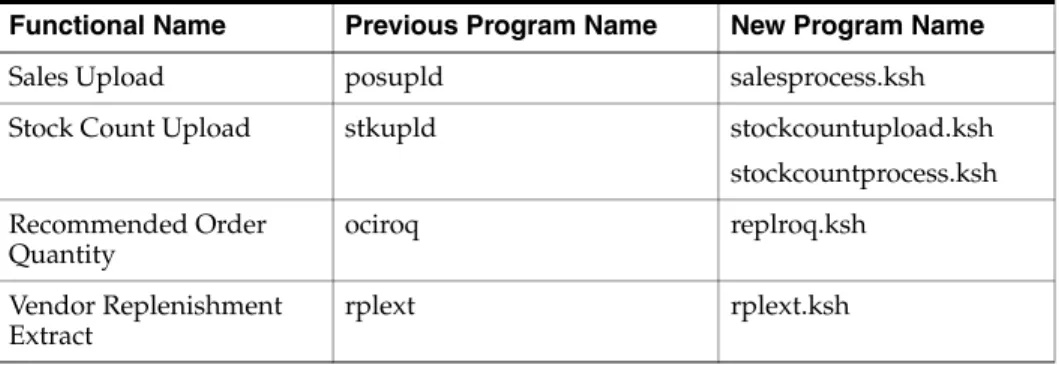
The batch programs that are extensively used by customers and process large quantities of data were rewritten to utilize the Oracle Database Bulk processing features. Using the Core Service approach, the updated batch processes were changed to use PLSQL and are called by a Korn shell wrapper script. The programs impacted by this change include those shown in Table 1.
Table 1 Oracle Database Bulk Processing Updates
Functional Name Previous Program Name New Program Name
Sales Upload posupld salesprocess.ksh
Stock Count Upload stkupld stockcountupload.ksh stockcountprocess.ksh Recommended Order
Quantity
ociroq replroq.ksh
Vendor Replenishment Extract
rplext rplext.ksh
Software Operating Environment Upgrades
Note: The following list announces the addition of Oracle Retail support for the technology described. See the Installation Guide requirements section for critical information, such as whether the listed enhancements replace previous versions or is supported in addition to already existing versions.
■ Oracle Linux 6 for x86-64 (Actual hardware or Oracle virtual machine) ■ Red Hat Enterprise Linux 6 for x86-64 (Actual hardware or Oracle virtual
machine).
■ Java 1.7.0+ 64 bit for the server side (JDK) ■ Java JRE 1.7.0+ for the client browser.
Integration Enhancements
RMS 14.0 includes the following integration enhancements.
ReSA/SIM Integration
In previous releases, functionality was introduced in SIM and Oracle Retail
Point-of-Service (ORPOS) to support the use of unique identification numbers (UINs) to manage inventory of items such as electronics, mobile phones, fire-arms, and so on. RMS supports this process by identifying the items for which UINs should be tracked. Additional enhancements were added in this release to allow UINs captured in ORPOS to flow through ReSA and onto SIM. This enhancement ensures that any changes made in ReSA that impact inventory position are accurately reflected in SIM. Additionally, modifications were made in the SIM/ORPOS integration to support inventory updates directly to SIM whether in a real-time or batch mode. To support this enhancement and to improve the timeliness of data sent to SIM, ReSA was enhanced to send only changes to SIM, rather than the entire sales file.
Oracle E-Business Suite (EBS) Integration with RMS and ReSA
RMS and ReSA include operational processes where data must be shared with a company’s financial system.
This requirement includes the following two general areas:
■ Certain master data that is owned by the financial system is also required in RMS
and ReSA to support core business processes.
■ The financial result of a retailer’s core operations, including purchasing, sales, and
so on, that is initially recorded in RMS and ReSA, also must become a part of the retailer’s General Ledger (GL) to support overall corporate financials and reporting.
First released in 13.2.6 and now ported to the 14.0 code line, Oracle Retail Financial Integration (ORFI) for Oracle Retail Merchandise Operations Management and Oracle E-Business Suite Financials represents, for RMS and ReSA, a packaged financial integration that replaces the Oracle Application Integration Architecture (AIA) Process Integration Pack (PIP) designed for the same integration. ORFI supports the same standard integration points between the MOM applications and core financials, with a simplified architecture and technology stack.
Product Support
The integration provided as a part of RMS and ReSA is supported by Oracle Retail, providing the retailer with a lower total cost of ownership and a more streamlined support process. For product support and logged defects, the new product identifier for Oracle Retail Financial Integration is 10722. Functionality is shared among RMS/Oracle Retail Invoice Matching (ReIM)/ReSA, RIB, ORFI as well as EBS. For
issues you can log defects against RFI. Each logged defect will be analyzed to
determine the source of the reported issue. There may be fixes required for any of the participating products that can mean they will be patched separately.
Supplier Enhancements
In addition to changes in integration method, several changes were made in RMS in the supplier integration with EBS to better align functionality between RMS and EBS. These include the following:
■ Visibility to the supplier ID from EBS
■ Enabling supplier status and allowing of updates via EBS integration
■ Turning off the defaulting of RMS-specific supplier attributes when updates are
received for the supplier from EBS
■ The addition of payment method to the integration
■ Updating addresses for supplier sites, rather than creating new addresses in RMS ■ The removal of payment and purchasing addresses based on changes to
pay/purchase flags in EBS
Documentation Enhancements
RMS 14.0 includes the following documentation enhancements.
Security Guide
This new guide addresses pre and post installation considerations and configuration for the infrastructure that supports RMS, as well as infrastructure troubleshooting points. Topics about RMS security include its security architecture, authentication techniques, administration, security-related tables, encryption, and more.
RMS DAS Data Model and RMS DAS Developer’s Guide (ID 1599704.1)
The Data Access Schema (DAS) is a new optional component of the Merchandising Suite. The Data Access Schema (DAS) exposes a subset of core RMS data to external applications via database replication and through read only access to RMS data as they need it. Selected sets of tables are replicated and the changes are synchronized near real time between the RMS database and the Data Access Schema (DAS) to expose RMS data in a manner that allows client applications to self-service integrate to third-party systems.
Merchandising Functional Library (ID 1585843.1)
The Merchandising Functional Library is a collection of White Papers that go into detail about various areas of the functional, business operations within the Merchandising Operations Management suite of applications.
Commerce Anywhere Functional White Papers (ID 1598177.1)
an overview of the solution from an enterprise perspective, and it is accompanied by product specific-papers addressing RMS, SIM, RWMS and the POS Suite.
Commerce Anywhere Technical Integration Solution (ID 1598187.1)
This set of architectural diagrams and related business processes depict the Commerce Anywhere solution and its major integration points. The conceptual representation that is depicted is intended to support an integrated implementation of an Oracle Retail Commerce Anywhere solution that includes RMS, SIM, RWMS, and the POS Suite.
Independent Code Download from My Oracle Support
To support supplier direct fulfillment of customer orders, the Order Detail report (ord_ det) has been modified to include the customer details. Because this information may be considered confidential, the report is being made available for download through My Oracle Support and has not been packed with the source code. The number on My Oracle Support is 17866117.
Known Issues
The following are known issues for Oracle Retail Merchandising System Release 14.0. Fixes are in development.
■ Under the retail method of accounting, if the system setting indicates that value
added tax (VAT) should be tracked in the stock ledger, the Gross Margin calculation incorrectly includes VAT in the franchise sales data.
■ The integration of Oracle Retail applications with Oracle's PeopleSoft Financial
Management is not supported in this release.
Related Documentation
For more information, see the following document in the Oracle Retail Merchandising System Release 14.0 documentation set:
■ Oracle Retail Enterprise Integration Guide ■ Oracle Retail Merchandising Batch Schedule
■ Oracle Retail Merchandising Data Conversion Operations Guide ■ Oracle Retail Merchandising Implementation Guide
■ Oracle Retail Merchandising Security Guide
■ Oracle Retail Merchandising System Custom Flex Attribute Solution Implementation Guide
■ Oracle Retail Merchandising System DAS Data Model ■ Oracle Retail Merchandising System Data Model ■ Oracle Retail Merchandising System Installation Guide ■ Oracle Retail Merchandising System Operations Guide ■ Oracle Retail Merchandising System Reports User Guide ■ Oracle Retail Merchandising System User Guide
■ Oracle Retail POS Suite/Merchandising Operations Management Implementation Guide ■ Oracle Retail Sales Audit User Guide
■ Oracle Retail Trade Management User Guide
Supplemental Documentation on My Oracle Support
The following documents are available through My Oracle Support. See the
Documentation Enhancements section for descriptions on additional documents. Access My Oracle Support at the following URL:
https://support.oracle.com
Enterprise Integration Guide (located in the Oracle Retail Integration Suite library on the Oracle Technology Network)
The Enterprise Integration Guide is an HTML document that summarizes Oracle Retail integration. This version of the Integration Guide is concerned with the two integration styles that implement messaging patterns: Asynchronous JMS Pub/Sub Fire-and-Forget and Web Service Request Response. The Enterprise Integration Guide addresses the Oracle Retail Integration Bus (RIB), a fully distributed integration infrastructure that uses Message Oriented Middleware (MOM) to integrate
applications, and the Oracle Retail Service Backbone (RSB), a productization of a set of Web Services, ESBs and Security tools that standardize the deployment and run time of Web Service flows within Oracle Retail Suite of applications.
Oracle Retail Merchandising Operations Management 14.0 Upgrade Guide (ID 1595732.1)
This guide describes the approach that each Oracle Retail Merchandising Operations Management application takes for the upgrading process, as well as its upgrade assumptions and considerations. Actual procedures for the upgrade may be included in the application's Installation Guide.
Oracle Retail Merchandising Mock Installation Test Cases, Release 14.0 (1597813.1)
The tests in this document have been created to assist in verifying (smoke testing) that the installation of the following products was successful: RMS, ReSA, RTM, Oracle Retail Allocation, ReIM, ARI, and RPM. These tests are not intended to verify all functionality in the suite of products previously listed.
Supplemental Training on My Oracle Support
The following document is available on the My Oracle Support Web site. Access My Oracle Support at the following URL:
https://support.oracle.com
Transfer of Information (TOI) Material (ID 732026.1)
Online training is available to Oracle supported customers at product release. These online courses provide release-specific product knowledge that enables your functional and technical teams to plan, implement and/or upgrade and support Oracle Retail applications effectively and efficiently.
Documentation Accessibility
Our goal is to make Oracle products, services, and supporting documentation accessible to all users, including users that are disabled. To that end, our
documentation includes features that make information available to users of assistive technology. This documentation is available in HTML format, and contains markup to facilitate access by the disabled community. Accessibility standards will continue to evolve over time, and Oracle is actively engaged with other market-leading
technology vendors to address technical obstacles so that our documentation can be accessible to all of our customers. For information about Oracle's commitment to accessibility, visit the Oracle Accessibility Program website at:
http://www.oracle.com/pls/topic/lookup?ctx=acc&id=docacc
Accessibility of Code Examples in Documentation
Screen readers may not always correctly read the code examples in this document. The conventions for writing code require that closing braces should appear on an
otherwise empty line; however, some screen readers may not always read a line of text that consists solely of a bracket or brace.
Accessibility of Links to External Web Sites in Documentation
This documentation may contain links to Web sites of other companies or
organizations that Oracle does not own or control. Oracle neither evaluates nor makes any representations regarding the accessibility of these Web sites.
Access to Oracle Support
Oracle customers have access to electronic support through My Oracle Support. For information, visit http://www.oracle.com/pls/topic/lookup?ctx=acc&id=info or visit http://www.oracle.com/pls/topic/lookup?ctx=acc&id=trs if you are hearing impaired.
Oracle Retail Merchandising System Release Notes, 14.0 E51166-01
Copyright © 2013, Oracle and/or its affiliates. All rights reserved.
This software and related documentation are provided under a license agreement containing restrictions on use and disclosure and are protected by intellectual property laws. Except as expressly permitted in your license agreement or allowed by law, you may not use, copy, reproduce, translate, broadcast, modify, license, transmit, distribute, exhibit, perform, publish, or display any part, in any form, or by any means. Reverse engineering, disassembly, or decompilation of this software, unless required by law for interoperability, is prohibited.
The information contained herein is subject to change without notice and is not warranted to be error-free. If you find any errors, please report them to us in writing.
If this is software or related documentation that is delivered to the U.S. Government or anyone licensing it on behalf of the U.S. Government, the following notice is applicable:
U.S. GOVERNMENT END USERS: Oracle programs, including any operating system, integrated software, any programs installed on the hardware, and/or documentation, delivered to U.S. Government end users are "commercial computer software" pursuant to the applicable Federal Acquisition Regulation and agency-specific supplemental regulations. As such, use, duplication, disclosure, modification, and adaptation of the programs, including any operating system, integrated software, any programs installed on the hardware, and/or documentation, shall be subject to license terms and license restrictions applicable to the programs. No other rights are granted to the U.S. Government.
This software or hardware is developed for general use in a variety of information management applications. It is not developed or intended for use in any inherently dangerous applications, including applications that may create a risk of personal injury. If you use this software or hardware in dangerous applications, then you shall be responsible to take all appropriate fail-safe, backup, redundancy, and other measures to ensure its safe use. Oracle Corporation and its affiliates disclaim any liability for any damages caused by use of this software or hardware in dangerous applications. Oracle and Java are registered trademarks of Oracle and/or its affiliates. Other names may be trademarks of their respective owners. Intel and Intel Xeon are trademarks or registered trademarks of Intel Corporation. All SPARC trademarks are used under license and are trademarks or registered trademarks of SPARC International, Inc. AMD, Opteron, the AMD logo, and the AMD Opteron logo are trademarks or registered trademarks of Advanced Micro Devices. UNIX is a registered trademark of The Open Group.
This software or hardware and documentation may provide access to or information on content, products, and services from third parties. Oracle Corporation and its affiliates are not responsible for and expressly disclaim all warranties of any kind with respect to third-party content, products, and services. Oracle Corporation and its affiliates will not be responsible for any loss, costs, or damages incurred due to your access to or use of third-party content, products, or services.
Licensing Note: This media pack includes a Restricted Use license for Oracle Retail Predictive Application Server (RPAS) - Enterprise Engine to support Oracle® Retail Analytic Parameter Calculator for Regular Price Optimization only.
Value-Added Reseller (VAR) Language Oracle Retail VAR Applications
The following restrictions and provisions only apply to the programs referred to in this section and licensed to you. You acknowledge that the programs may contain third party software (VAR applications) licensed to Oracle. Depending upon your product and its version number, the VAR applications may include:
(i) the MicroStrategy Components developed and licensed by MicroStrategy Services Corporation (MicroStrategy) of McLean, Virginia to Oracle and imbedded in the MicroStrategy for Oracle Retail Data Warehouse and MicroStrategy for Oracle Retail Planning & Optimization applications. (ii) the Wavelink component developed and licensed by Wavelink Corporation (Wavelink) of Kirkland, Washington, to Oracle and imbedded in Oracle Retail Mobile Store Inventory Management.
(iii) the software component known as Access Via™ licensed by Access Via of Seattle, Washington, and imbedded in Oracle Retail Signs and Oracle Retail Labels and Tags.
(iv) the software component known as Adobe Flex™ licensed by Adobe Systems Incorporated of San Jose, California, and imbedded in Oracle Retail Promotion Planning & Optimization application.
You acknowledge and confirm that Oracle grants you use of only the object code of the VAR Applications. Oracle will not deliver source code to the VAR Applications to you. Notwithstanding any other term or condition of the agreement and this ordering document, you shall not cause or permit alteration of any VAR Applications. For purposes of this section, “alteration” refers to all alterations, translations, upgrades, enhancements, customizations or modifications of all or any portion of the VAR Applications including all reconfigurations, reassembly or reverse assembly, re-engineering or reverse engineering and recompilations or reverse compilations of the VAR Applications or any derivatives of the VAR Applications. You acknowledge that it shall be a breach of the agreement to utilize the relationship, and/or confidential information of the VAR Applications for purposes of competitive discovery.
The VAR Applications contain trade secrets of Oracle and Oracle's licensors and Customer shall not attempt, cause, or permit the alteration, decompilation, reverse engineering, disassembly or other reduction of the VAR Applications to a human perceivable form. Oracle reserves the right to replace, with functional equivalent software, any of the VAR Applications in future releases of the applicable program.