© 2011 Pearson Education, Inc.
Lectures by Erin Barley Kathleen Fitzpatrick
Overview: The DNA Toolbox
• Sequencing of the genomes of more than 7,000
species was under way in 2010
• DNA sequencing has depended on advances in
technology, starting with making recombinant DNA
• In recombinant DNA, nucleotide sequences from two different sources, often two species, are
combined in vitro into the same DNA molecule
• DNA technology has revolutionized
biotechnology, the manipulation of organisms or their genetic components to make useful products
• An example of DNA technology is the microarray,
a measurement of gene expression of thousands of different genes
• To work directly with specific genes, scientists
prepare well-defined segments of DNA in identical
copies, a process called DNA cloning
DNA Cloning and Its Applications:
A Preview
• Most methods for cloning pieces of DNA in the
laboratory share general features, such as the use of bacteria and their plasmids
• Plasmids are small circular DNA molecules that replicate separately from the bacterial
chromosome
• Cloned genes are useful for making copies of a
particular gene and producing a protein product
cell
• Reproduction in the bacterial cell results in cloning
of the plasmid including the foreign DNA
• This results in the production of multiple copies of
a single gene
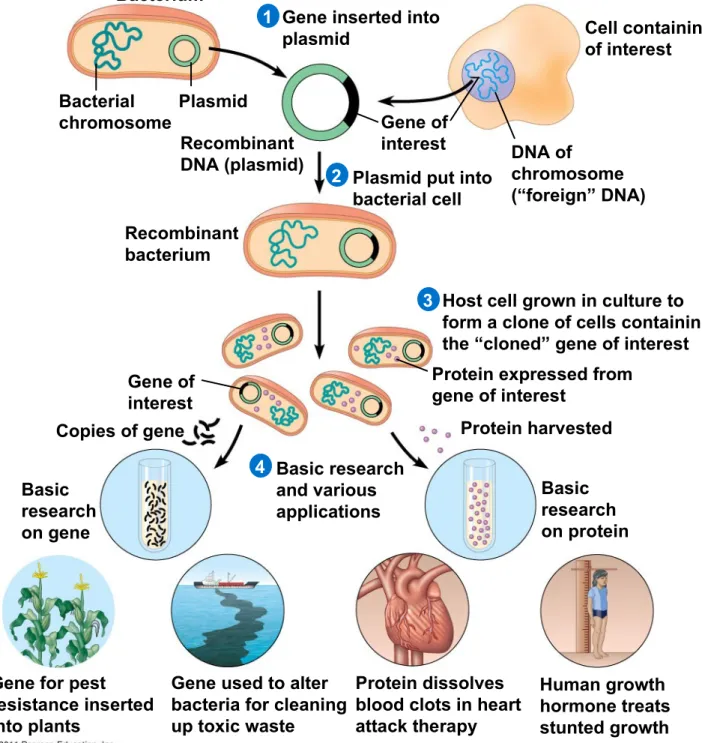
Figure 20.2 Bacterium Bacterial chromosome Plasmid 2 1 3 4
Gene inserted into
plasmid Cell containing gene of interest
Recombinant DNA (plasmid)
Gene of interest Plasmid put into bacterial cell DNA of chromosome (“foreign” DNA) Recombinant bacterium
Host cell grown in culture to form a clone of cells containing the “cloned” gene of interest Gene of
interest
Protein expressed from gene of interest
Protein harvested Copies of gene
Basic research and various applications Basic research on protein Basic research on gene
Gene for pest resistance inserted into plants
Gene used to alter bacteria for cleaning up toxic waste
Protein dissolves blood clots in heart attack therapy
Bacterial
chromosome
Plasmid
2
1 Gene inserted into
plasmid Cell containing
gene of interest
Recombinant DNA (plasmid)
Gene of interest
Plasmid put into bacterial cell
DNA of
chromosome (“foreign” DNA)
Figure 20.2b
Host cell grown in
culture to form a clone of cells containing the “cloned” gene of interest
Gene of interest
Protein expressed from gene of interest
Protein harvested Copies of gene
Basic research and various applications 3 4 Basic research on protein Basic research on gene
Gene for pest
resistance inserted into plants
Gene used to alter bacteria for cleaning up toxic waste
Protein dissolves blood clots in heart attack therapy
• Bacterial restriction enzymes cut DNA
molecules at specific DNA sequences called
restriction sites
• A restriction enzyme usually makes many cuts,
yielding restriction fragments
• The most useful restriction enzymes cut DNA in a
staggered way, producing fragments with “sticky
ends.”
© 2011 Pearson Education, Inc.
Animation: Restriction Enzymes
between restriction fragments
One possible combination DNA fragment added
from another molecule cut by same enzyme. Base pairing occurs.
5 5 5 5 5 5 5 5 5 5 5 5 3 3 3 3 3 3 3 3 3 3 3 3 2 Sticky end CTTAA G AATTC G G G AATTC CTTAA G
G G AATT CG
AATT C
Figure 20.3-3
Recombinant DNA molecule One possible combination DNA ligase
seals strands
DNA fragment added from another molecule cut by same enzyme. Base pairing occurs. Restriction enzyme cuts sugar-phosphate backbones. Restriction site DNA 5 5 5 5 5 5 5 5 5 5 5 5 5 5 5 5 3 3 3 3 3 3 3 3 3 3 3 3 3 3 3 3 2 3 1 Sticky end GAATTC CTTAAG CTTAA G AATTC G G G AATTC CTTAA G
G G AATT CG
AATT C
• In gene cloning, the original plasmid is called a
cloning vector
• A cloning vector is a DNA molecule that can carry
foreign DNA into a host cell and replicate there
Producing Clones of Cells Carrying
Recombinant Plasmids
• Several steps are required to clone the
hummingbird β-globin gene in a bacterial plasmid
– The hummingbird genomic DNA and a bacterial plasmid are isolated
– Both are cut with the same restriction enzyme – The fragments are mixed, and DNA ligase is
added to bond the fragment sticky ends
– Some recombinant plasmids now contain hummingbird DNA
– The DNA mixture is added to bacteria that have been genetically engineered to accept it
– The bacteria are plated on a type of agar that selects for the bacteria with recombinant
plasmids
– This results in the cloning of many hummingbird DNA fragments, including the β-globin gene
RESULTS
Humming-bird DNA fragments Recombinant plasmids Nonrecombinant
plasmid
Bacteria carrying plasmids
Colony carrying non-recombinant plasmid with intact lacZ gene
Colony carrying recombinant plasmid
with disrupted
Figure 20.4a-1
Bacterial plasmid
TECHNIQUE
ampR gene lacZ gene
Restriction site
Hummingbird cell
Sticky
ends Gene of
interest
Sticky
ends Gene of
interest
Humming-bird DNA fragments
Figure 20.4a-3
Bacterial plasmid
TECHNIQUE
ampR gene lacZ gene
Restriction site
Hummingbird cell
Sticky
ends Gene of
interest
Humming-bird DNA fragments
Recombinant plasmids Nonrecombinant plasmid
RESULTS
Colony carrying non-recombinant plasmid with intact lacZ gene
Colony carrying recombinant
plasmid
with disrupted lacZ gene
One of many bacterial
Storing Cloned Genes in DNA Libraries
• A genomic library that is made using bacteria is the collection of recombinant vector clones
produced by cloning DNA fragments from an entire genome
• A genomic library that is made using
bacteriophages is stored as a collection of phage clones
Recombinant plasmids
Plasmid clone
(a) Plasmid library
(b) BAC clone
Large insert with many genes
Figure 20.5a
• BACs are another type of vector used in DNA library construction
• A complementary DNA (cDNA) library is made
by cloning DNA made in vitro by reverse
transcription of all the mRNA produced by a particular cell
• A cDNA library represents only part of the
genome—only the subset of genes transcribed into mRNA in the original cells
Figure 20.6-2
DNA in nucleus mRNAs in cytoplasm
mRNA
Reverse
transcriptase Poly-A tail
DNA
strandPrimer 5
53
mRNA
Reverse
transcriptase Poly-A tail
DNA
strandPrimer 5
5
5
5
3 3
3 3
A A A A A A
A A A A A A T T T T T
Figure 20.6-4 DNA in nucleus mRNAs in cytoplasm mRNA Reverse
transcriptase Poly-A tail
DNA strandPrimer DNA polymerase 5 5 5 5 5 5 3 3
3 3
3
3
A A A A A A
A A A A A A T T T T T
mRNA
Reverse
transcriptase Poly-A tail
DNA strandPrimer DNA polymerase cDNA 5 5 5 5 5 5 5 5 3 3
3 3
3
3
3 3
A A A A A A
A A A A A A T T T T T
Screening a Library for Clones Carrying a
Gene of Interest
• A clone carrying the gene of interest can be
identified with a nucleic acid probe having a
sequence complementary to the gene
• This process is called nucleic acid hybridization
– Then we would synthesize this probe
© 2011 Pearson Education, Inc.
5 CTCATCACCGGC 3
• The DNA probe can be used to screen a large number of clones simultaneously for the gene of interest
• Once identified, the clone carrying the gene of
interest can be cultured
labeled probe
molecules Gene of interest Probe DNA Single-stranded DNA from cell Film Location of DNA with the complementary sequence Nylon membrane Nylon membrane Multiwell plates holding library clones 5
3GAGTAGTGGCCG
Expressing Cloned Eukaryotic Genes
• After a gene has been cloned, its protein product
can be produced in larger amounts for research
• Cloned genes can be expressed as protein in
either bacterial or eukaryotic cells
• To overcome differences in promoters and other DNA control sequences, scientists usually employ an expression vector, a cloning vector that
contains a highly active bacterial promoter
Eukaryotic Cloning and Expression Systems
• Molecular biologists can avoid eukaryote-bacterial
incompatibility issues by using eukaryotic cells, such as yeasts, as hosts for cloning and
expressing genes
• Even yeasts may not possess the proteins
required to modify expressed mammalian proteins properly
• In such cases, cultured mammalian or insect cells
may be used to express and study proteins
• Alternatively, scientists can inject DNA into cells using microscopically thin needles
• Once inside the cell, the DNA is incorporated into
the cell’s DNA by natural genetic recombination
Cross-Species Gene Expression and
Evolutionary Ancestry
• The remarkable ability of bacteria to express some
eukaryotic proteins underscores the shared evolutionary ancestry of living species
• For example, Pax-6 is a gene that directs
formation of a vertebrate eye; the same gene in flies directs the formation of an insect eye (which is quite different from the vertebrate eye)
• The Pax-6 genes in flies and vertebrates can substitute for each other
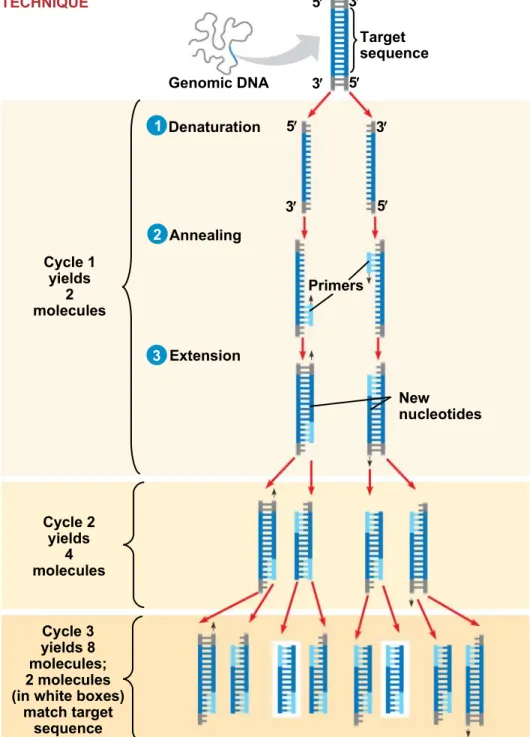
• The polymerase chain reaction, PCR, can
produce many copies of a specific target segment of DNA
• A three-step cycle—heating, cooling, and
replication—brings about a chain reaction that produces an exponentially growing population of identical DNA molecules
• The key to PCR is an unusual, heat-stable DNA
polymerase called Taq polymerase.
Figure 20.8 Genomic DNA Target sequence Denaturation Annealing Extension Primers New nucleotides Cycle 1 yields 2 molecules Cycle 2 yields 4 molecules Cycle 3 yields 8 molecules; 2 molecules (in white boxes)
Genomic DNA
Target
sequence 5
5 3
3
Cycle 2 yields
4
Figure 20.8d
Cycle 3 yields 8 molecules; 2 molecules (in white boxes)
• DNA cloning allows researchers to
– Compare genes and alleles between individuals – Locate gene expression in a body
– Determine the role of a gene in an organism
• Several techniques are used to analyze the DNA
of genes
Gel Electrophoresis and Southern Blotting
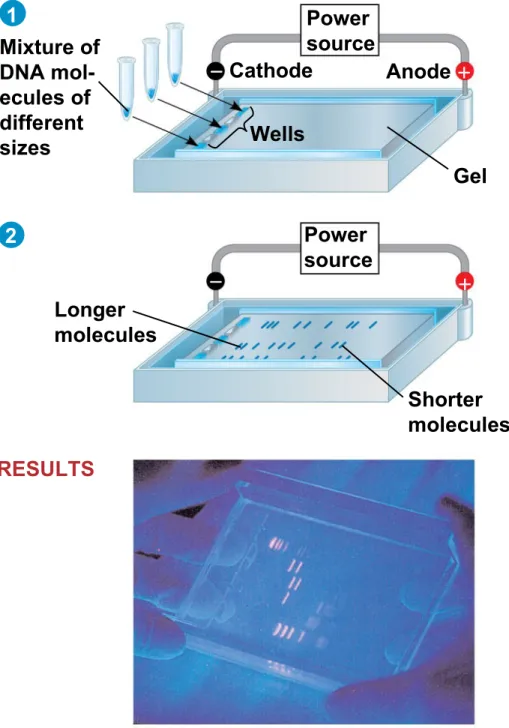
• One indirect method of rapidly analyzing and
comparing genomes is gel electrophoresis
• This technique uses a gel as a molecular sieve to
separate nucleic acids or proteins by size, electrical charge, and other properties
• A current is applied that causes charged
molecules to move through the gel
• Molecules are sorted into “bands” by their size
ecules of different sizes
Power source
Longer molecules
Wells
Gel
Shorter molecules
2
Figure 20.9b
• Restriction fragment analysis can be used to compare two different DNA molecules, such as two alleles for a gene, if the nucleotide difference alters a restriction site
• Variations in DNA sequence are called polymorphisms
• Sequence changes that alter restriction sites are
called RFLPs (restriction fragment length
polymorphisms)
Sickle-cell mutant -globin allele Large fragment allele allele 201 bp 175 bp 376 bp
(a) DdeI restriction sites in normal and sickle-cell alleles of the -globin gene
(b) Electrophoresis of restriction fragments from normal and sickle-cell alleles 201 bp 175 bp 376 bp Large fragment Large fragment
DdeI DdeI DdeI DdeI
Figure 20.10a
Normal -globin allele
Sickle-cell mutant -globin allele
(a) DdeI restriction sites in normal and sickle-cell alleles of the -globin gene
201 bp 175 bp
376 bp
Large fragment
Large fragment
DdeI DdeI DdeI DdeI
Large
fragment
201 bp 175 bp
376 bp
• A technique called Southern blotting combines gel electrophoresis of DNA fragments with nucleic acid hybridization
• Specific DNA fragments can be identified by
Southern blotting, using labeled probes that
hybridize to the DNA immobilized on a “blot” of gel
3 2
1
4
I Normal
-globin allele
II Sickle-cell allele III Heterozygote Sponge Alkaline solution Paper towels II
I III I II III
Preparation of
restriction fragments
Gel electrophoresis DNA transfer (blotting)
Radioactively labeled probe for -globin gene Nitrocellulose blot Probe base-pairs with fragments Fragment from sickle-cell
-globin allele Fragment from normal - globin allele
Film over blot
DNA Sequencing
• Relatively short DNA fragments can be sequenced
by the dideoxy chain termination method, the first automated method to be employed
• Modified nucleotides called
dideoxyribonucleotides (ddNTP) attach to synthesized DNA strands of different lengths
• Each type of ddNTP is tagged with a distinct
fluorescent label that identifies the nucleotide at the end of each DNA fragment
• The DNA sequence can be read from the resulting
spectrogram
3 AA OH H 5 3 C C C C T T T G G A A A A DNA (template
strand) Labeled strands
Shortest Longest5 3 ddC ddG ddA ddA ddA ddG ddG ddT ddC G T T T G T T T C G T T T C T T G G T T T C T GA G T T T C T GA A G T T T C T GA A G G T T T C T GA A GT G T T T C T GA A GT C G T T T C T G A AG T C A Direction of movement
of strands Longest labeled strand Detector
Laser
Shortest labeled strand
Figure 20.12a
DNA
(template strand)
TECHNIQUE
Primer Deoxyribonucleotides Dideoxyribonucleotides (fluorescently tagged) DNA polymerase 5 5 3 3 OH H G G dATP dCTP dTTP dGTP
P P P P P P
Shortest Longest Direction
of movement of strands
Longest labeled strand
Detector
Laser
Shortest labeled strand
3 G C C C T T A A A T T T G ddC ddG ddG ddA ddA 5 T T T G C T T T G C G T T T G C G A T T T G C GA A T T T G C GA A G T T T C GA A G T T T C GA A G T T T C GA A G
Figure 20.12c RESULTS Last nucleotide of longest labeled strand Last nucleotide of shortest labeled strand G G G A A A C C T Direction of movement
of strands Longest labeled strand
Detector
Laser
• Probes can be used to identify where or when a gene is transcribed in an organism
Studying the Expression of Single Genes
• Changes in the expression of a gene during
embryonic development can be tested using
– Northern blotting
– Reverse transcriptase-polymerase chain reaction
• Both methods are used to compare mRNA from
different developmental stages
• Identification of mRNA at a particular
developmental stage suggests protein function at that stage
• Reverse transcriptase-polymerase chain
reaction (RT-PCR) is quicker and more sensitive because it requires less mRNA than Northern
blotting
• Reverse transcriptase is added to mRNA to make
cDNA, which serves as a template for PCR amplification of the gene of interest
• The products are run on a gel and the mRNA of
interest is identified
PCR amplification
Gel electrophoresis
cDNAs Primers
-globin gene
Embryonic stages
1 2 3 4 5 6
2
3
• In situ hybridization uses fluorescent dyes attached to probes to identify the location of specific mRNAs in place in the intact organism
Studying the Expression of Interacting
Groups of Genes
• Automation has allowed scientists to measure
the expression of thousands of genes at one time using DNA microarray assays
• DNA microarray assays compare patterns of gene expression in different tissues, at different times, or under different conditions
2
3
4
Make cDNA by reverse transcription, using fluorescently labeled nucleotides.
Apply the cDNA mixture to a microarray, a different gene
in each spot. The cDNA hybridizes with any complementary DNA on the microarray.
Rinse off excess cDNA; scan microarray for fluorescence. Each fluorescent spot (yellow) represents a gene expressed in the tissue sample.
mRNA molecules
Figure 20.15a
DNA microarray with 2,400
• Using in vitro mutagenesis, mutations are introduced into a cloned gene, altering or destroying its function
• When the mutated gene is returned to the cell, the
normal gene’s function might be determined by examining the mutant’s phenotype
• Gene expression can also be silenced using RNA interference (RNAi)
• Synthetic double-stranded RNA molecules
matching the sequence of a particular gene are used to break down or block the gene’s mRNA
• Genetic markers called SNPs (single nucleotide polymorphisms) occur on average every 100– 300 base pairs
• SNPs can be detected by PCR, and any SNP
shared by people affected with a disorder but not among unaffected people may pinpoint the
location of the disease-causing gene
Figure 20.16
DNA
SNP
Normal allele
Disease-causing allele
T
• Organismal cloning produces one or more
organisms genetically identical to the “parent” that donated the single cell
Cloning Plants: Single-Cell Cultures
• One experimental approach for testing genomic
equivalence is to see whether a differentiated cell can generate a whole organism
• A totipotent cell is one that can generate a complete new organism
• Plant cloning is used extensively in agriculture
2-mg
fragments
Fragments were cultured in nu-trient medium; stirring caused single cells to shear off into the liquid. Single cells free in suspension began to divide. Embryonic plant developed from a cultured single cell.
Plantlet was cultured on agar medium. Later it was planted in soil.
Cloning Animals: Nuclear Transplantation
• In nuclear transplantation, the nucleus of an
unfertilized egg cell or zygote is replaced with the nucleus of a differentiated cell
• Experiments with frog embryos have shown that a
transplanted nucleus can often support normal development of the egg
• However, the older the donor nucleus, the lower
the percentage of normally developing tadpoles
Less differ-entiated cell Donor nucleus trans-planted Enucleated egg cell entiated (intestinal) cell Donor nucleus trans-planted Egg with donor nucleus
activated to begin development
Most develop into tadpoles.
Most stop developing before tadpole stage.
Reproductive Cloning of Mammals
• In 1997, Scottish researchers announced the birth
of Dolly, a lamb cloned from an adult sheep by nuclear transplantation from a differentiated
mammary cell
• Dolly’s premature death in 2003, as well as her
arthritis, led to speculation that her cells were not as healthy as those of a normal sheep, possibly reflecting incomplete reprogramming of the
original transplanted nucleus
3 4 5 6 RESULTS Cultured mammary cells Nucleus removed Cells fused
Grown in culture
Implanted in uterus of a third sheep
Embryonic development Nucleus from mammary cell Early embryo Surrogate mother
Lamb (“Dolly”) genetically
5
6
RESULTS
Implanted in uterus of a third sheep
Embryonic development
Early embryo
Surrogate mother
Lamb (“Dolly”) genetically
• Since 1997, cloning has been demonstrated in many mammals, including mice, cats, cows, horses, mules, pigs, and dogs
• CC (for Carbon Copy) was the first cat cloned;
however, CC differed somewhat from her female “parent”
• Cloned animals do not always look or behave
exactly the same
Problems Associated with Animal Cloning
• In most nuclear transplantation studies, only a
small percentage of cloned embryos have
developed normally to birth, and many cloned animals exhibit defects
• Many epigenetic changes, such as acetylation of
histones or methylation of DNA, must be reversed in the nucleus from a donor animal in order for
genes to be expressed or repressed appropriately for early stages of development
into specialized cells of one or more types
• Stem cells isolated from early embryos at the
blastocyst stage are called embryonic stem (ES) cells; these are able to differentiate into all cell types
• The adult body also has stem cells, which replace
nonreproducing specialized cells
Figure 20.21 Cultured stem cells Different culture conditions Different types of differentiated cells Embryonic
stem cells stem cellsAdult
Cells generating all embryonic cell types
Cells generating some cell types
Liver
• These transformed cells are called iPS cells (induced pluripotent cells)
• These cells can be used to treat some diseases
and to replace nonfunctional tissues
Figure 20.22
Remove skin cells
from patient. 2
1
3
4
Reprogram skin cells so the cells become induced pluripotent stem (iPS) cells.
Patient with damaged heart tissue or other disease
Return cells to patient, where they can repair damaged tissue.
Treat iPS cells so
that they differentiate into a specific
• Many fields benefit from DNA technology and genetic engineering
Medical Applications
• One benefit of DNA technology is identification of
human genes in which mutation plays a role in genetic diseases
primers, then sequencing the amplified product to look for the disease-causing mutation
• SNPs may be associated with a disease-causing
mutation
• SNPs may also be correlated with increased risks
for conditions such as heart disease or certain types of cancer
Human Gene Therapy
• Gene therapy is the alteration of an afflicted individual’s genes
• Gene therapy holds great potential for treating
disorders traceable to a single defective gene
• Vectors are used for delivery of genes into
specific types of cells, for example bone marrow
• Gene therapy provokes both technical and ethical
questions
2
3
4
Retrovirus capsid
Bone marrow cell from patient
Bone marrow
Let retrovirus infect bone marrow cells that have been removed from the
patient and cultured.
Viral DNA carrying the normal allele inserts into chromosome.
Pharmaceutical Products
• Advances in DNA technology and genetic
research are important to the development of new drugs to treat diseases
overexpression of a specific leukemia-causing receptor
• Pharmaceutical products that are proteins can be
synthesized on a large scale
• Host cells in culture can be engineered to secrete a protein as it is made, simplifying the task of
purifying it
• This is useful for the production of insulin, human
growth hormones, and vaccines
Protein Production in Cell Cultures
• Transgenic animals are pharmaceutical “factories,” producers of large amounts of otherwise rare
substances for medical use
body fluids
• DNA testing can identify individuals with a high
degree of certainty
• Genetic profiles can be analyzed using RFLP
analysis by Southern blotting
• Even more sensitive is the use of genetic markers
called short tandem repeats (STRs), which are
variations in the number of repeats of specific DNA sequences
• PCR and gel electrophoresis are used to amplify
and then identify STRs of different lengths
• The probability that two people who are not
identical twins have the same STR markers is exceptionally small
(b) These and other STR data exonerated Washington and led Tinsley to plead guilty to the murder.
Semen on victim
Earl Washington
Kenneth Tinsley
17,19
16,18
17,19
13,16
14,15
13,16
12,12
11,12
12,12 Source of
Figure 20.25a
This photo shows
Washington just before his release in 2001,
• Some modified microorganisms can be used to extract minerals from the environment or degrade potentially toxic waste materials
Agricultural Applications
• DNA technology is being used to improve
agricultural productivity and food quality
• Genetic engineering of transgenic animals speeds
up the selective breeding process
• Beneficial genes can be transferred between
varieties or species
for introducing new genes into plant cells
• Genetic engineering in plants has been used to
transfer many useful genes including those for herbicide resistance, increased resistance to pests, increased resistance to salinity, and improved nutritional value of crops
Figure 20.26
Plant with new trait
RESULTS TECHNIQUE
Ti
plasmid
Site where restriction enzyme cuts
DNA with the gene of interest
Recombinant Ti plasmid
T DNA
•
Potential benefits of genetic engineering must
be weighed against potential hazards of
creating harmful products or procedures
•
Guidelines are in place in the United States
and other countries to ensure safe practices for
recombinant DNA technology
• Most public concern about possible hazards
centers on genetically modified (GM) organisms
used as food
• Some are concerned about the creation of “super
weeds” from the transfer of genes from GM crops to their wild relatives
• Other worries include the possibility that
transgenic protein products might cause allergic reactions
strive to set guidelines for safe and ethical practices in the use of biotechnology
Figure 20.UN03
3
3 3
3 5
5
5
5
CTTAA AATTC
G
G
or cDNA or copy of DNA obtained by PCR
vector
Mix and ligate
Figure 20.UN05
Aardvark DNA
Plasmid 5
3 5
3 TCCATGAATTCTAAAGCGCTTATGAATTCACGGC
AGGTACTTAAGATTTCGCGAATACTTAAGTGCCG
G
G
A A
AA
T
T T T