
Page 1 of 78
Alcotra Innovation project
Deliverable 2.3
Best practices Database for Living Labs
:
-
Overview of the Living Lab approach
Page 2 of 78
Table of contents
Preface ……… 3 Part A ……… 4 Part B ………. 59
Page 3 of 78
Preface
For the study and creation of a best practices Database for Living Labs, a two folded approach was chosen by the Alcotra Innovation project consortium. On the one hand it became clear in the beginning of the project that a general overview about the Living Lab activities in Europe would be desirable to provide a general understanding about Living Labs and their characterization. This part was particular helpful in demonstrating, on the basis of different case studies, how Living Labs are operated and maintained in different settings.
Thus part A describes the findings of a study conducted on the bases of Living Labs belonging to the European Network of Living Labs (ENoLL1). The description shows how Living Labs are deployed in different
international and particular local settings. The insights of this study were used to support the deployment and development of the Alcotra Innovation Living Labs based on the one hand on the general findings of the study and further on by direct coaching and consultancy of the appointed European experts. As such the first part of the Living Lab study was used to generally outline the possibilities of living labs and investigating preferred settings to successful deploy Living Labs, while afterwards providing case based feedback for the deployment of the cross-border Living Labs in Alcotra Innovation project.
The second part of this Deliverable deals with the deployment of a Living Lab database in order to allow interested industrial as well as governmental organizations a structured approach to the Living Labs of Alcotra. Part B thus describes the structure of the database to be deployed to describe the Living Labs of Alcotra (with the help of ERM and Rational Database Models). The work here strongly adherence to the description of Living Labs identified in the CO-LLABS project, which has also been used as the description template for the European Network of Living Labs. This approach has been approved e.g. by the European Commission DG INFSO. However in order to support even further the idea of the Living Lab Benchmarking the structure of the Living Lab Database has been enhanced to allow for the storage of further benchmarking parameters. These parameters are based on the Living Lab harmonization cube that allows the analysis of Living Labs according to their fulfilment of some basic principles governing Living Labs and their maturity grade. This approach was presented and further discussed in the Alcotra Innovation project Genoa meeting hold on 7th July 20112.
1 http://www.openlivinglabs.eu/
Page 4 of 78
DELIVERABLE 2.3 PART A
OVERVIEW OF THE LIVING LAB APPROACH
(WITH A SURVEY OF ENOLL MEMBERS)
Page 5 of 78
TABLE OF CONTENTS
1. INTRODUCTION 7
2. LIVING LABS AS TERRITORIAL INNOVATION MODELS 9
3. OPERATIONAL IMPLEMENTATION 14
3.1 The FormIT Process 15
3.2 The C@R Workflow 15
3.3 The IBBT Research Cycle 17
3.4 The Technological Platform Model 19
3.5 The ENoLL Definition 20
3.5.1 Innovation settings 20 3.5.2 Operating conditions 21 3.5.3 Innovation processes 22 3.5.4 User engagement 22 3.5.5 Innovation outcomes 23 3.6 Conclusions 24 4. SURVEY RESULTS 25 4.1 Country Clusters 25 4.2 Age Clusters 27 4.3 Thematic Domains 28
4.4 Living Lab profiles 33
Profile #1: Single sector Business Association 35
Profile #2: Open Innovation prone Enterprise 35
Profile #3: Policy-driven Government initiative 35
Profile #4: Network-oriented University spin-off 36
Profile #5: High-tech R&D Laboratory 36
Profile #6: Business services provider 36
5. CONCLUSION AND FUTURE WORK 38
Page 6 of 78
ANNEX A: FULL DATABASE OF ENOLL MEMBERS 41
Page 7 of 78
1. Introduction
Much has been written about the massive explosion of Living Labs that has positively affected the European scenario in the past five years now. Scientists, industry observers, and policy makers seem to share the perception that the big movement (and momentum) still under way defies meaningful descriptions, making an overall evaluation almost impossible. This perception is unfortunate, because the ‘essence’ of European Living Labs – a successful mixture of ICT-based collaborative environments, open innovation platforms, user centered product/service development methods, and public private partnerships – holds potentially disruptive and long lasting transformational effects on industry, markets, regional economies and societal landscapes.
On November 20th, 2006, the Finnish EU Presidency launched the idea of a European Network of Living Labs (ENoLL) for the “co-creation of innovation in public, private and civic partnership”. This was presented as a first step towards a new European R&D and Innovation System, entailing a major paradigm shift for the whole innovation process. Since then, a growing number of European actors in a variety of business and non-business domains, have understood that involving people into product and service creation is of vital importance for the acceptance and marketability of results. This has led to the launch of six non-funded calls (the one currently open expires on February 28th, 2012) and the acknowledgment of five consecutive “waves” of Living Labs, endorsed by the Portuguese, Slovenian, French, Swedish, Spanish and Hungarian Presidencies, bringing the 19 founding members of the ENoLL to 274 (including 47 non-EU Living Labs from e.g. North and South Africa, Australia, Brazil, Canada, China, Colombia, and the US). A subset of these has also given life, in January 2010, to the ENoLL aisbl international non-profit association, holding its seat in Brussels.
In essence, the Living Lab concept refers to a set of (quantitative and qualitative) methodologies and tools for the co-creation and validation of innovation together with the end users in real-world environments. In these environments, people are taken across the different roles played during a normal day, and which typically require the use and support of different technologies. Compared with traditional testbeds, where users are not necessarily involved and the laboratory setting is controlled, Living Labs place people at the very centre of the innovation process; thereby, innovation becomes human-centric, in contrast to technology-centric. Further to that, Living Lab activities go on round the clock: this means that solution developers get the opportunity to gain understanding of a new product or service in its 24/7 usage context. Finally, in the perspective of validation, the focus is on how users experience technology, e.g. by interfacing design and ergonomics, as well as on user acceptance. Hence, the purpose of a Living Lab is to enhance innovation, usefulness, and usability of ICT applications in society.
To date, evidence collection on current and emerging Living Labs has largely relied on self-reflection and some empirical analyses carried out on relevant, yet partial subsets of the movement. However, this has contributed to highlight the complexity of a European ‘phenomenon’ which is characterized, at the very least, by a great deal of variability in the respective aims, methods, tools, activities and results. In this context, time is ripe for an integrated research agenda, which aims to fill in the vacuum between theoretical developments and practical implementations, and lay the scientific basis for what can be recognized as ‘the’ first truly original model of innovation ever appeared in Europe.
As a preliminary contribution in that direction, this paper proposes a survey of all 274 Living Labs that are currently members of the ENoLL, based on textual information kindly made available by the ENoLL aisbl chair. The survey was carried out, when available, on the individual self-descriptions delivered by the candidates to the various ENoLL “waves”, otherwise on the Living Lab profiles that are published on the www.openlivinglabs.eu website. No attempt has been made to contact any Living Lab directly for a clarification or integration of the received and analyzed information. While this approach may lend itself to criticisms, as it leaves a lot of margin to the discretional interpretation of the researcher, we believe it also comes as close as possible to what can be said to be an objective and neutral presentation of the Living Lab
Page 8 of 78
movement in 2011. Furthermore, by presenting the results only in aggregate form (ie clustered by country, maturity, thematic domain, nature of the leading organization), we have avoided the risk of disclosing any confidential or simply personal data that was not already public or confirmed by other independent sources (especially the respective Living Lab websites).
The structure of this document is as follows: Section 2 briefly outlines the territorial Living Lab model and Section 3 introduces a number of operational methodologies purporting to its concrete implementation. Section 4 overviews the ENoLL survey results – explaining in particular why and how the focus was set on the four thematic domains of direct interest for the Alcotra Innovation project partners. Section 5 concludes the study with some propositions and implications for future work.
Two Annexes are also provided, one with the full listing of ENoLL members and the other with the profiles of those Living Labs that are coming from the Alcotra Innovation regions.
Acknowledgment and disclaimer: this research was made possible in part by the financial contribution of the European Commission, DG Regio, through the Government of Regione Piemonte, Italy, in the context of the Alcotra Innovation Strategic Project, which is also partaken by the Regional Governments of PACA and Rhone-Alpes, France, and Liguria and Valle D’Aosta, Italy. Some excerpts of Section 2 are borrowed from a paper I presented last September at the ICEGOV11 conference in Tallinn, Estonia [1]. I am particularly grateful to Alvaro Oliveira and Jesse Marsh from the ENoLL Chair and Secretariat for their kind and helpful support in this endeavour. However, I remain solely responsible for any possible mistake and remind you that none of the judgments expressed throughout the text are meant to specifically engage or commit the aforementioned organisations.
Page 9 of 78
2. Living Labs as Territorial Innovation Models
In line with some authoritative statements [2, 3], we can define Living Labs as territorial policy instruments where all the key stakeholders of R&D and innovation governance – namely firms, public authorities, universities and citizens – collectively form a Public-Private-People-Partnership (PPPP) for the joint support and management of systemic innovation according to an open, user driven perspective. In particular, the PPPP members agree to collaborate in the co-creation, design, prototyping, validation and testing of new services, products and technologies, experimented by and with the end users in real-life contexts, thus achieving the preconditions for “democratizing the process of innovation” [4], at least at local and community level. There, the human being is seen as a source of improvement and sustainable change, not just like a consumer, a customer, or a ‘guinea pig’ for closed-door, classical prototype validation and verification activities. To adopt these principles in practice, several real-life experimentation pilots are set up and executed, which are normally and quite simply dubbed Living Lab’s trials.
It is quite interesting to note that most initiators of the Living Labs ‘movement’ in Europe actually operated in urban [5] and mobile [6] environments, either to increase the participation of citizens in spatial planning decision making or to implement User Centred Design (UCD) techniques into R&D on ubiquitous computing technologies. Although the ‘Mobile City’ – and more recently ‘Smart City’ – concept can be seen as quite transversal to many experiences, it is in regional development policy design that the extended stakeholders engagement within a Living Lab’s PPPP can really mark a visible difference with respect to the UCD and Participatory Decision-Making (PDM) approaches. In fact, the main impact of Living Labs is to increase the economic and social attractiveness of the territory they belong to, especially by improving the conditions of ICT-enabled systemic innovation [7].
This, however, requires the unification and coordination of several independent efforts from the local stakeholders, while bringing about a great deal of advantages. In particular, the involvement of citizens and businesses helps to strengthen a culture of innovation and to raise the awareness of policy makers towards the socioeconomic value of infrastructure investments (such as broadband); the cultural commitment to the so-called ‘Living Labbing’ leads to a permanent improvement of innovation capacity in both mature and emerging markets. At the end of the day, this calls for an integrated, sectorial, and also possibly cross-domain approach to the governance of innovation, growth and development in a given area, which can hardly be achieved without electronic means [8].
Typically, the ‘birth announcement’ of a Living Lab coincides with pilot users, researchers, policy makers and businesses at local level entering into agreements, on the basis of which they engage in a long-term collaboration and commit to practicing user driven, open innovation [9]. Thus, we may assimilate a Living Lab to a multi-stakeholder platform, though it can also happen that the original PPPP gets structured into a conventional legal form.
A widely accepted definition [10] describes a multi-stakeholder platform as a (voluntary or statutory) body, comprising different stakeholders, who perceive the same problem, realize their own respective interdependencies, and come together to agree on the best action strategies for solving it. It is like a roundtable, where people are gathered with very different perspectives. Examples of such a platform do abound in several, rather independent policy contexts – from Millennium Development to natural resource management and environmental assessment, from participatory urban planning to the deployment of Information Society. Some platforms are promoted and supported by public decision-makers; some others just aggregate and develop spontaneously.
When people come together in such platforms, they hold multi-stakeholder dialogues, which instantiate themselves into one or more collaboration experiments (trials). Basically, the multi-stakeholder dialogue is not just a conversation model, but an interactive approach to get things done - a contrived situation in which a set of (more or less) interdependent stakeholders are identified and invited to meet and interact to
Page 10 of 78
achieve e.g. conflict resolution, goal negotiation, social learning or collective decision-making towards concerted action.
In a Living Lab framework, any trial or collaboration experiment can be positioned – even concurrently - at either ‘stage’ of the ‘standard’ product/service development process (or chain): idea generation, concept design, prototype generation, verification and validation, product/service evaluation and market launch [11]. At all such stages, the work of technology innovators can get a robust contribution from the early involvement of users in the trials under real-life conditions, which can be taken as the proper hallmark of the Living Lab’s methodological approach [12].
From a heuristic perspective, a multi-stakeholder platform is a more advanced metaphor than a network. Platforms suggest a form of institutionalization that networks do not have. In a typical network, problem-solving capacity is dispersed; while in a typical platform, it is governed and brought to a more advanced synthesis. Furthermore, an ICT infrastructure can be associated to the platform, providing efficient means to manage, store and analyze the production results. Based on the known evidence that most networks are often characterized by cooperation and coordination problems, which are caused by the lack of a dominant decision centre, network management can be a success if it promotes some minimally joint activities between actors. On the contrary, in multi-stakeholder platforms like Living Labs, the power is – at least ideally – dispersed in such a way that no single actor can dominate, nor is management responsibility or the accountability for results exclusive to any particular stakeholder.
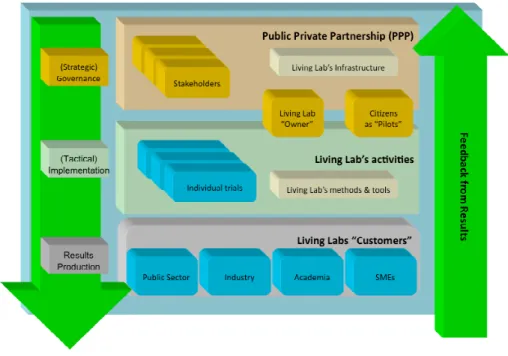
Figure 1 exhibits the ‘typical’ appearance of a Living Lab’s PPPP environment as a three layered multi-stakeholder platform.
Figure 1: A Living Lab PPPP’s conceptual architecture (from: [1])
On the top of everything lies the PPP (Public Private Partnership) between local stakeholders, dealing with the strategic governance of user-driven, open innovation policy. One layer below there is the practical (and tactical) implementation of the trials, foreseeing a key role for the Living Lab’s ‘owner’ or ‘representative’ (the real or virtual organization appointed to act on behalf of the PPP) and for the people/citizens as ‘actors’ of the individual pilot (the missing “P” in the PPPP acronym). Finally, the third layer deals with the actual generation of (material and/or immaterial) results from the trials, going to the benefit of the Living Lab’s service ‘customers’ (e.g. SMEs or large enterprises wanting the pre-test the market feasibility of their engineered solutions). Depending on each trial’s positioning along the product/service development chain, results can take the form of new or improved prototypes, products, services, and technologies, including
Page 11 of 78
(from a public authority’s viewpoint) local innovation policies and strategies. An evaluative ‘feedback loop’ from this third layer to the PPP on the top is key to ensure not only the eventual replication of the trial at the same or another future stage, but also a collective, shared and transparent evaluation of the results obtained. This is another essential feature of the Living Labs approach, well in line with the principles of Open Innovation, but also a guarantee for taxpayer’s money expenditure, provided that most stakeholders do belong to the public sector.
The relevance of the strategic layer is confirmed by the evidence collected in 2008 within the ‘1st and 2nd wave’ members of the European Network of Living Labs [13], which showed how in 8 out of 10 cases, their essence (or raison d’être) pointed at the creation of innovative places (milieux) for territorial marketing and business (or SME) promotion, thus adding to the plethora of territorial innovation policy instruments. This evidence can only be partly explained by a prevalence of government stakeholders (in 35% of the cases, according to the 2008 survey) within the Living Labs PPPP’s. More generally, it stems from the shared intuition that by leveraging on the positive externalities of user-driven, open innovation, a bigger share of product and service inventions can actually reach the market, which in turn leads to the creation of a more favourable and conducive environment to entrepreneurship and business development, not to speak of employment and social cohesion.
In this context, it comes with little surprise that the majority of the Living Labs’ thematic domains surveyed in 2008 was belonging to Government and Public Administration on the one hand, and to SME-specific industrial applications on the other hand (see Figure 2).
Figure 2: Overview of Living Labs domains - 2008 (from: [13])
In the above respect, the Living Lab approach presents itself as a new model of territorial innovation in which the local institutional dynamics play a significant role [14]. This is achieved via a novel and reportedly successful ‘mixture’ of ICT-based collaboration, open innovation, people (user) integration in the design process [15] and public private partnerships, as the following table shows in more detail:
Page 12 of 78
Table 1. Comparison of Territorial Innovation Models (from: [1])
Based on the above table, we can identify the following distinguishing features that are supposed to make Living Labs a truly new and usable instrument for the economics (and policy) of innovation:
• ICT-based collaboration: the presence of a collaborative ICT working environment between remotely located entities is a basic requirement of the Living Labs approach, though actually fulfilled by a limited subset of the existing experiences, as it is also the case for Science and Technology Parks [16, 17], Research Driven Clusters3 and Digital Business Ecosystems [18, 19];
• Open Innovation: a concept that is transversal to most territorial innovation models, being based as they are on the integration of multiple information sources into existing and novel market transition paths4. While the more ‘traditional’ models - born in the 1980s - rely on the physical proximity of economic agents to ensure rapid and effective information exchange and knowledge ‘spillovers’, thanks to the massive introduction of ICT it now becomes possible to situate human communication and collaboration at a ‘virtual’ level, which makes geographic distance less important than before [20]. This shapes a totally new dimension of Open Innovation that seems particularly apt to the development of European SMEs;
3 For a definition of research driven clusters see: http://ec.europa.eu/research/faq/index.cfm?lang=it&page=details&idfaq=18147.
4 Alfred Marshall in 1890 first hypothesized three main reasons for industrial clustering: the benefits of pooled labour supply, better access to specialized inputs, and the information flows between people and firms.
Page 13 of 78
• People (User) Integration in Design: the novelty of the Living Labs approach lies in the particular emphasis given to people’s involvement in the design process since the very early stages of the product/service development chain [11, 15]. This is something that goes beyond the traditional UCD principles, as they are typically anchored to the latest stages of testing, verification and validation; • Public Private Partnership: this is the most typical nature of European Living Labs – whenever they are
established as such – and in that respect, it acquires a similar trait to the ‘support space’ of Innovative Milieux [21], or the territorial ‘Triple Helix’ required by the EC-funded Research Driven Clusters.
As Almirall and Wareham [12] point out, Living Labs engage in a sort of intermediary role between individual users and the other local innovation stakeholders. In particular, they “organize users in needs finding exercises contributing to ideation, support them in acting as entrepreneurs, orchestrate the innovation process, organize user contribution in incremental innovation through localization exercises or promote societal involvement for a certain platform, product or service. Therefore, playing a more encompassing and systemic role in the innovation process” that structures and provides governance to user participation in Open Innovation.
While larger enterprises seem to have sufficient resources to avail themselves of a similar kind of infrastructure, a totally different story concerns SMEs – the natural market of election for the Living Lab’s ‘services’. The diagram below depicts the distribution of a representative sample of “1st and 2nd wave” ENoLL members across a wide range of SME support services. Access to R&D communities, unsurprisingly, stands out as being the main service offered by nearly all Living Labs. Other important contributions emerging from the graph have to do with the role of Living Labs as technology platforms or data sources, possibly relevant to the purposes of product/service development and/or improvement thereof.
Page 14 of 78
3. Operational Implementation
The key concept at the basis of a Living Lab is to turn users from being traditionally considered as merely passive subjects to whom new products or services are simply proposed, into active players contributing to the co-creation and experimentation of emerging ideas, breakthrough scenarios and innovative concepts. Among the numerous definitions available, we select from [22] the following illustration of a Living Lab’s components, with Innovation placed at the centre:
Figure 4: Living Lab’s components (from: [22])
Proceeding clockwise, we encounter the following:
• The ICT & Infrastructure component, which outlines the role that new and existing ICT technology can play to facilitate new ways of cooperating and co-creating innovation among stakeholders; • Management represents the ownership, organization, and policy aspects of a Living Lab, which can
be handled by e.g. consultants, entrepreneurs or researchers;
• Partners and Users bring their own specific wealth of knowledge and expertise to the community, helping to achieve boundary spanning knowledge transfer results;
• Research symbolizes the collective learning and reflection that take place in a Living Lab and should result in useful contributions to both theory and practice. Academic and industrial partners can also provide direct access to ongoing research and research results that can be better turned into new technological innovation;
• Finally, Approach stands for the methods and tools aimed at trial configuration and execution that emerge as best practice within the Living Labs environment.
Over the past few years, several methods and tools have been presented in relation to Living Lab activities. We will now briefly overview some of them in quick succession.
Page 15 of 78
3.1 The FormIT Process
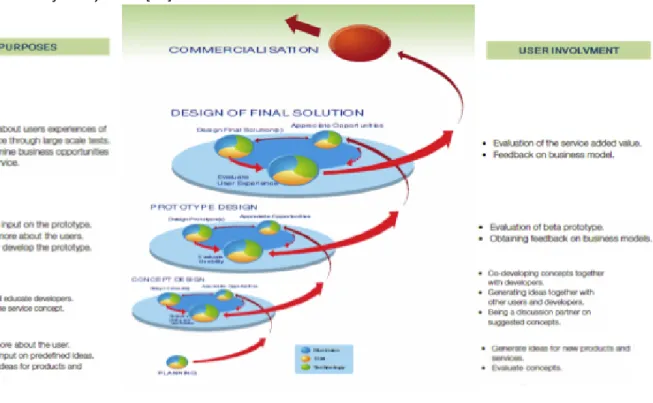
The FormIT process can be seen as “a spiral in which the focus and shape of the design becomes clearer, while the attention of the evaluation broadens from a focus on concepts and usability aspects to a holistic view on the use of the system” [23].
Figure 5: The FormIT Process for Systems Development
In this process, three phases – Appreciate Needs/Opportunities, Design the Solution, and Evaluate Impact (on e.g. usability, experience, etc.) – are repeated along three iterative cycles. The first is named Concept Design, the second Prototype Design, and the third one Final System Design. The name of each cycle indicates the expected output of it.
Besides these three cycles, two additional phases are included in the figure. The first is the Planning phase, which can be seen on the very bottom of the picture, while the second is Commercialization, right on the top. In each of these five phases, relevant analytical dimensions (with a same weight) are Business, Use and Technology.
3.2 The C@R Workflow
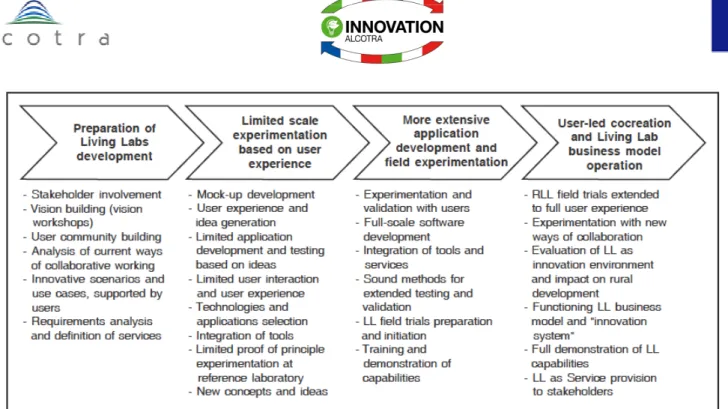
The C@R - Collaboration at Rural - Integrated Project (http://www.c-rural.eu/) has been supported by the European Commission, DG Information Society and Media, under the Information Society Technologies (IST) Priority within the 6th Framework Programme. When the project started in 2006, Living Labs as such were not yet in place in the participant regions/countries. In this context, a “pragmatic phasing approach” to Living Lab and trial development was introduced by [8], as follows:
Page 16 of 78
Figure 6: The C@R Workflow for Living Labs and Trial Establishment
In short, the proposed workflow rolls out along four consecutive stages:
• Preparation: setting in place the preconditions for successful establishment of the Living Lab, such as the commitment of local stakeholders and the compliance with development and/or innovation policies. Key activities here are joint vision and user community building, discussion of current and prospective collaboration opportunities, definition of innovative scenarios and use cases, analysis of requirements and definition of prospective services;
• Limited scale experimentation: demonstrating the effect of user integration on work and business practice is necessary to convince the skeptics or disseminate innovation to followers. New ideas, concepts and mock-up’s generated at this stage can serve as “proofs of principle” to create an initial user community. Here, suitable technologies and applications are selected or integrated and can also be developed in small experimental series where found appropriate, to start sharing critical information with initial users and testing innovations at technical, social and business level; • Extensive application development and field experimentation: in this later stage of the Living
Lab’s workflow, prototype solutions and tools are made available in full scale for user driven validation and testing in real life conditions. To this end, the first field trials are prepared and initiated, based on a number of operational methodologies, including training of early adopters and demonstration of capabilities.
• User-led
co-creation and Business model operation: here the conditions are set for extending the field trials to a full user experience as well as experimenting on new ways of collaboration with and between end users. Thus, co-creation of innovative applications is the end result, not the premise of Living Lab’s establishment. Additionally to that, impact evaluation of innovations on business processes, ways of living and development models can be launched. At this stage there is a more extensive user community willing to actively be involved. A business model governing the operation of the Living lab as innovation environment is also in place.
A similar implementation workflow, as proposed by [24], is depicted below. We use different colors to identify the activities belonging to each of the three layers of our conceptual architecture described in Section 2 (see also Figure 1 above).
Page 17 of 78
Figure 7: Sample Living Lab’s trial implementation workflow (from: [24])
After the institutional definition of the PPP, an initial phase of brainstorming with local stakeholders is realized, aimed at making them aware of the goals and features of the prospective solution concept. As a result of this first activity, several key aspects of the preliminary usage scenario(s) envisaged for the prototype may be confirmed, refined or radically changed.
Then follows the initial development of the technical architecture (only at mock-up level in this stage) and its validation with the end users in order to get additional feedback from the illustration of the related usage potential. A notable remark is that up to this moment, only the PPP stakeholders have been involved in the group discussion and no single code line has been written as yet.
The next activity is the actual development and installation of the specific application on real devices, in order to carry out the ‘live’ demonstrations of its main features as required. Some training sessions may also be needed in order to support technology deployment in this phase. A number of real working sessions are recorded, and several concrete suggestions for improving usability as well as functionality of the system are collected. Bugs fixing and the provision of requested improvements (with or without a new battery of field tests for further refining the architectural and structural aspects) ultimately leads to the final prototype.
3.3 The IBBT Research Cycle
One of the earliest examples of Living Labs as testing and experimentation platforms for technologies and services in early stages of the innovation process comes from IBBT, the leading Belgian Institute of Applied Technologies [25]. In this perspective, the basic research cycle is based on four consecutive (and iterative) steps:
Page 18 of 78
1) Contextualization, or a prior exploration of the technological and social challenges implied by the technology and service under investigation;
• This step also includes Selection, meaning the identification of potential users or user groups for the Living Lab trial to be executed, and Recruiting, or the complete definition of the test-panel according to the predefined selection profiles;
2) Concretization, meaning a thorough description of the current characteristics, everyday behavior and perceptions of the selected users with respect to the trial’s focus;
• This includes an initial Measurement of the sample, ie made before the technology or service is introduced or before the test panel becomes active in the Living Lab;
3) Implementation, or the behavioral validation and operational testing phase, driven from a user-led perspective;
• This step is supported by two major families of research methods: Direct Analysis (e.g. Logging and other remote data collection techniques) and Indirect Analysis (e.g. focus groups, in-depth interviews, and self-reporting techniques like diaries);
4) Feedback, consisting of two distinct steps:
• An ex post Measurement based on the same techniques of the initial one, to check if there has been any evolution in the users perception and attitude towards the introduced technology and service, to assess the changes and detect the transitions in relation to everyday life usage over time;
• A set of Technology Recommendations arising from the analysis of data gathered during the previous implementation phase.
Figure 8: Overview of the Living Lab research cycle (from: [25])
Like the picture above shows, the outcome of the Feedback stage can be used as the starting point for a new research cycle; in this way the iterative feature of the chosen approach is made operational.
Page 19 of 78
3.4 The Technological Platform Model
The “process oriented” definitions above leave the additional issue open of introducing and describing a “Living Lab platform”, whereby knowledge is shared and the collective work, including social intelligence, of multidisciplinary teams and user communities is crystallized into new and emerging concepts, artefacts and ultimately services.
Marc Pallot [26] gives emphasis to Living Labs as technological platforms (see next Figure) offering research and innovation services for the design, exploration, experimentation and evaluation of new and innovative ideas, usage scenarios, and application prototypes. Within a Living Lab, an iterative process takes place - whatever innovation is to be generated - that links together the following four activities:
1. Co-creation of new ideas, concepts, artefacts and application scenarios, by means of open sessions of collective creativity involving all concerned stakeholders and especially end users;
2. Exploration of alternative usage scenarios through setting the scene by the implementation of different immersive techniques within real-life environments;
3. Experimentation done on various assessment scenarios for concrete applications and/or service prototypes by the use of the Living Lab’s technological platform, also within real-life environments; 4. Evaluation of the resulting exploitation scenarios on the basis of metrics for measuring the Quality
of Service as well as the Quality of Experience, which both allow anticipating the potential degree of future adoption by the user communities involved.
Figure 9: Living Labs as Technology Platforms (from: [26])
The FP7 ICT STREP ELLIOT (Experiential Living Labs for the Internet Of Things, http://www.elliot-project.eu) adopted this model to develop IoT technologies and Ambient Intelligence (AmI) services by and for the users, supported by a KSB (Knowledge-Social-Business) Experience Model [27] and by an innovative ICT Platform operating as a knowledge and experience gathering environment. This combination of user driven experimentation and experiential design approaches is expected to positively impact on the development and adoption of IoT technologies and services.
Page 20 of 78
3.5 The ENoLL Definition
The European Network of Living Labs (ENoLL, see www.openlivinglabs.eu) defines a Living Lab as “an open innovation environment in real-life settings in which user-driven innovation is fully integrated within the co-creation process for new services, products and societal infrastructures”. This definition identifies five key dimensions of the Living Labs that are
1. innovation settings (the “open innovation environment”),
2. operating conditions (“real-life settings”),
3. affecting innovation processes (“user-driven innovation” and “co-creation”),
4. related to user engagement and
5. from which innovation outcomes are expected (“new services, products and societal infrastructures”).
3.5.1 Innovation settings
Conceptualized as an organizational entity, a Living Lab represents an open innovation environment that is characterized by a thematic domain (e.g. healthcare, multimedia, etc.) and a territorial dimension (e.g. city, region). Moving from a plain stakeholder network towards a “functional region” (Santoro & Conte 2009) requires that relevant stakeholders play their role by leveraging and articulating the network’s resources (as illustrated by the next Figure) to foster innovation dynamics.
The paradigm at the basis of Living Labs is Chesbrough’s Open Innovation [9], assuming that firms, in the effort to enhance the marketability of their product and service solutions, should use ideas, feedback and improvement proposals deriving from any external as well as internal sources, such as customers, suppliers, employees etc. However, the Living Lab approach to open innovation goes beyond Chesbrough’s firm-level prescription that businesses should make greater use of the existing knowledge available in- and outside an organization. Indeed, Living Labs are organizational settings based on inter-organizational and multi-disciplinary collaboration, as exhibited in Figure 10 below. This structural feature indicates that Living Lab environments can primarily thought of as (technology and/or multi-stakeholder) platforms for exploiting the complementarities and synergic potentials between local and regional businesses, public authorities, academia (the “Triple Helix”) and obviously people’s communities (the fourth “P” of the “PPPP” acronym).
Page 21 of 78
Figure 10: Living Labs as Functional Regions (from: [3])
3.5.2 Operating conditions
Living Labs also differentiate because of the playground in which innovation is grown. ENoLL’s definition prescribes ‘real-life’ environments, which encourage carrying out the innovation process in an uncontrolled context that is fully consistent with the product’s or service’s usage conditions. In particular, Følstad’s review ([28], p. 116) proposes an attenuated definition whereby innovation takes place in “(semi)realistic contexts”, thus considering to engage users either in partly controlled environments or in what is often described as the uncontrolled “real-life”.
‘Users’ here generally means ‘end users’, or those specific persons adopting and being impacted by the innovation considered. In other words, the term relates to citizens, consumers and possibly employees, if that innovation assumes an organizational meaning. A particularly important category of end users is represented by the “lead users”, described [in 29] as a particular group of people “on the leading edge of the market with respect to important market trends”. The two defining characters of lead-users are that (a) they are ahead with respect to important market trends, typically early adopters, and (b) they expect to gain relatively high benefits from a given solution [30].
More recently, the Web 2.0 explosion has demonstrated the positive impact of involving user communities in mass collaboration projects (e.g. Wikipedia, crowdsourcing, etc.) that collectively create new contents and applications. Because of heterogeneity of users’ requirements and the growing demand for solutions that are more precisely meeting individual needs, the innovation driven by users provides a very necessary complement to manufacturer innovation. In practice, however, it is often very difficult to shift product development activities from manufacturers to lead users: if it is not possible to find representative users for all user groups, a broad variety of users is needed to assess all relevant user needs.
This condition that user involvement activities should take place in real-world contexts is a main difference between the Living Lab approach and traditional user involvement methods. This means, for example, that potential users are involved all day round. Hence, the aim here is to create as authentic a usage situation as possible, whereas in traditional practice users can be asked to use a system or device in a so-called field study, then in a not fully authentic context.
The rationale for such realism having instrumental value in Living Labs is that innovations should ultimately take place in the “real world”. For example, if a user tests a mobile service, s/he can gain understanding of how it functions and fits into her/his usage context at all times and in diverse ordinary situations: at the end
Page 22 of 78
of this real-life experimentation, the company developing the advanced mobile service will gain important feedback from potential customers about performance, quality, efficiency, thus being able to improve the service and to approach the market with a higher probability of success.
3.5.3 Innovation processes
Another difference between the Living Lab and other development approaches is their focus on the vertical value chain in which customers, producers, and suppliers are involved, with the objective to create new businesses: in fact, the Living Lab approach does not only aim at involving end users in the development processes, because it also strives to facilitate the interaction between other relevant stakeholders, such as research organizations, companies, public sector, and society as a whole.
Thus, from a process perspective, Living Labs are innovative because they encompass two ground-breaking ideas:
(a) Managing a multi-organizational, inter-disciplinary collaboration for innovation (pilot configuration challenge), and
(b) Engaging intensively with end users (methodological and instrumental challenge). In order to be met, both challenges require specific research methods and tools, respectively to
(a) Trigger innovators and support the formation of effective innovation groups, and (b) Engage users adequately on the innovation process.
Several methods, such as action research, community informatics, contextual design, user-centred design, participatory design, empathic design, emotional design, and others, already exist in research and practice, but they mostly fail to sufficiently empower users for co-creation in open development environments.
3.5.4 User engagement
Research up to now conducted on the subject of users role in innovation processes has found that needs are highly heterogeneous and that users show a high willingness to pay for a solution that is more closely related to there individual needs: the advantage of a user driven innovation process is that users can develop exactly what they want. Users can have intrinsic motivations to co-create (interest in innovation and improvement, fun to participate, etc.), but could also require extrinsic motivations (e.g. financial or material incentives for consumers, free loan of the new IT system, etc.), which have to be taken into account.
The focus on user engagement derives from this central and driving role attributed to users as a source of dynamism (“user driven”), creativity and improvement inputs (“co-creation”). As the following picture shows, end users potentially play a role in all phases of the innovation lifecycle, from idea to concept to product/service development, from deployment for testing and experimentation purposes, evaluation and ultimately market launch. End users are central contributors to Living Labs because they are expected to be a source of ideas (creative role for the generation of radically new concepts), a mechanism for product improvement (supporting role in an iterative development process), verification and validation (evaluation role), as well as diffusion agents (marketing role).
Page 23 of 78
Figure 11: The Living Lab Innovation ‘Vortex’ (from: [3])
User engagement can be differentiated in terms of intensity, between
• Reactive modes, for example giving feedback on an existing proposal, prototype or product, and • Proactive modes, for example becoming a source of innovation or ideas to improving a product or
service along its development process.
In theory, the benefits of user involvement in the development of new products, services and processes are quite relevant: expected added values are for example higher acceptance among stakeholders, better hit-rates and faster time-to market. Involving users in the development of interactive systems and innovative solutions typically increases the likelihood that those new products and/or services will be useful and usable: empirical evidence suggests that user involvement is beneficial in such developments [31].
Let us take an example from IT industry: nowadays, IT investments are considered failures if they do not produce an added value for the users. Actually, in order to increase the probability that users will use a public IT system when it is introduced in the competitive and open market, this must offer users an added value of some sort. Therefore, it is important to gain knowledge about what the intended users need and want from technology. One obvious way to gain knowledge about users and their needs is to engage them on the development and testing process run by the IT firms themselves.
In market research, experts usually investigate end user needs. User engagement goes one step further. It is not purely about assessing and considering user needs in the product/service development process, but also about actively involving end users. Therefore, suggestions, remarks and recommendations from them need to be taken seriously: this represents an innovative business model, which asks product developers and researchers to accept the user as benchmark for the design of a new product or service.
The strategy of this new business model, strongly linked to people, is to cooperate in a productive and effective manner in order to jointly develop appropriate products in a bottom-up fashion: according to this perspective, social innovation is recognized as a crucial source of innovativeness in Living Labs.
3.5.5 Innovation outcomes
The single most consensual feature of Living Labs is their overarching purpose, as captured in part (5) of the ENoLL’s definition. Living Labs are strongly expected to be platforms fostering business innovation in a way that bridges the crucial gap between market pull, commercially oriented product/service development and research push, technology driven solution proposal and product/service prototyping (see next picture).
Page 24 of 78
Figure 12: A missing link in the innovation chain (from: [32])
That very aim is also reflected in the so-called “Helsinki Manifesto” [33] that established the European Network of Living Labs and articulated its central mission by directly linking it to the Lisbon Strategy (now Digital Agenda), the European Union’s knowledge and information society master plan. Thus, the ENoLL is expected to have a strong regional growth and development impact by facilitating and fostering regional innovation as interlinked with a European innovation system holding a global reach.
To that end, the Living Lab approach has been inscribed into a number of recent calls of the Framework Programme 7 (ICT 2009-2011) and especially the Competitive and Innovation Programme (CIP 2009-2011).
3.6 Conclusions
To sum up, the Living Lab approach can be defined as a methodological paradigm that guides user driven development and integrates users’ needs in the design of a new product, service, or innovative IT-system, by paying attention to the following aspects [34]:
• Early and continuous participation of all project stakeholders (firms, end users, academia, research institutes, public administration, briefly the so-called PPPP);
• Broad inclusion of end users, open process and transparent results;
• Data collection methods that facilitate spontaneous reactions, i.e. open and qualitative; • Engagement of real users in real contexts with real systems;
• Involvement different competencies to increase creative solutions; • Design as an iterative process;
• Insights into user characteristics;
• Focus on identifying strengths, opportunities and values; • Prioritisation of needs in dialectical interaction with users;
• Translation of user expressions into needs and technical requirements; • Creation of an authentic usage situation in the evaluation of the prototype.
Five principles are considered key for Living Lab operations: Continuity, Openness, Realism, Empowerment of Users, and Spontaneity (CORES), which are described as follows [35]:
• Continuity: this principle is important since good collaboration, the so-called PPPP (People Public Private Partnership), which strengthens creativity and innovation, builds on trust, which takes time to develop. In particular, if users feel that their opinions and needs are important and considered in the design of the innovative product or service, then the relationship established with the firms, SMEs and research institutes tends to be more trustworthy productive, and long-term oriented. Reflecting on openness also awakens questions about how the process must be designed to cope with all the input an open process might generate: a solution could be deploying an ICT infrastructure with a mobile platform and an online forum, freely accessible and always-on.
Page 25 of 78
• Openness: the innovation process should be gathering of many perspectives and bringing enough power to achieve rapid progress is important. The open process also makes it possible to support the process of user-driven innovation, including users wherever and whoever they are. The open process is demonstrated by the continuous interactions among the involved stakeholders, with special attention to the users. This means that multiple stakeholders and perspectives should be one key characteristic of a Living Lab, and can be implemented with project-teams consisting of people from academia, private companies, public organisations, and potential end user groups.
• Realism: to generate results that are valid for real markets, it is necessary to facilitate as realistic use situations and behaviour as possible. This principle also is relevant since focusing on real users, in real-life situations, is what distinguishes Living Labs from other kinds of open co-creation environments.
• Empowerment of users: the engagement of users is fundamental in order to bring the innovation process in a desired direction based on human needs and desires. Living Labs efficiency is based on the creative power of user communities; hence, it becomes important to base innovations on people needs and desires, as well as to motivate and empower the users to engage in these processes. Needs and suggestions, priorities and requirements, collected through focus-group interviews, open source communities and prototype tests should be considered seriously and implemented as functions and features in the solution design.
• Spontaneity: in order to succeed with new innovations, it is important to inspire usage, meet personal desires, and both fit and contribute to societal and social needs. Here, it becomes important to have the ability to detect, aggregate, and analyse spontaneous users’ reactions and ideas over time.
4. Survey Results
This section provides the preliminary results of a qualitative survey carried out on all the 274 Living Labs that are currently members of the ENoLL, based on textual information kindly made available by the ENoLL aisbl chair. The survey was carried out, when available, on the individual self-descriptions delivered by the candidates to the various ENoLL “waves”, otherwise on the Living Lab profiles that are published on the www.openlivinglabs.eu website. The results presented are only in aggregate form (i.e. clustered by country, maturity, thematic domain, nature of the leading organization), to avoid the risk of disclosure for any confidential or simply personal data. However, Annex A and B provide the full listing of ENoLL members as well as the profiles of those Living Labs that are coming from the Alcotra Innovation regions. These Annexes only use public information, available from the ENoLL website or confirmed by other independent sources (especially the respective Living Lab websites).
4.1 Country Clusters
Page 26 of 78
Figure 13: List of ENoLL member countries (from: www.openlivinglabs.eu)
As the next two diagrams display, 83% of Living Labs (or 227) come from EU27 countries, 17% (or 47) from non-EU and international countries. Within these latter, 34% (or 16 Living Labs) are from South America, 24% (or 11) from Europe (non-EU), 19% (or 9) from Asia (especially China and Taiwan), 15% (or 7) from North America and 2% (or 1) from Oceania.
Thus, all the six continents are currently represented in ENoLL, which is due to the particular openness and inclusion policies followed by this association since the ‘3rd wave’ call: then, it was decided that applications as associate members would be accepted from all over the world, a policy that has continued ever since.
Page 27 of 78
Figure 14: Geographical distribution of ENoLL, EU27 and non-EU members (source: ENoLL database)
4.2 Age Clusters
In the application form, each candidate to ENoLL membership has to specify the year of foundation. The next diagram displays how the 274 Living Labs distribute themselves according to this parameter. As it can be seen, the overwhelming majority did not exist before 2006, when the EC Presidency launched the so-called ‘Helsinki Manifesto’.
Figure 15: Age distribution of ENoLL members (source: ENoLL database)
Quite understandably, as the next two diagrams show, the above represented trend (reaching a peak in 2008, then slowing down) is pushed by the dynamics of the EU27 Living Labs, which are about four fifths of the overall population.
Page 28 of 78
Figure 16: Age distribution of EU27 and non-EU members (source: ENoLL database)
In absolute terms, the four countries that contribute more to the current ENoLL population – as displayed by Figure 13 above – are Spain, France, Italy and the UK. The next graphs compare their respective age distribution, in terms of foundation year, as resulting from the respective ENoLL application forms.
Figure 17: Age distribution of the top four EU27 ENoLL members (source: ENoLL database)
4.3 Thematic Domains
The evidence presented in the following diagram has been obtained as follows. All the application forms (or in case they were missing, the published profiles on the ENoLL website) of the 274 Living Labs have been
Page 29 of 78
scanned for the identification of the leading thematic orientation(s), based on the statements made by the applicants themselves. No attempt was made to contact any Living Lab directly to clarify or integrate the received and analyzed information.
Given the framework of the Alcotra Innovation project, within which this research was planned and done, and particularly the four thematic domains of election for the participant Regions, our focus was set to the Living Labs that have characterized themselves as belonging to one or more of these domains (as multiple options were also available).
As the next diagram exhibits, 39% of Living Labs (or 107) were assessed to belong to the Creative Industries and e-Learning sector, 29% (or 80 ENoLL Members) to the e-Health, AAL, Well Being and Sports sector, 13% (or 35 Living Labs) to the Intelligent Energy, Smart Grid and Sustainable Building sector, and 9% (or 26) to the Transport, Logistics and Automotive sector. On the other hand, 221 out of the 274 ENoLL members (or 80%) also belonged to different – and quite often, additional, thematic domains, such as rural or urban inclusion, manufacturing, mobile and broadband services etc.
Figure 18: Thematic orientation of ENoLL members (source: ENoLL database)
Not surprisingly, as the next two diagrams show, the above represented distribution is confirmed after splitting up the current universe of ENoLL members into EU27 and non-EU Living Labs, with a particularly good matching between the appearance of Figure 18 and the outlook of EU27 members, while the cluster of Intelligent Energy, Smart Grid and Sustainable Building seems a little bit overrepresented in the non-EU and international universe.
Page 30 of 78
Figure 19: Thematic orientation of EU27 and non-EU members (source: ENoLL database)
It is now quite interesting to compare the relative performance of EU27 countries with respect to the four thematic domains of election for the Alcotra Innovation project. To start with, the four countries that contribute more to the Creative Industries and e-Learning cluster population – as displayed by Figure 20 below – are France (by an overwhelming majority), Italy, Spain and Germany. The next graphs compare their respective performance, in terms of number of Living Labs in the cluster, as resulting from the ENoLL application forms.
Figure 20: Relative performance of the top four EU27 ENoLL members in the Creative Industries and e-Learning sector (source: ENoLL database)
Page 31 of 78
Turning now our attention to the e-Health, AAL, Well Being and Sports sector, the four countries that contribute more to its population – as displayed by the next diagram – are Finland first, then again France, Spain and Germany. Figure 21 compares their respective performance, in terms of number of Living Labs in the cluster, as resulting from the ENoLL application forms.
Figure 21: Relative performance of the top four EU27 ENoLL members in the e-Health, AAL, Well Being and Sports sector (source: ENoLL database)
We now move on to the Intelligent Energy, Smart Grid, and Sustainable Building sector, whereby Spain, Portugal, France (not displayed here), Italy and Germany are the five countries that contribute more to its population. Being the size of this cluster considerably lower than in the above two cases, the next diagrams have been rescaled to ensure better readability. As before, Figure 22 compares the performance of the aforementioned countries, in terms of number of Living Labs in the said cluster, as resulting from the ENoLL application forms.
Page 32 of 78
Figure 22: Relative performance of the top four EU27 ENoLL members in the Intelligent Energy, Smart Grid and Sustainable Building sector (source: ENoLL database)
Last but definitely not least, we now move on to the Transport, Logistics and Automotive sector, whereby France, Italy, Portugal, and Spain are the four countries that contribute more to its size. In Figure 23, the diagram concerning France has been rescaled to ensure comparability with the others. As before, the next exhibits compare the performance of the aforementioned countries, in terms of number of Living Labs in the said cluster, as resulting from the respective ENoLL application forms.
Page 33 of 78
Figure 23: Relative performance of the top four EU27 ENoLL members in the Transport, Logistics and Automotive sector (source: ENoLL database)
To conclude this section, we present the following table, which lists all the EU27 countries with at least one ENoLL member belonging to either of the four thematic domains of relevance for Alcotra Innovation.
Table 2. EU27 Living Labs belonging to the 4 thematic domains of Alcotra Innovation (source: ENoLL database)
Countries Clusters
AT BE BG DE DK EL ES FI FR HU IE IT MT NE PT RO SE SI UK Total
Creative Industries, incl. E-Learning
1 3 2 8 1 2 9 6 30 5 1 10 2 2 1 1 5 2 4 95
e-Health, AAL, Well Being and Sports
1 1 1 7 1 3 10 12 11 1 2 6 0 2 3 1 5 0 3 70
Intelligent Energy, Smart Grid, Sustainable Building
0 1 0 3 1 1 4 0 3 1 1 3 1 2 3 1 0 1 1 27
Transport, Logistics and Automotive
1 0 0 0 1 1 2 1 6 1 1 4 0 0 3 1 1 2 0 25
Total 3 5 3 18 4 7 25 19 50 8 5 23 3 6 10 4 11 5 8 217
4.4 Living Lab profiles
In late 2007, the European Commission – DG INFSO, Unit F4 – awarded to Altec SA, International Research, the execution of an evaluative study [13] on the potential of the emerging Living Labs “phenomenon”. The study was concluded right in coincidence with the ICT 2008 event in Lyon, when the results of the 3rd wave
Page 34 of 78
ENoLL call were officially announced. Thus, it only dealt with the 51 ENoLL members known at the time, which were approached and inspected through a variety of research methods and tools – from online surveys to interview based case studies, from Social Network Analysis to MASAI® and PACE©.
Based upon the evidence collected, the most recurring elements of European Living Labs could be listed as follows:
- A University played a key role, ensuring a systematic and coherent implementation of underlying methodologies (Open Innovation and the like);
- One or more local/global industries were involved as technology providers, being interested in designing, testing or validating their prototype products and services;
- The Open Innovation concept was assumed, postulating that there is more value to companies in “sharing and spreading” rather than “storing and protecting” the knowledge created by various internal and external sources, such as employees, customers, suppliers, etc.;
- A real-life testing environment was established, supported by the ICT, where users’ feedback on innovation was collected and aggregated as long as it emerged from a seamless and spontaneous interaction between people and technologies;
- A user centric approach to innovation was implemented, putting people’s feedback at the core (or as integral part) of the product and service design/development/validation/marketing process, especially in the earlier stages of it;
- An external funding entity (typically a public one) made all of the above financially feasible; and - An ‘umbrella’ organisation acted from the background, either a virtual (like an informal network) or a
real one, named “XYZ Living Lab” and being a public/private partnership composed of several local and global stakeholders, each of them with some degree of relevance and/or expertise in the areas of e.g. territorial marketing, technology transfer, R&D promotion or business incubation, and the like.
Another crucial element of a Living Lab should logically be the establishment of a ‘permanent’ community of users, who are iteratively asked to become integrated in some particular stages of the design/development/validation and marketing process, and whose feedback is collected by means of various socio-ethnographic research methods (from focus groups to surveys, from TV recorded debates to web based interviews and polls). However, very few European Living Labs could at the time rely on such a permanently established (and potentially quite numerous) user community. Notable exceptions were identified in Lulea, Sweden and Oulu, Finland, in which cases the number of involved people reached the order of thousands. In many other cases, if relevant to its policy aims, it was the City or Regional Authority lying behind the ‘umbrella’ organisation of the Living Lab, which took on the commitment to build such a community, starting from the whole constituency, often as a complement of an ongoing strategy towards bridging the digital divide or promoting innovation in the territory. Relevant examples in the latter direction ranged from Spain (e.g. Barcelona or Zaragoza) to the UK (Manchester), from Sweden/Finland (Åboland/the Turku Archipelago) to France (Paris) and Greece (Thessaloniki). In some other cases, it was the University itself, holding responsibility for Living Lab’s methodology deployment, which utilised its students to run particular trials in the area of, say, mobile innovation. Examples of such a kind were reported from Belgium (Brussels), Slovenia (Maribor), and Germany (Bremen).
According to the evidence collected during the Study, the 1st and 2nd wave ENoLL members were clustered in the 6 profiles described below. As any taxonomy, this also can be questionable in its conception, but it has the advantages of being complete, quite informative, and without overlaps between the features of each different group. Its robustness was also successfully tested with the members of the 3rd wave ENoLL, which could not be included due to lack of published information at the time the final report was prepared. The next picture shows the frequency of occurrences of each profile in the surveyed universe.
Page 35 of 78
Figure 24: Key Profiles of Living Labs (Source: [13])
Profile #1: Single sector Business Association
It was the least represented case (6% of occurrences). The Living Lab was organised and pushed forward by an ‘umbrella’ association which represented the interests of several companies of a same business sector (e.g. automotive). Typically this profile was not very developed in terms of successful trials. However, it has a great potential in two main respects:
- as a promoter and aggregator of thematic R&D and innovation initiatives in the territory of reference;
- as a vehicle for cross-national, pan-European interoperability of Living Labs trials, platforms and solutions.
Profile #2: Open Innovation prone Enterprise
1 out of 10 occurrences belonged to this case, which is similar to the previous one, being another Living Lab that is likely motivated by a vested business interest. However this profile, instead of a corporate association, was based on a single enterprise’s initiative, adopting the User driven, Open Innovation concept and/or creating a network of relations aimed at the cooperative design and validation of novel ideas, products and services. While interesting per se, the presence of individual enterprises within the ENoLL could also be useful in terms of exemplarity and potential transfer of the concepts, methods and tools utilised.
Profile #3: Policy-driven Government initiative
This was unsurprisingly the most common case (35% of occurrences) within the 1st and 2nd wave ENoLL. The Living Lab was clearly backed up by a Regional or City Government – also in those few cases where a non-profit foundation, or even a cooperative cluster, were practically managing it. The prevalent dimension of this case is akin to local development, also as a complement to more traditional innovation policies and practices (such as territorial marketing, business incubators, technology clusters, industrial parks, etc.). An additional side benefit of this profile was the prompt availability of a permanent user community, obviously emerging from citizens and stakeholders forming the Government’s “constituency”.
![Figure 2: Overview of Living Labs domains - 2008 (from: [13])](https://thumb-us.123doks.com/thumbv2/123dok_us/10668082.2954942/11.892.195.680.552.831/figure-overview-living-labs-domains.webp)
![Figure 3: Overview of Living Labs services - 2008 (from: [13])](https://thumb-us.123doks.com/thumbv2/123dok_us/10668082.2954942/13.892.205.680.660.972/figure-overview-living-labs-services.webp)
![Figure 7: Sample Living Lab’s trial implementation workflow (from: [24])](https://thumb-us.123doks.com/thumbv2/123dok_us/10668082.2954942/17.892.217.690.97.586/figure-sample-living-lab-s-trial-implementation-workflow.webp)
![Figure 8: Overview of the Living Lab research cycle (from: [25])](https://thumb-us.123doks.com/thumbv2/123dok_us/10668082.2954942/18.892.102.788.751.1062/figure-overview-living-lab-research-cycle.webp)
![Figure 9: Living Labs as Technology Platforms (from: [26])](https://thumb-us.123doks.com/thumbv2/123dok_us/10668082.2954942/19.892.169.725.643.950/figure-living-labs-technology-platforms.webp)
![Figure 10: Living Labs as Functional Regions (from: [3])](https://thumb-us.123doks.com/thumbv2/123dok_us/10668082.2954942/21.892.138.711.63.497/figure-living-labs-functional-regions.webp)
![Figure 11: The Living Lab Innovation ‘Vortex’ (from: [3])](https://thumb-us.123doks.com/thumbv2/123dok_us/10668082.2954942/23.892.257.693.166.399/figure-living-lab-innovation-vortex.webp)
