Marquette University
e-Publications@Marquette
College of Nursing Faculty Research and
Publications
Nursing, College of
9-6-2017
Nursing Students’ Perception of the Stigma of
Mental Illness
Abir K. Bekhet
Marquette University
, [email protected]
Carolyn J. Murrock
University of Akron
Qiyan Mu
Marquette University
Harpreet Singh-Gill
Behavioral Health Center
SM Journal of Nursing
, Vol. 3, No. 2 (2017) Case Report 1013.
Publisher link
.. Distributed under
Creative Commons CC-BY 4.0. Used with permission.
SM Journal of
Nursing
Stigma and Mental Health
Mental illnesses are mental disorders or health conditions that are characterized by dysfunction of mood, thoughts, and/or behaviors resulting in distress and/or impaired functioning [1]. The prevalence of mental illnesses is high in the United States. In 2013, an estimated 43.8 million adults had some diagnosis of mental illness and 15.7 million adults, aged 18 or older, experienced at least one major depressive episode in 2012 [2].
Compared to physical disabilities, people with mental illness are often viewed harshly and negatively by the general public with many myths and stereotypes surrounding mental illness [3]. People with mental illnesses are often regarded as dangerous, unpredictable, and prone to violence [4]. Much literature has described attitudes toward people with mental illness as uninformed, negative, fearful, and stigmatizing [5,6,7]. These stigmas often lead people to fear, avoid, or distance individuals with mental illness, and the level of avoidance is tied to the specific types of mental illness [8]. For instance, many people expressed much greater social distance toward a person with schizophrenia than someone with depression [5,6,8].
Similar to the general population, nursing students are not immune to much of the negativity and stigma associated with mental illness [9,10]. In a study of 38 senior nursing students before and after a mental health class and it was noted that these nursing students generally viewed patients with mental illness as dangerous, unpredictable, and more prone to violence prior to their mental health class [11]. In another study, 605 nursing students were assessed prior to their clinical placement in the mental health area and found that the majority of these nursing students either agreed or were neutral about several mental illness stereotypes and negative attitudes, despite well-informed mental illness knowledge [12]. Also, in a different study of 30 master level direct-entry nursing students were examined about their perceptions and attitudes toward mental illness and mental health nursing. The results indicated that most of the students felt uncertain about how to interact with persons with mental illness and about one third of the students believed persons with mental illness are difficult to work with [12]. In turn, these beliefs and views can hinder nursing students’ ability to interact and take care of patients with mental illness in the clinical areas [13].Many nursing students often display anxiety, discomfort, and fear in working with patients who have mental illness diagnoses [12,14,16]. Furthermore, the negativity and stereotypes associated with mental illness may lead nursing students to avoid psychiatric mental health nursing as a professional choice [11,12,15].
Among the surveyed nursing students, there is varied degree of familiarity toward mental illness [14]. It was reported that 77% of the students either have a mental illness or know someone with mental illness. another study, found that most of students had either a family member (55%) or a friend (65%) with depression and 35% of the students have had depression themselves [16]. Similarly, 58% of the students reported to have either a close friend or a family member with a
Nursing Students’ Perception of the Stigma
of Mental Illness
Abir K Bekhet
1*, Carolyn J Murrock
2, Qiyan Mu
1and Harpreet Singh-Gill
31Marquette University College of Nursing, USA 2University of Akron School of Nursing, USA 3Behavioral Health Center- North Hills, USA
Article Information
Received date: Jul 28, 2017 Accepted date: Aug 31, 2017 Published date: Sep 06, 2017
*Corresponding author
Abir K Bekhet, Marquette University College of Nursing, US,
Tel: 414-288-3847,
Email: [email protected]
Distributed underCreative Commons CC-BY 4.0
KeywordsMental illness; Stigma; Nursing students; Percerption
Abstract
Background: Mental health disorders are highly prevalent in the U.S. Nursing students’ perceptions regarding the stigma of mental illness will impact the quality of care delivered and the patients’ outcomes.
Method: Data was collected from 64 sophomore students. Five open ended questions were distributed to
the students during the first class. All the surveys were collected by a volunteer student and were placed in the
instructor’s mailbox in a sealed envelope.
Results: The results revealed three categories: students ‘perceptions of the causes of mental illness stigmatization, their own perception of mental illness, and their perception on how to break the cycle of stigmatization of mental illness.
Conclusion: Nursing students provided insightful perceptions regarding the causes of the stigma and possible interventions. Collaborative efforts to break the stigma of mental illness include: education, acceptance, increasing awareness, and better portrayal in the media.
Citation:Bekhet AK, Murrock CJ, Mu Q and Singh-Gill H. Nursing Students’ Perception of the Stigma of Mental Illness. SM J Nurs. 2017; 3(2): 1013.
Page 2/6
Gr up
SM
Copyright Bekhet AKmental illness and 76% of the students had frequent contact with people with mental illness on a monthly or more frequent basis. Nevertheless, it seems that nursing students’ personal experience or familiarity toward mental illness does not ease their worry about stigmatization as many students prefer not to reveal their own mental illness to others [12].
Literature often indicates that nursing education can positively influence nursing students’ perceptions and attitude toward mental illness [11,14,16,17,18,19]. For example 136 nursing students’ attitudes toward individuals with major depression were examined and it was found that that their negative attitudes decreased as the students’ age and their year in school increased [16]. This finding was especially notable for students who have completed the psychiatric mental health didactic and clinical rotation. Likewise, noted that nursing students with more exposure expressed significantly less anxiety or stereotypes towards patients with mental illness[14]. Furthermore, studies reported a positive relationship between the nursing students’ hours spent in theoretical and clinical mental health setting and their desire to pursue a future career in mental health nursing [17,18].
Given the prevalence of mental illness in our current society, nurses will encounter patients with mental illness in a variety of health care settings. Therefore, it is critical to educate every nursing student on mental illness and mental health nursing. In order to meet the learning needs of nursing students, the first step is to understand nursing students’ perceptions related to mental illness and mental health nursing. This knowledge is a key in assisting nursing educators in designing and developing mental health training for nursing students. So far, the majority of the studies were conducted on nursing students who have had either did actic or clinical exposure in mental health [12,15]. Little is known about the perceptions and attitudes of nursing students who have not had any formal professional exposure in mental health. Furthermore, the majority of the studies were quantitative studies and used questionnaires to assess attitudes and perceptions [10,12,14,17,18]. Thus, it is imperative to hear nursing students’ unstructured voice and opinions related to mental illness and mental health nursing.
Methods
This study was conducted using an exploratory, qualitative research design. Data was collected via surveys from 64 undergraduate sophomore nursing students from a Midwest University college of nursing in the first mental health theory class and before any exposure to mental health theories. The college has recently decided to get rid of the mental health practicum to cut the budget. The survey consisted of 5 open ended questions: (1) Why do you think people with mental illness are stigmatized? (2) You personally, what do you think about mental illness? (3) How can we break the destructive cycle of stigma? (4) Can mental illness be managed? How? And (5) Among your family and friends: a. Do you have any who are affected by mental illness? b. Do they have difficult times dealing with people? Approval for the study protocol was obtained from the Institutional Review Board (IRB) at the Midwest University. The surveys were distributed during the first class of the semester. Students were then asked to complete it anonymously and to bring it to the next class. 64 out of 72 students completed the survey for an 89% return rate. All surveys were collected by a volunteer student and were placed in the instructor’s mailbox in a sealed envelope.
Data Analysis
Content analysis was used to identify the categories across students’ responses about their perceptions of the stigma of mental illness, its causes, and the interventions that can be implemented to break the destructive cycle of the stigma. Content analysis is a qualitative technique for making inferences by systematically and objectively identifying special characteristics of messages [20]. Data obtained from the surveys were transcribed by a member of the research team trained in transcription. Research team members independently analyzed each student’s survey word-for-word and searched for common words, phrases, and meanings to develop categories. For each question, the common words and phrases with the same meanings were the open coding unit. The units were developed into categories by using the raw data inductively. The researchers then developed themes after looking for commonalities among the categories. To enhance credibility, research team members independently developed themes after looking for commonalities among the categories. Once research team members were satisfied with their respective categories, they exchanged their work and reviewed each other’s categories. This ensured trustworthiness of the findings as research team members compared categories and themes until consensus was reached through discussion.
Results
Sixty-four sophomore nursing students participated in the study. The majority were females (90%) and students’ ages ranged between 18-21 years of age.
Part I: Categories
The results revealed three categories: students ‘perceptions of the causes of mental illness stigmatization, their own perception of mental illness, and their perception on how to break the cycle of stigmatization of mental illness.
Category 1: The Students’ Perception of the causes of Stigmatization
The first category, the students’ perceptions of causes of stigmatization, comprised the following five subcategories: Fear and lack of education, against social norms, bad portrayal by the media, not the same as a physical illness, and the false perception of having control over mental illnesses.
Subcategory 1:Fear and lack of education: Many students stated
that fear and lack of education was a common problem with stigmatization of mental illness. Fear and lack of education were interwoven in their responses. One student said, “Because people fear what they don’t know. It’s easier to put people into a box than try and really understand them.” Another stated, “I believe it’s like most stigmas-people stigmatize what they are afraid of since mental illness is still largely misunderstood. People are afraid and they see those with mental illness as a reminder of what they fear.” Yet another student said, “People are afraid of what we don’t know or understand. We also only hear about the crazy stories with people who get locked up and cannot function normally”. Another student said, “I think people with mental illnesses are stigmatized because people can sometimes be uncomfortable with their lack of knowledge about mental illnesses. When someone doesn’t know a lot about something, they tend to ignore it or avoid it. While that is not the proper response, I think it is more so subconscious than it is intentional. This avoidance of,
what some would consider, uncomfortable encounters are what cause the stigma.” Another student shared her opinion as follows: “I believe that people with mental illnesses are stigmatized because society is afraid of what they do not understand when it comes to this subject. People often jump to conclusions that someone is ‘crazy’ or ‘insane’ when they have a mental illness because they know no other way to brand them”.
Subcategory 2: Against social norms: The majority of the students
felt that the behaviors often demonstrated by those with mental illness were against social norms or what is perceived as “normal” by society and this is why they are stigmatized. One student said, “I believe people with mental illness are stigmatized because they are considered different from ‘normalsociety’. Another wrote, “Because they are different and people are afraid of what they think isn’t ‘normal’.” In addition, “I think it is because of the way they act and behave are outside of what society as deemed ‘normal.’” One student said, “Because they behave outside of social constructs.”Another student said “I think that people with mental illnesses are often stigmatized because our culture tends to ignore the things that differ from the norm. As a society, we are uncomfortable with being different. Clearly, those of us with mental illnesses are considered to be ‘abnormal,’ and since it makes people uncomfortable we tend to avoid talking about it.”Other students stated: “I think it’s largely due to the fact that they are different. People with mental illnesses act differently and generally are not capable of holding a job. For these reasons, they are often seen as less than other people and are stigmatized because of that.” One student said, “People with mental illnesses are probably stigmatized because they are different. When people are different in our society, some people have a tendency to outcast those individuals.” Finally, another student said, “I believe people with mental illness are stigmatized because they are seen as different; like other minority groups that are seen as different they are pushed aside and are not regarded as equal, but as less”.
Subcategory 3: Bad portrayal by the media: Many of the students’
thoughts, ideas, and images of people with mental illness came from watching various forms of media. One student wrote, “I think society is heavily influenced by people portrayed in movies and media as dangerous and angry. People tend to believe this instead of finding an answer for themselves”. Another said, “Most stories people hear about mental illness is very negative and therefore people think that all mental illness is bad and negative”. Still another student said, “The bad representation by the media. People are not educated about mental illness and judge”. Finally, two students wrote, “Movies, TV, and the media portray mental illness in the most traumatic and dramatic ways,” and “Mental illness is hard to understand. There are a lot of myths, movies and other things within society that may confuse and worry people. When people feel unsure or unsafe about a topic they stigmatize”.
Subcategory 4: Not the same as a physical illness: The students were
very clear that mental illness is not the same as a physical illness. This distinction was evidenced by their responses, such as: “Because not everyone can understand what mental illness is like. It really doesn’t have physical signs”. Students discussed the lack of understanding about mental illness and how it cannot be thought of as the same as a physical illness by saying, “Because people don’t know much about it and relate it to a physical illness.”Another student said, “It’s not something you can physically look at so people see the proof as faulty
or just an excuse.”One student said, “Because some people don’t understand that others with mental illness truly do have a health problem.” Another student said “Since mental illnesses are all mental and we cannot read minds it is hard to see and understand what affected individuals are going through. Therefore, we tend to make our own assumptions and form a stigma.” Two students said “Since it is not something we can physically see, it is very hard to relate to when you do not have experience with mental illness,”and “People prefer being able to ‘see’ the facts .Therefore, people may have a hard time taking mental illness patients seriously because many symptoms are unseen”. Finally, a student said “I believe people with mental disorders are stigmatized because their symptoms are not physical which is what people typically regard as a sickness”.
Subcategory 5: The false perception of having control over mental
illnesses: Many of the students felt that another part of stigmatization
was that people, in general, thought those with mental illness could just control their thoughts and behavior. This was supported by a student who said, “Because it is a disability in the brain/mind, people assume that it can be controlled.”Another stated, “People try to separate mind and body and it is perceived that you can control your mind.”Another said, “People think it is all in their head and can be fixed without help.” Finally, one student stated, “People think that since mental illnesses involve your brain, you can control it.” And, I think people with mental illness are stigmatized because people do not understand what it means to have a mental illness…..It is very easy to say “just get over it,” but those with mental illness understand this is very hard to do”.
Second Category: Their own perception of mental illness:
The students’ own perception of mental illness consist of five subcategories: similar to physical illnesses, I don’t feel comfortable and I don’t know much about it, more common than what people think, mental illness does not define the person, and serious problem that needs to be addressed.
Subcategory 1: Similar to physical illnesses: Many students indicate
that they perceive that mental illnesses are similar to physical illnesses and should be treated with the same respect and dignity. One student said “it needs to be addressed and treated in a manner similar to physical illnesses”. Another student said “I feel like mental illness is similar to any other chronic disease-heart disease, diabetes. There may not be a cure but if people are compliant with treatment and receive proper care, mental illness can be handled”. Other responses include: “I think it is an illness just as any other, needing the same amount of treatment and care,” and “I believe that individuals with mental illness are no different than a person with physical illness. They should not be embarrassed and should be treated equally”.
Subcategory 2: I don’t feel comfortable… I don’t know much about it: Some students expressed the need to learn more about mental illness and they admitted the fact that they don’t know much about it and as a result they don’t feel comfortable when they are around people with mental illness. One student said “I do not feel fully comfortable talking about mental illnesses because I do not know enough about them. I would like to learn more about mental illness and how to communicate with people affected by mental illness.” Another student mentioned “I have to admit that I am a lot more awkward when it comes to people with mental illness… I just don’t know how to approach them or how they want to be approached so
Citation:Bekhet AK, Murrock CJ, Mu Q and Singh-Gill H. Nursing Students’ Perception of the Stigma of Mental Illness. SM J Nurs. 2017; 3(2): 1013.
Page 4/6
Gr up
SM
Copyright Bekhet AKI tend to away them which I know is very wrong. ” A third student stated, “Sometimes I think mental illness is used as an excuse in certain situations. I really do not know anyone with a severe mental illness. So it is hard for me to make any informed opinions on the matter”. Yet, other students said “I don’t know much about mental illnesses or how to fully interact with some”. “I am interested to know more about it and understand it more fully. As of now, I’m not sure just how to approach and care for a patient with mental illness”. “It throws me off and makes me uncomfortable because I don’t understand it.” and “Mental illness is hard for me to understand but I am very excited and willing to get a better grasp on it.” “I have not had a lot of background information. I need more information that is not judgmental/ biased”.
Subcategory 3: More common than what people think: Some
students expressed that mental illnesses are more common than what people think. One student stated “I think it’s a lot more common than people think…Chances are that someone you know is affected by mental illness but they just don’t share it. I think sometimes people are reluctant to share because once people know, they focus on it, if someone knows you have depression or bipolar you can’t have a bad day without it being all about your diagnosis.” Another student said “I believe it affects more people than most realize”. “I think they are more common than we think… We should be more accepting”. “I think mental illness is more common than people think and affects many people not just the person diagnosed”.
Subcategory 4: mental illness does not define the person: “I think
mental illness does not define a person. It’s hard to deal with and overcome without love and support”, “I don’t think it makes someone different I myself have struggled with an eating disorder, anxiety and small depression and my friends who know don’t treat me differently”.
Subcategory 5: Serious problem that needs to be addressed: “I think
it is a serious matter that people need to be more educated about so that they can help a family or friend in need.” “I think that it is
definitely an important healthcare concern, and needs to be taken more seriously. I feel sad when someone is affected and can’t find someone to help them”. “I think they’re serious issues that need to be talked about, because many people are scared to bring up their issues with friends and family which only makes the condition worse”.
Category 3: How to Break the Cycle of Stigmatization of Mental
Illness: How to break the cycle of stigmatization of mental illness
had two subcategories: that mental illness could be managed and the importance of education and awareness. Both of these subcategories were interwoven in the students’ responses.
Subcategory 1: Mental Illness could be managed: Ninety-eight
percent stated that support, medication, therapy, behavioral management, diet, lifestyle changes, counseling, and cognitive behavioral therapy were essential for the treatment to break the negative stigmatization. Overall, support was highly valued by the students in helping people with mental illness that included family, friends, health care providers, and all of society. One student said, “Therapy, medication, and support from people around them. Become educated and unbiased about people who are unlike ourselves.” Another said, “By educating health care providers about the care of people with mental disorders and by educating the public about them as well”.
Subcategory 2: Importance of Education and Awareness:
Eighty-one percent said that education was needed and that people need to be more accepting, have a better portrayal of mental illness in the media, stop stereotyping and stigmatizing, and those with mental illness need to tell their story. For example, one student said, “I think more information and more accurate portrayal in the media would help ease the stigma, leading to more treatment”. Another said, “I think mental illness can be managed with social experiences and social support. I think the best way to break the cycle is by changing the world in conversation. We should push awareness and make people understand what it may feel like to experience mental illness”. In addition, “Through family support, health practitioner
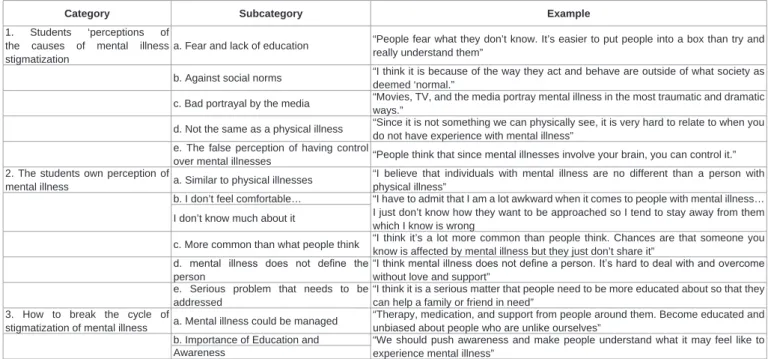
Table 1: Summary of categories Expressed by Undergraduate Nursing Students.
Category Subcategory Example
1. Students ‘perceptions of the causes of mental illness stigmatization
a. Fear and lack of education “People fear what they don’t know. It’s easier to put people into a box than try and really understand them”
b. Against social norms “I think it is because of the way they act and behave are outside of what society as deemed ‘normal.”
c. Bad portrayal by the media “Movies, TV, and the media portray mental illness in the most traumatic and dramatic ways.”
d. Not the same as a physical illness “Since it is not something we can physically see, it is very hard to relate to when you do not have experience with mental illness”
e. The false perception of having control
over mental illnesses “People think that since mental illnesses involve your brain, you can control it.” 2. The students own perception of
mental illness a. Similar to physical illnesses
“I believe that individuals with mental illness are no different than a person with physical illness”
b. I don’t feel comfortable… “I have to admit that I am a lot awkward when it comes to people with mental illness… I just don’t know how they want to be approached so I tend to stay away from them which I know is wrong
I don’t know much about it
c. More common than what people think “I think it’s a lot more common than people think. Chances are that someone you know is affected by mental illness but they just don’t share it”
d. mental illness does not define the
person
“I think mental illness does not define a person. It’s hard to deal with and overcome
without love and support” e. Serious problem that needs to be
addressed
“I think it is a serious matter that people need to be more educated about so that they can help a family or friend in need”
3. How to break the cycle of
stigmatization of mental illness a. Mental illness could be managed
“Therapy, medication, and support from people around them. Become educated and unbiased about people who are unlike ourselves”
b. Importance of Education and “We should push awareness and make people understand what it may feel like to experience mental illness”
care, relaxed/controlled environments, and meds in extreme care. Education is the most helpful tool in breaking the cycle. Integration into the educational system, and a decrease of misconstrued images in the media”. Finally, “Giving attention to it and do not blame the person. Treat it like physical problems. Educate our population! Do not ignore it!”
Part II: a. The Frequency of Family and Friends Diagnosed with Mental Illness
For the frequency of family and friends with mental illness, 81% percent had family, friends, cousins, and old high school classmates with some form of mental illness. Students freely shared family members and friends who were diagnosed, “My mother suffers from depression and post-traumatic stress disorder.” Another student said, “Two of closest friends suffer from mental illness… Sometimes I do struggle while comforting my friend with bipolar.” Another shared, “I have aunts, uncles, friends, and a parent with various mental illnesses”.
b. Types of Mental Illness Exposed to: The most common types of
mental illness were depression, alcoholism, and anxiety. Some also reported family members with eating disorders and autism. Only one reported a family member with paranoid schizophrenia.
c. People with Mental Illness have Difficulty in Dealing with
Other People: In addition, 80% stated that their family and friends
diagnosed with mental illness had difficulty when dealing with people. One student said, “A family member of mine has a lot of issues dealing with people who do not understand what she was going through and dismissed her experience as being all in her head.” Another shared, “Family gatherings can become overwhelming as it interferes with the need for a particular schedule.” Still another said, “It was hard to eat/communicate and be social with people.” Another student said, “Before they got medication and when they chose not to take them, they became defensive of their behavior” Table 1 Finally, “They have a difficult time dealing with people because the people are uneducated about their disease or are ignorant and chose to ignore and not respect their differences”.
Discussion
This study surveyed 64 sophomore undergraduate nursing students who had no previous didactic or clinical exposure to mental health or patients with mental illness. Their description provided insight into how sophomore undergraduate nursing students viewed mental illness, which is important to guide the development of mental health curriculum in undergraduate education. In this study, these nursing students shared a variety of sources that they believe contributed to the stigmatization of mental illnesses. The results of this study showed that the students’ perceptions of causes of stigmatization include: fear and lack of education, the perception that mental illnesses are against social norms, bad portrayal by the media, the perception that mental illnesses are not the same as physical illnesses, and the false perception of having control over mental illnesses. This in fact, was similar to the results of previous studies that showed that stigmatization associated with mental illness are the result of ignorance and misinformation and lack of knowledge about mental illnesses resulting in negative reactions such as fear, distrust, dislike, danger, and unpredictability [21].
In this study, when the students were asked about their own perception of mental illnesses; some stated that “they don’t feel comfortable because they don’t know much about it.” The results of this study is similar, in part, to the results of the study conducted by [21], in which they asked 194 undergraduate nursing students whether they had received information about mental disorders prior to their academic education or through the mass media. Half indicated that they had received some information in pre-university education and of these, 33%had received information about schizophrenia and other psychosis, followed by information about depression and Alzheimer disease.
While some authors pointed out the fact that a mental health theory course is important in helping the students acquire knowledge, skills, and better attitudes toward mental illnesses [22], others argued that the clinical exposure is the most important in acquiring knowledge, skills, and improving the students’ attitudes toward mental illnesses [18,23, 24,25]. The recent trend of diminishing mental health clinical sites for nursing students nationwide will decrease the student’s exposure to patients with mental illnesses [26] and decrease the number of undergraduate students who can seek mental health nursing as a specialization. A study found that after completing a mental health found that after completing a mental health clinical rotation, almost half of the students were able to relate to the individuals with mental illness and they were able to experience a diminished fear of individuals with mental illness as compared to 99% who were fearful of working with individuals with mental illness prior to the clinical rotation [27]. Similarly, another study found that the clinical experience increased students’ confidence in the mental health field and their study showed a positive correlation between students’ feeling of being more prepared to work in mental health and choosing mental health as a career after an exposure to mental health clinical [17,18]. Consequently, one way to decrease the negative stigma of mental illness is to increase students’ exposure to mental health settings, which in turn will impact the quality of care [26].
It is encouraging to know that many undergraduate nursing students were aware of their limitations in understanding mental illness and were willing to learn more about mental illness and how to interact with patients who have mental illness. Many of these undergraduate nursing students expressed a strong desire to learn and work with patients with mental health illness. As the evidence shows, both didactic classroom education and clinical exposure can lead to more positive attitudes towards mental health among undergraduate nursing students [19].
In conclusion, in designing and developing mental health didactic and clinical curriculum, it is important to take into consideration the evolvement of mental health care model and incorporate this curriculum into a variety of health care settings, such as primary care and community settings.
References
1. Centers for Disease Control and Prevention. Mental Health Basics. Retrieved from. 2013.
2. National Institute of Mental Health. Any Mental Illness among adults. Retrieved from. 2013.
3. Corrigan PW, Kuwabara SA & O’Shaughnessay J. The public stigma of mental illness and drug addiction. Journal of Social Work. 2009; 9: 139-147.
Citation:Bekhet AK, Murrock CJ, Mu Q and Singh-Gill H. Nursing Students’ Perception of the Stigma of Mental Illness. SM J Nurs. 2017; 3(2): 1013.
Page 6/6
Gr up
SM
Copyright Bekhet AK4. Alexander LA & Link BG. The impact of contact on stigmatizing attitudes toward people with mental illness. Journal of Mental Health. 2003; 12: 271-289.
5. Martin JK, Pescosolido BA, Olafsdottir S & McLeod JD. The construction of fear: Modeling Americans’ preferences for social distance from children and adolescents with mental health problems. Journal of Health and Social Behavior. 2007; 48: 50-67.
6. Martin JK, Pescosolido BA & Tuch S. Of fear and loathing: The role of disturbing behavior, labels and causal attributions in shaping public attitudes toward persons with mental illness. Journal of Health and Social Behavior. 2000; 41: 208-233.
7. Pescosolido BA. The public stigma of mental illness: What do we think; what do we know; what can we prove? Journal of Health and Social Behavior. 2013; 54: 1-21.
8. Parcesepe AM & Cabassa LJ. Public stigma of mental illness in the United States: A systematic literature review. Administration and policy in mental health. 2013; 40: 384-399.
9. Edwalds-Kvist B, Högberg T, & Lützén K. Student nurses and the general population in Sweden: Trend in attitudes towards mental illness. Nordic Journal of Psychiatry. 2013; 67: 164-170.
10. Schafer T, Wood S & Williams R. A survey into student nurses’ attitudes towards mental illness for nurse training. Nurse Education Today. 2011; 31: 328-332.
11. Happell B & Gough K. Undergraduate nursing students’ attitudes toward
mental health nursing: Determining the influencing factors. Contemporary
Nurse. 2007; 25: 72-81.
12. Hunter L, Weber T, Shattell M & Harris BA. Nursing students’ attitudes about psychiatric mental health nursing, Issues in Mental Health Nursing. 2014; 36: 29-34.
13. Ganzer CA & Zauderer C. Structured learning and self-reflection: Strategies to decrease anxiety in the psychiatric mental health clinical nursing experience. Nursing Education Perspectives. 2013; 34: 244-247.
14. Thongpriwan V, Leuck SE, Powell RL, Young S, Schuler SG & Hughes RG. Undergraduate nursing students’ attitudes toward mental health nursing. Nurse Education Today. 2015; 35: 948-953.
15. VAN Rensburg J, Poggenpoe M & Myburgh PM. Student nurses’ experience working with mental challenged individuals in South Africa. Journal of Psychiatric and Mental Health Nursing. 2012; 19; 761-769.
16. Halter MJ. Stigma & help seeking related to depression: a study of nursing students. Journal of Psychosocial Nursing & Mental Health Services. 2004; 42: 42-53.
17. Happell B, Robins A & Gough K. developing more positive attitudes towards mental nursing in undergraduate students: Part1- does more theory help? Journal of Psychiatric and Mental Health Nursing. 2008; 15: 439-446. 18. Happell B, Robins A, & Gough K. Developing more positive attitudes towards
mental health nursing in undergraduate students: Part 2- the impact of theory and clinical experience. Journal of Psychiatric and Mental Health Nursing. 2008; 15: 527-536.
19. Happell B & Gaskin CJ. The attitudes of undergraduate nursing students towards mental health nursing: A systematic review. Journal of Clinical Nursing. 2013; 2: 148-158.
20. Berg BL. Qualiative Research Methods for the Social Sciences (5th edn).
Boston: Pearson. 2004.
21. Granados-Gámez G, Del Mar López Rodríguez M, Carrol Granados A & Marquez-Hernadez V. Attitudes and beliefs of nursing students toward mental
disorder: The significance of direct experience with patients. Perspectives in
Psychiatric care. 2016.
22. Henderson S, Happell B & Martin T. So what is so good about clinical experience? A mental health nursing perspective. Nurse Education in Practice. 2007; 7: 164-172.
23. Jingjing W, Ling P, Guiping L & Xiaoqing Z. Effects of educational approach in changing public stigma related to mental illness among Chinese diploma nursing students. Life Science Journal. 2013; 10: 934-938.
24. Romen P, Anson O, Kanat-Maymon Y & Moisa R. Reshaping students’ attitudes toward individuals with mental illness through a clinical nursing clerkship. Journal of Nursing Education. 2008; 47: 396-402.
25. Mann CE & Himelein MJ. Putting the person back into psychopathology: An intervention to reduce mental illness stigma in the classroom. Social Psychiatry and Psychiatric Epidemiology. 2008; 43: 545-551.
26. Matel-Anderson D & Bekhet AK. Resilience in adolescents who survived a suicide attempt from the perspective of a registered nurse in a psychiatric facility Issues in Mental Health Nursing. 2016; 37: 839-846.
27. Ketola J & Stein JV. Psychiatric clinical course strengthens the student-patient relationships of baccalaureate nursing students. Journal of the American Psychiatric Nurses Association. 2013; 20: 23-34.