Use of Evaluation to Design Quality Online Learning: Understanding the Shared Experience
A Thesis
Submitted to the Faculty of
Drexel University by
Judith Ann Giering in partial fulfillment of the requirements for the degree
of
Doctor of Philosophy May 2012
© Copyright 2012
Dedications
This dissertation is dedicated to:
My father, Robert Giering, Sr., for showing me that learning can be a life-long passion, My mother, Margaret Giering, for teaching me the value of hard work and perseverance, My husband, James McArdle, for providing love, support, and motivation at every step of the way,
My children, Mary Kate, Will, and Tess, for bringing the joy into my life that makes it all worthwhile.
Acknowledgements
I would like to thank my advisor, Dr. Elizabeth Haslam, for the guidance, insight, and support that she has shown me throughout the process of writing my dissertation. Not only did she help me learn much about research and writing, but she helped me discover my ability to create a goal and reach it, despite the challenges faced along the way.
I would also like to thank Dr. Valerie Arms, Dr. Craig Bach, Dr. Frank Harvey, Dr. Marylou McHugh, and Dr. Sheila Vaidya, for taking the time to serve on my committee and provide valuable insight into my dissertation research.
Finally, I would like to recognize my colleagues in the Learning Technologies Group, Goodwin College, and the Online Learning Council, for helping to keep my passion for online learning and instructional design alive throughout this process.
Table of Contents
List of Tables ... vii
List of Figures ... viii
Abstract ... ix
1. Introduction Introduction ...1
Background of the Study ...1
Growth of online programs ...1
Online-course design ...4
Evaluation in online programs ...6
Problem Statement ...7
Purpose of the Study/Research Questions ...9
Significance of the Study ...9
Methodology ...10
Definition of Terms...11
Delimitations of Study ...12
Limitations of Study ...12
2. Review of Literature Instructional Design for Online Courses ...13
Instructional Design Defined ...13
Constructivism as Framework for Design of Online Courses ...16
Evaluation Theory and Models of Evaluation ...27
Evaluation Theory ...27
Models of Evaluation ...30
Standards and Accrediting Agencies ...42
Evaluation of Online Courses ...44
Conclusion ...50
3. Methodology Rationale ...54
Role of Researcher ...60
Context of Study ...61
Data Collection Plan ...62
Data Analysis ...65
Methods for Verification ...70
Conclusion ...72
4. Results Overview ...73
Individual Case Analysis ...74
Cross-Case Analysis ...98
5. Conclusions and Discussion Conclusions ...107
Recommendations and Implications ...116
Significance...122
Recommendations for Future Research ...124 6. References ...126 Appendix A ...134 Appendix B ...135 Appendix C ...136 Appendix D ...137 Appendix E ...138 Appendix F...139 Vita ...140
List of Tables
Table 1: Key features of evaluation models ...16
Table 2: Types of learners...20
Table 3: Jonassen’s guidelines for design of online learning ...22
Table 4: Stages in Quinn’s model for e-learning ...25
Table 5: The four levels of Kirkpatrick’s evaluation model ...31
Table 6: Horton’s adaptation of Kirkpatrick’s four levels ...32
Table 7: Components of CIPP model for online program evaluation ...33
Table 8: Required steps of the e3Learning model ...35
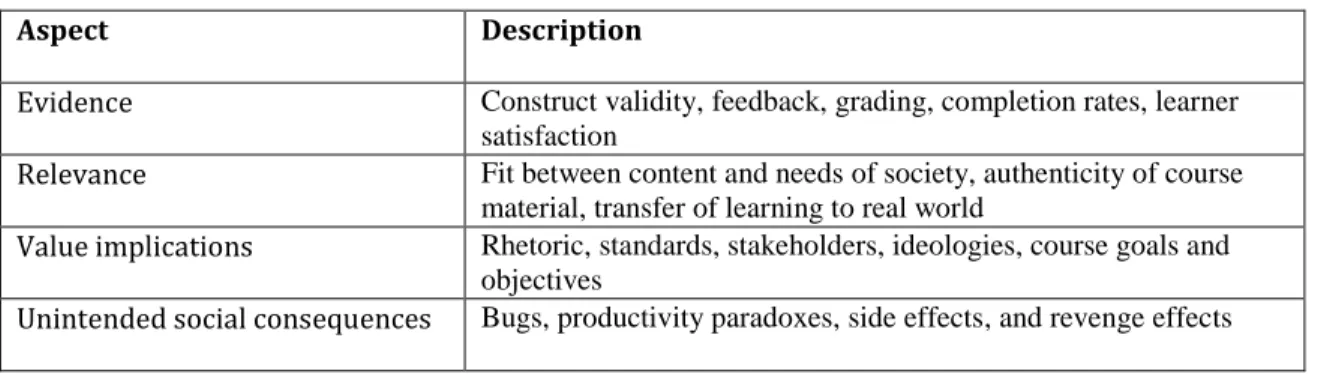
Table 9: Four aspects of Ruhe & Zumbo’s adaption of Messick’s framework ...38
Table 10: Factors influencing the design of the e-learning interface ...40
Table 11: Reasons to evaluate online programs and courses ...45
Table 12: Quality online learning checklist ...49
Table 13: Data collection ...67
Table 14: Quality online learning checklist for case one ...75
Table 15: Quality online learning checklist for case two ...81
Table 16: Quality online learning checklist for case three ...87
Table 17: Quality online learning checklist for case four ...91
List of Figures
Figure 1: Predictive research vs. Design research ...57 Figure 2: Relationship between Conclusions One and Two ...115 Figure 3: Relationships between Conclusions One, Two, and Three ...116 Figure 4: Design Research Model for Collaborative Online Course Design and Evaluation ...122
Abstract
Use of Evaluation to Design Quality Online Learning: Understanding the Shared Experience
Judith Ann Giering
The growth of online programs has been substantial over the past decade; such growth has required that an equally substantial number of faculty become proficient in the pedagogy of online learning and the best practices in online course design. At the same time, universities are being called on to provide evidence of student learning and satisfaction. The literature review shows that the design of online courses can have an impact on the student learning experience; therefore, knowledge of these practices and the ability to use them when designing an online course is critical for faculty. The
literature review also provided an overview of evaluation theory, as well as specific cases of online course evaluations. Design research was used to inform the methodology of this study in which five online courses were investigated. Faculty teaching the courses were asked to complete an evaluation of the design of their online course using the Quality Online Learning Checklist (Hosie, 2005), derived from the constructivist-based Situated Learning Model (Herrington & Oliver, 2000), and a matrix aligning course learning objectives with elements in the online course design. Participants were then interviewed about their experience evaluating the design of their online course. The study found that faculty need more information and training about online learning pedagogies when designing and evaluating courses. In large part, this is due to the fact that responsibility for the design of the online course falls on the faculty, who often have little or no
background in design or online pedagogy. Overcoming this challenge, however, becomes difficult given that faculty in this study were averse to a collaborative approach to the
design and evaluation of their online course. Until a culture of collaboration is fostered and rewarded, it may be difficult for faculty to design high quality courses using research-based best practices.
Chapter 1: Introduction Introduction
The purpose of this study was to gain an understanding of the experience of evaluating online-course design and how this process can impact institutional design and evaluation practices for online courses. Student learning is directly impacted by online-course design; however, the roles and perspectives of each individual involved in the design process, as well as the demands and constraints of different curricula, can create difficulties for large universities seeking a scalable method for evaluating of online-course design.
It is critical that institutions offering online courses evaluate their success in designing engaging learning experiences for their students. Failure to do so can result in dissatisfied students and faculty, students who do not achieve course learning goals, student attrition, and possible loss of academic reputation and/or revenue (Garrison & Anderson, 2003; Krenelka, 2009). This study examined the impact of the evaluation of online-course design; in addition, it explored the perceptions of the various participants and how the evaluation process can contribute to a university-wide, shared understanding of excellence in online-course design.
Background of the Study
Growth of online education. Sixty-three percent of colleges and institutions have reported that “online learning [is] a critical part of their institution’s long-term strategy” (Allen & Seaman, 2010). Universities offer online programs for many reasons: to provide quality education to a broader population of students, to give students a more flexible option for earning a degree, to create an engaging educational experience, to enhance the
reputation of the institution, and/or to increase revenues for the institution (Meyer, 2002; Simonson, Smaldino, Albright, & Zvacek, 2009; Vignare, 2009). Over the past decade, the growth of online programs in higher education has increased exponentially; the number of students taking online courses grew an average of 19.75% from fall 2002 to fall 2009 (Allen & Seaman, 2010), with a 21.1% increase (nearly 1 million new students) from fall 2008 to fall 2009 (Allen & Seaman, 2010); it is estimated that nearly 5.6 million students were enrolled in online programs as of fall 2009 (Allen & Seaman, 2010).
Over 40% of virtual universities spend more than $1 million annually on the development and delivery of their online degree programs (Poulin & Michelau, 2009), including instructional design, professional development, technology infrastructure, faculty pay, marketing, and student support. Reasons for doing so include increasing the number of students who will have access (financial and geographic) to degree programs, increasing revenue streams, offering programs in a format accessible to disabled students, and enhancing the academic reputation of the organization (Garrison & Anderson, 2003; Mandinach, 2005). Additionally, institutional goals exist for all programs regardless of delivery method, such as engaging students in an intellectually demanding environment, promoting faculty–student interaction, supporting students through their degree pursuit, aiding career preparation, and encouraging graduation from the program (Kuh et al., 2005).
Feedback from online students provides insight into why the growth of online programs has been so significant. Online programs are popular for reasons that include the following: the flexibility and convenience of the asynchronous facet of online
to earn a degree through universities’ continuing- or professional-studies programs (Allen & Seaman, 2007), and the appeal of online delivery and its various media formats to students with different learning styles (Harroff & Valentine, 2006). Aware of these factors, colleges and universities have, not surprisingly, been eager to adopt online education.
Such rapid growth has attracted the attention of both accrediting agencies and state and federal governments, all of whom are concerned about the future of online learning and its impact on education in the United States. According to the United States Web-based Education Commission:
The question is no longer if the Internet can be used to transform learning in new and powerful ways. The Commission has found that it can. The Web-Based Education Commission calls upon the new Congress and Administration to embrace an “e-learning” agenda as a centerpiece of our national’s federal education policy. (2001)
The United Stated Department of Education’s Office of Postsecondary Education echoes that concern: “The rapid increase in the number of institutions offering distance education courses and programs in the last decade, and the pressure to launch distance education initiatives, can lead an institution or program in directions that are not congruent with its mission” (U.S. Department of Education, 2006).
Leaders of colleges and universities are also concerned about the future of online learning, and particularly with the role that online learning plays in their institutions’ success. Over 96% of large (enrollment of 15,000 or higher) institutions provide some type of online course offering (Allen & Seaman, 2006); therefore, the future of online education is critical to the future of higher education. The Middle States Commission on Higher Education acknowledged this challenge in their Interregional Guidelines for
Electronically Offered Degree and Certificate Programs, which state that the delivery of online learning “test[s] conventional assumptions, raising fresh questions as to the essential nature and content of an educational experience and the resources required to support it” (2002). Clearly, online education is not just more of the same. Institutions offering online degree programs need to invest the necessary resources and continue to question and analyze their efforts to provide an engaging learning experience for online students.
Despite the rapid growth of online learning, a number of challenges exist to the successful implementation of online degree programs: faculty resistance (Meyer, 2002), students’ lack of access to necessary support services (Brooks, 2003), problems with technology (Frankola, 2001), and poorly designed courses (Frankola, 2001). Developing an online course requires significant effort on the part of faculty and instructional design staff before the course even begins (Hardy & Bower, 2004). Another stumbling block in the development of online courses is a lack of understanding that the online environment often requires a shift in pedagogical approach (Knowlton, 2000).
Online-course design. Online courses use a computer-based learning
environment, often a proprietary learning management system (LMS), to deliver content and conduct course communication. This approach involves two challenges for faculty: learning about the tools and technology that are part of the learning environment and understanding the pedagogical considerations of a well-designed course. “Most faculty come to distance education with classroom experience, and few have experienced distance education either as instructors or students” (U.S. Department of Education, 2006). Because of these challenges, some instructors avoid teaching online (Hardy &
Bower, 2004). Faculty may be concerned that they do not have the time or resources to learn these skills in addition to their already established responsibilities. Training workshops, mentoring, and online resources often help faculty overcome the
technological challenges they face (Barker, 2003; Koehler, Mishra, Hershey, & Peruski, 2004). However, it is not easy to “teach” online course-design principles to a faculty member in a short period of time.
A number of institutions offering online programs have responded to the design issue by hiring instructional designers to support faculty in the course-development process. These universities recognize that while faculty are the experts on the topic being taught and should generate the course content, the time required to become sufficiently experienced in instructional design is significant and unlikely to occur in the short period of time that instructors have to prepare for a course. Through collaboration, an instructor and instructional designer can potentially develop a course that is easy to navigate, utilizes technology in a way that supports learning, promotes interaction between and among the instructor and students, includes quality assessments that measure learning, and provides an overall engaging experience for students (Jonassen, Howland, Marra, & Crismond, 2008; Garrison & Anderson, 2003).
A number of models for instructional design, detailed in the literature review of this study, are available and have been used to some degree in online-course design (Brown & Green, 2006). Further, research has begun to produce frameworks aimed specifically at the design of online learning environments (Garrison & Anderson, 2003; Herrington & Oliver, 2000; Jonassen, Davidson, Collins, Campbell, & Haag, 1995; Knowlton, 2000). While adoption of these new frameworks may not yet be widespread,
research has indicated that the use of an instructional-design approach founded on theories of online learning and pedagogy can be quite effective in achieving course learning goals (Herrington & Oliver, 2000).
Evaluation in higher education. The practice of evaluation in higher education has grown significantly over the past few decades, becoming a “major focus of national, state, and institutional efforts intended both to make institutions more accountable for their performance and to help them improve educational quality” (Peterson & Augustine, 2000). Efforts and initiatives on the part of the federal government, including A Nation at Risk (1983) and the Spelling Report (The Commission of the Future of Higher Education, 2006), have put the spotlight on the importance of evaluation practices. Additionally, reports such as Evidence of Quality Distance Education Programs Drawn from Interviews with the Accreditation Community (U.S. General Accounting Office, 2006) and the Interregional Guidelines for the Evaluation of Distance Programs (Online Learning) (Middle States Commission on Higher Education, 2011) have provided a more in-depth focus on the evaluation of online learning.
With the rapid increase in online degree programs in a relatively short period of time, many colleges and universities have focused primarily on program development and student enrollment for online programs. It is not enough, however, to demonstrate success in these areas. Institutions must evaluate the “effectiveness of [their] online learning offerings, including the extent to which the online learning goals are achieved, and [use] the results of [their] evaluations to enhance the attainment of the goals” (Middle States Commission on Higher Education, 2011). The growth of online programs has occurred because institutions have embraced new technologies, new delivery methods,
and new paradigms for instruction; now these institutions must embrace the evaluation of these programs so that the programs can flourish in ways that benefit students and the institution alike. Colleges and universities must find and implement methods of collecting evaluation data, but more importantly, they must determine how best to use the data in a way that benefits student success.
Problem Statement
More and more frequently, faculty members are being asked to teach online. They come to this experience with a wide variety of experience in online learning—from those instructors who have a wealth of experience to those who are not only inexperienced but also reluctant (Morris & Finnegan, 2009; Vignare, 2009). The demands of online
teaching are high, particularly in regard to utilizing the available technology in order to design a course that engages students (Lee & Busch, 2005; Hardy & Bower, 2004). A particular challenge faced by online instructors is designing a high-quality online course that is student centered and uses pedagogical approaches that consider both learners and course objectives (Barker, 2003).
Universities have met this challenge to varying degrees through a number of efforts. Instructional designers can provide “the evidence-based methodologies for implementing quality online programs based on solid pedagogical principles and collaboration” (Vasser, 2011), and many universities suggest or require that faculty use these designers’ assistance in developing online courses (Morris & Finnegan, 2009). Professional development for online instructors has become a critical requirement for providing a quality learning experience for students (Broughton, 2009); universities are addressing this need in a variety of ways ranging from “how to use basic technology tools
to effective pedagogical techniques” (Vignare, 2009). These programs range from multi-pronged, sustained courses to lunchtime workshops (Roman, Kelsey, and Lin, 2011).
At the same time, universities are being required to demonstrate the effectiveness of student learning at their institutions. Traditional end-of-course evaluations may fall short in this effort as a result of low response rates (Morris & Finnegan, 2009), students’ attitudes towards surveys (Doherty, 2006), or poor survey design (Doherty, 2006). The evaluation of online courses, and of those courses’ design in particular, can be difficult to craft and implement (Matuga, 2006); stakeholders therefore must explore various ways to gain the information they need. Specifically, they must ensure that assessment of online courses “align[s] with other pedagogical variables to support effective teaching and learning” (Matuga, 2006).
Just as online-course design can be a positive experience when it is a team-based effort (Xu & Morris, 2007), the evaluation of online-course design can benefit from a collaborative approach. The evaluation effort must also be scalable, particularly in an institution in which online courses are offered regularly and in large numbers. It is clear that a need exists for a formative evaluation process to be implemented in which
qualitative and quantitative data are used on an ongoing basis to improve course design. The measures should include course learning goals as the basis for evaluation; in addition, data should be elicited from course subject-matter experts, instructional designers, students, and all course instructors, as each will bring a unique perspective to the evaluation. It is through such an effort that universities will be able to confidently acknowledge the quality of the learning experience in their online courses.
Purpose of Study/Research Questions
In its 2007–2012 strategic plan, Drexel University identified “enriching the educational experience” as a primary strategic objective (Strategic Plan). Specifically, the strategic plan indicated that the university “must not only compete on the quality of the content but on the quality of the learning process—including design and delivery.” Given this mandate from the university, it is imperative that the school’s faculty and
instructional designers explore ways of improving online-course design. The following research questions were therefore conceived for this study:
1. Which components and activities of the course design evaluation are deemed valuable and why?
2. What factors support or challenge the evaluation process for online-course design?
3. What is the perception of the shared experience of evaluating the design of an online course?
Significance of the Study
The body of literature related to program evaluation is extensive. However, research on the evaluation of online degree programs, and specifically evaluation
supporting the design of online courses, is still in its infancy. Much remains to be learned about how evaluation can inform the online-course design and improvement processes.
This study aimed to contribute to the development of theory related to online-course evaluation and the methods of improving online-online-course design, providing a model for evaluating online-course design that is grounded in theory, assessment regulations, and best practices. The researcher believed that exploring the potential impact evaluation
may have on course design would yield a deeper understanding of how instructional design for online courses can help promote the programmatic and learning goals of online programs. Student learning and success are accepted and valuable goals of higher
education. This study sought to determine how both goals can be better achieved for online students.
Methodology
This investigation was a qualitative study investigating how the evaluation of course design can be implemented, monitored, and/or improved using the design-research approach. Design research is concerned with what can be learned from the process of implementing a potential solution. At the same time, design research uses rigorous approaches to research that enable researchers to generalize findings to other cases. This study used the case-study method to investigate the evaluation of the course design of five online courses from five different colleges or schools at one university.
In this study, faculty completed an evaluation of their online course design. Artifacts resulting from the evaluation were analyzed, including the course description and learning objectives, a completed Quality Checklist for Online Learning, a completed matrix aligning course elements with learning goals, the results of faculty surveys, and faculty and instructional designers’ answers to reflective questions. Finally, interviews and/or focus groups were conducted for all participants in the study, during which feedback and perceptions about the evaluation were elicited.
Evaluation – A process of “collecting and analyzing data in order to determine whether and to what degree objectives have been or are being achieved [or] in order to make a decision” (Boulmetis & Dutwin, 2005).
Formative evaluation – “An examination of a program or project in progress” (Boulmetis & Dutwin, 2005).
Design research – An approach to research “characterized by iterative design and formative research in complex real world settings” (Edelson, 2002).
Instructional design – The process of identifying a learning problem or goal, determining the instructional approaches and media that will be used to deliver the instruction,
obtaining or developing the resources needed to implement the instruction, delivering the instruction, and evaluating the instruction (Brown & Green, 2006).
Interactive evaluation – An evaluation framework based on the premise that evaluation efforts are “internal, influenced by those who are ‘close to the action,’ and . . . encourage utilization of findings” (Owen, 2006).
Learning management system – A proprietary computer-mediated learning environment, used by organizations to deliver online learning, which bundles communication
technology, social media, and multimedia technology, and provides a framework within which to deliver course content.
Online course – In the context of this research study, a for-credit course that is part of a degree program and delivered online via Blackboard or Bb Vista.
Summative evaluation – “Evaluation conducted at the end of a program or project” (Boulmetis & Dutwin, 2005).
This scope of this study was limited to five cases in one university. Additionally, this study represented the first phase of a design-research study. Further research over a significant period of time would provide additional insight into the effectiveness of the evaluation of online-course design.
Limitations of the Study
Because this research was a case study and the sample was purposively selected, findings may not be generalizable to all online courses or to all disciplines. Universities that do not have large online programs, instructional designers on staff, or the use of learning management systems may not obtain similar findings in a like study.
Chapter 2: Review of the Literature
In order to provide a theoretical foundation for this study, research on the
following topics occurred: instructional design for online courses, evaluation theory and models of evaluation, and evaluation of online programs. In this chapter, an analysis of the theory of instructional design for online courses provides insight into the importance of quality course design and the pedagogy supporting it. The research on evaluation theory and models of evaluation defines evaluation terminology, presents the
underpinnings of evaluation theory, and explores various approaches to evaluation. An overview of the current practices in online-program evaluation provides a context for understanding what, at the time of the study, was occurring—and, more importantly, was not occurring—at institutions of higher education in terms of online-program evaluation. Finally, the chapter provides a synthesis of these three areas.
Instructional Design for Online Courses
Instructional design defined. With a basis in fields such as educational psychology, cognitive psychology, and communications (Brown & Green, 2006), instructional design is the process of identifying a learning problem or goal, determining the instructional approaches and media that will be used to deliver the instruction,
obtaining or developing the resources needed to implement the instruction, delivering the instruction, and evaluating the instruction (Brown & Green, 2006; Gustafson & Branch, 2007).
Alternatively, instructional design can be seen as a process, a discipline, a science, and a reality:
Process - Instructional design is the systematic development of instructional specifications using learning and instructional theory to ensure the quality of instruction. It is the entire process of analysis of learning needs and goals and the development of a delivery system to meet those needs. It includes the development of instructional materials and activities, and the tryout and evaluation of all instruction and learner activities.
Discipline - Instructional design is that branch of knowledge concerned with research and theory about instructional strategies and the process for developing and implementing those strategies.
Science - Instructional design is the science of creating detailed specifications and the development, implementation, evaluation and maintenance of situations that facilitate the learning of both large and small units of subject matter at all levels of complexity.
Reality - Instructional design can start at any point in the design process. Often a glimmer of an idea is developed to give the core of an instruction situation. By the time the entire process is done, the designer looks back, and she or he checks to see that all parts of the “science” have been taken into account. Then the entire process is written up as if it occurred in a systematic fashion.
(University of Michigan, 1996) While the definitions of instructional design as a discipline, a science, and a reality all informed this research, the definition of instructional design as a process was the most relevant. Gustafson and Branch (2007) described the process of instructional design as one that is learner-centered, goal-oriented, and focused on meaningful
performance; assumes outcomes can be measured in a reliable and valid way; is empirical and self-correcting; and requires a team effort. Although instructional design today can be a very complex, systems-based process, utilizing diverse types of media and
computer-based technology, the field was not always that way; growth and change in instructional design has occurred rapidly over the last fifty-plus years.
Instructional design has a two-pronged background: the growth of instructional media over the 20th century and the psychological theories of learning that have shaped educational practice (Reiser, 2007). In the first half of the 20th century, instructional media was primarily limited to photos, films, slides, and radio; after World War II, that list expanded to include television and, soon afterward, computer-based technologies (Reiser, 2007). Paralleling this evolution was the exploration of how various theories of learning could improve training materials used both in the military during World War II and in industry in the decades after the war. Some of these theories include behaviorism and Skinner’s programmed instruction movement, Bloom’s taxonomy, and Gagne’s conditions of learning (Reiser, 2007). In the 1960s, models of instructional design appeared based on the work of individuals like Gagne and Silvern; more models were introduced in the 1970s based on the systems approach to instructional design (Reiser, 2007).
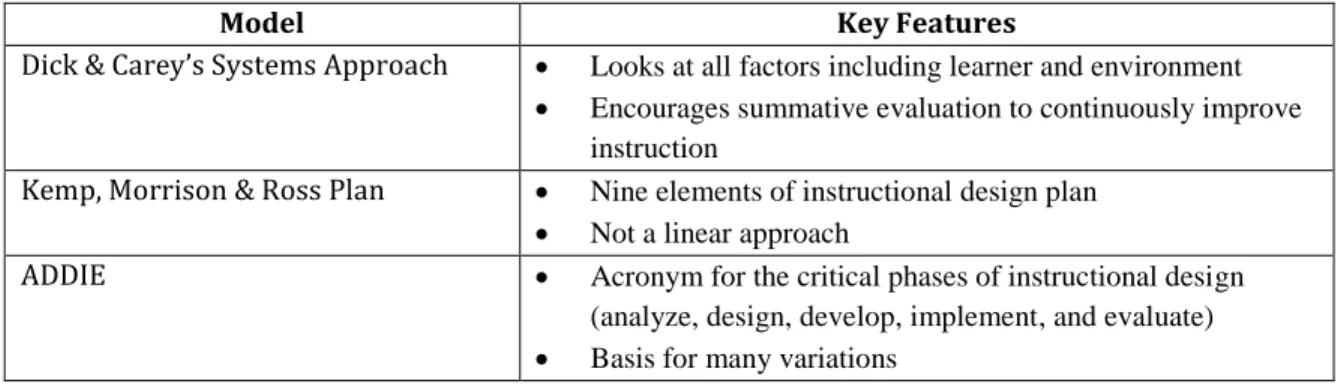
A few of the more well-known instructional design models that have been developed include Dick and Carey’s systems approach; the Kemp, Morrison, and Ross plan; and the commonly used ADDIE (analyze, design, develop, implement and evaluate) model (Brown & Green, 2006). The use of a model during the instructional design
process provides “guidelines and procedures that can be applied to a wide variety of specific situations [and] can help significantly reduce training and education costs (Nixon & Lee, 2001, in Brown & Green, 2006). Table 1 shows the key features of some popular models.
Table 1: Key features of evaluation models
Model Key Features
Dick & Carey’s Systems Approach Looks at all factors including learner and environment
Encourages summative evaluation to continuously improve instruction
Kemp, Morrison & Ross Plan Nine elements of instructional design plan
Not a linear approach
ADDIE Acronym for the critical phases of instructional design (analyze, design, develop, implement, and evaluate)
Basis for many variations
(Brown & Green, 2006)
The field of instructional design was further influenced in the 1980s by an interest in cognitive psychology and primarily saw growth in business and the military, as
opposed to education (Reiser, 2007). This trend was accompanied by an increasing interest in how the advent of the microcomputer could impact the delivery of
instructional training. As developments in computing, including the widespread adoption of the internet, occurred in the 1990s, constructivism joined cognitive psychology as a major learning theory to be used in instructional design (Reiser, 2007). Combined with computer-based instruction, constructivism appeared to a growing number of theorists to answer the challenge of how to effectively promote meaningful learning (Duffy & Kirkley, 2004; Irlbeck, Kays, Jones, and Sims, 2006; Jonassen, 1994, Jonassen, Davidson, Collins, Campbell, & Haag, 1995).
Constructivism as a framework for the design of online courses. The
challenges faced by instructional designers in the late 1980s and 1990s were several: how to embrace new, computer-based technologies, how to make instructional design more relevant for the educational setting in general and distance education in particular, and
how to ensure that the learning process was meaningful and not just behavior-changing (Duffy & Kirkley, 2004; Irlbeck et al., 2006; Jonassen et al., 1995; Reiser & Dempsey, 2007). Traditional models were not meeting the unique needs of the online learning environment. In particular, learning management systems and online tools need to be considered within a pedagogical framework. In response, many leaders in the field began to use constructivism to design computer-mediated learning environments as a potential answer to the above concerns.
Since the field’s inception, instructional designers have incorporated a number of learning concepts and theories into their practice. Constructivism presented more of a challenge than other learning theories. As Jonassen (1994) pointed out, “The term ‘constructivist instruction’ is, from a theoretical perspective . . . an oxymoron.” Instructional sequences leading an individual down a pre-scripted path toward a
previously determined outcome—the basis of traditional instructional design models—is conceptually opposed to constructivism, which encourages individuals to learn through self-led, meaningful discovery that leads to potentially different, yet valuable outcomes. Although the concepts of learning promoted by constructivism are easily understood, they are not easily placed into a design methodology (Jonassen, 1994).
That said, many research articles and books discuss instructional design for online courses. Jonassen (1994) asked, “How do we adapt our models of design to foster
constructivist learning?” He attempted to answer the questions by presenting seven guidelines for instructional design using constructivism:
Avoid oversimplification of instruction by representing the natural complexity of the real world
Present authentic tasks
Provide real-world, case-based learning environments
Foster reflective practice
Enable context- and content-dependent knowledge construction
Support collaborative construction of knowledge through social
negotiation (Jonassen, 1994)
The use of such guidelines is the key to creating an engaging learning experience.
“Students engaged by the materials are actively processing the content, which is essential for learning” (Morrison & Guenther, 2000). The concept of engaging students in learning has led to recommendations on the use of constructivism in online courses.
Several theorists have presented their concepts of how constructivism can be used and implemented in online courses. “Constructivist principles provide a set of guiding principles to help designers and teachers create learner-centered, collaborative
environments that support reflective and experiential processes” (Jonassen et al., 1995). Following is a discussion of constructivism in online courses focusing on the aspects of constructivism used in instruction (Jonassen et al., 1995); the features of instructional activities (Jonassen et al., 1995); the roles of instructor and students (Knowlton, 2000); and types of assignments (Marra & Jonassen, 2001).
Jonassen et al. (1995) discussed the four aspects of constructivism that bear on instruction. Context adds a real-world aspect to learning and can be physical,
organizational, cultural, social, or political in form. Construction is a process comprised of the “active process of articulation and reflection within a context” (Jonassen et al., 1995). Collaboration can be seen throughout many phases of the learning process. An important component of distance learning, collaboration helps students develop and test new concepts within its context. The final aspect is conversation, which involves
“reflecting on what is known, what needs to be known, the viability of plans and their potential effectiveness” (Jonassen et al., 1995).
Once aware of the aspects of constructivism that are effective in online courses, instructors and designers can begin to evaluate specific learning activities. Each activity should:
“Be centered on engaging and worthy problems or questions of importance in which students must construct knowledge for effective performance.”
“Include tasks that are either replicas of or analogous to the kinds of real-world problems faced by citizens, consumers, or professionals in the field.”
“Provide access for the student to resources commonly available to those engaged in analogous real-life problems or activities.”
“Present problems requiring a repertoire of knowledge, judgment in determining the appropriateness of knowledge, and skills in prioritizing problem classification and solution phases.”
(Jonassen et al., 1995) Given specific learning activities, instructors and students must discover their new roles in a constructivist online course. Students have much more responsibility for their own learning in an online course than in a traditional educational setting; they become active participants in the learning process and “should actively construct their own meaning by engaging in tasks that are indicative of real-world activities” (Knowlton, 2000). In this way, the “learner [is] one who interacts with the environment and acquires knowledge, skills and competence from it, rather than . . . one who is controlled by instruction” (Jonassen et al., 1995).
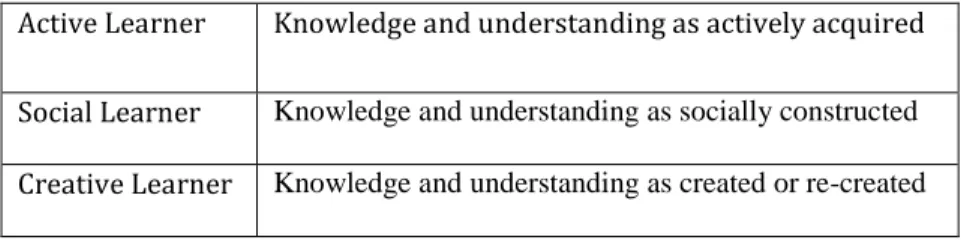
Perkins (1991) asserted that learners are of three types: active, social, and creative. Each learner type is described in Table 2.
Table 2: Types of learners
Active Learner Knowledge and understanding as actively acquired Social Learner Knowledge and understanding as socially constructed
Creative Learner Knowledge and understanding as created or re-created
(Perkins, 1991)
On the other hand, in online learning the teacher’s role changes from one of content delivery to one of coach, counselor, and mentor (Knowlton, 2000). The key to success with these role changes is the presence of a collaborative dialog between
instructors and students. In practice, such a dialog requires de-emphasis of lecturing and “talking at” students and encouragement of students’ active engagement in establishing and pursuing their own learning objectives (Nodding, 1998). Another role of the instructor is to provide assignments that are constructivist in nature. “Semantic networking, concept mapping, multi-media representations, prototyping, learning communities” (Marra & Jonassen, 2001) are just some of the effective types of assignments that can be offered in a constructivist online course.
Research has suggested that, by following these guidelines, a designer can support a shift “from creating prescriptive learning situations to developing environments that engage learners and require them to construct the knowledge that is most meaningful to them” (Jonassen et al., 1995). With this foundation, several researchers have proposed their own models of instructional design for online courses.
Models of instructional design for online courses. “Designing for the online
incorporating value systems and problem contexts, and therefore, needs a process that makes instructional design more effective [and] efficient and better reflects the
complexity of the overall process” (Irlbeck et al., 2006). Instructional design for online courses offers both expanded opportunities and additional challenges in comparison to traditional instructional design. The media and other features used in online courses enable designers to create environments that mimic real-life situations that students would not otherwise be able to experience, use interactivity in many learning exercises, and connect learners to resources without geographical or temporal boundaries. On the other hand, designing online courses requires significant time and resources, is an ill-defined process that may seem onerous to some designers, and can present difficulty in determining how best to apply constructivist principles. The following models use constructivist-based learning principles to inform the instructional design process for online learning.
In a 1994 article, Jonassen explored the questions of how “designers determine and insure a common set of outcomes for learning” if individuals are responsible for the construction of their own knowledge, and how designers “adapt . . . models of design to foster constructivist learning.” While he did not actually propose a model of instructional design, Jonassen offered guidelines for design based on 3 Cs—context, collaboration and construction—with the following facets (Table 3).
Table 3: Jonassen’s guidelines for design of online learning
Context Supported by case-based problems
Requires an understanding of its own thinking processes and problem-solving methods
Modeled for learners by skilled performers Collaboration Engages and facilitates social negotiation
Provides an intellectual toolkit to facilitate an internal negotiation which is necessary for building mental models.
Construction Based on internal negotiation (articulating mental models – accommodation by Piaget)
Based on social negotiation (sharing a reality with others)
Facilitated by exploration of real-world environments and invention of new environments
Resulting in mental models
(Jonassen, 1994)
Recognizing the fact that without the aid of some type of structure in the design process, many teachers and designers will be dissuaded from designing for online
courses, Oliver and Herrington (2003) discussed three elements of the design process that “promote knowledge construction”:
Design and specification of tasks to engage and direct the learner in the process of knowledge acquisition and development of
understanding;
Design and specification of supports for the online learner to scaffold the learning and to provide meaningful forms of feedback;
Design and specification of the learning resources needed by the learner to successfully complete the set tasks and to facilitate the scaffolding and guidance.
(Oliver & Herrington, 2003) One of the most effective ways to achieve these specifications is the situated learning model for designing multimedia learning environments (Herrington & Oliver, 2000). The model consists of the following elements: “provid[ing] authentic contexts that reflect the way the knowledge will be used in real life, provid[ing] authentic
activities, provid[ing] access to expert performances and the modeling of process, provid[ing] multiple roles and perspectives, support[ing] collaborative construction of knowledge, promot[ing] reflection to enable abstractions to be formed, promot[ing] articulation to enable tacit knowledge to be made explicit, provid[ing] coaching and scaffolding by the teacher at critical times, [and] provid[ing] for authentic assessment of learning within the tasks” (Herrington & Oliver, 2000). In a study that evaluated
students’ perceptions of their learning experiences using a multimedia package based on a situated-learning framework, Herrington & Oliver (2000) determined that the use of the situated-learning framework “provided effective instructional design guidelines for the design of an environment for the acquisition of advanced knowledge.” Given these findings, Herrington & Oliver (2000) averred that the situated learning model can be an “effective substitute for the traditional instructional design model.”
Noting that “the foundational models of instructional design that typically inform the design, development, and delivery of online environments do not always support the epistemology and pedagogy that embodies the online environment,” Irlbeck et al. (2006) proposed the three-phase model. This model is a team-based, bottom-up approach in which decisions about media and content are made by the student from options created by instructional designers, teachers, and media producers. Phase one, preparing functional components, includes identifying content, media used, and learning strategies; phase two is an iterative process of evaluation, elaboration, and enhancement; and phase three is the maintenance of the system (Irlbeck et al., 2006). One key to the model is the interaction of three teams during and after the design process: the development support team, the faculty team, and the user team. All three teams are required for a successful design
process (Irlbeck et al., 2006). While the authors stated that they used the three-phase model, no data were presented as to its effectiveness or usability.
Jonassen & Rohrer-Murphy (1999) proposed activity theory as a theoretical “framework for designing constructivist learning environments.” Based on the presumption that “conscious learning emerges from activity, not as a precursor to it” (Jonassen & Rohrer-Murphy, 1999), activity theory forms the basis of designing activity systems, a complex interplay between the learner, the community, and the learning goal that is supported by tools, rules, and a division of labor (Jonassen & Rohrer-Murphy, 1999). In order to incorporate activity theory into an online course, the following steps should be taken:
1. Clarify purpose of activity system 2. Analyze the activity system 3. Analyze the activity structure 4. Analyze tools and mediators 5. Analyze the content
6. Analyze activity systems domains
(Jonassen & Rohrer-Murphy, 1999) Each step above has a series of sub-steps that are a part of the design process of the online course. In this way, activity theory “provides an appropriate framework for analyzing needs, tasks, and outcomes for designing” online courses using constructivism as the foundation (Jonassen & Rohrer-Murphy, 1999).
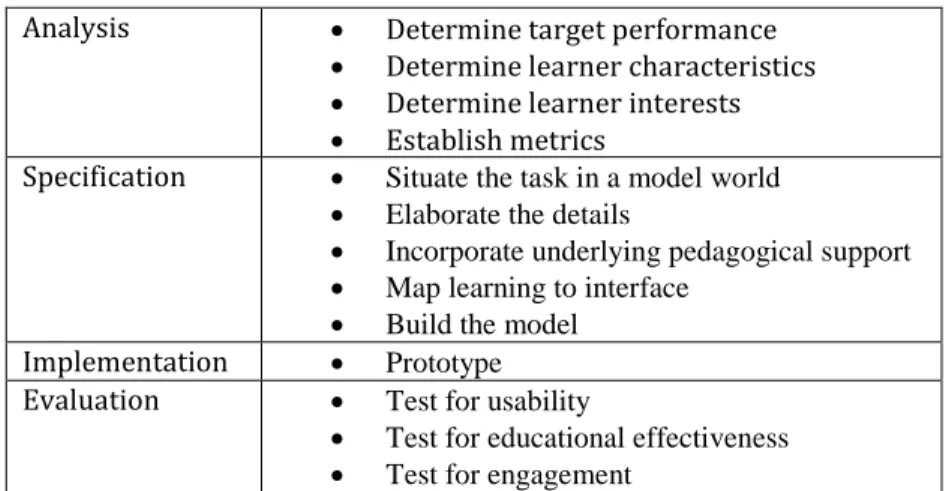
E-learning simulation games, a constructivist method of instruction, are engaging to students as well as effective forums for learning (Quinn, 2005). Quinn’s model for e-learning simulation games is a hybrid of an ADDIE-like design process merged with the principles of game engagement in order to create meaningful learning (Quinn, 2005). The stages of his model, which are iterative in nature, are shown in Table 4.
Table 4: Stages in Quinn’s model for e-learning Analysis Determine target performance
Determine learner characteristics Determine learner interests Establish metrics
Specification Situate the task in a model world
Elaborate the details
Incorporate underlying pedagogical support
Map learning to interface
Build the model
Implementation Prototype
Evaluation Test for usability
Test for educational effectiveness
Test for engagement
(Quinn, 2005)
The model yields the following elements: objective, introduction, concept,
examples, practice, and summary (Quinn, 2005). Case studies presented by Quinn (2005) indicated that while building effective e-learning simulation games is more challenging than traditional instruction, the payoff of an engaging and educational module is worth the investment.
Problem-based learning was the approach used for the design and implementation of a learning module developed for a Master of Education program. Problem-based learning, an offshoot of the constructivist approach, uses “real” problems in “real” contexts to create active learners out of the students (Pearson, 2004). “Problem-based learning (PBL) presents a coherent and practical approach to learning which incorporates ‘active’ rather than ‘passive’ approaches to the development of critical thinking skills, experiential and social learning in the form of collaborative inquiry based on engaging with authentic problems, and more dynamic interactions between teachers and learners
based on respect for students’ prior learning and experience” (Pearson, 2004). The following are the steps of the model:
Clarify terms in the problem
Define the problem to seek initial understanding
Analyze the problem—give possible explanations to reveal prior knowledge
Summarize the major points of problem analysis
Formulate learning objectives for the problem in the form of issues or questions
Independent research based on step five
Group discussion
Group presentations
(Pearson, 2004) A survey was conducted to evaluate the effectiveness of the problem-based-learning approach, and specifically “the extent to which the adoption of PBL as ‘curriculum’ and ‘process’ had been implemented” (Pearson, 2004). Pearson’s (2004) findings indicated that “PBL can be a viable strategy to investigate the challenges associated with the use of [internet communications technologies] in schools in both face-to-face and online
learning situations.”
In their investigation into students’ reactions to using a learning-management system, Osman (2005) noted the following implications for the design of online learning environments (OLLE): “The theoretical foundations for OLLE should be based on constructivist, situated-cognition, and shared-cognition approaches to learning; OLLE requires certain infrastructures that are capable of accommodating both synchronous and asynchronous learning activities, and are able to provide students with both ‘static’ and ‘dynamic’ learning resources; designing pedagogically sound OLLE requires certain types of technical features, and easy to use communication tools, as well as course design, development, implementation, monitoring and evaluation tools; efficient transfer
and transformation of learning requires unlimited access to OLLE and associated technical support services; the instructional design principles for OLLE should
accommodate the provision of authoring environments that can facilitate the development of web-based instructional materials and learning activities without demanding high levels of technical expertise on the part of the instructors and/or students; and learning materials designed for OLLE are often very resource intensive to develop” (Osman, 2005).
Evaluation Theory and Models of Evaluation
Evaluation theory. The practice of evaluation cannot effectively be considered until the theoretical foundation is discussed; therefore, before reviewing the various models that are used for the evaluation of online programs, this review will define the concept of evaluation and explore related theoretical issues. Simonson et al. (2009) defined evaluation as “the systematic investigation of the worth of an object.” More practically, Boulmetis and Dutwin (2005) described a process of “collecting and
analyzing data in order to determine whether and to what degree objectives have been or are being achieved in order to make a decision.” Scriven (1991, in Williams, 2006) gave this process more detail, indicating that evaluation “involves some identification of relevant standards or merit, worth, or value; some investigation of the performance of evaluands on these standards; and some integration or synthesis of the results to achieve an overall evaluation.” The conclusions of such an evaluation “encompass both an empirical aspect (something that is the case) and a normative aspect (judgment about the value of something)” (Fournier, 2005, in Williams et al., 2006). Both aspects are valuable to the organizations that conduct evaluations.
The purposes for undertaking an evaluation are extensive, including “validation, accountability, monitoring . . . improvement and development” (Smith & Brandon, 2008), presenting a case for funding, aiding an organization in strategic planning and decision-making, and research (Boulmetis & Dutwin, 2005). Owen (2006) formalized the reasons for which an evaluation may be conducted, defining the purpose of evaluation based on the following forms: proactive evaluation, which occurs prior to program implementation to “assist program planners to make decisions about what type of program is needed” (Owen, 2006); clarificative evaluation, which focuses efforts on developing the justification of a program and its objectives; interactive evaluation, which assesses ongoing programs and their effectiveness at meeting program goals and can be “involved in facilitating change that is consistent with the evaluation findings” (Owen, 2006); monitoring evaluation, which provides ongoing data about an established program; and impact evaluation, which is used to “assess the effects of a settled program” (Owen, 2006). Use of one of these forms in an evaluation provides a “conceptual map by which the evaluator and client can make a decision about how to proceed” (Owen, 2006).
Keith and Fortune (1992, in Simonson et al., 2009) presented another format for providing insight into why organizations evaluate. They discussed the reasons for evaluating in terms of the AEIOU (accountability, effectiveness, impact, organizational change and unexpected outcomes) approach to evaluation. Simonson et al. (2009) described each of these aspects as follows:
Accountability – Did the project planners do what they said they were going to do?
Impact – Did the program make a difference?
Organizational change – What structures, policies, or events in the organization helped or hindered the program in accomplishing its goals?
Unanticipated consequences – What unexpected changes or consequences of importance happened as a result of the program?
Each of the facets in AEIOU can stand independently as the purpose for an evaluation or can be used in conjunction with some or all of the other facets to create an in-depth look at a program or situation.
Regardless of the purpose for the evaluation, the evaluative process can be described as utilizing both formative and summative strategies of evaluation. Boulmetis and Dutwin (2005) defined formative evaluation as “an examination of a program or project in progress” and summative evaluation as “an evaluation conducted at the end of a program or project.” Most evaluation models use both approaches to some degree (Schankman, 2005), but the goal of the evaluation ultimately drives the focus toward one or the other approach. Formative evaluation focuses “more on process and feedback to determine the extent to which the program is operating as intended” (Rovai, 2003) and is often used to assess whether a program is functioning in accordance with program goals or for program improvement. Conversely, summative evaluation emphasizes
“determining the results or outcomes of the program” (Rovai, 2003) and is frequently used for funded projects or other instances for which accountability measures are required.
Whether pursuing a formative or summative evaluation, a methodology must be selected. The three evaluation methodologies include the qualitative, quantitative, and mixed-methods approaches. The results of an evaluation should be both meaningful to
stakeholders (Mandinach, 2005) and capable of providing the data necessary for decision making or to “improve or change a program” (Boulmetis & Dutwin, 2005). Quantitative methods of evaluation are context-free and seek to determine a relationship between variables such as cause and effect. Surveys, tests, questionnaires, and analysis of
numerical data are all forms of data collection for quantitative evaluations (Boulmetis & Dutwin, 2005). Qualitative methods of evaluation “tend to be less precise in terms of the measurement of outcomes, [but] they can provide rich information on the details of the process” (Mandinach, 2005). Qualitative evaluation is often field-focused, contextual, interpretive, and holistic in nature; pays attention to details that are part of an experience; and seeks to provide meaning to the subject being evaluated (Eisner, 1998).
Data-collection techniques used for qualitative evaluation include observation by the evaluator, interviews, case studies, focus groups, and artifact analysis (Boulmetis & Dutwin, 2005). A mixed-methods approach to evaluation uses both qualitative and quantitative data collection methods and seeks to triangulate the data in a manner that provides a comprehensive understanding of the program.
Models of evaluation. A number of models of evaluation have been developed over the past 50 years; those created or adapted for online learning appear in this review. One of the original models, Kirkpatrick’s four levels of evaluation, has been adapted by Horton (2001) as a model for e-learning evaluation. Kirkpatrick first developed his model in 1959 in a series of articles he wrote for the American Society for Training and
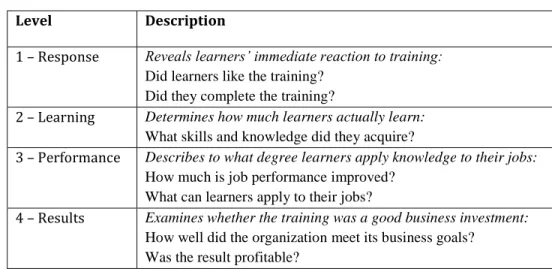
Development (ASTD) (Kirkpatrick & Kirkpatrick, 2006). Each of the four levels (Table 5) of evaluation provides an increasingly complex look at the outcomes of a training program (Kirkpatrick & Kirkpatrick, 2006).
Kirkpatrick’s model has been used extensively in corporations over the past five decades and remains a mainstay on the ASTD web site (ASTD web site). In his
adaptation of Kirkpatrick’s four levels, Horton pointed out that “since we are measuring results rather than mechanisms, we can use this framework to evaluate e-learning as we do to evaluate other forms of learning” (Horton, 2001). In other words, it is the outcomes
Table 5: The four levels of Kirkpatrick’s evaluation model
Level Description
1 – Response Reveals learners’ immediate reaction to training: Did learners like the training?
Did they complete the training?
2 – Learning Determines how much learners actually learn: What skills and knowledge did they acquire?
3 – Performance Describes to what degree learners apply knowledge to their jobs: How much is job performance improved?
What can learners apply to their jobs?
4 – Results Examines whether the training was a good business investment: How well did the organization meet its business goals?
Was the result profitable?
(Horton, 2001)
that matter, not the format or delivery of the training. Horton’s adaptation of the four levels, therefore, is primarily about identifying methods of data collection that are uniquely suited to the online environment. Several examples of these methods appear in Table 6.
Table 6: Horton’s adaptation of Kirkpatrick’s four levels
Level Examples of Data Collection Methods
1 – Response Online polls and ballots to ask for learners’ feedback Blogs for reflection on learning
Chat rooms for conducting a focus group
2 – Learning Online quizzes
Authoring tools with self-check features
3 – Performance Questionnaires on job performance Reports from HRIS systems
4 – Results Spreadsheets for quantifying information
Web-based surveys on perceived value of program
(Horton, 2001)
Horton noted that a comprehensive evaluation gains input from many constituents: the learner, instructors, program administrators, and organizational executives (Horton, 2001). He also pointed out that one of the primary benefits of collecting data in e-learning is the ability easily and frequently to obtain formative data, allowing for improvements throughout the learning event (Horton, 2001); many
traditional training events, on the other hand, focus on summative data provided by learners at the end of the training.
Horton’s model, however, failed to address the unique pedagogical aspects of the e-learning environment. In limiting his adaptations of Kirkpatrick’s four levels to
“employ[ing] some different technologies to the evaluation process,” Horton did not recognize critical topics in the e-learning environment such as engagement, the potential of constructivist approaches, and instructional design issues. Additionally, Horton’s model was primarily directed to training in the corporate environment. While there is much to learn from training and education in the corporate world, academic instruction, by its very nature, has different goals and objectives, and different environmental and
institutional factors impact its evaluation process. Faculty development and student services are just two of the issues that are not addressed in a corporate-training evaluation model.
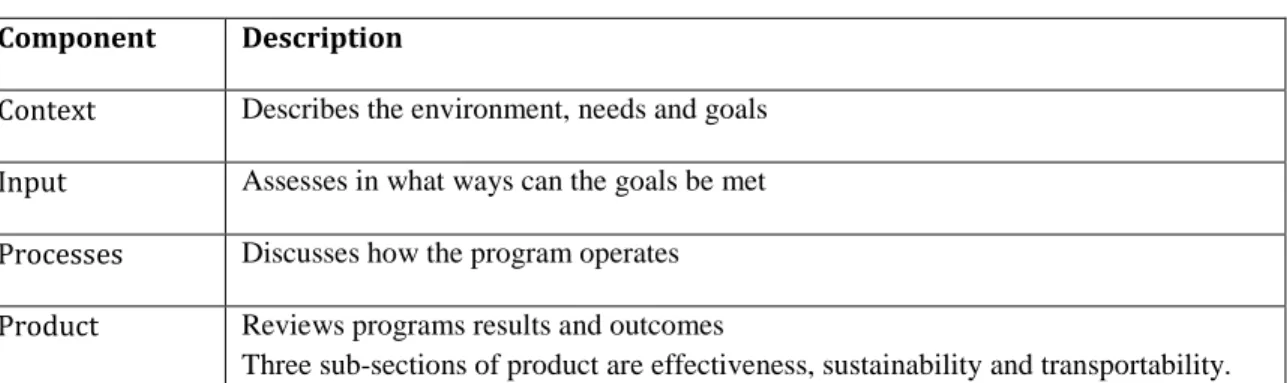
Another traditional model adapted for online learning is the CIPP (context, input, process, and product) model. Created by Donald Stufflebeam, CIPP “recognizes essential types of decisions encountered in education, planning, programming, implementing, and recycling (Chapman, 2006). Stufflebeam originally developed the CIPP model in the 1960s as a solution for public schools that needed to evaluate federally funded projects (Stufflebeam, 2003). According to Chapman, who used the CIPP model for online program evaluation, the CIPP model “places emphasis on guiding planning,
programming, and implementation efforts, and the model emphasizes that the most important purpose for evaluation is improvement (Stufflebeam, 2002, in Chapman, 2006).
Table 7 shows the four main components of the model.
Table 7: Components of CIPP model for online program evaluation
Component Description
Context Describes the environment, needs and goals
Input Assesses in what ways can the goals be met
Processes Discusses how the program operates
Product Reviews programs results and outcomes
Three sub-sections of product are effectiveness, sustainability and transportability. (Chapman, 2006)
Chapman appears to have achieved the goal of creating a theoretically based evaluation for online programs and, more importantly, demonstrated that such an evaluation can and should result in action items contributing to the ongoing quality and improvement of the program. The study produced a roadmap for following Stufflebeam’s CIPP model of evaluation that can be adopted by other programs. After a review of the data collected and questions asked in the surveys and interviews, however, it appears that this model focuses primarily on summative, quantitative data and ignores the importance of understanding the learning process and specifically the learning process in the online environment.
The e3Learning (enrich, extend, evaluate) model of evaluation, designed specifically to evaluate online college courses in a pragmatic way, has been used
prolifically by three different universities in Hong Kong (McNaught & Lam, 2005). The purpose of the e3Learning model is to “assist teachers to better exploit the possibilities of web-assisted teaching by offering a range of services: from introducing teachers to practical ideas about using the Web in education, to helping them make better use of the functions of teaching and learning platforms . . . to developing complete course websites for the teachers” (Lam & McNaught, 2007).
The e3Learning model is “complex and multilayered” (Ruhe & Zumbo, 2009) and involves several decision matrices populated by the data from over 450 potential survey questions, administered at various times before, during, and after the course. Table 8 shows the required steps for each course evaluated.
Table 8: Required steps of the e3Learning model
Level Activities
1 – Role of evaluation Proposal, meetings development, implementation, reflection
2 – Evaluation process Write plan and implement
3 – Communication
4 – Work flow Logistics, monitoring, data analysis, reporting
5 – Chart of roles by team member
(Ruhe & Zumbo, 2009)
Level two, the evaluation process, incorporates the following activities: Frame evaluation questions and select strategies Develop a plan and timeline
Collect data Analyze data
Decisions and action plans
(Lam & McNaught, 2007)
The e3Learning model presents both a challenge and an opportunity by its flexible nature. Lam and McNaught (2007) pointed to three areas in which the e3Learning model is particularly effective. First, the course content can be refined throughout the course implementation by the use of formative feedback. Second, summative evaluation
“provides evidence of the strengths and weaknesses” (Lam & McNaught, 2007) and leads to necessary and appropriate professional development for instructors. Third, the
e3Learning project has provided an avenue for “strategies [to be] disseminated to the wider educational community” (Lam & McNaught, 2007), leading to continuous improvement of the evaluation process itself.
However, while each evaluation is tailored to an individual course, providing data that can lead to course improvement, the resources required to conduct each evaluation may be substantial, because the evaluation needs to be defined for each course. This
approach may not be practical for most universities. Also, the e3Learning model is so focused on individual courses that it fails to address the programmatic and institutional factors.
Developed for Sloan-C, a consortium of online learning providers, Lorenzo and Moore’s (2002) five pillars for quality online education provide guidelines to providers of online learning programs in five areas: learning effectiveness, student satisfaction, faculty satisfaction, cost-effectiveness, and access (Sloan-C web site). The purpose in developing the Five Pillars was to “share knowledge that other educators can examine and perhaps emulate, and . . . substantiate that online teaching and learning does indeed work, not just here and there, but for many people in many disciplines, in many kinds of institutions” (Sloan-C web site).
Learning effectiveness is “concerned with ensuring that online students are provided with a high quality education” (Sloan-C web site) and includes such factors as course design, pedagogy, assessment, learning outcomes. In particular, Lorenzo and Moore (2002) highlighted interaction and higher order learning as critical issues in learning effectiveness. “Learning effectiveness requires that educators understand how to build online learning environments that generate meaningful discourse and encourage deep reflection, with significant opportunities for collaboration between students and faculty and student and student” (Garrison, 2002, in Lorenzo & Moore, 2002).
Acknowledging that students who are not satisfied with their online learning experience are more likely to drop out of the program, Lorenzo and Moore (2002) identified student satisfaction as the second pillar. “Online learners, like customers, are satisfied when they receive responsive, timely, and personalized services and support,
along with high-quality learning outcomes” (Humbert, 2002, in Lorenzo & Moore, 2002). Factors impacting student satisfaction include academic services, technology support, and access to student services offered by the institution (Sloan-C web site).
Faculty support is a key aspect of online-course quality. Teaching online can be a daunting experience, but many instructors find it “personally rewarding and
professionally beneficial” (Sloan-C web site). Providing the right support services to faculty can make the difference in their satisfaction; this includes addressing promotion and tenure issues, providing technical and pedagogical professional development, and recognizing the effort that online teaching requires (Sloan-C web site).
The fourth pillar is cost-effectiveness. Attention to items like infrastructure, scalability, and resources helps institutions understand an online program’s cost-effectiveness, “offer their best educational value to learners, and . . . achieve capacity enrollment” (Sloan-C web site). The final aspect of the five pillars model is access. The concept of access in this case is not limited to providing disabled students with access to learning opportunities; rather, Sloan-C viewed access as “reducing all barriers” to each part of the educational process for prospective and current students (Lorenzo & Moore, 2002).
A comprehensive model, the five pillars can be used by any higher education institution as a foundation to evaluation of their online programs. However, the model does not discuss the actual implementation of the evaluation. For example, the type and methodology of data collection are not defined. Many institutions that post their own effective practices on the Sloan-C web site focus on just one of the five pillars; it is difficult to ascertain whether or not the organizations are using the entire model. In