DEVELOPING EXPERT COMMUNICATION
Suggestions for improving creative design
Student and pro gradu thesis information
Name of student, student ID number and contact details Tapani Jämsen, 167684, [email protected]
University, department and study programme
Aalto University School of Art and Design, Media Department, Media Laboratory, MA in New Media
Title of pro gradu thesis
Developing Expert Communication – Suggestions for improving creative design Illustrations
Mikko Jäppinen 2011, [email protected]
Translation
Prologue to Translation
Philosopher Pekka Himanen gave an inspiring lecture on the human culture of creativity in autumn 2010. He highlighted the significance of trust and enriching communities as the basis of success and creativity. He gave examples of this in his own life and the lives of other creative people. He also described how mutual appreciation, encouragement, and enriching interaction between people provide the basis for creativity and success as a fundamental force.
I started to think about the enriching communities I had been privileged to belong to, and was inspired to write this pro gradu thesis. For the translated version of my thesis, I considered the evaluators’ valuable comments and complemented the work as follows:
● page 15, section 1 Introduction, sections 2—3
● pages 24—25, section 2 Human-‐centredness in creative design and communication, sections 2—3 and figure
● pages 82—83, section 5.6 Overview from the perspective of the research questions
● pages 85—86, section 6.2 A couple of words about the Web10 project
Philosopher Pekka H. is doing an outstanding job whilst tirelessly lecturing about the significance of mutual appreciation, trust, and enriching communities for life and people’s success. He has made me pursue what is important and do my small share of the big picture. I want to thank everybody with whom I have had the privilege of
interacting in an encouraging and enriching atmosphere. I want to thank the informants participating in my pro gradu project, and translator Marja Heikkinen whose translation is better than my original. Mikko Jäppinen gave me the idea for the topic and provided the great illustrations. Mikko also reminded me about the significance of humour in the building of trust and cooperation. Joy for life!
Abstract
The initial motivation for my pro gradu thesis was a desire to investigate and develop the cooperation and communication between creative experts while working. I got the opportunity to do this in late summer 2009, when the reform of the webstore
Veikkaus.fi was started. What we were facing was a giant project with a super busy schedule. Those involved were easily motivated to start thinking about how we could facilitate our cooperation by any means possible, for example, by developing our mutual communication and interaction.
Interaction needed to run smoothly in the project’s multinational network of people with offices in different locations. Veikkaus’ Web10 reform employed nearly 200 people from five different countries and ten different companies at the maximum.
The work was based on human-‐centred thinking, which creative experts used as a source of inspiration. They knew they were building services for customers and understood that the needs, thoughts, and understandings of these people should be taken into account in the creative planning work. Human-‐centred thinking is part of the toolkit of creative experts.
The purpose of this pro gradu thesis is to enrich creative communities working with the new media by considering, e.g., second-‐order understanding, the
relationship-‐constructed and constructivist perspectives, as well as the theme of trust, which I was inspired to investigate further during two lecture series given by philosopher Pekka Himanen in autumn 2010. Each of these issues is also central to the development of communication and interaction.
The analysis centres on creative experts whose thoughts and feelings are in focus, running through the text. The experts reflect on their interactive skills, and discuss the significance of active listening and building of trust for cooperation. They talk about interaction during the creative design work in the Web10 project and the related cooperation. They also tell about their experiences of problems in communication and interaction, and give their views of how interaction and cooperation could be developed.
Attached to this work, there is a Guide for communication during projects and creative cooperation at Veikkaus, including a checklist-‐like Model for thinking up a communication plan.
Key words: human-‐centered, second-‐order understanding, building trust, active listening, language of design, communication based on listening and understanding, interactive skills.
Evaluations
Evaluation of the pro gradu thesis for the degree of MA in New Media,
Media Laboratory/ Department of Media /Aalto University /School of Art and Design Pro gradu thesis evaluated:
”Developing Expert Communication – Suggestions for improving creative design” Author of thesis: Tapani Jämsen
Submitted 3/2011 Evaluator:
Sanna Marttila
Master of Arts (MA), University of Oulu
Master of Arts (MA), School of Art and Design,
Project Manager, PhD Student, Aalto University, School of Art and Design
Tapani Jämsen’s pro gradu thesis for the Master of Arts degree is an exploratory narrative about “the development of the cooperation and communication of creative experts within the new media during working hours”. Jämsen addresses expert
communication through literature and a reform project of the webstore Veikkaus.fi, in which Jämsen acted as a design planner and coordinator for approximately a year. As one of his core research results, Jämsen presents a communication guide and a ”model for thinking up a communication plan”, targeted at experts who are ”reflecting on and/or planning the communication of their creative community and its development”.
Jämsen’s work sheds light on communication in an expert organization, the organization of work and the cooperation methods that are most often invisible to outsiders. The chosen research object is topical, as the decentralized information work, the increasing number of communication channels and the growing volume of
communication impose new requirements on work and its organization. What makes the research object challenging is the multidisciplinary nature and wide scope of the topic.
Jämsen makes use of the methods of, e.g., action research and ethnography, and he has produced rich empirical research data consisting of a research journal, a background survey addressed to certain members of the working group, as well as interviews. These data provide the reader with a multi-‐faceted view to the opportunities, challenges, and points that need further development in the communication and cooperation within the expert organization.
In the introduction Jämsen defines his research object clearly, and justifies his research task and questions, together with his research themes by making reference to source literature. However, Jämsen describes the reform project of Veikkaus.fi and his own role to a very limited degree only, e.g.: “rather unique in terms of its scale; subject
to a very tight schedule, comprehensive and extensive large-‐scale project”, “Veikkaus Web10 reform employed nearly 200 people from five different countries and ten
different companies at most ”. I would have been pleased to read a brief description of the project and its objectives, together with some basic information about the working group and community studied. The pro gradu thesis would also have merited from an account of how Jämsen selected the informants in the project group to answer the background questionnaire survey and to participate in the interviews. In addition, it might have been worthwhile to dedicate a subsection of the Introduction to explain what different elements the research data consist of more concretely, and how the data were collected.
Jämsen delineates his research questions as follows: “How is the communication between experts constructed and how does it change during the creative cooperation on Veikkaus.fi?”and “How does the pursuit of change in communication influence the cooperation between experts?”Unfortunately Jämsen does not return to his research questions at a later stage in his work; nor does he give explicit answers to his questions on the basis of his data, or make a synthesis. For example, the final section of the thesis would have offered a great opportunity for that. Further, attachment 4 at the end of the thesis called “Plans for the action-‐research based development periods” lists concrete objectives and operative proposals. The relationship between these objectives and the research questions remains unclear in the text.
Jämsen has a pragmatic and eclectic approach to the source literature. In fact, he states at one point that he is using literature which he believes will enrich his work and help “experts in the new media enhance their operations”. A central concept in
Jämsen’s work is ’human-‐centredness’ in creative design and communication (section 2), which Jämsen defines by following closely Krippendorff’s views. The work would have gained more versatility if Jämsen had brought up a variety of views in the discussion. Further, e.g., the methods of user-‐oriented design are described rather narrowly in the work (cf., e.g., Human-‐centred design processes for interactive systems, ISO 13407 [1999]). Although part of the source literature is, in fact, characteristically
background-‐setting and descriptive, it must be noted that Jämsen does manage to commendably present and master Krippendorff’s framework of ’second-‐order
understanding’ and apply Krippendorff’s communication theory to the categorization and explanation of his empirical data (e.g. background-‐setting survey, interviews).
Jämsen explains his research approach and methods mainly in section 3 “The
action-‐research approach”. From the perspective of the structure of the thesis, it would have been better if the chosen methods had been presented before discussing the empirical data (section 2). Further, it would have been beneficial to present the stages of data production and collection before the interpretation and analysis of the data. It is not until section 4 that Jämsen attempts to simultaneously describe and reflect on the research stages and data. Jämsen does not really analyse his data or informants in a source-‐critical manner in the text (does not evaluate the character of the information
offered by the source or assess its reliability). Yet, what is most valuable in Jämsen’s work in my opinion is his way of conducting dialogue between the source literature and the interviews. Jämsen has managed to foreground special themes in his data that can be used to develop communication and cooperation in a creative expert community, as well as methods that can be used to organize cooperation between several operators. These methods Jämsen has summarized in his communication guide that can be applied to several different fields.
It has been a pleasure to read Jämsen’s work, since it, along with the research data, reflects the learning process of the author and the working community, and shows how communication and cooperation evolved during the research process in practice. I wish Jämsen the best of luck and success in his future research and design projects.
Evaluation of the pro gradu thesis for the degree of MA in New Media,
Media Laboratory/ Department of Media /Aalto University /School of Art and Design Pro gradu thesis evaluated:
”Developing Expert Communication – Suggestions for improving creative design” Author of thesis: Tapani Jämsen
Submitted 3/2011 Evaluator:
Antti Ellonen
M.Sc. (Econ.), University of Jyväskylä, Editor, Sanoma School of Journalism,
Web Editor-‐in-‐Chief, Ministry of Transport and Communications
The topic of the work is highly relevant. The choice of the topic and the relationship of the work to practice are dealt with at many points and fairly comprehensively. From this perspective, the justifications for the significance of the work are valid. The writing is fluent, although there are occasional instances of less elegant writing, probably resulting from a busy schedule or project fatigue.
What was fascinating about the project was its close connection to the author’s job and his genuine excitement and motivation to develop his own work that was prominent in the text. The resulting Guide for expert communication in creative cooperation and Model for thinking up a communication plan provide a sound and useful basis for the development of communication processes related to creative work.
The theoretical framework and methods are used fairly extensively in the work. Yet, the combining of theory and practice is not thought through completely. Part of the theoretical framework and the description of the methods of research and data collection remain without proper connection to the research.
The data are described, e.g., through extracts from the research journals, but the method of data collection and analysis are discussed rather superficially. Further, the results are not arrived at very clearly from the perspective of the theoretical framework determined by the research questions, methods, and the data investigated. The
interview methods are not described, nor is there a list of the interviewees attached to the work.
The author has probably not had the patience or willingness to entirely comply with the characteristic form of a research report. It is not very easy to spot the building of the framework, the collection of the data and its handling, and the results and
conclusions based on them in a report organized like this. For example, in section 2, titled “Human-‐centredness in creative design and communication”, a framework for the
research is built based on literature and earlier research; yet, even interview
observations, results falling into the scope of the framework, are discussed in the same section.
Krippendorff’s Becomings, Poets’ and Subjects’ positions are identified in the
interviews used as background material in an outstanding way. These observations, too, are discussed whilst constructing the framework. There are a couple of other similar instances in the work, too. It would have been recommendable to present these
insightful findings in a separate section shedding more light on the research results. That would have highlighted the interesting findings and made them more explicitly outcomes of the author’s own thinking and analysis. A more traditional structure would also have made it easier to spot the research results in the report. It must be tempting to
question the structure of a research report, but in a pro gradu thesis, challenging the tradition makes it much more difficult for the author to achieve coherence.
The two research questions the author poses at the beginning of the thesis are not reverted to in an explicit way in the analysis of the results. It would have been
appropriate to make sure at the end of the research process that the questions on which the work was based had been answered. The questions might also have changed or
become more specific during the process. It would have been beneficial if the author had reconsidered, at the end of the thesis, what questions were actually answered. It would also have been worthwhile to discuss the Guide for expert communication in creative cooperation and Model for thinking up a communication plan in attachments 7 and 8, which were presented as central results, in the form of research questions.
Pekka Himanen’s ideas about the culture of creativity and the significance of enriching communities, presented in the prologue, could have been discussed more thoroughly by including more writings by Himanen on the subject matter in the source literature. Wikipedia and certain other web sources have been used as primary sources in contexts where it would have been preferable to use original source literature.
The author’s oral presentation of his pro gradu thesis was well organized and clear. The author managed to properly justify his choice of the communication perspective and especially the significance of communication between those active in design processes. In his presentation, the author showed he mastered the ideas of his framework, including second-‐order understanding and the relationship-‐constructed perspective. Further, the author also justified commendably the usefulness of the perspective related to the
building of trust and especially the significance of listening among the interactive skills in a process of creative design.
Contents
1. Introduction
1.1 Motivation and background 1.2 Research questions
1.3 Structure of my pro gradu thesis
2. Human-centredness in creative design and communication 2.1 On second-order understanding
2.2 On the relationship-constructed perspective 2.3 Constructivist reflections on communication 2.4 On trust as the basis of cooperation
2.5 On interactive skills
2.6 On interaction and cooperation 3. The action research approach 4. On research stages and data
4.1 Summary on a timeline (in Finnish) — two images 4.2 Dialogue between data and theory
5. Results towards a guide for expert communication
5.1 Communication and interaction as development objects
5.2 Through trust and listening towards experts’ genuine interaction and shared understanding
5.3 From the textual to the visual;; towards dialogue and listening through the language of design?
5.4 Building of trust
5.5 Reflections on communication
5.6 Overview from the perspective of the research questions 5.7 The communication guide – an introduction
6. Conclusion
6.1 Critique of the methods used and possible uses in respective development work 6.2 A couple of words about the Web10 project
6.3 Possible further research topics and epilogue References
Attachments
Attachment 1 Extract from the encoded research journal from August 2009 Attachment 2 The background survey web form from January 2010
Attachment 3 Extract from the research journal from February 2010 Attachment 4 Plans for action-research based development periods
Attachment 5 Questions of the interview in Google documents format, 2010
Attachment 6 Extract from a transcribed, analysed, and encoded interview from May 2010
Attachment 7 A guide for communication during projects and creative cooperation at Veikkaus
1. Introduction
This pro gradu thesis is about the development of cooperation and communication between creative experts within the new media during working hours. I am writing an exploratory story about how media professionals were acting and cooperating in their everyday working lives during a reform project of a commercial internet service at the turn of the 2010s. I have explored the communication between expert employees and its development whilst carrying out creative planning, adopting an action research
perspective. The title of this research project “Developing Expert Communication – suggestions for improving creative planning” illustrates my whole venture in a fairly concise way.
Veikkaus Oy reformed its web service Veikkaus.fi in an extensive multiple supplier project in cooperation with several partners, e.g., service design office Palmu Inc. (palmuinc.fi, 2010), and game system supplier GTECH. All in all, however, this project, titled Web10, employed nearly 200 people from five different countries and ten different companies at most. The objective of the reform was to bring Veikkaus’ multi-‐faceted services together into an entity that is easy to use and manage. Everything that was visible to our customers on the website was revamped – even the information systems of the service were revised. Designing was initiated in April 2009 and the whole project was finalized in August 2010. There were over twenty experts working on the project’s design on a whole-‐time basis (Tuulaniemi, 2011, pp. 196-‐197). The objective of the reform was to activate customers who play infrequently and to offer young adults an interesting and secure gaming option (Veikkaus’ annual report, 2010 and Tuulaniemi, 2011, p. 202).
The present research project covered designers of the Web10 project and other experts; altogether some 15—20 people. The data consists of, first of all, two research journals, the first of which I started in mid-‐August 2009 and the second of which I ended at the beginning of July 2010. To analyse the background of the action research periods, I conducted a web questionnaire survey at the end of January 2010. I sent the
questionnaire to about forty colleagues working in different tasks of the project’s ownership, steering, and operative management, and in expert positions in particular. I completed my data by interviewing thirteen creative experts working with the project close to me, representing Palmu, GTECH, and Veikkaus; mainly in May and June 2010. My research data also included written communications produced during the project, e.g., emails and memos.
At the end of this pro gradu thesis, I will present a Guide for communication between creative experts of the new media – the designers of digital services – which is a
summary of the whole project. The guide can be seen as a small step towards what Klaus Krippendorff (2006, pp. 207-‐213; “The Semantic Turn -‐ Wikipedia,” 2010, p. 5)
meant by the concept Science for design. I am using the term ‘design’ to make a
difference between the creative work by new media experts and other possible planning work. In the following, I will present a possible and fairly topical definition and
interpretation of design.
According to Maarit Lindström et al. (2006, p. 28), design entails planning that can be targeted at companies in the fields of industry, commerce, and services; and
organizations within the public sector, all alike. Design covers not only products but also, e.g., services, and corporate or organizational identity in a broader sense. Thus, design refers to both the process and the outcome. The process may be abstract (visual) or material (model/models). Similarly, the outcome of design (what the outcome looks like) can be tangible (e.g. a product) or abstract (e.g. a vision or a concept). Lindström et al. (2006, p. 29) elaborate further on the process nature of design, saying that design as an activity is not a static phenomenon but rather a continuous process of
decision-‐making, where ideas yield an outcome, typically goods or services. In this interaction, there are usually several people involved; besides the experts, there are, e.g., the customers of the service designed, i.e. people belonging to the target groups.
Klaus Krippendorff, too, writes (2006, pp. 25-‐32) that modern design work often entails a demand for cooperation and interaction between, e.g., designers, the target groups of the design, and many other stakeholders. According to Don Norman (2007), design constitutes a complex activity and most products, services, etc. are the outcome of cooperation between people. Luke Wroblewski (2005) adopts a similar perspective and claims that design is essentially communication. He proposes that communication is what design should be conducted and used as (Wroblewski, 2005). Thus, as can be seen in what I have noted above, this pro gradu thesis is about the design cooperation and communication between new media experts.
I find it interesting to develop the working community and people’s interaction whilst working; thus, I was also inspired to find out that it could be done by writing a pro gradu thesis. I familiarized myself with the creation and improvement of the cooperative prerequisites of creative new media experts during working hours by adopting an action research based approach. My approach to the topic focuses on understanding interaction and managing people, as well as on the continuous improvement of both.
Managing creative experts and immaterial product development issues proved more multi-‐faceted and difficult than I would have thought. The new media has its own visually and technically oriented language, its own concepts and meanings. Donald Schön
comments on the language of design in the following way in his work “The Reflective Practitioner – How Professionals Think in Action” (1983, p. 80):
”He places a sheet of tracing paper over her sketches and begins to draw over her drawing. As he draws, he talks… and also draws, placing the kindergarten ’here’ in the drawing, making the line that ’carries the gallery level through.’ His words do not describe what is already there on the paper but parallel the process by which he makes what is there. Drawing
and talking are parallel ways of designing, and together make up what I will call the language of designing.” (Schön, 1983, p. 80)
Service designer Risto Kantola’s comments deal with the same topic:
”The very basic level is that you need to be able to communicate what you’ve designed, how it works, so that everyone in the team will understand; like presentation skills, like what you’re talking about; you need to steer the conversation to the right tracks. It’s really essential if you’re talking, for example, about prototypes that aren’t completely ready layouts. Then, gradually, like a user interface out of clay, the final product takes its shape.” (Risto, Service Designer in Helsinki, interviewed on 25 January 2010)
Schön (1983, p. 81) makes a summary of the close relationship between the verbal and non-‐verbal in the language of design. The way I interpret this is that, in the language of design, it is essential to develop and understand both through visual expression and understanding and the complementary commenting dialogue. I believe that leadership entails making things concrete and simple, interpreting, e.g., the language of design in particular; the images and concepts — and a dialogue and synthesis on the basis of all of them. Further, I also see leadership as the creation of the necessary preconditions for joint understanding, i.e. shared objectives and action. The creation of the preconditions is also associated with the continuous improvement of activities, right here and right now, right when it is necessary. Even the slightest changes for the better in people’s cooperation may result in fast and visible benefits.
According to Hannu L. T. Heikkinen (2008, p. 17), action research in its most modest form means developing one’s own work. However, people’s tasks almost always entail cooperation with other people and that is why developing work requires enhancing cooperation and interaction between people. This can rarely be done without taking into account other people’s working tasks, the organization and the operating environment. Sometimes a wider discussion between the different actors on the direction and means of development is necessary (2008, p. 17). In this pro gradu thesis, which covers the development of communication whilst carrying out creative design work, I am adopting an action research lens, moving smoothly between and within individual and group analyses.
Pekka Kuusela (2005, pp. 59—64) describes how action research can be divided into five levels of analysis on the basis of how extensive the activities are: “individual”, “group”, “inter-‐group relations”, “organization”, and “regional network”. Heikkinen describes these levels as follows (2008, p. 18): at the individual level, the teacher observes his own activities, writes a journal and discusses with his colleagues and the participants. The research report describes the individual’s experiences and, especially, the thinking processes and learning by the actor himself (Heikkinen et al., 2008, p. 18).
relationship-‐constructed perspective, calling it the constructive-‐critical view, referring to Peter L. Berger and Thomas Luckman. In this thesis, my thinking, motives, and
conception about knowledge construction are based on the relationship-‐constructed perspective, which has also become a central part of the research into corporate management and organization studies according to Tienari and Meriläinen (2009, pp. 116—119).
Constructivism refers to a view according to which “reality” is constructed socially (2009, p. 116) (Berger, Luckmann, Raiskila (Finnish edition epilogue), & Aittola
(epilogue), 1995, pp. 11—39). This means that there are several realities (2009, p. 116). Tienari and Meriläinen (2009, p. 117) claim that knowledge is constructed in
relationships between people, where the surrounding reality is shared between the participants. Knowledge is also defined as part of language use, see also Berger et al. (1995, pp. 45—57) and Krippendorff (1993; 2006) — used to name, classify, and evaluate things. Knowledge is assigned different meanings in different practices (Tienari & Meriläinen, 2009, p. 117).
Being critical means that even delicate issues are analysed, including power and asymmetrical relations, calling into question how power is maintained in human relationships and how those in power try to make inequality seem natural and self-‐evident in different contexts. In research based on the relationship-‐constructed perspective, certain specific words are used to describe the phenomena investigated. These words include reconstruct (to repeat and to actively maintain the existing) and construct (produce or create something new). In contrast, whilst describing their work, the researchers talk about understanding instead of, e.g., explaining (Tienari &
Meriläinen, 2009, p. 117).
This thesis is based on a free application of the humanities, the humanistic research tradition, and the relationship-‐constructed perspective. I am not doing, nor could I do, deeper science than that which my very practice-‐oriented topic requires. However, I have familiarized myself in an unprejudiced way with earlier thinking and material, which I believe has enriched my work. I have also observed suggestions and views by people supervising and supporting me in this project, concerning worthwhile sources of information. My approach to the material is rather more approving and excited than persistently pedantic and critical. This, too, is a choice, having to do with the topic and its ultimate end: to help new media experts improve their actions and cooperation right when it is necessary; fast and whenever required.
Following the introduction, in the next chapter, I will be shedding light on the background and motivation of the thesis. I will, for example, discuss the following
question: why am I studying expert communication in a design community? Further, I will outline the research questions in more detail.
1.1 Motivation and background
Why am I studying expert communication? And why am I also considering the meaning of trust?
Having worked in the field of the new media for some fifteen years, including some ten years of experience as a supervisor of design work, I am still rather confused professionally. It may have to do with my being slow or stubborn, but I do not consider confusion a bad thing; I see it rather as an active state of mind.
I am considering the communication of new media experts and how it could be improved. I am also thinking about how people and design activities are led. The exploratory narrative and action research of this pro gradu thesis are related to my work; the reform project of a new media service, Veikkaus’ Oy’s webstore, from autumn 2009 to autumn 2010. I wish my thesis will attract not only readers from Aalto University and my immediate working community, but also people representing the new media more widely.
My professional bewilderment in this work arises, e.g., from the ease with which we, in our practical working lives, forget many basic things we otherwise consider
self-‐evident. Even operators within the new media are familiar with the international, multi-‐cultural working environment, networks, and cooperation. Yet, we are constantly caught red-‐handed making mistakes that have to do with our communication,
interaction, and cooperation skills. The focus of interest in this thesis was clear to me from the very beginning. I wanted to investigate our project which was rather unique with its wide scale, subject to a very tight schedule; a comprehensive large-‐scale project. In contrast, to delineate the topic, I needed to do some thinking and reflecting for a while. The idea of improving and investigating expert communication was
suggested to me by Service Designer Mikko Jäppinen at the beginning of September 2009. We concluded that it would be wise and indispensable to develop people’s
communication and interaction skills in the working life. They constitute crucial parts of people’s professional skills, no matter what work we are dealing with. Thus, I took up the challenge to develop and investigate the communication of experts in creative design cooperation. I am glad my topic was also accepted by the Medialab community.
Sari Hammar-‐Suutari (2006, p. 1) has discussed the meaning of the words change and development. This pair of words is often used to characterize the way of the world or society today with its different sectors. Even discussion concerning the working life has focused strongly on the change — development axis. Workplace communities are living in the middle of changes and the working atmosphere is tinted with the requirement that we should be able to keep pace with them. Managing change and the related reforms
requires development: the development of skills, knowledge, different types of preparedness, attitudes and, e.g., tolerance for change. However, the mere
requirement for a desire or ability to change does not provide the members of a working community with tools for receiving change and realizing the required development. Besides change and development, we need more concepts. And to meet the challenges brought by change, we need factors initiating and enabling development, as well as tools for taking the steps the development requires (Hammar-‐Suutari, 2006, p. 1).
Hammar-‐Suutari’s thinking has been another source of inspiration to me in my endeavour.
My choice of topic can be justified by considering it against some of the questions posed by Juha T. Hakala in his guide to writers of pro gradu theses (2008, p. 54): Who or what does it benefit that I am investigating this topic in particular? I believe studying, analysing, and developing communication, interaction, and cooperation are beneficial in interpersonal activities in general. Even in business operations projects within the new media, which often have large budgets and heavy expense structures, it is sensible to keep developing the practice constantly. It is easier to take up developing when someone has already tested and documented their experiences for other people to use. I, too, hope my work will prove useful to the readers.
Kai Ruuska (2003, p. 83) claims that communication constitutes both a tool and a resource in a project. As a resource, communication can be paralleled with the other resources of the project, including time, money, people, and equipment. However, efficient communication does not take place on its own. Communication needs to be planned, led, and monitored in a working community, just like the other resources in the organization. Yet, communication is in a special position. Besides being a valuable
resource, communication is necessary for the efficient use of all the other resources in the project. Communication is a tool, a uniting factor which links the different parts of the project with each other and the whole project to its operating environment.
Projects are managed through communication (Ruuska, 2003, p. 83). I also found motivation to develop people’s interaction skills in Linda S. Henderson’s two articles (2004; 2008) on the significance of communication for, e.g., the productivity of projects and people’s work enjoyment, and for the degree to which their cooperation succeeds in different projects. Communication is a core interpersonal activity worth investigating and developing in different ways, even from the perspectives of individual human beings.
Am I myself sufficiently interested in my topic? I am excited about the topic from the point of view of developing my professional skills and work and from the point of view of the academic and research community. In both of these areas, the activities are based on meetings between people, interaction, and communication; it is their smooth operation and efficiency that yields results and provides the basis for the quality of the work.
Is my subject topical? The topic as such does not stand out as something brand new and unprecedented. A lot of thinking, discussing, and research related to my topic has been carried out, and there is a wealth of related material. However, I believe that the perspective and delineation of my pro gradu thesis can offer food for thought to the readers – and, above all, inspire a desire and courage to do something similar, maybe during the next upcoming project already.
The theme of trust and the subsequent path of knowledge acquisition and thinking occurred to me in the interviews with my colleagues during the project. Trust or the lack of trust came up in so many exchanges of thought and even in my own journal entries that I needed to dig deeper into the subject matter.
In the following subsection I will define the research task and write about the research questions which I used to tackle the big picture. The research task did not take its form easily or quickly. It took a lot of time to develop and required a closer investigation of the source material; a couple of evening seminars, and exchanging thoughts with the supervisor and my colleagues.
1.2 Research questions
How is my research task defined?
According to Jorma Kananen (2009, p. 39) a research project either succeeds or fails with the research questions that steer it. Kananen (2009, pp. 39-‐40) follows Eileen M. Schwalbach (2003), listing requirements for good research questions. My research task was an action-‐research based development task, discussing the improvement of expert communication during creative design. I avoided dichotomies allowing the answers yes and no. In addition, I did not ask questions containing the answer or a presumed answer.
According to Juha T. Hakala (2008, p. 128), the research task determined for an academic dissertation is, as it were, the hot nucleus of a volcano, from where the whole process unfolds over time. The research question is the basis for all other research activities. Of course, defining the research task is always affected by what we already know; however, what affects it in particular is what we do not know (Hakala, 2008, p. 128).
I started to outline my research task and questions in mid-‐September 2009 when the pro gradu thesis evening seminar, led by Teemu Leinonen, was launched at the Medialab. By the time I had presented my seminar paper in early December 2009, my first research question started to take its final form. However, at that stage, I still assumed I would end up improving communication more than I did in the finalized version. My research task was determined through one broader and one more concise research question, the scopes of which I believe were appropriate to a pro gradu thesis.
How is the communication between experts constructed and how does it change during the creative cooperation on Veikkaus.fi?
This question was essentially inspired by Mikko Jäppinen, my colleague in the reform project of Veikkaus.fi. We thought that this question, along with certain practical development measures, could provoke discussion that would help us to arrive at positive changes in the communication during the creative cooperation. At times I thought the term communication should be replaced with the broader concept of interaction. I also took up the possibility of improving communication in a separate research question, i.e. I had already made assumptions about the research object. In the final version of the first research question, however, I decided to stick to the term communication instead of interaction.
The latter research question took its form slowly, in many stages and spread out over a long time span.
How does the pursuit of change in communication influence the cooperation between experts?
This question has to do with my work as a developer and coordinator of Veikkaus ICT design. Whilst taking my colleagues’ skills and work development into account, I, in particular, have to develop myself as an example, a part of the whole and part of the interaction. This question, just like the previous one, reveals my assumption and hope that there will be change and development; however, I am not basically making presumptions about their quality.
In my pro gradu thesis, I am freely learning about and applying action research and exploratory narration, drawing on the ethnographic tradition. According to Hannu L. T. Heikkinen (2008, p. 15), action research aims to change reality by investigating it and to investigate reality by changing it. Heikkinen (2008, p. 16) says that knowledge is created in action research in order to develop practice. Action research explores human action, instead of, e.g., volcanic explosions or the functioning of machines. Rationality and goal-‐orientation have been regarded as characteristic of human beings as a species. Action research aims to improve practices by using rationality (Heikkinen et al., 2008, p. 16).
1.3 Structure of my pro gradu thesis
Following the introduction, I will be discussing my topic in sections 2—5, after which I will make a conclusive epilogue in section 6. In the following section 2, I will be discussing human-‐centredness in design and communication, introducing some of the basic concepts of human-‐centred design, including product semantics. Klaus Krippendorff (2006, pp. 47—70) claims that these basic concepts include human sense and meanings that together with action form a human being’s understanding. Krippendorff (1993;
1996; 2006) has also written about second-‐order understanding. This is a very usable idea, which can be grasped by everyday thinking. It is definitely interesting and worth thinking about. Second-‐order understanding should be included and rooted in the thinking and everyday language use of a creative design community. I believe it will prove useful whilst considering the construction of our own (design) understanding in relation to other people’s thinking.
In section 2, I will also be considering constructivist thinking based on the
relationship-‐constructed perspective. Further, section 2 will include passages on trust as the basis of cooperation, interaction skills, and creative design cooperation. The third section will deal with the action-‐research based approach of my pro gradu thesis, whereas the fourth section will discuss the different phases of the research project and the data used.
Section 5 will focus on the results. I will first tell about communication and interaction as targets of development, followed by a discussion on trust and listening, as well as my thoughts about communication. The section will end in a concise guide on expert
communication in creative cooperation. The sixth — the last — section will discuss
criticism of the methods used and their possible uses in respective development projects, as well as ideas for possible further research that arise.
2. Human-‐centredness in creative design and communication
As can be seen from the above, the world of my pro gradu thesis emerges from the thoughts of new media experts on creative cooperation and communication. The designers of modern digital services, versatile experts representing a variety of fields, find their inspiration in human-‐centred thinking. The essence of such thinking is that people are able to put themselves in each other’s position and take other people’s understanding into account.
Figure 1. Human-‐centred ISO 9241-‐210 standard in Timo Jokela’s blog (2006, http://iso9241-‐210.blogspot.com/)
In practice, human-‐centred design can proceed, e.g., according to Timo Jokela’s (2012) ISO 9241-‐210 standard, defining the principles and activities of human-‐centred design. The standard’s principles are:
● The design is based upon an explicit understanding of users, tasks and environments.
● Users are involved throughout design and development. ● The design is driven and refined by user-‐centred evaluation. ● The process is iterative.
● The design addresses the whole user experience.
● The design team includes multidisciplinary skills and perspectives.
The afore-‐mentioned activities and core parts of the human-‐centred standard ISO 9241-‐210 are:
● Understanding and specifying the context of use ● Specifying the user requirements
● Producing design solutions ● Evaluating the design (Jokela, 2012)
creative, accommodating, context sensitive, and possessing many intelligences. Krippendorff (2006, pp. 40-‐47) claims human-‐centred thinking has an honourable
intellectual history ever since the classical Greek philosopher Protagoras and the Italian Enlightenment philosopher Giambattista Vico (1668-‐1744), who were followed by Johann Wolfgang von Goethe (1749-‐1832) and the Baltic German philosopher/biologist Jakob von Uexkyll (1864-‐1944), as well as Ludwig Wittgenstein (1889-‐1951).
Product semantics, according to Krippendorff (and Butter 1989) (2006; “Semantics -‐ Wikipedia,” 2010; “The Semantic Turn -‐ Wikipedia,” 2010), assumes a systematic research approach to how and what kinds of meanings people make out of artefacts (e.g. products and services) and how people interact with the products and services in accordance with those meanings. Product semantics also covers a vocabulary and methods for the design of artefacts that are meaningful to people (e.g. products and services) (Krippendorff, 2006). As far as I understand, product semantics explores, e.g., the characteristics of services — both the concrete and symbolic ones, in their
psychological and social contexts — applying information thus gained to service design. By applying product semantics, designers can also generate simplicity, irrespective of the technology used, and improve the interaction between services and their users. I will get back to the theme of product semantics later, in figure 2. Based on Krippendorff’s
thinking, I will be discussing how product semantics can provide a means for creative experts to construct second-‐order understanding.
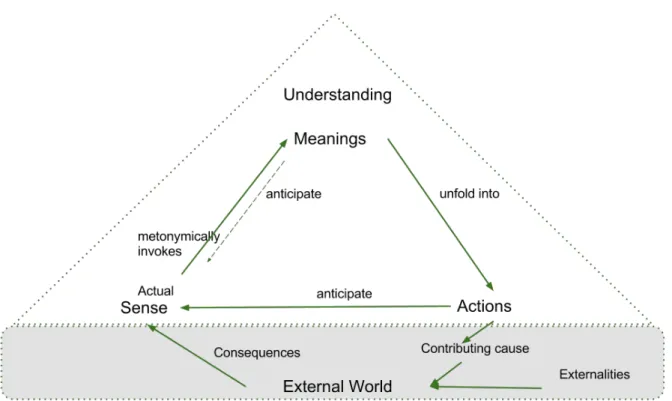
Whilst carrying out creative design, human-‐centred experts and service designers should always think about what kinds of meanings they want the products and services they are designing to construct for people. According to Krippendorff (2006, pp. 47—58), the basic concepts of human-‐centred design also cover human sense and the meanings, which, combined with human action, construct understanding. Krippendorff (2006, pp. 47—58) claims that humans do not see and act on the physical qualities of artefacts (e.g. products or services), but on what they mean to them.
Sense, according to Krippendorff (2006, pp. 47—58), is people’s connection to the world without ponderings, interpretations or explanations; sensing occurs here and now, neither in the past nor in the future. Senses invoke meanings and these meanings always involve what is being sensed. Basically, meanings are constructed on differences between the sensed and the action. In our ability to perceive, meanings arise from our
consciousness to different ways of seeing. The generation of meanings can also be discussed in connection with reading, language use in general and interpersonal discussions; in interaction. Meanings are always an individual’s own unique meanings, rather than being fixed or permanent (Krippendorff, 2006, pp. 47—58).
Figure 2. Sense, meaning, and action, adapted from Krippendorff (2006, p. 58)
The above visualisation illustrates how a human being’s understanding is constructed, the interaction between sense, meanings, and action. According to Krippendorff (2006, p. 58), the figure shows, in a concise form, that people are always acting according to meanings.
New media experts think and want to work in a human-‐centred way. They appreciate the fact that they are building services to customers and understand that the different needs, thoughts, and understandings of these people need to be accounted for in, e.g., service design. Human-‐centred thinking in the new media and knowledge about service design is part of the experts’ understanding. Their language, concepts, and actions include the principles of user-‐oriented design, including scenario-‐based design (Carroll, 2000), interaction design (e.g. Greger, 2010), prototyping, iteration, and usability assurance.
”I keep visualising things. I make drawings about the processes and, for example, service situations; I try to visualise them sufficiently enough to make them unambiguous and easy to comment on. I’ve noticed that it works. In other words, it’s part of the prototyping that is one of the most important tools of a designer; and in service design you keep prototyping those service situations in particular, the world of the customer, or the world of that particular customer who could be the consumer or the producer of the service. And visualisation is an outstanding tool for that. By visualisation you can make things
understandable and give them such tones that you can’t do by a simple text, you can’t open feelings and the context in which the service takes place, what kinds of feelings it may involve.” (Mikko, Service Designer in Helsinki, interviewed on 27 May 2010 in Vantaa.)
”The best way to communicate with customers is prototyping. This is something which we haven’t a chance to do in Web10. This is actually only way to make sure that customers are expressing exactly what they want. Prototyping and customer tests with prototypes are business as usual in digital business and in digital product development nowadays.” (Kamil, Technological Expert in Warsaw and Vantaa, interviewed in Helsinki on 3 August 2010) Jukka-‐Pekka Puro (2007, p. 23) claims that ethically sustainable communication requires that the participants in the communicative situation act in an
understanding-‐centred way. According to Krauss and Fussel (1991), dealing with the tension between an individual and the surrounding community requires the ability to put oneself in another person’s position. Puro (2007, p. 23) writes that communication presupposes that people express their own existence; yet it is also the only way to understand what other people’s existence means to them. Puro (2007, p. 23) refers to Johannesen & al. (2008) saying that, in accordance with existential ethics, there cannot be a communicative relationship without a tension between the individual and the community. The better we are aware of this, the better we can tackle the tension (Puro, 2007, p. 23). Puro goes on to note that the key concept of communication ethics is communication awareness, launched by Gary Cronkhite (1976, 2007, p. 23).
Irrespective of the forms and contents of communication, ethical awareness leads us to understand the contradictions that everyone in the community has to face between their own existence and communication (Puro, 2007, p. 23).
Puro (2007, pp. 23-‐24) notes that ethical awareness can also be addressed from a parallel angle. He refers to philosopher Martin Buber (Buber, 1992; “Martin Buber – Wikipedia,” 2010) and points out that the afore-‐mentioned tension constitutes one of the core questions in Buber’s (1992; 1994) theory of dialogism: do communicating people really show they understand the grounds for each other’s actions? An ethically sustainable dialogic activity is, according to Buber, based on an individual’s approaching the world from an understanding-‐focused perspective, trying to spot those features in his conversation partners that help him explain their being to himself. It is only after this that the individual seeks to express how he has understood his own being. Focusing on understanding leads to a circle where the desire to understand and a burning need to be understood alternate. The general objective of ethically aware communication is to gain a deeper understanding of being (Puro, 2007, p. 24).
In fact, we can presume that human-‐centred experts are in special need and in a special position to grasp that our understanding of things should be based on our interest in other people’s understanding. Our own understanding is not enough alone.
2.1 On second-‐order understanding
In his numerous writings since the early 1990s to date (1993; 1995; 1996; 1997; 2006, pp. 47-‐70), Krippendorff has associated human-‐centred thinking and design with the concept of understanding and especially the fact that people also need to understand each other’s understanding. Krippendorff has used widely the useful concept of
second-‐order understanding. It describes how people understand each other, which is indispensable to both human-‐centred experts and researchers. Krippendorff (2006, p. 66) defines second-‐order understanding as understanding other people’s understanding and its incorporation into one’s own understanding.
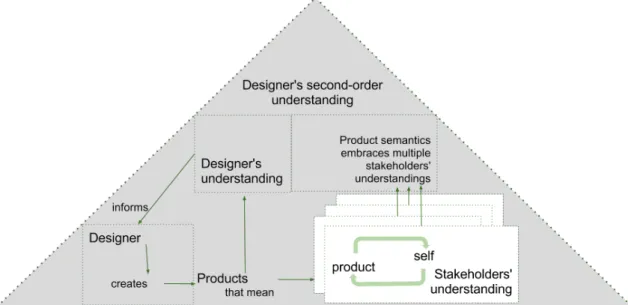
Figure 3. Second-‐order understanding of a designer, an expert, adapted from Krippendorff (2006, p. 67)
In figure 3, the second-‐order understanding of a creative expert is constructed as both the expert’s own understanding and other people’s understandings are joined and enriched through product semantics, including the stakeholders’
(customers’/consumers’) understandings and meanings.
Human-‐centred experts need to understand other people’s (e.g., customers’ or consumers’) understanding, whilst designing useful services for them. Second-‐order understanding, which arises from product semantics, is an essential part of the professional skills of experts; it belongs to their toolkit. Further, in the experts’ cooperation networks, projects, etc., the experts need to understand each other’s understanding; this brings us to the communication and interaction between experts. They have to be in dialogue and interaction to reach a joint understanding which equals more than just one individual’s personal understanding.
Human-‐centredness requires concrete human interaction. For example, experts need to communicate face to face with their customers /consumers/ end users in order to learn to understand their understanding. Experts also need to communicate and interact smoothly with each other in design cooperation.
2.2 On the relationship-‐constructed perspective
The above-‐presented requirement of smooth mutual communication and interaction in people’s cooperation gives us the opportunity to realize that different people have
different understandings. It takes us to the relationship-‐constructed perspective (Mantere, 2008; Tienari & Meriläinen, 2009).
Second-‐order understanding is associated with the relationship-‐constructed perspective and constructivism, which were already touched upon in the introduction. According to them, reality is constructed socially (Tienari & Meriläinen, 2009, p. 116) (Berger et al., 1995, pp. 11-‐39) and there are many realities (2009, p. 116). Tienari and Meriläinen (2009, p. 117) describe how knowledge is constructed in relationships between people, where they share the surrounding reality with each other.
Tienari and Meriläinen (2009, p. 113) go on to argue that a grounded view is always based on a perspective involving a way of conceiving the world (ontology), a conception about how information can be acquired about the world (epistemology), and a
conception about what means and forms of knowledge acquisition are possible
(methodology). Tienari and Meriläinen are active in the field of corporate management and organization studies. They write about two perspectives on management and organization, and compare them with each other. They summarize (2009, p. 116) the two perspectives – the relationship-‐constructed and the individual-‐centred in the table below, in which the differences are summarized very concisely. This table also presents the basis of the constructivist reflections about communication in the present thesis.
Relationship-‐constructed perspective
Individual-‐centred perspective
What is the nature of reality?
(Ontology) ● Interpreted (subjective)social realities
● Many realities that are constructed constantly
● An objective reality
● One reality that is permanent and independent of the researcher What is the nature of knowledge?
(Epistemology) ● Knowledge is created inhuman relationships
● Researcher and research object affect each other
● Research constructs different interpretations and versions of the world
● Individuals possess the knowledge
● Relationship between researcher and research object is neutral
● Research reflects the real world
What means and forms of
knowledge acquisition are possible (Methodology)
● Qualitative: creating data that help us to understand the unique nature of the research objectives (phenomena)
● Quantitative: gathering objective data that can be analysed statistically and used as a basis for establishing regularities and making
generalisations.
The above summary of the relationship-‐constructed perspective is worth remembering whilst explaining Klaus Krippendorff’s constructivist reflections on communication. 2.3 Constructivist reflections on communication
Krippendorff (1993, pp. 1—16) illustrates the concept of second-‐order understanding, and especially its uses in communication studies. The “reality” (ontology) of
communication is constructed on the different metaphors of communication people use. The metaphors are numerous and they reflect people’s different ways of understanding communication. Krippendorff’s constructivist reflections, the concept of second-‐order understanding in particular, indicate towards an epistemological thinking based on the premise that knowledge about communication is constructed by amalgamating people’s different understandings about communication. As a communication analyst,
Krippendorff has made the methodological choice to use second-‐order understanding as a tool for thinking and working. His own understanding is also constructed on other
people’s understanding. The different understandings enrich each other, build on each other, and equal more together than the individual understandings would equal
considered distinct from each other.
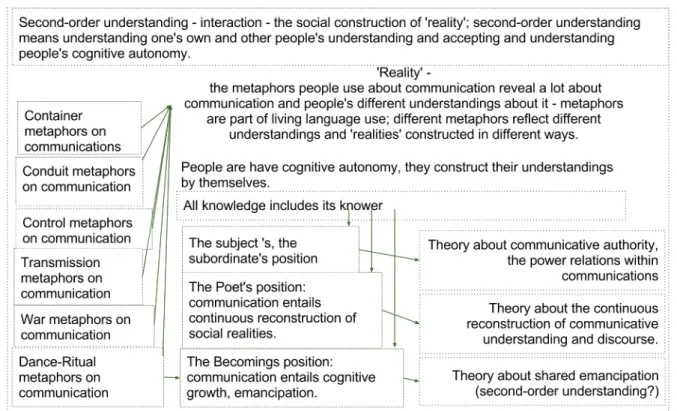
Figure 4. A visual summary of Krippendorff’s (1993) themes
The above figure is an interpretation of Krippendorff’s thinking up to the point where he suggests (1993, pp. 14—16) three preliminary constructivist theories about human
communication. These theories can be seen on the lower right corner of the figure and arise from Krippendorff’s (1993, p. 15) three knowledge positions. The knowledge
positions are the ones presented in the middle of the figure: the Subjects’ or the subordinates’ position, the Poets’ position and the Becomings position. They emerge from Krippendorff’s (1993, p. 14) idea according to which all knowledge includes its knowers.
The framework of second-‐order understanding entails the acceptance and
understanding of people’s cognitive (intellectual learning) autonomy (people construct their understandings by themselves) (Krippendorff, 1993, pp. 11—12). In
communication, second-‐order understanding is constructed on those multiple realities that, in turn, are constructed of the linguistic metaphors people use (1993, pp. 3—10). The six metaphor categories established by Krippendorff are seen on the left in the above figure. His overview (1993) constitutes interesting reflections about people’s communicative understanding and the theoretical framework of communication from the perspective of second-‐order understanding in particular. Drawing on second-‐order understanding, he outlines a basis for a researcher’s knowledge acquisition, which I find highly useful.
Krippendorff (1993, p. 1) adopts the premise that people’s linguistic metaphors, metaphors about communication, represent their different understandings and “realities” about communication, constituting valuable data for researchers. As a researcher, Krippendorff (1993, p. 11) uses the metaphors people use to increase his own understanding about communication. He believes this is important, labelling the way people amalgamate other people’s understanding into that of their own as second-‐order understanding (1993, p. 11). According to this view, second-‐order understanding is at the core of the social phenomenon investigated, i.e. communication, based on the awareness of the different understandings people associate with it (1993, p. 11).
Krippendorff (1993, pp. 3—10) describes, in his article, six different metaphor categories in which people’s linguistic metaphors fall. He establishes six metaphor categories (1993, pp. 3—9); the container, conduit, control, transmission, war, and dance-‐ritual metaphors that reflect people’s different understandings, i.e. “realities” about communication.
On container metaphors — Krippendorff cites Michael J. Reddy’s article (Reddy, 1979, pp.284—324, 1993, p. 3), describing how our everyday thinking is dominated by the idea that messages contain something: thoughts, information, instructions,
meanings, feelings, etc. Krippendorff (1993, p. 3) goes on to claim that similar thinking used to dominate communication research, as well. He says (1993, p. 4) container metaphors entail the idea that communication contents have objective, measurable qualities — the illusion prevails that communication contents are material by nature, as it were. For example, we “get something from a course” or “receive fragments of
information”, “write a piece of news” or ”compile data”. Container metaphors also entail the idea of communication as transportation. We can, e.g., talk about problems in the transportation of communication contents: thoughts, feelings, meanings,
information, etc. from one place to another. The expression “the message got lost on the way” is a good example of this. In our everyday interaction, when we say “you just don’t understand”, we mostly mean “you don’t understand the way I do”. We may feel the urge to find out whether we have something in common with a person we haven’t known before. We may conclude, after we have lived through the same events with another person, that we have a shared experience, history, or background. The idea of sharing is, in fact, a logical conclusion of the container metaphors on “good”
communication. Sharing is a result of exposure to the ’same’ messages and provides an explanation to ’common’ knowledge, similar values and thoughts (1993, p. 4).
For example, the following two comments made by experts in my background setting survey could be interpreted as examples of container metaphors – and as conduit metaphors which I will be discussing next:
”In general I am flooded with emails. This form of communication is overused.”
(An expert’s answer to an open-‐ended question in the Google background survey, January 2010)
”There is a very heavy reliance on the email as a communication channel – so much so that many of the messages get lost on the way.” (An expert’s answer to an open-‐ended question in the Google background survey, January 2010)
On conduit metaphors — According to Krippendorff (1993, p. 5), the conduit metaphors of communication developed at the end of the 19th century, at the time when the telegraph and telephone were invented. The thought that communication contents which had been previously considered almost material could suddenly be transferred through wires produced linguistic expressions referring to different communication channels, their problems and capacities, etc. Human communication turned into a multi-‐channel phenomenon (1993, p. 5). The conduit metaphors also include expressions like ‘the information highway’, ‘bandwidth’ or ‘communication bottlenecks’ (1993, pp. 5—6). Krippendorff (1993, p. 6) points out that the conduit metaphors resemble container metaphors. However, they are distinguished from each other by, e.g., the fact that conduit metaphors focus on the constant flow of message transportation, while in container metaphors, the focus of attention is on the
transportation of individual message contents (1993, p. 6).
”On the other hand instant messenger is a good form of communication in many cases.” (An expert’s answer to an open-‐ended question in the Google background survey, January 2010) ”The inconsiderate growth of FYI communications hinders the transmission of the right and essential messages; and it does not lead to reactions, activity”. (An expert’s answer to an open-‐ended question in the Google background survey, January 2010)
”The use of emails has grown wild, everyone defines their mailing lists by themselves; people keep adding and deleting people from the message chains according to their own tastes.
No-‐one is certain about which matter concerns whom.” (An expert’s answer to an open-‐ended question in the Google background survey, January 2010)
The two above comments could imply conduit metaphors; yet, they also contain clear judgments about the interactive skills of the people using the communication
instruments (or channels). My use of the concept ‘interactive skills’ could be considered, in Krippendorff’s terms, to imply a control metaphor — a metaphor category that will be introduced next.
On control metaphors — Krippendorff (1993, p. 6) claims that the communication metaphors that refer to communication control date back to the Sophists, who valued credible argumentation more than responsibility and the truth. Control metaphors also entail the idea of cause-‐and-‐effect relationships. For example, we may say that the ‘weather report caused the university to cancel lectures’, or that ‘watching TV affects students’ grades’. Likewise, we may say that someone was ‘unable to resist another person’s argument’. Claims about successful and unsuccessful communication are often based on control metaphors. We frequently talk about controlling communication,
communicative skills, techniques and efficiency (1993, pp. 6—7). The following comment to an open-‐ended question in the survey would seem to indicate towards both control and container metaphors:
”The top-‐down communication (directors-‐decision-‐makers-‐employees) has not run very smoothly in the project. You have not always been able to know whether your message has been received/ noted. Occasionally, the messages have not been transmitted smoothly to the lower levels. It seems as if the project has several different managers/ leaders of different subjects/ teams on different levels (leaders of leaders, etc.), sometimes the flow of
information has stopped just a couple of levels before yourself.” (An answer to an open-‐ended question in the Google background survey, January 2010)
According to Krippendorff (1993, pp. 7—8), transmission metaphors come from
cryptography, where the purpose was to encode, encipher understandable messages into a secret code, ‘cipher’ and, respectively, deciphering the message, decoding it back to an understandable form. Cryptography originated in the communication of secret communities; it has been used in wars, and encryption techniques are currently used to protect, e.g., electronic business and financial communication (1993, p. 8).
Krippendorff refers to Claude E. Shannon and Warren Weaver (Weaver & Shannon 1949, 1993, p. 8), citing people’s roles as senders, translators, interpreters, and receivers. Transmission metaphors are in radical contrast with container and conduit metaphors, since they represent meanings as being formed on the basis of people’s understanding, rather than being based on the idea of messages being transferred as such, as in the container and conduit metaphors (Krippendorff, 1993, p. 8). Transmission metaphors are based on people’s cognitive responsibility as senders of messages and receivers of messages alike. In transmission metaphors, communication is seen as ’reproduction’; and an everyday synonym of ‘decoding’ is ‘interpretation’ (1993, p. 8)
More or less pure examples of thinking in terms of transmission metaphors can be found in Linda S. Henderson’s papers on communication research (2004; 2008) ‘Encoding and decoding communication competencies in project management — an exploratory study’ and ’The Impact of Project Managers’ Communication Competencies: Validation and Extension of a Research Model for Virtuality, Satisfaction, and Productivity of
Project Teams’. However, these papers also contain themes that indicate towards, e.g., control metaphors. The following answer to an open-‐ended question in the background survey would also seem to indicate transmission metaphors.
“The most important factor in successful communication is that you understand the message and that you take the message into account in a project, i.e. you take the responsibility for handling/answering the activating messages that you face.” (An answer to an open-‐ended question in my background survey on Google, January 2010)
On war metaphors — Krippendorff (1993, pp. 8—9) believes the British tradition of public debating has provided ground for a conception of communication as a kind of war. He cites George Lakoff and Mark Johnson (Lakoff & Johnson, 1980, p. 4, 1993, pp.
8—9); listing a number of familiar everyday expressions “Your claims are indefensible. He attacked every weak point in my argument. His criticisms were right on target. If you use that strategy, he’ll wipe you out. He shot down all of my arguments”.
Krippendorff (1993, p. 9) says war metaphors are badly adapted to interactive situations that are not about gaining or losing something. They may lead to unnecessary
self-‐assertion, dominance over others, or demonstrations of power over others. Further, they may not necessarily have to do anything with the issues or problems people try to solve by communicating (Krippendorff, 1993, p. 9). The following comment in the background survey could serve as an example or war metaphors – and dance-‐ritual metaphors, which I will be introducing next.
”In Web10 the working and coordinating communication is at a high level in my opinion. People focus on the subject matter and dealing with it, avoiding ’blocks’ and defending their own positions.” (An answer to an open-‐ended question in the Google background survey, January 2010)
On dance-‐ritual metaphors — Krippendorff (1993, p. 9) claims a good example of dance-‐ritual metaphors is the concept of conversation. Its etymological roots are found in the Latin verb ‘conversari’, which means, e.g., ‘to live’, ’to keep company’, ‘to become engaged ‘or ’occupied’, or ’to move around’. The purpose of conversation is to keep it going (Krippendorff, 1993, p. 9). Krippendorff (1993, p. 10) goes on to discuss the continuous, repetitive, cooperative, and communal quality of the dance-‐ritual metaphor. He states that conversation becomes bad when it turns into a monologue. He also claims that what is essential in dance-‐ritual metaphors is that they entail just participants, rather than winners, losers, or managers in a conversation. Even the role of a “master of ceremony” is part of the ritual. “Communication, interaction as a