with Quasars Selected by both Color and Variability
A Thesis
Submitted to the Faculty
of
Drexel University
by
Christina M. Peters
in partial fulfillment of the
requirements for the degree
of
Doctor of Philosophy
This work is licensed under the terms of the Creative Commons Attribution-ShareAlike license Version 3.0. The license is available at
Acknowledgments
First, I would like to express my sincere gratitude to my advisor Gordon Richards for his continuous
support of my research. His guidance, patience, and motivation have helped me immensely in my
Ph.D. work and I couldn’t have asked for a better mentor.
To the rest of my thesis committee: Beth Willman, Luis Cruz Cruz, Michael Vogeley, and Steve
McMillan, I offer my sincere appreciation for the insightful comments and encouragement they
provided.
This research could not have been accomplished without my fellow graduate students. Thank you
for the stimulating discussions, bug checking line after line of code, and many coffee trips.
I will always be very grateful to Saint Thomas Aquinas Catholic Community, my incredibly
support-ive South Philadelphia home. Your encouragement when the times got rough is much appreciated.
Many thanks to my cycling teammates for all of the long rides and fast sprints that helped me stay
balanced while writing this thesis.
Finally, to my parents and my brother for supporting me throughout my many years in school. My
Table of Contents
List of Tables . . . v List of Figures . . . vi Abstract . . . xiii 1. Introduction . . . 1 2. Data . . . 11 2.1 SDSS Stripe 82 . . . 112.2 Master Quasar Catalog . . . 12
2.3 Classification Parameters: Colors . . . 13
2.4 Classification Parameters: Variability . . . 15
3. Classification . . . 24
3.1 Test Set and Training Sets . . . 24
3.2 NBC KDE Algorithm . . . 25
3.3 Testing Classification Parameters . . . 28
3.3.1 Classification Using Color . . . 28
3.3.2 Choosing Optimal Classification Parameters . . . 29
3.4 Building a Quasar Candidate Catalog . . . 34
3.4.1 Classifying the Test Set . . . 35
3.4.2 Classification using Redshift Bins . . . 35
4. Redshift Estimation . . . 41
4.1 Astrometry . . . 41
4.2 VISTA Hemisphere Survey . . . 48
4.3 Photometric / Astrometric Redshifts . . . 49
4.4 Smoothing Probability Density Functions . . . 51
4.5.1 LSST OpSim and MAF . . . 61
4.5.2 Fitting OpSim Data . . . 63
4.5.3 Results . . . 64
5. Catalog . . . 68
5.1 Self-Assessment of the Catalog . . . 68
5.2 Comparing to other Cuts and Catalogs . . . 72
5.2.1 Comparison to Other Variability Based Selection . . . 72
5.2.2 BOSS Quasar Selection . . . 75
6. Quasar Luminosity Function. . . 76
6.1 Number Counts . . . 76
6.2 Binned Luminosity Function . . . 76
6.3 QLF Evolution as a function of SED . . . 80
7. Future Work and Conclusions . . . 91
7.1 Future Work . . . 91 7.1.1 Bayesian Approach to QLF . . . 92 7.2 Conclusions . . . 96 .1 Catalog Columns . . . 99 Bibliography . . . 102 Vita. . . 111
List of Tables
2.1 Master Quasar Catalog . . . 12
3.1 NBC KDE Results - Self Test Non-quasar and Quasar Fraction . . . 30
3.2 NBC KDE Results: Self Test Completeness and Efficiency . . . 30
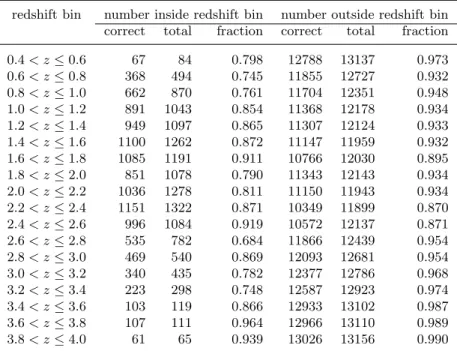
3.3 NBC KDE Results: Test Set Classification of Spectroscopically Confirmed Quasars . . 40
4.1 Redshift Estimate Statistics . . . 51
4.2 Smoothing Parameters for Redshift Probability Distributions . . . 57
4.3 Simulated Survey Datasets from the LSST Operations Simulator (OpSim) . . . 65
5.1 Quasar Candidates . . . 69
6.1 SED Groups . . . 86
List of Figures
2.1 Distribution of quasars and non-quasars in two SDSS color spaces from the coadded photometric catalog (Annis et al., 2014). Non-quasars (orange contours), such as stars and compact galaxies, are considered contaminants when trying to accurately classify quasars (cool colors). Notice the overlap of non-quasars in the region in which mid-redshift quasars (2.2< z <3.5; dark blue contours and scatter points) lie. This overlap makes it difficult to accurately classify an object in this region as a quasar or non-quasar, and motivates searches for alternative methods of classification, like variability. Quasars in three redshift ranges are shown: low-redshift (z < 2.2; green contours and scatter points), mid-redshift, and high-redshift (z >3.5; light blue dots). The extension of the non-quasar color space atg−r∼1.4 is not real, but an artifact of including objects with largeu-band photometric errors (and thus spilling into the true quasar parameter space). 14 2.2 g and u-band light curves (left panel) and g-band structure function fit with a power
law model (right panel) of SDSS J013417.81-005036.2, a redshift 2.26 quasar from SDSS Stripe 82 (also shown in Figure 4.5). This quasar is shown as an example representative of the data set. Left panel: There are 126 total observations in the g-band; 106 of those meet the PSF-width and airmass requirements (green points with error bars), while those that were removed are shown in orange. The dark green dashed line is the running median (with a window of 50 days and steps of 5 days) calculated from theg-band observations. Theu-band observations are similarly shown in blue and red. Right panel: The pairs of photometric points from the g-band light curve in the left panel are shown as a hex-bin density plot where the darkness of the hex bin indicates the number of points in that bin. The power law fit is shown as a green line. The method for calculating the structure function and the equation used to fit the structure function are detailed in Section 2.4. In the case of this object, the fitting algorithm gives Ag = 0.105 and γg = 0.102. The
points removed as outliers in the left panel would only contribute|∆m|>0.25 mag values. 16 2.3 Quasar and non-quasar data sets in variability parameter space for the g-band
observa-tions. Note that, unlike in the color-color plots in Figure 2.1, there are no distinct changes in the variability features as a function of quasar redshift in this parameter space. This is advantageous because it allows separation of the quasars from the non-quasars in the variability space without extreme changes in completeness at specific redshifts, as seen with color selection. Non-quasars, such as stars and normal galaxies, are shown in or-ange contours. Quasars are shown in cool colors as three redshift regions: low-redshift (z < 2.2; green contours and scatter points), mid-redshift (2.2 < z < 3.5; dark blue contours and scatter points), and high-redshift (z >3.5; light blue dots). . . 21 2.4 All spectroscopically confirmed quasars shown in A vs. γ space in each of the SDSS
bands, colored by redshift. This figure demonstrates the difficulty involved in combining the observations in all five bands to obtain one light curve and one structure function in order to describe the overall variability without previously knowing the object’s redshift. Note how the distribution of points shifts with band and with redshift. In particular, A
andγvalues agree well in theg,r, andiband, but the large photometric errors inuand
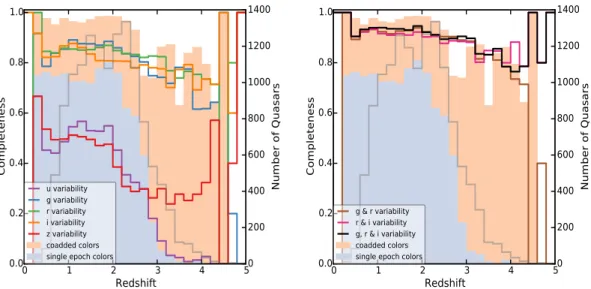
3.1 Fraction of quasars correctly classified as quasars (completeness). These panels demon-strate that quasars can be separated from non-quasars in the variability space without extreme changes in completeness at specific redshifts. In both panels the gray line shows the number of quasars in each bin (right axis) and light blue (single epoch) and peach (coadded epochs) histograms show the completeness of color-only selection (left axis, Sec-tion 3.3.1). Note the catastrophic loss of high-zquasars from single-epoch colors and the incompleteness atz∼2.8 even for coadded colors. Also showm is classification from vari-ability only: single bands (left panel) and combinations of multiple bands (right panel). The g, r, and i bands are shown as blue, green, and orange lines respectively. There are no dramatic drops in theg−,r−, ori−bands variability at distinct redshifts, just a gradual decline with increasing redshift, which is related to observed magnitude, signal to noise ratio, and time scale of variability in the observer’s frame. The overall completeness using variability alone is not as high as coadded colors alone at low redshifts, but is more successful than single-epoch colors alone at high redshifts. . . 31
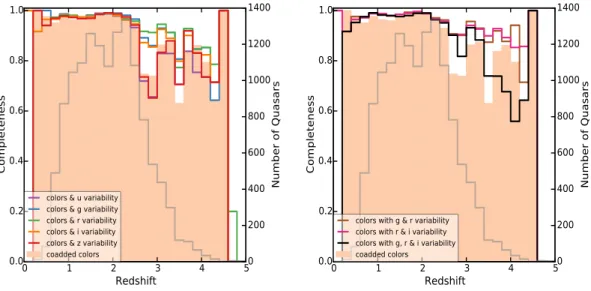
3.2 Fraction of quasars correctly classified as quasars using coadded colors and variability, as a function of redshift. Notice the improved completeness near redshifts 2.7 and 3.5, where the quasars and non-quasars overlap in color space, with the addition of variability features. Shown are single bands of variability combined with coadded colors (left panel) and combinations of multiple bands of variability combined with coadded colors (right
panel). In both panels the gray line shows the number of quasars in each bin (right axis). 32
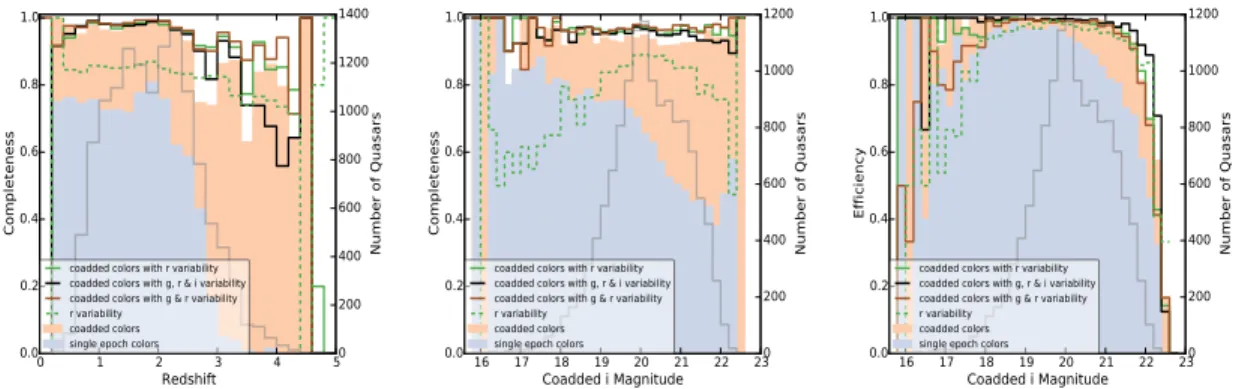
3.3 Comparison of self tests using with different combinations of color and variability. These panels demonstrate that the combination of color and variability gives the best results for completeness and efficiency as a function of redshift and magnitude with more details in the text. Shown are the completeness (known quasars classified as quasars divided by known quasars) as a function of redshift (left panel), completeness as a function of coadded i-band magnitude (center panel), and efficiency (known quasars classified as quasars divided all objects classified as quasars) as a function of coadded i-band magnitude (right panel). The gray line shows the number of quasars in each bin (right axis). . . 33
3.4 Color and variability parameter space plots showing the results of test set classification using a single quasar training set covering the full quasar redshift range (Section 3.4.1). These panels demonstrate that the incorrectly classified quasars lie in the area where quasars and non-quasars overlap in color and variability space and that the candidate quasars closely mirror the distribution of the known quasars and extend slightly beyond in the parameter space (including a region known to be inhabited by white dwarfs in the blue corner of the upper right panel). Colors left panel: u−g color vs.g−r,colors
right panel: g−r vs.r−i, variability left panel: Ag vs. γg, and variability right panel:
Ar vs.γr. Objects in the test set classified as non-quasars are shown as gray contours,
quasar candidates that are not spectroscopically identified are shown as green contours and scatter points for outliers, spectroscopically identified quasars classified as quasars are shown as orange contours and scatter points for outliers, and spectroscopically identified quasars incorrectly classified as non-quasars are shown as purple dots. The red dashed line in the upper right panel is the white dwarf cut described in Eq. 5.3. Levels for contours in Figures 3.4 and 3.7: gray: colors - 95%, 90%, 80%, 60%, 40%, 20%, variability - 98%, 95%, 90%, 80%; green: colors - 90%, 80%, 60%, 40%, 20%, variability - 90%, 80%, 60%; orange: 90%, 80%, 60%, 40%, 20%. . . 36
3.5 Classification of a test set of quasars with known spectroscopic redshifts, using the train-ing sets divided into redshift bins. Dark blue indicates all quasars in that bin, light blue indicates quasars classified with the correct redshift. The ratio of the two is the completeness of quasars inside the redshift bin. . . 38
3.6 Comparison of spectroscopic redshift to the bin into which known quasars were classified with the highest probability. Left panel: Spectroscopic redshift vs. the most probable redshift bin. Right panel: Histogram of ∆z (the most probable redshift bin minus the spectroscopic redshift). Only 5.6% of the quasars have|∆z|>0.5 . . . 38 3.7 As Figure 3.4, color and variability space plots showing the results of test set classification,
but using redshift bins (described in Section 3.4.2). In the bottom panels, the selection in variability parameter space shows no noticeable difference to Figure 3.4, which is not surprising as Ag vs.γg andAr vs.γr have no strong redshift trends. However, there are
slight differences in color space (top panels). This is discussed further in Section 5.1. . . 39
4.1 The SDSS filter curves (u- purple,g- green,r- light green,i- orange, andz- red) shown with the Vanden Berk et al. (2001) SDSS composite quasar spectrum at four different redshifts. . . 42
4.2 The effective wavelength of each of the SDSS filters as a function of the composite quasar spectrum’s redshift. The dashed line in each panel is the nominal effective wavelengths of the SDSS bandpasses for a flat-spectrum source (3551, 4686, 6165, 7481, and 8931 ˚A). 43
4.3 The difference between the angular deflection of an incoming photon for the composite quasar spectra and the pipeline correction in each of the SDSS filters. Shown for four different airmasses: 1.00 (solid grey line, no offset because this is at the zenith), 1.10 (dotted line), 1.25 (dashed line), and 1.40 (solid colored line). . . 44
4.4 Tangent of the zenith angle (Z) vs. offset in position along the parallactic angle in the
u-band [left] and g-band [right] for quasars at a range of redshifts. This shows multiple epochs of observations at different airmasses (where airmass ∼secZ). . . 46 4.5 The measured astrometric offset along the parallactic angle as a function of tan(Z).
Shown is SDSS J013417.81-005036.2, a redshift 2.26 quasar from SDSS Stripe 82, the same object shown in Figure 2.2. This quasar is shown as an example that is representative of the data set. Each point refers to a different observation of this object, at a different airmass. The astrometric accuracy is ∼0.03 arcsecs forg <20.0, but up to 0.1 arcsecs for g ∼ 22.0 (Pier et al., 2003). u-band observations are shown in blue; those points that were outliers removed from the light curve in Figure 2.2 are shown in red. g-band observations are shown in green, with outliers removed from the light curve shown in orange. The fits, shown as solid blue and green lines, have an y-axis intercept of zero. For this quasar, the slope of the line (offset along the parallactic angle) in the u-band (auP ar) is -0.055 andg-band (agP ar) is 0.105. The astrometric redshift is found to be 2.57. . . 47
4.6 Slope of the line (offset along the parallactic angle) with respect to redshift in theu-band (auP ar) andg-band (agP ar) as a function of redshift for the quasar sample (left panel) and as a function of magnitude for non-quasars (right panel). Left panel: While the changes in these astrometric parameters are not as strong as the changes in color with redshift, they provide another source of redshift information. Right panel: The differences between the distributions in the left panel and right panel can aid in the separation of quasars from non-quasars. For example, objects with large negative values ofauP arare more likely to be non-quasars than quasars. . . 48
4.7 Spectroscopic redshift vs. photometric redshift in hex bins with logarithmic gray scale, using (top left panel) optical colors (both single epoch and coadded, when available), (top
right panel) astrometry as described in Section 4.1, (bottom left panel) optical and NIR
adjacent colors, and (bottom right panel) combined optical and astrometry as described in Section 4.4. This illustrates those redshifts where the algorithm has the largest error rate (either due to degeneracy between distinct redshifts or smearing of nearby redshifts). 52
4.8 Histogram of the difference between spectroscopic redshift and estimated redshift. Note how the distribution tightens toward ∆z = 0.0 from the SDSS color photometric redshifts to the astro-photometric redshifts. Shown are optical colors (green), combined optical and astrometry as described in Section 4.4 (purple), and optical and NIR adjacent colors (orange). Shown in solid black is the histogram of classification in redshift bins from Figure 3.6. . . 53
4.9 Truth set of quasars divided into six bins to determine optimal smoothing. The bins were chosen empirically based on the shape of the photometric redshift PDFs which are shown in the following Figure. . . 55
4.10 Photometric redshift PDFs for 100 randomly of quasars from each of the bins shown in the preceding figure. The vertical gray line is the spectroscopic redshift of each quasar. The y-axis scale in each subplot is identical. The bins were chosen empirically to have quasars with PDFs of similar shapes. . . 56
4.11 Representative quasars from each of the bins to demonstrate optimal smoothing of the photometric and astrometric redshift PDFs. The green lines indicate the original and smoothed photometric redshift PDF. The vertical green line is the peak of the smoothed PDF. The astrometric PDF is similarly shown in purple. The product of the PDFs is shown in red, with the peak indicated by a vertical line. The spectroscopic redshift is shown as a vertical black line. . . 58
4.12 Optimal smoothing of the photometric redshift [x-axis] and astrometric redshift [y-axis] PDFs for each of the bins. The minimum value of ∆z is indicated as a white dot and this value ofσphotandσastromis used for all quasars in that bin. . . 59
4.13 Spectroscopic redshift vs. photometric redshift shown in orange under spectroscopic red-shift vs. astro-photometric redred-shift shown in gray. . . 60
4.14 Normalized histogram of spectroscopic redshift in panels based on bins of photometric redshift from 0.3 to 5.0 in the same bins as the luminosity function in Section 6.2. These panels demonstrate which photometric redshift ranges are most unreliable and most reli-able. Photometric redshifts were calculated using SDSS colors (green), SDSS colors and astrometry (purple), and SDSS and VHS colors (orange). In particular, note the bimodal distribution at 0.68< zphot<1.06 compared to the precision at 1.06< zphot<1.44 and
3.0 < zphot < 3.5. This bimodality is caused by degeneracies in color-redshift space.
Systematics in photometric redshift errors are corrected when calculating the quasar luminosity function in Section 6.2 . . . 62
4.15 Example linear fits of the measured astrometric offset along the parallactic angle as a function of tan(Z) forz = 0.8 and 2.2 quasars in theu-band [left] andz = 0.4 and 0.8 quasars in the g-band with 20 observations from airmass 1.0 to 1.95. Error bars are 20 mas. The semi-transparent lines illustrate the fits from various MCMC ensemble walkers. 64
4.16 The distribution of fits from the MCMC forz= 0.8 and 2.2 quasars in theu-band [left] andz= 0.4 and 0.8 quasars in theg-band [right]. The K-S statistic and p-values indicate that the quasars at these redshifts could be distinguished using DCR alone with enough observations. . . 64
4.17 Sky map of the p-value comparingz= 0.4 and 0.8 ing-band with an airmass limit of 1.3 after 1 year [left], with an airmass limit of 2.0 after 1 year [center], and with an airmass limit of 1.3 after the full survey [right]. The sky map has a resolution of∼27.5 arcmin. 65 4.18 Max airmass [left column], number of observations [center column], and p-value forz=
1.0 and 1.4 quasars [right column] for the baseline cadence in theu-band after one year [top row],g-band after one year [middle row], andg-band after survey completion [bottom row]. Sky map has a resolution of∼27.5 arcmin. . . 67 5.1 Stacked histogram of redshift for known Stripe 82 quasars and new quasar candidates.
Left panel shows the quasars and candidates i < 19.9 and right panel shows i > 19.9.
Spectroscopic quasars found as quasar candidates and spectroscopic quasars missed are both binned by spectroscopic redshift. Quasar candidates found by both methods and quasar candidates found only using a binned quasar training set are both binned by where the candidate was classified with the highest probability. These bins only span 0.4 < z < 4.0. Quasar candidates found only using a quasar training set over the full redshift range are binned by the astro-photometric redshift. . . 72
5.2 Histogram of coadded i band magnitude for known Stripe 82 quasars and new quasar candidates. In purple are the previously known, spectroscopically confirmed quasars returned by the selection. The quasar candidates returned by the selection are shown in orange and the new quasar candidates are shown in green. . . 73
5.3 Ar vs. γr for the training sets (left panel) and test set (right panel) shown with the
Schmidt et al. (2010) variability selection cuts (Equations 5.4 - 5.6) as gray lines. Left
panel: Orange contours show the non-quasar training set and purple contours and scatter
points show the quasar training set. Right panel: Gray contours show all objects in the test set classified as non-quasars and green contours and scatter points show all objects in the test set classified as quasars. . . 74
6.1 Left panel: Ratio of MQC quasars returned by classification (using a training set over the
full redshift range) to all those in the MQC on Stripe 82. This ratio allows for a correction due objects with too few observations to calculate variability features, the exclusion of extended sources, and incompleteness in the selection algorithm. The fraction is given as a function of coaddedi-band magnitude for two redshift ranges. Right panel: Quasar number counts as a function of redshift and i-band magnitude. Black points give the spectroscopic number counts reported in Richards et al. (2009a); circles forz <2.2 and triangles for 3< z <5. The open purple and green squares give the raw number counts (with Poisson error bars) for the candidates reported here. The filled colored squares give the number counts corrected using the left panel. The vertical dashed red line at
6.2 Corrections and cuts used in the QLF in Figure 6.3. Left panel: Completeness fraction, in bins of redshift and absolute magnitude,Mi[z= 2], for candidate selection. Similar to
Figure 6.1left panel, but in two dimensions. The number of quasars with spectroscopic redshifts on Stripe 82, even if they were excluded from the training set and test set, was divided by all quasars with spectroscopic redshifts that were recovered as candidate quasars. This is to correct for incompleteness from too few observations to calculate variability features, the exclusion of extended sources, and incompleteness in the classi-fication algorithm. Center panel: Completeness fraction for astro-photometric redshifts. All of the training set quasars are binned by spectroscopic redshift (purple) and astro-photometric redshifts (green). The ratio of the two is shown in grey (right axis). The astro-photometric redshifts of the candidate quasars, after being corrected by the com-pleteness fraction and assuming that objects without spectroscopic redshifts have the same astro-photometric redshift errors as those with spectroscopic redshifts, are shown in purple. Right panel: Astro-photometric redshift vs. absolute magnitude,Mi[z= 2], of
all quasar candidates. The green line shows the brightness limit for bins that are used in computing the luminosity function. Purple curves show the i= 15.0, 19.1, and 21.0 magnitude limits. . . 79
6.3 Mi[z= 2] binned luminosity function of the sample with astro-photometric redshifts using
the method from Page & Carrera (2000) (with Poisson error bars). The mean redshift of each slice is given in each panel. Black filled circles are complete bins, empty triangles indicate the lower limit for complete bins where the completeness fraction (shown in Figure 6.2 left panel) is 0, and empty circles are partial bins (a portion of the bin is dimmer than i = 22). The grey circles show the binned luminosity function and the grey dashed line shows the z = 2.01 curve both from Richards et al. (2006, Figure 18) for comparison. In the z = 2.4, 2.8, and 3.25 panels, the red squares show the binned luminosity function for BOSS quasars from DR9 from Ross et al. (2013, Figure 11). In the 4.75 panel, the green squares, purple squares, and dashed black line show the binned luminosity function at z = 4.9 for Stripe 82, DR7, and double power law fits from the maximum likelihood analysis from McGreer et al. (2013, Figure 12 and Figure 13). . . . 81
6.4 Distribution of the weights for the first three components (W1, W2, and W3) for the
quasar spectra (left panel) and the distribution at left normalized after dividing by the component mean (right panel). These differences are small, but they are crucial for making sure that all of the objects are calibrated in the same way. . . 84
6.5 Distribution of the weights for the first three components (W1, W2, and W3) for the
quasar spectra as function of redshift. Shown with the best fit line used for dividing the quasars into groups. . . 85
6.6 The three groups shown as a function of CIV blueshift and equivalent width. The division inW1-W2-W3space separated the quasars in this space with no CIV information used
in the ICA analysis. . . 85
6.7 The three groups as a function of redshift (left panel) and magnitude (right panel). Note that there is a strong difference in the selection function between the Hard and Soft SED groups. . . 86
6.8 Top panel: Spectroscopic redshift vs. absolute magnitude,Mi[z= 2], of all quasar
candi-dates. The green line shows the brightness limit for bins that are used in computing the luminosity function. Purple curves show the i= 15.0, 19.1, and 21.0 magnitude limits.
Bottom panel: Mi[z = 2] binned luminosity function of the full population (black) and
the three equal sized clusters (with Poisson error bars). The mean redshift of each slice is given in each panel. Black filled circles are complete bins, empty triangles indicate the lower limit for complete bins where the completeness fraction is 0, and empty circles are partial bins (a portion of the bin is dimmer than the brightness limit). The colored points are scaled by the number quasars in the group and all points corrected based on the selection function. . . 87
6.9 Top panel: Spectroscopic redshift vs. absolute magnitude,Mi[z= 2], of all quasar
candi-dates. The green line shows the brightness limit for bins that are used in computing the luminosity function. Purple curves show the i= 15.0, 19.1, and 21.0 magnitude limits.
Bottom panel: Mi[z = 2] binned luminosity function of the full population (black) and
the three equal sized clusters (with Poisson error bars). The mean magnitude of each slice is given in each panel. Black filled circles are complete bins, empty triangles indicate the lower limit for complete bins where the completeness fraction is 0, and empty circles are partial bins (a portion of the bin is dimmer than the brightness limit). The colored points are scaled by the number quasars in the group and all points corrected based on the selection function. . . 89
7.1 Normalized photometric redshift PDFs (top panel) and absolute magnitude as function of photometric redshift (bottom panel). The darkness of the line indicates the redshift probability (vertical axis of the top plot). The spectroscopic redshifts for each object are shown as purple points and the peak of the photometric redshift are shown as green points. Note how the gray gradient matches the widths of the spectroscopic redshifts more closely than the photometric peaks, which suggests that this analysis can be improved by using the full PDF of the photometric redshift instead of the peak value. . . 95
Abstract
Exploring the Quasar Luminosity Function with Quasars Selected by both Color and Variability
Christina M. Peters Gordon T. Richards Ph.D.
A non-parametric Bayesian classification selection algorithm was used to demonstrate that a
combination of optical colors and variability features improves quasar classification efficiency and
completeness over the use of colors alone, suggesting that this is a good set of features to use in
classi-fication algorithms for future time-domain focused sky surveys. These features were used to identify
35,820 type 1 quasar candidates in a 239 deg2 field of the Sloan Digital Sky Survey (SDSS) Stripe
82. Color analysis was performed on 5-band single- and multi-epoch SDSS optical photometry and
variability parameters were calculated by fitting the structure function of each object in each band
with a power law model. Using variability alone, colors alone, and combining variability and colors,
quasar completeness of 91%, 93%, and 97% and efficiency of 98%, 98%, and 97%, respectively, was
achieved. Particular improvement was seen in the selection of quasars at 2.7< z <3.5 where quasars and stars have similar optical colors. Of the 22,867 quasar candidates that are not spectroscopically
confirmed, 95.7% are dimmer than coaddedi-band magnitude of 19.9, the cut off for spectroscopic follow-up on Stripe 82. Brighter than 19.9, 5.7% more quasar candidates were found without
con-firming spectra in sky regions otherwise considered complete. In addition to calculating empirical
optical photometric redshifts for all candidate quasars, astrometric redshifts were calculated using
parameters determined by measuring the differential chromatic refraction (DCR) effect with the
purpose of breaking degeneracies in the photometric redshifts. The combined astro-photometric
redshifts are more accurate than optical and near-infrared photometric redshifts. Potential
obser-vation schedules for the Large Synoptic Survey Telescope (LSST) were analyzed to determine how
well quasars of different redshifts can be distinguished using the DCR effect. The resulting quasar
sample has sufficient purity (and statistically correctable incompleteness) to produce a luminosity
and redshift estimation. The quasar luminosity function of a uniformly-selected spectroscopic quasar
sample, grouped according to emission-line properties, suggests that the space density of quasars
with different underlying spectral energy distributions (SEDs) has evolved differently with redshift,
Chapter 1: Introduction
In this work I describe a suite of methods that uses multi-epoch photometry to identify a large
number of quasars, determine their redshift, and study their evolution with redshift and luminosity
without the need of spectroscopy. First, I identify quasars using optical photometry, by
simultane-ously using the distinctive and quantifiable features of color and variability to distinguish quasars
from other types of objects in the sky. As a proof of concept for this method, I classify the objects
in the Sloan Digital Sky Survey (SDSS) Stripe 82 where about 100 repeat observations have been
performed, allowing for study of variability. I identify 35,820 quasar candidates, 63% of which had
not been previously identified. Then, to ensure that the sample is useful for doing science, I have
used a sophisticated statistical method to calculate a photometric redshift (i.e. distance estimate)
based on imaging alone for each of the quasar candidates. To improve upon traditional
photomet-ric redshifts methodologies, I incorporate astrometphotomet-ric information into my calculations, using the
prismatic effects of the Earth’s atmosphere as a low-resolution spectrograph. I discuss how this
can be beneficial in redshift estimates for future large photometric surveys. Finally, I construct the
quasar luminosity function (QLF), which measures the space density of quasars per unit luminosity
and redshift. I compare the redshift evolution of the photometric sample to previous spectroscopic
quasar samples and populations of quasars with different underlying spectral energy distributions
(SEDs).
In 1960, Thomas Matthews and Allan Sandage were searching for the optical counterpart to
a radio source and found a variable point source object whose spectrum had broad emission lines
that did not correspond to any known element or molecule (Matthews & Sandage 1963; Greenstein
& Matthews 1963). Several similar sources were later found, and they were named quasi-stellar
objects (QSOs) or quasars. Later that year, the pattern of emission lines in the quasar spectra
These strange new objects were found to be the most distant objects in the Universe; so far away
that in images the galaxy is not visible just the bright active galactic nucleus (AGN). To be visible
at such distances quasars must be very powerful sources of energy, in fact, they produce ∼105 as
much energy as the Milky Way and are visible out to redshifts∼6.
Since their discovery, quasars have been identified by their colors, variability, and (lack of)
proper motion—but not through all of these methods combined. The standard way of identifying
large numbers of candidate quasars is to make “color cuts” using optical (or infrared) photometry
(e.g., Richards et al. 2002; Croom et al. 2004; Warren et al. 2000; Lacy et al. 2004; Stern et al.
2005; Maddox et al. 2012; Assef et al. 2013). This is because the majority of unobscured quasars at
z <2.5 are much bluer than the majority of stars in the optical and are much redder in the infrared. However, this process is neither complete (identifying all true quasars) nor efficient (minimizing false
positives). Such methods do an effective job of identifying a large number of interesting objects with
relatively little effort; however, better methods are needed to scale to future surveys to allow for
scientific analysis without the need for spectroscopic confirmation.
In addition to classification by color, time-domain data make variability a promising way for
classifying objects. The long history of such work can be followed through Koo et al. (1986), Hughes
et al. (1992), Vanden Berk et al. (2004), de Vries et al. (2005), Sesar et al. (2007), Kelly et al. (2009),
Koz lowski et al. (2010), Schmidt et al. (2010), Butler & Bloom (2011), MacLeod et al. (2010, 2011,
and 2012), and Graham et al. (2014). Specifically, quasars exhibit stochastic, aperiodic variability
with variations of order 10% on the timescale of years (de Vries et al. 2003; Vanden Berk et al. 2004).
The amplitude and time scale of this variability are sufficiently distinctive to allow one to identify
an object as a candidate quasar.
Many current and future astronomical imaging surveys (SkyMapper: Keller et al. 2007;
Palo-mar Transient Factory: Law et al. 2009; Pan-STARRS: Stepp et al. 2010; DES: The Dark Energy
Survey Collaboration 2005; LSST: Ivezi´c et al. 2008) are focusing on time-domain astronomy and in
anticipation, it is important to determine the effectiveness of classification using variability
selection will fill in the gaps in color selection methods (or replace color selection entirely). Indeed,
investigations such as Schmidt et al. (2010), MacLeod et al. (2011), and Butler & Bloom (2011)
have been quite successful. However, variability-only selection suffers from its own set of problems.
For example, high-redshift quasars can be lost when using a fixed observed-frame variability
analy-sis: Lyαabsorption reduces the quasar continuum in blue bands and the redder bands have larger photometric errors for fainter objects. In addition, variability increases with lower luminosity (e.g.,
Vanden Berk et al. 2004), but so does the host galaxy contribution—potentially complicating the
selection of such objects without careful difference imaging to remove the host galaxy
contribu-tion. Thus, it is important to investigate how well variability selection works by itself versus being
combined with other methods (e.g., colors and astrometry).
The first part of this project is to simultaneously use the distinctive and quantifiable
charac-teristics of color and variability to distinguish quasars from stars and inactive galaxies. The Sloan
Digital Sky Survey (SDSS; York et al. 2000) repeatedly imaged a 2.5◦ equatorial section of the sky
referred to as Stripe 821(Abazajian et al. 2009; Annis et al. 2014; Jiang et al. 2014). The light curves
of spectroscopically confirmed quasars and stars from Stripe 82 give us the information needed to
develop and test classification of quasars.
Specifically, color and variability data are used in combination with modern machine learning
techniques to uncover previously unidentified quasars in the SDSS Stripe 82 region and to pave the
way for improved multi-faceted selection in the future. The goal is not necessarily to produce the
most complete or efficient catalog possible but to test the combined use of colors and variability data
in classification. In this investigation, some simplifications are made to the process that could be
explored in more detail in future work. Specifically, this analysis is focuses on point sources to avoid
the problem of the host galaxy washing out the variable nucleus (reducing our sensitivity to
low-redshift quasars), a simple power-law model of variability is used as opposed to more sophisticated
(but not necessarily “correct”) models such as the damped random walk, variability data from each
band is used separately instead of merging them together, and a simplistic approach is taken to
combine photometric redshift information from different methods. Each of these simplifications is
worthy of a separate investigation to determine precisely how much they affect this classification.
A shortcoming of the traditional quasar identification process is that it usually involves selecting
quasar candidates by identifying them as outliers using cutsin the observed data space(e.g., selecting
all point sources withu−g <0.6). My classification instead makessimultaneoususe of all of the data types available and uses modern statistical techniques (based on kernel density estimation; KDE) to
make cuts inprobability space(e.g., objects with an expected quasar probability greater than 50%).
The methods developed by my research group (Richards et al. 2004; Riegel et al. 2008;Richards et al.
2009a; Richards et al. 2009b) and others (e.g., Suchkov et al. 2005; Ball et al. 2006; Davoodi et al.
2006; Gao et al. 2008; Bailer-Jones et al. 2008; D’Abrusco et al. 2009; Guy et al. 2010; Schmidt et al.
2010; Abraham et al. 2012; Bovy et al. 2012; Peng et al. 2012; Gupta et al. 2014) are extended to
create a classification algorithm for time-domain focused sky surveys. While this approach has been
shown to work well in the past (e.g., Richards et al., 2004, 2009a), future work will inevitably explore
other modern statistical techniques such as described by Feigelson & Babu (2012) and references
therein.
The quasar candidates that result from the application of this method are only identified
photo-metrically; they lack spectroscopy which not only would confirm the type of an object, it crucially
also would determine the redshift. Most galaxy and cosmology science requires objects with verified
types and redshifts. Even with the upcoming large spectroscopic surveys, e.g. the Dark Energy
Spectroscopic Instrument2 (DESI; Levi et al. 2013) and Subaru Prime Focus Spectrograph3 (PFS;
Takada et al. 2014), there is not enough follow-up for even a small fraction of the sources that current
photometric surveys will see. Thus, it will be critical to have an alternative to the current practice
of following up on each object to have an accurate redshift.
When calculating photometric redshifts for galaxies, the standard is to fit a suite of spectral
templates to the flux information from the images. When the process fails, it is because there is
some level of degeneracy in the suite of templates. Additionally, the galaxy population has multiple
2desi.lbl.gov 3sumire.ipmu.jp
sub-populations and inherent scatter because not all galaxies of the same type are identical. More
complicated are the galaxies which contain a bright central region caused by an AGN. There are
many sophisticated methods for estimating photometric redshifts (e.g. Rowan-Robinson et al. 2008;
Salvato et al. 2009). Quasar photometric redshifts based on templates have not been shown to work
well, particularly when the AGN component is brighter than the host galaxy component (Assef et al.,
2010). However, empirically based algorithms have been successful. These algorithms essentially
least-squares fit between the candidate quasar colors and the mean colors of quasars as a function
of redshift. In this work the algorithm described in Richards et al. (2001) and Weinstein et al.
(2004) is used, which ranks among the most accurate for (luminous) quasar photometric redshift
estimates. This algorithm, in addition to identifying a most probable redshift, generates a probability
distribution for a continuum of redshifts.
I improve this process further by using the effective prismatic effects of the Earth’s atmosphere as
a low-resolution spectrograph (Kaczmarczik et al., 2009). In short, the apparent positions of quasars,
with their strong emission features, is a function of the pass band and redshift. This behavior of
quasars allows me to uniquely incorporate astrometric information into the photometric redshift
estimates.
As demonstrated in Figure 9 of Kaczmarczik et al. (2009), the astrometric redshift and the
photometric redshift probability distribution functions (PDFs) contain complementary information
about the quasar redshift. The photometric redshifts are more accurate in general, but have
de-generacies, particularly at redshifts 0.4 and 2.0 (Richards et al., 2001). The astrometric redshifts,
when combined, can break these degeneracies. The PDFs are optimally combined by giving them
a relative weighting based on the shape of the photometric redshift PDF. This weighting is done
by smoothing the PDFs before multiplying them. The improvements of these astro-photometric
redshifts are comparable to those from adding infrared detections to the photometric redshifts.
This work provides a stepping stone for quasar classification for future surveys such as the Large
Synoptic Survey Telescope4 (LSST). Eventually, each region of LSST will be imaged about 200 4lsst.org
times in each filter over the ten years of the survey, allowing for the study of the variability on
scales of minutes to a decade. This focus on time-domain astronomy is an exciting new era in
surveys, but the lack of spectroscopy creates a problem for confirming the type of an object. As the
number of spectroscopic fibers allocated to quasar identification pales in comparison to the number
of photometrically detected objects that merit spectroscopic follow-up, it is only through complete
and efficient object classification coupled with accurate redshift estimates that we can overcome
the lack of spectroscopy in LSST and other future astronomical surveys and maximize their science
output.
The LSST Operations Simulator (OpSim) and Metric Analysis Framework (MAF) make it
pos-sible to determine how effective the telescope and processing pipeline will be at reaching the various
science objectives of the telescope. Multiple OpSims have been produced by the LSST Collaboration
with deviations from the current baseline cadence for the survey. The MAF software package allows
interested parties to interact with the OpSims to determine how well a given cadence will allow them
to do their science with the future LSST data. In this work, I present a MAF to evaluate how well
LSST will be able to constrain quasar redshifts using astrometric data alone.
Identification of large numbers of quasars/AGNs over a broad range of redshift and luminosity
is crucial for many scientific endeavors. Work that requires a greater density of objects than current
spectroscopic surveys provide includes cross-correlating the catalogs with the cosmic microwave
background (Giannantonio et al., 2008) to constrain dark energy; using quasars to measure cosmic
magnification (Scranton et al., 2005); finding binary quasars which can be used to test the merger
hypothesis of quasars (Hennawi et al., 2010); finding gravitationally lensed quasars (Oguri et al.,
2006); constraining quasar evolution (Myers et al., 2006); studying dust in galaxies (M´enard et al.,
2010); and broader cosmological studies (Leistedt et al., 2013).
Quasars are among the brightest extragalactic sources and are sufficiently numerous to be used as
a cosmological probe. The space density of optically detected quasars evolves strongly with redshift
and luminosity. The cause of this evolution is a composite of intrinsic quasar evolution and the
underlying drivers of quasar evolution over cosmic time can inform our understanding of the role
of quasar activity in the formation, evolution of the galaxy population and physics of black hole
growth.
The quasar luminosity function (QLF) is the calculation of the space density of quasars per unit
luminosity (or magnitude) and redshift. The evolution of the QLF with redshift is a fundamental
observational probe of the formation history of supermassive black holes (Rees 1984; Madau & Rees
2001; Volonteri et al. 2003; Volonteri & Rees 2006; Netzer & Trakhtenbrot 2007) and maps the black
hole accretion history of the Universe via the black hole mass function (Vestergaard 2002; Shankar
et al. 2009, Shankar et al. 2010; Shen 2009; Shen & Kelly 2012). Additionally, it can inform models
of galaxy formation and understanding of the galaxy–black hole connection (Ferrarese & Merritt
2000; Gebhardt et al. 2000). If supermassive black holes gain most of their mass during quasar
phases caused by mergers of gas-rich galaxies (Hernquist & Katz 1989; Carlberg 1990; Cattaneo
et al. 1999; Kauffmann & Haehnelt 2000; Hopkins et al. 2006; Shen et al. 2009), then the QLF is
linked to the merger rate of dark matter halos in cosmological simulations (Di Matteo et al. 2012).
Additionally, the feedback from black hole accretion plays a role in regulating the growth of black
holes and the duration of quasar activity (Cattaneo et al. 2009; Fabian 2012). Finally, the intensity
and nature of cosmic backgrounds are constrained by measurement of the QLF. UV photons from
quasars contributed to the epoch of the H reionization at z>6 (Fan et al. 2006), and UV photons from quasars may have driven the second epoch of reionization at z ∼ 3. Determination of the QLF also provides a check on other measures of Helium reionization by its effect on the Lyαforest (Jakobsen et al. 1994; Reimers et al. 2005; Syphers et al. 2011; Worseck et al. 2011).
The QLF is often fit with a broken (double) power law (Boyle et al. 2000; Croom et al. 2004;
Richards et al. 2006). A change in the power law slopes or the location of the break luminosity
indicates an evolution in the QLF with redshift and thus in the quasar population over cosmic time.
This can be characterized by pure luminosity evolution (PLE), meaning the number of quasars
remains constant and they becomes less luminous over time, or by pure density evolution (PDE),
Croom et al. 2004). However, both PLE and PDE fail to explain what happens beyond the peak
in space density at z∼2.5 observed with deeper surveys. (Richards et al. 2006; Ross et al. 2013). Alternatively, “cosmic downsizing” proposes that the most massive black holes completed most of
their growth early on, while less massive objects grew more recently, meaning the less luminous
quasars peak in space density at smaller redshifts (Cowie et al. 2003; Ueda et al. 2003; Merloni 2004;
Heckman et al. 2004; Barger et al. 2005; Richards et al. 2006).
The selection function for the quasar population must be well understood to correct for biases
in apparent magnitude and redshift to obtain an accurate luminosity function. Atz>2 selection of luminous quasars becomes more difficult due to A and F stars having similar optical colors, resulting
in a redshift dependent selection function (Fan 1999; Fan et al. 2001; Richards et al. 2002; Ross et al.
2012). To constrain the luminous quasar density peak (the “quasar epoch”) atz∼2.5, more efficient selection of luminous quasars is needed, but this is where it is most difficult to identify quasars due
to the density of the stellar locus (Osmer 1982; Warren et al. 1994; Schmidt et al. 1995; Fan et al.
2001; Richards et al. 2006; Croom et al. 2009).
Identification of quasars using variability helps to improve the selection function in the
mid-redshift range and better constrain the peak mid-redshift. Nearly all quasars are variable on the time
scale of months to years and there is not a strong redshift dependence in a variability based selection
function.
In an early paper attempting to use quasar variability to do a full quasar census, Hawkins
(1993) constructed the QLF using a sample of 48 variability selected quasars over 2.0 deg2. Their
QLF shows no obvious departure from a straight line in any of the redshift bins and no significant
change in slope as a function of redshift, which conflicts with the previous color selected QLFs. The
variability selection used in this QLF is independent of color, which suggests that the discrepancies
are caused by a color–based selection effect that is not fully understood. Note that the Hawkins
(1993) variability selected QLF has a density of 24 quasarsdeg−2 (reported to be
∼96% complete) while the Richards et al. (2006) SDSS Data Release 3 QLF has a density ∼ 10 quasars deg−2
for doing a complete quasar census.
In a more recent study, Palanque-Delabrouille et al. (2011) obtained spectra of 1877 quasars
using variability-based selection to calculate the QLF out toz = 4. They found agreement out to
z <2 with Hopkins et al. (2007) and Croom et al. (2009) which used selections relying on quasar colors for broad optical bands, but they find discrepancies at higher redshift where their results
indicate a flatter faint luminosity slope.
Both these variability selected QLFs were done on small, spectroscopically confirmed, quasar
samples. The final part of this project is to construct the QLF using the large catalog of candidate
quasars that were classified using broad band optical color and variability. Since these are not
spectroscopically confirmed, the QLF will make use of the astro-photometric redshifts. Similar to
the QLF in Richards et al. (2009a), the QLF allows for a qualitative assessment of the efficiency
and completeness of a quasar candidate catalog to be made by comparing with spectroscopic QLFs.
This QLF is found to be in good agreement with previous work atz <2, but as with the variability selected QLFs described above it suggests that color–based selection function may be biasing the
QLF at some redshifts.
Even at a particular redshift and luminosity, all quasars are not the same. Observationally, they
display a range of emission line properties and those differences are attributed to different underlying
spectral energy distribution, which, in turn, reflect differences in the mass, accretion rate and spin
of the central black hole in models where quasars are powered by a thin accretion disk. Determining
the QLF as a function of mass and accretion rate and computing the black hole mass function can
be very informative.
Allen & Hewett (in prep.) used the blind source separation (BSS) technique Independent
Com-ponent Analysis (ICA; Roberts & Everson 2001) to brake SDSS quasar spectra into comCom-ponents.
These component spectra can be combined with various weights to reconstruct the observed
spec-tra. ICA is constrained to produce non-negative components, allowing for physical interpretations
of both the components and weights. In Section 6.3 the weights are used to group the QSOs into
the observed differential evolution with redshift and luminosity is discussed.
In Chapter 2, I describe the origin of the data and the features used for classification. In Chapter 3
I define the test and training sets, describe the machine learning algorithm used to perform the
classification, determine the optimal combination of features, and classify the Stripe 82 sources. In
Chapter 4 I calculate redshift estimates for all the quasar candidates found in Chapter 3, including
incorporating astrometric parameters to improve traditional photometric redshift estimates. In
Chapter 5, I describe my catalog of known quasars and quasar candidates on Stripe 82, including a
self-assessment and comparison to previous quasar catalogs. Next, I calculate the quasar luminosity
function (QLF), first using the quasar candidates and redshift estimates, then comparing quasars
with different underlying SEDs in Chapter 6. Finally, in Chapter 7, I conclude and discuss future
Chapter 2: Data
In this chapter, I describe the origin of the data and the features used for classification by the
machine learning algorithm. Section 2.1 describes the imaging data and 2.2 the spectroscopic data.
Sections 2.3 and 2.4 discuss the derivation of the color and variability classification features,
respec-tively. Machine learning algorithms need both training sets to find patterns in the data and test sets
of data to verify that these patterns are useful. Construction of these sets from the data is described
in Section 3.1.
2.1
SDSS Stripe 82
The SDSS is an optical survey that has used the 2.5-m Sloan telescope (Gunn et al. 2006) at Apache
Point Observatory in New Mexico to map 14,500 deg2 of the sky (Aihara et al. 2011). Photometry
was performed with a drift-scan CCD camera (Gunn et al. 1998) taking nearly simultaneous 54.1–
second exposures in five broad optical bands (u,g,r,i, andz) between 3,000˚A and 10,000˚A (Fukugita et al. 1996).
The imaging data used in this analysis consists of objects from the SDSS Data Release 7 (DR7;
Abazajian et al. 2009). The objects used in the classification work are exclusively from the SDSS
Stripe 82 area, which includes observations from October 1999 to November 2007. The Stripe 82
region covers a 2.5◦ wide ‘stripe’ on the celestial equator from right ascension∼320◦to∼55◦in the Southern Galactic Cap. Repeated observations were performed on this region throughout the SDSS
I/II, with increasing frequency as part of the SDSS Supernova Survey (Frieman et al. 2008), with
∼100 repeat imaging scans by the end of observations. The initial observations were done under optimal seeing, sky brightness, and photometric conditions. The supernova survey runs were done
on usable nights, but under less than optimal conditions. The analysis is limited to those objects
detected as point sources.
Table 2.1. Master Quasar Catalog
Source Description w/ spectra w/o spectra Training Set
Table 5 from Schneider et al. (2010) SDSS I/II 105472 0 6082
Croom et al. (2004) 2QZ 9663 0 0
Croom et al. (2009) 2SLAQ 8881 0 1576
Croom et al. (in prep.) AUS 2200 0 1706
Kochanek et al. (2012) AGES 2844 4 0
Lilly et al. (2007) and Elvis et al. (2009) COSMOS 259 0 0
Fan et al. (2006) and Jiang et al. (2008) z >5.8 27 0 0
Pˆaris et al. (2014) SDSS-III/BOSS 168820 0 7383
Ross et al. (2012) MMT 836 0 278
Richards et al. (2009a) NBCKDE* 174663 965542 9061
Bovy et al. (2011) XDQSO* 142567 682831 7088
Table 5 of Papovich et al. (2006) BROADLINE objects 104 0 0
Table 5 of Glikman et al. (2006) z∼4 10 0 0
Tables 4 and 6 of Maddox et al. (2012) KX-selected 3608 0 986
Total 274329 1301846 13221
∗Photometrically Selected Catalog of Quasar Candidates
in Annis et al. (2014) (see also Jiang et al. 2014 and Huff et al. 2014). This catalog uses 20
to 40 observations on the region, mostly the early runs under optimal conditions. The data were
downloaded from the SDSS Stripe 82 Catalog Archive Server (CAS)1. Database entries having SDSS
“run” numbers of 106 and 206, representing objects with co-added photometry, were extracted along
with the individual epoch photometry for each of these objects to generate light curves2. The single
epoch images go to a depth ofr∼22.4 (5σ) with a median seeing of 1.400. Coaddition of the imaging data reaches ∼2 magnitudes deeper and improves the median seeing to 1.100. The improvement in using coadded magnitudes over single epoch magnitudes for classification is demonstrated in
Section 3.3.2; see also Ivezi´c et al. (2007). These imaging data are the basis of the light curves
analyzed in Section 2.4.
2.2
Master Quasar Catalog
Definition of the quasar data set requires a subsample with spectroscopic confirmation. The
pri-mary source of spectroscopy for this investigation comes from a “Master” Quasar Catalog (MQC),
described in Section 2.1 of Richards et al. (2015), containing over 1.5 million sources, for which over
1cas.sdss.org/stripe82/en
2This process has since been made somewhat easier through the use of a unifying “thingIndex” table in Data Release 12 (Alam et al., 2015): skyserver.sdss.org/dr12/en/help/browser/browser.aspx
250,000 have confirming spectroscopy. This dataset consists of sources within the SDSS survey areas
and draws classifications from the sources described in Table 2.1.
This quasar sample represents nearly every known quasar fainter thani∼16 (including candidate photometric quasars) at the time of Data Release 10 (DR10; Ahn et al. 2014) of SDSS-III (Eisenstein
et al. 2011; Dawson et al. (2013)). The majority of the confirmed quasars come from the SDSS I/II
quasar catalog, which is described in detail by Richards et al. (2002) and Schneider et al. (2010)
and from the SDSS-III/BOSS quasar catalog, which is described in detail by Ross et al. (2012) and
Pˆaris et al. (2014).
The SDSS I/II quasars were primarily color selected (with some radio and X-ray selection) over
a broad redshift range (0< z <5). Richards et al. (2002) describe the quasar target selection of the main quasar survey, which went toi <19.1 for quasars with colors consistent withz <3 and to
i <20.2 for quasars expected to be at higher redshifts. On Stripe 82, deeper targeting was performed (Adelman-McCarthy et al. 2006) going toi= 19.9 andi= 20.4, respectively, in targeting “chunk” 22; to i = 20.2 (for low-redshift sources) and i = 20.65 (for radio sources) in targeting chunk 48; and toi <21 for sources more variable (between two epochs) than 3σ(and 0.1 mag) in bothg and
r in targeting chunk 73. The BOSS quasars (focused on 2.2 < z < 3.5.; Ross et al. 2012) were, in addition to color selection, also targeted by variability (on Stripe 82). This variability selection
is described in Palanque-Delabrouille et al. (2011) and uses an algorithm that was also based on
the same parameterization of variability as used herein (see Section 2.4). Thus, it is interesting to
see if the method discussed herein finds additional quasars beyond those already spectroscopically
confirmed. Quasar candidates in this catalog that are previously known from I/II and
SDSS-III spectroscopy are indicated as such in the catalog presented in Chapter 5.
2.3
Classification Parameters: Colors
The optical color information used in this analysis consists of the four adjacent SDSS colors (u−g,
g−r,r−i, andi−z) which were determined from cataloged photometry using point-spread-function magnitudes, corrected for Galactic extinction (Schlegel et al., 1998). Both the single-epoch colors,
0
2
4
6
8
u-g
0.5
0.0
0.5
1.0
1.5
2.0
2.5
g-r
Non-Quasars - 72680 Quasars (z < 2.2) - 8410 Quasars (2.2 < z < 3.5) - 4521 Quasars (z > 3.5) - 2900.5 0.0 0.5 1.0 1.5 2.0 2.5
g-r
0.5
0.0
0.5
1.0
1.5
2.0
r-i
Figure 2.1 Distribution of quasars and non-quasars in two SDSS color spaces from the coadded photometric catalog (Annis et al., 2014). Non-quasars (orange contours), such as stars and compact galaxies, are considered contaminants when trying to accurately classify quasars (cool colors). Notice the overlap of non-quasars in the region in which mid-redshift quasars (2.2 < z <3.5; dark blue contours and scatter points) lie. This overlap makes it difficult to accurately classify an object in this region as a quasar or non-quasar, and motivates searches for alternative methods of classification, like variability. Quasars in three redshift ranges are shown: low-redshift (z <2.2; green contours and scatter points), mid-redshift, and high-redshift (z >3.5; light blue dots). The extension of the non-quasar color space at g−r ∼ 1.4 is not real, but an artifact of including objects with large
were used.
Optical surveys often use relatively simple color cuts (which are empirical lines of demarcation
in these color spaces) to select objects that are likely to be quasars. The level of contamination
from stars and galaxies varies significantly in various regions of colorspace; see Figure 2.1. In SDSS,
outliers from the stellar locus in the color space were potential spectroscopic target candidates
(Richards et al., 2002). The ugri bands were used to identify low-redshift quasars and the griz
bands for high-redshift quasars. For low- and high-redshift quasars, selecting by colors is effective,
but mid-redshift quasars (2.2 < z <3.5) occupy the same region of color space as many stars and contamination becomes a serious problem. Note how the mid-redshift quasars, shown as dark blue
contours and scatter points in Figure 2.1, overlap with the non-quasars, shown as orange contours.
It is most efficient to choose quasars outside of this redshift region for spectroscopic follow-up, but
this creates a strong selection effect in the quasar sample. For the efficient selection of mid-redshift
quasars, it becomes necessary to have another method to distinguish the quasars from non-quasars
and this is where the variable nature of quasars becomes particularly useful.
2.4
Classification Parameters: Variability
Most quasars vary at optical wavelengths by about 10% over several years, which distinguishes them
from most normal galaxies and stars (de Vries et al. 2003; Vanden Berk et al. 2004). Most variable
stars vary periodically or quasi-periodically (Richards et al. 2012) and with a smaller amplitude,
but quasars generally show no periodic variability (Bailer-Jones 2012; Andrae et al. 2013). While
the physical causes for the variability in quasars are not well understood (see Dexter & Agol 2011
for a recent investigation), the nature of the variability enables one to distinguish quasars from
non-quasars.
The structure function is used to characterize variability by quantifying the amplitude of
vari-ability as a function of the time difference between paired observations. There are other methods
currently being used to characterize the variability of quasars including Slepian wavelet variance
(SWV; Graham et al. 2014), AutoRegressive Moving Average, or ARMA, processes (Kasliwal et al.,
0
500 1000 1500 2000 2500
Time [days]
18.5
19.0
19.5
20.0
20.5
21.0
21.5
Magnitude
10
-310
-210
-110
0∆
t
[
years
]
10
-310
-210
-110
0 |∆
m
|0.0
0.2
0.4
0.6
0.8
1.0
1.2
1.4
1.6
lo
g
10(
N
)
Figure 2.2 g and u-band light curves (left panel) and g-band structure function fit with a power law model (right panel) of SDSS J013417.81-005036.2, a redshift 2.26 quasar from SDSS Stripe 82 (also shown in Figure 4.5). This quasar is shown as an example representative of the data set. Left
panel: There are 126 total observations in theg-band; 106 of those meet the PSF-width and airmass
requirements (green points with error bars), while those that were removed are shown in orange. The dark green dashed line is the running median (with a window of 50 days and steps of 5 days) calculated from theg-band observations. Theu-band observations are similarly shown in blue and
red. Right panel: The pairs of photometric points from theg-band light curve in the left panel are
shown as a hex-bin density plot where the darkness of the hex bin indicates the number of points in that bin. The power law fit is shown as a green line. The method for calculating the structure function and the equation used to fit the structure function are detailed in Section 2.4. In the case of this object, the fitting algorithm givesAg= 0.105 andγg= 0.102. The points removed as outliers
consider using these methods instead of the structure function.
Before determining the structure function for the quasars, first potentially bad data is removed
from the light curves. Based on empirical analysis (balancing the number of epochs with the quality
of the data), it is required the FWHM of the PSF fit in therband be less than 200and the airmass in therband be less than 1.575 for the observation to be included. These cuts remove approximately 15% of observations. After this procedure, it was found that a small number of non-astrophysical
outliers in the light curve still must be removed; these points are such strong outliers that there
is no concern that removing them compromised the variability analysis. Similar to the approach
of Schmidt et al. (2010), outliers were removed by calculating a running median light curve then
removing all measurements with a difference between the median light curve and the observed
magnitude greater than 0.25 magnitudes (Figure 2.2left panel). The structure function is calculated
in all of the SDSS bands where at least ten observations remain after these cuts.
The structure function can take a number of forms, in this work the structure function is defined
as the root mean square magnitude difference as a function of the time lag between magnitude
measurements:
V2(∆t) =h(m(t)−m(t+ ∆t))2i (2.1)
In the above equation,m(t)−m(t+ ∆t) is the measured magnitude difference between two obser-vations in a given band and ∆tis the time difference between the two observations in the observer’s frame. The SDSS has a high cadence of observations during the fall months each year, and then
gaps of ∼9 months before the next set of observations. This irregular sampling in the light curve (Figure 2.2left panel) results in a structure function with gaps (Figure 2.2right panel).
The structure function can be modeled as a power law (Equation 3 in Schmidt et al. 2010):
VP owerLaw(∆t|A, γ) =A ∆t 1year γ . (2.2)
mechanism for it, but provides a sufficiently robust statistical description for the timescales (∼ 1 day to ∼ 8 years) covered by the data (Schmidt et al., 2010) to distinguish variable sources from non-variable sources, which is the objective. Using this model for the structure function, 93% of
quasars were found to be more variable than non-variable stars on average (using white dwarfs as
representative) and show more growth in variability at longer time scales than 80% of non-quasar
point sources.
The variability can also be modeled as a DRW (Kelly et al. 2009, Koz lowski et al. 2010, MacLeod
et al. 2010), which predicts the following form of the structure function:
VDRW(∆t|σ, τ) = √ 2σ1−e−∆t/τ 1 2 . (2.3)
To first order in ∆t, the DRW behaves as:
VDRW(∆t|σ, τ)∼ √ 2σ ∆t τ 1 2 , (2.4)
a realization of Equation 2.2 where γ = 1/2. In short, the DRW model is similar to the power-law model except that it truncates the growth of the magnitude differences at some characteristic
timescale. For this work, the power law model will suffice and will be used hereafter. Future work
could investigate whether a more sophisticated model, such as the DRW model, improves quasar
selection; however, even that model may be too simplistic to describe quasar variability across the
range of timescales probed by modern optical monitoring data (Mushotzky et al. 2011; Zu et al.
2013; Graham et al. 2014; Kasliwal et al. 2015).
To fit the power law model to the observational data for each object, the likelihood function was
used (Equation 4 in Schmidt et al. 2010):
L(A, γ) =Y
j,k
Lj,k, (2.5)
curve points separated by ∆tj,k. To determine the maximum likelihood of a Gaussian distribution,
as in the case of the noise and intrinsic photometric variability, the likelihood function is:
L= N Y i 1 √ 2πσi exp − 1 2 (∆mi)2 σ2 i (2.6) The varianceσ2= (A(t
j−tk)γ)2+σphot,j2+σphot,k2represents the scatter around the line fit by the
likelihood function and includes both intrinsic variability and noise. Theσphot,j andσphot,k are the
measured photometric errors on the measurements. Both the noise and the intrinsic photometric
variability are assumed to have a Gaussian distribution.
The likelihood function now has the form:
L=Y j>k 1 p 2π[(A(tj−tk)γ)2+σphot,j2+σphot,k2] exp − 1 2 (mj−mk)2 (A(tj−tk)γ)2+σphot,j2+σphot,k2 . (2.7)
If there is no variability or measurement noise, the structure function would be equal to zero for all
∆t.
The product only counts those observations where j > k, so there is no double counting and there are n(n2−1) data pairs, where n is the number of observations. The fitting was required to return physical values,A >0 andγ >0, so that the power law exponent and the average variability on a 1-year timescale are positive. All light curves will have some level of measurement noise, so
fitting|∆m|and|∆t| will causeA >0. Non-variable stars generally haveγ approaching 0. The expected increasing deviation from the mean for quasars with increasing|∆t|will causeγ >0.
A strong degeneracy betweenAandγ was found when maximizing the likelihood. To break this degeneracy, a Gaussian prior was applied to the likelihood onA. With a typical observing cadence of∼1 year, the prior is centered on the observed median|∆m|value, ˆA, at 0.5 years<|∆t|<1.5 years and the standard deviation, σA, for those values. No explicit prior was placed on γ in the
likelihood, but the requirement that γ > 0 functions as a flat prior. In addition to breaking the degeneracy, this prior encourages the minimization routine to converge on a realisticA value more quickly. The cadence of the Stripe 82 data gives sufficient data points over this time difference to
support this constraint. The log of the likelihood function and the prior were combined as follows:
S =−2 1 Nlog(L) +P(A) = 2 n(n−1) X j>k log((A(tj−tk)γ)2+σj2+σk2) + (mj−mk)2 (A(tj−tk)γ)2+σj2+σk2 + (A−Aˆ)2 σ2 A , (2.8)
whereN is the number of terms in the sum andP(A) is the prior onA.
The posterior probability is maximized, by minimizing3Equation 8 (the negative of the posterior
probability), for each object in each of the five bands, so that for each object there are now ten
variability features that can be used for classification: Au, γu, Ag, γg, Ar, γr, Ai, γi,Az, andγz.
Figure 2.3 shows an example for the g-band variability features; note that the different redshift ranges are well mixed (but are largely distinct from non-quasars) in this case. In practice, this
implementation of the likelihood method is biased, meaning that it will not always converge to the