Seton Hall University Seton Hall University
eRepository @ Seton Hall
eRepository @ Seton Hall
Seton Hall University Dissertations and Theses
(ETDs) Seton Hall University Dissertations and Theses
Spring 5-15-2020
Faculty Role in Student Career Development: A Qualitative Study
Faculty Role in Student Career Development: A Qualitative Study
Marianne Jacullo BrosnanSeton Hall University, [email protected]
Follow this and additional works at: https://scholarship.shu.edu/dissertations
Part of the Curriculum and Instruction Commons, Educational Leadership Commons, Educational Methods Commons, and the Scholarship of Teaching and Learning Commons
Recommended Citation Recommended Citation
Brosnan, Marianne Jacullo, "Faculty Role in Student Career Development: A Qualitative Study" (2020). Seton Hall University Dissertations and Theses (ETDs). 2726.
FACULTY ROLE IN STUDENT CAREER PREPAREDNESS: A QUALITATIVE STUDY
Marianne Jacullo Brosnan
Dissertation Committee Martin J. Finkelstein, PhD, Mentor David B. Reid, PhD, Committee Member Richard L. White, PhD, Committee Member
A dissertation submitted in partial fulfillment of the requirements for the degree of
Doctor of Philosophy
Department of Higher Education Leadership Management and Policy
Seton Hall University 2019
ABSTRACT
As chief architects of curriculum, faculty are largely responsible for student learning outcomes. Given the cost of higher education and the amount of debt students incur, higher education stakeholders want to know if higher education is worth the investment.
Student career preparedness is an important goal of higher education. While research has been dedicated to college student development, career decision-making, and student-faculty interaction from a student perspective, little is known about the faculty perspective and their role in student career preparedness in a specific articulated way.
In this study, the phenomenological perspective provided a framework for data collection and analysis. Using qualitative data gathered from 10 faculty and one career services
administrator through surveys and in-depth, semi-structured interviews, this dissertation investigated the participants’ perceptions of the faculty role in student career preparedness, the ways in which they support undergraduate career preparedness in and outside of the classroom, and possible differences in perception and behavior detected by subgroups. Selected syllabi were examined for supporting factors and institutional websites were examined to determine the environmental conditions that can influence faculty behavior and provide messaging to stakeholders.
This study recognizes that students can acquire career preparedness through background contextual affordances, such as exposure to social and learning opportunities, and directly through learning experiences. Faculty can influence these through their interactions with students. This study identified environmental conditions, environmental response, social knowledge, self-knowledge, sociodemographic characteristics, and career influences on faculty behavior related to student career preparedness.
Through thorough data analysis several common themes emerged: (a) Faculty strongly agree that undergraduates need support and guidance in determining their career direction and agree that employment after college is a priority goal of higher education. Faculty feel they can influence student career preparedness through high-impact practices and assignments, advising and mentoring behavior, and connections to useful resources on and off campus. (b)
Effectiveness of student–faculty relationships and potential outcomes is largely dependent on an understanding of shared responsibility that the institution, faculty, and most critically, the students must mutually grasp and enact, but effectiveness is also related to faculty disciplines, careers, backgrounds, and connections. (c)The most noteworthy differences among subgroups are related to the subtle but disparate behavior by faculty disciplines of professional track faculty vs. liberal arts and sciences track faculty, with occasions of overlap between these subgroup tracks. Faculty have an appreciation for first-generation student struggles, who might lack social and cultural capital, and especially by those faculty with their own first-generation experiences. Those faculty with longevity in their careers and life (ages 66–85) urge the importance of students to embrace an attitude of life-long learning that has served each of them well. (d) Faculty feel barriers to supporting student career preparedness include: lack of career-related knowledge by faculty; lack of faculty time; student academic deficits and distractions which impedes development of helpful relationships with faculty. Clear communication of the importance of shared roles in student career preparedness remains a barrier for institutional effectiveness. A comprehensive system of career preparedness is presented as a model for practice and policy improvement.
Keywords: Faculty behavior; Student career development; Workplace readiness; High-impact practices; Faculty advising and mentoring; First-generation students; College student career preparedness system; Student cultural and social capital; Higher education goals.
ACKNOWLEDGEMENTS
Truly, who knew my family would be so proud of me when I completed my PhD? Who knew my daughter, Kelsey, a PhD herself, would think of me as “brave” or “brilliant?” How could I fathom my daughter, Ally, a gifted educator, would proudly deem me “Dr. Mom
Brosnan”? And how could I have expected the enthusiastic cheers of “congratulations” from the Ryan and Christine Brosnan family from across the country? These treasured acknowledgements from my family have been as immeasurably rewarding as completing the work itself. Most essential to my success and joy has been the encouragement of my beloved husband Tim and his infinite and irreplaceable patience and love.
With the generous support of my employer, Raritan Valley Community College, and my commitment to its mission of transforming students’ lives, I ventured to advance a better
understanding of higher education. At Seton Hall University College of Education and Human Services I met the dedicated professionals Dr. Joseph Stetar and Dr. Martin J. Finkelstein whose immense knowledge and vast experience inspired my continuation and completion of my degree. Dr. David B. Reid deserves my sincere thanks for his generous feedback on my study
methodology and content, an essential and vital contribution. Similarly, Dr. Richard L. White, former provided subject-matter expertise from his years in student career development, his wonderful willing spirit, and an eagle editing eye. My deepest appreciation goes to Dr. Finkelstein for his continued support and for his mentorship through my years of Seton Hall University study and particularly for his support in my completing this dissertation.
I am grateful to all my Advising and Counseling Services colleagues at RVCC who encouraged me, followed my progress, and celebrated me at this junction in my career: Dr. Audrey Loera who first ignited my interest in pursuing a doctoral degree and Greg DeSanctis for
his vital flexibility in allowing me to take time to complete this work. Thanks to the insightful, considerate faculty at my study site who offered their honest, generous, and rich responses, which fueled the findings of my study and particularly to my colleague in graduate study, Meghan, who helped me in providing connection to the institution study site.
Thanks also go to my wonderful yoga friends, Karen Boyle, Susan Johnson, Suzanne Pisano, Linda Popescu, and Lisa Spencer, who consistently greeted the best in me these many years and to Kevin Chynoweth for his perpetual belief in me and his freely given technical talent.
Lastly, but not least of my acknowledgements goes to my parents Emil and Mary Jacullo, who would be so very proud of this work, too.
DEDICATION
For Tim Brosnan, forever and always my partner, my friend, my love.
i
TABLE OF CONTENTS
LIST OF FIGURES ... iii
LIST OF TABLES ... iii
LIST OF APPENDICES ... iv
CHAPTER I - INTRODUCTION ... 1
Problem Statement ...3
Theoretical Orientation ...4
Overview of Study ...6
Significance of the Study ...7
Summary ...8
Dissertation Organization ...9
CHAPTER II - LITERATURE REVIEW ... 10
Definition of Terms...10
Student–Faculty Relationships...11
Trends in Student Career Preparedness and Faculty Behavior ...19
High-Impact Practices and Student Career Preparedness ...22
Theoretical Frameworks ...28
Summary ...33
CHAPTER III - RESEARCH METHODOLOGY ... 36
Research Questions ...37 Research Design...37 Assumptions ...42 Delimitations ...44 Credibility ...44 Researcher’s Experience ...46 Population Studied ...50
Purposeful and Convenience Sampling ...51
Procedures ...52
Participant Selection ...52
Data Collection ...56
Treatment of the Data ...59
Data Analysis ...60
ii
The Essence of Faculty Role in Student Career Preparedness ...64
Q1: Faculty Perception of their Role in Student Career Preparedness ...66
Students’ Need for Support and Guidance ...66
The Priority of Employment after College ...70
Faculty Ability to Influence and Support Students ...73
Responsibility ...79
Summary Q1 Findings ...86
Q2: Faculty Support of Students’ Career Preparedness in and Outside the Classroom ...91
High-Impact Practices ...91
Advising, Mentoring, and Providing Career Guidance ...118
Summary Q2 Findings ...140
Q3: Differences and Similarities Among Subgroups...149
Disparity in Engagement by Discipline ...150
Similarities in Faculty Attitude and Behaviors...152
Summary Q3 Findings ...155
Q4: Barriers that Prohibit Faculty’s Role in Student Career Preparedness ...157
Student Distractions and Deficits. ...158
Institutional and Faculty Priorities. ...162
Summary Q4 Findings ...165
CHAPTER V- DISCUSSION and IMPLICATIONS... 168
Discussion of Findings ...168
Students’ Need for Support ...170
Priority of Employment after College ...171
Faculty Ability to Influence and Support Students ...172
Shared Responsibility ...173
High-Impact Practices ...174
Advising, Mentoring, and Providing Career Guidance ...175
Disparity and Similarities in Faculty Attitudes and Behaviors by Discipline ...180
Barriers that Prohibit Faculty’s Role ...183
Limitations of the Current Study ...184
Recommendations for Practice ...186
Student Career Preparedness System ...188
iii
Conclusion ...191
REFERENCES ... 194
LIST OF FIGURES Figure 1: Blackburn and Lawrence Theoretical Framework ...5
Figure 2: Model of Career Self-Managment ...6
Figure 3: HERI Changes in Faculty Teaching Practices 1989 to 2014 ...23
Figure 4: Blackburn and Lawrence Theoretical Framework ...31
Figure 5: Model of Career Self-Management ...32
Figure 6: Student Career Preparedness System: Faculty, Institutional and Student Roles ...189
LIST OF TABLES Table 1: Faculty Participants ...55
Table 2: Administrative Participant ...55
Table 3: Faculty Ability to Influence Students’ Career Preparedness ...78
Table 4: Institutional, Student and Faculty Responsibility ...84
Table 5: Writing Skills in Practice ...106
Table 6: Soft Skills in Practice...111
iv
LIST OF APPENDICES
APPENDIX A – Literature Review Methodology and Search Terms ... 207
APPENDIX B – Email Request for Participation... 208
APPENDIX C – Letter to Participants Confirming Participation ... 213
APPENDIX D – Member Checking ... 215
APPENDIX E – Faculty Interview Protocol ... 217
APPENDIX F – Career Services Administrator Interview Protocol ... 226
1
CHAPTER I INTRODUCTION
There are convincing reasons to care about undergraduate career development and outcomes, the role faculty perceive they play, and how they enact this role and why. While universities and colleges prepare a diverse student population to join many professions, amplified pressure from stakeholders in higher education requires colleges to become
increasingly accountable for student career development and preparedness that lead to desired outcomes (U.S. Department of Education, 2006; Dey & Cruzvergara, 2014; Franek, Soto, O’Toole, Staff of the Princeton Review, 2016; Humphreys, 2009; Kelchen, 2018; Kuh, 2009a; Lipka, 2008a; Rampell, 2015; Supiano, 2013).
Even with low unemployment, this scrutiny is particularly important given the increasing societal focus on the return on tuition investment and the outspoken demand: Is college worth it? There is continuing debate over the value of a higher education and its necessity in the marketplace (Becker et al., 1992; Clark, 2016; Schleifer & Silliman, 2016). Stakeholders ask colleges to prove they are a good investment (Dey & Cruzvergara 2014; Folsom & Reardon, 2003; Franek et al., 2016; Kelchen, 2016; Lipka, 2008a; Princeton Review, 2015; Supiano, 2013), and they hold the institutions accountable to produce high-skilled workers, particularly given the alarming $1.5 trillion national student loan debt (Kelchen, 2018). This is compounded by the fact that nearly 70% of all students have debt, with individual graduates typically owing $30,000–40,000 for their education (Kelchen, 2018). Kelchen (2016) asserts that taking on debt can be an outstanding investment, but only if students end up getting good jobs [emphasis added].
2
The increased attention on and pressures to boost student career preparedness generate interest in institutional responses. Clydesdale (2015), like others who champion a liberal
education, such as the American Association of Colleges and Universities (AAC&U), warns that the college years should not focus on the singular goal of career training, and college students should not forgo the big questions about who they are and how they can change the world for the better. Nevertheless, there is an urgency inspired by stakeholders who are concerned specifically with measurable student career outcomes in terms of higher education accountability,
particularly given the enormity of investment and student debt (U.S. Department of Education, 2006; Kelchen, 2018; Schleifer & Silliman, 2016; U.S. Department of Education, 2015). With increased pressure, colleges and universities are eager to prepare students not just for awarding degrees, but for their role in the world and their careers (Howard, 2004; Schleifer & Silliman, 2016).
The AAC&U suggests that higher education is in a period of profound
transformation because society itself is setting higher expectations for citizens and workers in the 21st century (Clydesdale, 2015; U.S. Department of Education, 2006; Finkelstein,
Conley, & Schuster, 2016; AAC&U as cited in Humphreys, 2009; Kuh, 2009b; Schleifer & Silliman, 2016; Schuster & Finkelstein, 2006). Colleges must equip students with not only a good education, including self-reflection and self-understanding, but also the ability to adapt
to the competencies and skills required in an ever-changing workplace (Clydesdale, 2015; U.S. Department of Education, 2006; Humphreys, 2009; Kuh, 2009b; Lipka, 2008a; Supiano, 2013). Hollister (2010) and Clydesdale (2015) submit that preparing students professionally is essential to the stability of the local, national, and global economy and recognize the role
3
of the university in this objective. Once only the domain of career services offices, undergraduate career preparedness and outcomes have thus become a wider concern for American higher education and its stakeholders (The Atlantic, 2015; Kuh, 2008). Faculty, too, largely agree: 81.9% believe that “preparing students for employment after college” is an “essential” or “very important” goal for undergraduates, according to the Higher Education Research Institute Faculty Survey (Eagan, Stolzenberg, Ramirez, et al., 2014, p. 32). There is evidence American college students are widely concerned about their career development and outcomes, as well.
According to college freshmen in a CIRP survey (Eagan, Stolzenberg, Ramirez, Aragon, Suchard, & Hurtado, 2014), four of the seven top “very important” reasons for attending college include career-related concepts: “ability to get a better job,” “to get training for a specific career,” “to be able to make more money,” or “to prepare myself for graduate or professional school”(p. 38). The ability to make more money as very important in their decision to go to college is similar for male and female students and has increased gradually and consistently over nearly a 40-year period of study.
Additionally, there has been much attention in the popular media regarding college costs, return on investment (ROI), and student career outcomes as well (The Atlantic, 2015; Kelchen, 2016; PayScale.com, 2016). Data on salary outcomes have become increasingly more common by the government and other entities (Franek et al., 2016; PayScale.com, 2016; U.S. Department of Education, 2015; Stratford, 2015).
Problem Statement
Whether considered through the lens of contribution, accountability, or blame, American higher education is the understandably the focus of the student career outcomes
4
conversation. Importantly, there cannot be a conversation about career outcomes without an exploratory look at the career development and preparation made possible through higher education institutions and the perceptions, behavior, attitudes, and motivations of their faculty.
Theoretical Orientation
Several theories are pertinent to this study including Blackburn and Lawrence’s theoretical model on faculty behavior (1995), Lent and Brown’s (2013, p. G) model of career self-management that extends Bandura’s (1986) social cognitive career theory (SCCT), which frames the relationship between experiences and the formation of self-efficacy.
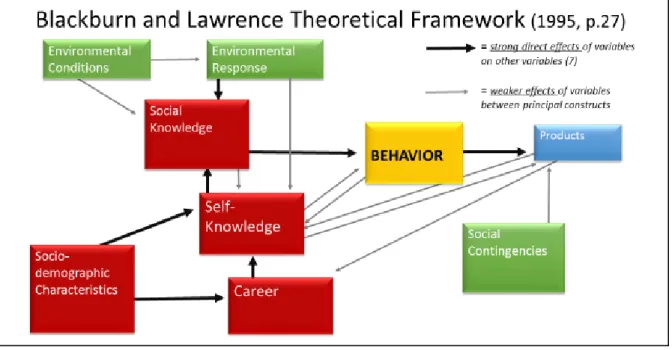
Blackburn and Lawrence (1995) take the theoretical perspective that the characteristics of individuals and their employing institutions combine and lead to variations in faculty motivation, behavior, and productivity. Generally speaking,the thick arrows in Blackburn and Lawrence’s model signify the strong direct effects of the variables in one category on the variables in the category to which the arrow points. The thin arrows acknowledge that there are weaker effects between several of the principal concepts. (Figure 1)
5
Figure 1. Blackburn and Lawrence theoretical framework (1995). Source: R. T. Blackburn and J. H. Lawrence (1995). Faculty at Work: Motivation, Expectation, Satisfaction. Johns Hopkins University Press, p. 27. Reprinted with permission.
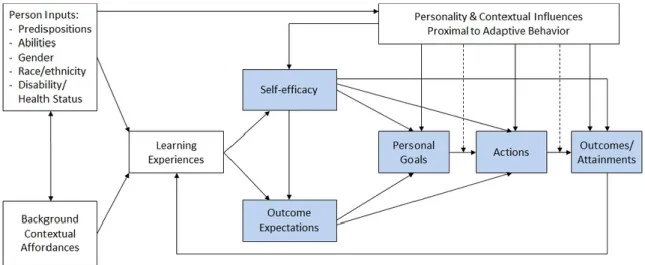
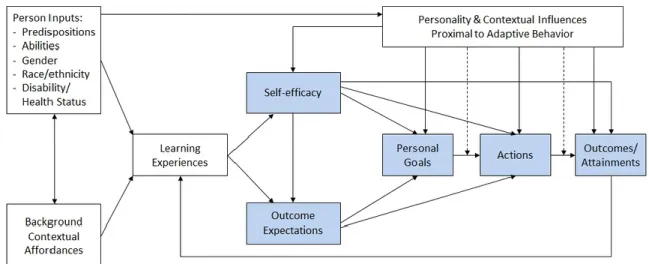
Lent and Brown (2013, p. 562) propose a model of career self-management that extends Social cognitive career theory (SCCT; Bandura, 1986), which frames the relationship between experiences and the formation of self-efficacy. Central to Bandura’s social cognitive theory (1986) and its extensions into career theory is the concept of self-efficacy. Self-efficacy is an individual’s belief in their ability to perform a given task in the future, regardless of their current ability (Bandura, 1986). Students can benefit from out-of-the classroom experiences by watching others and participating in hands-on activities that challenge them to think, plan, and execute (Majewski, 2018). This theory encourages students to self-manage by focusing on the
adjustments to behaviors that influence career development, including career exploration, decision-making, job searching, and identity management (Majewski, 2018). Faculty in their
6
academic roles have vast influence on students’ learning experiences and thereby impact student self-efficacy and outcome expectation in student career self-management.
Figure 2. Model of career self-management. Adapted from “Social Cognitive Model of Career Self- Management: Toward A Unifying View Of Adaptive Career Behavior Across Life Span,” by R. W. Lent, S. D. Brown, 2013, Journal of Counseling Psychology, 60, p. 562. Copyright 1993 by R.W. Lent, S. D. Brown and G. Hackett. Reprinted with permission. Secondary Source: “Does College Experience Matter? A National Study Understanding
Graduates’ Job Satisfaction” by K. R. Majewski, 2018, unpublished doctoral dissertation, Seton Hall University. p. 20. Reprinted with permission.
Overview of Study
Given the lack of clear knowledge in prior research on faculty’s perception of their role in student career preparedness, this study addressed the following questions:
Q1: How do faculty perceive their role in student career preparedness?
Q2: In what ways, if any, do faculty support undergraduate career preparedness in and outside the classroom?
Q3: What differences in perception and behavior, if any, exist by subgroups (discipline, rank, age, gender, longevity in academia, tenure, parental and first-generation status)?
7
To seek answers to these research questions, I conducted a qualitative study at a small,
private Catholic university in the northeastern United States known for teaching and professional
studies. My methodology is outlined in Chapter III. The study includes multiple sources of data,
including in-depth, semi-structured and open-ended interviews of faculty participants from two
areas, specifically the professional track majors, including nursing, education, art therapy,
communication and media, business and liberal arts and sciences track majors, including
biology, chemistry, history, and psychology. I also interview the career services administrator for
her views on faculty role in student career preparedness at this institution.
Interviews were approximately 60 to 90 minutes in length and conducted at an
agreed-upon location and followed up with emails and telephone conversations when clarification was
needed. All interviews were audio-recorded and/or transcribed. During the in-depth interviews,
participants answered background information surveys, a vital aspect of the data gathering to
arrive at the findings. To enrich this study, I examined the syllabi of selected courses and
institutional websites for related student career preparedness content. I coded and analyzed all
data using the preliminary codes to arrive at conceptual themes and subsequent findings
(Appendix H). I also make suggestions for further study and offer conclusions.
Significance of the Study
I am compelled to ask how higher education prepares students for good jobs, adaptability in the workplace, and/or provides a means for students to decide their career direction. More specifically, I wanted to know what faculty perceive they have to do with it and how they behave in response to the clear imperative to help undergraduates prepare for careers and the workplace. Though we have much data in terms of the benefits of student–faculty interaction and related high-impact practices and other data on faculty behavior, we currently have only vague or
8
indirect knowledge of the faculty perspectives and behaviors regarding their role in student career preparedness.
Inquiring about faculty from a qualitative point of view in essential matters is endorsed by FTI Consulting (2015), which posits that in the current demanding economic environment, it is crucial to understand faculty members, both as stakeholders and as potential creators and drivers of innovation, and as the direct, front-line drivers of student success. A qualitative faculty investigation could capture the quality of their perceptions, particularly the nuances of how
faculty perceive student career preparedness as part of their faculty roles and why or why not
faculty embrace this role. Results of this qualitative study may help faculty, college
administrators, and other higher education stakeholders understand more about how faculty perceive their roles, what behaviors they enact in and out of the classroom, and how this might align with departmental and institutional goals and the goals of higher education, both stated or implied (Creswell, 2007; Patton, 2002).
Summary
In summary, economic, environmental, and other general factors drive our attention to student career preparedness and the potential and importance of faculty support. Factors include the demand for return on large tuition investments and accompanying student debt, students’ topmost reasons for attending college, a demand for higher skills essential to the nation’s and global workplace, the need for institutional accountability for preparing students for the workplace given government financial aid investment, faculty agreement that preparation for employment is a very important higher education goal, and heightened media and societal attention. Specific focus on faculty could harness the actuality of student career preparedness support behaviors in and out of the classroom through pedagogy, assignments, and advisement
9
and identify departmental or institutional messaging, supports, or other deterrents that could require attention in development of programs and policy.
Dissertation Organization
This dissertation explores faculty perceptions of their role in student career preparedness and reviews relevant documents. The research design model includes faculty surveys, semi-structured and open-ended interviews, and an examination of syllabi and institutional websites. Chapter I introduces the concept faculty’s perception of their role in student career preparedness, the problem related to understanding faculty as front-line drivers of student success, and
theoretical model lenses through which data can be explored. Chapter II provides a review of high-impact pedagogical practices related to student-career preparedness, with an emphasis on faculty practices in and out of the classroom related to career preparedness, and the value of student–faculty interactions in which student career preparedness is often embedded. It also provides an exploration of a related theoretical model that influences faculty attitudes and behavior and a theory that lends an understanding of the importance of experiences on the formation of student self-efficacy related to career development. Chapter III introduces the data collection methodology, sample, and analytic strategy used to address the research questions of this dissertation. Chapter IV includes more information on the data and sampling collection followed by all the results and findings from inductive qualitative analysis. Chapter V serves as a summary of findings, implications for future practice, policy, and research, and conclusions of the study.
10
CHAPTER II LITERATURE REVIEW
While career preparedness can be considered in psychological, educational, and
organizational contexts, what follows is a literature review in relation to faculty’s role in student career preparedness within the undergraduate higher education milieu. Because career
preparedness is recognized as one of the overarching goals of higher education, a comprehensive literature review could overlap with a variety of related perspectives.
The scope of this literature review, however, will be concerned with the following issues: (a) the impact and value of student–faculty relationships in a current context and student career preparedness enmeshed within these relationships, (b) trends in student career preparedness and faculty behavior, (c) the value and use of certain high-impact practices in relation to the notion of student career preparedness, and (d) an examination of a theoretical model of faculty behavior by Blackburn and Lawrence (1995) and a modified model of students’ career self-management by Lent and Brown (2013, p. 562) as reported by Majewski (2018, p. 20).
Definition of Terms
High-impact practices (HIPs) are practices widely tested and shown to be beneficial for college students from many backgrounds and thought to increase rates of student retention and student engagement. They include: first-year seminar, common intellectual experiences
(formerly known as core), learning communities, writing-intensive courses, collaborative assignments and projects, undergraduate research, diversity/global learning, service learning, community-based learning, internships, capstone courses and projects. These, I believe, are strongly related to career development and have been identified as especially valuable by employers (Kuh, 2008).
11
Student career development and preparedness refers to activities, discussions, advising, mentoring, and experiences that add to the advancement of students’ skills, knowledge, and abilities applicable to workplace positions. Such experiences allow students to explore their interests, define their career goals, seek opportunities for personal growth and professional development, connect their education with their values, meaningful and purposeful work-life planning, and assume and adapt to responsibilities expected of them in the modern workplace.
Student–Faculty Relationships
Student–faculty relationships are a foundational concept of the earliest higher education history, where institutions first prepared men for roles as civic leaders and clergy (Veysey, 1970). These relationships have evolved through advisement and mentoring interactions in the present day as education has expanded from elite to mass enrollment in the 20th century (Jacobi, 1991; Johnson, Rose, & Schlosser, 2010; Trow, 1999). There are extensive empirical studies–– literally hundreds––on the nature, quality, and frequency of student–faculty contact and its positive impact on students (Alderman, 2008; Cox, McIntosh, Terenzini, Reason, & Lutovsky Quaye, 2010). One might say it is the very essence of education in any context.
Most research on student–faculty interactions is quantitative. Some of the positive student outcomes include student engagement, academic achievement, college satisfaction, student retention, persistence, and clarification of career and learning goals (Alderman, 2008; Cox et al., 2010). The last outcome in Cox et al. (2010) suggests that student–faculty interaction research is highly relevant to the specificity of my research topic (Alderman, 2008; Astin, 1993; Kuh et al., 2005; Pascarella & Terenzini, 2005; Tinto, 1987; Umbach & Wawrzynski, 2005; Wilson, Wood, & Gaff, 1974). Indeed, while many positive results and benefits from student–faculty interaction appear well-supported by the literature of nearly four decades, it is the entanglement with overall
12
student success and pedagogical practice that provides a challenge to discerning the relation of the student–faculty relationships specifically to student career preparedness.
One early study on college influences on students’ sociopolitical attitudes by Jacob (1957) noted that the student–faculty interactions of “peculiar potency” were those that were “normal and frequent and students find teachers receptive to unhurried and relaxed conversations out of class” (p. 8). Studies since have demonstrated the potency and influence of student– faculty interactions in a variety of important ways, including the nuance of impact on undergraduate career preparedness.
Beginning in the 1980s, education advocacy groups pushed for reform in university teaching, focused, in part, on active learning, diversity, and community involvement (Brint, 2011 as cited in Chory & Offstein, 2016). Brint (2011) reviews a 30-year movement, during which various high-impact educational practices evolved, many of which require students and faculty to interact off campus in nontraditional contexts and roles. (See the next section for specifics on high-impact practices related to in-class interaction.) Student–faculty contact is identified as influential in fostering overall student engagement, essential to persistence and degree attainment (Brint, 2011; Kuh & Kinzie, 2018).
Preceded by the College Student Experiences Questionnaire (CSEQ; in use 1979 – 2014), the National Survey of Student Engagement (NSSE) captures data on out-of-class academic student–faculty interactions. Other assessments, such as the Early Collegiate Experiences, Freshman Year (Milem & Berger, 1997), College Student, and Freshman surveys (Sax, Bryant, & Harper, 2005), and the Gallup-Purdue Index (Gallup, Inc., 2016) alsoaddress nonacademic student–faculty experiences (Chory & Offstein, 2016). These reports and nationally
13
interaction for students. Importantly, current quantitative research has centered on the CSEQ and NSSE data (Chory & Offstein, 2016). The Gallup-Purdue Index measures jobs outcomes in Great Jobs, Great Lives (2016) and provides higher education leaders with insights for meaningful performance improvements. The initiative aims to create a national movement toward a new set of measures, created by and for higher education, and to foster a new level of
accountability for the higher education sector. More college graduates felt supported in college
because they had a mentor who encouraged them to pursue their goals, a professor who made them excited about learning, and felt their professors cared about them as a person. As a result, students are subsequently thrive in all areas of their well-being. As a result of the study,
Gallup-Purdue (2016) claims it is changing the student experience with greater focus on student–faculty
interaction, increased internships, on-the-job training and experiential learning, and creative use of technology. The intent of this study is better understanding of the faculty experience in this changing focus.
The Nation Survey of Student Engagement (NSSE), funded by the Pew Charitable Trust,
includes five questions that address student–faculty out-of-classroom interactions that include:
(a) discussion of grades, assignments, and class content with faculty; (b) the frequency with
which students work with faculty on activities other than coursework, such as committees; (c)
receipt of prompt oral and written feedback from faculty; (d) whether students plan to work with
faculty on research not required by a class; and (e) career-related discussions students have with
faculty (Alderman, 2008). The last two of the five have immediate pertinence to student career
preparedness. It is interesting that NSSE’s (2007) results report less than optimal student–faculty
14
career-related discussions with faculty as part of the national survey might imply its importance
to overall student–faculty interactions.
Positive outcomes linked with student–faculty interactions are confirmed through the literature to improve persistence by undergraduates (Pascarella & Terenzini, 1977). Pascarella and Terenzini (1978) furthered their work in this regard by controlling for 14 pre-college characteristics to account for the largest share of explained variance when predicting college completion (Kuh & Kinzie, 2018). They found that a significant positive association exists between the extent and quality of student–faculty interaction and the following: academic achievement, educational aspirations, attitudes toward college; intellectual and personal development; and persistence first to second year (Pascarella & Terenzini, 1977). Even while controlling for pre-entering characteristics, Pascarella (1980) points to the causal direction of his findings where he asserts frequent student–faculty contact may help a student become more interested in career exploration, which subsequently leads the student to initiate more out-of-class contact with faculty (Alderman, 2008). This indirect result of student–faculty interaction and career exploration is worth exploring further.
Broadly, Pascarella (1980) is among the first to focus on student–faculty interactions
outside the classroom in a well-regarded literature review, which concludes that informal contact
between faculty and students helps academic achievement, educational aspirations, attitudes
toward college, intellectual and personal development, interpersonal skills, clarification of
personal values, promotion of critical thinking and problem-solving skills, and persistence from
the first to second year of college. Other positive outcomes related to student–faculty interaction
15
For example, Astin (1985) notes that maximizing personal contact between faculty members and students was the best way to involve students in learning and in college life. Additionally, Lamport’s (1993) literature review on 60 studies over four decades also finds informal student–faculty interaction is related to student academic achievement, persistence, and career and educational aspirations. Lamport (1993) notes the questions on student–faculty interaction are progressing to how and why, and to the quality of student-faculty relationships (Alderman, 2008), as my study intended to explore.
Subsequent studies build on the understanding of the impact of student–faculty
interactions highlighted by Pascarella, Terenzini, and Astin, including Chickering and Gamson (1987). They identify seven principles for good practice important to college student success, one of which is student–faculty interaction, found to be a key factor in student motivation and
involvement (Chickering & Gamson, 1987). Along with Pascarella and Terenzini (1980), and
Astin (1985, 1993), Chickering and Gamson’s summary is a standard often used by scholars in
the field of higher education regarding student-faculty interaction (Alderman, 2008).
Hearn (1987), in a longitudinal study using the College Experiences Questionnaire (CEQ) for freshman in 1973 and again with these students in 1976, concludes that faculty–student contact played a positive role in aspirations formation and indirectly influenced graduate school plans. He also notes that student–faculty interaction was affected positively by freshman year grades, suggesting academically talented students may have sought out or were sought out for higher levels of contact with faculty (Alderman, 2008). Some questions may remain on the nature and frequency of student–faculty interaction with less achieving students.
Pascarella’s and Terenzini’s subsequent analysis of 20 years of research, How College Affects Students (2005) found vast evidence to suggest that when student–faculty interactions
16
extend beyond the classroom, the impact is for faculty members to become role models for
students, likely increasing social integration and persistence (Alderman, 2008).
In What Matters in College: Four Critical Years Revisited (1993), Astin notes that student–faculty interaction has substantial positive correlations with various outcomes and factors such as enrollment in graduate or professional school, overall college experience, degree attainment, every self-reported area of intellectual and personal growth, and peer tutoring. This work further advances and reinforces the critical importance to student development of frequent interaction between faculty and students (Astin, 1993).
Other studies add empirical evidence of the positive outcomes of student–faculty interactions with a focus on other factors. Anaya and Cole (2001) confirm findings of student– faculty interactions’ positive impact on student GPAs. In a large empirical investigation, Kuh and Hu (2001) find student–faculty interactions reported by 5,409 full-time undergraduates from 126 four-year colleges and universities had substantial positive effects on students' efforts in
other educationally purposeful activities and contributed to academic and personal gains and
satisfaction by students. This study also finds that frequency of interactions with faculty is
correlated with student satisfaction (Alderman, 2008).
Others investigate factors based on race/ethnicity (Anaya & Cole, 2001; Nettles et al., 1986 as cited in Cox et al., 2010; Kim & Sax, 2007) and gender variables (Sax et al., 2005; Wawrzynski & Sedlacek, 2003). Kuh and Hu (2001) clarify that the outcomes of student–faculty interaction vary depending on the type of interaction, where more substantive interactions seem
to have a greater impact on knowledge acquisition and skill development, especially when the
interactions reinforce the academic ethos of the campus or focus on student development issues,
17
premise in their Documenting Effective Educational Practice (DEEP) study at 20 schools, which
found meaningful interactions are essential to high-quality student learning experiences.
Studies frequently highlight the positive qualities of faculty from a student point of view on student–faculty interaction. Alderman (2008) finds that high-quality out-of-classroom
interactions with faculty were shown to have four characteristics from a student perspective: faculty members are approachable and personable; faculty members have enthusiasm and passion for their work; faculty members care about students personally; and faculty members serve as role models and mentors (Alderman, 2008). Bradley and Graham (2000) extend exploration of high-quality interactions to include the education ethos, career development and scientific reasoning among others. Here again, career-related outcomes are enmeshed within other overarching student-related educational outcome findings and from a student perspective.
Though empirical studies in recent decades regarding student–faculty interactions are student-centric, like Alderman’s, (2008) there are serious attempts to capture faculty
perspectives. The Higher Education Research Institution Faculty Survey (HERI) has conducted triennial national surveys since the late 1980s that provide empirical detail on the nature and frequency of student–faculty interactions from the faculty point of view and other details on faculty and their work. Einarson and Clarkberg (2004) explore faculty out-of-class interactions with students from a faculty perspective with 904 faculty at a large East Coast research
institution. They used four explanations of faculty engagement using OLS regression and estimated separate models for research-based and other types of out-of-class involvement. Their findings provided little support for two of the most prevalent explanations of factors that inhibit faculty involvement: competing time demands and lack of institutional rewards of supports for out-of-class interaction with students (Einarson & Clarkberg, 2004).
18
In addition to the HERI surveys (Eagan, Stolzenberg, Lozano, Aragon, Suchard, & Hurtado, 2014), research and reports, such as Kuh (2009), NSSE (2007), AAC&U (2004), and FSSE (2014) also connect faculty to roles affiliated with student career preparedness enmeshed with the concepts of good teaching, fulfillment of college majors, and high-impact classroom practices (Acker, 2003; Basow, 2000; FTI Consulting, 2015; Miron & Segal, 1978).
Coordinated by the Indiana University Center for Postsecondary Research, the Faculty Survey of Student Engagement (FSSE, 2018) was designed to complement the National Survey of Student Engagement (NSSE), which is administered to undergraduate students. Since 2003, more than 250,000 instructional staff from more than 800 institutions have responded to FSSE according to the published information about the survey. The instructional staff version focuses on the following: instructional staff perceptions of how often students engage in different activities; the importance instructional staff place on various areas of learning and development; the nature and frequency of instructional staff-student interactions; and how instructional staff organize their time, both in and out of the classroom. FSSE is designed to measure instructional staff expectations for student engagement in educational practices that are empirically linked with high levels of learning and development. Several other national studies confirm the importance of student–faculty out-of-classroom interactions in helping students clarify their career and educational aspirations (Sax, Bryant, & Harper, 2005 as cited in Alderman, 2008; Iverson, Pascarella, & Terenzini, 1984; Lamport, 1993; Pascarella, 1980; Pascarella & Terenzini, 2005).
As noted, it is the entanglement with overall student success and pedagogical practice that provides a challenge in discerning faculty’s perception of their role in the higher education outcome of student career preparedness in isolation from other higher educational goals.
19
Nevertheless, we find a current trend in higher education outcomes tied to institutional
accountability that is clearly specific to student employment, salary, and workplace readiness as judged by employers (U.S. Department of Education, 2006; Kelchen, 2016; US ).
Trends in Student Career Preparedness and Faculty Behavior
In its national annual reports, the National Association of Colleges and Employers (NACE, 2015a) identifies faculty among the most effective job-search resources for students. NACE (2015a) also strongly urges career services professionals, who are obligated in their roles to help build student career preparedness, to engage faculty collaboration as a best practice, recognizing faculty importance to desired learning outcomes and respecting faculty as essential partners. (See also Oatis-Skinner & Betz, 1998). NACE (2015a) urges faculty to consider using relevant high-impact practices to promote career readiness (University of West Florida, Career Services, 2014). While there are a variety of data from national surveys that indicate a wide range of high-impact practice as a faculty priority (Eagan, Stolzenberg, Lozano, et al., 2014), what is unknown and lacking in the literature is how faculty feel about enacting these
recommendations and why, and why they may hesitate to do so.
In career development literature regarding student–faculty interactions, faculty roles are noted in studies that emphasize creating campus connections and collaborations, and promoting career, self-knowledge, and purpose within the curriculum and college communities. The University of Southern California and AAC&U’s Delphi Project (Kezar, Maxey, & Holcombe, 2015) Changing Faculty and Student Success report provides data suggesting faculty play a role in supporting student career outcomes without an in-depth exploration on faculty’s perception or enactment of this role (Kezar et al., 2015). It seems stakeholders outside the faculty come to
20
conventional wisdom on the essential faculty role in student career preparedness, without much consideration for the direct investigation of attitudes and behaviors of the faculty themselves.
Clydesdale (2015) presents longitudinal empirical work on student purpose exploration programming in which students explore their purpose across 88 campuses including large research institutions and small liberal arts colleges. Faculty roles in these studies includes engagement in interdisciplinary collaboration, fostering important connections between faculty and community, industries, nonprofits and government and mentoring and advising students in their purposeful career explorations. The experiences from faculty’s point of view in
Clydesdale’s research are “positive impact” on more meaningful advising (p. 134). Program design staff feel strongly that faculty involvement is essential for robust student vocational exploration and important for sustainability of the career exploration programs (Clydesdale, 2015; Kezar et al., 2015). While helpful to confirm the crucial nature of faculty engagement in students’ quest for purpose and direction, these reports lack the detail that could be revealed directly from a more in-depth study of the faculty’s point of view and motivations specific to career preparedness.
Clydesdale (2015) places his empirical work within the context of Delbanco (2012), Arum and Roska (2010), and Keeling and Hersh (2011) and the overarching state of higher education, what it is, what it has become, and what it should be for students. This work echoes the importance and focus of the national surveys, like HERI (Eagan, Stolzenberg, Lozano, et al., 2014) that explore faculty views on the goals of higher education and the practices that support them.
Not unlike Clydesdale’s (2015) study, other career development trends suggest that institutional policy should afford attention and support for career-oriented programs promoting a
21
campus culture or ethos that values and encourages strong ties with professional and alumni communities, and by doing so, academically and socially integrating peers and faculty members (Dey & Cruzvergara, 2014; Hollister; 2010; Dey & Real, 2010; NACE, 2015b; Xu, 2013).
Despite the very extensive research on the nature of faculty work by Blackburn and Lawrence (1995, 2002), Finkelstein (1984), Schuster and Finkelstein (2006), Finkelstein, Conley, and Schuster (2016), and Gehrke and Kezar (2015), there are far fewer qualitative studies to my knowledge regarding how faculty perceive their role in student career development. Research on student–faculty mentoring also remains sparse and focused on
positive outcomes (Johnson, Rose, & Schlosser, 2010). Similarly, very few studies examine why some faculty members are more likely to interact with students than their colleagues (Cox, McIntosh, Terenzini, Reason, & Lutovsky Quaye, 2010). The limited evidence suggests that faculty members who have a student–centered philosophy of education believe that teaching is a critical part of their role as professors and consistently display higher levels of out-of-class interaction with students (Cotton & Wilson, 2006; Einarson & Clarkberg, 2004). Faculty with friendly personalities and strong interpersonal skills do as well (Einarson & Clarkberg, 2004; Wilson, Gaff, Dienst, Wood, & Bavry, 1975). The findings from the study by Cox et al. (2010) suggest that student engagement may have more to do with student–faculty interactions than with any other faculty characteristics and found to have little predictive power on the frequency of out-of-class interactions regardless of faculty gender, race, field, rank, time commitments, and pedagogical practices.
Despite the relative dearth of qualitative studies, Steven Lohr (2004) contributes to the literature on student–faculty interactions by conducting a qualitative study on student–faculty interactions. His results suggest out-of-classroom interactions assist with a variety of important
22
college outcomes, including clarifying career and educational goals. Lohr’s (2004) work reinforces the specific career-development-related findings of Pascarella (1980), Astin (1985, 1993), Hearn (1987), Lamport (1993), and Kuh and Hu (2001). Lohr (2004) believes interactions begin with class-room related activities. Like most other studies examining student–faculty interactions, this work focuses on the student perspective. Student-noted benefits of the interactions include assistance in designing career and educational objectives, increased job opportunities, assistance with coursework, and personal development.
Most studies about student–faculty interaction affirm the significant positive influence of out-of-classroom interactions on student success. These include increased retention and
graduation, and clarified and enhanced career aspirations, aspirations formation, and indirect influence on graduate school plans. Additional positive influences discovered through studies of student-faculty interaction include access to job opportunities, personal development, improved problem-solving abilities, assistance with coursework and development of interpersonal skills applicable to career preparedness. While there is extensive information about faculty work, their views on student–faculty interactions specifically related to career preparedness are still wanting.
High-Impact Practices and Student Career Preparedness
In contemporary higher education, certain high-impact practices that the faculty employ in and out of the classroom related to career preparedness by employers and institutions have been advanced considerably in the last decade by Kuh (2008) and the American Association of Colleges and Universities (AAC&U, 2004). Exploring the impact of in-class pedagogy related to student career preparedness is essential to this literature review. This is where student–faculty interaction has the potential for meaningful learning experiences and outcomes related to career preparedness. These include practices known as high-impact practices (HIPs), explored over 15
23
years since their introduction in the AAC&U report in 2004, where the practices were defined as especially effective for student learning, engagement and career preparation for the 21st century (Kuh, 2008). George Kuh documents the strong positive effects explained in High-Impact Educational Practices: What They Are, Who Has Access to Them and Why They Matter,
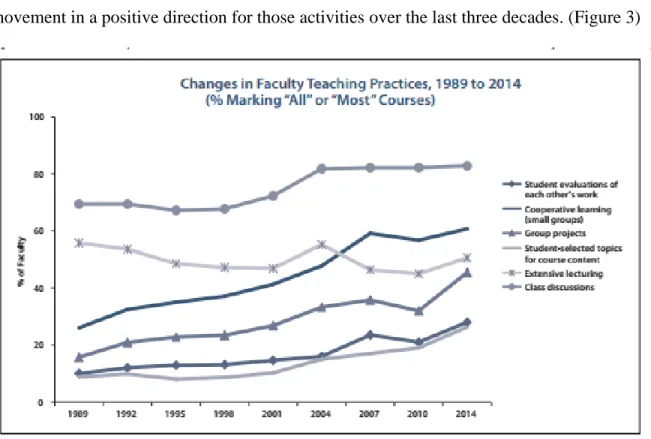
including research that demonstrates HIPs have an impact on learning outcomes and progress toward graduation. This conclusion is endorsed by others in the literature (Brownell & Swaner, 2010; McNair & Albertine, 2012). With this HIP research comes increasing interest in faculty development to implement the practices effectively. Over the course of time when HERI Faculty Surveys have been conducted (1989 – 2018), data suggest an increase in some high-impact practices supporting career development, such as cooperative learning and group projects, with movement in a positive direction for those activities over the last three decades. (Figure 3)
Figure 3. HERI changes in faculty teaching practices 1989 to 2014. HERI longitudinal data indicating changes in faculty teaching practices noted by faculty on the survey in “All” or “Most Courses” by %, including increase in some high-impact practices (Kuh, 2008).
24
Some practices are related to student career development, particularly cooperative learning
and group projects. (Note the decline in extensive lecturing.)Source: Eagan, M. K.,
Stolzenberg, E. B., Berdan Lozano, J., Aragon, M. C., Suchard, M. R. & Hurtado, S. (2014). Undergraduate teaching faculty: The 2013–2014 HERI Faculty Survey. Los Angeles: Higher Education Research Institute, UCLA, p. 6.
Majewski’s (2018) dissertation explores college career development related to job-satisfaction after graduation. In his quantitative analysis using the National Center for Education Statistics’ Educational Longitudinal Study of 2002 (National Center for Education Statistics, 2015), Majewski (2018) finds that increased job satisfaction 5 years after graduation is
associated with certain high-impact activities, such as research with faculty outside of a course or program requirements (Sagen, Dallam, & Laverty, 2000).
Regarding the historical development of HIPs, Kuh (2008) acknowledges several key factors. Learning communities were developed in the 1970s, and undergraduate students have engaged in research and internships for decades, as have other HIPs in various forms. What changed in recent evaluation is the collective effort to document the impact of these practices and a “sea change” in undergraduate education (Kuh & Kinzie, 2018; McNair & Albertine, 2012). Faculty’s capacity to implement the practices is considered key (Kuh & Kinzie, 2018; McNair & Albertine, 2012), but the results are found to be inconsistent among institutions (Randall Johnson & King Stage, 2018). AAC&U has worked through its Liberal Education and America’s Promise (LEAP) initiative to promote the practices and work with faculty to bring HIPs more intentionally to the undergraduate experience. Kuh (2008) warns HIPs “must be done well” and emphasizes the heightened benefits from underserved populations, who historically participate less in HIPs than others (Day Keller, 2012). In fact, issues of equity and access for these populations and conducive environments to encourage faculty professional development, both full-time and contingent faculty, are essential to successfully implementing high-impact
25
practice opportunities for every student (Day Keller, 2012; Kuh, 2009b; Kuh & Kinzie, 2018; McNair & Albertine, 2012; Randall Johnson & King Stage, 2018).
National research initiatives support the notions that high-impact learning practices increase student achievement, retention, and attainment, all requisite accomplishments prior to career success (Brownell & Swaner, 2010; Gallup, Inc., 2016; Kuh, 2008; Kuh et al., 2005; Rhoades, 2012). These practices are believed to help develop the skills and knowledge
employers in the 21st century seek and are considered essential for success in life and citizenship (Kuh, 2008; McNair & Albertine, 2012). The high-impact instructional strategies and their corresponding philosophies are institutionalized with the research that the National Survey of Student Engagement began in the early 2000s (National Survey of Student Engagement, 2007), founded by George Kuh at Indiana’s Center for Postsecondary Research and the HERI Faculty Survey (Eagan, Stolzenberg, Lozano, et al., 2014) developed by the Cooperative Institutional Research Program (Eagan, Stolzenberg, Ramirez, et al., 2014), at UCLA. The developers of the HERI Faculty Survey claim to have surveyed over 1900 institutions over the course of its implementation, 15 million students and 300,000 faculty. The most recent survey included over 150 institutions (Stolzenberg, Eagan, Zimmerman, et al., 2019).
Important to this discussion, 8 of 10 suggested high-impact practices, which appear on the HERI (Eagan, Stolzenberg, Lozano, et al., 2014) Faculty Survey are related to student career preparedness including: learning communities; writing-intensive courses; collaborative
assignments and projects; undergraduate research; diversity/global learning (including study abroad); service learning, community-based learning; internships (experiential learning); and capstone courses and projects, including presenting work to demonstrate competence (AAC&U, 2004; Brint, 2011; Brownell & Swaner, 2010; Evenbeck & Johnson, 2012; Gallup, Purdue
26
University, and the Lumina Foundation, 2016; Kuh, 2008; Rhoades, 2012). The two additional high-impact practicesinclude common intellectual experiences and first-year seminars, both enhancing knowledge building and preparation for the other HIPs and appear relevant to this study.
In examination of a specific HIP, Day Keller (2012) in her dissertation explored the qualities of effective internships from student, faculty, and employer viewpoints. Her findings are based on interviews with 19 students participating in internships facilitated by a large
midwestern university. Day Keller suggests that outcomes related to student career preparedness include developing student competencies, career-related crystallization, building self-confidence, and generating capital, both social and monetary (Day Keller, 2012). A study by Narayanan, Olk, and Fukami (2010) finds transfer knowledge between academia and industry via internships is related to students’ motivation to learn and that faculty mentoring is relatively important.
A recent study by Sarah Randall Johnson and Frances King Stage (2018) challenged the widely promoted and adopted high-impact practices as tools to promote completion (Valbrun, 2018). Their research is based on data from 101 institutions, some of which make extensive use of the practices while others make minimal use or no use at all (Valbrun, 2018). The study found that the graduation rates at 4-year public colleges that incorporated all the high-impact practices were not higher than those that used fewer in any of the practices (Randall Johnson & King Stage, 2018). Though they acknowledge the research linking individual practices to engagement and learning, Randall Johnson and King Stage (2018) suggest these benefits cannot be linked to timely college completion for public institutions. They also conclude that the current consensus about the institutional adoption of high-impact practices may be “misinformed” (Randall
27
Johnson & King Stage, 2018). Instead they recommend intentional decisions about the fit of the practices to campuses versus quantity of offerings (Randall Johnson & King Stage, 2018).
Kuh and Kinzie (2018) respond to these recent findings by stressing that simply making practices available is not what makes the high-impact practices effective, but they concur with Randall Johnson and King Stage that the specific fit of HIP practices to campus context is essential. In addition, careful and intentional implementation is what makes HIPs effective. Kuh and Kinzie offer NSSE data analysis that indicate advantages for HIP students over peers without these experiences, as offered by Finley and McNair (2013).
In their mixed-method research done for the AAC&U, Finley and McNair (2013) find historically underserved students benefiting significantly in terms of outcomes, performance, and behavior, including persistence and graduation, with cumulative effects of more than one HIP. Working with NSSE data from 38 campuses in three states, California, Oregon, and Wisconsin, Finley and McNair advance an understanding by examining underserved populations among survey respondents. They also open a new line of qualitative inquiry by introducing student voices into the HIP discussion, enriching their quantitative conclusions by interpreting results of focus groups conducted with underserved students on nine campuses, three in each of the three states. Responses from focus group participants suggest that there is strong alignment between students’ views of the skills and competencies that matter for the workforce, including
employers’ views (Finley & McNair, 2013).
Kuh and Kinzie (2018) find fault with the Randall Johnson and King Stage (2018) study limitations and methodology for not considering the impact of students’ pre-college academic preparation and family socioeconomic status, which account for the largest share of variance when predicting completion, overlooking “implementation fidelity (p. 1),” and masking the
28
accentuating effects of multiple HIPs. Kuh and Kinzie concede and emphasize that offering HIPs at scale does not guarantee their effectiveness, a conclusion that other literature generally
supports. Indeed, implementation quality and institutional context are critical in terms of realizing the benefits of HIP participation.
Theoretical Frameworks
Blackburn and Lawrence’s (1995) theoretical model is appropriate to this study because it considers faculty cognition, their self-evaluations of their efficacy (competence and ability to influence outcomes), and their perceptions of the environment (what it expects and what it rewards, p. 11). The theoretical perspective suggests that the characteristics of individuals and their employing institutions combine and lead to variations in faculty motivation, behavior, and productivity (Blackburn & Lawrence, 1995). Blackburn and Lawrence place individual and environmental constructs within this framework based on the results of the empirical studies of faculty careers and cognitive motivation research and differences between direct and weaker effects. Blackburn and Lawrence define properties of individuals in four constructs as
“antecedents to faculty behavior”: sociodemographic characteristics, career, self-knowledge, and social knowledge (pp.15–16). These aspects of faculty attitude and behavior are foundational to the understanding I seek in my study and prove essential to the findings. According to
Blackburn and Lawrence (1995), widely studied sociodemographic characteristics, including chronological age, race/ethnicity, and gender, which the literature suggests influence behavior indirectly by limiting or enhancing one’s access to resources and opportunities.
The career construct includes several key properties of individuals: individuals’ socialization experiences learned in research and conceptions of the faculty role they learned, one’s academic discipline, and type of institution in which one works. The institutional and
29
normative structures within the academic disciplines and institutions influence a number of factors: the individual faculty’s beliefs and priorities; the individual’s pattern or sequence of academic or administrative positions and current position; the career age, and/or the number of years the individual held a full-time faculty position; and prior accomplishments, such as publication records, teaching awards, grants and fellowships obtained. These most salient characteristics influence decisions and the ability to acquire resources (Blackburn & Lawrence, 1995).
The self-knowledge construct demonstrates one’s understanding of self and is a measure of self-image and self-assessed competence in selected professional activities and efficacy in other situations (Blackburn & Lawrence, 1995). Self-knowledge includes an individual’s
personal attitudes and values with respect to the importance of certain aspects of the faculty role (e.g., teaching, research, and service; Blackburn & Lawrence, 1995).
The last construct of properties of individuals is social knowledge, representing how individuals perceive their environment, that is, how others expect them to behave (subjective norms) and their beliefs about others in the environment. According to Blackburn and Lawrence (1995), these elements characterize an organization’s social climate or ethos. As part of social knowledge, the social climate includes the prototypes or cognitive representations of other valued faculty members that individuals can carry in their heads and may use to guide their decisions on how to behave (Cited by Blackburn & Lawrence, 1995; Nisbet & Ross, 1980).
Properties of the environment are objective characteristics of the work environment, separate from the faculty perceptions of it, which include environmental conditions,
30
study. Like properties of the individual, properties of the environment conditions are also described by several properties.
Social contingencies are the last environmental construct outlined by Blackburn and Lawrence (1995). They include personal matters of the faculty, such as a family illness or the birth of a child. These conditions can be short or long term but can also affect faculty work (Blackburn & Lawrence, 1995).
Also important to Blackburn and Lawrence’s (1995) model are cognitive theories of motivation, where motivation is a function of an individual’s subjective estimate of the
probability of task success (expectancy) and the consequences of their actions (value); it assumes people make decisions about how to behave by evaluating their capacity to respond to situations and estimating their possible losses and gains.
Blackburn and Lawrence’s (1995) model depicts environmental constructs, such as structural and normative features of the institution, as having both direct and indirect effects on behavior. Behavior is defined as specific activities a faculty member engages in and the levels of effort expended. Productivity is the specific outcomes achieved by individuals, for example, articles published, teaching awards, and grants and fellowships obtained. Blackburn and Lawrence (1995) contend that productivity affects one’s self-knowledge and career.
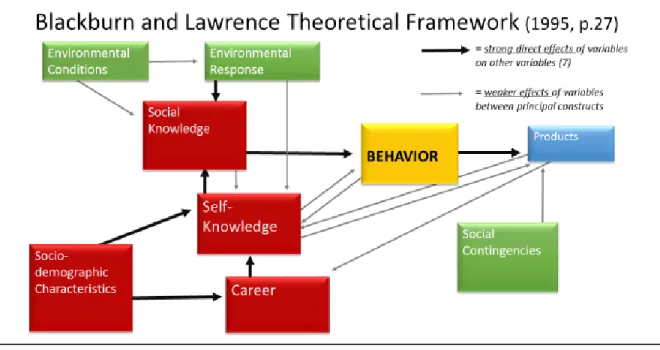
Exploring the concepts of Blackburn and Lawrence’s (1995) model including personal (red) and environmental (green) properties in terms of faculty attitudes and behaviors (gold) can uncover the relationship between faculty self-perceptions and student career development and productivity (blue). With the understanding of this theoretical framework, we can best judge and evaluate outcomes derived in this study (Figure 4).
31
Figure 4.Blackburn and Lawrence theoretical framework (1995). This framework depicts influences on faculty behavior, both personal (red) and environmental (green) influences. Source: R. T. Blackburn and J. H. Lawrence (1995). Faculty at Work: Motivation, Expectation, Satisfaction. Johns Hopkins University Press, p. 27. Reprinted with permission.
Lent and Brown (2013, p. 562) offer a view of student career self-management. A foundational construct in the model of career self-management is the notion of agency
(Majewski, 2018). Lent and Brown (2013) define agency as an individual’s inclination to exert control over portions of their career preparation. While individuals may believe that they are in control, Lent and Brown (2013) explain that individuals often act in response to any number of internal and external factors, which directly relates to the faculty influence explored in this study.
32
Figure 5. Model of career self-management. Adapted from “Social Cognitive Model of Career Self- Management: Toward A Unifying View Of Adaptive Career Behavior Across Life Span,” by R. W. Lent, S. D. Brown, 2013, Journal of Counseling Psychology, 60, p. 562. Copyright 1993 by R.W. Lent, S. D. Brown and G. Hackett. Reprinted with permission. Secondary Source: “Does College Experience Matter? A National Study Understanding
Graduates’ Job Satisfaction” by K. R. Majewski, 2018, unpublished doctoral dissertation, Seton Hall University. p. 20. Reprinted with permission.
The interplay between person, environment, and behavior can influence the choices an individual makes throughout their career development (Lent & Brown, 2013, p. 562 modified by Majewski, 2018, p. 20). This modified model by Majewski (2018) frames the relationship
between learning experiences and the formation of student self-efficacy, which is an individual’s belief in their ability to perform a given task in the future, regardless of their current ability. This endorses the notion that students often act in response to any number of internal and external factors. This study’s focus on faculty beliefs and behavior is directly pertinent as an external factor to student learning experiences. However, it does not necessarily consider student “person inputs,” for example, abilities, gender, race or background contextual affordances in the modified Lent and Brown model (2013, p. 562 modified by Majewski, 2018, p. 20).