Evaluation of
A New Multipath Congestion Control Scheme
using the NetPerfMeter Tool-Chain
Thomas Dreibholz, Martin Becke, Hakim Adhari, Erwin P. Rathgeb
University of Duisburg-Essen, Institute for Experimental Mathematics
Ellernstraße 29, 45326 Essen, Germany
{
dreibh,martin.becke,hakim.adhari,rathgeb
}
@iem.uni-due.de
Abstract—Multi-homed Internet sites become more and more widespread, due to the rising dispersal of inexpensive Internet access technologies combined with the growing deployment of resilience-critical applications. Concurrent Multipath Transfer (CMT) denotes the Transport Layer approach to utilise multiple network pathssimultaneously, in order to improve application payload throughput. Currently, CMT is a quite hot topic in the IETF – in form of the Multipath TCP (MPTCP) and CMT-SCTP protocol extensions for TCP and SCTP. However, an important issue is still not fully solved: multipath congestion control.
In order to support the IETF activities, we have set up a distributed Internet testbed for CMT evaluation. An important tool – which we have developed for multi-protocol Transport Layer performance analysis – is the Open Source NETPERFMETER tool-chain. It supports the parametrisation and processing of measurement runs as well as results collection, post-processing and plotting. However, its key feature is to support multiple Transport Layer pro-tocols, which makes a quantitative comparison of different protocols – including state-of-the-art features like CMT – possible. In this paper, we first introduce NETPERFMETER and then show a proof-of-concept performance evaluation of CMT congestion controls which are currently discussed in the IETF standardisation process of CMT-SCTP.1234
Keywords: NetPerfMeter Tool-Chain, Concurrent Multi-path Transfer, Congestion Control, Dissimilar Paths, Perfor-mance Analysis
I. INTRODUCTION
The increasing deployment rate of resilience-critical Internet services leads to a steady growth in the num-ber of multi-homed Internet sites. Technologies like ADSL (Asymmetric Digital Subscriber Line) make adding access redundancy possible at a competitive cost level. The availability of a secondary (or even more) access path to different Internet Service Providers (ISP) for redundancy reasons also leads to the demand for
utilising all paths simultaneously – in order to increase
application payload throughput. The idea of this so-called Concurrent Multipath Transfer (CMT) is to apply load sharing among all available paths. It is currently a hot topic in IETF standardisation, in form of the Multipath TCP (MPTCP) [1] extension for TCP as well 1Parts of this work have been funded by the German Research
Foundation (Deutsche Forschungsgemeinschaft – DFG).
2Parts of this work have been funded within the scope of the
G-Lab project by the German Federal Ministry of Education and Research (Bundesministerium f¨ur Bildung und Forschung – BMBF).
3The authors would like to thank Robin Seggelmann and Michael
T¨uxen for their friendly support.
4The authors would like to thank the anonymous reviewers for their
helpful comments.
as the CMT-SCTP [2], [3] extension for the Stream Control Transmission Protocol (SCTP) [4], [5]. However, Congestion Control (CC) for CMT is still an open topic: the possible existence of shared bottlenecks [6] may lead to an unfair bandwidth distribution. [7] provides a set of new CC strategies, which are simulatively evaluated. However, a proof of concept in a real network is missing. In order to evaluate these new CCs, we have set up a testbed and developed Open Source tools – denoted as
NetPerfMetertool-chain – to perform performance evalua-tions and analyse the results. These tools and testbed setup experiences are also useful for other projects evaluating and comparing Transport Layer protocols performance – particularly with respect to distributed environments like
G-LAB[8]. We finally applyNetPerfMeterto evaluate the
CC schemes of [7] – on the example of CMT-SCTP – in a real-world, heterogeneous Internet setup. However, the results are protocol-independent and may be adapted to other ones – particularly to MPTCP – as well.
II. THESCTP PROTOCOL
SCTP [4], [5] is a general-purpose, connection-oriented, unicast transport protocol which provides the reliable transport of user messages and a multi-homing concept out of the box. An SCTP connection between
two peers is denoted as association. In an association,
each peer is able to use multiple IP addresses. This is
calledmulti-homing. Each IP address of the peer endpoint
defines a unidirectionalpath. In each direction, one of the
paths is chosen asprimary path. This designated path is
actually utilised for the data transmission; the other paths are only used for retransmissions. Upon failure of the primary path, it may be switched to one of the backup paths.
The user data is segmented into units of so-called DATA chunks. Each DATA chunk is identified by a unique Transmission Sequence Number (TSN). The receiver ac-knowledges the successful reception of DATA chunks by using a Selective Acknowledgement (SACK) chunk. Such a SACK chunk contains a cumulative acknowl-edgement (CumAck) which acknowledges all TSNs until a given TSN. It may furthermore acknowledge chunks above the CumAck in form of so-called GapAcks. This allows the sender instance to selectively retransmit only the particular chunks which are still missing in the re-ception sequence. A SACK chunk is sent back over the peer path of the last received DATA chunk packet. While CumAcks are obviously non-renegable (i.e. the receiver
may not “unacknowledge” a CumAck), it may revoke GapAcks. This could e.g. happen when the receiver queue gets too full to store earlier chunks which are necessary for the next CumAck. In order to improve efficiency – and to avoid retaining the non-outstanding GapAck’ed chunks in the send buffer – the Non-Renegable SACK extension (NR-SACK) [9] can be used to signalise non-renegable GapAcks.
Two different mechanisms are applied to handle re-transmissions [5]: Fast Rere-transmissions (Fast RTX) are
used to retransmit a DATA chunk once, after being
GapAck’ed for 3 times by default [5]. Fast RTX occurs frequently, due to sporadic packet loss caused by concur-rency. Timer-Based Retransmissions (Timer-Based RTX) are triggered by a timeout for any further retransmission. They should occur rarely and are usually a sign of severe congestion.
SCTP applies window-based congestion control [10] – similar to TCP – on each path, i.e. the amount of outstanding data (i.e. in flight through the network and/or not yet acknowledged by the receiver) is limited by the congestion window cP of path P. AIMD (Additive Increase, Multiplicative Decrease) behaviour is used to
adaptcP to changing network conditions: onαnewly
ac-knowledged bytes on pathPin a fully-utilised congestion
window,cP is adapted as follows [5]:
cP =cP +
(
min{α,MTUP} (cP ≤sP)
MTUP (cP > sP ∧pP ≥cP)
(1)
Here,sdenotes the so-called slow-start threshold s. For
cP ≤sP, the increase phase is denoted asslow startand
leads to an exponential growth ofcP. In slow start, SCTP
applies Appropriate Byte Counting [11], i.e. cP is only
advanced by the minimum of the acknowledged bytesα
and MTUP. The other case, i.e.cP > sP, is denoted as
congestion avoidancephase. Here,cPis only increased by
one MTU when a full windowcPhas been acknowledged.
The variable pP (“partially acknowledged”) counts the
acknowledged bytes; when it reaches the threshold cP,
the window is increased and pP reset. In case of a
retransmission (i.e. Fast or Timer-Based) on path P,
sP andcP are adapted as follows [5]:
sP = max cP− 1 2∗cP,4∗MTUP (2) cP = ( sP (Fast RTX) MTUP (Timer-Based RTX) (3)
That is, on a Fast RTX, the sender remains in congestion avoidance (and is therefore able to quickly recover from the frequently occurring sporadic packet loss); on Timer-Based RTX – which is a sign for severe congestion –
cP slow-starts again from one MTUP.
The CMT-SCTP extension [2], [3] adds CMT support to SCTP. It is used to distribute data across multiple paths in order to improve the payload throughput. CMT-SCTP is quite straightforward; it just adds a few mechanisms to improve retransmission, congestion window update and acknowledgements handling (for examples, see [12]). To efficiently handle dissimilar paths – i.e. paths having dif-ferent QoS characteristics like bandwidths, bit error rates
and delays – so-called Buffer Splitting techniques [13],
[14] in combination with NR-SACKs [9] are necessary to solve blocking issues.
III. MULTIPATHCONGESTIONCONTROL
Plain CMT-SCTP CC handles each path independently, i.e. each path shows the same AIMD behaviour as a
normal TCP flow. In result, having n paths sharing a
single bottleneck, a CMT-SCTP flow gets n times the
bandwidth of a concurrent TCP flow – which is quite unfair [6], [7].
Key idea for fair multipath CC is Resource Pool-ing (RP), which denotes “makPool-ing a collection of resources behave like a single pooled resource” [15]. That is, the set of all paths should behave like a single high-capacity path [6], fulfilling the following goals [16]: (1) In comparison to a single-homed flow via the best path, a CMT flow should get at least the same (or – if possible – better) bandwidth. (2) On a shared bottleneck path, a CMT flow should not take more bandwidth than a single-homed flow. (3) Congestion should be balanced among all paths of a CMT flow.
CMT/RPv1 CC [6] scales the congestion window
in-crement (see Equation 1) by the so-called slow-start
threshold ratio sPˆ = sP
P
isi, and tries to halve the total
congestion window (P
ici) on decrement (see Equation 1 and 3). While CMT/RPv1 CC works well for similar paths [6], the simulations in [7] show performance issues for dissimilar paths.
These issues are solved by CMT/RPv2 CC [7], which
scales the congestion window increment cP on path P
(see Equation 1) by the so-called increase factor ˆiP =
cP
RTTP
P
iRTTcii
, which denotes the bandwidth ratio ofP on the
total bandwidth of the association. On decrement, it is
tried to halve the bandwidth of the flow, not the total
congestion window.
The MPTCP CC [16] – defined for MPTCP – is also based on RP. The main difference to CMT/RPv1 and
CMT/RPv2 is that, while CMT/RP tries to halve thetotal
congestion window/total bandwidth on a retransmission
on path P, MPTCP CC behaves exactly like standard
TCP or SCTP by only halving the pathcongestion
win-dow cP. To ensure fairness, MPTCP uses the idea of
controlling engineering: growth and decrease ofcP have
to be brought into equilibrium by adapting the congestion
window growth by a per-flow aggressiveness factor ˆa
(see [7], [16] for derivation and details). That is,ˆais used
to scale the congestion window incrementcP on pathP
(see Equation 1).
While Plain-CMT-SCTP, CMT/RPv1, CMT/RPv2 for SCTP, as well as MPTCP CC for MPTCP have been examined by simulations [7], a comparison of all four approaches in a real network had been missing.
IV. THENETPERFMETERTOOL-CHAIN
In order to evaluate the CCs mentioned, we had first considered to apply one of several existing tools. Each tool has its own advantages and disadvantages. However, none of the existing tools has fulfilled our requirements, and we have finally designed our own multi-platform and
Open Source tool-chain: NETPERFMETER.
In fact, the first difficulty we were confronted with was that most of the known tools are designed to work
Figure 1. The Concept of a NetPerfMeter Measurement
Figure 2. The NetPerfMeter Protocol Stack
mainly with TCP and UDP. Tools such asTTCPorNTTCP
do not support SCTP. Modified versions of IPERF are
available and are able to support this protocol. However, only basic functionalities are possible, due to the lack of
parametrisation possibilities. On the other hand, TSCTP
is a powerful SCTP tool, which makes it possible to address most of the important SCTP-specific parameters. However, this tool is only designed for SCTP and does not support other Transport Layer protocols.
In our self-developed tool, it is possible to use UDP, DCCP, TCP as well as SCTP (including multi-homing and the parametrisation of extensions like CMT-SCTP [2], [13], [17]). It allows to configure multiple transport con-nections, denoted as flows, between two systems using varying parameters. Furthermore, each flow may use its own Transport Layer protocol. In fact, independent traffic configuration is possible for each stream of an SCTP association, as well as bidirectional data transmission and on-off traffic (i.e. setting time stamps when to start, stop and restart a flow or sub-flow) are possible. One example configuration is to start with one SCTP flow, to start a second SCTP flow after 10 s and a TCP flow after 30 s. This example shows the advantage of our tool in comparison with other existing tools, since none of them is able to manage different flows with different protocols out of the box, and to start the flows at different times without having to write additional scripts.
Another criterion related with network testing tools is whether and how the results of an experiment are recorded. Here, basic functionalities are supported by
other tools. IPERF, for example, generates text log files.
With NETPERF, it is possible re-direct the results shown
on the screen into a text file. In comparison to it, NET
-PERFMETERmakes it possible to directly write the results
as scalar and in particular as vector files, which simplifies the creation of plots showing the results.
To ease the configuration and measurement process,
the parametrisation of a run is only necessary at one
side of the communication, as illustrated in Figure 1:
the remote NETPERFMETERnode (denoted aspassive
in-stance), accepts incoming NETPERFMETER connections
from the local node (denoted as active instance). The
passive instance is fully controlled by the active instance,
by using a control protocol denoted as NETPERFMETER
Control Protocol (NPMP-CONTROL). That is, the pas-sive instance may run as daemon; no manual interaction – e.g. restart before a new measurement run – is required. This feature is highly practical for a setup distributed over multiple Internet sites and allows for parameter studies consisting of many measurement runs. The payload data between active and passive instances is transported by
us-ing the NETPERFMETERData Protocol (NPMP-DATA).
Figure 2 illustrates the protocol stack to make the protocol interaction clearer.
A new measurement run is initiated by first establish-ing an NPMP-CONTROL association (usestablish-ing SCTP for transport) to the passive instance. Then, the configured NPMP-DATA connections are established by using their configured Transport Layer protocols. The passive in-stance is informed about the identification and parameters of each new flow by using NPMP-CONTROL Add Flow messages; on startup of the DATA flow, an NPMP-DATA Identify message allows the mapping of a new incoming connection to a configured flow by the passive
NETPERFMETER instance. It acknowledges each newly
set up flow by an NPMP-CONTROL Acknowledge mes-sage. After sequentially setting up all flows, the scenario is ready to start the measurement run.
The actual measurement run is initiated by using an NPMP-CONTROL Start Measurement message, which is acknowledged by an NPMP-CONTROL Acknowledge message. Then, both instances start running the configured scenario by transmitting NPMP-DATA Data messages over their configured flows. During the measurement run, incoming and outgoing flow bandwidths may be recorded as vectors (i.e. time series) at both instances, since NPMP-DATA Data traffic may be bidirectional. Furthermore, the CPU utilisations – separately for each CPU and CPU core – are also tracked. This allows to identify performance bottlenecks, which is particularly useful when debugging and comparing transport protocol implementation performances. Furthermore, if clocks are appropriately synchronised, the one-way delay of mes-sages can be recorded. To use this feature, the clocks of both instances need to be appropriately synchronised by using the Network Time Protocol (NTP) [18].
The end of a measurement run is initiated by the
active NETPERFMETER instance by using an
NPMP-CONTROL Stop Measurement message. It is also ac-knowledged by an NPMP-CONTROL Acknowledge mes-sage. At the end of the measurement, average bandwidth and one-way delay of each flow are recorded as scalars (i.e. single values). They may provide an overview of the long-term performance.
After stopping the measurement, the flows are se-quentially removed, triggered by NPMP-CONTROL Re-move Flow messages. On flow removal, the passive instance archives vector and scalar results of the corre-sponding flow and reports them to the active instance by using NPMP-CONTROL Results messages. The active instance, as well, archives its local vector and scalar
Figure 3. The Testbed and Simulation Setup
statistics and stores them – together with the results received from its peer – locally. All data is compressed by
using BZIP2 [19], which may save a significant amount
of bandwidth5 and disk space.
By using shell scripts, it is possible to apply NET
-PERFMETER for parameter studies, i.e. to create a
set of runs for each input parameter combination. For example, a script could iterate over a number of
flows n from 1 to 5 and a number of frame sizes fS
from 100 bytes to 1000 bytes and perform 5 measurement
runs for each combination. Then, the NETPERFMETER
toolcreatesummarycombines the scalar results from
each run into a table, containing columns for n andfS
as well as the flow number and its resulting average payload throughput. For disk space saving, the resulting
tables are again compressed by using BZIP2 [19]. These
tables may be read by the statistics and plotting language
GNU R [20], which is used by our tool plotter.R
to post-process (i.e. filter parameter ranges, compute 95% confidence intervals, etc.) and finally plot the results.
plotter.Ris shared with our OMNET++ simulation
processing tool-chain SIMPROCTC; a detailed description
is provided in [21].
NETPERFMETER has been designed with reusability
in mind. Particularly, it has been developed to support
re-search in the G-LAB [8] plattform. Therefore, it has been
released as Open Source under GPLv3 license. Currently, Linux, FreeBSD and MacOS X are supported; it is freely available at [22]. Also, it has been contributed to Debian and Ubuntu Linux (allowing to install it directly from the distributions’ standard package repositories) as well as to FreeBSD (allowing to install it from the FreeBSD ports collection). MacOS X and Solaris are also supported.
Furthermore, in order to support teaching and de-bugging purposes, dissectors for NPMP-CONTROL and NPMP-DATA have been contributed to the Wireshark [23] network analysis tool. Also, the IANA has assigned SCTP Payload Protocol Identifiers and a DCCP Service Code for
the NETPERFMETER protocols.
V. OURCMT-SCTP TESTBED
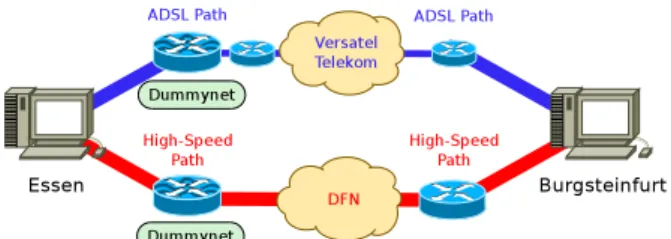
Our experimental testbed setup is shown in Fig-ure 3. Sender and receiver are running FreeBSD 8.2 (already including CMT/RPv1 CC) with CMT/RPv2 and
MPTCP CCs added. NETPERFMETER runs on sender
(active instance) and receiver (passive instance). The sender located in Essen/Germany is connected to the receiver in Burgsteinfurt/Germany through two different paths which are known to be disjoint: the first path uses a high-speed fibre optic connection over the German Re-search Network (Deutsches Forschungsnetz – DFN), with 5Of course, the passive node compresses the databeforetransmission.
a typical RTT of 4 ms. The second path uses an ADSL connection in Essen (Versatel; 800 Kbit/s upstream) as well as an ADSL connection in Burgsteinfurt (Telekom; 16 Mbit/s downstream); the typical RTT is 56 ms.
In order to perform experiments with different network characteristics (here: bandwidth), the FreeBSD packet
filtering mechanism DUMMYNET [24] is used to apply
traffic limitations on the routers connecting the host in Essen to the ISPs. In case of the DFN network, this has
been realised without any problem by using DUMMYNET
on the first router. In contradiction, performing the same procedure for the DSL path has been more complicated. The router delivered by the ADSL ISP has to be used for establishing the connection. However, its configuration had been fixed by the ISP – with no possibility to
re-configure it6. Therefore, we have put another FreeBSD
router – also running DUMMYNET– between the sender
host and ADSL router. In order to subnet the IP network provided by the ADSL ISP, we have furthermore applied Proxy ARP on the FreeBSD router (since the locked-down ADSL router also did not provide a way to configure subnets).
One more restriction caused by the ADSL network has been the lack of support for IPv6. Native IPv6 connectiv-ity is still very unusual for end-users in Germany. Most of the ISPs – including our ADSL ISP – still do not support it, yet. With IPv6 connectivity only via the DFN network, we therefore had to restrict the measurements in this paper to IPv4 only.
Furthermore we have also started to investigate an integration of our experiments into global platforms such
as G-LAB[8]. These platforms consist of a group of
com-puters, which are available as a large testbed for computer networking and distributed systems research. A research
project has access to a so-called slice, which consists of
virtual machine access to a subset of the nodes. Virtual links may be combined with real-existing physical links (like an ADSL connection) to set up complex topologies and perform experiments in these setups. This will bring significant benefits in terms of scalability, extensibility and reliability.
VI. SYSTEMSETUP
For our performance evaluation of the CMT-SCTP CCs introduced in Section III, we have used the following configuration parameters, unless otherwise specified: The senders have been saturated (i.e. sending as much as possible); the message size has been 1,444 bytes at an MTU of 1,492 bytes (i.e. MTU-sized packets [5] on the ADSL path applying PPPoE). All messages have used unordered delivery. CMT-SCTP has been applied for the first flow; the second one – denoted as reference flow – has not applied CMT. The send buffer has been set to 1,000,000 bytes, the receive buffer has been set to 500,000 bytes; Buffer splitting as defined in [13] (pro-vided by FreeBSD kernel SCTP) has been applied. The duration of each throughput measurement has been 5 min. Tests have been repeated 5 times in order to ensure a sufficient statistical accuracy. The results plots show the average values and their corresponding 95% confidence intervals.
6We have been restrained from a password recovery procedure, since
0 2 4 6 8 10 12 14 16 18 20 0 2 4 6 8 10 12 14 16
Data Rate on DFN Path ρDFN [Mbit/s]
Application P a yload Throughput [ Mbit/s ] CMT−SCTP Flow
Congestion Control Variant Γ
1: Γ=cmt 2: Γ=cmtrpv1 3: Γ=cmtrpv2 4: Γ=like−mptcp 0 2 4 6 8 10 12 14 16 18 20 0 2 4 6 8 10 12 14 16
Data Rate on DFN Path ρDFN [Mbit/s]
Application P a yload Throughput [ Mbit/s ] SCTP Reference Flow
Congestion Control Variant Γ
1: Γ=cmt 2: Γ=cmtrpv1 3: Γ=cmtrpv2 4: Γ=like−mptcp
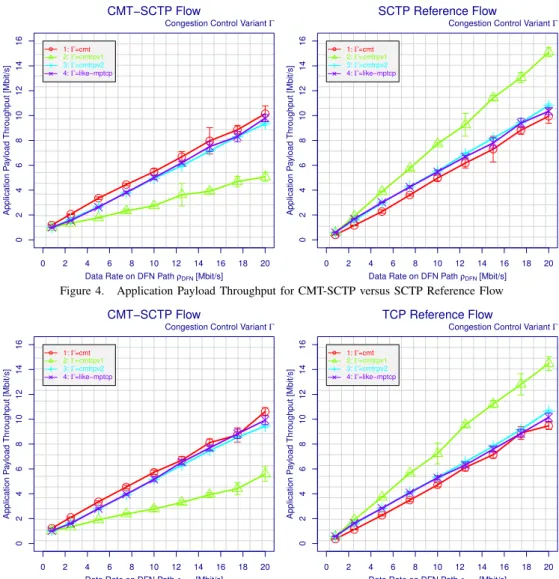
Figure 4. Application Payload Throughput for CMT-SCTP versus SCTP Reference Flow
0 2 4 6 8 10 12 14 16 18 20 0 2 4 6 8 10 12 14 16
Data Rate on DFN Path ρDFN [Mbit/s]
Application P a yload Throughput [ Mbit/s ] CMT−SCTP Flow
Congestion Control Variant Γ
1: Γ=cmt 2: Γ=cmtrpv1 3: Γ=cmtrpv2 4: Γ=like−mptcp 0 2 4 6 8 10 12 14 16 18 20 0 2 4 6 8 10 12 14 16
Data Rate on DFN Path ρDFN [Mbit/s]
Application P a yload Throughput [ Mbit/s ] TCP Reference Flow
Congestion Control Variant Γ
1: Γ=cmt
2: Γ=cmtrpv1
3: Γ=cmtrpv2
4: Γ=like−mptcp
Figure 5. Application Payload Throughput for CMT-SCTP versus TCP Reference Flow
VII. EVALUATION
A. CMT-SCTP versus SCTP
In our first measurement, we have examined the per-formance of CMT-SCTP versus standard SCTP. The
bandwidth of the DFN path ρDFN has been varied
from 800 Kbit/s to 20 Mbit/s, while the bandwidth of the ADSL path has been fixed at 800 Kbit/s (ADSL uplink speed). This scenario is challenging, due to the dissimi-larity of the paths (different RTTs, different bandwidths) and in particular due to so-called Buffer Bloat [25], which is caused here by the typically long ADSL modem queue; see also [13] for more details on this subject. The resulting application payload throughputs are displayed in Figure 4 for the CMT-SCTP flow (left-hand plot) and the standard SCTP reference flow (right-hand plot) for the four CCs
(i.e. Γ=cmt for plain CMT-SCTP CC; Γ=cmtrpv1 for
CMT/RPv1 andΓ=cmtrpv2 for CMT/RPv2 respectively,
as well asΓ=like-mptcp for MPTCP CC.
Clearly, plain CMT-SCTP CC performs as expected:
atρDFN=20 Mbit/s, the CMT-SCTP flow achieves a
pay-load throughput of about 10.5 Mbit/s (i.e. it gets half of
the ρDFN=20 Mbit/s shared with the reference flow, as
well as the 800 Kbit/s of the ADSL link exclusively). The reference flow achieves the corresponding throughput (i.e. about 9.6 Mbit/s) on its single path.
The performance of CMT/RPv1 is obviously bad, due to the very different slow-start thresholds on both paths. Due to the Buffer Bloat caused by the ADSL modem
queue, the congestion windowcADSL grows very large in
comparison to cDFN, leading to corresponding slow-start
thresholds sADSL and sDFN – and in result to a
slowly-growing congestion window cDFN on the fast path (due
to small slow-start threshold ratio sˆDFN). Even worse,
due to the large sADSL, cDFN has to restart from one
MTU each time a retransmission occurs on the DFN path. This happens frequently – due to concurrency with the reference flow. In result, the achieved application payload
throughput is less than 5 Mbit/s atρDFN=20 Mbit/s. This
clearly violates RP goal #1 of Section III.
CMT/RPv2 as well as MPTCP-like CC behave as expected: for the CMT-SCTP flow, the achieved through-put is slightly less than the throughthrough-put for plain CMT-SCTP CC. This is an intended effect of RP, which tries to shift congestion to less-congested paths (goal #3 of Section III). Since the CMT-SCTP flow may exclusively use the 800 Kbit/s of the ADSL path, it is less aggres-sive on the DFN path. In result, both flows achieve a quite similar payload throughput (e.g. about 10 Mbit/s
atρDFN=20 Mbit/s. That is, both CCs fulfil the goals set
B. CMT-SCTP versus TCP
In order to show the performance of CMT-SCTP on concurrency against a TCP flow, we have repeated the measurement described in Subsection VII-A with the SCTP reference flow replaced by a TCP one. The cor-responding application throughput results are shown in Figure 5 for the CMT-SCTP flow (left-hand plot) and the TCP reference flow (right-hand plot).
Obviously, the results are very similar to the previous CMT-SCTP versus SCTP results. The CMT-SCTP flow throughput for CMT/RPv2 as well as MPTCP-like CC are slightly lower than for plain CMT-SCTP CC – due to a shifting of congestion to fulfil RP goal #3 – and CMT/RPv1 is unsuitable in the dissimilar path setup. The particularly important result of this measurement is the fact that the CMT transport does not introduce unfairness when concurring with TCP flows. This point is highly crucial, since a major prerequisite for standardising CMT protocol extensions in the IETF is to not cause unfairness to the widely deployed TCP protocol.
VIII. CONCLUSIONS
In order to examine the multipath congestion controls which are currently under discussion in the IETF within the scope of standardisation activities for the CMT pro-tocol extensions CMT-SCTP and MPTCP, we have set up a distributed CMT testbed based on a real-world Internet setup. To actually run measurements, we have
developed our Open Source NETPERFMETERtool-chain,
which helps researchers to perform tests in the testbed – as well as in upcoming large-scale,
multi-homing-capable, virtualised network testbeds like the G-LAB.
Our tool-chain is not only useful for our congestion control evaluation. It may also be used for other network performance research purposes as well.
By using the NETPERFMETERtool-chain in our
Inter-net testbed setup, we have performed a proof-of-concept performance evaluation of the four relevant CMT conges-tion controls: plain CMT-SCTP, CMT/RPv1, CMT/RPv2, as well as MPTCP-like. We have shown that both, CMT/RPv2 as well as MPTCP-like congestion control, fulfil the set goals and are suitable for handling CMT traffic in a heterogeneous Internet setup.
As part of future work, we are going to perform pa-rameter studies using a wider range of papa-rameters in more
complex setups (e.g. based on G-LAB). Furthermore, we
are also going to simulatively evaluate the congestion control approaches. We will use these results to formalise the fairness criteria of multipath transport, in order to provide a more fine-granular classification. Finally, we are also going to contribute our results into the ongoing IETF standardisation process of CMT-SCTP and MPTCP.
REFERENCES
[1] A. Ford, C. Raiciu, M. Handley, S. Barr´e, and J. R. Iyengar, “Architectural Guidelines for Multipath TCP Development,” IETF, Informational RFC 6182, Mar. 2011, ISSN 2070-1721.
[2] J. R. Iyengar, P. D. Amer, and R. Stewart, “Concurrent Multipath Transfer Using SCTP Multihoming Over Independent End-to-End Paths,”IEEE/ACM Transactions on Networking, vol. 14, no. 5, pp. 951–964, Oct. 2006, ISSN 1063-6692.
[3] M. Becke, T. Dreibholz, J. R. Iyengar, P. Natarajan, and M. T¨uxen, “Load Sharing for the Stream Control Transmission Proto-col (SCTP),” IETF, Network Working Group, Internet Draft Ver-sion 02, July 2011, draft-tuexen-tsvwg-sctp-multipath-02.txt, work in progress.
[4] T. Dreibholz, I. R¨ungeler, R. Seggelmann, M. T¨uxen, E. P. Rathgeb, and R. R. Stewart, “Stream Control Transmission Pro-tocol: Past, Current, and Future Standardization Activities,”IEEE Communications Magazine, vol. 49, no. 4, pp. 82–88, Apr. 2011, ISSN 0163-6804.
[5] R. R. Stewart, “Stream Control Transmission Protocol,” IETF, Standards Track RFC 4960, Sept. 2007, ISSN 2070-1721. [6] T. Dreibholz, M. Becke, J. Pulinthanath, and E. P. Rathgeb,
“Applying TCP-Friendly Congestion Control to Concurrent Mul-tipath Transfer,” in Proceedings of the 24th IEEE International Conference on Advanced Information Networking and Applica-tions (AINA), Perth/Australia, Apr. 2010, pp. 312–319, ISSN 1550-445X.
[7] T. Dreibholz, M. Becke, H. Adhari, and E. P. Rathgeb, “On the Impact of Congestion Control for Concurrent Multipath Transfer on the Transport Layer,” inProceedings of the 11th IEEE Inter-national Conference on Telecommunications (ConTEL), Graz/Aus-tria, June 2011, pp. 397–404, ISBN 978-953-184-152-8. [8] M. Kleis, J. M¨uller, A. Siddiqui, and M. Becke, “Evaluating a
Future Internet Cross-Layer Composition Prototype,” in Proceed-ings of the 7th International ICST Conference on Testbeds and Research Infrastructures for the Development of Networks and Communities (TridentCom), Shanghai/China, Apr. 2011. [9] P. Natarajan, N. Ekiz, E. Yilmaz, P. D. Amer, and J. R. Iyengar,
“Non-Renegable Selective Acknowledgments (NR-SACKs) for SCTP,” inProceedings of the 16th IEEE International Conference on Network Protocols (ICNP), Orlando, Florida/U.S.A., Oct. 2008, pp. 187–196, ISBN 978-1-4244-2506-8.
[10] M. Welzl,Network Congestion Control: Managing Internet Traffic. Chichester, West Sussex/United Kingdom: John Wiley & Sons, 2005, ISBN 978-0-470-02528-4.
[11] M. Allman, “TCP Congestion Control with Appropriate Byte Counting (ABC),” IETF, RFC 3465, Feb. 2003, ISSN 2070-1721. [12] T. Dreibholz, M. Becke, J. Pulinthanath, and E. P. Rathgeb, “Implementation and Evaluation of Concurrent Multipath Transfer for SCTP in the INET Framework,” in Proceedings of the 3rd ACM/ICST International Workshop on OMNeT++, Torremolinos, M´alaga/Spain, Mar. 2010, ISBN 978-963-9799-87-5.
[13] H. Adhari, T. Dreibholz, M. Becke, E. P. Rathgeb, and M. T¨uxen, “Evaluation of Concurrent Multipath Transfer over Dissimilar Paths,” in Proceedings of the 1st International Workshop on Protocols and Applications with Multi-Homing Support (PAMS), Singapore, Mar. 2011, pp. 708–714, ISBN 978-0-7695-4338-3. [14] T. Dreibholz, M. Becke, E. P. Rathgeb, and M. T¨uxen, “On the
Use of Concurrent Multipath Transfer over Asymmetric Paths,” in Proceedings of the IEEE Global Communications Confer-ence (GLOBECOM), Miami, Florida/U.S.A., Dec. 2010, ISBN 978-1-4244-5637-6.
[15] D. Wischik, M. Handley, and M. B. Braun, “The Resource Pooling Principle,” ACM SIGCOMM Computer Communication Review, vol. 38, no. 5, pp. 47–52, Oct. 2008, ISSN 0146-4833.
[16] C. Raiciu, M. Handley, and D. Wischik, “Practical Congestion Control for Multipath Transport Protocols,” University College London, London/United Kingdom, Tech. Rep., 2009.
[17] T. Dreibholz and M. Becke, “SCTP Socket API Extensions for Concurrent Multipath Transfer,” IETF, Network Working Group, Internet Draft Version 01, May 2011, draft-dreibholz-tsvwg-sctpsocket-multipath-01.txt, work in progress.
[18] D. L. Mills, J. Martin, J. Burbank, and W. Kasch, “Network Time Protocol Version 4: Protocol and Algorithms,” IETF, Standards Track RFC 5905, June 2010, ISSN 2070-1721.
[19] J. Seward,bzip2 – A Program and Library for Data Compression, Dec. 2007.
[20] R Development Core Team,R: A Language and Environment for Statistical Computing, Vienna/Austria, July 2011.
[21] T. Dreibholz, X. Zhou, and E. P. Rathgeb, “SimProcTC – The Design and Realization of a Powerful Tool-Chain for OMNeT++ Simulations,” inProceedings of the 2nd ACM/ICST International Workshop on OMNeT++, Rome/Italy, Mar. 2009, pp. 1–8, ISBN 978-963-9799-45-5.
[22] T. Dreibholz, “NetPerfMeter Homepage,” 2011, http://www.iem.uni-due.de/ dreibh/netperfmeter/.
[23] Wireshark, “Wireshark: The World’s Most Popular Network Pro-tocol Analyzer,” 2011.
[24] M. Becke, T. Dreibholz, E. P. Rathgeb, and J. Formann, “Link Emulation on the Data Link Layer in a Linux-based Future Internet Testbed Environment,” inProceedings of the 10th International Conference on Networks (ICN), St. Maarten/Netherlands Antilles, Jan. 2011, pp. 92–98, ISBN 978-1-61208-002-4.