Cross-border goods traffic –
Results, potentials and problems in the Frankfurt (Oder) – Slubice region
Study within the framework of the Interreg III B – Project RAIL BALTICA
On behalf of the German Partners:
Ministry for Infrastructure and Spatial Planning of the State of Brandenburg Senate Authority for Urban Development Berlin
Cross-border goods traffic –
Results, potentials and problems in the Frankfurt (Oder) – Slubice region
Study within the framework of the Interreg III B – Project RAIL BALTICA
Final report
Customer:
Ministry for Infrastructure and Spatial Planning of the State of Brandenburg Henning-von-Tresckow-Straße 2-8
14467 Potsdam
in cooperation with the senate authority for urban development Berlin and Deutsche Gesellschaft für Technische Zusammenarbeit (GTZ) GmbH
Supplier:
Infrastruktur- und Projektentwicklungsgesellschaft mbH
(Company for the Development of Infrastructure and Related Projects Ltd) Burgstraße 30 14467 Potsdam Project Team: Torsten Wolter Marc Kuper Simone Fejér Martin Heiland Potsdam 9 January 2007
Cross-border goods traffic –
results, potentials and problems in the Frankfurt (Oder) / Slubice region
LIST OF CONTENTS
LIST OF DIAGRAMS ... V LIST OF ABBREVIATIONS ...VII
0. OBJECTIVE ... 1
1. STUDY OF EXISTING ECONOMIC STRUCTURE ... 2
1.1
Regional economic structure ...2
1.1.1 Voivodship Lubuskie ... 2
1.1.2 Oderland-Spree region ... 4
1.2
Special economic zone Kostrzyn – Slubice ...6
1.3
Logistics infrastructure: ETTC Frankfurt (Oder) ...7
1.4
Significance of the German-Polish trade for the border region ...9
1.5
Development trends in economic structures ... 11
2. STUDY OF EXISTING TRANSPORT INFRASTRUCTURE ... 12
2.1
Railway transport network...12
2.1.1 The railway transport network in the studied region ... 12
2.1.2 Other routes with significance for cross-border goods traffic between Germany and Poland ... 29
2.2
Road transport network...35
2.2.1 Highway network in the studied region... 35
2.2.2 Further routes with significance for cross-border goods traffic between Germany and Poland ... 40
2.3
Border crossing facilities ... 44
3. VOLUMES AND CHARACTERISTIcs of cross-border goods traffic ... 47
3.1
Development of goods traffic output in Germany and Poland ...47
3.2
Cross-border goods traffic Germany – Poland and in particular in the
Frankfurt (Oder) – Slubice region...48
3.2.1 Railway transport ... 48
3.2.2 Road transport ... 50
3.2.3 Cargo handling services ... 52
4. STRENGTHS AND WEAKNESSES OF THE EXISTING INFRASTRUCTURE... 53
4.1.
Outstanding features of the economic structure ...53
4.1.1 Attractive features (strengths)... 53
4.1.2 Deficits and problems (weaknesses) ... 54
4.2
Outstanding features of the transport infrastructure and the traffic flow ....55
4.2.1 Rail haulage... 55
4.2.1.1 Attractive features (strengths) ... 55
4.2.1.2 Deficits and problems (weaknesses)... 57
4.2.2 Road haulage ... 60
4.2.2.1 Attractive features (strengths) ... 60
4.2.2.2 Deficits and problems (weaknesses)... 60
4.3
Assessment of the cross-border transport infrastructure ...62
Cross-border goods traffic –
results, potentials and problems in the Frankfurt (Oder) / Slubice region
5. ORGANISATION OF CROSS-BORDER GOODS TRAFFIC AND THE
NECESSARY INFRASTRUCTURE ... 67
5.1
Estimate of the development potential of the economic and transport
infrastructure and in the cross-border traffic flow ...67
5.1.1 Economic structure ... 67
5.1.2 Transport infrastructure ... 68
5.1.3 Traffic flow ... 69
5.2
Development goals for an attractive cross-border goods traffic development
(theses) ...70
5.3
Recommendations for organising the infrastructure and the cross-border
networking of infrastructure components ...72
5.3.1 Rail haulage... 72
5.3.2 Road haulage ... 73
5.3.3 Goods traffic logistics... 74
Cross-border goods traffic –
results, potentials and problems in the Frankfurt (Oder) / Slubice region
LIST OF DIAGRAMS
Fig. 1: Specifications Voivodship Lubuskie... 2
Fig. 2: Industry structure in the Oderland-Spree and Lubuskie region... 4
Fig. 3: Specifications Oderland-Spree region ... 5
Fig. 4: The location system of the ETTC ... 7
Fig. 5: The industrial real estate of the ETTC ... 7
Fig. 6: Existing and planned direct transports of the CT terminal Frankfurt (O) ... 8
Fig. 7: Aerial view CT terminal Frankfurt (O) ... 8
Fig. 8: Exports from Germany and the federal states near the border to Poland ... 9
Fig. 9: Exports from Poland and the Voivodships near the border to Germany ... 9
Fig. 10: Share of exports of the GDP, 2001... 10
Fig. 11: Railway bridge over the Oder in September 2005 ... 14
Fig. 12, 13: Border goods station Oderbrücke in August 2006 ... 15
Fig. 14: CT terminal of the ETTC in August 2006... 16
Fig. 15: The classification of the route Berlin – Warszawa in the context of Rail Baltica 17 Fig. 16: Measures on the railway route E 20 (Berlin – Warszawa – Russia)... 19
Fig. 17: Development of the Polish railway network in the current development plan .... 19
Fig. 18: Route characteristics in the area of the Voivodship Lubuskie ... 21
Fig. 19, 20: Route impressions in Kunowice station ... 21
Fig. 21, 22: Slubice station (respectively view direction Kunowice)... 22
Fig. 23, 24: Kunowice station ... 22
Fig. 25, 26: Rzepin station (platform installations, view direction west / east)... 23
Fig. 27, 28: Goods track systems in the western head of Rzepin station... 24
Fig. 29: Route characteristics in the area of the Voivodship Lubuskie ... 24
Fig. 30, 31: Platform installation of the route in the southern area of Rzepin station ... 25
Fig. 32: Double-track bypass west of Rzepin station ... 25
Fig. 33: Single-track introduction of the route in the south eastern head of Rzepin station ... 25
Fig. 34: Route characteristics Berlin – Strausberg – Küstrin-Kietz – border D/PL... 26
Fig. 35: Route characteristics border D/PL – Kostrzyn – Gorzow Wlkp. – Krzyz – Tczew27 Fig. 36, 37: Route Kostrzyn – Tczew in Kostrzyn station ... 27
Fig. 38: Route characteristics Eberswalde – Werbig – Frankfurt (Oder)... 28
Fig. 39: Route characteristics Frankfurt (Oder) – Grunow – Königs Wusterhausen ... 28
Fig. 40: Route characteristics Frankfurt (Oder) – Guben - Cottbus ... 29
Fig. 41: The railway network in the Voivodship Lubuskie... 30
Fig. 42: Route characteristics border D/PL – Gubin – Zbaszynek ... 31
Fig. 43: Route characteristics border D/PL – Gubinek – Zagan – Wroclaw ... 32
Fig. 44: Route characteristics border D/PL – Zagan – Glogow - Lodz ... 33
Fig. 45: Route characteristics E30 Amsterdam - Berlin - Warsaw - Moscow ... 35
Fig. 46, 47: Road condition E30 after the border crossing on the Polish side... 36
Fig. 48, 49: Quality of the N2 west of Rzepin as well as near Pniewy... 36
Fig. 50, 51: Marked formation of lane grooves in the course of the Swiebodzin ring road37 Fig. 52, 53: Town thoroughfare Bytyn of the N2 in the section Pniewy - Poznan... 37
Fig. 54, 55: Building measures in the section of the A 2 Konin – Strykow ... 38
Fig. 56: Route characteristics Berlin – Gorzow Wlkp. – north east of Poland ... 38
Fig. 57, 58: Border clearance facilities on 2 August 2006... 39
Fig. 59, 60: Truck tailback in front of the border crossing Oderbrücke ... 40
Cross-border goods traffic –
results, potentials and problems in the Frankfurt (Oder) / Slubice region
Fig. 62 - 66: Characteristics of other significant routes... 42
Fig. 67: Cross-border facilities railway traffic ... 44
Fig. 68: Overview of the border crossings ... 45
Fig. 69: Border crossing facilities road transport ... 46
Fig. 70: Development of transport demand in Poland... 47
Fig. 71: Development of cross-border rail haulage D/PL ... 48
Fig. 72: Operating programme 1990/91 route Berlin – Frankfurt (Oder) – border D/PL. 48 Fig. 73: Operating programme 2006 for ABS Berlin – Frankfurt (Oder) – border D/PL.. 49
Fig. 74: Operating programme 2015 for ABS Berlin – Frankfurt (O) – border D/PL... 50
Fig. 75: Long distance road haulage by trucks in both directions via the border crossing Frankfurt (Oder) – Swiecko... 51
Fig. 76: Cross-border road connections D/PL with high goods traffic volumes in 2002 . 51 Fig. 77: Assessment of the railway infrastructure ... 63
Fig. 78: Assessment of the road infrastructure ... 64
Fig. 79: Assessment of the border crossing facilities... 65
Fig. 80: Estimate of potential economic structure ... 67
Fig. 81: Estimate of potential transport infrastructure ... 68
Cross-border goods traffic –
results, potentials and problems in the Frankfurt (Oder) / Slubice region
LIST OF ABBREVIATIONS
AGC European Agreement of Main International Railway Lines
AGTC European Agreement on Important International Combined Transport Lines and Related Installations
B Belgium
Bf. * Station
GDP Gross domestic product
BVWP Federal Transportation Route Plan
BY Belarus
DB AG Deutsche Bahn Aktiengesellschaft
GDR German Democratic Republic (until 1990)
EBRD European Bank for Reconstruction and Development EC, IC EuroCity, InterCity
EFRE European Fund for Regional Development (corresponds with ERDF)
EKO
Acelor Eisenhüttenstadt / formerly EKO (Eisenhüttenkombinat Ost [Ironworks Combine East] steel
ERDF European Regional Development Fund (corresponds with EFRE) ERTMS European Rail Traffic Management System
ESTW * Electronic signal box (technology) ESTW-A * Electronic signal box – external unit ESTW-Z * Electronic signal box – control station
ETCS TAP European Train Control System, Telematic Applications for Passengers ETTC Euro Transport & Trade Center Frankfurt (Oder)
EU European Union
EUR Euro
GDDKiA Generalna Dyrekcja Drog Krajowych i Autostrad GSM-R Global System for Mobile Communication - Rail
GÜ* Border crossing
IAB * Institute for labour market and professional research of the job agency
IHK * Chamber of Commerce
ISPA Instrument for Structural Policies for Pre-Accession SME Small and medium-sized companies
CT Combined traffic
L Luxembourg
LST * Control and security technology
NL The Netherlands
PKP S. A. Polskie Koleje Panstwowe, Spolka Akcyjna
PL Poland
PLK S. A. Polskie Linie Kolejowe, Spolka Akcyjna PZB * Punctiform train influence
RGW * Council for reciprocal economic aid (until 1991)
RUS Russia
SPNV * Local passenger transport by rail TEU Twenty Foot Equivalent Unit
* Translator’s note: These are generally recognised abbreviations used in the German text for which there are no equivalent abbreviations in English
Cross-border goods traffic –
results, potentials and problems in the Frankfurt (Oder) / Slubice region
0.
OBJECTIVE
Goals of the Interreg III B Rail Baltica project
The goal of the EU project RAIL BALTICA is to develop an efficient rail transport link in the relation (Helsinki -) Estonia – Latvia – Lithuania – Warsaw (- Berlin). In particular the ex-change of goods between the Baltic States and with Finland, Poland and Central Europe is to be reinforced and the share of goods traffic by rail substantially increased through this important international infrastructure.
Studies by order of the German partners
The smooth integration of the route into the Central European rail transport system as well as the exchange of experiences with German institutions and planners is aimed at through the participation of German partners in the project. Orders were placed for studies on se-lected issues with experienced and efficient planning offices by the project partner Ministry for Infrastructure and Spatial planning of the State of Brandenburg, by close coordination with the Senate Administration for Urban Development Berlin, in order to enhance the pro-ject work with actual scientific knowledge.
The contents of the studies are the assessment of the border-zone and cross-border in-frastructure planning in the area of the German-Polish border (study 1), the study of the potentials of the transport and infrastructure network with regard to setting-up new logis-tics centres along the Rail Baltica (study 2) as well as the analysis of results, potentials and problems of the cross-border goods traffic in the Frankfurt (Oder) / Slubice region (study 3).
Strengths and weaknesses of the business and transport infrastructure and in the traffic flow are presented as well as and potentials, development targets and recommendations for organisation derived in and from this study 3 based on a study of the existing struc-tures. The focus is placed on the region of Kostrzyn – Frankfurt (Oder) / Slubice / Rzepin – Eisenhüttenstadt, nevertheless there is a useful consideration of the infrastructures and transport relations with implications beyond this region as well as the competition.
Cross-border goods traffic –
results, potentials and problems in the Frankfurt (Oder) / Slubice region
1.
STUDY OF EXISTING ECONOMIC STRUCTURE
1.1 Regional economic structure
1.1.1 Voivodship Lubuskie
The thinly populated Voivodship Lubuskie covers an area of approx. 14,000 m² and has approx. one million inhabitants. The two large cities of the Voivodship Gorzow Wielkopol-ski (Wlkp.) and Zielona Gora with respectively more than 100,000 inhabitants share the capital function. In terms of business the region is primarily characterised by small compa-nies with up to five employees. 80 % of the employees work in SMEs, primarily in the fields of services, transport industry, trade and the construction industry. These compa-nies account for a share of 60% of the macro-economic production.
Fig. 1: Specifications Voivodship Lubuskie
Surface area: 13,984 m²
Inhabitants Approx. 1,000,000 / 73 inhabitants/km²
Capitals Gorzow Wlkp. (Voivodship department)
Zielona Gora (marshal department)
Labour market approx. 382,000 employed
approx. 92,000 unemployed (24.4 %) Special economic area Kostrzyn – Slubice
Universities Gorzow Wlkp. (Business Studies, Finances, IT)
Zielona Gora (Electronics, Physics, Mechanical Engineering, Mathe-matics, IT, etc.)
Average income level -2,047 Zl. (gross, industry) -1,771 Zl. (gross, construction)
Main business industries -Trade, paper, furniture, farming, food, textiles The most important export goods 1. Furniture and carpentry products
2. Clothing 3. Cables 4. Shoes
5. Paper products / cellulose products 6. Chemical fibres
The largest foreign investments • Kostrzyn Paper S.A. (Trebruk AG, Sweden), paper mill
• Volkswagen Elektro-Systemya Sp. z. o.o. in Gorzow
• Zaklady Farmaceutyczne Biowet, (Aksila AG Switzerland) – factory for veterinary medicine in Gorzow
• Swedwood (part of IKEA Fabrok, Sweden). Furniture factories in Zbaszynek and Babimost
• Steinpol (Steinhoff Group Germany), furniture factory in Zielona Go-ra
• Stilon S.A. (Rhône Poulenc, France) chemical factory in Gorzow
• Podravka Polska Sp. z o.o. (Podravka, Croatia) food factory
Cross-border goods traffic –
results, potentials and problems in the Frankfurt (Oder) / Slubice region
Lubuskie is a farming-industrial region with expansive service sector. Several industrial sectors can use raw materials from farming, forestry and water management which can be found regionally. Deposits of crude oil and natural gas which were developed recently have led to the development of petrochemical companies. 35 % of the population live in the countryside, approx. 20 % live from farming. Industrial clusters can be found in the two large cities Gorzow Wlkp., Zielona Gora as well as in Zary. A new commercial-industrial cluster was able to develop in the past few years through the attraction of the special eco-nomic zone Kostrzyn – Slubice, which is particularly characterised by fiscal concessions. Nevertheless, there are also industrial companies of various sizes in small towns, where they use the local resources, such as e. g. IKEA the large forest stocks in Zbaszynek and Babimost.
The dominating sector is the food industry (18.2 %) as well as wood production and proc-essing (18.3 %). Companies from Lubuskie account for a significant share of the whole production of Poland (e.g. 30 % wooden flooring, 19 % shoe production, 10 % furniture) in several industries. The location near the border combined with favourable transport con-nections is an important location benefit for the region, which did not just steer invest-ments into the special economic zones.
The original peripheral location of the Voivodship Lubuskie within Poland has increasingly developed into a very positive factor through the proximity to the border. By interacting with the market potential of Poland and the favourable cost and workforce situation the re-gion takes advantage of its specific location benefits. The most important trading partner of the region is Germany, the majority of the exports goes to the European Union. The Voivodship Lubuskie has a positive foreign trade balance. Altogether there are 1,900 companies with foreign participation. German investments account for the majority share, however there are also investments above all from Switzerland, Sweden, Denmark, the Netherlands, France and other countries. Sources: www.lubuskie.pl / www.ihk-ffo.de
Cross-border goods traffic –
results, potentials and problems in the Frankfurt (Oder) / Slubice region
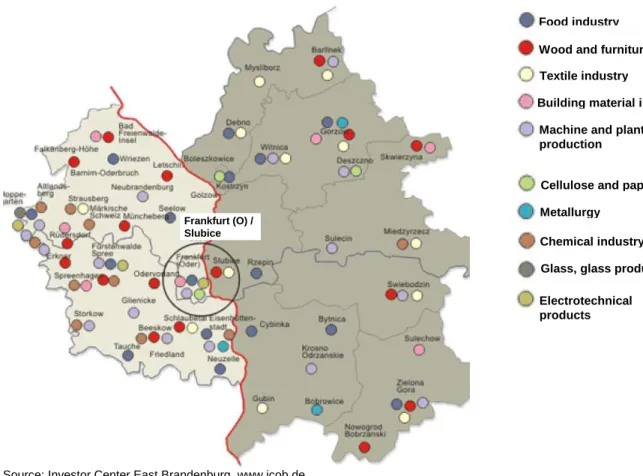
Fig. 2: Industry structure in the Oderland-Spree and Lubuskie region
Source: Investor Center East Brandenburg, www.icob.de
1.1.2 Oderland-Spree region
The Oderland-Spree business region consists of the two counties Märkisch-Oderland and Oder-Spree as well as the City of Frankfurt (Oder). The region covers an area of approx. 4,500 km² and has approx. 450,000 inhabitants. In terms of business structure East Bran-denburg can be broken down into three sub-regions:
• commercial industrial cores near the Oder (Frankfurt/O, Eisenhüttenstadt)
• commercial industrial core in the border area near Berlin (Strausberg, Rüdersdorf, Fürstenwalde)
• largely rural sub-areas with isolated industry between the afore-mentioned commercial industrial cores
The commercial-industrial core near the Oder is primarily characterised by the metal pro-duction in Eisenhüttenstadt by the company EKO-Stahl and is one of the most modern in the industry. A multitude of small and medium-sized enterprises have settled in its sur-rounding area, which profit from cooperation possibilities and the availability of quality steel. Frankfurt (Oder) sees itself as administrative, service and trading centre in the east of Brandenburg with the functions of an upper level centre. Despite the features of a
struc-Food industry
Wood and furniture indus. Textile industry
Building material indus. Machine and plant production
Cellulose and paper Metallurgy
Chemical industry Glass, glass products Electrotechnical products
Frankfurt (O) / Slubice
Cross-border goods traffic –
results, potentials and problems in the Frankfurt (Oder) / Slubice region
turally weak region with a trend to small and very small companies there are several facili-ties in Frankfurt/Oder which offer big chances for the economic development. These are the Technology Park East Brandenburg with the Institute for semi-conductor physics and the industrial park Euro Transport & Trade Center (ETTC) which is oriented to the logistics industry. In addition, the town is increasingly establishing itself as a German-Polish plat-form for trade and cooperation, flanked by trade fairs such as Logtrans as well as the Uni-versity of Viadrina.
A decisive boost for growth and the economic development of the town is expected from the settlement of the company “First Solar Manufacturing” from Phoenix, USA. After com-pletion of a factory for the production of thin layer solar modules around 400 new jobs will be created in the then world’s biggest factory for this purpose. Conergy AG from Ham-burg, the solar company with the highest revenue in Europe, has also chosen Frankfurt for a new location so that together with Odersun AG, which is already based here, a cluster for the solar industry could emerge.
The western part of the region which borders onto Berlin functionally assumes the role of a relief zone for the capital city with a differentiated economic and industry structure. The GVZ [Goods Traffic Centre] Berlin east Freienbrink can also be found here. The region in between is a classical structurally weak rural region with isolated smaller commercial cores such as Bad Freienwalde (brick industry) or Beeskow (wood industry).
Sources: www.ihk-ffo.de, www.oderland-spree.de, www.frankfurt-oder.de
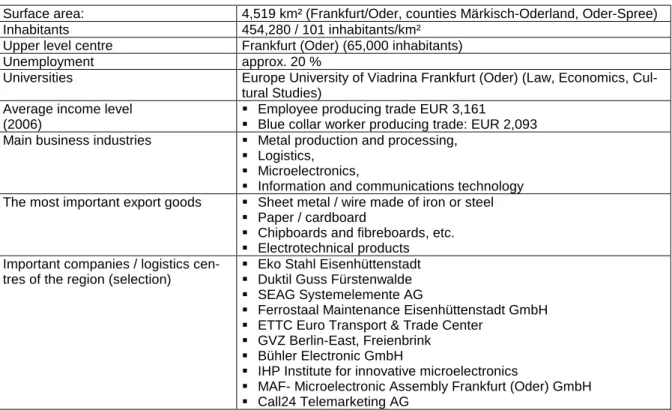
Fig. 3: Specifications Oderland-Spree region
Surface area: 4,519 km² (Frankfurt/Oder, counties Märkisch-Oderland, Oder-Spree) Inhabitants 454,280 / 101 inhabitants/km²
Upper level centre Frankfurt (Oder) (65,000 inhabitants)
Unemployment approx. 20 %
Universities Europe University of Viadrina Frankfurt (Oder) (Law, Economics, Cul-tural Studies)
Average income level (2006)
Employee producing trade EUR 3,161
Blue collar worker producing trade: EUR 2,093 Main business industries Metal production and processing,
Logistics, Microelectronics,
Information and communications technology The most important export goods Sheet metal / wire made of iron or steel
Paper / cardboard
Chipboards and fibreboards, etc. Electrotechnical products Important companies / logistics
cen-tres of the region (selection)
Eko Stahl Eisenhüttenstadt Duktil Guss Fürstenwalde SEAG Systemelemente AG
Ferrostaal Maintenance Eisenhüttenstadt GmbH ETTC Euro Transport & Trade Center
GVZ Berlin-East, Freienbrink Bühler Electronic GmbH
IHP Institute for innovative microelectronics
MAF- Microelectronic Assembly Frankfurt (Oder) GmbH Call24 Telemarketing AG
Cross-border goods traffic –
results, potentials and problems in the Frankfurt (Oder) / Slubice region
1.2 Special economic zone Kostrzyn – Slubice
The special economic zone of Kostrzyn and Slubice was established according to the regulations of the Council of Ministers of 9 September 1997. The administration of the special economic zone was handed over to an Aktiengesellschaft [joint stock company] with the same name. After all necessary preparatory tasks had been settled, the executive board of the specialist economic zone began intensive advertising and marketing activi-ties.
The special economic zone of Kostrzyn and Slubice is still a very young zone which is ex-tremely attractive in the opinion of the investors. That this decision was right was con-firmed in the first few years of its existence already.
The most important concession consists in the exemption from corporate income tax. This can be up to 50% of the investment volume with large companies and up to 65% with small and medium-sized companies. The actual amount of the subsidy is determined by calculating the costs which are liable to subsidies in the three most important spending groups property acquisition, expenses for buildings as well as expenses for the equipment of new companies, in particular for: machinery and plants, work appliances and apparatus, technical office equipment, technical infrastructure. The government aid granted in the special economic zone of Kostrzyn and Slubice for the companies has the character of a regional subsidy. This means that the concessions are also determined for creating new jobs in connection with the investment. In order to calculate the costs, which serve as computation base for promoting new jobs, the company’s labour costs (gross salary and secondary costs) for the new jobs, which are incurred within two years, are taken into ac-count. However, subject to the condition that the new jobs are maintained for at least 5 years, beginning from the date upon which the government aid is granted.
The amount of the government aid is, as with the investment concessions, up to 65 % of the labour costs with SME and up to 50 % of the labour costs with large companies. The minimum volume of the investment, that entitles to claim the public subsidies, is EUR 100 thousand.
It is important to mention that the afore-mentioned principles for granting public aid in Po-land apply since 1 January 2001 and comply in full with the provisions of the European Union concerning regional aid. (bezgranic.net)
So far three permits were granted for the construction of factories in the special economic zone Kostrzyn-Slubice (KS SSE). The total value of these investments is EUR 40 million. The transport and logistics company Simex and AM Dönerfabrik (Turkish-German capital), specialised in meat processing, are investing in Slubice. Work will begin on the construc-tion of a factory of the Faurecia Group in Gorzow Wielkopolski, in which automotive cock-pits will be produced. 400 employees are to be employed at this location in the first stage of this investment. The representatives of KS SSE informed about well-advanced talks with a Finnish-Canadian company. The possible investment would relate to the wood in-dustry. As a result a factory for EUR 120 million would be erected on an area of 60 ha in Kostrzyn near the Oder.
Cross-border goods traffic –
results, potentials and problems in the Frankfurt (Oder) / Slubice region
Town of Slubice
Almost 5,000 companies were registered in Slubice at the end of 2000. Besides trade there are primarily industrial companies (production of furniture, semi-finished parts for the building industry and food) as well the building industry and gastronomy. The establish-ment of the special economic zone of Kostrzyn and Slubice in September 1997 secured additional preferential conditions for the companies. (www.ewz.euv-ffo.de)
1.3 Logistics infrastructure: ETTC Frankfurt (Oder)
The Euro Transport & Trade Center (ETTC) sees itself as a logistics centre at the inter-face of the Pan-European east-west main transport axis II Netherlands – Germany – Po-land – Russia with the north-south axis Szczecin – Prague. The offer of the ETTC is com-posed of transport and logistics services with a logistics-oriented industrial park and a CT terminal. The target group of the ETTC is above all oriented to companies with east-west market orientation, which wish to take advantage of the benefits owing to the proximity to the border and the German and Polish markets as well as favourable personnel and cost structures. As service provider the ETTC provides assistance in developing co-operations, corporate models, the search for employees and in establishing contacts to state institu-tions.
Fig. 4: The location system of the ETTC Fig. 5: The industrial real estate of the ETTC
Source: ETTC Source: ETTC
The industrial park is located directly near the motorway junction Frankfurt (Oder)-West of the A12/E30. It is broken down into two sub-areas, one north and one south of the motor-way on a total surface area of approx. 40 ha. (cf. Fig. 5). Fully-developed trade and indus-trial areas with property sizes between 1,000 and 10,000 m² are offered which enable 24
Cross-border goods traffic –
results, potentials and problems in the Frankfurt (Oder) / Slubice region
The transport carriers road and rail are linked on a sub-area of the shunting yard Frankfurt (Oder), approx. 5 km north of the industrial park. It was put into operation in April 2005. The operator of the facility is the BTS-Kombiwaggon company which belongs to the DB Group. At present direct transports are offered to the German seaports of Hamburg and Bremerhaven. Connections to Brest (Polish-Belarusian border), Italy and to the Ruhr re-gion are planned (cf. Fig. 6).
The efficiency of this facility can be seen as follows:
Surface area: 5 ha
2 transshipment tracks, length: 620 m
Transshipment capacity: 400 loading units / day Transshipment area 500 m x 40 m
2 mobile cranes
Packaging of the goods in containers, customs clearance Picking and handling, agency activities
Sources : www.ettc.de, CT terminal of the ETTC, status 02/2006
Fig. 6: Existing and planned direct trans-ports of the CT terminal Frankfurt (O)
Fig. 7: Aerial view CT terminal Frankfurt (O)
Cross-border goods traffic –
results, potentials and problems in the Frankfurt (Oder) / Slubice region
1.4 Significance of the German-Polish trade for the border region
The trade relations between Germany and Poland have constantly expanded in the last 10 years. Imports to Germany from Poland increased by 196.5 %, exports to Poland by 152.1 % in the period 1995-2003. This development is of major importance for the border region. Diagrams 8 and 9 illustrate the relative significance of the exports for Germany and Po-land as well as for their zones near the border. The border zones of the studied region hold an excellent position in the exports to the respective neighbouring country in both analyses. Thus, 11 % of all exports of the state of Brandenburg go to Poland in 2003. It ranks first among the states which border onto Poland. The comparable figure for the whole of Germany is merely approx. 3 %. The share of exports of the Voivodship Lubuskie to Germany is very high with approx. 60 %.
Fig. 8: Exports from Germany and the federal states near the border to Poland 1995-2003, in % of the respective total exports
Source: Federal Statistical Office in HWWA, 2006
Fig. 9: Exports from Poland and the Voivodships near the border to Germany 1995-2003, in % of the respective total exports
Cross-border goods traffic –
results, potentials and problems in the Frankfurt (Oder) / Slubice region
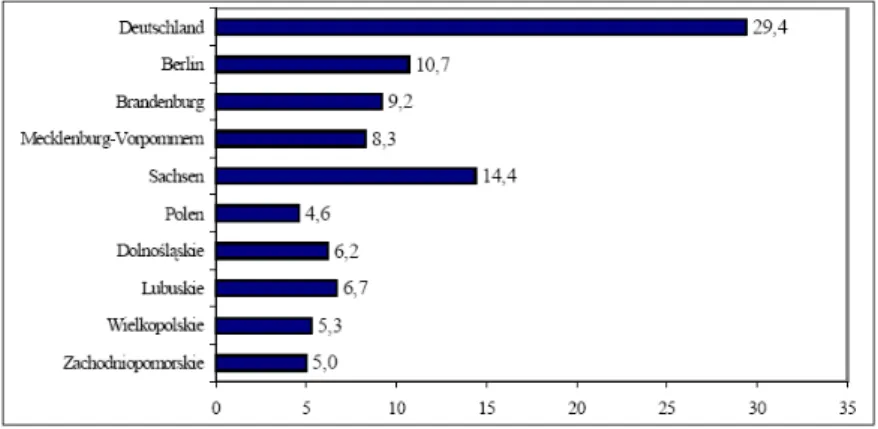
In order to present the actual significance of foreign trade it is necessary to compare the share of exports of the macroeconomic power, the GDP of the respective territorial units. Against the background of the low share of exports of GDP of the Voivodship Lubuskie the high share of exports direction Germany is put into perspective. However, it is striking that the Polish Voivodships near the border play a bigger part in the cross-border work distribu-tion than the Polish economy on the whole. The situadistribu-tion is completely the opposite with the federal German states near the border. Seen as the reasons for this is the lower sig-nificance of the processing trade compared with Germany as a whole.
Source: HWWA Report 263, Analyses and development trends for the German-Polish border zone, 2006
Fig. 10: Share of exports of the GDP, 2001
Source: Glówny Urzad Statystyczny, Federal Statistical Office, Centrum Informatyki Handlu Zagranicznego, HWWA, in HWWA 2006
Within the framework of a study of the Chamber of Commerce Frankfurt (Oder), in which the opinions and attitudes of companies in East Brandenburg (counties of Barnim, Ucker-mark, Märkisch-Oderland, Oder-Spree and City of Frankfurt (Oder) as well as in the region of the economic chamber Gorzow were surveyed, it was expressed that business contacts from the neighbouring country, in particular also after the accession of Poland to the EU, hardly play a role for the majority of the companies from the region. Accordingly there has been no initial trigger for comprehensive cross-border business integration through the accession to the EU. Opportunities, offered for companies through the EU enlargement, are above all used by those which were already active in the respective neighbouring country before 2004 already. Thus, no structures can be seen which allowed the identifica-tion of sustainable cross-border business integraidentifica-tion in the studied region Frankfurt (Oder).
Source: Chamber of Commerce study “The EU enlargement in the opinion of companies in East Brandenburg, 2005, state-ments Mr. Radzimanowski, Chamber of Commerce Frankfurt (Oder)
Cross-border goods traffic –
results, potentials and problems in the Frankfurt (Oder) / Slubice region
1.5 Development trends in economic structures
Long-terms forecasts are difficult owing to a multitude of developments which can neither be influenced or foreseeable. The future economic development in the region depends above all on global development trends, the economic conditions in the border zone and the development of cross-border business relations. Moreover, it is to be taken into ac-count that respectively the German as well as the Polish border zone take part in interna-tional competition for locations. Principal indications are seen in a forecast of the Institute for Labour Market and Professional Research of the Job Agency (IAB) for Germany, which will tend to also apply to the border zone. According to this one can assume a further ter-tiarisation (from 71 % in 2005 to 77 % in 2020) and a further fall in the producing trade (from 27 % to 21 %).
It can be assumed for Poland that the continuing structural changes will effect harmonisa-tion to West European Standards, in particular in the agricultural sector, but also in the service sector. For the border zone this means that owing to different initial situations the Polish side will undergo a greater reorganisation process than on the German side. At present there are still substantial differences in economic structures between German and Polish regions. Different pre-requisites for settlement structures cause different changes in economic structures. Greater upheavals are to be expected for regions more character-ised by agriculture than for those which already have large shares in the service sector.
The results of a workshop in Szczecin on 06.02.2004 concerning the economic develop-ment trends in the German-Polish border zone can be summarised as follows:
• To what extent the still underrepresented service sector on both sides of the border can develop, depends on the company spread and the business industries.
• In the course of harmonisation of the purchasing power to previous West European standards of living the demand in the retail sector and in other service areas will in-crease on the Polish side.
• With regard to the chances in the tourist sector reference is above all made to water sports. The actual chances are however estimated as dim
• Principle chances are seen for the border zone with company-related services. How-ever, the actual development depends on the spread with companies. Potentials are above all presumed for the compressed regions, these however only with the availabil-ity of qualified workers.
• After the introduction of the free movement of labour one can assume a rise in the border commuters from Poland to Germany. It is very difficult to put the expected ex-tent into figures. It depends on the offers of work, the wage gap, which will continue to fall, the demographic development and the transport infrastructure. According to the spatial planning forecast 1999-2020 of the Federal Department for Building and Spa-tial Planning a commuter potenSpa-tial of approx. 11,000 Polish commuters is assumed for the spatial planning region Oderwald-Spree in 2020.
Cross-border goods traffic –
results, potentials and problems in the Frankfurt (Oder) / Slubice region
2.
STUDY OF EXISTING TRANSPORT INFRASTRUCTURE
2.1 Railway transport network
2.1.1 The railway transport network in the studied region
The railway network in the studied region is characterised by the east-west axes Berlin – Frankfurt (Oder) - Warszawa and Berlin – Strausberg – Kostrzyn – Gorzow as well as the north-south tangents Eberswalde – Frankfurt (Oder), Frankfurt (Oder) – Cottbus and Szczecin – Kostrzyn – Rzepin - Wroclaw. In addition, there is the route connection with Königs Wusterhausen via Grunow starting from Frankfurt (Oder).
Route Berlin - Frankfurt (Oder) – border D/PL
The route which is very important for the transport relations West Europe (in particular NL, B, L) – Germany (in particular Rhine/Ruhr, North Sea ports) – Eastern Europe (PL, RUS, Baltic States) is configured with double-tracks and can currently be driven at 120 km/h (Berlin – Fürstenwalde) or 160 km/h (Fürstenwalde – Frankfurt/O). Merely in the section Frankfurt/O passenger station – Oderbrücke is it only possible to drive 40-60 km/h owing to superstructure defects, construction work and the desolate condition of the Oderbrücke. Moreover, the Oderbrücke can only be driven single-track. Up to Frankfurt/O passenger station the route is controlled using modern electronic signal box technology (ESTW) from the operations control centre Berlin-Pankow. Moreover, the modern communication sys-tem GSM-R is installed.
The route is consistently electrified. The overhead contact line systems are fed with alter-nating current 15 kV 16.7 Hz up to the vertex of the border goods station Oderbrücke in order to connect to the traction current configuration direct current 3 kV of the Polish net-work there.
Nearly all of the station facilities are in an excellent condition whereby particularly high in-vestments were made in the Berlin long distance stations as well as the stations in Für-stenwalde and Frankfurt (Oder).
Route expansion
The section Erkner - Frankfurt (Oder) was completed as the first construction stage of the route expansion for 160 km/h when the time table was changed in December 2005. One exception is the section Hangelsberg - Fangschleuse at 120 km/h still, the expansion for 160 km/h began on 22.10.2006 and will end in April 2007. Moreover, it was possible to hand over the new railway fly-over Leipziger Straße in Frankfurt (Oder). The travelling time in the relation Berlin East Station - Frankfurt (Oder) is thus reduced by approx. five (RegionalExpress) or approx. 15 minutes (EC traffic).
Cross-border goods traffic –
results, potentials and problems in the Frankfurt (Oder) / Slubice region
The new ESTW station Oderbrücke will be put into operation when the time table changes in December 2006. From this time the route will be completely fitted with modern control and security technology.
The sections Berlin East Station - Erkner and station Frankfurt (Oder) - Oderbrücke will be upgraded to 120 - 160 km/h or 100 km/h at a later date (expected after or by 2010) ac-cording to the information of DB Netz AG. It will then only take 36 minutes to travel from Berlin East Station to Frankfurt (Oder). These measures depend on sufficient financing by the federal government. The aim is to invest a total of around EUR 560 million in the infra-structure.
160 km/h can be driven to a large extent on the Polish side following extensive expansion measures in the last few years. The aim is also to further reduce the travelling time there.
Capacity for goods traffic
Passing loops were realised on both sides for goods traffic in the stations Fangschleuse, Fürstenwalde, Berkenbrück, Briesen and Pillgram within the framework of the route ex-pansion.
The length of the passing loops is at least 750 m in all stations, as the ore deliveries Rostock / Hamburg – EKO Ziltendorf are carried out using trains with a length of up to 750m now already. The 600 m track length required for international traffic is thus clearly exceeded.
Bottlenecks currently exist still in the area Frankfurt/O (passenger station, Oderbrücke). The track gauge plan in Frankfurt (Oder) station will be optimised in 2007, with extensive new switch constructions for guaranteeing sufficiently long passing loops for goods traffic. With the completion of the ESTW measures in the Oderbrücke station there will be a con-sistent block distance of 1,500 m on the route for maximum route occupancy (capacity).
The focus of the goods traffic will continue to be placed on hours during the night, in which the high-frequency and fast passenger traffic (160 km/h) does not have to be taken into account. Goods train speeds of 90 km/h are the rule with rolling material used today and in the near future. The goods traffic can be processed at five minute intervals (12 trains per hour and direction) with this.
Railway bridge over the Oder
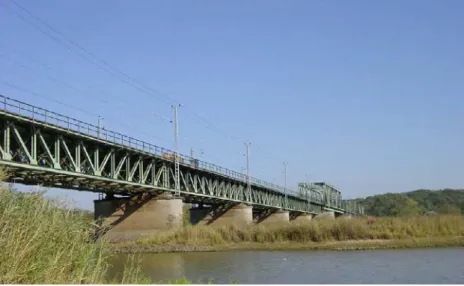
Restrictions currently exist in the area of the railway bridge over the Oder for the cross-border traffic. Since the time table was changed in December 2005 the critical condition of the bridge only allows single-track operation at 50 km/h over the direction track Frankfurt (Oder) > Kunowice, which was repaired for EUR 370,000.
Cross-border goods traffic –
results, potentials and problems in the Frankfurt (Oder) / Slubice region
DB Netz AG is planning to replace the desolate railway bridge by foreland bridges which will be erected completely new as well as a bowstring arch bridge over the main current (passability with respectively 100 km/h). The measures will comprise a cost volume of ap-prox. EUR 20 million and are expected to be finished at the end of 2008.
After the blueprint planning has been completed, a financing agreement is to be con-cluded between Poland and Germany (treaty) in 2006 still. This will be followed by the planning approval procedures and the bid invitation for the construction measures. The ac-tual construction work is to begin In October 2007 with a total of four construction stages, in which first the northern and then the southern bridge track is to be erected new.
Fig. 11: Railway bridge over the Oder in September 2005
Border goods station Oderbrücke
The border goods station Oderbrücke is in a bad condition owing to the age of the installa-tions and the high load over many decades.
Eight tracks are available. These are broken down into an import and an export group with respectively four tracks and corresponding one-sided signalisation. With the commission-ing of the ESTW Oderbrücke at the end of 2006 there will be eight tracks with signalisa-tion on both sides (two line tracks, six handling tracks) available. The two centrally located line tracks are currently being renewed (track replacement, track superstructure). The complete track renewal including switch replacement will continue until 2007.
The electric locomotives are being replaced in Oderbrücke station owing to the deviating traction current supply. The trains enter the station tracks and are moved up to the exit signals with drawn-in current collector. A towing locomotive of the station pulls the traction vehicle from the track, the electric locomotive of the Polish or German partner takes over the train.
Cross-border goods traffic –
results, potentials and problems in the Frankfurt (Oder) / Slubice region
The border clearance services are carried out during the standstill time. These in particular comprise the handling of the shipping documents by the customs authorities (track scales are not available), the incoming inspection and if applicable regulation of the rolling mate-rial by the wagon foremen.
An extension of the station is practically not possible owing to the geographical conditions (dyke location, sensitive nature area). The goods traffic division of the DB Group, Stinnes Logistics / Railion, as decisive player in the cross-border rail haulage is considering relo-cating the clearance services into the generally dimensioned Rzepin station on the Polish side in the long term.
Fig. 12, 13: Border goods station Oderbrücke in August 2006
(with view in direction Frankfurt/O passenger station or railway bridge over the Oder)
Other goods traffic and transshipment facilities in Frankfurt (Oder)
Shunting yard Frankfurt (Oder)
The shunting yard in Frankfurt (Oder) was very important in rail haulage in the GDR. Thus, approx. 50 goods trains were cleared per day by more than 500 workers. Its importance fell sharply since 1990. The reason for this is the clearly declining collection and distribu-tion funcdistribu-tion of the shunting yard in conjuncdistribu-tion with substantially changed modal split in goods traffic as well as the general trend towards longer operating relations and increas-ing integration of CT terminals (container traffic).
DB Netz AG is planning to reduce the track systems to a configuration which is useful for the operations (system optimisation) in connection with the already carried out conversion of the signal box technology (ESTW). Moreover, the shunting yard Frankfurt (Oder) was shutdown as an independent operating point effective as of 20.12.2005.
Cross-border goods traffic –
results, potentials and problems in the Frankfurt (Oder) / Slubice region
CT terminal ETTC Frankfurt (Oder)
The transshipment station for combined traffic of the goods traffic centre Euro Transport & Trade Centers (CT terminal ETTC), which was completed at the end of 2001 already, was put into operation in the area of the former south group of the shunting yard on 06.04.2005. The transshipment station consists of two transshipment tracks with a length of 620 m, two mobile cranes and a transshipment area of approx. 20,000 m². The owner of the facility which costs approx. EUR 10 million is the City of Frankfurt (Oder), lease-holder is BTS Kombiwaggon. There is a one-sided connection to the track systems of the passenger station through a shunting siding. The security through the passenger station is guaranteed by a daily 24h operation.
The current offer of the CT terminal consists of three container block trains per week and direction in the direct connection Frankfurt (Oder) – Bremerhaven / Hamburg as well as single wagon traffic (public goods traffic point). Other relations (Brest / Moscow, Ruhr re-gion / western North Sea ports, Italy) are being planned. At present mainly products which are determined for the East Brandenburg region or which are produced in this region are transshipped. According to the information of the operators BTS Kombiwaggon (terminal) and freight forwarders Petersen (train traffic) the capacity utilization of the block trains is 65-75 % - however the operation would not cover the costs. It is intended to increase the number of container trains to five per week from January 2007.
The city of Frankfurt (Oder) is supporting a form of system optimisation which does not re-strict the operation of the CT terminal or burden it with even more high costs. This was made clear with objections within the framework of the TÖB participation of the planning approval procedure initiated by DB Netz AG.
Fig. 14: CT terminal of the ETTC in August 2006
The city is intending to rent further tracks (concretely: four tracks as capacity reserve) from DB Netz AG or to take over the altogether necessary track infrastructure and operate this as a connecting line under its own management. The negotiations in this respect have not been completed yet. DB Netz AG has undertaken to not dismantle the currently tem-porarily shutdown tracks, which are envisaged as capacity reserve for the CT terminal, in 2006.
Cross-border goods traffic –
results, potentials and problems in the Frankfurt (Oder) / Slubice region
Route border D/PL – Poznan – Warszawa
European classification
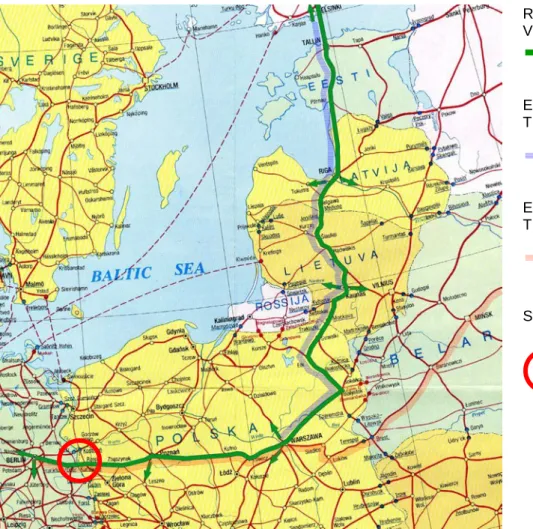
The route is part of the Pan-European Transport Corridor II Berlin – Warsaw – Minsk – Moscow, as defined by the European Commission, which is attributed a fundamental sig-nificance for the trade relations between the EU and the Russian Federation.
Fig. 15: The classification of the route Berlin – Warszawa in the context of Rail Baltica
Route Via Baltica European Transport Corridor I European Transport Corridor II Studied region
Source Map basis PKP 1997
The Corridor II connects a large part of the industrial centres of the EU with those of the Russian Federation (Moscow, Nischni Nowgorod, Samara, Togliatti, Wolgograd and Swerdlovsk). The EU share of the Russian foreign trade amounted to 31% in 2003. Al-though a large share of the exports from Russia is energy in the form of oil or gas via pipelines, a large share of the transport volume remains in the form of ores, metals and partly-processed products.
Cross-border goods traffic –
results, potentials and problems in the Frankfurt (Oder) / Slubice region
A constant increase in the transport service of fully-processed products is forecast in both directions. The route of Rail Baltica will be reached in Warsaw which branches off there as Pan-European Transport Corridor I.
Factual status
The goals of the planned measures were specified in more detail (only for the route Berlin – Warsaw) within the framework of the “Agreement between the Federal Ministry for Transport, Building and Housing of the Federal Republic of Germany and the Minister for Infrastructure of the Republic of Poland concerning the cooperation in the further devel-opment of the railway links Berlin – Warsaw (Warszawa)(C-E 20) as well as Dresden – Breslau (Wroclaw)(E30/C-E 30)” of 5 June 2003:
• Maximum speed 160 km/h
• Adjustment to the parameters of the agreement AGC and AGTC with regard to route occupancy and load category
• Reduction in travelling time from more than 6 hours to no more than 5 hours (EC-traffic)
• Harmonisation of the technical conditions in railway traffic between the states
• Improvement of the standards for goods traffic above all also for the combined goods traffic
• Doubling of the rail market share in this corridor (initial situation: 4% passenger traffic, 2 % goods traffic)
• Implementation by the end of 2006
The essential implementation of the defined measures is expected by the end of 2006. Deviations from the target condition will then merely exist in the station areas of Swiebodzin, Zbaszynek, Zbaszyn, Poznan (partial) and Konin as well as expected in parts of the route section Lowicz – Warszawa.
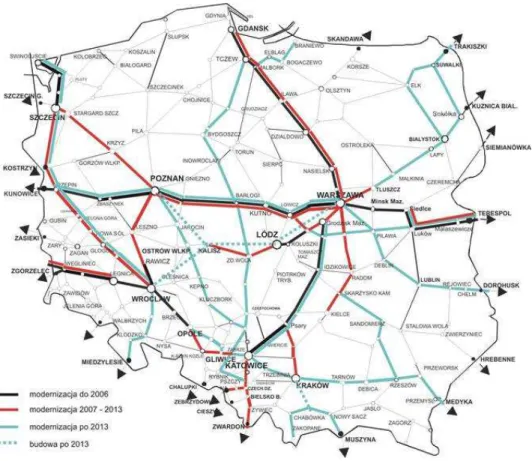
An overview of the essential measures including the EU subsidies on this railway route can be seen from the following table (see Fig. 16). The route national border D/PL - Rzepin – Terespol – national border PL/BY continues to play an important role in the na-tional development plan 2007 – 2013 (see Fig.17).
Cross-border goods traffic –
results, potentials and problems in the Frankfurt (Oder) / Slubice region
Fig. 16: Measures on the railway route E 20 (Berlin – Warszawa – Russia) Route
ca-tegory
Country Section Measure Lengt
h (km)
Begin End Status Costs (mill €)
EU subsidy source
Main axis Germany Berlin – Frank- furt/O - border
Modernisation 84.0 1997 2010 539 ERDF: € 103 mill. Main axis Poland Kunowice - Rzepin Modernisation 25.0 2002 2005
fin-ished
24 Coherence Fund (75%) Main axis Poland Junction Poznan Modernisation 2003 2009 105 Coherence Fund (75%) Main axis Poland Warszawa –
Minsk Mazowiecki
Modernisation 38.0 2002 fin-ished Main axis Poland Minsk Mazowiecki –
Siedlce
Modernisation 52.0 2000 2006 fin-ished
133 Coherence Fund (75%) Main axis Poland Siedlce – Terespol Modernisation
(stage I)
121.0 2004 2007 291 Coherence Fund (75%) Main axis Poland Lowicz –
Skierniewice – Lukow Modernisation (Bypass for goods traffic) 182.0 2010
Main axis Poland Malaszewicze – Terespol Modernisation (border cross-ing) 2002 fin-ished Main axis Poland Border BY/RUS -
Moscow
Repair 500.0 EBRD
Source: PKP 2006, HB Verkehrsconsult / VTT 2005, own research
Fig. 17: Development of the Polish railway network in the current development plan
Cross-border goods traffic –
results, potentials and problems in the Frankfurt (Oder) / Slubice region
A total of EUR 1,709 million are to be invested for the route recorded as European railway route E-20 in the planning period with the co-financing of the European Cohesion Fund, and an amount of EUR 380 million for the Polish part-route of the Rail Baltica recorded as E-75 (cf. Fig. 15).
In this connection the project of a high speed route Warsaw – Lodz – Poznan / Wroclaw is significant, for which investments in the amount of EUR 1,700 million are envisaged for a first phase in the national development programme 2007 – 2013 also with the co-financing of the European Cohesion Fund. As a result additional capacities would be produced for the axis Berlin – Poznan – Warszawa in a medium to long-term perspective as it is ex-pected that additional capacities would become free for goods traffic on the existing route Poznan – Warszawa, since the long distance passenger traffic will mainly be relocated to the high speed route.
The border-zone route section to Rzepin as well as within the Voivodship Lubuskie
EUR 30 million were invested with a 60 % ISPA subsidy for the modernisation in the sec-tion nasec-tional border – Rzepin. The 16 km long secsec-tion was completed in 2005 already (cf. Fig. 16 above). The following objectives were associated with this measure.
• Refurbishment and modernisation of all route parts except the superstructure from 1995, with which only critical parts of the railway bed were renewed
• Reinforcement of bridges to the necessary extent
• Increase in the route capacity and transport safety with the help of automatic section blocking
• Technical signal equipment in line with ERTMS / ETCS TAP
• Overhead contact lines and relay stations
• Level crossings
• Platform installations with simplification of the pedestrian guidance
• Travel speeds of up to 160 km/h
• Compliance with AGC and AGTC standards
Whereas the section Kunowice – Rzepin can be driven at 160 km/h, conditional restric-tions to 100 km/h exist in the section national border – Kunowice through the curved rout-ing. Moreover, DB Netz AG points out that the Polish network operator PLK currently only permits a route speed of 80 km/h there owing to special provisions which deviate from those on the German side.
The route is fitted with electronic signal box technology from German production (Adtranz, today Bombardier Transportation) and level crossings at grade with new security systems.
Cross-border goods traffic –
results, potentials and problems in the Frankfurt (Oder) / Slubice region
Fig. 18: Route characteristics in the area of the Voivodship Lubuskie ROUTE CHARACTERISTICS
(within Voivodship Lubuskie)
Border D/PL – Rzepin – Poznan - Warszawa Route number PLK /
railway corridor
003 / E 20 Traction type electrified Number of tracks double-track
Significance important state railway corri-dor
Traffic SPFV, SPNV, GV [goods traf-fic]
Vmax 120 - 160 km/h
Route length 96 km
As on the German side the traffic on the route is also secured by PZB technology. Despite the fact that the systems are of the same construction to a large extent they are not com-patible so that traction vehicles of the German partners have to switch off the system in-stalled in the driver’s cab (see also Chap. 3.2). The equipment of the route with state-of-the-art telecommunications technology (GSM-R) is in preparation.
Fig. 19, 20: Route impressions in Kunowice station (view direction Slubice or Rzepin)
Cross-border goods traffic –
results, potentials and problems in the Frankfurt (Oder) / Slubice region
Stations / goods traffic facilities
Whereas the already existing Kunowice station was modernised a new, modern Slubice station was built in the area of the junction with the national highway N29 south east of the town. Both stations act as access points in the local passenger traffic by rail, with respec-tively two outer platforms on the line tracks.
Fig. 21, 22: Slubice station (respectively view direction Kunowice)
There are no passing loops for the goods traffic, these are not necessary either through the proximity of the high-capacity Rzepin station. A goods traffic connection with low ca-pacity and simple loading possibilities are available in Kunowice station (ramp, loading line).
Fig. 23, 24: Kunowice station
(platform installations and goods traffic connection, respectively view direction Rzepin)
Cross-border goods traffic –
results, potentials and problems in the Frankfurt (Oder) / Slubice region
Railway junction Rzepin
The north-south connection Szeczin – Kostrzyn – Rzepin – Zielona Gora –Wroclaw crosses in Rzepin station. The configuration of the station reflects the historic develop-ment of the railway junction. The northern area of the platform installations and track sys-tems is allocated to the route Berlin – Warszawa, the southern to the north-south connec-tion. The reception building is located between these in an island posiconnec-tion. The condition is accordingly: modernised installations in the northern area, substantial need for renewal in the southern area.
Fig. 25, 26: Rzepin station (platform installations, view direction west / east)
The Rzepin station makes very high capacities available for forming, clearing and control-ling goods traffic in the western head of the station installation.
The spacious northern track formation allocated to the line tracks Berlin – Warszawa of-fers high capacity and a modern standard through the measures which were carried out within the framework of the route expansion. The south formation has average capacity and requires modernisation and thus adjustment to the standard of the north formation.
For transit goods traffic in the relation Szczecin – Kostrzyn – Zielona Gora –Wroclaw (north-south connection) it is possible to bypass Rzepin station via an approx. 7 km long bypass route. This is developed double-track, electrified and can be driven with up to 80 km/h. The removal from the regular route is carried out approx. 2 km north west of the sta-tion near the town of Drzensko. In the further course the route Berlin – Warszawa is crossed, in close dependence the location of Europe road E30 recorded (route bundling) and integrated into this with the regular route direction Zielona Gora in the junction area.
The regular route itself is double-track from the direction of Szczecin, configured only sin-gle-track from the direction Zielona Gora, whereby only the south formation of the goods track systems can be used, however the exit in direction Kunowice / Berlin is possible.
Cross-border goods traffic –
results, potentials and problems in the Frankfurt (Oder) / Slubice region
As opposed to this goods trains of the Berlin – Warszawa route can use both goods track formations via a connecting track in the eastern head of the station, including driving pos-sibilities in direction Szczecin or Zielona Gora.
Fig. 27, 28: Goods track systems in the western head of Rzepin station (north and south formation, respectively with view direction Kunowice)
Route Szczecin – Rzepin - Wroclaw
This route forms a large-scale north-south tangent in the Polish railway network and is classified as an important state railway corridor (CE 59). According to the national devel-opment plan 2007-2013 investments with a volume of EUR 650 million are estimated for expanding the route section Rzepin – Wroclaw (223 km) (cf. also map development of the Polish railway network in the current development plan, Fig. 17, p. 22).
Fig. 29: Route characteristics in the area of the Voivodship Lubuskie ROUTE CHARACTERISTICS
(within Voivodship Lubuskie)
Szczecin – Rzepin - Wroclaw Route number PLK /
railway corridor
273 / CE 59 Traction type electrified Number of tracks double-track
Significance important state railway corri-dor
Traffic SPFV, SPNV, GV
Vmax 40 – 60 km / h
Cross-border goods traffic –
results, potentials and problems in the Frankfurt (Oder) / Slubice region
In addition the route section Kostrzyn – Zielona Gora is being examined as a part route for a western variant of an upgraded railway connection between the two municipal main cen-tres of the Voivodship Gorzow Wielkopolski and Zielona Gora.
The future desired significance of the route can hardly be determined so far from the cur-rent condition. The route is in fact consistently configured double-track and electrified, however the permissible route speed fluctuates substantially, depending on the mainte-nance condition between 40–100 km/h. The 120 km/h required for fast traffic are not reached. Measures are currently being carried out to remedy substantial falls in speed in the section Rzepin – Zielona Gora.
Fig. 30, 31: Platform installation of the route in the southern area of Rzepin station
Fig. 32: Double-track bypass west of Rzepin station
(in the level of the crossing of the link road Rzepin – Nove Biskupice; in the background the crossing of the Berlin – Poznan – Warszawa route)
Fig. 33: Single-track introduction of the route in the south eastern head of Rzepin station (with entry of a seasonal express train Wroclaw – Swinoujscie)
Cross-border goods traffic –
results, potentials and problems in the Frankfurt (Oder) / Slubice region
Route Berlin – Strausberg – Küstrin-Kietz – border D/PL
By 2010 the control and security technology will be modernised and the superstructure upgraded to a route speed of 120 km/h from Strausberg. The first construction stage with the ESTW-Z Küstrin-Kietz will go into operation when the time table is changed in Decem-ber 2006. This package of measures also includes e.g. the refurbishment of the Oder fore-land bridges.
The project also comprises ESTW technology on the Polish side up to Kostrzyn station. Consequently a clear system interface will be formed in the railway junction Kostrzyn.
The further modernisation of the route in the section Berlin Ostkreuz – Strausberg has not yet been concretely classified (from 2010). This measure will also include a conversion of Strausberg station.
Fig. 34: Route characteristics Berlin – Strausberg – Küstrin-Kietz – border D/PL ROUTE CHARACTERISTICS
(within the state of Brandenburg)
Berlin – Strausberg – Küstrin-Kietz – border D/PL Route number PLK /
railway corridor
6078 / -- Traction type not electrified Number of tracks single-track
(section Trebnitz – Seelow-Gusow double-track)
Significance regional, in particular as na-tional detour route
Traffic SPNV, GV
Vmax 100 km/h
Route length 68 km
Route border D/PL – Kostrzyn – Gorzow Wlkp. – Krzyz – Tczew
At present the route can only be driven at a maximum speed of 40-60 km/h owing to wear and tear and neglect of the maintenance on part sections so that the travel time for pas-senger traffic increases by 7 to 41 minutes in the section Kostrzyn – Gorzow Wlkp. The necessary restrictions are in particular a result of deficits in the superstructure condition, bad visibility as well as insufficiencies in the control and security technology.
The consistent maximum speed of 100 km/h is to be restored through investments in the amount of 8 million Zloty in the period 2007-2010. The current route occupation is 22 pas-senger and 8 goods trains per day.
Cross-border goods traffic –
results, potentials and problems in the Frankfurt (Oder) / Slubice region
Fig. 35: Route characteristics border D/PL – Kostrzyn – Gorzow Wlkp. – Krzyz – Tczew ROUTE CHARACTERISTICS
(within Voivodship Lubuskie)
Border D/PL – Kostrzyn – Gorzow – Krzyz – Tczew Route number PLK /
railway corridor
203 / -- Traction type not electrified Number of tracks double-track Significance regional
Traffic SPNV, GV
Vmax 100 km/h with restrictions (40-60 km/h)
Route length 51 km
This route could increase in significance in the section Gorzow Wlkp. – Kostrzyn through the upgrade for accelerated regional traffic between the two municipal centres of the Voivodship Gorzow Wlkp. and Zielona Gora. The pre-requisite is above all the construc-tion of a connecting curve in Kostrzyn. As a result the travel time in this relaconstruc-tion is to be reduced by 52 minutes to 132 minutes. As an alternative a routing via Miedzyrzecz - Zbaszynek is being examined.
Fig. 36, 37: Route Kostrzyn – Tczew in Kostrzyn station
Route Eberswalde – Werbig – Frankfurt (Oder)
The superstructure was renewed in sections in the last few years. Moreover, work was started on the modernisation of level crossings. It is envisaged that a route speed of 80 km/h will be possible for the part route Eberswalde – Werbig by approx. 2012. The realisa-tion of the 4th construcrealisa-tion stage of the ESTW Ostbahn (control starealisa-tion in Küstrin-Kietz
Cross-border goods traffic –
results, potentials and problems in the Frankfurt (Oder) / Slubice region
station) in the routing Bad Freienwalde – Frankfurt (Oder) is still open. A simple, more cost-effective form of control and security technology may be used.
Fig. 38: Route characteristics Eberswalde – Werbig – Frankfurt (Oder) ROUTE CHARACTERISTICS
(within the state of Brandenburg)
Eberswalde – Werbig – Frankfurt (Oder) Route number PLK /
railway corridor
6758, 6156 / -- Traction type not electrified Number of tracks single-track Significance regional
Traffic SPNV, GV
Vmax 60 km/h (Ew. – Werbig)
100 km/h (Werbig – Ff./O) Route length 85 km
Route Frankfurt (Oder) – Grunow – Königs Wusterhausen
The aim here is also to guarantee a route speed of 80 km/h by approx. 2012. The work on the superstructure (approx. 25 %) and on the level crossing installations (modernised to a large extent) are in an advanced stage. The signal box centralisation of the section Frank-furt (Oder) – Grunow is already completed.
Fig. 39: Route characteristics Frankfurt (Oder) – Grunow – Königs Wusterhausen ROUTE CHARACTERISTICS
(within the state of Brandenburg)
Frankfurt (Oder) – Grunow – Königs Wusterhausen Route number PLK /
railway corridor
6253, 6520 / -- Traction type not electrified Number of tracks single-track Significance regional
Traffic SPNV, GV
Vmax 60 km/h Grunow - Kwh
100 km/h (Ff. – Grunow) Route length 82 km
Cross-border goods traffic –
results, potentials and problems in the Frankfurt (Oder) / Slubice region
Route Frankfurt (Oder) – Guben - Cottbus
The route can be driven at 120 km/h, from Peitz east at 140 km/h with continued existence of the double-track ability. Presuming maintenance as well as punctual substitute meas-ures, no fundamental activities with an effect on travel time are necessary. The moderni-sation of the level crossing installations is about to be concluded.
The planning for an ESTW Guben was deferred at DB Netz AG. Current measures are the adjustment of the track gauge plan in Guben station in order to simplify the routes in direc-tion border (Gubin).
Fig. 40: Route characteristics Frankfurt (Oder) – Guben - Cottbus ROUTE CHARACTERISTICS
(within the state of Brandenburg)
Frankfurt (Oder) – Guben – Cottbus Route number PLK /
railway corridor
6153, 6345 / -- Traction type electrified Number of tracks double-track Significance national
Traffic SPNV, GV
Vmax 120 km/h
(Frankfurt/O – Peitz East) 140 km/h
(Peitz East - Cottbus) Route length 86 km
2.1.2 Other routes with significance for cross-border goods traffic between Ger-many and Poland
An analysis of further route infrastructure significant for cross-border rail haulage between Germany and Poland appears useful for the differentiated classification and assessment of the routes presented in Chapter 2.1.1 which mark the studied region.
The border-zone rail transport network was substantially thinned out on the German and Polish side in the last few years in order to be able to generate modernisation effects in real time through a concentration on the main network as well as regional routes in conur-bations, in conjunction with further market structuring measures. This process which is go-ing at full speed in particular at the PKP results in the fact that both the condition of the in-frastructure as well as that of the rolling material proves to be very heterogeneous.