Contents lists available at ScienceDirect
Journal
of
Systems
Architecture
journal homepage: www.elsevier.com/locate/sysarc
Verifying
parallel
dataflow
transformations
with
model
checking
and
its
application
to
FPGAs
Robert
Stewart
a, ∗,
Bernard
Berthomieu
d,
Paulo
Garcia
c,
Idris
Ibrahim
a,
Greg
Michaelson
a,
Andrew
Wallace
baMathematicalandComputerSciences,Heriot-WattUniversity,Edinburgh,UK bEngineeringandPhysicalSciences,Heriot-WattUniversity,Edinburgh,UK cFacultyofEngineeringandDesign,CarletonUniversity,Ottawa,Canada dLAAS-CNRS,Université deToulouse,Toulouse,France
a
r
t
i
c
l
e
i
n
f
o
Keywords: Dataflow FPGAs Modelchecking Programtransformation Parallelisma
b
s
t
r
a
c
t
Dataflowlanguagesarewidelyusedforprogrammingreal-timeembeddedsystems.Theyofferhighlevel abstrac-tionabovehardware,andareamenabletoprogramanalysisandoptimisation.Thispaperaddressesthechallenge ofverifyingparallelprogramtransformationsinthecontextofdynamicdataflowmodels,wherethescheduling behaviourandtheamountofdataeachactorcomputesmaydependonvaluesonlyknownatruntime.
WepresentaLinearTemporalLogic(LTL)modelcheckingapproachtoverifyadataflowprogram transfor-mation,usingthreeLTLpropertiestoidentifycyclostaticactorsindynamicdataflowprograms.Theworkflow abstractsdataflowactorcodetoFiacrespecificationstosearchforcounterexamplesoftheLTLpropertiesusing theTinamodelchecker.WealsopresentanewrefactoringtoolfortheOrccdataflowprogrammingenvironment, whichappliestheparallelisingtransformationtocyclostaticactors.Parallelrefactoringusingverified transfor-mationsspeedilyimprovesFPGAperformance,e.g. 15.4×speedupwith16actors.
1. Introduction
In the dataflow model of execution, the firing of actors depends only on data availability, allowing each actor in a program to execute asyn- chronously without a global control flow sequentialising their execution. Dataflow languages are a natural abstraction for FPGAs, since a pro- gram’s dataflow structure is distributed across the programmable hard- ware fabric. In other words, each actor in a dataflow program is com- piled to an independent processing hardware block, subject to FPGA resource availability. Moreover, large kernel variables like intermedi- ate arrays may use on-chip block RAM (BRAM). BRAMs are distributed across FPGA fabric, meaning there is no memory contention when multi- ple actors update their kernel variables, e.g.intermediate arrays. That is, both computation and memory access is inherently parallel. For FPGAs, dataflow programming environments represent a high level abstraction above Hardware Description Languages (HDLs) i.eVerilog or VHDL. The dataflow programming model can be exploited for high FPGA perfor- mance, e.g.[1], or as an Intermediate Representation in compilers for higher level FPGA languages e.g.[2]. The dataflow abstraction enables program analysis e.g. optimal static scheduling [3] and program trans- formation (this paper).
∗ Correspondingauthor.
E-mail address: [email protected](R.Stewart).
1.1. Parallelprogramtransformation
The goal of parallelisation is to speed up performance by executing code across multiple processing elements e.g.the cores of a CPU. Parallel transformations must preserve a program’s functional semantics, i.e a transformed program must have identical output for the same inputs as the original program.
RefactoringSoftwareCode. Refactoring tools exploit language prop- erties to parallelise code. For example, exploiting the referential trans- parency of pure code and equational laws to rewrite a map, which sequentially applies a function to every element in a collection, as a parMap to perform them in parallel. Software languages for which par- allel transformation tools exist include Haskell [4], Erlang [5] and C ++ [6].
RefactoringEmbeddedSystemsCode.Static dataflow code is simple to parallelise because information about scheduling and data rates can be deduced at compile time. However, static dataflow language primitives are inexpressive, inhibiting the expression of algorithms with dynamic control flow and dynamic data rates. Introducing dynamicdataflow fea- tures to a language, e.g. value-dependent scheduling and dynamic data rates, complicates auto-parallelisation of dataflow code.
https://doi.org/10.1016/j.sysarc.2019.101657
Received26February2019;Receivedinrevisedform13September2019;Accepted5October2019 Availableonline23October2019
Fig.1.VerifyingandTransformingCyclo-StaticDataflow.
1.2. Relatedwork
This work is influenced by the Box Calculus [7], a program rewrite system for the Hume embedded systems language [8]. The approach specifies Hume programs with Lamport’s temporal logic of actions (TLA) [9]and uses deductive verification in TLA to verify Box Calculus trans- formations [10]. This is exploited for parallelism by transforming single Hume boxes into multiple boxes using high level patterns like divide- and-conquer. The language for implementing Hume boxes (analogous to actors) is purely functional and stateless, mapping input patterns directly to output expressions and any state is carried via feedback wires. This contrasts with our work, where we aim to support stateful dataflow languages like CAL, where actors can have internal variables that persist values between firings. This complicates parallelisation, due to the possibility of changing the read/write order on mutable variables, or introducing race conditions. Moreover, Hume lacks tooling for programmers to apply program transformations. In contrast, our work uses model checking to verify transformations of stateful actors, and we have extended the Eclipse based Orcc IDE with a graphical tool to apply a parallel transformation when model checking enables it.
The most salient related work in the context of parallelising dataflow programs is the StreamIt compiler. That approach is restricted to par- allelising stateless actors only [11], whereas our use of model checking enables the parallelisation of stateful actors too. Related work that com- bines dataflow models with model checking includes determining mini- mum dataflow buffer sizes [12], and enabling compile-time scheduling of multirate static actors [13]. On the hardware side, related work uses model checking to verify that two Verilog/VHDL modules satisfy the same global requirements [14] and hence enabling one to replace an- other with dynamic partial reconfiguration. None of these approaches consider the parallelisation of hardware designs or the verification of dataflow graph transformations.
1.3. Ourapproachandcontributions
Approach. Our approach ( Fig.1) extends dataflow parallelisation be- yond stateless actors, to actors that are stateful and contain firing rules with different data rates, provided they have cyclo-static properties. This is important because in practise cyclo-static actors very often hold state between action firings ( Section7.2). This is achieved by using model checking to identify parallelisable multi-rate static (MRDF) and cyclo- static (CSDF) actors that coexist with dynamic (DDF) actors in dataflow programs. These dataflow models are described in Section2.2. The ap- proach is general to any dynamic dataflow language, this paper demon- strates the approach with the CAL dataflow language [15] in the Orcc development environment [16]. It marks cyclostatic actors as parallelis- able, to enable an interactive graphical program transformation tool.
ContributionsThis paper makes the following contributions:
• An abstraction of dataflow actors to Fiacre, a formalised language for representing behavioural and timing aspects of embedded and distributed systems ( Section3).
• Three Linear Temporal Logic (LTL) properties that model cyclo- static dataflow properties. Model checking Fiacre abstractions of actors identifies cyclostatic actors in dynamic dataflow programs ( Section4).
• A graphical interactive refactoring tool that automates the paral- lelisation of potentially stateful cyclostatic actors ( Section5).
• An evaluation showing counterexamples of the cyclostatic LTL properties, and the efficacy of parallel transformations of a cy- clostatic actor on an FPGA with two case studies ( Section6).
2. Background
Task parallel languages provide either a high level programming model of spawning tasks and defining synchronisation points, or a lower level model with a fixed set of actors, explicit point-to-point FIFO con- nections and FIFO depths. Software oriented task parallel models are often more high level than parallel languages for hardware. Software languages often support spawning new tasks/actors at runtime across threads on a multicore CPU. This is unsuitable when compiling programs to programmable hardware ( i.e.application specific circuits), where the fixed task graph is mapped into the hardware with place and route, and cannot be changed without re-synthesis.
There are numerous programming models to express task parallel programs, e.g. fork/join APIs and threads, where data flows are im- plicit between parallel tasks. Dataflow programming models offer a more explicit way to express independent parallel tasks, and which tasks communicate. They clearly separate computation and communication, and are popular for embedded systems programming, especially FPGAs, where the entire task graph and communication routing must be fixed in hardware prior to execution.
2.1. Propertiesofdataflowlanguages
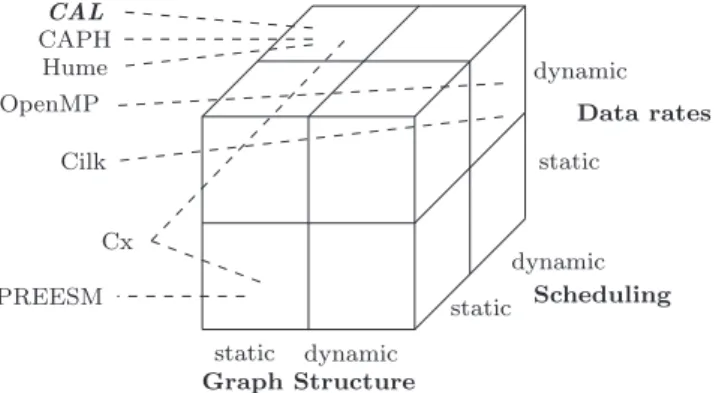
Dataflow programs are directed graphs of connected actors. There are many dataflow languages for multicore processors and embedded systems, each exhibiting a trade-off between expressivity and reasoning power. The hardware architecture they are designed to target reflects their functionality, specifically the graph structure, scheduling and data rates of programs expressed with them, shown in Fig.2.
Graph structure. Some languages support dynamic task graphs, i.e. where the number of actors change during runtime. An example is Cilk [17], a C ++fork/join model that creates parallel threads with
spawn
and synchronises their results withsync
. This is similar to OpenMP’stask
thread creation andtaskwait
syn- chronisation pragmas [18]. With other languages, the number of tasks (or actors) and the task graph topology is static at compile time, and does not change at runtime.Scheduling. This is the selection of executable code within an ac- tor. Some dataflow languages support only fixed scheduling poli- cies e.g. PREESM [19], whilst other models support code execu- tion choice driven by data availability and data values using pat- tern matching e.g. Hume [20] and CAPH [21]. Some languages
Fig.2. TaskParallelLanguages.
support both, e.g. Cx [22] has non-blocking reads/writes on de-fault ports (static scheduling) and synchronised ports (dynamic scheduling), where data availability determines if an executable rule is enabled.
Data rates. An actor with a static data rate produces and consumes the same number of values every time it is executed. An actor with a dynamic data rate is free to consume/produce data sequences of arbitrary length with no periodic pattern.
2.2. Dataflowmodels
The models considered in our approach are:
1. Multi-RateDataflow(MRDF)[23], where actors consume and pro- duce a fixed number of tokens every firing.
2. Cyclo-Static Dataflow(CSDF) [24], where actors contain mul- tiple fireable actions. Actions may have different consump- tion/production rates, but the sequence of action executions must be periodic.
3. DynamicDataflow(DDF)[25], where, when a DDF actor is fired its scheduler picks an enabledexecution rule and executes it. The enabled status of an execution rule can depend on both the avail-ability and the values of tokens, and hence the data rate is un- known at compile time. If there are no fireable rules, execution is deferred and the actor’s scheduler tries again to find an enabled execution rule.
Dataflow actors can have multiple actions but only one action can fire at a time, in contrast to synchronous languages e.g. Quartz [26], where allenabled actions execute in a single firing.
Some dataflow programming environments only support static dataflow models, e.g. direct feedthrough function blocks in Simulink [27]. The open source Orcc development environment [16] supports dynamic dataflow programming with CAL [15].
Real world application of dynamic dataflow properties include real- time Twitter data processing [28] and MPEG decoding, a widely used dataflow benchmark with practical relevance. [29] presents an MPEG implementation in CAL. The disadvantage of dynamic dataflow is that it inhibits program analysis, meaning a programmer has to revert to manual program refactoring to improve performance, and although this can improve FPGA performance [30], this approach is cumbersome and error-prone.
2.3. ConstructingstaticdataflowgraphstructureswithCAL
CAL is a dataflow language for programming real-time embedded systems, which was developed as part of the Ptolemy II project ( [31]). It is a dataflow language for constructing dataflow graphs with (1) a fixed setofactorsandconnections, (2) support for dynamicscheduling and (3) support for dynamicdatarates. These two dynamic properties make CAL suitable for implementing relatively complex algorithms on
embedded systems, e.g. algorithms for which control flow and the in- put/output data size is determined by runtime values, at the expense of lost static analysis and program transformation opportunities due to these dynamic properties.
Each CAL actor encapsulates an algorithmic kernel. Actors are con- nected together with lossless order-preserving FIFOs, through which to- kens flow. Fig.3a shows a volume amplifier example. Actor ports are named ❶. The actor may have a store of private variables ❷. Actors contain discrete non-interruptible execution rules, called actions. Ac- tions match on input patterns to consume tokens and output patterns produce tokens ( ❸and ❺). Actions may also update store variables ❹. A Finite State Machine (FSM) determines enabled actions from each FSM state ❻, and the initial FSM state which in this example is
s0
. When multiple actions are fireable from a given state, a priority block can dis- ambiguate multiple enabled actions ❼.2.4. Implementingdynamicdataflowlanguages
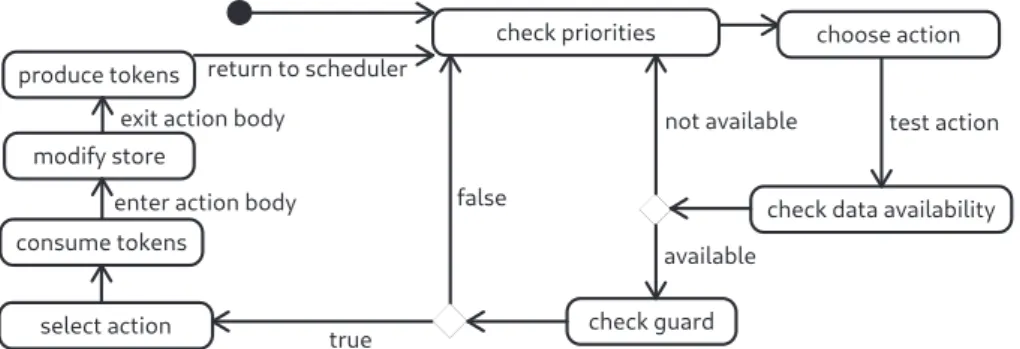
Since action selection for dynamic actor firing is a runtime decision, implementations of dynamic dataflow models need a runtime schedul- ing mechanism to determine which action to execute next. Fig.4shows the architecture components necessary for supporting dynamic dataflow execution. Each actor consumes input streams and produces output streams via ports.Connections(edges) enable data to flow between ports. An internal store associates values with actor-local variables.
CAL includes a primitive called
guard
( Section3.1), which supports the firing of an action depending on the valuesof incoming tokens and of variables in the actor’s store. Satisfying both of the following conditions enables an action for firing:1. there is a sufficient number of tokens to match its input patterns, 2. its guard evaluates to true (if a guard exists).
Fig.5 shows the scheduling algorithm for action selection. If there are multiple enabled actions, and an absence of a priority statement to disambiguate action selection, the runtime scheduler chooses one at random.
2.5. Actordatarates
An FSM transition system drives actor execution, e.g. the FSM in Fig.3b for the amplifier actor. Actions have data rates [ C/ P], mean- ing they consume C tokens and produce P tokens when transitioning between FSM states when their actions are fired.
Consider an actor Aconsuming tokens from a connection v and pro- ducing tokens on a connection u. Firing an action in this actor will con- sume 𝑐𝑣
𝐴tokens from connection v and produce 𝑝𝑢𝐴tokens to connection u. Successive execution of actor A may select different actions inter- nally, e.g.𝑐𝐴𝑣(1)=3 means the 1st firing of Aresulted in a consumption of 3 tokens whilst 𝑐𝑣
𝐴(2)=5 means that on the 2nd firing 5 tokens were consumed. More generally, 𝑐𝑣
𝐴(𝑛) and 𝑝𝑢𝐴(𝑛) are the number of tokens consumed and produced on the nthfiring of actor A.
Definition 1.Datarates. The number of tokens produced on edge u after nfirings for actor Ais 𝑃𝐴𝑢(𝑛)=∑𝑖𝑛=1𝑝𝑢𝐴(𝑖,𝑎)where a∈ActionsA. The number of tokens consumed from edge v after n firings for actor A is 𝐶𝑣
𝐴(𝑛)=∑𝑛𝑖=1𝑐𝑣𝐴(𝑖,𝑎).
Consider actor A with actions a1and a2, both enabled after 5 actor
firings. If 𝑐𝑢
𝐴(5,𝑎1)≠𝑐𝐴𝑢(5,𝑎2),then the actor’s data rate may not be static, i.e. it would be a dynamic actor, and it may not be possible to answer:
1. can the program execute with bounded buffer size?
2. will parallelising an actor preserve the actor’s functional semantics?
Fig.3. AnAmplifierDataflowActor.
Fig.4. AnArchitectureforDynamicActors.
2.6. Programpreservingparallelisation
Parallelism can speed up execution. However, parallelisation (and any other program transformation) must preserve a program’s func- tional semantics. Two properties of dynamic dataflow programs that must be preserved by parallel program transformation are:
1. Functionaldatarates: An actor may require multiple input to- kens to compute its function and produce an output. Such an atomic operation is often implemented as multiple action firings ( Section7.2). Parallel instances of an actor should read and write enough tokens to preserve the atomic behaviour of the original sequential actor.
2. Stores: An actor may have a store of local variables. A program transformation should preserve the modification sequence of an actor’s store.
Section4shows that, with model checking, one can parallelise actors expressed with a dynamic dataflow language to increase its throughput performance, whilst preserving the actor’s functional semantics.
3. Abstractingactorstomodelsforverification
Our approach uses model checking to identify cyclostatic actors for parallelisation. Since CAL is a dataflow programming language and not a model description language, this section shows how we abstract per- tinent features of actor code into Fiacre.
3.1. AbstractdataflowtransitionsystemforCAL
An abstract transition machine model for describing dataflow ac- tors [32] is now presented to formalise the actor model. It describes the data rates and scheduling rules for actors in terms of transitions on an abstract machine. The firing of actions is determined by an actor’s FSM, a labeled transition system between control states. An actor is a se- quential process, communicating values by transitioning between states in the actor’s FSM. Executions of statements in the body of an action can compute output token values and can update the store. The state machine receives tokens and reacts to them, possibly entering another state, and possibly producing tokens. The dataflow transition: 𝜎⟨𝑎𝑐𝑡𝑖𝑜𝑛1←𝑒⟩
𝑠↦𝑠′ ⟶𝜎′⟨𝑎𝑐𝑡𝑖𝑜𝑛
2←𝑒′⟩ (fire)
describes a transition from FSM control state 𝜎to 𝜎′ by firing action1, and at 𝜎′ the enabled action is action2. The store ewith the input stream sis the input state, and the firing of action1produces a new store e′ and
outputs the s′ stream. In the following example:
The store e is
{accum
=
0}
before the 1st firing. The action issumStream
, the input stream sis[x]
consumed from input portin1
. The new store e′ is{accum
=
0+x}
after the firing.The following (fire-guard) rule supports dynamic dataflow. It adds a predicate function that guards the firing of the transition. This function guardEmust evaluate to true for the action to fire. The E predicate can
Fig.5. SchedulingAlgorithmtoExecuteDynamic Actors.
use token values from s and store values from e. 𝑒⊢ 𝐸 𝑔𝑢𝑎𝑟𝑑𝐸⇝𝑡𝑟𝑢𝑒 𝜎⟨𝑎𝑐𝑡𝑖𝑜𝑛1←𝑒⟩ 𝑠↦𝑠′ ←← ←←←←←←←←←←←←←←←→←← 𝑔𝑢𝑎𝑟𝑑𝐸𝜎 ′⟨𝑎𝑐𝑡𝑖𝑜𝑛 2←𝑒′⟩ (fire-guard) An example is:
This
sumTen
action consumes tokenx
, adding it each time toaccum
in the store with 10 successive firings. The guardE predicate checks thatcount
is less than 10. Another action (omitted) might pro- duce the value ofaccum
on the 11th firing, resetting the count and accumulation variables.If there are multiple fireable actions from 𝜎′ then we use •to indicate a runtime scheduler choice to disambiguate two or more actions that both can fire from the same control state. Hence when there are multiple enabled actions at 𝜎′ we write:
𝑒⊢ 𝐸 𝑔𝑢𝑎𝑟𝑑𝐸⇝𝑡𝑟𝑢𝑒 𝜎⟨𝑎𝑐𝑡𝑖𝑜𝑛1←𝑒⟩ 𝑠↦𝑠′ ←← ←←←←←←←←←←←←←←←→←← 𝑔𝑢𝑎𝑟𝑑𝐸𝜎′⟨∙←𝑒′⟩ (fire-guard)
An example of two (fire-guard) actions in an actor is:
The
positivesRepeat
action produces twice any positive inte- ger consumed, whilstnegativesIdentity
simply propagates any negative or 0 values consumed. Here, • means that after firing either of these, the scheduler will not know which action to fire next until the value ofx
becomes known after consuming the token on the next fir- ing. This becomes problematic for verifying cyclo-static data rates when two or more ambiguous actions have different production or consump- tion rates.3.2. Actorabstractions
The CAL primitives we abstract for model checking are:
1. Theproductionandconsumptionratesofeach action. We
need the model checker to verify if there exists a cyclic data rate sequence.
2. Updatestovariablesinanactor’sstore. These variables can be used to conditionally fire actions, i.e.the (fire-guard)rule. 3. Statements inside action bodies. Specifically, if/then/else,
variable assignment and loop statements, because they can up- date variables in an actor’s store.
4. ActorFSMs. They enforce action scheduling and we need to know (1) if exactly one periodic cycle of visited states exists, and (2) the cycle’s data rate, i.e. the sum of data rates for each action representing a state transition in the cycle.
3.3. Fiacre
We abstract CAL code to Fiacre [33]to abstract actor to a model for checking cyclostatic properties. Fiacre is a formal intermediate model to represent both the behavioural and timing aspects of embedded and
Fig.6. AutomotaforFiacreProcess
P
.distributed systems for formal verification. It is a target language of pro- gram modelling tools for use with verification engines. From Fiacre spec- ifications, the Fiacre compiler produces enriched Petri nets, in which transitions can test and modify a set of data variables. Therefore Fiacre provides a high level, compositional syntax for Time Petri Nets. TINA [34]is a model checking toolset to analyse these nets.
3.3.1. Fiacrelanguage
The primary Fiacre primitive is a process. Fiacre processes can contain deterministic statements including assignment and loops ( Section3.4). As with CAL actors, a Fiacre process describes sequential behaviour defined by a set of control states and a set of process tran- sitions. Processes can contain non-deterministic choice, which we map FSM scheduling to in Section3.5. CAL actor ports are mapped to Fiacre process ports, and dataflow connections are mapped to Fiacre channels. The following
Product
Fiacre example 1 reads pairs of integersfrom port
b
then sends their product out from porta
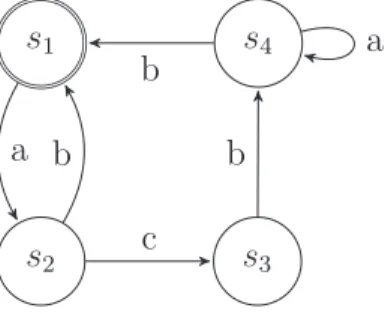
.The evaluation sequence in a Fiacre process is guided by a labelled transition system. The Fiacre process
P
below has four control states with labelled transitions between them. Ports denote here pure synchro- nization labels (without communications). The automaton for this pro- cess is in Fig.6.In the abstraction for model checking, actor FSMs map naturally to Fiacre process transitions. The transition labels are the actions to execute to get to new FSM control states. In our approach, action code bodies are abstracted ( Section3.4) and then inlined into Fiacre transitions between control states.
3.3.2. Fiacreevaluationrules
The Fiacre semantics presented here are taken from [36]. Labelled relations express the semantics of Fiacre statements.
The evaluation rules that follow have the shape: 𝑃1…𝑃𝑛
𝑒⊢ 𝐸⇝𝑣
which states that under conditions P1to Pn, the value of expression E with store e is v, where ⇝is expression evaluation.
The semantics of statements is expressed operationally by a labelled relation. The big step relation holds triples (𝑆,𝑒)⇒𝑙 (𝑆′,𝑒′)in which S is a statement, e and e’ are stores, 𝑆′∈ {done}∪ {self}∪ {target𝑠|𝑠∈ Λ}, where Λis the declared set of states of the process. The ⇒transition updates the store from eto e′ , moving execution to statement S′ , and the label is either a communication action l or silent action 𝜖.
3.4. Abstractingdataflowactionstosmallstepfiacreevaluationrules This section shows the abstraction of the pertinent CAL code primi- tives given in Section3.2, i.e. procedures, data rates, and actor FSMs, to small step Fiacre rules. Each abstraction rule from actors to processes is written =…,which translates CAL to Fiacre evaluation rules. 3.4.1. Actionprocedures
Action bodies may include statements that modify the actor’s store. The translation maps these statements, i.e. for loops and if/then/else statements, to deterministic Fiacre process statements.
Conditional if/then/else CAL statements are translated to the follow- ing evaluation rules:
𝐢𝐟𝐸𝐭𝐡𝐞𝐧𝑆1𝐞𝐥𝐬𝐞𝑆2𝐞𝐧𝐝 = 𝑒⊢ 𝐸⇝𝑡𝑟𝑢𝑒 (𝑆1,𝑒) 𝑙 ⇒(𝑆,𝑒′) (𝐢𝐟𝐸𝐭𝐡𝐞𝐧𝑆1𝐞𝐥𝐬𝐞𝑆2𝐞𝐧𝐝,𝑒) 𝑙 ⇒(𝑆,𝑒′)
(if- then- else)
𝑒⊢ 𝐸⇝𝑓𝑎𝑙𝑠𝑒 (𝑆2,𝑒) 𝑙 ⇒(𝑆,𝑒′) (𝐢𝐟𝐸𝐭𝐡𝐞𝐧𝑆1𝐞𝐥𝐬𝐞𝑆2𝐞𝐧𝐝,𝑒) 𝑙 ⇒(𝑆,𝑒′)
(if- then- else)
Conditional while loops are translated as: 𝐰𝐡𝐢𝐥𝐞𝐸𝐝𝐨𝑆𝐞𝐧𝐝 = 𝑒⊢ 𝐸⇝𝑡𝑟𝑢𝑒 (𝑆;𝐰𝐡𝐢𝐥𝐞𝐸𝐝𝐨𝑆𝐞𝐧𝐝,𝑒) 𝑙 ⇒(𝑆′,𝑒′) (𝐰𝐡𝐢𝐥𝐞𝐸𝐝𝐨𝑆𝐞𝐧𝐝,𝑒)⇒𝑙 (𝑆′,𝑒′) (while) 𝑒⊢ 𝐸⇝𝑓𝑎𝑙𝑠𝑒 (𝐰𝐡𝐢𝐥𝐞𝐸𝐝𝐨𝑆𝐞𝐧𝐝,𝑒)⇒𝜖 (done,𝑒) (while) CAL loops with a fixed iteration count are translated as: 𝐟𝐨𝐫𝐞𝐚𝐜𝐡𝑣1.𝑣2𝐝𝐨𝑆𝐞𝐧𝐝 =(𝑉 ∶=𝑣1; 𝑆…𝑉 ∶=𝑣2;𝑆,𝑒) 𝑙 ⇒(𝑆′,𝑒′) (𝐟𝐨𝐫𝐞𝐚𝐜𝐡𝑉 𝐝𝐨𝑆end,𝑒)⇒𝑙 (𝑆′,𝑒′) (foreach)
For assignment, Fiacre offers a number of forms but we only need the simplest here. e[ X↦u] is store eextended with the pair ( X,u). 𝑣∶=𝐸 = 𝑒⊢ 𝐸⇝𝑢 (𝑋∶=𝐸,𝑒)⇒𝜖 (done,𝑒[𝑋↦𝑢]) (assignment) CAL action bodies can contain multiple procedures, i.e. a sequence of assignments, if/then/else blocks and loops. Fiacre statements can be compositions of other statements, and this is used to compile multiple CAL statements ( S1; S2), e.g. an if statement following a while loop, to
the following Fiacre (composition) evaluation rules. In the second rule, the static semantics of Fiacre ensures that at most one of labels l1and l2is not empty, so l1. l2resumes to either l1or l2.
𝑆1;𝑆2 = (𝑆1,𝑒) 𝑙 ⇒(target𝑠,𝑒′) (𝑆1;𝑆2,𝑒) 𝑙 ⇒(target𝑠,𝑒′) (composition) (𝑆1,𝑒) 𝑙1 ⇒(done,𝑒′) (𝑆2,𝑒′) 𝑙2 ⇒(𝑆′,𝑒′′) (𝑆1;𝑆2,𝑒) 𝑙1 .𝑙2 ⇒ (𝑆′,𝑒′′) (composition)
3.4.2. Actionswithguards
Actions with guards can only fire if the guard predicate function evaluates to true in the current context. Fiacre has an on statement, which blocks if its expression evaluates to false that prevents execution of subsequent statements. The mapping models the actor guard predi- cate guardE with on, s is the input queue and s′ is the output queue for action1when executed. The execution of a sequential composition of
Fiacre statements abstract from action bodies depends on the boolean value of the on condition.
With an environment context of an actor’s store and input tokens s, the abstraction of action guards is:
𝑔𝑢𝑎𝑟𝑑𝐸=𝑒⊢ 𝐸⇝𝑡𝑟𝑢𝑒 (𝑆,𝑒) 𝑙 ⇒(𝑆′,𝑒′) (𝐨𝐧𝐸 𝑆,𝑒)⇒𝑙 (𝑆′,𝑒′) (on) 3.4.3. Actorcommunication
Actors share the results of their computations by explicitly passing tokens to each other via connections between their ports. The parallelis- ing transformation of actors in Section5needs to know its cyclo-static data rate, so we capture token communication in the abstraction. That is, during execution of Fiacre statements we keep a count of the incom- ing and outgoing tokens into and out of the process.
The syntax for token communication in Fiacre is
!
and?
, corre- sponding to the (send)and (receive) Fiacre rules respectively:𝑒⊢ 𝐸1⇝𝑣1 𝑒⊢ 𝐸𝑛⇝𝑣𝑛 (𝑝𝜏!𝐸1,…,𝐸𝑛,𝑒) 𝑝𝜏𝑣1 ,…𝑣𝑛 ⟹ (done,𝑒) (send) 𝑒′=𝑒[𝑋 1↦𝑣1,…,𝑋𝑛↦𝑣𝑛] [𝑒′⊢ 𝐸⇝𝑡𝑟𝑢𝑒] (𝑝𝜏?𝑋1…𝑋𝑛[𝐰𝐡𝐞𝐫𝐞𝐸],𝑒) 𝑝𝜏𝑣1 ,…𝑣𝑛 ⟹ (done,𝑒′) (receive)
Communications are sequences 𝑝𝜏𝑣1 … 𝑣𝑛where p𝜏is a port iden- tified by a label 𝜏and the 𝑣1 …𝑣𝑛are values.
Fiacre has a single-communication constraint whereby only one (send) or (receive) statement can occur in a (process-action) execu- tion. In Fiacre, values are consumed from ports with
?
, e.g.in1?x
. Whilst it is possible to consume multiple values from a Fiacre port, e.g.in1?x,y,z
, this is constrained by the data type of the port, e.g.where thebytepair
channel is abyte
#
byte
tuple in the earlier ex- ample in Section3.3.1, where exactly two values must be consumed every time, e.g. within1?x,y
. The same Fiacre constraint applies for producing values with!
, e.g.out1!x,y
. The single communication rule is enforced by Fiacre’s type checker to ensure that only one la- bel is ever carried by a ⇒transition update. In CAL, values are con- sumed/produced from ports by pattern matching, e.g.in1:[x,y,z]
andout1:[3,x+2,0]
.The communication semantics for dynamic dataflow differ from Fi- acre’s single-communication semantics in two ways:
1. An action can have multiple communication events, because an action can have both an input pattern and an output pattern and these patterns can match on multiple input/output ports. 2. Actions within the same actor can pattern match on the same
ports but consume/produce a different number of tokens, e.g.:
Therefore to support dynamic dataflow with Fiacre’s single- communication constraint, we give the Fiacre process ports a channel type. For each token in an action’s input pattern, Fiacre’s front func- tion on the queue reads from this internal channel, the value is then removed with dequeue and the counter monitoring how many tokens are consumed is incremented. Likewise for an action’s output patterns, a Fiacre queue receives all output tokens, and the counter monitoring how many tokens are produced is incremented by the size of that queue.
Fig.7. AbstractingActorScheduling.
Actions that have multiple communication events, i.e. multiple to- kens in input/output patterns or consuming/producing from/to multiple ports, are separated into multiple intermediate single-communication events when abstracted to Fiacre.
3.4.4. Actorschedulestoprocessselections
The selection of actions in dataflow actors is determined by the ac- tor’s FSM between control states. Given an actor’s FSM that specifies multiple next states from the current state 𝜎, the abstraction maps to Fiacre’s
select
statement as:Where
[]
separates the non-deterministic choices. The following ac- tor FSM example has one control states0
:These FSMs are abstracted to Fiacre selection statements. Consider the following contrived example for
actn1
andactn2
, where both consume a token but produce no tokens:Because the actions
actn1
andactn2
have one communication event, and a guard (abstracted to anon
statement after consumingx
), the FSM will be abstracted to the following Fiacre selection statement:The abstraction of actor FSMs uses three Fiacre rules (from)(to)and (select), shown in Fig.7. This requires FSM transitions to be grouped by the control states, for all control states Σin the FSM, that transi- tions start from. The (from)rule is used for each source state, the action used to transition between states is then abstracted and inlined into each corresponding transition, and finally the (to) rule is appended to these statements to arrive at the destination state, shown with set comprehen- sion as follows:
𝐹𝑆𝑀={(𝐟𝐫𝐨𝐦𝜎(𝐬𝐞𝐥𝐞𝐜𝐭(𝑎𝑐𝑡𝑖𝑜𝑛;(𝐭𝐨𝜎′))+𝐞𝐧𝐝)) |𝜎,𝜎′∈ Σ
∧ {(𝑎𝑐𝑡𝑖𝑜𝑛,𝜎′) |(𝜎,𝑎𝑐𝑡𝑖𝑜𝑛,𝜎′)∈𝐹𝑆𝑀}}
This restructures the FSM to group transitions by their source state, to map actor FSMs to the syntactic structure of Fiacre’s selectstatement.
3.5. Abstractingactionfiringtobigstepfiacreevaluationrules
The previous section abstracted data rates, procedures and actor FSMs to small step Fiacre rules. We now require a big step Fiacre rule to abstract the atomic firing of a dataflow actor’s action.
The following big-step (process-action) rule abstracts the sequential composition of multiple small-step executions. It describes statement executions between (from)and (to) rules, i.e.originating from an initial control state and arriving at a target state, where →is a process action getting from control state sto s′ and ⇒𝑙 is a big-step statement execution with the (process-action) rule:
(𝐟𝐫𝐨𝐦𝑠𝑆,𝑒)⇒𝑙 (target𝑠′,𝑒′)
(𝑠,𝑒)→(𝑠′,𝑒′) (process-action)
A transition from fromto the target control state in the (process-action) rule happens in totality or not at all. If a transition includes an onstate- ment then tokens produced/consumed will only be consumed if the on predicate evaluates to true. This peek semantics is equivalent to CAL’s semantics for guard.
This big step rule corresponds to firing a dataflow actor’s action, i.e. the (fire) or (fire-guarded) dataflow execution rules from Section3.1, which capture the actor CAL code we intend to model check. One big step (process-action)evaluation corresponds to multiple small step eval- uations of action selection (select), production and consumption rates (send) and (receive), and procedures inside an action body i.e. (assign-ment),(if-then-else)and (foreach).
Consider an action1 with an action body with a sequence of state-
ments S1; S2, and the body of an action2with statement S3. Abstracting this (fire-guard) to Fiacre is as follows:
𝜎⟨(𝑆1;𝑆2)←𝑒⟩𝑠↦𝑠 ′ ⇒ 𝜎′⟨(𝑆 3)←𝑒2⟩ (f ire) =𝑆1=(𝑆1,𝑒) 𝑙1 ⇒(𝑆2,𝑒1) 𝑆2=(𝑆2,𝑒1) 𝑙2 ⇒(𝑆3,𝑒2) (𝐟𝐫𝐨𝐦𝜎(𝑆1;𝑆2,𝑒) 𝑙 ⇒(target𝜎′,𝑒2) (𝜎,𝑒)→(𝜎′,𝑒 2) (process- action) Consider the same action, but this time with a guard predicating its firing. Abstracting this (fire-guard) to Fiacre is as follows:
𝑒⊢ 𝐸 𝑔𝑢𝑎𝑟𝑑(𝑠,𝐸)⇝𝑡𝑟𝑢𝑒 𝜎⟨(𝑆1;𝑆2)←𝑒⟩ [ ⇒𝑔𝑢𝑎𝑟𝑑(𝑠,𝐸)]𝑠↦𝑠′𝜎′⟨(𝑆 3)←𝑒2⟩ = (f ire- guard) 𝑆1=(𝑆1,𝑒) 𝑙1 ⇒(𝑆2,𝑒1) 𝑆2=(𝑆2,𝑒1) 𝑙2 ⇒(𝑆3,𝑒2) (𝐟𝐫𝐨𝐦𝜎((𝐨𝐧𝐸𝑆1);𝑆2,𝑒) 𝑙 ⇒(target𝜎′,𝑒2) (𝜎,𝑒)→(𝜎′,𝑒 2) (process- action)
3.6. Trackingdatarates
We introduce a
P_static
boolean and two numbersP
andP_prev
that count the number of produced tokens in the current and previous cycle respectively, to check for cyclostatic data rates. VariablesC_static
,C
andC_prev
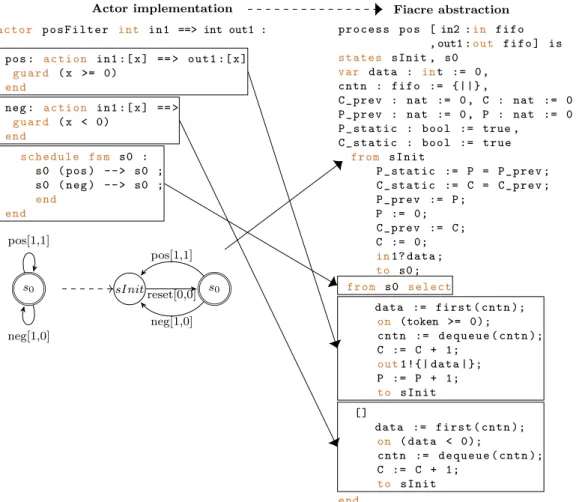
are injected to track consumption rates.To demonstrate this with an example, the CAL actor implementation on the left of Fig.8is a predicate filter that outputs only positive integer input tokens and discards negative integers. The actor scheduler is: 𝑠0⟨𝑝𝑜𝑠←{}⟩←←←←←[←←←𝑥←←←←]←←←←↦←←←←←←[←←←←𝑥→←←←]
𝑥>=0 𝑠0⟨∙←{}⟩ 𝑠0⟨𝑛𝑒𝑔←{}⟩←←←←←[←←←𝑥←←←←]←←←←↦←←←←←←←[←←←←→𝑥←←]
Fig.8. TranslatingaPredicateFiltertoFiacre.
The Fiacre translation is on the right of Fig.8. In the first com- plete cycle of a cyclo-static actor, i.e. ( s0, e) →( s0, e),
P_static
andC_static
will be false since this cycle computes the actor’s produc- tion rate. In all subsequent cycles, these are trueif the actor has a fixed data rate.To determine data rates for cyclostatic actors, the abstraction to Fi- acre intercepts all actor transitions to the user defined initial state, e.g. s0, introducing an additional Fiacre state sInitthat compares previously recorded data rates for 𝑠0→.→𝑠0. The sInit→s0 Fiacre transition also consumes tokens from the FIFO for this transition sequence.
4. Cyclo-StaticactorsasLTLformula
Once the mapping abstracts Fiacre process descriptions from actors, the Fiacre compiler translates them to enriched Petri nets ( [37]) for the purpose of LTL verification by TINA to search for counterexamples of cyclostatic properties. LTL (Linear Temporal Logic) is a temporal logic in which a formula can encode time (logical) and future state observations along runs, where each state in time has a single successor.
4.1. LTLModelcheckingapproach
The LTL formula we use has logical operators negation ( not), conjunction ( and), disjunction ( or) and implication ( ⇒), and temporal operators eventually ( ◊), always ( □) and until ( until). In addition, it has atomic properties asserting that a particular process instance in the Fiacre description is in some particular Fiacre state and that one of its variables has a particular value. In the following LTL formulas thse atomic properties are written State(s)and Value(x=v), respectively.
Our LTL model checking approach is:
1. Translate the actor to a Fiacre process ( Section3).
2. Abstract an actor’s initial FSM state and store variable values into three LTL formulas ( Sections4.2.1,4.2.2and 4.2.3).
3. Model check the Fiacre process for counterexamples of the LTL properties that model cyclostatic actors.
• If a counterexample cannot be found, the actor is classified as a multirate static or cyclostatic actor and can be parallelised using the algorithm in Section5.2.
• Otherwise the actor is classified as dynamic and is not suitable for parallelisation.
4.2. Thecyclo-staticassertions
Cyclo-static actors always have an infinitely repeating periodic cy- cle of FSM transitions between control states. We capture cyclostatic dataflow semantics in the following LTL properties:
1. The variables in an actor’s store are bound to their initial value after each periodic cycle. Property cyclic_store, Section4.2.1. 2. There exists a periodic cycle between FSM control states. Property
periodic_sequence, Section4.2.2.
3. The data rates of an actor are static. Property static_rate, Section4.2.3.
The model checker searches for violations of these LTL properties to identify dynamic actors. We now give more detail of these three LTL properties.
4.2.1. Periodicprocessconfiguration
This LTL property is for checking that all values in an actor’s store are reset on completion of the periodic cycle. The LTL formula is gen- erated from actor code, and ensures that all store variables are at their initial value when the initial FSM state is returned to. In the follow- ing example the actor’s store is {𝑥=0},which can be extracted directly from the programmer’s code e.g.
int
x:
=
0;
, and the actor’s initial FSM state iss0
, which the programmer specifies in the FSM declara- tion ( Section2.3):4.2.2. Periodicstatetransitionsequence
The LTL property to verify the existence of a periodic cycle in an actor’s state transition combines observations of control states with the until temporal property. Consider an actor with states s0, s1, s2 and s3, and a periodic cycle s0 →s1 →s3 →s2 →s0. The property for prov- ing that this is the sole possible sequence, and that it infinitely occurs is:
where, for any two Fiacre states
i
andj
,To(i,j)
stands for the formula:State(i)
and
(State(i)
until
State(j))
At some position along a run,
To(si,sj)
holds if the Fiacre state of the actor at that position issi
, the actor is in Fiacre statesj
at some latter position in the run, and it remains in statesi
until then. Propertyperiodic_sequence
asserts that, in each run, the initial state of the actor iss0
and that at each position in the run exactly one of theTo(si,sj)
propositions in the disjunction holds. The ab- sence of counterexamples proves an infinitely periodic FSM cycle for this actor. In practice, extracting this LTL formula for automated veri- fication will require a CAL language extension for expressing explicit cyclic sequences that the programmer intends the model checker to verify.4.2.3. Cyclo-Staticperiodicdatarate
Finally, we check for the same static data rate for every loop through the verified periodic cycle with:
The LTL static_production_rateproperty reads: at each state along each run, either
P_static
is true or it eventually becomes continuously true. A static consumption rate is checked with the static_consumption_rate property, which tests for the same temporal observations for cyclic con- sumption rates.Whilst a simple mechanism, the
P_static
andC_static
booleans enable the model checker to search for a single action firing sequence counterexample whereby theP
andC
data rate counters de- viate from a fixed value after an initial periodic cycle. Should a counter example not exist, i.e. an actor is cyclo static, these two values are used by the parallelisation algorithm in Section5.2.4.3. Modelcheckinganactor
Processes cannot be model checked against the LTL rules above without communicating with another process that feeds data to it and
Fig.9.OrccIRforDataflowTransformation(from[38]withpermission).
consumes its results. Therefore the following testbench is composed in parallel with the actor being model checked:
Their parallel composition is expressed in a top level Fiacre component:
5. Dataflowtransformations
Our dataflow transformation system supports the parallelisation of static and cyclostatic actors. It is implemented using the Java based Orcc Intermediate Representation (IR) API, shown in Fig.9, by instantiating the Actor and Connection classes to implement the parallelisation algo- rithm in Section5.2.
5.1. Programmingenvironment
We have extended the open source Orcc dataflow programming en- vironment ( [16]) with a refactoring tool, shown in Fig.10, for paral- lelising static and cyclo-static actors which introduces fork and join ac- tors to scatter/gather data. The user chooses the parallelism degree, i.e. how many actors to take the place of the previous single actor. Orcc has multiple backends for different target architectures. We have added
Fig.10. InteractiveDataflowTransformation.
two additional backends to support the tool: 1) CAL, to generate new actor code for the fork and join actors and 2) Fiacre, for model check- ing actors. Fig.11 shows the graphical consequence of applying the transformations.
5.2. Parallelisationalgorithm
For an actor Aconsuming from edge uand producing to edge v, the transformation algorithm is:
1. Extract using model checking the consumption and production data rates 𝐶𝑢
𝐴(𝑛)and 𝑃𝐴𝑣(𝑛)for a complete cyclostatic cycle, where n is the number of firings in a periodic cycle. This is done by parsing the
P
andC
values from the output from the Tina model checker.2. Create Nparallel instances A1to ANwith the Orcc IR API, where N is the user-selected parallelism factor ( Fig.10).
3. Create a fork actor with Orcc IR that distributes data from edge u across 𝐴1,.,𝐴𝑁in 𝐶𝐴𝑢(𝑛)chunks.
4. Create a join actor with Orcc IR to consume 𝑃𝑣
𝐴(𝑛) chunks from actors A1to AN.
5. Output the joined chunks as a sequential stream to edge v. After this transformation the graph remains partially sequential due to the linear stream of data that the forkactor consumes then distributes. Fig.12 shows the sequential nature of stream propagation as it broad- casts tokens to each parallel instance in sequence on an FPGA. In this case each parallel actor is receiving streams of 10 elements, 1 token per cycle. Here, the high out1_SEND signal instructs the first parallel actor that the data signal is valid for the first 10 cycles and the low signals out2_SEND,out3_SEND and out4_SEND instructs the other three actors to not read the data signal during these cycles. Stream gathering by the join actor is sequential also. This data propagation latency limits the speedup since some actors may be idle waiting for their next input stream, so there is a balance between the task size, potential parallel speedups and the latency overheads of parallelism.
6. Evaluation
This section evaluates the model checking based classification of ac- tor models using three actors that implement (1) sparse matrix compres- sion, (2) matrix row sorting and (3) dynamic time warp. One of these actors is identified as not being cyclostatic, the other two are, and hence are parallelisable. They are parallelised using the interactive transforma- tion tool, replacing these sequential actors with up to 16 parallel actors. The speedup results are given in Section6.3.
6.1. Counterexample
An actor can implement a sparse matrix compression algorithm in- crementally as a matrix streams through an actor. It consumes the matrix in row major order, and outputs a (row,column,value)tuple for non-zero values. The transition rules of the actor are:
𝑠0⟨𝑐𝑜𝑚𝑝𝑟𝑒𝑠𝑠←{𝑤,ℎ}⟩←←←←←←⟨𝑣←←←←←←←←⟩←↦←←←←←←←←←←⟨𝑣,𝑤,ℎ←←←←←←←←←←←←←←←←←←→←←⟩ 𝑣!=0 𝑠0⟨∙←{𝑤 ′,ℎ′}⟩ 𝑠0⟨𝑖𝑔𝑛𝑜𝑟𝑒←{𝑤,ℎ}⟩←←←←←⟨𝑣←←←←←←←⟩←←←←↦←←←←←←←⟨⟩←→←← 𝑣==0 𝑠0⟨∙←{𝑤 ′,ℎ′}⟩
The actor has one control state s0 and two actions compress and ignore that both transition from s0 back to s0. Each matrix value in the stream disambiguates action scheduling: compressfires on non-zero values, and ignore fires on zero values. The compress action increments width and height counters, as w′ and h′ in the store after the transition.
The actor is 25 lines of CAL code. The Fiacre description is 79 lines of code. The TINA model checker generates a synchronised Büchi automa- ton and a transition system from the LTL formula in Section4, then looks for paths through the transition system for counterexamples. The model checker finds a counterexample for the static_data_rate property. State 60 in the Büchi automaton is:
The model checker finds a transitional path
60 →76 →88 →97 →109 →115 →127 →47 →59 →76. There is a loop from state 76 to itself. In this loop is state 97, which in the counter example is:
Therefore the model checker proves static_production_rateproperty false, since
P_static
is false at state 60 serves as the antecedent of the ⇒ implication, and the consequent:does not hold, because state 97 is always returned to. This is due to the nature of sparse arrays, number of non-zero values in the matrix determines the data rates.
6.2. Parallelisingverifiedcyclo-staticactors
Two benchmarks are now used to show the performance improve- ments of parallelisation of verified cyclostatic actors with the mecha- nised algorithm from Section5.2.
6.2.1. Matrixrowsorting
The matrix row sorting actor sorts every row in a matrix in ascending numerical order using bubble sort. The pre-sorted nature of the input determines the clock cycle latency to perform the sorting. There is also the latency of consuming and producing rows, one cycle per element. The actor’s FSM is in Fig.13. With an initial store {𝑟𝑜𝑤=[],𝑖=0}, the scheduling is: 𝑠0⟨𝑟𝑒𝑐𝑒𝑖𝑣𝑒←{𝑒𝑙𝑒𝑚𝑠,𝑖}⟩←←←←←⟨𝑎←←←←←←←⟩←←←←↦←←←←←←←⟨⟩←→←← 𝑖<𝑤𝑖𝑑𝑡ℎ𝑠0⟨∙←{𝑟𝑜𝑤+{𝑎},𝑖+1}⟩ 𝑠0⟨𝑠𝑜𝑟𝑡←{𝑒𝑙𝑒𝑚𝑠,𝑖}⟩ ←←←←←⟨⟩←←←←←←←←↦←←←←←←⟨⟩←→←← 𝑖==𝑤𝑖𝑑𝑡ℎ𝑠1⟨∙←{{𝑟𝑜𝑤 ′},0}⟩ 𝑠1⟨𝑜𝑢𝑡𝑝𝑢𝑡←{(𝑒∶𝑒𝑙𝑒𝑚𝑠′),𝑖}⟩←←←←←←⟨⟩←←←←←←←↦←←←←←←←⟨𝑒←←←→←←←⟩ 𝑖<𝑤𝑖𝑑𝑡ℎ𝑠1⟨∙←{{𝑒𝑙𝑒𝑚𝑠 ′},𝑖+1}⟩ 𝑠1⟨𝑟𝑒𝑠𝑒𝑡←{{},𝑖}⟩ ←←←←←⟨⟩←←←←←←←←↦←←←←←←⟨⟩←→←← 𝑖==𝑤𝑖𝑑𝑡ℎ𝑠0⟨∙←{{},0}⟩
Fig.11. ParallelisinganActorwiththeDataflowTransformationTool.
Fig.12. ScatteringtheDataStreamfromthefork Actor.
Fig.13. FSMoftheMatrixRowSortActor.
The model checker is unable to find counterexamples of the LTL properties. For a matrix of width 100, the sorting actor A has a peri- odic cycle of 202 firings: 100 ×
receive
, 100 ×output
, 1 ×sort
and 1 ×reset
. The fork actor scatters 𝐶𝑣𝐴(202)=100 tokens to each parallel actor and the join actor gathers 𝑃𝑢
𝐴(202)=100tokens from each actor.
6.2.2. Dynamictimewarp
Dynamic time warping (DTW) is an algorithm to measure similar- ity of two temporal sequences. Applications of DTW include automated speech recognition. The actor takes two sequences S and T, then out- puts the optimal match between them. Consuming each sequence ele- ment costs one cycle, followed by multiple clock cycles to compute the optimal match, then one cycle to output that match. The actor’s FSM is in Fig.14. With an initial store {𝑠=[],𝑡=[],𝑑𝑤𝑡=[][],𝑖=0} and a sequence length n, the scheduling is:
𝑠0⟨𝑟𝑒𝑐𝑒𝑖𝑣𝑒𝑆←{𝑠,𝑡,𝑑𝑤𝑡,𝑖}⟩←←←←←⟨𝑎←←←←←←←←⟩←←←↦←←←←←←←⟨⟩←→←← 𝑖<𝑤𝑖𝑑𝑡ℎ𝑠0⟨∙←{𝑠+{𝑎},𝑡,𝑑𝑤𝑡,𝑖+1}⟩ 𝑠0⟨𝑟𝑒𝑠𝑒𝑡←{𝑠,𝑡,𝑑𝑤𝑡,𝑖}⟩ ←←←←←←⟨⟩←←←←←←←↦←←←←←←⟨⟩←←→← 𝑖==𝑤𝑖𝑑𝑡ℎ𝑠1⟨∙←{𝑠,𝑡,𝑑𝑤𝑡,0}⟩ 𝑠1⟨𝑟𝑒𝑐𝑒𝑖𝑣𝑒𝑇←{𝑠,𝑡,𝑑𝑤𝑡,𝑖}⟩←←←←←⟨𝑎←←←←←←←←←⟩←↦←←←←←←←←⟨⟩←→←← 𝑖<𝑤𝑖𝑑𝑡ℎ𝑠1⟨∙←{𝑠,𝑡+{𝑎},𝑑𝑤𝑡,𝑖+1}⟩
Fig.14. FSMoftheDynamicTimeWarpActor.
𝑠1⟨𝑑𝑤𝑡𝐷𝑖𝑠𝑡𝑎𝑛𝑐𝑒←{𝑠,𝑡,𝑑𝑤𝑡,𝑖}⟩ ←←←←←←⟨⟩←←←←←←↦←←←←←←←⟨⟩←←→←
𝑖==𝑤𝑖𝑑𝑡ℎ𝑠2⟨∙←{𝑠,𝑡,𝑑𝑤𝑡,0}⟩
𝑠2⟨𝑑𝑤𝑡𝐷𝑖𝑠𝑡𝑎𝑛𝑐𝑒←{𝑠,𝑡,𝑑𝑤𝑡,𝑖}⟩←←←←←←⟨⟩←←←←←←←↦←←←←←←←⟨𝑑𝑤𝑡←←←←←←←←←←←←←←←←←[←←𝑛←←←←][←←←←←𝑛←←←←→←]←←⟩ 𝑠0⟨∙←{[],[],[][],0}⟩ Again, the model checker is unable to find counterexamples of the LTL properties. For input sequence lengths of 40, the DTW actor A has a periodic cycle of 83 firings: 40 ×
receiveS
, 40 ×receiveT
, 1 ×reset
, 1 ×dwtDistance
and 1 ×outputMatch
. The fork actor scatters 𝐶𝐴𝑣(83)=80tokens to each parallel actor and the join actor gath- ers 𝑃𝑢𝐴(83)=1 token from each actor. 6.3. Performanceresults
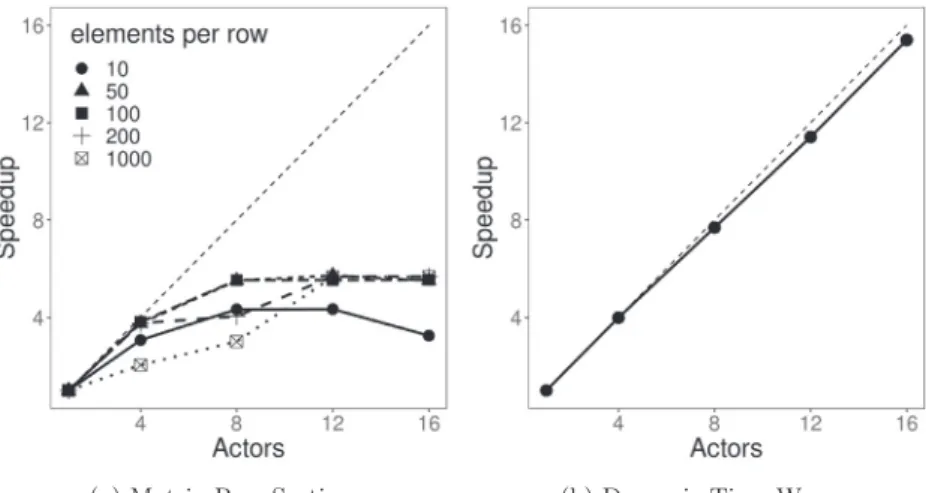
For the two benchmarks, the Orcc compiler generates an FPGA cir- cuit description using the Xronos Verilog backend ( [39]). The results in Fig.15show the parallel speedup using 4, 8, 12 and 16 actors. Speedup is T1/ Tn, where T1is the clock cycles with one actor and Tnis the cycles with n actors. The dashed line shows ideal linear speedup. The Verilog simulation testbench randomises the input values for 128 input sets for
Fig.15. SpeedupsafterParallelActorTransformation.
both benchmarks, i.e. when using 16 actors each actor processes 8 in- puts.
Fig.15a shows matrix row sorting speedups for different row lengths. The number of elements in a matrix row, and the pre-sorted arrangement of its values, determines the clock cycle latency of sorting the elements since randomly ordered inputs require repeated sorting. The sequen- tial algorithm for a row length of 1000 requires 1,546,477 clock cycles. There is a 5.6 × speedup for 12 and 16 actors when processing rows of lengths between 10 and 200. From a speedup of 4.3 with 12 actors there is a drop in performance to a 3.3 speedup with 16 actors to sort just 10 elements. At such small workloads, most of the 16 actors will not be firing and instead the data propagation latency overheads result in degraded performance.
Fig.15b shows dynamic time warping speedups for a length of 40 for sequences S and T. The sequential algorithm requires 1,332,979 clock cycles. Speedup with 16 actors is almost linear (15.4).
Speedups of 5.6 × and 15.4 × with our approach take significantly less time to achieve compared to using direct Verilog or VHDL optimisa- tions. This is because our tooling automates fork/join data management and verifies the optimisation can be safely applied with model check- ing, which if done at the Verilog/VHDL level would require extensive testbench simulation.
The CAL and Fiacre implementations, generated hardware descrip- tions and raw results are in an Open Access dataset [40].
7. Discussion
The previous section demonstrated how parallelising actors can elicit speedups. However this is not always the case, e.g.when an actor is not on the critical path of a program’s execution [41]. Worse still, rather than increasing performance it can have a countereffect of generating larger programs, which in turn can reduce achievable clock frequencies or exceed hardware resource constraints. Tooling can help direct a pro- grammer to bottlenecks, which parallelism may alleviate.
In Section7.1 we present a tool we have developed for Orcc that addresses this issue. The motivation is to present hardware costs to the user, e.g. identifying the actor with the longest datapath, which in turn affects the overall achievable clock speed for the entire dataflow graph. Then in Section7.2we quantify the CAL language features used in real world code. The use of some CAL language features potentially results in dynamic dataflow behaviours. The frequent occurrence of these lan- guage constructs in each actor justifies the need for model checking. 7.1. Hardwareprofiling
The Xronos FPGA backend for Orcc uses Xilinx’s open source Open- Forge [42]compiler to generate hardware cost reports for each actor at
Table1
Actorproperties.
Property Occurrence
Guardoninputtokenvalue 15%ofactions Guardonstorevalue 56%ofactions Sharedinputports 49%ofinputports Sharedoutputports 41%ofoutputports Actorswithastore 78%ofactors Storesmodifiedbymultipleactions 62%ofstorevariables
compile time. These are: 1) the number of BRAM blocks, and 2) the dat- apath depth for each action in an actor. The datapath depth determines the minimum latency (microseconds) between each clock cycle.
We have added to the Orcc programming environment a tool that lifts these hardware costs into the visual dataflow editor ( Fig.16), to communicate hardware bottlenecks to the user. Green actors have small datapath depths, relative to the orange critical actor(s) which have the longest datapath. BRAM counts for implementing actor internal vari- ables are also shown to the programmer.
7.2. Realworlddynamicdataflowprograms
A static analysis approach with small actors may be able to identify static, cyclostatic and dynamic actors, e.g. an actor with just one action. However scaling static analysis to identify models of computation of larger actors, e.g. multiple guarded actions and store variables updated by multiple actions, would be very challenging and the authors are not aware of a dataflow framework that can do this automatically. That is, applying static analysis on actors implemented in a dynamic dataflow language to classify their dataflow model of computation.
We assess dataflow language features used in a real world code repos- itory 2to evaluate the size of CAL actors in practise. It includes 823 ac-
tors in 555 dataflow graphs written by 23 developers, across multiple domains including cryptography, image processing and network proto- cols.
Table1shows the frequency of CAL language features in this repos- itory that can impact on the complexity of classifying an actor’s model of computation, e.g. whether it has cyclostatic or dynamic data rates. An external control signal from an input port is in a guard predicate for 15% of actions, and internal control signals in the store appear in a guard predicate for 56% of actions, i.e. whose private variable values may de- termine runtime scheduling choices. Most actors are stateful, with 78% containing at least one variable in its store. Multiple actions consume
Fig.16. VisualisingFPGAResourceCosts.
the same port for 49% of all input ports. Multiple actions write to the same port for 41% of all output ports. Multiple actions modify store variables for 62% of all store variables.
Static analysis would not be feasible at these scales of code complex- ity. Machine checked verification would be the only feasible option to overcome this, e.g. with the model checking approach that this paper presents.
Automating the verification and parallelisation approach for the full CAL language will require some additional engineering: (1) the imple- mentation of a parser for the TINA model checking output, (2) an ex- tension of the verification approach to support multiple input or output ports, and (3) a CAL language extension for explicit cyclic sequences to be expressed ( Section4.2.2). Supporting multiple actor ports (task 2) will likely be the most trivial, because there is a direct mapping from CAL ports to Fiacre ports ( Section3.3.1). Extending the syntax of CAL FSMs to support a programmer’s claim of a deterministic cyclic sequence through states (task 3), for model checking to verify, will require an ex- tension to Orcc’s frontend i.e.changes to the Xtext grammar, and adding it to Orcc IR by extending the Orcc EMF (Eclipse Modelling Framework) model. Processing the output of the TINA model checker (task 1) will a require a parser, or a machine readable output format added to TINA’s backend.
8. Conclusion
As the performance of embedded architectures increases, program sizes that they can support also grow, as does the complexity and dy- namic nature of algorithms in programs. As embedded accelerators be- come more widely adopted, the importance of effective code optimi- sations grows. Previous work ( [43]) explores the NP-hard problem of cyclic scheduling of multiple actors mapped to parallel processing archi- tectures. In contrast, this paper presents a program transformation ap- proach that parallelises a single, potentially stateful, actor into multiple actors to exploit parallel architectures. The approach separates cyclo- static from dynamic actors using LTL model checking. The verification phase takes seconds to run. Th graphical parallel refactoring tool speed- ily increases FPGA performance, e.g. a 15.4 ×speedup with 16 actors.
This paper is a step towards auto-parallelisation of dynamic dataflow programs. Verifying other parallelising transformations, e.g. task and pipelined parallelism, and verifying transformation of dynamic actors, would extend our approach. The broader aim of this work is to integrate
automated formal verification more widely into optimising compilers and parallel runtime systems for embedded systems.
DeclarationofCompetingInterest
The authors declare that they have no known competing financial interests or personal relationships that could have appeared to influence the work reported in this paper.
Acknowledgements
We acknowledge the support of the EngineeringandPhysical Re-searchCouncilgrant references EP/K009931/1(Programmable embed- ded platforms for remote and compute intensive image processing ap- plications), EP/N014758/1 (The Integration and Interaction of Multiple Mathematical Reasoning Processes) and EP/N028201/1 (Border Patrol: Improving Smart Device Security through Type-Aware Systems Design), and the Scottish Funding Council for a SICSA Postdoctoral and Early Ca- reer Researcher Exchanges grant.
References
[1]D.Bhowmik,P.Garcia,A.M.Wallace,R.Stewart,G.Michaelson,Powerefficient dataflowdesignforaheterogeneoussmartcameraarchitecture,in:2017 Confer-enceonDesignandArchitecturesforSignalandImageProcessing,DASIP2017, September27–29,2017,IEEE,Dresden,Germany,2017,pp.1–6.
[2]R.Stewart,K.Duncan,G.Michaelson,P.Garcia,D.Bhowmik,A.Wallace,RIPL:A ParallelImageprocessinglanguageforFPGAs,TRETS11(1)(2018)7:1–7:24.
[3]E.A.Lee,D.G.Messerschmitt,Staticschedulingofsynchronousdataflowprograms fordigitalsignalprocessing,IEEETrans.Comput.36(1)(1987)24–35.
[4]C.Brown,H.Loidl,K.Hammond,ParaForming:formingparallelhaskellprograms usingnovelrefactoringtechniques,in:TFP2011,May16–18,2011,RevisedSelected Papers,Springer,Madrid,Spain,2011,pp.82–97.
[5]C.Brown,M.Danelutto,K.Hammond,P.Kilpatrick,A.Elliott,Cost-Directed refac-toringforparallelerlangprograms,Int.J.ParallelProgram.42(4)(2014)564–582.
[6]C.Brown,K.Hammond,M.Danelutto,P.Kilpatrick,H.Schöner,T.Breddin, Para-phrasing:generatingparallelprogramsusingrefactoring,in:FMCO2011,October 3–5,2011,RevisedSelectedPapers,Springer,Turin,Italy,2011,pp.237–256.
[7]G.Grov,G.Michaelson,Humeboxcalculus:robustsystemdevelopmentthrough softwaretransformation,Higher-OrderSymbol.Comput.23(2)(2010)191–226.
[8]K.Hammond,G.Michaelson,ThedesignofHume:ahigh-levellanguageforthe real-timeembeddedsystemsdomain,in:InternationalSeminaronDomain-Specific ProgramGeneration,DagstuhlCastle,Germany,March23–28,2003,Springer,2003, pp.127–142.
[9]L.Lamport,Thetemporallogicofactions,ACMTrans.Programm.Lang.Syst.16(3) (1994)872–923.
[10]G.Grov,ReasoningAboutCorrectnessPropertiesofaCoordinationProgramming Language,Heriot-WattUniversity,Edinburgh,UK,2009Ph.D.thesis.

![Fig. 9. Orcc IR for Dataflow Transformation (from [38] with permission).](https://thumb-us.123doks.com/thumbv2/123dok_us/10116551.2912207/9.892.466.835.94.439/fig-orcc-ir-dataflow-transformation-permission.webp)