Reaseheath visit to Xinjiang Agricultural Vocational College on 29 June 2014
BackgroundThis document reports the findings of a preliminary visit conducted by a Head of Department from Reaseheath College who visited Xinjiang Agricultural Vocational College on 29 June 2014 as part of an International Skills Partnership project part funded by the British Council.
Xinjiang Region
The college is located in the Xinjiang Uygur Autonomous Region that is in the North-West of China. It is the largest Chinese administrative division and covers an area of over 1.6 million km2 of land.
Xinjiang borders Russia, Mongolia, Kazakhstan, Kyrgyzstan, Tajikistan, Afghanistan, Pakistan and India.
Xinjiang Agricultural Vocational College
Xinjiang Agricultural Vocational Technical College, founded in 1959, is a full-time ordinary advanced college, which delivers higher vocational education. In 2005, the college was authorised by the government to collaborate with foreign colleges. In 2006 it was identified as a ‘National Demonstration Higher Vocational College’ one of 23 colleges in China. More recently was awarded “National Advanced College for Vocational Education”, “One of the top 100 Colleges for Moral Education Research”.
The main college complex covers a total area of 406 hectares, which includes 230,000 m2 of
buildings, occupied by 13 faculties. It provides residential accommodation for over 10,000 students and staff. Academic facilities include a range of classrooms, laboratories, practical facilities and a library with over 900,000 volumes. It also has on site a Sino-Israel Demonstration Centre for Agriculture in Arid Zones and a veterinary hospital. The college has three satellite teaching Centres and access two other facilities that include seed and feed companies, animal breeding farms and dairy processing plants.
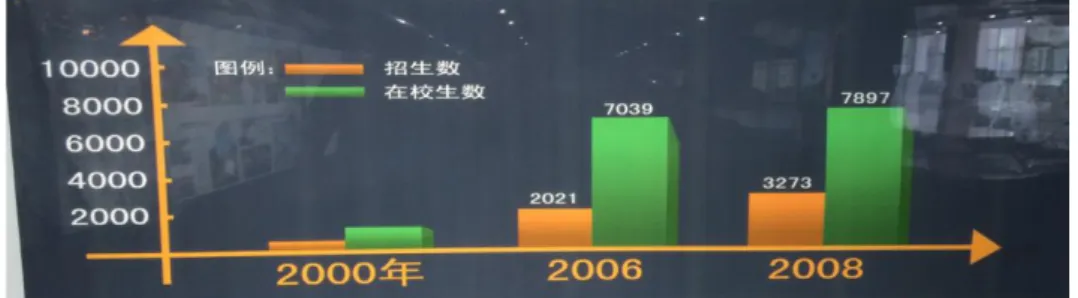
Fig 1: Chart showing rapid growth of student numbers since 2000 (orange indicates 1st year intake)
The college has worked with a number of international colleges and universities from the following countries: Malaysia, Australia, United States, South Korea, Japan, Kyrgyzstan, Kazakhstan, and Russia. Arrangements with a number of these have enabled over 200 international students to study at the college and a similar number of Chinese students to study or practice in these countries. The college is keen to establish a similar arrangement with Reaseheath.
Action 1: Reaseheath to consider a similar exchange arrangement with Xinjiang College.
Faculty and Subject Areas
The following list summarises the main specialist departments and subject areas at Xinjiang College.
Horticultural Technology: to include vegetable production technology, floral decoration and flower production technology skills.
Animal Husbandry and Veterinary: to include livestock artificial insemination, food technology, and practical breeding livestock.
Biological and Technological Sciences: to include, quality inspection of products, biological technology and application, production and management, facility farming, inspection biological medicine, environmental engineering, city inspection and engineering technology, air pollution management.
Accounting: to include basic accounting, financial accounting, economic law, tax law and international accounting practice.
Business Management (central Asian trade): to include international business management, international trade practice and practice of foreign trade documents.
Construction Engineering Technology: construction engineering surveying, construction technology and organisation and construction project budgeting.
Visit Overview
The itinerary included a number of meetings arranged with faculty managers at Xinjiang College, and visits to East Campus, three factories and one horticultural demonstration unit. The overall re-scheduling of the visit resulted in no teaching being observed because the summer break had commenced.
The college delivers advanced vocational training to students that achieve a high school certificate with HSK (Hanyu Shuiping Kaoshi) of more than level four. (A description of level 4 is ”learners who can discuss a relatively wide range of topics in Chinese and are capable of communicating with Chinese speakers at a high standard”).
Education at the satellite centres tends to focus on land-based training for learners with lower graduation scores.
Programmes
There are three modes of full time attendance. In most cases courses are of a three-year duration divided into six semesters. An example of this includes 1st and 2nd semesters on campus, 3rd, 4th and 5th on placement and the 6th semester back on campus.
Fig 2: Six semesters delivered over three years
The second variation includes three semesters on campus and three semesters on placement. The third model is four semesters on campus and two semesters on placement. The second and third options are preferred by students. Students on these placements often get the tuition fees, accommodation and a small salary paid during the final year by the employer.
Curriculum Design
The syllabus is written by each faculty within the college and its content is influenced by the requirements of industry. For example, twice a year the college would invite employers to a dairy husbandry review meeting where they discuss work placements and course content. A series of sub-committees would replicate this for swine, poultry, sheep and food.
The facilities on site include laboratories, classrooms and demonstration areas. In most cases this appears to satisfy the science and research based courses but the lack of livestock on site limits the skills development whilst on campus. Currently the practical skills development of the individual is heavily reliant on the work placement.
Actions: Request translation of the following documents:
2. Unit of study (unit from within a syllabus)
3. An example of a weekly timetable for a student
4. Sample minutes of one of their stakeholder meetings.
Update: Still awaiting documents.
Teaching and Assessment
No teaching was observed during the visit week and therefore only discussion into teaching methods was explored. Many aspects of their delivery style and method appeared to mirror the British approach. Conventional lesson planning sheets are used and many aspects of the criteria used to grade lessons in the UK was acknowledged and recognised. The tutor also explained examples of how they would use student centered activities, for example small groups would research a topic and present their findings back to their peers.
Assessment methods were briefly explored and the following example explains how an equine feeding unit would be formally assessed. Four component parts make up the assessment for this unit and include classroom activity 20%, homework 20%, skills 30%, and final exam 30%.
Action 5: Observe both practical and theory lessons on the next visit to see exactly what happens. Update: Lessons observed during December 2014 visit.
Action 6: Explore the content of the ‘skills’ assessment and establish how the college assesses the practical placement.
Quality Assurance
This section of the report chose to sample aspects of quality that directly affected course content and the quality of the teaching and learning. The observations were purely to assess the maturity of the quality process and to see what parallels exist between the two educational establishments. Quality of Teaching and Learning
The teacher could experience up to three categories of teaching observation and feedback. During each academic year the tutor will complete two teaching observations firstly at faculty level and the second by a college-wide team. Once every five years a government body will complete a college
Colleges are graded similar to the UK OFSTED method in which four grades can be awarded: excellent, good, satisfactory and fail. The college is graded excellent which would currently reflect their recognition as a ‘national model college’. Teaching staff are required to undertake 30 days of industrial placement a year and this is a pre-requisite for an individual to achieve ‘excellent’ teacher status. All academic staff at the college were qualified and had teaching qualifications. Within certain disciplines, agriculture and food for example, a substantial element of a student’s skills development naturally occurred during their work experience period. This is delivered by the employers where, in the majority of cases, staff had no formal teacher training.
Action 7: Share Reaseheath’s lesson observation grading matrix with the reciprocal quality
department at Xinjiang College.
Action 8: Investigate the establishment of a short instructional techniques course for employers.
Student Voice
Student surveys are completed at the end of their study course. From the documentation displayed the detail of the questioning appeared to lack detail; however this would need to be checked with the appropriate department at Xinjiang. In comparison to the Reaseheath reports, referred to as "Student Perception of Course," they provide little benefit for improving quality. This may be considered as an area for development. A similar inquiry into information provided to students prior to starting their course provided limited information, advice or guidance. For example providing more course detail for each component of study would help and guide students to make a more informed choice.
Action 9: Further investigate the use of learner surveys to improve quality and the detail of
information provided to learners prior to starting courses.
Work Placement
Work experience is an integral part of the course. In a number of programmes, the work experience element is where students apply theory into practice and develop ‘hands-on’ practical skills. The college reported that 882 employers provide work experience. Some of the larger businesses would take up to 40 students per year. These larger employers include a feed company called Tycoon Group Co Ltd, Maiquer a dairy and bread manufacturer and Xiyuchun Dairy Industry Co Ltd.
A further example of business engagement was the development of a business partnership on the East Campus, approximately one hours’ drive from the main college. The college had established a joint venture to manufacture confectionery products for the holiday festival seasons; these
students. During peak manufacturing periods, students were paid a small salary to meet demand. The college invested 10M Yuan and this was part matched by 7M Yuan from the commercial business.
It was stated that on a number of placements the businesses would provide accommodation and a small salary; this would increase towards the end of the three-year course to approximately one third of a full-time wage. Average full time wages are approximately 4,000 Yuan CNY a month (10 CNY to £1).
The Student Experience
The work experience can be viewed as a significant part of the students’ skills development and to provide a consistent quality experience for all students is a challenge. The college has limited agricultural practical teaching facilities and therefore is heavily reliant on the experience gained from the work placements. Where students complete work experience on a larger establishment they are likely to receive a week long induction period. Communication between the employer’s HR department and the college teaching team are more formalised. For smaller establishments this could be more of a problem due to their size, infrastructure and accessibility to appropriately trained employees able to teach a range of practical skills effectively.
The programme of study normally requires the student to complete a work experience placement with a single employer. Therefore, the experience and knowledge would be limited to the methodologies of that employer and this could stifle creativity for future employment. It was suggested that a high percentage of students following graduation would normally return to be employed on their original placement. However, it may be viewed that a broader work experience offer would ultimately benefit both the industry and the individual.
Action 10: Investigate establishment of an instructional techniques short course for employers.
Business Development
Currently in Xinjiang Province, there is significant expansion of the land-based agri-food sector and supporting ancillary industries. This very fact requires the acquisition of new knowledge and skills for existing and future employees. Currently students may experience and develop very different practices and capabilities based on the technology involved. For example, a feed manufacturer, Tycoon Group Co Ltd, was due to move to new premises with a significant investment in automated technology. The difference between the two facilities in terms of technology would be monumental and would require highly specialised training for all staff.
A further observation made of the existing factory was the attention paid to health and safety management. There were a number of signs displayed around the factory warning employees of potential hazards. In a number of these cases, the hazards could have been either removed or corrected. For example, a sign showing slips and trips near to a staircase, which had crumbling edges and missing rails, etc. Compared to the UK Health & Safety standards it fell significantly short. To a large extent, this is likely to be improved with the new facilities. Equally, there will be a training element required and again this would be something to consider within the curriculum design.
Action 11: Investigate to what extent new and emerging technical skills are being introduced into curriculum content.
Action 12: Investigate whether health & safety is included within curriculum design.
International Department
During the visit Reaseheath staff have worked closely with the International Department. Through discussions it was recognised that there is an opportunity for this department to link with the English Department at Reaseheath to share resources for the English language curriculum delivered at Xinjiang College.
Action 13: Establish a link between these two departments
East Campus Visit
(Approximately one hour’s drive from the main college)
East Campus is one of three satellite sites to the main college. This campus currently provides training on ‘lower vocational’ short courses for 2,000 students age 16–18 years old. Facilities included a special organic research site, small vineyard, horticulture, amenity, poultry, engineering facility and bakery. They grow 27 varieties of vegetables and are currently conducting trial work into a new chilli plant variety in partnership with a commercial company. A large area of the farm is planted with tomatoes, which are harvested by machine. Working with a local company this produce is processed into tomato sauce. The estate has nine water bore holes for the irrigation of the farm.
The campus requires significant investment and is currently in the early stages of a 15 year development plan. They have recently established a bakery factory and have advanced plans to establish a research facility to be called the ‘Demonstration Park of High Technology, Agriculture, Ecology and Research Centre’. During the next 12 months, they are due to complete the construction of a number of demonstration centres for dairy production, poultry, sheep, equine and
The new facility will provide significant benefits for both the college and the students. Currently the college has a limited commercial and research facility. This will enable the staff and students to get more involved with new and emerging technologies. This will influence curriculum design and ultimately benefit the learners to become an important facility for the future of the main college. Funding for this will come from Xinjiang Province and the World Bank.
Industry Visits Overview
Tycoon Group Co Ltd.Feed manufacturer producing 360,000 tonnes per year and also chicken meat production supplying companies such as KFC and Decoshi. Currently employing 22 staff, which will increase when their new factory opens in September. The main product lines include feed products for cattle, sheep, pigs and poultry. They also produce a range of oil products manufactured from cottonseed and sunflower. Approximately 40 students a year complete work experience at this plant.
Maiquer
Maiquer is a dairy processing and bread manufacturing business. The factory is a modern facility with a large proportion of Tetrapak technology that processes UHT milk and yoghurt products. They also produce a small range of confectionery products for the festive season markets. The factory has its own training department and provides work experience for up to 40 students a year. Xinjiang staff were unable to confirm how many students were undertaking food technology at the college and whether all students irrespective of placement would receive the same opportunity and experience as those at Maiquer. This dairy appeared to be at the top of its game. Furthermore, those students studying other food subjects would benefit from this insight and level of technology and would develop a more rounded food technologist. A question to investigate is whether staff from Maiquer are involved in the delivery of teaching at the college.
Xiyuchun Dairy Industry Co Ltd.
The Technical Manager for this establishment explained the structure of the business. It comprised of a supply chain, which included 20,000 cattle of which 2,000 are Simmental, 1,000 Angus and the remainder are Holstein. The business farms 20,000 Ha and produces over 200 tons of fresh milk and yoghurt produce per day through its ultra-modern dairy processing factory. The business could supply 50% of the local demand for fresh produce. It was also developing a dry powder plant
but were experiencing technical problems establishing a consistent product. On face value a very impressive setup.
The company had recently imported semen from the West (Worldwide Sires) and average price paid 40 CNY and 150 CNY for sexed semen. Generally, bull selection is based on production traits and little attention is considered for animal conformation or longevity. The production of fresh milk had a shelf life of only two days and this would fall significantly below EU current standards. We discussed the link to primary production and the importance of controlling clinical and sub-clinical mastitis but this did not appear to be an important strategy. The original itinerary for Xiyuchun Dairy was to visit the farm and see the primary aspects of production but unfortunately, at short notice, we could only visit the main offices and the dairy plant. This was unfortunate for the objectives and purpose of the visit.
Education link at Xiyuchun
The business received both undergraduates from the local university and up to 30 students from Xinjiang College each year. Some of these students would return to the farm following graduation. We discussed the skills requirements of these students and they identified the main aspects to include veterinary skills, artificial insemination and nutrition. We discussed the importance of developing supervisory and management skills of students but their approach was to identify individuals that demonstrated those skills and develop those within the workplace. The business did get involved in the stakeholder meetings held by the college each year.
Action 14: Investigate the need to improve the hygiene standards of primary milk production to improve keeping quality (industry need)
Action 15: Investigate whether animal health curriculum content includes aspects of udder health and clean milk supply
Action 16: Investigate whether animal breeding curriculum discusses the link between conformation, longevity and health of the animal
Action 17: Obtain a copy of the minutes taken from a typical stakeholder employer review meeting. (example meeting which influences curriculum design).
Embryo Transfer Unit
This business was established in 1958 for bovine and sheep production systems. It employs five doctorates and nine engineers. They produce 8,000 grade ‘A’ embryo a year with a success rate of 65% for grade ‘A’ implants. They supply approximately 50% of the Chinese market and suggested the genetic average yields would produce 9,500 litres for Holstein and 7,200 litres for the Simmental breeds.
Overriding Comment – Translation
The author has made every effort to confirm the accuracy of the information in this report. However the potential for inaccuracies due to technical misinterpretation and cultural misunderstanding are inevitable. Mindful of these facts the author would recommend that any important points highlighted in this report should be confirmed on the next visit before any actions are agreed.
Actions Recommended
All actions stated are potential suggestions for further lines of enquiry and to suggest a starting point for discussion for the Reaseheath team to consider.